

1. Define the unused megawatt
Curtailment is renewable energy that could have been produced but is deliberately not injected into the system. It differs from resource shortfall, equipment failure and planned maintenance. The project must be available, the resource must exist and an instruction or system condition must prevent delivery.
The unused megawatt therefore requires a counterfactual: output but for the curtailment. That counterfactual determines compensation, operating performance and debt service. A contract that does not define it creates a recurring valuation and payment dispute.
2. State the procurement decision
The procurer must decide how much curtailment risk the public system should absorb and how much the private project should price. Full protection can reduce financing cost but weaken incentives to select unconstrained locations. Full generator risk can increase tariffs, reduce leverage and deter investment where the grid remains under public control.
The decision should follow system planning, connection evidence, dispatch rules, storage availability and the party able to manage each cause. It should be visible before bids so that tariffs remain comparable.
3. Separate physical and contractual curtailment
Physical curtailment is an operating event. Contractual curtailment is the legal classification that follows. The PPA may treat an instruction as deemed energy, permitted curtailment, force majeure, purchaser default or an uncompensated system event.
Classification affects revenue, relief, liquidated damages, termination and insurance. Dispatch logs alone cannot answer the financing question. The event must be mapped through the PPA, connection agreement, grid code and direct agreement.
4. Distinguish six causes
Technical curtailment manages congestion, voltage, frequency, stability or equipment limits. Economic curtailment reflects market price or merit order. Emergency curtailment protects people and system integrity. Purchaser-directed curtailment follows an offtaker instruction. Transmission curtailment results from network unavailability. Project-caused curtailment follows plant non-compliance or failure.
Each cause has a different controllable party and evidence trail. Broad drafting that combines them under one label transfers risk without pricing clarity.
5. Map cause, control and evidence
The first underwriting task is a cause-and-control map. It should identify the event, instruction authority, responsible asset, notice record, measurement source and contractual consequence. Grid and market events require system data; project events require plant telemetry and compliance evidence.
The map should also identify overlapping causes. A plant may be partly unavailable when a grid instruction arrives. Compensation should cover only the output the compliant plant could otherwise have delivered.
Table 1. Curtailment classification, evidence and debt consequence
| Curtailment category | Typical cause | Principal evidence | Illustrative allocation | Debt-service effect |
|---|---|---|---|---|
| Technical system | Congestion, voltage, stability or balancing constraint | Dispatch instruction, SCADA data, network status and system logs | Procurer or system side when outside project control | Deemed-energy receivable or liquidity delay |
| Economic | Oversupply, price signal or merit-order dispatch | Market price, dispatch stack, demand and bid data | Contract-specific; generator may accept a defined band | Lower merchant revenue or compensated deemed output |
| Emergency | System security, restoration or safety event | Emergency declaration, incident log and duration | Temporary relief; compensation depends on drafting | Short interruption or reserve use |
| Purchaser-directed | Commercial or portfolio instruction | Authenticated instruction and reason code | Purchaser, subject to exclusions and caps | Deemed energy and counterparty exposure |
| Transmission outage | Line, substation or interconnection unavailable | Outage record, maintenance plan and connection tests | Network or procurer side if project compliant | Revenue interruption and potential termination clock |
| Project-caused | Plant fault, code breach or unavailable equipment | Availability, alarms, tests and compliance record | Project company | No deemed energy; possible performance deduction |
Allocation is illustrative and requires review of the executed project documents and applicable grid code.
6. Identify the contractual perimeter
The financed perimeter usually ends at the delivery point. Assets beyond that point may include the substation, transmission line and control centre. The contract should define which interface must be complete for commercial operation and which party bears later outage risk.
An unclear perimeter permits the grid owner to classify its own constraint as a project delivery failure. Lenders require interface drawings, ownership schedules, completion tests and operating responsibility.
7. Preserve system-operator authority
The system operator must retain authority to protect security and reliability. Bankability does not require the plant to run during unsafe conditions. It requires predictable financial treatment when a compliant plant follows a valid instruction.
The PPA should therefore separate the right to curtail from the obligation to compensate. Emergency action can be immediate, while evidence, classification and settlement follow a controlled process.
8. Define dispatch priority
Dispatch priority determines whether renewable output is must-take, priority-dispatched, economically dispatched or subject to a defined curtailment hierarchy. The term should align with the grid code and system-operating rules.
Priority should not be promised where the operator lacks the physical capability to honour it. The contract can instead define transparent order, pro-rata sharing, caps and deemed-energy treatment.
9. Establish the resource baseline
Deemed energy depends on the renewable resource during the event. Solar projects use irradiance measurements, temperature and equipment status. Wind projects use wind speed, direction, turbine availability and power curves.
Instruments need redundancy, calibration and data retention. The contract should identify fallback sources when project measurements fail or are disputed, including nearby stations, satellite data or agreed reference sets.
10. Establish plant availability
Resource alone does not prove output. The model must remove unavailable inverters, modules, turbines, transformers and auxiliaries. It should reflect clipping, temperature, wake, degradation and electrical losses under agreed rules.
Availability telemetry should be time-synchronised with the curtailment interval. Maintenance scheduled during a curtailment should not automatically create deemed output unless the contract expressly permits it.
11. Calculate counterfactual generation
Counterfactual output can be calculated from a validated power model, recent unaffected performance or a contractual curve. The method should be tested before operation and recalibrated under controlled rules.
The formula needs interval granularity, input hierarchy, loss treatment and quality thresholds. Manual judgement should be limited and documented. The model should prevent payment above the plant's available capacity.
12. Define deemed energy
Deemed energy is the quantity treated as delivered for payment when qualifying curtailment prevents actual delivery. World Bank PPA guidance describes the approach for non-dispatchable generation and links it to measured renewable resource and plant capability [1][2].
The definition should state qualifying events, exclusions, calculation and settlement. It should avoid equating every lost megawatt-hour with compensable deemed generation.
13. Deduct avoided costs
Curtailment can reduce variable operating cost, degradation or imbalance exposure. Compensation should normally deduct costs genuinely avoided because output was not produced. For solar and wind, avoided cost may be modest but is not always zero.
The schedule should define eligible deductions. It should not permit broad discretionary offsets that make the revenue protection uncertain or duplicate deductions embedded in the tariff.
14. Treat certificates and attributes
Renewable certificates, carbon attributes and environmental claims may depend on actual generation. Deemed energy may earn contractual revenue without creating a transferable certificate under the applicable scheme.
The PPA should identify ownership, replacement obligation and compensation for lost attributes. The financial model should not assume certificate revenue unless the rule permits it.
15. Set a curtailment band
A deductible band can allocate ordinary system-balancing risk to the generator while protecting against structural constraint. The band can be expressed as hours, energy or a percentage of potential output.
The level should follow system studies rather than convention. A high band can materially impair debt service; a zero band can transfer every balancing cost to the purchaser.
16. Define annual caps
Compensation caps can limit purchaser exposure while preserving a minimum revenue floor. Caps should be modelled with probability, seasonality and correlation to resource. A cap that is likely to bind should be treated as generator risk.
The contract should state whether unused protection carries forward, whether caps apply by event or year, and how prolonged constraint affects termination rights.
17. Align term and debt tenor
Curtailment protection should cover the debt-repayment period or support a demonstrably resilient merchant tail. Protection that expires before debt maturity creates a refinancing and cash-flow cliff.
The lender case should match the legal term precisely. Optional extensions, purchaser discretion and change-in-law exposure should not be treated as committed revenue.
18. Define permitted curtailment
Permitted curtailment usually includes project non-compliance, unsafe operation, agreed maintenance, grid-code breach and limited emergencies. It may be uncompensated because the project caused or accepted the event.
The definition needs objective boundaries. A general right to curtail for system reasons without payment can absorb risks that the project cannot assess or control.
19. Define compensated curtailment
Compensated curtailment can include purchaser instruction, transmission unavailability or system constraint when the project is ready. Payment can follow deemed energy, capacity availability or a hybrid formula.
Notice, evidence and invoice timing should align with monthly settlement. Long dispute periods convert protected revenue into working-capital risk.
20. Build the contract map
Curtailment rights sit across the PPA, grid connection agreement, dispatch protocol, land and access arrangements, EPC contract, O&M agreement, financing documents and direct agreement. The same event must produce consistent consequences.
The map should show instruction, data, cash, relief and dispute routes. Contradictory definitions should be resolved before financial close.
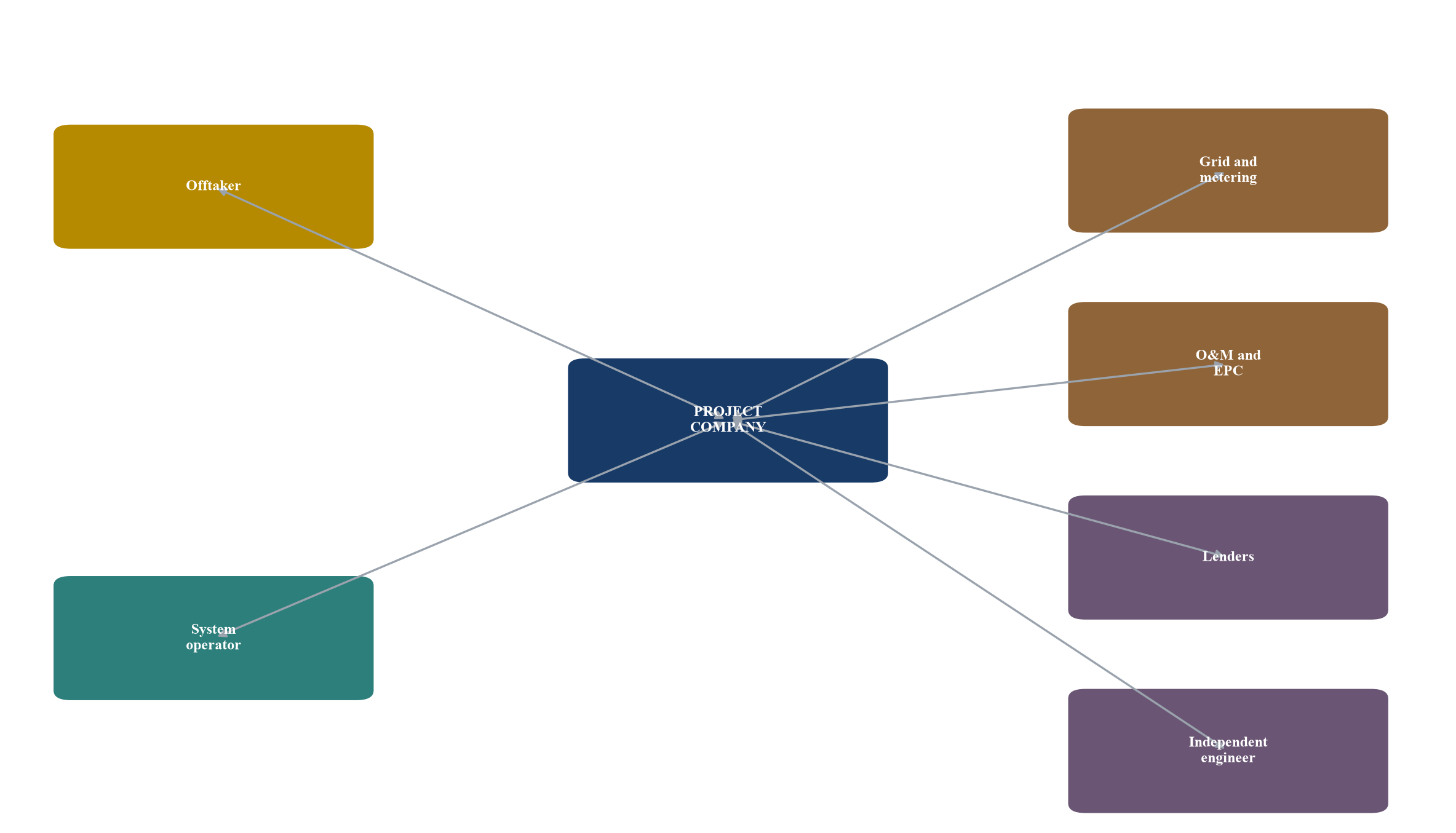
The diagram is a generic transaction framework; project-specific rights require document review.
21. Align the PPA and grid code
The PPA can allocate cash but cannot override lawful system operation. Its definitions should incorporate the applicable grid code without importing unlimited future discretion. Change mechanisms should address later code amendments.
Where the code permits uncompensated instructions, the bid documents should state the exposure. Lenders will assess whether contractual support fills the gap.
22. Align the connection agreement
The connection agreement defines capacity, voltage, metering, outages, maintenance and interface responsibility. Its relief should match the PPA's deemed-energy regime.
If the grid company receives relief while the offtaker remains liable, the purchaser may seek recovery. If both are relieved, the project carries transmission risk. The allocation should be deliberate.
23. Align EPC completion tests
The EPC contractor should demonstrate output, controls, reactive power, ramping, communications and grid-code compliance. Completion tests must allow the project to prove availability when the system cannot accept full export.
Alternative testing, simulation or deemed completion may be needed. Otherwise grid delay can trap the project between unavailable acceptance capacity and expiring EPC security.
24. Align O&M incentives
The operator should maximise availability, forecast accurately, maintain sensors and follow dispatch instructions. Fees and bonuses should use the same definitions as the PPA.
The operator should not receive full availability credit for equipment that could not have generated. It should receive relief for valid external curtailment when readiness is evidenced.
25. Define instruction authority
Only authorised parties and channels should create a contractual curtailment. The protocol should address automated signals, control-centre instructions, emergencies, confirmation and cybersecurity.
Every instruction needs a timestamp, reason code, requested level and release time. Informal calls and retrospective classifications create settlement disputes.
26. Build a reason-code taxonomy
Reason codes should distinguish congestion, balancing, frequency response, maintenance, emergency, market dispatch, grid fault, project fault and test instruction. The taxonomy should be consistent across operator logs and invoices.
Codes enable trend analysis and responsibility allocation. A generic code such as system condition is insufficient for financing and grid planning.
27. Measure partial curtailment
Curtailment can reduce output rather than stop it. The model should calculate the difference between counterfactual capability and instructed export in each interval.
Partial events require careful treatment of inverter loading, wake effects, auxiliary consumption and ramping. The plant should not be paid twice for energy actually delivered.
28. Measure ramping losses
An instruction can cause energy loss during ramp-down and recovery. The contract should state whether these intervals form part of deemed energy and how normal ramp capability is treated.
Excessive recovery time attributable to the project should be excluded. Dispatch data and plant controls should permit separation.
29. Allocate forecast error
Renewable forecasts support system scheduling. Material project forecast error can cause balancing actions and should remain a project responsibility within agreed tolerance.
System-wide forecast error or unexpected demand change may remain with the operator. The PPA should avoid using forecast error as a broad route to deny unrelated curtailment compensation.
30. Build the risk-allocation matrix
The matrix should connect cause, control, evidence, revenue, relief, reserve use and termination. It becomes a single reference across commercial, technical and financing workstreams.
Every row needs a named contract clause and model input. Unmapped risk should be escalated before bid approval or credit committee.
Table 2. Illustrative curtailment risk-allocation matrix
| Risk | Project company | Offtaker or system | Shared mechanism |
|---|---|---|---|
| Plant unavailability | No deemed energy; cure and performance deductions | Confirm evidence and avoid duplicate penalties | Independent testing and dispute process |
| Grid congestion | Maintain readiness and comply with instruction | Deemed energy above agreed band | Interval data, cap and grid-investment review |
| Emergency action | Follow immediate instruction | Document event and restore dispatch promptly | Limited relief and post-event audit |
| Economic dispatch | Accept agreed exposure | Pay if outside defined economic-curtailment regime | Price trigger, annual band and transparent data |
| Meter or sensor failure | Maintain project instruments | Provide system and fallback data | Agreed hierarchy and independent calculation |
| Prolonged constraint | Preserve plant and mitigate | Cure network or compensate | Long-stop, termination and refinancing consultation |
The matrix is a negotiation tool, not a substitute for legal review.
31. Model gross potential output
The lender model should begin with resource and a validated production model. It should calculate gross potential output before outage, loss and curtailment adjustments.
P50 and downside cases should use internally consistent resource, degradation and availability assumptions. The contract formula may differ from the engineering forecast and must be modelled separately.
32. Model actual delivered output
Actual output follows potential generation less technical losses, plant outage and curtailment. Revenue then separates metered sales from deemed-energy payments.
This bridge makes double counting visible. It also shows whether the project depends on compensation rather than physical delivery.
33. Model the compensation waterfall
The waterfall begins with counterfactual generation, removes project unavailability, applies the curtailment band, deducts avoided cost, applies caps and multiplies eligible energy by the contractual tariff.
Payment timing, tax and indexation then determine cash receipt. Each step should trace to contract language and monthly evidence.
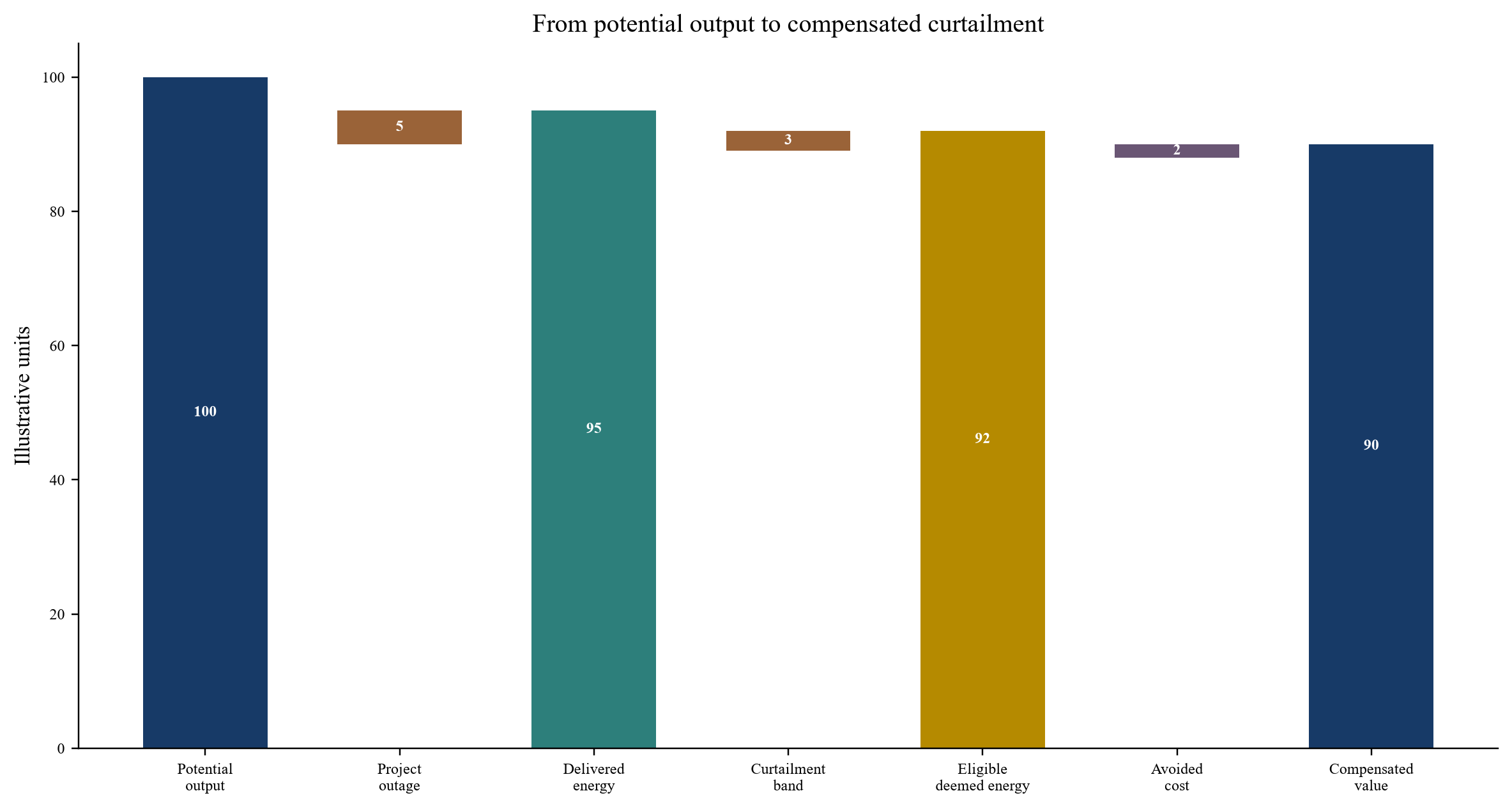
Values are hypothetical management assumptions and do not describe a market project.
34. Model debt-service coverage
Debt-service coverage should be calculated separately for delivered-energy revenue and deemed-energy revenue. The split shows reliance on public payment during constrained periods.
Base and downside cases should test lower resource, higher curtailment, delayed deemed payment, cap exhaustion and project outage. Correlated events matter because grid stress may coincide with high renewable output.
35. Model receivable delay
Compensation can be contractually owed yet paid after verification or dispute. The model should include settlement lag, working capital and reserve access.
Lenders may require a deemed-energy receivable reserve, stronger payment security or direct access to data. A revenue right without liquidity can still cause payment default.
36. Set reserve accounts
Standard debt-service and maintenance reserves may not cover prolonged curtailment receivables. A tailored liquidity reserve can bridge the verification cycle.
Sizing should reflect exposure, payment history, security package and cap structure. Excessive reserves can weaken equity returns and should not replace sound allocation.
37. Model tariff interaction
Energy tariffs can be fixed, indexed or split into capacity and output components. Deemed energy should use the applicable contractual price and avoid duplicating availability revenue.
If tariff escalation depends on actual delivery, the contract should state how deemed output affects the index or threshold. The model should follow that rule.
38. Model curtailment sensitivities
Sensitivities should vary annual curtailment, compensated share, payment delay and cap exhaustion. Results should show debt-service coverage, reserve use and equity distributions.
The purpose is to identify structural thresholds, not to create false precision. Assumptions should be labelled and reconciled to system studies.
Table 3. Illustrative curtailment debt-service sensitivities
| Scenario | Gross curtailment | Compensated share | Payment delay | Minimum DSCR | Illustrative consequence |
|---|---|---|---|---|---|
| Base case | 2% | 100% above deductible | 30 days | 1.35x | Scheduled distributions continue |
| Higher balancing | 6% | 80% | 60 days | 1.20x | Distribution lock-up approaches |
| Grid constraint | 12% | 70% | 90 days | 1.08x | Liquidity reserve is drawn |
| Cap exhausted | 15% | 40% | 120 days | 0.94x | Debt cure or restructuring required |
| Combined stress | 15% plus lower resource | 40% | 180 days | 0.86x | Default risk and long-stop review |
All values are hypothetical management assumptions used to demonstrate the framework.
39. Price curtailment in the bid
Bidders price expected uncompensated curtailment through tariff, leverage, reserves and equity return. The procurer should compare bids on an effective system-cost basis rather than headline tariff alone.
A low tariff paired with broad deemed-energy protection can cost more than a higher tariff with a balanced band. Bid evaluation should model both.
40. Compare allocation alternatives
Alternative structures include full deemed energy, a deductible band, annual caps, capacity payment, take-or-pay quantity and merchant exposure. Each produces different incentives and financing cost.
The selected structure should reflect grid maturity, data quality, competition and public credit. There is no universal allocation.
41. Allocate economic curtailment
Economic curtailment can be efficient when the system has surplus low-cost generation. IRENA notes that moderate curtailment can be rational where avoiding it would require disproportionate infrastructure [3].
The contract should define price triggers, negative-price treatment and dispatch priority. Economic action should not be misclassified as technical constraint merely to change payment.
42. Allocate technical curtailment
Technical curtailment follows physical operating limits. If the grid is publicly planned and controlled, the project cannot usually mitigate structural congestion after location approval.
Compensation can preserve investment while retaining incentives through bands, caps and network milestones. Persistent constraint should trigger a system remedy, not indefinite payment alone.
43. Address storage
Battery storage can absorb curtailed energy, provide reserves and shift delivery. Its value depends on capacity, duration, efficiency, degradation, dispatch rights and tariff.
The PPA should state whether the project must charge before claiming deemed energy and who pays for storage losses. Mandatory mitigation should remain technically and economically bounded.
44. Address hybrid plants
Solar, wind and storage behind one connection can reduce variability and share network capacity. They also complicate counterfactual output and priority between assets.
The contract should define plant-level and portfolio-level caps, metering and dispatch. Deemed energy should not exceed the connection capacity or ignore storage state.
45. Address flexible demand
Desalination, cooling, hydrogen, charging and industrial loads can consume surplus renewable output. Flexible demand may reduce curtailment while creating new credit and interface risks.
The project should receive value only where the service is contracted. Anticipated future demand should not substitute for enforceable offtake in the lender case.
46. Address regional interconnection
Cross-border trading can widen the balancing area and reduce curtailment. It depends on transfer capacity, market rules, scheduling and political coordination.
The PPA should treat exports as an option unless rights are committed. Regional opportunity should not erase local grid risk from the base case.
47. Protect payment security
Deemed-energy exposure can rise when system constraints persist. Payment security should cover both delivered and qualifying deemed revenue.
Support can include letters of credit, escrow, guarantees, budget undertakings or termination compensation. The instrument's amount, tenor and replenishment must match exposure.
48. Define termination thresholds
Prolonged curtailment can make the asset uneconomic even when monthly compensation exists, particularly if caps bind or payment is delayed. The PPA should include cure periods and long-stop rights.
Termination compensation should allocate debt, break costs and equity consistently with cause. Voluntary project exit should not receive the same protection as purchaser default.
49. Define lender step-in
Lenders need notice and cure rights before termination for project default. Curtailment data and invoices should remain accessible during enforcement.
Step-in cannot cure a public grid constraint, so direct agreements should preserve compensation and consultation. Security over receivables should include deemed-energy claims.
50. Govern disputes
Disputes often concern resource data, availability, reason codes and formula inputs. The process should separate technical determination from broader arbitration.
Undisputed amounts should be paid on time. Independent experts need access to raw data, models, calibration and operating records.
51. Use independent verification
An independent engineer can validate the baseline model, instruments, availability rules and monthly calculations. Independence and scope should be agreed before operation.
Verification should focus on material judgement, not recreate every interval. Automated checks can identify anomalies for review.
52. Build the data architecture
The project needs synchronised SCADA, revenue meter, weather station, dispatch and network data. Time standards, retention, cybersecurity and access rights should be documented.
Raw data should remain immutable, with calculations version-controlled. Both sides should be able to reproduce an invoice from the same evidence.
53. Report operational evidence
Monthly reports should disclose potential output, actual output, project outage, curtailed energy by reason code, deemed energy claimed, amounts paid and disputes.
Annual reporting should show concentration, cap usage, sensor quality and mitigation. The record informs refinancing and system investment.
54. Link curtailment to grid planning
High curtailment can signal inadequate transmission, inflexible generation or weak demand response. IRENA links excessive curtailment to system-flexibility limits and identifies storage, demand flexibility and grid expansion as responses [3][4].
Contract reporting should feed planning. Compensation without diagnosis can perpetuate inefficient constraints.
55. Refinance after operating evidence
Operating history can replace assumptions with observed curtailment frequency, reason, duration and payment performance. Stable evidence may support lower reserves or improved pricing.
Refinancing should preserve purchaser protections and comply with consent. Upside allocation should follow the financing documents.
56. Stress climate and temperature effects
Extreme heat, dust, storms and changing demand can affect output and grid operation. The resource model, equipment rating and system study should reflect local conditions.
Climate scenarios should avoid double counting with ordinary variability. Adaptation measures need owners, budgets and tests.
57. Apply five bankability gates
The first gate confirms a complete perimeter and grid connection. The second confirms objective classification and data. The third confirms the compensation formula and payment security. The fourth confirms debt-service resilience. The fifth confirms governance, long-stop rights and a system remedy.
Failure at any gate should produce redesign, repricing or rejection. A low headline tariff does not cure unbounded curtailment risk.
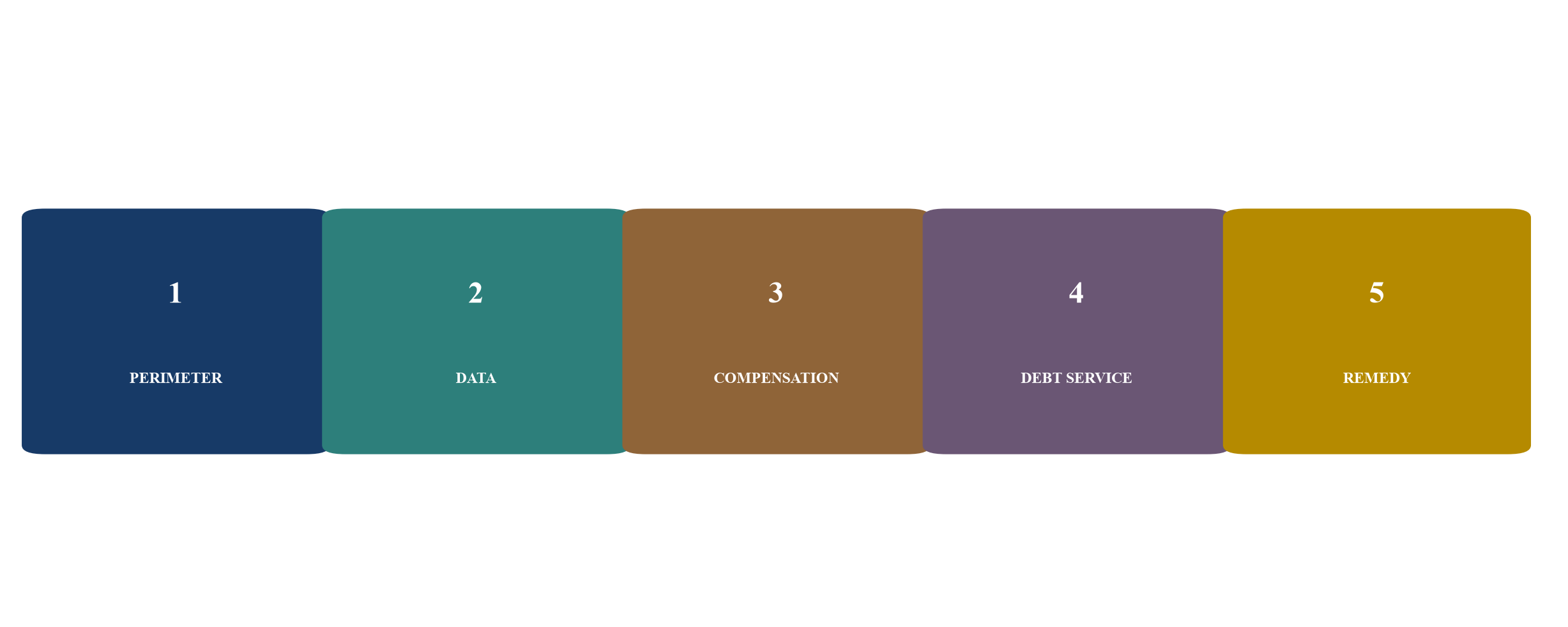
Each gate requires project-specific evidence and an accountable decision.
58. Build the decision record
The record should preserve system studies, connection assumptions, bid clarifications, risk allocation, formulas, model cases, approvals and deviations. It should distinguish observed data from management assumptions.
The record supports credit approval, public accountability and later dispute resolution. Protected commercial information can remain controlled while the decision logic stays traceable.
59. Use a ninety-day transaction plan
The first month should map the grid, dispatch and data architecture. The second should align contracts, model compensation and test financing. The third should resolve exceptions, secure approvals and prepare closing conditions.
Complex system studies may take longer. The plan should expose decisive gaps early rather than compress essential diligence.
Table 4. Ninety-day curtailment bankability plan
| Period | Core work | Decision output | Principal control |
|---|---|---|---|
| Days 1-30 | Grid, connection, dispatch, resource and telemetry diligence | Agreed perimeter and curtailment taxonomy | System study, interface register and data map |
| Days 31-60 | PPA, grid-code, deemed-energy, cap and payment-security design | Bankable allocation and financial model | Clause-to-model reconciliation and sensitivities |
| Days 61-75 | EPC, O&M, lender, reserve and termination alignment | Approved finance structure | Independent technical and legal review |
| Days 76-90 | Final exceptions, approvals and conditions precedent | Procurement or financing decision | Evidence register and closing plan |
Timing is illustrative and should be adapted to procurement law and system-study requirements.
60. Conclusion
Curtailment converts an operating instruction into a financing decision. The project may be ready, the renewable resource may be available and the grid may still leave energy unused. Who pays depends on cause, control, contract and proof.
The Curtailment Allocation and Debt Protection Framework distinguishes the physical event from its contractual treatment. It measures counterfactual output, removes project unavailability, allocates ordinary and structural risk, deducts avoided cost, protects liquidity and links persistent constraint to a system remedy.
Investment committees should ask six questions. Is the delivery perimeter complete? Are curtailment categories objective? Can both parties reproduce deemed energy from reliable data? Does payment security cover the exposure? Does the downside model preserve debt service? Does prolonged constraint trigger grid action or an orderly exit? A transaction that cannot answer these questions has not priced the unused megawatt.
The first committee test should reconcile the system study with the revenue case. The study should identify the connection capacity, normal and contingency transfer limits, planned generation, demand profile, maintenance constraints and reinforcements assumed during the PPA term. The base case should use the same commissioning dates and network availability. A study that assumes future transmission while the financial model treats that transmission as complete creates hidden completion risk. Conditions precedent should cover the facilities required for export, their tests and the consequences of delay.
The second test should examine whether location signals remain intact. If every project receives unlimited deemed energy regardless of congestion, bidders can favour resource quality and land cost while transferring network consequences to the purchaser. A structured deductible can preserve an incentive to select a better node. The deductible should remain proportionate to evidence available at bid stage. Projects should not bear constraints caused by later generation awards, delayed public works or material changes to dispatch policy that they could not price.
The third test should assess counterfactual integrity. For solar, a pyranometer reading does not by itself establish delivered alternating-current power. The calculation should account for module temperature, inverter availability, clipping, soiling assumption, transformer loss and plant controls. For wind, the calculation needs turbine-level wind measurements, power curves, wake effects, density adjustment and turbine status. Any correction factor should be agreed and independently tested. A formula that systematically overstates output becomes a public liability; a formula that understates output weakens credit protection.
The fourth test should reconcile data rights across the contractual chain. The project company may own plant SCADA, the grid company may own substation measurements and the system operator may control dispatch logs. The offtaker needs access sufficient to validate invoices, while lenders need access sufficient to protect revenue and exercise step-in rights. Data-sharing should cover format, latency, retention, cybersecurity, confidentiality and use in disputes. A party should not control both the decisive evidence and an unrestricted right to withhold it.
The fifth test should separate the event clock from the payment clock. Curtailment begins with an operational instruction, but compensation may require validation, invoice submission and purchaser approval. Each stage needs a deadline. Automatic provisional payment based on undisputed data can reduce liquidity risk, followed by later true-up. Interest on delayed amounts and payment-security draw rights should apply consistently. A technically robust deemed-energy clause can still be unbankable if cash arrives after debt service.
The sixth test should examine concentration. Annual curtailment percentages can hide a cluster of events during the highest-resource months or the same daily hours. Revenue loss is determined by energy and tariff, not only by elapsed time. Concentration can also accelerate battery cycling, create repeated thermal transitions or interfere with planned maintenance. The model should use interval or monthly patterns where material and test whether reserve sizing remains adequate.
The seventh test should model interaction with negative or very low prices where a market signal exists. A purchaser should not pay a project to generate when the economic value of output is materially negative unless the broader contract intentionally socialises that cost. The trigger needs a reliable reference price, location, duration and treatment of network charges. Markets without transparent nodal prices require a different proxy. Economic-curtailment terms should remain distinct from emergency and technical rights.
The eighth test should examine storage dispatch as a mitigation duty. Requiring a battery to absorb every curtailed megawatt can consume cycle life, displace higher-value reserve services and exceed state-of-charge limits. The contract should define available charging headroom, round-trip loss, degradation allowance, minimum reserve and discharge destination. Compensation should reflect the service actually required. Storage can reduce exposure, yet it does not create unlimited network capacity.
The ninth test should establish a credible path when a constraint persists. A rolling payment claim can keep debt current while wasting renewable output for years. Persistent events should trigger diagnosis, a network-remedy plan, storage or demand alternatives, and periodic review of the cap. Milestones can include study completion, procurement of reinforcement, construction and energisation. If no remedy is economic, the parties may consider buyout, relocation where feasible, restructuring or termination. The contract should define authority and compensation before the system becomes locked into avoidable payments.
The tenth test should examine portfolio effects. A single offtaker may procure several plants connected to the same corridor. Curtailment allocation should avoid favouring an affiliate or later project without transparent priority. Pro-rata allocation based on available capacity may be appropriate where plants have equivalent rights. Technical characteristics, storage obligations or connection seniority may justify different treatment. The rule should be disclosed before bids and applied through verifiable dispatch records.
The eleventh test should connect curtailment with refinancing and valuation. A project with three years of low, promptly compensated curtailment may command different financing terms from one with rising constraint, recurring disputes and cap exhaustion. Historic deemed-energy receipts should be separated from delivered-energy revenue. Forecasts should explain whether planned grid works are committed, funded and on schedule. Valuation should not capitalise compensation indefinitely if the PPA cap, term or remedy changes the exposure.
The twelfth test should protect public value. Deemed-energy payment is not a penalty for system operation; it is a risk-allocation mechanism that supports private financing when the project cannot control acceptance. Public authorities should compare the cost of compensation with reinforcement, storage, flexible demand and different procurement timing. The least-cost response can include some curtailment. The decision record should show the volume accepted, the avoided infrastructure cost, the financing impact and the threshold for later action.
These tests turn a curtailment clause into a complete operating and financing system. They preserve the operator's freedom to protect the network, protect lenders from unallocated public-system risk, and preserve economic signals for efficient location and flexibility. The result is neither unlimited payment nor unlimited generator exposure. It is a measured allocation supported by observable data, enforceable cash flow and a plan for structural constraints.
A practical credit memorandum should present the allocation through one reconciled schedule. The schedule should list every qualifying event, the annual deductible, the compensation cap, the tariff applied, the avoided-cost deduction, payment timing, security instrument and termination threshold. It should show the relevant clauses beside the model input. This prevents legal language, engineering logic and financial assumptions from drifting apart during negotiation. Any departure from the schedule should require approval from the same functions that approved the original allocation.
The lender base case should also distinguish contracted protection from expected operating behaviour. A project may expect little curtailment because the network is strong, but contractual protection still matters if the system changes. Another project may expect material curtailment and receive full deemed-energy revenue, creating greater reliance on offtaker credit and settlement performance. Both cases can be financeable, but their risk is different. The first depends on infrastructure; the second depends on public payment and accurate measurement.
Sensitivity design should reflect that distinction. An infrastructure case stresses event frequency, duration and concentration. A credit case stresses approval delay, disputed quantities, security draw and replenishment. A legal case stresses exclusions, force majeure and cap interpretation. An operating case stresses sensor failure, plant outage and forecast error. Combining the cases reveals whether a single event can remove compensation at the same time as it reduces physical output. That interaction can be more important than the headline curtailment percentage.
The procurement team should publish enough system information for bidders to price intelligently. Useful information includes connection studies, known constraints, planned reinforcements, outage history, dispatch protocol, demand shape, existing and awarded generation, measurement standards and the proposed compensation formula. Confidential system-security information can be controlled through a data room. Information asymmetry does not remove cost; it appears as risk premium, qualification or post-award dispute.
Bid evaluation should therefore include a curtailment-adjusted tariff comparison. The evaluator can combine the offered tariff with a common set of resource, dispatch, cap and payment assumptions. It should show purchaser cash cost, expected delivered energy, expected deemed energy and required network investment. Scenarios should be identical across bidders unless a proposal changes the physical system. This approach makes a bid with a low nominal tariff and expensive protection comparable with a bid that carries more ordinary curtailment risk.
The final contract should retain an orderly change process. New storage, interconnection, market rules or flexible demand can reduce curtailment after financial close. The parties may benefit from adjusting dispatch and sharing savings. Change should preserve debt service, equipment warranties and contracted economics. It should require evidence of costs, benefits and operational capability. A unilateral amendment that removes a revenue protection can impair financing even when the system objective is reasonable.
Governance should continue through operation. A quarterly curtailment committee can review events, reason codes, disputed calculations, cap usage, grid works and mitigation proposals. It should include the project, purchaser, system operator and, where appropriate, independent engineer. The committee should not replace contractual rights. It provides a disciplined forum to resolve data issues before they become payment disputes and to identify structural constraints before they exhaust financial protection.
At portfolio level, the procurer should publish aggregate curtailment by cause without disclosing protected project information. The series helps planners distinguish ordinary balancing from persistent congestion, connection outages and economic dispatch. It also permits comparison between compensation paid and investment avoided or deferred. Transparent aggregate evidence improves later procurement and prevents a sequence of projects from repeating the same unpriced grid assumption.
The governing principle remains simple: allocate the risk to the party able to control it, measure it with data both sides can test, and price the residual explicitly. The unused megawatt then becomes a manageable project-finance variable rather than an argument discovered after the plant begins operating.
References
- World Bank Group. Understanding Power Purchase Agreements. https://ppp.worldbank.org/sites/default/files/2021-09/Understanding_Power_Purchase_Agreements.pdf
- World Bank PPP Resource Center and RCREEE. Power Purchase Agreement Model. https://ppp.worldbank.org/sites/default/files/2024-09/RCREE_power_purchase_agreement_model_for_reeg_rcreee_ms.pdf
- International Renewable Energy Agency. Flexibility for a Secure and Affordable Power Sector Transformation. 2026. https://www.irena.org/-/media/Files/IRENA/Agency/Publication/2026/Jan/IRENA_TEC_Flexibility_power_sector_2026.pdf
- International Renewable Energy Agency. Delivering on the UAE Consensus: Tracking Progress toward Tripling Renewable Energy Capacity and Doubling Energy Efficiency by 2030. https://www.irena.org/Digital-Report/Tracking-progress-toward-tripling-renewable-energy-capacity-and-doubling-energy-efficiency-by-2030-2
- International Renewable Energy Agency. Renewable Energy Market Analysis: The GCC Region 2023. https://www.irena.org/Publications/2023/Dec/Renewable-energy-market-analysis-GCC
- International Renewable Energy Agency. Power Sector Planning in Arab Countries: Incorporating Variable Renewables. 2020. https://www.irena.org/Publications/2020/Jan/Arab-VRE-planning
- World Bank Group. Variable Renewable Energy Competitive Bidding Study. https://documents1.worldbank.org/curated/en/099800004292227800/pdf/P16931304a5c360290938a028c3bf72ec72.pdf
- World Bank PPP Resource Center. Power Purchase Agreements. https://ppp.worldbank.org/sector/energy/energy-power-agreements/power-purchase-agreements
- World Bank PPP Resource Center. Renewable Energy Public Private Partnership. https://ppp.worldbank.org/energy-and-power/renewable-energy
- Dubai Electricity and Water Authority. Mohammed bin Rashid Al Maktoum Solar Park Phase Six Agreement. 2023. https://dewa.gov.ae/en/about-us/media-publications/latest-news/2023/09/mohammed-bin-rashid-witnesses
- Dubai Electricity and Water Authority. 900MW Solar PV IPP Preferred Bidder. 2019. https://dewa.gov.ae/en/about-us/media-publications/latest-news/2019/11/dewa-selects-preferred-bidder-for-900mw-solar-pv
- Dubai Electricity and Water Authority. 700MW CSP IPP Award. 2017. https://www.dewa.gov.ae/en/about-dewa/news-and-media/press-and-news/latest-news/2017/09/dewa-awards-aed142-billion-largest-csp
- Emirates Water and Electricity Company. Statement of Future Capacity Requirements. https://ewec.ae/
- Emirates Water and Electricity Company. Solar Projects. https://ewec.ae/
- International Finance Corporation. Environmental and Social Performance Standards. https://www.ifc.org/en/insights-reports/2012/ifc-performance-standards
- Equator Principles Association. Equator Principles. https://equator-principles.com/
- Loan Market Association. Green Loan Principles. https://www.lma.eu.com/sustainable-lending/resources
- International Project Finance Association. Project Finance Resources. https://www.ipfa.org/
- International Energy Agency. Electricity Grids and Secure Energy Transitions. https://www.iea.org/reports/electricity-grids-and-secure-energy-transitions
- International Energy Agency. Renewables 2025. https://www.iea.org/reports/renewables-2025
- International Renewable Energy Agency. Innovation Landscape for a Renewable-Powered Future. https://www.irena.org/publications/2019/Feb/Innovation-landscape-for-a-renewable-powered-future
- International Renewable Energy Agency. Electricity Storage Valuation Framework. https://www.irena.org/publications
- GCC Interconnection Authority. Annual Reports and System Information. https://www.gccia.com.sa/
- Abu Dhabi Department of Energy. Electricity Sector Policies. https://www.doe.gov.ae/
- Dubai Electricity and Water Authority. Annual Report 2025. https://www.dewa.gov.ae/en/investor-relations
- Emirates Water and Electricity Company. Annual Reports. https://ewec.ae/
- ACWA Power. Renewable Energy Portfolio. https://www.acwapower.com/
- Masdar. Renewable Energy Projects. https://masdar.ae/
- International Valuation Standards Council. International Valuation Standards. https://www.ivsc.org/standards/
- IFRS Foundation. IFRS 13 Fair Value Measurement. https://www.ifrs.org/issued-standards/list-of-standards/ifrs-13-fair-value-measurement/
- International Private Equity and Venture Capital Valuation Board. IPEV Valuation Guidelines 2025. https://www.privateequityvaluation.com/Valuation-Guidelines
- World Bank Group. Private Participation in Infrastructure Database. https://ppi.worldbank.org/
About the Author
Chennakeshav (CK) is a corporate finance and investment banking executive with 25+ years of global experience in deal origination, structuring and execution across M&A, growth capital and corporate strategy. He has led value-creation mandates for founders, corporates and funds — bridging the boardroom view to hands-on execution and close.
His career spans Morgan Stanley, HSBC, Lloyds Banking Group, EWEC, ADQ portfolio companies and Emirates Growth Fund, across TMT, real estate, fintech, deeptech, cleantech, infrastructure and energy. He has partnered with C-suite leaders, private equity and venture funds, sovereign wealth funds and family offices to finance complex fund raises and scale-up ventures, and has led M&A due diligence, post-merger integration and business-transformation initiatives to create value.
At Matchpoint Partners he is Managing Partner, leading the firm's corporate finance, M&A and capital-raising practice. He holds an MBA from London Business School, an engineering degree from VTU and a Master of Laws (LLM, in progress) from UCL London.
An active start-up mentor, CK mentors at Techstars, DIFC FinTech Hive, Startup Grind, Founder Institute and IN5, serves as Entrepreneur Mentor in Residence (EMiR) at London Business School, and judges the Entrepreneurship World Cup.
