
1. Define the procurement decision
The procuring authority must decide what service it is buying, which risks the private project company can control and which risks remain with the power and water systems. For a reverse-osmosis project, the core service is reliable delivery of potable water to a defined point and quality. Electricity is a critical input rather than a co-product.
The decision should establish capacity, dispatch, storage, power source, term, payment security and handback. It should also determine whether the project company buys electricity, receives it from the procurer or combines grid and dedicated generation. Each choice changes tariff, financeability and incentives.
2. Explain the technical decoupling
Thermal desalination commonly uses steam or waste heat from power generation. Water output can therefore depend on the operating state of the turbine. Reverse osmosis uses electricity to pressurise saline water through membranes and can operate independently from a thermal cycle.
DEWA describes its strategy as decoupling desalination from electricity production and expanding reverse osmosis supplied by clean energy and waste heat [1]. EWEC identifies reverse osmosis as more efficient and less emissions-intensive than older thermal desalination and links it to decoupling power and water [2]. The contract must reflect this changed operating system.
3. Separate water revenue from power revenue
An independent water project earns revenue for water capacity, availability and output. It does not need to sell electricity. The project company incurs electricity cost or receives power under a defined arrangement. Mixing the two can obscure the true water tariff and transfer uncontrolled power-market risk.
The financial model should show water revenue and electricity cost separately. If the procurer supplies electricity, the tariff should state how power volume and efficiency affect payment. If the project buys power, indexation, hedging and pass-through rules become central.
4. Define the contracted product
The contracted product should specify potable-water quality, delivery point, pressure, flow, capacity and availability. It should distinguish installed capacity, tested capacity, available capacity and dispatched output. Storage and conveyance can be inside or outside the project boundary.
The payment mechanism should reward service the project can control. Feedwater, grid availability and dispatch instructions may sit with other parties. The contract should define relief and compensation when external conditions prevent delivery.
5. Map the complete water chain
The project chain includes marine intake, screening, pretreatment, high-pressure pumps, membranes, energy recovery, post-treatment, storage, connection, brine outfall, power supply and control systems. Failure at any critical link can stop compliant water.
The financing perimeter should show ownership, interface and performance for each link. A desalination plant can meet internal tests yet fail to deliver because the grid, reservoir or pipeline is unavailable. Lenders need one reconciled completion and operating system.
Table 1. Reverse-osmosis project risk and evidence map
| System element | Required evidence | Controllable party | Principal contract risk | Debt-service consequence |
|---|---|---|---|---|
| Intake and feedwater | Surveys, quality range, marine design and permits | Project company and public interface as allocated | Fouling, salinity, marine works or access failure | Lower output, higher chemicals and maintenance |
| Electricity | Connection, capacity, tariff, metering, reliability and curtailment terms | Utility, generator or project company according to structure | Price increase, outage, constraint or supply mismatch | Margin compression, availability loss or reserve draw |
| Process plant | Proven design, membrane guarantee, pumps, recovery devices and test protocol | Project company and EPC contractor | Efficiency, capacity, quality or degradation shortfall | Liquidated damages, reduced revenue and capex |
| Water offtake | Capacity nomination, dispatch, take-or-pay and delivery acceptance | Procurer | Low dispatch, rejection, delayed connection or payment | Revenue shortfall and liquidity pressure |
| Storage and conveyance | Interface tests, hydraulic capacity and operating responsibility | Procurer or project company as defined | Pipeline outage, reservoir constraint or pressure mismatch | Deemed availability dispute and delayed cash |
The allocation is illustrative. Project-specific obligations require direct review of the procurement and finance documents.
6. Define the project perimeter
The perimeter determines capital cost, interfaces and accountability. It can include only the treatment plant or extend to intake, outfall, storage, pipelines, substations and renewable generation. Broader scope can reduce interface risk while increasing financing need and construction complexity.
The tender should state provided assets, land, access, utility connections and handback. Existing infrastructure should be tested and its condition allocated. The project company should not bear hidden legacy defects without information and pricing capacity.
7. Establish the demand case
Water demand depends on population, industry, conservation, groundwater, storage and system planning. The project can be essential even when annual dispatch varies. The contract should therefore distinguish capacity value from variable water production.
Take-or-pay or availability-based payments can support fixed-cost recovery while preserving system dispatch. Demand projections should inform capacity and expansion, but debt service should not depend on an unprotected forecast if the procurer controls nominations.
8. Choose IWP or IWPP logic
An independent water producer focuses on water. An independent water and power producer combines both outputs. Reverse-osmosis decoupling often supports the IWP structure, allowing power and water procurement to follow separate least-cost plans.
The choice should follow system economics, not terminology. Co-location can still provide land, connection or shared services. The contracts should avoid recreating an operational tie that prevents water production when the power plant is not dispatched.
9. Define the power-supply structure
Power can be supplied by the procurer at a contract price, purchased from the grid, contracted through a power-purchase agreement or generated by a dedicated renewable facility. A hybrid can combine these sources. Each structure has different credit, volume, basis and curtailment risks.
The financial model should use the contractual source rather than a generic electricity assumption. Connection cost, losses, demand charges, imbalance, certificates, storage and backup should be included where applicable.
10. Allocate electricity price risk
Electricity can represent a material operating cost. The party able to manage price should bear it. A fixed water tariff with unhedged market electricity can produce an unfinanceable mismatch. Full pass-through removes price risk but can weaken efficiency incentives.
A balanced mechanism can pass through a benchmark volume at an indexed price while leaving consumption variance with the operator. The contract should specify index, base, timing, caps, floors, taxes and change in law. The model should test basis risk between the index and actual supply.
11. Allocate electricity volume risk
Power volume depends on water output, feedwater, process efficiency, pressure, temperature and equipment condition. The operator should generally bear avoidable inefficiency within agreed conditions. It should receive relief for feedwater or dispatch outside the design envelope.
The contract can use a guaranteed specific energy consumption curve by operating condition. Metering should reconcile gross, auxiliary and delivered energy. Degradation and membrane replacement should be reflected in the lifecycle plan.
12. Define availability
Availability should measure the plant's ability to deliver compliant water when required. It should exclude outages caused by defined procurer, grid or force-majeure events. Partial availability should be calculated consistently across trains and common systems.
The payment mechanism should prevent double penalties for the same failure while preserving incentives. Availability tests should consider ramp, minimum stable output and water quality. Storage can buffer short interruptions but should not conceal persistent plant failure.
13. Separate capacity and output payments
Capacity payment recovers fixed costs, debt service and fixed operating costs for available plant. Output payment covers variable cost such as electricity, chemicals and consumables. The split should align with controllable costs and dispatch rights.
An all-in volumetric tariff can be simple but exposes the project to dispatch risk. A pure capacity payment can weaken efficiency incentives. The model should show how the selected structure performs at different production levels.
14. Define deemed availability
Deemed availability applies when the plant is capable but cannot deliver due to procurer or system constraints. It protects revenue when the project company does not control the interruption. The definition should require evidence of readiness.
Examples include unavailable grid supply, blocked delivery connection or dispatch below contracted minimum. The mechanism should specify power-cost treatment and avoided variable costs. Lenders will test whether deemed payments are timely and enforceable.
15. Price low dispatch
Low dispatch can reduce variable revenue and change membrane operation, maintenance and water quality. The project may incur fixed costs and cycling costs even when output falls. Minimum take or capacity payments can protect debt service.
The contract should define nomination procedures, ramp rates and minimum operating levels. Long periods of non-dispatch may require preservation, flushing or recommissioning. These costs should be allocated.
16. Price excess dispatch
The procurer may request output above the normal contract level or faster ramp. Excess output can accelerate membrane degradation, chemical use and maintenance. It may also require additional power capacity.
The contract should define optional capacity, price and notice. The project company should not compromise water quality or warranties. Expansion rights should be separated from short-term overproduction.
17. Model feedwater quality
Salinity, temperature, turbidity, algae and contaminants affect pressure, pretreatment, membrane life and recovery. The baseline should come from representative marine studies across seasons. Design ranges should be contractual.
If feedwater falls outside the range, the project may receive relief, cost compensation or adjusted performance standards. The operator remains responsible for normal variability and proper pretreatment. Monitoring and sampling should be independently verifiable.
18. Model membrane performance
Membranes determine rejection, recovery, pressure and replacement cost. Guarantees should cover initial and sustained performance under defined conditions. The lifecycle model should include cleaning, degradation, replacement and disposal.
Supplier warranties can support the EPC and operating case but should not be the only protection. The project company should manage inventory and qualification. A single-supplier dependency should be tested for continuity and price.
19. Model energy-recovery devices
Energy-recovery devices capture pressure from the brine stream and reduce net electricity consumption. DEWA has reported high-efficiency recovery devices in its Jebel Ali reverse-osmosis project [3]. Project performance depends on integrated operation, not a component rating alone.
Guarantees should measure plant-level specific energy under agreed conditions. Maintenance, bypass and part availability belong in the lifecycle plan. Savings should reconcile to metered energy.
20. Build the contract map
The project company sits between the water purchaser, power provider, EPC contractor, operator, lenders, land provider, regulators and equipment suppliers. Each interface should allocate the same event consistently. Gaps can leave the project without relief or recourse.
The map should show notice, evidence, time relief, cost relief, payment and termination for each event. Lenders will focus on whether project obligations are passed through to capable counterparties.
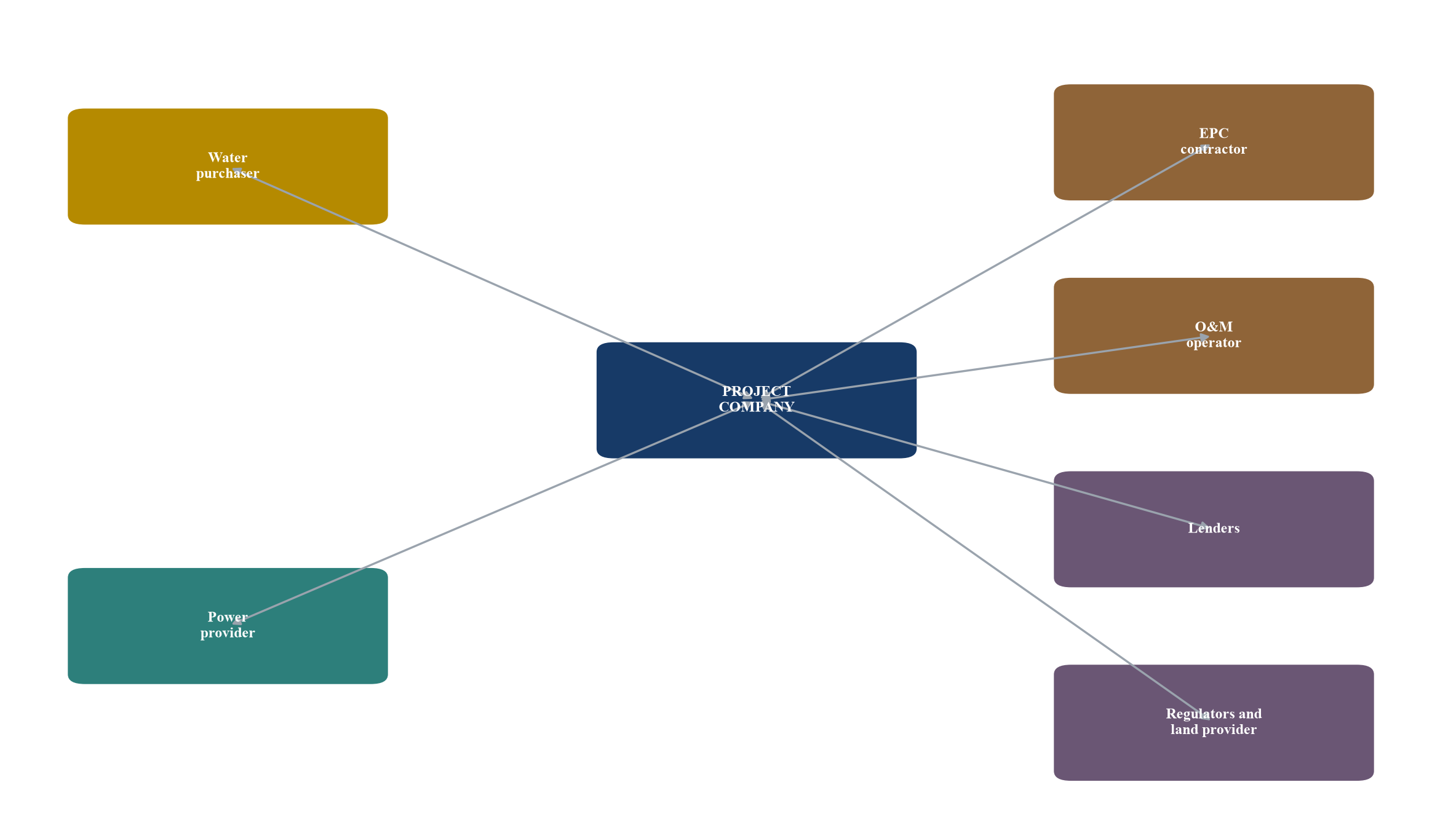
The diagram is a generic transaction framework; project-specific rights require document review.
21. Structure the water purchase agreement
The water purchase agreement should define term, capacity, availability, output, tariff, dispatch, quality, testing, relief, payment security, change in law, termination and handback. It is the core revenue contract and the basis for lender underwriting.
DEWA's Hassyan project uses an IWP model and long-term water purchase arrangements [4]. Public summaries support the structure but do not disclose every risk term. Each transaction must be assessed from its executed documents.
22. Structure the power agreement
The power arrangement should define source, capacity, delivery point, metering, price, index, losses, reliability, curtailment, outages and change in law. It should align with the water contract's relief and deemed-availability provisions.
If the procurer supplies electricity, the project company should retain efficiency responsibility within design conditions. If it procures power, the water tariff needs adequate indexation or hedging. Dedicated renewable generation introduces intermittency, storage and grid-balancing questions.
23. Align EPC obligations
The EPC contract should deliver the entire performance envelope required by the water and power contracts. It should cover intake, process, outfall, electrical connection, storage and interfaces within scope. Completion tests should reflect contracted service.
Price, schedule, liquidated damages, security and caps should support debt service. Relief under the EPC contract should not be broader than relief available to the project company. Technology suppliers should provide enforceable warranties.
24. Align O&M obligations
The O&M contract should pass through availability, efficiency, water quality, maintenance and reporting obligations. Fee structure can include fixed, variable and performance components. The operator should control day-to-day inputs and lifecycle planning.
The project company should retain oversight, data and step-in rights. Term and termination should support continuity. A weak operator balance sheet can leave lenders relying on limited recourse.
25. Design completion tests
Completion tests should demonstrate capacity, availability, specific energy, recovery, product-water quality, discharge compliance, reliability and interfaces. Tests should run under defined feedwater and power conditions. Independent engineers should verify results.
Phased completion can support early water and progressive capacity. Revenue, liquidated damages and debt draw should follow accepted capacity. Temporary fixes should not become permanent without approval and reserve.
26. Allocate grid outages
Grid outages are outside plant control when power is utility supplied. The water contract should provide time and revenue relief, subject to plant readiness. The power agreement should provide matching evidence and notice.
Backup generation may support controls and safe shutdown rather than full production. The financial model should not assume continuous water output without adequate power. Storage can cover short system events but should be sized explicitly.
27. Allocate curtailment
Renewable or grid constraints can curtail power. If curtailment prevents water production, the project needs deemed availability or another compensation mechanism unless it priced and controls the risk. The contract should distinguish economic curtailment from emergency events.
Battery storage, diversified supply and flexible dispatch can mitigate exposure. Their cost and operating logic should be included. Renewable certificates do not by themselves establish deliverable electricity.
28. Allocate change in electricity law
Tariffs, taxes, network charges, environmental costs and market rules can change over a long concession. The contract should define which changes pass through and how. General inflation and operator inefficiency should remain separate.
The formula should use observable evidence and avoid delayed cash recovery. Lenders will test materiality thresholds, dispute timing and termination if the project becomes uneconomic.
29. Allocate water-quality failure
Product-water quality is generally within plant control when feedwater and power remain within specification. Failure can trigger rejection, reprocessing, penalties and public-health obligations. The contract should define sampling, laboratories and dispute procedures.
The operator should maintain online monitoring and independent confirmation. A quality failure may require storage isolation and notification. Revenue deductions should reflect severity and duration without creating uncontrolled liability.
30. Allocate marine risk
Intake and outfall systems face storms, fouling, sediment, marine growth and environmental constraints. Surveys and design should cover the expected range. Some extreme conditions may qualify for relief.
Environmental permits and monitoring are central to operation. Brine discharge, chemicals and habitats require management under applicable standards. The IFC's Aqaba-Amman review highlights the significance of cumulative marine and environmental effects [5].
Table 2. Risk-allocation matrix for a decoupled reverse-osmosis IWP
| Risk | Project company | Procurer or utility | Shared mechanism |
|---|---|---|---|
| Electricity efficiency | Guaranteed consumption within design envelope | Feedwater or dispatch outside envelope | Metering, test curves and adjustment formula |
| Electricity price | Indexed or hedged portion as agreed | Pass-through or supplied-power obligation as agreed | Benchmark, caps, floors and reopeners |
| Grid availability | Plant readiness and connection compliance | Supply interruption and system curtailment | Deemed availability, notice and restoration protocol |
| Water demand | Availability and dispatch compliance | Take-or-pay, capacity payment or nomination | Minimum take and avoided-variable-cost adjustment |
| Feedwater | Normal design range and pretreatment | Conditions outside agreed range where allocated | Sampling, relief and process adjustment |
| Process performance | Capacity, quality, efficiency and lifecycle maintenance | Timely acceptance and delivery interface | Independent testing and cure rights |
Allocation is illustrative and should be negotiated against control, information and mitigation capacity.
31. Build sources and uses
Sources include sponsor equity, senior debt, subordinated capital, grants and permitted working-capital facilities. Uses include development, EPC, owner costs, financing fees, reserves, interest during construction and contingency. Power and grid assets should be included if inside the perimeter.
The model should reconcile contract scope to financing. Excluded infrastructure can still be a critical condition precedent. Contingency should reflect marine, equipment and interface risks, not merely a percentage convention.
32. Size debt from contracted cash flow
Debt should be sized from predictable cash available for debt service under conservative availability, output, power and cost assumptions. Capacity payment can support leverage when backed by a creditworthy procurer. Variable tariff should cover controllable operating cost.
The model should test low dispatch, power-price shocks, efficiency degradation, outages and delayed indexation. Debt maturity should leave a tail before contract expiry. Amortisation should match ramp and lifecycle expenditure.
33. Define debt-service coverage
Debt-service coverage should be calculated from cash available after operating cost, taxes and required reserves. Electricity pass-through can reduce volatility only when timing and basis align. Deemed revenue should be tested for payment certainty.
Lenders may use minimum and average coverage ratios, lock-up tests and distribution conditions. The ratios in any financing are project-specific. Scenario analysis should show cure capacity.
34. Establish reserve accounts
Reserve accounts can cover debt service, major maintenance, membrane replacement, working capital and power settlements. They support timing and lifecycle risk. The required amount should follow cash-flow volatility and contract mechanics.
Reserves are not a substitute for proper allocation. Repeated draws indicate structural mismatch. Replenishment, permitted use and release should be documented.
35. Model tariff indexation
Indexation can apply to fixed O&M, labour, chemicals, membranes and electricity. Each component should use a relevant index and currency. A broad consumer index may not track specialised inputs.
The formula should specify base date, lag, frequency, caps and extraordinary adjustment. The financial model should reconcile invoicing and payment timing. Unindexed cost exposure should be visible.
36. Model currency risk
Debt, equipment and operating inputs can be denominated in different currencies from water revenue. A pegged currency reduces some volatility but does not remove all basis or convertibility risk. The project should identify each exposure.
Hedges, indexation, reserves and contractual pass-through can mitigate risk. Hedge tenor and break cost should match debt and termination compensation. Currency assumptions should be stressed.
37. Model interest-rate risk
Long construction and operating periods expose debt to benchmark-rate changes. Fixed-rate debt or swaps can stabilise service. The water tariff may not adjust for interest after financial close.
The model should include hedge cost, mandatory breakage and refinancing. Delay can increase interest during construction and reduce coverage. Completion support should address the financing consequence.
38. Model inflation
Inflation affects construction, labour, chemicals, spares and insurance. Fixed EPC price can transfer part of the construction exposure but may contain exclusions and relief. Operating indexation should follow the cost base.
The committee should distinguish general inflation from commodity or electricity price. Scenario analysis should include lag and caps. Persistent mismatch can erode equity and debt protection.
39. Model membrane and chemical cost
Membrane replacement depends on feedwater, operation and degradation. Chemical consumption depends on pretreatment and water quality. These costs should have unit assumptions, escalation and replacement schedules.
Supplier concentration and shipping can create volatility. Inventory and alternative qualification support continuity. The operator should bear avoidable consumption while receiving relief for defined external changes.
40. Build the tariff waterfall
The tariff waterfall begins with capacity revenue and output revenue, then deducts electricity, chemicals, labour, maintenance, fees, taxes and lifecycle reserves. The remaining cash services debt and equity. Each line should map to a contract and evidence source.
The waterfall shows whether a low headline tariff depends on an off-book power subsidy or public infrastructure. Transparent comparison should include the value of supplied electricity, land, connection and credit support.
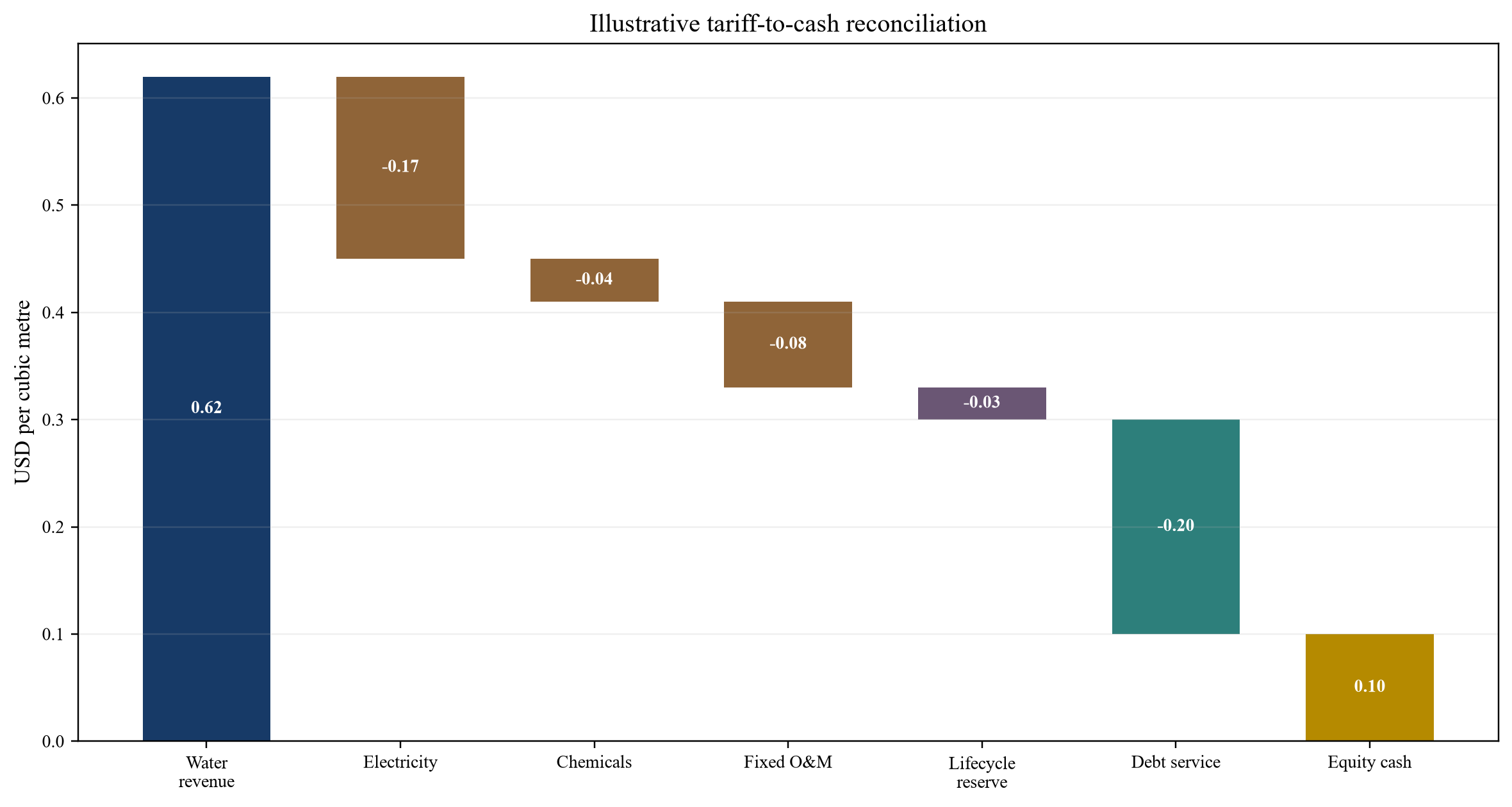
Values are hypothetical management assumptions in USD per cubic metre and demonstrate reconciliation only.
41. Compare tariffs consistently
Published water tariffs can differ in scope, date, power treatment, capacity, term, taxes, land, connection and risk allocation. DEWA has published tariff information for Hassyan, but a transaction comparison requires the executed scope and assumptions [4].
The procurer should normalise volume, currency, indexation, supplied inputs and public support. Lowest headline price is not necessarily lowest system cost. Bankability and lifecycle performance matter.
42. Test power-price sensitivity
Power-price sensitivity should vary delivered electricity price and specific consumption. It should show tariff, coverage, cash and equity return. Basis and timing should be included where an index or hedge applies.
The model should identify the price at which distributions lock up or debt service fails. This threshold supports pass-through and hedge design. It also shows the value of efficiency investment.
43. Test dispatch sensitivity
Dispatch sensitivity should vary water output while preserving capacity revenue and fixed costs according to the contract. It should include minimum operation, cycling and maintenance. Low output can increase unit cost.
The analysis should distinguish procurer dispatch from plant unavailability. Revenue protection should follow the cause. Storage and system integration can reduce cycling.
44. Test performance degradation
Specific energy, recovery, membrane rejection and availability can deteriorate. The lifecycle model should show planned maintenance and replacement that restore performance. Unplanned degradation should reduce cash.
The model should test gradual and step changes. Guarantees and operator security may recover some loss but have caps. Equity should retain exposure beyond contractual remedies.
45. Test construction delay
Delay increases interest, fees, overhead and exposure to input inflation. It can also postpone system benefits. The EPC contract should provide schedule security and liquidated damages within enforceable limits.
The model should test relief events and interface delays. Long-stop dates and termination compensation should protect lenders. Early water can reduce delay impact when technically and contractually accepted.
46. Test offtaker credit
Project debt ultimately depends on timely payment by the procurer or guarantor. Credit analysis should assess legal status, revenue, support, payment history and dispute process. Escrow, guarantees and direct agreements can strengthen security.
The IFC Saudi desalination case used a take-or-pay agreement and purchaser-funded escrow to support obligations [6]. The structure is evidence of one transaction, not a universal template. Current projects require current credit assessment.
47. Define termination compensation
Termination compensation should distinguish project-company default, procurer default, force majeure and prolonged relief. It should address debt, hedge breakage, equity and asset condition. Lenders need predictable recovery for public-counterparty and political events.
Compensation should avoid rewarding poor performance. Valuation and payment timing should be defined. Direct agreements should provide cure and step-in before termination.
48. Design lender step-in
Lenders should have notice and cure rights for material project-company default. Step-in permits replacement of operator or sponsor while preserving the water service. It should align across water, power, land and EPC documents.
Regulatory and security requirements can limit transfer. The documents should identify permitted substitutes and consent standards. Continuity of licences and rights is essential.
49. Address environmental and social risk
Marine intake, brine discharge, chemicals, construction and community impacts require assessment and management. Lenders may apply IFC Performance Standards or equivalent requirements. Compliance cost and monitoring belong in the model.
The Aqaba-Amman project includes desalination, conveyance and renewable generation and has been assessed for cumulative environmental and social risks [5]. Project boundaries should include associated facilities where required.
50. Address water security
Desalination supports water security but depends on energy, marine systems and infrastructure. The contract should include emergency operation, storage coordination, cyber security and recovery. Essential-service status can shape dispatch and payment.
Water security value should inform procurement, but the project still needs transparent economics. Redundancy and reserves should have defined costs and service outcomes.
Table 3. Hypothetical debt-service sensitivities
| Scenario | Water dispatch | Electricity price change | Plant availability | Minimum DSCR | Equity consequence |
|---|---|---|---|---|---|
| Base case | 92% | Base | 95% | 1.38x | Distributions follow plan |
| Low dispatch with capacity protection | 75% | Base | 95% | 1.31x | Lower variable margin |
| Power-price shock with partial pass-through | 92% | +30% | 95% | 1.18x | Distribution lock-up |
| Efficiency degradation | 92% | Base | 90% | 1.15x | Reserve draw and maintenance |
| Combined downside | 80% | +30% | 88% | 0.96x | Debt-service shortfall and cure |
All values are hypothetical management assumptions; they are not observed project data or financing terms.
51. Integrate renewable power
Dedicated solar or wind can lower emissions and provide a long-term energy source. Output does not always match water dispatch. Grid balancing, storage or flexible operation may be needed. The project should model delivered rather than nameplate renewable energy.
The Aqaba-Amman project includes a large solar facility to cover part of energy needs [7]. Hassyan is described by DEWA as clean-energy powered [4]. Contract and financing analysis should verify delivery, allocation and backup.
52. Use storage intelligently
Water storage can decouple production from demand over hours or days. Battery storage can smooth renewable power. Each has different cost and duration. The optimal combination depends on water demand, grid conditions and plant flexibility.
Storage responsibility and losses should be assigned. Revenue and availability tests should recognise the delivery point. A full reservoir may constrain dispatch even when the plant is available.
53. Plan expansion
Demand growth may justify additional trains, intake capacity or conveyance. Expansion rights should address land, common assets, power, interface and tariff. The original project should not be stranded or unfairly diluted.
Options can be priced separately. The procurer should test whether expansion or a new site is least cost. Financing should not rely on uncommitted expansion.
54. Plan handback
At contract end, assets may transfer to the procurer. Handback standards should cover remaining life, maintenance, membranes, records, spares and personnel. A reserve or inspection regime can support compliance.
The project should avoid deferring maintenance near expiry. Handback obligations belong in lifecycle cost and debt tail. Rights to software, data and licences should continue as required.
55. Report operational evidence
Reports should include output, availability, quality, specific energy, recovery, chemicals, membrane condition, outages and environmental performance. Data should reconcile to meters and invoices. Causes and relief events should be coded consistently.
The procurer and lenders need enough detail to test payment and covenant calculations. Dashboards should preserve audit trails. Material estimates should be labelled and replaced when observations become available.
56. Refinance after operating proof
Successful completion and stable operation can reduce risk and support refinancing. The model should test debt tenor, pricing, hedge breakage, reserve release and distribution. Refinancing gain may be shared under the project documents.
Refinancing should not weaken resilience or handback. Remaining power and offtaker exposure still matter. Lenders will assess actual performance and contract history.
57. Apply five bankability gates
The framework uses five gates: system need, complete perimeter, aligned contracts, resilient cash flow and operating proof. Capital should advance only when evidence supports each gate. Exceptions should be recorded and funded.
The gates connect technical decoupling to financial separation. They prevent a low tariff from hiding an unfunded interface or uncontrolled electricity risk.
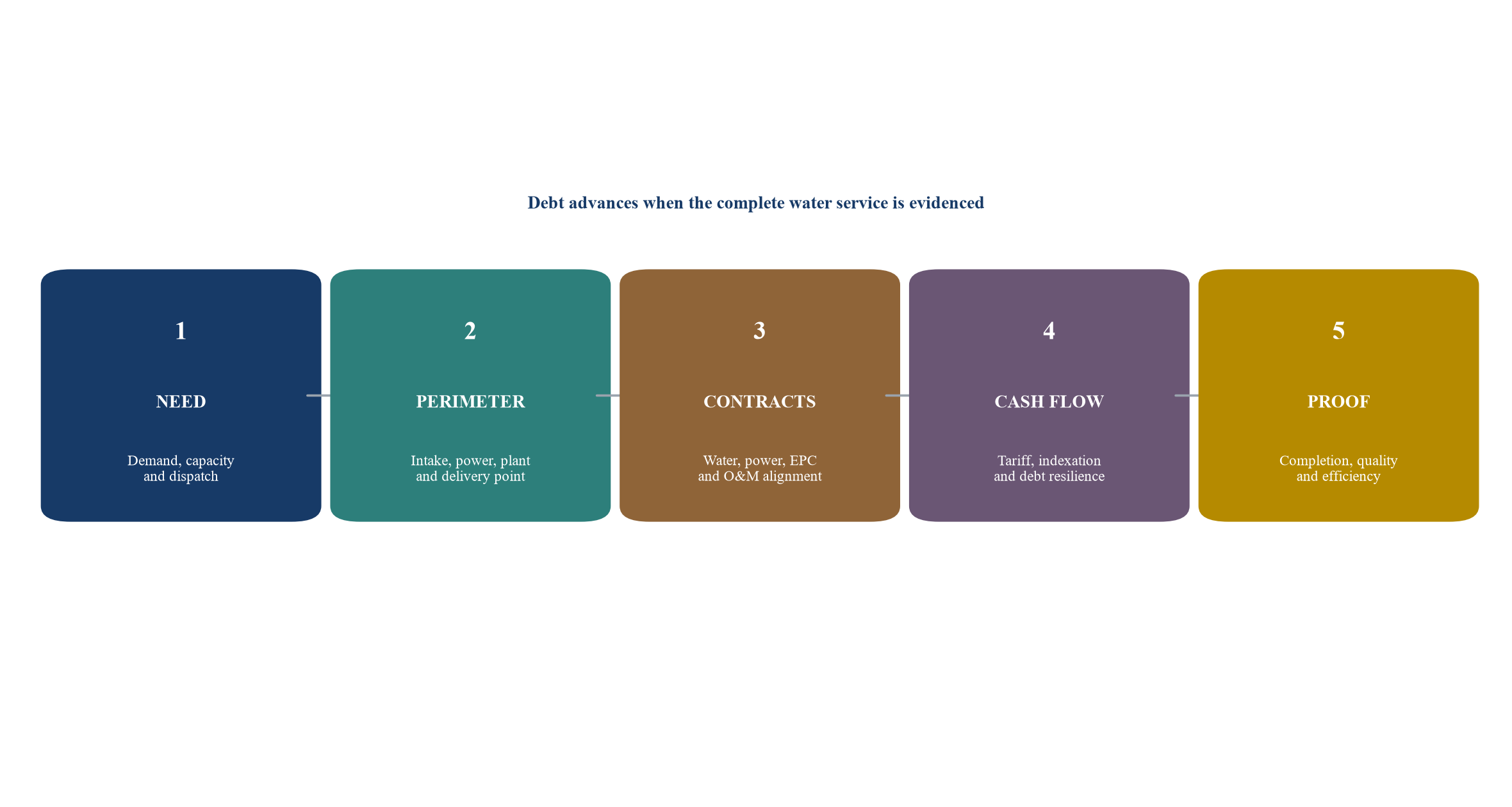
Each gate requires current evidence and a recorded financing decision.
58. Build the decision record
The record should include demand, technology, perimeter, bids, risk allocation, models, contracts, permits, finance, tests and approvals. It should show what was observed, estimated and contingent. Changes should be traceable.
The record supports lender diligence, public accountability and future procurement. Protected bid and technical information can remain controlled while decision logic is preserved.
59. Use a ninety-day bankability plan
The first month should confirm demand, perimeter, feedwater, power and interfaces. The second should align tariff, risk allocation, EPC, O&M and financing. The third should close evidence gaps, run lender cases and approve procurement or financing.
Complex environmental, land or system issues may require longer. The plan should not compress essential diligence. It should focus on decisions that affect tariff and debt service.
Table 4. Ninety-day reverse-osmosis bankability plan
| Period | Core work | Decision output | Principal control |
|---|---|---|---|
| Days 1-30 | Demand, water chain, site, feedwater, power and interface diligence | Agreed project perimeter and service specification | Independent technical evidence and system owner sign-off |
| Days 31-60 | Tariff, risk allocation, EPC, O&M, environmental and credit work | Bankable contract matrix and financial model | Pass-through reconciliation and lender sensitivity cases |
| Days 61-75 | Bid assumptions, security, reserves, hedging and completion tests | Approved commercial structure | Effective-tariff comparison and contract alignment |
| Days 76-90 | Final diligence, financing terms, approvals and conditions precedent | Procurement or financing decision | Evidence register, exception approval and closing plan |
Timing is illustrative and should be adapted to project scope and procurement law.
60. Conclusion
Reverse osmosis allows water production to leave the turbine's operating logic. The separation can reduce energy use, support cleaner power and permit water capacity to be procured through a dedicated IWP. It also creates a new contract system in which electricity price, electricity volume, grid availability and water dispatch must be allocated explicitly.
The Decoupled Reverse-Osmosis Project Finance Framework prices the potable-water service, separates fixed and variable economics, aligns water and power contracts, and tests debt service under operational stress. The result is a tariff that can be compared, financed and governed without hiding power risk inside a headline water price.
The investment committee should therefore approve a reverse-osmosis project as a connected system rather than as a single tariff bid. The first approval question is whether the project perimeter is complete. Intake, pretreatment, membrane trains, post-treatment, product-water storage, outfall, grid connection and delivery infrastructure must each have a contractual owner. A low desalination tariff does not compensate for an unfunded transmission line, an uncertain marine interface or a grid connection that remains outside the completion tests. The committee should require a perimeter drawing, an interface register and a sources-and-uses reconciliation before accepting the headline price.
The second question is whether fixed and variable economics are genuinely separated. Capacity payment should recover efficiently incurred fixed costs when the plant is available. Variable payment should follow measured production and the agreed treatment of electricity, chemicals and other supplied inputs. If electricity is a pass-through, the contract should define the benchmark consumption, eligible tariff components, metering point, loss factor, indexation date and reconciliation period. If the project procures electricity, the financing case should identify the hedge, renewable-supply contract or price collar that contains exposure. Ambiguous electricity treatment transfers risk into disputes and reserve accounts.
The third question is whether performance guarantees match the financial model. Specific energy consumption should be tested at stated feedwater temperature, salinity, membrane age and production level. Water-quality guarantees should cover the parameters required at the delivery point. Availability should distinguish planned maintenance, forced outage, grid failure, low demand and procurer instruction. Each guarantee should connect to a financial consequence that the model can reproduce. A technical schedule that cannot be mapped into revenue, cost or liquidated damages provides limited credit protection.
The fourth question is whether downside cases preserve debt service without depending on unsupported assumptions. Lenders should examine higher electricity cost, membrane replacement, deteriorating feedwater, lower dispatch, delayed completion, reduced availability, indexation lag and weak offtaker payment. Combined cases matter because operating shocks rarely arrive one at a time. The model should state the minimum debt-service coverage ratio, reserve usage, distribution lock-up and cure path in every material case. A case that fails should lead to revised leverage, stronger support, a different risk allocation or a clear rejection.
The fifth question is whether public obligations are executable. The water purchaser's payment covenant, termination compensation, deemed-availability regime, change-in-law protection and dispute process should align with the project agreements and financing documents. Government support should be described precisely: guarantee, undertaking, liquidity mechanism, tariff covenant or no support. The committee should avoid treating general public ownership as a substitute for documented credit protection. Payment timing, budget mechanics and currency convertibility can be as important as the purchaser's nominal standing.
The sixth question is whether environmental and social obligations have been priced through the asset life. Marine studies, intake effects, brine dispersion, chemical handling, occupational safety, community interfaces and cumulative impacts can affect both construction and operations. The environmental management plan should feed into the programme, capital budget, operating budget, monitoring obligations and lender reporting. Compliance costs that sit outside the model can become debt-service costs later.
Finally, approval should carry a small number of measurable conditions rather than a long list of general reservations. Conditions can include execution of the water-purchase agreement, confirmation of grid capacity, completion of marine permits, achievement of a capped EPC price, agreement of the electricity-risk schedule and delivery of a lender base case within the approved coverage range. Each condition needs an owner, evidence requirement and expiry date. This turns the investment decision into an executable closing plan and keeps the economic separation promised by reverse osmosis intact through financing, construction and operation.
References
- Dubai Electricity and Water Authority. Using SWRO and IWP to Enhance Water Sustainability. June 2022. https://www.dewa.gov.ae/en/about-us/media-publications/latest-news/2022/06/using-latest-technologies-swro-and-iwp-enhances-the-uaes-competitiveness-in-water-sustainability
- Emirates Water and Electricity Company. Statement of Future Capacity Requirements 2024-2037. https://ewec.ae/uploads/mediakit/1747641325/Statement%20of%20Future%20Capacity%20Requirements%202024-2037_%20Summary%20Report.pdf
- Dubai Electricity and Water Authority. Jebel Ali Reverse Osmosis Project. https://www.dewa.gov.ae/
- Dubai Electricity and Water Authority. Hassyan Seawater Reverse-Osmosis Project. https://www.dewa.gov.ae/en/about-us/strategic-initiatives/hassyan
- International Finance Corporation. Aqaba-Amman Water Desalination and Conveyance Project. https://disclosures.ifc.org/project-detail/ESRS/47924/aqaba-amman-water-desalination-conveyance-aawdc
- International Finance Corporation. Saudi Arabia Desalination Public-Private Partnership. https://www.ifc.org/content/dam/ifc/doc/2010/2013-saudi-arabia-desalination-ppp-brief.pdf
- International Finance Corporation. Aqaba-Amman Water Desalination and Conveyance Summary of Investment Information. https://disclosures.ifc.org/project-detail/SII/47924/aqaba-amman-water-desalination-conveyance-aawdc
- Dubai Electricity and Water Authority. Hassyan IWP Financial Close. April 2024. https://www.dewa.gov.ae/en/about-us/media-publications/latest-news/2024/04/dewa-and-acwa-power-reach-financial-close
- Dubai Electricity and Water Authority. Water Purchase and Shareholders Agreements for Hassyan. March 2021. https://www.dewa.gov.ae/en/about-us/media-publications/latest-news/2021/03/dewa-signs-water-purchase-and-shareholder-agreements
- Emirates Water and Electricity Company. Projects under Construction. https://ewec.ae/under-construction
- World Bank Group. Saudi Arabia Desalination PPP Case Study. https://documents1.worldbank.org/curated/en/150011468190136311/pdf/96933-BRI-PUBLIC-PPPStories-SaudiArabia-Desalination.pdf
- World Bank PPP Resource Center. Desalination Plant for Victoria. https://ppp.worldbank.org/library/desalination-plant-victoria-australia-project-financed-structure
- World Bank PPP Resource Center. Victorian Desalination PPP. https://ppp.worldbank.org/library/victorian-desalination-ppp
- International Finance Corporation. Preparing for Pilgrims and Passengers with Potable Water. https://www.ifc.org/en/stories/2010/saudi-arabia-airport
- International Finance Corporation. OCP Green Water Project. https://disclosures.ifc.org/project-detail/ESRS/49203/ocp-green-water
- International Finance Corporation. OCP Water Pipeline Financing. September 2024. https://www.ifc.org/en/pressroom/2024/ifc-and-ocp-launch-project-to-address-water-shortage-in-morocco-and-food-insecurity-in-africa
- World Bank. Securing Potable Water Supply. https://documents.worldbank.org/curated/en/166941539893383666/pdf/131040-WP-P159228-Securing-Potable-Water-Supply-PUBLIC.pdf
- International Finance Corporation. Environmental and Social Performance Standards. https://www.ifc.org/en/insights-reports/2012/ifc-performance-standards
- World Health Organization. Guidelines for Drinking-water Quality. https://www.who.int/publications/i/item/9789241549950
- International Organization for Standardization. ISO 24512 Drinking Water Utilities. https://www.iso.org/standard/37248.html
- International Organization for Standardization. ISO 30500 Non-sewered Sanitation Systems. https://www.iso.org/standard/72523.html
- International Renewable Energy Agency. Renewable Energy in the Water, Energy and Food Nexus. https://www.irena.org/publications
- International Energy Agency. Water-Energy Nexus. https://www.iea.org/topics/water
- United Nations Environment Programme. Desalination and Brine Management. https://www.unep.org/
- European Investment Bank. Water Sector Financing. https://www.eib.org/en/projects/sectors/water-and-wastewater/index.htm
- Asian Development Bank. Water and Urban Development. https://www.adb.org/what-we-do/topics/water-and-urban-development
- World Bank PPP Resource Center. Water and Sanitation PPPs. https://ppp.worldbank.org/sector/water-sanitation
- International Project Finance Association. Project Finance Resources. https://www.ipfa.org/
- Loan Market Association. Green Loan Principles. https://www.lma.eu.com/sustainable-lending/resources
- Equator Principles Association. Equator Principles. https://equator-principles.com/
- International Private Equity and Venture Capital Valuation Board. IPEV Valuation Guidelines 2025. https://www.privateequityvaluation.com/Valuation-Guidelines
- International Valuation Standards Council. International Valuation Standards. https://www.ivsc.org/standards/
- International Financial Reporting Standards Foundation. IFRS 13 Fair Value Measurement. https://www.ifrs.org/issued-standards/list-of-standards/ifrs-13-fair-value-measurement/
- Dubai Electricity and Water Authority. Annual Report 2025. https://www.dewa.gov.ae/en/investor-relations
- Dubai Electricity and Water Authority. Sustainability Report 2024. https://www.dewa.gov.ae/-/media/Files/Sustainability_Report_Eng_2024_V4.ashx
- Emirates Water and Electricity Company. Annual Reports and Planning Publications. https://ewec.ae/
- ACWA Power. Water Desalination Portfolio. https://www.acwapower.com/
- International Desalination and Reuse Association. Resources. https://idadesal.org/
- Global Water Partnership. Water Security Resources. https://www.gwp.org/
- World Bank Group. Private Participation in Infrastructure Database. https://ppi.worldbank.org/
About the Author
Chennakeshav (CK) is a corporate finance and investment banking executive with 25+ years of global experience in deal origination, structuring and execution across M&A, growth capital and corporate strategy. He has led value-creation mandates for founders, corporates and funds — bridging the boardroom view to hands-on execution and close.
His career spans Morgan Stanley, HSBC, Lloyds Banking Group, EWEC, ADQ portfolio companies and Emirates Growth Fund, across TMT, real estate, fintech, deeptech, cleantech, infrastructure and energy. He has partnered with C-suite leaders, private equity and venture funds, sovereign wealth funds and family offices to finance complex fund raises and scale-up ventures, and has led M&A due diligence, post-merger integration and business-transformation initiatives to create value.
At Matchpoint Partners he is Managing Partner, leading the firm's corporate finance, M&A and capital-raising practice. He holds an MBA from London Business School, an engineering degree from VTU and a Master of Laws (LLM, in progress) from UCL London.
An active start-up mentor, CK mentors at Techstars, DIFC FinTech Hive, Startup Grind, Founder Institute and IN5, serves as Entrepreneur Mentor in Residence (EMiR) at London Business School, and judges the Entrepreneurship World Cup.
