

1 Define the asset being valued
A geothermal licence before drilling is a bundle of conditional rights. It may permit data acquisition, access, drilling or production, but the exact permissions depend on the governing instrument and law. The physical prospect may contain heat at depth, a naturally permeable reservoir, usable fluid or some combination. None of those components is identical to a saleable megawatt-hour or a financeable revenue stream. A valuation must therefore identify the asset interest, the technical concept and the next decision the holder can make. A price for shares in an exploration company is different from a price for one prospect, a carried working interest or an option to enter a project after a successful well.
The first valuation question is the counterfactual. What can the owner do without a buyer or partner, and what rights would the transaction transfer? The owner may have a permit nearing expiry, a valuable data set, priority access to a grid connection or an exclusive route to a heat customer. It may also have work commitments and closure liabilities. These attributes can create or subtract value independently of subsurface heat. A buyer should map each to a document, a condition and a party able to enforce it. An investor presentation that multiplies theoretical resource capacity by a market price skips the capital and evidence required between those endpoints.
The paper treats valuation as a controlled sequence from regional evidence to first-well evidence and onward to a commercial project. It does not re-estimate global geothermal potential or propose a price for a named field. The International Energy Agency describes both the promise of next-generation geothermal and the need to address development risks, permitting and bankability [1]. The World Bank identifies exploratory drilling as an upstream cost and risk obstacle [2]. Those sources support the need for a staged decision. They do not supply a probability of success for any particular licence.
2 Classify the concept before comparing prospects
Conventional hydrothermal, enhanced geothermal systems and closed-loop designs can expose investors to different technical risks. A hydrothermal power concept depends on heat, fluid and sufficient permeability or a flow path. Enhanced systems seek to create or improve flow through hot rock; stimulation, circulation and reservoir behaviour become central. A closed-loop concept circulates a working fluid inside a sealed well system; it still needs a credible heat-transfer and cost case. These architectures should not share one undifferentiated “geothermal success probability.” The geological and engineering event called success must be specified for each design.
The Department of Energy's play-fairway programme uses regional geological, geochemical and geophysical evidence to target exploration. Its phases moved from basin-scale models to field data and then exploratory drilling [3]. The method is useful for ranking where to investigate. A favourable map pixel is not proof that a well at a specified depth can sustain commercial output. The investor should obtain the underlying data, model assumptions, spatial resolution, alternative geological interpretations and an independent account of what a drill result would test. A colour-coded score without that audit trail is a marketing graphic.
The technical concept also determines the product. A 90-degree-Celsius sedimentary aquifer serving district heat has a different demand, distribution and tariff structure from a high-temperature power field. Heat pumps, industrial steam and electricity each impose different temperature, flow and delivery requirements. The prospect should be evaluated against a named use at a named location. A large theoretical heat inventory may have little commercial value if the load is distant, seasonal, uncontracted or priced below delivery cost. The project boundary belongs in the first page of the valuation memo.
3 Keep resource classification separate from transaction value
The United Nations Framework Classification for Resources provides a three-dimensional account of environmental and socio-economic viability, technical feasibility and degree of confidence in quantities. Its geothermal specifications were updated in 2022 [4]. The International Renewable Energy Agency and partners applied the framework to fields in the Caribbean, Ethiopia and Indonesia [5]. This discipline helps analysts communicate what has been observed and what remains prospective. It does not turn an early-stage classification into a purchase price, nor does it make a pre-drill quantity a proved reserve.
GeoRePORT separates geothermal resource grade from project readiness. The United States national laboratory protocol describes geological, technical and socio-economic attributes and the quality of the assessment behind them [6]. A prospect can have attractive estimated temperature and poor readiness because rights, drilling data or a market route are absent. Another prospect can have modest temperature but a nearby district-heating customer and strong access rights. The two dimensions should be shown side by side. Combining them into one promotional score conceals the source of uncertainty.
For valuation, the committee should use an evidence ledger. It should record each proposition, the observation supporting it, the date and method, the independent reviewer, a reasonable alternative interpretation and the financial variable affected. A temperature gradient measured in a nearby well is not identical to a measured temperature at the proposed target. A surface manifestation can support a conceptual model while leaving flow and recharge uncertain. The ledger should preserve negative evidence and contradictory readings. A new result changes the probability distribution or the development design; the old assumption should remain visible in the change log.
Table 1. Evidence ledger for a pre-drill geothermal prospect
| Valuation input | Evidence to request | Uncertainty that remains before drilling |
|---|---|---|
| Legal right | Licence, land access, work commitments and counsel review | Renewal, transfer, production and security permissions |
| Heat and depth | Regional heat flow, nearby wells and calibrated model | Temperature at the actual target and drilling depth |
| Fluid and flow | Geochemistry, hydrogeology and structural interpretation | Sustainable well output, chemistry and interference |
| Surface use | Power or heat concept and preliminary process design | Conversion efficiency and physical connection cost |
| Market route | Grid study or identified heat customer | Delivery date, binding price and buyer credit |
| Cost | Well design, vendor indications and contingency | Formation response, lost circulation and final tenders |
| Closure | Permit conditions and restoration estimate | Actual well liability after drilling result |
Author-developed diligence framework; no entry implies that a hypothetical prospect has passed a test.
4 Construct a project-specific probability distribution
A pre-drill probability is an analyst or management estimate unless it is tied to a calibrated reference class and a documented model. It should not be borrowed from another basin because two prospects both carry the label “geothermal.” The committee should define mutually exclusive decision outcomes: a commercial result under the proposed design; a technically interesting but uneconomic result; an ambiguous result requiring a narrow test; and a failure requiring closure. Probabilities should sum to one and be associated with evidence. An independent technical adviser can challenge whether the branch definitions are physically coherent and whether geological dependencies have been counted twice.
Heat, permeability, fluid, chemistry and usable market access may be correlated. A simplistic product of five independent probabilities can understate or overstate the chance of success. For example, a structure that improves fluid circulation may alter drilling hazard and chemistry. A higher-temperature target may require a deeper, more expensive well. The model should record dependencies and show how they affect both the probability and the conditional cash flow. A Monte Carlo model can represent correlated inputs when adequate data exist. More simulation draws do not make unsupported probability assumptions reliable.
The Department of Energy's exploration work highlights the role of integrated conceptual models, geophysical and geochemical data, and uncertainty reduction before invasive drilling [7]. That guidance supports disciplined information gathering. It does not dictate a universal drill threshold. The investor should identify which uncertainty the first well is designed to resolve and which uncertainties remain after a successful result. A single well may confirm temperature at one point while leaving sustainable field capacity uncertain. The probability tree should therefore include later appraisal and development steps instead of treating first-well success as automatic commercial operation.
5 Convert conditional technical outcomes into cash flow
The project cash-flow model should begin only after the analyst specifies the product and delivery point. For a power project, annual saleable electricity depends on net plant capacity, availability, parasitic load, interconnection availability and curtailment. For heat, contracted delivery depends on load profile, network losses, required temperature and backup supply. The price must come from an identified contract, tariff, market assumption or clearly labelled hypothetical input. Capital expenditure must include wells, surface plant, connection, owner's costs, contingency, financing and a responsible closure allowance. Operating costs need pumping, chemicals, maintenance, staff and reinjection where relevant.
The National Laboratory of the Rockies' 2025 Annual Technology Baseline provides technology-specific geothermal cost and performance assumptions [8]. Its published scenarios are useful reference inputs. They are not bids for a particular prospect. The Department of Energy lists GETEM and GEOPHIRES as models for geothermal economic simulation [9]. An adviser can use these tools to test physical and financial relationships, then replace generic assumptions with site-specific engineering and contracts. The model should make that replacement visible. A number copied from a national benchmark should never be described as a negotiated project cost.
The net present value of a conditional operating project is the discounted sum of project free cash flow after tax and sustaining capital, less the construction capital still required. The pre-drill owner cannot book that conditional value at full amount. It must account for the probability of reaching the technical state, the capital required to learn that state, the ability to abandon or redesign after evidence, the time needed for permits and connection, and dilution or royalties under the capital plan. A positive project NPV after discovery can coexist with a negative value for drilling today. That distinction is central to an acquisition price.
6 Model the downside in the same physical units
The base case should identify the physical quantities on which revenue depends. An electricity model can state gross thermal power, conversion efficiency, gross electrical output, parasitic consumption and net export. A district heat model can state fluid temperature, flow, heat-exchanger approach temperature, seasonal demand and delivery losses. The downside should alter the drivers that engineering says can fail, rather than applying an unexplained ten-percent haircut to EBITDA. A lower flow rate can affect plant size, pumping energy, well count and maintenance simultaneously.
Decline and reservoir sustainability require explicit treatment. The investment committee should ask whether the model assumes natural recharge, injection support, periodic redrilling, stimulation or another physical mechanism. The cost and timing of replacement wells belong in the long-term cash flow. Chemistry can also affect scaling, corrosion, treatment and disposal. A preliminary pre-drill model may need broad scenarios instead of a narrow point estimate. That is an honest representation of the evidence state. Model precision should increase after tests establish the relevant operating behaviour.
The commercial downside can be independent of the geology. A reservoir may perform while an interconnection is delayed, a heat customer withdraws or a permit condition raises costs. A risked valuation should avoid counting every risk through a single higher discount rate and then again through probability haircuts. State where each risk appears. Geological success probability belongs in the branch tree; engineering performance ranges belong in conditional cash flows; financial cost of capital belongs in the discount rate; contractual contingencies belong in the date and revenue assumptions. This separation makes the model auditable.
7 Price the right to stop
An untested prospect is an option because the holder can defer, test, redesign or abandon within the limits of its licence and commitments. That flexibility has value when information arrives before the largest capital commitment. A standard project DCF that assumes every later well and plant is built even after bad evidence discards the stop right. Conversely, a promotional option model can overstate value by ignoring expiry, minimum work commitments and the capital needed to exercise the option. Both the right and its constraints must be documented.
The first branch should be the current choice: acquire or hold the rights, commission a lower-cost study, drill now, negotiate a partner-funded well, or relinquish the prospect. Each branch has cash costs, deadlines and decisions after observations. The World Bank's geothermal handbook describes decision trees as a way to balance probability of success against failure cost [10]. A recent peer-reviewed geothermal study also evaluates sequential data acquisition as an investment decision under uncertainty [11]. These sources support the decision method; the model's probabilities and values remain project-specific estimates.
The model should exclude sunk expenditure from the next decision. Past spending may influence negotiations, accounting and contractual reimbursement, but it does not make a poor next well economically attractive. The relevant cost is the cash still required to obtain the next piece of evidence, together with the obligations triggered by that decision. A licence price is another forward cash outflow. An investor must compare its bid with the prospect's risked value after expected future commitments. A seller's historic expenditure cannot replace that calculation.
8 Work a transparent first-well decision tree
Consider a fictional prospect with three possible first-well outcomes. The author assumes a 20 percent chance of a high-value result, a 30 percent chance of a marginal result and a 50 percent chance of failure. A high result would have a conditional project-rights value of USD 60 million after the first result, before USD 8 million of additional appraisal cost. A marginal result would have a conditional value of USD 20 million before USD 5 million of further appraisal. Failure has no saleable project value and requires closure already included in the assumed USD 12 million well budget. These are invented teaching inputs. They do not describe a field, published success rate, market transaction or offer.
If the holder drills immediately, expected value before acquisition price equals 0.20 multiplied by USD 52 million plus 0.30 multiplied by USD 15 million, less USD 12 million. The result is USD 2.9 million. A negative branch pays no additional appraisal capital because the holder stops. This is a decision-tree value, not a risked resource quantity. If the acquisition asks more than USD 2.9 million while giving no further rights or information, the illustrated immediate-drill strategy would not support it. The conclusion changes when actual probabilities, contract terms, tax, timing and other rights change.
The model's strongest discipline is its exposure of assumptions. The USD 60 million and USD 20 million conditional values require their own cash-flow and market analysis; this example takes them as illustrative inputs so the decision logic is visible. The high and marginal outcomes could be subdivided by flow, cost or market access. A real committee should have an independent subsurface review, detailed cost schedule and legal opinion. It should not present the example's 20, 30 and 50 percent probabilities as evidence drawn from industry averages.
Table 2. Fictional first-well branch values in USD millions
| Well outcome | Assumed probability | Conditional value | Additional appraisal | Branch value after appraisal |
|---|---|---|---|---|
| High | 20% | 60 | 8 | 52 |
| Marginal | 30% | 20 | 5 | 15 |
| Failure | 50% | 0 | 0 | 0 |
| Probability-weighted branch value | 100% | 14.9 | ||
| First-well spend | 12.0 | |||
| Immediate-drill expected value | 2.9 |
Every probability and value is an author assumption; conditional values are project-rights values after first-well evidence and before the stated further appraisal cost.
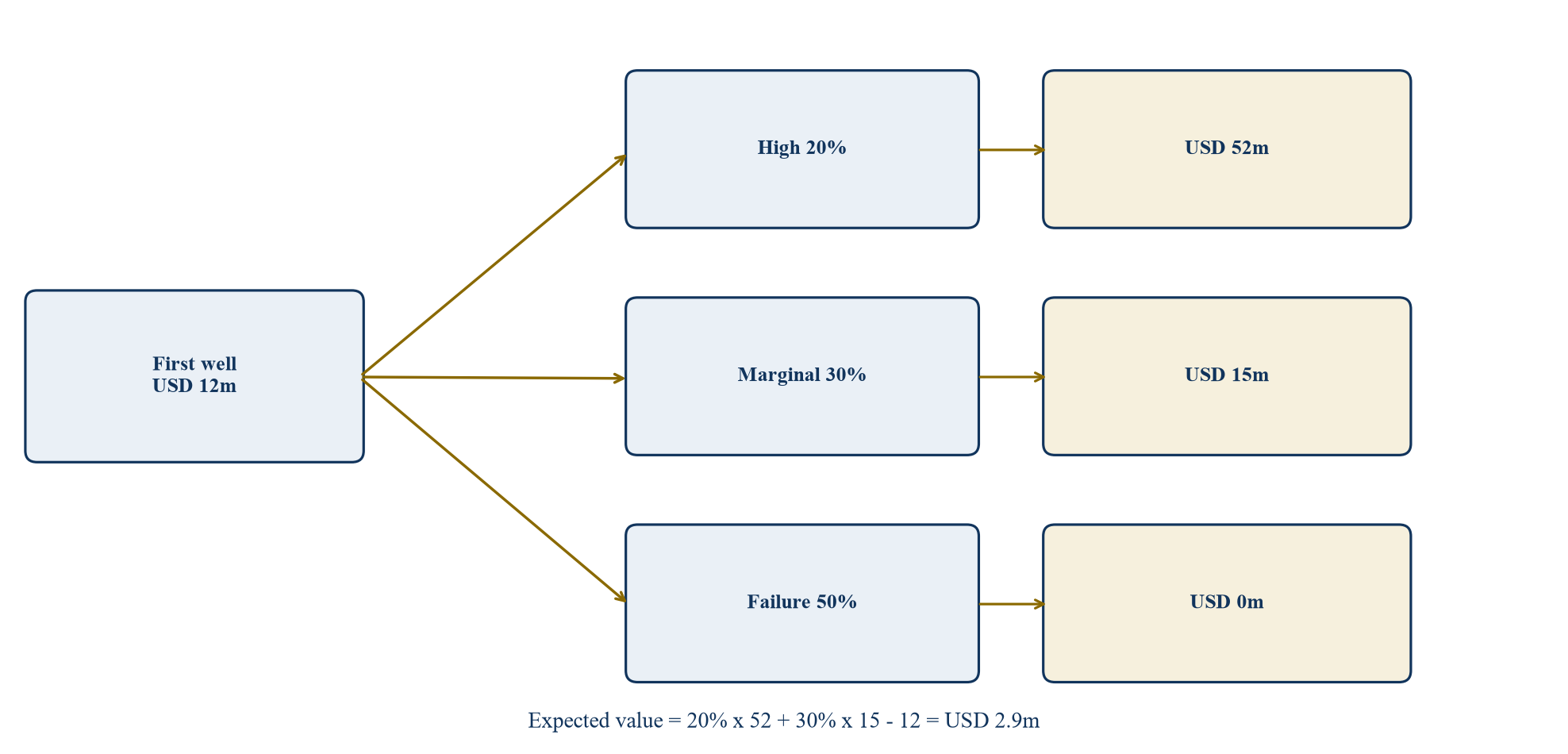
USD million author assumptions. Branch values are after stated follow-on appraisal cost but before the USD 12 million first-well spend.
9 Pay for information only when it can change the drill decision
Suppose a proposed geophysical survey costs a fictional USD 1 million. It is useful only if its result changes the choice to drill, sell, redesign or stop. In the author's teaching case, assume that a positive signal occurs with probability 80 percent in the high branch, 60 percent in the marginal branch and 12 percent in the failure branch. Given the original branch probabilities, the unconditional chance of a positive signal is 40 percent. Bayes' rule then yields a positive-signal posterior of 40 percent high, 45 percent marginal and 15 percent failure. A negative signal produces approximately 6.7 percent high, 20 percent marginal and 73.3 percent failure.
After a positive signal, drilling has an assumed expected value of 0.40 times USD 52 million plus 0.45 times USD 15 million, less USD 12 million, or USD 15.55 million. After a negative signal, the same calculation is negative, so an owner with a genuine right to stop chooses not to drill. Survey-then-decide value is 40 percent times USD 15.55 million less the USD 1 million survey cost, or USD 5.22 million. Relative to the USD 2.9 million immediate-drill value, the net uplift is USD 2.32 million. The example is internally consistent arithmetic, not a statement that any real survey has those diagnostic properties.
The result is sensitive to signal calibration, the ability to act on a negative result and the licence deadline. If the owner must drill regardless of the survey, the hypothetical information cannot create the same option value. If the survey delays the well beyond the licence term, the strategy may destroy value. If the signal is correlated with an unmodelled cost, the posterior branch values need revision as well as the probabilities. Every survey proposal should specify the decision threshold before data are collected and a quality-control plan for how the result will be interpreted.
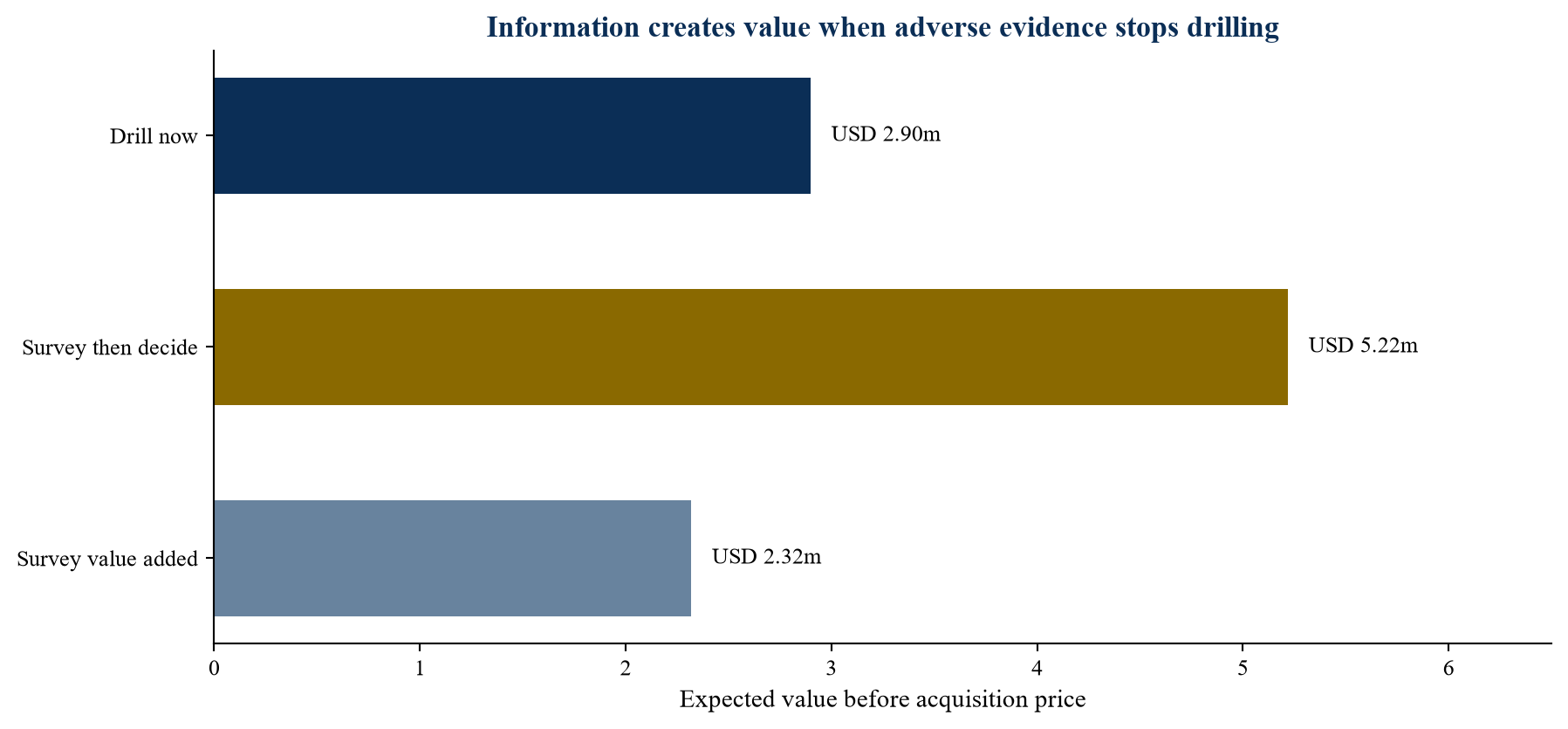
USD million author assumptions; the survey signal reliability and all branch values are hypothetical and have no claim to site calibration.
10 Distinguish a modelled survey from a proven signal
The Bayesian example does not validate the proposed survey. Before paying for any technique, the sponsor needs to understand what the instrument measures, the depth and spatial resolution, noise sources, model inversion choices and correlation with the commercial attribute of interest. A survey that identifies a thermal anomaly may say little about permeability or a sustained fluid pathway. A model trained on known hydrothermal fields may not transfer to an enhanced or closed-loop target. The evidence file should record test locations, failed analogues and whether predictions were made before or after drilling.
The Department of Energy's play-fairway method treats regional models, field evidence and exploratory wells as successive stages [3]. Its current exploration and characterisation work emphasises multi-disciplinary conceptual models and the ambiguity of stand-alone geophysical data [7]. A survey bid should therefore include a falsifiable hypothesis and an interpretation plan that treats alternative geological explanations seriously. Vendor confidence should be separated from independent validation. A client should not purchase a proprietary “success score” without access to the inputs, calibration and uncertainty range needed to evaluate its economic effect.
Value of information can be zero or negative. If every survey outcome still leads to drilling, the survey may add cost without changing the decision. If the survey shifts the location of a well, its value may appear through lower expected drilling cost or higher conditional production rather than a stop decision. If competing bidders receive the same survey result, the seller may capture part of the benefit in a higher price. The investment memo should show who owns the data and which party captures its value under the proposed transaction.
11 Reconcile heat potential with a specific market
Resource assessment and revenue assessment should develop together. A prospect close to an industrial heat user may support a smaller project whose economics depend on a reliable heat contract. A prospect intended for electricity faces plant conversion efficiency, grid interconnection, curtailment and dispatch rules. The International Energy Agency distinguishes geothermal electricity from direct heat applications and notes that new drilling can broaden geographic reach [1]. That global observation does not remove the need for a local customer and delivery path. The value file should name the point where heat or power changes hands and the permits and assets needed to reach it.
Heat buyers may need specified temperature, pressure, seasonal capacity and backup. A district heating network may have summer demand below the resource's theoretical output. A factory may have process interruptions or a credit profile that requires security. A data centre may value firm power at a constrained site but still need a physical connection and contingency supply. The sponsor should obtain evidence of demand and an indicative commercial structure before applying a full-price annual utilisation assumption. A non-binding expression of interest belongs in a scenario, with its status recorded.
The commercial model should identify who builds and owns the surface network. A site with an apparently low well cost can become expensive if it needs a long heat main, new substation or transmission reinforcement. Conversely, a modest resource beside an existing heat network may have a lower delivered capital requirement. The proper benchmark is delivered cost and contracted revenue for the chosen use, not the highest possible temperature or regional theoretical capacity. This is one reason a pre-drill valuation can change materially even when geological interpretation does not.
12 Stress a hypothetical operating project before risking it
A conditional project DCF can expose what a successful well would need to support. Assume, solely for teaching, a 20 MW net-export plant, annual availability of 85 percent, a realised price of USD 100 per MWh, USD 4 million of annual operating cost, USD 90 million of remaining construction capital, a 20-year flat operating period and a 10 percent discount rate. Ignore tax, inflation, working capital and decommissioning for this narrow illustration. Annual saleable electricity is 20 times 8,760 times 0.85, or 148,920 MWh. Annual revenue is USD 14.892 million. The 20-year 10-percent annuity factor is about 8.514, making the simplified present value of the USD 10.892 million annual margin about USD 92.73 million. The conditional project NPV after construction capital is about USD 2.73 million.
This small positive number is not a pre-drill licence price. It assumes that the plant is built, the 20 MW net export is achieved, the price is received and the stated costs are accurate. It also excludes the first well, later appraisal, legal rights price, financing costs and failure branches. The example shows why an attractive regional heat map cannot justify a large acquisition cheque by itself. A modest change in price, deliverable output or capital can erase the conditional operating value before geological risk is applied.
At 70 percent availability and USD 75 per MWh, the same simplified model yields roughly negative USD 45.7 million. At 95 percent availability and USD 125 per MWh, it yields roughly positive USD 53.1 million. These values are arithmetic sensitivities using author assumptions, not forecasts, public tariff observations or observed geothermal project economics. Real output and revenue can be correlated with drilling result, temperature, fluid conditions, location and contract date. The final valuation should model those relationships explicitly rather than treating each table cell as equally likely.
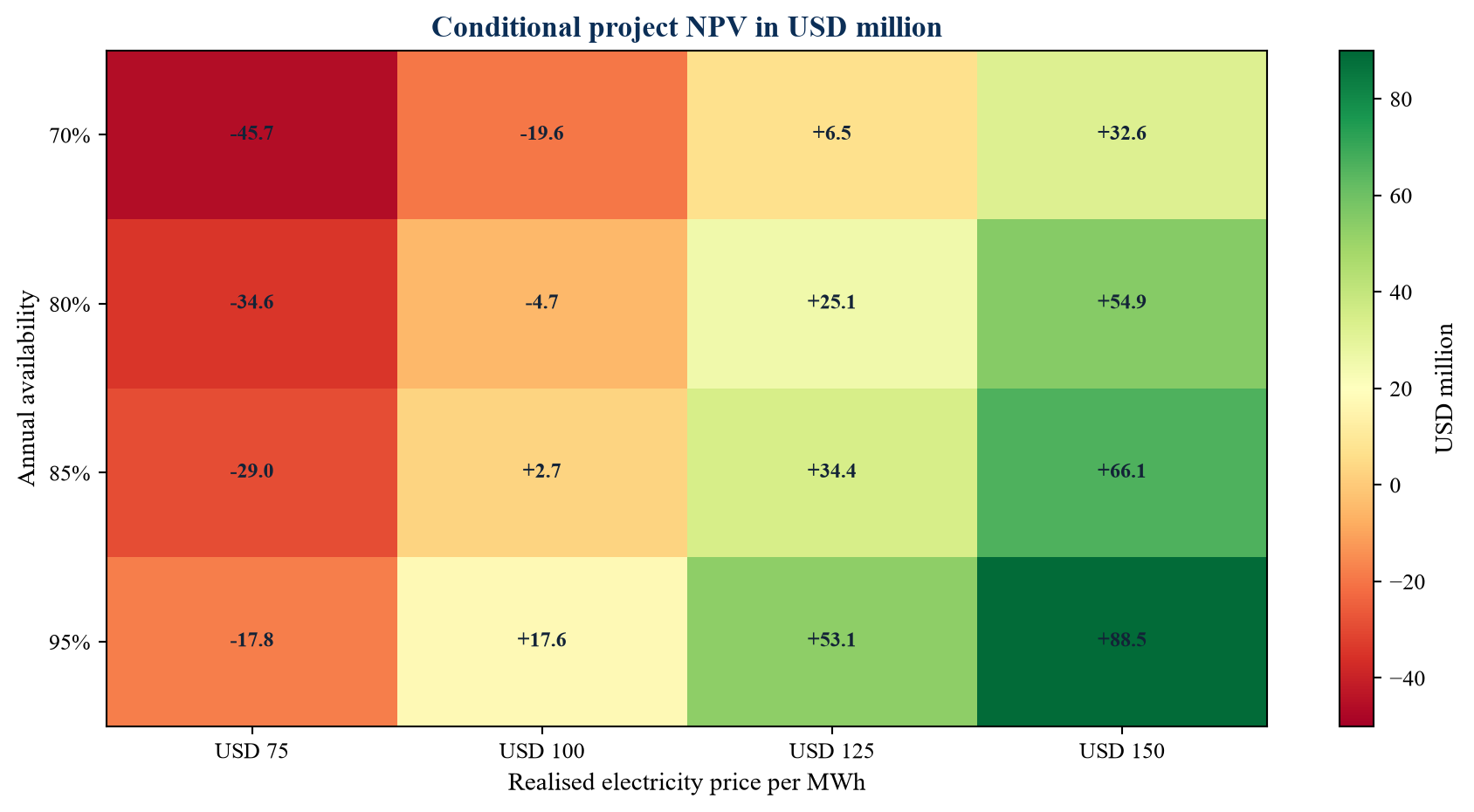
Author assumptions: 20 MW net, USD 4m annual operating cost, USD 90m remaining construction capital, 20 years and a 10 percent discount rate. Values exclude first-well and acquisition cost.
13 Select benchmarks with an explicit comparability test
A market benchmark should answer a defined question. The 2025 Annual Technology Baseline can inform ranges for geothermal capital, operating costs and capacity factors across its specified technologies and innovation cases [8]. A publicly disclosed power purchase agreement can indicate how counterparties describe volume and delivery, but a headline price may conceal escalation, grid costs, incentives, capacity obligations and start date. A corporate funding round can value platform IP and future pipeline, not just one prospect. Each benchmark needs a comparability bridge before it informs a licence price.
The bridge should state technology, geography, resource maturity, well depth, fluid and thermal system, market route, project scale, rights duration, contract status, subsidy treatment, cost year and financing perimeter. If information is missing, the benchmark should be classified as context rather than fitted into a numerical average. A recent transaction involving proven wells should not be applied to a pre-drill field merely because both are geothermal. A cost-per-MW comparison is particularly weak when one asset has a connected network and another has only a mapped target.
The committee can use benchmark evidence to test whether a hypothetical model is within a plausible range, then use project-specific engineering and a decision tree for the actual price. It should keep every benchmark's original source and date. A news summary or investor slide may omit transaction structure and contingent payments. A directly sourced filing, regulator document, official project disclosure or counterparty release has a stronger evidentiary role, though still requires interpretation. Where no close analogue exists, the valuation should show a wider range and a staged transaction rather than manufacture a precise comparable multiple.
14 Price the licence clock and work commitments
An option has an expiry. The buyer should obtain the full licence and underlying law, then test remaining term, extension conditions, relinquishment obligations, approved work programme, royalties, transfer limits and security rights with counsel. A model that values the choice to wait for new information is invalid if an inflexible drilling deadline arrives first. A minimum work commitment can require expenditure in a branch that the model treats as optional. A renewal discretion can also reduce the value of waiting. The cash-flow timeline should use the legal calendar, not a generic development schedule.
Permitting and land access have their own sequence. A surface owner may consent to surveys and oppose a deep well; an exploration permit may not cover commercial extraction; a production licence may require water or reinjection approvals. The International Energy Agency identifies permitting and environmental issues among the barriers to wider geothermal deployment [1]. The valuation should therefore carry a permit decision state and the cost of compliance. Counsel and environmental specialists should describe the relevant jurisdiction and conditions. This paper offers no legal conclusion for a particular territory.
The committee should pay attention to obligations that survive failure. The first well may need plugging and site restoration even when no usable resource is found. A water-test or seismic programme may trigger monitoring duties. These costs belong in the failure branch or in a separate funded reserve. A seller may seek reimbursement for historical costs or release from a performance bond. Such terms change the effective acquisition price. A term sheet that says only “USD 3 million for the licence” can omit a much larger assumed liability.
15 Choose a transaction that shares the unresolved risk
An outright acquisition pays today for all transferred rights and liabilities. It may suit a buyer that wants control over a portfolio, proprietary data or access to an existing team. A farm-in lets a partner earn an interest by funding specified work. An option grants a time-limited right to acquire or drill after further evidence. A staged share purchase can release price at independently verified milestones. A royalty preserves seller participation but reduces future project cash flow. None is universally best. The structure should allocate geological, legal and commercial risk to parties willing and able to bear it.
For the fictional prospect, a bidder with an immediate-drill expected value of USD 2.9 million before acquisition price would need room for legal diligence, overhead, capital uncertainty and required return. The paper does not prescribe a maximum bid from that figure. A vendor may control a portfolio of adjacent prospects or data that changes the buyer's distribution. A partner may provide drilling capability or access to a contracted heat user. Each incremental item should be valued separately and supported by evidence. The bidder should avoid paying twice for a concessionary first-well carry that is already reflected in a reduced cash outlay.
Milestones need objective language. “Commercial success” can be disputed; a defined temperature, flow test, pressure behaviour, chemistry range and independent sign-off are more operable. The agreement should state who designs and operates the well, who owns raw data, how cost overruns are approved, what happens after an ambiguous result and whether the seller can market the prospect if the buyer declines the next tranche. Counsel must align these rights with the actual licence. The finance team should then model the same allocation in the buyer and seller economics.
Table 3. Transaction structures for an untested geothermal opportunity
| Structure | Cash committed before first well | Principal control issue | Evidence or payment gate |
|---|---|---|---|
| Full asset purchase | Purchase price plus buyer-funded programme | Transferability and inherited obligations | Verified rights, data and liability schedule |
| Funded farm-in | Capped work contribution | Operatorship and earned interest | Approved well scope and independent test |
| Time-limited option | Option fee and agreed diligence spend | Expiry and exclusivity | Election after named data deliverables |
| Milestone share purchase | Initial stake and contingent tranches | Governance between stages | Objective technical and commercial milestones |
| Royalty or deferred price | Lower initial cash, future burden | Lender consent and gross-revenue leakage | Metered production or contracted receipt |
Author-developed comparison; legal terms and price require a negotiated transaction and jurisdiction-specific advice.
16 Keep market, geological and capital assumptions traceable
The investment model should have one controlled source register. Each geological parameter should point to a log, sample, map, professional interpretation or explicitly identified management estimate. Each commercial input should point to a contract, regulated tariff, market data or labelled assumption. Each capital item should point to a design, quotation, benchmark or contingency rationale. The register should show currency, base year, tax treatment and whether amounts include owner costs. Scenario changes should be recorded with their reason and author.
An independent reviewer should be able to reproduce the probabilities and arithmetic without accepting management's preferred narrative. That does not require a complex spreadsheet with thousands of cells. A small, transparent tree can be stronger than a large simulation when data are sparse. The key is to expose branch definitions, conditional values, future capital, stop rights and correlated risks. If probability estimates come from expert elicitation, the memo should name the experts, method and dissenting views. If probabilities are purely illustrative, they belong in an educational example, never in a live valuation opinion.
The data room should include negative tests, expired rights and unsuccessful analogues. Omitting adverse evidence can bias the prospect score and increase the chance of overpaying. A clean provenance trail also supports a later sale or financing if the first well succeeds. The acquiring party will need to demonstrate what was known at each decision point, what changed and what it paid for. Independent engineering, legal and commercial reviews should have distinct scopes. Corporate finance combines their outputs into a price and structure; it does not certify subsurface performance through spreadsheet formatting.
17 Account for portfolio effects without disguising correlation
Several prospects can share drilling contractors, geological data and market infrastructure. A portfolio may create learning value: a result at one location can improve the model for neighbouring locations. It can also concentrate risk if every prospect relies on the same flawed regional interpretation or the same grid bottleneck. An investor should map common risk factors before adding individual prospect values. Simply summing ten risked NPVs can overstate diversification when failures are correlated.
The portfolio model should represent shared permits, central plant opportunities, data ownership and staged well sequence. One well might test a basin-wide temperature thesis but reveal little about permeability elsewhere. A successful production well could reduce uncertainty in adjacent licences; a dry or cool well might impair several. The sale price of one prospect therefore depends partly on what rights the buyer holds over the rest of the play. An option on adjacent acreage can protect that learning value. The instrument should specify whether data from the first well may be used by the seller or another bidder.
The World Bank's geothermal programme used portfolio planning and upstream risk mitigation to support early development in multiple countries [2]. That public-sector experience does not establish a private investor's success rate or return. It does show why the portfolio unit is relevant to resource policy and risk-sharing. For a private fund, concentration limits, follow-on reserves and the ability to abandon weak prospects matter as much as mean value. The portfolio committee should compare cash at risk in a correlated failure with available capital for the remaining good outcomes.
18 Link valuation to the capital plan
A prospective resource can be attractive on a fully funded model and still be uninvestable for a sponsor that cannot finance the first well or later appraisal. The capital plan should distinguish funds needed to acquire rights, complete pre-drill work, drill and close the well safely, appraise a favourable result and build the operating system. Each tranche should have an identified potential source, conditions and time. Equity commitments, grants and strategic partner interest have different certainty. Non-binding interest should not be treated as cash available for a rig deposit.
A farm-in changes value because it trades ownership for funded work and often technical expertise. The seller's net value is its retained share of conditional outcomes, less residual obligations and any loss of control. The buyer's value is its earned share, less carried costs, option fee and later capital. Both sides should use the same geological outcomes and project assumptions so the negotiation concerns actual economics rather than incompatible spreadsheets. A development lender ordinarily enters after resource validation, costed construction and a credible revenue contract; the World Bank notes that commercial debt is commonly unavailable before field confirmation [2].
The investment committee should reserve capital for success. A company can win the first-well lottery and then fail to fund appraisal or hold the licence through development. The model should show dilution, partner elections, pre-emption and the rights to raise additional capital. An acquisition agreement can preserve flexibility through staged payments, earn-outs or consented security. These protections have value only when enforceable under the governing law and acceptable to future counterparties. A nominally high project NPV can be captured by later capital providers if early investors have no funded path.
19 Define a decision-ready diligence mandate
A scoped pre-drill mandate can deliver six items. First, a verified rights and obligations map. Second, an independent technical evidence ledger that distinguishes observations from interpretations. Third, a conditional market and project design with a credible delivery point. Fourth, a transparent valuation model with geological branches, stop rights, timing and correlated risks. Fifth, a capital and transaction-structure comparison. Sixth, an investment committee paper stating the maximum expenditure approved for the next test and the evidence required for the next decision. Each item has a responsible specialist and a defined review point.
The adviser should not market a resource quantity as proved, present a hypothetical probability as a geological fact or imply that a benchmark is a bid. A technical adviser can review the subsurface model and test design. Counsel can review licences, water, land, environmental and security rights. A commercial specialist can test the proposed power or heat contract. Corporate finance can integrate those workstreams into a price, term sheet and capital process. The mandate should state which opinions are outside each adviser's competence and how disagreements are resolved.
The resulting transaction recommendation may be to buy, bid below an asking price, negotiate a farm-in, commission a survey, obtain a heat customer commitment, wait for permitting or decline the prospect. A recommendation to stop can preserve capital. For a seller, a robust evidence package can also improve price discovery by allowing bidders to compete on the same data. No paper can promise a mandate or a transaction outcome. The practical value is a decision that can be defended against the current evidence and revised when a well produces new information.
20 Implement the valuation in staged approvals
The first approval should fund only the evidence needed to define the prospect and its legal perimeter. The second should authorise a site-specific survey or other non-invasive work when its result can change the decision. The third should approve a capped well programme with an explicit stop authority, a closure reserve and an independent test protocol. The fourth should assess appraisal after the first result. The fifth should consider construction and project finance only after a deliverable resource, feasible system, permissions and market contract are evidenced. A project may repeat a stage or exit after any one of them.
Each approval paper should present the latest evidence ledger, the prior and updated probability distributions, conditional project values, cash committed to date, cash still required, licence deadlines and the current alternatives. It should show a downside involving technical failure and a separate downside involving commercial delay. A change in assumed probability should have a traceable new measurement or expert review. A change in price should have a contract or market source. This discipline prevents a favourable survey from being treated as proof of a later operational result.
The timetable must reflect the market and the asset. A first well can take time to permit and procure. A grid connection may have its own queue. A heat user may need an investment decision before signing. The committee should maintain a single critical path and identify which commitment becomes irreversible next. Value of information is highest when it arrives before that commitment. The decision to wait has a cost if it causes rights to lapse or a customer to leave. Those competing effects belong in the same model.
21 Conclusion
Before the first geothermal well, the asset is a right to learn and, if evidence warrants, to develop. A regional prospectivity map can identify where to spend attention. A classification framework can describe what is known and what remains uncertain. A conditional DCF can show what a successful project might earn. The investment decision needs an additional layer: probability-weighted outcomes, future cash commitments, a real ability to stop and a timetable constrained by rights and contracts. None of those elements should be hidden inside an unexplained “resource discount.”
The fictional case shows a USD 2.9 million value for an immediate well before acquisition price and a USD 5.22 million value for a calibrated survey followed by an optimal drill decision. Those results depend entirely on author-selected probabilities, signal reliability, costs and conditional values. They are reproducible examples, not a claim about a particular prospect or market. The separate power-plant sensitivity shows how price and availability can change conditional value even after geological success. An investment committee must replace every hypothetical input with verified, site-specific evidence before using the framework to set a bid.
The recommended transaction process is to secure the legal option, price the next piece of information, fund a well only under a clear test protocol and leave room for further appraisal. A staged acquisition or farm-in can align payment with evidence. Independent technical, legal and commercial reviews should remain visible in the valuation file. The result is a narrower and more useful claim than a headline heat-in-place number: the buyer knows what it is paying for today, what evidence it will purchase next and when it should stop.
References
- International Energy Agency (2024). The Future of Geothermal Energy. https://www.iea.org/reports/the-future-of-geothermal-energy
- World Bank ESMAP (2020). The Global Geothermal Development Plan: Mitigating Upstream Cost and Risk. https://www.worldbank.org/en/results/2020/11/10/the-global-geothermal-development-plan-mitigating-upstream-cost-and-risk
- US Department of Energy. Play Fairway Analysis. Accessed 5 October 2026. https://www.energy.gov/hgeo/geothermal/play-fairway-analysis
- United Nations Economic Commission for Europe (2022). Supplementary Specifications for the application of UNFC to Geothermal Energy Resources. https://unece.org/sites/default/files/2022-12/UNFC_Geothermal_Specs_25October2022.pdf
- International Renewable Energy Agency and International Geothermal Association (2021). United Nations Framework Classification for Geothermal Energy: Pilot Applications in the Caribbean, Ethiopia and Indonesia. https://www.irena.org/Publications/2021/Jun/United-Nations-Framework-Classification-for-Geothermal-Energy
- Rubin, R., Young, K., Badgett, A., Kolker, A., Levine, A., Wall, A., Witter, E. and Dobson, P. (2022). GeoRePORT Protocol Volume II: Geological Assessment Tool. https://doi.org/10.2172/1859734
- US Department of Energy. Exploration and Characterization. Accessed 5 October 2026. https://www.energy.gov/hgeo/geothermal/exploration-and-characterization
- National Laboratory of the Rockies (2025). Annual Technology Baseline: Geothermal. https://atb.nlr.gov/electricity/2025/geothermal
- US Department of Energy. Geothermal Technical Resources, including GETEM and GEOPHIRES. Accessed 5 October 2026. https://www.energy.gov/hgeo/geothermal/technical-resources
- World Bank ESMAP (2012). Geothermal Handbook: Planning and Financing Power Generation. https://ppp.worldbank.org/library/geothermal-handbook-planning-and-financing-power-generation
- Corso, A., Chiotoroiu, M., Clemens, T., Zechner, M. and Kochenderfer, M. J. (2024). Sequentially optimized data acquisition for a geothermal reservoir. Geothermics 120, 102983. https://doi.org/10.1016/j.geothermics.2024.102983
About the Author
Chennakeshav (CK) is a corporate finance and investment banking executive with 25+ years of global experience in deal origination, structuring and execution across M&A, growth capital and corporate strategy. He has led value-creation mandates for founders, corporates and funds — bridging the boardroom view to hands-on execution and close.
His career spans Morgan Stanley, HSBC, Lloyds Banking Group, EWEC, ADQ portfolio companies and Emirates Growth Fund, across TMT, real estate, fintech, deeptech, cleantech, infrastructure and energy. He has partnered with C-suite leaders, private equity and venture funds, sovereign wealth funds and family offices to finance complex fund raises and scale-up ventures, and has led M&A due diligence, post-merger integration and business-transformation initiatives to create value.
At Matchpoint Partners he is Managing Partner, leading the firm's corporate finance, M&A and capital-raising practice. He holds an MBA from London Business School, an engineering degree from VTU and a Master of Laws (LLM, in progress) from UCL London.
An active start-up mentor, CK mentors at Techstars, DIFC FinTech Hive, Startup Grind, Founder Institute and IN5, serves as Entrepreneur Mentor in Residence (EMiR) at London Business School, and judges the Entrepreneurship World Cup.
