

1. Technology neutrality begins with the service being bought
A storage auction is technology-neutral when eligibility and evaluation follow the system service rather than a named engineering solution. The buyer must first define the scarcity problem: how many dependable megawatts are required, for how long, at which locations, with what notice, and how quickly the resource must recover. Technologies can then compete against the same obligation.
Neutrality does not mean ignoring physical differences. Pumped storage, compressed-air systems, flow batteries, lithium-ion batteries, thermal storage and emerging chemistries carry different development, operating and performance risks. A neutral process recognises those differences through evidence requirements while applying the same output standard.
The investment proposition is therefore a contracted service, not a catalogue of hardware. Procurement documents, financial models and completion tests should use the same service definition.
2. The need case should precede the auction format
An auction cannot correct an unclear system need. The procurer should publish the adequacy, flexibility or network analysis that supports the quantity and duration sought. The analysis should identify the stressed intervals, assumed demand, renewable profile, interconnection, conventional outages and contribution of other flexible resources.
The counterfactual matters because system value is incremental. A storage project adds limited value if the relevant scarcity is already covered by dependable resources. It can add substantial value where it avoids involuntary demand reduction, expensive peaking capacity or network reinforcement.
Official adequacy methods provide a disciplined starting point. ACER describes capacity mechanisms as payments to resources that support security of supply, while its European resource-adequacy methodology uses de-rating and probabilistic assessment to quantify capacity gaps. Auction quantities should remain traceable to that evidence.
3. Nameplate megawatts are not dependable megawatts
Nameplate power records the maximum rated discharge. Dependable power measures the contribution expected during the defined stress event. The difference can arise from state of charge, energy duration, temperature, degradation, forced outage, shared infrastructure and correlated charging constraints.
A 100 MW asset with four hours of stored energy cannot automatically provide 100 MW through a twelve-hour event. A 100 MW asset with twenty hours of inventory may still fail if its connection, pumps, compressors or control system are unavailable. Procurement should therefore contract accredited or derated capacity rather than nameplate capacity.
Great Britain's Capacity Market applies technology-specific de-rating factors and procures through T-1 and T-4 auctions. The principle is portable: remuneration should reflect expected contribution at the time the system needs it.
4. Duration should be defined at contracted output
Duration equals usable energy divided by the contracted discharge level, after auxiliary consumption and operating limits. Tender documents should state the reference power, minimum continuous duration, permitted ramp profile and terminal state-of-charge requirement.
A duration threshold can create a cliff. An asset delivering 7.9 hours may be excluded from an eight-hour product even when it contributes material value. Bands or a transparent duration multiplier can reduce this distortion. Separate products may be appropriate when the system needs both overnight and multi-day capability.
Ofgem's long-duration electricity-storage framework uses an eight-hour definition. California's central-procurement programme distinguishes resources capable of at least twelve hours and multi-day storage. These examples show that duration must follow the diagnosed system duty.
5. Availability is a measured operating obligation
Availability should mean the resource can accept a dispatch instruction and deliver the accredited service during defined windows. It should cover the storage medium, power conversion, connection, controls and essential auxiliaries. A plant that is mechanically ready yet lacks charge cannot be considered fully available for an energy-limited obligation.
The contract should define planned outages, forced outages, testing, notice, measurement, cure and penalty. Availability measured across every hour can produce a different incentive from availability concentrated in scarcity windows. The chosen window should reflect system risk.
Payments should reward evidence of readiness. Repeated tests, telemetry and event performance provide stronger evidence than self-certification.
6. A stress event converts policy into a testable product
The event definition should specify start conditions, notice, minimum output, duration, number of possible calls, interval between calls and required recharge. It should also state whether dispatch follows a system operator instruction, a market price threshold or an objective adequacy condition.
An event that is too narrow can reward assets that perform only under an artificial test. An event that is too broad transfers uncontrolled market risk to bidders and raises prices. Historical simulation and prospective scenarios can help calibrate the boundary.
Performance settlement should use metered delivery at the contracted point. Shortfalls can be measured as missing megawatt-hours, unavailable megawatts or both, with penalty caps aligned to contract value and financeability.
7. Energy and capacity are separate procurement dimensions
Capacity is the ability to deliver power when required. Energy is the volume delivered over time. Long-duration storage combines both, but their costs and risks differ. A procurement that pays only for energy may under-reward rarely used readiness. A procurement that pays only for capacity may create weak operating incentives.
A two-part structure can include a fixed availability payment and a variable energy settlement. The fixed component supports capital and fixed operating cost. The variable component covers charging energy, losses, degradation and dispatch cost. Market revenue can offset the required fixed payment if revenue-sharing rules are explicit.
The buyer should prevent double recovery by defining which merchant revenues remain with the project and which reduce consumer support.
8. Derating should be transparent and evidence-led
Derating converts installed capacity into an accredited contribution. The method should reflect probability of availability during stress, energy limitation, outage history, charging opportunity and common-mode risks. New technologies require a provisional factor supported by engineering evidence and conservative assumptions.
A single factor for a broad technology class can conceal differences in duration, design and operating strategy. Project-level adjustment may be justified where data are auditable. The methodology should be published before bid submission and updated through a predictable process.
Investors should model both the awarded factor and the risk of future recalibration. A change in accredited capacity can affect revenue, debt service and asset value even when physical performance is unchanged.
9. Recharge capability belongs in the service definition
Storage cannot provide repeated events without replenishment. Recharge depends on connection capacity, market access, energy availability, efficiency, operating constraints and the time between calls. Multi-day scarcity can reduce the opportunity to recharge from renewable or low-price power.
The auction should state whether the product requires one event, repeated events or seasonal readiness. A recharge test may require the asset to restore a defined state of charge within a specified window without breaching network limits.
Charging cost allocation also matters. The buyer can reimburse indexed energy, leave it to the project, or settle a reference spread. Each choice changes bidding behaviour and exposure to wholesale prices.
10. Efficiency affects cost without defining value alone
Round-trip efficiency influences charging volume, network use, emissions and variable cost. It should be evaluated using a common boundary from metered import to metered export. Auxiliary loads and standby consumption belong inside that boundary.
Efficiency alone does not measure duration or adequacy contribution. A lower-efficiency asset can be economic if it provides long duration, favourable siting or low-cost storage inventory. A high-efficiency asset can be unsuitable if its duration is too short for the diagnosed event.
Bid evaluation should convert efficiency into expected system cost under common dispatch scenarios rather than award a qualitative preference.
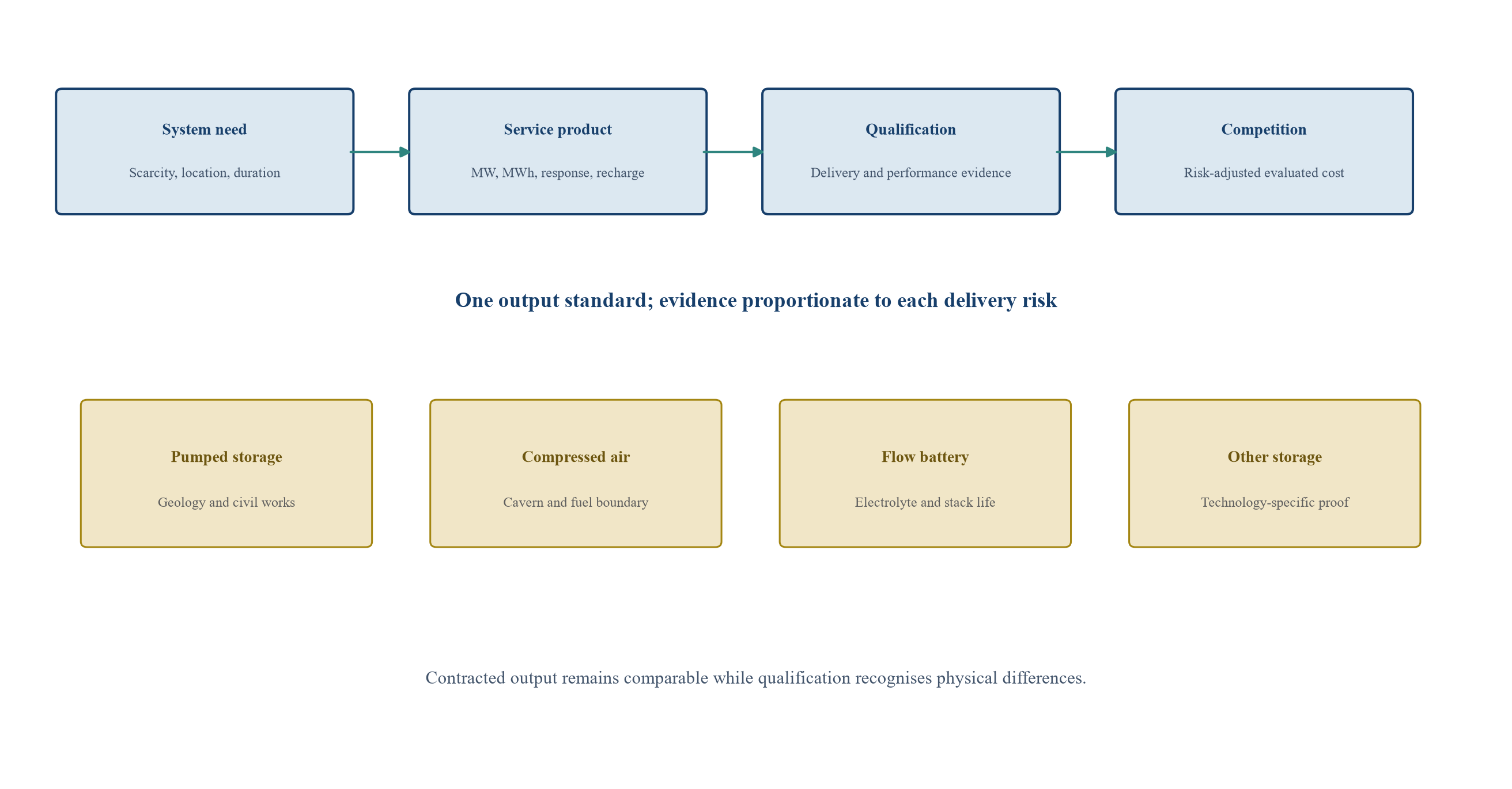
The architecture separates common service requirements from technology-specific evidence and competitive price discovery.
11. Location can change the system value of identical assets
Storage at a constrained node can absorb surplus generation, reduce curtailment and support local adequacy. The same asset at an unconstrained node may provide less network value. Locational signals should use published network evidence and avoid arbitrary preferences.
The procurement can define zones, apply locational adders, procure separate quantities or include network value in portfolio optimisation. Each approach requires a transparent method. Connection deliverability should be confirmed before award because a nominal queue position does not establish timely access.
Locational value can change as transmission is built. Long contracts should define whether the asset retains the original payment when system conditions evolve.
12. Response speed should match the diagnosed service
Milliseconds, seconds, minutes and hours correspond to different system needs. Fast frequency response can be valuable, yet it should not dominate an auction intended to buy sustained energy. Minimum response should be set at the level required for the contracted event.
Additional services can remain available through separate markets if they do not impair the storage obligation. The contract should specify priority during overlapping calls and prevent the same capacity from being sold twice.
Telemetry, control integration and dispatch testing should prove response before commercial operation. An engineering specification unsupported by integrated testing is incomplete completion evidence.
13. Self-discharge and standing losses affect long holding periods
Some technologies can retain energy for long periods with modest loss; others consume material energy through thermal management, pressure management or self-discharge. A seasonal product should measure the state-of-charge path across the expected holding period.
The common model should price the energy required to maintain readiness. It should also recognise whether losses vary with temperature, inventory, time and operating mode. Guarantees should use test conditions that resemble the commercial duty.
Standing losses influence both variable cost and carbon accounting. They should be included in the dispatch and emissions model rather than hidden within fixed operating cost.
14. Degradation links operating decisions to future availability
Cycle life, calendar ageing, mechanical wear and component replacement affect the capacity available over the contract term. Bidders should provide a warranted performance curve, maintenance plan and augmentation strategy. The financial model should fund replacement at realistic intervals.
The contract can require a minimum tested capability in each delivery year. It should allow planned augmentation while preserving safety, connection and environmental compliance. Penalties should apply to service shortfalls, not to a particular maintenance choice.
Residual value is sensitive to remaining life, future market need and replacement cost. Acquisition models should avoid assuming that nameplate capability persists without capital expenditure.
15. Portfolio diversity can be a measurable procurement objective
A portfolio can reduce correlated failure, construction concentration and dependence on one supply chain or geography. Diversity has value when it improves expected service delivery. It should be measured through scenarios rather than used as an undeclared preference.
The procurer can optimise across evaluated cost, dependable capacity, duration, location and correlation. A higher-priced project may enter the portfolio if it materially reduces common-mode risk. The optimisation rule and any constraints should be published.
Portfolio discretion requires governance. Independent review, an audit trail and sensitivity disclosure help demonstrate that selection follows the stated system objective.
16. Technology-specific evidence protects a neutral competition
Common outputs require different proof. Pumped storage needs reservoir, geology, hydrology, civil-design and permitting evidence. Compressed-air storage needs cavern, pressure, thermal-cycle and any fuel or emissions boundary. Electrochemical systems need cell, module, thermal-runaway, warranty and degradation evidence. Emerging systems need pilot results at relevant scale and duty.
The evidence standard should be proportionate to the risk carried by consumers and financiers. A novel technology can compete when uncertainty is priced, contained and reduced through milestones. Neutrality does not require the buyer to treat unproven performance as proven.
Independent engineer review should focus on whether the proposed system can meet the service, construction schedule and life assumptions.
17. Prequalification should remove non-deliverable bids
Prequalification should test site control, connection pathway, planning status, technology rights, sponsor capability, financing plan and delivery schedule. The threshold should be demanding enough to exclude speculative bids while allowing credible new entrants.
Evidence can be staged. Early qualification may accept a documented route to consent or connection, while financial close requires executed agreements. The auction rules should distinguish conditions precedent from post-award milestones.
A bid cap does not protect consumers if the lowest offer cannot be built. Delivery confidence belongs in qualification and evaluation, supported by security and milestone remedies.
18. Bid security should reflect the harm from non-delivery
Bid bonds, development security and completion security discourage speculative bidding and compensate for re-procurement cost. Their size should reflect project stage, award value, replacement lead time and the sponsor's ability to control the relevant risk.
Security that is too small becomes an option fee. Security that is excessive can exclude otherwise financeable projects and concentrate competition among large sponsors. A stepped structure can increase exposure as the project reaches defined milestones.
Release conditions should be objective. Drawdown should follow a material, uncured failure within the bidder's control, with lender cure rights where appropriate.
19. Lead-time diversity should shape auction cadence
Long-duration assets have different construction periods. A pumped-storage project may require extensive civil works and permitting. Modular systems can be deployed faster but may face manufacturing and integration constraints. One delivery year can therefore bias the eligible set.
The buyer can run recurring auctions, create delivery windows or procure separate near-term and strategic tranches. A credible cadence gives developers and supply chains visibility while preserving competition.
Milestones should reflect each project plan, yet the final service date remains common. Schedule contingency and interface ownership should be visible in the bid rather than absorbed into an unsupported completion promise.
20. Completion tests should reproduce the contracted duty
Mechanical completion does not establish service capability. The project should demonstrate net power, continuous duration, response, state-of-charge measurement, recharge and repeated-event performance. Tests should include essential auxiliaries and the commercial connection point.
Testing rules should address ambient conditions, water levels, pressure, cell temperature and other variables that affect performance. Correction curves can be used when they are agreed before testing and independently verified.
Provisional acceptance may permit a limited cure period with reduced payment. Final acceptance should require the full accredited service and complete data handover.
Table 1. Service-product design matrix
| System requirement | Auction parameter | Qualification evidence | Settlement measure |
|---|---|---|---|
| Dependable capacity | Accredited MW | Availability and outage evidence | Metered MW during stress |
| Sustained delivery | Continuous hours at contracted MW | Usable-energy and operating model | Delivered MWh and terminal state |
| Rapid mobilisation | Notice and ramp requirement | Controls and integrated test | Dispatch timestamp and ramp |
| Repeat readiness | Recharge window and event sequence | Charging pathway and operating plan | Restored state of charge |
| Locational value | Eligible zone or network node | Connection and deliverability evidence | Metered delivery at node |
| Low-carbon operation | Emissions boundary or threshold | Energy-source and process evidence | Auditable operational emissions |
Each auction parameter should be traceable from the diagnosed need to evidence and settlement.
21. A common cost boundary prevents selective bids
Evaluated cost should include the support payment, expected charging energy, network charges borne by consumers, losses, balancing exposure, expected penalties and any public contribution. Tax and inflation treatment should be consistent across bids.
The boundary should also recognise retained merchant revenue. A project keeping substantial market upside may require less fixed support, while a project transferring upside can justify a different payment. Comparisons should use expected net consumer cost under common scenarios.
Published templates reduce ambiguity. Bidders can still offer innovation within the standard boundary, supported by schedules that reconcile to the bid price.
22. Bid price and system value answer different questions
Bid price identifies the requested remuneration. System value measures avoided costs and incremental service. Selecting the lowest nominal price can be inefficient when bids differ in location, duration, availability or delivery probability.
The evaluation can convert each attribute into a common risk-adjusted cost per dependable megawatt or expected served megawatt-hour. Inputs should be observable where possible and tested through sensitivities.
Value modelling should avoid double counting. For example, a locational benefit embedded in avoided network cost should not also receive an unexplained qualitative premium.
23. Uniform clearing prices can support competition
Under a uniform-price auction, accepted bids receive the clearing price. This can encourage bidders to reveal opportunity cost when competition is effective. It can also create consumer concern when low-cost projects earn infra-marginal rent.
Market power, bid concentration, uncertain quantities and heterogeneous products complicate the design. A uniform price is most credible where bids compete for a sufficiently standard service and the clearing rule is published.
The buyer should test concentration, pivotal suppliers and the effect of quantity changes. Bid caps and independent monitoring can complement the design, while preserving a route for legitimate high-cost projects to explain exceptional conditions.
24. Pay-as-bid pricing shifts forecasting risk
Under pay-as-bid, each successful project receives its offer. This may appear to reduce windfall payments. Bidders then have an incentive to estimate the clearing level rather than bid underlying cost, and weaker participants may price that uncertainty poorly.
Heterogeneous long-duration projects can make pay-as-bid administratively convenient because contracts already differ in timing and risk. The procurer should compare expected consumer cost after strategic bidding and financing contingencies.
Whichever pricing rule is chosen, evaluation adjustments should remain separate from contractual payment unless the rules state otherwise.
25. Multi-parameter auctions can improve service matching
A multi-parameter bid can include fixed payment, variable dispatch price, dependable capacity, duration, availability and delivery date. Evaluation uses a published formula or optimisation model to select the portfolio.
This format captures heterogeneity and creates a direct link between service and cost. It also increases modelling and governance requirements. Bidders must be able to reproduce the evaluation, and the procurer should publish enough information to support accountability without disclosing protected bid data.
The formula should be locked before opening price bids. Post-bid discretion should be confined to stated clarification and verification rights.
26. Portfolio optimisation should expose trade-offs
Optimisation can minimise expected system cost subject to quantity, duration, location, diversity and delivery constraints. The model should report which constraints bind and how results change under alternative scenarios.
A robust selection is one that remains reasonable across plausible demand, renewable, fuel-price and project-delay cases. Sensitivity analysis can identify awards that depend on a narrow forecast.
The optimisation output supports a decision; governance remains necessary. Data provenance, version control, independent validation and a retained audit package should accompany the recommendation.
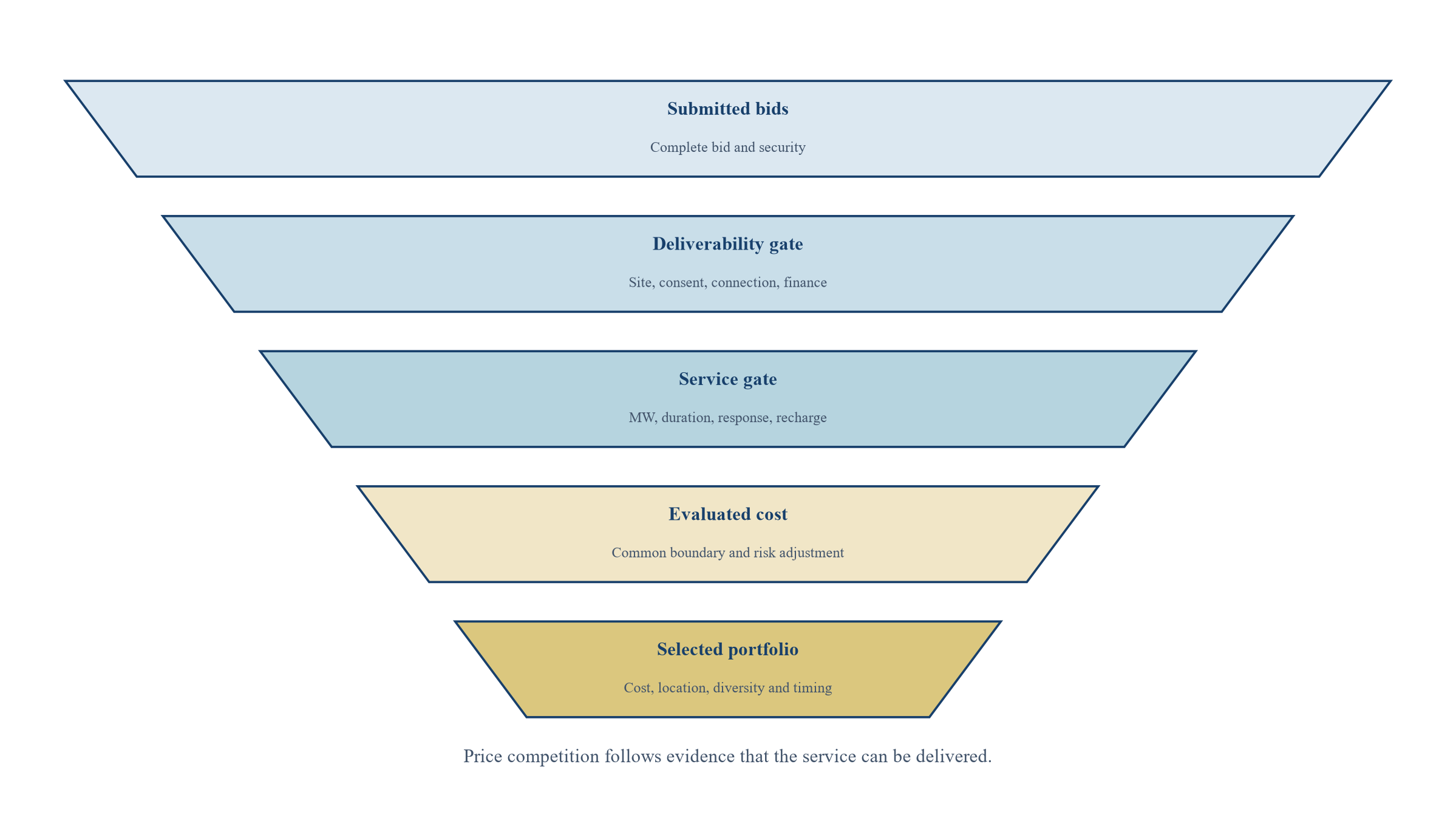
Bids pass through deliverability and service gates before portfolio optimisation and contracting.
27. Adequacy evidence should govern the procured quantity
Over-procurement raises consumer cost and can suppress merchant investment. Under-procurement leaves the diagnosed reliability gap. The quantity should be derived from a probabilistic adequacy assessment and adjusted for expected contribution from existing resources.
The assessment should include weather years, correlated outages, demand uncertainty, interconnection and energy limitations. It should state the reliability standard and the marginal value of additional capacity.
Quantity revision rules should be announced before bidding. Material late changes can undermine financing effort and confidence in future auction cadence.
28. Duration bands can reveal the shape of system need
Separate bands can procure short, long and multi-day resources without forcing one technology to satisfy every duty. Each band should correspond to a distinct need and avoid arbitrary fragmentation.
Interaction between bands matters. A twenty-hour resource may satisfy an eight-hour need, while an eight-hour resource cannot satisfy a twenty-hour obligation. Substitution rules should reflect accredited contribution and prevent excess payment for redundant duration.
The buyer can publish minimum quantities by band and allow optimisation above those floors. This preserves competition while securing the required capability.
29. Central procurement can coordinate strategic resources
Central procurement is useful where market signals do not provide timely investment in resources with long lead times or broad system benefits. California authorised central procurement for long-lead resources, including long-duration and multi-day storage. The structure concentrates planning and credit decisions in a designated buyer.
Centralisation can improve coordination across utilities and reduce fragmented procurement. It also creates forecast, governance and cost-allocation responsibilities. Beneficiaries, payment collection and prudency review should be clear.
Projects still require disciplined competition and delivery controls. Central status should not substitute for transparent evaluation.
30. Long-term energy service agreements allocate market exposure
New South Wales uses Long-Term Energy Service Agreements within its Electricity Infrastructure Roadmap. Tender Round 5 announced 524 MW and 4,192 MWh of long-duration storage, illustrating procurement of both power and energy capability.
A long-term agreement can provide a revenue floor or option-like support while allowing market participation. The strike, floor, sharing and exercise rules determine risk allocation. Financeability depends on the credit of the settlement counterparty and predictability of payment.
Comparable bids require consistent treatment of forecast merchant revenue and retained upside. The evaluation should disclose the market scenarios used to value the support instrument.
Procurement teams should also reconcile the agreement with dispatch rules, network access and wholesale settlement. A support contract cannot create physical charging energy or export access. The project model should demonstrate performance through low-price charging periods, high-price discharge periods and prolonged system stress. Consumer exposure should be reported as present value, annual cash requirement and tail liability under consistent cases.
For financiers, the decisive question is whether the floor behaves as dependable cash flow after availability deductions, market settlement and termination provisions. Legal review should trace every payment through metering, calculation, invoicing, dispute and credit support. Technical review should confirm that the operating strategy used in the revenue model remains compatible with warranty and service obligations.
31. Cap-and-floor structures can support low-utilisation assets
A cap-and-floor regime can protect projects against very low revenue while returning part of high revenue to consumers. Ofgem's long-duration electricity-storage framework applies this approach and assesses projects across economic, strategic and financial merits. Its 2026 minded-to position covered sixteen projects across several technologies.
The floor should support efficient fixed cost and financing under specified conditions. The cap should preserve operating incentives while sharing upside. Treatment of market revenues, outages, refinancing and additional capital expenditure requires detailed rules.
Competitive parameters can be limited while project assessment covers a wider evidence set. This preserves price discovery within a structured qualification and evaluation process.
32. Availability payments should buy verifiable readiness
An availability payment can create stable cash flow for resources whose value arises during infrequent stress. Payment should be proportional to accredited capacity and adjusted for tested availability, outage and event performance.
The contract should prevent an asset from earning full availability revenue while repeatedly entering stress periods with insufficient charge. State-of-charge obligations, reserve inventory or readiness tests can address that risk.
Lenders will examine the payment formula, penalty caps, force majeure, change in law and termination compensation. A predictable contract can support debt; weak performance definitions can leave material cash-flow uncertainty.
33. Revenue stacking needs a hierarchy of obligations
Storage can earn from wholesale arbitrage, balancing, ancillary services, network support and capacity. Multiple revenues can improve utilisation and reduce required public support. They can also create conflicting dispatch obligations.
The contract should define priority when calls overlap, capacity reserved for the procured service, state-of-charge management and treatment of incremental wear. Telemetry should allow the buyer to verify that sold capacity remains available.
Financial modelling should avoid adding revenues that rely on the same megawatt in the same interval. Downside cases should remove speculative markets and retain only supported contracted cash flows.
34. Indexation should follow the cost exposure
Long construction and operating periods expose projects to inflation in civil works, equipment, labour and maintenance. Indexing the entire payment to a general price index can overcompensate or undercompensate specific technologies.
A transparent formula can separate pre-completion and operating periods, apply indexation to eligible cost shares and include caps or reopeners for exceptional events. Bidders should disclose the unindexed portion and contingency.
Debt sizing should use the contractual index rather than an assumed perfect hedge. Mismatches between indexed revenue and fixed or foreign-currency cost remain sponsor risk unless hedged.
35. Foreign-exchange and supply-chain risk should be allocated explicitly
Equipment can be priced in a currency different from the support payment. Lead times, commodity inputs, shipping and supplier concentration create additional exposure. The bid should state its base date, currency assumptions and hedge plan.
Automatic pass-through weakens price competition. Full sponsor exposure can produce large contingencies or non-delivery. A balanced structure can retain ordinary movements with the bidder and define narrow relief for specified extreme events.
Supply-chain diligence should examine manufacturing capacity, substitute suppliers, intellectual property, warranty support and spare parts. Delivery security depends on the complete chain rather than the primary equipment order alone.
36. Connection risk can dominate project timing
A storage plant requires dependable import and export rights. Queue position, reinforcement scope, curtailment, charging restrictions and energisation timing can materially affect service. The auction should require a credible connection pathway and identify which network works are outside sponsor control.
Milestones should track offer acceptance, design approval, construction and energisation. Relief should be confined to evidenced network delay after the project has met its own obligations.
Locational procurement should confirm that the connection enables the intended system value. A constrained import right may limit recharge even when export capacity is available.
37. Planning and environmental evidence belongs before award
Reservoirs, caverns, industrial sites, transmission connections and battery facilities face different planning and environmental pathways. Water, land, ecology, subsurface rights, visual impact, noise, fire safety and community engagement can affect schedule and design.
Prequalification should require a consent map, baseline studies, stakeholder plan and critical-path schedule. A project with unresolved fundamental siting issues should not receive the same delivery score as one with mature approvals.
Contract relief for permitting should distinguish general development risk from a specific government-caused delay. The allocation should be stated before bids.
38. Safety is a continuing commercial obligation
Storage technologies carry different hazards, including dam integrity, pressure, thermal events, hazardous materials and underground integrity. Applicable regulation, design standards, emergency response and insurer requirements should be identified during qualification.
The contract should require reporting, incident management, maintenance and independent inspections throughout the term. Safety-related outages affect availability settlement while preserving the operator's duty to act safely.
Investors should test whether the operating budget, staffing and spares support the safety case. Deferred maintenance can increase both event risk and long-term availability loss.
39. Cybersecurity protects dispatch and settlement
Storage assets depend on controls, telemetry, market interfaces and remote access. A cyber incident can interrupt dispatch, distort state-of-charge data or compromise settlement. Procurement should require an architecture, access controls, incident response, patching and supply-chain assurance proportionate to criticality.
Completion testing should include data integrity and fail-safe operation. Material changes to controls should remain subject to configuration management.
Cyber obligations should extend to key contractors and cloud services. Insurance can support recovery, while technical and governance controls remain the primary protection.
40. Three hypothetical cases show how design changes selection
The following cases are illustrative and use simplified assumptions. They do not represent bids, forecasts or recommendations. Their purpose is to show how a service-led evaluation can produce a different ranking from nominal bid price.
Case A procures eight-hour evening capacity in a constrained renewable zone. Case B procures twelve-hour central adequacy capacity. Case C procures multi-day strategic reserve with limited annual dispatch. Each case uses a different duration, recharge and availability obligation.
The evaluation should apply the same method to all eligible technologies within each case and avoid transferring results across services that are materially different.
Table 2. Hypothetical technology-neutral auction cases
| Case | Contracted need | Evaluation emphasis | Principal risk test |
|---|---|---|---|
| A; constrained-zone evening | 300 MW for eight hours | Location, import access and cycling efficiency | Connection and repeat recharge |
| B; central adequacy | 500 MW for twelve hours | Dependable capacity, delivery date and evaluated cost | Derating and completion |
| C; multi-day reserve | 250 MW for forty-eight hours | Inventory, standing loss and event reliability | Rare-event readiness and replenishment |
Values are illustrative and show how the product changes the evaluation emphasis.
41. Case A rewards usable capacity at the relevant node
Case A values eight-hour delivery and repeated recharge within a constrained zone. An efficient modular project may score well if connection and charging rights are credible. A larger-duration asset can compete, but receives value only for the service and incremental network benefit demonstrated.
The buyer evaluates total expected cost after charging losses and curtailment effects. Bid price alone does not establish the ranking. A low-priced project with an uncertain connection receives a delivery adjustment or fails qualification.
Settlement combines fixed availability with market energy revenue retained under defined stacking rules. Repeated-event tests protect the service during consecutive stressed evenings.
42. Case B makes derating and schedule decisive
Case B seeks dependable capacity for a specified delivery year. Bids are converted to accredited megawatts using the published method. A project offering more nameplate capacity can rank below a smaller project when its duration or delivery probability is weaker.
The portfolio model includes construction delay, correlated outages and location. Bid security rises at financial close and major construction milestones. Capacity payment begins only after the full service test.
Lenders size debt to contracted availability cash flow under conservative outage and penalty cases. Merchant revenue provides upside and limited coverage support rather than the sole repayment source.
43. Case C values inventory and strategic readiness
Case C procures a forty-eight-hour reserve expected to dispatch rarely. Energy throughput is low by design, so a pure arbitrage case is inadequate. The contract pays for accredited readiness and reimburses or indexes dispatch energy under a defined formula.
Qualification focuses on stored inventory, withdrawal rate, standing loss, black-start or restoration needs where relevant, and the ability to replenish after an event. Annual tests verify the connected system without consuming the full reserve unnecessarily.
Valuation compares the support cost with the expected cost of alternative firm resources and unserved energy under the system model. All inputs remain scenario-dependent.
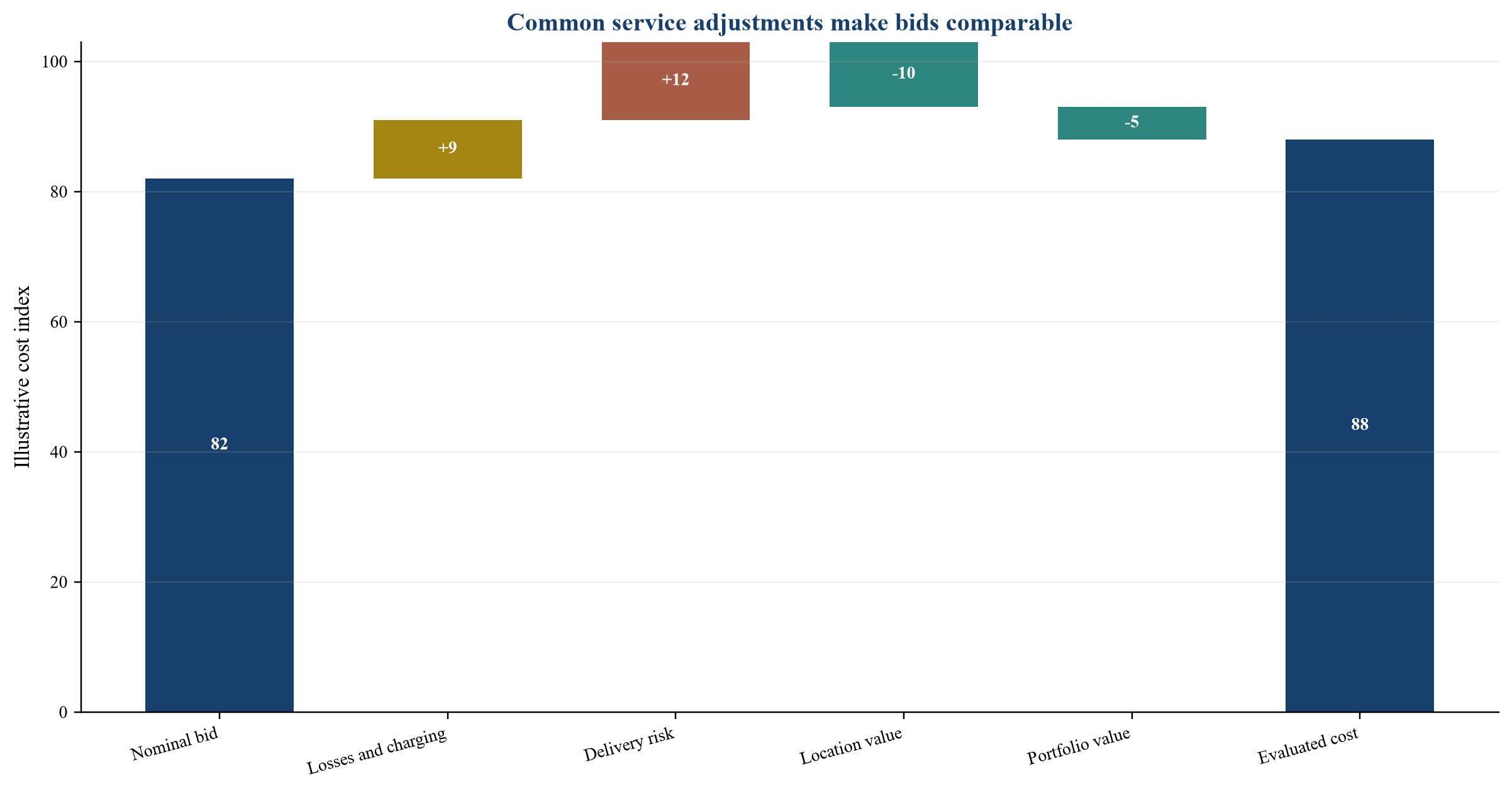
Illustrative values show how common adjustments can reverse a nominal bid-price ranking; they are not forecasts or observed bids.
44. Risk allocation should follow control and evidence
Sponsors should carry design, construction, operation and ordinary market risks they can manage. The buyer should carry payment obligations and clearly defined policy choices. Network, planning, change-in-law and force-majeure risks require allocation based on control, information and the cost of bearing them.
The allocation should be consistent across the tender, contract and financial model. Hidden transfer increases bid contingencies or undermines delivery after award. Relief events need notice, mitigation, evidence and limits.
Termination compensation should distinguish project default, buyer default, prolonged force majeure and voluntary termination. Lender step-in and cure rights can preserve service while protecting public value.
Risk registers should state the event, control owner, early warning, mitigation, contractual consequence, financial exposure and residual risk. Construction interfaces deserve particular attention because storage projects combine civil works, power equipment, controls and network assets. A single missing interface can delay the integrated service even when individual packages are complete.
The financing case should map each material risk to contingency, insurance, guarantee, reserve or sponsor support. Contract protections should remain enforceable through the project company and direct agreements. Investment committees should see both the allocated risk and the evidence that the allocated party can bear it.
Table 3. Risk allocation and financing response
| Risk | Primary control | Contract response | Financing diligence |
|---|---|---|---|
| Construction and integration | Sponsor and contractors | Milestones, security and delay remedies | Fixed-price coverage, contingency and interface review |
| Performance and degradation | Operator and technology provider | Tested availability and shortfall settlement | Warranty, augmentation plan and downside case |
| Market revenue | Sponsor, subject to policy design | Defined stacking and revenue sharing | Conservative merchant curves and sensitivities |
| Connection delivery | Sponsor and network company | Evidence gates and narrow relief | Offer, works programme and energisation dependency |
| Buyer payment | Contract counterparty | Credit support and termination payment | Counterparty and legal enforceability review |
| Change in law | Allocated by definition | Adjustment or relief within stated scope | Scenario analysis and reserve |
Allocation should follow control, information and capacity to bear the exposure.
45. A disciplined first hundred days can make the auction investable
During the first thirty days, the procurer should confirm the need case, reliability standard, product boundary, quantity, delivery windows and governance. It should publish the data needed for bidders to reproduce the core system analysis.
During days thirty-one to sixty, it should consult on qualification, derating, evaluation, contract payment, penalties, revenue stacking and security. Independent technical, auction, legal and financing review should test internal consistency.
During days sixty-one to one hundred, the procurer should freeze the methodology, issue standard models and data-room protocols, establish conflict controls and complete a dry run with synthetic bids. A credible process buys measurable duration and rewards verified availability while keeping competition open to any technology capable of delivering the defined service.
The final launch pack should include the need case, product definition, qualification checklist, derating workbook, evaluation model, contract, security forms, timetable, clarification protocol and governance record. A bidder should be able to reconcile an engineering design to accredited output, a financial model to the requested payment and a construction plan to the service date.
After award, the same evidence chain should continue through financing, construction, testing and operation. Periodic publication of aggregate delivery status, accredited capacity and consumer cost can strengthen accountability while protecting confidential bid data. Future rounds should incorporate observed completion and operating performance through a pre-announced methodology.
References
- Ofgem (2025), Long duration electricity storage: multi-criteria assessment framework. https://www.ofgem.gov.uk/publications/long-duration-electricity-storage-multi-criteria-assessment-framework
- Ofgem (2026), Long duration electricity storage: minded-to project assessment decision. https://www.ofgem.gov.uk/publications/long-duration-electricity-storage-minded-project-assessment-decision
- Ofgem, Long duration electricity storage cap and floor regime. https://www.ofgem.gov.uk/energy-policy-and-regulation/policy-and-regulatory-programmes/long-duration-electricity-storage
- UK Government, Capacity Market. https://www.gov.uk/government/collections/electricity-market-reform-capacity-market
- UK Government (2025), Capacity Market T-4 auction results. https://www.gov.uk/government/publications/capacity-market-auction-results
- National Energy System Operator, Capacity Market registers and auction guidance. https://www.neso.energy/industry-information/capacity-market
- ACER, Capacity mechanisms. https://www.acer.europa.eu/electricity/security-of-supply/capacity-mechanisms
- ACER (2026), European resource adequacy assessment methodology amendments. https://www.acer.europa.eu/documents/official-documents/decisions
- European Commission, Energy storage. https://energy.ec.europa.eu/topics/research-and-technology/energy-storage_en
- United States Department of Energy, Storage Innovations 2030. https://www.energy.gov/oe/storage-innovations-2030
- United States Department of Energy, Long Duration Storage Shot. https://www.energy.gov/oe/long-duration-storage-shot
- National Renewable Energy Laboratory, Storage Futures Study. https://www.nrel.gov/analysis/storage-futures.html
- International Energy Agency (2024), Batteries and Secure Energy Transitions. https://www.iea.org/reports/batteries-and-secure-energy-transitions
- California Public Utilities Commission, Central Procurement Entity. https://www.cpuc.ca.gov/industries-and-topics/electrical-energy/electric-power-procurement/central-procurement-entity
- California Public Utilities Commission, Integrated Resource Planning. https://www.cpuc.ca.gov/industries-and-topics/electrical-energy/electric-power-procurement/long-term-procurement-planning
- California Department of Water Resources, Strategic Reliability Reserve and procurement information. https://water.ca.gov/Programs/State-Water-Project/Power-and-Risk-Office
- AEMO Services, Long-Term Energy Service Agreements. https://aemoservices.com.au/tenders
- AEMO Services, Tender Round 5 results. https://aemoservices.com.au/news
- New South Wales Government, Electricity Infrastructure Roadmap. https://www.energy.nsw.gov.au/nsw-plans-and-progress/major-state-projects/electricity-infrastructure-roadmap
- Council of European Energy Regulators, Security of supply and capacity mechanisms. https://www.ceer.eu/electricity
- International Renewable Energy Agency, Electricity storage valuation framework. https://www.irena.org/publications
- Sandia National Laboratories, DOE Global Energy Storage Database. https://gesdb.sandia.gov/
- Federal Energy Regulatory Commission, Electric storage participation in markets. https://www.ferc.gov/electric-power-markets
- National Renewable Energy Laboratory, Grid-scale storage analysis. https://www.nrel.gov/grid/energy-storage.html
About the Author
Chennakeshav (CK) is a corporate finance and investment banking executive with 25+ years of global experience in deal origination, structuring and execution across M&A, growth capital and corporate strategy. He has led value-creation mandates for founders, corporates and funds — bridging the boardroom view to hands-on execution and close.
His career spans Morgan Stanley, HSBC, Lloyds Banking Group, EWEC, ADQ portfolio companies and Emirates Growth Fund, across TMT, real estate, fintech, deeptech, cleantech, infrastructure and energy. He has partnered with C-suite leaders, private equity and venture funds, sovereign wealth funds and family offices to finance complex fund raises and scale-up ventures, and has led M&A due diligence, post-merger integration and business-transformation initiatives to create value.
At Matchpoint Partners he is Managing Partner, leading the firm's corporate finance, M&A and capital-raising practice. He holds an MBA from London Business School, an engineering degree from VTU and a Master of Laws (LLM, in progress) from UCL London.
An active start-up mentor, CK mentors at Techstars, DIFC FinTech Hive, Startup Grind, Founder Institute and IN5, serves as Entrepreneur Mentor in Residence (EMiR) at London Business School, and judges the Entrepreneurship World Cup.
LinkedIn: https://www.linkedin.com/in/ckadya/
Profile: https://www.matchpoint-partners.com/team/ck-adya.html
