

1. Seasonal storage is an insurance question as well as an efficiency question
Electricity systems with large shares of wind and solar can experience surplus generation in one period and scarcity in another. Batteries can shift energy across hours. Reservoirs, demand response, interconnection and dispatchable generation can cover other intervals. Hydrogen becomes relevant when the required duration, fuel inventory or strategic reserve extends beyond the economic duty of shorter-duration assets.
The first investment question is not whether hydrogen is efficient in isolation. It is whether a defined hydrogen chain delivers a needed service at lower risk-adjusted cost than the available alternatives. The comparison should include energy losses, capital, fixed operating cost, fuel inventory, network cost, carbon performance, response time, reliability and the value of dependable supply during stressed periods.
Security value is real only when the asset can deliver. Storage volume without withdrawal capacity, hydrogen production without transport, or a turbine without firm fuel is incomplete. The financed asset is the connected chain.
2. The complete chain defines the economic boundary
A seasonal hydrogen system can include renewable generation, grid import, electrolysis, water treatment, drying, compression, pipelines, geological storage, withdrawal, purification, metering, direct industrial use and power generation. Each component has its own capacity, availability, loss and contractual boundary.
An energy balance should begin at the electricity meter feeding the electrolyser and end at the final sale meter. For hydrogen-to-power, that final meter is net electricity exported after turbine or fuel-cell auxiliaries. For direct use, the final meter may be kilograms or megawatt-hours of hydrogen delivered at specified pressure and purity.
Changing the boundary changes the apparent efficiency. An electrolyser efficiency does not represent the full chain. A turbine heat rate does not capture electrolysis and storage. Investment committees should require one reconciled model and prohibit selective component metrics.
3. Round-trip efficiency captures losses and omits duration value
Round-trip efficiency divides net electrical energy returned by net electrical energy consumed. The United States Department of Energy's 2023 bidirectional hydrogen-storage assessment used a 31 per cent base round-trip efficiency for a system with stated electrolyser and fuel-cell assumptions. That public benchmark illustrates the magnitude of conversion losses; it is not a project guarantee.
The metric is useful because lost energy must be purchased or produced. It is incomplete for an asset held for rare, prolonged scarcity. A reserve plant may operate for few hours while preserving system adequacy throughout the year. Its value comes from readiness and dependable capacity, not high annual energy throughput.
The correct comparison therefore pairs round-trip efficiency with duration, annual cycles, dependable megawatts, response, storage losses, outage correlation and the avoided cost of the marginal security resource.
4. Direct hydrogen use changes the conversion logic
Hydrogen sold to industry, refining, chemicals, heavy transport or another fuel user avoids conversion back to electricity. The energy chain still includes electrolysis, conditioning, compression, transport and storage, but it does not incur turbine or fuel-cell reconversion losses.
This distinction can materially change project economics. A store supporting both industrial demand and power-system reserve may earn from regular hydrogen throughput while preserving an inventory tranche for scarcity. The two services need separate rights, nomination rules and inventory accounting.
Direct-use demand also creates quality constraints. Pressure, purity, moisture, contaminants, temperature and delivery profile must meet the customer's process. A store that preserves energy quantity while allowing unacceptable contamination does not satisfy the commercial duty.
5. Electrolysis converts electricity into a storable molecule
Electrolysers split water into hydrogen and oxygen. Their output depends on electrical input, stack efficiency, loading, temperature, water quality, compression boundary and degradation. Flexible operation can absorb renewable surplus, but frequent starts, low-load periods and variable power may influence performance and maintenance.
The financial model should use net alternating-current electricity at the project boundary and saleable hydrogen after agreed treatment. Stack replacement, auxiliary systems and availability belong in operating cost. A quoted stack efficiency without balance-of-plant loads can overstate delivered output.
Renewable procurement also matters. A project relying on curtailed or negative-price power should test how often that energy is available at its grid node, whether the electrolyser can secure it, and whether network charges or connection constraints change the price.
6. Compression, drying and transport are material energy users
Hydrogen leaving an electrolyser may require drying, purification and compression before transport or injection. The work depends on inlet and delivery pressure, compressor stages, cooling, flow profile and equipment efficiency. Pipelines add linepack and pressure-management requirements.
These loads should appear explicitly in the energy balance. Treating them as a generic percentage can conceal a design that operates far from its efficient range. Compression equipment may also define the rate at which surplus electricity can be converted into stored inventory.
Transport utilisation influences unit cost. A large pipeline sized for future demand can be strategically valuable while operating at low initial throughput. The contract and financing structure must allocate ramp-up risk rather than assuming mature utilisation from the first year.
7. Geological storage separates inventory from deliverability
Underground capacity is commonly described in energy or mass terms. Commercial performance also depends on injectivity, withdrawal rate, pressure range, working gas, cushion gas, cycling, well configuration and surface equipment. Two stores with equal inventory can provide different dependable power.
Salt caverns can offer high deliverability and repeated cycling where suitable geology exists. Porous reservoirs such as depleted fields and aquifers may offer large volume and broader geographic potential while requiring evidence on containment, microbial activity, geochemical reactions, gas quality and recovery.
Storage value should therefore be decomposed into working inventory, injection capacity, withdrawal capacity, availability and required pressure. A single currency-per-kilowatt-hour metric does not capture the complete service.
8. Salt caverns provide a strong reference class with site-specific limits
Hydrogen has been stored in salt caverns for industrial use for decades in selected locations. Caverns are created through solution mining and operated within geomechanical pressure limits. Salt can provide low permeability and self-healing characteristics, subject to site conditions and design.
The development case depends on salt thickness, depth, purity, cavern spacing, leaching water, brine disposal, wells, subsidence, permitting and connection to production and demand. Existing industrial experience supports the storage principle. It does not remove project-specific construction and cycling risk.
The National Energy System Operator's 2025 pathways note existing hydrogen salt-cavern storage in Teesside and identify large-scale hydrogen storage as important for seasonal power use and security of supply. Those system pathways remain scenarios rather than project revenue contracts.
9. Porous reservoirs increase capacity and subsurface uncertainty
Depleted gas fields and aquifers can offer substantial pore volume. Their hydrogen performance depends on caprock integrity, residual fluids, mineral reactions, microbial consumption, mixing, pressure response and recovery. Existing wells and data can reduce selected uncertainties while introducing legacy integrity issues.
Pilot injection and withdrawal should measure gas composition, losses, pressure, plume behaviour and well performance across representative cycles. Models should be calibrated to observed data before full capacity is recognised in valuation.
Cushion gas can be a large initial inventory and working-capital requirement. The model should state whether cushion gas is recoverable, who owns it, how it is financed and what happens at decommissioning.
10. Above-ground storage serves different duties
Pressurised tanks, tube trailers, liquid hydrogen systems and chemical carriers can store hydrogen without suitable local geology. They generally face different scale, cost, energy and safety characteristics from underground storage.
Surface systems may suit buffering, mobility, distributed demand or early market development. Liquefaction and carrier conversion can facilitate transport while imposing additional energy use and reconversion requirements. The International Energy Agency notes material energy use for certain hydrogen shipping chains.
A seasonal power-system proposal should not assume that every hydrogen storage technology scales economically to months of inventory. The chosen medium should match volume, duration, location, purity and withdrawal duty.
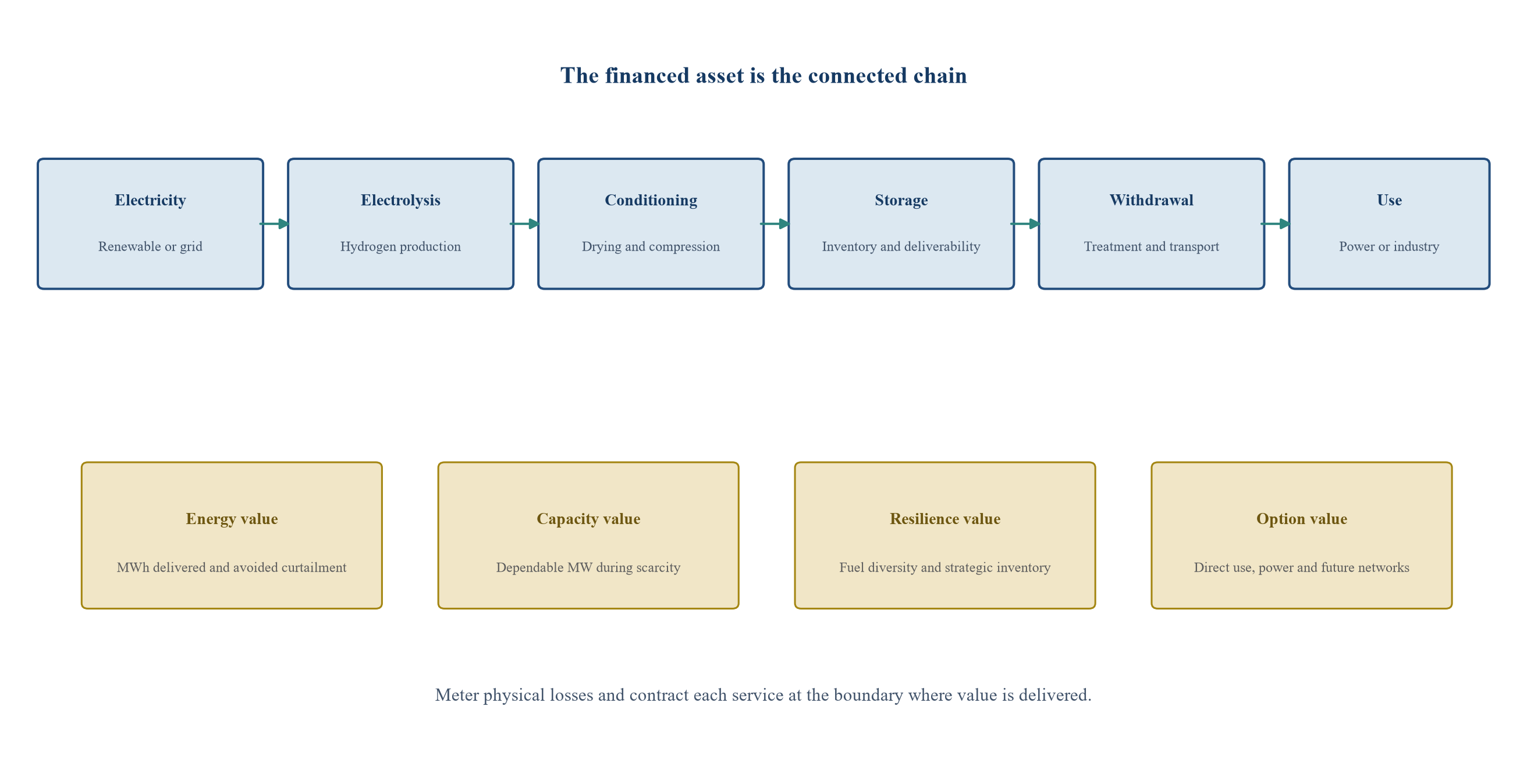
The diagram identifies physical and commercial boundaries. Actual equipment, losses, ownership and metering remain project-specific.
11. Seasonal duty creates low utilisation by design
A store intended for winter scarcity may complete one major annual cycle or remain unused in mild years. Low throughput raises the capital cost allocated to each unit of discharged energy. It can still be rational when the asset provides dependable capacity or avoids an expensive disruption.
The financial model should separate fixed readiness revenue from variable energy revenue. Fixed revenue supports staff, maintenance, inspections, debt service and return on capital. Variable revenue covers hydrogen consumed, incremental wear and dispatch costs.
An energy-only model is vulnerable when scarcity events are rare. A capacity-only model is vulnerable when performance obligations are weak. The commercial structure should pay for measurable readiness and penalise unavailable delivery.
12. Security of supply must be translated into a service specification
Security cannot remain a broad policy aspiration. A contract should define the event, notice, minimum output, duration, ramp, inventory, recovery time, permitted outages, testing and consequences of non-performance.
For hydrogen-to-power, dependable capacity is constrained by turbine availability, firm hydrogen, withdrawal rate, pipeline capacity and electricity connection. Accreditation should consider common-mode risks such as one compressor station or one pipeline serving multiple plants.
The alternative resource establishes the economic benchmark. It may be additional interconnection, demand response, gas generation with carbon constraints, bioenergy, nuclear, batteries, other long-duration storage or controlled load. Each alternative has a different risk and delivery profile.
13. Curtailment capture depends on chronology and location
Hydrogen is often proposed as a sink for surplus renewable electricity. Annual curtailment totals do not prove that a particular electrolyser can access that energy. Time, node, connection, network rules and competing flexible demand determine availability.
The model should use chronological hourly or sub-hourly data where possible. It should identify the price and volume the project can secure after network charges, losses and operational constraints. Future renewable build and transmission expansion can increase or reduce local surplus.
Electrolyser utilisation is a trade-off. Running only during the cheapest hours lowers electricity cost and spreads fixed capital over fewer kilograms. Running more often raises utilisation and may consume higher-priced electricity.
14. Hydrogen inventory creates working-capital exposure
Seasonal storage requires hydrogen to be produced and paid for before it is sold. Inventory may remain underground for months. Its funding cost, losses, insurance, ownership and valuation method influence project cash flow.
The project should distinguish working gas from cushion gas and strategic reserve. Inventory pledged to one customer cannot simultaneously support another obligation unless nomination and replenishment rules permit it. Title transfer at injection, in store or at withdrawal creates different credit exposure.
Lenders will examine whether inventory can be sold after counterparty default, whether access rights survive enforcement and whether quality remains within specification. A volumetric asset without marketable title may provide limited collateral value.
15. Carbon intensity follows the whole chain
Hydrogen's climate value depends on production pathway, electricity source, methane emissions where applicable, carbon capture performance, compression, transport, storage leakage and end use. A low-emissions label should map to the relevant regulation and contract.
For electrolysis, temporal and geographic electricity matching can influence attributed emissions. For hydrogen from fossil fuel with carbon capture, upstream methane and residual process emissions matter. Hydrogen leakage also warrants monitoring because it can affect atmospheric chemistry.
Contracts should preserve measurement data and allocate the risk of methodology change. A project may remain physically operational while losing a premium, subsidy or eligibility status if its emissions evidence fails.
16. Water and brine are development constraints
Electrolysis needs treated water. Salt-cavern construction requires water for leaching and creates brine that must be used or disposed of lawfully. Water availability, abstraction rights, treatment, discharge and local acceptance belong in the core development plan.
The quantity and timing should be reconciled with drought conditions and competing users. Desalination can add energy, capital and discharge considerations. Municipal or industrial sources may require long-term agreements and quality management.
Brine disposal can control cavern schedule. A cavern without a permitted brine route is not construction-ready. The owner should avoid valuing theoretical geological capacity before this constraint is resolved.
17. Development lead time can be longer than the power asset
Geological characterisation, wells, cavern leaching, pipelines, environmental approvals and market-support contracts can take years. A turbine or electrolyser procurement schedule may be shorter than the enabling infrastructure on which it depends.
The integrated critical path should cover subsurface studies, land, permits, water, brine, electricity, transport, storage and offtake. Independent schedules for each asset can conceal a system completion gap.
Early expenditure should purchase information and rights. Large irreversible capital should wait until decisive constraints have been reduced or contractually protected.
18. Technology readiness is chain-specific
Individual components may be commercially available while the integrated duty remains first of a kind. Electrolysers, compressors, wells, caverns, pipelines and turbines each have reference projects. Their combination at a new scale, pressure, fuel specification or operating profile can create integration risk.
Readiness evidence should record scale, operating hours, cycles, ramp, impurities, outages, maintenance and measurement boundary. A natural-gas turbine converted to hydrogen blend is not equivalent to a plant guaranteed for the proposed hydrogen concentration and duty.
Capital gates should follow integrated evidence. A pilot can establish injection and withdrawal behaviour. A demonstration can prove fuel and turbine performance. Commercial completion should prove the full contracted sequence.
19. Public project pipelines contain limited committed capacity
The International Energy Agency's 2026 infrastructure assessment reports a substantial announced underground-storage pipeline and a much smaller share at final investment decision or under construction. This gap is relevant to investors because announcements do not demonstrate financing, permits or completion.
Pipeline data can identify geography, scale and policy direction. It should not be treated as delivered supply. The project model should use only capacity supported by rights, engineering, approvals, contracts and credible funding.
Supply-chain demand should also be based on committed timing. A broad future pipeline can justify strategic positioning while leaving near-term utilisation uncertain.
20. Policy is beginning to contract the missing services
The United Kingdom has developed separate policy mechanisms for hydrogen production, transport, storage and hydrogen-to-power. The storage model work recognises that large infrastructure may need revenue support and coordinated allocation. The hydrogen-to-power response confirms an intention to use a business-model intervention adapted from dispatchable-power arrangements.
These initiatives illustrate the cross-chain problem. A store depends on producers and users. Producers depend on transport and demand. Power plants depend on firm fuel. Coordinated support can reduce circular dependency.
Policy design remains jurisdiction-specific and can change. An investment case should identify enacted rules, awarded contracts and remaining decisions rather than treating a policy intention as bankable revenue.
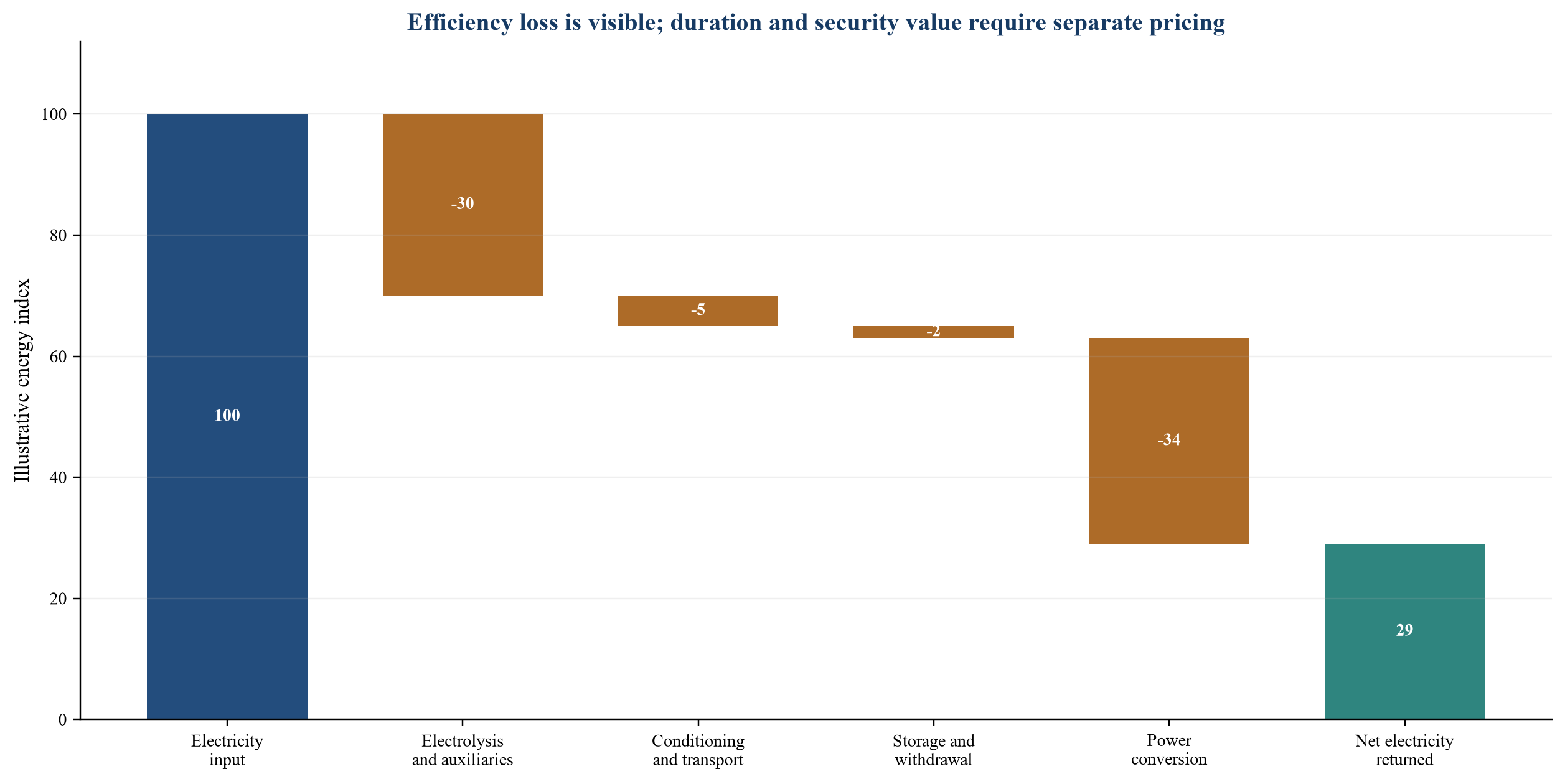
Values are hypothetical percentages of initial electrical input. They are not observed performance, a forecast or a project guarantee.
21. A common evidence matrix improves technology comparison
Storage concepts should be compared through geology, scale, deliverability, loss, operating evidence, development period, environmental boundary, quality risk and commercial duty. No single category wins every dimension.
Table 1. Evidence matrix for seasonal hydrogen storage archetypes
| Archetype | Principal advantage | Decisive evidence | Material risk | Most credible duty |
|---|---|---|---|---|
| Salt cavern | Large working volume and potentially high deliverability | Core data, cavern design, leaching plan, well integrity and cycling tests | Location, brine disposal, development schedule and cavern integrity | Seasonal inventory, repeated balancing and firm fuel |
| Depleted field | Potentially very large pore volume and existing subsurface data | Containment, microbial and geochemical tests, recovery and calibrated reservoir model | Hydrogen loss, contamination, cushion gas and legacy wells | Large strategic inventory with proven withdrawal |
| Aquifer | Broad theoretical resource in suitable structures | Seismic, wells, caprock, pressure, water chemistry and pilot cycles | Limited operating evidence, recovery and permitting | Future large-volume storage after demonstration |
| Pressurised surface tanks | Modular deployment and controlled equipment boundary | Certified vessels, cycle life, compression duty and safety case | High unit cost at seasonal scale and land footprint | Buffering, distributed demand and early markets |
| Liquid hydrogen | High volumetric density relative to compressed gas | Liquefaction performance, boil-off, materials and handling | Large energy penalty, boil-off and specialised infrastructure | Transport or high-value applications with limited alternatives |
| Chemical carrier | Use of carrier-specific transport and storage systems | Conversion yield, reconversion, purity and terminal compatibility | Additional conversion loss and carrier-management risk | Trade and transport where carrier infrastructure is valuable |
The matrix is a diligence framework. Project evidence, regulation and commercial performance remain location-specific.
22. Scenario analysis should preserve physical causality
Hydrogen economics are sensitive to electricity price, utilisation, efficiency, storage duration, capital cost, financing and sale value. A scenario should change related assumptions coherently. Cheap curtailed power may occur for limited hours, reducing electrolyser utilisation. High scarcity prices may occur infrequently and carry volume uncertainty.
Chronological dispatch should respect production, injection, inventory, withdrawal, turbine and network limits. An annual average can permit hydrogen to be used before it is produced or hide prolonged low-renewable periods.
The model should show mass and energy balances in every period. Reconciliation errors can create more apparent value than the commercial strategy.
23. Three hypothetical cases reveal different value drivers
The following cases are illustrative and do not describe an identified project. They demonstrate how duty changes the investment case.
Table 2. Hypothetical seasonal-hydrogen commercial cases
| Attribute | Case A: industrial seasonal supply | Case B: hydrogen-to-power reserve | Case C: integrated multi-user hub |
|---|---|---|---|
| Electrolyser capacity | 100 MW | 500 MW | 1,000 MW |
| Storage working inventory | 150 GWh hydrogen energy | 1,500 GWh hydrogen energy | 4,000 GWh hydrogen energy |
| Principal storage | Salt cavern | Salt caverns | Caverns or proven porous storage |
| Final service | Firm industrial hydrogen | 300 MW dispatchable power for prolonged scarcity | Industrial supply, balancing and 600 MW power reserve |
| Illustrative full-chain electrical round-trip efficiency | Not applicable to direct use | 30% | 32% for power tranche; direct-use tranche avoids reconversion |
| Illustrative major cycles | 2 per year | 0.5 per year | 1.5 blended cycles per year |
| Principal revenue | Take-or-pay hydrogen and availability | Readiness, capacity and dispatched energy | Storage capacity, throughput, reserve and optionality |
| Dominant risk | Customer credit and specification | Low utilisation and cross-chain availability | Interface, allocation and governance complexity |
| Financing posture | Project finance possible after firm offtake and completion | Contracted availability revenue needed for leverage | Ring-fenced assets and coordinated contracts |
Every quantity is a modelling assumption for framework illustration. The cases are not forecasts, observed projects or investment recommendations.
24. Case A values firm molecules rather than returned electricity
The industrial case produces hydrogen during lower-cost periods and delivers against a customer profile. Its economics depend on avoided alternative fuel, process value, carbon eligibility, take-or-pay commitment and storage service.
The customer may value continuity more than spot hydrogen price. A production outage or electricity constraint can be covered from inventory. The contract should define minimum stock, delivery pressure, purity, nomination and replenishment.
Direct use avoids power reconversion, but it does not remove production and storage losses. Debt capacity depends on the customer's credit, termination payment, replacement market and the project's ability to meet specification.
25. Case B needs a readiness contract
The power-reserve case may dispatch rarely and consume large hydrogen volumes during prolonged scarcity. Energy sales alone are unlikely to recover fixed cost under the illustrative duty. A capacity, availability or dispatchable-power contract therefore becomes central.
The contract should pay for dependable output and define fuel-stock obligations. Performance testing should prove start, ramp, sustained output, emissions, minimum load, cycling and recovery. The storage and pipeline must be tested with the plant rather than separately.
Fuel price indexation and dispatch economics require careful design. The operator should not profit from withholding inventory, and it should not face unlimited exposure to a fuel price it cannot control.
26. Case C creates a portfolio and allocation problem
An integrated hub can serve industrial users, balance producers and retain a reserve tranche for power. Diversified demand can improve utilisation and reduce dependence on one customer. It also creates competing claims on inventory and withdrawal capacity.
Operating rules should allocate capacity during normal and emergency periods. Priority rights, interruptibility, imbalance charges and replenishment determine how value and risk are shared. A central system operator or storage operator may be needed.
Financing can ring-fence components while preserving interface obligations. Cross-defaults and step-in rights should avoid a failure in one user contract collapsing the whole system unnecessarily.
27. Revenue stacking requires compatible obligations
Potential revenue includes hydrogen sales, storage-capacity fees, injection and withdrawal charges, capacity payments, availability revenue, ancillary services, electricity sales and strategic-reserve payments. Each stream can improve utilisation or risk allocation.
The obligations may conflict. An industrial customer may need firm withdrawal when the power system also calls the turbine. Ancillary dispatch may consume inventory needed for a seasonal event. A capacity contract may restrict merchant use.
The model should simulate simultaneous calls and identify the governing priority. Revenue should be counted only when the same physical capacity can satisfy all obligations.
28. Capacity accreditation should follow the weakest link
Dependable megawatts should reflect the probability that electricity generation, hydrogen inventory, withdrawal, transport, treatment, turbine and grid connection are available together. Independent availability assumptions can overstate system reliability when components share power, controls or location.
Stress tests should cover renewable drought, cold weather, compressor failure, well outage, pipeline restriction and delayed replenishment. Maintenance schedules should avoid concentrating outages before the target season.
Accreditation rules may apply derating or testing requirements. Investors should use the applicable market methodology and maintain a separate engineering view of common-mode risk.
29. The alternative benchmark should include carbon and resilience
Comparing hydrogen only with spot electricity misses the resource it is intended to replace. The relevant benchmark might be a gas peaker plus fuel storage, an interconnector backed by foreign capacity, batteries with replacement, demand curtailment, or overbuilding renewable generation and networks.
The comparison should include carbon cost, fuel-price exposure, import concentration, start time, duration, outage correlation, development risk and residual value. Security of supply can justify a premium when alternatives share the same disruption risk.
The premium should remain explicit. Labelling it as strategic does not establish its amount. A regulator, government or customer must decide how much dependable service is worth and who pays.
30. A security premium can be structured as an availability payment
An availability payment can compensate fixed cost in return for tested readiness. The payment may be reduced for outages, inventory shortfall or failed tests. Dispatch payments can cover fuel and variable operating cost.
A cap-and-floor structure can support a network-like store where revenues are uncertain and users develop over time. A regulated-asset approach can suit monopoly infrastructure. A contract for difference can support production price while leaving storage and capacity risks elsewhere.
Each mechanism allocates volume, price and utilisation differently. The selected form should match the risk the investor cannot control and preserve incentives for efficient construction and operation.
31. Contract duration should reflect asset and market maturity
Underground storage and pipelines can have long physical lives. Early users may contract for shorter periods because their own hydrogen demand is developing. This mismatch creates re-contracting and residual-value risk.
Support duration should allow recovery of efficient investment while retaining performance incentives. Termination compensation should distinguish default, policy change and convenience. Refinancing provisions should preserve public value where support is publicly funded.
Residual value should be supported by transferable rights, remaining technical life and a credible market after the initial contract. A long-lived cavern with no connected users has limited commercial value.
32. Cross-chain interfaces require coordinated completion
The production plant, storage, pipeline and end user may be owned by different entities. Each asset can be mechanically complete while the chain remains unavailable. Delay in one component can strand capital in the others.
Interface agreements should align definitions, testing, pressure, purity, nominations, planned outages, relief events and liability. A coordinated long-stop date and cross-chain delay regime can reduce circular claims.
Government allocation processes can coordinate projects, but investors still need enforceable bilateral rights. Policy alignment is not a substitute for project contracts.
33. Metering is a financial-control system
Meters determine electricity input, hydrogen production, inventory movement, losses, deliveries and power output. They support settlement, carbon accounting, performance tests and loss allocation.
The metering architecture should define ownership, calibration, redundancy, data access, cybersecurity and dispute resolution. Mass balance should reconcile production, injection, stock, withdrawal, use and leakage over each settlement period.
Unexplained imbalance can signal measurement error, venting, leakage or subsurface loss. Tolerance and investigation procedures should be agreed before operation.
34. Completion tests should reproduce the commercial duty
Electrolyser tests should establish net consumption, saleable output, dynamic range, purity and degradation baseline. Storage tests should establish injectivity, working volume, withdrawal, pressure response and quality. Power tests should establish start, sustained output, efficiency and emissions.
The integrated test should move energy through the full chain at representative conditions. Seasonal duration may make a complete inventory cycle impractical before acceptance, so staged tests and conservative initial capacity can be used.
Minimum thresholds, correction, retest, delay damages and rejection rights should protect the downside case. A performance certificate without access to underlying data provides weak evidence.
35. Procurement strategy should follow risk boundaries
A single engineering, procurement and construction contract can simplify accountability when one contractor can control the chain. Geological storage, networks, electrolysis and power equipment may require specialist packages and owner integration.
Package procurement can improve technical depth and price transparency. It increases interface and schedule risk. The owner needs a systems integrator, common design basis and enforceable data obligations.
The risk-adjusted comparison should include exclusions, caps, security, claims exposure and integrated testing. A low package price can conceal a costly unallocated interface.
36. Operating strategy must protect inventory and equipment
The operator manages nominations, compression, wells, pressure, hydrogen quality, turbine readiness, maintenance and emergency response. Optimising one component can reduce whole-system value.
Operating procedures should define minimum inventory, pressure bands, injection and withdrawal sequences, impurity control and abnormal conditions. Digital models can support dispatch, but control decisions require verified sensors and safe limits.
The maintenance plan should align with seasonal risk. Critical spares, compressor redundancy, well workover capability and turbine support influence dependable capacity.
37. Safety and integrity remain investment fundamentals
Hydrogen has a wide flammability range, low ignition energy and material-compatibility considerations. Design should address detection, ventilation, hazardous areas, isolation, pressure relief, embrittlement, emergency shutdown and fire response.
Subsurface integrity includes wells, cavern or reservoir pressure, caprock, subsidence and induced effects. Pipelines require material, welding, fracture and operating assessments suited to hydrogen service.
Safety evidence should be integrated with permitting, insurance and lender diligence. A compliant design still requires competent operation and incident learning throughout asset life.
38. Cybersecurity protects a coupled infrastructure chain
Electrolysers, compressor stations, storage sites, pipelines and turbines depend on industrial-control systems and remote communications. A cyber event can interrupt supply or create unsafe states across several owners.
The architecture should segment networks, control remote access, authenticate devices, preserve logs and support recovery. Vendor access and cloud services need contractual security and continuity obligations.
Joint incident protocols should allocate command, notification and restoration. A chain is only as resilient as the least protected critical interface.
39. Debt sizing should use contracted downside cash flow
Development equity should fund early geology, design, permitting and market formation. Construction debt becomes more credible after rights, permits, tested technology, fixed scope, completion support, connected users and durable revenue are established.
Debt service should be covered after electricity purchases, hydrogen losses, compression, maintenance, inventory finance, network charges, availability deductions, taxes and reserves. Merchant scarcity prices should receive conservative treatment.
Drawdown can be staged against cavern evidence, well tests, pipeline completion, production tests and offtake readiness. Refinancing after stable operation can recognise proven availability and lower risk.
40. Risk allocation should follow control and credit
The party controlling design, construction, operation or demand should bear the associated risk where it can price and manage it. Allocation has limited value if the responsible party lacks financial capacity or the obligation expires before the risk appears.
Table 3. Risk allocation and financing response for seasonal hydrogen storage
| Risk | Evidence before commitment | Natural control party | Contract response | Financing response |
|---|---|---|---|---|
| Geology and containment | Seismic, wells, cores, tests and calibrated model | Developer and subsurface contractor within defined baseline | Baseline, staged capacity acceptance, warranty and remediation | Risk capital until containment and cycling are demonstrated |
| Injection and withdrawal | Well and compressor curves, pressure range and duty tests | Storage operator and equipment suppliers | Rate, availability, retest, damages and redundancy | Debt case uses guaranteed dependable rate |
| Hydrogen quality and loss | Sampling, material balance, microbial and geochemical evidence | Storage and transport operators within custody boundaries | Specification, tolerances, treatment and loss allocation | Reserves and conservative saleable volume |
| Cross-chain completion | Integrated schedule, interfaces and common test plan | Sponsors and designated system integrator | Coordinated long-stop, cross-chain relief and delay security | Staged draw and funded delay support |
| Electricity and production | Connection rights, procurement and electrolyser evidence | Producer | Power supply, output, efficiency and availability guarantees | Contracted production supports inventory build |
| Demand and dispatch | Binding industrial offtake or capacity arrangement | Offtaker or support counterparty within contract | Take-or-pay, availability, nominations and termination payment | Debt relies on creditworthy downside revenue |
| Inventory value | Title, custody, replacement market and access | Inventory owner | Title transfer, pledge, stock obligation and replenishment | Working-capital facility with conservative advance rate |
| Policy and carbon eligibility | Applicable rules, measurement and audit method | Allocated between project and support counterparty | Change-in-law, eligibility covenant and data rights | Exclude unsupported premiums from base case |
| Operations and safety | Operating plan, competence, spares and emergency system | Operator | Availability, integrity, audit, insurance and step-in | Maintenance and liquidity reserves |
Final allocation depends on project design, policy, counterparties and applicable law.
41. Valuation should separate energy, capacity and option value
Energy value comes from hydrogen or electricity sold. Capacity value comes from dependable availability during scarcity. Resilience value comes from reducing exposure to disruption, common fuel sources or prolonged renewable shortfall. Option value comes from future users, network growth and alternative end uses.
Each value should have an evidence basis and probability. A strategic narrative cannot be capitalised at full value without a payer or enforceable right. Future network expansion should remain option value until approvals and funding are credible.
The base case should use contracted or conservatively supported cash flow. Upside can be shown separately with required capital and timing.
42. A risk-adjusted bridge prevents double counting
The illustrative bridge begins with the value of delivered energy and contracted readiness. Firm duration, fuel diversity and optional direct use may add value. Conversion loss, development, cross-chain and merchant risks reduce it.
The percentages are hypothetical. A real valuation should use project data, independently reviewed forecasts and contracts.
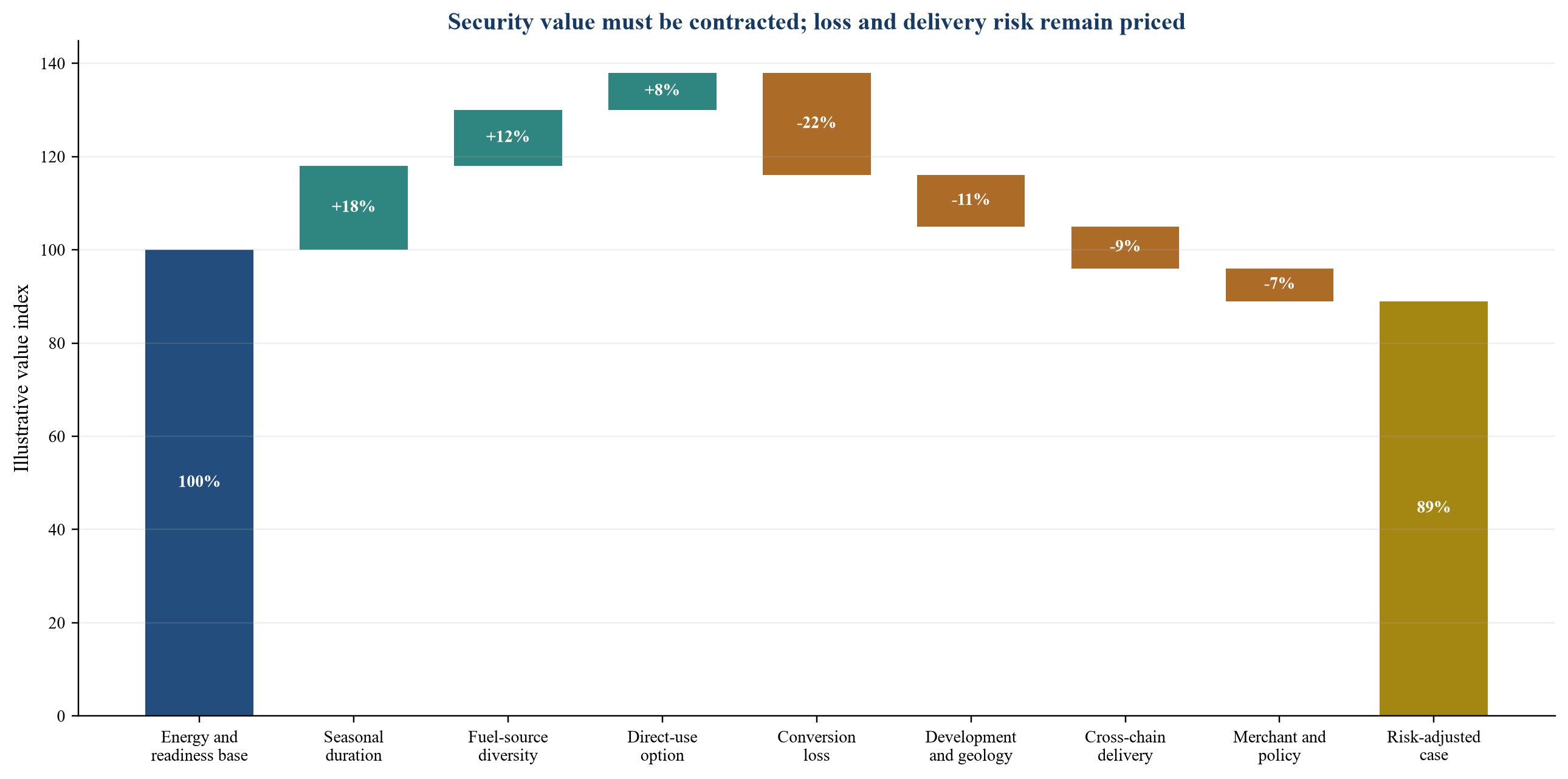
Values are hypothetical percentage adjustments to a reference index. They are not observed economics, valuations or forecasts.
43. Acquisition diligence should test the connected platform
A buyer should reconcile every announced kilogram, megawatt and storage unit with rights, permits, engineering, connection, users and funding. A large development pipeline can contain projects at very different levels of control.
The diligence file should include geological data, models, wells, land, water, brine, grid, pipeline routes, equipment references, contracts, carbon evidence, safety studies, data rights and claims. Key-person dependency and access to specialist capability also matter.
Consideration can be linked to objective milestones such as permits, support awards, storage tests, financial close and commercial operation. Governance should identify who controls each milestone after acquisition.
44. The first hundred days should close the decisive gaps
The initial programme should establish a single mass-and-energy balance, custody map, subsurface evidence register, chronological dispatch model and integrated schedule. Independent engineers should review storage capacity, withdrawal, efficiency, completion and safety.
Commercial work should define users, capacity need, alternative resources, revenue mechanism and inventory ownership. Legal work should secure site, subsurface, water, brine, grid, pipeline and data rights. Finance work should connect every downside assumption to a contract or reserve.
At day one hundred, the sponsor should decide which gaps require testing, redesign, contract protection, additional contingency or termination. Continued spend should follow documented evidence gates.
45. Limits and conclusion
Public evidence can establish policy direction, reference performance, announced infrastructure and system scenarios. It does not establish the cost, containment, deliverability, schedule or bankability of an unidentified project. Investment decisions require current site data, designs, permits, bids, tests, contracts and qualified technical, legal, tax and regulatory advice.
Seasonal hydrogen storage loses substantial energy when electricity is converted to hydrogen and later returned to electricity. Those losses are economically important and should be metered transparently. They do not, by themselves, determine whether the system is valuable. Duration, dependable withdrawal, firm fuel, strategic inventory, alternative-use optionality and resilience can justify a service payment when a credible payer defines and procures them.
An investable project connects geology, production, transport, demand and power through one evidence system. It separates inventory from deliverability, energy from capacity, and contracted value from policy aspiration. It releases capital through subsurface and integrated tests, protects cross-chain interfaces, and sizes debt to dependable downside cash flow. Summer energy becomes winter security only when the complete chain can deliver under stress.
References
- International Energy Agency, Global Hydrogen Review 2026, 2026. https://www.iea.org/reports/global-hydrogen-review-2026
- International Energy Agency, Trade and Infrastructure, Global Hydrogen Review 2026, 2026. https://www.iea.org/reports/global-hydrogen-review-2026/trade-and-infrastructure
- International Energy Agency, Global Hydrogen Review 2025, 2025. https://www.iea.org/reports/global-hydrogen-review-2025
- International Energy Agency, Proving the Viability of Underground Hydrogen Storage, 2021. https://www.iea.org/articles/proving-the-viability-of-underground-hydrogen-storage
- International Energy Agency, Hydrogen in North-Western Europe, 2021. https://www.iea.org/reports/hydrogen-in-north-western-europe
- United States Department of Energy, Findings from Storage Innovations 2030: Bidirectional Hydrogen Storage, July 2023. https://www.energy.gov/sites/default/files/2023-09/11_Technology%20Strategy%20Assessment%20-%20%2311%20Bidirectional%20Hydrogen%20Storage_508.pdf
- United States Department of Energy, Bulk Storage of Gaseous Hydrogen: 2022 Workshop Summary Report, 2022. https://www.energy.gov/sites/default/files/2022-05/bulk-storage-gaseous-hydrogen-2022.pdf
- United States Department of Energy, Pathways to Commercial Liftoff: Long Duration Energy Storage, July 2025. https://www.energy.gov/sites/default/files/2025-07/LIFTOFF_DOE_Long-Duration-Energy-Storage.pdf
- National Renewable Energy Laboratory, The Role of Hydrogen in Future Energy, 2021. https://docs.nrel.gov/docs/fy21osti/78296.pdf
- National Energy System Operator, Future Energy Scenarios 2025: Pathways to Net Zero, 2025. https://www.neso.energy/document/364541/download
- Department for Energy Security and Net Zero, Hydrogen to Power: Market Intervention Consultation Response, December 2024. https://www.gov.uk/government/consultations/hydrogen-to-power-market-intervention-need-and-design
- Department for Energy Security and Net Zero, Hydrogen Storage Business Model: Market Engagement on the First Allocation Round, December 2023. https://www.gov.uk/government/consultations/hydrogen-storage-business-model-market-engagement-on-the-first-allocation-round
- Department for Energy Security and Net Zero, Proposals for Hydrogen Transport and Storage Business Models, updated August 2023. https://www.gov.uk/government/consultations/proposals-for-hydrogen-transport-and-storage-business-models
- Department for Energy Security and Net Zero, Hydrogen Strategy Update to the Market: December 2024, 2024. https://www.gov.uk/government/publications/hydrogen-strategy-update-to-the-market-december-2024
- Department for Energy Security and Net Zero, Clean Flexibility Roadmap, accessed September 2026. https://www.gov.uk/government/publications/clean-flexibility-roadmap/clean-flexibility-roadmap
- Department for Energy Security and Net Zero, Statutory Security of Supply Report 2025, 2025. https://www.gov.uk/government/publications/statutory-security-of-supply-report-2025
- Department for Energy Security and Net Zero, Capacity Market: New Technologies 2025, updated November 2025. https://www.gov.uk/government/consultations/capacity-market-new-technologies-2025
- Department for Energy Security and Net Zero, Hydrogen Production Business Model and Net Zero Hydrogen Fund: HAR1 Successful Projects, December 2023. https://www.gov.uk/government/publications/hydrogen-production-business-model-net-zero-hydrogen-fund-shortlisted-projects/hydrogen-production-business-model-net-zero-hydrogen-fund-har1-successful-projects
- European Commission, A Hydrogen Strategy for a Climate-Neutral Europe, July 2020. https://energy.ec.europa.eu/system/files/2020-07/hydrogen_strategy_0.pdf
- European Union Agency for the Cooperation of Energy Regulators, European Hydrogen Markets, accessed September 2026. https://www.acer.europa.eu/gas/hydrogen
- Heinemann, N. et al., Enabling Large-Scale Hydrogen Storage in Porous Media: The Scientific Challenges, Energy & Environmental Science, 2021, 14, 853-864. https://doi.org/10.1039/D0EE03536J
- Tarkowski, R., Underground Hydrogen Storage: Characteristics and Prospects, Renewable and Sustainable Energy Reviews, 2019, 105, 86-94. https://doi.org/10.1016/j.rser.2019.01.051
- Zivar, D., Kumar, S. and Foroozesh, J., Underground Hydrogen Storage: A Comprehensive Review, International Journal of Hydrogen Energy, 2021, 46(45), 23436-23462. https://doi.org/10.1016/j.ijhydene.2020.08.138
- Caglayan, D. G. et al., Technical Potential of Salt Caverns for Hydrogen Storage in Europe, International Journal of Hydrogen Energy, 2020, 45(11), 6793-6805. https://doi.org/10.1016/j.ijhydene.2019.12.161
About the Author
Chennakeshav (CK) is a corporate finance and investment banking executive with 25+ years of global experience in deal origination, structuring and execution across M&A, growth capital and corporate strategy. He has led value-creation mandates for founders, corporates and funds — bridging the boardroom view to hands-on execution and close.
His career spans Morgan Stanley, HSBC, Lloyds Banking Group, EWEC, ADQ portfolio companies and Emirates Growth Fund, across TMT, real estate, fintech, deeptech, cleantech, infrastructure and energy. He has partnered with C-suite leaders, private equity and venture funds, sovereign wealth funds and family offices to finance complex fund raises and scale-up ventures, and has led M&A due diligence, post-merger integration and business-transformation initiatives to create value.
At Matchpoint Partners he is Managing Partner, leading the firm's corporate finance, M&A and capital-raising practice. He holds an MBA from London Business School, an engineering degree from VTU and a Master of Laws (LLM, in progress) from UCL London.
An active start-up mentor, CK mentors at Techstars, DIFC FinTech Hive, Startup Grind, Founder Institute and IN5, serves as Entrepreneur Mentor in Residence (EMiR) at London Business School, and judges the Entrepreneurship World Cup.
LinkedIn: https://www.linkedin.com/in/ckadya/
Profile: https://www.matchpoint-partners.com/team/ck-adya.html
