

1 The decision before the decision
A financing process commonly has an initial decision that is distinct from the final investment or credit approval. The first question is whether a proposal merits the institution's scarce appraisal capacity. A sponsor can mistake a request for more information for genuine investment interest. A financier can express interest in a sector while declining a specific transaction after the entity, instrument or risk becomes clear. The issuer needs a disciplined way to judge whether its case is ready for a meaningful screen.
The research question is which verifiable commercial, governance and cash-flow evidence can change that initial decision. Public sources identify types of information financiers seek and duties regulated lenders must perform [1, 2, 3]. They do not provide a market-wide numerical evidence threshold. An honest framework therefore starts with the decision to be made, the counterparty's known mandate and the material claims in the proposal. It avoids counting uploaded files as a proxy for financing quality.
This paper uses a source-to-claim test. A claim is a proposition that matters to an expected financing decision, such as recurring contracted revenue, an enforceable concession, available collateral or board authority to issue shares. A source is a dated record that can be attributed to a legal entity and checked by a reviewer. The analytical threshold is met when the source actually supports the claim at the level of precision used in the investment case, and when a plausible adverse interpretation has been tested. This is an author-developed preparation standard, not a rule imposed by any particular UAE investor.
The scope is private corporate equity and debt raising involving UAE issuers or UAE financing counterparties. The legal vehicle may sit in a mainland, free-zone or cross-border group; applicable corporate, regulatory, tax and reporting requirements vary. A commercial bank, development institution, private-credit fund, family office and growth-equity investor can examine the same company through different mandates. The framework is designed to be adapted to an actual counterparty request and reviewed with qualified legal and accounting advisers where needed.
2 What public screening sources establish
IFC's public financing guidance lists project and sponsor information relevant to a preliminary proposal, including the business, ownership and management, market, technical feasibility, funding requirement, expected returns and timetable [1]. Its description expressly allows further information requests after initial review. IFC also publishes a project cycle in which appraisal and investment review occur as separate stages [2]. The institution's procedures provide a useful example of staged decision-making. They cannot be attributed to every UAE fund, bank or private investor.
The Central Bank of the UAE's Credit Risk Management Regulation and Standards govern licensed institutions within their scope [3, 4]. They address credit policy, limits, due diligence, financial information, analysis, approval authority, documentation and monitoring. An issuer approaching a regulated bank should expect a lender to test repayment capacity and the legal and risk perimeter of the facility. The bank's duty to perform its own review remains even when the issuer supplies a polished data room.
Published corporate-governance guidance offers a different lens. IFC's methodology considers board structure, control environment, transparency and shareholder rights, with adaptations across company types [5]. An equity investor may see weak governance as a constraint on ownership rights or eventual exit. A lender may see it as a control and enforceability issue. These are reasons to document decision rights and conflicts early. They are not evidence that a company with a particular board structure will receive a particular offer.
The relevant public sources do not show the frequency with which individual documents lead to committee acceptance in UAE private raises. A credible claim about such a relationship would require access to both accepted and rejected cases, actual request lists, committee criteria, dated source versions and the final reason for each decision. This paper reports no such dataset. Its contribution is a transparent way to formulate a readiness hypothesis that a real financier can test.
3 Define the counterparty and the instrument
Evidence can only be assessed against an intended decision. A debt request needs an amount, obligor, use, tenor, repayment source, existing debt, security package and covenant concept. An equity request needs the issuer, proposed amount, security class, pre- and post-money basis, dilution, rights, use of proceeds and expected milestones. A hybrid instrument needs both ownership and payment consequences. A pitch that leaves the instrument undefined makes its supporting documents difficult to evaluate.
The next step is a counterparty fit note. It should record the financier's public mandate or stated parameters, ticket size if available, stage, geography, sector, instrument, prohibited exposures and decision owner. If those fields are unavailable, mark them unknown and ask. A company can have exemplary accounts and still fail a mandate screen. Conversely, an aligned mandate only opens the question of whether a particular transaction is financeable. An adviser should maintain the provenance and date of every mandate statement rather than relying on a sales conversation summary.
The issuer's internal decision is also specific. Is management asking for permission to approach investors, authority to accept an indicative term sheet, a board-approved debt ceiling, or consent to a final subscription agreement? Different evidence packages support each decision. The preparation file should include a one-page transaction definition with version number and owner. Any later change in amount, entity or rights triggers a source-to-claim review because seemingly minor terms can alter the cash or ownership outcome.
For a cross-border group, the investment perimeter requires a diagram. A holding company may own an operating subsidiary indirectly; contracts, bank accounts, licenses and intellectual property can sit in different entities. Financial statements of a group do not by themselves prove that the proposed issuer controls a cash-generating asset or may pledge it. The screen needs an explicit entity bridge, with unresolved legal questions escalated before the financing thesis rests on them.
4 Five gates for an initial screen
The proposed sequence has five gates. First is eligibility: legal authority and counterparty mandate. Second is commercial substance: evidence that the business has customers, enforceable or reasonably supportable demand, and a defined economic model. Third is financial coherence: historical statements, management data and forecasts reconcile sufficiently for analysis. Fourth is downside capacity: the proposal remains intelligible when an important assumption disappoints. Fifth is governance and execution: the people and entities that must approve, provide information or sign can be identified.
The sequence is an analytical tool, not a claim that investors use five identical committee gates. It protects the issuer from spending heavily on detailed diligence when a hard eligibility condition fails. It also distinguishes a gap that can be repaired from a thesis that has no support. For each gate, the reviewer records a claim, source, date, legal entity, known contradiction, materiality judgment and next action. An unanswered question should remain visible; a confident phrase in a deck must not turn it into an accepted fact.
An advance decision means the available evidence justifies the cost of the next appraisal stage. A repair decision means a defined source or reconciliation can be obtained by a named owner within a time limit. A stop decision means the financing concept conflicts with the counterparty's mandate, legal capacity or economic case as presently known. The three outcomes are useful because a binary ready/not-ready status hides the work required to change the decision.
The gates should be applied proportionately. An early-stage technology company may not have a three-year audited history; a receivables-backed mid-market borrower should be able to show the receivables and collections on which repayment depends. The absence of one document cannot be interpreted without the stage and instrument. What matters is whether the available evidence lets the actual financier form a decision without inventing the missing facts.
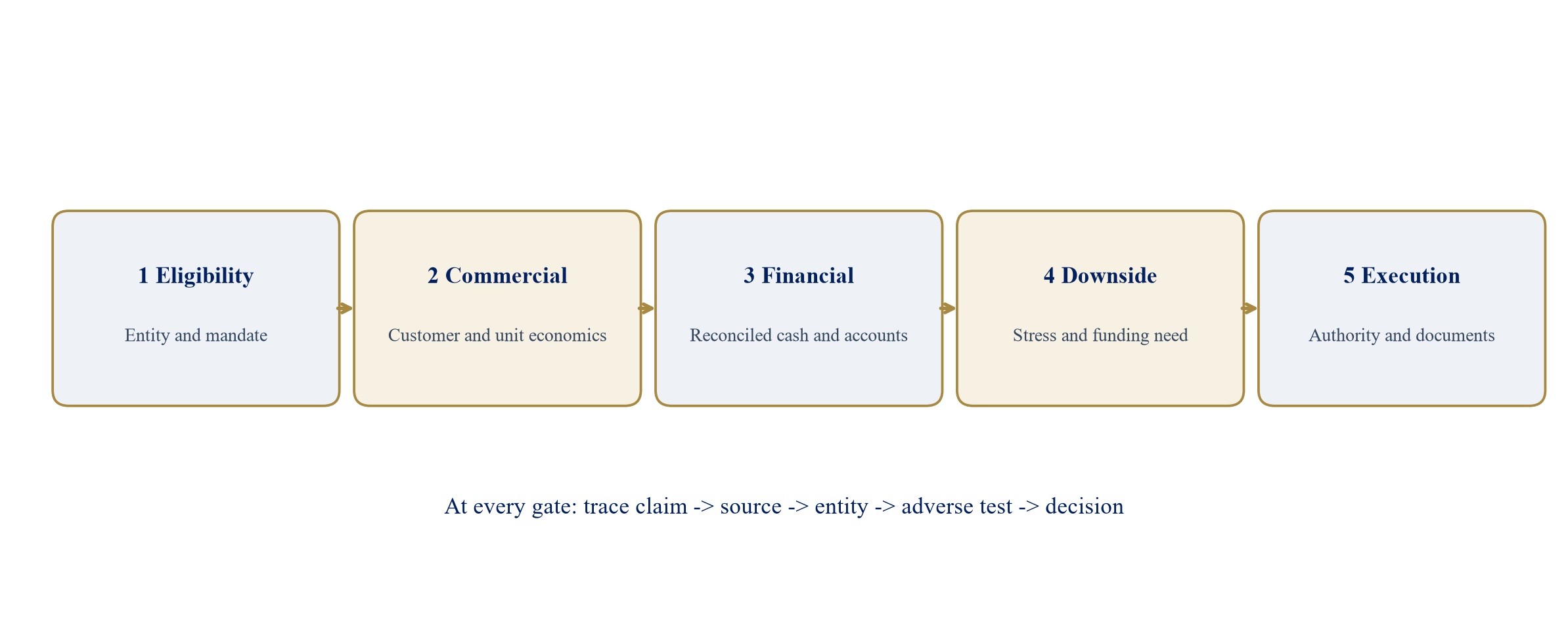
Author-developed decision framework. The gates are a preparation method, not observed financier policy or an approval promise.
5 Evidence has a provenance problem
Data rooms make documents available. They do not prove that each version is authoritative. A signed customer contract can have a later side letter; an audited group account can exclude a newly acquired subsidiary; a management dashboard can count gross transaction value as revenue. The first screen should ask whether a source is original or derived, who can attest to it, when it was effective and whether another record contradicts it. This question is particularly important when financing depends on a small number of high-value contracts or assets.
A source-to-claim record can be simple. State the claim exactly as it appears in the teaser. Attach the primary document and the page or data field relied on. Identify the contracting entity, effective date, renewal or termination terms, conditions, and any subsequent modification. Show the calculation that converts the raw evidence into a headline metric. Record the preparer's name and the independent reviewer. If the calculation includes a judgment, such as an assumed renewal probability, label that assumption as a scenario and show the outcome without it.
This work matters across instruments. A lender may advance against eligible receivables; eligibility can depend on customer acceptance, dispute rights, assignment restrictions or ageing. An equity investor may value recurring revenue; recurrence depends on enforceable commitments, cohort behavior and the definition of revenue. Neither instrument should rely on a chart whose underlying records cannot be reproduced. IFRS 15 sets principles for recognition of revenue from customer contracts [6]; the financing metric and the accounting metric may differ, so the bridge should be shown rather than assumed.
An evidence register can rank sources by reliability for a particular claim. A signed agreement may be primary evidence of legal rights; it may be poor evidence of cash collection. A bank statement is strong evidence of a historical receipt; it does not establish future renewal. Management forecasts can be useful for scenario analysis when their assumptions are explicit; they are not historical observations. The rank is claim-specific. The critical discipline is to write down what each record proves and what remains open.
6 Commercial traction that survives a question
A commercial claim should describe the customer's action, the issuer's performance obligation and the economic consequence. A letter of intent, purchase order, signed contract, delivered service, accepted invoice and cash receipt represent different points in that chain. The initial screen should present them separately. Aggregating all into a single booked-revenue figure can overstate certainty. A financier may legitimately ask how much of the pipeline is binding, how much has been delivered and how much has been collected.
For a contracted business, construct a contract ledger showing the customer, counterparty entity, value, term, minimum commitment, cancellation rights, payment schedule, currency and performance conditions. Reconcile it to recognised revenue and cash receipts. For a transaction platform, reconcile gross payment volume, net fee, refunds, chargebacks and settlement cash. For a project business, show awarded backlog, notice to proceed, certified work, variation claims, receivables and retentions. These structures are preparation proposals; the appropriate fields depend on the business model.
Concentration deserves early attention. A single customer can make growth appear compelling and also create a material counterparty risk. An issuer should show revenue and receivables by customer, changes in contract terms and the operational consequences of losing the largest account. A growth-equity investor may test the path to broader demand; a lender may test whether stressed cash still pays debt. A screen can advance with concentration when its exposure is transparent and the proposed instrument accounts for it. The assessment belongs to the actual financier.
Evidence of demand should be dated and falsifiable. A management claim that customers 'love the product' lacks a test. Retention by cohort, usage under a paid agreement, renewal decision records and realised unit economics provide more precise questions. Qualitative customer references can help explain why the product is used, but they should be recorded with consent and interpreted alongside transaction data. The purpose is to make commercial reality legible before a full diligence exercise consumes both parties' time.
7 Cash conversion before headline growth
Revenue growth alone does not answer a debt-financing question. A lender needs a view of cash available for repayment after operating costs, taxes, capital expenditure and working-capital needs. An equity investor also needs to know how quickly invested funds will be consumed and which milestones require another raise. IAS 7 organises historical cash-flow reporting into operating, investing and financing activities [7]. The board's forecast should connect those historical categories to the operating drivers that will govern future cash.
Begin with a historical bridge: reported revenue to invoicing, receivables, collections and cash from operations. Explain changes in deferred revenue, accrued income, payables and inventory where material. Reconcile cash at the bank to the opening and closing cash in the accounts. A forecast then projects customer-level receipts and payment timing from explicit assumptions. It identifies capital expenditure, debt service, restricted cash and intercompany transfers. A consolidated cash balance can be misleading if the obligor cannot access the cash when a payment is due.
For debt, show base and downside debt-service capacity with the calculation and covenant definitions that the proposed financier uses. If those terms are not yet available, present a transparent indicative calculation and mark it as a management scenario. For equity, show burn, runway, milestone expenditure and dilution at alternative raise sizes. Avoid a single 'runway' number when revenue collection and hiring timing are uncertain. An interval or monthly cash trough can expose the financing need more usefully.
The screen should not reward false precision. A forecast extending five years can be arithmetically perfect and commercially fragile. Its most important output may be a sensitivity: if the largest customer pays sixty days later, which month becomes the minimum cash point? If utilisation reaches half the plan, how much capital is required before a viable milestone? Every material sensitivity should connect to a decision about size, instrument, tranche or contingency.
8 The legal and governance perimeter
The named issuer must be able to raise the proposed instrument. The screen should identify its incorporation documents, licences, directors, shareholder register, constitutional restrictions, existing investor rights and any approvals required to borrow, issue shares or pledge assets. A group chart should distinguish ownership percentages from control rights. Where an asset or contract sits outside the issuer, the proposed transfer, guarantee or security arrangement should be stated as a legal workstream rather than treated as already effective.
Beneficial ownership and customer-due-diligence records have a separate purpose. ADGM publishes obligations for entities within its framework to maintain beneficial ownership and control information [8]. UAE licensed financial institutions have customer-due-diligence requirements under the Central Bank rulebook [9]. The specific documents requested vary by counterparty and entity. Preparing a current ownership chart, identity records and an explanation of nominee or layered structures can reduce avoidable clarification, while the financier remains responsible for its own checks.
Board authority and consent mapping can control the calendar. A founder may be authorised to discuss a transaction while lacking authority to accept a financing term. Existing debt may contain negative pledges or consent requirements. An investor rights agreement may grant pre-emption, anti-dilution or reserved-matter approval. A first-screen memo should list these conditions and their owners. It should not promise that consent will be obtained. Where interpretation is contested, legal advice and a clear reservation belong in the memo.
Governance quality is more than formal compliance. IFC's corporate-governance materials examine board oversight, controls and transparency in financing contexts [5]. For a smaller issuer, a proportionate file may explain who approves budgets, how related-party transactions are recorded and how management information reaches directors. The initial question is whether the financier can understand who can commit the company and how material cash and risk decisions are controlled.
9 Debt and equity share evidence but ask different questions
Debt and equity diligence overlap around the legal entity, commercial prospects and quality of financial information. Their decision rights diverge. A lender typically focuses on repayment, priority, security, covenants and recovery under downside. An equity investor focuses on the value of the residual claim, dilution, governance rights, growth milestones and exit possibilities. Both can examine downside; the loss-bearing position differs. A single undifferentiated data room can force reviewers to reconstruct the transaction from files that were prepared for another instrument.
Table 1 maps the common evidence domain to the decision each instrument needs. It is an author-developed crosswalk; it is not a universal lender or fund request list. Management should add the actual counterparty's requests and mark every field as supplied, pending, inapplicable or disputed. A blank field is not equivalent to a negative fact; it is an unresolved verification point.
Table 1. Debt-versus-equity evidence crosswalk for an initial screen
| Evidence domain | Debt screening question | Equity screening question | Source to trace |
|---|---|---|---|
| Legal entity and authority | Who is liable and may grant security? | Who issues shares and whose consent is required? | Constitutional documents, register, resolutions |
| Commercial contracts | Which receipts support repayment? | Which demand and margins support value? | Signed agreements, performance and receipts |
| Historical accounts | Is debt service visible in realised cash? | Are growth and unit economics credible? | Accounts, management ledger, bank bridge |
| Forecast and downside | Can scheduled payments survive stress? | How much capital reaches a value milestone? | Versioned model and sensitivity cases |
| Capital structure | What ranks ahead and what covenants exist? | What is ownership and dilution after the round? | Debt schedule, cap table, rights agreements |
| Governance and risk | Can funds, collateral and covenants be controlled? | Can rights, reporting and exit be exercised? | Board minutes, policies, consent map |
Author-developed preparation matrix. Each financier's mandate and request list take precedence.
The matrix can expose a route mismatch. A company with valuable optionality and irregular near-term cash may be compelling to an equity investor yet inappropriate for scheduled amortising debt. An asset-rich company with stable contracted cash may choose debt, subject to security and covenant economics. The paper makes no recommendation for a specific issuer. The screening task is to surface the economic trade and the evidence that would let an authorised counterparty assess it.
10 Build a claim ledger rather than a document dump
The central working paper is a claim ledger. Each row contains a material pitch statement, the source that supports it, the calculation or interpretation used, the entity to which it applies, the source version, the person who checked it, a contrary observation and the decision consequence if it proves wrong. The ledger is short enough for a screening team to use. It can link to a larger data room without reproducing confidential material in a teaser.
A source does not need to be public to be usable; it needs consent, a lawful basis for sharing and a controlled verification path. The issuer can offer redacted samples at first screen and provide originals under a confidentiality agreement when appropriate. Customer contracts, payroll information and personal identity records require proportionate access controls. The version log should record what was seen and by whom. An adviser should avoid sending sensitive material merely to demonstrate apparent readiness.
The ledger makes contradiction productive. Suppose the deck states that a customer contract produces a fixed annual fee, while the signed schedule makes fees conditional on transaction volume. The row should retain both facts and restate the claim. A forecast may still assume substantial volume; that assumption belongs in the model and sensitivity, not in a description of contracted revenue. Repairing the wording before the first meeting improves the quality of the question the investor is asked to answer.
The output of the first screen can be a short exception list. Each exception has a materiality judgment, owner, evidence required and latest date that matters to the financing calendar. The list should include unresolved mandate fit and authority questions alongside financial reconciliations. This avoids presenting the data room as complete while the transaction definition itself remains open. It also gives management a manageable sequence of work rather than a demand to perfect every document at once.
11 The decision memo and its evidence threshold
A first-screen memo should state the requested decision in one sentence. For example, management may seek permission to begin full diligence on a specified issuer, instrument and amount, subject to named exceptions. It should then explain the commercial case, funding use, ownership perimeter, historical cash, forecast, material downside and authority path. A reviewer should be able to move from each conclusion to the underlying source without guessing which entity or period it covers.
The proposed threshold has four parts. The claim is relevant to the decision. The source can be authenticated and is current enough for the decision. The calculation or interpretation can be reproduced. The adverse case is explicit where the claim materially depends on an assumption. A claim that fails one part is not necessarily fatal; its weakness should be classified by materiality and repairability. The threshold is qualitative because public evidence does not justify a universal percentage or document count.
Decision authority matters at two levels. The issuer's board must know which statements it is authorising management to make; the financier's committee or delegated officer must know which facts are established and which are contingent. A memo that places a management forecast next to audited accounts without distinguishing them can lead both groups to overestimate certainty. Clear labels such as historical, contracted, management forecast and illustrative downside describe the evidence status in ordinary professional language.
The first screen may advance despite open items when the reviewer can define the next diligence questions and the downside of a wrong answer. It should stop when a hard mandate condition fails or when the legal issuer cannot be linked to the assets and cash used in the case. It should repair when a specific source, reconciliation or consent is obtainable within a realistic calendar. These are proposed governance decisions for preparation; actual approval belongs to the counterparty.
12 Sequence the fundraising timeline
An initial screen happens within a longer capital-raising process. A practical timeline begins with internal transaction definition and source reconciliation, then counterparty selection, authorised outreach, preliminary review, diligence, internal approval, documentation and cash settlement. These stages can overlap. The timeline should show which event makes the proposal eligible for the next gate and which person owns the evidence. It should also record the date when the issuer's cash need becomes binding.
Figure 2 is an illustrative sequence. Its week labels are planning placeholders, not observed UAE averages or a promised duration. A real process should substitute the counterparty's calendar, statutory or contractual notice periods and the issuer's actual preparation time. A process with parallel lenders and investors may need separate tracks because an equity term sheet can change the credit structure and a debt term sheet can change the equity need.
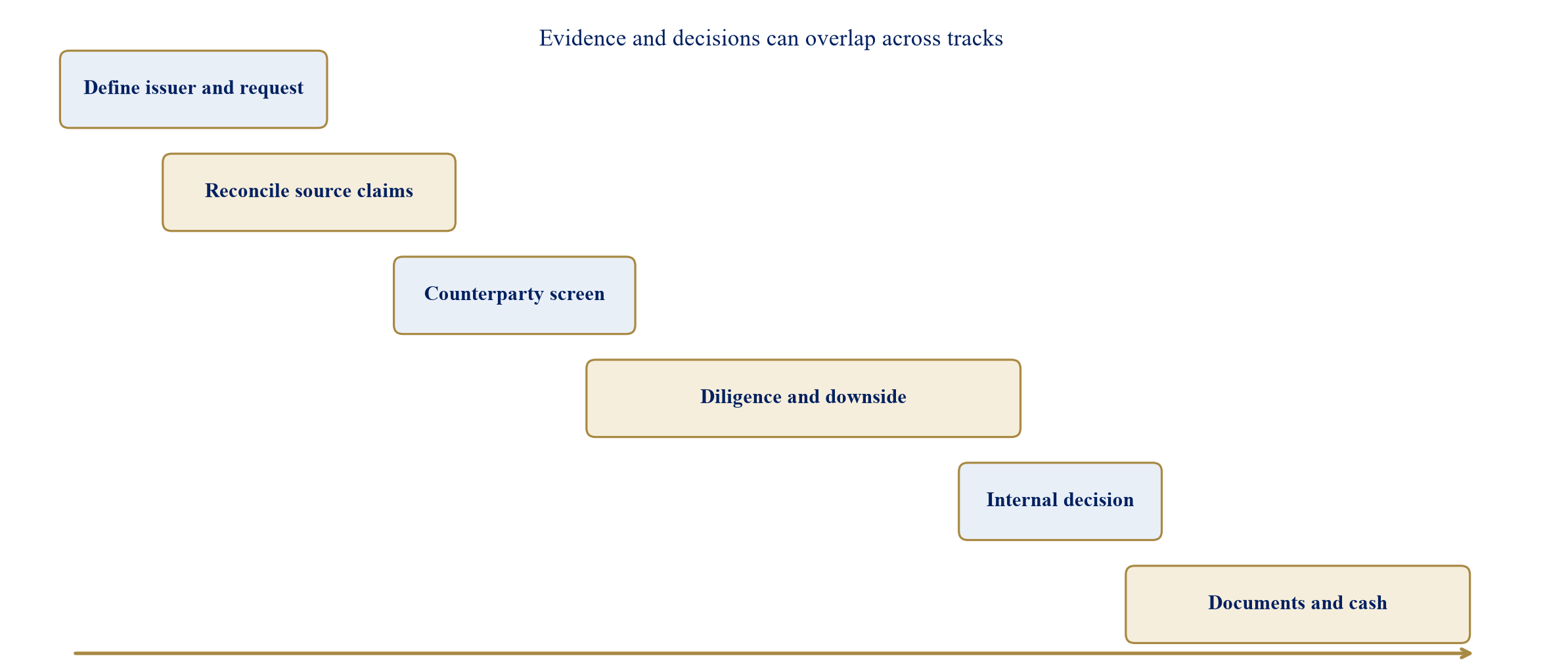
Author-developed sequence. Week markers are hypothetical planning placeholders; no market duration is estimated.
The fundraising timeline should preserve event definitions. A preliminary positive response is distinct from an approved investment, an executed agreement and funds in the issuer's account. Readiness should be tested at each stage against the evidence needed for that decision. This helps the board manage both the quality of its case and calendar risk without implying that preparation controls a financier's independent choice.
13 A wholly hypothetical financing case
Consider an invented UAE industrial-services company seeking AED 40 million to finance equipment and working capital. Management reports AED 100 million of prior-year revenue and a new AED 70 million order book. The figures in this section are teaching assumptions. They are not drawn from a Matchpoint mandate, a customer record or a market sample. The company is considering either a three-year debt facility or a minority equity raise. A polished deck states that the order book will fund repayment and support a higher valuation.
The first source test changes the story. Of the assumed AED 70 million order book, AED 25 million is subject to a notice to proceed and AED 12 million consists of nonbinding proposals. The signed unconditional portion is therefore AED 33 million under these invented facts. The remaining amounts may still convert, but the deck must distinguish them. The receivables ledger contains AED 18 million from the largest customer, of which AED 7 million is more than ninety days overdue. The cash forecast assumes collection of the full AED 18 million in the next quarter.
The second test is the entity bridge. The equipment to be acquired would be held by a subsidiary that has a minority shareholder. Existing bank debt at the parent includes a covenant requiring lender consent to additional security. The board has approved fundraising exploration but has not approved a specific facility or share issuance. None of these facts alone determines the financing outcome. They define legal and governance work that a lender or equity investor would need to understand before relying on the proposed cash or asset package.
Table 2 shows how the claim ledger converts this invented case into decisions. The fictional base forecast can be remodelled with delayed customer receipts, order-book conversion of only the unconditional contracts and the equipment purchase moved to the entity that can hold it. A debt screen might require a demonstrated repayment and consent path. An equity screen might progress on a milestone-based use of proceeds with explicit dilution and customer-concentration risk. Neither choice is an approval prediction.
Table 2. Hypothetical case: claim-to-source triage
| Pitch claim | Source test | What can be stated now | Screen action |
|---|---|---|---|
| AED 70m contracted order book | Contract and proposal ledger | AED 33m assumed unconditional; AED 25m conditional; AED 12m nonbinding | Repair classification and forecast |
| AED 18m near-term collections | Ageing and cash receipt ledger | AED 7m assumed more than 90 days overdue | Stress collection timing |
| Equipment supports the facility | Entity and security map | Asset holder and parent obligor differ | Obtain legal structure and consent review |
| Board-approved raise | Minutes and constitutional powers | Exploration approved; final terms remain open | Define required resolutions |
All amounts and facts in this table are fictional teaching assumptions. They are not client data, quotes or UAE benchmarks.
The case illustrates why a source-to-claim threshold can matter more than a fixed document count. All major documents could be present, yet the financing thesis would remain overstated until conditional sales, overdue receivables and entity rights are represented accurately. The decision to continue would depend on the financier's mandate, the issuer's ability to repair the presentation and the economics after downside stress.
14 A proportionate document checklist
A checklist is most useful when every row has a decision purpose. A signed contract proves different things from a revenue schedule; a group chart identifies relationships but may not show enforceable control. Table 3 therefore pairs each document family with the claim it can support and a common limitation. It should be adapted to the actual issuer and counterparty. A request for personal records, customer files or regulated data requires appropriate access, consent and storage controls.
Table 3. Source-to-claim screening checklist
| Document family | Initial decision use | Check before reliance |
|---|---|---|
| Entity chart, register, constitutional documents | Issuer, control and authority | Current entities, rights and approvals |
| Audited and management accounts | Historical performance | Perimeter, date and reconciliation |
| Bank and cash-flow bridge | Cash conversion | Restricted cash and intercompany flows |
| Customer contracts and order ledger | Commercial demand | Conditions, terminations and side letters |
| Debtor ageing and receipt evidence | Collection risk | Disputes, concentration and timing |
| Forecast model and sources-and-uses | Funding need and downside | Assumptions, versions and cash trough |
| Debt schedule and cap table | Priority and dilution | Consents, options and rights |
| Board minutes and policies | Decision authority | Exact transaction permissions |
Author-developed checklist. A listed item may be inapplicable or insufficient in a particular transaction; confirm the financier's own requirements.
The checklist should have five status values: current and checked, current but unverified, requested, exception and inapplicable. A document tagged current and checked needs a reviewer and date. A requested item needs an owner and due date. An exception needs a decision about whether the screen can proceed with a reservation. A status label is not a substitute for legal opinion or audit assurance; it tells the team which reliance has been established for the present screening purpose.
A data room index can mirror the claim ledger. Place the transaction definition first, then entity and authority, historical financials, commercial evidence, forecast and downside, instrument-specific documents, risks and consents. Cross-references should be stable across versions. When a source changes, identify every claim and sensitivity that depends on it. This version discipline helps an issuer respond accurately to follow-up questions and lets the board see when the proposed case has changed since it authorised outreach.
15 Decide whether to stop, repair or advance
The decision rule should be explicit enough to avoid an indefinite 'almost ready' status. A stop applies to a verified hard conflict with the identified financier's mandate, a legal impossibility that cannot be resolved within the transaction timetable, or an economic case that no longer covers the proposed instrument under defensible assumptions. Stop refers to this financing route and current facts. The issuer may redesign the route or pursue another counterparty after a fresh assessment.
Repair applies when a material claim lacks a source, a calculation is inconsistent or an approval can be sought. The repair order should follow decision impact and lead time. A revenue reconciliation that could change debt service is more urgent than a formatting defect in the pitch. A consent taking six weeks may need to start before a forecast refinement taking two days. The owner and proof of completion must be named. Replacing a source with a new management assertion is not a completed repair.
Advance applies when the next stage can test a coherent proposition. The reviewer should receive a memo that states the established facts, assumptions, open questions and proposed diligence scope. An advance decision does not mean the case is financeable at final terms; it means the uncertainty is bounded enough to justify more work. The next stage should have a decision date and criteria for ending diligence if a key hypothesis fails.
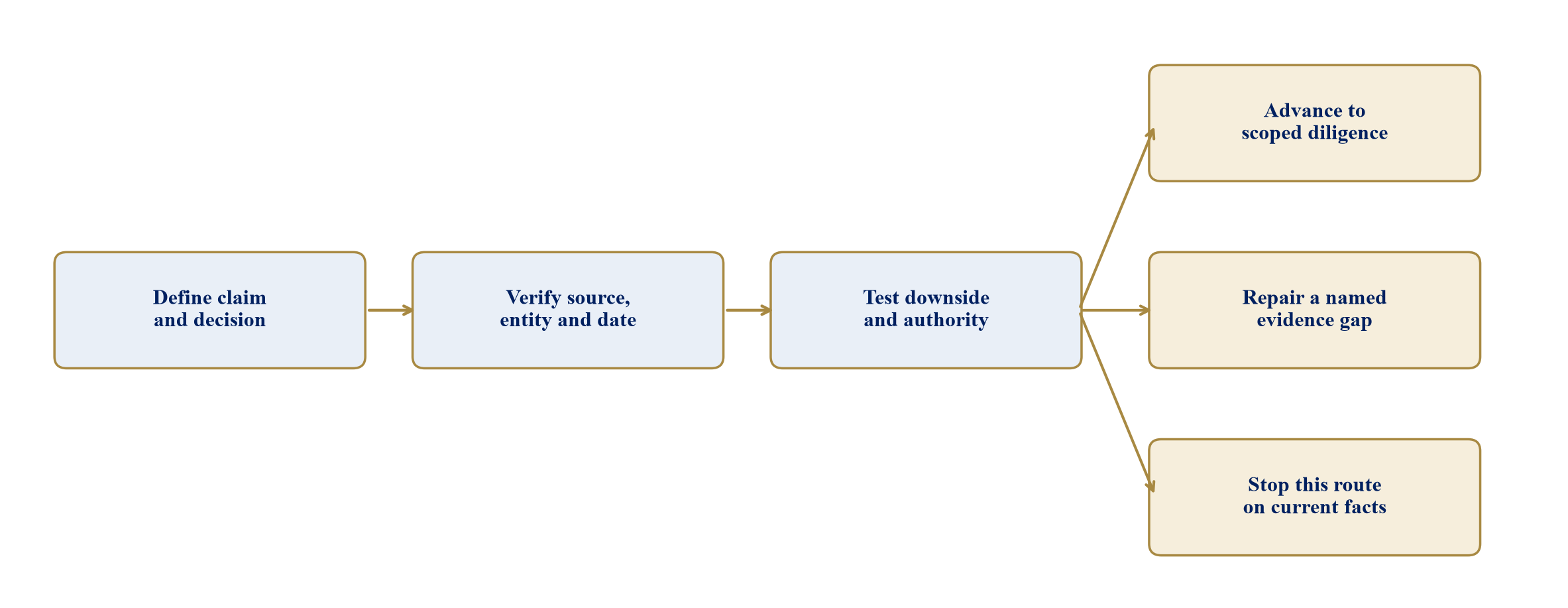
Author-developed triage logic; no approval probability or observed financier threshold is implied.
The rule should be applied by a person with authority to challenge the commercial narrative. A finance lead can check reconciliations, a legal adviser can advise on entity and consent questions, and a transaction lead can test counterparty fit. Where these views differ, record the disagreement and the evidence that would resolve it. The purpose is an auditable decision, not consensus manufactured by removing difficult questions from the memo.
16 Confidentiality and the financing signal
The issuer's desire to demonstrate readiness can conflict with confidentiality. An early screen rarely requires unrestricted access to every customer agreement, employee record or board paper. A teaser can state ranges and source types, followed by a controlled disclosure protocol. The protocol should specify the counterparty, purpose, permitted users, confidentiality obligations and whether personal information is involved. The issuer should maintain a log of what was shared and the version seen by each party.
Selective redaction can protect a counterparty's commercial terms while allowing a reviewer to see whether a commitment exists and how it affects cash. Excessive redaction can make a source unverifiable. An independent accountant or counsel may confirm a specific fact when direct disclosure is constrained. A financier may still insist on the original during diligence. The issuer should therefore identify the ultimate verification path before basing a headline claim on a document it cannot show.
Confidentiality also applies to unsuccessful approaches. A first-screen record can be retained internally to explain the decision and improve the evidence pack. It should not be described publicly as a committee endorsement or as proof that funding is available. A positive initial response can depend on further diligence, market conditions, investment limits and final authority. Accurate language protects the issuer's credibility when it later approaches another capital provider.
In the hypothetical industrial-services case, the contract ledger might contain customer-specific pricing and dispute history. A redacted summary could support preliminary discussion if the counterparty accepts it; a limited review of originals could be scheduled under appropriate protections. The principle is proportionality: enough verifiable information to make the current decision, with a clear route to deeper confirmation.
17 What the existing literature can and cannot transfer
Research on investor decision-making confirms that people, market and financial evidence can have different weights across investors. A survey by Gompers and co-authors covered institutional venture capitalists and examined their reported investment practices [10]. It is useful as prior art on how professional investors describe screening. Its sample and vintage do not supply a UAE-specific coefficient, a lender underwriting standard or a current committee success probability. This paper does not transfer survey percentages to UAE raises.
Institutional process material offers a second type of prior art. IFC describes the information it seeks from prospective projects and the stages through which its own investments pass [1, 2]. These public pages establish that a preliminary proposal and final approval are distinct. Their contents may inspire a preparation checklist, but IFC's ticket, development mandate and governance can differ materially from a local bank or private fund. The actual financier's requirements must be obtained and recorded.
Accounting and regulatory texts provide a third type of source. IFRS 15 and IAS 7 help a reviewer understand recognised revenue and cash-flow categories [6, 7]. Central Bank rules establish duties for covered lenders [3, 4, 9]. These texts can support a statement about required analysis or reporting concepts. They do not answer whether a private equity fund values a specific customer contract, or whether a bank will grant an exception. The paper's original method sits between these sources: it turns the public categories into a transaction-specific, falsifiable evidence record.
The public sources reviewed here do not provide a matched dataset of UAE private raises linking each initial-screen claim, its source quality and a recorded committee outcome. Private studies or proprietary datasets may exist beyond this review. A future empirical study should test whether the proposed claim-ledger variables predict progression after controlling for mandate fit, business quality, sector, stage and macro conditions. Until then, the framework remains a disciplined research proposal and decision aid.
18 A research design for testing the threshold
An empirical test would need permission from issuers and financiers to examine screening records. Each case should include the legal issuer, instrument, amount range, date, counterparty mandate, first submitted materials, subsequent versions, material questions, decision stage reached and eventual outcome. Both successful and unsuccessful approaches are needed. Selection based only on completed raises would conceal cases rejected for weak evidence or mandate mismatch.
The coding scheme should be fixed before outcomes are analysed. Variables might include the share of material claims with primary-source support, number of unresolved entity contradictions, age of financial data, presence of a historical cash bridge, customer concentration, downside sensitivity and completeness of decision authority. Each variable needs a reproducible definition and independent coder agreement. A simple count of documents would be a weak proxy because a room can contain many irrelevant files.
The study would separate prediction from causation. Better-prepared issuers may also have better businesses and better advisers. An association between evidence quality and first-screen progression would not prove that uploading documents caused approval. Matching or statistical controls could reduce measured differences, but unobserved business quality and investor preferences would remain. A prospective design could observe how specified gaps are repaired before the same counterparty makes its next decision, subject to consent and realistic operational constraints.
Privacy and commercial sensitivity would require careful governance. The dataset should minimise personal information, use access controls and de-identification where suitable, and avoid publishing confidential committee votes or customer terms. A public research output could report aggregate definitions and limitations without revealing individual mandates. This paper has not conducted that study, and its proposed variables have no estimated coefficients or benchmark cut-offs.
19 A ninety-day implementation programme
A management team can implement the framework in phases without claiming that ninety days is a market-standard raise duration. In an illustrative first fortnight, confirm the transaction definition, cash need, counterparty criteria and source owners. Reconcile historic financials, order book, receivables, ownership and debt schedule. Record exceptions in a claim ledger. The duration is a management planning illustration; a complex group may need substantially longer.
During a second phase, develop a model that links historical cash to prospective receipts, spending and financing terms. Run at least one plausible adverse case and identify the month of minimum cash. Prepare instrument-specific evidence notes. Obtain advice on legal capacity, approvals and disclosure constraints where needed. Test whether the actual materials support each sentence of the initial memo. A rehearsal reviewer who did not build the pack can identify unexplained leaps.
During outreach, keep a dated log of the counterparty's mandate statements, request list, accepted sources, open items and next decision. Avoid treating silence as interest or a preliminary discussion as internal approval. When a counterparty declines, record the reason as stated and distinguish it from management's interpretation. A reason such as ticket size or sector fit may require a new target list; a missing reconciliation may require repair; unfavorable economics may require a different instrument or a change in business plan.
The board should review a short weekly dashboard: current cash and forecast low point, active counterparty stages, latest accepted transaction definition, unresolved critical claims, consents, next decisions and contingency options. The dashboard measures what is known and what must be decided. It should never convert an unconfirmed first-screen response into forecast cash. The practical benefit of the programme is clearer choices and faster identification of evidence gaps; outcomes remain dependent on commercial merit and independent financier judgment.
20 Conclusion and limits
The evidence threshold before an investment committee is best framed as a traceable decision standard. An issuer should be able to show why its legal vehicle may raise the chosen instrument, why a particular counterparty could consider it, what commercial evidence supports the thesis, how historical and forecast cash connect, and what happens when the strongest assumption fails. A reviewer should be able to identify the source and the remaining uncertainty for every material claim. This is a preparation method for a first screen, not a universal capital-provider rule.
The public record supports several components of that method. IFC's application and project-cycle materials distinguish a preliminary proposal from later appraisal and approval [1, 2]. UAE central-bank rules set substantive credit-risk duties for covered lenders [3, 4]. IFRS standards help define recognised revenue and reported cash flows [6, 7]. Governance and beneficial-ownership sources make entity and control questions visible [5, 8, 9]. None provides a numerical probability of approval for a UAE issuer with a given checklist.
The debt-versus-equity matrix, timeline, checklist and hypothetical case are author-developed. The fictional AED amounts illustrate the method and must not be used as transaction evidence. This paper had no matched set of issuer submissions and financier decisions. It cannot estimate a causal effect of preparation on funding, a market-wide evidence threshold or the financing outcome of any particular company. The proposed research design explains what records and protections would be needed to test those questions.
For the board, the immediate question is concrete: which material claim currently lacks a source that the intended financier can rely on, who will resolve it, and does the financing concept still work if the claim weakens? Recording the answer can improve the integrity of outreach and the quality of the next decision. The final funding judgment remains with the capital provider under its own mandate and authority.
References
- International Finance Corporation. “How to Apply for Financing.” Accessed 6 October 2026. https://www.ifc.org/en/what-we-do/products-and-services/how-to-apply-for-financing
- International Finance Corporation. “IFC Project Cycle.” Accessed 6 October 2026. https://www.ifc.org/en/what-we-do/products-and-services/ifc-project-cycle
- Central Bank of the UAE. “Credit Risk Management Regulation.” Effective 30 November 2024. https://rulebook.centralbank.ae/en/rulebook/credit-risk-management-regulation
- Central Bank of the UAE. “Credit Risk Management Standards.” Effective 30 November 2024. https://rulebook.centralbank.ae/en/rulebook/credit-risk-management-standards
- International Finance Corporation. “Corporate Governance Methodology and Tools.” Accessed 6 October 2026. https://www.ifc.org/en/what-we-do/sector-expertise/corporate-governance/cg-methodology-tools
- IFRS Foundation. “IFRS 15 Revenue from Contracts with Customers.” Accessed 6 October 2026. https://www.ifrs.org/issued-standards/list-of-standards/ifrs-15-revenue-from-contracts-with-customers/
- IFRS Foundation. “IAS 7 Statement of Cash Flows.” Accessed 6 October 2026. https://www.ifrs.org/content/dam/ifrs/publications/pdf-standards/english/2021/issued/part-a/ias-7-statement-of-cash-flows.pdf
- Abu Dhabi Global Market. “Beneficial Ownership and Control.” Accessed 6 October 2026. https://www.adgm.com/operating-in-adgm/obligations-of-adgm-registered-entities/beneficial-ownership-and-control
- Central Bank of the UAE. “Standard Customer Due Diligence.” Effective 7 November 2025. https://rulebook.centralbank.ae/en/rulebook/62-standard-customer-due-diligence
- Paul Gompers, Will Gornall, Steven N. Kaplan and Ilya A. Strebulaev. “How Do Venture Capitalists Make Decisions?” NBER Working Paper 22587, 2016. https://www.nber.org/papers/w22587
About the Author
Chennakeshav (CK) is a corporate finance and investment banking executive with 25+ years of global experience in deal origination, structuring and execution across M&A, growth capital and corporate strategy. He has led value-creation mandates for founders, corporates and funds — bridging the boardroom view to hands-on execution and close.
His career spans Morgan Stanley, HSBC, Lloyds Banking Group, EWEC, ADQ portfolio companies and Emirates Growth Fund, across TMT, real estate, fintech, deeptech, cleantech, infrastructure and energy. He has partnered with C-suite leaders, private equity and venture funds, sovereign wealth funds and family offices to finance complex fund raises and scale-up ventures, and has led M&A due diligence, post-merger integration and business-transformation initiatives to create value.
At Matchpoint Partners he is Managing Partner, leading the firm's corporate finance, M&A and capital-raising practice. He holds an MBA from London Business School, an engineering degree from VTU and a Master of Laws (LLM, in progress) from UCL London.
An active start-up mentor, CK mentors at Techstars, DIFC FinTech Hive, Startup Grind, Founder Institute and IN5, serves as Entrepreneur Mentor in Residence (EMiR) at London Business School, and judges the Entrepreneurship World Cup.
