

1 The financing clock needs more than a start and finish
A board may ask why a raise promised for one quarter closed in the next. The answer is commonly reduced to a sentence about market conditions or an incomplete data room. Those summaries are often too coarse to guide action. Between first mandate and cleared funds, the company and prospective financiers exchange information, test assumptions, obtain internal authority, negotiate documents and satisfy conditions. Several workstreams run at once. A missing audit reconciliation might be relevant for twenty days, yet it may not delay funding if a lender's credit committee cannot meet until later. Conversely, a two-day delay in supplying a signature can postpone a closing that is otherwise ready.
This paper treats the raise as a sequence of dated states. Every request has a sender, recipient, content, version, due date, completion test and dependency. The practical research question is how much elapsed time can fairly be assigned to issuer evidence gaps and how much to investor or lender decision cycles. A percentage cannot be inferred from a launch date and a funding date. It requires an event history for each mandate, comparable definitions and a rule for concurrent work. Without those records, the honest answer is that the split is unknown.
The scope covers private UAE growth-equity and debt processes. A funding route can involve an operating company, a holding company or a project vehicle; the legal perimeter and approval path differ by transaction. References to lenders, investors and committees describe possible process roles, not a claim that every financier uses identical governance. Licensed UAE financial institutions have binding credit-risk requirements [1, 2]. Other financiers may apply different mandates and internal rules. The framework works only when adapted to the actual counterparty and the documents it requests.
The objective is operational: give management an evidence-backed answer about the current bottleneck and the next controllable action. It is also a research design: define a consented, privacy-protected dataset that could later test the distribution of delays. A process dashboard can improve coordination, but it cannot create a fundable business model or compel investment. Funding remains conditional on commercial quality, risk appetite, terms, regulatory constraints and the financier's own decision.
2 Define the clock before measuring it
The first task is to choose a clock origin. A company may count from the day it hires an adviser, sends a teaser, opens a data room, receives an indicative offer or submits a complete application. These yield different durations. The board should report at least three clocks: mandate-to-first-qualified-offer, qualified-offer-to-credit-or-investment-approval, and approval-to-cash. Each has a timestamp, timezone, owner and documented event. A single headline duration may be retained, but its construction should be visible.
The endpoint also needs precision. A signed term sheet is not financing. A signed facility agreement may still have undrawn conditions. For equity, an executed subscription agreement may precede funds reaching the issuer. The cash endpoint should be the value date on the company's bank statement or an equivalent confirmed settlement record. If the purpose is to measure the decision process rather than liquidity, approval date can be a separate endpoint. Mixing these endpoints makes a comparative dataset unusable.
Calendar days capture the company's liquidity exposure; business days can describe administrative throughput. A board that faces a payroll date cares about calendar time. A process analyst may also want business-day time after recording public holidays, weekends and committee calendars. A file should store both, never substitute one silently for the other. When a process spans jurisdictions, timestamps should be normalised to a common timezone and the original timezone preserved.
Withdrawal and rejection are outcomes, not missing observations. A raise that did not close should retain its dated history and be classified as declined, withdrawn, expired or still open. If the researcher studies only completed financings, the sample will overstate successful process speed and miss the periods where evidence problems or decision delays mattered most. Censoring rules belong in the measurement specification before cases are collected.
3 Four clocks that are easy to confuse
Issuer readiness is the interval needed to make a financing proposition internally consistent: reconciled accounts, forecast, ownership record, use of funds and evidence behind key claims. Diligence response is the interval between a specific external request and a response that meets its stated acceptance criterion. Financier decision time begins when an agreed decision file is complete enough to enter its review queue and ends with an approval, decline or formal request for a material change. Closing time covers negotiated documents, consents, conditions precedent and funding mechanics.
These categories are analytical, not necessarily contractual. A financier can start preliminary diligence with partial information, and an issuer can answer questions while the financier prepares a committee memo. Some conditions emerge only after approval. The event ledger should therefore record states rather than force each date into one exclusive phase. It should also distinguish active work from waiting for a scheduled decision. A bank's obligation to conduct credit due diligence under its rulebook cannot be labelled avoidable issuer delay merely because a company wants speed [1, 2].
The most useful distinction is between a missing item and a gating item. A file may lack a nonmaterial annex while the investment team evaluates commercial risks. That omission is a task, but it may not govern the earliest approval date. A different omission, such as a contradictory revenue reconciliation, may prevent the file from being submitted at all. The analyst should ask whether supplying the item today would advance the next irreversible milestone. This counterfactual is recorded as a judgment with a named basis, not treated as a measured fact.
External constraints can add a fifth clock: a regulator, third-party consentor, valuation expert, auditor or security registrar may need time. Its role should be separately recorded. Assigning every external day to the investor would distort the comparison; assigning every document day to the issuer would do the same. A board should see an owner map with categories that can be revised as evidence arrives.
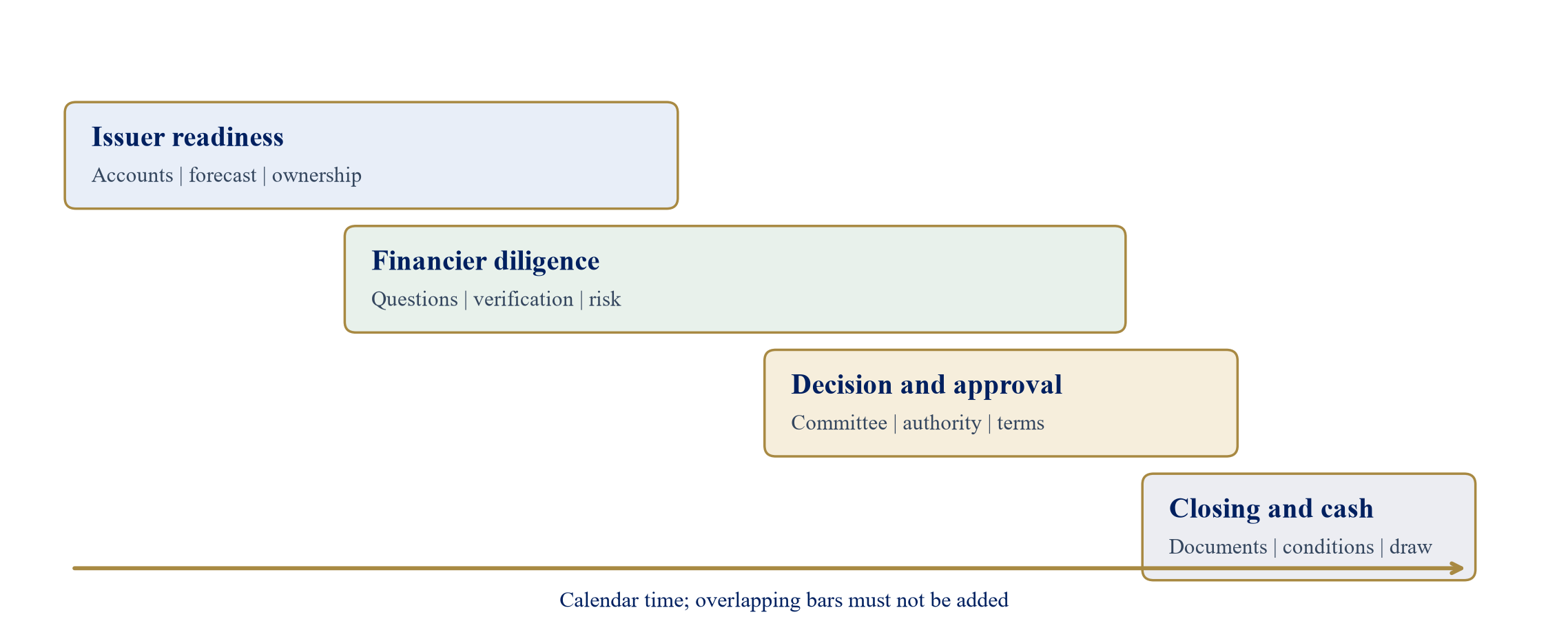
Author-developed process diagram. Sequence and overlap are illustrative; no durations are observed UAE averages.
4 Regulatory duties set a floor for lender diligence
For a UAE licensed financial institution, the Central Bank's Credit Risk Management Regulation requires policies for credit approval governance, limits, due diligence and financial information from the obligor, analysis, collateral, credit-file documentation and legal documentation [1]. The associated Standards call for robust credit due diligence that captures information necessary to assess creditworthiness [2]. These are substantive requirements. A company cannot accelerate a bank responsibly by asking it to skip the work that its regulator expects.
The issuer can reduce avoidable cycles by presenting traceable evidence. Financial statements should be tied to the legal borrowing group and current management accounts. A facility request should specify amount, purpose, tenor, proposed repayment source, existing debt, security offered and contingent liabilities. A forecast should identify the contracts, receivables and capital expenditure supporting projected cash, and show downside debt-service capacity. The file must name the legal obligor and any guarantor. These are preparation proposals in this paper; a specific bank may request more or different information.
Customer due diligence is another distinct track. The Central Bank's current guidance addresses identification and verification of customers, beneficial owners and ongoing risk information [3]. KYC queries often involve corporate structures and people rather than the investment thesis. If a group has several entities and cross-border shareholders, management should maintain a clear ownership chart and current documents for each relevant entity. A document room that contains old incorporation records or inconsistent shareholder names can create repeated requests even if the commercial model is strong.
A lender's complete-file confirmation should be captured in writing when possible. It is a process milestone, not a promise of approval. Later diligence may reveal a new issue. The ledger should record whether a request was part of the initial checklist, a clarification of a submitted item, or a genuinely new risk discovered during review. This classification allows a board to challenge process drift without asserting that every new question was unnecessary.
5 Investor appraisal has its own decision rights
Growth equity can be subject to its own stages of screening, appraisal, internal review, negotiation, subscription and funding. The IFC publicly describes a project cycle in which an investment team appraises a business, management reviews the investment, terms are negotiated and approvals precede disbursement [5]. IFC is an institution with its own mandate; its cycle is evidence that appraisal and approval are different activities, not a template that can be attributed to every private investor.
An equity investor may test market size, unit economics, customer concentration, intellectual property rights, governance, cap-table accuracy, historical tax and contractual liabilities. A debt financier may focus more heavily on repayment, security, covenants and priority. The two requests overlap, especially around quality of earnings and beneficial ownership, yet they are not interchangeable. Table 1 gives a decision-oriented crosswalk; it is a preparation checklist derived from financing mechanics and public diligence requirements, not an official universal request list.
Management should ask prospective financiers about decision rights early: who can issue a term sheet, who approves commercial terms, what risk or investment committee is involved, who signs documentation and what remains after approval. An adviser can request an indicative process calendar and identify the next formal gate. A named sponsor who likes the business may lack authority to commit capital. A calendar built around an informal expression of interest can therefore be materially wrong.
This distinction also protects the issuer from over-sharing. A company can disclose information in phases, using confidentiality obligations and controlled access appropriate to the information. The ledger records when access was granted and the exact version reviewed. If an investor says a financial model was unavailable while logs show access to a different version, the problem may be version control rather than refusal to cooperate. Process evidence should be precise enough to resolve such disputes without exposing confidential contents in a public research dataset.
Table 1. A decision-oriented debt-versus-equity evidence matrix
| Evidence domain | Debt question | Equity question | Issuer-controlled readiness test |
|---|---|---|---|
| Historic financials | What cash repays principal and interest? | What earnings and cash support valuation? | Reconcile audited, management and bank records |
| Forecast | When is covenant or liquidity headroom tight? | What milestones support growth and follow-on capital? | Version assumptions and downside case |
| Entity and ownership | Who borrows, guarantees and grants security? | Who sells or issues shares and controls votes? | Complete entity chart and cap table |
| Contracts and assets | What collateral or receivables are enforceable? | What rights and concentration shape enterprise value? | Tie material contracts to claims |
| Governance | What consents and restrictions apply? | What investor rights and reserved matters apply? | Map current and proposed approvals |
| Closing | What conditions precede a draw? | What conditions precede subscription cash? | Maintain signed-document and condition ledger |
Author-developed preparation matrix. Requirements depend on the actual financier, instrument, entity and jurisdiction; this is not a regulatory checklist.
6 Financial evidence should reconcile to the cash story
The most common analytical error in a financing pack is to present attractive historical accounts and a forecast that cannot be bridged to them. Revenue in a pitch deck may differ from audited revenue because the former includes gross merchandise value, contracted but undelivered sales, or a different entity perimeter. An investor may be willing to analyse the distinction, but an unexplained difference consumes time and credibility. The company should maintain a reconciliation from statutory accounts to current management reporting and then to forecast opening balances.
The model should state revenue recognition basis, backlog conversion, cash collection, gross margin, operating costs, working capital, tax, capital expenditure and financing flows. Every headline metric should have a definition and owner. If a funding case relies on adjusted EBITDA, management should list each adjustment, its recurrence and the corresponding cash effect. IFRS 18, effective for annual periods beginning on or after 1 January 2027 unless adopted earlier, introduces disclosure requirements for certain management-defined performance measures [6]. A 2026 private raise should still treat its own adjusted metrics as separately reconciled management measures; the standard's future effective date is not a claim about current issuer compliance.
A debt file needs a monthly cash model through repayment and covenant dates. An equity file needs a capital-use and milestone bridge showing how the new money changes value. Both need a coherent sources-and-uses schedule that accounts for fees, refinancing and reserves. A banker or investor should be able to reproduce the starting cash, outstanding obligations and use of proceeds from source documents. If that is impossible, the issuer has a readiness gap even if a polished presentation exists.
For empirical measurement, the first model upload is not automatically the moment of evidence completion. A model can be technically present but materially inconsistent. The ledger should record a completion criterion agreed in advance: for example, current management accounts through a stated month, a three-way reconciliation, approved assumptions and a working cash bridge. The reviewer can then date the first version meeting that criterion and record subsequent changes separately.
7 Ownership, authority and legal perimeter can govern the path
A financing process can stall because the entity seeking cash lacks authority to issue shares, borrow, pledge assets or receive a guarantee without further consent. The problem is often discovered late when the data room has treated the group as a single business. A practical perimeter map identifies each legal entity, jurisdiction, owners, directors, signatories, existing lenders and material contracts. It then marks which entity receives funds and which assets or shares are affected.
Beneficial ownership evidence is particularly sensitive. ADGM explains that applicable registered entities must maintain up-to-date beneficial ownership records and report changes to the Registrar within its stated period [4]. This is a specific ADGM obligation, not a statement that the same filing deadline applies everywhere in the UAE. For a group with ADGM entities, the issuer should compare the official record, internal register and cap table before releasing the process pack. For other jurisdictions, counsel should confirm the applicable rule and current filing position.
Approval rights can sit with shareholders, directors, existing lenders, minority investors or a third-party joint-venture partner. A proposed equity round may trigger pre-emption rights, anti-dilution mechanics or consent requirements. A proposed secured facility may require release or intercreditor agreement with an existing creditor. The ledger should store when each approval was identified, requested, granted and made unconditional. A closing checklist that first mentions a consent after committee approval may explain a late cash date more accurately than an assertion that the investor was slow.
Legal review should distinguish a missing corporate document from a contested transaction term. Producing an incorporation certificate is usually a readiness task. Negotiating a veto, security ranking or cash sweep is a commercial and legal negotiation. Both can delay closing, but they suggest different interventions. The board cannot resolve a genuine allocation of risk by merely uploading more files.
8 Treat the data room as a controlled evidence system
A data room is useful only if a reviewer can locate a stable document and know whether it is current. The issuer should design a folder map around decision questions: company and ownership, financials, commercial contracts, operations, legal and tax, people, assets, financing and transaction documents. Each file should have a date, version, owner and status. Superseded files should remain traceable without appearing to be the current answer. Access logs should be protected and shared only for a legitimate process purpose.
The question log is a more powerful diagnostic than a raw document count. Each question needs an identifier, date received, accountable issuer owner, target date, response version and acceptance status. A financier should be able to mark a response complete, request clarification or state that a new issue has arisen. Management can then observe whether a recurring theme is missing source evidence, ambiguity in presentation, an unresolved commercial risk or an internal financier gate. A high volume of questions does not prove poor issuer readiness; demanding investors may simply investigate thoroughly.
The data room should include an exceptions register. If audited accounts are not yet available, the issuer should say what exists, who is preparing the missing work, the expected date and what alternative assurance can be offered. A forecast labelled final when management knows the underlying budget is disputed is a more serious problem than a transparent outstanding item. The goal is decision-grade evidence, not a claim of perfect completeness.
The protocol must also protect privacy. A prospective research dataset should record request type, dates, completeness state and outcome rather than unrestricted copies of passports, employee data or proprietary contracts. Consent, confidentiality and data minimisation should be designed before data collection. The published paper cannot independently verify any mandate-level delay without access to an authorised event log.
9 Map dependencies before assigning blame
Tasks in a raise form a dependency graph. A credit memo may require financial statements and security assessment. Legal drafting may proceed before approval but cannot finalise certain schedules until terms are agreed. A valuation may wait for management accounts, while customer reference calls can proceed in parallel. A timeline that simply sums all task durations will double-count overlap and exaggerate the scope for acceleration.
For each milestone, the process team should record predecessors and earliest feasible finish. The critical path is the longest chain of necessary tasks leading to the chosen endpoint under the recorded assumptions. If a ten-day audit reconciliation runs during a twelve-day committee scheduling wait, the audit may consume ten days of work yet add zero days to the cash date. If the audit finishes after the committee deadline and pushes the case to the next meeting, its marginal effect may be much larger than its working duration. This is why owner labels alone cannot answer the research question.
The graph should distinguish strict dependencies from customary practice. A lender may require audited statements before submission, or it may agree to begin analysis with management accounts and make audit delivery a condition. The actual counterparty decides. The ledger stores the stated rule and date it became known. Without that evidence, a process analyst should mark the dependency unverified rather than invent a standard workflow.
Figure 2 presents an illustrative dependency structure. It is intentionally small enough for a board pack. A live financing may contain many more nodes, but a complicated diagram is not inherently better. The operating discipline is to connect each node to an acceptance event and a decision owner, then update the graph when a new risk or condition is discovered.
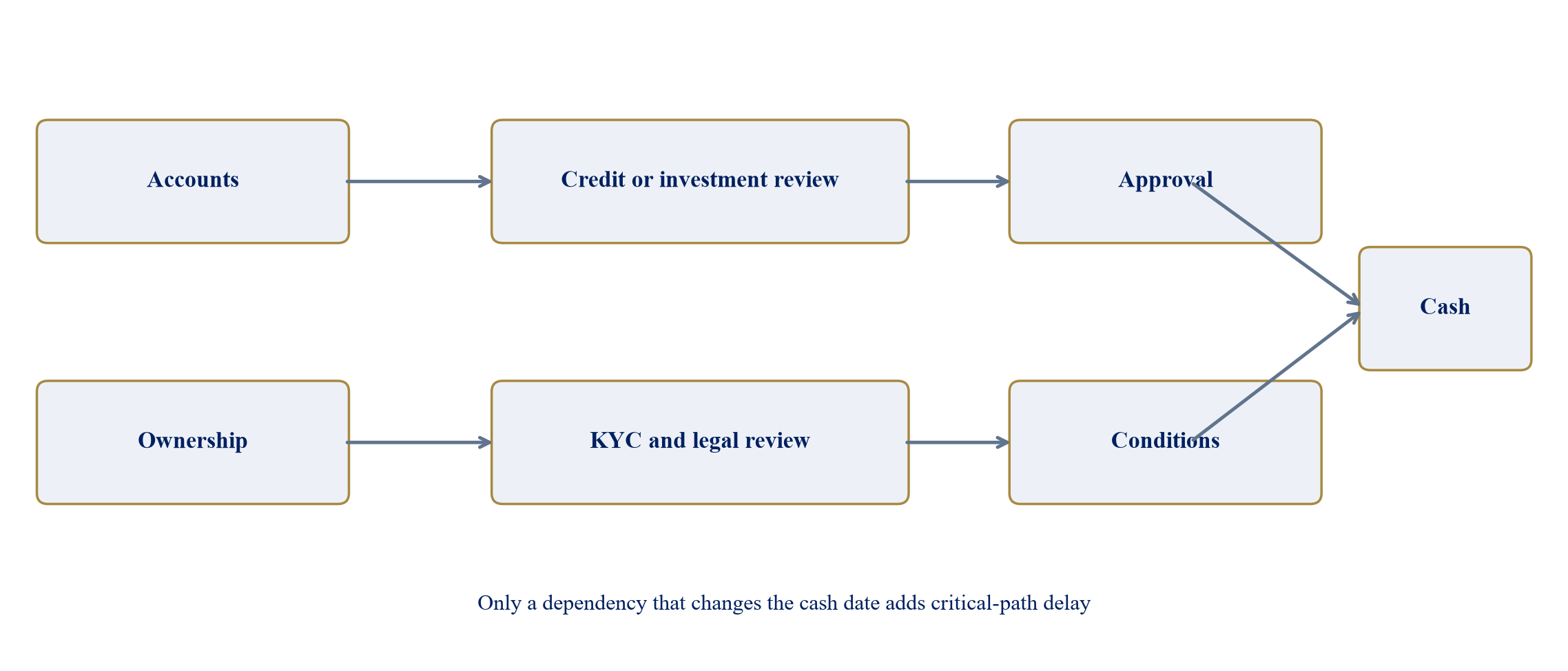
Author-developed example; arrows show hypothetical prerequisites, not a mandatory UAE approval sequence.
10 Attribute time through counterfactual milestones
Once an event history and dependency graph exist, management can distinguish work duration, waiting duration and critical-path contribution. Work duration is the time spent preparing or reviewing an item. Waiting duration is the time between a request and its accepted response or between a complete file and a decision. Critical-path contribution asks how many days the actual cash date would move if one task had been completed earlier while other conditions remained unchanged. The last measure is most useful for intervention.
Attribution should use a documented counterfactual. Consider two independent blockers that both must clear before approval. Removing one may yield no improvement because the other remains. Removing both may advance the date. A simplistic marginal method would assign zero to each and lose the combined effect. A transparent allocation can test both removal orders and average each actor's contribution, while retaining an interaction category if the evidence is too weak for allocation. The mathematical device does not make the underlying dates more reliable.
The analyst should report at least three views: gross days attached to each task, critical-path days under the observed schedule, and days whose ownership is shared or unknown. These measures answer different questions. Gross task days can reveal workload. Critical-path days identify opportunities to accelerate funding. Unknown days reveal a measurement limitation. The reported figures should never be added to a number exceeding the total measured calendar interval unless explicitly labelled as overlapping work.
A board should resist precision that the records do not support. If only weekly committee dates are known, the effect of a two-day issuer delay may be zero or seven days depending on the cutoff time. The report should show that range. If a financier has not disclosed its committee calendar, the analyst can record a decision interval but cannot claim why it lasted. A label such as “internal approval” is a stage, not proof of organisational inefficiency.
11 A hypothetical raise shows why the labels matter
Consider an entirely fictional UAE company seeking AED 30 million. Day 0 is the date on which a qualified financier receives an initial pack. The company expects to fund on day 60. The financier asks for a reconciled financial model, ownership evidence and material-contract schedule. Management supplies a revised model on day 18, ownership evidence on day 12 and a final contract schedule on day 25. The reviewer states on day 28 that the decision file is complete. A committee meets on day 49, grants conditional approval, and cash arrives on day 73 after documentation and a third-party consent. These dates are invented to explain the method; they describe no Matchpoint client or typical UAE timetable.
The observed day-0-to-cash interval is 73 calendar days. It would be false to say that the issuer caused 28 days, the financier caused 21, and closing caused 24, then claim those categories are independently measured. The file-complete date may reflect both the contract schedule and the reviewer's verification. The committee may have been scheduled for day 49 even if the file was complete on day 18. If the contract schedule could have been delivered on day 5 without moving the committee, its critical-path contribution to funding may be zero. If the committee submission cutoff was day 24, a day-25 document might push approval by an entire cycle. The answer depends on an observed cutoff and decision calendar.
Suppose the company later obtains a dated committee schedule showing that a complete file by day 30 could enter the day-49 meeting, while a complete file by day 14 could have entered a day-35 meeting. Even then, the analyst must ask whether legal drafting and third-party consent could have kept pace. A faster approval does not automatically imply cash fourteen days earlier. A dependency graph can test the earliest feasible cash date under each counterfactual, with unknown consent duration shown as a range.
Table 2 records the fictional events in a form that can be audited. Its purpose is to demonstrate the minimum record needed before a proportion is assigned. An issuer should not use these numbers as a benchmark for another raise. A banker should not quote them as evidence about financier speed. The hypothetical makes the uncertainty visible; it does not answer the population research question.
Table 2. Fictional event ledger for an illustrative UAE raise
| Event | Fictional day | Evidence needed for an actual case | Tentative owner |
|---|---|---|---|
| Qualified pack received | 0 | Receipt and pack version | Shared |
| Ownership evidence accepted | 12 | Request and acceptance record | Issuer |
| Financial model reconciled | 18 | Reconciliation and reviewer response | Issuer and reviewer |
| Contract schedule supplied | 25 | Request, file hash and receipt | Issuer |
| Decision file declared complete | 28 | Written completeness milestone | Financier |
| Conditional approval | 49 | Dated authority record | Financier |
| Executed conditions and cash | 73 | Closing record and bank value date | Shared and third parties |
All dates and amounts are hypothetical teaching assumptions; no client, lender or investor outcomes are represented.
12 A timeline should expose concurrent work
Figure 3 depicts the fictional case as bars on a common calendar axis. It deliberately overlaps issuer responses, financier review and closing preparation. A board that sees the bars can ask whether legal work could begin earlier, whether the investment team can review a reconciled subset before the full room is complete, and which deadline controls the next committee slot. These are questions for the actual counterparty. The paper does not assume that any institution permits such parallelism.
The chart also shows a weakness of retrospective storytelling. A closing delay might be attributed to a third-party consent after the fact even though counsel first sought that consent late. Responsibility depends on when the requirement was known, who was authorised to request it and when a complete request was sent. An event ledger should retain the discovery and request dates, not only the date of receipt. If the company could have sought consent on day 1 but waited until day 52, that is a different causal account from a consent that first became necessary under terms negotiated on day 50.
For a live raise, a timeline should carry confidence flags rather than apparent certainty. Some timestamps will come from emails or signed documents; others may be reconstructed from calendars or recollection. The chart can use separate styles for observed and reconstructed dates. It should name missing records. A case with incomplete committee data can still be managed operationally, but it cannot support a precise estimate of institutional review time.
Management can update this picture weekly. The active question is which bar now determines the earliest cash date. A completed workstream drops out of the forward critical path; a new diligence issue or revised term can bring it back. Treating the plan as a living network makes it more useful than a slide with a single promised closing date.
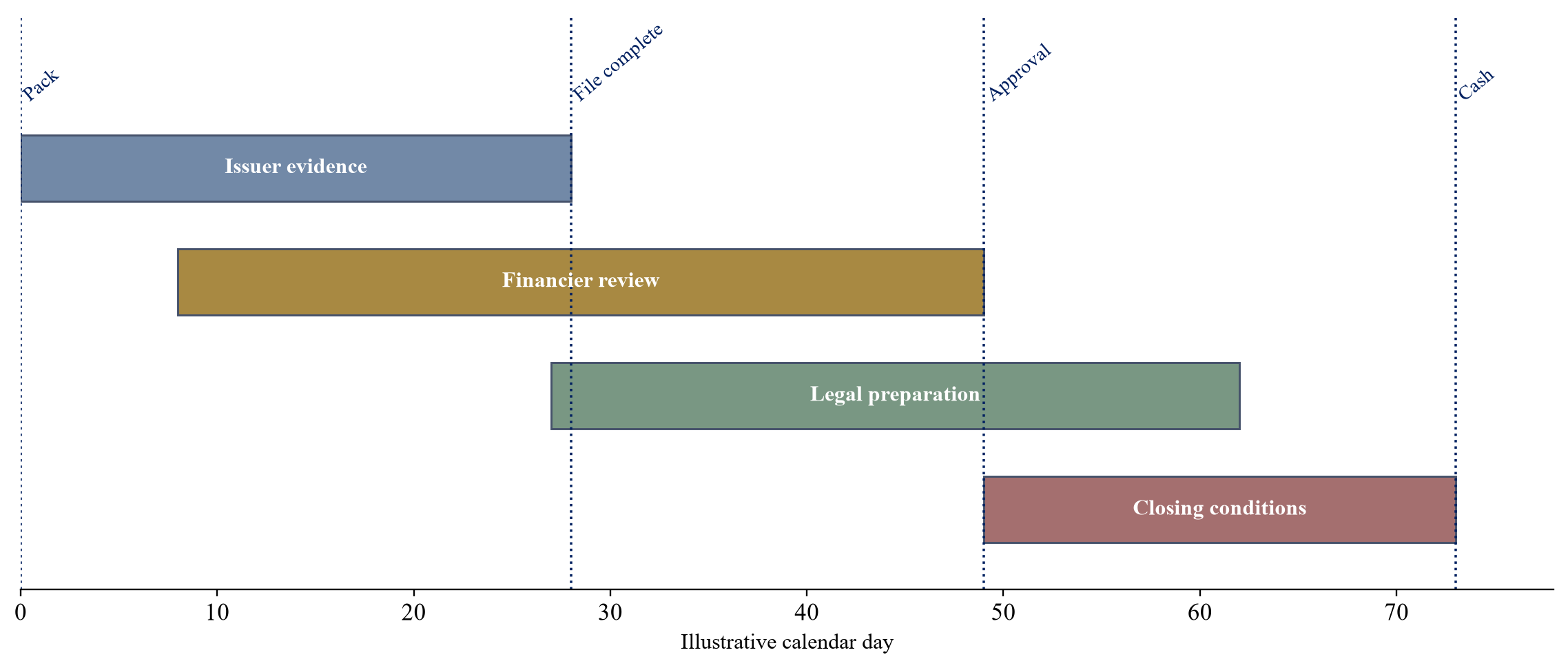
All bars and dates are hypothetical. They illustrate concurrency and are not observed transaction durations.
13 Build an evidence checklist around decision gates
A useful document checklist is ordered by the decision it enables. An incorporation record supports entity verification. A cap table supports ownership and issuance analysis. Accounts and a forecast support value or repayment analysis. Customer contracts support revenue quality. A sources-and-uses schedule supports instrument sizing. Consent records support closing. A flat list of documents obscures these links and encourages an issuer to celebrate upload volume while a critical question remains unanswered.
Table 3 proposes a minimum working set for a private raise. Its rows are not a substitute for a financier's actual request list. The company should add sector-specific evidence: regulated permissions for a financial firm, title or permits for real estate, intellectual-property chain of title for technology, project agreements for infrastructure, or receivables ageing for an asset-backed facility. The pack should also identify who can explain each file. A technically complete upload with no accountable owner may cause another cycle of questions.
The checklist should include a quality status, not just a binary present/missing mark. Useful states are not applicable, draft, uploaded, reconciled, externally accepted and superseded. A draft financial model is different from one whose outputs tie to the accounts. An uploaded shareholder register is different from one that reconciles to beneficial-ownership records. The issuer can disclose what has been tested and what remains pending. This gives reviewers a clearer basis to decide whether to start work, request remediation or pause.
A readiness review before outreach should be adversarial. Assign a reviewer who did not build the deck to trace five claims from presentation to source records, recalculate the cash bridge, follow the cap table through proposed financing and check the legal signatory chain. Log every exception with an owner and due date. If management cannot resolve a material conflict, the right response is to narrow or defer the claim. Issuer preparation has commercial value because it reduces uncertainty in the investment case; it does not guarantee a quicker decision.
Table 3. A gate-linked financing document checklist
| Decision gate | Core evidence | Completion test | Accountable function |
|---|---|---|---|
| Entity and authority | Incorporation, licences, board powers, group chart | Parties and signatories reconcile | Company secretary or counsel |
| Ownership | Current register, beneficial owners, cap table | Percentages and rights reconcile | Finance and counsel |
| Historic performance | Audited accounts, management accounts, bank bridge | Period and entity differences explained | CFO |
| Forward funding | Forecast, uses, milestones, downside cash | Inputs trace to operating evidence | CFO and operations |
| Commercial quality | Material contracts, backlog, concentration | Claims tie to executed rights | Commercial lead |
| Existing obligations | Debt, security, guarantees, covenants | Consent and priority issues identified | Treasury and counsel |
| Approval and cash | Terms, authority, conditions, funds flow | Every sign-off and cash condition assigned | Transaction lead |
Author-developed working list; professional advisers and each prospective financier should confirm transaction-specific requirements.
14 Segment cases before comparing elapsed time
An empirical programme cannot pool a small revolving facility, a first institutional equity round and a project-finance transaction as if they share the same process. Instrument type changes risk assessment and documentation. Issuer maturity changes record quality. A foreign investor may have different review and compliance steps from a domestic bank. A regulated target may require approvals that an unregulated company does not. Any later estimate should stratify these dimensions before reporting a median or a percentage.
The minimum case record should identify debt or equity, amount band, sector, operating history, issuer entity type, number of financiers approached, single or competitive process, whether audited accounts existed at launch, whether the offer included security or preferences, and the date of cash need. These characteristics must be collected consistently and with consent. Sensitive client names and exact transaction values can be withheld from public analysis if the statistical design does not require disclosure. A sample drawn only from one adviser could still have selection bias, which should be reported.
Counterparty changes also matter. A company may run several approaches in parallel, pause one, then close another. The research unit should be a financing path linked to an issuer-level capital need, not merely an investor conversation. Otherwise the same issuer's readiness days may be counted repeatedly. A declined path should retain its outcome even when another path succeeds. The start date for each path should reflect a qualified proposition received by that counterparty, while the issuer-level start date should reflect the approved capital programme.
Macro conditions belong in context, not as a substitute for process data. The IMF's July 2026 UAE staff statement noted expanding credit and deposits while expecting private-sector credit growth to moderate [7]. That observation does not tell us how long a particular bank takes to approve a loan. A study could include calendar-period controls and financing-market conditions, but it would still need dated mandate-level events to answer the central question.
15 Distinguish negotiation from an evidence defect
The most consequential weeks in a raise may be spent negotiating a genuine allocation of value and risk. A bank may seek additional security, a lower advance rate, tighter financial covenants or a shorter tenor. An investor may seek a lower price, board rights, liquidation preference or a follow-on funding option. These requests are not necessarily signs of a bad data room. They may reflect the financier's conclusion after analysing the evidence. Treating negotiation as diligence delay blurs a commercial disagreement that the board must resolve.
The event ledger should record first proposed term, counterproposal, issue owner, date of agreement and the effect on the critical path. It should retain versions of term sheets, not only the final document. An issuer can then see whether the process slowed because management took time to decide its acceptable risk transfer, because the financier revised an offer, or because legal drafting could not reflect agreed economics. The board may choose to accept a costly term to meet a liquidity deadline; the process record should make the trade-off explicit.
Time has an economic cost. A company may lose an acquisition option, require expensive bridge funding or defer a capital project while negotiating. The correct comparison is not “fast financing” against “slow financing” in isolation. It is the expected cost of waiting against the value of improved terms and certainty. The issuer should quantify cash runway, contractual deadlines and the cost of a fallback option using its own records. If these quantities are management estimates, label them as estimates in the decision memo and test sensitivities.
A sensible process can establish a decision deadline for material terms and a fallback route. The deadline should be chosen from cash needs and counterparty commitments, not a generic market timetable. If a financier cannot state when its formal decision occurs, management can plan conservatively, but the paper cannot infer an internal cause for the uncertainty. Negotiation remains a separate category in both operational reporting and any research dataset.
16 Closing conditions can reverse apparent process gains
An issuer can be fully prepared and a financier can approve promptly, yet funding can still wait on documentation, corporate authority, KYC refresh, security perfection, third-party consents or a funds-flow instruction. Closing conditions should be mapped when indicative terms are received. Each condition needs a responsible party, evidence of satisfaction, verifier and expected completion date. A transaction can have several conditions in parallel; the last one to clear determines cash timing if all others are ready.
A condition should be classified by when it became knowable. If an existing loan agreement plainly requires consent for additional debt, the issuer can identify it before lender outreach. If a new security package creates a novel priority issue, responsibility may be shared with the incoming lender and lawyers. If a public authority has an independent review period, that period should be separately recorded. This chronology prevents hindsight from turning every delay into an issuer failure.
The cash endpoint also requires settlement discipline. A board can receive an approval email but still lack freely available funds. For debt, the draw notice, permitted-use restrictions and account credit matter. For equity, the subscription amount, currency, receiving entity and allotment mechanics matter. The board should hold a single funds-flow schedule reconciled to legal agreements. A payment advice is evidence of transfer instruction; the bank statement confirms receipt. These distinctions are essential when the business has an immovable cash need.
Where legal or regulatory interpretation is required, qualified counsel should advise on the actual documents and jurisdiction. This paper proposes process measurement, not legal clearance. It should not be used to certify that a consent can be waived, that security is enforceable or that customer due diligence has been satisfied. The date at which such advice was requested and delivered is, however, a legitimate event in the timeline.
17 Design a prospective dataset that can answer the question
The central share-of-time question is empirically answerable only with a carefully defined cohort. A prospective design is preferable to asking participants months later why a process was late. At intake, the researcher should record the financing objective, proposed instrument, issuer characteristics and agreed event definitions. During the process, a designated recorder logs each request, response, acceptance, internal decision milestone, negotiation and closing condition as it happens. At closure or termination, a second reviewer checks chronology and supporting records.
The cohort should include funded, rejected, withdrawn and still-open cases. Each participant must consent to the specific data use. Financiers may be unwilling to disclose committee minutes, so the design should allow a narrower verified milestone such as complete-file acknowledgment and dated decision notice. If a case lacks the internal review record, its stage duration can be observed only between those endpoints, not decomposed into subcommittee tasks. A study should report coverage for each variable rather than silently fill gaps.
For each case, calculate calendar time to decision and cash, gross task days by party, critical-path contribution under recorded dependencies, and a residual of shared or unknown days. Stratify by instrument and issuer readiness. Show medians, ranges and censoring. Confidence intervals or formal causal estimates require a sampling frame and enough cases; neither is present in this paper. The planned method is a protocol, not a completed study. Its usefulness is that a future researcher can pre-register definitions and test whether issuer evidence completion actually advances funding dates under different approval structures.
An independent reviewer should audit a sample of events against emails, room logs, committee notices, signed terms and bank records. An adviser who benefits from blaming the financier should not control classification alone; the converse also applies. Disputes can be adjudicated under a written codebook with a residual “contested” category. Privacy, confidentiality and retention terms must be agreed before any cross-mandate analysis. Public reporting should aggregate results to avoid identifying transactions inadvertently.
18 Test the measurement against alternative explanations
Even with dated records, correlation is not causation. A weak issuer may have both incomplete evidence and a financier who proceeds cautiously. An unusually complex transaction may produce more questions and more internal approvals. If those case characteristics are ignored, a study could overstate the effect of document readiness on speed. It should compare like with like, include complexity measures and avoid claiming that a checklist alone causes faster funding.
The definition of “complete” is especially vulnerable to hindsight. A financier might call the file complete only after deciding to proceed, which mechanically shortens measured decision time and lengthens measured issuer time. The researcher should pre-specify a completeness test tied to documents available at the time and retain subsequent clarification events. It should ask whether the financing decision could have been submitted under the counterparty's stated process. If the counterparty will not state a rule, classification confidence should fall.
Sensitivity analysis can vary the start event, calendar versus business days, unknown committee cutoff and treatment of concurrent tasks. If conclusions reverse under plausible definitions, the result should be reported as unstable. A hypothetical process improvement can be evaluated as a range: deliver audited accounts earlier, pre-clear an existing lender consent, or prepare draft documents before approval. The analysis should not promise an exact saved-day figure without evidence of the counterparty's schedule and the remaining critical path.
Selection bias is likely if the only cases available are successful adviser-led mandates. The sample would miss unadvised companies and raises abandoned before a formal offer. External validity should be limited accordingly. An OECD 2026 SME-finance scoreboard shows why access to multiple financing channels is a broad policy concern [8]; it does not supply transaction-level UAE turnaround times. Aggregate sources can motivate a question but cannot answer an event-level attribution problem.
19 A weekly board control for the live mandate
The board need not wait for a future research cohort to manage its own raise. A weekly one-page report can carry the current cash-need date, forecast runway, next formal financing gate, evidence items due, financier decision date if stated, unresolved commercial terms, closing conditions and three scenarios for earliest cash. Each item should show owner, source and last verified date. The report should mark unknown dates explicitly. A range with a stated assumption is more useful than an unjustified single day.
The transaction lead should conduct a short evidence review before each investor or lender meeting. The review asks whether the last model version reconciles, whether the request log is current, whether an answer was accepted and whether the next committee submission deadline is known. If a claim changes, all affected files and counterparties should be updated with a version trail. This disciplined correction may be uncomfortable, but an undisclosed inconsistency can damage credibility more seriously later.
Escalation should follow the dependency graph. If a missing customer contract is on the critical path, assign a commercial executive and a date. If the financier's committee window is the gate, seek confirmation of agenda cutoff and any material questions, then plan alternate capital if the date is too late. If legal terms are disputed, put the economic trade-off to the board rather than letting drafting circulate indefinitely. The action is specific to the gate, not a generic demand to “push everyone harder.”
After funding or termination, the team should perform a close-out audit. Compare planned and actual events, record missed assumptions and archive the room index, versions and decision notices under the agreed retention policy. This yields a reusable preparation checklist while respecting confidentiality. The audit should separate observed dates from management explanations. It may reveal an improvement opportunity; it should never be rewritten to present a preferred party as blameless.
20 What can be concluded and what remains to be measured
The paper's supported conclusion is methodological. A UAE raise contains issuer evidence work, financier diligence and approval, negotiation, third-party action and closing. These activities can overlap, and the calendar effect of one delay depends on the critical path. The Central Bank's credit framework requires substantive lender underwriting [1, 2], while IFC's published cycle distinguishes appraisal from approval [5]. These sources establish process stages; they do not quantify how private UAE deals divide time between parties.
An issuer can improve its own information position now: reconcile financials, verify ownership, map consents, assign document owners, maintain a question log and negotiate an explicit decision calendar. An adviser can use the event ledger to report which tasks are complete, which are gating and which remain uncertain. A financier can state file-completeness and approval milestones without revealing confidential committee deliberations. None of these practices guarantees a financing outcome or a shorter timeline in every case.
The unanswered empirical question is the distribution of elapsed time and critical-path contribution across a representative, consented set of raises. That work requires dated records from funded and unfunded cases, a pre-registered codebook, privacy controls and independent classification. This paper reports no such cohort and no issuer-versus-financier percentage. Its hypothetical dates and AED amount are teaching devices. The framework's value is to make the missing evidence visible and the next live decision more precise.
Boards should therefore ask a narrower question at each meeting: what verified event must occur next for cash to arrive earlier, who owns it, and what other condition would still control the date? The answer can guide an action today and create a reliable record for later research. Where it cannot be verified, the board should record that limit and preserve a contingency for the liquidity need.
References
- Central Bank of the UAE. “Credit Risk Management Regulation.” Effective 30 November 2024. https://rulebook.centralbank.ae/en/rulebook/credit-risk-management-regulation
- Central Bank of the UAE. “Credit Risk Management Standards.” Effective 30 November 2024. https://rulebook.centralbank.ae/en/rulebook/credit-risk-management-standards
- Central Bank of the UAE. “Standard Customer Due Diligence.” Effective 7 November 2025. https://rulebook.centralbank.ae/en/rulebook/62-standard-customer-due-diligence
- Abu Dhabi Global Market. “Beneficial Ownership and Control.” Accessed 6 October 2026. https://www.adgm.com/operating-in-adgm/obligations-of-adgm-registered-entities/beneficial-ownership-and-control
- International Finance Corporation. “Project Cycle.” Accessed 6 October 2026. https://www.ifc.org/en/what-we-do/products-and-services/ifc-project-cycle
- IFRS Foundation. “IFRS 18 Presentation and Disclosure in Financial Statements.” Accessed 6 October 2026. https://www.ifrs.org/issued-standards/list-of-standards/ifrs-18-presentation-and-disclosure-in-financial-statements/
- International Monetary Fund. “IMF Staff Concludes Visit to United Arab Emirates.” 17 July 2026. https://www.imf.org/en/news/articles/2026/07/17/pr26250-united-arab-emirates-imf-staff-concludes-visit
- Organisation for Economic Co-operation and Development. “Financing SMEs and Entrepreneurs 2026.” 31 March 2026. https://www.oecd.org/en/publications/financing-smes-and-entrepreneurs-2026_075d8058-en/full-report.html
- International Finance Corporation. “IFC Policy on Environmental and Social Sustainability.” 2012. https://www.ifc.org/content/dam/ifc/doc/2023/ifc-policy-on-environmental-and-social-sustainability-2012-en.pdf
About the Author
Chennakeshav (CK) is a corporate finance and investment banking executive with 25+ years of global experience in deal origination, structuring and execution across M&A, growth capital and corporate strategy. He has led value-creation mandates for founders, corporates and funds — bridging the boardroom view to hands-on execution and close.
His career spans Morgan Stanley, HSBC, Lloyds Banking Group, EWEC, ADQ portfolio companies and Emirates Growth Fund, across TMT, real estate, fintech, deeptech, cleantech, infrastructure and energy. He has partnered with C-suite leaders, private equity and venture funds, sovereign wealth funds and family offices to finance complex fund raises and scale-up ventures, and has led M&A due diligence, post-merger integration and business-transformation initiatives to create value.
At Matchpoint Partners he is Managing Partner, leading the firm's corporate finance, M&A and capital-raising practice. He holds an MBA from London Business School, an engineering degree from VTU and a Master of Laws (LLM, in progress) from UCL London.
An active start-up mentor, CK mentors at Techstars, DIFC FinTech Hive, Startup Grind, Founder Institute and IN5, serves as Entrepreneur Mentor in Residence (EMiR) at London Business School, and judges the Entrepreneurship World Cup.
