

1 Start with the capital decision, not the coupon
A board that needs new money often receives comparisons headed by nominal interest and percentage dilution. These are visible terms, yet they are incomplete. Debt has a schedule of contractual cash payments, fees, security and restrictions. Equity has a price, a share of future outcomes, investor rights and usually a different path to closing. A choice between them depends on whether the investment creates value, when its cash returns, what the company must spend before those returns arrive and whether the owner can keep control of decisions in an adverse state.
The research question is often expressed as a search for the level of volatility or leverage at which a new shareholder becomes cheaper than additional borrowing. A single threshold would be misleading. Two firms with the same annual volatility can have very different liquidity risk if one holds cash, receives contracted revenue and can defer expenditure, while the other faces lumpy working capital and a near-term repayment. The relevant exposure is the joint path of operating cash, debt service, covenant measurement dates and refinancing access. The decision should be evaluated across those paths.
For a GCC issuer, the location of cash and obligations matters. A borrower may sell in one currency, pay suppliers in another, hold operating companies under a parent, and need permission to upstream funds. A financing model must identify the legal borrower, guarantors, cash-generating entities and whether cash can actually reach the debt-service account. A group consolidated cash balance cannot automatically be used to cure a subsidiary shortfall. Legal and tax advisers should confirm the actual structure and restrictions before a board treats modelled liquidity as deployable.
This paper sets out an analytical method, not a financing recommendation. It draws on capital-structure and liquidity research [1, 2, 3], financial-reporting guidance [4], and current public macro-financial sources [5, 6, 7, 8]. The method can help organise a live process. No market report cited here supplies an issuer-specific loan quote, investor valuation, covenant package or probability of financial distress. Those inputs must come from verifiable company records and actual proposals.
2 Define the financing perimeter before comparing prices
The company should first define what the money will fund and when it will be drawn. A growth programme may include equipment, land, acquisitions, product development, inventory, receivables and a reserve for delayed receipts. Each use has a different conversion period. Fixed equipment may be financeable against an asset; working capital may need a revolving facility; an acquisition may create a delayed integration cost. Treating all uses as one round number can obscure the period when cash is tightest.
The sources-and-uses schedule should state gross funds, transaction fees, cash actually available to the business, any refinancing of old obligations and a minimum operating reserve. A debt facility of AED 40 million with upfront fees does not provide the same usable cash as AED 40 million of subscribed equity. Equity fees and other closing expenses also reduce net proceeds. The comparison should solve for the same net deployable cash, then report the gross capital required under each route. If the debt instrument has staged drawings, model fees on committed and drawn balances according to its draft terms.
Entity scope matters for the ownership calculation. An investor could subscribe at the operating company, the regional holding company or a new project vehicle. The founder's effective economic ownership and voting control can differ across these structures. Existing preferred rights, employee options, convertible instruments and minority subsidiaries must appear in a fully diluted capitalization table. Debt may be at one entity and equity at another. A simple percentage from a pitch deck is therefore insufficient for a founder-value comparison.
The decision file should freeze a common base case and name the data owner. The chief financial officer can reconcile audited statements, monthly management accounts, bank statements, debt agreements and the board-approved operating plan. The investment team can then record lender and investor proposals separately. An adviser should not be allowed to improve the debt case by using a more optimistic forecast than the equity case. Equal operating assumptions make financing consequences visible.
3 What the literature establishes and what it leaves open
Classic capital-structure analysis recognises tax benefits, expected distress costs and information asymmetry [1]. More recent research explicitly models liquidity as valuable for constrained firms: debt service can consume reserves and increase the chance that a firm must seek external finance at an unfavourable time [2]. This mechanism is central to the present comparison. The nominal coupon may be lower than an investor's target return, yet the expected cost to the founder can rise when cash is needed to complete the project.
The literature does not deliver a ready-made cutoff for a GCC private issuer. Empirical samples may contain listed firms, different insolvency systems, particular tax regimes and financing markets unlike the mandate at hand. A model calibrated to those samples would need validation before it could assign probabilities to a privately held company's cash flows. The present method uses published research to identify mechanisms and equations; transaction-specific values remain unestimated until evidence is available.
Hartman-Glaser, Mayer and Milbradt model debt and equity as potentially complementary because future equity access can support present borrowing capacity [3]. That insight cautions against treating the decision as an enduring binary. A business might raise a smaller equity buffer and a debt tranche, draw debt after a commercial milestone, or reserve the ability to issue equity if execution slips. The relevant questions are instrument timing, priority and the cost of future options.
The OECD's 2026 SME-finance scoreboard spans 48 countries and reports debt, equity and asset-based finance trends through 2024 with some later information [8]. Its comparisons show why diversified funding channels matter. It does not report a representative private GCC debt-versus-equity outcome cohort. The absence of directly matched evidence is an explicit boundary of this paper. It is also the reason the method centres on issuer-level records and terms rather than a headline regional average.
4 Separate price, cash obligation and claim priority
A loan's stated interest rate is only one component of its economic cost. The company may pay arrangement, agency, monitoring and commitment fees; provide security; maintain deposits or hedges; and accept prepayment charges. An effective cash cost should reflect the expected draw profile and all contracted payments. Accounting classification and effective-interest measurement follow the applicable standard and contract; an adviser should not substitute this analytical cost comparison for audited accounting treatment [4, 9].
Equity has no conventional principal repayment date. Its cost to the founder arises through dilution of future distributions and exit proceeds, investor liquidation preferences, governance rights and the possibility of follow-on dilution. The percentage issued at closing is only the first layer. If an investor receives preferential return, vetoes or anti-dilution protection, a headline valuation can overstate the founder's share in weak or middling outcomes. The cap table should be a distribution waterfall, not a single ownership pie.
Priority matters most in the downside. Senior secured lenders normally have contractual claims before ordinary shareholders. The practical outcome is governed by the actual agreement, security, intercreditor arrangements and applicable law. An owner should map existing debt, new debt, trade claims and preferred capital in the same recovery waterfall. The exercise should ask what cash is required to remain current and what consent is needed to change the plan. It should not assume that every shortfall leads to immediate enforcement or that every lender grants a waiver.
Figure 1 displays the claim and cash distinction. Its purpose is to keep contractual payment, control and upside in separate lanes. A founder can then see whether a proposed financing removes a near-term cash obligation by assigning future upside, or preserves ownership while imposing a fixed payment and conditional control through covenants. The diagram does not rank instruments without company data.
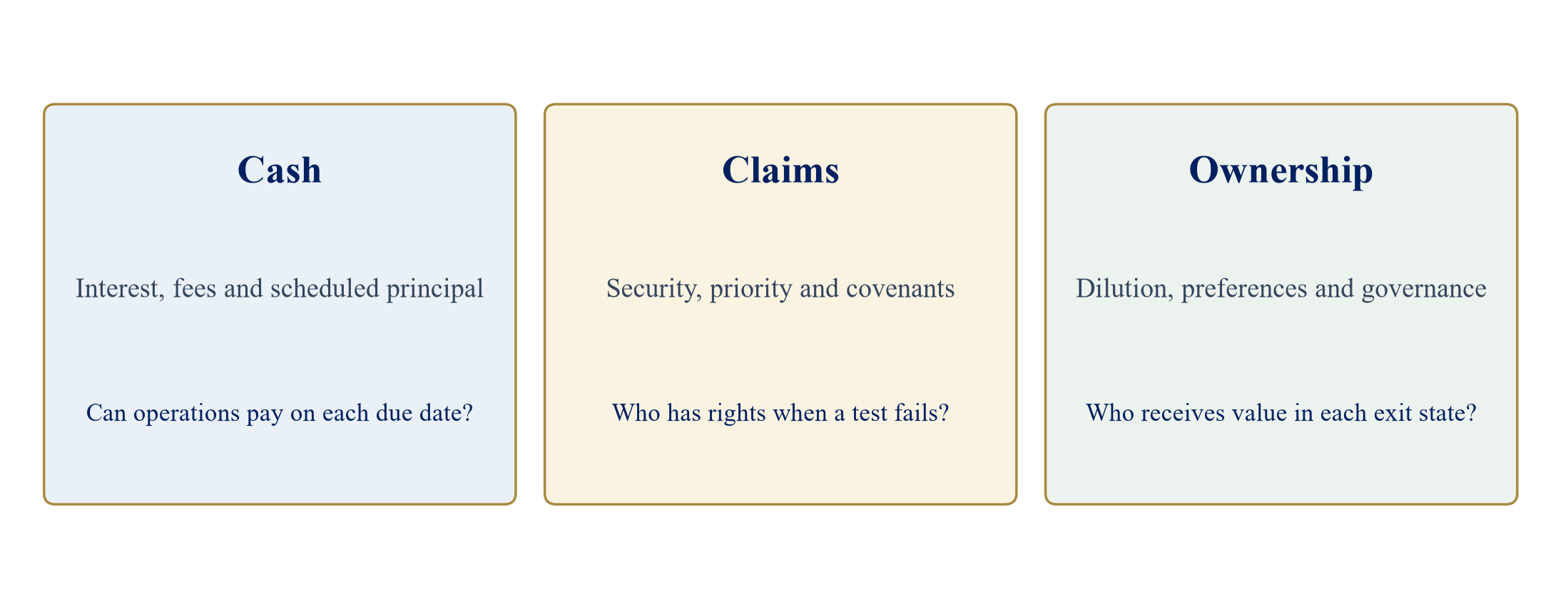
Author-developed classification diagram; positions describe contractual features to investigate and do not represent observed GCC terms.
5 Use one operating forecast and two financing overlays
The core model should begin with unlevered operating cash before discretionary financing flows. It needs monthly opening cash, receipts, payroll, supplier payments, taxes, committed investment, working-capital movements and closing cash. Revenue should be split by contract and timing where concentration matters. A yearly EBITDA line is too coarse for a lender repayment due in a weak month. The model should reconcile to the same balance sheet and sources-and-uses statement under both alternatives.
Overlay the debt route with net loan proceeds, draw dates, interest, fees, amortisation, cash sweeps, covenant tests and any reserve accounts. Overlay the equity route with net subscription proceeds, any investor-required spending, dividends and follow-on capital assumptions. The base operating plan remains identical. Any investor's promised commercial access or lender's ancillary benefit should be shown as a separate scenario supported by a deliverable, not inserted into the common base case as a certain cash inflow.
The model should disclose what happens if cash becomes negative. A spreadsheet that silently allows an unlimited overdraft has no credible downside analysis. The board can test a capped revolver only if a committed facility exists and conditions for drawing are understood. Otherwise it should identify the month and amount of unmet need and the decision that follows: defer investment, reduce costs, seek a waiver, sell an asset, inject equity or stop the programme. Each action has time, feasibility and owner-value implications.
The financing overlays also need expiry dates. Equity discussions may have an exclusivity period; lender approvals may require recent accounts and an executed security package. A cost comparison using a quoted interest rate after the term sheet lapses is stale. The board memo should carry version dates for every proposal and forecast. This creates an audit trail when the chosen structure changes during diligence.
6 Model the lower tail as a sequence of cash events
The usual “downside case” reduces annual revenue by a percentage and recomputes profit. That is useful only if it captures how a shock reaches cash. A delayed customer payment can produce a liquidity crisis without much change in annual revenue. Margin loss on a large contract, a late project completion, a deposit requirement or an imported-equipment payment can have different timing. The scenario design should therefore begin with causal events and then translate them into monthly cash receipts and payments.
For each material driver, record a range supported by contracts, historical experience or management estimates clearly identified as such. The board can test a single shock and a plausible combination. Correlation matters: a market disruption may lengthen receivables, raise input costs and delay a refinancing at the same time. Randomly combining independent shocks can understate that joint exposure. Where there is no reliable distribution, scenario bands are more honest than a simulated probability curve.
Cash-flow volatility is not equivalent to risk of distress. A firm can have volatile receipts but ample reserves, undrawn committed capacity and flexible investment. Another can have smooth annual cash with a large maturity wall. The useful debt test is minimum month-end liquidity and the distance between actual covenant measures and contractual limits across scenarios. Management should report both the worst month and the date on which intervention is still feasible. A breach observed after the cash has already been spent is a late signal.
The central bank's annual UAE financial stability work uses forward-looking stress testing at banking-system level [5]. That illustrates the relevance of stress design, while its system-wide results are not borrower-specific thresholds. The IMF's July 2026 UAE statement describes continuing credit and deposit growth alongside expected moderation in private-sector credit growth [6]. Those observations motivate current lender engagement and timing analysis. They provide no evidence that a given company can borrow at a specified rate or renew debt after a shock.
7 Compare leverage to cash generation and refinancing capacity
Leverage can be measured as gross debt to EBITDA, net debt to EBITDA, debt to enterprise value or debt to cash available for debt service. Each ratio answers a different question. A company with high accounting EBITDA and slow collections may be unable to service a coupon. A company with valuable assets but uncertain cash may support secured credit yet face a refinancing problem. The board should use the actual covenant definitions in proposed documents and calculate them from the same forecast used for liquidity.
Existing debt terms can dominate the incremental decision. New debt might be structurally subordinated, require old-lender consent, or be secured by assets already pledged. A fresh equity issue may trigger a change-of-control provision or require shareholder approval. The legal instrument and group chart should be read before financial model outputs are treated as executable. The question is not simply whether new debt is affordable in isolation, but whether the entire capital stack remains serviceable and permitted.
Refinancing is often hidden in a terminal-value calculation. A four-year bullet loan must be repaid from cash, a sale or a new financing. If the business plan assumes refinancing, the downside case should ask whether lenders would still lend at the lower cash flow and collateral value. A model that shows an attractive exit multiple in year five can miss a maturity in year four. The funding timetable should show that earlier gate explicitly.
Saudi Arabia's IMF 2025 Article IV report describes strong credit growth and funding pressure in banks as corporate and mortgage credit outpaced deposits [7]. That macro observation can affect how a Saudi issuer tests timing and lender concentration. It should not be projected mechanically onto UAE, Bahrain, Kuwait, Oman or Qatar. GCC markets and financing channels are not interchangeable. A company should obtain actual lender appetite in the relevant jurisdiction and entity structure.
8 Treat investor governance as an economic term
An ordinary-share subscription can be economically different from a preferred instrument. A new shareholder may request reserved matters, board seats, information rights, transfer restrictions, vetoes over debt or acquisitions, and exit provisions. Some terms protect a minority investor against value leakage. Others can slow a financing or prevent the founder from taking an action that would be attractive in a changed market. The analysis should record each material right and identify decisions it could affect.
The owner should map three states: ordinary operations, underperformance and a proposed exit. In ordinary operations, ask who approves budgets and new borrowing. Underperformance may trigger a right to demand information, block new capital or negotiate a recapitalisation. At exit, preferences and drag-along or tag-along provisions can change the allocation of proceeds. The economic value of a veto cannot be reduced to a generic percentage. Its effect depends on when the decision arises and whether the parties' interests remain aligned.
Accounting labels need care. IAS 32 differentiates a financial liability from equity by contractual cash-delivery obligations and has specific rules for own-share settlement and compound instruments [4]. A security called “equity” in a term sheet can have liability features for financial reporting. Conversely, a convertible instrument may be split into components. The board should ask its accountants to analyse the actual draft, while the financing committee separately models cash and ownership rights. One classification does not replace the other analysis.
The proposed shareholder also brings potential non-financial contributions. Sector knowledge, customer access, governance and future funding can be valuable. A board can assess them by identifying the named team, deliverables, conflicts, historical examples and whether support is contractual or discretionary. Unverified promises should remain an upside scenario. A weak operational partner can impose governance costs as well as dilution. A strong one can alter the operating plan; that causal route should be described and tested independently.
9 Define the founder-value comparison correctly
Founder value is the distribution of cash and claims to the existing owners across the decision horizon. It includes retained cash, distributions, exit proceeds and any required support payment. A comparison should show each owner's fully diluted stake and preference waterfall, then deduct debt and costs according to claim priority. The model should report the amount available to the founder under each financing route in a common set of enterprise outcomes. It should also report cases where the business cannot fund its operations before an exit.
The nominal cost-of-capital comparison can be a useful diagnostic. It cannot alone rank instruments when the financing changes the probability of completing an investment, retaining customers or preserving negotiating time. The choice is state contingent. Debt lets the owner retain more upside if the company can pay it and the investment succeeds. Equity shares the upside and can provide more cash resilience if contractual service would strain the plan. Specific terms can reverse these broad tendencies; the owner must model the actual documents.
The discounted founder-value model can use scenario weights only when the committee can explain their evidence and sensitivity. If probabilities are management estimates, label them as estimates and show results without them. A robust decision can be described by dominance tests: if one route leaves more founder value in every credible state and satisfies all cash gates, it has a clear advantage under those assumptions. When rankings cross, the board should name the values it is trading: control, survival, upside, speed or future financing flexibility.
The analysis must avoid double-counting debt cost. Enterprise value at exit may already reflect operational cash retained or spent. Interest paid from cash should not be subtracted again from an exit equity value that already includes lower cash. A model should show a bridge from operating cash to closing cash, then from enterprise value to equity value, and finally through the distribution waterfall. The illustrative arithmetic below separates a simple exit bridge from the broader cash model for this reason.
10 A transparent hypothetical comparison
Consider a wholly fictional business seeking AED 40 million net of any transaction costs, which are set to zero solely for the first arithmetic demonstration. Assume a pre-money equity value of AED 180 million, existing net debt of AED 20 million and 100% founder ownership. A fresh AED 40 million ordinary-equity investment at that price would give the investor 40 divided by 220, or 18.18% of post-money ordinary equity. The founders would retain 81.82%. Actual pricing, preferences, fees and option dilution would change those figures.
For a debt comparator, assume the same AED 40 million is added as a four-year bullet at a 9% annual cash coupon, with no amortisation, fees or tax benefit in this simplified bridge. The annual coupon is AED 3.6 million. The new debt must be repaid at maturity or earlier from a refinancing or sale. A simple terminal bridge that ignores interim cash and treats existing net debt as AED 20 million compares founder residual value after debt with the founder's 81.82% share under equity. That bridge is not a final investment decision because it leaves out the financing cash flows.
Table 1. Hypothetical exit-claim bridge before interim cash flows
| Assumed exit enterprise value | Founder residual after new debt | Founder ordinary-equity share after new investor | Initial reading |
|---|---|---|---|
| 160 | 100.0 | 114.5 | Equity protects more terminal residual before cash costs |
| 240 | 180.0 | 180.0 | Claim bridge is approximately equal |
| 320 | 260.0 | 245.5 | Debt preserves more terminal upside before cash costs |
AED million. Author-developed arithmetic with assumed values only. Debt column equals enterprise value less 20 existing net debt and 40 new debt. Equity column equals 81.82% of enterprise value less 20 existing net debt. Coupons, fees, retained cash, preference rights and distress actions are excluded; the table cannot rank the alternatives alone.
The break-even enterprise value in this restricted bridge is AED 240 million. It is algebra, not a market estimate. Debt coupons, other cash payments, transaction fees and the possibility that the debt route fails before exit all move the comparison. The cash model should be run first, and the table should then be rebuilt with actual term sheets and a full cap table. A board that uses the AED 240 million figure as a general valuation threshold would be making a category error.
Assume, separately, that the business can generate cash available before financing of AED 7 million per year in a downside state. A AED 3.6 million coupon would leave AED 3.4 million before principal and any covenant reserve. If required reinvestment or working capital is AED 5 million, the year is underfunded unless opening cash, a committed line or reduced expenditure covers the gap. A nominally inexpensive loan can therefore be infeasible in this state. These amounts are teaching assumptions, not forecasts of any GCC business.
11 Construct a debt-versus-equity matrix with gates
A financing matrix should distinguish an instrument that is economically attractive from one that can actually close and operate. The first gate is net funding: can the route deliver the required cash by the date of expenditure? The second is monthly liquidity: can the business meet all unavoidable payments while holding its board-approved reserve? The third is legal and contractual feasibility: can the borrower grant security, obtain consents and satisfy existing agreements? The fourth is founder economics across credible outcomes. The order matters because a high-upside structure that fails the first two gates is not a viable funding plan.
The matrix should present actual offers, not representative assumptions disguised as quotes. Where a lender has supplied only an indicative term sheet, note conditions precedent and unresolved pricing. Where an investor has supplied only a non-binding valuation range, show the resulting cap-table range. Compare a mixed structure if the available proposals permit one. The board may choose to keep two routes live until a diligence milestone, but it should budget the management time and exclusivity implications of running parallel negotiations.
Table 2. Debt-versus-equity decision matrix
| Decision gate | Debt evidence | Equity evidence | Board question |
|---|---|---|---|
| Net proceeds and timing | Draw conditions, fees, security, availability period | Subscription amount, closing conditions, investor approvals | Which route funds the committed uses when due? |
| Cash resilience | Monthly service, principal, reserve and covenant headroom | Operating runway, follow-on rights and spending conditions | Which route remains workable in the lower-tail cases? |
| Existing obligations | Consent, ranking, cross-default and guarantee map | Change-of-control, consent and shareholder-rights map | What existing contract can block closing or later action? |
| Founder value | Residual after all debt, cash costs and distress response | Fully diluted waterfall and governance constraints | How does the owner fare across credible exit states? |
| Option value | Prepayment, accordion, refinancing and waiver capacity | Future rounds, anti-dilution, exit and transfer terms | Which route leaves useful future choices open? |
Author-developed board tool. Fill each cell from dated term sheets, operating records and legal review. No entry is a market quote or a predicted outcome.
The matrix is a decision aid rather than a numerical score. A board could assign weights to objectives, yet a weighted total can conceal a failed hard gate. For example, an equity route with an attractive partner may still miss a non-deferrable acquisition closing date. A debt route with a low nominal cost may breach a covenant in the first weak quarter. Record failed gates separately from preferences, and state what evidence or contract change could reopen the route.
The matrix should be accompanied by a version ledger. It should identify the date of each operating forecast, the source and status of each financing proposal, legal assumptions, tax assumptions and unresolved diligence. A committee reviewing the decision later can then see whether a change arose from the issuer, the financier or external conditions. This is particularly important when a process spans several months and rates, valuation expectations or shareholder priorities move.
12 A fundraising timetable is a risk model
Time to cash has its own cost. Lender underwriting can require audited statements, collateral valuation, beneficial-ownership documentation, board approvals, account-opening, security perfection and conditions precedent. An equity investor may require commercial diligence, governance negotiations, regulatory approvals and a fully diluted cap table. The actual path varies by institution and jurisdiction. A timetable should therefore be built from the specific proposal and workstream owners, rather than from a generic market average.
The board should mark four dates: the first committed use of funds, the latest date at which the project can be deferred without a material cost, the expected financing close and the lender or investor long-stop date. A financing that closes after a non-deferrable payment creates a bridge requirement. That bridge may be more expensive than the difference between the long-term alternatives. A staged investment can sometimes reduce the gap. The point is to price the full sequence of financing, including any temporary instrument.
Figure 2 shows a decision-gated timetable. Parallel preparation can protect option value, while an exclusive term sheet may narrow it. The company should record which milestones are within its control. A missing audit, unresolved title document or unapproved shareholder consent is an issuer-side delay. A financier's committee scheduling and third-party review are external dependencies. The plan should specify when the board will revisit the capital choice if a milestone slips.
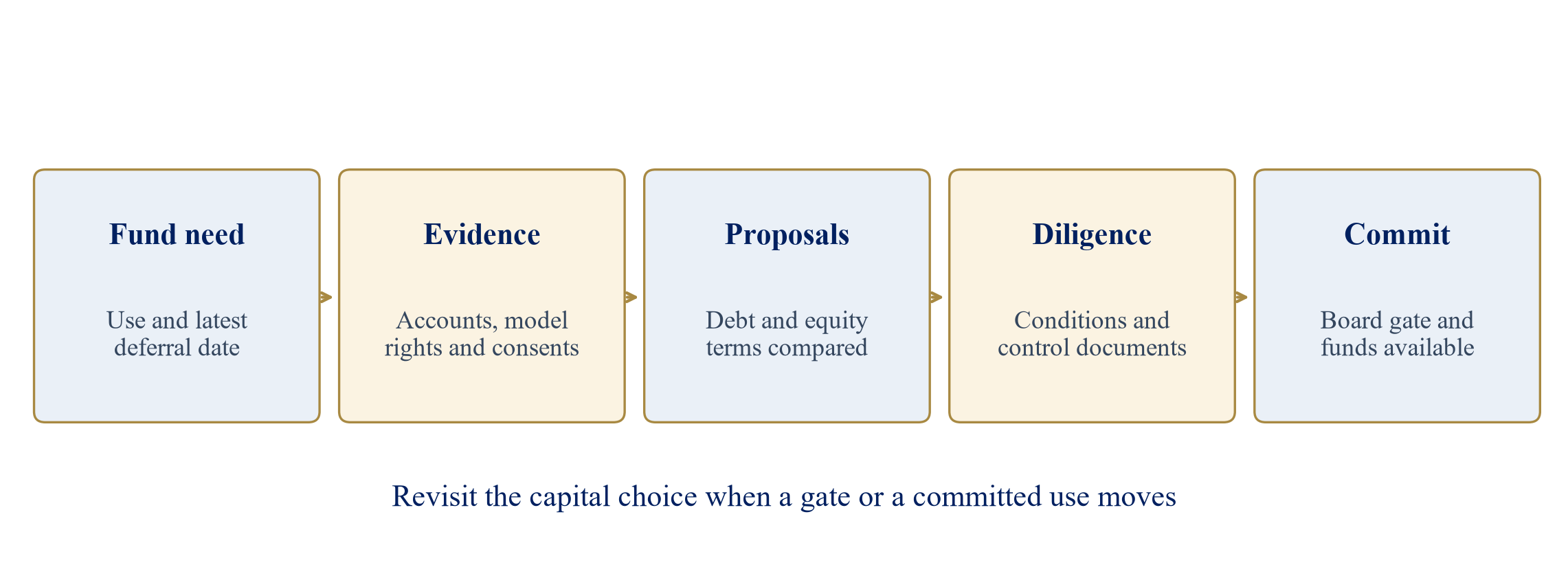
Author-developed workflow, with no claim about typical GCC closing duration. Each phase must be dated against the issuer's own committed cash needs.
The timetable also tests the meaning of “available” capital. A signed equity subscription that still depends on investor committee approval is not cash in the bank. A debt commitment with unsatisfied security conditions is not fully drawable. The board should distinguish an expression of interest, indicative term sheet, approved commitment, executed documents and settled funds. Cash planning should use the stage actually reached.
13 Set a document standard before approaching capital
Weak evidence raises the cost of both routes. A lender cannot underwrite cash coverage without reliable management accounts, borrower identity and debt details. An investor cannot price ownership and governance without a cap table, legal structure and commercial plan. The core data room should therefore be financing-neutral. It can later add lender-specific security files and investor-specific ownership materials. This reduces contradictory numbers and avoids preparing separate stories for each party.
The minimum financial set comprises audited statements where available, monthly management accounts, bank statements, working-capital schedules, customer and supplier concentration, an integrated forecast and a bridge from historical actuals to assumptions. The legal set comprises group chart, licences, major contracts, existing financing and security, shareholder documents, litigation and material consents. The operating set comprises the investment programme, milestones, procurement, permits, insurance and responsible managers. A business in a regulated sector needs its sector-specific permissions and compliance evidence.
Table 3. Financing evidence and responsibility checklist
| Evidence package | Owner and control | Debt use | Equity use |
|---|---|---|---|
| Integrated monthly model with assumption log | Finance; reconciliation to actuals | Service and covenant headroom | Runway, funding need and value case |
| Existing debt and security register | Finance and counsel; contract check | Ranking, consent and available collateral | Enterprise-to-equity bridge and restrictions |
| Fully diluted cap table and shareholder rights | Company secretary and counsel | Change-of-control and guarantee permissions | Dilution, preferences and governance |
| Contract and cash-conversion file | Commercial and finance; sampled evidence | Borrower cash reliability | Growth thesis and customer risk |
| Use-of-funds schedule and milestone budget | Operating sponsor and finance; board approval | Draw profile and debt sizing | Capital deployment and follow-on need |
| Tax, regulatory and entity analysis | Qualified specialists; written advice | Borrower, security and payment treatment | Issuer, instrument and investor permissions |
Author-developed data-room control list. Applicability depends on the issuer and proposed instrument; a missing document is a diligence question, not proof of ineligibility.
The data room should include an open-issues log rather than hide uncertainty. A forecast may depend on an unsigned contract; a receivable may be disputed; a land title may be under review. Record the fact, amount at risk, owner, evidence due date and effect on each financing route. Financiers can then price the remaining risk. An apparently more attractive term sheet obtained from incomplete disclosure may deteriorate during diligence or fail to close.
Confidentiality remains essential. A lender and a prospective shareholder may need different levels of access, especially where a party also competes with the business or has a commercial relationship with a shareholder. The company should obtain appropriate nondisclosure and data-processing arrangements, stage sensitive information and log access. The paper does not prescribe a universal data-room protocol; counsel should adapt controls to the parties and applicable law.
14 Identify the conditions that turn debt into forced equity
Debt can preserve ownership at closing yet lead to equity dilution later if liquidity becomes tight. A missed forecast, covenant breach or maturity can require a rescue raise. The later investor may negotiate when the company has less time and leverage. A comparison that models only initial dilution understates this contingent path. The debt case should include a branch for refinancing, amendment, asset sale, equity injection or restructuring after each identified stress event.
The cost of a rescue cannot be assumed from today's valuation. A credible downside scenario should show a range of possible terms or mark them unknown. It should also state whether existing owners have capacity to invest and whether current shareholders or lenders have consent rights. A “bridge to the next round” can be rational when a near-term milestone is verifiable. It becomes fragile when the milestone itself depends on the financing remaining available through a delay.
This mechanism also affects governance. A covenant breach can give a lender control over waivers or distributions. An equity investor may have reserved-matter rights from the outset. Both are contractual control channels. The board should compare the circumstances under which they activate and the time allowed to respond. A simple assertion that debt preserves control ignores lender rights; a simple assertion that equity loses control ignores the particular shareholder agreement.
The board can seek structural changes before choosing. Smaller initial debt, a longer grace period, staged drawings, amortisation matched to project cash, a committed revolver or a lower covenant trigger can reduce stress. Equity can be staged after proof points, with valuation adjustment, governance sunsets or narrow reserved matters. Each modification requires the other party's agreement and may change price. The decision file should show the economics of the negotiated package, not an idealised structure that no counterparty has offered.
15 Evaluate hybrids on their own cash and claim terms
A mixed structure can preserve cash and limit dilution, but “hybrid” is not a risk category. A convertible note can have interest, a maturity, valuation caps and conversion triggers. Preferred equity can carry a redemption obligation. Mezzanine capital can combine cash pay, payment-in-kind and warrants. IAS 32 classification turns on contractual substance, including obligations to deliver cash, rather than the label selected for a pitch [4]. Every proposed instrument should be decomposed into payment, claim, ownership and control components.
The useful hybrid question is whether each tranche finances a different risk period. A small equity buffer can fund development and provide liquidity while a senior loan finances contracted asset spending after completion risk falls. A revolver can absorb working-capital fluctuations while permanent equity funds a long-return project. A term loan may be drawn after an offtake contract is signed. The board should state the milestone that changes the risk and the evidence required before capital moves to the next tranche.
Layered capital also creates intercreditor and shareholder interactions. A senior lender may restrict subordinated debt payments or equity distributions. New investor vetoes may apply to borrowing or security. The pricing of one tranche can be affected by another's ranking. The model should include all fees, commitment charges and conditionality. It should also identify whether staged capital is fully committed or dependent on later investment-committee decisions.
The presence of a third option does not answer the original comparison automatically. If no lender has offered a feasible debt tranche and no investor accepts the proposed minority terms, the hybrid remains a design hypothesis. A board should continue to show the standalone alternatives with actual proposals. This makes clear whether the hybrid creates value, merely splits the risk between parties or leaves a funding gap.
16 Measure option value with decision triggers
Financial flexibility is valuable because a company learns after financing. Sales may accelerate, a project may be delayed, an acquisition may become available or an investor may offer better terms. A debt package with prepayment flexibility can be useful if cash arrives early. An equity package with clear future-round rights can be useful if the business needs more risk capital. The company should list likely future decisions and test whether the present instrument permits each one.
This is an option-value analysis, though it need not assign a speculative monetary value to every right. The board can record the action, date, required consent, expected cash and downside consequence. For example, a loan's security package may block a later asset sale without lender consent; an investor's reserved matters may require approval for an acquisition. These rights are often reasonable protections. Their cost to the founder depends on the likelihood and value of the future action. Where neither can be estimated credibly, the memo should preserve the qualitative constraint.
The board should also test the ability to change course. Can expenditure be deferred before a debt draw? Can the company raise an additional equity tranche without disproportionate anti-dilution? Can a lender waive a breach, and who approves it? Can founders sell a minority stake to meet a personal liquidity need without triggering financing consequences? Answers must come from draft documents. A term-sheet summary can miss clauses that drive real option value.
Bolton, Chen and Wang's liquidity analysis gives a theoretical basis for retaining reserves when future external financing is costly [2]. It does not provide a GCC-specific option premium. The present framework therefore records the choices that could be lost, models the cash consequences when possible and leaves unpriced elements visible. That is more decision-useful than burying them in a blanket “cost of capital” percentage.
17 Run an investment-committee challenge session
The financing decision should receive a challenge session before exclusivity or signing. The sponsor presents the investment case and why the amount is needed. Finance presents the reconciled cash model and lower-tail tests. Legal counsel presents borrower, security, investor rights and consents. Tax and accounting specialists address the actual proposed terms. A commercial lead explains the assumptions behind major customer receipts and milestones. The founder states the ownership and control objectives that the board is authorised to consider.
The challenge should ask what evidence would change the recommendation. If a customer contract is signed, would the lender increase capacity or reduce pricing? If a valuation falls, would equity still be preferred? If the base case slips by three months, which covenant or runway fails first? What is the minimum capital that allows the project to reach a value-relevant proof point? These questions turn a broad debt-versus-equity debate into specific decisions and evidence requests.
The committee can require a one-page comparison of net proceeds, month of minimum cash, first possible covenant stress, rights granted, founder payout across exit states, conditions precedent and closing schedule. It should also see a no-deal case. Sometimes the defensible decision is to reduce or defer the investment rather than accept either offered instrument. That alternative has commercial costs and should be modelled alongside the financing routes.
The record should identify dissent and uncertainty without creating an illusion of numerical precision. A management estimate of customer timing remains an estimate. A lender's verbal expression of support remains preliminary until documented. A model that produces two decimals of founder value from highly uncertain assumptions should show sensitivity bands. The final resolution should state the chosen route, fallback route, triggers to revisit and owner for each unresolved condition.
18 Specify the study needed to estimate a real threshold
An empirical answer to “at what volatility and leverage does equity preserve more founder value?” would require a matched dataset that this paper does not possess. The sample would need financing proposals for comparable issuers, pre-financing monthly cash histories, opening cash, leverage, covenant definitions, ownership terms, alternative options and subsequent outcomes. Recording only closed debt deals or completed equity rounds would omit failed financings and introduce selection bias.
The study should define the outcome carefully. Founder value can include distributions, retained stake value, rescue contributions and losses. Some private companies do not exit within the observation period, making realised value unavailable. The study could separately examine near-term liquidity breaches, forced recapitalisations, financing delay and survival of the investment plan. It should identify whether the comparison is descriptive, predictive or causal. An observed correlation between leverage and dilution does not establish that debt caused the dilution; weaker firms may choose debt or receive unattractive equity offers in the first place.
Volatility should be measured from cash, not only EBITDA, and conditioned on seasonality, concentration and investment stage. Leverage should include all contractual debt and guarantees at the relevant entity, with clear treatment of leases and shareholder loans. Instrument terms should be recorded as of offer date, before outcomes are known. Sector, scale, collateral, jurisdiction, sponsor quality and prevailing funding conditions could affect both the offered terms and eventual outcomes. Without these controls, a single threshold would be unreliable.
The cohort would need client consent, confidentiality controls and publication rules that protect private mandates. Sparse cells could reveal a company. A preregistered analysis, independent coding and disclosure of rejected cases would improve interpretability. Until such evidence exists, the present paper offers a falsifiable method and a transparent scenario model. It does not assert that its hypothetical crossover applies to any issuer.
19 Read public context with the right level of precision
Public macro-financial data can inform stress scenarios and financing timing, but it cannot replace a term sheet. The CBUAE publishes annual financial stability assessments and system stress analyses [5]. The IMF's July 2026 UAE staff statement describes the banking system as well-capitalised and liquid while expecting moderation in private-sector credit growth [6]. Neither source reports the credit decision of a named lender for a named borrower. A strong aggregate bank balance sheet does not mean every business can raise secured debt on the same conditions.
The IMF's Saudi analysis identifies funding pressure associated with strong credit growth and a changing bank liability mix [7]. That issue may prompt a Saudi borrower to test lender funding tenor and concentration. It cannot be transferred without evidence to another GCC jurisdiction, and it should not be transformed into an unsupported forecast of loan margins. The OECD's 2026 financing scoreboard includes multiple countries and financing types [8]. It is valuable as comparative context, while it does not supply the private GCC matched cases required by the research question.
Accounting standards are another evidence class. IAS 32 and IFRS 9 clarify classification and measurement questions [4, 9]. They do not choose the economic financing route for a company. Academic papers explain possible mechanisms, including liquidity and distress costs [1, 2, 3]. They do not convert management estimates into observed issuer outcomes. The board should keep four folders distinct: public context, contractual financing offers, company operating evidence and analytical assumptions. The final recommendation should trace each consequential statement to one of them.
This separation also protects the firm's credibility. A hypothetical example should never be introduced as a completed mandate or a market benchmark. A model output should be tied to its dated assumptions. A service promise should be limited to work that can be delivered under an actual engagement. The value of the framework lies in making uncertainty and contractual consequences explicit enough to support negotiation and governance.
20 Decide through a reversible, evidence-led sequence
The first decision is the minimum net capital needed to reach a defined operating milestone with a reserve. The second is which available proposals can deliver that capital by the required date. The third is whether the debt route passes monthly liquidity, covenant and refinancing stress tests. The fourth is how founder value and control differ across credible exit and underperformance states. The fifth is whether negotiated changes to terms can improve a viable route. These gates produce a narrower, more actionable decision than a blanket preference for cheap debt or non-dilutive ownership.
The recommendation should have an implementation plan. For debt, identify conditions precedent, security, cash-reporting systems, covenant monitoring, reserve policy and a maturity plan. For equity, identify investor approvals, final cap table, governance calendar, information rights and follow-on capital strategy. For a staged mix, identify the proof point and what happens if the second tranche does not close. Each plan should state the date on which the board revisits the capital structure.
Figure 3 is the final decision map. It treats the downside as a financing path: an operating event changes cash, cash interacts with contractual claims, and the resulting choices affect founder value. There is no universal volatility or leverage number in the map. The company can populate it with actual data and offers, then keep it current as evidence changes.
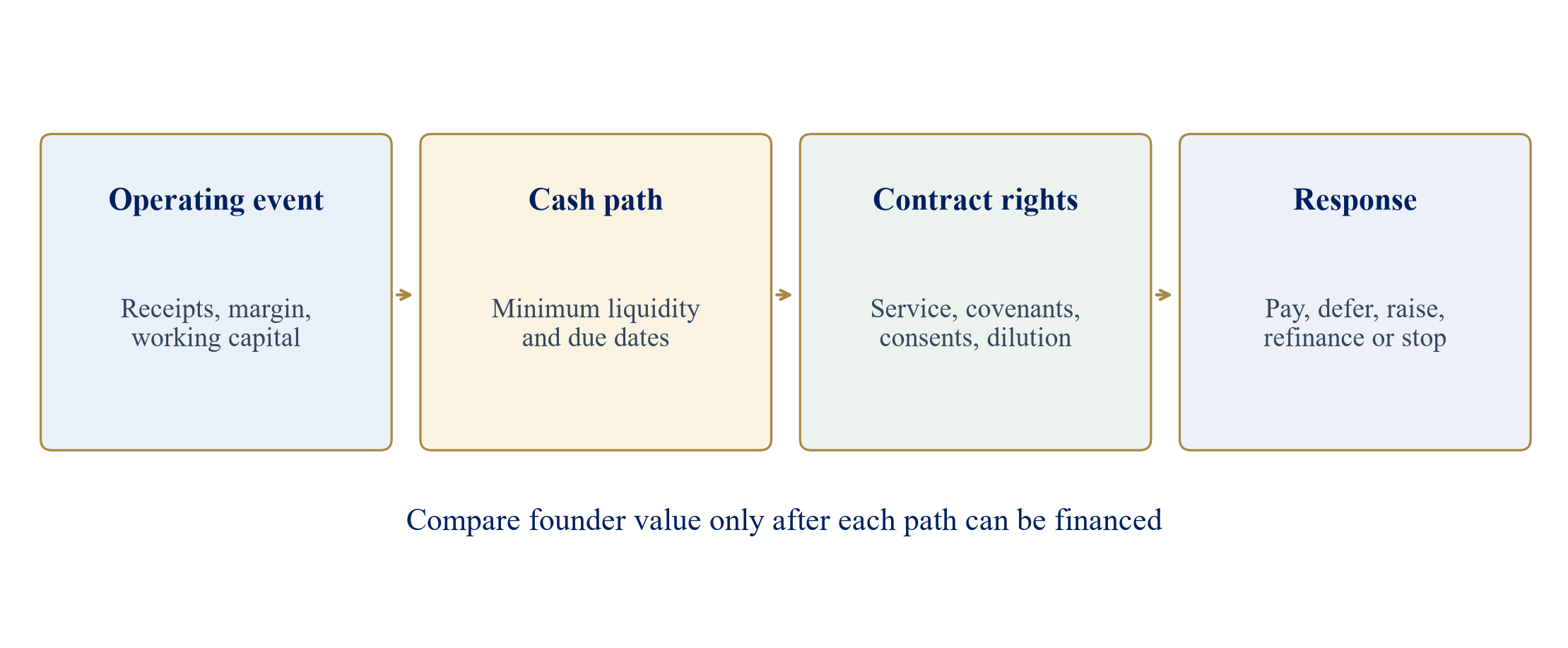
Author-developed decision architecture. It is a sequence of tests and does not estimate probabilities or represent observed transactions.
The framework has an explicit limit. It cannot state that one instrument is cheaper for all GCC companies, assign an issuer-specific probability of covenant breach from public aggregate data, or claim that a specific structure will preserve founder wealth. Those claims require actual company records, executable terms and, for population-level thresholds, a carefully constructed cohort. A board can still make a disciplined present choice by recording its assumptions, testing the lower tail, negotiating the rights that matter and committing to update the decision as facts arrive.
References
- Myers, S. C. “The Capital Structure Puzzle.” National Bureau of Economic Research Working Paper 1393, 1984. https://www.nber.org/papers/w1393
- Bolton, P., Chen, H. and Wang, N. “Debt, Taxes, and Liquidity.” National Bureau of Economic Research Working Paper 20009, 2014. https://www.nber.org/papers/w20009
- Hartman-Glaser, B., Mayer, S. and Milbradt, K. “A Theory of Cash Flow-Based Financing with Distress Resolution.” National Bureau of Economic Research Working Paper 29712, revised 2024. https://www.nber.org/papers/w29712
- IFRS Foundation. “IAS 32 Financial Instruments: Presentation.” Accessed 6 October 2026. https://www.ifrs.org/issued-standards/list-of-standards/ias-32-financial-instruments-presentation/
- Central Bank of the UAE. “Financial Stability Report for the Year 2025.” Published 17 August 2026. https://centralbank.ae/en/our-operations/financial-stability/
- International Monetary Fund. “IMF Staff Concludes Visit to United Arab Emirates.” 17 July 2026. https://www.imf.org/en/news/articles/2026/07/17/pr26250-united-arab-emirates-imf-staff-concludes-visit
- International Monetary Fund. “Saudi Arabia: Concluding Statement of the 2025 Article IV Mission.” 26 June 2025. https://www.imf.org/en/news/articles/2025/06/25/saudi-arabia-concluding-statement-of-the-2025-article-iv-mission
- Organisation for Economic Co-operation and Development. “Financing SMEs and Entrepreneurs 2026.” 31 March 2026. https://www.oecd.org/en/publications/financing-smes-and-entrepreneurs-2026_075d8058-en/full-report.html
- IFRS Foundation. “IFRS 9 Financial Instruments.” Accessed 6 October 2026. https://www.ifrs.org/issued-standards/list-of-standards/ifrs-9-financial-instruments/
About the Author
Chennakeshav (CK) is a corporate finance and investment banking executive with 25+ years of global experience in deal origination, structuring and execution across M&A, growth capital and corporate strategy. He has led value-creation mandates for founders, corporates and funds — bridging the boardroom view to hands-on execution and close.
His career spans Morgan Stanley, HSBC, Lloyds Banking Group, EWEC, ADQ portfolio companies and Emirates Growth Fund, across TMT, real estate, fintech, deeptech, cleantech, infrastructure and energy. He has partnered with C-suite leaders, private equity and venture funds, sovereign wealth funds and family offices to finance complex fund raises and scale-up ventures, and has led M&A due diligence, post-merger integration and business-transformation initiatives to create value.
At Matchpoint Partners he is Managing Partner, leading the firm's corporate finance, M&A and capital-raising practice. He holds an MBA from London Business School, an engineering degree from VTU and a Master of Laws (LLM, in progress) from UCL London.
An active start-up mentor, CK mentors at Techstars, DIFC FinTech Hive, Startup Grind, Founder Institute and IN5, serves as Entrepreneur Mentor in Residence (EMiR) at London Business School, and judges the Entrepreneurship World Cup.
