
Introduction
AI data centres require unusually large and reliable electrical loads. Grid interconnection can take longer than the commercial window for a campus, particularly where transmission upgrades, resource adequacy or utility studies remain unresolved. Developers have therefore proposed gas-fired generation, renewable assets, batteries and hybrid systems located behind the utility meter. Public filings describe projects that seek to combine grid service with on-site generation, equipment warehouses, power partners and customer leases.
The private-credit opportunity appears straightforward: lend against tangible generation equipment, a contracted data-centre customer and a site with valuable power access. The credit risk becomes more complex when the project remains under construction. Turbines can be ordered before permits are final. Customer payments can depend on staged energisation and acceptance. Fuel arrangements can be conditional. Grid rules can change the services, charges and operating constraints that apply to co-located load. The power plant may have limited alternative use if the campus is delayed, while the data centre may have limited value without the power plant.
The lender must determine when future infrastructure becomes credible collateral. That determination requires evidence of ownership, control, permits, construction progress, cost-to-complete, sponsor support, customer obligations and a workable recovery route. It also requires a clear boundary between the power SPV, the data-centre SPV, the sponsor and any third-party operator.
The central conclusion is that behind-the-meter credit becomes financeable when completion obligations, operating interfaces and recovery rights form one controlled system. The lender should size exposure to the verified value and cash flow available at each construction stage. Future capacity receives recognition only after objective conditions are satisfied.
1 Define the lending decision
The lending memorandum should state the precise asset, borrower, use of proceeds and repayment source. A facility may finance generation equipment before delivery, construction after delivery, a completed plant, or a broader campus. Each purpose creates a different exposure. Equipment finance depends heavily on title, specification, delivery and resale. Construction debt depends on cost-to-complete, contractor performance and sponsor support. Operating project finance depends on contracted cash flow, plant performance and customer credit.
The proposal should identify the maximum commitment, funded amount, tenor, amortisation, interest reserve, equity contribution and conditions precedent. It should state whether repayment depends on construction refinancing, operating cash flow, asset sale, sponsor resources or a combination.
The credit committee should define the reasons to decline. A project should not proceed when the borrower lacks control of essential land, permits, fuel, equipment, grid rights or customer contracts. The same applies when the sponsor cannot fund a downside cost-to-complete or recovery depends on an unverified buyer for specialised equipment.
2 Separate the power asset from the campus
A behind-the-meter project contains at least two operating systems. The power system can include turbines or engines, transformers, switchgear, fuel connections, emissions controls, batteries and a control room. The data-centre system can include the building shell, cooling, electrical distribution, backup generation, racks, networks and customer-specific infrastructure. Shared substations, land, water, access and software can connect them.
The lender should map ownership and responsibility for every interface. A generation SPV may sell capacity and electricity to a data-centre SPV under a power-services agreement. The same sponsor may control both entities. A third-party energy company may finance, construct and operate the plant on leased land. Grid service may support the remaining load and allow exports under defined conditions.
The separation supports risk allocation only when contracts preserve access, operating rights, data and step-in. A lender to the generation SPV needs rights that remain effective if the data-centre developer defaults. A lender to the campus needs assurance that the power asset will continue operating through a data-centre restructuring. Shared assets require ownership, maintenance and replacement rules that survive a change of control.
3 Map the entities and contracts
The transaction map should show the sponsor, holding companies, landowner, generation borrower, data-centre owner, customer, equipment suppliers, engineering contractor, fuel supplier, operator, utility, grid operator and lenders. It should identify equity interests, guarantees, security, payment flows and termination rights. Public filings often describe separate equipment borrowers, project entities and customer leases; the lender should verify the final structure rather than rely on an announcement.
Contracts should be tested as a connected set. The land lease must permit generation, fuel facilities, access, security and lender step-in. Equipment contracts must allow assignment and preserve warranties. The engineering, procurement and construction contract must allocate delay, performance and change-order risk. The fuel agreement must support the expected dispatch profile. The power-services agreement must recover fixed costs, fuel, maintenance and debt service under defined availability conditions. The customer lease must align its energisation and acceptance milestones with those arrangements.
The map should also identify contracts that remain with sponsor affiliates. Shared personnel, procurement systems, intellectual property and control software can become essential. These services require documented terms, data access, replacement rights and limits on amendment.
4 Classify completion risk
Completion has several dimensions. Physical completion concerns construction and installation. Mechanical completion concerns equipment readiness. Electrical completion concerns interconnection, protection and energisation. Performance completion concerns output, efficiency, emissions, reliability and availability. Commercial completion concerns customer acceptance and payment. Legal completion concerns permits, title, security and enforceability.
A project can satisfy one dimension while failing another. A turbine may be installed but unable to operate because a gas lateral or air permit remains incomplete. A plant can produce electricity while failing the customer availability test. A data hall can be ready while the grid or on-site generation cannot supply the contracted load. Completion tests should therefore be stated separately and tied to draw, conversion, amortisation and release conditions.
The lender should assign each completion risk to a party with the capability and financial resources to manage it. The contractor can accept specified construction and performance risks. The sponsor can fund owner-driven changes and residual cost. The customer can accept obligations after defined delivery. The lender should avoid becoming the residual holder of unbounded interface risk.
Table 1. Behind-the-meter completion-risk allocation
| Risk | Required evidence | Primary control | Lender response when unresolved |
|---|---|---|---|
| Site and land | Enforceable title or lease, access, easements and security rights | Direct agreement and cure rights | No construction draw |
| Equipment | Executed purchase order, specification, title, delivery schedule and warranty | Assignment, inspection and payment milestones | Advance against verified value only |
| Construction | Fixed or controlled price, schedule, contractor capability and contingency | EPC security, liquidated damages and independent engineer | Lower commitment or additional equity |
| Fuel | Firm capacity, pressure, quality, transport, price and interruption rules | Long-term agreement and replacement plan | Stress dispatch and reserve requirements |
| Permits | Air, water, building, environmental and operating approvals | Permit register and legal opinion | Holdback until final permit |
| Electrical interface | Approved design, protection study, metering and operating protocol | Utility or grid agreement | Exclude assumed grid benefit |
| Customer acceptance | Executed contract, test procedure, payment commencement and remedies | Acceptance certificate and credit support | No term conversion |
| Operations | Qualified operator, spares, maintenance and performance regime | O&M direct agreement and replacement rights | Operating reserve and covenant |
| Cost-to-complete | Independent budget, committed costs, contingency and remaining equity | Equity-first funding and completion support | Stop draws if coverage is insufficient |
This author-developed matrix is a credit-screening tool. Transaction documents, law, technology and counterparties determine the actual allocation.
5 Establish development readiness
The first underwriting gate should determine whether the project is ready for debt. Site control should match the construction and financing term. The project should have a defined layout, electrical single-line diagram, fuel route, water plan, environmental basis, equipment specification and construction schedule. Material permits should be listed with status, dependencies and expected decision date.
Commercial readiness requires a credible customer path. An executed lease or services contract provides stronger evidence than a memorandum of understanding. The lender should review customer identity, guarantor, termination rights, security, acceptance, power obligations and remedies. The project budget should reconcile customer-funded amounts, sponsor equity, equipment deposits, debt and contingency.
Readiness also includes organisation. The sponsor should have named engineering, construction, legal, environmental, insurance and operating advisers. Governance should define who can approve design changes, draw requests, change orders and claims. A complex campus can lose value through interface decisions even when each contractor performs its narrow scope.
6 Control permits and regulatory approvals
Behind-the-meter generation can require air permits, water approvals, building permits, fuel-pipeline approvals, electrical authorisations and environmental reviews. Requirements vary by technology and jurisdiction. The credit file should contain a permit register supported by counsel and technical advisers. Each permit should identify its legal holder, transferability, conditions, monitoring requirements and consequences of breach.
Air-permit timing can affect equipment choice and operating hours. Water constraints can influence cooling and generation. Noise, traffic and community conditions can restrict construction or operations. Environmental liabilities can attach to land or activities outside the generation SPV. The lender should assess remediation responsibility, indemnities and insurance alongside permits.
The draw schedule should reflect permit risk. Early equipment deposits may be appropriate where title, refund rights and resale value are protected. Civil works and installation should proceed only after the relevant approvals support them. A general expectation of approval does not create collateral value.
7 Underwrite fuel and energy supply
Fuel is both an operating input and a completion dependency. A gas-fired plant requires pipeline capacity, pressure, quality, metering, balancing and delivery rights. The agreement should match expected hourly and seasonal use. Interruptible service can be useful when the grid provides backup, yet it can undermine availability when both systems are stressed. Dual-fuel capability can reduce one dependency while adding storage, environmental and maintenance requirements.
Renewable assets introduce resource and shape risk. Wind or solar output may not align with a continuous data-centre load. Batteries can shift energy and provide ride-through, but their duration, degradation and warranty limits must be modelled. A hybrid system should specify dispatch priority, minimum reserves and the services purchased from the grid.
The financial model should separate capacity payment, energy charge, fuel pass-through, fixed operating cost and variable maintenance. Fuel-price hedges can reduce volatility, subject to basis, collateral and counterparty risk. A lender should test the period after any hedge expires and the consequences of a customer dispute over pass-through charges.
8 Test equipment procurement
Large turbines, engines, transformers and switchgear can require substantial deposits and long delivery periods. The lender should verify manufacturer identity, equipment specification, manufacturing slot, payment schedule, delivery terms, title passage, storage, insurance, inspection, warranties and cancellation rights. It should identify whether the equipment is standard, configurable or dedicated to one project.
Title can be difficult when deposits are paid before the equipment exists or while components remain commingled. The lender may need a manufacturer acknowledgement, bailee agreement or direct agreement. Progress payments should correspond to independently verified work and vesting. Delivery should be conditioned on site readiness and storage capability.
Resale value should be assessed conservatively. A public announcement of demand for generation equipment does not establish a liquid secondary market. Recovery depends on technical configuration, remaining warranty, transport, installation status, buyer permits and timing. The lender should include removal and remarketing costs.
9 Build a complete sources-and-uses plan
The sources-and-uses plan should include equipment, civil works, electrical interconnection, fuel infrastructure, data-centre interface, permits, engineering, owner costs, financing fees, interest, taxes, insurance, contingency and reserves. Committed contracts should be reconciled to the latest budget. Uncommitted amounts require current estimates and procurement plans.
Equity should fund early development and identified risk. Bank construction-lending guidance highlights the increased completion risk created by deferred equity. The lender should confirm that remaining equity is available and controlled. Land value, deferred fees and expected profit should not be treated as cash available to finish the project.
Contingency should reflect design maturity, technology, procurement status and interface risk. A percentage applied to an incomplete budget can create false precision. The independent engineer should review both quantity and basis. The facility should contain a stop-draw test when remaining committed funds, equity and available contingency no longer cover a conservative cost-to-complete.
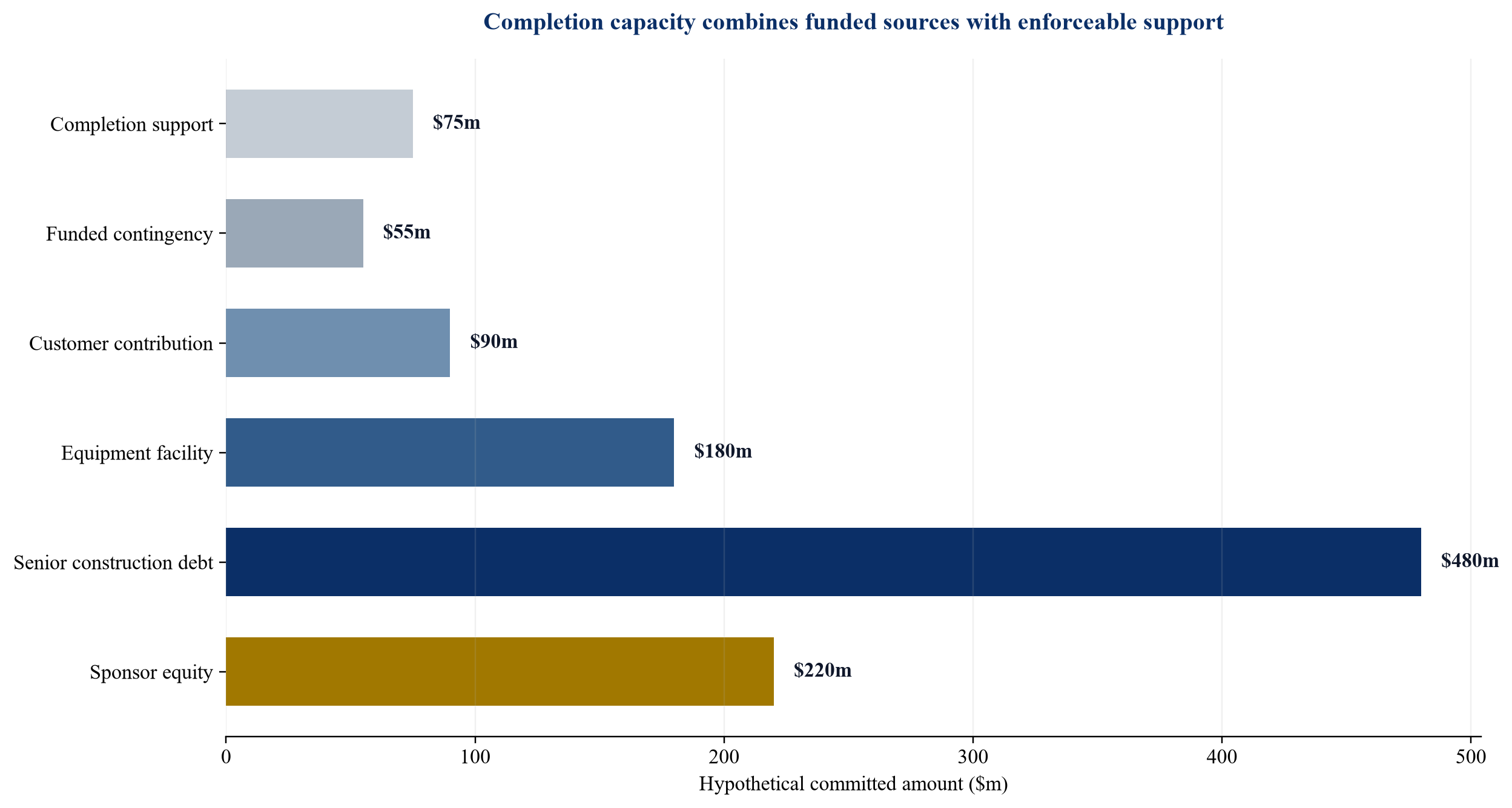
Values are hypothetical author-developed assumptions in US dollars millions. They do not describe a particular project, financing or market term.
10 Design draw controls
Construction lending requires evidence before each disbursement. A draw package should include invoices, schedule progress, budget variance, change orders, permits, lien waivers, insurance, title evidence, equity contributions and an updated cost-to-complete. The independent engineer should confirm physical progress and forecast completion. The account bank should control payments to approved beneficiaries.
Milestones should correspond to durable value. Equipment deposits can vest title or secure a refundable slot. Factory acceptance should precede a major payment. Delivery, installation, mechanical completion, first fire, synchronisation, performance testing and customer acceptance can support subsequent draws. Retention can remain until defects and documentation are resolved.
The lender should preserve discretion for material variance. Draw controls should not require the lender to redesign the project. They should prevent funds from moving ahead of verified value and ensure that sources cover the remaining scope.
11 Structure sponsor completion support
Sponsor support can take several forms: an equity commitment, cost-overrun agreement, completion guarantee, debt-service undertaking, letter of credit or funded reserve. The document should define the supported obligations, cap, duration, demand mechanics, defences, subordination and release conditions. A broad statement of sponsor intent offers little protection.
The sponsor's financial capacity matters as much as the legal form. The lender should review liquidity, competing commitments, debt, distributions and contingent liabilities. Support from a thin holding company may depend on upstream cash that is unavailable when several projects face stress together.
Release should occur only after objective completion. The project may need to pass output, efficiency, emissions, reliability and customer-acceptance tests, fund reserves and demonstrate a defined period of stable operation. Early release can transfer unresolved defects and ramp risk to the lender.
12 Allocate contractor risk
The construction strategy can use a single EPC contractor, multiple packages or owner-managed procurement. A single contract can concentrate accountability while increasing price and contractor exposure. Multiple packages can improve procurement flexibility while leaving interface risk with the owner. The lender should understand the actual allocation rather than the contract label.
The review should cover price, schedule, scope, exclusions, change orders, delay damages, performance damages, caps, security, warranties and termination. Contractor guarantees and performance bonds require enforceability and credit assessment. Liquidated damages can provide compensation yet may remain below the project's financing loss.
Interface schedules should link generation, fuel, electrical works and data-centre commissioning. A contractor can complete its scope while the integrated project remains unable to serve load. The owner should maintain a consolidated schedule and responsibility matrix reviewed by the independent engineer.
13 Underwrite the customer contract
The data-centre customer often provides the main source of project value. The lender should identify the contracting entity, guarantor, credit support and corporate relationship. It should examine term, committed capacity, commencement, acceptance, price, escalation, power pass-through, availability, credits, termination, assignment and change of control.
Payment should begin on an objective event that the project can achieve and the lender can verify. A customer may accept capacity in stages. The model should match debt draws and interest carry to each stage. Delayed customer equipment or network readiness should not automatically delay payment if the project has delivered its obligations.
Termination rights require close attention. The customer can have rights after prolonged delay, repeated outage, regulatory change or force majeure. Cure periods should align with lender step-in. Security deposits, letters of credit or parent guarantees should be held within the secured structure where permitted.
14 Align the power-services agreement
The generation SPV may sell electricity, capacity, availability or a bundled service to the data-centre owner. The contract should recover fixed capital and operating costs, fuel, variable maintenance, taxes and required reserves. Its payment mechanism should reflect the plant's responsibilities and the customer's load profile.
Availability definitions should exclude events outside the operator's control only where the risk is allocated elsewhere. Fuel interruption, grid instruction, customer curtailment, maintenance and force majeure need clear treatment. Metering and settlement should be auditable. Disputes should not allow the customer to withhold undisputed amounts.
The term should support debt maturity and include appropriate tail. Assignment, change of control and lender step-in should be permitted. A power contract between affiliated entities needs arm's-length governance, durable obligations and bankruptcy analysis.
15 Address grid and co-location rules
Behind-the-meter status does not remove every grid obligation. A campus can require firm or non-firm transmission service, backup, start-up power, exports or balancing. The applicable utility, system operator and regulator determine the rules. The lender should identify the point of interconnection, contracted demand, import and export limits, protection settings, metering, charges and operating instructions.
FERC's December 2025 PJM co-location order directed new transmission-service and interconnection rules for large co-located loads. The order illustrates how regulatory treatment can change as data-centre demand grows. A project should therefore avoid relying on a general claim that on-site generation bypasses the grid. The credit case should use executed service arrangements and current tariffs.
The operating model should test loss of on-site generation and limits on grid backup. It should also test curtailment or dispatch requirements affecting the generator. Regulatory counsel should confirm that the structure can operate as modelled and that cost allocation is reflected in the contracts.
16 Size debt from verified cash flow
Debt sizing should begin with payments that become enforceable after accepted completion. The model should deduct fuel, operating cost, maintenance, taxes, insurance, environmental cost, management fees and sustainable lifecycle capital expenditure. It should include customer credits, planned outages, degradation and working capital.
Coverage should be calculated under base and downside cases. The downside case should combine delay, cost overrun, lower availability, higher fuel cost, reduced grid support and customer stress. Debt capacity may be limited by coverage, leverage, cost-to-complete or recovery. The lowest constraint should govern.
During construction, the funded amount should remain below verified asset value and supported completion capacity. At conversion, the facility can resize to tested operating cash flow. Any excess commitment should be cancelled or remain conditional on later capacity.
17 Choose the financing instrument
Equipment finance can fund identified movable assets with strong title and resale value. A construction facility can fund installed scope against a controlled budget and completion support. Project finance can rely on long-term contracted cash flow and security over the project. Corporate debt can provide flexibility where sponsor credit is strong and asset isolation is unnecessary.
A hybrid structure can combine an equipment warehouse with a construction loan and later project refinancing. The warehouse finances deposits and delivered equipment. The construction facility funds installation and infrastructure after permits and equity. The term facility begins after completion tests and customer acceptance.
The lender should avoid gaps between instruments. Equipment debt can mature before project financing is available. Intercreditor terms should govern priority, enforcement, standstill and release. Refinancing conditions should be plausible under stressed interest rates and project performance.
18 Build the security package
The security package can include equity pledges, bank accounts, equipment, fixtures, land interests, material contracts, insurance proceeds, receivables, intellectual property and project rights. The exact package depends on law, ownership and asset classification. Perfection and priority require jurisdiction-specific advice.
Control should extend to cash. Customer and power-service payments should enter pledged accounts. The waterfall should fund taxes, essential fuel, operations, insurance, senior debt, reserves and permitted distributions in order. Leakage to affiliates should be limited and transparent.
Security value depends on enforceability and practical access. A lien over equipment inside an operating campus may be difficult to realise without land access and removal rights. A share pledge can preserve the integrated project, subject to permits, customer consent and change-of-control restrictions. The lender should model both going-concern and piecemeal enforcement.
19 Obtain direct agreements
Direct agreements connect the lender to counterparties whose contracts support value. The landowner can provide notice, cure and non-disturbance. The equipment supplier can acknowledge assignment, warranty rights and payment status. The contractor can provide step-in and transition. The fuel supplier and operator can continue service during cure. The customer can recognise security and lender step-in.
Each agreement should define notice, cure period, information, suspension, termination and transfer. Cure periods should be long enough to assess and fund a remedy while respecting the counterparty's operational needs. The lender should have access to records and project personnel.
Direct agreements should be negotiated early. A late request can reveal that a key contract prohibits assignment or limits lender rights. The credit committee should treat missing direct agreements as a specific risk with a defined remedy, not as a documentation detail.
20 Make step-in operational
Step-in rights create value only when the lender can use them. The recovery plan should identify a qualified operator, required permits, system credentials, spare parts, supplier accounts, fuel scheduling and customer communications. Critical data should be backed up and accessible outside sponsor systems.
The lender should decide whether it would step into the borrower, appoint a receiver, transfer contracts or sell the shares. The choice depends on law, environmental liability, customer consent, operating continuity and value. A pre-agreed replacement operator can reduce interruption.
The plan should be tested through a tabletop exercise before closing and updated during construction. The exercise can reveal missing passwords, licences, site access or contract rights. Those gaps can be cheaper to fix before a default.
21 Align insurance with construction and operations
Construction insurance can include builder's risk, delay in start-up, marine cargo, liability and environmental coverage. Operating insurance can include property damage, machinery breakdown, business interruption, liability and cyber. Policies should name the correct entities and recognise lender interests.
Limits and indemnity periods should reflect long-lead equipment and integrated delay. A turbine loss can delay both power and customer acceptance. Delay-in-start-up cover depends on insured physical damage and policy wording. It does not cover every permitting, contractor or commercial delay.
The lender should review deductibles, exclusions, sublimits, aggregation, claims control and proceeds. Insurance proceeds should fund restoration or debt repayment under objective tests. Sponsor support should cover risks retained outside insurance where they affect completion.
22 Assess environmental and social risk
Behind-the-meter generation can create emissions, water, noise, traffic, fuel and community impacts. The lender should assess applicable law and recognised environmental and social standards. The review should cover the site, fuel infrastructure, generation technology, cooling and cumulative campus effects.
Environmental obligations can affect construction timing and operating hours. Monitoring failure can create penalties or permit restrictions. Community opposition can delay approvals and increase cost even where formal requirements are ultimately met. The credit case should include mitigation, monitoring, reporting and grievance arrangements appropriate to the project.
Security documents should address environmental representations, covenants, indemnities and access. Enforcement decisions should consider potential liability from owning or operating the asset. Independent advice is required for each jurisdiction.
23 Test generation performance
Performance tests should cover net output, heat rate or efficiency, availability, emissions, reliability, ramp, black-start or islanding where relevant, and integration with the campus. The test procedure should define conditions, corrections, tolerances, repeats and independent witnessing.
Nameplate capacity does not equal dependable capacity. Auxiliary load, ambient conditions, maintenance and degradation reduce output. The data centre also requires power quality and continuity. A plant that meets annual energy output can still fail short-duration reliability requirements.
The lender should link completion, debt conversion and contractor remedies to the tested metrics supporting the financial model. Persistent shortfall can require debt paydown, additional equipment, customer amendment or sponsor support.
24 Model construction delay
Delay affects more than interest carry. It can trigger customer termination, equipment storage, contractor claims, permit expiry, hedge mismatch and lost commercial opportunity. The schedule should identify the critical path across permits, equipment, fuel, electrical works, data halls and customer acceptance.
The model should test staged delays of three, six and twelve months together with cost and revenue effects. It should show remaining liquidity, interest reserve, customer remedies and sponsor support. Delay damages should be recognised only to the extent enforceable and collectible.
The lender should establish early-warning thresholds based on float consumption, procurement variance and milestone slippage. A waiver should include a revised schedule, funded cure plan and updated customer position.
25 Combine completion and operating stresses
Single-variable sensitivities can miss the way project risks interact. A delayed plant may enter operation during higher fuel prices. A customer may renegotiate after missing an acceptance date. A contractor claim can coincide with exhausted contingency. Grid backup may remain unavailable when testing begins.
The combined stress should show cost-to-complete, debt funding, sponsor contribution, commercial-operation date, revenue, operating cost, coverage and recovery. It should also show which covenants or stop-draw conditions respond first.
The hypothetical table below illustrates a project whose base case remains financeable, whose moderate case requires additional equity and whose severe case exhausts completion support before stable operation.
Table 2. Hypothetical lender stress cases
| Metric | Base case | Moderate stress | Severe combined stress |
|---|---|---|---|
| Completion delay | 0 months | 6 months | 15 months |
| Total project cost | $1,100m | $1,235m | $1,455m |
| Senior debt funded | $660m | $705m | $760m |
| Additional sponsor equity required | $0m | $90m | $245m |
| Available completion support after cure | $75m | $20m | $0m |
| Accepted critical load | 180 MW | 150 MW | 95 MW |
| Stabilised free cash flow | $112m | $81m | $42m |
| Debt-service coverage | 1.55x | 1.12x | 0.58x |
| Estimated going-concern value | $1,080m | $815m | $470m |
| Lender action | Convert to term debt | Trap cash and require equity | Enforce, restructure or sell |
All monetary values are hypothetical author-developed assumptions in US dollars millions. They do not represent market terms, a forecast or a credit recommendation.
26 Develop the recovery waterfall
Recovery analysis should begin before closing. The first path preserves construction and completes the project with additional capital. The second path sells the integrated project to a strategic or financial buyer. The third path separates equipment and site rights where integration cannot be preserved. Each path has different time, cost and consent requirements.
Cash recovery follows the legal priority and practical costs. Essential operating and preservation expenses can sit ahead of distributions. Taxes, employees, environmental obligations, cure payments, receiver costs and sale expenses can reduce proceeds. Intercreditor arrangements determine how equipment and project lenders share value.
The lender should estimate recovery ranges and time rather than one point. It should test customer continuation, sponsor cooperation, permit transfer, equipment removal and buyer financing. Discounting should reflect delay and uncertainty.
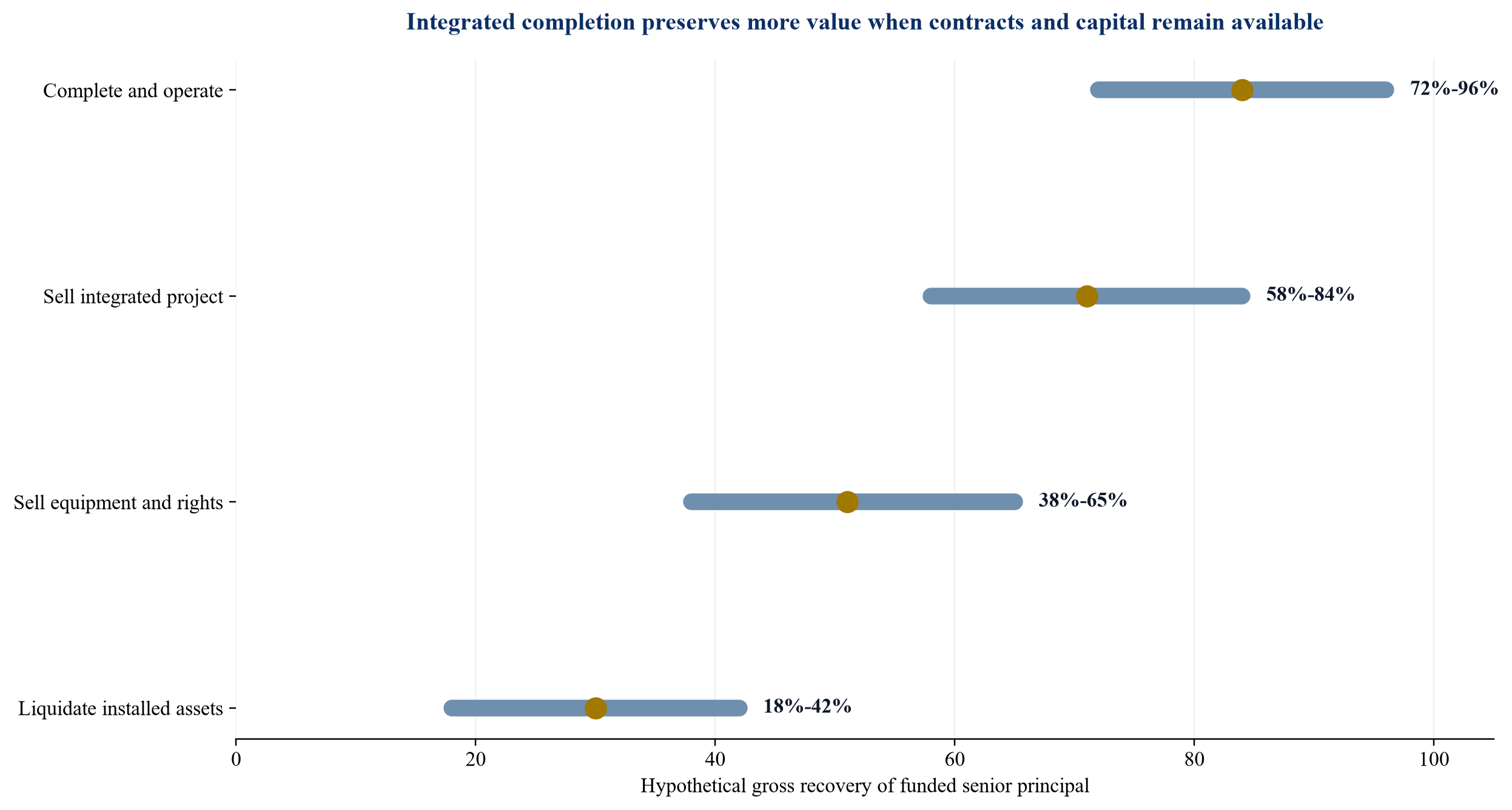
Percentages are hypothetical author-developed recoveries of funded senior principal before time-value discounting. They do not represent observed recoveries or a valuation.
27 Value an incomplete project
An incomplete project should be valued from the assets and rights actually available. Historical cost can exceed recoverable value. Deposits may be refundable, assignable or forfeited. Delivered equipment may have resale value subject to configuration and removal. Installed civil and electrical works may have value only with the site and permits.
The going-concern value should deduct remaining cost, delay, buyer return, cure payments and transaction expenses. Customer and power contracts should be included only where they remain effective through transfer. A prospective buyer may require amendments or new guarantees.
Independent valuation should use scenario ranges and identify reliance on sponsor information. The lender should compare integrated sale, completion and piecemeal liquidation. The most credible route can change as construction advances.
28 Structure covenants and triggers
Construction covenants should cover budget, schedule, permits, contracts, equity, change orders, liens, insurance and information. Operating covenants should cover performance, maintenance, fuel, customer contracts, debt service, reserves and distributions. Negative covenants should restrict additional debt, asset sales, affiliate transactions and material amendments.
Triggers should translate deterioration into action. A cost-to-complete shortfall can stop draws. Schedule slippage can require a cure plan and added contingency. Customer downgrade or termination can reduce availability. Performance shortfall can block conversion. Coverage failure can trap cash and accelerate amortisation.
Cure rights should have clear amounts, timing and evidence. Repeated waivers can conceal structural weakness. The lender should record cumulative changes to cost, schedule and scope.
29 Build construction surveillance
Monthly reporting should include schedule, budget, committed costs, paid invoices, contingency, equity, change orders, permits, equipment status, safety, claims, tests and customer interfaces. The independent engineer should visit the site and reconcile reported progress to physical evidence.
The lender should monitor manufacturer and contractor credit, fuel infrastructure and customer readiness. A project can remain on its internal construction schedule while an external dependency moves. Reports should identify critical path and float.
Data should be stored in a controlled repository that survives sponsor distress. The lender should have direct access to key reports, contracts, drawings and asset registers. Surveillance becomes the foundation for recovery if a default occurs.
30 Manage portfolio concentration
Private lenders may finance several data-centre power projects sharing sponsors, contractors, turbine models, gas networks, utilities or customers. Geographic diversification can leave significant common-cause risk. The portfolio should therefore measure concentration by each dependency.
Construction schedules can also correlate. Several projects may require equity or refinancing at the same time. Equipment defects or regulatory changes can affect an entire technology class. A customer concentration can span multiple campuses.
Limits, participations, syndication and risk transfers can manage exposure. The lender should retain sufficient information and control after distribution. Portfolio risk should be assessed in combined stress rather than as the sum of independent base cases.
31 Apply a credit decision matrix
The committee can evaluate five linked questions. First, can the project reach completion with committed sources and credible support? Second, will the completed assets produce cash flow under enforceable customer and power contracts? Third, does the lender control the assets, contracts and cash needed to protect repayment? Fourth, can another operator or buyer preserve value after default? Fifth, does the return compensate for construction, concentration and recovery uncertainty?
The matrix below converts those questions into conditions for approval, conditional approval and decline. It is a governance tool rather than a scoring model. Material weakness in one category can outweigh strength elsewhere.
Table 3. Private-lender decision matrix
| Category | Approve when | Require cure or extra protection when | Decline when |
|---|---|---|---|
| Completion | Conservative cost-to-complete is fully funded | Contingency or schedule requires added equity | Funding gap has no enforceable solution |
| Contracts | Customer, power, fuel and construction terms align | Consents or direct agreements remain outstanding | Essential contract can terminate before debt repayment |
| Sponsor | Support is enforceable and financially credible | Support cap needs increase or collateral | Sponsor lacks capacity for plausible downside |
| Security | First-ranking control covers assets, contracts and cash | Perfection or access needs final evidence | Critical assets remain outside the security perimeter |
| Operations | Tested plant and replaceable operator support service | Spares, warranty or operator transition needs cure | Operations depend on non-transferable sponsor capability |
| Recovery | Integrated sale or completion offers credible range | Buyer consents or remarketing evidence remains limited | Recovery relies on unsupported headline asset value |
| Return | Pricing and structure compensate for verified risk | Size, tenor or amortisation needs adjustment | Economics depend on optimistic refinancing or exit |
This author-developed matrix summarises transaction gates. It does not replace lender policy, legal advice, technical diligence or credit judgement.
32 Recognise common failure modes
Common failures begin with treating ordered equipment as a completed power asset. Other failures include using customer headline contract value as operating cash flow, assuming permits will arrive on schedule, accepting deferred equity, relying on untested sponsor support and ignoring the cost of grid backup.
Documentation failures can be equally important. The land lease may restrict removal. Equipment title can remain with a supplier. The customer can terminate after delay before the lender can cure. The fuel agreement can be shorter than the debt. Shared control systems can remain with an affiliate.
Recovery analysis can fail through optimism. Historical cost can be treated as value. A claimed secondary market can lack verified buyers. Removal, transport, tax and completion costs can be omitted. The lender should challenge each path with current evidence.
33 Apply an execution sequence
The lender begins with an entity, asset and contract map. It verifies site control, permits, equipment, fuel, electrical arrangements and customer obligations. The independent engineer validates design, budget, schedule and cost-to-complete. Counsel confirms security, direct agreements and enforcement. Insurance and environmental advisers assess retained risk.
Credit structuring then sets commitment stages, equity funding, completion support, draw controls, reserves, covenants and conversion tests. The recovery plan identifies step-in, replacement operator, integrated sale and equipment routes. Documentation should preserve the agreed allocation across every material contract.
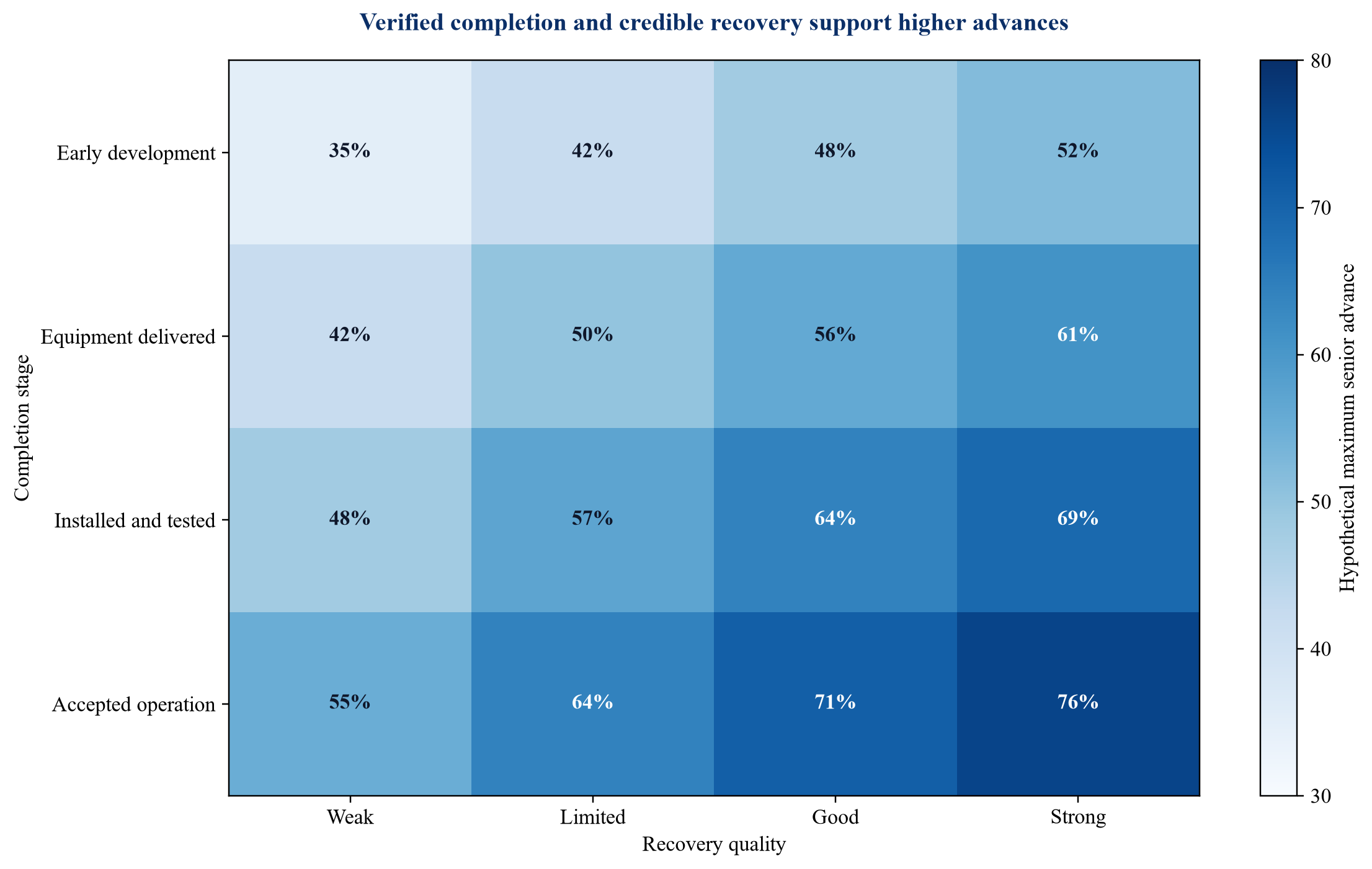
Values are hypothetical author-developed maximum senior advances as percentages of verified project cost. They do not represent lender policy or market practice.
34 Limitations
This paper presents a general analytical framework. It does not determine the financeability, legal structure, environmental position, value, credit quality, expected loss or recovery of a particular project, borrower, sponsor, technology or contract. Outcomes depend on jurisdiction, transaction documents, equipment, site, permits, grid and utility rules, fuel, customer obligations, construction, operations and capital markets.
The figures and tables use hypothetical author-developed assumptions. They do not represent observed project data, market pricing, a credit rating, an offering, a forecast, a financing commitment or an investment recommendation. Public filings describe their issuers' own projects and may contain forward-looking statements subject to their stated risks.
Transaction-specific legal, technical, environmental, regulatory, accounting, tax, insurance, valuation and financial advice is required. Lenders should apply their own policies, risk appetite, capital requirements and approval processes.
Conclusion
Behind-the-meter generation can help a data-centre campus obtain power within a commercial timetable. The financing case depends on disciplined completion and recovery design. The lender needs verified assets, a fully funded cost-to-complete, credible sponsor support, aligned customer and power contracts, controlled draws and enforceable security.
The Behind-the-Meter Credit Framework connects those elements to staged commitments, technical tests, reserves, covenants, surveillance and step-in. It recognises value as the project earns it through permits, delivery, installation, performance and customer acceptance. It also prepares an integrated recovery path before default.
A strong transaction gives the lender a clear answer at every stage: what has been built, who must finish it, what cash will repay debt, which rights can be enforced and how value can be preserved under stress. That evidence supports a credit decision grounded in completion capacity and practical recovery.
References
- Federal Energy Regulatory Commission, Order Directing PJM to Establish Rules for Co-Located Large Loads, Docket EL25-49-000 et al., 18 December 2025. https://www.ferc.gov/sites/default/files/2025-12/E-1%20EL25-49-000.pdf
- Federal Energy Regulatory Commission, Fact Sheet: FERC Directs Nation's Largest Grid Operator to Create New Rules to Embrace Innovation and Protect Consumers, 18 December 2025. https://www.ferc.gov/news-events/news/fact-sheet-ferc-directs-nations-largest-grid-operator-create-new-rules-embrace
- Federal Energy Regulatory Commission, Commissioner Rosner Concurrence on PJM Co-Location, 18 December 2025. https://www.ferc.gov/news-events/news/e-1-commissioner-rosners-concurrence-pjm-co-location
- Federal Energy Regulatory Commission, State of the Markets 2026. https://www.ferc.gov/sites/default/files/2026-03/26_State-of-the-Market_0324_1430.pdf
- North American Electric Reliability Corporation, Characteristics and Risks of Emerging Large Loads, July 2025. https://www.nerc.com/globalassets/who-we-are/standing-committees/rstc/3_doc_white-paper-characteristics-and-risks-of-emerging-large-loads.pdf
- US Department of Energy, Report on Evaluating US Grid Reliability and Security, July 2025. https://www.energy.gov/articles/department-energy-releases-report-evaluating-us-grid-reliability-and-security
- National Renewable Energy Laboratory, Enabling Regulatory and Business Models for Broad Microgrid Deployment, NREL/TP-5D00-84818. https://www.nrel.gov/docs/fy23osti/84818.pdf
- Office of the Comptroller of the Currency, Comptroller's Handbook: Commercial Real Estate Lending, Version 2.0, 2024. https://www.occ.gov/publications-and-resources/publications/comptrollers-handbook/files/commercial-real-estate-lending/pub-ch-commercial-real-estate.pdf
- Basel Committee on Banking Supervision, CRE20: Standardised Approach for Individual Exposures, Specialised Lending. https://www.bis.org/basel_framework/chapter/CRE/20.htm
- Basel Committee on Banking Supervision, Working Paper on the Internal Ratings-Based Approach to Specialised Lending Exposures. https://www.bis.org/bcbs_wp9.pdf
- International Finance Corporation, Performance Standards on Environmental and Social Sustainability. https://www.ifc.org/en/insights-reports/2012/ifc-performance-standards
- International Finance Corporation, Guidance Note on Financial Intermediaries, 2023. https://www.ifc.org/content/dam/ifc/doc/2023/202309-ifc-guidance-note-on-financial-intermediaries.pdf
- World Bank Group, Project Finance: Key Concepts. https://ppp.worldbank.org/financing/project-finance-concepts
- World Bank Group, Allocating Risks in Public-Private Partnership Contracts. https://ppp.worldbank.org/allocating-risks
- US Securities and Exchange Commission, Hut 8 Beacon Point $4.25 Billion Senior Secured Notes Announcement, 4 June 2026. https://www.sec.gov/Archives/edgar/data/1964789/000110465926070744/tm2616926d1_ex99-1.htm
- US Securities and Exchange Commission, Hut 8 Beacon Point Phase Two Lease Announcement, 20 July 2026. https://www.sec.gov/Archives/edgar/data/1964789/000110465926084862/tm2620835d1_ex99-1.htm
- US Securities and Exchange Commission, Hut 8 2025 Annual Report and River Bend Case Study, 2026. https://www.sec.gov/Archives/edgar/data/1964789/000110465926049721/tm2534221d3_ars.pdf
- US Securities and Exchange Commission, Fermi Inc Annual Report for 2025, 2026. https://www.sec.gov/Archives/edgar/data/2071778/000207177826000010/frmi-20251231.htm
- US Securities and Exchange Commission, Fermi $500 Million MUFG Equipment Supply Loan Financing, 10 February 2026. https://www.sec.gov/Archives/edgar/data/2071778/000121390026014270/ea0276274-8k_fermi.htm
- US Securities and Exchange Commission, Galaxy Digital 2025 Annual Report and Helios Project Financing. https://www.sec.gov/Archives/edgar/data/1859392/000185939226000041/glxy2025arsfinal.pdf
- US Securities and Exchange Commission, Applied Digital Q1 FY2026 Earnings Presentation. https://www.sec.gov/Archives/edgar/data/1839341/000162828026031246/q1fy26earningsdeck.htm
- US Securities and Exchange Commission, Soluna Holdings Form 10-Q for Quarter Ended 31 March 2026. https://www.sec.gov/Archives/edgar/data/64463/000162828026035538/slnh-20260331.htm
- US Securities and Exchange Commission, New Era Energy & Digital Annual Report for 2025, 2026. https://www.sec.gov/Archives/edgar/data/2028336/000121390026026501/ea0276741-10k_newera.htm
- US Securities and Exchange Commission, Texas Critical Data Centers Behind-the-Meter Power Update, 2025. https://www.sec.gov/Archives/edgar/data/1860514/000182912625007956/rothchacq_425.htm
- US Securities and Exchange Commission, Big Digital Energy Texas Load House Investor Presentation, July 2026. https://www.sec.gov/Archives/edgar/data/1218683/000121390026075248/ea029690001ex99-2.htm
- US Securities and Exchange Commission, Roma Green Finance Behind-the-Meter Data Centre Financing Announcement, 18 June 2026. https://www.sec.gov/Archives/edgar/data/1945240/000149315226029722/ex99-2.htm
- US Securities and Exchange Commission, CleanCore Minnesota Data Centre Joint Venture, 23 July 2026. https://www.sec.gov/Archives/edgar/data/1956741/000121390026082561/ea0299459-8k_cleancore.htm
- US Securities and Exchange Commission, Nebius $775 Million Senior Secured Debt Facility, 17 July 2026. https://www.sec.gov/Archives/edgar/data/1513845/000110465926084452/tm2620683d1_ex99-1.htm
- International Energy Agency, Energy and AI, 2025. https://www.iea.org/reports/energy-and-ai
- International Energy Agency, Electricity 2026: Demand. https://www.iea.org/reports/electricity-2026/demand
- US Energy Information Administration, Annual Energy Outlook 2026. https://www.eia.gov/outlooks/aeo/pdf/AEO_Narrative.pdf
- US Environmental Protection Agency, New Source Review Permitting. https://www.epa.gov/nsr
- US Environmental Protection Agency, Stationary Engines and Reciprocating Internal Combustion Engines. https://www.epa.gov/stationary-engines
- National Institute of Standards and Technology, Cybersecurity Framework 2.0, 2024. https://doi.org/10.6028/NIST.CSWP.29
- National Institute of Standards and Technology, Guide to Operational Technology Security, SP 800-82 Revision 3, 2023. https://doi.org/10.6028/NIST.SP.800-82r3
- International Organization for Standardization, ISO 55001 Asset Management Systems. https://www.iso.org/standard/83054.html
- International Organization for Standardization, ISO 50001 Energy Management Systems. https://www.iso.org/iso-50001-energy-management.html
- International Valuation Standards Council, International Valuation Standards. https://www.ivsc.org/standards/
- IFRS Foundation, IFRS 9 Financial Instruments. https://www.ifrs.org/issued-standards/list-of-standards/ifrs-9-financial-instruments/
- IFRS Foundation, IFRS 16 Leases. https://www.ifrs.org/issued-standards/list-of-standards/ifrs-16-leases/
- IFRS Foundation, IFRS 10 Consolidated Financial Statements. https://www.ifrs.org/issued-standards/list-of-standards/ifrs-10-consolidated-financial-statements/
- Uptime Institute, Tier Standard: Topology. https://uptimeinstitute.com/tiers
- ASHRAE, Data Center Resources. https://www.ashrae.org/technical-resources/bookstore/datacom-series
- Federal Emergency Management Agency, Benefit-Cost Analysis Guidance. https://www.fema.gov/grants/guidance-tools/benefit-cost-analysis
- International Finance Corporation, Guarantees for Approved Exposures. https://www.ifc.org/en/what-we-do/products-and-services/treasury-client-solutions/guarantees-for-approved-exposures
About the Author
Chennakeshav (CK) is a corporate finance and investment banking executive with 25+ years of global experience in deal origination, structuring and execution across M&A, growth capital and corporate strategy. He has led value-creation mandates for founders, corporates and funds — bridging the boardroom view to hands-on execution and close.
His career spans Morgan Stanley, HSBC, Lloyds Banking Group, EWEC, ADQ portfolio companies and Emirates Growth Fund, across TMT, real estate, fintech, deeptech, cleantech, infrastructure and energy. He has partnered with C-suite leaders, private equity and venture funds, sovereign wealth funds and family offices to finance complex fund raises and scale-up ventures, and has led M&A due diligence, post-merger integration and business-transformation initiatives to create value.
At Matchpoint Partners he is Managing Partner, leading the firm's corporate finance, M&A and capital-raising practice. He holds an MBA from London Business School, an engineering degree from VTU and a Master of Laws (LLM, in progress) from UCL London.
An active start-up mentor, CK mentors at Techstars, DIFC FinTech Hive, Startup Grind, Founder Institute and IN5, serves as Entrepreneur Mentor in Residence (EMiR) at London Business School, and judges the Entrepreneurship World Cup.
