
Introduction
The familiar real-estate sequence begins with land and asks what can be built on it. Large-scale digital infrastructure increasingly requires the sequence to begin with electricity. The investor first asks what power can be delivered, when it can be delivered, under which agreement, at what cost, with which curtailment and upgrade obligations, and whether the right survives a sale or financing. The land becomes valuable when those answers support a financeable operating plan.
The International Energy Agency estimated that data centres used about 415 terawatt hours of electricity in 2024 and projected roughly 945 terawatt hours by 2030 in its Base Case. It also emphasised that demand is geographically concentrated and can therefore challenge local networks even when its global share remains modest. The US Department of Energy has described connection requests for 300 to 1,000 megawatt facilities with development lead times shorter than the grid build-out needed to serve them. These system facts explain scarcity. They do not establish the value of any site.
Site valuation requires a transaction-specific bridge. The bridge starts with enforceable control of land and power rights. It adjusts for development conditions, network works, energisation timing, conversion from gross supply to critical IT load, customer contracting, operating cost and financing. It then tests the result against a scenario in which the connection arrives late, is smaller than expected or cannot be assigned to a buyer.
The central conclusion is that grid access creates value when it is enforceable, deliverable, transferable and commercially usable. A queue position, application or announced capacity may create an option. Its value depends on evidence and the cost of keeping that option alive.
1 Define the valuation object
The first question is what is being valued. It may be freehold land, a long lease, shares in a project company, a development platform, a connection agreement, completed electrical infrastructure, an operating data centre or a combination. Each object carries different rights, liabilities and cash flows. A land appraisal that excludes the project company may miss the connection contract. An enterprise valuation that assumes site control may overstate value when the lease can terminate before the power right matures.
The valuation date matters because connection rights evolve. A study can expire. A deposit can become non-refundable. A network operator can revise its programme. A planning consent can lapse. A customer can sign or terminate. The report should therefore state the exact documents and status observed on the valuation date.
The unit of account should also be explicit. Market value of land, fair value of an asset, investment value to a particular buyer and transaction price can differ. IFRS 13 defines fair value through an orderly transaction between market participants at the measurement date. International Valuation Standards and RICS standards require a clear basis, scope, assumptions and investigation. A board can use a strategic investment value for its decision while retaining a separate accounting or secured-lending valuation.
2 Treat the site as a bundle of conditional rights
A powered site is not a single asset. It is a bundle comprising land rights, planning position, environmental permissions, grid application, connection agreement, upgrade works, easements, substation rights, energy supply, fibre, water, access, customer commitments and development capability. Some rights sit in separate entities. Some depend on milestones. Some cannot be transferred without consent.
Valuation should map each right to its holder and dependency. A project company may hold the utility agreement while an affiliate owns the land. The network easement may benefit the utility. A generation agreement may be tied to a particular customer or load. A sale of shares may preserve these relationships more effectively than an asset sale, while introducing corporate liabilities and tax considerations.
The bundle creates value only when its components work together. Land without power can remain an alternative-use property. Power without a lawful site or viable design can be stranded. A connection whose capacity cannot support the intended rack density may require redesign. A connection that cannot be assigned may have little value to a buyer despite substantial sunk cost.
3 Distinguish five connection states
The first state is a speculative request. The developer has identified a site and requested service or entered a queue, with limited evidence on deliverability. The second is a studied connection. The relevant network studies define an indicative point of connection, works, cost and schedule, subject to conditions. The third is a contracted connection. An executed agreement establishes rights and obligations, deposits, milestones, capacity and a target date. The fourth is construction-ready power. Material permits, land rights, network scope, procurement and financing are aligned. The fifth is energised capacity that has passed tests and can support contracted operations.
The states should not be collapsed into a binary powered or unpowered label. Each state has a different probability of reaching operation, remaining capital requirement and time value. A contracted connection can still depend on upstream reinforcement. An energised connection can be curtailed or limited. The valuation bridge should show the movement between states and the evidence required for each transition.
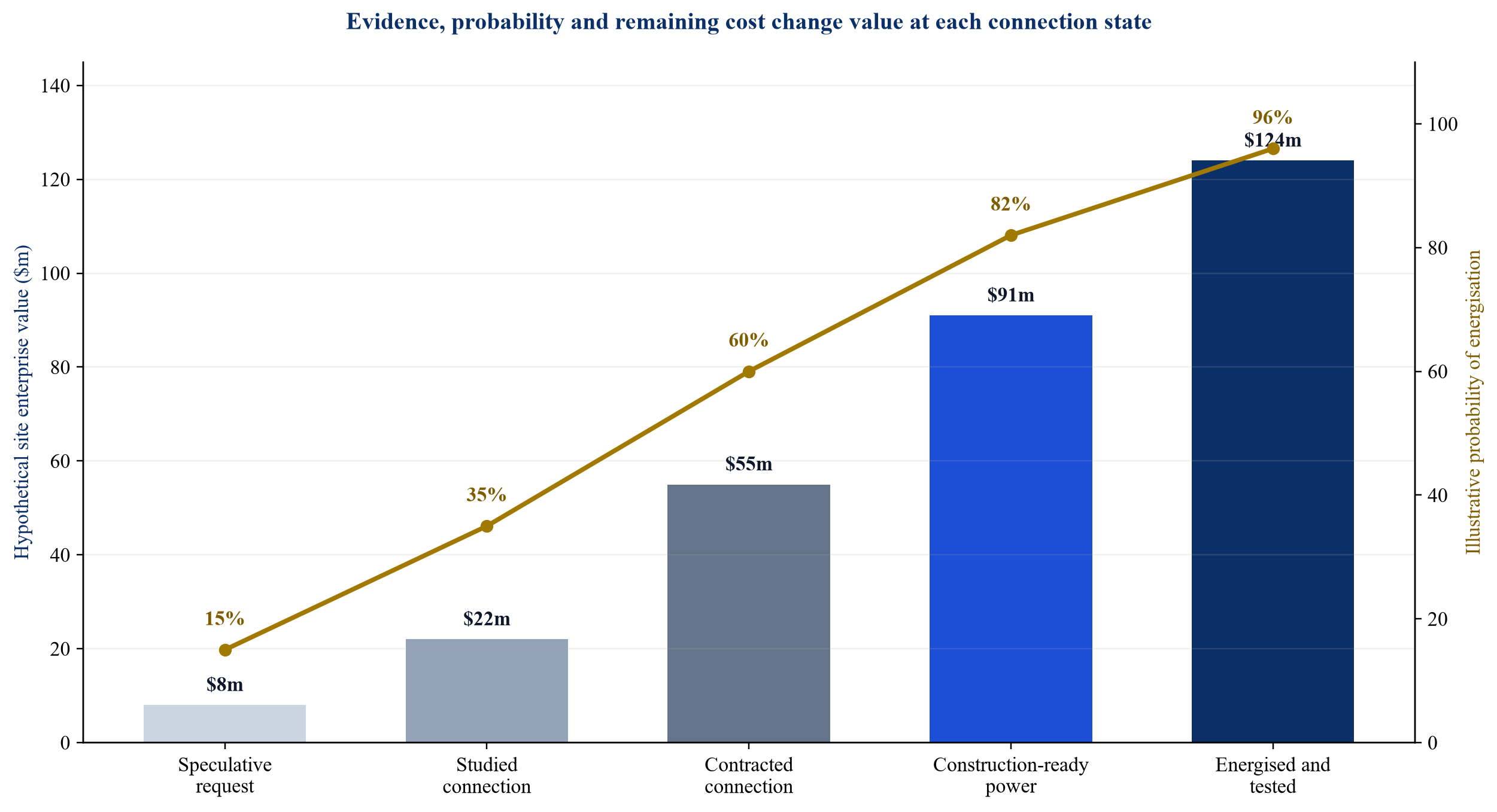
Values and probabilities are hypothetical author-developed assumptions. They demonstrate the method and do not describe a particular site.
4 Verify legal control before pricing scarcity
The power right should be read as a contract, not a marketing attribute. Diligence should identify the contracting entity, capacity, voltage, point of connection, delivery date, conditions, milestones, deposits, upgrade contributions, security, curtailment, termination, liability, force majeure, change control, assignment and lender rights. A capacity figure in a letter or portal can have a different status from an executed service agreement.
The investor should determine whether the right attaches to the site, the customer, a named use or the project company. It should test whether a change of control, asset sale, lease, financing or redesign requires consent. A consent process can create delay or buyer concentration. A right that cannot be transferred may still support value in a share sale, subject to tax, liability and governance considerations.
Security interests require similar care. The lender may need assignment of the connection agreement, project accounts, receivables, land rights and equipment. Direct agreements can provide notice and cure rights. Where the network operator cannot grant step-in, the financing may rely on sponsor support and cash-flow controls rather than asset enforcement alone.
5 Separate queue position from deliverability
Queues are administrative mechanisms for studying competing projects. A position can indicate progress while leaving cost, schedule and system impact unresolved. Large-load processes are also evolving. FERC's large-load interconnection docket has considered responsibility for upgrades, reliability, co-location and service of substantial loads. PJM has developed procedures and stakeholder work around large-load additions and data-centre planning. These processes reinforce the need to identify the operative tariff and agreement on the valuation date.
The study package should be reconciled with the latest network plan. Required transmission, distribution, substation and generation works should be identified, along with the party responsible for each item. The energisation path should include equipment procurement, land access, outages, permits, testing and upstream dependencies. A quoted date without a critical path provides weak evidence.
The valuation should assign no automatic premium to queue age. Value follows the probability-adjusted right to useful service after remaining cost and delay. A later application with firm capacity and defined works can be more valuable than an older request exposed to unresolved reinforcement.
6 Reconcile gross megawatts with billable capacity
Grid access is generally expressed at a connection boundary. The operating business earns revenue from critical IT load or computing service. The conversion depends on electrical losses, cooling, redundancy, auxiliary load, power-usage effectiveness and design density. A 100 megawatt supply does not necessarily produce 100 megawatts of customer capacity.
The model should bridge contracted import capacity, firm deliverable capacity, usable facility input, critical IT load, available capacity, contracted capacity and billable capacity. Each measure should have a definition and evidence source. The bridge prevents a valuation multiple per megawatt from being applied to inconsistent units.
Efficiency affects both economics and design. A lower power-usage effectiveness can increase the share of input used by IT equipment, subject to climate, load and measurement boundary. High-density accelerated computing can increase cooling and electrical requirements. The value of the connection therefore depends on whether the facility can convert it into the service customers require.
7 Establish the counterfactual land value
Connection value should be measured against a credible counterfactual. The property may have logistics, industrial, residential, agricultural or infrastructure uses. The alternative use may require different planning and utilities. Its value can create a floor, an opportunity cost or a competing development path.
The counterfactual should reflect the same valuation date and market conditions. It should deduct conversion cost and timing. A high alternative-use value can reduce the incremental value attributed to grid access because the investor gives up a valuable use. A remote site with limited alternatives may have low land value while still supporting substantial connection value if the digital-infrastructure economics are strong.
The model should avoid attributing all enterprise value to power. Fibre, water, planning, construction market, customer proximity, latency, taxes, resilience and operator capability also matter. The residual method can illuminate the combined value while requiring a separate allocation if accounting, tax or financing needs a value for each component.
8 Select a valuation architecture
Three approaches can be combined. The income approach discounts probability-weighted cash flow from the completed project after development cost. The market approach compares transactions or listed companies after normalising geography, stage, power unit, customer contracts and remaining investment. The cost approach considers land, studies, deposits, network contributions and replacement cost, with allowances for risk and obsolescence.
The income approach is generally most informative when the project design and commercial route are sufficiently defined. Its output remains sensitive to energisation date, achievable critical load, price, operating margin, capital cost, ramp and exit assumptions. The model should therefore show those variables rather than burying them in a single discount rate.
The market approach can provide a reasonableness range. A price per gross megawatt is weak when comparable assets have different connection states. A price per energised critical megawatt is stronger when definitions align. Platform transactions may include management, pipeline, customers and financing capability that do not transfer with a single site.
9 Build the connection-first cash-flow model
The model begins with the connection critical path. It schedules studies, deposits, network works, site works, construction, testing and customer acceptance. Capital expenditure should be linked to milestones. Revenue begins only when the contract permits billing. Fixed infrastructure charges, power pass-through, variable use and ancillary services should be separated.
Operating cost should include purchased energy, network charges, maintenance, staffing, insurance, taxes, security, fibre, water, software and recurring replacement reserves. Pass-through clauses should be modelled with timing and collectability. Customer payments may lag utility invoices, creating working-capital needs even when the annual economics are neutral.
The model should preserve the distinction between project value and land value. Enterprise value equals the present value of operating cash flow and residual value, less remaining capital and liabilities. Equity value then deducts debt and other claims. The amount paid for land and connection rights should leave sufficient return for construction, commercialisation and operating risk.
10 Value time to power
Time affects value through discounting, carrying cost, customer availability and competitive position. A twelve-month delay can add interest, staff, insurance, security and escalation. It can also cause a customer to move to another site. Equipment commitments may age before use. Network deposits and land options can expire.
Time-to-power should be modelled through a schedule distribution rather than a single date where uncertainty is material. The base case can use the current critical path. A moderate case can add defined delays to network equipment, permits and customer acceptance. A severe case can assume a required upstream reinforcement or re-study.
The model should identify which delays create relief under customer and construction contracts. A utility delay may not excuse the project from all customer obligations. Gaps between contracts become sponsor risk. Delay liquidated damages, termination rights and warranty commencement should be included where relevant.
Table 1. Connection evidence and valuation treatment
| Evidence state | Stronger evidence | Principal uncertainty | Indicative valuation treatment |
|---|---|---|---|
| Speculative request | Site control and accepted application | Capacity, works, price and date unresolved | Value as a low-probability option after holding cost |
| Studied connection | Completed studies and identified point of connection | Re-study, upstream works and schedule | Probability-weight residual value; deduct all remaining works |
| Contracted connection | Executed agreement, deposits and milestones | Conditions, assignment, curtailment and delay | Recognise contractual option with explicit downside cases |
| Construction-ready | Permits, procurement, financed works and customer route | Completion, testing and commercial ramp | Use phased project cash flow and completion contingency |
| Energised and tested | Accepted service, operating data and transferable rights | Customer, operating and lifecycle performance | Value sustainable cash flow with contract and residual tests |
This author-developed matrix is a screening framework. Transaction-specific legal, technical, regulatory, tax and valuation advice remains necessary.
11 Probability-weight the milestones
Probability should attach to defined transitions. The chance of moving from study to contract differs from the chance of moving from a completed substation to customer acceptance. One overall probability can hide the point of failure. A milestone tree makes each dependency visible.
Probabilities should be supported by observed project evidence where available. Management judgement can be used when data are unavailable, clearly identified as an assumption. The model should avoid false precision. A range or scenario weighting can be more decision-useful than a percentage presented to one decimal place.
Correlation matters. Planning, grid works and customer timing may share a common dependency. Multiplying independent probabilities can overstate completion likelihood when the events are linked. A scenario model can capture a delayed network programme that affects both energisation and customer commitment.
12 Deduct the complete connection cost
Connection cost includes application and study fees, deposits, network reinforcement, substations, transformers, switchgear, protection, transmission or distribution lines, easements, civil works, metering, testing, taxes and financing. It can also include generation, storage or demand flexibility needed to obtain service.
Sunk cost is not value. A deposit may be refundable, forfeitable or credited against works. Network contributions may benefit the wider system while remaining non-recoverable to the project. The valuation should classify every payment by recoverability, ownership and future benefit.
Cost-to-complete should include escalation and contingency. Long-lead transformers, switchgear, turbines and cooling equipment can shape the schedule. The US Department of Energy and IEA have identified physical and supply-chain bottlenecks around data-centre growth. A quotation that expires before financing should be refreshed or stressed.
13 Analyse connection quality
Megawatt quantity alone does not describe quality. The investor should examine firmness, redundancy, voltage, fault level, outage history, curtailment, restoration, power quality, planned maintenance and exposure to upstream congestion. A nominally large connection with frequent interruption may support less customer revenue than a smaller resilient supply.
The design should match the service promise. Some customers require concurrent maintainability or fault tolerance. Backup systems, on-site generation and storage can improve resilience while adding fuel, emissions, maintenance and regulatory obligations. A battery can bridge short events and support flexibility; it cannot replace firm energy indefinitely.
Connection quality should be translated into revenue and cost. Service credits, lost availability, additional generation, fuel inventory and maintenance belong in the cash-flow model. Insurance can transfer some losses while retaining deductibles, exclusions and claims timing.
14 Test curtailment and flexible connection terms
Networks may offer non-firm, curtailable or phased service where firm capacity is constrained. Such arrangements can accelerate energisation. Their value depends on curtailment frequency, notice, duration, compensation and the facility's ability to reduce load without breaching customer obligations.
Flexibility can be designed through workload shifting, storage, on-site generation or staged customer ramp. The commercial contract must permit the operational response. A data centre that promises continuous capacity cannot assume discretionary curtailment without pricing the service risk.
The valuation should compare the accelerated revenue from a flexible connection with the cost of backup, service credits and uncertainty. It should also identify the path to firm service. A temporary arrangement with no defined conversion can create a long-dated operating constraint.
15 Include customer evidence
Grid access creates enterprise value when it can be commercialised. Customer evidence can range from market studies and memoranda to capacity reservations, leases, take-or-pay agreements and compute-service contracts. The valuation should recognise the legal and economic strength of the actual document.
The model should review counterparty credit, guarantee support, capacity, commencement, ramp, acceptance, price, indexation, energy pass-through, service levels, termination and technology change. A high-quality connection can retain option value without a customer, though the development cash flow remains exposed to market demand and leasing time.
Public data-centre transactions illustrate the importance of contract duration, credit support and phased delivery. The terms of each public transaction are specific to its documentation. They should inform diligence questions rather than become universal valuation benchmarks.
16 Separate strategic premium from financeable value
A buyer may pay for speed, market entry, portfolio clustering, customer adjacency or scarcity. This strategic value can exceed standalone discounted cash flow. The investment committee should state the source and amount of any premium, along with the buyer-specific synergies required to earn it.
Financeable value may be lower. A lender generally relies on collateral, contracted cash flow, completion support and downside coverage. An uncontracted connection can support limited development capital while remaining valuable to a strategic acquirer. The capital stack should recognise the difference.
The model can show three values: standalone project value, financeable value and buyer-specific investment value. The purchase price should be reconciled to all three. A gap funded entirely with equity may be rational when the strategic case is documented and approved.
17 Use option value carefully
A connection right can resemble a real option. The holder can continue development, wait for information, redesign, sell the project or abandon it. The option has value when the right can be maintained at reasonable cost and the upside exceeds the remaining investment.
The option has an expiry. Milestones, deposits, planning periods, land options and network deadlines can force decisions. Volatility can increase option value while delay cost and non-transferability reduce it. A real-option framework should therefore include the cost of keeping the right alive.
Option language should not obscure a weak project. If the connection has no credible delivery date, the land cannot support the required use and the agreement cannot be assigned, the option may have little market value. Evidence remains the foundation.
18 Model a hypothetical site
Consider a hypothetical site with an executed 120 megawatt gross connection targeted in three years. The design converts this to 84 megawatts of critical IT load. A first customer is assumed to contract 48 megawatts after testing. Remaining site and network capital is assumed at $760 million. Annual stabilised fixed infrastructure revenue is derived from contracted capacity, with energy passed through separately.
The model probability-weights the energisation date and customer commencement, deducts remaining capital and carrying cost, and values the operating cash flow. It also retains an alternative-use land value. The resulting site value is therefore a residual after development risk, rather than the gross value of the completed enterprise.
The illustration below is designed to show mechanics. It does not use observed data from a particular site and does not provide a price recommendation.
Table 2. Hypothetical connection-first site valuation bridge
| Item | Base assumption | Downside assumption | Valuation effect |
|---|---|---|---|
| Gross contracted connection | 120 MW | 100 MW after constraint | Starting capacity only |
| Critical IT conversion | 70% | 64% | Defines potential billable capacity |
| First-phase contracted load | 48 MW | 36 MW | Drives initial fixed revenue |
| Target energisation | 36 months | 60 months | Changes discounting and carrying cost |
| Probability of energisation and acceptance | 78% | 52% | Applied to milestone cash flows |
| Remaining development and construction capital | $760m | $890m | Deducted from completed-project value |
| Stabilised fixed revenue | $82m | $55m | Reflects load, price and ramp |
| Stabilised operating margin before reserve | 82% | 72% | Reflects operating and service risk |
| Alternative-use land value | $18m | $14m | Provides counterfactual value |
| Indicated residual site and rights value | $91m | $24m | Output before transaction costs and tax |
All values are hypothetical author-developed assumptions in US dollars. They are not a valuation, forecast, market quotation or transaction recommendation.
19 Expose delay sensitivity
Delay can destroy value rapidly when remaining capital is large and customer availability is time-sensitive. The effect is nonlinear. Early delay may consume contingency and defer revenue. Longer delay can trigger re-study, customer termination, redesign or financing expiry.
The sensitivity should combine timing with energisation probability and capital escalation. Treating each variable independently can understate their relationship. A two-year delay may both raise cost and reduce the likelihood that the original customer remains committed.
The figure below holds other variables within a simplified hypothetical model and shows how value changes across time and probability. It demonstrates why the transaction should price the connection state rather than the announced capacity.
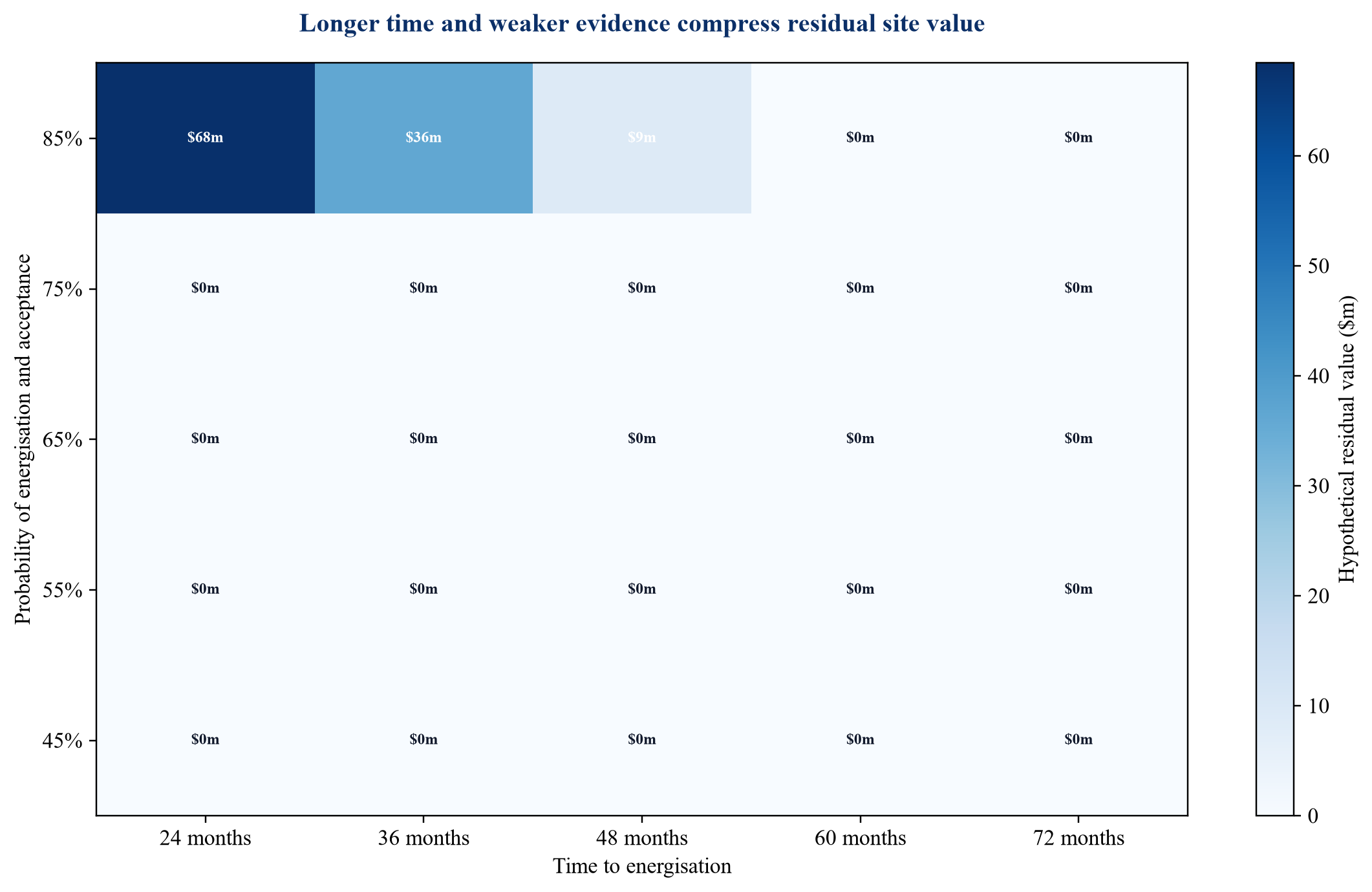
Values are hypothetical author-developed assumptions in US dollars millions. They do not represent a particular property or market forecast.
20 Price network-cost uncertainty
Network cost can change after study, tender or redesign. The agreement may allocate actual cost to the customer. Upstream reinforcement can be shared among projects or triggered by a specific load. Refunds can depend on later users. The valuation should distinguish fixed, capped, estimated and pass-through amounts.
Cost risk can be managed through contingencies, staged acquisition payments, seller indemnities, price adjustments and conditions precedent. A buyer can pay an initial amount for current rights and additional consideration when the connection reaches agreed milestones. This aligns price with evidence.
The model should also test stranded expenditure. If the project stops, some equipment may be reusable or saleable while site-specific works have limited recovery. Deposits may be refundable subject to deductions. Recovery value should be supported by contract terms and market evidence.
21 Allocate value between land and connection rights
Allocation may matter for accounting, tax, security and transaction documentation. The income approach can value the combined business. A residual allocation can then assign value to identifiable rights after recognising land, completed works and other assets. The result depends on the legal form and applicable standards.
The connection agreement may be a contract-based intangible asset when it is identifiable and controlled, subject to accounting analysis. Some network works may be owned by the utility despite being funded by the developer. The project can receive service without owning the physical asset. Cost incurred therefore does not determine asset recognition or fair value.
The valuation team should coordinate with legal, tax and accounting advisers. A commercial model can inform negotiation while remaining distinct from purchase-price allocation, secured-lending value and financial reporting.
22 Design the acquisition structure
The buyer can acquire land, project-company shares, contractual rights or a combination. An asset purchase can isolate liabilities while requiring assignment of critical agreements. A share purchase can preserve contracts while transferring corporate history. The decision should follow the connection agreement, land tenure, permits, tax and consent requirements.
Conditional consideration can manage uncertainty. Payments can be linked to study completion, executed connection, procurement, energisation, customer contract and acceptance. Escrow, holdback and seller security can support obligations. The milestones should be objective and within a documented verification process.
Conditions precedent should include required consents, absence of adverse connection changes, verified deposits, land and easement rights, environmental status, planning position and a confirmed cost-to-complete. The buyer should retain termination rights where a defining assumption fails before closing.
23 Finance the acquisition conservatively
Development-stage connection rights may support limited leverage because cash flow has not begun. Lenders can finance refundable deposits, contracted works or land within advance-rate limits. Construction debt can increase after permits, customer commitments, equity and completion support are in place. Stabilised debt can follow accepted service and collected revenue.
The debt model should exclude early pipeline from current debt service. It can include committed development funding with draw conditions. Loan-to-cost, loan-to-value, debt-service coverage and minimum liquidity should be tested at the appropriate stage.
Security and direct agreements should cover land, project-company shares, connection rights, customer agreements, accounts, insurance and material equipment where available. Enforcement assumptions should be realistic. A lender may need a qualified operator and network consent to preserve service.
24 Protect the downside through transaction terms
The price can be divided between value proven at closing and value proven later. A closing payment can reflect alternative-use land and current rights. Deferred consideration can reflect energisation, capacity and customer milestones. This structure reduces the amount paid for uncertain future performance.
Representations should address title, agreement status, undisclosed defaults, deposits, studies, costs, correspondence, permits, easements and customer commitments. Disclosure should include the complete network file. Warranties cannot create power, so material pre-closing evidence should remain a condition where possible.
Long-stop dates, termination rights and reimbursement should align with the critical path. If the buyer funds works before closing, it needs rights over the resulting value. Exclusivity and access should avoid an open-ended commitment to a deteriorating option.
25 Establish a connection evidence room
The data room should contain the land documents, applications, studies, agreements, tariffs, deposits, invoices, network correspondence, designs, programmes, procurement, permits, easements, environmental reports, customer documents and financial model. Documents should be indexed by date and legal entity.
A structured assumptions register should link each material model input to evidence. It should state the owner, source, date, expiry, confidence and valuation impact. Open items should change the model or transaction terms. A red flag that has no effect on price, condition or structure is unlikely to be resolved by description alone.
Correspondence can reveal changes that formal documents have not yet captured. Meeting minutes and portal status should be reconciled with signed agreements. Oral indications should be identified as such and excluded from the binding case until confirmed.
26 Use a cross-functional valuation committee
Grid access crosses real estate, power systems, contracts, regulation, construction, customers and finance. A committee should combine those perspectives and maintain one capacity and schedule bridge. The group should approve changes to connection state, probability, cost and recognised value.
Technical advisers assess deliverability and design. Legal advisers interpret rights, assignment and liability. Commercial specialists assess customer demand and pricing. Finance specialists translate the evidence into cash flow, liquidity and returns. The valuation professional integrates the evidence under the selected basis of value.
The committee should record dissent and uncertainty. A single blended score can hide a fatal condition. The decision paper should identify stop conditions, value range and the evidence that would move the range.
27 Apply an evidence gate
The evidence gate converts diligence into a repeatable investment decision. It begins with site control and alternative use. It then tests network status, deliverability, transfer, cost, time, critical-load conversion, customer route, construction readiness, financing and downside recovery.
Each gate should have a pass, conditional pass or fail. A conditional pass must have an owner, deadline, funding source and transaction consequence. The investment committee can approve staged capital while withholding the full purchase price until conditions are met.
Table 3. Connection-first site valuation evidence gate
| Gate | Required evidence | Failure signal | Transaction response |
|---|---|---|---|
| Land and alternative use | Title or lease, planning, access, environmental status and counterfactual value | Site control expires before connection maturity | Extend control, reduce price or stop |
| Connection right | Executed document, capacity, point, milestones, deposits and tariff | Application or marketing statement presented as a firm right | Value as an option with low recognition |
| Deliverability | Studies, upstream works, programme, procurement and testing plan | Undefined reinforcement or no credible critical path | Defer consideration and increase contingency |
| Transfer and security | Assignment, change-control and lender consents | Right terminates or resets on transaction | Use share structure, obtain consent or stop |
| Critical-load conversion | Design, efficiency, redundancy and customer boundary | Gross MW used as billable MW | Apply technical haircut and redesign cost |
| Commercial route | Customer evidence, price, ramp, support and termination | Revenue depends on discretionary future demand | Use merchant case and higher return threshold |
| Capital and liquidity | Complete cost, escalation, contingency and funding | Remaining cost exceeds committed capital | Reprice, stage or require seller and sponsor support |
| Downside recovery | Refund rights, reusable equipment, alternative use and exit route | Most expenditure is site-specific and unrecoverable | Limit pre-energisation capital and preserve options |
This author-developed checklist supports transaction planning and does not replace legal, regulatory, technical, environmental, accounting, tax, insurance, financing or valuation advice.
28 Stress the acquisition thesis
The base case should be challenged through coherent scenarios. A network-delay scenario adds time, escalation and customer consequences. A capacity-reduction scenario changes critical-load conversion and revenue. A transfer-failure scenario tests whether the buyer can preserve rights through another structure. A customer-loss scenario tests leasing time and redesign.
The model should also test a combined case. A delayed connection can cause customer loss and financing expiry. A smaller connection can reduce revenue while leaving much of the site and network capital unchanged. These combined effects often determine downside value.
The board should identify the maximum exposure before each milestone. It should compare that exposure with recoverable deposits, land value, reusable equipment and seller support. The gap is capital at risk.
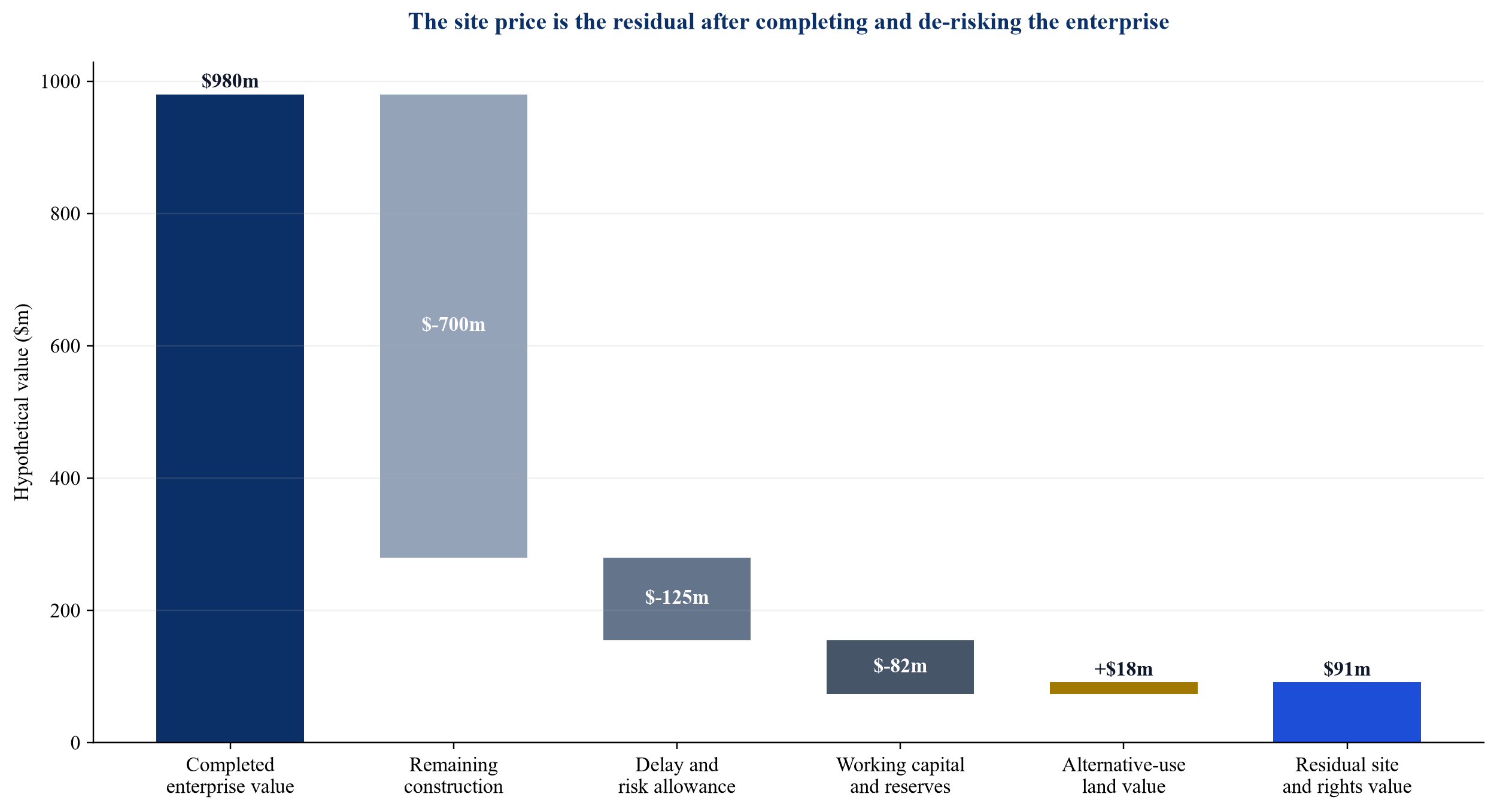
Values are hypothetical author-developed assumptions in US dollars millions. They demonstrate a residual valuation bridge and do not represent a particular site.
29 Recognise common valuation failures
Common failures include multiplying announced megawatts by a headline market price, treating deposits as value, using gross connection capacity as critical IT load, assuming the utility target date is guaranteed, and counting a customer discussion as contracted revenue. Each shortcut omits evidence that can change the result materially.
Another failure is applying a stabilised capitalisation rate to revenue that begins after years of development. The valuation must deduct time, remaining capital and completion risk. A high discount rate cannot substitute for an explicit schedule and cost model because it hides the source of risk.
Comparable transactions can also mislead. A powered shell, operating campus, greenfield site and connection option are different assets. Geography, tariff, customer, lease term, ownership, financing and tax should be normalised before a price informs the subject property.
30 Consider geography explicitly
Grid-access value is local. In the United States, regional transmission organisations, utilities, state regulators and local authorities shape the path. FERC's large-load work and PJM's processes demonstrate active rule development. In Europe, national connection regimes interact with EU energy and data-centre reporting rules. In the Gulf, integrated utilities, national infrastructure plans, free zones and sovereign development strategies can create different allocation and contracting structures.
The framework remains consistent across geographies while the evidence changes. The report should identify the competent authority, network operator, tariff, connection code, planning regime, foreign ownership rules, environmental approvals, water constraints and tax treatment.
Cross-border comparisons should therefore use functional milestones rather than identical labels. An executed agreement in one market may allocate less certainty than a different instrument elsewhere. Legal advice should confirm the effect.
31 Integrate sustainability and community constraints
Power availability does not complete site diligence. Water, emissions, noise, land use, backup generation and community impact can affect permits and operating conditions. Electricity source and carbon intensity can influence customer commitments and regulation. Reporting requirements can add data obligations.
Sustainability features should connect to economics. Efficient design can reduce auxiliary load and improve billable capacity. Water-saving cooling can change capital and energy use. Clean-energy procurement can support customer requirements while leaving physical grid constraints unresolved.
The valuation should include required mitigation and monitoring. A project whose connection is viable while its cooling or planning solution is not viable remains incomplete.
32 Preserve flexibility in design
The site may be energised before the final customer configuration is known. Modular substations, adaptable cooling, phased halls and spare routes can preserve options. Flexibility has a cost and should be measured against the probability of customer change.
Design optionality can protect value as rack density and cooling technology evolve. It can also delay standardisation and procurement. The investment case should distinguish value-preserving flexibility from speculative overbuild.
The model should allocate shared infrastructure across phases. A large first-phase substation can support later growth while burdening initial returns. Staged procurement can reduce early capital while risking later equipment availability.
33 Link value to financing covenants
The financing should monitor the same variables that support value. Covenants can cover connection status, milestone dates, minimum capacity, cost-to-complete, customer contracts, liquidity, insurance and reporting. A decline in evidence should trigger cash preservation before value is lost.
Development facilities can cap expenditure before a binding connection and customer route exist. Construction facilities can require certified progress, equity and contingency. Term debt can require coverage, contract tail and operating performance.
Valuation updates should follow material events. A re-study, delay, capacity change, customer termination or redesign can affect the borrowing base and investment decision. The reporting process should use the same definitions across technical, commercial and finance teams.
34 Build a board decision sequence
The board first defines the asset, basis of value and valuation date. It maps land and power rights, connection state, transfer and security. It reviews the critical path, cost-to-complete and gross-to-billable capacity bridge. It then assesses customers, operating economics, financing and alternative use.
The financial model produces standalone, downside and buyer-specific values. Transaction terms allocate unresolved risk through conditions, staged payments, holdbacks and support. The board records stop conditions and the evidence required to release further capital.
The sequence should be repeated at contract, construction, energisation and acceptance. Site value changes as evidence changes. A disciplined update process protects the buyer from paying today for capacity that remains conditional.
35 Limitations
This paper presents a general analytical framework. It does not determine the market value, fair value, investment value, legal status, technical feasibility, financeability, credit quality or expected return of a particular property, connection right, data centre or transaction. Results depend on jurisdiction, tariff, network, agreements, land, planning, design, customers, construction, operations, tax, accounting, financing and capital markets.
The figures and tables use hypothetical author-developed assumptions. They do not represent observed project data, a valuation opinion, financing offer, tariff, credit rating or investment recommendation. Public disclosures describe specific companies and transactions and should be read with the complete filing. Project-specific legal, technical, regulatory, environmental, accounting, tax, insurance, financing and valuation advice is required.
Conclusion
Scarce grid access can create more value than the underlying land. That value is conditional. It arises from a sequence of enforceable rights, completed studies, funded works, credible timing, technical conversion, customer demand and operating resilience.
The Connection-First Site Valuation Framework separates land from the connection option and the completed enterprise. It values each connection state through probability-weighted cash flow, time, remaining capital and downside recovery. It also makes transfer, curtailment, customer evidence and gross-to-billable capacity visible.
The most defensible transaction pays for evidence as it arrives. It preserves alternative use, limits capital before key milestones, allocates delay and cost risk, and aligns financing with recognised value. The result is a valuation that reflects what the site can deliver, when it can deliver it and who controls the right.
References
- International Energy Agency, Energy and AI: Executive Summary, 2025. https://www.iea.org/reports/energy-and-ai/executive-summary
- International Energy Agency, Energy and AI: Energy demand from AI, 2025. https://www.iea.org/reports/energy-and-ai/energy-demand-from-ai
- International Energy Agency, Energy and AI: Energy supply for AI, 2025. https://www.iea.org/reports/energy-and-ai/energy-supply-for-ai
- International Energy Agency, Energy and AI data product, 2025. https://www.iea.org/data-and-statistics/data-product/energy-and-ai
- International Energy Agency, Data centre electricity use surged in 2025, 2026. https://www.iea.org/news/data-centre-electricity-use-surged-in-2025-even-with-tightening-bottlenecks-driving-a-scramble-for-solutions
- US Department of Energy, Powering AI and Data Center Infrastructure Recommendations, 2024. https://www.energy.gov/sites/default/files/2024-08/Powering%20AI%20and%20Data%20Center%20Infrastructure%20Recommendations%20July%202024.pdf
- US Department of Energy, DOE Releases New Report Evaluating Increase in Electricity Demand from Data Centers, 2024. https://www.energy.gov/articles/doe-releases-new-report-evaluating-increase-electricity-demand-data-centers
- Lawrence Berkeley National Laboratory, 2024 United States Data Center Energy Usage Report, 2024. https://eta-publications.lbl.gov/publications/2024-lbnl-data-center-energy-usage-report
- US Department of Energy, United States Data Center Energy Usage Report 2025 Update, 2026. https://www.energy.gov/documents/united-states-data-center-energy-usage-report-2025-update
- Federal Energy Regulatory Commission, Interconnection of Large Loads to the Interstate Transmission System, Docket RM26-4-000. https://www.ferc.gov/rm26-4
- Federal Energy Regulatory Commission, FERC Directs PJM to Create Rules for Co-Located Large Loads, 2025. https://www.ferc.gov/news-events/news/fact-sheet-ferc-directs-nations-largest-grid-operator-create-new-rules-embrace
- Federal Energy Regulatory Commission, Reliability Technical Conference, 2025. https://www.ferc.gov/news-events/events/commissioner-led-reliability-technical-conference-05142025
- PJM Interconnection, Critical Issue Fast Path: Large Load Additions. https://www.pjm.com/committees-and-groups/cifp-lla
- PJM Interconnection, Data Center Planning. https://www.pjm.com/planning/service-requests/data-center-planning
- PJM Interconnection, Load Forecasting Process. https://www.pjm.com/planning/resource-adequacy-planning/load-forecast-dev-process
- North American Electric Reliability Corporation, Characteristics and Risks of Emerging Large Loads, 2025. https://www.nerc.com/globalassets/who-we-are/standing-committees/rstc/whitepaper-characteristics-and-risks-of-emerging-large-loads.pdf
- North American Electric Reliability Corporation, Emerging Large Loads Technical Conference, 2026. https://www.nerc.com/events/02-24-26-emerging-large-loads-technical-conference
- European Commission, Energy efficiency in data centres. https://energy.ec.europa.eu/topics/energy-efficiency/energy-efficient-products/energy-efficiency-data-centres_en
- European Commission, Commission Delegated Regulation EU 2024/1364 on data-centre reporting. https://eur-lex.europa.eu/eli/reg_del/2024/1364/oj
- European Commission, Action Plan for Affordable Energy, 2025. https://energy.ec.europa.eu/strategy/affordable-energy_en
- International Valuation Standards Council, International Valuation Standards. https://www.ivsc.org/standards/
- IFRS Foundation, IFRS 13 Fair Value Measurement. https://www.ifrs.org/issued-standards/list-of-standards/ifrs-13-fair-value-measurement/
- Royal Institution of Chartered Surveyors, RICS Valuation: Global Standards. https://www.rics.org/profession-standards/rics-standards-and-guidance/sector-standards/valuation-standards/red-book
- Financial Accounting Standards Board, Fair Value Measurement Topic 820. https://asc.fasb.org/topic&trid=2124164
- Digital Realty Trust, Annual Report on Form 10-K for the year ended 31 December 2025. https://www.sec.gov/Archives/edgar/data/1297996/000110465926015365/dlr-20251231x10k.htm
- Equinix, Annual Report on Form 10-K for the year ended 31 December 2025. https://www.sec.gov/Archives/edgar/data/1101239/000110123926000032/eqix-20251231.htm
- CoreWeave, Annual Report on Form 10-K for the year ended 31 December 2025. https://www.sec.gov/Archives/edgar/data/1769628/000176962826000104/crwv-20251231.htm
- CoreWeave, Quarterly Report for the period ended 30 June 2025. https://www.sec.gov/Archives/edgar/data/1769628/000176962825000041/crwv-20250630.htm
- Hut 8, River Bend 245 MW AI Data Center Lease announcement, 2025. https://www.sec.gov/Archives/edgar/data/1964789/000110465925122052/hut-20251217xex99d1.htm
- Cipher Mining, 168 MW AI Hosting Agreement announcement, 2025. https://www.sec.gov/Archives/edgar/data/1819989/000095010325012168/dp234624_ex9901.htm
- World Bank Group, Infrastructure Finance. https://ppp.worldbank.org/infrastructure-finance
- World Bank Group, Project Finance: Key Concepts. https://ppp.worldbank.org/financing/project-finance-concepts
- World Bank Group, Finance Structures for PPP. https://ppp.worldbank.org/finance-structures-ppp
- World Bank Group, Risk Allocation in Public-Private Partnerships. https://ppp.worldbank.org/allocating-risks
- International Finance Corporation, Performance Standards on Environmental and Social Sustainability, 2012. https://www.ifc.org/en/insights-reports/2012/ifc-performance-standards
- National Institute of Standards and Technology, Guide to Operational Technology Security, SP 800-82 Revision 3, 2023. https://doi.org/10.6028/NIST.SP.800-82r3
- National Institute of Standards and Technology, Cybersecurity Framework 2.0, 2024. https://doi.org/10.6028/NIST.CSWP.29
- Uptime Institute, Tier Standard: Topology. https://uptimeinstitute.com/tiers
- ASHRAE, Data Center Resources. https://www.ashrae.org/technical-resources/bookstore/datacom-series
- International Organization for Standardization, ISO 50001 Energy management systems. https://www.iso.org/iso-50001-energy-management.html
- International Organization for Standardization, ISO 55001 Asset management systems. https://www.iso.org/standard/83054.html
- Organisation for Economic Co-operation and Development, Due Diligence Guidance for Responsible Business Conduct, 2018. https://mneguidelines.oecd.org/due-diligence-guidance-for-responsible-business-conduct.htm
About the Author
Chennakeshav (CK) is a corporate finance and investment banking executive with 25+ years of global experience in deal origination, structuring and execution across M&A, growth capital and corporate strategy. He has led value-creation mandates for founders, corporates and funds — bridging the boardroom view to hands-on execution and close.
His career spans Morgan Stanley, HSBC, Lloyds Banking Group, EWEC, ADQ portfolio companies and Emirates Growth Fund, across TMT, real estate, fintech, deeptech, cleantech, infrastructure and energy. He has partnered with C-suite leaders, private equity and venture funds, sovereign wealth funds and family offices to finance complex fund raises and scale-up ventures, and has led M&A due diligence, post-merger integration and business-transformation initiatives to create value.
At Matchpoint Partners he is Managing Partner, leading the firm's corporate finance, M&A and capital-raising practice. He holds an MBA from London Business School, an engineering degree from VTU and a Master of Laws (LLM, in progress) from UCL London.
An active start-up mentor, CK mentors at Techstars, DIFC FinTech Hive, Startup Grind, Founder Institute and IN5, serves as Entrepreneur Mentor in Residence (EMiR) at London Business School, and judges the Entrepreneurship World Cup.
