
1. The reserve question starts with the service promise
A battery replacement reserve exists to protect a future service, not a historical purchase price. The project may promise four hours of deliverable energy, a power level, availability, response time, round-trip efficiency or a combination. Degradation, equipment failure and operating choices can reduce those capabilities at different rates. The funding mechanism should therefore begin with the exact obligation that produces revenue or prevents deductions.
The central decision is time-specific. At each forecast date, the model should identify expected capability, the contractual threshold, the earliest intervention date, procurement lead time, installation outage and cash payment schedule. A reserve funded after the threshold is breached is late. A reserve funded years before a credible need may create unnecessary negative carry and reduce equity value. The financeable answer balances liquidity protection against trapped cash.
The U.S. Department of Energy's 2022 storage assessment includes augmentation, replacement, charging cost and decommissioning in lifecycle cost. NREL's 2024 utility-scale battery assumptions include augmentation within fixed operation and maintenance cost to preserve rated capacity over a 15-year life. These are useful planning conventions. A project model must translate the convention into its own contracts, chemistry, duty cycle, site, payment structure and financing documents.
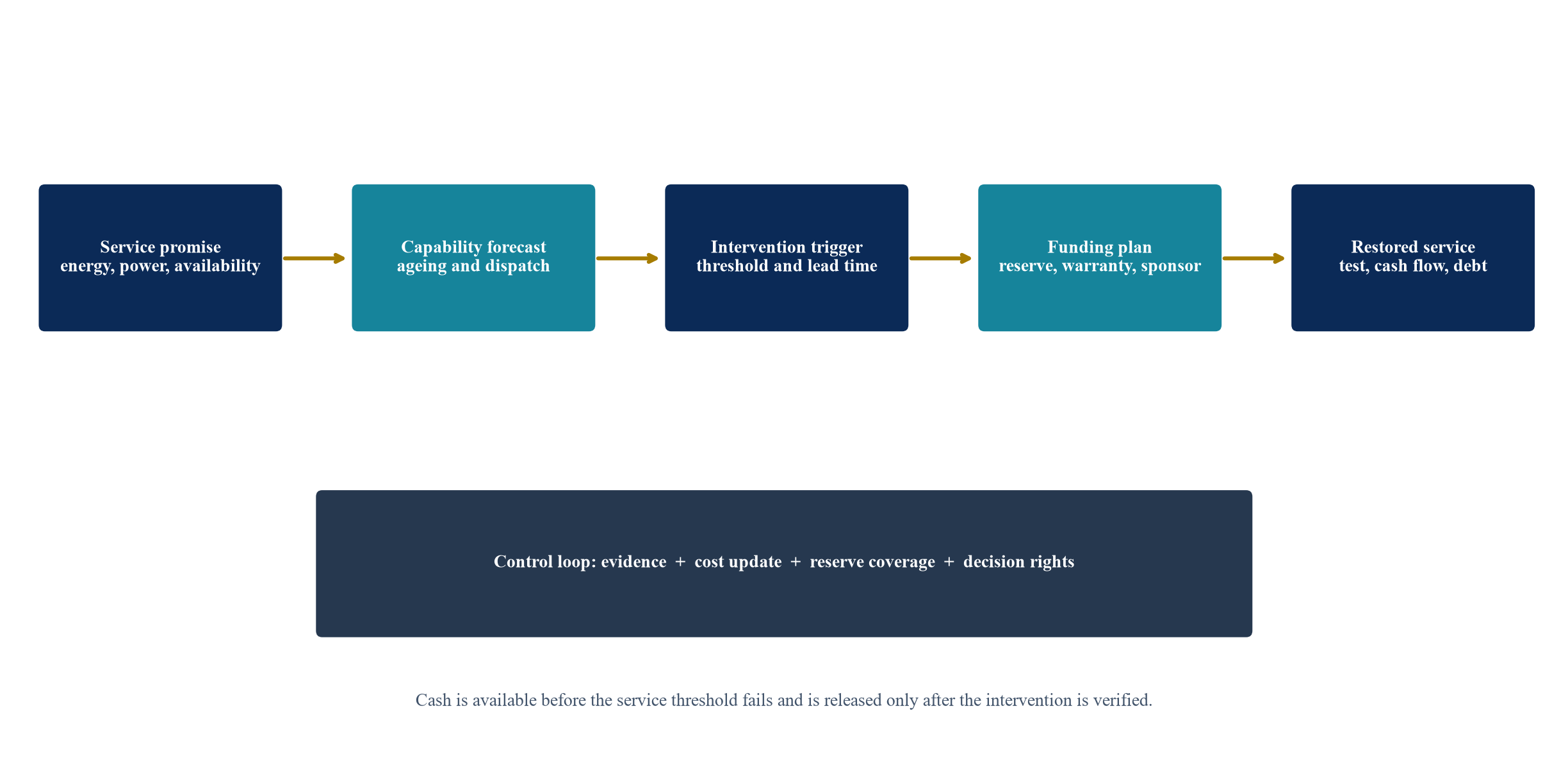
Conceptual framework. The reserve follows the capability obligation, forecast trigger, procurement schedule and funding source.
2. Define augmentation before funding it
Augmentation can mean adding new battery modules, replacing degraded modules, adding containers, repowering a power-conversion system, increasing thermal-management capacity or changing controls to recover usable capability. These actions have different cost, outage, permitting, warranty and integration consequences. A document that uses the word augmentation without defining the physical scope leaves the reserve disconnected from the intervention it is expected to fund.
An addition increases installed capability. A replacement removes or retires existing components and installs substitutes. A repower can change technology, controls or system architecture. A repair restores a defect. Routine maintenance preserves condition without necessarily increasing useful capacity. The boundaries matter because contracts, accounting, tax, insurance and warranty may treat the same cash payment differently.
The model should record units and boundaries. Energy additions are usually expressed in MWh or kWh; power equipment in MW or kW; service contracts may use fixed payments or price per unit; installation involves labour, freight, engineering, testing and downtime. A reserve stated only as a percentage of original capex cannot show which quantity it buys.
3. Preserve energy, power, efficiency and availability separately
Usable energy determines duration. Power determines the rate of charge or discharge. Round-trip efficiency affects charging cost and net output. Availability measures whether the asset can perform when required. An energy-only augmentation may restore duration while leaving an inverter constraint, thermal bottleneck or availability problem unresolved.
The reserve model should therefore carry at least four capability paths. Each path needs a measurement boundary and test procedure. Energy at cell level differs from energy delivered at the revenue meter. Nameplate power differs from sustainable grid export after auxiliary load and temperature derating. Contract definitions govern the economic result.
A project that funds cells while ignoring balance-of-system constraints can spend the reserve without restoring revenue. The augmentation specification should identify interface capacity, communications, fire and safety systems, auxiliary demand, civil works and commissioning. Independent technical review should confirm that the proposed intervention restores the contracted service rather than one isolated technical metric.
4. Separate physical need from contractual responsibility
Physical degradation creates an intervention need. Contractual allocation determines who pays or performs. The owner may bear ordinary ageing while an equipment supplier covers defects. A long-term service provider may promise a capacity threshold. An optimiser may pay for excess cycling. An offtaker may accept a declining delivery profile. The reserve should cover the owner's net retained obligation after enforceable recovery.
Fluence disclosures describe augmentation commitments that either maintain capacity above a threshold for a term or provide a fixed number of augmentations. Those structures create different risk. A threshold obligation places performance and cost risk on the service provider within contract limits. A fixed-number obligation can leave timing and sufficiency risk with the owner. The finance model should reproduce the executed structure.
Contract recovery should not be treated as cash until enforceability, counterparty credit, exclusions, evidence, notice, remedy and timing are tested. A warranty claim can be disputed or delayed. The reserve can be reduced for reliable committed recovery only when lenders accept the credit and documentation. Otherwise, recovery is a contingent upside or reimbursement after owner-funded work.
5. Build four linked ledgers
The physical ledger records installed energy and power, forecast degradation, measured performance, augmentation additions and retired components. The obligation ledger records revenue thresholds, warranty limits, service commitments and performance remedies. The expenditure ledger records equipment, freight, labour, engineering, permitting, testing, tax and downtime. The funding ledger records reserve cash, cash sweeps, letters of credit, sponsor support, service-provider obligations and undrawn facilities.
These ledgers prevent a frequent modelling error: one expected augmentation cost appears in several places or disappears between technical and financial models. Each intervention should have an identifier linking physical scope, legal responsibility, expenditure and funding. Changes should update all four ledgers through controlled assumptions.
Table 1. Augmentation obligation and funding ledger
| Item | Core question | Evidence | Cash-flow treatment | Funding implication |
|---|---|---|---|---|
| Contracted energy | What usable energy must be delivered and where measured? | Revenue contract and capacity-test procedure | Revenue, deduction and cure path | Determines the intervention threshold |
| Contracted power | Does augmentation also require inverter or interconnection capacity? | Grid, EPC and operating documents | Capex and outage | May require a separate power-component reserve |
| Ordinary degradation | Who bears expected calendar and cycle ageing? | Warranty, LTSA and operating protocol | Owner cost or service payment | Fund retained owner exposure |
| Defect or failure | Which events create supplier recovery? | Product warranty, defect evidence and notice | Recovery, repair cost and delay | Treat uncertain recovery separately |
| Excess use | Who pays for throughput or operating-limit breaches? | Dispatch records and optimiser agreement | Variable charge or indemnity | Link reserve top-up to excess use |
| Equipment scope | Which cells, racks, containers, PCS and auxiliaries are included? | Technical specification and bill of materials | Equipment and integration capex | Size reserve by units and interfaces |
| Installation scope | Which labour, freight, civil work, testing and outage are required? | EPC estimate and schedule | Capex, opex and revenue loss | Fund total installed cost, not pack cost alone |
| Timing | When must procurement start and cash be paid? | Capability forecast and procurement plan | Milestone payments and downtime | Reserve must be liquid before the trigger |
| Residual and disposal | What happens to removed components and unused reserve? | Recycling, title and finance documents | Salvage, disposal and terminal cash | Define proceeds and release waterfall |
General framework. Project treatment depends on executed contracts, applicable accounting policy, tax advice and technical evidence.
6. Start with the capability trigger, not the accounting label
The intervention trigger can be a contractual threshold, an economic optimum, a warranty boundary, a safety finding or a lender covenant. These triggers may occur at different dates. The model should identify the earliest binding trigger and the consequences of delay.
Accounting classification follows facts and policy. IAS 16 distinguishes day-to-day servicing from the replacement of parts that meet recognition criteria; qualifying replacement cost is recognised in the asset and the carrying amount of the replaced part is derecognised. This framework does not decide project liquidity. Cash must still be available when equipment and installation invoices are due.
Similarly, a service payment can place performance responsibility on a supplier while leaving owner exposure to exclusions, credit risk and termination. A fixed-O&M forecast can levelise expected cost while actual cash expenditure remains lumpy. Reserve design should follow the cash and obligation schedule, then reconcile accounting and tax treatment with qualified advisers.
7. Choose the funding architecture deliberately
Five common architectures are available. First, prefunding at financial close creates maximum certainty and maximum negative carry. Second, periodic cash sweeps build cash from operations. Third, an augmentation service or capacity-maintenance agreement transfers defined performance obligations to a counterparty. Fourth, committed sponsor support or a letter of credit substitutes credit for cash. Fifth, a committed debt accordion funds future eligible expenditure subject to conditions.
Hybrid structures can be more efficient. A minimum cash reserve may cover near-term lead time; periodic sweeps build the balance; a letter of credit covers residual timing risk; warranty or service recoveries replenish cash after receipt. The structure should survive downside cases without relying on discretionary refinancing.
The funding source should match risk. Long-lead equipment and weak counterparties favour earlier cash. Stable contracted revenue can support periodic funding. Merchant revenue, aggressive dispatch, uncertain cost or a reserve trigger close to debt maturity may require more conservative protection. The finance documents should specify priority, permitted investments, control, release and replenishment.
8. Do not double count augmentation in capex and opex
NREL's 2024 Annual Technology Baseline includes battery augmentation in fixed O&M to maintain rated capacity through a 15-year life. This is a levelised modelling convention. A project model that also inserts discrete future augmentation capex without removing the same amount from fixed O&M double counts lifecycle cost.
The reverse error also occurs. A model may use an industry fixed-O&M percentage that excludes augmentation, then omit discrete replacement expenditure. The resulting equity return and debt coverage are overstated. Model documentation should state which costs are included in each line.
A reconciliation table should start with vendor service fees, routine O&M, augmentation equipment, installation, outage, disposal, insurance and major replacement. Each cost belongs once in the economic model. Accounting presentation can be mapped separately. The investment committee should receive both cash timing and reported-accounting views.
9. Build a complete sources-and-uses schedule
Equipment price is only one use. A finance-grade budget should include engineering, procurement management, freight, duties, site access, lifting, civil work, electrical integration, controls, cybersecurity, fire protection, testing, owner costs, independent engineer, financing fees, contingency, tax and revenue lost during outage. It should also include disposal or recycling cost net of supportable proceeds.
Sources should be equally explicit: restricted cash, operating cash flow, sponsor equity, reserve letter of credit, warranty reimbursement, service-provider performance, insurance proceeds, vendor credit and committed debt. Sources with conditions should not be treated as equivalent to cash. The model should identify the date each source becomes available.
The reserve need is the peak cumulative funding gap after eligible sources and before uncertain recoveries. This approach captures timing. A project can have enough total expected cash over its life and still fail to pay a supplier deposit when required.
10. Size the reserve from units, not percentages
The technical forecast should estimate how many energy modules or containers are required to preserve service at each intervention. Unit cost should include the compatible equipment available at that future date, not merely current cell price. Integration cost can rise even if cell cost falls.
A unit-based estimate can be represented as required added MWh multiplied by installed cost per MWh, plus fixed mobilisation, engineering, testing and outage. Power-component replacement requires a separate cost basis. The estimate should show nominal and real currency, escalation, foreign-exchange assumptions and contingency.
Percentage-of-capex checks remain useful as reasonableness tests. They should not drive the model when the physical need is available. The same original capex percentage can buy different capability as technology, supplier availability, labour and import cost change.
11. Model procurement lead time explicitly
The reserve date precedes the augmentation date. Specification, tendering, lender consent, supplier qualification, manufacturing, shipping, customs, site work and commissioning require time. A capability trigger in year eight may require a procurement notice in year seven or earlier.
Cash milestones often precede delivery. Deposits, progress payments and reservation payments can create exposure before equipment reaches site. The reserve schedule should fund these milestones and test refund security, title transfer and insolvency protection.
Delay can produce performance deductions, lost merchant revenue, warranty problems and covenant breaches. A reserve calibrated only to equipment cost understates this risk. The downside case should combine cost escalation with delay and revenue effects.
12. Escalate the right components
Battery pack prices, power electronics, labour, freight, duties and professional services can follow different paths. A single inflation rate is convenient and can be misleading. NREL projections distinguish energy-related pack costs from power and balance-of-system costs. Project estimates should preserve that separation.
Technology cost decline should be balanced against compatibility and scale. A future module may be cheaper per kWh and unavailable for the installed platform. A smaller replacement order may carry a premium. End-of-line components, software integration and certification can increase cost.
The model should present at least a base, high-cost and compatibility-constrained case. Foreign-currency exposure should be shown where the reserve currency differs from equipment or freight currency. Hedging cost belongs in the funding plan when material.
13. Preserve contingency and uncertainty
Reserve sizing should reflect forecast error in degradation, cost and timing. Deterministic expected cost can be supplemented by scenario weights or a confidence allowance. The chosen method should be transparent and governable.
Contingency is not a substitute for incomplete scope. The base estimate should be technically coherent before contingency is added. A percentage allowance should identify the risks it covers and the risks addressed elsewhere through contracts or insurance.
The lender case should avoid false precision. It can use a conservative capability path, an adverse installed cost, a procurement delay and limited warranty recovery. The resulting peak funding gap is more useful than a single point estimate labelled as certain.
14. Use a constructed case to expose timing
Consider a hypothetical 100 MW / 400 MWh project with an initial installed cost of USD 120 million and 65 percent senior debt. The project must maintain 360 MWh of usable energy at the contractual measurement point. The base technical forecast reaches the procurement trigger in year seven and installs 52 MWh in year eight. The high-use case requires 72 MWh in year seven. The delayed case installs 72 MWh in year nine after a one-year procurement delay.
The base installed augmentation budget is USD 16 million. The high-use case is USD 24 million. The delayed case is USD 30 million, including higher equipment and integration cost, extended owner costs and lost revenue. These figures are constructed solely to demonstrate mechanics. They are not observed market terms or a forecast for a specific project.
Assume the base reserve starts with USD 2 million at close and receives quarterly cash sweeps. The high-use case consumes lifecycle capability faster and needs a larger early balance. The delayed case demonstrates why a nominal reserve balance is not enough: the project faces performance deductions and weakened debt service before the intervention restores energy.
Table 2. Hypothetical augmentation reserve and finance cases
| Measure | Controlled operation | High-use operation | Delayed procurement |
|---|---|---|---|
| Initial project cost | USD 120m | USD 120m | USD 120m |
| Contracted usable-energy threshold | 360 MWh | 360 MWh | 360 MWh |
| Forecast augmentation need | 52 MWh | 72 MWh | 72 MWh |
| Procurement notice | Year 7 | Year 6 | Year 6 |
| Installation | Year 8 | Year 7 | Year 9 |
| Installed augmentation budget | USD 16m | USD 24m | USD 30m |
| Initial funded reserve | USD 2m | USD 3m | USD 3m |
| Periodic cash funding before installation | USD 12m | USD 17m | USD 16m |
| Sponsor or contingent support | USD 2m | USD 4m | USD 6m |
| Minimum DSCR before intervention | 1.31x | 1.17x | 0.98x |
| Minimum DSCR after completed intervention | 1.36x | 1.25x | 1.19x |
| Primary decision | Maintain quarterly funding | Accelerate reserve and constrain dispatch | Draw support, cure delay and lock distributions |
Constructed assumptions only. Figures are not forecasts, quotations, observed market data or recommended financing terms.
15. Interpret the constructed case carefully
The controlled case illustrates a financeable sequence: the reserve accumulates before procurement, contingent support covers residual timing and capability is restored before the service threshold fails. The high-use case shows that profitable dispatch can accelerate augmentation and reduce pre-intervention coverage. The delayed case shows the combined effect of cost, revenue and timing.
The figures do not establish a universal reserve percentage. The correct amount depends on the project. The decision rule is to compare the funded balance at each payment date with the total installed cost and cash-flow consequences under the selected capability path.
The case also shows why reserve coverage and DSCR should be read together. A project can satisfy DSCR while underfunding a future intervention, then experience a sharp liquidity event. A distribution test that includes forecast reserve sufficiency provides earlier protection.
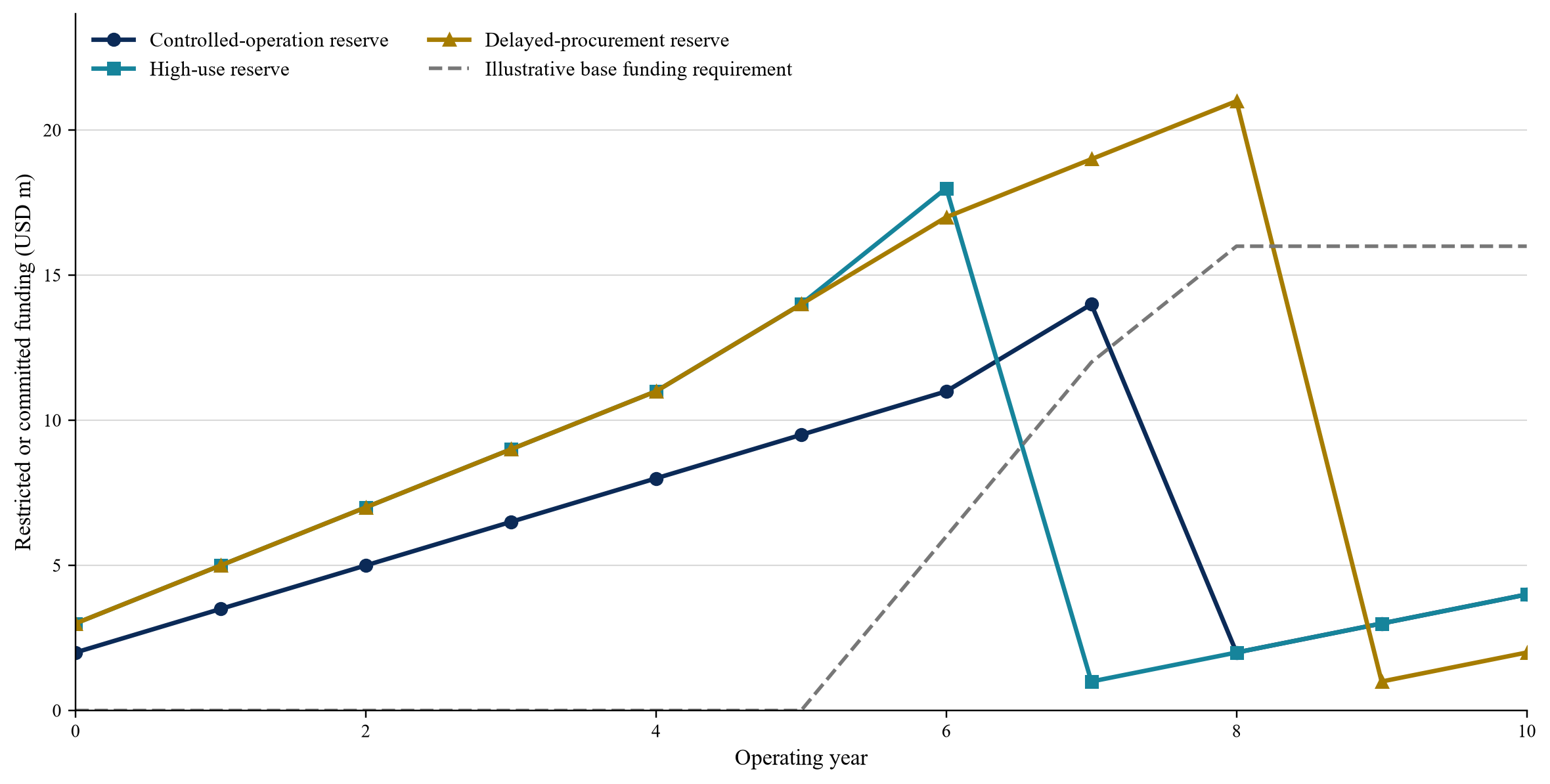
Constructed scenarios only. Values demonstrate funding timing and do not represent observed projects or forecasts.
16. Calculate periodic funding from the payment curve
A periodic reserve contribution should be derived from future cash needs and existing funded or committed sources. The calculation can discount or accumulate investment earnings, but it should not assume returns unavailable under permitted-investment rules.
The simplest schedule divides the remaining uncovered amount by funding periods before the first payment. A stronger schedule recalculates quarterly using updated technical forecasts, supplier pricing, reserve earnings and recoveries. The contribution becomes dynamic while the decision rule remains fixed.
Cash sweeps should avoid circularity. The model should define whether contributions occur before or after debt service, taxes and distributions. Senior lenders commonly require reserve funding before distributions because the reserve protects future contracted cash flow and collateral value.
17. Measure reserve coverage at payment dates
Reserve coverage is available eligible funding divided by forecast eligible uses at each payment date. Available funding should exclude cash needed for debt service, routine O&M, taxes or other restricted purposes. A letter of credit should count only when it is drawable for the relevant use and remains in force through the payment date.
Forecast uses should include deposits, progress payments, delivery, installation, testing and contingency. Warranty reimbursement expected after installation does not cover an earlier supplier deposit unless bridge liquidity exists. The model should show gross and net funding requirements.
Coverage can support warning thresholds. For example, an early-warning level can require a remediation plan; a lower level can lock distributions; a severe shortfall can require sponsor funding or constitute a default after cure periods. Exact thresholds belong in project documents and depend on risk.
18. Connect the reserve to debt service
Augmentation affects debt through cash diversion, downtime, performance deductions, operating cost and asset value. Debt sizing should use cash flow after required reserve contributions. A base case that calculates DSCR before lifecycle funding overstates distributable cash.
The debt model should test the capability path with and without timely augmentation. The no-action case may show falling revenue and terminal value. The intervention case shows expenditure and restored service. The optimal decision can differ for equity and lenders if the expenditure occurs near debt maturity or contract expiry.
Financing documents can include reserve-funding covenants, distribution conditions, forecast tests, information rights and independent-engineer review. The objective is early action. Waiting for a historical DSCR breach can allow capability and liquidity to deteriorate together.
19. Define warranty recovery conservatively
Warranty and capacity-maintenance contracts can reduce owner exposure. They also introduce exclusions, evidence requirements, caps, deductibles, response periods and counterparty risk. The reserve should fund the amount and timing risk the owner retains.
Fluence's 2026 disclosure distinguishes threshold-maintenance obligations from fixed-number augmentations. Energy Vault's warranty disclosures state that actual failure rates and replacement costs can differ from estimates, requiring changes to warranty liabilities. These public disclosures reinforce that future cost and performance remain uncertain even for experienced providers.
The model should distinguish assurance warranties for defects, service-type warranties, maintenance services and explicit augmentation commitments. It should map notice, test, cure and payment timing. Recovery should enter cash flow when reasonably supportable under the contract and credit analysis, with a downside case for delay or non-recovery.
20. Price service-provider credit
Transferring augmentation responsibility does not eliminate economic exposure when the provider cannot perform. Credit analysis should cover the contracting entity, parent support, guarantees, insurance, letters of credit, security and replacement rights.
The owner's contingency plan should identify replacement suppliers, data access, software rights, compatibility information and step-in rights. A service agreement without technical data portability can leave the owner unable to procure an alternative.
The finance case can assign different recovery haircuts to cash collateral, bank letters of credit, parent guarantees and unsecured claims. These are project-specific assumptions and should be approved rather than embedded invisibly.
21. Treat letters of credit as instruments with expiry risk
A reserve letter of credit can reduce trapped cash, yet it creates issuer credit, renewal, draw and expiry risk. The beneficiary, draw conditions, notice period, governing law and permitted uses must align with the augmentation obligation.
The expiry date should extend beyond the relevant payment and cure period. Automatic renewal language may be supported by a non-renewal draw right. Replacement requirements should apply if the issuing bank falls below an agreed rating or eligibility standard.
Fees and collateral belong in the model. A sponsor-backed letter of credit may consume corporate facilities. A project-level instrument may have covenant and security consequences. The value is liquidity certainty, not merely an accounting reduction in restricted cash.
22. Use committed debt only with credible draw conditions
A future debt facility or accordion can fund augmentation when the project retains borrowing capacity and satisfies draw conditions. It should not be assumed available if it remains subject to lender discretion, market syndication or financial ratios that deteriorate as the battery degrades.
The model should test interest, fees, amortisation and tenor after the draw. Augmentation debt can restore revenue and asset value while increasing leverage. Debt maturity should not precede the benefit period of the intervention.
Committed funding can complement a reserve. Cash covers deposits and uncertainty; debt funds eligible installed assets after evidence and consent. The sources-and-uses schedule should identify any bridge requirement between supplier payment and debt draw.
23. Align disbursement with objective evidence
Reserve disbursement should follow approved milestones: technical need confirmed, scope approved, procurement completed, supplier and contract accepted, permits and lender consents obtained, payment evidence delivered, installation complete and performance test passed. The exact sequence depends on the contract.
Controls should preserve flexibility for urgent safety work while preventing leakage. A controlled account can pay suppliers directly. Reimbursement can follow invoice and completion evidence. Independent-engineer certification may be appropriate for material releases.
The final release should depend on restored capability under the relevant test, not delivery alone. Retention or performance security can preserve remedies until commissioning defects are resolved.
24. Replenish the reserve after claims and overruns
Warranty or insurance proceeds received after owner-funded work should replenish the reserve or repay bridge funding according to the waterfall. Cost savings should not automatically become distributable until the updated lifecycle forecast confirms sufficiency.
An overrun can require sponsor support, additional cash sweeps or reduced distributions. The documents should specify cure periods and priority. The reserve target should be recalculated after each intervention because the installed fleet, capability path and compatibility risk have changed.
Replenishment also applies when dispatch exceeds the approved lifecycle budget. Optimiser payments or excess-throughput charges can top up the reserve. This links operating economics to the capability consumed.
25. Integrate dispatch incentives
An optimiser may maximise short-term market revenue while accelerating degradation and reserve demand. The commercial agreement should price lifecycle consumption or constrain operating bands. Gross revenue alone is an incomplete performance measure.
The model can calculate a marginal degradation and reserve charge for each dispatch pattern. The charge does not need to reproduce cell electrochemistry in settlement; it needs a controlled relationship to throughput, temperature, depth of discharge and approved technical outputs.
Incentive fees should use net value after charging cost, performance deductions, degradation cost and reserve contribution. Exceptions should require owner approval and a documented reserve impact.
26. Address accounting without confusing it with cash
IAS 16 indicates that day-to-day servicing is expensed, while qualifying replacement parts are capitalised and the replaced carrying amount is derecognised. Spare parts can be property, plant and equipment when they meet the definition; otherwise they are inventory. Application requires judgement and project-specific accounting advice.
A service payment may be recognised over the service term by the provider while the owner's accounting follows its contract and standards. Public company disclosures show augmentation arrangements can be distinct performance obligations. These accounting outcomes do not guarantee reserve availability.
The board should receive a bridge from economic cost to accounting presentation, tax basis, covenant definitions and distributable cash. Differences should be documented. The financial model should preserve actual cash timing as the primary funding control.
27. Review tax treatment by jurisdiction and modification
Tax treatment depends on jurisdiction, ownership, placed-in-service rules, modification scope and incentive law. The U.S. Internal Revenue Service states that qualifying energy storage placed in service after 2024 can be eligible for the technology-neutral clean electricity investment credit and may qualify for five-year MACRS treatment. Instructions for Form 3468 address modifications that increase energy-storage nameplate capacity.
These sources do not establish that every augmentation qualifies for a new credit or depreciation result. Projects require tax advice on ownership, basis, recapture, domestic-content or labour requirements, used property, capacity increase and documentation. The finance case should show incentives only when eligibility is supported.
Tax uncertainty should not create a liquidity gap. The gross reserve should be visible before tax benefits; a supported benefit can be shown separately with timing and conditions.
28. Plan for technology and compatibility change
Future cells may use a different chemistry, form factor, voltage, controls or safety standard. Mixing generations can require engineering, new certification, software changes and additional spares. A reserve based on future commodity cost can understate integration expense.
The technical strategy should compare like-for-like augmentation, partial repower and full repower. Like-for-like reduces interface risk and can create supplier concentration. Repower can improve capability and warranty while increasing scope and outage.
Procurement documents should secure data, interface specifications, software access, cybersecurity support and end-of-life information. Optional pricing or framework agreements can reduce uncertainty without replacing reserve funding.
29. Include outage and revenue effects
Installation can require full or partial shutdown. The model should estimate unavailable MW and MWh by interval, contractual deductions, lost market revenue, charging constraints and recommissioning risk. Seasonal market conditions can influence the preferred installation window.
Outage cost belongs in the intervention decision even if it is not paid from the reserve. A project might select a more expensive staged installation that preserves availability and debt coverage. The least equipment cost is not always the least economic cost.
The schedule should include contingency for failed testing or delayed grid approval. Performance recovery should be verified before revenue is restored in the model.
30. Link reserve governance to operating data
Monthly reporting should reconcile actual usable energy, power, efficiency, availability, throughput, temperature and warranty headroom with the approved forecast. Cost estimates and procurement lead times should be refreshed at defined intervals.
The finance team should report funded cash, eligible letters of credit, committed support, required uses and coverage ratios. The technical and funding views should use the same intervention schedule. Differences require explanation.
Table 3. Replacement-reserve monitoring and governance matrix
| Indicator | Evidence | Early-warning question | Financial consequence | Governance response |
|---|---|---|---|---|
| Usable energy | Controlled capacity test and revenue-meter data | Is the intervention trigger moving forward? | Earlier procurement and higher reserve target | Update forecast and funding schedule |
| Power and efficiency | PCS records, energy meters and test protocol | Will cells alone restore contracted service? | Additional equipment and charging cost | Expand scope and technical review |
| Throughput and operating limits | Validated dispatch trace | Is use consuming capability faster than budget? | Accelerated funding need | Reprice or constrain dispatch |
| Installed-cost estimate | Supplier budget, labour, freight and integration plan | Has total installed cost changed? | Reserve shortfall or surplus | Reforecast and approve contingency |
| Procurement lead time | Tender and supplier schedule | Is cash required before current funding is available? | Deposit or bridge-liquidity gap | Accelerate funding or secure commitment |
| Warranty recovery | Claim evidence, notices and counterparty review | Is recovery timely and enforceable? | Gross owner funding increases | Haircut recovery and preserve claims |
| Reserve balance | Controlled-account statement | Does eligible funding cover dated uses? | Distribution restriction or support draw | Apply waterfall and cure plan |
| Downside DSCR | Integrated project-finance model | Does intervention timing protect debt service? | Covenant pressure and refinancing risk | Lock distributions and remediate |
| Post-installation capability | Acceptance and capacity test | Did the intervention restore the required service? | Revenue and residual value remain exposed | Withhold final release and enforce remedies |
General framework. Frequencies, thresholds and remedies should be tailored to project documents and technical evidence.
31. Make decisions through a six-gate process
Gate one confirms the service obligation and measurement boundary. Gate two validates the technical capability path and intervention trigger. Gate three confirms contractual allocation and recovery. Gate four approves scope, installed cost and procurement schedule. Gate five proves funding and debt-service resilience. Gate six governs disbursement, testing and ongoing update.
Each gate should produce evidence, exceptions, an accountable owner and a recorded decision. Conditional approval should state the condition, owner and deadline. The process should begin before the forecast trigger reaches procurement lead time.
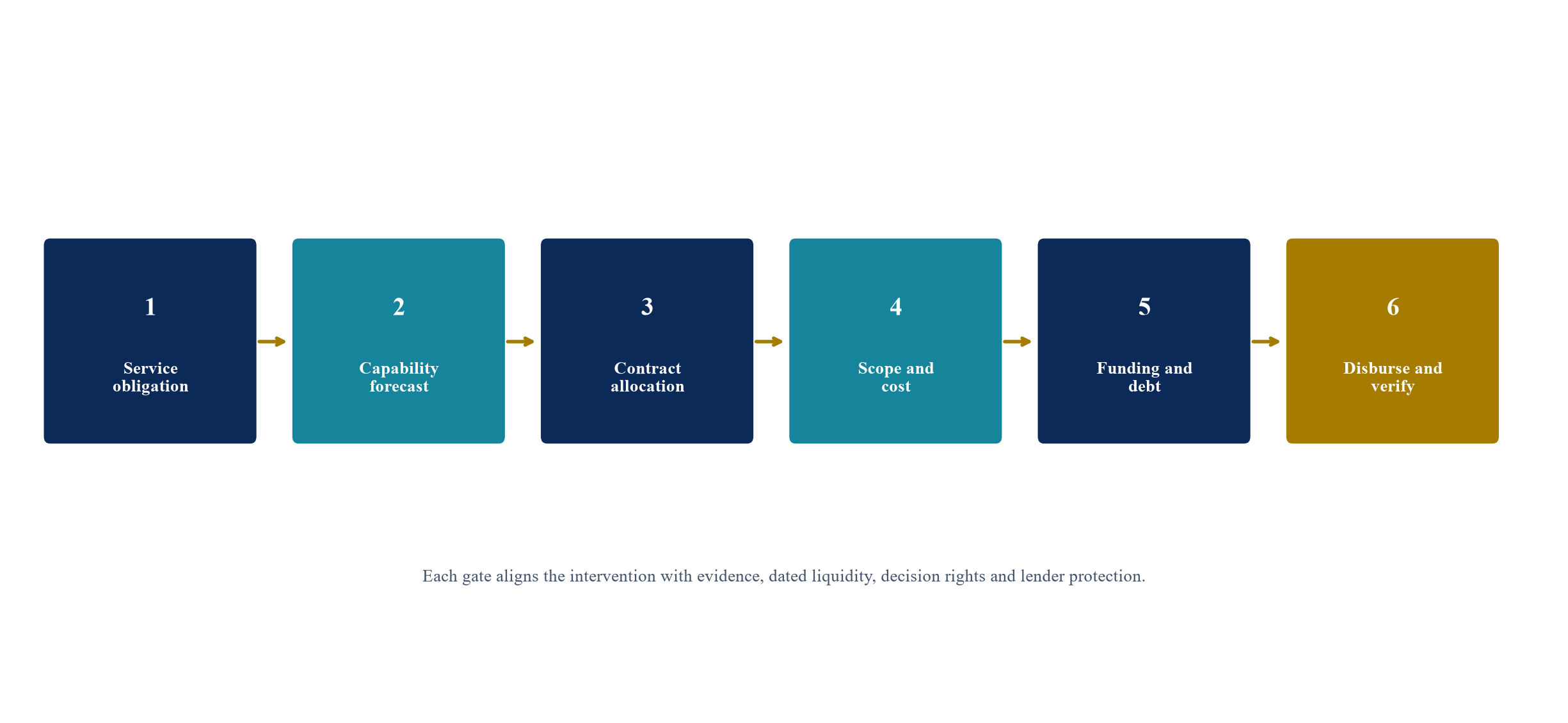
A financeable reserve links service obligations, technical need, contractual recovery, installed cost, funding and verified completion.
32. Diligence the reserve in acquisitions and refinancing
A buyer should reconcile the seller's reserve balance with the current capability forecast, executed contracts, dispatch history, supplier pricing and procurement lead time. Cash in an account does not prove sufficiency. A modelled future cost does not prove funding.
Diligence should examine historical capacity tests, BMS and revenue-meter data, warranty compliance, notices, claims, service-provider credit, compatible equipment, permits, tax assumptions, accounting policy and lender restrictions. It should identify whether the reserve transfers with the project and whether a change of control affects contracts or guarantees.
Purchase-price mechanisms can retain cash, adjust working capital, create escrow, require seller support or reflect an unfunded lifecycle liability. Refinancing can resize the reserve and fund a near-term intervention. The valuation should use post-augmentation capability and cash, not initial nameplate capacity.
33. Protect residual value and terminal cash
An augmentation can extend contracted life, preserve merchant capability or improve saleability. Its value depends on the remaining contract term, market access, site rights, interconnection, technology compatibility and decommissioning obligation. Expenditure close to the end of the model should not be assumed to recover full cost.
Unused reserve should follow a documented waterfall at debt maturity, contract expiry or sale. It may fund later work, repay debt or distribute to equity. The same cash cannot support both terminal value and an outstanding intervention.
Removed equipment can have reuse, recycling or salvage value and may also create transport, safety and disposal cost. Terminal assumptions require evidence and should be shown gross before uncertain proceeds.
34. Recognise limitations and research needs
Battery degradation and cost forecasts are approximations. Actual performance depends on chemistry, cell design, manufacturing quality, site conditions, thermal management, controls, dispatch, maintenance and measurement. Future equipment and integration markets can differ materially from current assumptions.
The constructed case in this paper illustrates mechanics. It does not estimate a representative project return, reserve percentage, augmentation cost, tax benefit or financing term. Project decisions require technical, legal, accounting, tax and insurance advice.
Further research should compare forecast reserve schedules with operating fleets; quantify compatibility and integration premiums; test reserve efficiency across contract structures; and develop standard reporting that reconciles capability, obligation, expenditure and funding.
35. Conclusion
The replacement reserve is a bridge between today's dispatch and tomorrow's service obligation. Its purpose is to make cash or committed support available before degradation, procurement lead time and contract performance converge into a liquidity event.
A financeable design begins with the service promise, preserves separate energy, power, efficiency and availability paths, defines the physical intervention, allocates contractual responsibility and builds a complete installed-cost schedule. It then selects funding sources, tests dated coverage, integrates debt service and controls disbursement through verified milestones.
Capex, opex, service obligations and financing reserves describe different legal, accounting and funding views. The project should reconcile them without losing the cash requirement. A governed four-ledger system and six-gate decision process keep physical need, contractual recovery, expenditure and funding aligned throughout the asset life.
References
- U.S. Department of Energy, 2022 Grid Energy Storage Technology Cost and Performance Assessment, August 2022. https://www.energy.gov/sites/default/files/2022-09/2022%20Grid%20Energy%20Storage%20Technology%20Cost%20and%20Performance%20Assessment.pdf
- National Renewable Energy Laboratory, Utility-Scale Battery Storage, 2024 Annual Technology Baseline. https://atb.nrel.gov/electricity/2024b/utility-scale_battery_storage
- National Renewable Energy Laboratory, Utility-Scale Battery Storage, 2022 Annual Technology Baseline. https://atb.nrel.gov/electricity/2022/utility-scale_battery_storage
- National Renewable Energy Laboratory, Utility-Scale PV-Plus-Battery, 2024 Annual Technology Baseline. https://atb.nrel.gov/electricity/2024/utility-scale_pv-plus-battery
- Nicholas DiOrio, Aron Dobos, Steven Janzou, Aldo Nelson and Blake Lundstrom, Technoeconomic Modeling of Battery Energy Storage in SAM, NREL/TP-6A20-64641, September 2015. https://www.nrel.gov/docs/fy15osti/64641.pdf
- Richard Baxter, Energy Storage Financing: Operations and Market Strategy, Sandia National Laboratories, SAND2022-0422, January 2022. https://www.osti.gov/servlets/purl/1840836
- Fluence Energy, Inc., 2026 disclosure on extended warranty and augmentation performance obligations. https://www.sec.gov/Archives/edgar/data/1868941/000186894126000029/R9.htm
- Fluence Energy, Inc., registration statement disclosure on capacity guarantees and augmentation activities. https://www.sec.gov/Archives/edgar/data/1868941/000110465921101525/filename1.htm
- Energy Vault Holdings, Inc., 2026 disclosure on warranty liabilities, guarantees and project obligations. https://www.sec.gov/Archives/edgar/data/1828536/000182853626000101/R26.htm
- Southern California Edison, Engineering, Procurement, Construction and Maintenance Agreement for battery storage facilities. https://www.sec.gov/Archives/edgar/data/1488139/000148813922000014/ex-1010epcm_10x20x21xsce.htm
- Tesla, Framework BESS Sale and Purchase Agreement filed as a public exhibit. https://www.sec.gov/Archives/edgar/data/1758766/000175876622000129/stem-10xq2022q2_ex101xfram.htm
- IFRS Foundation, IAS 16 Property, Plant and Equipment, paragraphs on recognition, subsequent costs and component replacement. https://www.ifrs.org/content/dam/ifrs/publications/pdf-standards/english/2021/issued/part-a/ias-16-property-plant-and-equipment.pdf?bypass=on
- U.S. Internal Revenue Service, Clean Electricity Investment Credit. https://www.irs.gov/credits-deductions/clean-electricity-investment-credit
- U.S. Internal Revenue Service, Cost recovery for qualified clean energy facilities, property and technology. https://www.irs.gov/credits-deductions/cost-recovery-for-qualified-clean-energy-facilities-property-and-technology
- U.S. Internal Revenue Service, Instructions for Form 3468, Investment Credit. https://www.irs.gov/instructions/i3468
About the Author
Chennakeshav (CK) is a corporate finance and investment banking executive with 25+ years of global experience in deal origination, structuring and execution across M&A, growth capital and corporate strategy. He has led value-creation mandates for founders, corporates and funds — bridging the boardroom view to hands-on execution and close.
His career spans Morgan Stanley, HSBC, Lloyds Banking Group, EWEC, ADQ portfolio companies and Emirates Growth Fund, across TMT, real estate, fintech, deeptech, cleantech, infrastructure and energy. He has partnered with C-suite leaders, private equity and venture funds, sovereign wealth funds and family offices to finance complex fund raises and scale-up ventures, and has led M&A due diligence, post-merger integration and business-transformation initiatives to create value.
At Matchpoint Partners he is Managing Partner, leading the firm's corporate finance, M&A and capital-raising practice. He holds an MBA from London Business School, an engineering degree from VTU and a Master of Laws (LLM, in progress) from UCL London.
An active start-up mentor, CK mentors at Techstars, DIFC FinTech Hive, Startup Grind, Founder Institute and IN5, serves as Entrepreneur Mentor in Residence (EMiR) at London Business School, and judges the Entrepreneurship World Cup.
LinkedIn: https://www.linkedin.com/in/ckadya/
Profile: https://www.matchpoint-partners.com/team/ck-adya.html
