
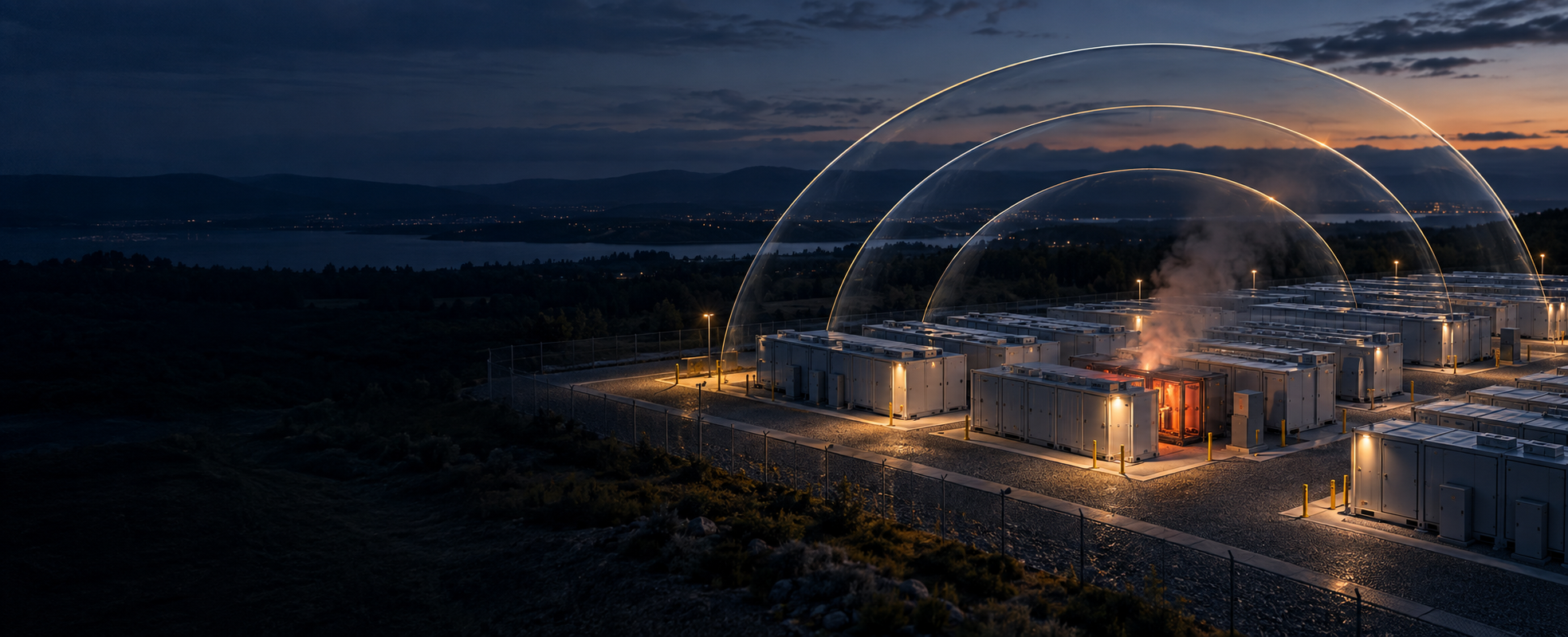
1. A battery fire creates a chain of claims
A battery incident rarely produces one isolated invoice. Thermal runaway can damage cells, modules, racks, containers, power-conversion equipment, cabling, structures and neighbouring assets. Heat, smoke, gases, firefighting water and debris can create off-site concerns. The asset can remain unavailable during investigation, stabilisation, removal, redesign, procurement and recommissioning. Revenue loss and debt-service pressure can outlast the visible fire.
The allocation problem begins with the sequence of events. A cell defect, installation error, control failure, water ingress, electrical fault, external fire, physical impact or operating excursion may initiate the event. Detection, isolation, ventilation, suppression, spacing and emergency response then affect propagation and loss severity. Each stage can involve a different party and a different contractual obligation.
The U.S. Environmental Protection Agency's public record for the January 2025 Moss Landing fire shows the breadth and duration of post-event work. EPA supervised planning, air monitoring, battery removal, de-energisation, transport and disposal under an enforceable agreement. The incident therefore illustrates why the loss model must extend beyond damaged equipment and immediate business interruption. It does not establish a general loss frequency or fault allocation for other projects.
The finance question is practical: who must pay each cash requirement, when must payment occur, what evidence triggers reimbursement and what happens if a responsible party or insurer disputes the claim? A complete answer connects engineering evidence to contractual and insurance recoveries in the same dated cash-flow model.
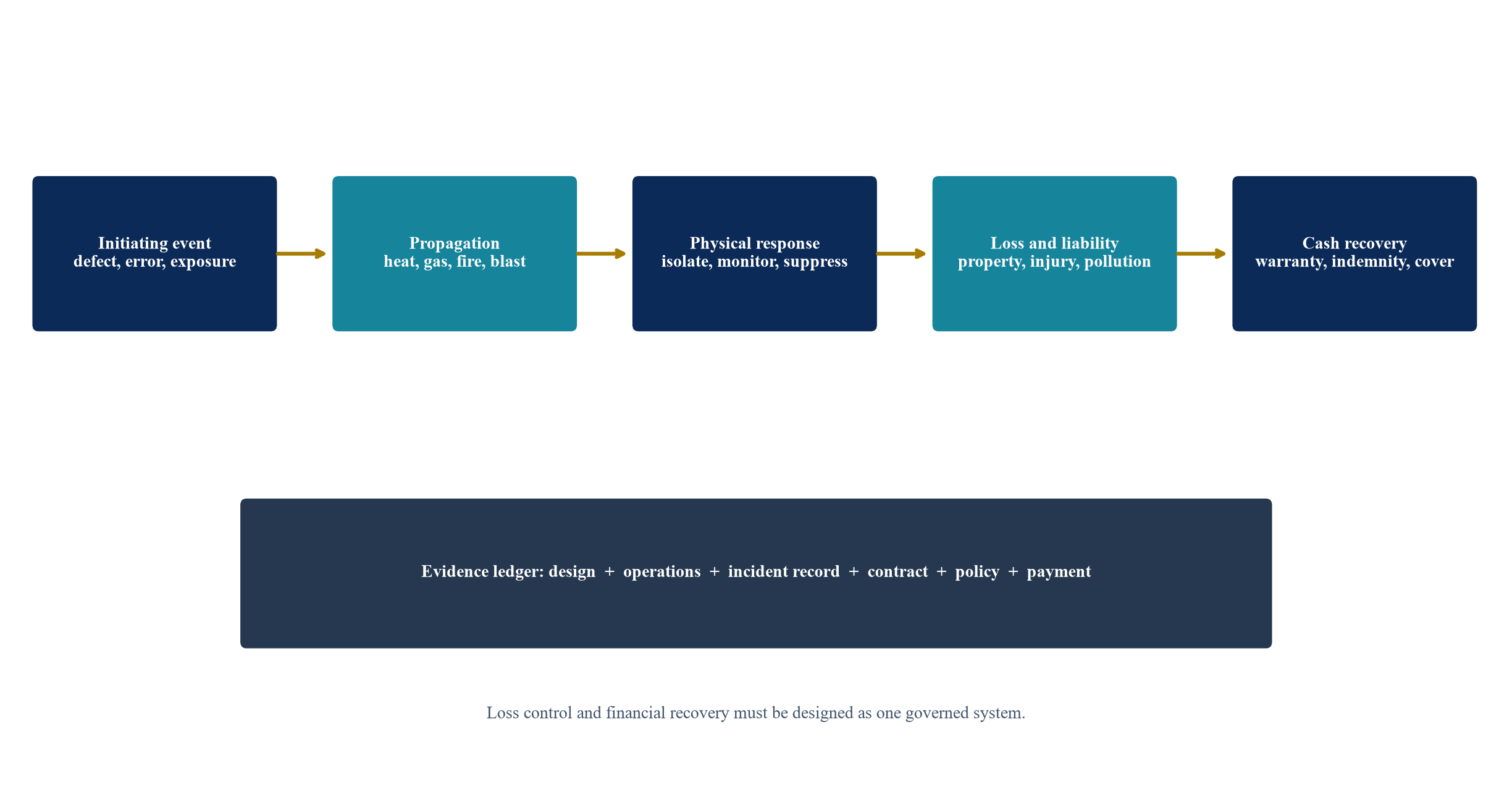
Conceptual loss path. Each stage can engage different contracts, policies, parties and payment dates.
2. Separate hazard, loss, legal responsibility and funding
Hazard describes the potential source of harm. Loss records the economic consequence. Legal responsibility depends on contract, tort, statute and facts. Funding identifies the cash source available when payment is due. These four concepts overlap, yet none is a substitute for another.
A system can satisfy a recognised safety standard and still suffer a loss. Compliance can support evidence of prudent design and affect insurability, permits and claims, while the governing contract and law still determine responsibility. A supplier can breach a warranty without causing all resulting losses. An owner can possess an indemnity and still fund emergency work before recovery. An insured event can fall within property cover while a policy exclusion leaves pollution or defective-work costs outside the recovery.
The investment case should therefore avoid a single risk-transfer percentage. It should list each loss category, the most relevant legal and policy path, limits, deductibles, exclusions, waiting periods, security and expected payment timing. The same physical event can engage several paths without allowing double recovery.
3. Start with the credible event set
The event set should reflect the proposed chemistry, cell and module design, enclosure, site, balance-of-system equipment, installation method, operating profile and external hazards. Sandia's safety work identifies mechanical, electrical and thermal abuse among causes of thermal runaway and examines battery management, ventilation, suppression and emergency response. The project risk register should convert those concepts into site-specific scenarios.
Credible scenarios may include an internal cell defect, loose connection, overcharge, coolant leak, heating or ventilation failure, sensor or communications failure, control-software error, water ingress, flooding, lightning, wildfire, vehicle impact, dropped equipment, commissioning error and maintenance error. Transport and storage before commissioning deserve separate treatment because title, custody and insurance can change during those stages.
The event set should also include response failure. Detection may be delayed. Isolation may not operate. Gas may accumulate. Emergency responders may have incomplete information. Firewater may migrate. Damaged cells may reignite during removal. The loss model should examine both initiating failures and barriers intended to limit consequences.
4. Use standards as design evidence and contract inputs
UL 9540 addresses energy-storage system equipment. UL 9540A evaluates thermal-runaway fire propagation. NFPA 855 addresses installation. The 2026 edition of NFPA 855 and the sixth edition of UL 9540A place greater emphasis on installation-level large-scale fire testing. UL Solutions states that the revised method evaluates severe conditions, including ignition of vented gases and developed fire, with measurable performance criteria.
Standards affect layout, separation, suppression, ventilation, test evidence and authority review. The EPC and supply contracts should identify the required editions, test configuration, report delivery, permitted deviations and responsibility for changes between tested and installed systems. A report for a different cell, module, enclosure or configuration may provide limited evidence for the actual project.
The contract should also address future changes. Firmware, cell sourcing, rack architecture, suppression, augmentation and replacement can alter the hazard profile. The owner needs approval rights, evidence obligations and a clear rule for retesting or engineering review. Insurance notification requirements should align with the change-control process.
5. Preserve the complete safety case
A lender or insurer needs more than a certificate. The safety case should connect hazard analysis, product listing, fire-test reports, design drawings, separation distances, ventilation, deflagration protection, detection, suppression, controls, emergency plans, commissioning records, operating limits and maintenance procedures. The configuration used in the analysis should match the configuration placed in service.
Document custody matters after an incident. Logs, alarms, firmware versions, settings, inspection records, photographs, video, samples and damaged components can become evidence. Contracts should allocate control of the site and equipment, notification, preservation, access, testing, expert appointment and privilege. An early clean-up decision can affect later causation and recovery disputes.
The project should define an evidence protocol before operation. It should identify who can isolate systems, copy logs, appoint laboratories, communicate with authorities and approve destructive testing. The protocol should coexist with immediate life-safety and environmental duties.
6. Map loss categories before drafting indemnities
The loss schedule should begin with economic categories rather than legal boilerplate. Direct property loss includes damaged battery equipment and other project assets. Business interruption includes lost contracted and merchant revenue, replacement power, imbalance cost, operating expense and debt-service pressure. Third-party loss includes injury, property damage, nuisance and economic-loss claims where legally recoverable.
Environmental cost can include monitoring, containment, contaminated water, debris management, transport, treatment, disposal, regulatory oversight and restoration. Professional cost includes emergency engineers, forensic experts, legal defence and claims preparation. Financing cost includes reserve draws, waiver fees, interest during outage and the effect of delayed completion or reduced capacity.
Each category needs a measurement rule. Replacement cost, actual cash value, agreed value, gross earnings and gross profit can produce different recoveries. The contract and policy should identify whether taxes, escalation, expedited freight, code upgrades, debris removal, professional fees and mitigation expense are covered and within which limits.
Table 1. Loss allocation and recovery schedule
| Loss category | Immediate payer | Contract path | Insurance path | Principal gap to test |
|---|---|---|---|---|
| Battery equipment | Owner or contractor controlling the work | Warranty, EPC remedy, indemnity | Property or construction all risks | Defect, faulty-work and serial-loss exclusions |
| Other project property | Owner | Indemnity for caused damage | Property damage and equipment breakdown | Sublimits, deductibles and causation |
| Delay before completion | Project company and sponsors | Delay liquidated damages and indemnity | Delay in start-up | Waiting period, critical path and excluded cause |
| Operating revenue loss | Project company | Availability remedy or indemnity | Business interruption | Indemnity period and revenue methodology |
| Bodily injury | Responsible party pending resolution | Third-party indemnity | General, employers or excess liability | Defence costs and aggregate limits |
| Off-site property damage | Project company or alleged tortfeasor | Third-party indemnity | General and excess liability | Economic loss, pollution and nuisance exclusions |
| Monitoring and clean-up | Owner or authority-directed party | Indemnity, warranty or statutory recovery | Pollution or environmental impairment | Discovery trigger, gradual pollution and clean-up order |
| Emergency mitigation | Party acting to control the event | Mitigation and emergency-cost clause | Sue-and-labour or mitigation expense | Consent, reasonableness and sublimit |
| Investigation and experts | Appointing party | Cost-shifting after causation is established | Claims-preparation or professional-fee extension | Pre-approval and privilege |
| Debt-service shortfall | Project company and sponsors | Support agreement or reserve | Business interruption proceeds assignment | Payment delay and lender waterfall |
General framework. Actual allocation depends on executed contracts, policy wording, governing law and evidence.
7. Allocate design responsibility precisely
Battery projects combine product design, system integration, civil and electrical design, fire engineering, controls and grid interfaces. A broad statement that each party is responsible for its scope can leave interface failures unresolved. The contract should define design authority and the duty to coordinate across interfaces.
The equipment supplier should identify the conditions required for its listing, test evidence and warranty. The integrator should confirm that the system architecture and controls comply with those conditions. The EPC contractor should incorporate site-specific hazards, codes, access, drainage, foundations, electrical protection and emergency infrastructure. The owner should provide accurate site and operating information.
Professional indemnity cover may respond to negligent design by insured professionals, subject to claims-made triggers, exclusions and limits. It is commonly distinct from property and general liability cover. The project should confirm which entities carry the cover, the retroactive date, the period for maintaining it and rights to evidence renewal.
8. Treat interfaces as their own risk package
Many losses arise between scopes. A battery supplier may provide containers while another party provides transformers, switchgear, SCADA, communications, firewater, drainage or buildings. The operating algorithm may come from an optimiser. Cybersecurity may involve several vendors. The party able to prevent an interface failure may differ from the party holding the relevant insurance.
An interface schedule should identify inputs, outputs, assumptions, verification and sign-off. It should cover temperature and humidity limits, electrical protection settings, alarm transmission, emergency shutdown, auxiliary power, drainage, water supply, access, communications and response procedures. Changes should trigger coordinated review.
Liability caps should be examined at the interface level. If each contractor excludes damage to another contractor's equipment, the owner can retain the combined loss. The owner should test whether cross-liability cover, mutual indemnities, waivers of subrogation and property insurance form a coherent allocation.
9. Distinguish product warranty from casualty cover
A product warranty addresses defined defects or performance failures under stated conditions. Property insurance addresses fortuitous physical loss within policy terms. The two can interact, yet they answer different questions. A warranty may provide repair or replacement of the defective component and exclude removal, installation, consequential loss and damage to other property.
Property policies often contain defects or faulty-work exclusions with different forms of ensuing-loss treatment. Project-finance insurance provisions may require coverage for physical damage outside warranty or guaranty to the extent normally insured. Publicly filed financing documents show this distinction and may require replacement-cost valuation and business interruption coverage.
The recovery model should separate the defective part, ensuing damage, labour, freight, testing, revenue loss and third-party claims. It should record which party pays first and whether the insurer has subrogation rights. The owner should avoid assuming that warranty and insurance together cover every dollar.
10. Address serial defects and fleet-wide action
A defect in one cell, module, rack, enclosure, firmware version or manufacturing batch can affect many units. The immediate fire may damage one part of the project while the investigation identifies a broader population requiring inspection, isolation, software change or replacement. A property policy may respond to damaged property while leaving preventive replacement of undamaged equipment outside coverage.
The supply agreement should define epidemic or serial defect, sampling, root-cause analysis, fleet notice, corrective action, recall cost, access and cost allocation. The threshold should reflect the asset population and severity. The owner should have rights to information about relevant incidents and corrective actions across the supplier's installed base, subject to appropriate confidentiality.
Warranty insurance can support the supplier's long-term obligations and reduce credit exposure. Munich Re describes products that back product and performance warranties, including protection against supplier insolvency within the coverage terms. The project still needs to review exclusions, attachment, limits and claims control.
11. Build an indemnity matrix around causation
An indemnity should identify the protected parties, covered claims, causal standard, defence obligation, control of counsel, settlement rights, exclusions, survival and interaction with liability caps. Third-party claims, direct losses, regulatory costs and pollution may require separate treatment.
Fault-based indemnities can leave the owner funding loss until negligence or breach is established. Risk-based indemnities can allocate specified events regardless of fault, such as hazardous materials brought to site, infringement or employer injury. The chosen approach should reflect control, insurability and bargaining position.
Public energy-storage agreements often use reciprocal indemnities for bodily injury and property damage caused by negligence, wilful misconduct or contractual failure. These clauses provide useful structures, though they are not market standards for every project. The project should align them with insurance requirements and governing law.
12. Examine liability caps by loss layer
A headline cap gives limited information. The contract should show which claims sit inside the general cap, which have separate caps and which are excluded from limitation. Common categories for separate analysis include death or injury, third-party property damage, pollution, confidentiality, intellectual property, fraud, wilful misconduct, insurance proceeds and costs of correcting defective work.
The cap should be compared with credible loss severity. A cap equal to a fraction of contract price may be insufficient where fire can affect adjacent units, buildings, grid equipment or third parties. Unlimited liability can be commercially unavailable or unsupported by the counterparty's balance sheet.
Credit support converts contractual entitlement into a more reliable recovery source. Parent guarantees, letters of credit, performance bonds, warranty insurance and retained payments can support selected obligations. The finance model should reflect their amount, expiry, conditions and drawing mechanics.
13. Align liquidated damages with insured delay
Delay liquidated damages compensate for specified delay within the contract and agreed cap. Delay-in-start-up insurance can cover insured physical damage that delays completion, subject to a waiting period and indemnity period. A supplier delay without insured physical damage may fall outside the policy.
The schedule model should distinguish equipment delivery delay, construction delay, testing delay, authority delay and insured reinstatement. It should identify the critical path and concurrent delay. Liquidated damages and insurance proceeds should be treated according to their triggers and timing.
Lenders should test the cash gap before either source pays. Deductibles, waiting periods, proof of loss, adjustment and disputes can delay receipts. Sponsor contingency or a funded reserve may be required even where final recovery is expected.
14. Design property and equipment breakdown cover together
Property cover should identify the insured assets, valuation basis, perils, deductibles, sublimits and extensions. Equipment breakdown cover can address sudden and accidental mechanical or electrical breakdown, subject to wording. The boundary matters for control systems, transformers, inverters, HVAC, pumps and batteries.
FM's loss-prevention data sheet 5-33 covers design, operation, protection, inspection, maintenance and testing for stationary lithium-ion storage above 20 kWh. Swiss Re also identifies fire testing, separation, ventilation, detection, suppression, battery management and construction risk as important controls. Underwriters can translate these controls into information requirements, pricing, deductibles and capacity.
The owner should disclose the system accurately. Chemistry, cell format, enclosure, installed energy, spacing, fire protection, operating profile, maintenance and loss history can affect underwriting. Material changes should follow the policy's notification and consent provisions.
15. Model business interruption from the actual revenue stack
Battery revenue may include capacity, availability, ancillary services, energy arbitrage, tolling payments and contracted dispatch. A fire can remove the full asset, one block or one service. The business-interruption model should use the policy definition of insured gross profit or gross earnings and the project's actual contracts.
The indemnity period should reflect investigation, debris removal, permitting, redesign, supplier lead time, installation, testing and recommissioning. The physical repair period can be shorter than the period required to regain contracted capability. Policy extensions for denial of access, utilities, suppliers and authorities should be reviewed where relevant.
Saved expenses and mitigation revenue should be modelled. A project may continue operating at reduced capacity or procure substitute services. The policy can require reasonable mitigation. The owner should understand consent and documentation requirements before an emergency.
16. Treat pollution and firewater as separate exposures
Smoke, gases, damaged battery materials, debris and firewater can create environmental response obligations. EPA's Moss Landing record includes air monitoring, battery handling, de-energisation, transport and disposal. A separate EPA incident record for the Gateway BESS describes firefighting water entering a storm drain during a 2024 event. These records show distinct pathways that a property-loss estimate can miss.
General liability policies commonly contain pollution exclusions. Environmental impairment or pollution liability cover can use discovery, claims-made or event-based triggers and can distinguish sudden accidental pollution from gradual pollution. Clean-up costs, transportation, non-owned disposal sites and natural-resource damage require specific review.
Site design affects the exposure. Drainage isolation, containment, water management, access and pre-arranged disposal routes can reduce cost and uncertainty. Contracts should assign emergency action while preserving later allocation of responsibility.
17. Allocate emergency-response authority before an event
The emergency plan should identify incident command, fire-service liaison, system isolation, site access, exclusion zones, monitoring, public communication and escalation. NFPA guidance emphasises an emergency operations plan, shutdown procedures, damaged-system removal and training. UK fire-service guidance similarly focuses on site-specific hazards, responder access, water, detection, suppression, environmental impacts and recovery.
Decision rights affect liability and mitigation. The operator may need authority to shut down the whole plant. The fire service controls emergency response under applicable law. The OEM may advise on battery condition. The owner communicates with lenders, insurers, regulators and the public. These roles should be documented and exercised.
Contracts should protect reasonable emergency action. A party should not delay mitigation solely because cost allocation is unresolved. Notice, consent and evidence obligations can be satisfied through an agreed emergency protocol, followed by formal claims processes.
18. Make claims cooperation operational
Claims clauses often require prompt notice, information, cooperation and consent. A multi-party BESS project needs a practical protocol for satisfying these duties across several policies and contracts. The protocol should list policy numbers, notice addresses, brokers, adjusters, legal advisers and technical contacts.
The project should preserve a chronology of alarms, operator actions, weather, dispatch, maintenance, communications and authority directions. It should segregate factual records from privileged legal analysis. Parties should agree access to relevant equipment and data while protecting confidential information and cybersecurity.
Settlement control requires care. An indemnifying party or insurer may control defence, yet the owner can face licence, reputation and financing consequences. Consent should not be unreasonably withheld, and settlements should avoid admissions or operational commitments affecting unrepresented parties.
19. Give lenders direct visibility into risk transfer
Finance documents commonly require named insured or additional insured status, loss-payee provisions, lender notice, waiver of subrogation, minimum insurer ratings and restrictions on cancellation or material change. The detailed requirements should match the project contracts and policy structure.
Insurance proceeds need a waterfall. Small losses may fund repair directly. Large losses may enter a controlled account and require reinstatement conditions, independent engineer certification or debt repayment. Business-interruption proceeds may support operating cost and debt service. Third-party liability proceeds should remain available for the relevant claims.
Lenders should receive current certificates, key endorsements, policy summaries and, where appropriate, full policy wording. Certificates alone do not establish coverage. The insurance adviser should confirm compliance, exclusions, deductibles and the effect of annual market changes.
20. Protect against counterparty credit failure
An indemnity or warranty has the credit quality of the obligor and its support package. Storage supply chains include manufacturers, integrators, special-purpose entities, contractors and service providers with different balance sheets. Consolidation or insolvency can occur during a long warranty term.
Credit protection can include parent guarantees, performance security, retention, escrow, letters of credit, bonds and warranty insurance. Each instrument has conditions, expiry and jurisdictional risk. A parent guarantee can be weakened by structural subordination or limited scope. A bond can require precise default evidence. A letter of credit needs timely extension or replacement.
The project should track credit throughout construction and operation. Deterioration should trigger enhanced reporting, replacement security or reserve funding where contracts permit. Lenders should avoid relying on a support instrument that expires before the protected obligation.
21. Reconcile waivers of subrogation and indemnities
Property insurance can cover project assets on a broad basis, followed by insurer recovery against responsible parties through subrogation. A waiver of subrogation can prevent that recovery against specified insured parties. The waiver can support project cooperation and reduce internal litigation, while transferring more loss to the insurance programme.
The contract should align indemnities, insured-party status and waivers. A party should not promise an indemnity that the agreed property-insurance structure was designed to absorb unless the exception is deliberate. Gross negligence, wilful misconduct, uninsured deductibles and excluded losses may require separate rules.
The policy endorsement controls the insurer's rights. Contract wording alone may not bind the insurer. The owner should obtain the required endorsements and verify that they apply to the relevant entities and activities.
22. Allocate deductibles and uninsured loss
Deductibles, waiting periods, coinsurance and sublimits determine retained risk. Publicly filed project-finance terms show BESS-specific property deductibles and business-interruption requirements, illustrating how lenders can distinguish storage from other project assets. The applicable amount for a live project must come from its policy and financing documents.
The contract should allocate deductibles by cause. The owner may retain ordinary deductibles while a contractor bears the deductible for loss caused by its breach or negligence. Aggregate deductibles require a rule when several events or parties contribute. The allocation should respect governing law and policy terms.
Uninsured loss needs its own waterfall. Sources can include contractor liability, sponsor support, operating cash, reserves and equity. The financial model should test whether retained loss can be funded without covenant default.
23. Construct a severe but plausible loss case
Consider a hypothetical 100 MW / 400 MWh project divided into twenty independently isolatable blocks. A thermal event begins in one block during operation, damages that block and adjacent balance-of-system equipment, and leads authorities to suspend the site pending investigation. The figures below illustrate mechanics and are not market estimates.
Assume direct physical damage of USD 14 million, debris and environmental response of USD 4 million, investigation and professional fees of USD 1.5 million, third-party defence and settlement provision of USD 3 million, and gross revenue loss of USD 12 million over the interruption. Emergency mitigation adds USD 1 million. Total gross loss is USD 35.5 million before deductibles, exclusions and recoveries.
Assume property and business-interruption policies respond to USD 23 million after deductibles and waiting-period effects. Pollution cover responds to USD 2.5 million, and liability cover responds to USD 2 million. Warranty recovery for the failed equipment is provisionally assessed at USD 3 million, subject to causation and credit. The remaining USD 5 million consists of uninsured cost, deductibles and timing differences. These assumptions show the model; they do not predict policy response.
Table 2. Hypothetical loss and recovery bridge
| Layer | Gross loss | Provisional recovery | Timing assumption | Residual exposure |
|---|---|---|---|---|
| Direct property and reinstatement | 14.0 | 11.5 property cover plus 1.5 warranty | Property month 6; warranty month 12 | 1.0 |
| Debris and environmental response | 4.0 | 2.5 pollution cover plus 0.5 property extension | Months 4 to 9 | 1.0 |
| Business interruption | 12.0 | 11.0 business interruption | Monthly after adjustment begins | 1.0 |
| Third-party liability | 3.0 | 2.0 liability cover | Defence paid; settlement month 18 | 1.0 |
| Investigation and professional fees | 1.5 | 0.5 claims-preparation extension | Month 8 | 1.0 |
| Emergency mitigation | 1.0 | 0.5 mitigation extension plus 0.5 property cover | Month 3 | 0.0 |
| Total | 35.5 | 30.5 | Multiple payment dates | 5.0 |
Constructed case in USD millions. Figures are illustrative and are not market quotes, forecasts or statements about any actual project.
24. Model liquidity separately from ultimate recovery
The hypothetical case can require substantial cash before insurers and counterparties pay. Emergency response, site security, consultants, monitoring, temporary works and supplier deposits may be due within weeks. Liability claims can continue for years. The ultimate insured amount therefore does not measure the peak funding need.
The model should plot cumulative uses and receipts by month. It should apply policy deductibles, waiting periods, advances, proof-of-loss timing and disputed amounts. Warranty and indemnity receipts should follow enforceability and credit assumptions. Tax and accounting effects should remain separate from immediate cash.
A liquidity facility, sponsor support or funded reserve can bridge the gap. The documents should define permitted use, priority, replenishment and treatment of later recoveries. Lenders should test delayed-payment and partial-denial cases.
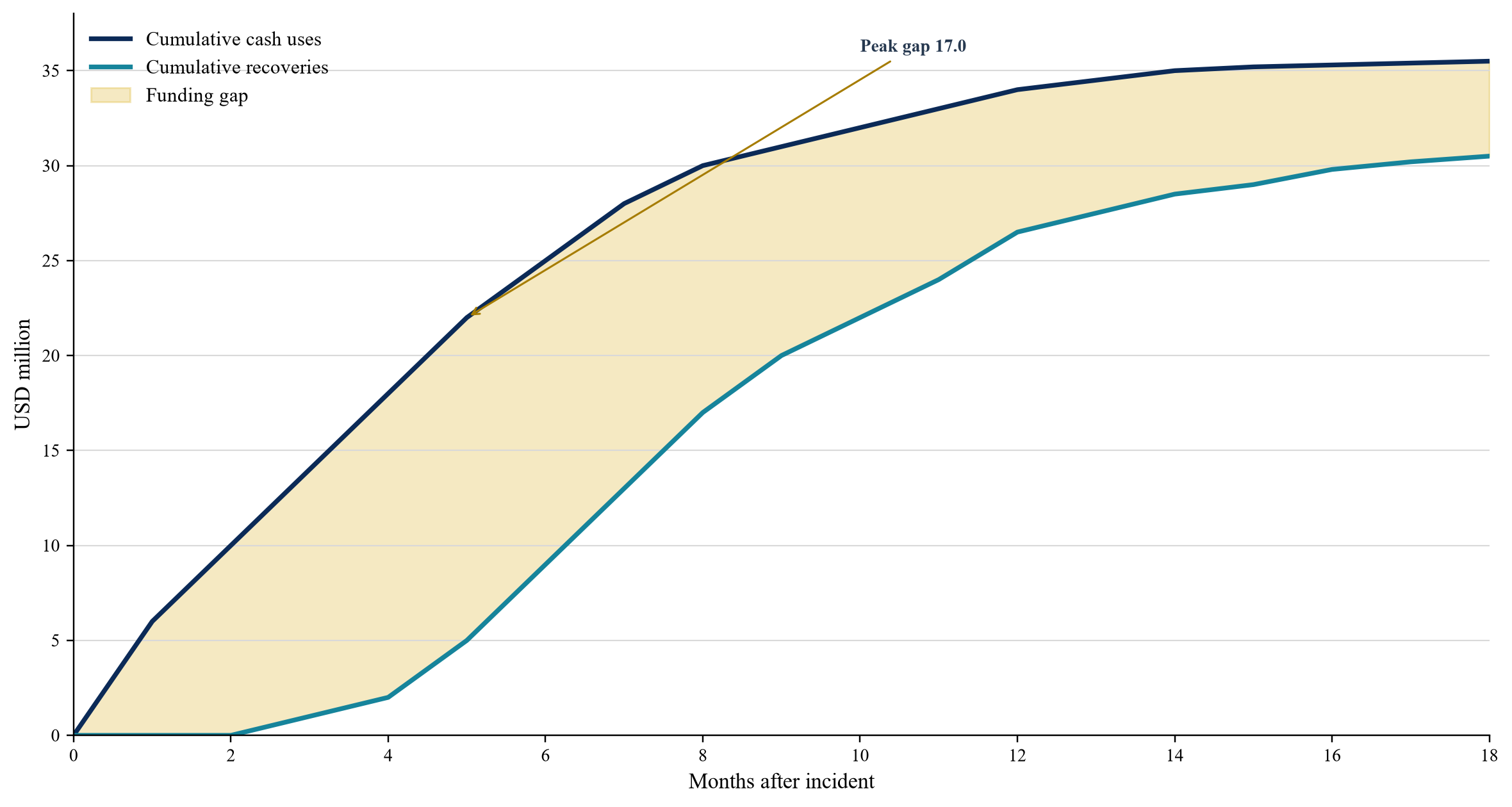
Constructed case in USD millions. The chart illustrates timing mechanics and does not estimate an actual claim.
25. Test allocation under disputed causation
Real claims can involve concurrent causes. A latent cell defect may combine with inadequate detection, installation damage, poor maintenance or an operating excursion. Contracts and policies can use different causation tests. One expert may focus on initiation while another focuses on propagation or mitigation.
The downside model should therefore include disputed causation. It should delay warranty and indemnity recovery, reserve defence cost and test policy exclusions. It should also consider contribution between defendants and insurers. The project company may remain the immediate claimant and asset owner while disputes proceed.
Dispute procedures should preserve operations. Expert determination can resolve technical questions, while arbitration or courts address legal claims. The contract should identify governing law, forum, interim relief, evidence preservation and continued performance where safe.
26. Include cyber and control-system events
Battery management systems, energy-management systems, SCADA and remote access can influence charge, discharge, temperature control, alarms and isolation. A cyber event or software error can create physical damage, operational interruption or data loss. Policies can treat cyber-triggered physical loss differently.
The project should map responsibility for secure design, access control, patching, monitoring, incident response and vendor connectivity. Contracts should require prompt vulnerability notice, supported software and evidence of change control. Operating procedures should protect safety functions during communications loss.
The insurance review should examine cyber exclusions and affirmative cyber cover across property, liability and standalone cyber policies. The recovery model should identify potential overlaps and gaps for physical damage, business interruption, incident response and third-party claims.
27. Treat construction and commissioning as distinct periods
Construction creates exposures from storage, handling, lifting, incomplete fire systems, temporary power, hot work, water ingress and testing. Commissioning can introduce high-energy operation before every permanent control has been validated. Title and risk of loss may transfer at delivery, mechanical completion, acceptance or another milestone.
Construction all-risks and delay-in-start-up cover should align with the contractual risk-transfer point. Marine cargo and inland transit cover should address transport and temporary storage. The supply and EPC contracts should allocate responsibility for packing, securing, custody and inspection.
The NTSB's investigation of fires aboard the Genius Star XI found that improperly secured BESS units broke away in heavy weather, suffered structural deformation and entered thermal runaway. This transport event shows why cargo securement and custody sit within the overall battery risk framework.
28. Keep operations within the insured and warranted envelope
Operating limits can include state of charge, temperature, power, ramp rate, throughput, dwell time, maintenance and environmental conditions. Breach can affect warranty and insurance recovery. The owner should ensure that dispatch optimisation respects the limits and records the evidence.
The operator agreement should define monitoring, alarms, escalation, maintenance, record retention and reporting. It should allocate liability for operation outside agreed limits and for failure to act on warnings. The optimiser's incentives should incorporate degradation and safety constraints.
Policy conditions should be translated into operating controls. Required inspections, housekeeping, impairment procedures, hot-work controls and notification obligations should have named owners. Compliance evidence should be retained with the safety case.
29. Re-underwrite after material change
Augmentation, replacement, firmware updates, revised dispatch, adjacent development, altered drainage, reduced water supply or new wildfire exposure can change risk. A previous test or policy may no longer describe the installation. Contract change control should trigger technical, legal and insurance review.
The owner should maintain a material-change checklist. It should ask whether listings remain valid, fire-test evidence remains representative, permits require amendment, emergency plans need revision, insurer consent is required, limits remain adequate and lender approval is needed.
Renewal also creates change. Insurance capacity, wording, deductibles and sublimits can move annually. The financial model should test plausible retention increases and reduced capacity. Long-term projects need a covenant process for commercially unavailable cover.
30. Build an allocation scorecard for financial close
The scorecard should evaluate prevention, responsibility, recovery and liquidity. Prevention covers design evidence, configuration, testing, emergency response and operations. Responsibility covers scope, interfaces, indemnities, warranties, caps and governing law. Recovery covers policies, limits, deductibles, exclusions, endorsements and credit support. Liquidity covers payment timing, reserves, facilities and waterfalls.
Each material scenario should have a named owner and evidence status. Open issues should show the decision required, responsible party and deadline. The scorecard should prevent a project from treating insurance procurement as the final step after contracts and design have already fixed the exposure.
Table 3. Financial-close allocation scorecard
| Gate | Required evidence | Decision | Failure consequence |
|---|---|---|---|
| Hazard definition | Site hazard analysis, fire-test reports and installed configuration | Credible event set approved | Loss scenarios omitted or misstated |
| Design control | Interface matrix, listings, drawings and change procedure | Design responsibility accepted | Gap between tested and installed system |
| Contract allocation | Warranties, indemnities, caps, security and dispute clauses | Retained exposure approved | Legal entitlement lacks sufficient scope or credit |
| Insurance structure | Full policies, endorsements, adviser report and lender clauses | Cover and retention approved | Exclusion, sublimit or endorsement gap |
| Emergency readiness | Response plan, authority liaison, evidence and communication protocol | Site ready for operation | Delayed mitigation and impaired claim evidence |
| Liquidity protection | Dated loss case, reserve, facility and proceeds waterfall | Peak gap funded | Claim timing creates covenant or payment default |
| Operating control | Limits, monitoring, maintenance and renewal process | Compliance ownership assigned | Warranty or policy conditions breached |
A project-specific review should be completed by qualified technical, legal and insurance advisers.
31. Use a governed six-step decision process
First, define the service, installed configuration and credible events. Second, identify prevention and mitigation controls. Third, map every loss category to contracts, policies and statutory duties. Fourth, quantify gross loss and dated cash needs under base and downside cases. Fifth, test legal enforceability, policy response and counterparty credit. Sixth, approve retained risk, liquidity and governance.
The process should be repeated after design freeze, policy placement, commissioning and material change. It should also be repeated after an incident elsewhere that reveals a relevant failure mode. Information rights across the supply chain can support timely review.
The final allocation memorandum should reconcile technical, legal, insurance and financial advice. It should record remaining uncertainty rather than converting uncertainty into an unsupported recovery assumption.
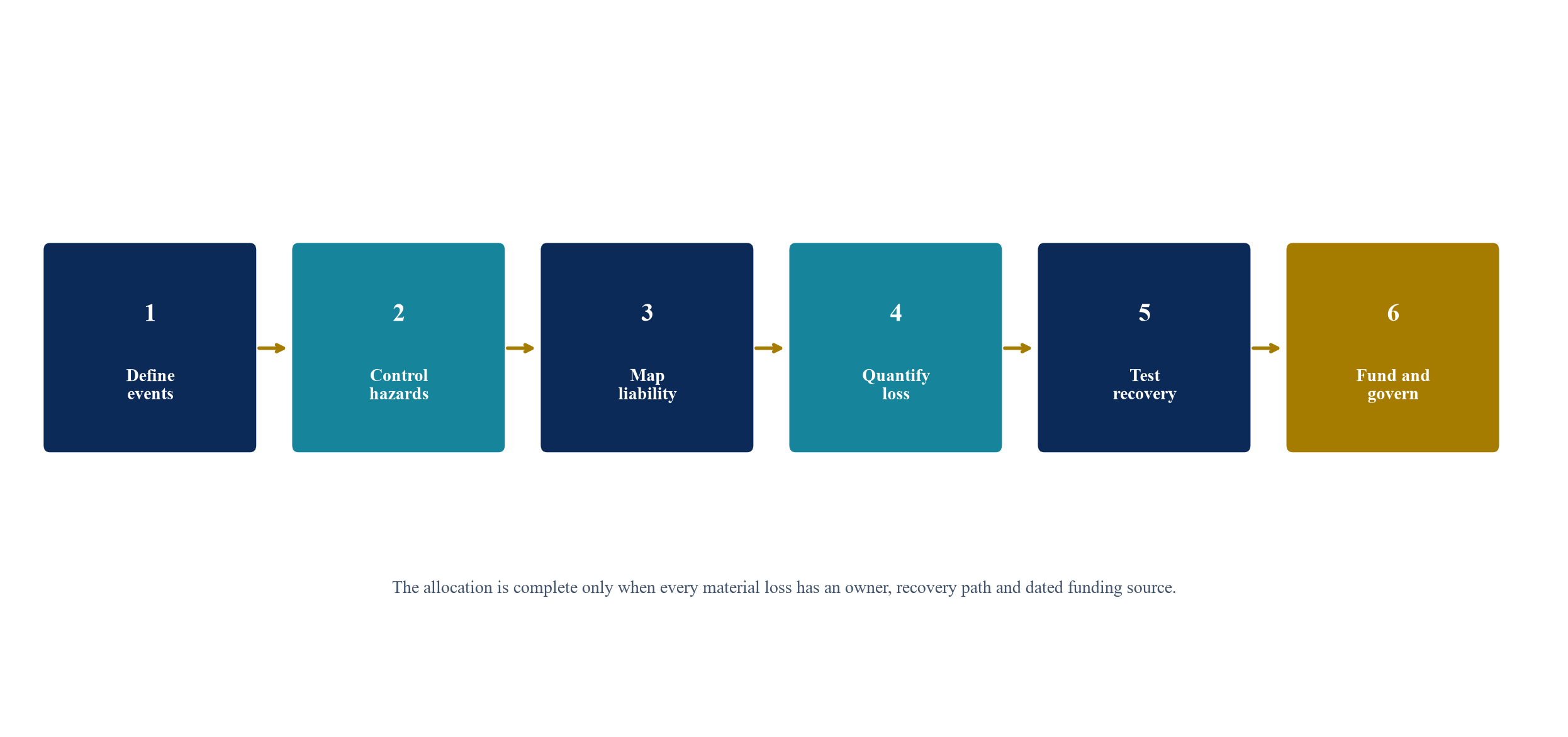
Governance framework for project development, financing and operation.
32. Diligence fire risk in acquisitions and refinancing
A buyer should compare the installed system with the original safety case, tests, permits, contracts and policies. It should review incidents, alarms, shutdowns, maintenance, firmware, cell sourcing, augmentation and claims. A clean claims history does not establish that controls remain adequate.
Diligence should identify open warranty notices, policy reservations, authority correspondence, neighbour complaints, environmental monitoring and changes in fire-service guidance. It should also test whether insurance and warranties transfer on change of control and whether limits are shared across a portfolio.
Purchase-price mechanisms can address known remediation, retained deductibles, unresolved claims and deficient credit support. Refinancing can require new engineering and insurance conditions. Valuation should reflect the cost and downtime required to reach the approved risk position.
33. Recognise jurisdictional differences
Safety, planning, environmental, insurance and liability rules vary by jurisdiction. The UK Health and Safety Executive identifies duties under workplace safety, dangerous substances, electricity, construction and notification rules. U.S. projects combine federal, state and local requirements, model codes, authorities having jurisdiction and environmental response law. Other markets use different standards and approval structures.
The allocation framework should therefore remain portable while legal conclusions remain local. Governing law, forum, mandatory liability, permit duties, insurance regulation and environmental responsibility require qualified local advice. Contract wording copied from another jurisdiction can create gaps.
Cross-border procurement adds currency, sanctions, transport, enforcement and product-recall issues. The project should confirm that guarantees, insurance and dispute awards are effective where assets and counterparties are located.
34. Recognise limitations and research needs
Public incident data is incomplete and heterogeneous. Systems differ in chemistry, design, age, use, enclosure, protection and reporting. A count of reported events cannot establish a reliable project-specific frequency without an appropriate exposure denominator and consistent definitions.
Insurance policy wording and pricing are project-specific and often confidential. The hypothetical case in this paper illustrates allocation and liquidity mechanics. It does not estimate expected loss, premium, deductible, claim recovery or legal outcome for a particular project.
Further research should connect anonymised incident and claims data with installed configurations, test results, operating histories and repair timelines. Standardised evidence packages could improve underwriting, contract drafting and lender review while protecting commercially sensitive information.
35. Conclusion
Battery fire risk becomes financeable when the project traces each credible event through prevention, loss, legal responsibility, insurance response, counterparty credit and dated cash. A certificate, warranty, indemnity or policy covers only its defined part of that chain.
The strongest allocation begins with the installed configuration and preserves a complete safety case. It defines design and interface responsibility, separates defective parts from ensuing damage, addresses serial defects, aligns indemnities with insurance, tests liability caps against credible severity and protects emergency action. It then funds the gap created by deductibles, exclusions, disputes and payment delay.
A governed allocation schedule allows owners, contractors, insurers and lenders to see the same exposure. The schedule should remain active through construction, commissioning, operation, renewal, augmentation, acquisition and refinancing. That discipline protects the asset's service, the project's liquidity and the credibility of every recovery assumption.
References
- UL Solutions, Understanding UL 9540A, NFPA 855 and Large-Scale Fire Testing for Battery Energy Storage Systems, 2026. https://www.ul.com/thecodeauthority/knowledge/understanding-UL-9540A-NFPA-855
- UL Solutions, Installation Codes and Requirements for Energy Storage Systems, FAQs, 2026. https://www.ul.com/resources/installation-codes-and-requirements-energy-storage-systems-ess-faqs
- National Fire Protection Association, Energy Storage Systems Safety Fact Sheet. https://www.nfpa.org/-/media/project/storefront/catalog/files/code-or-topic-fact-sheets/ESSFactSheet.pdf
- National Fire Protection Association, NFPA 855 public code-development materials for stationary energy storage systems. https://www.nfpa.org/855
- U.S. Department of Energy, Battery Energy Storage System Fire Safety and EPRI BESS Failure Event Database overview, 2023. https://www.energy.gov/sites/default/files/2023-06/Battery%20Energy%20Storage%20System%20Fire%20Safety.pdf
- Pacific Northwest National Laboratory and Sandia National Laboratories, Energy Storage System Safety: Plan Review and Inspection Checklist, SAND2020-0989, 2020. https://www.osti.gov/servlets/purl/1662020
- Arizona Public Service and DNV GL, McMicken Battery Energy Storage System Technical Analysis and Recommendations, 2020. https://www.aps.com/-/media/APS/APSCOM-PDFs/About/Our-Company/Newsroom/McMickenFinalTechnicalReport.pdf
- U.S. Environmental Protection Agency, Moss Landing Vistra Battery Fire Response, updated 2026. https://www.epa.gov/ca/moss-landing-vistra-battery-fire
- U.S. Environmental Protection Agency, Moss Landing Vistra Battery Fire Response Timeline, updated 2026. https://www.epa.gov/ca/moss-landing-vistra-battery-fire-updates
- U.S. Environmental Protection Agency, Hazardous Materials Incident Team Investigation Report for Gateway BESS, 2024. https://semspub.epa.gov/src/document/09/100040076
- U.S. National Transportation Safety Board, Lithium-ion Battery Fires aboard Cargo Vessel Genius Star XI, MIR-25-41, 2025. https://www.ntsb.gov/investigations/Pages/DCA24FM013.aspx
- UK Health and Safety Executive, Grid-scale battery energy storage systems, 2026. https://www.hse.gov.uk/electricity/battery-energy-storage-systems.htm
- National Fire Chiefs Council, Grid Scale Battery Energy Storage System Planning Guidance for Fire and Rescue Services, 2022. https://www.cne-siar.gov.uk/sites/default/files/2024-10/Grid-Scale-Battery-Energy-Storage-System-planning-Guidance-for-FRS__1_.pdf
- FM, Property Loss Prevention Data Sheet 5-33, Lithium-Ion Battery Energy Storage Systems, January 2024. https://www.fm.com/FMAApi/data/ApprovalStandardsDownload?isGated=true&itemId=%7BFB314761-0A9C-4B8C-9410-A31D6792170B%7D
- Lloyd's, Batteries and Grid Scale Energy Storage, Risk Revealed, 2023. https://assets.lloyds.com/media/f76e523e-9f14-4236-bf32-ae314a9a02dc/Risk%20revealed%20Lloyd%27s%20-%20Batteries%20and%20grid.pdf
- Swiss Re Corporate Solutions, Preparedness Guide: Battery Energy Storage Systems, 2022. https://corporatesolutions.swissre.com/insights/knowledge/preparedness-guide-battery-energy-storage-systems.html
- Munich Re, Insurance Covers for Electrical Energy Storage Systems. https://www.munichre.com/en/solutions/for-industry-clients/insurance-covers-for-electrical-energy-storage-systems.html
- Fluence Energy, Storage Core Frame Purchase Agreement, public SEC exhibit, 2021. https://www.sec.gov/Archives/edgar/data/1868941/000110465921127372/tm2120236d12_ex10-23.htm
- Tesla and Stem, Framework BESS Sale and Purchase Agreement, public SEC exhibit, 2021. https://www.sec.gov/Archives/edgar/data/1758766/000175876622000129/stem-10xq2022q2_ex101xfram.htm
- Public project-finance insurance provisions for renewable and storage assets, SEC exhibit, 2026. https://www.sec.gov/Archives/edgar/data/2133037/000162828026059639/exhibit108-amendmentno1and.htm
About the Author
Chennakeshav (CK) is a corporate finance and investment banking executive with 25+ years of global experience in deal origination, structuring and execution across M&A, growth capital and corporate strategy. He has led value-creation mandates for founders, corporates and funds — bridging the boardroom view to hands-on execution and close.
His career spans Morgan Stanley, HSBC, Lloyds Banking Group, EWEC, ADQ portfolio companies and Emirates Growth Fund, across TMT, real estate, fintech, deeptech, cleantech, infrastructure and energy. He has partnered with C-suite leaders, private equity and venture funds, sovereign wealth funds and family offices to finance complex fund raises and scale-up ventures, and has led M&A due diligence, post-merger integration and business-transformation initiatives to create value.
At Matchpoint Partners he is Managing Partner, leading the firm's corporate finance, M&A and capital-raising practice. He holds an MBA from London Business School, an engineering degree from VTU and a Master of Laws (LLM, in progress) from UCL London.
An active start-up mentor, CK mentors at Techstars, DIFC FinTech Hive, Startup Grind, Founder Institute and IN5, serves as Entrepreneur Mentor in Residence (EMiR) at London Business School, and judges the Entrepreneurship World Cup.
LinkedIn: https://www.linkedin.com/in/ckadya/
Profile: https://www.matchpoint-partners.com/team/ck-adya.html
