

1. Define the capital-allocation decision
Utilities and regulators must choose among operational technology, asset upgrades and new infrastructure under uncertain demand. The decision should compare equivalent system service, timing, risk and lifecycle value.
The evidence file should identify the system model, asset data, option scope, cost estimate, delivery schedule, benefit method, regulatory treatment and accountable owner. Each comparison needs a common base date and controlled assumptions.
A practical capital review asks which option meets the need, by when, for how long, with which downside and at what whole-life value. The answer should support board and regulatory approval using comparable evidence.
2. Define the system need
The need may be reliability, congestion relief, connection capacity, resilience, loss reduction or market integration. A precise need statement prevents technology selection from preceding problem definition.
The assessment should distinguish measured performance, vendor claims, scenario outputs and policy judgement. Capacity, cost and delivery conclusions should retain confidence ranges and record dependencies on other network investments.
The implementation plan should translate the option set into engineering, procurement, financing, operating and governance actions. Capital release should follow decision gates and preserve alternatives where uncertainty remains material.
3. Set the common service requirement
Each option should meet the same transfer, duration, contingency, availability and commissioning requirements. Comparisons based only on nameplate capacity can favour solutions that provide different service.
The working model should reconcile technical service, timing, lifecycle cost, financing and system benefit under common scenarios. Option-specific benefits should remain separate from transfers between customers, owners, vendors and public authorities.
The board and regulator should see the distribution of capacity, value and risk across scenarios. The preferred portfolio should remain deliverable and economically defensible under delay, escalation, lower benefits and technology underperformance.
4. Build the counterfactual
The counterfactual should represent credible system operation without the investment or with the next-best programme. It should include demand, generation, retirements, outages, constraints and policy.
The evidence file should identify the system model, asset data, option scope, cost estimate, delivery schedule, benefit method, regulatory treatment and accountable owner. Each comparison needs a common base date and controlled assumptions.
A practical capital review asks which option meets the need, by when, for how long, with which downside and at what whole-life value. The answer should support board and regulatory approval using comparable evidence.
5. Map the complete constraint chain
Conductors, towers, clearances, transformers, breakers, substations, stability, voltage and downstream circuits can each bind. Investment should target the system constraint rather than its most visible symptom.
The assessment should distinguish measured performance, vendor claims, scenario outputs and policy judgement. Capacity, cost and delivery conclusions should retain confidence ranges and record dependencies on other network investments.
The implementation plan should translate the option set into engineering, procurement, financing, operating and governance actions. Capital release should follow decision gates and preserve alternatives where uncertainty remains material.
Table 1. Grid-capacity technology benchmark
| Option | Typical role | Delivery profile | Capacity characteristic | Principal risk |
|---|---|---|---|---|
| Dynamic line rating | Unlock weather-dependent headroom | Fast after integration | Variable and corridor-specific | Forecast, systems and downstream constraints |
| Topology and power-flow control | Redirect power to spare paths | Fast to medium | Network-state dependent | Protection, control and device placement |
| Advanced reconductoring | Increase existing-corridor capacity | Medium | Structural and long-lived | Tower, clearance, outage and conductor risk |
| Storage or flexible demand | Relieve time-bound constraints | Medium | Duration and contract dependent | Degradation, performance and concentration |
| New AC or HVDC transmission | Add durable capacity and topology | Long | Structural and strategic | Route, permits, supply chain and capital |
Ranges are qualitative and project-specific; detailed engineering and current market evidence remain required.
6. Create the option universe
The option set should include dynamic ratings, ambient-adjusted ratings, topology optimisation, power-flow control, advanced conductors, conventional reconductoring, substation upgrades, storage, demand flexibility and new lines.
The working model should reconcile technical service, timing, lifecycle cost, financing and system benefit under common scenarios. Option-specific benefits should remain separate from transfers between customers, owners, vendors and public authorities.
The board and regulator should see the distribution of capacity, value and risk across scenarios. The preferred portfolio should remain deliverable and economically defensible under delay, escalation, lower benefits and technology underperformance.
7. Screen no-build and operational actions
Dispatch changes, outage coordination and operating procedures may create near-term relief. Their recurring cost, reliability effect and sustainability should remain visible.
The evidence file should identify the system model, asset data, option scope, cost estimate, delivery schedule, benefit method, regulatory treatment and accountable owner. Each comparison needs a common base date and controlled assumptions.
A practical capital review asks which option meets the need, by when, for how long, with which downside and at what whole-life value. The answer should support board and regulatory approval using comparable evidence.
8. Evaluate dynamic line ratings
DLR can unlock weather-dependent headroom quickly on suitable overhead lines. Value depends on limiting spans, forecast confidence, system integration and usable congestion relief.
The assessment should distinguish measured performance, vendor claims, scenario outputs and policy judgement. Capacity, cost and delivery conclusions should retain confidence ranges and record dependencies on other network investments.
The implementation plan should translate the option set into engineering, procurement, financing, operating and governance actions. Capital release should follow decision gates and preserve alternatives where uncertainty remains material.
9. Evaluate topology optimisation
Software can identify network configurations that relieve constraints. Switching feasibility, protection, operator workload, maintenance and contingency security determine dependable value.
The working model should reconcile technical service, timing, lifecycle cost, financing and system benefit under common scenarios. Option-specific benefits should remain separate from transfers between customers, owners, vendors and public authorities.
The board and regulator should see the distribution of capacity, value and risk across scenarios. The preferred portfolio should remain deliverable and economically defensible under delay, escalation, lower benefits and technology underperformance.
10. Evaluate advanced power-flow control
Modular or conventional devices can redirect power toward available capacity. Location, range, losses, failure mode, maintenance and coordination with dispatch shape economics.
The evidence file should identify the system model, asset data, option scope, cost estimate, delivery schedule, benefit method, regulatory treatment and accountable owner. Each comparison needs a common base date and controlled assumptions.
A practical capital review asks which option meets the need, by when, for how long, with which downside and at what whole-life value. The answer should support board and regulatory approval using comparable evidence.
11. Evaluate ambient-adjusted ratings
Temperature-sensitive ratings can improve near-term accuracy with less instrumentation than full DLR. The comparison should identify incremental value from additional variables and sensing.
The assessment should distinguish measured performance, vendor claims, scenario outputs and policy judgement. Capacity, cost and delivery conclusions should retain confidence ranges and record dependencies on other network investments.
The implementation plan should translate the option set into engineering, procurement, financing, operating and governance actions. Capital release should follow decision gates and preserve alternatives where uncertainty remains material.
12. Evaluate advanced reconductoring
Advanced conductors can increase capacity using existing rights of way and structures where mechanical and clearance limits permit. The study should include tower assessment, outage and conductor lifecycle.
The working model should reconcile technical service, timing, lifecycle cost, financing and system benefit under common scenarios. Option-specific benefits should remain separate from transfers between customers, owners, vendors and public authorities.
The board and regulator should see the distribution of capacity, value and risk across scenarios. The preferred portfolio should remain deliverable and economically defensible under delay, escalation, lower benefits and technology underperformance.
13. Evaluate conventional reconductoring
Conventional conductors can be efficient where moderate capacity is sufficient and towers have compatible loading. Lower material cost may be offset by future capacity limits.
The evidence file should identify the system model, asset data, option scope, cost estimate, delivery schedule, benefit method, regulatory treatment and accountable owner. Each comparison needs a common base date and controlled assumptions.
A practical capital review asks which option meets the need, by when, for how long, with which downside and at what whole-life value. The answer should support board and regulatory approval using comparable evidence.
14. Evaluate voltage upgrade
A voltage conversion can increase transfer capacity and reduce losses but may require insulation, substation, protection and clearance changes. System compatibility and outage sequencing are central.
The assessment should distinguish measured performance, vendor claims, scenario outputs and policy judgement. Capacity, cost and delivery conclusions should retain confidence ranges and record dependencies on other network investments.
The implementation plan should translate the option set into engineering, procurement, financing, operating and governance actions. Capital release should follow decision gates and preserve alternatives where uncertainty remains material.
15. Evaluate parallel circuit addition
An additional circuit on existing structures or corridor can provide structural capacity. Tower, right-of-way, foundation, outage and electromagnetic constraints should be tested.
The working model should reconcile technical service, timing, lifecycle cost, financing and system benefit under common scenarios. Option-specific benefits should remain separate from transfers between customers, owners, vendors and public authorities.
The board and regulator should see the distribution of capacity, value and risk across scenarios. The preferred portfolio should remain deliverable and economically defensible under delay, escalation, lower benefits and technology underperformance.
16. Evaluate substation and terminal upgrades
Transformers, breakers, buswork, compensation and protection can constrain otherwise adequate lines. Targeted terminal investment may unlock the corridor at lower cost.
The evidence file should identify the system model, asset data, option scope, cost estimate, delivery schedule, benefit method, regulatory treatment and accountable owner. Each comparison needs a common base date and controlled assumptions.
A practical capital review asks which option meets the need, by when, for how long, with which downside and at what whole-life value. The answer should support board and regulatory approval using comparable evidence.
17. Evaluate storage
Storage can relieve a constraint for defined hours and provide ancillary services. Energy duration, cycling, degradation, location and charging constraints affect equivalence with transmission.
The assessment should distinguish measured performance, vendor claims, scenario outputs and policy judgement. Capacity, cost and delivery conclusions should retain confidence ranges and record dependencies on other network investments.
The implementation plan should translate the option set into engineering, procurement, financing, operating and governance actions. Capital release should follow decision gates and preserve alternatives where uncertainty remains material.
18. Evaluate flexible demand
Managed load can reduce peaks or shift consumption. Contract duration, response performance, customer concentration and rebound should be modelled.
The working model should reconcile technical service, timing, lifecycle cost, financing and system benefit under common scenarios. Option-specific benefits should remain separate from transfers between customers, owners, vendors and public authorities.
The board and regulator should see the distribution of capacity, value and risk across scenarios. The preferred portfolio should remain deliverable and economically defensible under delay, escalation, lower benefits and technology underperformance.
19. Evaluate new overhead transmission
A new line can provide durable capacity and topology change. Development time, route, permits, land, community impact and supply chain create material execution risk.
The evidence file should identify the system model, asset data, option scope, cost estimate, delivery schedule, benefit method, regulatory treatment and accountable owner. Each comparison needs a common base date and controlled assumptions.
A practical capital review asks which option meets the need, by when, for how long, with which downside and at what whole-life value. The answer should support board and regulatory approval using comparable evidence.
20. Evaluate underground and subsea cables
Cable solutions can address route or environmental constraints with different cost, repair, thermal and reactive-power characteristics. Comparisons should include terminal equipment and outage recovery.
The assessment should distinguish measured performance, vendor claims, scenario outputs and policy judgement. Capacity, cost and delivery conclusions should retain confidence ranges and record dependencies on other network investments.
The implementation plan should translate the option set into engineering, procurement, financing, operating and governance actions. Capital release should follow decision gates and preserve alternatives where uncertainty remains material.
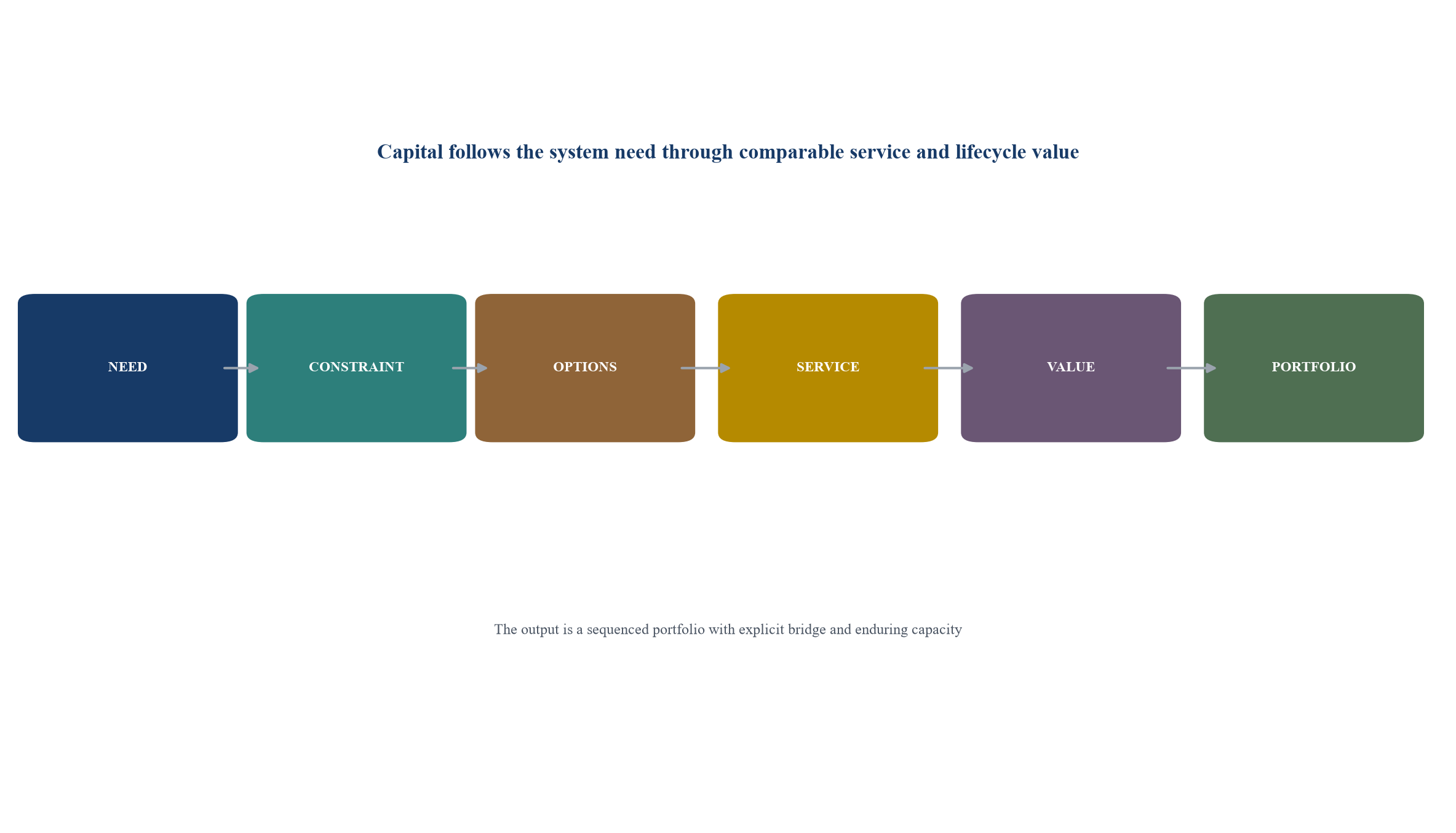
Options should be compared against one system need and common service requirement.
21. Evaluate HVDC
HVDC can move large power volumes over long distances and control flows. Converter cost, losses, multi-terminal complexity, fault behaviour and system strength belong in the case.
The working model should reconcile technical service, timing, lifecycle cost, financing and system benefit under common scenarios. Option-specific benefits should remain separate from transfers between customers, owners, vendors and public authorities.
The board and regulator should see the distribution of capacity, value and risk across scenarios. The preferred portfolio should remain deliverable and economically defensible under delay, escalation, lower benefits and technology underperformance.
22. Build technology combinations
A portfolio can pair near-term grid-enhancing technologies with later reconductoring or new build. Sequencing should avoid stranded digital or physical expenditure.
The evidence file should identify the system model, asset data, option scope, cost estimate, delivery schedule, benefit method, regulatory treatment and accountable owner. Each comparison needs a common base date and controlled assumptions.
A practical capital review asks which option meets the need, by when, for how long, with which downside and at what whole-life value. The answer should support board and regulatory approval using comparable evidence.
23. Define bridge and enduring capacity
Bridge capacity addresses a temporary timing gap; enduring capacity serves long-term need. The investment horizon and residual value should match that role.
The assessment should distinguish measured performance, vendor claims, scenario outputs and policy judgement. Capacity, cost and delivery conclusions should retain confidence ranges and record dependencies on other network investments.
The implementation plan should translate the option set into engineering, procurement, financing, operating and governance actions. Capital release should follow decision gates and preserve alternatives where uncertainty remains material.
24. Measure dependable transfer
Dependable transfer should reflect contingencies, weather, outages and other network limits. The model should distinguish average, percentile and firm capability.
The working model should reconcile technical service, timing, lifecycle cost, financing and system benefit under common scenarios. Option-specific benefits should remain separate from transfers between customers, owners, vendors and public authorities.
The board and regulator should see the distribution of capacity, value and risk across scenarios. The preferred portfolio should remain deliverable and economically defensible under delay, escalation, lower benefits and technology underperformance.
25. Measure delivery speed
Lead time should include studies, approvals, procurement, outages, construction, commissioning and integration. Software speed claims should include operational and cyber readiness.
The evidence file should identify the system model, asset data, option scope, cost estimate, delivery schedule, benefit method, regulatory treatment and accountable owner. Each comparison needs a common base date and controlled assumptions.
A practical capital review asks which option meets the need, by when, for how long, with which downside and at what whole-life value. The answer should support board and regulatory approval using comparable evidence.
26. Measure capital cost
Capital cost should cover development, land, equipment, construction, integration, financing, owner cost, contingency and escalation. Option scope should be consistently defined.
The assessment should distinguish measured performance, vendor claims, scenario outputs and policy judgement. Capacity, cost and delivery conclusions should retain confidence ranges and record dependencies on other network investments.
The implementation plan should translate the option set into engineering, procurement, financing, operating and governance actions. Capital release should follow decision gates and preserve alternatives where uncertainty remains material.
27. Measure operating cost
Licences, communications, maintenance, inspections, energy losses, cyber operations, data services, staffing and replacement cycles belong in lifecycle cost.
The working model should reconcile technical service, timing, lifecycle cost, financing and system benefit under common scenarios. Option-specific benefits should remain separate from transfers between customers, owners, vendors and public authorities.
The board and regulator should see the distribution of capacity, value and risk across scenarios. The preferred portfolio should remain deliverable and economically defensible under delay, escalation, lower benefits and technology underperformance.
28. Measure congestion and curtailment value
Chronological dispatch modelling can estimate avoided redispatch and renewable curtailment. Benefits should reflect how often the investment changes the binding constraint.
The evidence file should identify the system model, asset data, option scope, cost estimate, delivery schedule, benefit method, regulatory treatment and accountable owner. Each comparison needs a common base date and controlled assumptions.
A practical capital review asks which option meets the need, by when, for how long, with which downside and at what whole-life value. The answer should support board and regulatory approval using comparable evidence.
29. Measure connection value
Earlier capacity may accelerate generation, industrial or data-centre connections. Value should use credible project readiness and avoid assuming every queued project proceeds.
The assessment should distinguish measured performance, vendor claims, scenario outputs and policy judgement. Capacity, cost and delivery conclusions should retain confidence ranges and record dependencies on other network investments.
The implementation plan should translate the option set into engineering, procurement, financing, operating and governance actions. Capital release should follow decision gates and preserve alternatives where uncertainty remains material.
30. Measure reliability and resilience
Options provide different redundancy, visibility, control and restoration benefits. Engineering studies should quantify service under relevant contingencies and extreme events.
The working model should reconcile technical service, timing, lifecycle cost, financing and system benefit under common scenarios. Option-specific benefits should remain separate from transfers between customers, owners, vendors and public authorities.
The board and regulator should see the distribution of capacity, value and risk across scenarios. The preferred portfolio should remain deliverable and economically defensible under delay, escalation, lower benefits and technology underperformance.
Table 2. Option-risk allocation matrix
| Risk | Digital and operating options | Asset upgrades | New build | Core control |
|---|---|---|---|---|
| Service underperformance | Vendor and utility integration | Designer, supplier and owner | Developer and contractors | Measured acceptance against common service |
| Delivery delay | Systems and data interfaces | Outage and supply chain | Route, permits and construction | Stage gates and schedule contingency |
| Cost escalation | Licence and integration scope | Materials and outage scope | Civil works and financing | Controlled baseline and procurement evidence |
| Technology obsolescence | High for proprietary platforms | Moderate by conductor or device | Lower for core civil assets | Standards, data rights and upgrade path |
| Demand changes | Modular deployment can adapt | Phasing depends on corridor | High committed-capital exposure | Triggers, staging and residual-value plan |
| Regulatory recovery | Output and incentive evidence | Prudence and used-useful tests | Need, cost and delivery approval | Early regulatory treatment and reporting |
Risk ownership should follow controllability and the governing regulatory and contractual framework.
31. Measure losses
Conductors, voltage levels, power electronics and storage change losses. Energy value and thermal implications should be calculated under expected flows.
The evidence file should identify the system model, asset data, option scope, cost estimate, delivery schedule, benefit method, regulatory treatment and accountable owner. Each comparison needs a common base date and controlled assumptions.
A practical capital review asks which option meets the need, by when, for how long, with which downside and at what whole-life value. The answer should support board and regulatory approval using comparable evidence.
32. Measure land and permitting impact
Use of existing corridors can reduce land and approval requirements. New works may provide greater strategic capacity while carrying longer development risk.
The assessment should distinguish measured performance, vendor claims, scenario outputs and policy judgement. Capacity, cost and delivery conclusions should retain confidence ranges and record dependencies on other network investments.
The implementation plan should translate the option set into engineering, procurement, financing, operating and governance actions. Capital release should follow decision gates and preserve alternatives where uncertainty remains material.
33. Measure supply-chain exposure
Transformers, conductors, cables, power electronics, sensors and specialist labour have different lead-time and concentration risks. The schedule should reflect current procurement evidence.
The working model should reconcile technical service, timing, lifecycle cost, financing and system benefit under common scenarios. Option-specific benefits should remain separate from transfers between customers, owners, vendors and public authorities.
The board and regulator should see the distribution of capacity, value and risk across scenarios. The preferred portfolio should remain deliverable and economically defensible under delay, escalation, lower benefits and technology underperformance.
34. Measure technology maturity
Commercial deployment, standards, warranties, service capability and performance history inform execution risk. Maturity should be assessed for the specific use case and environment.
The evidence file should identify the system model, asset data, option scope, cost estimate, delivery schedule, benefit method, regulatory treatment and accountable owner. Each comparison needs a common base date and controlled assumptions.
A practical capital review asks which option meets the need, by when, for how long, with which downside and at what whole-life value. The answer should support board and regulatory approval using comparable evidence.
35. Measure interoperability and data rights
Digital options can create proprietary interfaces and vendor dependence. Open standards, data access, model transparency and transition rights affect lifecycle value.
The assessment should distinguish measured performance, vendor claims, scenario outputs and policy judgement. Capacity, cost and delivery conclusions should retain confidence ranges and record dependencies on other network investments.
The implementation plan should translate the option set into engineering, procurement, financing, operating and governance actions. Capital release should follow decision gates and preserve alternatives where uncertainty remains material.
36. Model modularity
Modular options can stage capital and respond to uncertainty. The model should value the option to add, relocate, expand, retire or combine modules.
The working model should reconcile technical service, timing, lifecycle cost, financing and system benefit under common scenarios. Option-specific benefits should remain separate from transfers between customers, owners, vendors and public authorities.
The board and regulator should see the distribution of capacity, value and risk across scenarios. The preferred portfolio should remain deliverable and economically defensible under delay, escalation, lower benefits and technology underperformance.
37. Model reversibility
Some investments can be redeployed or cancelled with limited loss; others commit the route and capital. Reversibility has value when demand timing is uncertain.
The evidence file should identify the system model, asset data, option scope, cost estimate, delivery schedule, benefit method, regulatory treatment and accountable owner. Each comparison needs a common base date and controlled assumptions.
A practical capital review asks which option meets the need, by when, for how long, with which downside and at what whole-life value. The answer should support board and regulatory approval using comparable evidence.
38. Model residual value
Residual value depends on remaining life, alternative use, redeployment, regulated treatment and salvage. It should be consistent with the asset and decision horizon.
The assessment should distinguish measured performance, vendor claims, scenario outputs and policy judgement. Capacity, cost and delivery conclusions should retain confidence ranges and record dependencies on other network investments.
The implementation plan should translate the option set into engineering, procurement, financing, operating and governance actions. Capital release should follow decision gates and preserve alternatives where uncertainty remains material.
39. Use real-options logic
Uncertainty can justify staging, learning and conditional commitment. Real-options logic should identify the information gained and the cost of waiting.
The working model should reconcile technical service, timing, lifecycle cost, financing and system benefit under common scenarios. Option-specific benefits should remain separate from transfers between customers, owners, vendors and public authorities.
The board and regulator should see the distribution of capacity, value and risk across scenarios. The preferred portfolio should remain deliverable and economically defensible under delay, escalation, lower benefits and technology underperformance.
40. Build the least-regrets portfolio
A least-regrets portfolio performs acceptably across demand, generation, technology and cost scenarios. It may combine early low-capital measures with protected pathways for larger assets.
The evidence file should identify the system model, asset data, option scope, cost estimate, delivery schedule, benefit method, regulatory treatment and accountable owner. Each comparison needs a common base date and controlled assumptions.
A practical capital review asks which option meets the need, by when, for how long, with which downside and at what whole-life value. The answer should support board and regulatory approval using comparable evidence.
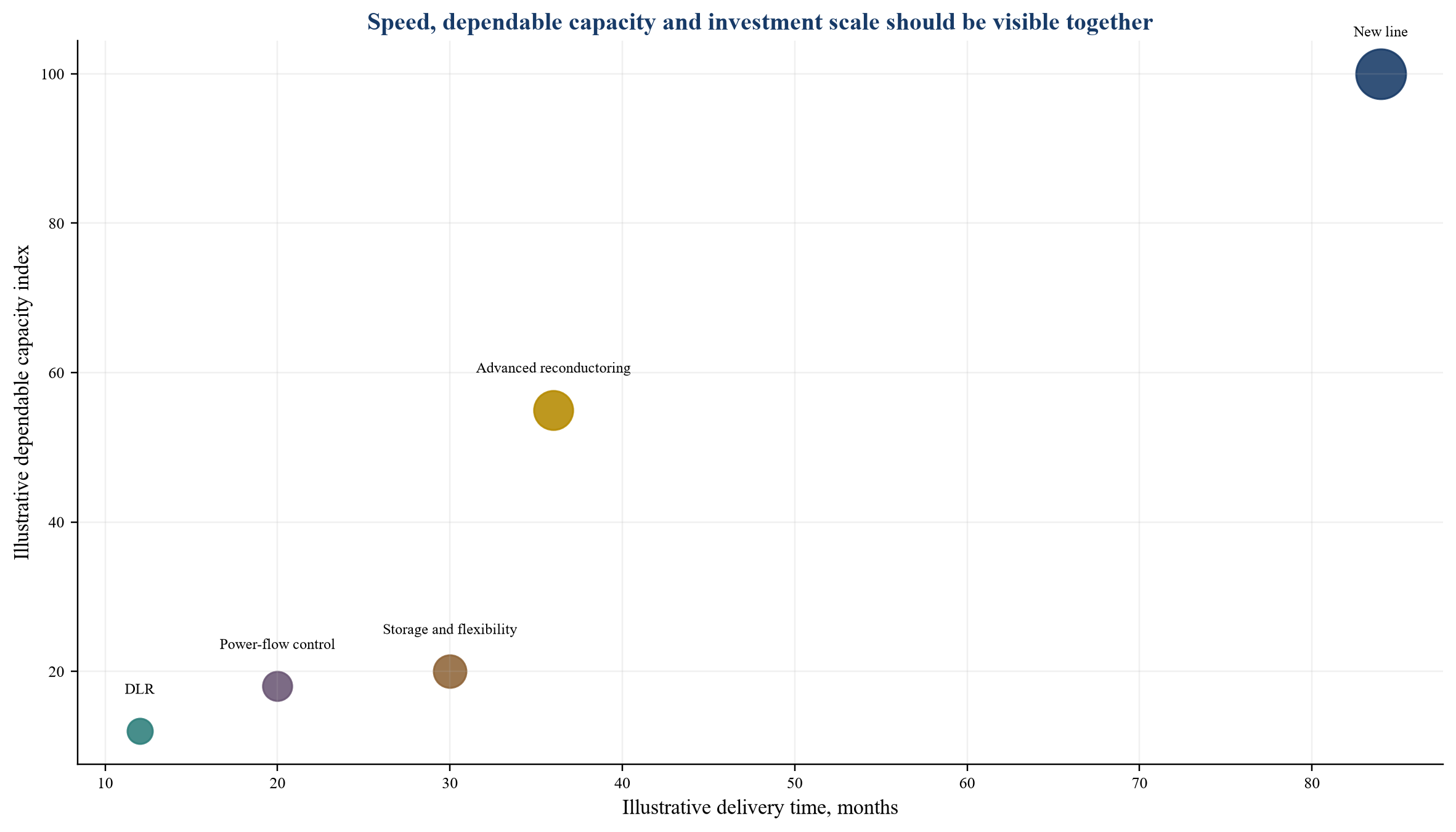
Values are hypothetical management assumptions used solely to demonstrate the framework.
41. Apply FERC Order 1920
Order 1920 requires planners to consider dynamic ratings, power-flow control, advanced conductors and transmission switching when they may meet needs more efficiently or cost-effectively.
The assessment should distinguish measured performance, vendor claims, scenario outputs and policy judgement. Capacity, cost and delivery conclusions should retain confidence ranges and record dependencies on other network investments.
The implementation plan should translate the option set into engineering, procurement, financing, operating and governance actions. Capital release should follow decision gates and preserve alternatives where uncertainty remains material.
42. Apply FERC Order 881
Order 881 establishes ambient-adjusted rating requirements for specified near-term transmission uses. Its implementation affects the incremental case for full DLR.
The working model should reconcile technical service, timing, lifecycle cost, financing and system benefit under common scenarios. Option-specific benefits should remain separate from transfers between customers, owners, vendors and public authorities.
The board and regulator should see the distribution of capacity, value and risk across scenarios. The preferred portfolio should remain deliverable and economically defensible under delay, escalation, lower benefits and technology underperformance.
43. Use DOE reconductoring evidence
DOE's advanced-conductor work and REFA tool support lifecycle comparison of conductor options, full rebuild and reconductoring under technical and economic constraints.
The evidence file should identify the system model, asset data, option scope, cost estimate, delivery schedule, benefit method, regulatory treatment and accountable owner. Each comparison needs a common base date and controlled assumptions.
A practical capital review asks which option meets the need, by when, for how long, with which downside and at what whole-life value. The answer should support board and regulatory approval using comparable evidence.
44. Use Great Britain price-control logic
Ofgem's price-control approach combines need, uncertainty, incentives and consumer protection. Current decisions emphasise maximising existing capacity before committing additional grid investment.
The assessment should distinguish measured performance, vendor claims, scenario outputs and policy judgement. Capacity, cost and delivery conclusions should retain confidence ranges and record dependencies on other network investments.
The implementation plan should translate the option set into engineering, procurement, financing, operating and governance actions. Capital release should follow decision gates and preserve alternatives where uncertainty remains material.
45. Address hot-climate grids
High ambient temperature and cooling load can reduce weather-dependent headroom during peaks. Advanced conductors, substations and new lines may provide firmer capacity.
The working model should reconcile technical service, timing, lifecycle cost, financing and system benefit under common scenarios. Option-specific benefits should remain separate from transfers between customers, owners, vendors and public authorities.
The board and regulator should see the distribution of capacity, value and risk across scenarios. The preferred portfolio should remain deliverable and economically defensible under delay, escalation, lower benefits and technology underperformance.
46. Address renewable corridors
Output and cooling conditions can support DLR while curtailment creates value. Longer-term renewable build may still require reconductoring or new transmission.
The evidence file should identify the system model, asset data, option scope, cost estimate, delivery schedule, benefit method, regulatory treatment and accountable owner. Each comparison needs a common base date and controlled assumptions.
A practical capital review asks which option meets the need, by when, for how long, with which downside and at what whole-life value. The answer should support board and regulatory approval using comparable evidence.
47. Address data-centre clusters
Large, fast connections require credible energisation dates and high reliability. A staged technology portfolio can bridge capacity while permanent works progress.
The assessment should distinguish measured performance, vendor claims, scenario outputs and policy judgement. Capacity, cost and delivery conclusions should retain confidence ranges and record dependencies on other network investments.
The implementation plan should translate the option set into engineering, procurement, financing, operating and governance actions. Capital release should follow decision gates and preserve alternatives where uncertainty remains material.
48. Address industrial electrification
Industrial loads can be concentrated, inflexible and economically material. Connection agreements, flexibility and reinforcement should be co-designed.
The working model should reconcile technical service, timing, lifecycle cost, financing and system benefit under common scenarios. Option-specific benefits should remain separate from transfers between customers, owners, vendors and public authorities.
The board and regulator should see the distribution of capacity, value and risk across scenarios. The preferred portfolio should remain deliverable and economically defensible under delay, escalation, lower benefits and technology underperformance.
49. Build the capital stack
Regulated expenditure, user contributions, public grants, project finance and vendor finance may support different assets. Recovery and risk should follow the approved service.
The evidence file should identify the system model, asset data, option scope, cost estimate, delivery schedule, benefit method, regulatory treatment and accountable owner. Each comparison needs a common base date and controlled assumptions.
A practical capital review asks which option meets the need, by when, for how long, with which downside and at what whole-life value. The answer should support board and regulatory approval using comparable evidence.
50. Compare revenue certainty
Regulated allowance, shared savings, congestion value, connection payments and availability revenue have different certainty. Debt sizing should use enforceable cash flows.
The assessment should distinguish measured performance, vendor claims, scenario outputs and policy judgement. Capacity, cost and delivery conclusions should retain confidence ranges and record dependencies on other network investments.
The implementation plan should translate the option set into engineering, procurement, financing, operating and governance actions. Capital release should follow decision gates and preserve alternatives where uncertainty remains material.
Table 3. Hypothetical capital-allocation sensitivity
| Portfolio | Initial capex, USD m | Dependable capacity index | Earliest service | Benefit-cost ratio | Decision implication |
|---|---|---|---|---|---|
| Digital bridge only | 25 | 15 | Year 1 | 2.8x | Useful bridge with limited enduring capacity |
| Reconductoring only | 220 | 55 | Year 3 | 2.2x | Strong corridor option where towers permit |
| New line only | 900 | 100 | Year 7 | 1.6x | Strategic capacity with high delay exposure |
| Bridge plus staged reconductoring | 245 | 62 | Year 1 | 2.7x | Preserves speed and structural capacity |
| Bridge plus protected new-line pathway | 80 then 900 | 115 | Years 1 and 7 | 2.1x | Highest optionality under uncertain demand |
All values are hypothetical management assumptions and do not represent an actual project or forecast.
51. Build the NPV model
The model should compare lifecycle cost, benefits, taxes, financing, residual value and timing under a common discount basis. Transfers between stakeholders should remain separate from system value.
The working model should reconcile technical service, timing, lifecycle cost, financing and system benefit under common scenarios. Option-specific benefits should remain separate from transfers between customers, owners, vendors and public authorities.
The board and regulator should see the distribution of capacity, value and risk across scenarios. The preferred portfolio should remain deliverable and economically defensible under delay, escalation, lower benefits and technology underperformance.
52. Build the cost-of-delay model
Delayed capacity can create congestion, curtailment, connection delay and reliability exposure. The cost should be measured against credible delivery schedules.
The evidence file should identify the system model, asset data, option scope, cost estimate, delivery schedule, benefit method, regulatory treatment and accountable owner. Each comparison needs a common base date and controlled assumptions.
A practical capital review asks which option meets the need, by when, for how long, with which downside and at what whole-life value. The answer should support board and regulatory approval using comparable evidence.
53. Build downside cases
Cases should include lower demand, higher demand, cost escalation, permit delay, technology underperformance, vendor failure, outage constraints and changed market conditions.
The assessment should distinguish measured performance, vendor claims, scenario outputs and policy judgement. Capacity, cost and delivery conclusions should retain confidence ranges and record dependencies on other network investments.
The implementation plan should translate the option set into engineering, procurement, financing, operating and governance actions. Capital release should follow decision gates and preserve alternatives where uncertainty remains material.
54. Set the decision thresholds
Thresholds can include benefit-cost ratio, NPV, dependable capacity, delivery date, reliability, consumer impact and optionality. Trade-offs should be documented explicitly.
The working model should reconcile technical service, timing, lifecycle cost, financing and system benefit under common scenarios. Option-specific benefits should remain separate from transfers between customers, owners, vendors and public authorities.
The board and regulator should see the distribution of capacity, value and risk across scenarios. The preferred portfolio should remain deliverable and economically defensible under delay, escalation, lower benefits and technology underperformance.
55. Design procurement by option class
Software, sensors, conductors, power electronics and civil works need different specifications and risk terms. Procurement should support fair comparison and future competition.
The evidence file should identify the system model, asset data, option scope, cost estimate, delivery schedule, benefit method, regulatory treatment and accountable owner. Each comparison needs a common base date and controlled assumptions.
A practical capital review asks which option meets the need, by when, for how long, with which downside and at what whole-life value. The answer should support board and regulatory approval using comparable evidence.
56. Design programme governance
Planning, engineering, operations, markets, cyber, finance, regulation and procurement need shared data and decision rights. Governance should control assumptions and change.
The assessment should distinguish measured performance, vendor claims, scenario outputs and policy judgement. Capacity, cost and delivery conclusions should retain confidence ranges and record dependencies on other network investments.
The implementation plan should translate the option set into engineering, procurement, financing, operating and governance actions. Capital release should follow decision gates and preserve alternatives where uncertainty remains material.
57. Create the investment scorecard
The scorecard should show service, speed, capacity, capex, opex, benefit, risk, maturity, modularity and residual value. Scores should be traceable to evidence.
The working model should reconcile technical service, timing, lifecycle cost, financing and system benefit under common scenarios. Option-specific benefits should remain separate from transfers between customers, owners, vendors and public authorities.
The board and regulator should see the distribution of capacity, value and risk across scenarios. The preferred portfolio should remain deliverable and economically defensible under delay, escalation, lower benefits and technology underperformance.
58. Run the need and constraint gate
This gate confirms the system need, counterfactual, binding constraints and common service requirement. It prevents premature technology selection.
The evidence file should identify the system model, asset data, option scope, cost estimate, delivery schedule, benefit method, regulatory treatment and accountable owner. Each comparison needs a common base date and controlled assumptions.
A practical capital review asks which option meets the need, by when, for how long, with which downside and at what whole-life value. The answer should support board and regulatory approval using comparable evidence.
59. Run the option and economics gate
This gate validates the option universe, technical feasibility, lifecycle economics, uncertainty and combinations. It identifies the preferred portfolio.
The assessment should distinguish measured performance, vendor claims, scenario outputs and policy judgement. Capacity, cost and delivery conclusions should retain confidence ranges and record dependencies on other network investments.
The implementation plan should translate the option set into engineering, procurement, financing, operating and governance actions. Capital release should follow decision gates and preserve alternatives where uncertainty remains material.
60. Adopt the decision record and 90-day plan
The final record states need, options, economics, risk, capital, procurement, owners and triggers. The first 90 days should close the evidence gaps that could change the preferred portfolio.
The working model should reconcile technical service, timing, lifecycle cost, financing and system benefit under common scenarios. Option-specific benefits should remain separate from transfers between customers, owners, vendors and public authorities.
The board and regulator should see the distribution of capacity, value and risk across scenarios. The preferred portfolio should remain deliverable and economically defensible under delay, escalation, lower benefits and technology underperformance.
Table 4. Illustrative 90-day grid-capital programme
| Period | Workstream | Core actions | Decision output | Accountable owner |
|---|---|---|---|---|
| Days 1-15 | Need and constraints | Confirm system need, counterfactual, binding elements and common service | Approved problem definition | System planner |
| Days 16-30 | Option engineering | Screen digital, conductor, substation, flexibility and new-build options | Feasible option set | Transmission engineer |
| Days 31-45 | Lifecycle economics | Model capex, opex, delivery, benefits, residual value and cost of delay | Comparable financial model | Financial adviser |
| Days 46-60 | Risk and scenarios | Test demand, escalation, permits, technology, outages and vendor failure | Risk-adjusted portfolio | Programme director |
| Days 61-75 | Procurement and recovery | Define commercial route, incentives, regulatory treatment and financing | Executable capital plan | Commercial and regulatory leads |
| Days 76-90 | Decision record | Approve sequence, triggers, owners, evidence and monitoring | Authorised investment portfolio | Utility board and regulator |
Timing is indicative and should be adapted to utility governance and the regulatory process.
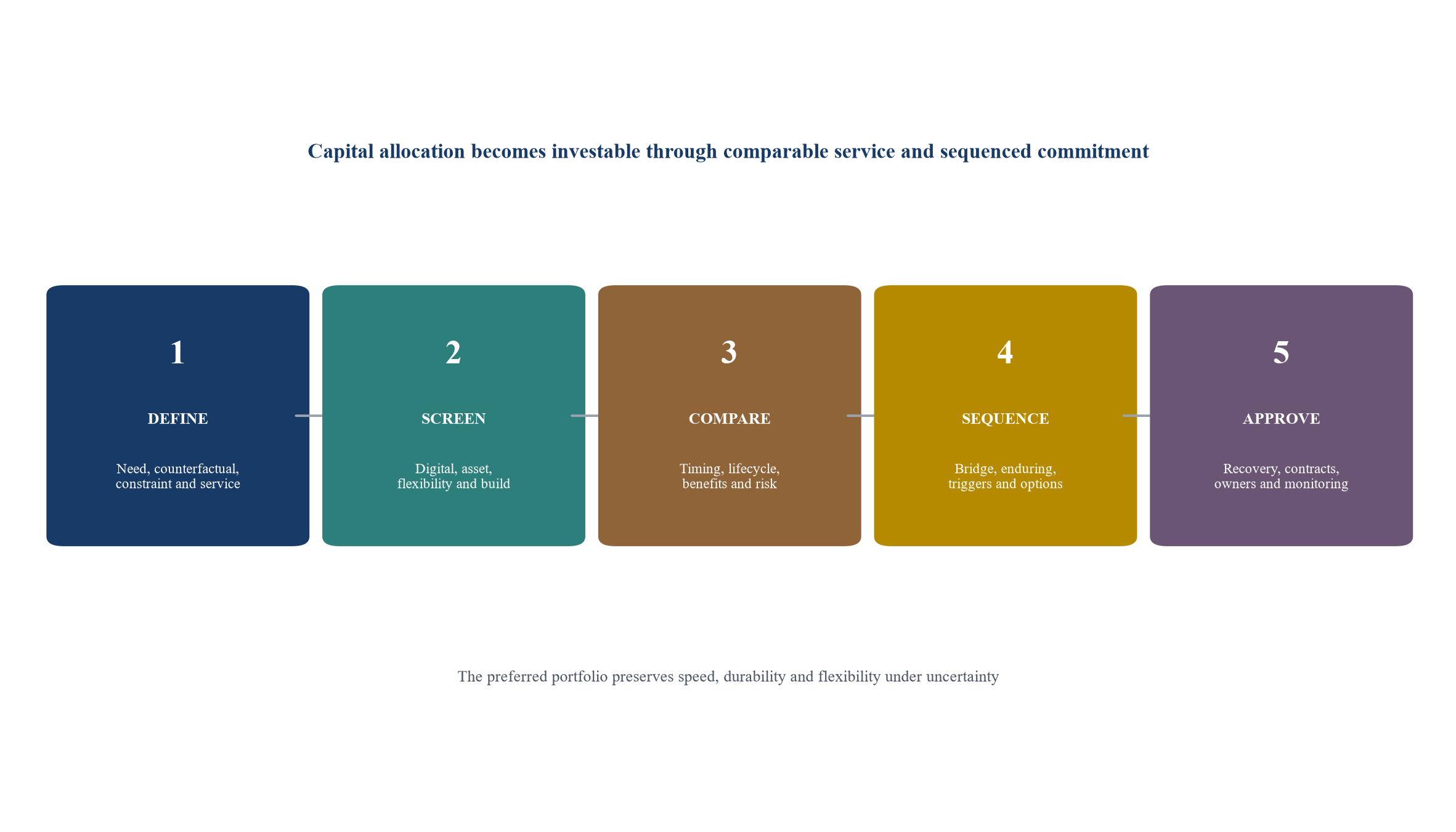
Each gate requires documented evidence before the next capital commitment.
The framework converts a technology menu into an auditable capital-allocation process. It compares options against one need, one service requirement and one lifecycle value model before sequencing bridge and enduring capacity.
Execution quality depends on preserving option value while evidence develops. Demand, technology, delivery and regulation should update the same controlled decision model and trigger pre-agreed changes to the portfolio.
References
- Federal Energy Regulatory Commission, "Explainer on the Transmission Planning and Cost Allocation Final Rule," https://www.ferc.gov/explainer-transmission-planning-and-cost-allocation-final-rule
- Federal Energy Regulatory Commission, "Order No. 1920-A," 2024, https://www.ferc.gov/sites/default/files/2024-11/20241121-3139.PDF
- Federal Energy Regulatory Commission, "Major Orders and Regulations," https://www.ferc.gov/major-orders-regulations
- Federal Energy Regulatory Commission, "Managing Transmission Line Ratings, Order No. 881," 2021, https://www.ferc.gov/media/e-1-rm20-16-000
- US Department of Energy, "Advanced Conductor Scan Report," 2023, https://www.energy.gov/sites/default/files/2024-08/Advanced%20Conductor%20Report%20December%202023.pdf
- US Department of Energy and Lawrence Berkeley National Laboratory, "Reconductoring Economic and Financial Analysis Tool," 2024, https://www.energy.gov/sites/default/files/2024-02/REFA%20tool%20factsheet_rev%20February%202024_optimized.pdf
- US Department of Energy, "Supply Chain Resources," https://www.energy.gov/oe/supply-chain-resources
- US Department of Energy, "Grid-Enhancing Technologies Improve Existing Power Lines," https://www.energy.gov/oe/grid-enhancing-technologies-improve-existing-power-lines
- US Department of Energy, "Electric Grid Projects," https://www.energy.gov/edf/electric-grid-projects
- Ofgem, "Ofgem Sets Rules for 2028 to 2033 Grid Investment to Meet Growing Electricity Demand," 2026, https://www.ofgem.gov.uk/press-release/ofgem-sets-rules-2028-2033-grid-investment-meet-growing-electricity-demand
About the Author
Chennakeshav (CK) is a corporate finance and investment banking executive with 25+ years of global experience in deal origination, structuring and execution across M&A, growth capital and corporate strategy. He has led value-creation mandates for founders, corporates and funds — bridging the boardroom view to hands-on execution and close.
His career spans Morgan Stanley, HSBC, Lloyds Banking Group, EWEC, ADQ portfolio companies and Emirates Growth Fund, across TMT, real estate, fintech, deeptech, cleantech, infrastructure and energy. He has partnered with C-suite leaders, private equity and venture funds, sovereign wealth funds and family offices to finance complex fund raises and scale-up ventures, and has led M&A due diligence, post-merger integration and business-transformation initiatives to create value.
At Matchpoint Partners he is Managing Partner, leading the firm's corporate finance, M&A and capital-raising practice. He holds an MBA from London Business School, an engineering degree from VTU and a Master of Laws (LLM, in progress) from UCL London.
An active start-up mentor, CK mentors at Techstars, DIFC FinTech Hive, Startup Grind, Founder Institute and IN5, serves as Entrepreneur Mentor in Residence (EMiR) at London Business School, and judges the Entrepreneurship World Cup.
