

1 Define the flexibility and cash that the borrower controls
A battery financing begins with a defined operating asset, connection and payment perimeter. The proposed appraisal in this paper follows electricity entering storage, the capability reserved for services, energy delivered and cash retained by the borrowing entity. Each revenue line would identify the buyer, settlement mechanism, delivery obligation and operating rights required to earn it. Equipment power, usable energy, connection permissions and contracted availability would have separate definitions. A forecast that uses one number for all four would require reconciliation before debt sizing.
The official participation framework supplies an initial boundary. FERC's 15 February 2018 announcement of Order 841 describes storage participation models for organised US regional wholesale markets. Those models were required to recognise physical and operational characteristics and permit technically capable storage to provide capacity, energy and ancillary services. The release also addresses wholesale charging energy for subsequent resale. [1] These are access principles. A particular project's current tariff, registration and service obligations require their own verification.
The proposed revenue ledger would distinguish payments for availability, delivered energy and measured performance. It would also separate an awarded public-market obligation from a private optimiser forecast. For a hypothetical borrower, gross trading receipts could belong to the operator while a contractual share reaches the project company later. The investment case would follow that transfer through fees, deductions and settlement dates. Portfolio value retained elsewhere would require an evidenced allocation before entering borrower cash.
This perimeter extends to costs. Charging purchases, auxiliary consumption, losses, operating expenditure and lifecycle funding would be traced to the party bearing them. A fixed payment accompanied by charging costs and performance deductions would have a different cash profile from a payment after those items. The analysis proposes measuring the amount and timing that remain available for financing obligations, with documentary and technical evidence attached to the underlying assumptions. No observed payment floor, optimiser fee or private financing term is supplied by the public sources reviewed here.
2 Keep market rules within their own jurisdiction
Great Britain, PJM, California and Australia's National Electricity Market provide useful examples of storage participation. Each has its own institutions, product definitions and evidence requirements. The proposed diligence would preserve the governing market and document version alongside every assumption. The relevant unit might be registered power, duration-class capacity, accredited capacity, qualified response or dispatched energy. Those quantities would be reconciled within the local rules before a commercial comparison is attempted.
In Great Britain, the July 2026 informal consolidation of the Capacity Market Rules includes storage generating-technology classes differentiated by duration. The government's publication page records the consolidation's release on 27 July 2026. [4] NESO's accessible Capacity Market explanation describes de-rating as reflecting expected availability against the reliability standard and identifies prequalification, auction and delivery stages. [5] This paper imports no numerical de-rating factor from those sources.
Table 1. Jurisdiction-specific evidence for a proposed revenue case
| Market boundary | Capacity evidence | Services evidence | Appraisal decision |
|---|---|---|---|
| Great Britain | Duration class, applicable de-rating and award | NESO qualification, service terms and compatible dispatch | Reconcile award MW to the operating envelope |
| PJM | Applicable ELCC accreditation and delivery year | Relevant regional market requirements | Use project accreditation supported by the current process |
| California | Relevant resource-adequacy contract and qualifying capacity | CAISO market and resource obligations | Reconcile contracted capacity, charging and shared connection |
| Australian NEM | Project-specific contract or support eligibility | AEMO registration, MASS and service verification | Model energy and FCAS with their distinct obligations |
Decision framework grounded in the identified official sources. Each project requires its own current registration, award and applicable rules.
The comparison would also preserve geographic scope. References to Australian NEM dispatch arrangements would remain separate from Western Australian WEM outcomes. The US examples concern particular organised markets and California resource adequacy, with no assumption that their structures apply throughout the country. A lender translating the method would first identify the local revenue rights and rebuild the rule map. Borrowing a familiar product name supplies no evidence about its qualification, penalties or payment security in another jurisdiction.
3 Connect capacity accreditation to sustained delivery
A capacity assumption requires a defined period, quantity and performance obligation. The proposed debt case would use the project's evidenced capacity entitlement for the relevant delivery year and contract. Nameplate inverter output would remain an engineering input. Usable stored energy, charging access, outages and any shared connection would be assessed for their effects on the capability relied upon during scarcity. The technical model and commercial award would therefore reconcile to the same asset condition.
PJM's 2025 ELCC and Reserve Requirement Study, dated 22 October 2025 and posted on its official page on 30 January 2026, models hourly charging and dispatch of limited-duration resources. Its future class-rating discussion identifies winter-event duration and increasing storage penetration as contributors to declining modelled limited-duration ratings. [2] These are study results and methodology, with no fixed lifetime accreditation promised to an individual project.
California supplies a different illustration. The CAISO Department of Market Monitoring's May 2025 report describes the resource-adequacy arrangements and 2025 slice-of-day reforms, including charging needs and qualifying-capacity treatment. It also describes limitations arising from shared interconnection facilities. [3] This dated explanation establishes the need to examine local charging and capacity rules. It supplies no certification that a particular 2026 project satisfies every applicable requirement.
For a hypothetical battery, the proposed capacity assessment would ask how much energy remains available before the required delivery interval and how it can be replenished afterward. A preceding arbitrage trade would be permitted in the model only when the later obligation remains feasible. Charging would use the evidenced import capability and its associated cost. Outages, operating restrictions and degradation would modify the available envelope on their stated dates.
The financing case would then separate awarded periods from assumptions about renewal. Future prices, future accreditation and later contract awards would have explicit scenario treatment. An extension of debt beyond the evidenced revenue period would require a stated refinancing or residual-revenue assumption. Capacity payment visibility can be assessed together with the cost of maintaining the capability; the public market records establish neither a project's accepted borrowing amount nor its lender coverage threshold.
4 Price Great Britain's response obligations within one dispatch envelope
NESO's Dynamic Response Provider Guidance v14, dated June 2026, identifies Dynamic Containment, Dynamic Moderation and Dynamic Regulation. It specifies different sustained-delivery requirements for energy-limited providers and describes state-of-energy management, performance monitoring and interaction with other markets. The guidance states that contractual documents prevail in a conflict. [6] An appraisal should therefore retain the governing service terms and the applicable product specification alongside any interpretation of the guidance.
The Response Services: Service Terms published in July 2026 and effective from 31 July address other-service provision in paragraph 12. They require that third-party activities do not impair contracted response, address notification and consequences of unavailability, and recognise conflict between balancing-service obligations. [7] Those provisions warrant a contract-specific compatibility review. This paper establishes no blanket right to sell every product simultaneously.
The proposed dispatch assessment would represent each committed response quantity as a claim on the battery's power and energy. It would identify the operating point, upward and downward headroom, activation assumptions and energy needed to restore the required position. The residual capability available for energy trading would be calculated after these requirements. Opposite-direction services would require their own assessment of deliverability and the relevant monitoring rules.
A useful financing stress would combine lower response prices with a more demanding activation pattern. The price assumption affects receipts, while activation can affect charging purchases, available energy and throughput. Any associated performance deduction would appear under the applicable settlement rule. This is a proposed analytical stress, with no assertion about its probability or a named asset's measured performance.
5 Verify Australian participation and energy constraints separately
AEMO records completion of its Integrating Energy Storage Systems project on 3 June 2024, with a subsequent industry transition period for bidirectional units. Its implementation account includes changes to registration, dispatch and directional non-energy cost recovery. [8] These changes are specific to the NEM. A project appraisal would use the resulting registration and settlement arrangements, together with evidence of the particular unit's accepted configuration.
The Market ancillary service specification v8.2, effective 3 June 2024, sets service descriptions, performance requirements and verification procedures. [9] AEMO's final BESS contingency FCAS registration guide v5.0, effective 2 September 2026, provides registration and testing requirements, including post-fault FCAS simulation. [13] Qualification and continuing delivery would require project evidence under the applicable documents.
AEMO's Energy Limit in BDU Bids instructions, modified 31 July 2026, contain an important modelling boundary. Optional bid energy limits are used in pre-dispatch and seven-day pre-dispatch. The instructions distinguish minimum and maximum stored-energy limits, and state that those bid limits affect energy targets while leaving regulation and contingency FCAS targets unaffected. [10] An appraisal cannot treat that field alone as a complete control for every service's energy requirement.
The proposed operating model would accordingly maintain its own reconciled energy inventory. It would trace charging, discharging, losses and service activation through the interval, using technical data and the actual bidding arrangements. Constraints represented in an operator system would be identified separately from limits imposed by the owner, optimiser or equipment controller. An omitted commercial or technical constraint would remain visible even if market software accepted the bid.
6 Distinguish captured trading margin from reported market value
The proposed arbitrage case would follow a chronological sequence of charging and discharging opportunities. Purchases would use the applicable location, interval, fees and losses; sales would use energy that can actually be delivered after committed service requirements. A daily maximum-minus-minimum price statistic would be retained as descriptive information until a feasible dispatch established what the battery could capture. The method would disclose forecast information available when each decision was made.
Official monitoring demonstrates the importance of measurement boundaries. CAISO's 2024 battery report presents net market revenues by category and describes their historical changes. [3] Those market measures would require a separate bridge to borrower operating cash. An investment appraisal would identify which capacity contracts, operating costs, financing items and private arrangements are included or excluded before comparing reported values with its own model.
AEMO's Q2 2026 report describes lower NEM battery arbitrage revenue alongside narrower captured spreads and higher charging costs. Its NEM revenue definition excludes battery FCAS costs and Frequency Performance Payment outcomes. The report separately identifies additional exclusions for WEM estimates, including bilateral contracts and reserve-capacity items. [11] These are dated aggregate estimates, with no individual project return inferred here.
The proposed forecast would use three clearly identified layers: observed market data, a reproducible historical dispatch exercise and forward scenarios. The historical exercise would reconcile input prices, constraints and captured cash. Forward scenarios would state the assumed changes in supply, demand, storage competition and market arrangements. Differences between the layers would appear as explicit assumptions, with no automatic continuation of a favourable historical period.
For a hypothetical financing, downside analysis would vary achievable margin together with charging cost and available dispatch hours. Lower spreads might reduce economic cycling, while contractual availability costs continue. The model would preserve the ability to leave an uneconomic trade unexecuted, subject to actual obligations. The resulting cash case would make visible the value of residual flexibility and the costs carried when that flexibility earns less than expected.
7 Fund the capability trajectory through degradation and augmentation
The lender's operating envelope would extend across the proposed financing period. The appraisal would identify usable energy at commissioning, its expected trajectory, maintenance needs and any augmentation required to preserve contracted capability. Equipment specifications, warranted conditions and independent technical advice would support those assumptions. An unverified lifecycle curve would remain a model assumption with a named sensitivity.
The National Laboratory of the Rockies' Battery Lifespan research page describes degradation assessment using environment, cycling and thermal information. Its BLAST modelling discussion covers both calendar and cycle ageing, including complex operating profiles. [12] This supports considering more than cumulative discharged energy when examining asset life. The page supplies no universal coefficient, warranty entitlement or augmentation cost applicable to the hypothetical battery.
The proposed dispatch model would therefore connect operational choices to a separate lifecycle schedule. It would record throughput, depth of use, operating conditions and any relevant contractual restrictions at the resolution supported by the engineering inputs. The financial model would then show how the resulting usable-energy trajectory affects service eligibility, duration and retained margin. A simplified throughput allowance would be described as a simplifying assumption, with its omitted mechanisms stated.
Augmentation would have a procurement date, installation period, payment profile and completion test. The proposed funding case would account for temporary operating restrictions and the need to demonstrate restored capability afterward. Costs would be reconciled to any reserve account and to the supplier obligations actually contracted. A warranty claim would require its own eligibility and recovery assessment before becoming a cash receipt.
8 Read revenue floors and dispatch rights as a complete contract
A proposed toll or optimisation agreement would identify the legal obligor, payment basis, dispatch controller and permitted operating range. The appraisal would distinguish an availability fee from a net-margin floor and from a forecast prepared by a trading service provider. Charging energy, imbalance, fees, performance deductions and lifecycle costs would be allocated individually. The label applied to the agreement would carry no assumed payment protection beyond its executed wording.
Public support can introduce another contract boundary. DCCEEW's guide to eligible contracts under a Capacity Investment Scheme Agreement discusses standalone project pricing, arm's-length outcomes and contract eligibility. It explains that payment consequences depend on the relevant CISA and that ineligible arrangements may involve deemed spot revenues. [14] A proposed hedge or toll must therefore be reconciled to the actual support agreement before its combined cash effect is calculated.
Table 2. Proposed contract review for retained battery cash
| Arrangement | Payment evidence | Operating allocation to examine | Downside test |
|---|---|---|---|
| Fixed availability toll | Executed fee, term and deductions | Dispatch rights, charging and capability limits | Counterparty loss and replacement interval |
| Net-margin floor | Defined revenue and cost calculation | Fees, losses and permitted exclusions | Floor dispute and excluded-cost increase |
| Merchant optimisation | Settlement and remittance obligations | Bid authority, operating limits and reporting | Lower capture and operator interruption |
| Public support with private contracts | Applicable support agreement and eligibility | Revenue attribution and required notifications | Deemed revenues, deductions and payment delay |
Analytical diligence questions; no private transaction terms or standard market prices are asserted.
The proposed credit analysis would examine the payer's obligations through expiry, early termination and an interruption in operations. Security, guarantees and collateral would be assessed only where the documents provide them. A nominal termination amount would have an explicit recovery assumption and date. Transfer of market registrations, data and operating responsibility would be reviewed for any replacement arrangement.
The cash model would reconcile these provisions to actual collection timing. A floor billed after a reconciliation period could leave the borrower exposed to interim costs. Restricted collateral would remain separate from operating liquidity. Contract tenor, renewal assumptions and operating limits would appear alongside the debt repayment schedule, allowing the reviewer to see which periods rely on enforceable payments and which require a forward merchant assumption.
9 Build a financeable downside from documented obligations
The proposed financing test would begin with a feasible service programme and trace its receipts through operating costs, lifecycle expenditure and collection timing. Debt service would be tested against the cash the borrower can retain under stated stresses. The choice of coverage requirement, amortisation and reserves would remain an authored financing assumption until supported by an actual lender decision. No general debt percentage follows from the number of eligible revenue products.
Government support also requires an evidenced eligibility and award path. Ofgem's 26 June 2026 LDES announcement concerns provisionally selected projects and further consultation before final determination. It defines LDES as eight hours or more. [15] This dated announcement supplies no assumed cap-and-floor award for a short-duration battery and no proof of a named project's executed support.
A useful downside would identify the event sequence and operating response. A reduction in service margin could shift economic dispatch toward another qualified product. That response would remain conditional on residual power, energy and contractual permission. Lower capacity entitlement would require a separate revenue adjustment and a technical assessment of whether augmentation, changed commitments or additional equity addresses the exposure. The model would retain the cost and timing of each proposed action.
Liquidity analysis would be dated. Charging purchases, service deductions, collateral and reserve funding might occur before customer receipts. The proposed ledger would separate unrestricted cash from restricted accounts and identify the period requiring sponsor or external funding. Collection delay and permanent non-payment would be different cases, with recovery assumptions stated explicitly. Positive annual coverage would be accompanied by a test of the dates on which payments fall due.
The resulting investment package would bring together registration, service compatibility, accreditation, dispatch authority, lifecycle capability, contracts and cash. Evidence gaps would have a defined consequence for the proposed commitment: an excluded receipt, a condition to funding, a revised operating plan or a quantified equity requirement. The approach supplies a transaction assessment method. It offers no conclusion that a named battery is financeable without the documents, engineering evidence and dated financial model needed to apply it.
10 Define one auditable operating boundary
Every numerical input and result in Sections 10-20 is an authored illustration. The contracts, prices, technical coefficients, tax allowance and financing terms have no asserted relationship to an observed project or market forecast. The calculation represents one project company, one 100 MW connection and an initially 200 MWh battery over ten operating years. It is a transparent illustrative case with a reproducible hourly energy ledger and annual cash accounts. Market qualification, legal compatibility and engineering acceptance remain separate diligence requirements.
The initial operating band is 20-180 MWh, with 110 MWh stored at each representative day's opening. Charging and discharging each have a 95% efficiency assumption, giving 90.25% round-trip efficiency. Fixed 20 MWh upper and lower buffers are retained as energy capacity fades. There are 350 available days within a 365-day financial year. Both fixed payments are prorated for those available days; unavailable days contribute no service or capacity receipts. Prices and the declared daily pattern repeat across available days.
Equation 1.
E denotes stored MWh; C and D are grid-side charging and discharging MWh in an hourly interval. The respective efficiencies convert each movement into stored-energy change. Inventory bounds, reserve requirements and daily restoration accompany this identity.
The representative-year approach exposes physical claims and arithmetic. It omits seasonal prices, sequential weather regimes, actual outage dates and intra-year fade. No separate auxiliary or HVAC consumption, self-discharge, temperature response or second-level control is modelled. The efficiencies are scalar author assumptions. Actual auxiliary demand and equipment performance would require additional measured inputs and engineering validation.
Table 3. Authored hypothetical operating and financing inputs
| Input | Assumption |
|---|---|
| Initial power and energy | 100 MW / 200 MWh |
| Initial inventory and operating band | 110 MWh; 20-180 MWh |
| Charge and discharge efficiency | 95% each; 90.25% round-trip |
| Availability | 350 days / 365 days |
| Capacity contract | 40 MW for 18:00-20:00; EUR 150,000/MW-year |
| Ancillary contract | 20 MW symmetric; EUR 12/MW-hour |
| Merchant target and prices | 60 MWh/day; EUR 45/MWh buy; EUR 180/MWh sell |
| Fixed opex and authored cash tax | EUR 1.800m / EUR 0.600m per year |
| Capex and opening working capital | EUR 60.000m / EUR 1.000m |
| Augmentation and senior terms | EUR 8.000m at start of year 6; 6% interest; 1.35x DSCR |
EURm means million euros. All entries are assumptions for this model.
11 Allocate power before accepting revenue
The hypothetical capacity buyer reserves 40 MW during the two-hour evening window. A separate ancillary buyer reserves 20 MW of symmetric upward and downward response throughout each available day, with a quarter-hour energy sustain requirement. The assumed contracts permit these two commitments and subordinate merchant dispatch to their operating envelopes. No other toll, congestion or co-location income is included. These permissions are conditional contract assumptions requiring verification in a real financing.
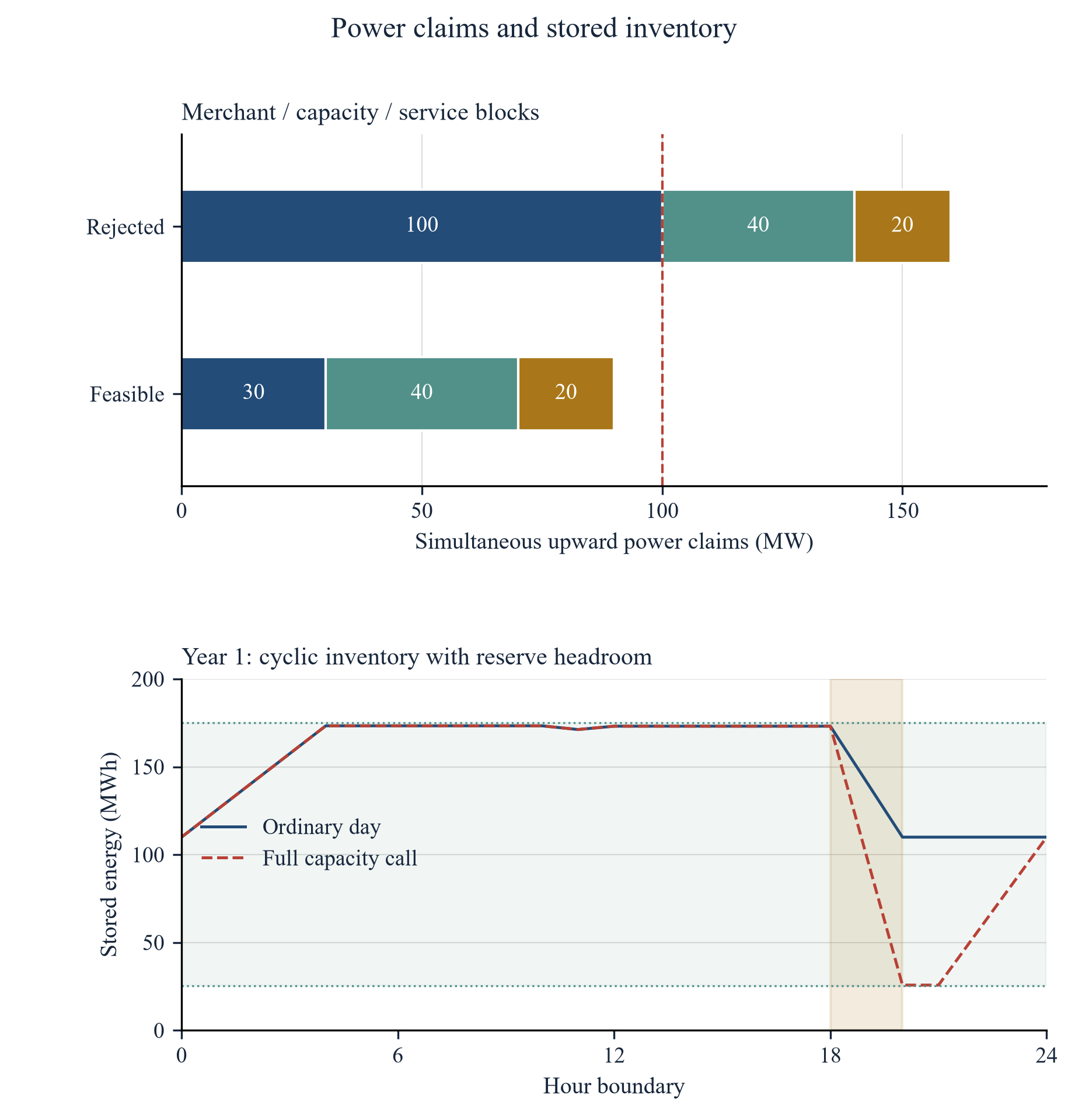
The merchant target is 60 MWh over the same two evening hours, equivalent to 30 MW. Its combined upward commitment with capacity and service is therefore 90 MW. The remaining 10 MW is physical power headroom. Merchant charging and capacity-recovery charging also leave the ancillary buyer's downward block available. Upward and downward limits are tested separately because the service claim is symmetric.
Equation 2.
Here, scheduled merchant discharge is P-sell, charging is P-buy, K is the capacity reservation, S is the ancillary reservation and P-max is 100 MW. An actual ancillary response consumes the existing service block. It creates no additional 20 MW reservation. Actual charging and discharging are mutually exclusive in each scripted interval.
An unconstrained illustration assigning all 100 MW to merchant sales alongside the 40 MW capacity and 20 MW service claims requires 160 MW. The model rejects that stack and calculates no earnings for it. The feasible 90 MW allocation still requires an independent energy test: two-hour output, response inventory and later restoration must fit the available stored energy.
Table 4. Reserved claims in the evening discharge window
| Claim | Power (MW) | Energy or operating claim |
|---|---|---|
| Capacity | 40 | 80 MWh over two hours |
| Symmetric ancillary service | 20 | 5 MWh upward and 5 MWh downward sustain |
| Merchant target | 30 | 60 MWh over two hours |
| Feasible combined upward commitment | 90 | Separate inventory test applied |
| Rejected full-power merchant stack | 160 | Exceeds the 100 MW envelope; earnings unavailable |
These hypothetical contracts permit the stated allocation. Power compliance alone does not establish energy compliance.
12 Keep inventory cyclic and reserve energy
The hourly ledger uses grid-side charging and discharging MWh. Stored energy increases by charging multiplied by charge efficiency and falls by discharge divided by discharge efficiency. This convention prices losses through actual purchased energy. Each available day's closing inventory returns to its 110 MWh opening value, including the full-capacity-call test day.
The inventory identity introduced in Section 10 applies efficiencies in their respective directions. At nominal capacity, a 5 MWh upward service obligation requires 5/0.95 MWh above the 20 MWh lower buffer. A 5 MWh downward obligation requires 5 multiplied by 0.95 MWh below the 180 MWh upper bound. Faded energy reduces that upper bound in later representative years.
The scripted ancillary response delivers 2 MWh upward at 10:00 and accepts 2 MWh downward at 11:00. Each movement represents 20 MW for 0.1 hour within its ledger interval. The equal grid-side volumes create a net stored-energy loss, which is purchased and restored. The service commitment remains 20 MW throughout this example; the hourly average energy movement is a separate measure.
The capacity call test delivers an additional 80 MWh during 18:00-20:00 and restores inventory during 21:00-24:00. The assumed capacity contract limits full calls to 80 days per year and reimburses their recharge cost at cost. The model tests that annual maximum against the cycle budget. An unlimited call entitlement would require a new physical and contractual assessment.
Table 5. Year-one daily energy and activation checks
| Metric | Ordinary day | Full-call test day |
|---|---|---|
| Merchant delivery (MWh) | 60.000 | 60.000 |
| Ancillary upward delivery (MWh) | 2.000 | 2.000 |
| Capacity delivery (MWh) | 0.000 | 80.000 |
| Total grid charging (MWh) | 68.698 | 157.341 |
| Opening and closing SOC (MWh) | 110.000 | 110.000 |
| Annual EFC with 80 call days | Not applicable | 147.895 |
The full-call column is a physical test. Activation charging is reimbursed at cost under the authored contract assumption.
View figure at full size; scroll horizontally on smaller screens.
The service-only inventory band includes 5 MWh sustain in either direction. Capacity and remaining merchant energy are independently checked in the 18:00-20:00 window. The assumed contract permits 80 full-call days/year and reimburses recharge at cost. Hourly energy ledger; sub-hour response and engineering validation are outside scope.
13 Settle charging, losses and retained cash
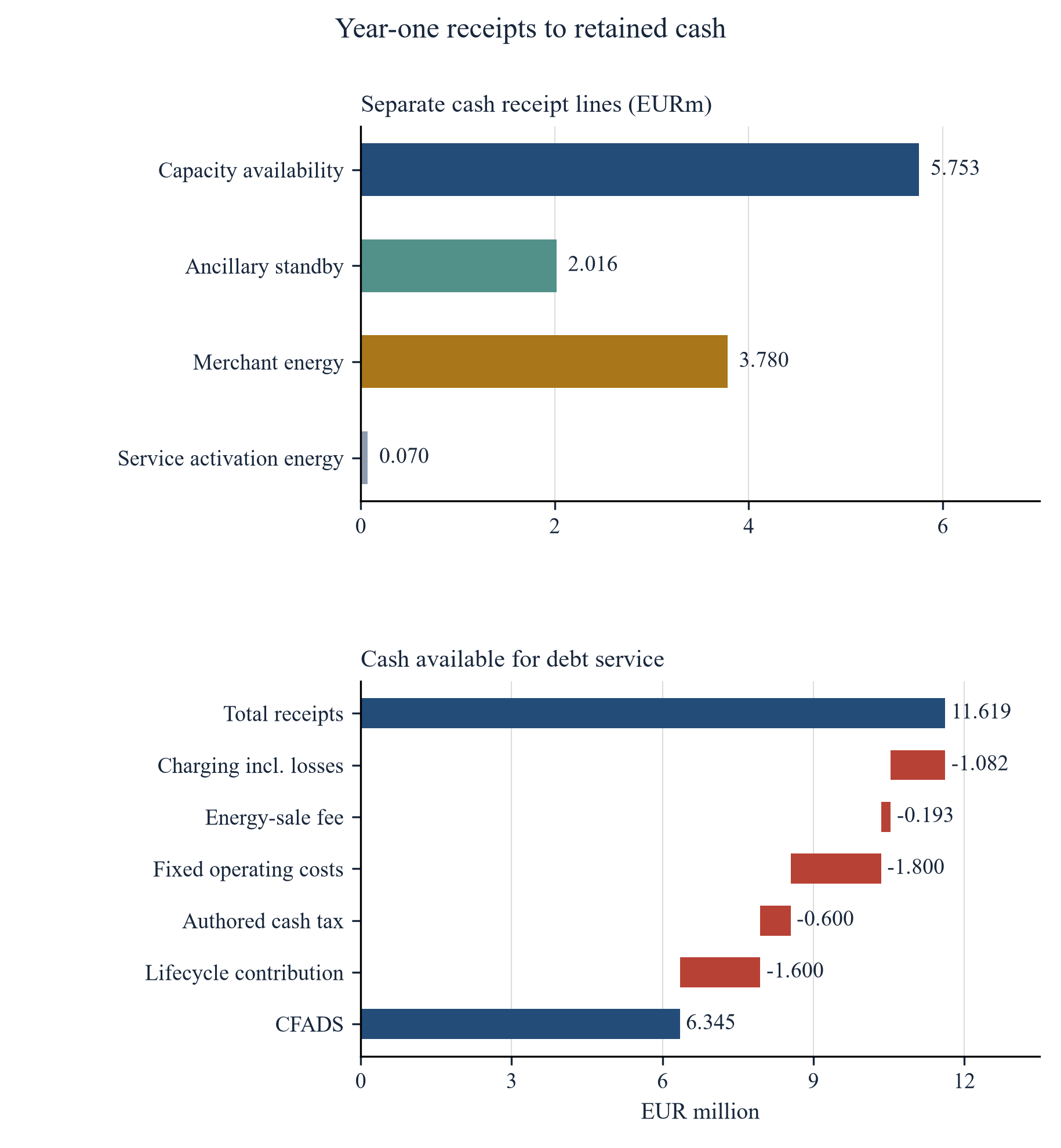
Year-one contracted capacity receipts are EUR 5.753m after availability proration. Ancillary standby receipts are EUR 2.016m. Merchant energy sales contribute EUR 3.780m and ancillary activation sales EUR 0.070m under the stated prices. These lines sum to EUR 11.619m of cash receipts. Merchant volume and service activation volume have separate identifiers, so the same delivered MWh cannot receive both energy-revenue labels.
Annual charging purchases cost EUR 1.082m. The total includes EUR 0.035m for mandatory ancillary activation and its losses, plus EUR 1.047m associated with merchant energy. Round-trip losses are already contained in those quantities. No additional percentage loss expense is deducted. Capacity-call recharge reimbursement and its matching charging expense cancel at project cash level; the base case has zero call days and therefore zero such pass-through.
The optimiser receives 5% of energy-sale receipts, producing a EUR 0.193m year-one fee. Fixed standby payments and at-cost capacity recharge reimbursements are outside that fee base. Fixed opex is EUR 1.800m, including the assumed fixed market-access and operating costs. The annual cash-tax allowance is an authored EUR 0.600m deduction, with no jurisdictional tax-law interpretation. A EUR 1.600m restricted lifecycle contribution leaves EUR 6.345m available for scheduled debt service in year one.
Equation 3.
R denotes receipts; B denotes charging purchases; O combines fixed opex and optimiser fees; T is the cash-tax allowance; A is the lifecycle contribution. This formula retains the operating costs of delivering the contracted floor when merchant trading is switched off.
Table 6. Year-one cash receipts to CFADS
| Component | EURm |
|---|---|
| Capacity availability payment | 5.753 |
| Ancillary standby payment | 2.016 |
| Merchant energy sales | 3.780 |
| Ancillary activation energy sales | 0.070 |
| Total receipts | 11.619 |
| Mandatory ancillary charging | 0.035 |
| Merchant charging | 1.047 |
| Optimiser fee | 0.193 |
| Fixed operating costs | 1.800 |
| Authored cash-tax allowance | 0.600 |
| Restricted augmentation contribution | 1.600 |
| CFADS | 6.345 |
Hypothetical EURm; deductions are shown as positive amounts. Rounded components may differ from displayed totals by 0.001.
View figure at full size; scroll horizontally on smaller screens.
Capacity and ancillary standby are fixed-contract assumptions. Energy-sale attribution is exclusive. At-cost capacity-call reimbursement contributes zero margin; the base year has zero call days. No separate cash wear charge duplicates the lifecycle funding.
14 Fund wear and augmentation once
The authored degradation rule applies 1% calendar fade plus 0.005% of opening energy capacity per equivalent full cycle. EFC is discharged stored-energy throughput divided by the initial 200 MWh rating. Both merchant and service discharges count, with capacity activation included in the maximum-call scenario. The annual operating limit is 150 EFC. These coefficients are illustrative arithmetic assumptions, with no asserted warranty or engineering basis.
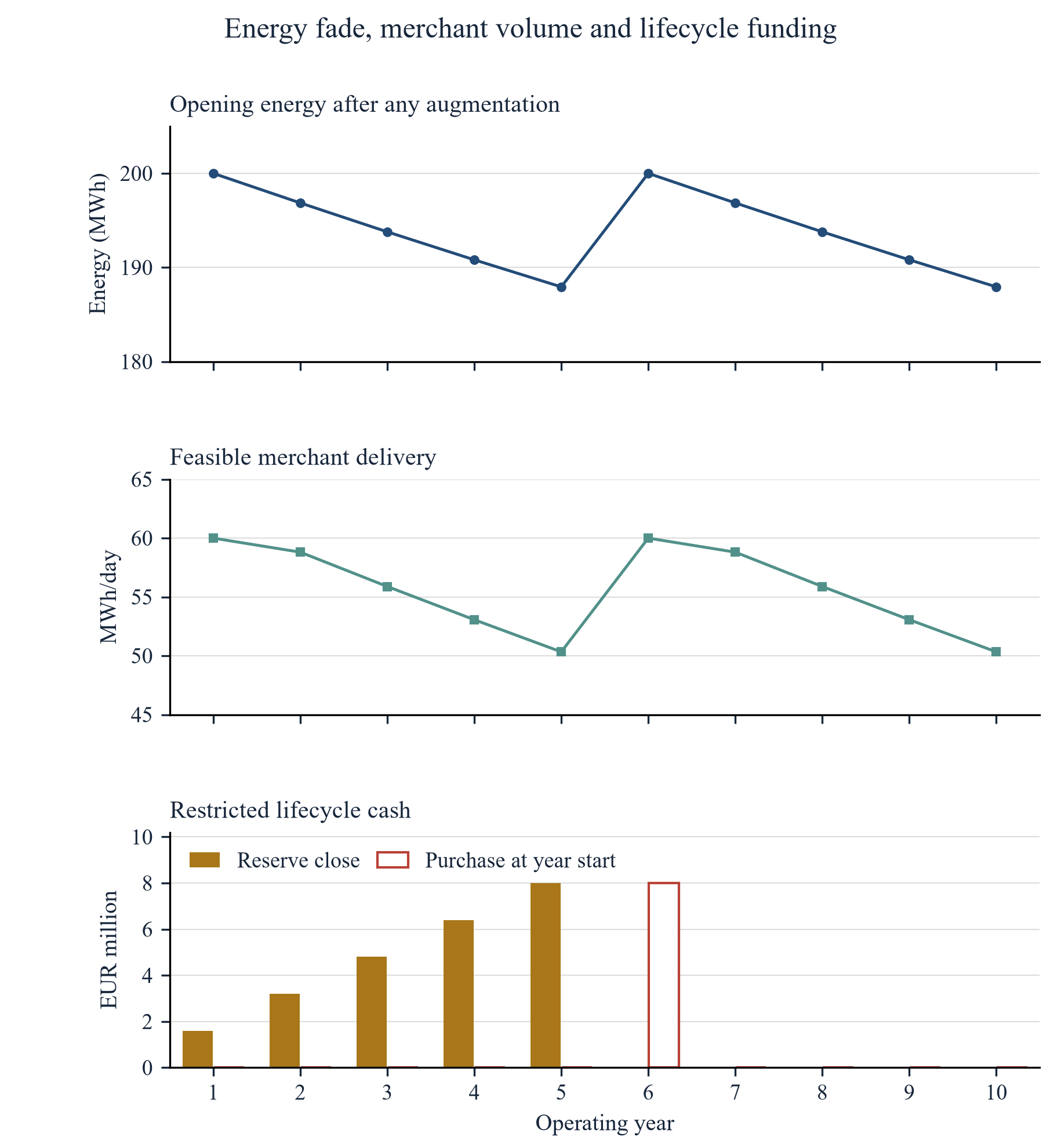
Fade is applied between representative years. Opening energy falls from 200.000 MWh in year one to 187.940 MWh in year five. The corresponding merchant dispatch falls from 60.000 to 50.335 MWh per available day as the upper energy envelope tightens. The model preserves the contractual reserves throughout. Within-year drift and evolving intra-day dispatch are excluded.
At the start of year six, an assumed EUR 8.000m augmentation restores 200 MWh. Contributions of EUR 1.600m at each of the preceding five year-ends build a ring-fenced EUR 8.000m balance. The year-six opening spend draws that balance to zero. There are no further contributions or augmentation payments within the ten-year horizon. The expenditure restores the stated technical envelope under an explicit illustrative assumption; its amount is not a cell-price forecast.
The EUR 10/MWh merchant wear shadow price screens dispatch profitability. It is a non-cash optimisation input. Lifecycle cash is charged through the reserve contributions and the actual augmentation purchase in their respective calculations. Deducting an additional cash wear charge would count the same authored lifecycle provision twice.
Table 7. Energy capacity and restricted augmentation funding
| Year | Energy (MWh) | Merchant (MWh/day) | EFC/year | Reserve close (EURm) | Spend (EURm) |
|---|---|---|---|---|---|
| 1 | 200.000 | 60.000 | 114.211 | 1.600 | 0.000 |
| 2 | 196.858 | 58.807 | 112.014 | 3.200 | 0.000 |
| 3 | 193.787 | 55.890 | 106.639 | 4.800 | 0.000 |
| 4 | 190.816 | 53.067 | 101.440 | 6.400 | 0.000 |
| 5 | 187.940 | 50.335 | 96.407 | 8.000 | 0.000 |
| 6 | 200.000 | 60.000 | 114.211 | 0.000 | 8.000 |
| 7 | 196.858 | 58.807 | 112.014 | 0.000 | 0.000 |
| 8 | 193.787 | 55.890 | 106.639 | 0.000 | 0.000 |
| 9 | 190.816 | 53.067 | 101.440 | 0.000 | 0.000 |
| 10 | 187.940 | 50.335 | 96.407 | 0.000 | 0.000 |
Opening energy is restored at the start of year six. The EUR 8m spend uses the existing restricted reserve.
View figure at full size; scroll horizontally on smaller screens.
Fade is an authored arithmetic rule applied between representative years, with no within-year drift. Reserve spending is financed by prior contributions and is not deducted again from CFADS. The augmentation cost and restoration outcome are assumptions.
15 Underwrite the contracted operating floor
The financing floor assumes that both ten-year fixed contracts perform as specified, with their availability deductions and recharge reimbursement honoured. It assigns zero merchant dispatch and zero ancillary activation energy revenue. Mandatory ancillary charging remains payable, together with fixed opex, tax and required lifecycle contributions. The physical floor case also tests the maximum 80 capacity-call days and preserves the 150-EFC budget.
The contracted receipts total EUR 7.769m per year. After EUR 0.035m of mandatory service charging, EUR 1.800m opex, EUR 0.600m cash tax and EUR 1.600m reserve contributions, early-period floor CFADS is EUR 3.735m. After the reserve is fully funded, years six to ten have EUR 5.335m of floor CFADS. Matching capacity recharge receipts and expenses contribute zero margin. The fixed fee assumption and contractual reimbursement are central credit dependencies.
This floor is a stated counterparty-performance case. A signed contract, its security and enforceability would need independent diligence before the income could support an actual loan. The illustration supplies no default probability or legal recovery rate. The separate payment-loss tests retain the operating obligations and expose the resulting cash deficit.
The floor is also conditional on continued technical performance and the assumed augmentation outcome. A performance deduction, unavailable charging connection or failed restoration would require a revised dispatch and cash case. Funding the reserve gives the model a defined source for its year-six spend; delivery certainty and engineering adequacy remain outside this arithmetic exercise.
Table 8. Floor cash and maximum opening senior debt
| Item | Amount |
|---|---|
| Contracted receipts after availability | 7.769 |
| Mandatory ancillary charging | 0.035 |
| Floor CFADS, years 1-5 | 3.735 |
| Floor CFADS, years 6-10 | 5.335 |
| Minimum DSCR | 1.350x |
| Maximum opening senior debt | 24.091 |
| Restricted DSRA funded at close | 1.976 |
EURm except the DSCR ratio. Merchant trading and ancillary activation sales contribute zero to debt sizing.
16 Sculpt and fund the senior facility
Senior service is floor CFADS divided by a 1.35x minimum annual DSCR. The opening debt is the present value of those ten service payments at the assumed 6% loan rate. Annual interest is 6% of opening debt; principal equals service less interest. The resulting positive principal payments fully amortise the EUR 24.091m facility over ten years.
Equation 4.
k denotes the minimum DSCR and r the loan interest rate. Debt service is EUR 2.766m in years one to five and EUR 3.951m in years six to ten. The increase reflects completed lifecycle prefunding. It does not anticipate a merchant-price improvement. The debt case has 1.350x coverage in every year by construction.
A DSRA equal to half the maximum annual service requires EUR 1.976m at close. It is restricted cash, excluded from operating liquidity and untouched in every model scenario. Uses comprise EUR 60.000m of capex, EUR 1.000m opening working capital and that reserve. Senior debt and EUR 38.885m of equity fund the EUR 62.976m total. The initial 110 MWh energy fill is already within capex; its calculated EUR 0.005m cost is disclosed without an additional funding charge.
Sizing the same repayment formula on the full merchant-inclusive base case would produce EUR 37.377m of apparent senior capacity. That figure is an undrawn comparison. The actual debt schedule remains floor-sized throughout every downside and sensitivity. The higher comparison depends on merchant assumptions and gradual technical fade, so its underwriting premise would require a separate lender decision.
Table 9. Hypothetical sources and uses at close
| Sources | EURm | Uses | EURm |
|---|---|---|---|
| Senior facility | 24.091 | Capex including initial energy fill | 60.000 |
| Equity | 38.885 | Opening working capital | 1.000 |
| Restricted DSRA | 1.976 | ||
| Total sources | 62.976 | Total uses | 62.976 |
EURm; DSRA is restricted cash. Sources and uses reconcile at full precision.
17 Track annual cash with distinct reserves
The annual cash ledger begins with EUR 1.000m of unrestricted working capital and adds CFADS less scheduled debt service. No distributions or cash sweeps are assumed. All revenue and costs are collected or paid within the relevant financial year. This convention provides annual boundary balances; it cannot size an intra-year liquidity facility or collateral requirement.
The base case closes year one with EUR 4.579m unrestricted cash and year ten with EUR 37.003m. The latter balance includes the original working capital. Adding another EUR 1.000m to that ledger would duplicate cash already present. In the separate unlevered valuation, the original working-capital investment is recovered once at termination.
The augmentation account and DSRA are separate restricted balances. EUR 8.000m leaves the augmentation account at the start of year six, after five contributions have reduced prior CFADS. A second EUR 8.000m reduction of year-six CFADS would duplicate its funding charge. Unlevered asset valuation removes internal contributions and recognises the actual purchase at its cash date.
Coverage falls from 2.294x in year one to a minimum 1.907x in year ten. Merchant headroom declines with fade, and scheduled debt service increases after lifecycle prefunding. Those changes explain the pattern even with flat prices. The terminal DSRA release is a financing-account return, separate from the operating cash series and excluded from unlevered asset NPV.
Table 10. Base annual coverage, debt and unrestricted cash
| Year | CFADS | Service | DSCR | Debt close | Cash close |
|---|---|---|---|---|---|
| 1 | 6.345 | 2.766 | 2.294x | 22.770 | 4.579 |
| 2 | 6.294 | 2.766 | 2.275x | 21.370 | 8.107 |
| 3 | 6.171 | 2.766 | 2.231x | 19.886 | 11.511 |
| 4 | 6.051 | 2.766 | 2.187x | 18.313 | 14.796 |
| 5 | 5.935 | 2.766 | 2.146x | 16.645 | 17.965 |
| 6 | 7.945 | 3.951 | 2.011x | 13.692 | 21.958 |
| 7 | 7.894 | 3.951 | 1.998x | 10.562 | 25.901 |
| 8 | 7.771 | 3.951 | 1.967x | 7.245 | 29.720 |
| 9 | 7.651 | 3.951 | 1.936x | 3.728 | 33.420 |
| 10 | 7.535 | 3.951 | 1.907x | 0.000 | 37.003 |
EURm except DSCR. Cash is the annual boundary balance before terminal DSRA release; no distributions are assumed.
18 Stress credit and merchant value separately
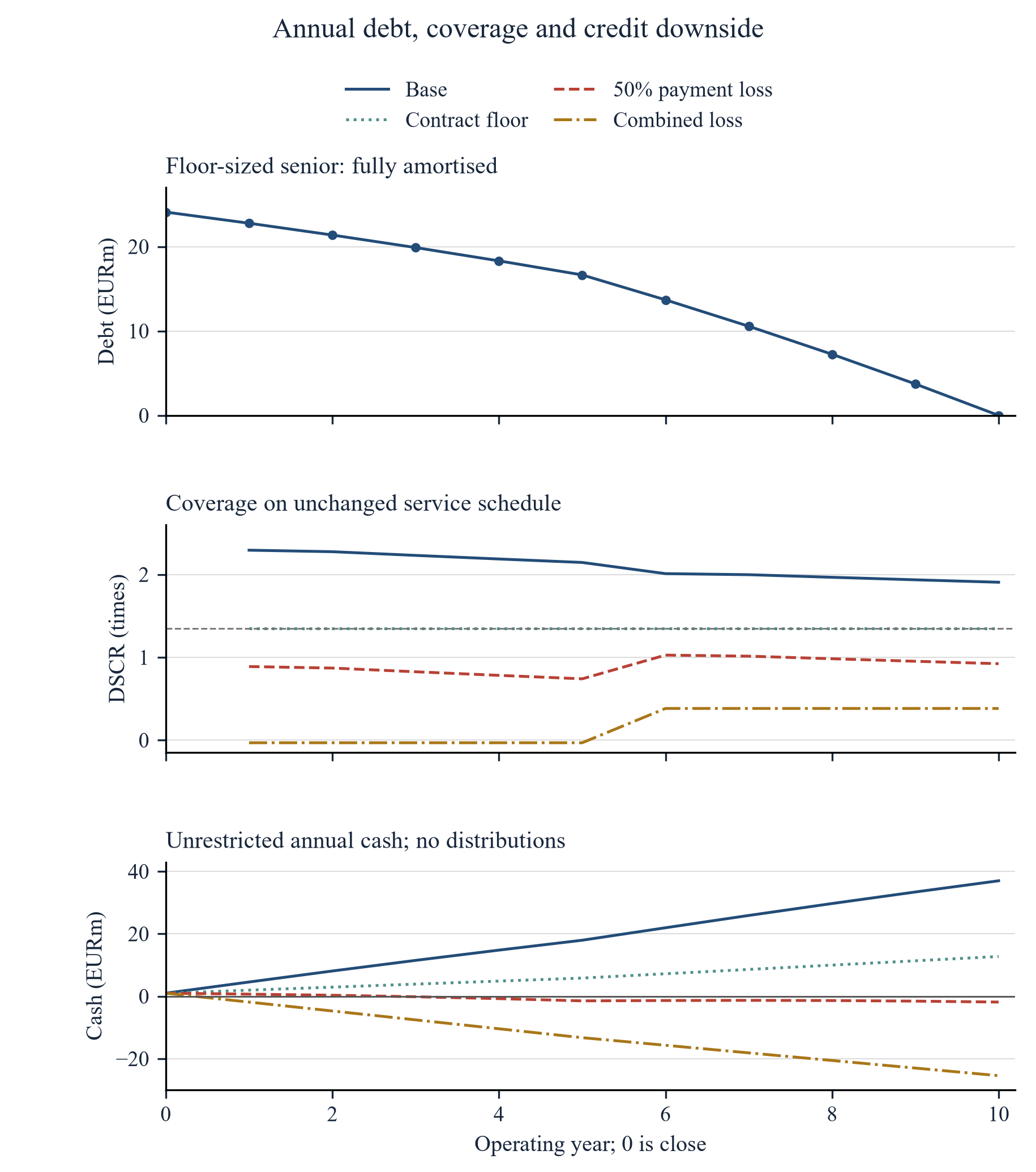
The merchant-compression case reduces the energy-sale price to EUR 60/MWh with the purchase price held at EUR 45/MWh. After the 5% energy-sale fee, charging losses and the EUR 10/MWh wear shadow allowance, merchant dispatch has negative screened margin and stops. Ancillary service continues, including mandatory charging and its separate activation settlement. Minimum DSCR remains 1.367x on unchanged senior debt, conditional on full fixed-payment collection.
The 50% floor-payment-loss case retains the base merchant operation and all contractual operating costs. It cuts both fixed payment streams by half without assuming legal relief or recovery. Minimum DSCR becomes 0.741x, and the undistributed annual cash path reaches a EUR 1.844m funding shortfall. Combining that payment loss with merchant compression produces negative early CFADS, minimum DSCR of minus 0.030x and a EUR 25.426m cumulative annual boundary shortfall.
Negative projected cash identifies external funding required to continue the assumed programme. The calculation does not establish that lenders or shareholders provide it. DSRA remains unused by assumption, and intra-year exposure could differ materially. No default likelihood, recovery claim or automatic contractual termination is inferred.
Two technical operating cases retain full fixed payments. Reducing availability to 320 days prorates both contracts and merchant volumes. Using all 80 permitted capacity-call days adds at-cost recharge flows and cycle wear, which further compresses later merchant headroom. These tests distinguish payment quality, available time and activation intensity within the same capital structure.
Table 11. Named downside cases on unchanged senior debt
| Case | Year-1 CFADS (EURm) | Minimum DSCR | Asset NPV (EURm) | Funding need (EURm) |
|---|---|---|---|---|
| Base | 6.345 | 1.907x | -13.807 | 0.000 |
| Contract floor only | 3.735 | 1.350x | -30.186 | 0.000 |
| Merchant compression | 3.801 | 1.367x | -29.740 | 0.000 |
| 50% floor-payment loss | 2.460 | 0.741x | -39.874 | 1.844 |
| Combined credit and merchant | -0.084 | -0.030x | -55.807 | 25.426 |
| Availability: 320 days | 5.458 | 1.695x | -19.618 | 0.000 |
| Maximum capacity calls | 6.345 | 1.894x | -13.968 | 0.000 |
All results are hypothetical. Funding need is measured at annual boundaries with no distributions and no DSRA use; it is not an intra-year bridge size.
View figure at full size; scroll horizontally on smaller screens.
The floor case has no merchant or ancillary energy revenue and retains mandatory service costs. The 50% payment-loss case retains operating obligations; the combined case also stops uneconomic merchant cycling. Negative cash is required external funding, with no asserted funding availability. Annual balances do not size intra-year liquidity.
19 Value cash at its declared dates
The unlevered valuation begins with EUR 60.000m capex and EUR 1.000m working capital. Operating cash after charging, fees, opex and the authored tax allowance is discounted at each year-end using 8%. Internal transfers to the augmentation reserve are excluded. The EUR 8.000m equipment purchase occurs at the start of year six, immediately after the fifth year-end contribution, so its discount time is five years. Working capital returns once at the end of year ten.
Equation 5.
V denotes operating cash after tax before reserve transfers, J-six the augmentation purchase, and W the terminal working-capital return. Initial energy fill is already within initial capex. Debt draw, service, interest and DSRA transfers are financing items outside this calculation. Zero asset resale and zero terminal energy recovery are assumed.
The resulting base asset NPV is minus EUR 13.807m. The model's positive coverage ratios accompany a negative asset valuation at the chosen cost and discount assumptions. This is an internally consistent result: the debt is only one source within the initial EUR 62.976m funding plan, while equity funds the residual. Coverage addresses scheduled service; NPV evaluates the full project's discounted unlevered cash against its initial investment.
The two-dimensional sensitivity recomputes dispatch, fade and annual cash for five retained-floor percentages and five merchant sale prices. Debt stays fixed at its original floor-sized amount. At 75% retained payments and EUR 180/MWh merchant sales, minimum DSCR is 1.415x; at EUR 150/MWh it falls to 1.262x. Every displayed asset NPV remains negative in this authored grid. These cells express assumptions and deterministic responses, with no statistical probability attached.
Table 12. Minimum annual DSCR under two-dimensional stress
| Floor retained | 60 | 90 | 120 | 150 | 180 |
|---|---|---|---|---|---|
| 0% | -1.435x | -1.208x | -1.026x | -0.845x | -0.663x |
| 25% | -0.732x | -0.505x | -0.324x | -0.142x | 0.039x |
| 50% | -0.030x | 0.197x | 0.378x | 0.560x | 0.741x |
| 75% | 0.672x | 0.899x | 1.080x | 1.262x | 1.415x |
| 100% | 1.367x | 1.526x | 1.653x | 1.780x | 1.907x |
Columns are merchant sale prices in EUR/MWh; purchase price remains EUR 45/MWh. Rows show fixed payments retained. Debt is unchanged; dispatch and degradation are recalculated.
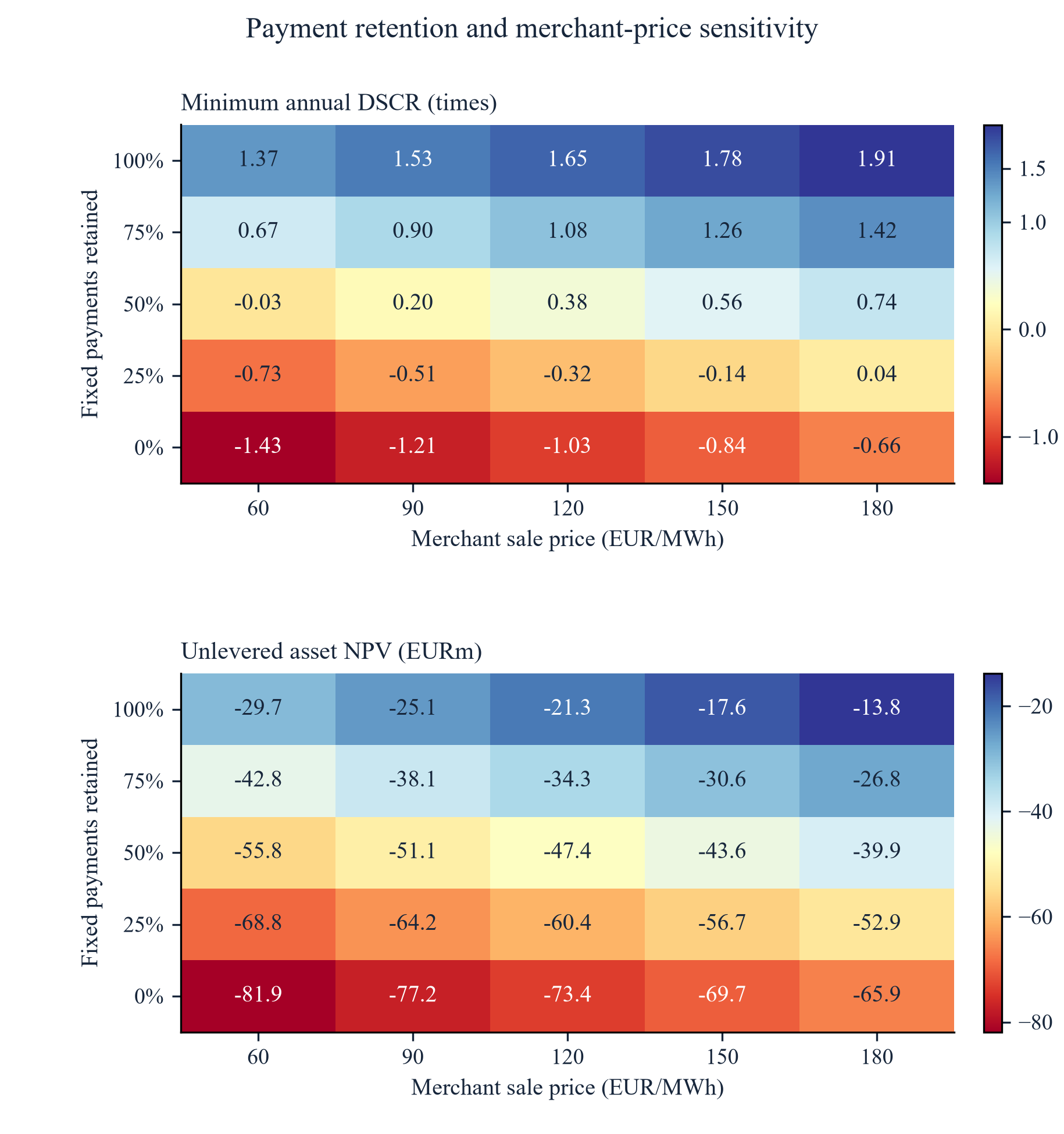
View figure at full size; scroll horizontally on smaller screens.
Dispatch, annual cycles, energy fade and cash are recalculated for each cell. Merchant cycling stops when its fee/loss/wear-screen margin is negative. NPV uses 8%, year-end operating cash, the EUR 8m start-year-six augmentation at time 5 and EUR 1m year-ten working-capital return. No probability or market forecast is attached.
20 Read the reproducible result within its limits
The calculation package separates configuration, hourly dispatch, annual cases, debt amortisation, sensitivity and manuscript tables. Re-running the declared inputs reproduces the same arithmetic. Checks cover power claims, stored-energy identities and bounds, reserve sustain, mutually exclusive charging and discharging, daily inventory restoration, cycle limits, separate energy-revenue attribution and funded augmentation. Additional checks reconcile opening debt to service present value, principal to the original draw, sources to uses, annual cash balances and unlevered discount timing.
The reserve screen includes both the ordinary day and a fully activated capacity-call day in every representative year. An infeasible 160 MW power stack has no calculated revenue. A negative merchant margin switches off discretionary cycling while service obligations continue. Payment-loss sensitivities retain mandatory costs and expose funding needs. These conventions make the source of each result inspectable.
The package remains a simplified authored model. Actual settlement lags, collateral calls, intra-year liquidity, charging-network restrictions, sub-second response, market accreditation and contract enforceability are unverified. Decommissioning, recycling and site-restoration liabilities are unestimated and excluded, together with other replacement costs beyond the single stated augmentation. The zero terminal-value assumption supplies no funding allowance for those liabilities.
For a transaction, the next evidence would be the executed product contracts and operating hierarchy, engineering-validated energy and power envelopes, measured efficiency and auxiliary consumption, interval prices and activations, lifecycle quotations, tax advice and an appropriately dated collection ledger. Each input would enter the same physical and cash boundary before it supported revised debt capacity. The present case establishes a reproducible calculation architecture under its disclosed assumptions.
Table 13. Valuation and scope reconciliation
| Item | Treatment or value |
|---|---|
| Initial capex plus working capital | 61.000 |
| Start-year-six augmentation purchase | 8.000 at time 5 |
| Year-ten working-capital return | 1.000 |
| Resale and terminal energy recovery | 0.000 |
| Internal reserve transfers in asset DCF | Excluded |
| Debt and DSRA in asset DCF | Excluded |
| Base asset NPV at 8% | -13.807 |
| Decommissioning and restoration | Unestimated; excluded |
Hypothetical EURm. Operating cash is year-end; augmentation is at the start of year six, time five.
21 Contract the dispatch hierarchy and payment boundary
A financing proposal should identify who may commit the battery in each interval and who bears the cost of that commitment. The operating schedule should translate each contract into reserved power, stored energy, permissible charging and a restoration deadline. If two counterparties can independently instruct the same equipment, the documents need a priority rule and a procedure for declining incompatible instructions. The financial model should apply that rule before calculating either party's payment.
The proposed contracting test has four parts. First, define the payment at the borrower's boundary, including deductions, netting and reimbursement. Second, specify the physical obligation that earns it. Third, identify the party responsible for restoring state of charge and paying for losses. Fourth, specify what happens after an interruption or termination. The result is a set of traceable cash flows and obligations that counsel, the engineer and the market adviser can review together.
The hypothetical model's fixed payments and charging-cost reimbursement are assumed contract terms. Their value depends on performance, payer credit and enforceability. A real financing would require executed documents, credit assessment, an agreed deductions schedule and evidence of payment capacity. An optimiser's forecast or indicative proposal would leave those questions unresolved. Legal review should also establish whether an account-control or direct agreement gives lenders practical continuity following default.
Operating discretion should be bounded by the funded lifecycle plan. The optimiser needs access to updated capacity tests, warranty consumption and reserve requirements. An additional trade can be attractive on immediate cash margin while consuming energy needed for a contracted event or advancing augmentation. A proposed approval rule should test both effects using the same dispatch record. Required maintenance and replacement funding should enter the cash waterfall before discretionary distributions.
22 Reconcile acquisition value to operating evidence
A purchaser should reconstruct a sample of operating periods from original meter data, accepted bids, activation records and settlement statements. The review should bridge recorded market receipts to cash received by the project company. It should identify amounts retained by an optimiser, charging costs paid elsewhere, disputed settlements and payments attributable to another asset. A seller's aggregate trading margin provides an incomplete valuation input when these boundaries are unresolved.
The technical review should pair revenue history with energy-capacity tests, temperature records, throughput and warranty terms. The buyer should examine whether the historical dispatch pattern can continue within the remaining equipment life and contractual obligations. A proposed forecast should show the capacity trajectory, augmentation expenditure and operating downtime used to reproduce future service eligibility. The funding source for that expenditure belongs in the transaction model.
For a contracted acquisition, valuation should distinguish the current contract period from renewal assumptions. A payment may cease before the debt matures, or an assignment may require consent. The purchaser should test changes of control, termination rights, collateral requirements and replacement-provider access. Any value assigned to an extension should carry its additional capital requirement and approval conditions. A perpetual terminal multiple would need separate justification for a battery with finite energy capacity and time-limited rights.
The numerical cases in this paper support a method comparison. They do not provide a valuation benchmark for an operating BESS. A project-specific value would require location-specific chronology, applicable tariffs, verified engineering parameters, tax advice and executable contracts. The acquisition decision should therefore reconcile the seller's valuation to the buyer's evidenced dispatch and cash-flow case, identifying each difference in quantity, price, cost, obligation or duration.
23 Allocate risks and monitor the borrowing base
The proposed operating report should retain the distinction between eligible capacity, committed capacity, delivered energy and settled revenue. Availability alone cannot describe the amount of energy remaining after an activation. A useful lender report would show the relevant obligation, the measured operating position and the resulting cash or covenant effect. Exceptions should be investigated against their original interval records.
Table 14. Proposed risk allocation and verification schedule
| Risk | Evidence to request | Proposed responsible party | Financing response to test |
|---|---|---|---|
| Conflicting commitments | Accepted bids and dispatch hierarchy | Owner and optimiser | Remove incompatible revenue; revise limits |
| Energy or power shortfall | Capacity tests and interval state of charge | Operator and technical adviser | Recalculate deliverable services and deductions |
| Lifecycle funding gap | Warranty record and augmentation budget | Owner and equipment supplier | Fund reserves; restrict distributions |
| Payment or optimiser default | Contract, credit support and settlement data | Counterparty and owner | Replacement rights and liquidity stress |
| Accreditation or rule change | Applicable rules and qualification record | Market adviser and owner | Reprice eligible MW and debt tenor |
| Settlement or data discrepancy | Meter data, invoices and bank receipts | Operator and finance team | Reconcile cash; review disputed exposure |
Author's proposed diligence structure. Actual responsibilities, remedies and security depend on executed contracts and applicable law.
The annual debt schedule should remain linked to the current capacity and contract case. Deteriorating usable energy, a lower contracted minimum or an additional fixed cost can alter coverage even when nameplate power is unchanged. Reporting should identify the effect on cash available for debt service, reserve balances and the remaining debt repayment path. A covenant certificate should use definitions consistent with the original financing model.
For merchant exposure, the report should separately show the assumed and realised charging price, sale price, traded volume, energy loss and fee. Combining these into one revenue variance obscures the decision that caused the change. The proposed review would also distinguish a price shortfall from deliberate curtailment of uneconomic trading. The latter may preserve cash and cycle life while reducing gross receipts.
24 Conclusions and research limitations
Battery financing requires a common accounting boundary for physical delivery, settlement and borrower cash. A revenue line earns its place in the debt case when its operational requirements, payment entitlement, costs and downside treatment are explicit. The model developed here provides a transparent way to examine those relationships and the amount of capital supported by assumed minimum payments.
Its results remain conditional on the authored inputs. The representative-day chronology cannot establish the frequency or severity of real scarcity events. Annual availability and degradation simplify within-year changes. The assumed contract payments, reimbursement, tax cash charge, augmentation budget and financing terms have no empirical calibration to a named project. The valuation has a finite forecast period and the stated terminal treatment. It should be read together with those boundaries.
A project-specific extension should use chronological market and activation data, engineering-validated capacity and degradation, actual settlement rules and an executed contract register. It should test clustered events, connection outages, forecast error, delayed payments, augmentation downtime and correlated market changes. The analyst should retain the rejected revenue combinations and the reasons for rejection, so later iterations preserve the same physical and contractual constraints.
The financing decision follows from the cash that survives those constraints. Fixed payments can support debt only for the obligations and period underwritten. Additional merchant value should retain its dispatch cost, lifecycle consequence and uncertainty. A complete investment case should show required equity, liquidity and replacement expenditure alongside debt capacity, with every proposed source of value traceable to a feasible service and a payment right.
References
- FERC. FERC Issues Final Rule on Electric Storage Participation in Regional Markets (2018-02-15). https://www.ferc.gov/news-events/news/ferc-issues-final-rule-electric-storage-participation-regional-markets. Accessed 2026-10-11.
- PJM. 2025 PJM Effective Load Carrying Capability and Reserve Requirement Study (ELCC/RRS) (2025-10-22). https://www.pjm.com/-/media/DotCom/planning/res-adeq/elcc/2025-pjm-elcc-rrs.pdf. Accessed 2026-10-11.
- California ISO Department of Market Monitoring. 2024 Special Report on Battery Storage (2025-05-29). https://www.caiso.com/documents/2024-special-report-on-battery-storage-may-29-2025.pdf. Accessed 2026-10-11.
- Department for Energy Security and Net Zero. Informal consolidation of Capacity Market Rules July 2026 (2026-07). https://assets.publishing.service.gov.uk/media/6a68894dcc35a9471da4c18f/capacity-market-rules-consolidation-2026.pdf. Accessed 2026-10-11.
- National Energy System Operator. Capacity Market. https://www.neso.energy/what-we-do/energy-markets/electricity-market-reform-emr-delivery-body/capacity-market. Accessed 2026-10-11.
- National Energy System Operator. Dynamic Response Services: Provider Guidance v.14 (2026-06). https://www.neso.energy/document/276606/download. Accessed 2026-10-11.
- National Energy System Operator. Response Services: Service Terms (2026-07-23). https://www.neso.energy/document/384606/download. Accessed 2026-10-11.
- Australian Energy Market Operator. Integrating Energy Storage Systems project. https://www.aemo.com.au/initiatives/major-programs/nem-reform-program/nem-reform-program-initiatives/integrating-energy-storage-systems-project. Accessed 2026-10-11.
- Australian Energy Market Operator. Market ancillary service specification (2024-06-03). https://www.aemo.com.au/-/media/files/electricity/nem/security_and_reliability/ancillary_services/2024/market-ancillary-services-specification---v82-effective-3-june-2024.pdf?rev=d22d0dc2594e40578abeae44670a0b28&sc_lang=en. Accessed 2026-10-11.
- Australian Energy Market Operator. Energy Limit in BDU Bids (2026-07-31). https://markets-portal-help.docs.public.aemo.com.au/Content/EMMSenergyFCAS/BDU_Energy_Limit.htm?TocPath=Energy+Market+Management+System+(EMMS)%7COffers+%26+Submissions%7CEnergy,+FCAS+and+MNSP+Bids%7C_____3. Accessed 2026-10-11.
- Australian Energy Market Operator. Quarterly Energy Dynamics Q2 2026 (2026-07-28). https://www.aemo.com.au/-/media/files/major-publications/qed/2026/qed-q2-2026.pdf?hash=E46DFE92689FE582EB708D5647453DD6&rev=5cfa9aa6b7b6490ab22a13de588f9a66&sc_lang=en. Accessed 2026-10-11.
- National Laboratory of the Rockies. Battery Lifespan. https://www.nlr.gov/transportation/battery-lifespan. Accessed 2026-10-11.
- Australian Energy Market Operator. Battery Energy Storage System guide to Contingency FCAS registration (2026-09-02). https://www.aemo.com.au/-/media/files/stakeholder_consultation/consultations/nem-consultations/2026/fcas-registration-guides-consultation/bess-guide-for-contingency-fcas-registration-v50.pdf?rev=ae32400a98d44de6b204ba33e2837546&sc_lang=en. Accessed 2026-10-11.
- Department of Climate Change, Energy, the Environment and Water. Guide to assessing eligible contracts under the Capacity Investment Scheme Agreement. https://www.dcceew.gov.au/sites/default/files/documents/guide-assessing-eligible-contracts-cisa.pdf. Accessed 2026-10-11.
- Ofgem. Ofgem boosts long duration storage to secure more homegrown energy for customers (2026-06-26). https://www.ofgem.gov.uk/press-release/ofgem-boosts-long-duration-storage-secure-more-homegrown-energy-customers. Accessed 2026-10-11.
About the Author
Chennakeshav (CK) is a corporate finance and investment banking executive with 25+ years of global experience in deal origination, structuring and execution across M&A, growth capital and corporate strategy. He has led value-creation mandates for founders, corporates and funds — bridging the boardroom view to hands-on execution and close.
His career spans Morgan Stanley, HSBC, Lloyds Banking Group, EWEC, ADQ portfolio companies and Emirates Growth Fund, across TMT, real estate, fintech, deeptech, cleantech, infrastructure and energy. He has partnered with C-suite leaders, private equity and venture funds, sovereign wealth funds and family offices to finance complex fund raises and scale-up ventures, and has led M&A due diligence, post-merger integration and business-transformation initiatives to create value.
At Matchpoint Partners he is Managing Partner, leading the firm's corporate finance, M&A and capital-raising practice. He holds an MBA from London Business School, an engineering degree from VTU and a Master of Laws (LLM, in progress) from UCL London.
An active start-up mentor, CK mentors at Techstars, DIFC FinTech Hive, Startup Grind, Founder Institute and IN5, serves as Entrepreneur Mentor in Residence (EMiR) at London Business School, and judges the Entrepreneurship World Cup.
https://www.linkedin.com/in/ckadya/
https://www.matchpoint-partners.com/team/ck-adya.html
Disclaimer
This paper is part of a continuing series on the structure of private and alternative markets. The views expressed are the author's own. The paper is for information only, describes market structure in general terms, and does not constitute investment, legal, tax or regulatory advice or a recommendation in respect of any security, vehicle or counterparty.
