

1. Revenue design determines whether storage is financeable
A battery does not create revenue merely because it can respond quickly. Revenue appears when a defined buyer values a service, the project holds the right to provide it, measurement can prove delivery, and settlement converts performance into cash. These conditions are especially important in Gulf systems where vertically integrated utilities, single buyers, regulated networks and developing market arrangements coexist.
The physical asset can provide several services. It can shift solar output into evening demand, reserve dependable power for peaks, respond to frequency deviations, support voltage, relieve a network constraint, reduce renewable curtailment and assist restoration. The commercial structure must decide which services are contracted, which remain optional, who controls dispatch and how competing uses are prioritised.
The International Energy Agency reported that energy shifting represented more than 90 percent of new battery projects by primary application in 2025, while ancillary services represented about 7 percent. Early batteries often relied on lucrative but shallow ancillary markets. Growing deployment has increased the importance of larger-volume energy shifting and capacity value. Gulf revenue design should reflect this change while recognising local institutional structures.
2. Start with the power system rather than a generic market template
Each Gulf jurisdiction has its own procurement, dispatch, tariff, grid-code and settlement arrangements. A structure designed for an energy-only market can fail in a system where a single buyer schedules generation and pays contracted availability. A pure availability contract can also leave valuable fast-response and network capabilities unused.
The first task is to map the system. The map should identify the electricity buyer, system operator, transmission owner, market operator, balancing authority, connection counterparty, renewable generator, large consumer and regulator. It should state which party incurs fuel cost, curtailment cost, reserve cost, outage cost and network reinforcement cost. A service has an economic buyer when one of these parties can retain a measurable benefit and has authority to procure it.
The framework in this paper therefore begins with avoided system cost and required system outcomes. It then converts those benefits into payment products that match current law and operating arrangements. Market development can expand the set of products later. The project should remain viable under the rules that exist at financial close.
3. Current Gulf projects show several commercial pathways
Abu Dhabi provides two distinct signals. Emirates Water and Electricity Company issued a request for proposals in July 2024 for a standalone 400 MW battery project with up to 800 MWh of storage. Masdar and EWEC also developed a round-the-clock project combining 5.2 GW of solar photovoltaic capacity with 19 GWh of battery storage to deliver 1 GW of continuous renewable power. Masdar announced financial close in 2026 for total investment of USD 6.1 billion.
Oman introduced the region's first wholesale electricity spot market in 2022. Nama Power and Water Procurement's 2025-2031 seven-year statement describes storage evaluation for capacity planning and peak shaving as renewable penetration rises. Its storage study also identifies ancillary services as an important role. Oman therefore illustrates a system where contracts, spot settlement and future flexibility products can interact.
Saudi Electricity Company reported 8 GWh of commissioned battery storage at four sites by mid-2025 and a further 14 GWh under development. Saudi connection standards require battery systems to support power-system frequency and voltage stability and define operating and disconnection requirements. The physical capability is visible. Commercial remuneration still requires project-specific evidence.
4. Regional trade adds another layer of potential value
The GCC Interconnection Authority facilitates scheduled energy transfers, installed-capacity sharing, operating-reserve contracts and settlement of unscheduled exchanges among member states. Its market platform also supports bilateral contracts and transmission-capacity allocation. These arrangements create a regional setting in which storage may support a national system and influence cross-border trade.
Regional value should be treated carefully. A battery connected within one member system does not automatically hold a right to trade across the interconnector. The project would need transmission access, market eligibility, metering, scheduling, settlement and an accountable counterparty. National reserve obligations and local congestion can also limit export availability.
The strategic implication is still material. A storage contract can preserve optionality for regional products that may develop during the asset life. Change-in-law, market-access and revenue-sharing clauses can describe how future regional income is treated. Debt should rely only on revenues supported by current enforceable rights.
5. Define the service before setting the price
Revenue design often begins with a proposed tariff. A stronger process defines the service first. A capacity product may require a stated MW output for a stated duration during declared events. An energy-shifting product may require charging during specified hours and delivery against an hourly profile. A reserve product may require headroom, response speed, accuracy and sustained delivery. A network product may require availability at a particular node.
The service definition should include dispatch notice, ramp rate, minimum response, event duration, annual call limit, recovery time, metering boundary, baseline, state-of-charge obligation and test procedure. It should also state the consequences of a grid outage, renewable shortfall, force majeure, curtailment instruction and market suspension.
Price follows the obligation. A project that must reserve four hours of discharge every day cannot freely sell the same stored energy elsewhere. Its capacity price must recover the opportunity cost, degradation, charging losses, fixed operating cost and capital cost associated with that commitment.
6. Separate power capacity from energy inventory
Battery value has two dimensions. Power capacity measures the instantaneous rate at which the asset can charge or discharge. Energy capacity measures how long that power can be sustained. A 200 MW / 800 MWh asset has a nominal four-hour relationship, while usable output at the connection point depends on state-of-charge limits, efficiency, auxiliary load, degradation and network losses.
Commercial products should reserve the relevant dimension. Frequency response may reserve a portion of MW capacity and require a state-of-charge band. Energy shifting consumes MWh inventory. Voltage support can use reactive capability and affect inverter headroom. Capacity adequacy reserves both MW and sufficient MWh to survive the required event.
A contract that refers only to MW can overstate deliverability. A contract that reserves all MWh can unnecessarily prevent fast-response services. The dispatch model should allocate both dimensions for every settlement interval.
7. Build the revenue stack from measurable system value
The principal revenue families are capacity availability, delivered energy or energy shifting, operating reserves, frequency response, voltage and reactive support, congestion relief, renewable firming, black start or restoration support, and future market participation. Each family has a different buyer, measurement method and risk profile.
Table 1. Revenue products for a Gulf battery-storage project
| Revenue product | Commercial buyer | Measurement | Payment basis | Principal risk |
|---|---|---|---|---|
| Capacity availability | Single buyer, utility or system operator | Tested MW and sustained MWh during declared windows | Fixed periodic availability payment with deductions | Non-availability, derating and event overlap |
| Energy shifting | Offtaker, renewable project or market participant | Metered charge and discharge by interval | Agreed spread, tolling fee or indexed energy payment | Charging cost, losses, forecast error and degradation |
| Operating reserves | System operator or reserve buyer | Reserved MW, response time and event delivery | Reservation fee plus utilisation payment | Product access, call frequency and saturation |
| Frequency response | System operator | High-resolution response to frequency signal | Availability and performance score | State of charge, telemetry and competition |
| Voltage and reactive support | Network or system operator | Reactive power, voltage response and availability | Fixed service payment or tendered fee | Locational need and inverter headroom |
| Congestion relief | Network owner or system operator | Delivery at constrained node during defined hours | Availability plus event payment | Constraint duration, baseline and network change |
| Renewable firming | Generator or offtaker | Compliance with contracted output profile | Tolling, shaped-energy payment or performance fee | Renewable resource, curtailment and co-optimisation |
| Restoration support | System operator or network | Successful tests and event performance | Readiness fee plus event payment | Rare-event evidence and system dependency |
Product availability depends on local law, procurement rules, grid codes, metering and contractual rights. The table describes design options rather than existing products in every jurisdiction.
The table should be completed with jurisdiction-specific evidence before investment approval. A technical capability that lacks an authorised buyer remains an option. An expected market that lacks rules, metering or settlement should not enter base-case debt sizing.
8. Use availability payments to anchor the contracted case
A periodic availability payment can create a stable revenue base when the system requires dependable capacity or flexibility. The payment compensates the project for keeping tested capability available during defined windows. It can be expressed per available MW, per MW and MWh combination, or as a fixed monthly amount subject to performance deductions.
The definition of availability matters more than the headline rate. It should reflect usable energy at the delivery point, current degradation, ambient temperature, auxiliary consumption, state of charge and connection status. Availability should be tested through scheduled and random demonstrations. A project should receive relief when the system operator prevents charging or dispatches the battery outside the contracted service.
Lenders generally value an availability stream when the buyer is creditworthy, the contract term supports debt maturity, deductions are bounded, termination compensation is defined and dispatch does not cause uncompensated degradation. Equity retains risk where payment depends on untested operating assumptions.
9. Price energy shifting through a transparent toll
Energy shifting converts low-value or surplus electricity into delivery at a later time. The commercial model can use a tolling structure, an indexed spread, a shaped-energy contract or a performance fee. A tolling contract allows the offtaker to supply charging energy and receive discharged energy while paying the battery owner for conversion and availability.
The contract should allocate charging-energy cost, transmission losses, imbalance charges, renewable curtailment, negative prices where applicable, taxes and certificates. It should define whether the owner or offtaker controls charging. It should also specify the reference meter and the treatment of auxiliary consumption.
An indexed spread can preserve price signals, although it transfers more market risk to the project. The index must exist, remain observable and reflect the asset's actual settlement location. Where a liquid index is absent, a transparent avoided-cost formula can use the procurer's marginal fuel, start cost or alternative capacity cost, subject to audit and periodic review.
10. Contract renewable firming as an output obligation
The Abu Dhabi round-the-clock project illustrates a commercial outcome based on continuous renewable delivery. A firming contract can define an hourly, block or minimum output profile and use storage to manage solar variability. The revenue is linked to the delivered profile rather than separate battery arbitrage.
The contract must allocate resource risk. Solar irradiation, module availability, grid curtailment and battery condition all affect output. The project should model the full portfolio and preserve a state-of-charge policy that can meet the profile through the relevant weather distribution. A guaranteed profile that ignores multi-day resource variation can create open-ended exposure.
Payment can combine a fixed capacity component and an energy component. Performance deductions should reflect the value of shortfall and remain proportionate to causes within the project’s control. Relief events should cover instructed curtailment, network unavailability and changes to operating requirements.
11. Design reserve products around scarce response capability
Operating reserves protect the system against forecast error, outages and sudden changes. A battery can respond quickly, although a reserve obligation consumes power headroom and may require stored energy. Products should distinguish upward reserve, downward reserve, spinning replacement, contingency response and restoration reserve.
The procurer should state the minimum bid size, activation time, sustained duration, telemetry resolution, response accuracy and recovery requirements. Technology-neutral specifications allow batteries, demand response and generation to compete where their capabilities are comparable.
Reservation payment should compensate readiness. Utilisation payment should cover delivered energy, cycling and replenishment. A single undifferentiated fee can encourage overuse or understate degradation. The contract should identify whether the project can earn energy-shifting revenue while reserve capacity remains uncalled.
12. Recognise that ancillary-service markets can saturate
The IEA found that early battery projects concentrated on attractive but shallow ancillary services. Battery entry can reduce clearing prices because fast-response supply expands quickly. The value of a reserve product therefore depends on market depth, procurement volume, competing capacity and rule changes.
A revenue model should avoid extending current high prices through the full asset life. It should use volume and price scenarios, entry assumptions, procurement reform and declining scarcity. Where the service is procured bilaterally, the model should test contract expiry and retender risk.
International evidence provides a warning. Increased battery participation has reduced frequency-service costs in mature markets. This is beneficial for consumers and confirms the technology's capability. It also means that project finance should not rely on a permanent scarcity rent.
13. Measure frequency response at high resolution
Frequency response depends on speed and accuracy. Settlement may require second-by-second telemetry or another high-resolution signal, a baseline, deadband, droop setting and performance score. Monthly energy meters cannot prove the service.
The battery-management system, energy-management system, inverter and communications link should use synchronized time. The project should retain raw data and make it available to the system operator, owner and lenders' technical adviser. Data ownership and cybersecurity affect both settlement and dispute resolution.
Payment can include a reserved-MW fee multiplied by a performance factor. The factor can reflect response delay, accuracy and availability. Caps and cure periods should separate minor telemetry defects from sustained inability to perform.
14. Treat voltage support as a locational service
Voltage and reactive-power needs arise at specific network locations. A battery inverter may provide reactive support while charging, discharging or at zero active power, subject to equipment capability and connection rules. The service can reduce losses, improve voltage control and defer network equipment.
Value depends on the node. A national average price can overpay assets where the service is abundant and underpay constrained locations. Procurement can use competitive tenders for defined zones or bilateral contracts where few providers exist.
The commercial model should state the active-power tradeoff. Reactive output may reduce active-power headroom under the inverter's apparent-power limit. Payment should compensate the opportunity cost when the network instruction displaces energy or reserve revenue.
15. Contract congestion relief against a defined alternative
Storage can charge before a constrained period and discharge within the constrained area, reducing loading on a line or transformer. The value can equal deferred reinforcement, avoided redispatch, reduced curtailment or improved connection capacity. The network owner should identify the constraint, forecast need and credible alternative.
A congestion contract should specify location, hours, notice, required MW, required duration and availability season. The payment can combine an annual reservation fee and event compensation. The term should reflect the expected life of the constraint and the timing of planned reinforcement.
Stranded-contract risk appears when network topology changes early. The project can seek minimum-term payments, termination compensation or permission to move and reconnect. The procurer can preserve flexibility through shorter contracts with extension options. The financing model should match the chosen risk allocation.
16. Preserve black-start and restoration evidence
Some battery configurations can support restoration by energising equipment, providing grid-forming control or assisting generator start. The capability is system-specific and requires engineering studies, protection coordination, communications and periodic testing.
A readiness payment can compensate the project for maintaining the configuration and completing successful tests. Event payments should cover energy use and recovery. The contract should avoid promising restoration beyond the battery's proven islanding and fault-current capability.
Rare service calls create an evidence challenge. Acceptance testing and periodic simulations should support payment. The system operator should retain the right to revise restoration plans when the network changes, with agreed treatment of required modifications.
17. Prevent double commitment of the same capability
Revenue stacking fails when two products assume the same MW or MWh at the same time. A battery cannot reserve full discharge capacity for a peak event and simultaneously sell that capacity as upward reserve without a defined priority and probability framework.
The project should maintain an interval-level capability ledger. For each service, the ledger records reserved charge MW, reserved discharge MW, minimum state of charge, maximum state of charge, expected energy use, notice period and priority. It then confirms residual capacity for discretionary dispatch.
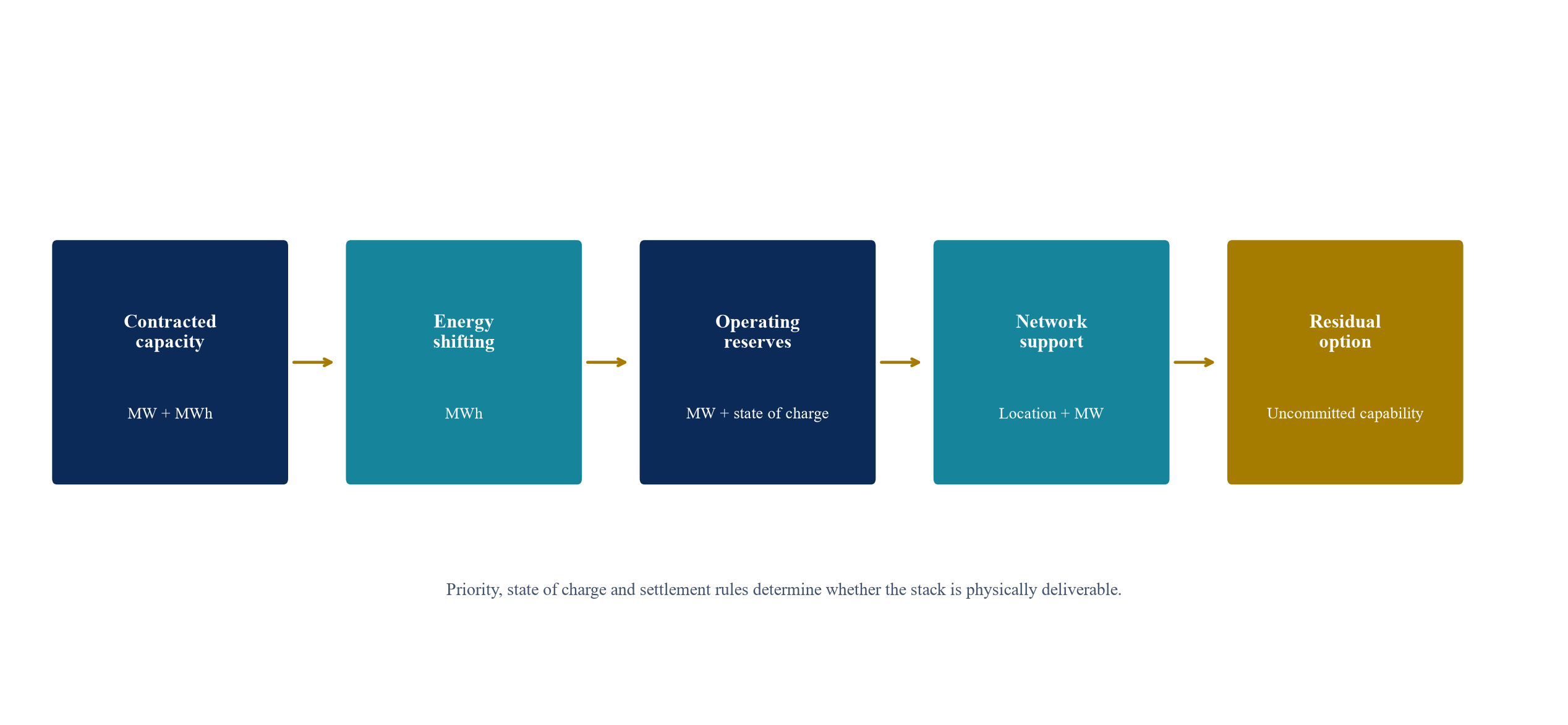
Each commercial product reserves power, energy or both. Residual capability can support additional services only after the priority rules are satisfied.
18. Put dispatch control in one accountable place
The dispatch controller decides how contracted obligations and optional revenues interact. Split control can create conflicting instructions from an offtaker, system operator, trader and network owner. The project needs a hierarchy that preserves safety, grid-code compliance and firm obligations before discretionary optimisation.
The control agreement should state who can send instructions, which signal prevails, how late or invalid instructions are treated, and who bears the cost of a conflicting dispatch. Emergency system instructions can take priority, with compensation determined under the contract.
The owner should preserve access to dispatch data, optimization logic, manual override and audit logs. An external optimizer can improve revenue, while the asset remains accountable for contract delivery and warranty compliance.
19. Convert dispatch into degradation cost
Every cycle consumes a portion of battery life. The cost depends on depth of discharge, state of charge, temperature, power, calendar time and product characteristics. A revenue stream should be valued after the incremental degradation and augmentation it causes.
The commercial model can assign a degradation price per equivalent full cycle or use a detailed state model. The price should change as replacement costs, warranty limits and operating evidence change. Dispatch rights should include annual throughput, state-of-charge and temperature boundaries.
If the offtaker controls dispatch, a throughput allowance and excess-cycling payment can protect the project. If the owner controls dispatch, the owner bears the optimisation tradeoff and should warrant contracted output. The allocation should remain consistent across the operating agreement and financial model.
20. Include charging energy and losses in settlement
Round-trip efficiency converts input energy into lower output energy. Auxiliary loads, transformers, cables and ambient conditions add further losses. A tolling structure should identify who supplies charging energy and who owns the output after losses.
Settlement should use metered charge and discharge at the agreed boundary. Loss factors should be measured rather than fixed for the asset life. The contract can use a guaranteed efficiency curve with bands for power and temperature. Persistent shortfall can trigger damages or augmentation.
Where charging uses curtailed renewable energy, that energy still has an opportunity cost, certificate treatment and metering requirement. The project should avoid describing it as free unless the contract establishes zero transfer price and no displaced alternative use.
21. Match duration to the service portfolio
Duration affects capital cost and revenue access. A two-hour project can provide fast response and some peak shifting. A four-hour project can cover longer evening peaks and capacity events. Longer duration can support renewable firming, although the optimal configuration depends on the shape of demand and renewable production.
The IEA reported that average duration for commissioned utility-scale batteries rose to three hours in 2025 from around two hours in 2023. The shift reflects growing energy-shifting needs. Gulf systems with strong solar production and evening cooling demand may value multi-hour discharge, subject to system-specific load evidence.
The model should calculate marginal value for each additional hour. Additional MWh capacity earns value only when the service needs it and the project can charge it. A flat price per MWh can obscure diminishing utilisation.
22. Set the contract term against useful life and market development
A long contract supports debt and reduces refinancing risk. It can also freeze a product definition while technology and market rules change. The term should cover the period needed to recover committed capital and should include mechanisms for technology replacement, augmentation, market access and change in law.
The contract can divide the asset life into a firm availability period and an extension period. Extension pricing can reflect demonstrated degradation and replacement cost. Market-development clauses can allow new services without impairing the contracted product.
Termination compensation should distinguish buyer default, project default, prolonged force majeure and change in law. Lenders should understand the termination amount, payment timing and security. A nominal right to payment has limited value if appropriation, dispute or enforcement risk is unresolved.
23. Design performance deductions around economic harm
Performance deductions should create an incentive to remain available and deliver accurately. They should be tied to observable failure and proportionate to the value of the missed service. An uncapped deduction formula can make fixed revenue less reliable than it appears.
Capacity contracts can measure monthly availability, event delivery and test performance. Energy-shifting contracts can measure profile deviation, efficiency and shortfall. Reserve contracts can measure response time, accuracy and duration. A cure regime should identify recurring defects and required remediation.
The financial model should apply historical or engineered failure cases, not assume maximum payment. Lenders may size debt to a percentile of expected performance or to a stated deduction envelope.
24. Allocate grid and curtailment risk explicitly
The project cannot perform when the connection is unavailable or the system operator prevents charging. The contract should classify grid outage, curtailment, emergency dispatch and constrained operation. It should state whether the project receives deemed availability, deemed energy or time relief.
Curtailment can create value for a co-located battery when energy would otherwise be lost. It can also remove the charging source when the instruction disconnects the entire facility. The electrical design and grid agreement determine the outcome.
Connection rights should cover import and export separately. A battery that can export but cannot charge from the grid may have limited recovery after an event. A shared export limit can constrain simultaneous renewable production and battery discharge.
25. Use a hypothetical project to test the stack
Consider a hypothetical 200 MW / 800 MWh battery with a 15-year operating period. The project is connected to a Gulf transmission node with rising solar penetration. A utility seeks dependable evening capacity and system reserves. A future network-support tender may emerge, while liquid merchant arbitrage remains limited.
The numerical assumptions below illustrate the method. They do not describe an actual project, tariff, procurement or market. All amounts are expressed as annual revenue index units so that the structure can be evaluated without presenting an unsupported market price.
The project reserves 140 MW and 560 MWh for contracted capacity and evening shifting. It reserves 40 MW within a managed state-of-charge band for operating reserves. Twenty MW remains available for optimization, network tests and operating margin. The exact allocation changes by hour under the capability ledger.
Table 2. Hypothetical annual revenue stack and risk treatment
| Revenue component | Annual index value | Share | Base-case treatment | Downside treatment |
|---|---|---|---|---|
| Availability payment | 62 | 62% | Contracted subject to deductions | Apply availability and counterparty stress |
| Energy-shifting fee | 20 | 20% | Contracted volume and efficiency bands | Reduce dispatch volume and increase losses |
| Reserve readiness | 10 | 10% | Contracted reservation fee | Apply retender and performance risk |
| Reserve utilisation | 3 | 3% | Variable event payment | Exclude from debt case |
| Network-support option | 3 | 3% | Conditional future contract | Equity option only until awarded |
| Merchant optimisation | 2 | 2% | Residual capability after obligations | Exclude from debt case |
| Total | 100 | 100% | Weighted contracted and variable cash flow | Contracted downside plus zero unproven income |
Index values illustrate contract architecture only. They are not forecasts, tariffs or observed GCC market prices.
26. Size debt to contracted downside cash flow
The table separates stable, variable and contingent income. A lender can test the availability and energy-shifting components under deductions, lower throughput, efficiency loss, degradation and buyer stress. Reserve readiness may enter the debt case where contract term and retender risk are acceptable. Utilisation, future network services and merchant optimization can remain equity upside.
Debt service should be covered after operating cost, augmentation reserves, taxes, insurance, major maintenance and working capital. The model should preserve a liquidity reserve for delayed settlement and performance disputes. A sculpted amortisation profile can follow contracted cash generation.
The project should avoid capitalising optional income into fixed debt service. Optional income can accelerate debt repayment or fund distributions after performance tests. This hierarchy protects the project when new markets develop later than expected.
27. Value the stack through correlated scenarios
Revenue streams are not independent. A high-price evening may coincide with a capacity event and reserve scarcity. The battery cannot collect all theoretical revenues if the same capability is committed. Weather, renewable output, demand and grid conditions affect several products together.
The valuation should use joint hourly scenarios. It should model dispatch priority, state of charge, degradation and settlement for each interval. Correlation should be based on system data where available and transparent assumptions where data are limited.
Stress cases should include low dispatch, high dispatch, low reserve price, connection outage, delayed market access, accelerated degradation, augmentation delay and buyer payment delay. The project should report break-even thresholds for the main uncertain variables.
28. Use break-even analysis for optional revenues
A merchant price forecast can create false precision in a market that lacks depth. Break-even analysis asks what observable condition is required for the option to add value. For energy trading, the threshold can be the spread needed after losses and degradation. For reserve entry, it can be the annual payment required after integration cost and reserved headroom.
Network-support value can be compared with the cost and timing of the deferred upgrade. Regional trade can be compared with transmission access and settlement cost. The option should be exercised only when the evidence exceeds the threshold.
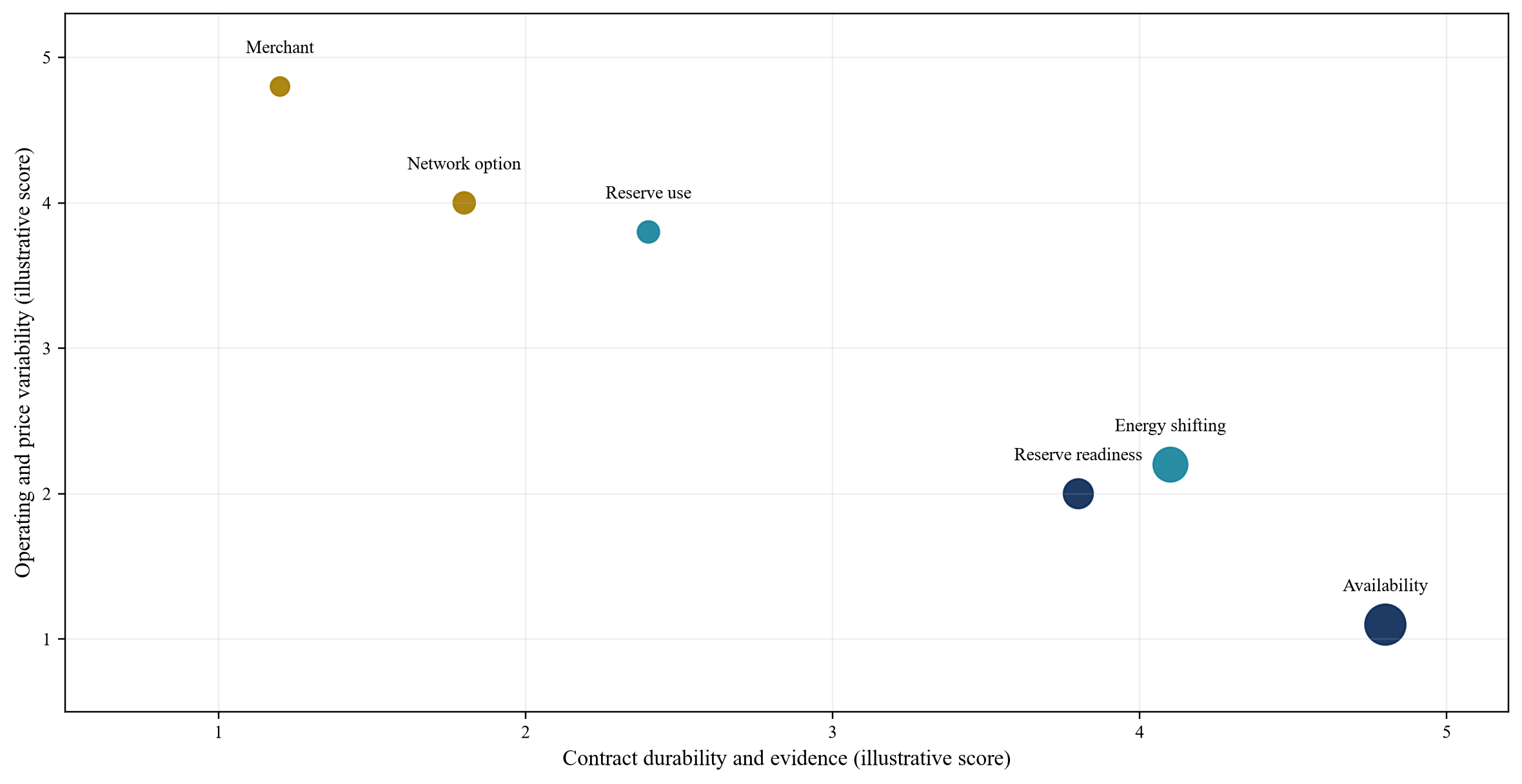
Positions are illustrative. Contract evidence and local rules determine the actual profile for a project.
29. Reconcile the revenue model with battery warranties
Commercial dispatch can conflict with warranty limits. The warranty may restrict annual throughput, equivalent cycles, state of charge, temperature, C-rate and rest periods. A reserve product may require high state of charge, while calendar ageing increases under sustained high charge.
The financial model, optimizer and warranty should use the same operating envelope. The project should obtain a duty-specific degradation forecast and confirm how warranty capacity is measured. Exclusions, response time and remedy should be understood before revenue is contracted.
Augmentation should restore contracted power and energy. The project can fund it through an upfront reserve, periodic reserve, supplier commitment or owner support. Revenue design should avoid penalties that assume permanent nameplate capacity without recognizing the agreed augmentation plan.
30. Align metering, data and settlement
Each product needs a settlement meter and data frequency. Energy shifting may use revenue-grade interval meters. Frequency response may require sub-second telemetry. Availability may depend on tests, state of charge and control-system records. Network services may require nodal measurements.
The contract should establish a data hierarchy, validation process, estimation method and dispute window. Missing data should not give one party unlimited discretion. Independent calibration and audit rights support financeability.
Settlement timing affects working capital. Monthly invoices may include preliminary values followed by true-up after validated data. The project should model payment lags, disputed amounts and credit support. A complex stack can create several invoice streams unless the parties build a single settlement statement.
31. Allocate counterparty credit by revenue stream
The availability buyer, energy offtaker, reserve procurer and market operator may be different entities. The project should assess each counterparty's legal obligation, credit quality, payment history, security and termination regime. Sovereign ownership does not by itself establish a sovereign guarantee.
Credit support can include letters of credit, escrow, parent guarantees, payment reserves and direct agreements. The protection should match the payment cycle and replacement time. A short letter of credit may provide little support if a default leads to a long retender.
The project should also consider set-off. A buyer that controls several revenue streams may deduct disputed amounts from otherwise undisputed payments. Contracts can limit set-off and require payment of the undisputed portion.
32. Keep procurement technology neutral and outcome specific
A procurer can invite competition by specifying the system outcome rather than a preferred battery product. The tender can define location, delivery point, MW, MWh, response, availability, efficiency, operating windows, telemetry, safety, environmental and end-of-life requirements.
Bidders should submit a normalized revenue requirement and operating envelope. Evaluation can compare fixed payment, expected variable payment, degradation allocation, network cost, delivery schedule, security package and residual value. A low tariff with narrow operating rights can cost more at system level.
The tender should disclose the data needed to price the service. Load shape, renewable profile, event history, connection constraints and dispatch assumptions materially affect bids. Bidders will price uncertainty when the procurer withholds critical information.
Table 3. Contract controls for a financeable storage revenue stack
| Risk | Evidence before commitment | Contract control | Financing response |
|---|---|---|---|
| Service overlap | Interval capability ledger and dispatch simulation | Priority rules and prohibition on double commitment | Size debt only to physically deliverable revenues |
| Availability shortfall | Acceptance tests and degradation forecast | Tested availability definition, deductions and cure | Apply downside availability and funded reserve |
| Excess degradation | Duty-specific model and warranty confirmation | Throughput limits and excess-cycling compensation | Augmentation reserve and distribution test |
| Grid constraint | Executed connection rights and outage history | Deemed availability, relief events and compensation | Connection outage stress and liquidity reserve |
| Settlement dispute | Meter map, data hierarchy and sample statement | Validation, estimation, audit and dispute timetable | Working-capital buffer and limited set-off |
| Market-access delay | Licence, registration and product eligibility | Conditions precedent and long-stop date | Exclude unproven revenue from debt case |
| Buyer default | Credit review and payment-security package | Letter of credit, guarantee and direct agreement | Counterparty limits and termination-value stress |
| Rule change | Regulatory map and change scenarios | Change-in-law relief and future-market allocation | Scenario valuation and refinancing covenant |
The control package should remain consistent across the service contract, dispatch protocol, financial model and financing documents.
33. Use competitive procurement for scarce bilateral services
Some services may have too few qualified providers for a continuous market. Black start, voltage support and locational congestion relief can be procured through periodic competitive tenders. The product should remain transparent even when bilateral contracting is necessary.
The procurer can publish need, location, technical specification, evaluation method and contract term. It can retender periodically as competition develops. Cost disclosure and performance reporting can support regulatory oversight without revealing protected bidder information.
Longer contracts can be appropriate for new capital investment. Shorter contracts may suit existing assets. The procurement should distinguish these cases so that an incumbent operating asset does not set the financing standard for a greenfield project.
34. Design change-in-law and market-development clauses
Storage markets can change during a 15-year asset life. New reserve products, aggregation rules, cross-border trade, nodal pricing or capacity mechanisms may create revenue. New charging, network or licensing rules may also add cost.
The contract should classify discriminatory, project-specific and general changes in law. Relief can include tariff adjustment, cost pass-through, term extension or termination where the impact is material. The process should require evidence and mitigation.
Future-market clauses should allocate incremental revenue after incremental cost. The contracted buyer may receive a share where it funded the asset or releases capacity. The owner should retain an incentive to develop the opportunity. The clause should preserve core obligations and avoid double recovery.
35. Address tax, accounting and regulatory classification
Battery charging and discharging can be treated differently across legal regimes. Questions can include whether the asset is generation, consumption, network equipment or a hybrid; whether charging incurs network charges; how energy is purchased and resold; and how certificates and emissions attributes are treated.
The project should obtain jurisdiction-specific legal, tax and accounting advice. The revenue model should map each payment to the contract, invoice, tax treatment and financial-statement classification. Unclear classification can affect cash tax, value-added tax, withholding, licensing and covenant calculations.
Regulated network ownership can raise competition and cost-recovery questions. A network-supported project should state whether the asset enters the regulated base, operates under a service contract or remains an independent project.
36. Test inflation, foreign exchange and indexation
Battery projects may incur capital and replacement costs in foreign currency while receiving local-currency revenue. Operating costs, insurance, wages and augmentation may follow different inflation measures. A fixed nominal tariff can lose coverage over time.
Indexation should match the cost base without transferring unrelated commodity exposure to the buyer. The contract can use weighted local and foreign indices, subject to floors, caps and rebasing. Replacement and augmentation cost may need a separate adjustment.
The model should test currency depreciation, basis mismatch and index publication changes. Hedging cost and availability should enter the financing case. A contract denominated in a stable currency still requires evidence that payment and convertibility are enforceable.
37. Build an operating reserve for settlement and performance
Revenue stacking creates timing and dispute risk. A project may pay for charging energy before receiving availability and utilisation payments. Performance deductions may be calculated after the operating month. Network-service true-ups can arrive later.
The project should size working capital for the actual settlement calendar. It should also maintain a performance reserve for expected deductions, testing and minor remediation. The reserve should be linked to scenario cash flows rather than a generic percentage.
Distribution tests can protect liquidity. Equity distributions can require minimum state-of-health, reserve funding, no unresolved material default and forward debt-service coverage. These controls align the asset's physical condition with financial extraction.
38. Prepare the data room around revenue evidence
The data room should contain procurement documents, executed contracts, licences, grid studies, connection agreements, dispatch protocols, product definitions, meter specifications, settlement procedures, historical system data, degradation models, warranties, insurance and tax advice.
Every model input should link to a source. Contracted revenue should link to executed terms. Market revenue should link to current rules and observed prices. Network value should link to the constraint and alternative investment. Scenario assumptions should be clearly identified.
Version control matters because commercial and technical documents interact. A change to duration, connection rights or reserve obligation can alter the entire revenue stack. The transaction team should maintain a decision log and a single assumptions register.
39. Apply eight approval gates
The investment process should confirm system need, service definition, market and legal access, physical capability, dispatch and degradation, contracts and settlement, financeability, and exit transferability. Each gate should have required evidence, decision owner and failure response.
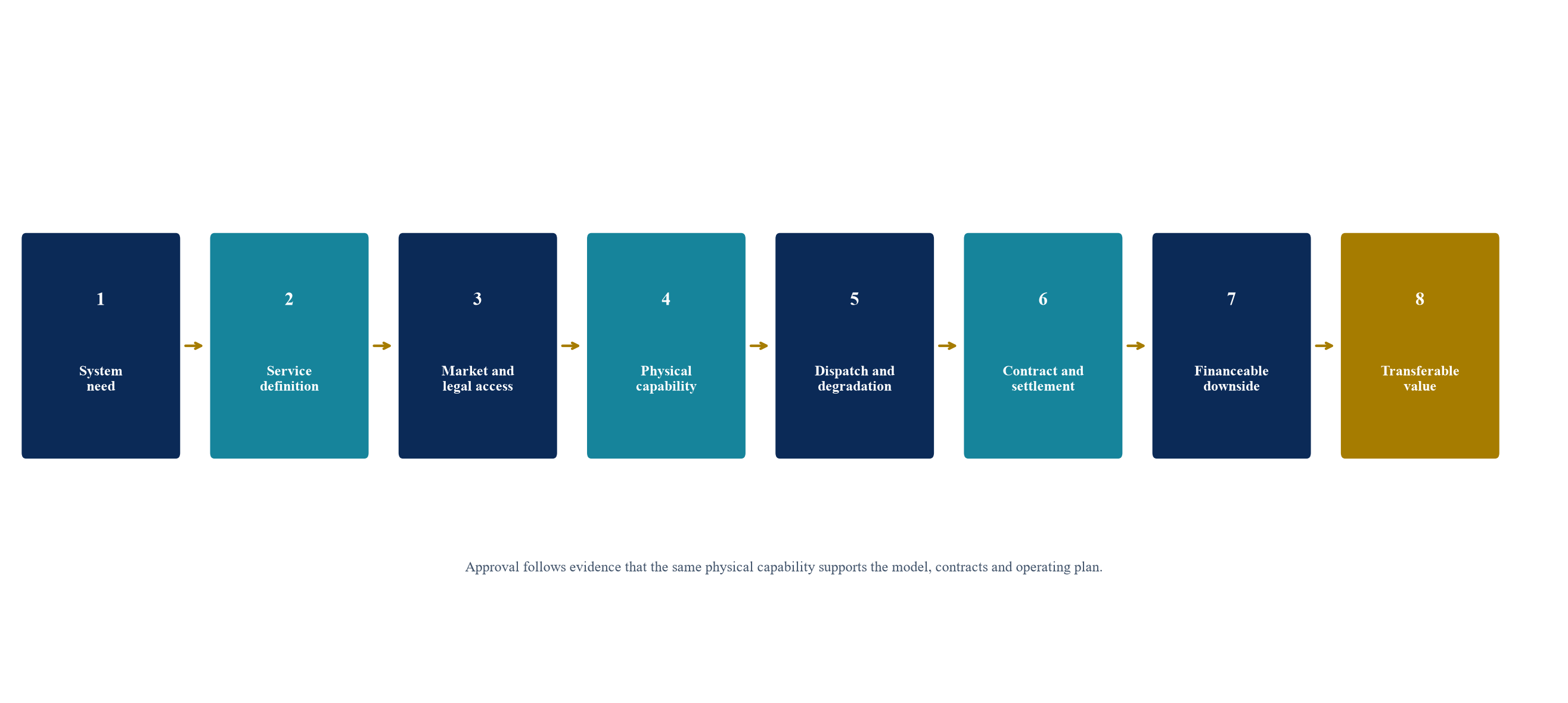
The process moves from system need to transferable contracted value. Conditional approval should identify evidence, owner and deadline.
40. Plan for refinancing and exit
A buyer or lender will test whether the revenue stack transfers with the asset. Change-of-control consent, market registration, dispatch contracts, software licences, warranties, data rights and connection agreements should be assignable or replaceable.
Refinancing value depends on operating evidence. A project that demonstrates availability, efficiency, degradation, reserve performance and settlement discipline can reduce uncertainty. The owner should preserve raw data and audited calculations from commissioning.
Optional revenues should be presented separately from contracted cash flow. A buyer can value them using its own view of market development. Clear separation reduces the risk that headline revenue hides fragile assumptions.
41. Recognise limits and research needs
Public information does not disclose every commercial term for Gulf battery projects. This paper does not claim that every revenue product described here is currently available in every GCC jurisdiction. It uses published procurement, grid, planning and market evidence to develop a structured design method.
Further research should publish comparable data for reserve volumes, activation, battery performance, curtailment, congestion and settlement. Regulators and procurers can improve investment efficiency by disclosing historical service need and standardising product definitions.
The hypothetical project demonstrates a financing method. It does not estimate the tariff, return, tax treatment or preferred structure for a specific asset. Project decisions require current legal, regulatory, technical, insurance, tax and financing advice.
42. Conclusion
Gulf battery storage needs revenue structures that reflect the region's actual power systems. A project can combine availability, energy shifting, reserve readiness, utilisation and network support when the commercial rights match physical capability. Every stream should identify its buyer, measurement, settlement, priority and degradation cost.
A durable structure uses contracted availability to support fixed obligations, performance-linked payments to preserve operating discipline, and carefully bounded optionality for developing markets. The dispatch controller and capability ledger prevent double commitment. The downside model excludes income that lacks enforceable access or a credible buyer.
This framework allows utilities to procure measurable system outcomes and investors to distinguish contracted value from future opportunity. The resulting project can adapt as Gulf power markets develop while preserving the obligations that support finance.
References
- International Energy Agency, Battery Storage Is Scaling Up and Taking on a Larger System Role, 2026. https://www.iea.org/commentaries/battery-storage-is-scaling-up-and-taking-on-a-larger-system-role
- International Energy Agency, Global Energy Review 2026: Technology: Battery Storage, 2026. https://www.iea.org/reports/global-energy-review-2026/technology-battery-storage
- International Energy Agency, Electricity 2026: Flexibility, 2026. https://www.iea.org/reports/electricity-2026/flexibility
- International Energy Agency, Introduction to System Integration of Renewables: Market and System Operation, 2020. https://www.iea.org/reports/introduction-to-system-integration-of-renewables/market-and-system-operation
- International Energy Agency, Introduction to System Integration of Renewables: Technology Options, 2020. https://www.iea.org/reports/introduction-to-system-integration-of-renewables/technology-options
- International Energy Agency, World Energy Investment 2020: Energy Financing and Funding, 2020. https://www.iea.org/reports/world-energy-investment-2020/energy-financing-and-funding
- International Renewable Energy Agency, Electricity Storage Valuation Framework, 2020. https://www.irena.org/publications/2020/Mar/Electricity-Storage-Valuation-Framework-2020
- Emirates Water and Electricity Company, Round The Clock Project, accessed September 2026. https://ewec.ae/under-construction
- Emirates News Agency, EWEC Issues Request for Proposals for Developing 400 MW Battery Energy Storage System, 25 July 2024. https://www.wam.ae/en/article/14181pg-ewec-issues-request-for-proposals-for-developing
- Masdar, UAE President Witnesses Launch of Large-Scale 24/7 Solar PV and Battery Storage Project, 14 January 2025. https://masdar.ae/en/news/newsroom/uae-president-witnesses-launch-of-worlds-first-24-7-solar-pv-battery-storage
- Masdar, Masdar Reaches Financial Close for Gigascale 24/7 Clean Energy Project, 2026. https://masdar.ae/en/news/newsroom/masdar-reaches-financial-close-world-first-gigascale-clean-energy-project
- Nama Power and Water Procurement, Power 7 Year Statement 2025-2031, 2025. https://www.omanpwp.om/storage/files/1/7-year-statement/696087c603ae3.pdf
- Nama Power and Water Procurement, Oman Electricity Market, accessed September 2026. https://omanpwp.om/oman-electricty-market
- Nama Power and Water Procurement, Optimum Energy Mix and Storage Options Study, 2025. https://omanpwp.om/storage/files/1/68124d2923770.pdf
- Saudi Electricity Company, H1 2025 Results Presentation, 2025. https://www.se.com.sa/-/media/sec/Investors/Financial-Results/SEC-H1-2025-Results-Presentation-english-12-08-2025.ashx
- Saudi Electricity Company, Standards for Connection of Battery Energy Storage Systems, 2022. https://www.se.com.sa/-/media/sec/Sustainability/Renewable-Energy/ProcAndGuides/Battery-Energy-Storage/Standards-for-Connection-of-BESS.ashx
- Saudi Electricity Company, Connection Guidelines for Battery Energy Storage Systems, 2022. https://www.se.com.sa/-/media/sec/Sustainability/Renewable-Energy/ProcAndGuides/Battery-Energy-Storage/Connection-Guidelines-for-BESS.ashx
- Saudi Electricity Regulatory Authority, Saudi Arabian Grid Code, 2026. https://sera.gov.sa/-/media/760cb4c6f4d7482fbae4325f53e035d1.ashx
- GCC Interconnection Authority, GCC Power Trade Market, accessed September 2026. https://gccia.com.sa/gcc-power-trade-market/
- GCC Interconnection Authority, Interconnection Benefits, accessed September 2026. https://gccia.com.sa/gccia-grid/interconnection-benefits/
About the Author
Chennakeshav (CK) is a corporate finance and investment banking executive with 25+ years of global experience in deal origination, structuring and execution across M&A, growth capital and corporate strategy. He has led value-creation mandates for founders, corporates and funds — bridging the boardroom view to hands-on execution and close.
His career spans Morgan Stanley, HSBC, Lloyds Banking Group, EWEC, ADQ portfolio companies and Emirates Growth Fund, across TMT, real estate, fintech, deeptech, cleantech, infrastructure and energy. He has partnered with C-suite leaders, private equity and venture funds, sovereign wealth funds and family offices to finance complex fund raises and scale-up ventures, and has led M&A due diligence, post-merger integration and business-transformation initiatives to create value.
At Matchpoint Partners he is Managing Partner, leading the firm's corporate finance, M&A and capital-raising practice. He holds an MBA from London Business School, an engineering degree from VTU and a Master of Laws (LLM, in progress) from UCL London.
An active start-up mentor, CK mentors at Techstars, DIFC FinTech Hive, Startup Grind, Founder Institute and IN5, serves as Entrepreneur Mentor in Residence (EMiR) at London Business School, and judges the Entrepreneurship World Cup.
LinkedIn: https://www.linkedin.com/in/ckadya/
Profile: https://www.matchpoint-partners.com/team/ck-adya.html
