
Introduction
Biochar carbon removal begins with a biological resource and ends with a verified storage claim. Between those points, the project must establish where the biomass came from, what would have happened without the project, how the material was transformed, how much stable organic carbon remains, where the biochar was stored and which emissions arose across the chain. The carbon credit is therefore the output of an operating system and an evidence system.
Feedstock and permanence are linked. Moisture, ash, volatile matter, contaminants and particle characteristics affect preprocessing and pyrolysis. Feedstock origin affects additionality, leakage and sustainability. Pyrolysis conditions affect char yield, organic carbon content and the hydrogen-to-organic-carbon ratio used by several methodologies as a durability indicator. Storage route affects monitoring, reversal risk and permitted claims. A lender cannot treat those factors as technical appendices because they determine saleable volume and cash timing.
The European Union's Carbon Removals and Carbon Farming Regulation created an EU-wide voluntary certification framework for permanent removals, carbon farming and carbon storage in products.[1] Commission Delegated Regulation (EU) 2026/285 establishes methodologies for biochar carbon removal, direct-air capture with storage and biogenic carbon capture with storage.[2] Verra's VM0044 v1.2 became active on 27 June 2025 and requires, among other matters, an investment analysis for additionality.[3] The Integrity Council for the Voluntary Carbon Market approved VM0044 v1.2 under its Core Carbon Principles assessment in July 2025.[4] These developments strengthen the basis for transaction diligence while increasing the consequences of weak evidence.
This paper addresses the investment decision: which physical, methodological and contractual conditions should be met before capital is committed to a biochar project, and which cash flows can prudently support debt?
1. Define the financed activity
The investment boundary should identify the feedstock catchment, preprocessing, pyrolysis technology, production capacity, energy use, biochar product classes, storage pathways, certification methodology, crediting period and buyer market. A project that describes only annual tonnes of biochar leaves the core removal calculation undefined.
The financed activity may include a central plant, distributed units or a co-product system attached to another industrial process. It may own feedstock logistics and storage, or contract those functions. The financing memorandum should distinguish assets, contracts and data responsibilities for every stage.
2. Separate physical output from credited removal
A tonne of biochar is not a tonne of carbon removal. Gross biochar mass includes moisture, ash, organic carbon and other constituents. Credited removal depends on eligible organic carbon, an approved durability calculation, baseline and counterfactual deductions, life-cycle emissions, leakage and any methodology-specific uncertainty or reversal deductions.
Isometric's protocol expresses net removal as stored carbon dioxide equivalent minus counterfactual storage and project emissions.[5] The principle is useful beyond one registry: finance should begin with net verified removals and should retain each deduction as an auditable model line.
3. Treat feedstock as a portfolio
Feedstock should be recorded by source, legal owner, location, biomass type, annual and seasonal volume, moisture, ash, contamination, current use, counterfactual fate, collection radius, price, contract term and sustainability evidence. Forestry residues, crop residues, processing by-products, manure-derived material and purpose-grown biomass have different risks.
A blended feedstock portfolio can improve utilisation while widening the operating envelope. The project should model each component separately before combining them. A low-cost source can reduce char quality or raise drying energy. A high-carbon source can be unavailable during part of the year.
4. Establish lawful and sustainable origin
Feedstock eligibility begins with legal control and sustainability. Contracts should identify whether biomass is a residue, by-product, waste or primary product under the applicable jurisdiction. The project should document harvest, land, waste and transport permissions and preserve chain-of-custody evidence.
The European Biochar Certificate requires evidence of sustainable forest management for specified forest wood and primary wood-processing products. Its current standard also prohibits clear-cutting as a qualifying source and sets specific rules for animal by-products and biosolids.[6] Those rules show why a broad label such as woody biomass is insufficient.
5. Prove the counterfactual
Additionality and carbon accounting depend on what would have happened to the biomass without the project. Residues may have decomposed, been burned, used for energy, incorporated into soil, sold into another market or accumulated. The evidence can include historic records, local practice, competing bids, disposal routes, policy and market data.
The counterfactual should be revisited when markets change. A residue that was previously discarded may acquire a material use. A long-term supply agreement does not preserve the original baseline automatically. The credit model and supply contract should address periodic reassessment.
6. Control leakage and displacement
Removing biomass from an existing use can cause another material or fuel to replace it. That displacement can create emissions or land-use effects outside the plant boundary. Credit-quality diligence should test whether the feedstock has a competing use and whether project demand changes regional harvesting or residue management.
Volume growth should be assessed at catchment level. A project may source a modest share without material displacement at initial scale and create pressure after expansion. Expansion capital should require a refreshed feedstock and leakage assessment.
7. Map feedstock into verified removal
The physical and evidence chains should be mapped together. Each incoming load should connect to source records, weight, moisture and feedstock class. Production batches should connect to process conditions, char mass, carbon content, durability parameters and energy use. Storage batches should connect to destination, delivery evidence, application or incorporation records and verification.
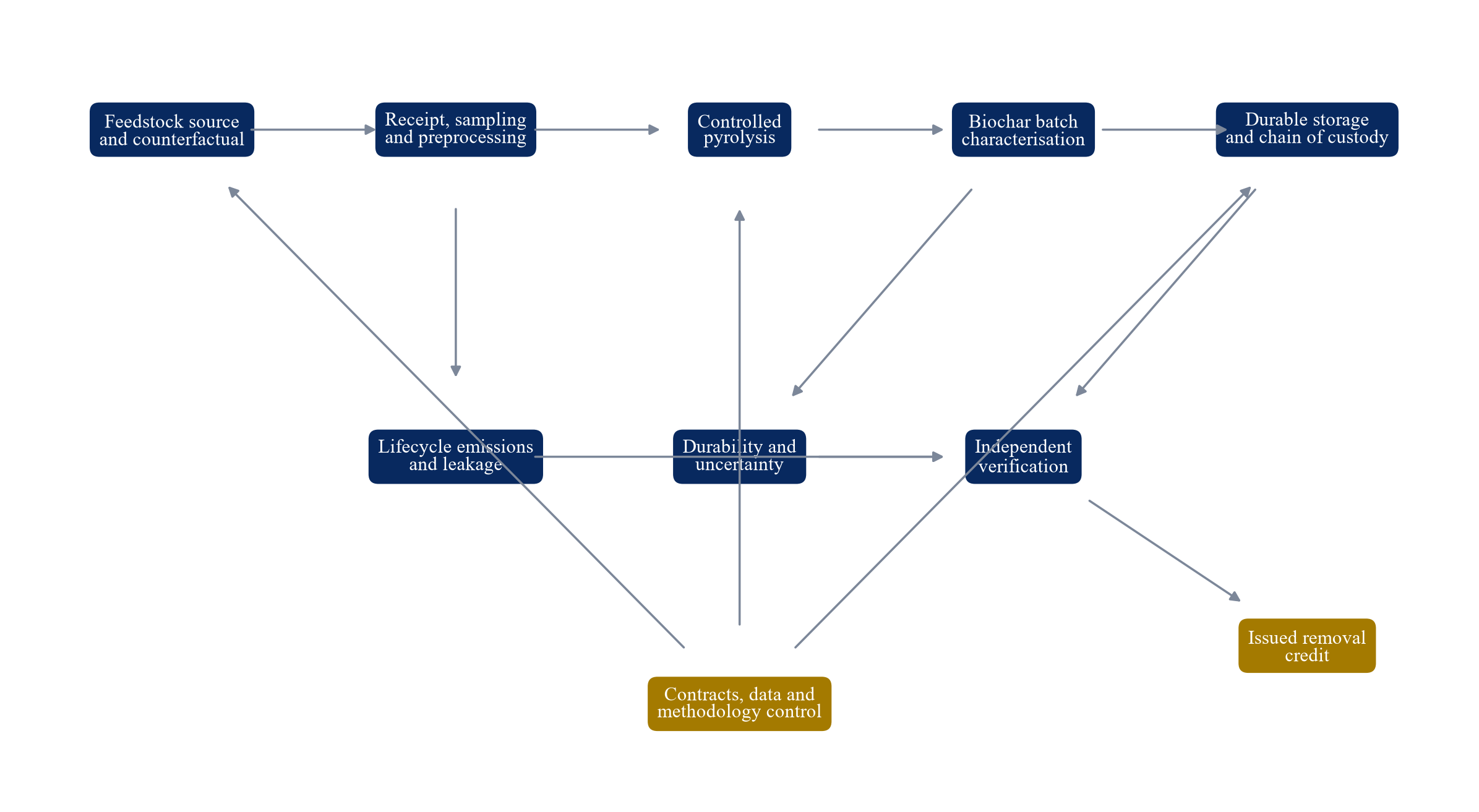
Proposed control architecture; methodology, sampling, storage and verification requirements depend on the selected standard and jurisdiction.
8. Define production batches
A production batch should represent material made under a documented feedstock and process envelope. Batch rules determine sampling frequency, traceability and the amount of production affected by an adverse test. A monthly accounting batch can be too broad when feedstock or temperature changes within the month.
Batch identifiers should remain linked through storage and sale. Blending can average quality while concealing poor output. The project should retain mass-weighted records for each contributing batch and follow the selected methodology's rules for sampling and conservative estimation.
9. Measure moisture and ash
Moisture affects inbound logistics, drying demand, thermal stability and net char yield. Ash affects total mass and dilutes organic carbon. A wet or ash-rich feedstock can create high physical output with lower creditable carbon and higher energy use.
Supply pricing should use the measurement basis that drives value. Dry-matter or energy-adjusted terms can align incentives better than an undifferentiated wet-tonne price. The contract should specify sampling, laboratory or onsite methods, calibration and dispute resolution.
10. Measure organic carbon
Organic carbon content is a direct input to the removal calculation. The European Biochar Certificate requires organic carbon to be declared and notes that content varies materially by biomass and pyrolysis conditions.[6] Each methodology specifies acceptable analytical methods and frequency.
The project should test within-batch and between-batch variation during commissioning. Finance models should use conservative measured values and should reduce eligible volume when the process moves outside the qualified envelope.
11. Use H to C with care
The molar hydrogen-to-organic-carbon ratio is widely used as an indicator of carbonisation and stability. A lower ratio generally reflects a greater share of condensed aromatic structures. The European Biochar Certificate sets class-specific thresholds, including an H/Corg ratio below 0.7 for many classes and below 0.4 for EBC-Feed.[6]
H/Corg does not remove the need for feedstock, process and storage evidence. Recent research confirms that it is a leading predictor while showing that long-term estimates remain sensitive to data selection and extrapolation model.[7] Diligence should retain that uncertainty.
12. Distinguish persistence models
Long-duration claims extend far beyond most field and incubation studies. The literature therefore uses models to extrapolate measured decay. Harmonised analysis of 129 decomposition time series found that H/Corg remained the main predictor, while the estimated fraction remaining was sensitive to curve choice and data selection.[7]
Another recent assessment reported materially different 100-year retention under power and two-pool exponential models despite strong short-term fit.[8] A credit-quality memo should name the required model, confidence adjustment and crediting duration rather than treating permanence as one universal property.
13. Match durability to the marketed claim
The marketed removal unit should state the credited duration and methodology. Puro.earth's 2025 biochar methodology labels eligible removals CORC200+, representing storage for several centuries under its framework.[9] EU CRCF rules classify biochar within permanent removals and prescribe a regulated methodology.[2]
Contracts should avoid broader language than the underlying certificate. Buyer communications, financing memoranda and impact reports should use the same duration, unit and standard. A methodology update may change the calculation without changing the physical char.
14. Specify pyrolysis conditions
Temperature, residence time, heating rate, oxygen control and pressure influence char yield, volatile matter and aromaticity. Higher severity can improve stability while reducing solid yield or changing energy balance. The optimal setting depends on feedstock, product market and required credit quality.
The technology contract should define the qualified operating envelope. Completion testing should use representative feedstock and demonstrate mass balance, energy use, emissions, organic carbon, H/Corg, contaminants and throughput over a sustained period.
15. Control production emissions
Pyrolysis gases, combustion, electricity, auxiliary fuel, drying, material handling and transport can create project emissions. Methane and nitrous oxide require specific attention because small releases can materially affect net removal. The monitoring plan should cover normal operation, start-up, shutdown and upset conditions.
Carbon credit revenue should be modelled after life-cycle deductions. Operating incentives based only on gross tonnes can reward output that weakens net removal. Management reporting should therefore show gross stored carbon, deductions and net verified tonnes.
16. Manage co-products
Pyrolysis can produce usable heat, gas, bio-oil and other outputs. Co-product revenue can improve economics and can alter emissions allocation. Contracts should identify ownership, metering, quality, maintenance and allocation rules under the selected methodology.
The base case should avoid counting the same energy benefit twice. Exported heat can create revenue, while avoided auxiliary fuel can reduce cost. The carbon methodology may prescribe allocation or system-boundary treatment that differs from financial reporting.
17. Test contaminants and product safety
Feedstock can introduce metals, salts, persistent organic pollutants, pathogens or physical contaminants. Pyrolysis may destroy some compounds and concentrate non-volatile elements in the char. Product and storage eligibility can therefore depend on representative chemical testing.
The European Biochar Certificate includes class-specific feedstock and contaminant requirements.[6] Project contracts should allocate rejection, remediation and liability. Lenders should require evidence that a failed batch can be isolated without disrupting the entire plant.
18. Select a storage pathway
Biochar may be applied to soil, incorporated into construction materials, buried in specified environments or used in another approved durable route. Each pathway has distinct evidence, product, environmental and reversal requirements. A credit methodology may accept one route and exclude another.
The storage agreement should define quantity, quality, destination, timing, handling, evidence, liability and audit access. An unspecific product sale can break the chain of custody required for issuance.
19. Preserve chain of custody
The chain should connect the production batch to the storage batch and final destination. Weighbridge records, sealed loads, delivery tickets, invoices, geospatial records, application logs, material incorporation records and retained samples can form the evidence set.
Isometric's current protocol requires records for mass, carbon analysis and incidents and uses ex-post issuance after durable storage.[5] Financing should reflect the period between production expenditure and verified issuance.
20. Design representative sampling
Sampling should capture variability rather than provide a convenient average. Isometric's protocol describes multiple independent samples per production batch and an initial data set before reduced-frequency sampling can be used.[5] Projects should apply the requirements of their selected methodology and laboratory standard.
The sampling plan should specify randomisation, collection points, preparation, custody, laboratory accreditation, replicates, retention and treatment of outliers. A single composite sample can conceal variation that matters to durability and carbon content.
Table 1. Proposed biochar credit-quality evidence architecture
| Control area | Primary evidence | Financing relevance | Failure consequence |
|---|---|---|---|
| Feedstock origin | supplier records, permits, chain of custody and sustainability certification | supports eligibility, supply and leakage assessment | ineligible volume, claim challenge or supply interruption |
| Counterfactual | historic practice, competing uses, local evidence and methodology test | supports additionality and net-removal calculation | lower creditable volume or failed validation |
| Production envelope | feedstock class, temperature, residence time, energy and emissions data | supports technology completion and predictable quality | reduced output, higher deductions or rejected batches |
| Biochar characterisation | moisture, ash, organic carbon, H/Corg and contaminants | determines eligible stored carbon and product route | lower credits or restricted storage |
| Storage | destination, mass, delivery, application or incorporation records | supports ex-post issuance and buyer acceptance | delayed or cancelled issuance |
| MRV and verification | calibrated meters, sampling plan, laboratory reports and verifier records | determines cash timing and covenant reporting | issuance delay, reserve draw or default |
| Methodology and registry | applicable version, validation, project registration and account controls | determines legal and commercial form of credit | stranded development cost or replacement obligation |
Proposed diligence framework; the selected methodology and jurisdiction determine binding requirements.
21. Choose the certification route
The project should compare eligible feedstocks, geographical scope, storage pathways, additionality, durability calculation, emissions boundary, sampling, verification, registry, issuance cycle and buyer acceptance across available standards. A popular standard may be unsuitable for the project's specific material or route.
The decision should be documented before major equipment and contracts are fixed. Changing methodology can require new sampling, validation, design or records. A fallback methodology is useful only when the project preserves the evidence needed for it.
22. Understand EU CRCF implementation
The CRCF framework requires third-party verification and public certification information through an EU registry architecture.[1] The permanent-removal delegated regulation provides a legally grounded methodology for biochar and other permanent removals.[2] Recognition of certification schemes also requires governance, accredited or recognised certification bodies, reliable registries and double-counting controls.[10]
EU projects should identify the recognised scheme, certifier and operative rules at the relevant date. Commercial documents should separate regulatory eligibility from buyer willingness to pay.
23. Understand Verra VM0044
VM0044 v1.2 applies globally to conversion of waste biomass into biochar at new production facilities and recognises eligible soil and non-soil uses.[3] The methodology includes additionality, project-boundary, feedstock, quantification and monitoring rules. Its 2025 revision added an investment-analysis requirement for additionality.
ICVCM approval can support market recognition, yet a project still requires validation, verification and issuance under the programme.[4] The label does not replace project-level diligence.
24. Understand Puro and Isometric
Puro.earth's 2025 methodology introduced a several-centuries durability label and a revised decomposition equation.[9] Isometric's protocol calculates net removal after counterfactual and life-cycle emissions and requires ex-post issuance following durable storage.[5]
The two frameworks illustrate why methodology choice affects timing and volume. A finance model should use the actual calculation, verification and issuance rules of the selected route. A generic carbon-credit yield is insufficient.
25. Use ICVCM as an additional screen
ICVCM assesses programmes and categories against its Core Carbon Principles. Its biochar page lists approved methodologies and records methodology status.[11] That assessment can inform buyer and lender diligence, particularly where procurement policies require CCP-labelled credits.
Project-level performance remains decisive. Feedstock, sampling, storage and validation can fail even when the methodology has category approval. Contracts should state whether CCP eligibility is a delivery condition and what happens if status changes.
26. Build the credit-volume bridge
The model should start with dry eligible biomass and derive biochar output, dry char, organic carbon, durable fraction and carbon dioxide equivalent. It should then deduct baseline storage, project emissions, leakage, uncertainty, buffer or other required adjustments.
Every coefficient should identify its source, measurement frequency and downside. The model should reconcile physical inventory to issued serial numbers and cash receipts. Forecasts should distinguish produced, stored, verified, issued, delivered and paid tonnes.
27. Build a hypothetical sources-and-uses case
Consider a hypothetical facility with total uses of USD 24 million. The illustration allocates USD 16 million to pyrolysis and material handling, USD 2 million to site and utilities, USD 1 million to laboratories and digital MRV, USD 2 million to development and financing costs, and USD 3 million to contingency and reserves. No element is a market benchmark.
One illustrative structure uses USD 9 million senior debt, USD 3 million subordinated or buyer-linked capital and USD 12 million sponsor equity. The structure assumes that senior lenders recognise only contracted and conservatively verified removal revenue.
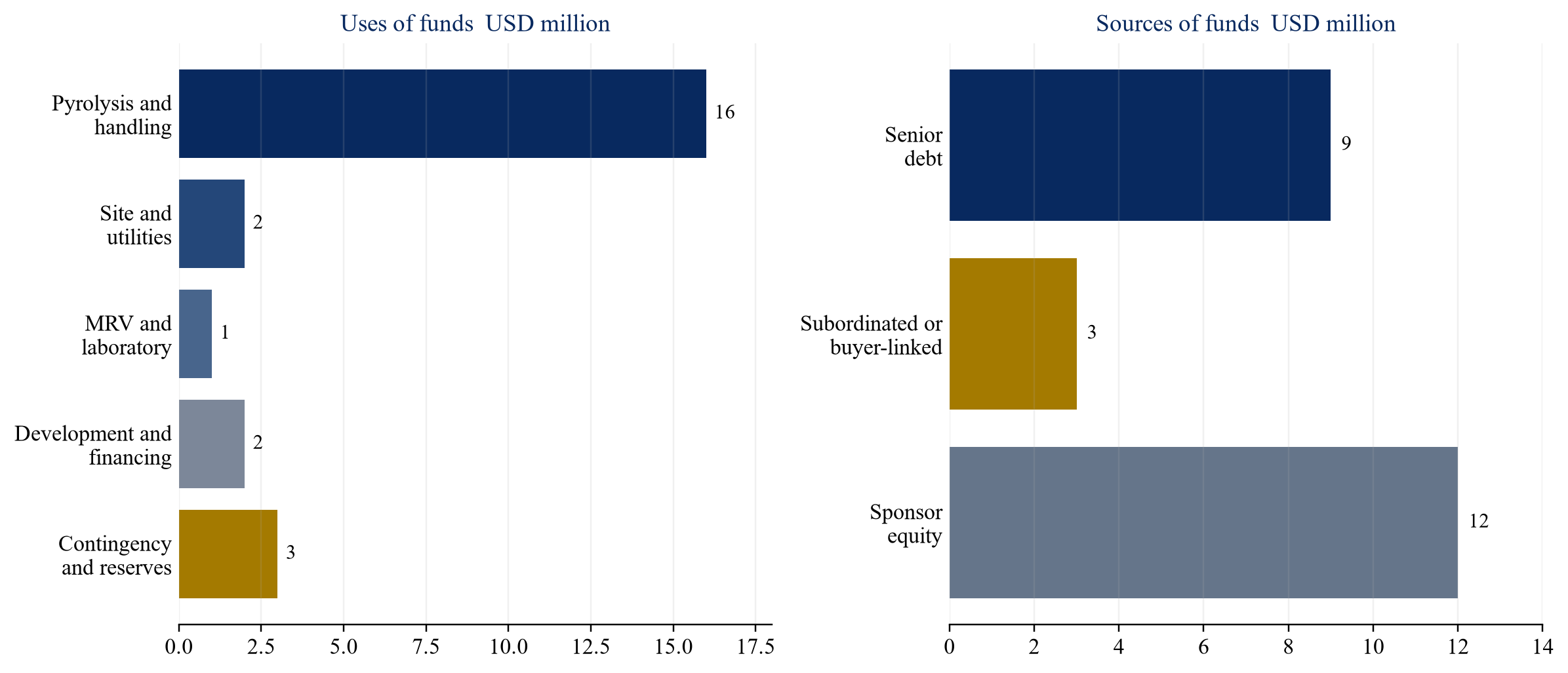
Illustrative scenario only; values are not market data, advice or a forecast for any identified project.
28. Contract feedstock supply
The supply agreement should define biomass classes, origin, sustainability evidence, counterfactual information, moisture, ash, contaminants, quantity, seasonality, delivery, price, title, sampling, rejection, audit and change in law. The supplier should update information that affects eligibility.
Minimum volume protects utilisation while potentially creating take-or-pay exposure. A diversified portfolio can reduce supplier concentration but increase testing and logistics. The project should price the value of flexibility explicitly.
29. Contract carbon removal sales
A forward carbon-removal agreement should define the unit, methodology, registry, vintage, durability, volume schedule, price, verification, delivery, payment, buyer credit, replacement, invalidation, force majeure and methodology change. A term sheet without these elements provides limited debt support.
Payment can occur at signing, milestones, production, storage, issuance or delivery. Each structure allocates project and credit risk differently. The financing model should match cash receipt to the contract rather than to physical production.
30. Allocate methodology-change risk
Standards evolve as science, policy and market expectations change. A new version can alter eligible feedstock, additionality, durability, sampling, deductions or documentation. Contracts should identify which methodology version applies and whether migration is required.
The sponsor can retain upgrade risk, share it with the buyer or create a price and volume adjustment. Debt documentation can require reserve, consent and revised model tests before migration.
31. Allocate invalidation and replacement risk
Credits can face reversal, misstatement, double-counting or eligibility disputes. The sales agreement should distinguish seller breach, verifier or registry error, methodology change and broader market rejection. Replacement rights should specify timing, equivalent attributes and price exposure.
The project should not assume that future credits will always be available at the original price. A replacement reserve can include cash, excess credits or insurance where available and effective.
32. Control registry and title
The project should identify the registry account that receives issued units, authorised users, approval rights and transfer process. Security documents should address control of receivables and, where legally effective, rights over issued credits or registry accounts.
Legal review should confirm title, perfection, insolvency treatment, tax and the contract governing delivery. Registry procedures and local law can differ. A spreadsheet of expected serial numbers does not create control.
33. Finance the issuance lag
Feedstock, labour, energy, transport, testing and verification costs arise before issuance and buyer payment. Ex-post systems create a working-capital gap that grows with verification cycle and inventory. The model should include rejected batches and delayed audits.
Working-capital facilities can rely on eligible stored inventory, contracted receivables or sponsor support. Advance rates should reflect methodology, buyer, verification and concentration risk. A borrowing base can exclude untested or disputed batches.
34. Size senior debt conservatively
Senior debt should rely on contracted net removal after conservative production, durability and emissions assumptions. Merchant premiums, uncontracted volume and co-product upside can remain with equity. Debt tenor should sit within feedstock, offtake and equipment-support terms.
The base case should include verification and payment lags. A project can meet annual production and still miss scheduled debt service when issuance is delayed. Debt-service reserves should reflect the actual certification calendar.
35. Test debt service
Assume, for illustration, annual debt service of USD 1.65 million. A base case of 30,000 paid net-removal tonnes at USD 120 per tonne produces USD 3.60 million of carbon revenue before operating and other costs. Lower paid volume, lower price, higher deductions and longer delay can reduce available cash simultaneously.
The sensitivity should use paid verified tonnes, not gross char output. No illustrative price or volume in this paper is a market forecast. Project-specific contracts and technical evidence are required.
Table 2. Hypothetical debt-service sensitivity to paid removal volume and realised price
| Paid net removals | USD 90 per tonne | USD 120 per tonne | USD 150 per tonne |
|---|---|---|---|
| 20,000 tonnes | 0.60x | 0.80x | 1.00x |
| 30,000 tonnes | 0.90x | 1.20x | 1.50x |
| 40,000 tonnes | 1.20x | 1.60x | 2.00x |
Illustrative scenario only; annual debt service is assumed at USD 1.65 million and cash available for debt service equals 55 percent of carbon revenue after the hypothetical operating and reserve burden.
36. Model combined downside
Feedstock shortage can reduce throughput and change the mix toward less suitable material. Lower organic carbon or higher H/Corg can reduce credited tonnes. Higher moisture can raise fuel use. Verification delay can defer cash. Buyer concentration can increase receivable risk.
The combined case should test liquidity, covenant headroom and cure actions. A collection of isolated sensitivities can understate the risk because adverse variables are connected.
37. Establish reserves
Reserves should have identified purposes. A debt-service reserve addresses payment timing. A working-capital reserve covers production and verification lag. A replacement reserve addresses invalidation obligations. A maintenance reserve covers planned equipment work. An environmental reserve can support remediation where legally permitted.
Release tests should use measured production, verification and contract performance. A permanent cash lock can make the project uneconomic, while an undersized reserve transfers predictable volatility to lenders.
38. Allocate technology risk
The supplier should warrant throughput, availability, energy consumption, emissions and biochar quality across an agreed feedstock envelope. Completion should require representative sustained tests and laboratory results. Liquidated damages should relate to the loss created by underperformance and should be supported by security.
The operator retains responsibility for feedstock preparation, operating discipline and maintenance. Interface risk among drying, pyrolysis, energy recovery, emissions control and char handling should have a named owner.
39. Allocate feedstock risk
The feedstock supplier controls origin, composition and delivery within its scope. The project controls acceptance and blending. Methodology eligibility may depend on information held upstream. Contracts should require document retention and audit access.
Price adjustments, rejection and indemnities can address measurable non-compliance. Replacement supply rights should preserve the qualified operating envelope. A broad obligation to deliver biomass cannot replace detailed specification.
40. Allocate credit-quality risk
The project company usually controls methodology application, monitoring, verification and registry. The technology provider controls part of process performance. Storage counterparties control evidence after delivery. The buyer controls acceptance and payment under the sales contract.
The risk-allocation matrix should connect each failure to prevention, evidence, remedy and capital support. Credit-quality risk should not remain in a general compliance covenant.
41. Build the data architecture
The project should use one batch identity across feedstock receipt, processing, sampling, storage, verification, issuance and sale. Laboratory reports, sensor data, weighbridge records and registry information should remain linked and access-controlled.
Data governance should cover calibration, change logs, retention, cyber security, backup and manual overrides. A verifier needs evidence; a lender needs timely covenant reporting; a buyer needs delivery confidence. One controlled data set can serve all three.
42. Establish completion tests
Mechanical completion confirms construction. Performance completion should demonstrate sustained operation at defined throughput with representative feedstock. Credit-quality completion should demonstrate eligible feedstock, compliant char, chain of custody, complete monitoring and a validation path accepted by the chosen programme.
Full debt availability can require all three. An early draw can be supported by sponsor equity, contingency and completion guarantees. A project should avoid treating first char production as completion.
43. Stage capital release
Development capital can fund feedstock campaigns, permits, engineering, laboratory work, methodology selection, buyer diligence and validation. Construction release can require executed supply and sales contracts, final design, permits, funded contingency and an agreed MRV plan.
Operating release can require sustained tests, storage evidence, verifier readiness and working-capital facilities. Refinancing can follow verified issuance and payment history.
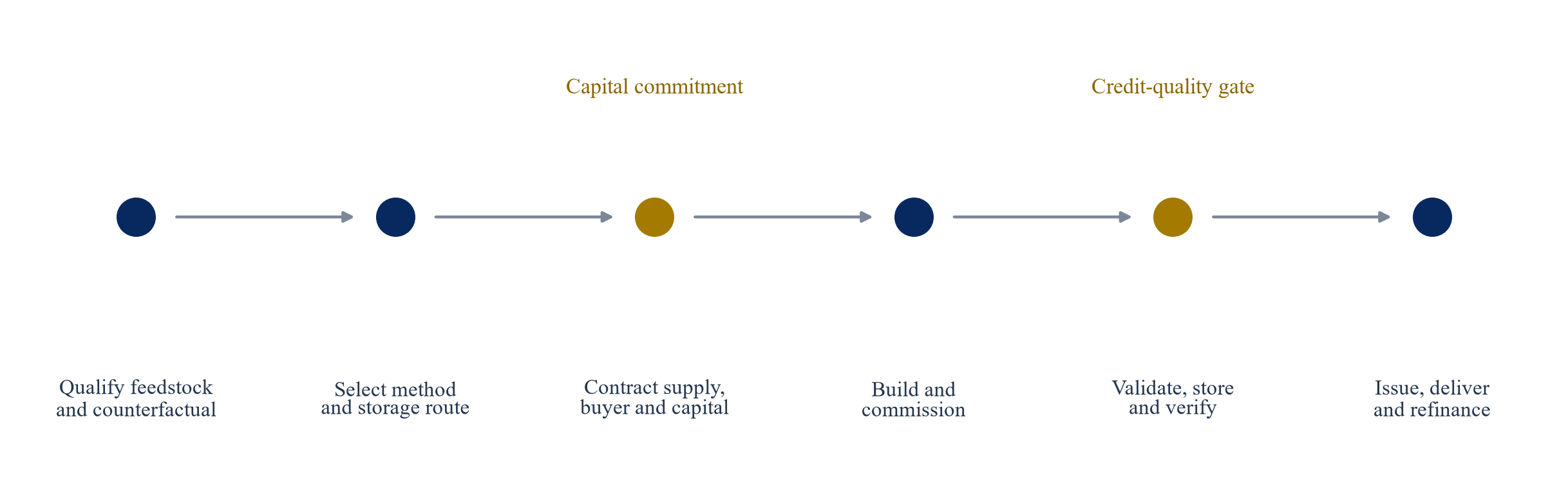
Proposed sequence; timing and gates depend on project, methodology, jurisdiction, technology, feedstock and buyer requirements.
44. Monitor the operating portfolio
The monthly pack should report contracted and delivered feedstock by source, moisture, ash, rejected loads, throughput, char yield, organic carbon, H/Corg, contaminants, energy, emissions, stored tonnes, verified tonnes, issued credits, delivered credits, receivables and cash.
Variance should distinguish volume, feedstock mix, process yield, carbon quality, deductions, verification timing and price. Management should identify the batch and counterparty causing each material movement.
45. Prepare for methodology migration
The project should track consultations, revisions and transition rules. It should preserve raw data that can support recalculation and maintain sampling above the minimum when the cost is proportionate. Contract amendment mechanisms should be prepared before a change occurs.
Migration should be an investment decision. The committee should compare credit volume, price, cost, buyer acceptance and execution risk under the old and new route where transition is permitted.
46. Protect environmental and social integrity
Carbon removal quality includes impacts beyond the credited carbon calculation. Feedstock collection can affect soil nutrients, biodiversity, air quality, traffic and local livelihoods. Production can create dust, noise, heat, fire and emissions risks. Storage can affect soil and water.
Permits, safeguards and community arrangements should be integrated into operations and contracts. A carbon claim does not excuse a local environmental failure.
47. Test product-market interaction
Biochar can have agricultural, filtration, construction or other material uses. Product revenue may improve economics, yet the selected use must preserve eligible durable storage and evidence. Product specifications can also demand characteristics that differ from the optimal carbon-removal setting.
The project should compare net value after processing, logistics, testing and credit effects. Premium product assumptions should remain outside senior debt until supported by contracts and repeat sales.
48. Define expansion rules
Expansion should follow verified evidence from the initial operating envelope. New feedstocks, process settings or storage pathways can require new qualification, validation or sampling. Existing credit quality should remain protected during integration.
Capital approval should identify the incremental source, counterfactual, logistics, quality and buyer. A larger plant with weaker feedstock evidence can reduce rather than increase financeable removal.
49. Establish stop rules
Development should pause when lawful and sustainable feedstock cannot be evidenced, the counterfactual fails the methodology, representative tests cannot meet quality, storage lacks traceability, permits remain unavailable or contracts leave unmanageable invalidation risk.
Operating stop rules can isolate a feedstock or production batch, restrict sales, increase sampling, divert product or trigger remediation. The rules should protect safety, compliance, credit quality and liquidity.
50. Apply the investment-committee test
Approval should state the feedstock portfolio, counterfactual, operating envelope, methodology, storage route, buyer contract, capital structure, reserves, completion tests and downside case. It should identify which cash flows support senior debt and which remain equity upside.
The final test is traceability. Source, production, carbon measurement, durability, storage, verification, issuance, delivery and payment should form one auditable chain. A project with high char output and incomplete evidence has not established financeable removal.
Table 3. Proposed biochar project risk-allocation matrix
| Risk | Natural owner | Contract mechanism | Evidence for capital release |
|---|---|---|---|
| Feedstock origin and sustainability | supplier within its control; project for portfolio selection | specification, chain of custody, audit, rejection and indemnity | verified suppliers and retained origin records |
| Counterfactual and leakage | project company | methodology assessment, periodic review and conservative deduction | documented baseline and competing-use analysis |
| Process performance | technology provider and operator within control | performance guarantees, security, cure and sustained tests | representative throughput, quality and emissions results |
| Carbon content and durability | project company and operator | sampling plan, accredited laboratory and conservative calculation | stable batch data and methodology-compliant analysis |
| Storage and chain of custody | project company and storage counterparty | delivery specification, records, audit and liability | qualified route and complete batch-to-destination evidence |
| Verification and issuance timing | project company | verifier plan, reporting covenant, liquidity and reserve | validation plan, complete monitoring and working capital |
| Methodology change | project, buyer and lenders as allocated | version clause, migration process, repricing and reserve | approved fallback and recalculated downside |
| Buyer credit and acceptance | buyer and project as allocated | delivery conditions, credit support, dispute process and replacement rights | executed contract and buyer credit assessment |
| Invalidation and replacement | project for breach; shared for defined external events | cure, replacement, buffer, insurance and liability cap | funded reserve and replacement procedure |
| Construction and integration | sponsor and contractors | coordinated design, contingency, completion support and tests | final design, permits and funded completion plan |
Proposed framework; allocation requires project-specific legal, technical, environmental, tax, methodology, market and credit review.
Conclusion
Biochar credit quality is produced through control of feedstock, conversion, measurement, storage and evidence. Feedstock origin and counterfactual determine eligibility and additionality. Moisture, ash and composition affect process economics. Organic carbon and H/Corg inform credited volume and durability. Storage and chain of custody determine whether the physical material can support an issued removal unit.
Current standards provide increasingly specific rules. EU CRCF regulation supplies a public-law certification framework. Verra, Puro.earth, Isometric and Climate Action Reserve provide distinct methodologies and protocols. ICVCM assessment can add a market-integrity screen. The project still carries the obligation to meet the selected route at batch level.
Financeability requires a conservative bridge from feedstock to paid net removals. Senior debt can rely on contracted volumes only after deductions, issuance timing, buyer credit and replacement obligations are reflected. Co-product and merchant upside can support equity. Staged capital release, representative testing, working-capital reserves and explicit methodology-change clauses can reduce execution risk.
The decisive evidence is one traceable chain from biomass source to verified storage, issued unit and cash. That chain converts a physical production project into a financeable carbon-removal business.
Investment-committee questions
1. Which feedstock sources are contracted and independently evidenced? 2. What legal classification and sustainability rules apply to each source? 3. What would each feedstock have done without the project? 4. Which competing uses and leakage effects have been tested? 5. How do moisture, ash and contamination affect cost and credited volume? 6. Which production-batch definition preserves meaningful traceability? 7. What organic-carbon and H/Corg distributions were measured? 8. Which permanence model and confidence adjustment apply? 9. Which pyrolysis envelope was tested with representative feedstock? 10. Which production emissions enter the life-cycle boundary? 11. How are co-product emissions and revenues treated? 12. Which contaminants constrain product or storage eligibility? 13. Which storage pathway is qualified under the selected methodology? 14. How does each batch connect to its final storage destination? 15. Does the sampling plan capture within-batch and seasonal variation? 16. Which certification route best fits the project and buyer? 17. Which methodology version governs delivery? 18. Is ICVCM status a contractual condition? 19. How are gross output, net removal, issuance and payment reconciled? 20. Which carbon-removal volumes and prices are contracted? 21. When does the buyer pay and what evidence is required? 22. Who bears methodology-change and invalidation risk? 23. How are registry accounts, credits and receivables controlled? 24. What working capital covers verification and issuance delay? 25. Which downside case determines senior debt capacity?
References
- European Commission, Carbon Removals and Carbon Farming Regulation, updated 20 May 2026. https://climate.ec.europa.eu/areas-action/carbon-removals-and-carbon-farming/carbon-removals-and-carbon-farming-crcf-regulation_en
- European Commission, Commission Delegated Regulation (EU) 2026/285 Establishing Certification Methodologies for Permanent Carbon Removals Activities, 3 February 2026. https://climate.ec.europa.eu/document/download/96845e08-0311-45b4-b6c0-7040e31d9cd0_en
- Verra, VM0044 Biochar Utilization in Soil and Non-Soil Applications, Version 1.2, active 27 June 2025. https://verra.org/methodologies/vm0044-biochar-utilization-in-soil-and-non-soil-applications-v1-2/
- Integrity Council for the Voluntary Carbon Market, Decision M43 VCS VM0044 Version 1.2, 24 July 2025. https://icvcm.org/wp-content/uploads/2025/08/M43_VCS_VM0044_v1.2_2025.pdf
- Isometric, Biochar Production and Storage Protocol, Version 1.2. https://registry.isometric.com/protocol/biochar/1.2
- Carbon Standards International, European Biochar Certificate Standard, 15 September 2025. https://www.carbon-standards.com/docs/transfer/4000093EN.pdf
- Azzi, E.S. et al., Modelling Biochar Long-Term Carbon Storage in Soil with Harmonized Analysis of Decomposition Data, Geoderma, 2024. https://doi.org/10.1016/j.geoderma.2023.116571
- Sundberg, C. et al., Dynamic Assessment of Biochar Soil Carbon Climate Change Impacts, Science of the Total Environment, 2025. https://doi.org/10.1016/j.scitotenv.2025.179181
- Puro.earth, Advancing the Science of Biochar Permanence, 2025. https://puro.earth/insights/post/biochar-permanence/
- European Commission, Certification Schemes under the CRCF Regulation. https://climate.ec.europa.eu/eu-action/carbon-removals-and-carbon-farming/certification-schemes_en
- Integrity Council for the Voluntary Carbon Market, CCP-Approved Methodologies: Biochar. https://icvcm.org/biochar/
- Climate Action Reserve, U.S. and Canada Biochar Protocol Version 1.0 and Version 1.1 Development. https://climateactionreserve.org/how/protocols/ncs/biochar/dev/
- Isometric, Biochar Storage in Soil Environments Module, Version 1.2. https://registry.isometric.com/module/biochar-storage-soil-environments/1.2
- Isometric, Biomass Feedstock Accounting Module, Version 1.2. https://registry.isometric.com/module/biomass-feedstock-accounting/1.2
- Woolf, D. et al., Greenhouse Gas Inventory Model for Biochar Additions to Soil, Environmental Science and Technology, 2021. https://pmc.ncbi.nlm.nih.gov/articles/PMC8567415/
- Lehmann, J. et al., Persistence of Biochar in Soil, Biochar, 2021. https://doi.org/10.1007/s42773-021-00127-0
- European Commission, Certification Methodologies for Permanent Carbon Removals. https://climate.ec.europa.eu/eu-action/carbon-removals-and-carbon-farming/certification-methodologies_en
- European Commission, EU Sets World's First Voluntary Standard for Permanent Carbon Removals, 3 February 2026. https://climate.ec.europa.eu/news-other-reads/news/eu-sets-worlds-first-voluntary-standard-permanent-carbon-removals-2026-02-03_en
- Isometric, Biochar Production and Storage Protocol Net CDR Calculation. https://registry.isometric.com/protocol/biochar/1.2/1.2.0
- Verra, Biochar and Forest Management Approaches Endorsed by ICVCM, 13 August 2025. https://verra.org/verras-biochar-and-forest-management-approaches-endorsed-by-icvcm-as-high-integrity-solutions/
About the Author
Authored by Chennakeshav Adya Independent Researcher
Chennakeshav (CK) is a corporate finance and investment banking executive with 25+ years of global experience in deal origination, structuring and execution across M&A, growth capital and corporate strategy. He has led value-creation mandates for founders, corporates and funds — bridging the boardroom view to hands-on execution and close.
His career spans Morgan Stanley, HSBC, Lloyds Banking Group, EWEC, ADQ portfolio companies and Emirates Growth Fund, across TMT, real estate, fintech, deeptech, cleantech, infrastructure and energy. He has partnered with C-suite leaders, private equity and venture funds, sovereign wealth funds and family offices to finance complex fund raises and scale-up ventures, and has led M&A due diligence, post-merger integration and business-transformation initiatives to create value.
At Matchpoint Partners he is Managing Partner, leading the firm's corporate finance, M&A and capital-raising practice. He holds an MBA from London Business School, an engineering degree from VTU and a Master of Laws (LLM, in progress) from UCL London.
An active start-up mentor, CK mentors at Techstars, DIFC FinTech Hive, Startup Grind, Founder Institute and IN5, serves as Entrepreneur Mentor in Residence (EMiR) at London Business School, and judges the Entrepreneurship World Cup.
Matchpoint profile: https://www.matchpoint-partners.com/team/ck-adya.html LinkedIn: https://www.linkedin.com/in/ckadya/
