

1. The bankability question
A low-carbon hydrogen project based on natural-gas reforming with carbon capture and storage is a chain rather than a single plant. Gas must be supplied within an agreed quality and emissions envelope. The reformer must produce hydrogen and a carbon-dioxide stream. The capture plant must remove, condition and meter carbon dioxide. A transport system must accept it, and a storage site must inject and permanently contain it. Hydrogen must then reach an offtaker that pays under terms compatible with the project's fixed and variable costs.
The investment decision is whether this chain can produce qualifying hydrogen and predictable cash flow through construction, commissioning and operation. Contract review should therefore test the complete interface system. A project can have technically capable components while remaining unfinanceable because its contracts use different definitions, measurement periods, outage rules or liability standards.
2. Use emissions intensity rather than colour alone
The phrase blue hydrogen is commonly used for hydrogen produced from fossil feedstock with carbon capture and storage. It does not specify lifecycle emissions. The International Energy Agency has shown that emissions vary materially with the production technology, carbon-dioxide capture rate and upstream gas emissions. Contractual qualification should therefore refer to measured or certified emissions intensity under an identified methodology.
This distinction affects price, subsidies, tax credits, customer claims and financing. A purchaser may be willing to buy hydrogen produced by a particular route while a regulator or public-support contract requires a maximum emissions intensity. The sale agreement, environmental-attribute schedule and financing model should use the same boundary and should state how methodology changes are treated.
3. The integrated contract chain
The core documents can include gas supply, electricity and utilities, engineering and construction, operations and maintenance, hydrogen offtake, carbon-dioxide transportation and storage, connection, network code, public support, carbon-accounting arrangements, insurance and financing. Each agreement can define availability and force majeure differently.
The sponsor should create a contract-interface schedule before financial close. The schedule should identify the responsible party, input, output, specification, meter, measurement period, notice deadline, remedy, payment consequence, liability cap and termination trigger for every material interface. Lenders should review that schedule alongside the base financial model.
4. Physical and contractual topology
The project's physical topology should be drawn beside its contractual topology. The physical diagram follows molecules and energy. The contractual diagram follows title, payment and liability. Differences between the two reveal risks, such as a producer retaining carbon-dioxide title after delivery or an offtaker receiving environmental attributes without bearing the consequences of later invalidation.
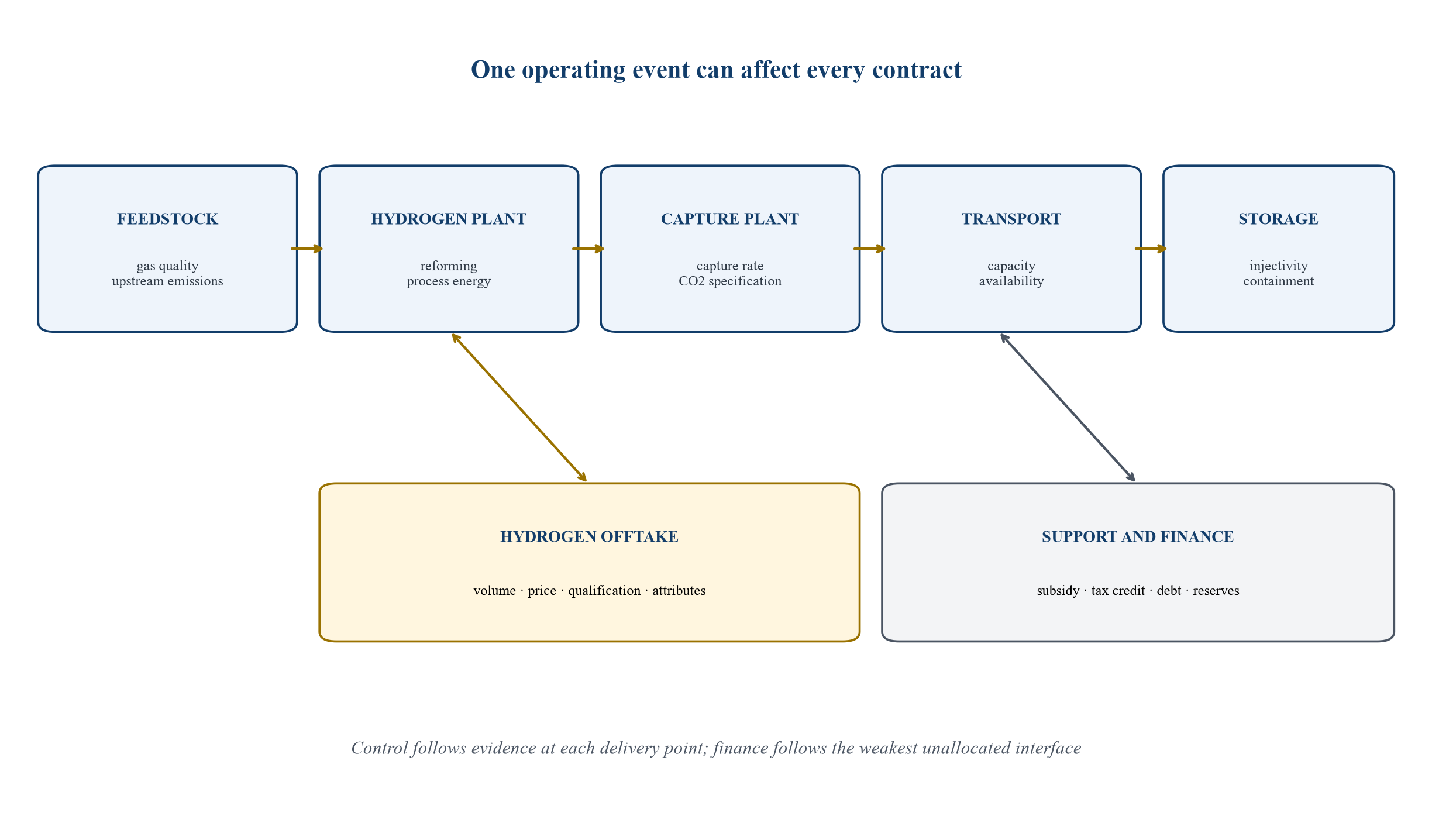
Generic structure. Actual contractual and regulatory arrangements vary by jurisdiction and project.
5. Define the emissions boundary
The parties should specify whether emissions are measured well-to-gate, well-to-delivery or on another basis. The United States section 45V framework uses lifecycle emissions through the point of hydrogen production under the applicable model. The European Union's 2025 low-carbon-fuels methodology applies lifecycle accounting rules that include relevant inputs and treatment of captured carbon dioxide. ISO 19870-1:2026 addresses production-stage greenhouse-gas emissions up to the production gate.
The contract should identify included sources, excluded sources, data hierarchy, global-warming-potential basis, allocation of co-products, treatment of electricity, feedstock evidence, calculation agent, assurance standard and correction process. A label without these elements does not create an auditable product.
6. Capture rate and lifecycle performance
Capture rate can be measured at a process stream, a capture plant or the total facility. These values are not interchangeable. A project can report high capture on a concentrated process stream while residual combustion emissions remain uncaptured. Capture-rate warranties should identify the numerator, denominator, measurement boundary and period.
Lifecycle performance also includes upstream methane and carbon-dioxide emissions, imported electricity, steam, compression and transport. The IEA has reported that upstream and midstream emissions can dominate at high capture rates. The commercial test should therefore combine facility performance with feedstock and energy evidence instead of relying on one equipment guarantee.
7. Measurement periods and reconciliation
Plant guarantees are often tested over hours or days, while regulatory compliance and support payments may be assessed monthly or annually. Gas certificates, metering corrections and storage confirmations can arrive later. Contracts should distinguish provisional invoicing from final emissions reconciliation.
A workable process uses contemporaneous meters, an agreed calculation workbook, monthly preliminary statements and an annual true-up after assurance. It should set deadlines, materiality thresholds, audit access and a method for correcting historic invoices or environmental attributes. Financing covenants should allow for predictable true-up timing and disputed amounts.
8. Feedstock risk
Natural-gas price, quality, pressure, availability and upstream emissions affect production cost and product qualification. A producer can control purchasing and plant efficiency, while the supplier or upstream operator controls much of the source data. The gas contract should require relevant origin and emissions evidence where the chosen methodology needs it.
Price risk can be passed through, hedged or retained. Emissions risk requires a separate mechanism. The producer may need substitution rights if a supply source exceeds an agreed intensity. A warranty without access to evidence is weak protection. The contract should preserve audit rights and define consequences for inaccurate or late data.
9. Electricity and utility risk
Capture, compression and hydrogen production consume electricity, steam, cooling water and other utilities. Their cost and emissions can change the qualification result. Utility agreements should state availability, specification, metering and carbon-intensity evidence.
Where an emissions methodology attributes grid electricity by time or region, the operating model must retain the relevant interval data. A financial model based on annual averages can misstate qualification if the applicable rule uses hourly or marginal values. Contract administration and data systems should be designed around the most granular binding requirement.
10. Technology configuration
Steam methane reforming, autothermal reforming and other configurations produce different carbon-dioxide streams and energy requirements. The selected design determines where capture occurs and which emissions remain. Technology choice also affects oxygen demand, steam balance, start-up profile and integration with the capture plant.
The engineering contract should guarantee output, quality, energy consumption, capture performance and emissions-relevant inputs using definitions aligned with offtake and support agreements. A performance test that proves mechanical completion while leaving product qualification unresolved creates a financing gap.
11. Commissioning sequence
The hydrogen plant, capture plant, carbon-dioxide network, storage site and offtaker may not become ready on the same date. Commissioning should therefore be planned as a multi-system sequence. Temporary venting, flaring, reduced capture, substitute fuels and test hydrogen need explicit treatment under environmental permits and support contracts.
Each interface agreement should state readiness evidence, test windows, retest rights, delay notices and the cost of keeping another system available. Long-stop dates should be aligned. If the transport and storage system is late, the hydrogen producer may need relief from capture-performance obligations, debt service support, a right to operate at reduced output or compensation for unavoidable fixed costs.
12. Carbon-dioxide specification
Transport and storage operators commonly require limits for water, oxygen, nitrogen, hydrogen, sulphur compounds and other constituents. Pressure, temperature and phase behaviour also matter. Off-specification carbon dioxide can damage equipment, affect injectivity or violate permits.
The delivery-point schedule should identify sampling method, continuous instruments, laboratory testing, meter uncertainty and precedence where results differ. Rejection rights should be proportionate to safety and system integrity. The producer needs cure rights and a clear allocation of disposal, shutdown and restart costs. Persistent off-specification delivery can justify termination; minor deviations may support adjustment or blending.
13. Transport and storage capacity
Reserved capacity should be defined by rate, volume, pressure, delivery point, operating window and duration. Annual tonnes alone do not establish that the system can accept the project's hourly profile. Ramp limits, planned maintenance and common-system constraints should be reflected.
A capacity reservation can use ship-or-pay or fixed availability charges to support network financing. The producer needs corresponding access certainty. The agreement should define firm and interruptible capacity, nomination procedures, imbalance rules, expansion rights and the treatment of other users. Priority during constraint should be transparent and compatible with the project's revenue contracts.
14. Storage performance
Storage risk includes injection availability, well integrity, pressure management, monitoring and long-term containment. The storage operator controls subsurface operations; the producer controls the delivered stream. Responsibility should change at a defined custody-transfer point once the carbon dioxide meets specification.
The storage contract should address injection shortfall, planned work, unexpected reservoir response, leakage, remediation and permit restrictions. It should identify the evidence supporting permanent storage and when that evidence becomes final for environmental accounting. Liability for invalidated claims should follow the cause and the party controlling the relevant evidence or operation.
15. Interface risk register
Table 1. Contract-interface risk register
| Interface | Primary evidence | Controlling party | Contract response | Financing consequence |
|---|---|---|---|---|
| feedstock to plant | gas meter, quality and origin data | supplier and producer | specification, substitution, audit and price adjustment | variable-cost and qualification sensitivity |
| plant to capture | process meters and emissions balance | producer and capture operator | integrated test, availability and efficiency guarantee | completion and performance support |
| capture to transport | custody meter and carbon-dioxide quality | capture operator | acceptance, rejection, cure and consequential-cost allocation | outage liquidity and liability cap |
| transport to storage | nominations, capacity and injection confirmation | network and storage operator | firm capacity, priority and network relief | fixed-charge coverage and reserve sizing |
| hydrogen to offtaker | hydrogen meter, quality and emissions certificate | producer and offtaker | take-or-pay, qualification adjustment and attribute transfer | revenue certainty and debt sizing |
| project to support counterparty | verified production and emissions statement | producer and calculation agent | provisional payment, audit and true-up | subsidy or tax-credit recognition |
Generic allocation framework. Project documents and mandatory law determine the final position.
16. Outage taxonomy
Contracts should distinguish hydrogen-plant outage, capture-plant outage, carbon-dioxide transport outage, storage outage, feedstock interruption, offtaker interruption and common force majeure. The physical result may be similar, yet responsibility and relief differ.
The UK Low Carbon Hydrogen Agreement contains detailed concepts for carbon-dioxide transport and storage outage events and related relief. This illustrates the level of precision needed. A private project should define minimum duration, affected capacity, excluded causes, notice, evidence, mitigation and payment treatment for each outage class.
17. Correlated outages
The largest liquidity risk can arise when one event affects several payments simultaneously. A storage outage may stop capture, reduce hydrogen output, eliminate support payments and trigger hydrogen-delivery damages while fixed network charges and debt service continue. Separate models can miss this correlation.
The sponsor should run an integrated outage model. It should show lost hydrogen margin, fixed gas obligations, network reservation charges, operating costs, support-payment effects, liquidated damages, insurance recovery and reserve draw. Contract relief should be assessed across the same period and event definition.
18. Allocation principle
Risk should sit with the party that can control its probability, mitigate its consequence and evidence its performance. Some risks cannot be fully controlled, so they require sharing, insurance, reserves or public support. Allocation should preserve incentives and avoid unlimited exposure that makes a counterparty unfinanceable.
The principle should be applied at event level. The capture operator can control maintenance and operating procedures, while it may need relief for transport unavailability. The storage operator can control injection and monitoring, while it should not bear contamination introduced upstream. The producer coordinates the chain and should retain risks it can manage through dispatch, procurement and customer portfolio.
19. Relief event mechanics
A relief clause should answer six questions: what event qualifies, who gives notice, what evidence is required, which obligations are suspended, which payments continue, and when relief ends. It should also address concurrent causes and failure to mitigate.
Relief can excuse performance without paying compensation. Compensation events can reimburse incremental cost or lost margin. Deemed availability can preserve a fixed payment where the asset was capable of performing. These concepts should remain distinct. Blurred drafting can create disputes and misstate forecast cash flow.
20. Force majeure
Force majeure should cover genuinely external events and should be consistent across linked contracts. A broad definition in one agreement and narrow definition in another creates stranded exposure. Government action, network failure, extreme weather, natural disaster, war, sanctions and change in law may require different treatment.
The clause should specify mitigation, alternative routes, prolonged-event termination and payment consequences. An infrastructure failure under a service provider's control should normally be addressed through availability and liability provisions rather than automatically treated as force majeure. The governing law and market practice will affect the final drafting.
21. Hydrogen offtake volume
Offtake can use take-or-pay, minimum annual quantity, capacity reservation, nomination bands or merchant sales. The appropriate structure depends on the customer's ability to switch fuels, store hydrogen or pass through a premium. Firm demand remains a central financing requirement because low-emissions hydrogen often carries a cost premium over conventional alternatives.
The International Energy Agency reported that firm offtake covered only a small portion of the potential 2030 output from announced projects in its 2025 review. A lender should therefore distinguish signed, conditional and non-binding demand. It should also test the customer's credit and the competitiveness of the end product.
22. Hydrogen price
Price can combine a commodity reference, natural-gas or electricity index, carbon price, fixed conversion charge and environmental premium. Public support may fill part of the difference between project cost and a reference price. The formula should avoid double recovery and should remain understandable through different market conditions.
Indexation should match material costs and debt exposure. Floors can protect fixed-cost recovery; caps can protect customers or public counterparties. Reopeners may address structural changes, but frequent discretionary reopeners weaken bankability. The parties should identify which inputs are passed through and which remain management risk.
23. Product qualification
The offtake agreement should state the required hydrogen purity, pressure, delivery conditions and emissions intensity. It should also identify the certificate, verification process and consequences if a batch or period fails. A binary rejection right can be disproportionate where hydrogen remains physically usable.
A tiered structure may permit delivery at an adjusted price, loss of environmental premium, replacement of attributes or redirection to another customer. Safety and process specifications remain absolute where deviation creates operational risk. Environmental qualification can use a cure or true-up if the governing methodology allows it.
24. Environmental attributes
Contracts should allocate title to emissions certificates, guarantees of origin, tax attributes, carbon credits and avoided-emissions claims. These instruments are governed by different rules. The same tonne of captured carbon dioxide should not support inconsistent claims by several parties.
The allocation schedule should specify creation, registration, transfer, retirement, audit and replacement. It should also identify who bears methodology change, meter correction, storage invalidation and counterparty misstatement. Marketing language should follow the verified attribute and applicable consumer-protection rules.
25. Public support
Revenue support can improve bankability by addressing the cost gap between low-carbon hydrogen and a counterfactual fuel. The United Kingdom uses a private-law Low Carbon Hydrogen Agreement between a producer and a government-appointed counterparty. The agreement contains project-specific terms, payment calculations and detailed operational provisions.
The project model should treat support as a contract with conditions rather than an unconditional grant. Eligibility, qualifying volume, emissions compliance, reference pricing, reporting, audit, change in law, termination and repayment can affect cash flow. Financing documents should contain covenants and reserves that reflect these conditions.
26. United States clean-hydrogen credit
The United States section 45V credit is determined by lifecycle greenhouse-gas emissions within statutory tiers and uses the applicable 45VH2-GREET model or permitted process. Final regulations published in 2025 contain detailed rules for determining lifecycle emissions and substantiation. Contracted cash flow should reflect the project's expected eligibility and evidence requirements.
Tax-credit value depends on actual qualifying production, emissions performance, prevailing-wage and apprenticeship rules where applicable, tax capacity or transfer arrangements, and the continued validity of data. A tax-credit buyer or lender may require indemnities, reserves, insurance or discounting. The hydrogen offtaker should not receive the same economic value twice through both price reduction and attribute transfer unless expressly agreed.
27. European low-carbon methodology
Commission Delegated Regulation (EU) 2025/2359 specifies a methodology for greenhouse-gas savings from low-carbon fuels. It addresses lifecycle inputs and recognises captured emissions stored in qualifying geological storage subject to applicable safeguards. Projects serving European demand need a data and assurance system that can support this methodology and relevant certification requirements.
Long-term offtake should address regulatory evolution, imported feedstock data and recognition of storage outside the Union. A change that alters calculated intensity can affect product qualification without changing physical operation. The contract should distinguish an operator failure from a methodology change and allocate economic consequences accordingly.
28. Standards and certification
ISO 19870-1:2026 provides a production-gate methodology for hydrogen supply-chain greenhouse-gas emissions. The International Partnership for Hydrogen and Fuel Cells in the Economy has also developed a detailed production methodology. Common methodologies can improve comparability, while individual support schemes can still impose specific rules.
The contract should state the hierarchy among mandatory law, support-contract rules, certification scheme and voluntary standard. Where two methodologies apply, the project should calculate both and identify the stricter operational constraint. Data architecture should preserve source evidence so calculations can be repeated after updates.
29. Payment waterfall
Cash inflow may include hydrogen sales, capacity payments, support payments, tax credits, carbon value and by-product revenue. Outflow may include gas, power, transport and storage tariffs, operating costs, fixed charges, taxes and debt service. The waterfall should show which revenue disappears under each outage or qualification event.
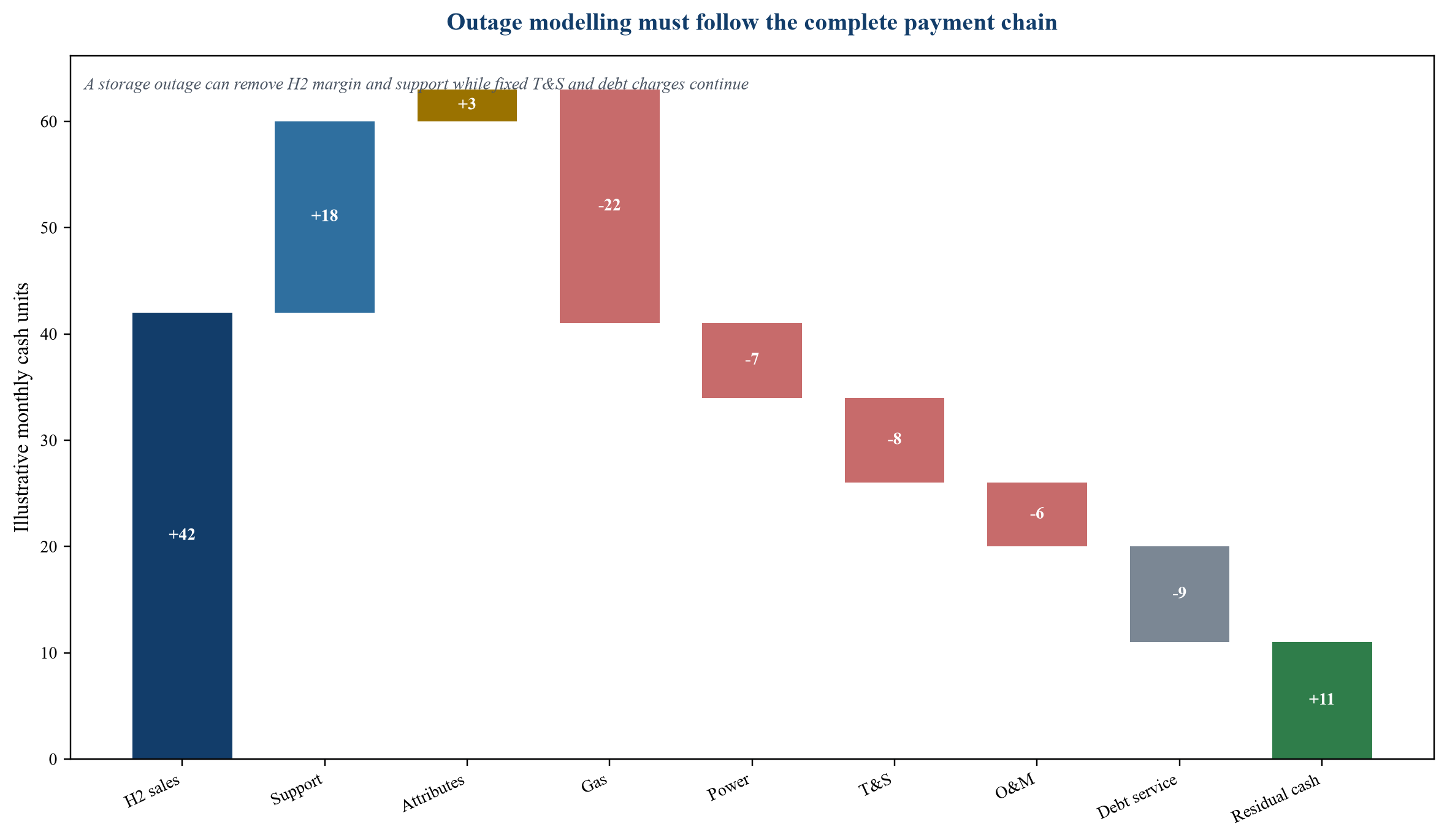
Hypothetical figures for decision analysis only. They do not represent a project forecast or offer.
30. Illustrative operating case
Consider a hypothetical project with expected monthly hydrogen sales of 42 cash units, support revenue of 18 and environmental-attribute revenue of 3. Monthly feedstock, power, transport and storage, operating costs and debt service total 52 units, leaving 11 units of residual cash before tax and distributions. These figures are solely an analytical example.
If storage becomes unavailable for a full month and the plant cannot operate, hydrogen sales and support may fall sharply while fixed transport and storage charges, minimum gas costs and debt service continue. A nominally profitable project can therefore face a severe liquidity draw. The contracts and reserve structure should be tested against the same event.
31. Performance deductions
Availability deductions should correspond to the economic harm caused by controllable underperformance. They can be calculated against unavailable capacity, shortfall volume or fixed payment. Caps should preserve incentives while keeping the service provider financeable.
Double counting should be avoided. The same capture failure should not generate uncapped liquidated damages, full lost-profit recovery, price adjustment and termination payment unless the allocation is deliberate. Exclusive-remedy clauses should be reviewed alongside indemnities, insurance and support-payment consequences.
32. Payment and relief matrix
Table 2. Illustrative payment and relief matrix
| Event | Hydrogen offtake | Carbon transport and storage | Public support | Recommended allocation |
|---|---|---|---|---|
| producer outage | delivery shortfall and agreed damages | capacity charge generally continues | qualifying volume falls | producer risk, subject to EPC or O&M recourse |
| capture outage | product may fail emissions test | fixed charge treatment depends on capacity | payment may reduce or cease | capture operator within guaranteed boundary |
| transport outage | producer receives delivery relief | service credit or deemed availability test | external-network relief where eligible | network operator plus coordinated relief |
| storage outage | output curtailment or attribute adjustment | service credit and mitigation obligation | relief depends on scheme | storage operator within permit and operating control |
| offtaker outage | take-or-pay or capacity payment | project retains network obligations | support may depend on sale or production | offtaker credit and replacement-sale rights |
| methodology change | price or qualification reopener | physical service may continue | eligibility can change | shared change-in-law process and termination floor |
Illustrative commercial design. The matrix should be conformed to each project's contracts and governing law.
33. Liability caps
Service providers commonly seek caps linked to annual fees or contract value. The project may face losses much larger than the fee, particularly where an outage removes hydrogen sales and support. Liability negotiation should distinguish ordinary service failure, wilful misconduct, fraud, confidentiality, environmental damage and attribute invalidation.
The sponsor should model recoverable amounts after deductibles, exclusions and caps. A theoretically available claim has limited financing value if the counterparty lacks credit. Parent guarantees, letters of credit, reserve accounts and insurance can support the agreed allocation.
34. Consequential loss
Linked infrastructure creates debate over consequential or indirect loss. Lost support, hydrogen margin and environmental attributes can be economically direct from the project perspective while contract language or governing law may classify them differently. Schedules should identify recoverable categories expressly.
Liquidated damages can provide clarity where loss is difficult to prove and the amount is a reasonable estimate under applicable law. The parties should avoid a formula that becomes punitive or duplicates another remedy. Lenders will focus on whether the remedy arrives in time to support debt service.
35. Insurance
Insurance can cover construction, property damage, machinery breakdown, business interruption, delay in start-up, environmental liability, cyber events and certain credit risks. Coverage for loss of subsidy or environmental attributes may be limited or highly conditional.
The insurance programme should be reviewed against the contract matrix. Waiting periods, indemnity periods, deductibles, sublimits, causation and interdependency extensions matter. A storage outage without physical damage may fall outside conventional business-interruption coverage. Reserves may therefore remain necessary.
36. Reserve accounts
Debt-service reserve, operating reserve, major-maintenance reserve, decommissioning reserve and carbon-liability reserve serve different purposes. Their triggers and permitted uses should match the project's risk allocation. One reserve should not be assumed to cover every event.
Reserve sizing should use integrated scenarios, including simultaneous loss of revenue and continuation of fixed charges. Replenishment priority belongs in the cash waterfall. Distribution locks should preserve liquidity before a forecast covenant breach becomes an actual payment default.
37. Completion testing
Completion should require more than physical operation. A lender may require reliable hydrogen output, capture performance, carbon-dioxide specification, transport acceptance, storage injection, emissions qualification, offtaker acceptance and receipt of public-support payments over a defined period.
The test should reflect seasonal conditions and avoid a short period that masks unstable operation. Completion support may include sponsor guarantees, standby equity or contingent facilities until the integrated test is passed. Partial completion can be used where separate trains operate independently.
38. EPC interfaces
Separate engineering contracts for the reformer, capture plant, compression and connections can leave gaps. Battery limits should identify physical tie-ins, control logic, utilities, testing and responsibility for combined performance. Interface warranties should survive handover and be supported by a lead integrator where possible.
The project should have a single integrated commissioning plan and shared data protocol. Delay liquidated damages and performance liquidated damages should reflect each contractor's contribution. A contractor should receive relief for another package only where causation is demonstrated and mitigation is documented.
39. Operations and maintenance
Operating agreements should contain availability, efficiency, capture performance, maintenance planning, staffing, spares, reporting and incentive mechanisms. The operator needs authority to coordinate dispatch across hydrogen, capture and network constraints.
Performance fees should use metrics the operator controls. A low capture result caused by unavailable storage should be excluded from an operator penalty if the operator followed the agreed shutdown or turndown procedure. The owner should retain audit rights and access to raw operational data.
40. Risk-allocation heatmap
The heatmap should compare control with financial impact. Risks with high impact and weak contractual recovery require capital structure, reserves or sponsor support. Risks under a strong counterparty's control can be transferred through performance obligations and credit support.
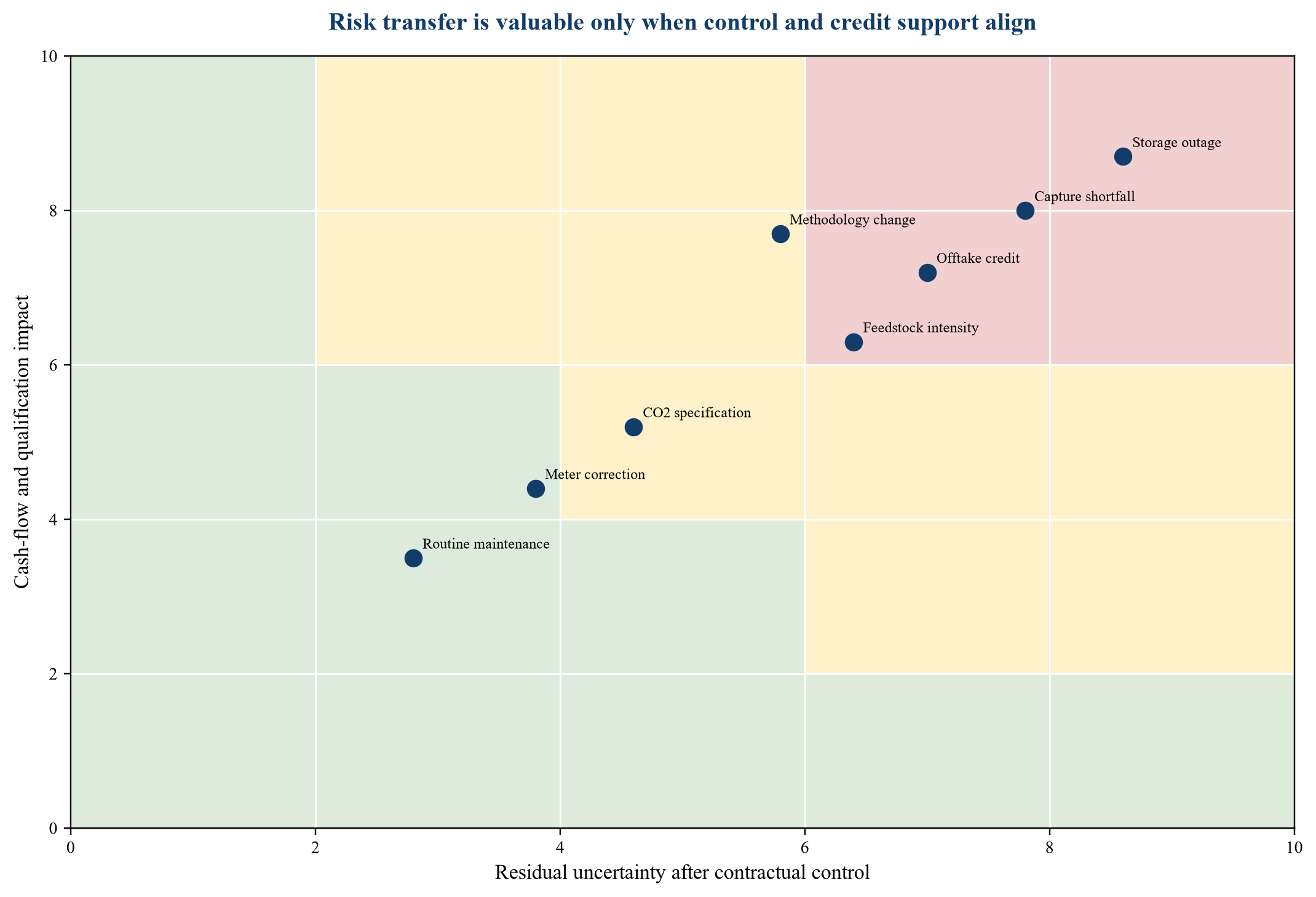
Illustrative prioritisation. Ratings require project-specific contracts, technical evidence and counterparty assessment.
41. Financial-model architecture
The model should link physical throughput, capture rate, emissions intensity, network availability and customer nominations to revenue and cost. Each contractual formula should have a corresponding model module and source document. This makes sensitivities traceable and helps lenders test covenant resilience.
Model cases should include base operation, ramp-up, capture degradation, high upstream emissions, gas-price shock, offtaker shortfall, transport outage, storage outage and methodology change. Correlated cases are essential. The model should distinguish cash timing from accounting recognition and include payment true-ups.
42. Debt sizing
Debt capacity should be based on contracted and qualifying cash flow after operating costs, fixed network charges and reserves. Revenue that depends on unproven capture performance or discretionary certification should receive an appropriate haircut. Merchant hydrogen and environmental attributes can support upside rather than core debt unless evidence justifies a stronger treatment.
Lenders will examine tenor relative to offtake, public support, network access and storage rights. Tail periods provide time to recover from underperformance. Amortisation can follow expected cash generation while preserving liquidity during ramp-up and major maintenance.
43. Covenant design
Financial covenants should be paired with operating and qualification covenants. Useful measures include debt-service coverage, minimum liquidity, plant availability, capture performance, qualifying volume, storage availability and counterparty concentration. Cure rights should address temporary issues without allowing persistent deterioration.
Information covenants should require meter data, emissions calculations, verification reports, notices, disputes and permit changes. A breach of an emissions standard may require a remediation plan before it becomes an event of default. Immediate default remains appropriate for fraud, loss of a critical permit or abandonment.
44. Counterparty credit
The contract chain is only as strong as the parties responsible for long-dated obligations. A project should assess the credit of the gas supplier, offtaker, transport and storage operator, support counterparty, EPC contractor, operator and attribute buyer. Special-purpose entities may need parent support.
Credit support can include guarantees, letters of credit, prepayment, escrow, collateral, reserve accounts and step-in rights. The amount and duration should reflect replacement cost and the time needed to find another counterparty. Rating triggers should avoid creating a liquidity crisis across several contracts at once.
45. Step-in and substitution
Lenders need cure and step-in rights before termination of material project agreements. Direct agreements should contain notice, cure periods, novation mechanics and recognition of a substitute owner or operator. Regulatory approval may still be required.
Substitution is more difficult for monopoly infrastructure or a unique geological store. The financing case should therefore place greater weight on service standards, regulatory protections, compensation and reserves. A contractual substitution right has limited value where no practical alternative exists.
46. Change in law and methodology
Change in law can affect permits, safety, carbon pricing, emissions thresholds, support eligibility, tax credits and storage obligations. Methodology change can alter reported intensity using the same physical data. These risks should be separated because remedies may differ.
A change mechanism should specify notice, mitigation, cost sharing, price adjustment, technical modification and termination. The parties can define a materiality threshold and a negotiation period followed by expert determination. A termination floor can protect unrecovered capital where the business becomes unlawful or permanently ineligible.
47. Data governance
Metering and calculation data create the evidence for payment, compliance and environmental claims. The data model should identify system owner, source meter, time stamp, unit, calibration, correction, access, retention and assurance status. Version control is necessary for calculations and methodology inputs.
The producer should maintain an auditable chain from raw operational data to invoices and certificates. External counterparties should receive only the information needed for their role while lenders and verifiers retain appropriate access. Data disputes should use an independent expert with access to original records.
48. Cyber and control systems
Hydrogen, capture, transport and storage systems rely on industrial-control and communications networks. Cyber failure can interrupt several assets simultaneously or corrupt measurement data. Responsibility can be fragmented among operators and vendors.
Contracts should define security standards, access control, incident notification, recovery, patching, vendor management and evidence preservation. Business-continuity plans should include manual operation and data reconstruction where safe. Cyber insurance should be reviewed against operational-technology exclusions and interdependency losses.
49. Governance and decision rights
The project board needs authority to coordinate outages, maintenance, dispatch, customer nominations and remediation. Joint-venture documents should allocate reserved matters without creating paralysis during an operating event. Technical, commercial and finance committees can support the board if accountability remains clear.
Daily operations need pre-agreed decision rights. During a storage constraint, someone must decide whether to reduce hydrogen output, vent where lawfully permitted, switch feedstock, redirect carbon dioxide or shut down. The decision protocol should prioritise safety, permit compliance, product qualification and value preservation in that order.
50. Investment-committee gates
Table 3. Investment-committee and financing gates
| Gate | Required evidence | Minimum decision test | Protection if unresolved |
|---|---|---|---|
| emissions eligibility | approved methodology, model, source data and verifier plan | base case and downside remain within applicable threshold | price haircut, reserve and methodology reopener |
| integrated performance | combined plant and network test protocol | hydrogen output, capture, specification and injection proven together | completion support and retest rights |
| offtake | executed agreement, credit support and end-market case | contracted cash covers fixed costs and debt under downside | minimum payment and replacement-sale rights |
| transport and storage | firm capacity, permits, outage regime and operator credit | capacity and relief align with plant obligations | service credits, deemed availability and liquidity reserve |
| public support or tax credit | executed terms, eligibility opinion and reporting plan | qualifying production supports modelled revenue | conservative debt sizing and recapture protection |
| liquidity | integrated correlated-outage model | reserves cover the approved stress duration | distribution lock and contingent facility |
Generic decision framework. Evidence requirements should be tailored to the project and jurisdiction.
51. Negotiation sequence
Commercial teams should negotiate the interface schedule before finalising individual agreements. First define physical delivery points and the emissions boundary. Then align specification, measurement, availability and outage definitions. Next allocate payment effects, liability, credit support and termination. Finally conform financing and public-support documents.
Parallel drafting without this sequence can produce circular gaps. The hydrogen offtaker may expect the producer to absorb storage failure while the storage contract excludes lost hydrogen revenue and the support agreement suspends payments. A term-sheet matrix makes these gaps visible before detailed drafting becomes difficult to change.
52. Conclusion
Low-carbon hydrogen produced from natural gas with carbon capture and storage is a shared-performance business. Its environmental and financial value depends on feedstock evidence, plant efficiency, capture performance, carbon-dioxide quality, transport availability, storage injectivity, hydrogen demand and the rules governing public support and environmental attributes.
Bankable contracts connect these elements through one emissions boundary, compatible meters, aligned operating definitions and coordinated relief. They assign each risk to the party that controls it, support the allocation with evidence and credit, and preserve liquidity for risks that cannot be transferred. This approach converts a collection of bilateral contracts into an integrated operating and financing system.
References
- International Energy Agency. Global Hydrogen Review 2025. 12 September 2025. https://www.iea.org/reports/global-hydrogen-review-2025
- International Energy Agency. Five key questions about hydrogen. Global Hydrogen Review 2025. https://www.iea.org/reports/global-hydrogen-review-2025/five-key-questions-about-hydrogen
- International Energy Agency. Towards hydrogen definitions based on their emissions intensity. 2023. https://www.iea.org/reports/towards-hydrogen-definitions-based-on-their-emissions-intensity
- International Energy Agency. Hydrogen Tracker. Updated 18 June 2026. https://www.iea.org/data-and-statistics/data-tools/hydrogen-tracker
- Department for Energy Security and Net Zero. Hydrogen production business model. Updated 19 December 2025. https://www.gov.uk/government/publications/hydrogen-production-business-model
- Department for Energy Security and Net Zero. Low Carbon Hydrogen Agreement: Front End Agreement, Hydrogen Allocation Round 1. December 2024. https://www.gov.uk/government/publications/hydrogen-production-business-model/low-carbon-hydrogen-agreement-front-end-agreement-hydrogen-allocation-round-1-december-2024-accessible-webpage
- Department for Energy Security and Net Zero. Low Carbon Hydrogen Agreement: key terms summary with explanatory notes. 10 December 2025. https://assets.publishing.service.gov.uk/media/693941eb7a605b2d61cd9014/lcha-key-terms-summary-explanatory-notes-har1-december-2025.pdf
- Department for Energy Security and Net Zero. UK Low Carbon Hydrogen Standard. https://www.gov.uk/government/publications/uk-low-carbon-hydrogen-standard-emissions-reporting-and-sustainability-criteria
- Department for Energy Security and Net Zero. Carbon capture, usage and storage business models. Updated 22 July 2026. https://www.gov.uk/government/publications/carbon-capture-usage-and-storage-ccus-business-models
- European Union. Commission Delegated Regulation (EU) 2025/2359 on greenhouse-gas emissions savings from low-carbon fuels. 8 July 2025. https://eur-lex.europa.eu/eli/reg_del/2025/2359/oj/eng
- United States Internal Revenue Service. Final regulations under sections 45V and 48(a)(15). Internal Revenue Bulletin 2025-13. 24 March 2025. https://www.irs.gov/irb/2025-13_IRB
- United States Internal Revenue Service. Instructions for tax year 2025 fiscal-year filers completing Form 7210, Part II, Clean Hydrogen Production. https://www.irs.gov/forms-pubs/instructions-for-tax-year-2025-fiscal-year-filers-completing-form-7210-part-ii-clean-hydrogen-production
- ISO. ISO 19870-1:2026, Hydrogen technologies: methodology for determining greenhouse-gas emissions associated with production up to the production gate. https://www.iso.org/obp/ui#iso:std:iso:19870:-1:ed-1:v1:en
- International Partnership for Hydrogen and Fuel Cells in the Economy. Methodology for Determining the Greenhouse Gas Emissions Associated with the Production of Hydrogen, Version 3. July 2023. https://www.iphe.net/_files/ugd/45185a_8f9608847cbe46c88c319a75bb85f436.pdf
- OECD and World Bank. Leveraging de-risking instruments and international coordination to catalyse investment in clean hydrogen. 2024. https://documents1.worldbank.org/curated/en/099703310092538947/pdf/IDU-ebab3d46-ee76-4c42-ac5d-27ff03c2c7d2.pdf
About the Author
Chennakeshav (CK) is a corporate finance and investment banking executive with 25+ years of global experience in deal origination, structuring and execution across M&A, growth capital and corporate strategy. He has led value-creation mandates for founders, corporates and funds — bridging the boardroom view to hands-on execution and close.
His career spans Morgan Stanley, HSBC, Lloyds Banking Group, EWEC, ADQ portfolio companies and Emirates Growth Fund, across TMT, real estate, fintech, deeptech, cleantech, infrastructure and energy. He has partnered with C-suite leaders, private equity and venture funds, sovereign wealth funds and family offices to finance complex fund raises and scale-up ventures, and has led M&A due diligence, post-merger integration and business-transformation initiatives to create value.
At Matchpoint Partners he is Managing Partner, leading the firm's corporate finance, M&A and capital-raising practice. He holds an MBA from London Business School, an engineering degree from VTU and a Master of Laws (LLM, in progress) from UCL London.
An active start-up mentor, CK mentors at Techstars, DIFC FinTech Hive, Startup Grind, Founder Institute and IN5, serves as Entrepreneur Mentor in Residence (EMiR) at London Business School, and judges the Entrepreneurship World Cup.
LinkedIn: https://www.linkedin.com/in/ckadya/
Profile: https://www.matchpoint-partners.com/team/ck-adya.html
