
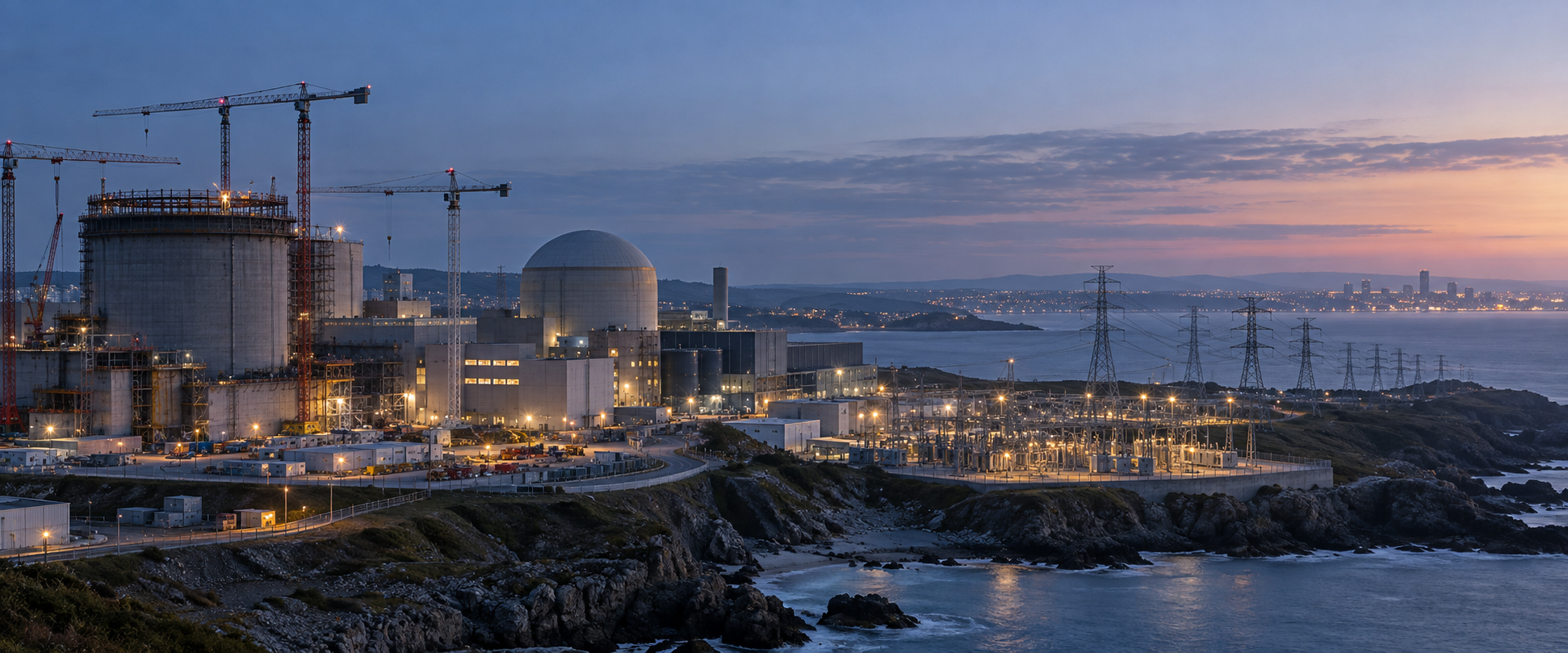
1. The financing decision
A nuclear regulated asset base changes the timing and allocation of project cash flow. Consumers begin contributing during construction, investors receive a regulated return before the plant produces electricity, and the project may support more debt at a lower financing cost. The mechanism can make a capital-intensive programme financeable. It also commits households and businesses to pay for an asset whose completion, cost and operating performance remain uncertain.
The policy decision is therefore whether the reduction in financing cost and expected system value justify the risks transferred to consumers and taxpayers. That judgment requires a complete architecture covering licence, allowed revenue, eligible expenditure, cost incentives, debt, government support, reporting, discontinuation and operation.
2. Why nuclear financing cost matters
Large reactors require years of design, licensing, procurement, civil works, installation and commissioning. Capital invested early can accrue financing cost for a long period before operational revenue begins. A merchant or fixed-price offtake model asks equity and debt providers to carry that exposure. Their required return rises with schedule, cost and policy risk.
A lower weighted average cost of capital can materially reduce lifetime cost because nuclear construction expenditure is large and front loaded. The financial benefit remains contingent on project control. A cheaper capital structure applied to escalating or weakly governed expenditure can still produce poor value.
3. What a regulated asset base does
A regulated asset base records eligible capital invested in a licensed infrastructure company. The regulator allows the company to earn revenue based on the asset base, an allowed return and approved cost building blocks. Established UK network regulation uses versions of this approach for monopoly infrastructure.
The nuclear adaptation allows revenue during construction. Ofgem describes the model as enabling cost recovery regulated through the economic licence. The Nuclear Energy (Financing) Act 2022 created the mechanism for designated nuclear projects. The project licence then defines the revenue calculation, incentives, reporting and controls.
4. The construction-period cash-flow cycle
The project spends capital on eligible work. Verified expenditure is entered into the RAB under licence rules. Allowed revenue includes a return and other approved building blocks. Electricity suppliers fund the revenue-collection mechanism, and the cost enters customer bills through applicable arrangements. The resulting cash supports construction, financing and investor distributions within the agreed controls.
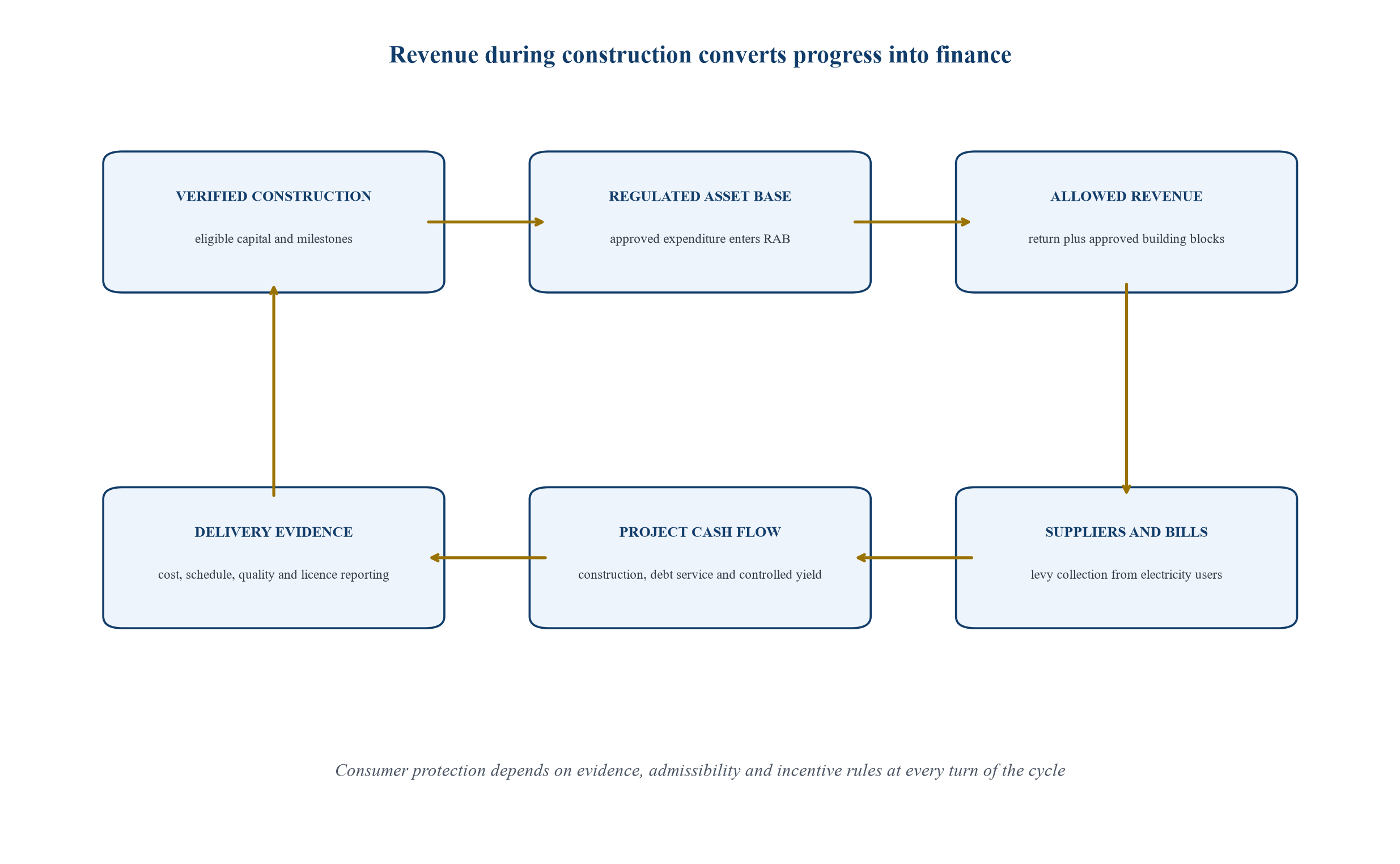
Generic architecture. Legal roles, collection mechanics and revenue building blocks depend on the project licence and jurisdiction.
5. The UK statutory foundation
The Nuclear Energy (Financing) Act 2022 establishes designation, licence modification and revenue-collection arrangements for qualifying nuclear projects. A project operator requires a modified electricity generation licence to benefit from nuclear RAB levies. The statutory structure also addresses revenue collection, special administration and powers connected with project continuation.
The legislation provides authority. The commercial allocation resides in the licence, project documents, government support package and regulatory decisions. An investor should read those instruments together because an attractive allowed return can be offset by expenditure disallowance, financing restrictions or tail-risk exposure.
6. Designation and licence modification
Designation identifies a project considered suitable for the RAB route under the statutory criteria. Licence modification converts the project into an economically regulated company with project-specific conditions. The licence governs allowed revenue, asset-base treatment, reporting, ring-fencing, debt and operational regulation.
The designation decision should test maturity, value for money, expected completion and the credibility of the financing plan. A licence should become effective only when the project, capital structure and support package are sufficiently defined for the regulator and public to understand the risk transfer.
7. Sizewell C as the first UK nuclear RAB
The UK government confirmed the Sizewell C final investment decision on 22 July 2025. The project is intended to provide 3.2 GW and operate for at least 60 years. Its capital structure combines government and private equity, public debt, the nuclear RAB and a government support package.
Sizewell C is therefore an important live reference for nuclear RAB design. It should be treated as a project-specific structure. Replication in another jurisdiction requires its own statutory authority, regulator, consumer base, generation market and sovereign support.
8. Revenue before electricity
Construction-period revenue reduces the period during which capital compounds without cash return. It can support investor yield, interest, fees, project costs and reserves according to the licence. This timing benefit can lower required returns and broaden the investor base.
The consumer begins paying before receiving output from the plant. The legitimacy of that arrangement depends on visible progress, credible expected value and protection against avoidable expenditure. Revenue timing must therefore be paired with stringent evidence and communication.
9. Allowed revenue
Allowed revenue is the maximum regulated income available to the licensee for a charging year, including relevant market or other sources under the licence. It is calculated through specified building blocks and financial models. The first Sizewell C charging year runs from 4 November 2025 to 31 March 2027, and Ofgem published an allowed-revenue amount notified by the Secretary of State of £1,443,625,216.26 nominal.
This amount is a regulatory cap and not evidence that every pound is a permanent addition to the RAB. Reconciliation, actual expenditure and licence treatment determine the final economics.
10. Revenue collection
The UK structure uses the Low Carbon Contracts Company as the designated counterparty for revenue-collection contracts. Electricity suppliers make payments under the mechanism and recover relevant costs through customer tariffs, subject to supply regulation and the price-cap methodology where applicable.
Revenue collection should minimise credit leakage and timing mismatch. The contract should define calculation, invoicing, collateral, shortfalls, reconciliation and default. A broad and durable payer base supports financeability, while transparency is required because the charge is collected from consumers rather than voluntary project customers.
11. Price-cap treatment
Ofgem decided to incorporate nuclear RAB costs into the default tariff cap from 1 January 2026. Its November 2025 decision described an annualised £14 allowance for a dual-fuel customer for the January to March 2026 cap period, including one-off recovery of earlier supplier costs. The amount was specific to that decision and period.
Consumer communications should separate the project levy, supplier administration and timing adjustments. A construction charge can vary as expenditure, allowed return and the customer base change. A single early bill estimate should not be used as a lifetime cap.
12. The regulated return
The allowed return compensates capital providers for time and regulated risk. The National Audit Office reported a 6.73% real construction-period weighted average cost of capital agreed for Sizewell C, with Ofgem expected to set the rate periodically after operation. This project-specific figure reflects the capital structure and risk allocation documented at the 2025 investment decision.
The rate should be tested against systematic risk, leverage, debt cost, inflation, government support and investor exposure. A lower return can reduce financing cost, while an incorrectly calibrated return can weaken financeability or overcompensate investors.
13. Cost of debt adjustment
Debt cost changes with market rates, tenor, issuance timing and credit support. The Sizewell C licence includes a Cost of Debt Adjustment model that interacts with the Price Control Financial Model. This can align allowed revenue with efficient financing cost under specified rules.
The mechanism should preserve incentives to issue debt efficiently. Pass-through of every financing choice can weaken discipline. A benchmark, adjustment formula, issuance strategy and regulatory review should define which costs consumers absorb.
14. Capitalisation and current cash
A RAB can provide current cash revenue and increase the regulated asset value that earns future return. The allocation between current recovery and capitalisation affects consumer bills, project liquidity and intergenerational burden. Higher current payments can reduce financing needs. Greater capitalisation defers cost and increases the future revenue requirement.
The regulator should publish the bridge from expenditure to current revenue and closing RAB. Investors should model both because cash yield and terminal asset value can respond differently to delay or disallowance.
15. Eligible expenditure
Only expenditure that satisfies licence definitions and regulatory tests should enter the RAB. Eligibility may depend on project scope, efficiency, evidence, procurement and timing. Costs outside the approved project specification should require explicit treatment.
The licensee needs a controlled cost ledger linked to work packages, contracts, milestones and asset records. The independent technical adviser and regulator should be able to trace claimed expenditure to delivery. Eligibility should not become automatic because cash was spent.
16. Day-one RAB
A day-one RAB can recognise eligible development expenditure incurred before the revenue commencement date. This creates value for capital already committed and establishes the opening regulated balance. It also transfers historic-cost risk to the regulated framework.
The admission process should review scope, prudency, related-party charges, sunk costs and evidence. The opening balance must be transparent because every future return and consumer charge can build upon it.
17. Cost and schedule baselines
The financing model requires an approved project baseline, regulatory thresholds and schedule milestones. The baseline should reconcile engineering quantities, executed contracts, contingency, inflation, owner's costs, financing and commissioning. Schedule assumptions should connect to regulatory, civil, equipment, fuel and testing logic.
The National Audit Office's 2026 report provides a public baseline for Sizewell C and records material uncertainty. A project-specific RAB should maintain an auditable bridge between each baseline revision and the treatment of consumers, taxpayers and investors.
18. Lower and higher regulatory thresholds
Thresholds determine how overspend, savings and tail risk are shared. Under the Sizewell C structure described by the NAO, the lower regulatory threshold is near a central project estimate and the higher threshold represents a more adverse cost and schedule outcome. Spend above the higher threshold can trigger decisions on further funding, dilution, return limitation or discontinuation.
Thresholds should be set from independent cost and schedule evidence. They should be indexed and updated only under defined change-control rules. Weak thresholds can transfer ordinary delivery risk to consumers.
19. Capex incentive
The Sizewell C licence includes a capex incentive that shares overspend or savings relative to the lower regulatory threshold. The published licence states a 0.5 incentive rate once cumulative allowable spend exceeds the lower threshold, with related calculations for the final pre-operation RAB.
A 50% sharing rate gives investors exposure to part of the variance while consumers absorb another part. The strength of the incentive depends on the threshold, exclusions, investor capital at risk and the effect of delay on yield and value.
20. Schedule incentives
Construction-period revenue can weaken schedule pressure if investors receive cash while completion moves further away. Yield caps, milestone conditions and declining distributions can restore discipline. The NAO reported Sizewell C yield caps that decline from 6% to 4%, then 2% and eventually zero as delay increases.
Schedule incentives should be tied to an integrated critical path and independently verified milestones. A cap on distributions preserves cash and reduces reward for delay. It should operate alongside contractual remedies and management accountability.
21. Investor returns and risk
RAB finance reduces some revenue and financing risk, yet nuclear construction risk remains. The NAO reported estimated post-tax investor internal rates of return between 12.0% and 13.0% at the lower regulatory threshold and between 10.8% and 11.4% at the higher threshold, under its stated assumptions. It also observed that investor returns retained a nuclear premium.
Return analysis should identify exposure to overspend, delay, disallowance, discontinuation, dilution and operating performance. Public debate is better served by comparing returns with retained risk and control responsibilities.
22. Public debt
Public or publicly supported debt can materially reduce funding cost. The NAO reported that the National Wealth Fund committed up to £36.6 billion nominal of debt to Sizewell C. Public debt transfers credit exposure to the state and can crowd in private equity.
Debt terms should include draw conditions, maturity, pricing, covenants, security, distribution controls and remedies. The public lender should operate through a defined mandate with transparent reporting. Cheap debt should not weaken project scrutiny.
23. Equity structure
Equity absorbs residual project risk and exercises governance. A mixed shareholder group can bring nuclear delivery, financial and public-policy capability. Conflicts can arise where shareholders also supply engineering, operations, debt or public support.
The shareholder agreement should cover further funding, dilution, deadlock, transfers, related-party transactions and board rights. Public and private capital should face clearly documented economics. Governance should match the risk each shareholder controls.
24. Government support package
The Sizewell C government support package addresses specified high-impact, low-probability risks. Published documents include contingent financing, discontinuation and compensation, a government liquidity facility, nuclear administration and statutory transfer arrangements, supplementary insurance support, an independent technical adviser deed and a call option.
Support can improve financeability by defining tail outcomes. It also creates contingent taxpayer exposure. Each support instrument should state trigger, cap, process, pricing, recovery and interaction with investor returns.
25. Contingent financing
Contingent financing becomes relevant when the project reaches a higher regulatory threshold or another defined stress. It can prevent value destruction where additional capital is rational. The facility should not create an unlimited commitment to complete.
Draws should require updated remaining-cost and completion-value analysis. Terms can include investor participation, dilution, return limits and stronger control. The decision should compare continuation with discontinuation on a forward-looking basis.
26. Government liquidity facility
The Sizewell C government liquidity facility provides a committed revolving loan for maturing principal under the common debt platform. Published information states that penalties discourage use. Such a facility can address refinancing or market-disruption risk without automatically absorbing construction overspend.
Liquidity support should be priced to preserve normal market access and contain objective draw conditions. It should include repayment priority, information rights and limits. Consumer or taxpayer protection improves where the facility addresses a defined liquidity gap rather than solvency.
27. Discontinuation
A RAB project should be capable of stopping when expected completion value falls below the remaining cost and risk. Discontinuation arrangements define the decision authority, triggers and compensation. They also determine treatment of debt, equity, contracts, assets and the partially built site.
Compensation can preserve financeability by protecting investors against political termination. Excessive protection can weaken abandonment discipline. The formula should distinguish policy change from project underperformance and align recovery with enforceable rights.
28. Special administration
Nuclear special administration seeks continuity where a licensed company becomes insolvent. It can preserve safety, construction or operation and protect value created through consumer contributions. The Sizewell C support package includes nuclear administration and statutory transfer arrangements.
The regime should define administrator duties, funding, transfer powers and creditor treatment. Lenders need clarity on security and enforcement restrictions. Consumers need confidence that insolvency does not erase the value already funded.
29. Independent technical scrutiny
The independent technical adviser reviews project cost and progress and makes recommendations to the regulator regarding amounts logged to the RAB. Independence, technical competence and access to records are essential. The adviser should examine schedule, procurement, change, contingency and forecast completion.
The regulator retains decision authority. Adviser reports should distinguish verified facts, management forecasts and unresolved claims. Public summaries can strengthen accountability while protecting commercially sensitive information.
30. Regulatory reporting
Ofgem's Regulatory Instructions and Guidance establish reporting on revenue, cost, schedule and financial performance. Structured reporting creates the evidence needed for annual revenue decisions and licence enforcement. It also allows trends to be compared with baseline.
Data should reconcile engineering systems, contract commitments, accounting records and the financial model. Forecast changes should carry owner, cause, probability and treatment. Repeated data-quality failure should have consequences because weak reporting can conceal project deterioration.
31. Price-control financial model
The Price Control Financial Model calculates allowed-revenue components using licence inputs. Its formulae, variable values, inflation, debt adjustment and reconciliations affect investor cash flow and customer charges. Ofgem modified elements of the Sizewell C regulatory framework in September 2026 to correct functionality and handle charging periods accurately.
Model governance should include version control, validation, independent testing and public explanation. A spreadsheet error can alter material revenue. Technical accuracy is part of consumer protection.
32. Ring-fencing
The licensed nuclear company should be financially and operationally ring-fenced from affiliates. Licence conditions can restrict disposals, indebtedness, distributions and related-party transactions. Ring-fencing protects regulated cash flow and project assets.
The company should maintain adequate resources, systems and directors capable of acting for the licensee. Affiliate contracts should be arm's length and transparent. RAB revenue should not subsidise unrelated group activity.
33. Procurement and related parties
Nuclear projects depend on long-term engineering, equipment and service contracts. Shareholders or affiliates may be counterparties. The regulator and board need evidence that price, scope and risk allocation represent value.
Competitive procurement, benchmarking, open-book verification and conflict governance can protect consumers. Contract change should be traced to design, schedule and RAB treatment. A related-party margin should not enter the asset base without scrutiny.
34. Change control
Design, regulatory and site changes can create cost and delay. A controlled process should define authority, estimate, schedule impact, contingency, funding and eligibility. Emergency work may require accelerated approval followed by retrospective verification.
The project should distinguish client choice, regulatory requirement, unforeseen condition and contractor failure. Their financial treatment can differ. Aggregating changes into general contingency weakens accountability.
35. Inflation
Construction lasts across economic cycles. Labour, materials, equipment and financing costs can move differently from general inflation. The licence should define indexation for expenditure, RAB and revenue. The model should prevent double recovery where contract prices and regulatory values use different indices.
Inflation allocation affects consumers and investors. A transparent index basket can match cost drivers while preserving efficiency. Unhedged inflation exposure should be identified in the financing plan.
36. Tax
Tax allowances, capital allowances, deferred tax and shareholder financing affect allowed revenue and investor returns. Regulatory tax treatment should follow defined principles and avoid double recovery. Changes in tax law require a controlled adjustment process.
The regulator should reconcile cash tax, accounting tax and modelled allowances. Tax transparency matters where public capital and consumer revenue coexist with private returns.
37. Decommissioning and waste
New nuclear operators must secure funding for decommissioning and their share of waste-management and disposal costs. These obligations extend beyond the operating life and should not be obscured by construction finance. The funded decommissioning programme defines contributions, assets, governance and review.
The RAB and operating revenue model should incorporate approved funding without transferring avoidable shortfall risk. Assumptions should be updated with policy, cost and investment performance.
38. Operations phase
After completion, the regulatory model moves from construction to operation. Allowed revenue should reflect the opening operational RAB, depreciation, return, efficient operating cost, tax and performance incentives. Electricity market revenue can offset the regulated requirement under the licence.
Operational regulation should reward availability, safety-compliant delivery and efficient cost. Outage, fuel and maintenance risk remain. The transition requires verified completion, asset data and an agreed opening balance.
39. Market revenue reconciliation
A nuclear plant sells electricity and related products. Under a RAB, market income can reduce the amount collected from consumers where the licence reconciles total income to allowed revenue. Low market prices can increase the levy; high prices can reduce it.
The settlement framework should define hedging, ancillary services, capacity income and imbalance. A prudent trading strategy should avoid exposing consumers to speculative risk. Reporting should bridge gross market revenue to the regulated collection requirement.
40. Comparing RAB, CfD and public finance
Table 1. Comparison of nuclear financing models
| Criterion | Nuclear RAB | Contract for Difference | Direct public finance |
|---|---|---|---|
| construction-period revenue | available under licence | generally begins with generation | funded through public budget or entity |
| financing-cost effect | can lower risk through early regulated cash | investors carry pre-operation finance until revenue | can approach sovereign borrowing cost |
| consumer exposure before output | direct through levy | generally limited before generation | indirect through taxation and public balance sheet |
| construction risk | shared among investors, consumers and state | principally investors and contractors, subject to support | principally taxpayer and public entity |
| price or revenue risk in operation | regulated allowed revenue with market reconciliation | strike-price support against reference market | determined by public ownership and market policy |
| delivery discipline | licence incentives, disallowance and governance | fixed contract economics and sponsor capital at risk | public governance, budget control and accountability |
| tail-risk support | often explicit government package | may include guarantees or political-risk protection | sovereign absorbs residual risk |
| transparency requirement | high because consumers pay during construction | contract and subsidy reporting | public accounts, parliamentary and audit scrutiny |
Generic comparison. Actual risk depends on project-specific contracts, regulation and sovereign support.
41. Hypothetical sources and uses
A RAB project may combine equity, debt, consumer-funded revenue and government facilities. The capital plan should show which source funds each use and which amounts are expected to enter the RAB. Current revenue is not a free source because it creates consumer cost and regulated obligations.
Table 2. Illustrative construction-period sources and uses
| Uses | Amount | Sources | Amount |
|---|---|---|---|
| development and licensing | 2,000 | public and private equity | 7,000 |
| nuclear equipment and engineering | 10,500 | senior construction debt | 14,500 |
| civil works and site infrastructure | 7,500 | construction-period allowed revenue | 5,000 |
| owner's cost, fuel and commissioning | 3,000 | government contingent facility | 2,500 |
| contingency and escalation | 3,500 | supplier and contractor credit | 1,000 |
| financing cost and reserves | 3,500 | committed completion support | 0 |
| total uses | 30,000 | total committed sources | 30,000 |
Hypothetical monetary units for decision analysis. Values do not describe Sizewell C or any named project.
42. Consumer-bill bridge
The public should be able to trace the annual levy from project expenditure through RAB balance, allowed return, depreciation or building blocks, market income and supplier recovery. The bridge should show household and business impacts under several usage levels.
Publication should include actual and forecast values, changes from prior year and principal drivers. A lifetime average can hide high construction-year charges or uncertainty. The bridge should therefore present a time series and confidence range.
43. Affordability and distribution
An electricity levy can affect households differently according to consumption and tariff. Vulnerable users may bear a larger burden relative to income. Policy makers can use bill support, taxation or alternative allocation to address distributional effects.
The financing model should quantify incidence across customer classes. Consumer protection includes affordability and transparency alongside project efficiency. Decisions about socialising cost should be explicit.
44. Intergenerational allocation
Current consumers can fund an asset that operates for decades. Future consumers may receive benefits after early payers have moved or changed supplier. Greater capitalisation can shift cost forward; greater current collection can reduce financing expense.
The regulator should state the principle used to allocate cost across generations. Asset life, depreciation and decommissioning funding should match expected benefit. The objective is a reasoned balance between financing efficiency and fairness.
45. Value-for-money test
Value for money compares the RAB project with credible alternatives that provide similar security, carbon and system services. It should include construction, financing, fuel, network, backup, decommissioning and risk. Alternative costs are uncertain and should be shown as ranges.
The assessment should separate strategic case, economic case and financing choice. A project can be strategically valuable while one financing term remains expensive. The RAB should be compared with public finance, a CfD and other risk allocations.
46. Counterfactual discipline
The value of private participation depends on whether investors improve delivery enough to offset their return. The NAO reported that DESNZ's Sizewell C analysis assumed private investors would reduce construction costs by at least £3.9 billion and delay by 24 months compared with a fully public counterfactual, offsetting a minimum £4.0 billion private-finance cost in the analysis.
Such assumptions should become measurable governance commitments. The project should identify which investor rights, expertise and interventions create the expected benefit. Outcomes should be reported against the counterfactual.
47. Risk of sunk-cost escalation
Early consumer payments and a growing RAB can create pressure to continue after adverse evidence. Decision makers may focus on sums already spent instead of remaining cost and expected benefit. A credible discontinuation framework counters this bias.
Every major review should present the cost to complete, probability-adjusted output, termination cost and alternative system plan. Sunk expenditure remains relevant to compensation and asset value, while the continuation decision should be forward looking.
48. Threshold sensitivity
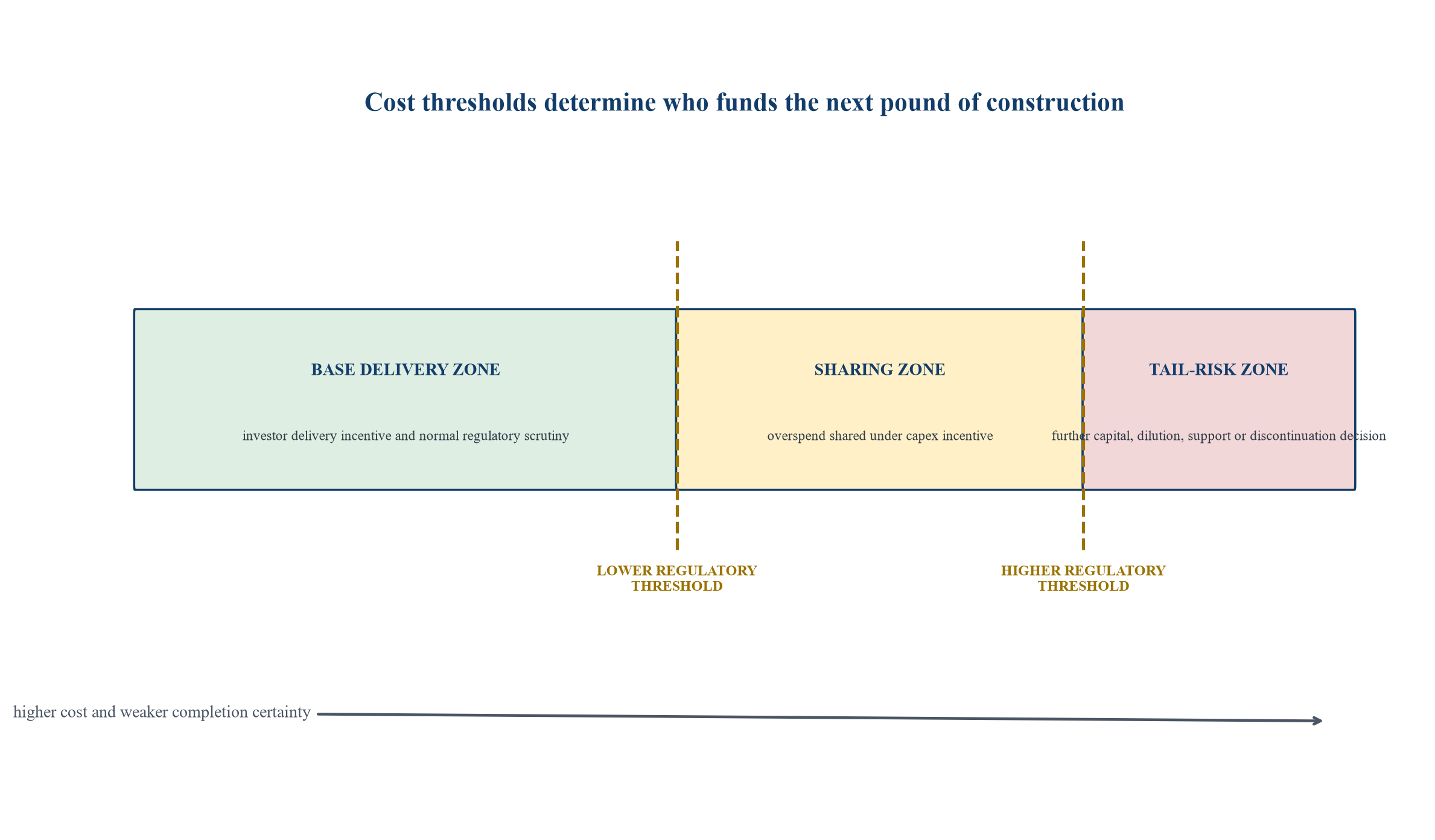
Hypothetical decision framework. Threshold values and sharing rates are illustrative and do not represent a named project.
49. Hypothetical downside model
The following sensitivity isolates the interaction between delay, RAB growth, annual consumer collection and investor return. It assumes a common project and changes only the downside scenario. The values are illustrative.
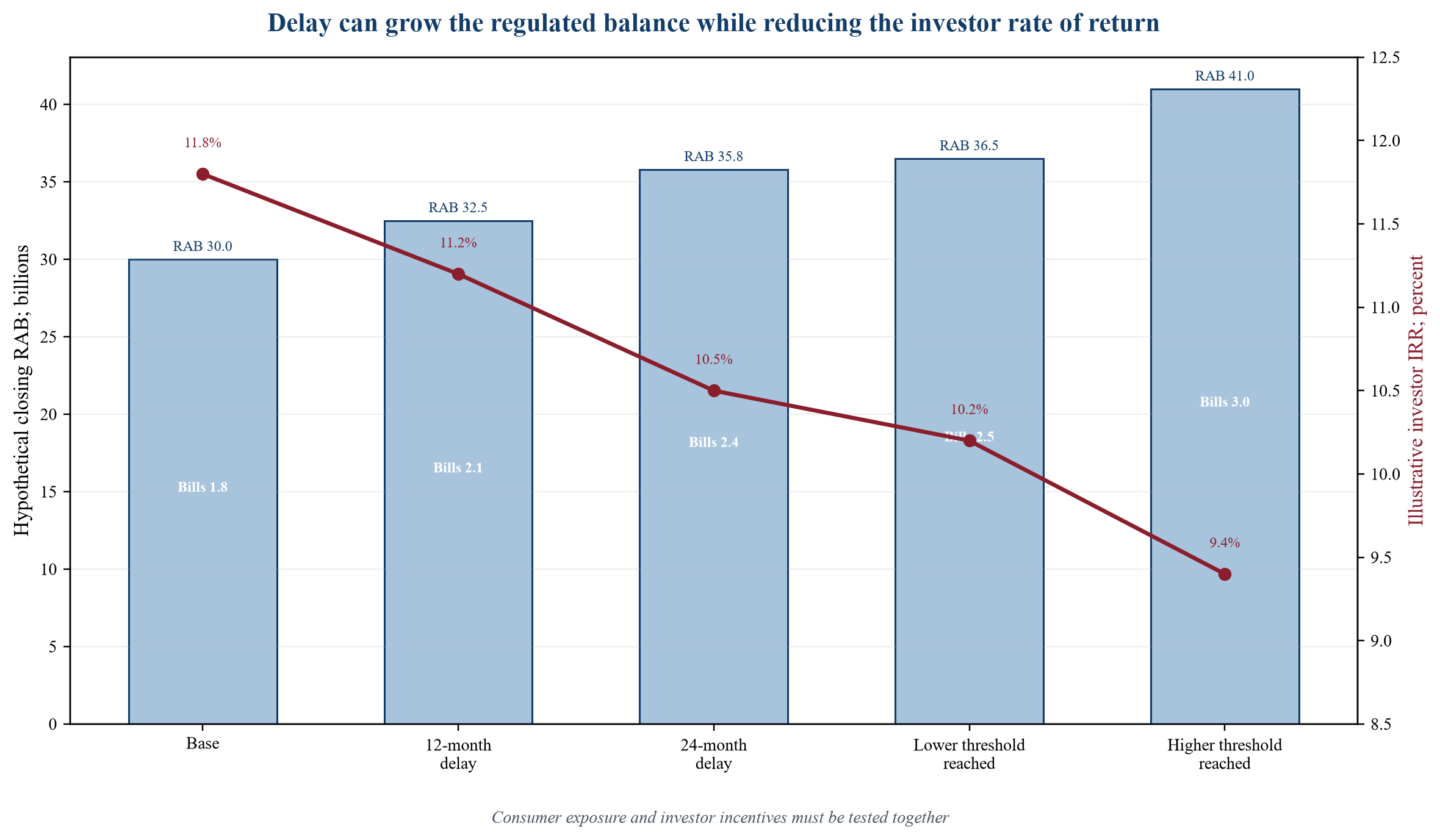
Hypothetical sensitivity. Monetary values and returns are decision aids and do not represent a forecast or named project.
50. Risk allocation matrix
Table 3. Nuclear RAB risk allocation and consumer-protection response
| Risk | Primary controller | Financial bearer | Control instrument | Evidence gate |
|---|---|---|---|---|
| design and construction | licensee, vendor and contractors | equity, consumers under approved sharing and government at tail | capex incentive, contracts, disallowance and completion support | mature design, executable contracts and verified progress |
| schedule delay | licensee and delivery partners | investors through yield limits, consumers through financing and state at tail | milestone-linked revenue, yield caps and long-stop review | independent critical-path and remaining-duration assessment |
| financing cost | treasury, licensee and debt managers | consumers within approved adjustment and investors outside it | debt benchmark, cost-of-debt adjustment and issuance controls | approved financing plan and market evidence |
| inflation | suppliers, licensee and macroeconomy | allocated through indexation and contract terms | specified indices, hedging and reconciliation | transparent index bridge and no double recovery |
| inefficient expenditure | licensee and regulator | shareholders where disallowed | eligibility, prudency review and independent technical advice | auditable cost record and regulatory determination |
| market revenue | licensee and electricity market | consumers through reconciliation within allowed revenue | trading policy, hedge controls and revenue true-up | verified market income and settlement data |
| insolvency | board, creditors and public authorities | investors, creditors and state under statutory regime | ring-fencing, special administration and transfer powers | financeability certificate and continuity plan |
| discontinuation | government, regulator and project board | allocated under compensation and support agreements | forward-looking completion review and call option | updated cost-to-complete and alternative-system case |
| decommissioning | licensee and government policy | funded programme and ultimately protected public interest | segregated fund, periodic review and investment governance | approved funded decommissioning programme |
Generic framework. Actual allocation must follow enforceable legislation, licences, contracts and jurisdiction-specific advice.
51. Consumer-protection control system
Consumer protection depends on linked controls. The licence defines revenue and obligations. The regulator admits efficient cost and sets revenue. The independent adviser tests technical evidence. The project board controls delivery. Government support addresses selected tail risks. Audit and public reporting create accountability.
Each control needs an owner, information, decision right and consequence. Duplication can slow delivery, while gaps transfer value. A control map should accompany the financing model and be refreshed after any licence or support amendment.
52. Annual revenue-setting process
The licensee prepares the annual calculation using the current financial model and handbook, supported by regulatory reporting. The regulator reviews inputs, applies determinations and notifies allowed revenue. Reconciliations correct provisional values where required.
The timetable should allow challenge before supplier charges are final. Material assumptions should be disclosed. Emergency adjustments should remain narrow and reviewable.
53. Governance dashboard
The board and regulator should review cost, schedule, RAB, revenue, financing, risk and outcomes in one dashboard. Metrics should include committed cost, forecast final cost, contingency, critical-path movement, milestone completion, cost admitted and pending, consumer collection, debt draw, liquidity and yield.
The dashboard should show threshold distance and tail scenarios. It should avoid a green status based only on expenditure or activity. Delivery evidence and forecast credibility carry equal weight.
54. Investment committee sequence
An investment committee should first assess the strategic need and alternative system portfolio. It should then test design replication, cost and schedule maturity, licence, RAB mechanics, government support and capital structure. Next it should model allowed revenue, threshold sharing, tail risk, dilution and exit.
Approval should state the investor's required return, retained risks, governance rights and additional funding obligation. The committee should understand the consumer and public funding position because political durability affects the asset.
55. Policy-maker sequence
Policy makers should define the energy service, justify the project and compare financing models. They should set consumer-protection principles before negotiating investor terms. Thresholds, incentives, government support and disclosure should follow those principles.
The final decision should publish a baseline that future reviews can test. Public value depends on execution after financial close. A continuing assurance programme should measure cost, schedule, risk transfer and system alternatives.
56. Transferability beyond the UK
Other jurisdictions can adapt RAB principles where a credible regulator, legal collection mechanism, broad payer base and durable political commitment exist. Vertically integrated utilities may already recover construction work in progress through rates. Competitive markets require a dedicated levy, licence and settlement framework.
Transferability depends on constitutional, consumer, insolvency and state-aid rules. A project should not import a headline allowed return without the associated controls and support architecture. The complete system determines financeability.
57. Conclusion
The nuclear regulated asset base can convert construction progress into current revenue and reduce the financing burden of a long-duration project. Its effectiveness depends on the quality of project execution and the precision of risk allocation. Consumers pay before operation and can bear part of cost, delay and financing risk. Investors receive regulated cash while retaining defined construction, threshold and tail exposure.
A durable RAB links every pound of revenue to verified delivery, admits only efficient expenditure, maintains meaningful cost and schedule incentives, controls distributions, provides transparent debt and support, and preserves a rational discontinuation decision. Governments and regulators should judge the model through this integrated control system. The public case becomes credible when lower financing cost, delivery discipline and consumer protection remain visible from financial close through decades of operation.
References
- United Kingdom. Nuclear Energy (Financing) Act 2022. https://www.legislation.gov.uk/ukpga/2022/15/contents
- Department for Energy Security and Net Zero. Sizewell C collection. Updated 2026. https://www.gov.uk/government/collections/sizewell-c
- Department for Energy Security and Net Zero. Sizewell C: Regulated Asset Base. Updated 7 November 2025. https://www.gov.uk/government/publications/sizewell-c-regulated-asset-base-rab
- Department for Energy Security and Net Zero. Electricity generation licence: special conditions for nuclear generator. 2025. https://assets.publishing.service.gov.uk/media/687f5ebe8adf4250705c9747/Nuclear_RAB_Licence_Full_Form_Special_Conditions_v7_19072025_redacted.pdf
- Department for Energy Security and Net Zero. Sizewell C: government support package. 22 July 2025. https://www.gov.uk/government/publications/sizewell-c-government-support-package
- Department for Energy Security and Net Zero. Sizewell C: Value for money assessment. 22 July 2025. https://www.gov.uk/government/publications/sizewell-c-value-for-money-assessment
- Department for Energy Security and Net Zero. Sizewell C gets green light with final investment decision. 22 July 2025. https://www.gov.uk/government/news/sizewell-c-gets-green-light-with-final-investment-decision
- Ofgem. Sizewell C Economic Guidance. 20 August 2025. https://www.ofgem.gov.uk/guidance/sizewell-c-economic-guidance
- Ofgem. Nuclear energy. https://www.ofgem.gov.uk/energy-regulation/low-carbon/nuclear-energy
- Ofgem. Allowed Revenue for Sizewell C for the First Charging Year. 4 November 2025. https://www.ofgem.gov.uk/transparency-document/allowed-revenue-sizewell-c-first-charging-year
- Ofgem. Decision: Amending the price cap methodology to account for the Nuclear Regulated Asset Base allowance. 21 November 2025. https://www.ofgem.gov.uk/sites/default/files/2025-11/Amending_the_price_cap_methodology_to_account_for_the_Nuclear_Regulated_Asset_Base_nRAB_allowance.pdf
- Ofgem. Consultation and notice of proposed modifications to Sizewell C regulatory framework; decision published 3 September 2026. https://www.ofgem.gov.uk/consultation/consultation-and-notice-proposed-modifications-sizewell-c-regulatory-framework
- Ofgem. New Regulatory Instructions and Guidance for Sizewell C. 2025. https://www.ofgem.gov.uk/consultation/new-regulatory-instructions-and-guidance-rigs-sizewell-c-nuclear-licensee-consultation
- Ofgem. Sizewell C Price Control Financial Handbook. 2025. https://www.ofgem.gov.uk/sites/default/files/2025-07/Sizewell-C-PCFH-V1.00.pdf
- Ofgem. CEPA Sizewell C Cost of Equity Guidance Final Report. 2024. https://www.ofgem.gov.uk/sites/default/files/2025-08/CEPA-Ofgem-SZC-Cost-of-Equity-Guidance-Final-Report.pdf
- National Audit Office. Sizewell C. 20 May 2026. https://www.nao.org.uk/reports/sizewell-c/
- National Audit Office. Sizewell C full report. 2026. https://www.nao.org.uk/wp-content/uploads/2026/05/sizewell-c.pdf
- OECD Nuclear Energy Agency. Financing New Nuclear Power Plants: Minimising the Cost of Capital by Optimising Risk Management. 2022. https://www.oecd-nea.org/upload/docs/application/pdf/2025-06/7632_nea_financing_report.pdf
- International Energy Agency. The Path to a New Era for Nuclear Energy; Financing Nuclear Projects. 2025. https://www.iea.org/reports/the-path-to-a-new-era-for-nuclear-energy/financing-nuclear-projects
- International Atomic Energy Agency. Financing Nuclear Power in Evolving Electricity Markets. https://www.iaea.org/sites/default/files/18/07/financing-np-0418.pdf
About the Author
Chennakeshav (CK) is a corporate finance and investment banking executive with 25+ years of global experience in deal origination, structuring and execution across M&A, growth capital and corporate strategy. He has led value-creation mandates for founders, corporates and funds — bridging the boardroom view to hands-on execution and close.
His career spans Morgan Stanley, HSBC, Lloyds Banking Group, EWEC, ADQ portfolio companies and Emirates Growth Fund, across TMT, real estate, fintech, deeptech, cleantech, infrastructure and energy. He has partnered with C-suite leaders, private equity and venture funds, sovereign wealth funds and family offices to finance complex fund raises and scale-up ventures, and has led M&A due diligence, post-merger integration and business-transformation initiatives to create value.
At Matchpoint Partners he is Managing Partner, leading the firm's corporate finance, M&A and capital-raising practice. He holds an MBA from London Business School, an engineering degree from VTU and a Master of Laws (LLM, in progress) from UCL London.
An active start-up mentor, CK mentors at Techstars, DIFC FinTech Hive, Startup Grind, Founder Institute and IN5, serves as Entrepreneur Mentor in Residence (EMiR) at London Business School, and judges the Entrepreneurship World Cup.
LinkedIn: https://www.linkedin.com/in/ckadya/
Profile: https://www.matchpoint-partners.com/team/ck-adya.html
