

1. The acquisition decision
The central decision is whether ownership creates more value than partnership, minority investment, licensing or internal development. A buyer should define the exact geothermal capability it lacks before searching for targets. The gap may concern resource assessment, high-temperature drilling, well design, reservoir modelling, stimulation, heat-network development, binary-cycle integration, project origination or operations. Each gap points to a different target universe and valuation logic.
The acquisition thesis should identify the customer problem that the combined business can solve, the evidence that customers will pay, and the constraint that ownership removes. Acquiring a respected technical team can shorten market entry when credibility and tacit knowledge matter. Buying equipment alone may add capacity without creating a geothermal franchise. A transaction becomes defensible when the buyer can state which bids, projects or recurring services become available after closing and why those opportunities are unavailable under a simpler commercial agreement.
2. Why oilfield capability is relevant
Geothermal and upstream oil and gas share subsurface evaluation, drilling, completions, project management, surface facilities and operating disciplines. The International Energy Agency estimates that around two-thirds of investment in conventional geothermal and more than three-quarters in next-generation geothermal overlap oil-and-gas skills and expertise [1]. Its executive analysis states that up to 80% of geothermal project investment can involve capabilities common to oil and gas [2].
These overlaps create a real adjacency for energy-service companies. They do not make every oilfield asset geothermal-ready. High temperature, corrosive fluids, lost circulation, different well economics, induced-seismicity controls, heat conversion and long project-development cycles can change equipment specifications and operating procedures. The acquisition case should distinguish common capability from adaptation work and genuinely geothermal-specific knowledge.
3. The market-entry choices
An energy-service company can enter geothermal through organic development, a commercial alliance, a minority investment, a joint venture, an asset acquisition or a control transaction. Organic development preserves ownership and limits purchase premium but can take years to establish references. Alliances can test demand and technical fit while leaving control and economics divided. Minority investments provide access and learning but may not secure people, data or customer priority.
Control transactions can combine scarce capability with the buyer's balance sheet and distribution. They also expose the buyer to integration risk, contingent liabilities and a valuation premium for an emerging market. The board should compare each route against the same scorecard: time to first qualified revenue, capital at risk, control over intellectual property, access to customers, ability to retain experts, reversibility and expected return.
4. Three transaction archetypes
Current market evidence illustrates three useful archetypes. RESPEC acquired Geothermal Resource Group in 2024 to add geothermal exploration, drilling management and reservoir expertise to a broader engineering platform [3]. CeraPhi acquired Third Energy and its legacy wells and infrastructure to support conversion of former gas assets to geothermal use [4]. SLB and Ormat chose a strategic partnership that combines subsurface and well-construction capability with geothermal plant development and operations [5].
The examples show that capability can reside in people, operating assets or a complementary platform. They also show that full ownership is only one route. The buyer should classify a target before valuing it. A people-led consultancy requires retention and succession analysis. An asset-conversion platform requires title, integrity and redevelopment diligence. A technology company requires intellectual-property and demonstration evidence. A project developer requires resource, permit, offtake and capital analysis.
5. Define the capability thesis
The capability thesis should be written as a testable statement. For example: the target's geothermal reservoir team, reference projects and drilling workflows, combined with the buyer's rigs, tools and international sales network, will qualify the group for integrated wellfield mandates within specified markets. This is more useful than a broad claim that geothermal is attractive.
The thesis needs a counterfactual. Management should estimate the cost, time and failure risk of building the same capability. It should identify whether the target's advantage is durable after employees, contracts and intellectual property are examined. If the advantage depends on a founder's personal relationships or undocumented judgement, the acquisition may buy fragility. The diligence process should convert strategic language into named capabilities, evidence and post-close actions.
6. Build the target map
The target universe should be segmented by capability rather than by company label. Relevant groups include geothermal consultancies, well-engineering specialists, reservoir-modelling firms, drilling-technology developers, high-temperature tool companies, project developers, operators, heat-network businesses, power-conversion suppliers, data platforms and owners of reusable wells or subsurface data.
Each segment has different transaction metrics. Consulting firms are assessed through utilisation, backlog, expert concentration and repeat clients. Technology companies require readiness-level, field-performance and freedom-to-operate analysis. Developers require project-by-project resource and permit evidence. Equipment companies require installed base, qualification status, manufacturing yield and aftermarket potential. Combining these categories into one revenue multiple obscures risk.
7. Screen strategic fit before price
The first screen should test whether the target fills an approved capability gap. The second should test whether the buyer can commercialise it. Geographic fit, customer overlap, delivery capacity, technical standards and brand credibility matter. A target can be technically excellent and commercially incompatible with the buyer's markets or contracting model.
The screen should also test channel conflict. Existing customers may view an integrated buyer as a competitor. Independent technical advice can lose credibility when embedded inside an equipment vendor. A target that serves multiple drilling contractors may face customer attrition if acquired by one. These risks affect perimeter and operating model, not only price.
8. Transaction perimeter
The perimeter defines which legal entities, people, contracts, intellectual property, data, equipment, permits, project interests and liabilities transfer. It should exclude assets that add remediation cost without advancing the capability thesis. Shared systems, offices, licences and service agreements need separation plans.
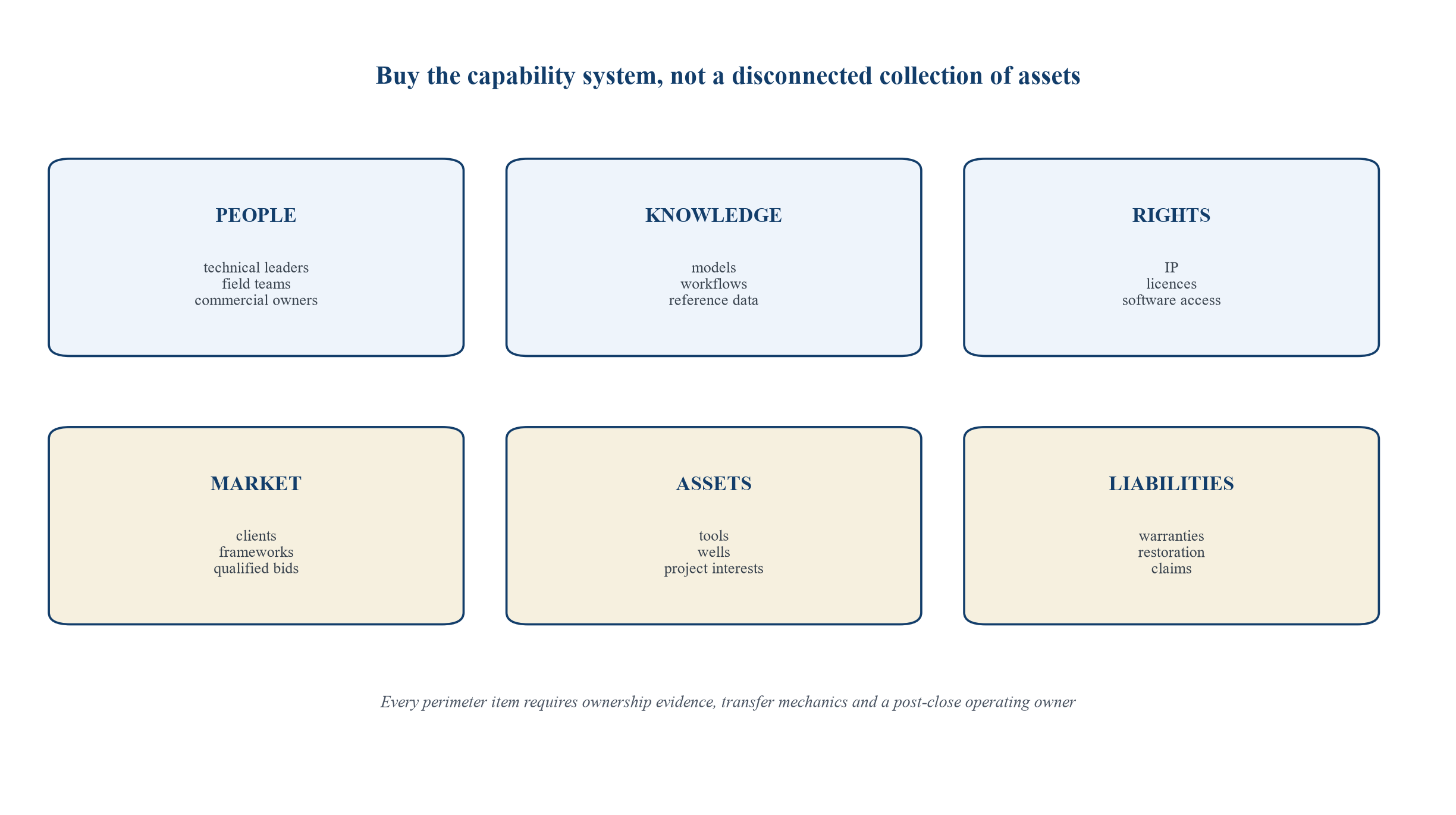
Generic framework; the actual perimeter depends on legal ownership, consent requirements and the acquisition thesis.
Perimeter diligence should reconcile the capability thesis to legal transfer. A named expert may not be an employee. A model may depend on third-party data that cannot be assigned. A reference project may be confidential and unusable in marketing. A permit may attach to an entity or site that is outside the proposed purchase. Each gap should change price, conditions or structure.
9. People and tacit knowledge
Geothermal capability is often concentrated in a small group of geoscientists, drilling engineers, reservoir specialists and project leaders. Their value includes judgement developed across wells and fields, not only documented procedures. Buyers should map which decisions depend on each person and whether another qualified individual can review or reproduce them.
Retention plans should address role, authority, technical independence, career path and incentives. Cash retention alone may fail if the buyer imposes an operating model that senior specialists consider unsafe or commercially misguided. Interviews should explore why people stay, which colleagues they rely on and how knowledge is shared. Employment restrictions must be reviewed under applicable law.
10. Reference-project verification
Management presentations often list projects without distinguishing advisory work, drilling responsibility, technology supply, ownership or operating accountability. Diligence should verify scope, dates, geography, client permission, contract value, outcome and the target's specific contribution. References should include both successful and difficult projects.
Technical success should be separated from commercial success. A well may meet temperature targets and still fail to support an economic project. A tool may operate successfully without reducing total well cost. A study may lead to no investment. The buyer should understand what was learned, which assumptions changed and whether the capability is repeatable.
11. Customer and pipeline diligence
The pipeline should be classified by signed backlog, framework call-off, preferred-bidder status, qualified opportunity and early lead. Probability weightings require evidence. Long-dated geothermal projects can remain in pipelines for years while permits, resource funding and offtake develop.
Customer concentration should be measured by revenue, gross margin, technical sponsorship and relationship ownership. The buyer should test whether customers will continue after a change of control and whether cross-selling is permitted. Interviews should ask what customers buy from the target, which alternatives they considered and what would cause them to stop.
12. Contract quality
Contracts should be reviewed for scope, liability, performance obligations, intellectual-property ownership, data rights, warranties, caps, indemnities, insurance, termination, change of control and payment terms. Geothermal work can combine advice, engineering and field execution; liability profiles differ materially across those roles.
Fixed-price work can contain exposure to subsurface uncertainty, schedule delay and third-party interfaces. Time-and-materials revenue may be less risky but less scalable. Success fees can create volatile recognition and disputes over causation. The buyer should rebuild backlog using only enforceable terms and identify contracts that need customer consent.
13. Technology diligence
Technology diligence should start with the problem solved, operating boundary and field evidence. Patents do not prove performance. A prototype does not establish manufacturability. A successful demonstration may depend on site conditions that are absent elsewhere.
Reviewers should inspect design history, test protocols, failure logs, materials, temperature and pressure limits, maintenance requirements, supplier dependencies, cybersecurity and product liability. Claims should be traced to raw data and independent witnesses. The diligence conclusion should identify what is proven, what remains developmental and which capital is required before commercial deployment.
14. Intellectual property and data rights
The buyer should establish ownership of patents, code, models, designs, trade secrets, data sets and know-how. Founder-created intellectual property may not have been assigned. University, grant or customer-funded work can carry restrictions. Open-source software can impose obligations that conflict with the intended commercial model.
Geothermal data often come from clients, governments, partners and licensed databases. The right to hold data may not include the right to reuse it across projects or train models. Diligence should map origin, licence, permitted use, retention, security and transfer. A model without lawful access to its training and calibration data can lose much of its value after closing.
15. Resource and project exposure
Targets may hold minority interests, development rights or contingent economics in geothermal projects. These interests should be valued separately from the service business. Resource, title, permit, offtake, funding and partner risks require asset-level diligence.
Project interests can create upside and balance-sheet calls. Shareholder agreements may require follow-on funding, guarantees or dilution. Change of control can trigger consent or pre-emption rights. The buyer should identify every commitment and avoid treating speculative project value as recurring operating earnings.
16. Legacy wells and infrastructure
Acquiring former oil-and-gas assets for geothermal conversion can provide wells, sites, pipelines, power connections and subsurface information. CeraPhi's acquisition of Third Energy included former gas wells and related infrastructure intended for geothermal redevelopment [4]. Such transactions require a combined acquisition and redevelopment case.
Well integrity, ownership, abandonment obligations, environmental condition, access rights, temperature, flow, proximity to heat demand and conversion design should be tested. Historic drilling cost is not a measure of current geothermal value. A well becomes valuable when it can deliver useful heat or power within a bankable commercial system.
17. Regulatory diligence
Geothermal rights and permits vary by jurisdiction. The target may need exploration, drilling, water, injection, environmental, land, construction, grid and heat-network approvals. Oil-and-gas permissions may not transfer or authorise geothermal use.
The buyer should map each approval to the entity, asset, term, renewal and change-of-control requirement. It should also test community commitments, induced-seismicity protocols and decommissioning security. Regulatory gaps can change transaction timing and should be reflected in conditions precedent or staged consideration.
18. Health safety and environmental diligence
Field capability should be tested through incident history, well-control systems, contractor management, training, audits and corrective actions. Geothermal operations introduce high-temperature fluids, gases, scaling, corrosion and pressure hazards. The buyer should confirm that procedures address the actual operating envelope.
Environmental diligence should cover historic contamination, produced fluids, waste, water use, emissions, habitat, restoration and legacy liabilities. Insurance history and claims can reveal issues absent from management summaries. Liability allocation in the purchase agreement should follow control, evidence and insurability.
19. Financial quality of earnings
The quality-of-earnings review should separate recurring client work from grants, one-off studies, equipment sales, project gains and related-party revenue. Revenue recognition should be tested against contract performance and collectability. Capitalised development cost can overstate current earnings when commercial evidence is limited.
Normalisation should reflect market compensation for founders, underinvestment in systems, required insurance, public-company compliance and stand-alone costs. Working capital can be volatile where projects use milestones or retainage. Cash conversion should be reconciled by contract rather than inferred from EBITDA.
20. Capability-adjusted valuation
The valuation should separate current earnings, transferable capability and contingent growth. Current earnings can be valued using appropriate service or technology comparables. Transferable capability may justify a premium when supported by retained people, protected knowledge, customer access and proven references. Contingent growth should be paid through milestones when evidence is incomplete.
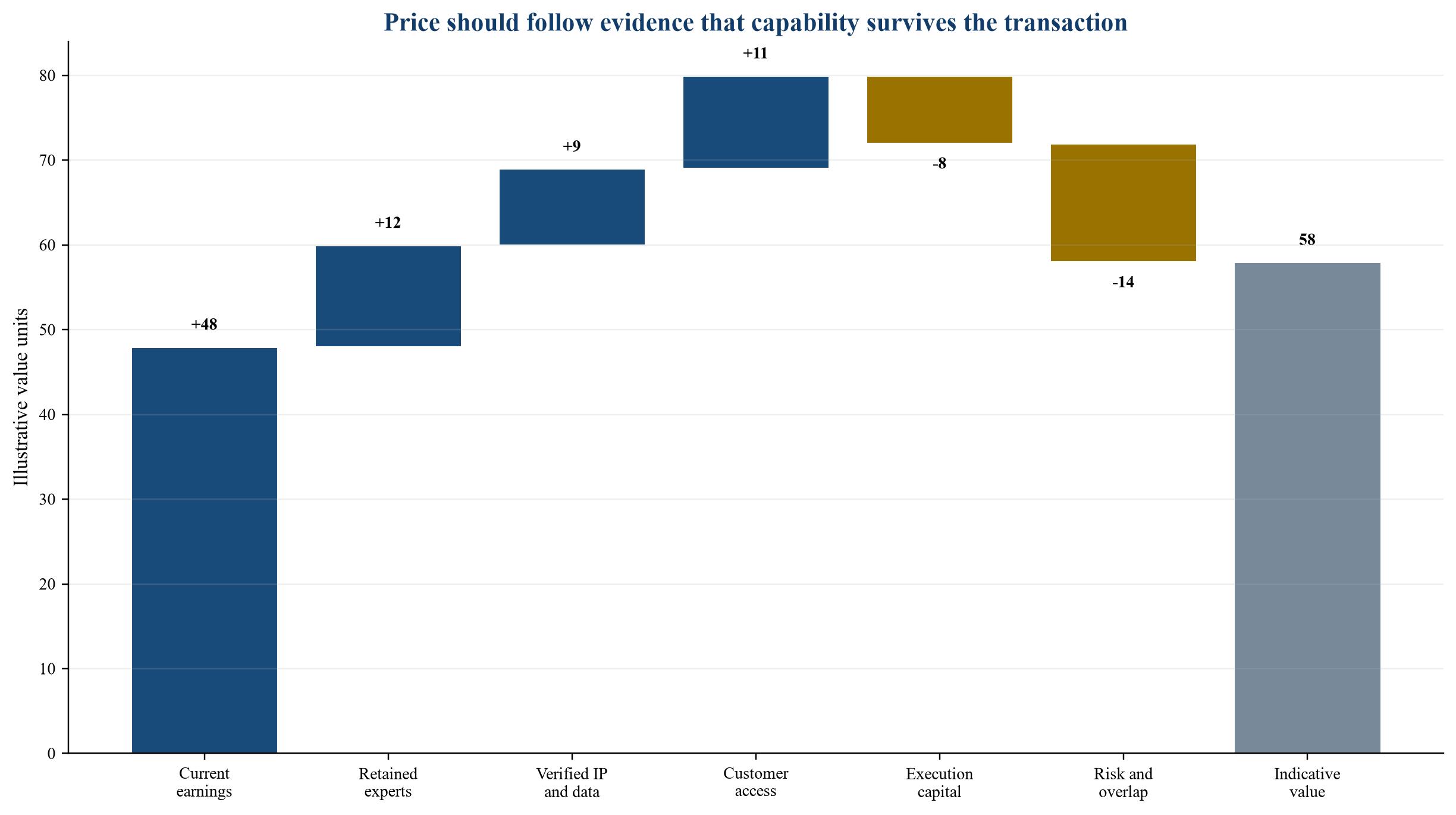
Hypothetical values for decision illustration only; not a valuation of any company or transaction.
The bridge prevents strategic language from becoming an undifferentiated premium. It also links diligence findings to price. Loss of a technical leader, non-transferable data or weak project references should reduce value. A credible customer framework or protected workflow can increase value when transfer and retention are demonstrable.
21. Comparable-company limits
Listed oilfield-service, engineering, renewable-technology and independent power companies have different economics. Their multiples reflect scale, cyclicality, capital intensity, recurring revenue and market liquidity. A small geothermal target should not inherit a public-company multiple without adjustment.
Transaction comparables can be sparse and terms are often undisclosed. Announced headline values may include cash, shares, debt, earn-outs or project interests. The buyer should use comparables as a reasonableness check and disclose differences rather than forcing a precise multiple from weak data.
22. Discounted cash flow
The cash-flow model should separate the existing business, qualified cross-sell, new-market expansion and technology commercialisation. Each stream needs its own conversion rate, margin, investment and timing. Revenue synergies should not appear in the base case before customers, capacity and commercial ownership are identified.
Downside cases should include slower geothermal deployment, loss of key staff, bid failure, customer conflict, higher insurance, project delay and additional development spending. Terminal value should reflect a durable business model rather than a temporary market narrative. The model should reconcile to staffing, equipment and working-capital capacity.
23. Earn-outs and contingent consideration
Contingent consideration can bridge differences over emerging geothermal revenue. Metrics should be observable, controllable and resistant to accounting choices. Suitable milestones may include retained experts, independent technology qualification, signed third-party contracts, delivered gross profit or verified operating performance.
Revenue-only earn-outs can reward low-quality or loss-making work. EBITDA measures can be distorted by integration allocations. Project milestones can depend on permits or customers outside the seller's control. The agreement should define accounting, governance, information rights, dispute resolution and the buyer's operating obligations during the measurement period.
24. Purchase agreement protections
Representations should cover intellectual property, data rights, permits, contracts, employees, environmental matters, compliance, grants, project interests and technical claims. Disclosure schedules should identify exceptions with enough specificity to evaluate them. Warranty insurance may support recovery but does not replace diligence.
Indemnities, escrow, holdback and price adjustment should address identified risks. Technical performance is often better handled through contingent value than broad warranties. Conditions precedent can include customer consent, key-person retention, licence transfer, permit confirmation and separation readiness.
25. Financing the acquisition
Financing should match the cash generation and risk of the acquired business. Senior debt may support stable service earnings and tangible assets. Developmental technology, speculative projects and uncertain synergies require equity or subordinated capital. The acquisition model should include integration cost, retention, working capital and future product-development funding.
Debt covenants should avoid forcing the buyer to cut investment needed to commercialise the capability. A transaction that consumes all liquidity can strand the target before geothermal opportunities mature. Lenders need a clear boundary between acquired operating cash flow and uncommitted project-development capital.
26. Diligence heatmap
The diligence programme should prioritise issues that can invalidate the acquisition thesis. Technical evidence, people retention, data rights, customer transfer and liability perimeter usually deserve early attention. A large data room does not compensate for failure to answer these core questions.
Table 1. Geothermal capability diligence heatmap
| Area | Critical question | Evidence | Deal response |
|---|---|---|---|
| Capability | What can the target do that the buyer cannot reproduce quickly? | Reference projects, work product, independent interviews | Reframe thesis or reduce premium |
| People | Which experts carry judgement, relationships and approvals? | Role map, project history, retention interviews | Retention, succession and deferred value |
| Technology | Is performance proven within the claimed operating envelope? | Raw test data, failure log, third-party validation | Milestone consideration and field test |
| IP and data | Can the buyer lawfully own and reuse the capability? | Assignments, licences, provenance and restrictions | Exclusion, consent or specific indemnity |
| Customers | Will contracts and relationships survive control change? | Contract review, consents, customer references | Condition precedent and revenue haircut |
| Projects | Are resource, permits, offtake and funding credible? | Asset-level technical and legal files | Separate project valuation and ring-fence |
| Liabilities | What environmental, well and warranty exposure transfers? | Claims, site reports, well records, insurance | Escrow, indemnity or perimeter exclusion |
| Integration | Can the buyer preserve technical credibility while scaling? | Operating-model design and leadership commitments | Integration covenant and staged migration |
Generic priorities; scope and legal responsibility depend on the target and jurisdiction.
The heatmap should be updated as evidence changes. Red issues need a price, structure, condition or decision. Amber issues need an owner and closure plan. Green status should mean evidence is complete enough for the relevant approval, not that risk has disappeared.
27. Synergy architecture
Synergies should be built from named actions. Revenue synergy may arise from cross-selling geothermal studies to existing energy clients, using the buyer's international network to originate projects, or combining well services with reservoir and plant expertise. Cost synergy may arise from shared offices, procurement, insurance or systems.
Each synergy needs a customer or cost base, accountable owner, enabling action, timing, investment and probability. Gross opportunity should be separated from net present value after tax, delivery cost, attrition and integration. The buyer should also quantify dis-synergies, including customer conflict, lost independence and higher governance cost.
28. Operating-model design
The target may operate as an independent specialist, a business unit, a centre of excellence or an integrated product line. The choice should follow the capability thesis. Independent status can protect credibility and agility. Integration can improve cross-selling, quality control and capital access.
Decision rights should cover technical sign-off, bid approval, project risk, capital expenditure, hiring, intellectual property and customer ownership. Geothermal experts need authority to reject unsafe or uneconomic work. Commercial teams need clear rules for account credit and pricing. Ambiguity can drive talent loss and technical compromise.
29. Day-one readiness
Day one should protect clients, employees, systems and field operations. The plan should confirm legal ownership, bank access, payroll, insurance, contract notices, customer communications, safety responsibilities, data access and authority limits. Sensitive integrations should wait until controls are ready.
The buyer should communicate the strategic purpose and what will remain unchanged. Technical staff need clarity on reporting and project approvals. Customers need continuity contacts. Suppliers need payment and ordering instructions. A stable first week protects value more effectively than an ambitious rebranding programme.
30. The first hundred days
The first hundred days should validate the acquisition thesis through operating evidence. Priorities include expert retention, customer calls, pipeline requalification, technology roadmap, bid selection, data-governance repair and a combined capability catalogue. Management should stop weak opportunities rather than preserve an inflated pipeline.
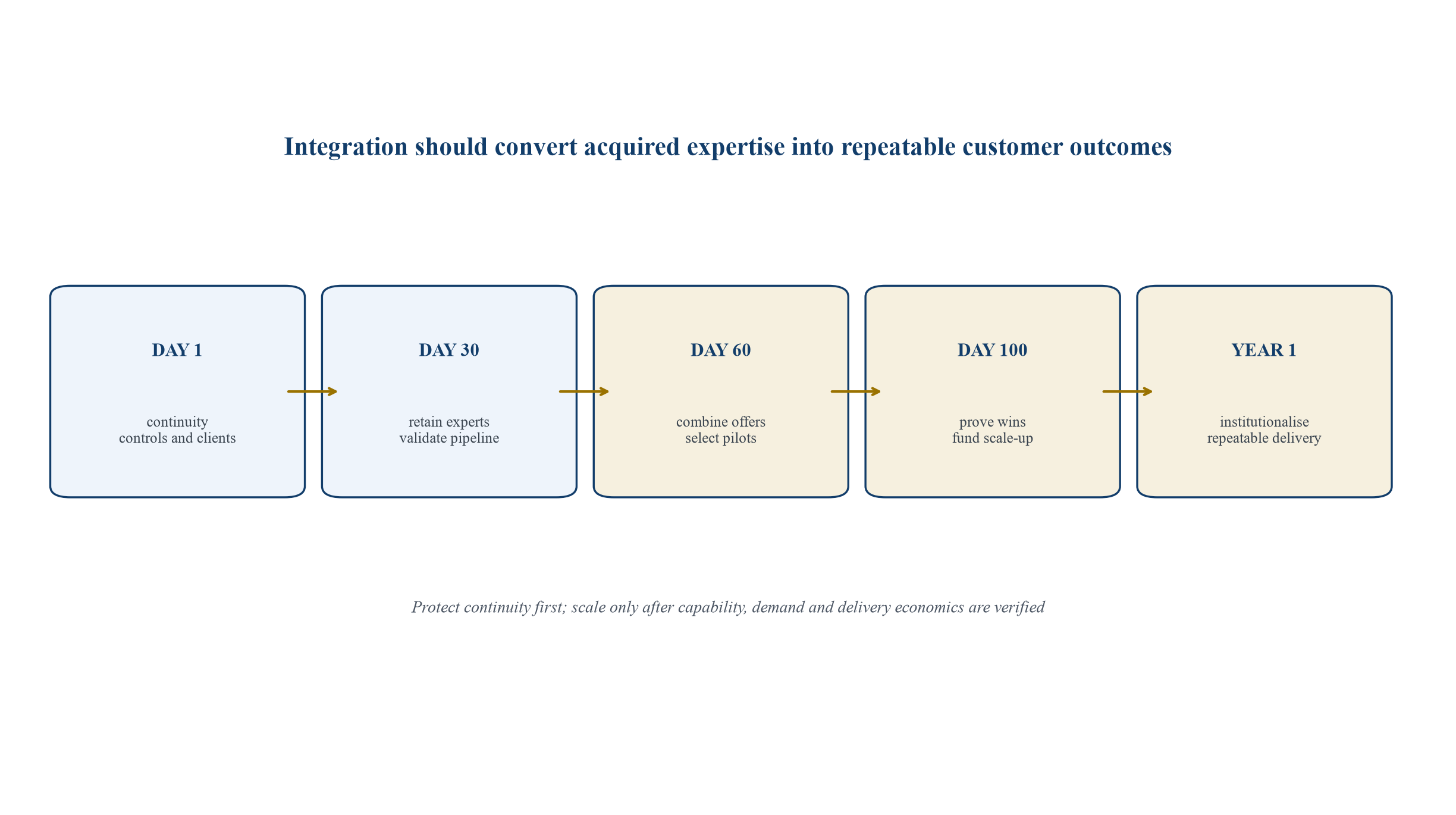
Generic sequence; legal, customer and operational constraints determine actual timing.
The roadmap should contain measurable outputs, not activity counts. Examples include signed retention, verified customer permissions, qualified bids, completed pilot gates and documented workflows. Integration governance should review evidence monthly and release capital when the combined platform demonstrates repeatability.
31. Brand and technical independence
Geothermal clients can value specialist independence, especially for resource opinions and drilling assurance. Immediate absorption into a broad service brand may weaken perceived objectivity. The buyer should test brand equity with customers and employees before changing it.
A dual-brand period can preserve trust while the buyer demonstrates investment and continuity. Technical opinions should follow documented review and conflict procedures. Where the buyer also supplies equipment or execution services, advisory work should disclose commercial interests and preserve independent sign-off.
32. Systems and data integration
The combined business needs secure access to project files, models, field data, contracts and intellectual property. Migration should preserve metadata, version history, permissions and client restrictions. Moving files into a common repository without understanding licence and confidentiality can destroy evidence and breach obligations.
System integration should start with an information-classification map. Critical engineering tools require licence transfer and validation. Cybersecurity review should cover remote field systems, sensors, vendor access and backups. The buyer should retain read-only archives where model provenance matters.
33. Commercial integration
The combined offer should describe customer outcomes, scope boundaries and accountable delivery teams. Bundled services can reduce interfaces but may increase perceived lock-in. Buyers should retain modular options where customers prefer independent advisers or competitive drilling procurement.
Bid governance should confirm resource maturity, technical scope, liability, price, capacity and partner roles. Sales incentives should reward margin, cash and reference quality, not only contract value. Early wins should be selected for deliverability and learning value.
34. Technology roadmap
The technology roadmap should classify products as commercial, qualified for limited conditions, demonstration-stage or research. Funding should follow evidence gates. Integration should not relabel developmental technology as proven.
Roadmap decisions should consider customer need, field-test access, regulatory acceptance, manufacturing, service support and intellectual-property position. Partnerships can fill gaps more efficiently than acquiring every component. The buyer should preserve optionality until a technical architecture and market segment show repeatable economics.
35. Workforce conversion
DOE's GEODE initiative is designed to apply oil-and-gas knowledge, technology and experience to geothermal deployment and includes workforce activities [6]. This supports the strategic premise that energy-service companies can redeploy skills. It also highlights the need for deliberate training and qualification.
Competency maps should distinguish directly transferable skills from geothermal-specific requirements. Drilling mechanics may transfer while materials, fluid chemistry, resource interpretation and power-project economics require additional expertise. Training should combine classroom content, field supervision and assessed performance. The acquired team can become a centre for qualification if its workload and incentives support teaching.
36. Partnerships after acquisition
Ownership of one capability does not create a full geothermal platform. Surface plant, power marketing, heat networks, project finance and local development may remain outside the buyer. SLB and Ormat's partnership reflects complementary subsurface and plant-development strengths [5]. Baker Hughes and Mantle Reach Power announced a model combining technology, development and finance roles [7].
The buyer should map the ecosystem it needs and establish partner-selection criteria. Agreements should allocate data, customer ownership, liability, intellectual property and economics. A partner strategy protects capital and accelerates market access when vertical integration would be slow or uneconomic.
37. Portfolio and capital allocation
Geothermal opportunities compete with core oilfield investment and other transition businesses. The board should set limits for acquisitions, technology development, project equity and guarantees. Service-company capital should not drift into unapproved resource or power-market exposure.
Portfolio reporting should separate service earnings, technology investment and project interests. Each category requires different return metrics and risk limits. Capital should be released against technical and commercial evidence. A strategic narrative should not exempt geothermal from disciplined hurdle rates.
38. Performance scorecard
The scorecard should test whether the acquisition created a durable capability and cash-generating business. Measures can include expert retention, reference quality, qualified backlog, gross margin, cash conversion, project delivery, safety, repeat customers, technology qualification and return on invested capital.
Table 2. Post-close capability scorecard
| Dimension | Leading evidence | Financial evidence | Warning sign |
|---|---|---|---|
| People | Critical experts retained and successors qualified | Revenue and margin per delivery team | Dependence on one founder persists |
| Customers | References consented and combined bids qualified | Repeat revenue and cash collection | Pipeline grows without signed backlog |
| Technology | Field gates passed within stated envelope | Product gross margin and service pull-through | Demonstrations replace commercial orders |
| Delivery | Standard workflows and independent reviews used | Rework, warranty cost and project margin | Integration pressure weakens technical control |
| Strategy | Capability gap demonstrably closed | Return on invested capital | Buyer could have achieved result through contract |
Illustrative measures; targets require transaction-specific baselines and board approval.
Measures should be reviewed against the acquisition model. Variances need operational explanations and corrective actions. Management should revise assumptions when evidence contradicts the original case rather than preserve acquisition accounting narratives.
39. Integration risk allocation
Integration risks should have owners and funded responses. Seller obligations can address pre-close facts, while the buyer controls post-close organisation and investment. Earn-outs can align continuing sellers, but they should not transfer ordinary integration responsibility back to them.
Table 3. Geothermal acquisition integration risk allocation
| Risk | Primary controller | Contract mechanism | Operating evidence |
|---|---|---|---|
| Key-person departure | Buyer and continuing management | Retention, deferred value and succession covenant | Signed roles, handover and bench depth |
| Non-transferable IP or data | Seller before close | Condition, warranty, consent and indemnity | Assignment and licence register |
| Customer attrition | Shared | Consent condition and contingent consideration | Customer confirmation and renewed backlog |
| Technology underperformance | Seller for stated facts; buyer for development | Specific warranty and milestone payment | Independent test protocol and field results |
| Legacy liability | Seller where attributable | Perimeter exclusion, escrow and indemnity | Site, well, claims and insurance records |
| Integration failure | Buyer | Governance and funded integration plan | Decision rights, owners, budget and scorecard |
Generic commercial structure; legal allocation and enforceability require transaction-specific advice.
The matrix should be translated into the purchase agreement, financing and integration plan. A risk that appears in only one document is likely to be unmanaged. The deal team should reconcile allocation before signing and again before closing.
40. Board decision framework
The board should approve the transaction only when strategic fit, evidence, valuation, structure and integration are coherent. The paper should state the capability acquired, the customer proposition, alternatives considered, value bridge, downside, funding, key conditions and post-close accountabilities.
Decision papers should separate observed evidence from management assumptions. They should show which facts were independently verified and which depend on future execution. Dissent and unresolved technical issues should remain visible. A clear decision record improves accountability when geothermal markets or project schedules change.
41. Red flags
Red flags include an undefined capability gap, revenue described as geothermal without contract evidence, reference projects that cannot be verified, technology claims unsupported by raw data, critical experts outside retention arrangements, customer conflicts, non-transferable models, legacy wells without integrity records, speculative projects embedded in service earnings and synergies without owners.
Other warnings include a purchase premium justified by total market size, developmental costs excluded from valuation, permits assumed to transfer, technical independence removed on day one and integration funded from future project cash flow. Any one issue may be manageable. Several together can invalidate the thesis.
42. Separation and carve-out diligence
Some targets sit inside larger engineering, energy or oilfield groups. A carve-out can provide the desired technical team without unrelated assets, but it can also reveal dependence on shared systems, laboratories, insurance, procurement, licences and customer contracts. The buyer should map every shared service and determine whether it can be transferred, replaced or covered through a transitional services agreement.
Carve-out financials require reconstruction. Revenue, cost, working capital and capital expenditure may be allocated rather than directly recorded. Stand-alone costs should include leadership, finance, human resources, cybersecurity, quality, insurance and software. The buyer should test whether the target can bid and deliver independently on closing day. Transitional services need scope, service levels, price, data access, exit milestones and remedies. A low headline purchase price can become expensive when separation investment and lost scale are recognised.
43. Cross-border execution
Geothermal capability is often international because resource basins, specialist teams and reference projects are dispersed. Cross-border acquisitions add foreign-investment review, export controls, sanctions, tax, employment, immigration, data localisation and currency exposure. Engineering qualifications and drilling approvals may not transfer across jurisdictions.
The buyer should identify where value is legally and operationally located. Intellectual property may sit in one entity, experts in another and customer contracts in several branches. Post-close cash movement, transfer pricing and withholding tax can affect returns. Local partners may be required for permits or market access. The integration plan should preserve regional expertise while establishing group controls. A centralised model can weaken relationships and slow field decisions when authority, language or regulatory engagement must remain local.
44. Seller motivation and competitive process
Seller motivation affects evidence, structure and negotiation. A founder may seek succession, an industrial parent may divest a non-core unit, or an investor may need liquidity. A distressed seller may create speed but also working-capital, retention and liability risk. The buyer should understand why ownership is changing and which alternatives the seller can pursue.
In a competitive process, the buyer should avoid paying for a geothermal market narrative unsupported by target-specific evidence. Bid differentiation can come from certainty, employee opportunity, technical stewardship, customer access or retained minority participation. Exclusivity should follow enough diligence to identify thesis-breaking issues. The board should predefine walk-away conditions and avoid allowing process momentum to replace valuation discipline.
45. Integration cost and stranded cost
Integration budgets should include systems, retention, rebranding, compliance, insurance, facilities, product qualification, field demonstrations and working capital. Costs should be scheduled by dependency. Technology integration may require new testing or certification before the combined offer can be sold. Customer and data migrations can require consent and parallel operation.
Stranded costs arise when the buyer removes shared support more slowly than forecast or retains facilities, licences and personnel after revenue has moved. The model should distinguish one-time cash costs from recurring cost. Synergy reporting should show gross savings, implementation cost, dis-synergy and net present value. Management should retain contingency for issues discovered after access to full systems and sites. Integration funding belongs in acquisition uses and should not depend on speculative cross-sell.
46. Scenario analysis and decision thresholds
The board should evaluate at least four scenarios: stand-alone performance, successful capability transfer, delayed geothermal adoption and thesis failure. Each scenario should specify revenue conversion, margin, retention, investment, working capital and exit options. The purpose is to identify which assumptions drive value and which mitigations remain available.
Decision thresholds should be explicit. Examples include minimum key-person acceptance, customer consent, lawful data transfer, independent technical validation and a maximum fully funded purchase price. Sensitivity analysis should show the effect of losing one major customer, delaying commercialisation, requiring an additional field test or excluding a project interest. A transaction can remain attractive under uncertainty when price and structure absorb the downside. It becomes fragile when all value depends on simultaneous success across people, technology and market adoption.
47. Exit, impairment and strategic reset
The buyer should define how it will respond if the capability does not scale. Options may include maintaining a specialist consultancy, licensing technology, partnering with a developer, selling project interests, divesting the unit or closing a product line. These choices require ownership of data, intellectual property and contracts that can stand independently.
Post-close impairment testing should follow evidence rather than enthusiasm. Departure of key experts, failed qualification, lost customers or sustained project delays can reduce recoverable value. Management should separate accounting impairment from the operating decision; a written-down asset may still support a profitable niche, while an unreduced carrying value does not prove strategic success. A scheduled strategic review at twelve and twenty-four months should compare actual capability, cash flow and market access with the approved case and decide whether to invest, partner, reposition or exit.
48. Conclusion
Oilfield-service companies have a credible pathway into geothermal because subsurface, drilling and execution capabilities overlap materially. Ownership creates value only when the transaction secures scarce and transferable capability, protects the people and data that make it work, and connects that capability to paying customers.
The recommended sequence is disciplined: define the capability gap; choose the entry route; map the target universe; verify people, projects, technology, data and customers; value current earnings separately from contingent growth; structure payment around evidence; and integrate with clear technical authority. This approach turns geothermal diversification from a thematic acquisition into an executable capability-building decision.
References
- [1] International Energy Agency. Overview of synergies between the oil and gas and geothermal industries. The Future of Geothermal Energy. 2024. https://www.iea.org/reports/the-future-of-geothermal-energy/overview-of-synergies-between-the-oil-and-gas-and-geothermal-industries
- [2] International Energy Agency. Executive summary. The Future of Geothermal Energy. 2024. https://www.iea.org/reports/the-future-of-geothermal-energy/executive-summary
- [3] RESPEC. RESPEC Company, LLC Expands Geothermal Capabilities With the Acquisition of Geothermal Resource Group, Inc. 10 September 2024. https://www.respec.com/news/respec-grows-geothermal-expertise-with-acquisition-of-geothermal-resource-group-inc/
- [4] CeraPhi Energy. CeraPhi Acquires Former Fracking Company. 5 February 2024. https://ceraphi.com/ceraphi-acquires-former-fracking-company/
- [5] SLB. SLB and Ormat Partner to Accelerate Integrated Geothermal Asset Development and Enhanced Geothermal Systems. 27 October 2025. https://investorcenter.slb.com/news-releases/news-release-details/slb-and-ormat-partner-accelerate-integrated-geothermal-asset
- [6] United States Department of Energy. Geothermal Energy from Oil and Gas Demonstrated Engineering. https://www.energy.gov/hgeo/geothermal/geothermal-energy-oil-and-gas-demonstrated-engineering
- [7] Baker Hughes. Baker Hughes and Mantle Reach Power Announce Strategic Agreement to Accelerate Large-scale Geothermal Across North America. 24 June 2026. https://investors.bakerhughes.com/news/press-releases/news-details/2026/Baker-Hughes-and-Mantle-Reach-Power-an-EnCap-Energy-Transition-Company-Announce-Strategic-Agreement-to-Accelerate-Large-scale-Geothermal-Across-North-America/default.aspx
- [8] National Oilwell Varco. Annual Report for the year ended 31 December 2025. 2026. https://www.sec.gov/Archives/edgar/data/1021860/000119312526048350/nov-20251231.htm
- [9] Baker Hughes. Annual Report for the year ended 31 December 2025. 2026. https://www.sec.gov/Archives/edgar/data/1701605/000119312526130311/d63282dars.pdf
- [10] United States Department of Energy. Enhanced Geothermal Systems. https://www.energy.gov/hgeo/geothermal/enhanced-geothermal-systems
- [11] United States Department of Energy. HGEO Workforce Programs. https://www.energy.gov/hgeo/hgeo-workforce-programs
- [12] CeraPhi Energy and Star Energy. Agreement to Repurpose UK Wells for Clean Geothermal Energy. 13 July 2026. https://ceraphi.com/ceraphi-energy-and-star-energy-announce-landmark-agreement-to-repurpose-uk-wells-for-clean-geothermal-energy/
- [13] Ranger Energy Services. Acquisition of American Well Services. 10 November 2025. https://investors.rangerenergy.com/news-and-events/press-releases/2025/11-10-2025-114814193
- [14] RPC, Inc. Acquisition of Pintail Completions. 2 April 2025. https://www.rpc.net/rpc-inc-expands-its-permian-operations-with-acquisition-of-pintail-completions-a-leading-wireline-completions-services-company/
- [15] Ormat Technologies. Quarterly Report for the period ended 30 September 2018; U.S. Geothermal acquisition disclosure. https://www.sec.gov/Archives/edgar/data/1296445/000143774918020023/ora20180930_10q.htm
About the Author
Chennakeshav (CK) is a corporate finance and investment banking executive with 25+ years of global experience in deal origination, structuring and execution across M&A, growth capital and corporate strategy. He has led value-creation mandates for founders, corporates and funds — bridging the boardroom view to hands-on execution and close.
His career spans Morgan Stanley, HSBC, Lloyds Banking Group, EWEC, ADQ portfolio companies and Emirates Growth Fund, across TMT, real estate, fintech, deeptech, cleantech, infrastructure and energy. He has partnered with C-suite leaders, private equity and venture funds, sovereign wealth funds and family offices to finance complex fund raises and scale-up ventures, and has led M&A due diligence, post-merger integration and business-transformation initiatives to create value.
At Matchpoint Partners he is Managing Partner, leading the firm's corporate finance, M&A and capital-raising practice. He holds an MBA from London Business School, an engineering degree from VTU and a Master of Laws (LLM, in progress) from UCL London.
An active start-up mentor, CK mentors at Techstars, DIFC FinTech Hive, Startup Grind, Founder Institute and IN5, serves as Entrepreneur Mentor in Residence (EMiR) at London Business School, and judges the Entrepreneurship World Cup.
LinkedIn: https://www.linkedin.com/in/ckadya/
Profile: https://www.matchpoint-partners.com/team/ck-adya.html
