

1 Price the cash a business can use
The label on a financing proposal rarely describes the cash that will reach the operating company. A commitment can be undrawn, conditioned on eligible collateral, reduced by fees, trapped in a reserve account or unavailable after a covenant event. The borrower meanwhile has payroll, supplier and project commitments with dates that do not move automatically when a lender's calculation changes. A useful decision begins with dated cash requirements and the financing documents that control access to proceeds. The question is not simply which lender asks for the lowest coupon. It is which structure can supply the required cash at the required time without creating an unacceptable downside state.
Consider a UAE operating group seeking financing for a working-capital build. It has invoices, inventory and forecast EBITDA, but those assets and earnings are not interchangeable forms of lender protection. A term lender may focus on cash generation and financial covenants. An asset-based lender may rely on the quantity and quality of collateral included in a borrowing base. A structured-finance investor may rely on defined cash flows, payment priority and a segregated vehicle. Each structure can fit a different risk. The board should compare them using one cash calendar, one legal-entity map and a common downside scenario, while documenting where each term sheet differs.
This paper offers that comparison as a research framework. It does not estimate a prevailing UAE or GCC private-credit rate, a typical advance percentage or a universal minimum covenant cushion. Such statements would require dated, comparable, consented terms and evidence about borrower risk. The numbers used later are invented solely to demonstrate how the arithmetic works. Before an actual mandate, management would replace them with its own source documents and written proposals, check legal and accounting treatment with advisers, and preserve the assumptions used in each decision.
2 Define the three financing routes
Private credit here means a bilaterally or privately arranged debt claim funded by a nonbank or private-market capital provider. The term describes a broad market; individual documents can be secured or unsecured, fixed or floating rate, amortising or bullet, and can carry different governance rights. A term facility is an appropriate stylised comparator because its cash draw and principal schedule can be stated explicitly. The financing contract, rather than the label 'private credit', determines the actual risk and borrower obligations.
Asset-based lending, abbreviated ABL, usually links borrowing capacity to specified assets and the lender's collateral controls. The US Office of the Comptroller of the Currency describes an ABL outstanding balance as constrained by both commitment and borrowing base, and details eligibility, advance rates, reserves and field examination [2]. That handbook applies to US national-bank supervision. It is used here as a mechanics reference; it does not create a UAE rule or a standard Gulf term sheet. A UAE lender's documents and applicable regulatory perimeter must be read on their own terms.
Structured finance is a broader family of transactions that allocates specified cash flows, risks and payment priority through contractual or vehicle arrangements. This paper models a simplified receivables-backed financing with an originator, a separate vehicle, collections and a reserve. That example is a conceptual comparator, not a claim that a particular issuer can achieve accounting derecognition, bankruptcy remoteness or regulatory capital relief. Each of those outcomes depends on actual legal rights, control, recourse, accounting policy and jurisdiction-specific analysis. The label 'SPV' does not by itself deliver any of them.
3 Build the common cash calendar
An issuer needs a dated uses schedule before it compares offers. It should identify the minimum cash needed at completion, the forecast draw path, expected customer collections, debt service, collateral turnover, tax and other unavoidable payments. The financing requirement should be tied to a realistic lower-bound operating case, not only the sponsor's base forecast. If AED 50 million must be available on day one, a facility that can lend that amount only after new invoices arise is not an equivalent substitute without a bridge.
The calendar should distinguish gross commitment, approved draw, lender disbursement, cash held in restricted accounts and cash freely available for operations. Upfront fees and original issue discount reduce initial proceeds. A reserve may reduce day-one cash but return later if tests are met; it therefore belongs in a separate restricted-cash column rather than being treated automatically as a permanent fee. A promise of undrawn capacity has value only while the draw conditions can be satisfied. The governing documents determine whether a change in eligible assets, lender discretion or an event of default can interrupt that access.
For a common twelve-month comparison, management should show monthly balances and the maturity date. Interest on a changing revolver balance cannot be compared accurately with interest on a full-year term balance by multiplying both headline rates by the same number. Commitment fees may attach to the unused portion; monitoring, legal, audit and collateral-agent costs may be fixed or contingent. The simple example later holds balances constant to isolate the mechanics. An actual board model should use contractual day-count conventions, draw dates, benchmark rates, prepayment terms, tax treatment and accounting classification from the live documents.
4 Separate price from availability
A financing cost is economically relevant only when the promised funding is available. Define initial usable cash as lender funds paid to the group minus non-refundable upfront deductions minus amounts restricted from ordinary use. Define net cash cost over a chosen horizon as interest, permanent fees, transaction expenses and any verified economic cost of restricted cash, net of actual reserve releases and other credits. A fee is a cost; a refundable reserve is an availability constraint, with its own time value and loss risk. Combining them into one percentage without explanation conceals the decision.
The simple comparison measure used in this paper is one-year stated interest plus permanent upfront and annual fees, divided by AED 50 million of initial usable cash. It is deliberately not an annual percentage rate, internal rate of return or IFRS effective-interest calculation. It ignores tax, floating benchmarks, daily utilisation and contingent costs unless separately specified. Its purpose is to show why the same nominal rate can translate into a different cash burden when net proceeds differ. A formal treasury analysis should include the full dates and cash flows.
Availability also has a state dimension. The issuer can receive AED 50 million today and face a compulsory paydown later if the borrowing base falls. It can hold a term loan today but lose the ability to incur acquisition debt under a leverage covenant. It can sell receivables into a vehicle yet face a trigger that traps excess spread rather than returning it. The board's comparison should therefore include base, stress and delayed-refinancing states with explicit probability judgments if it wants a probability-weighted view. The probabilities are management estimates until supported by a defensible dataset.
The denominator should also reflect how the money is used. A facility that funds AED 50 million for two weeks and remains undrawn for the balance of a year is economically different from a permanent AED 50 million term advance. For a fluctuating requirement, treasury can calculate time-weighted usable funding by summing each day's available draw multiplied by the number of days it remains accessible. It can then show cash interest and fees over the same calendar. This avoids a misleading comparison in which a revolver's full commitment is placed in the denominator even though the borrower could draw only a fraction of it. The method still needs a separate stress test, because unused capacity can disappear after an eligibility or covenant change.
5 Covenant capacity is scarce capital
Financial covenants allocate decision rights before insolvency. A leverage cap, minimum liquidity test or fixed-charge coverage requirement can constrain dividends, acquisitions, additional debt or ordinary operations depending on the contract. Headroom is the difference between a permitted threshold and the actual measured metric under the precise definition in the agreement. 'EBITDA' in a lender document can include negotiated add-backs and caps that differ from the income statement. A forecast using a convenient management definition may therefore overstate real borrowing capacity.
The issuer should calculate at least three layers of headroom. The first is compliance headroom at the next testing date. The second is incurrence headroom for additional debt or permitted investments. The third is operational headroom after a realistic earnings or working-capital shock. These are distinct. A company can be compliant today and still unable to make the next intended acquisition, fund a project or draw a delayed tranche. A covenant basket that can be used only for a restricted purpose should not be counted as general liquidity.
UAE central-bank credit standards require covered licensed financial institutions to evaluate credit risk, monitor terms and collateral, and assess refinancing risk where wholesale exposures are not fully amortising [1]. Those standards establish a lender-side regulatory context. They do not prescribe the covenant package for every private fund or prove that a borrower can obtain waivers. The actual documents control the covenant test. A prudent borrower should maintain a covenant model with definitions and testing dates copied from the negotiated agreement, independent review of inputs, and an escalation date before a shortfall becomes a formal event.
6 Collateral value is not a borrowing base
The existence of a receivable does not mean it will support an ABL draw. An eligibility schedule may exclude old invoices, disputed claims, related-party balances, concentration excesses or receivables subject to set-off. Inventory may be discounted for age, obsolescence, location or verification problems. An advance rate applies after the asset is classified as eligible, and reserves can reduce the resulting amount further. The loan then remains subject to the maximum commitment and any hard block or minimum-availability requirement. The formula must be modelled in the order specified by the agreement.
An asset register and borrowing-base certificate need to reconcile to accounting records. The lender may require receivables ageing, customer remittance histories, inventory counts and field examinations. The OCC handbook treats quality, liquidity and monitoring of the borrowing base as core ABL concerns [2]. It also describes dilution from discounts, returns, allowances and credit losses. This is a useful operational vocabulary for diligence, with the explicit jurisdiction limit already stated. A GCC issuer should confirm which tests its actual lender will require and whether its ERP data can produce them reliably at the agreed frequency.
Collateral rights add a separate legal layer. UAE Federal Law No. 4 of 2020 addresses security rights over movable property, while Federal Decree-Law No. 16 of 2021 addresses factoring and transfer of receivables [3, 4]. These sources establish legal frameworks relevant to particular UAE structures. They do not establish that any asset in a proposed deal is unencumbered, perfected, transferable or eligible under a lender's definition. Those conclusions require examination of the obligor, asset, existing security, contracts, registrations and applicable law. A borrowing-base spreadsheet cannot substitute for that review.
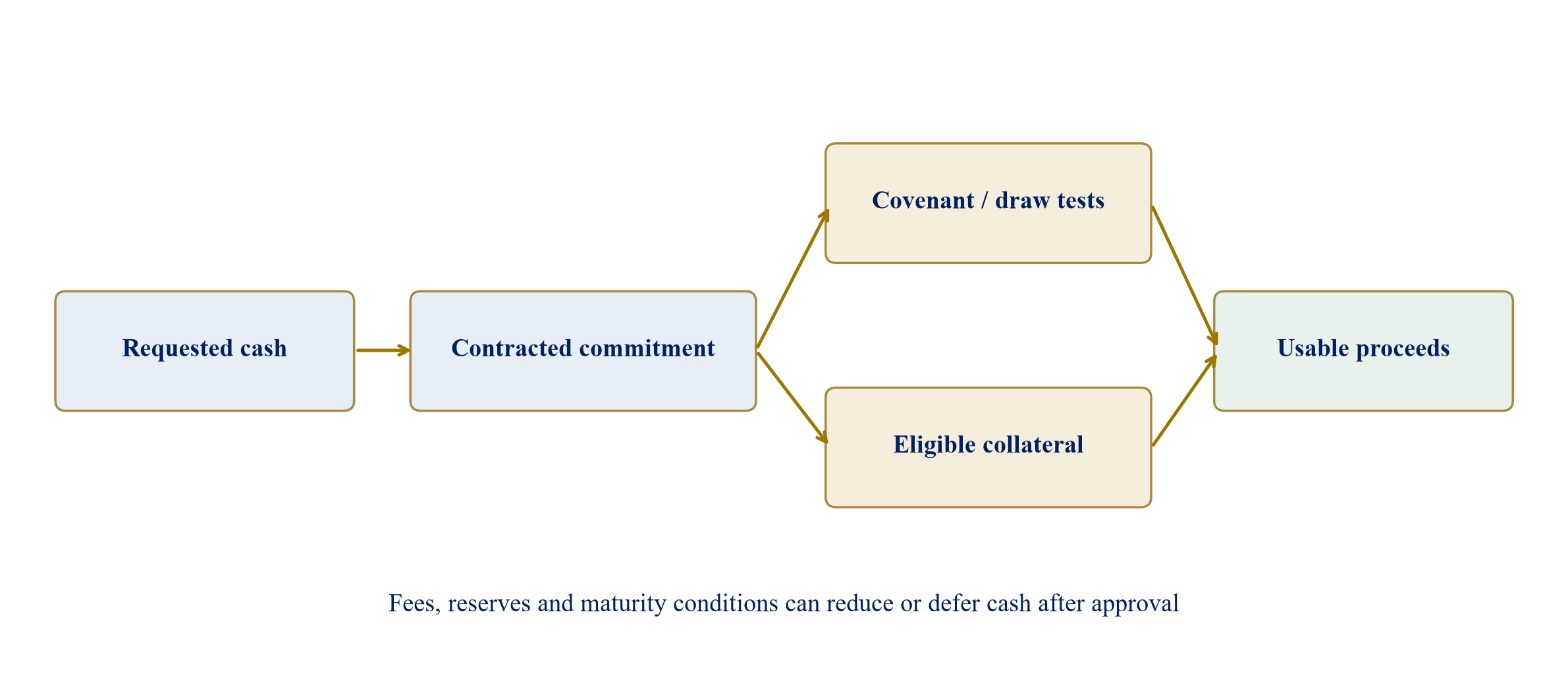
Author-developed conceptual map. It illustrates possible constraints and is not an observed market structure or legal opinion.
7 Structured finance changes the path of cash
A receivables-backed structure can define a pool of assets, an originator, a vehicle, collections, investor claims and a payment waterfall. The design can isolate and monitor specified cash flows, but the business may retain servicing, recourse, repurchase, reserve or support obligations. Each obligation affects the economic comparison. A vehicle may pay the company for receivables while retaining a portion of proceeds until collection performance meets a threshold. That portion is not necessarily a financing fee; it is cash the originator cannot use during the hold period and may lose under defined conditions.
The proposed cash flow should be traced from customer payment to collection account, permitted expenses, senior obligations, reserve top-up and residual distribution. The board should ask who owns the receivable at each step, who may redirect payment, what happens after a disputed invoice, and how customer-set-off or concentration affects eligibility. UAE receivables-transfer law is relevant to the legal analysis [4]. Accounting derecognition and consolidation require an assessment under applicable standards and facts; no conclusion follows from the vehicle's name. If the business still bears losses or controls the assets, those positions should appear in the downside model.
The International Finance Corporation has publicly described debt-securities syndications using a special-purpose vehicle and investor distribution [5]. That institutional product is not the same as a corporate receivables warehouse. It demonstrates why investor, asset and vehicle roles must be specified before price is compared. For a mid-market borrower, legal setup, servicing systems, pool reporting and minimum scale may determine feasibility. A structure that cannot close before a payroll or acquisition date has a timing cost even if its eventual coupon is attractive. The board should ask for a critical-path implementation schedule, not a headline spread alone.
8 A common fictional financing case
To make the mechanics comparable, assume a wholly fictional UAE operating company requires AED 50 million of freely usable cash immediately and expects to refinance or repay after exactly one year. Assume flat balances, no benchmark-rate changes, no tax effects, no prepayment and no default in the base case. These assumptions are intentionally narrow. No number below is a lender quotation, a Matchpoint transaction, or a market benchmark. The example does not assert that any of the three instruments is available to the hypothetical company.
The private-credit term route assumes a gross advance of AED 51.546 million, a 2% original issue discount and a 1% upfront fee, both deducted from proceeds, with 11% simple annual interest on gross principal. The deductions total approximately AED 1.546 million, leaving AED 50 million on day one. One year of stated interest is approximately AED 5.670 million. Permanent deductions plus that interest total approximately AED 7.216 million, or 14.43% of the cash available at completion. Principal of AED 51.546 million remains due at maturity in this simplified bullet case. Refinancing capacity is therefore a separate decision.
The ABL route assumes an AED 70 million maximum commitment, an 8.5% simple rate on a constant draw, a 1% origination fee on the draw, and an AED 0.35 million annual facility and monitoring charge paid from proceeds. To leave AED 50 million after those deductions, the gross draw is approximately AED 50.859 million. Interest is approximately AED 4.323 million; origination and annual charges total approximately AED 0.859 million. The simple one-year permanent cash cost is approximately AED 5.182 million, or 10.36% of initial usable cash. The facility can support that draw only while the agreed borrowing base and other tests permit it. The example's fees and rates are constructed arithmetic, not evidence of lender practice.
Table 1. Fictional one-year funding comparison for AED 50 million of initial usable cash
| Route | Gross funding, AED m | Initial usable cash, AED m | Annual stated rate | Interest, AED m | Permanent upfront and annual fees, AED m | Simple cash cost / usable cash |
|---|---|---|---|---|---|---|
| Private-credit term loan | 51.546 | 50.000 | 11.0% | 5.670 | 1.546 | 14.43% |
| ABL constant draw | 50.859 | 50.000 | 8.5% | 4.323 | 0.859 | 10.36% |
| Receivables vehicle | 54.348 | 50.000 | 9.5% | 5.163 | 1.630 | 13.59% before restricted-cash cost |
All amounts, rates, periods and structures are hypothetical. Rounded arithmetic; no lender quote, market benchmark or effective-interest calculation. Restricted reserve is shown separately from permanent fees.
9 The vehicle case and its reserve
The third fictional route assumes a receivables vehicle finances AED 54.348 million gross, deducts permanent transaction fees equal to 3% of gross and withholds a potentially refundable reserve equal to 5% of gross. Net freely usable proceeds at completion equal 92% of gross, or AED 50 million. At a hypothetical simple 9.5% annual investor return on gross, interest is approximately AED 5.163 million. Permanent fees are approximately AED 1.630 million. Their sum, AED 6.793 million, is 13.59% of the day-one cash. The AED 2.717 million reserve has been excluded from that permanent cost because its recovery depends on the agreed waterfall and collections.
The reserve nonetheless has economic importance. It may be unavailable for wages, inventory purchases or the intended investment at the very moment the business needs cash. If it is released at year end, the company has financed a temporary hold. If it is partly applied to receivable losses or a trigger traps it for longer, the cash outcome differs. Management should model reserve release dates, discount the time value using a justified rate, and model loss allocation under the actual documents. It should not automatically add the full withheld reserve to fees or assume it will all be returned.
No route can be ranked solely from Table 1. The term facility may supply certainty of initial draw yet consume covenant headroom and create a bullet maturity. The ABL facility appears cheaper in the example but may force repayment after collateral deterioration. The vehicle may protect or redirect specified collections but require longer setup and restricted cash. A board decision should combine arithmetic with the likelihood, severity and management capacity of those conditions. Without consented comparable bids and observed outcomes, this paper cannot infer which structure is generally cheapest for GCC firms.
10 A borrowing-base shock can reverse a cash plan
Assume the fictional ABL contract counts AED 80 million of eligible receivables at an 80% advance rate and applies AED 5 million of reserves. The resulting borrowing base is AED 59 million. It exceeds the AED 50.859 million opening draw, leaving approximately AED 8.141 million of nominal excess availability before any additional hard block or undrawn commitment limit. This calculation is only a formula illustration. The actual contract would determine eligibility, the reserve and the measurement date.
Now assume a customer dispute, ageing and concentration effects reduce eligible receivables to AED 60 million while the advance rate and reserve remain unchanged. The borrowing base becomes AED 43 million. Against the unchanged draw, the deficiency is approximately AED 7.859 million. If the agreement requires immediate cure or paydown, the issuer needs cash at a time when the collateral shock may also be delaying collections. If the lender permits a temporary overadvance, its price and duration must be documented. The lower 8.5% base coupon does not describe this contingent liquidity burden.
The analysis should also test sequential shocks. An invoice that becomes ineligible may reduce borrowing capacity before an actual credit loss occurs. A later customer payment may restore cash but reduce receivables and the borrowing base simultaneously. Inventory purchased with a draw may or may not qualify as collateral until received, counted and documented. Management needs daily or weekly visibility into certificate data near a tight threshold, with a treasury action plan for disputes and ageing. Using a month-end balance sheet alone can conceal the day on which a compulsory cash need arises.
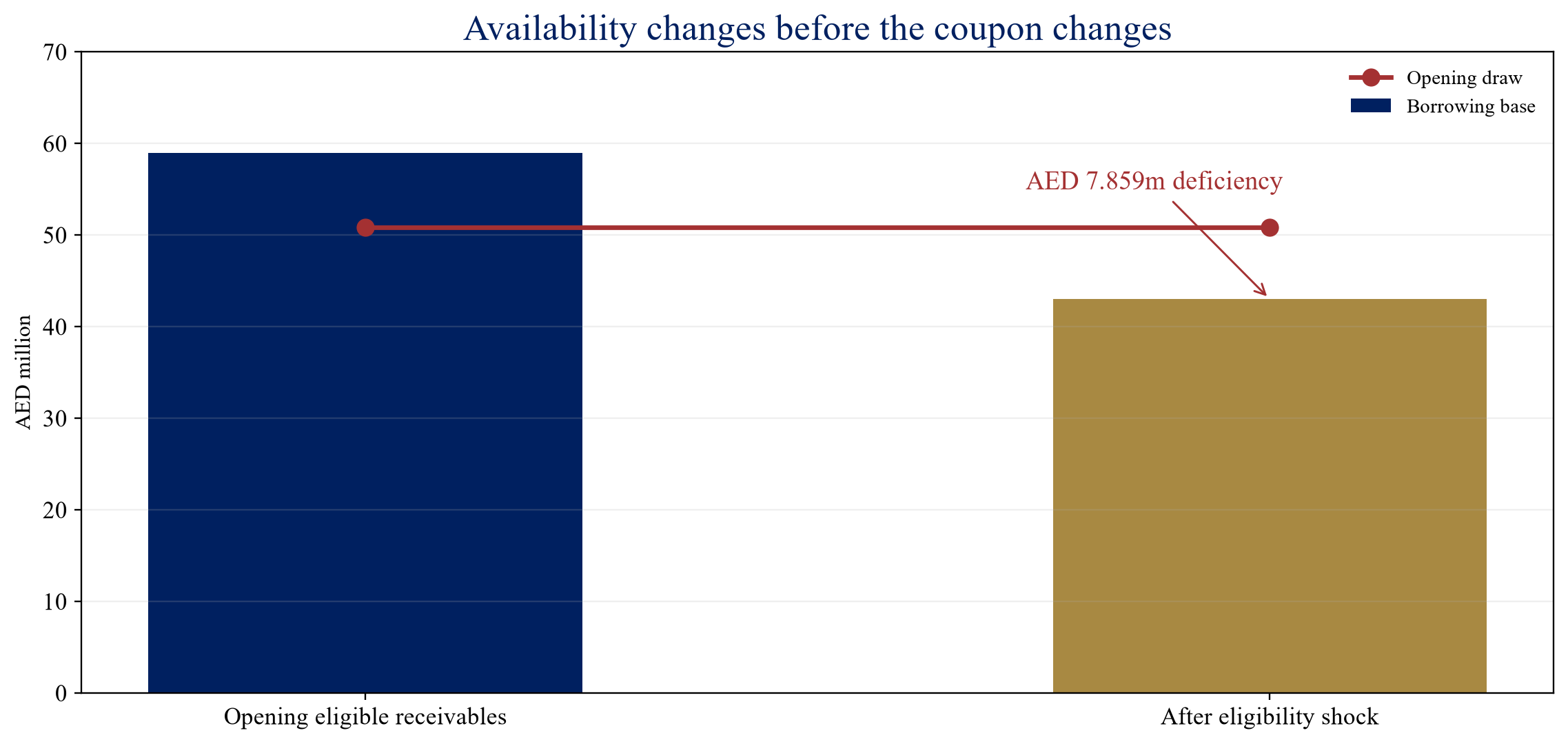
AED amounts and collateral assumptions are wholly fictional. The chart illustrates arithmetic, not a forecast, lender term or observed default.
11 An earnings shock uses a different gate
The term-loan problem is distinct from a borrowing-base deficiency. Assume fictional covenant EBITDA of AED 20 million, existing net debt of AED 45 million and a new term draw of AED 51.546 million. For illustration only, assume that all these amounts count within a maximum 5.0 times net-leverage covenant, tested immediately, with no other permitted adjustments. Total net debt would be AED 96.546 million against an assumed maximum of AED 100 million. Headroom is AED 3.454 million of debt capacity, or approximately 0.17 times EBITDA. That small cushion is a board issue even though the company is technically compliant at inception.
If the same hypothetical EBITDA falls by 10% to AED 18 million and debt is unchanged, maximum permitted debt under the assumed test falls to AED 90 million. The illustrative shortfall becomes AED 6.546 million. The issuer may need a waiver, an equity injection, asset sale, debt paydown or another contractually permitted cure. None of those responses is guaranteed, and each may carry cost or control consequences. A lender could also define the test differently, permit headroom baskets or test at a later date. The purpose of the calculation is to show that covenant capacity is a finite resource requiring document-specific modelling.
EBITDA and receivables can deteriorate together. A delayed customer acceptance may reduce recognised earnings, increase disputed invoices and slow cash collection. A company comparing financing routes should therefore run a common operating shock through each instrument, rather than giving the term lender an earnings stress and the ABL lender only a collateral stress. The legal consequence, cash demand and negotiation options must be derived from each signed contract. The board should show when management can first detect the problem and how many days remain to respond before a reporting or cure deadline.
12 Use a downside-adjusted cash ledger
A useful ledger lists cash as it moves from approval to repayment. Rows cover application and documentation expense, gross funding, original issue discount, initial fees, restricted reserve, monthly interest, unused or monitoring charges, periodic collateral-reporting expense, principal, any sweep and terminal reserve release. Columns cover base, collateral shock, earnings shock and refinancing delay. The ledger should state which cells are signed contractual amounts, which are lender proposals and which are management scenarios. The same cost can be booked once in the cash-flow row and then explained in notes, avoiding double counting.
The simple comparison in Table 1 becomes a decision model when each route is tested for the amount of cash still free after a shock. A compelled ABL paydown is a liquidity event; it is not automatically an incremental financing cost equal to the whole principal repaid, because principal was already owed. Its economic burden may be the price of emergency replacement funding, lost operating value or a forced asset sale. Similarly, a leverage covenant breach is not necessarily a realised loss of the outstanding loan balance. The model should identify the actual remedy, fee, acceleration right or operational restriction that applies.
To avoid invented precision, the board can present a range of states without assigning unsupported probabilities. A conditional break-even question is often more useful: how much extra annual monitoring and reserve cost can the lower-coupon ABL bear before its permanent cash cost equals the term loan in the same state? What refinancing spread would make the bullet structure more expensive over a two-year horizon? What fraction of the vehicle reserve must remain trapped for its timing cost to dominate its coupon advantage? These questions invite transparent assumptions and actual bids; they do not require a spurious GCC average.
Table 2. Decision ledger for conditional funding cost and access
| Dimension | Term private credit | Asset-based facility | Receivables structure |
|---|---|---|---|
| Day-one cash | Gross draw less permanent deductions | Permitted draw less fees and charges | Purchase or financing proceeds less fees and restricted reserve |
| Main live gate | Draw and financial covenant conditions | Commitment, eligibility, advance rate and reserves | Pool eligibility, collections and waterfall triggers |
| Stress cash call | Cure, waiver, paydown or acceleration if contract permits | Overadvance cure or borrowing-base paydown | Reserve top-up, trapped residual or repurchase if agreed |
| Monitoring data | EBITDA, leverage, cash and debt schedules | Ageing, inventory, dilution and certificates | Asset-level collections, exceptions and servicing reports |
| Maturity issue | Bullet or amortisation schedule | Renewal and collateral turnover | Investor take-out or pool run-off |
| Legal review | Obligor, security, covenant and intercreditor terms | Security, control and eligible-asset rights | Transfer, recourse, vehicle, servicing and set-off |
Author-developed framework. Entries describe questions to be answered from actual documents; they do not assert standard market terms.
13 Debt maturity has a price before it arrives
An apparent first-year winner can be a poor financing choice if its repayment depends on a new lender, a sale or a higher valuation at maturity. A bullet loan creates a financing need at a particular future date. A revolving ABL line may be renewed, reduced or replaced on different terms, and its collateral base may shrink as the business runs down stock or collects receivables. A receivables vehicle may amortise naturally as invoices pay, but it may also need a replacement conduit if the originator expects to keep selling new assets. Each case needs a dated take-out plan and a liquidity backup.
The International Monetary Fund's 2024 financial-stability report discusses private-credit vulnerabilities that include borrower fragility, leverage, valuation subjectivity and data limitations [6]. The Financial Stability Board's 2026 report describes interconnections, liquidity and concentration risks in the wider private-credit ecosystem [7]. These are system-level sources, not forecasts for this issuer or a basis for inventing a default probability. They justify a disciplined refinancing stress, especially where a lender's own funding or fund life might interact with the borrower's maturity. The counterparty's actual fund mandate and documents need separate verification.
Management can construct a refinancing ladder with dates for lender engagement, audited accounts, asset valuation, covenant testing, legal work, investment committee and signed funds. The critical date is earlier than legal maturity; it is when the available execution window becomes too short to obtain an alternative. Under a fictional six-month delay, the model should calculate cash interest, extension fees only if proposed, and operating cash consumed before the new close. It should also identify which business initiatives become unavailable while capital is tied up. That opportunity cost should be described with an evidence basis rather than turned into a confident revenue estimate.
14 The legal perimeter changes the answer
The operating group and proposed borrowing entity may sit in different UAE or GCC jurisdictions. Receivables may be owed by foreign customers, inventory may be held by third-party warehouses, and existing debt may already have security or negative pledges. A term lender can require guarantees from entities that do not own the cash-generating assets. An ABL lender can propose a borrowing base over assets that the group cannot assign cleanly. A vehicle can be incorporated in one jurisdiction while the receivable and obligor are governed by another law. Each mismatch affects both time to close and the reliability of expected recovery.
UAE movable-security and factoring laws [3, 4] are relevant starting points for an onshore UAE asset review. They do not answer whether a particular free-zone company, foreign-law contract or cross-border receivable falls within a chosen security and transfer path. Local counsel should map perfection, priority, registration, debtor notification, insolvency treatment and any contractual prohibitions. Lenders may ask for opinions or additional controls; those costs belong in the economics. The board should avoid describing an asset as 'bankable collateral' until the ownership and security position is actually confirmed.
The entity map should accompany the cash map. It names the obligor, guarantors, asset owners, originator, vehicle, account bank and collections servicer. Each arrow must have a legal basis and an operational owner. If an agreement requires customer notices or controlled collections, sales teams need a communications plan before signing. If the structure relies on an affiliate's cash, the group must examine distribution restrictions and intercompany rights. These are transaction-specific execution questions, not attributes implied by an instrument label.
15 Reporting quality is part of financing capacity
ABL and receivables structures depend on data that can be reconciled frequently enough for the lender or investor to trust it. Invoice age, disputes, credit notes, returns, debtor concentration and cash receipts must tie to the general ledger. Inventory systems need reliable product, location, title and age data. A term loan can require less granular asset reporting yet demand timely financial statements and covenant calculations. Poor data quality can create reserves, delayed advances, repeated field examinations or a refusal to fund; the existence and size of each consequence must be taken from the lender's actual proposal.
IFRS 7 asks reporting entities to disclose the nature and extent of risks arising from financial instruments and how those risks are managed [8]. This is a disclosure standard, not a borrowing-base certificate template. It reinforces the need to understand liquidity, credit and other instrument risks as exposures rather than as one aggregate debt balance. For transaction execution, management should design a versioned source pack with agreed reporting cut-offs and a reconciliation log. A finance team that cannot reproduce yesterday's certificate is exposed to both operational error and credibility loss.
The data test is practical. Can the group produce a signed invoice, evidence of delivery or acceptance, current debtor balance, cash application and dispute status for a sampled receivable? Can it show inventory location, ownership and movement through the financing period? Can it reproduce the EBITDA bridge and exclusions used in the covenant definition? A capital provider may select a sample before commitment. Management can run the same sample internally. The time required to repair records should enter the financing calendar, with a named owner and evidence of completion rather than a generic declaration that the data room is ready.
16 Compare control rights as well as cash price
Financing terms allocate control when performance deviates from plan. A term lender may restrict new debt, acquisitions, shareholder distributions or disposals. An ABL lender may control collections or increase reporting as availability declines, subject to the agreement. A vehicle's waterfall may prioritise investors and reserve restoration before the originator receives residual cash. A low coupon can be expensive if the associated trigger prevents a profitable but time-sensitive commercial action. That cost is case-specific and should be shown as a decision constraint, not claimed as a universal percentage.
The board should make a control-rights matrix beside Table 1. It should name who approves a waiver, how long a response can take, what information must be supplied and whether consent can be withheld under the signed terms. An issuer planning acquisitions or a dividend recapitalisation may value incurrence flexibility more than a small spread difference. An operating company with volatile receivables may value a committed term draw even if its base-case interest is higher. These preferences are strategic judgments for the actual issuer and shareholders; the paper's arithmetic cannot make them automatically.
Control also sits with the issuer. Management can negotiate reporting cadence, cure periods, collateral exclusions, reserve caps, baskets and consent processes where a lender is willing. The value of a concession should be tested under the same downside scenario used to price it. A longer cure period is valuable if it gives time to collect a known receivable; it may be less useful if the business has no credible cure source. Documented trade-offs can improve negotiations. Assertions that every borrower can secure a favourable term would have no support here.
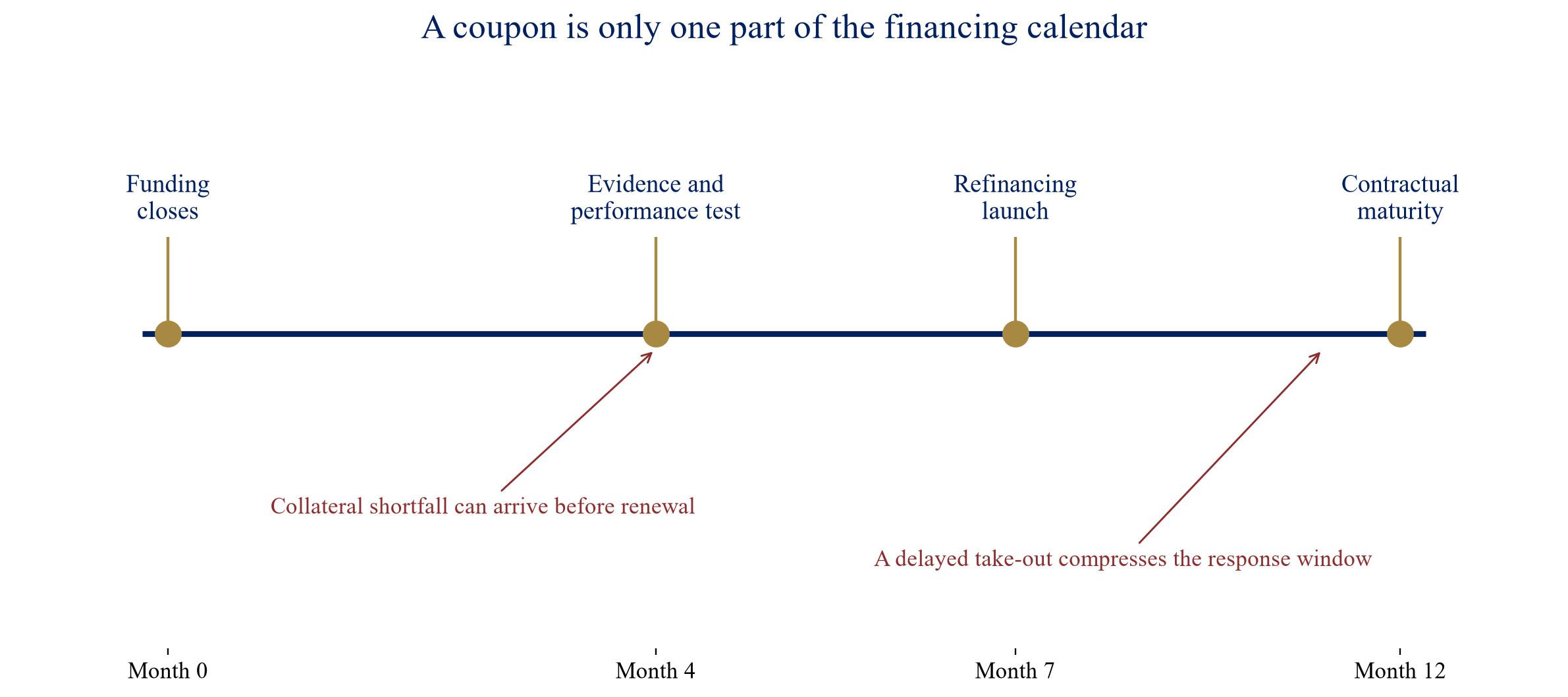
Author-developed decision timetable. Dates are relative to a hypothetical one-year maturity and do not describe an actual lender process.
17 Design the mandate before soliciting terms
A disciplined capital process begins with the issuer's use of funds and the legal entity that can borrow, pledge or sell assets. Management should establish the minimum day-one cash, expected peak need, repayment source and acceptable control terms. The next step is a reconciled debt schedule, asset register, receivables ageing, cash forecast and covenant model. These are not merely marketing documents. They determine whether the apparent funding route can close and continue to operate during stress.
The adviser can then ask capital providers for proposals using a common information pack and a common assumptions schedule. Requests should specify price components, benchmark mechanics, commitment and draw conditions, collateral tests, reserves, legal expenses, reporting, cash controls, covenant definitions, maturity, prepayment and permitted additional debt. A lender's indicative letter should be labelled as such. The issuer should not describe it as committed cash until credit approval, documentation and conditions precedent are satisfied. If providers request different structures, the model should preserve the differences and explain the adjustments used in any comparison.
Term-sheet review should include a dependency register. A security opinion may require a completed asset-title exercise. A borrowing-base test may require system changes. A vehicle may require customer-notice analysis and collection-account setup. Management should assign an owner, evidence source, duration and decision date to each item. If a route cannot deliver AED 50 million by the operational deadline, the shortfall needs a credible temporary funding plan or the route should be excluded from the immediate-cash comparison. Later optionality can still be valuable, but it belongs in a separate phase.
18 Research design for a genuinely comparable price study
The framework could be tested against real transactions with consented data. A sample would need dated proposals for the same issuer or carefully matched issuers, with complete term sheets, fee schedules, borrowing-base definitions, covenant packages, capital-structure information and realised draws. It would also need subsequent collateral quality, reporting costs, waivers, refinancing and final cash paid. Merely collecting advertised coupons would bias the comparison toward visible price and omit access restrictions and contingent events.
The unit of comparison should be a financing need in a specific period. Issuer size, sector, leverage, cash-flow volatility, asset mix, legal jurisdiction, security ranking, investor mandate and transaction timing can affect terms. A matched proposal design for the same borrower may reduce some confounding, but provider selection and negotiation remain endogenous. A study of accepted deals alone would exclude offers rejected for expensive controls or failed conditions. Unfunded proposals and withdrawn mandates are therefore valuable data if owners consent to their use and confidentiality can be protected.
Outputs should report distributions and uncertainty, not a single asserted Gulf premium. One measure could be realised permanent cash cost per unit of time-weighted usable funding; another could be days below the issuer's minimum liquidity threshold; a third could track covenant or borrowing-base interventions. The study should show sensitivity to the assumed value of restricted cash and refinancing delays. Until such a dataset is assembled, this paper's numerical cases remain teaching scenarios. The public sources describe mechanisms and broader risks, not an empirical ranking of UAE private credit, ABL and structured finance.
Confidentiality and selection matter. A borrower may be willing to share a successful term sheet but not a proposal that failed because collateral was rejected. A lender may describe a stated rate while redacting reserve mechanics. If the research retains only the documents easiest to obtain, it may underestimate the cost of execution failure and the frequency of ineligible-asset problems. A credible protocol would set consent and redaction rules before collecting records; code missing terms explicitly; record why each observation entered the sample; and publish an analysis plan that treats unfunded proposals as outcomes rather than discarding them. It would never identify an issuer, lender, investor or mandate without the permissions required for that use.
19 A ninety-day execution sequence
In the first thirty days, finance and treasury should reconcile the entity perimeter, historical cash flows, existing debt, security, receivables and inventory. The company should define the use of funds, minimum cash date and operating downside that threatens the plan. Counsel can flag asset-title, assignment, existing lien and jurisdiction questions without waiting for a final lender shortlist. The output should be an evidence map with discrepancies and owners, not a glossy financing deck that assumes every asset can be pledged.
In the second thirty days, management can build the common cash and covenant model and request comparable written indications. Each proposal should be converted into a signed-term checklist that identifies fees, usable proceeds, draw conditions, eligibility, reserve, control rights and maturity. Where a lender's response is ambiguous, the question should be asked in writing. The board can select a preferred route and a fallback based on the cash calendar, downside states and execution dependencies. Any public-sector, free-zone or regulator-specific issue should be referred to qualified counsel within its actual perimeter.
In the final thirty days, the team should validate collateral samples, finalise the legal and reporting architecture, run a test certificate where applicable, and verify that cash can be drawn when the operating plan needs it. A waiver strategy, refinancing date and lender-reporting owner should be approved before completion. The sequence is a proposed project plan, not evidence that every transaction can close in ninety days. A complex cross-border vehicle may take longer, and the plan should be recalibrated using the actual critical path.
Table 3. Board checklist before selecting a financing structure
| Decision test | Evidence to produce | Board question |
|---|---|---|
| Cash objective | Dated uses and minimum-liquidity forecast | What cash must be freely available, and when? |
| Gross-to-net bridge | Written pricing and deduction schedule | What reaches the issuer after fees and reserves? |
| Covenant capacity | Defined test calculation under base and stress | What action becomes restricted after an earnings shock? |
| Collateral support | Aged, sampled and legally reviewed asset schedule | Which assets remain eligible after dispute or delay? |
| Restricted cash | Waterfall and reserve-release terms | When could withheld cash return, and under what conditions? |
| Refinance route | Maturity calendar, alternative sources and lead times | What happens if the expected take-out is delayed? |
| Control and execution | Consent matrix, conditions and reporting owner | Who can interrupt funding or business decisions? |
Author-developed checklist. A 'yes' requires a dated source, owner and review; legal and accounting conclusions require qualified advisers.
20 Conclusion and limits
Private credit, asset-based lending and structured finance convert different evidence into capital. Their prices cannot be compared fairly by coupon alone. The borrower must know how much cash is freely available, which covenant or collateral test can reduce it, what cash remains restricted and what repayment or renewal event arrives at maturity. The fictional AED example shows how permanent fees change the cost of usable proceeds. Its borrowing-base and EBITDA shocks show how the route with the lower initial arithmetic cost can carry a larger contingent cash demand under a specific state.
The primary sources support narrower conclusions. UAE credit standards describe duties for covered lenders, and UAE legislation provides relevant security and factoring frameworks [1, 3, 4]. The OCC handbook explains borrowing-base mechanics within a US supervisory context [2]. IFRS 7 sets a disclosure framework for instrument risk [8]. IMF and FSB work identify broader private-credit vulnerabilities [6, 7]. None supplies a matched dataset of GCC offers or proves a universal ranking of structures. The figures, tables, rates and amounts in this paper are author-developed scenarios and decision aids.
The board's actionable question is which route supplies the required usable cash through the issuer's realistic downside while preserving sufficient flexibility to execute the business plan. A credible answer needs signed terms, reconciled asset and cash data, a legal-perimeter review, covenant definitions and a dated refinancing strategy. Where the evidence is absent, the decision should record the gap and the conditional assumption. Capital beyond the bank can be valuable, but the value rests in a structure whose cash, control and maturity consequences the company can actually manage.
The framework is intended for repeat use as terms evolve. A borrower should revisit the comparison when the lender changes an advance rate, adds a reserve, alters a covenant definition, moves a maturity date or shifts a fee from refundable to permanent. Each change should be recorded with the revised day-one cash, downside access and total contractual payments. The disciplined output is a board decision that can be tested against subsequent outcomes, including cases in which the chosen facility was never drawn or the expected refinancing did not occur.
References
- Central Bank of the UAE. “Credit Risk Management Standards,” effective 30 November 2024; Articles 3, 5 and 10. Applies to covered licensed financial institutions. https://rulebook.centralbank.ae/en/rulebook/credit-risk-management-standards
- Office of the Comptroller of the Currency. “Asset-Based Lending,” Comptroller's Handbook, Version 1.1. US supervisory reference, accessed 6 October 2026. https://www.occ.gov/publications-and-resources/publications/comptrollers-handbook/files/asset-based-lending/pub-ch-asset-based-lending.pdf
- United Arab Emirates. Federal Law No. 4 of 2020 on Securing Rights in Movable Property, official legislation portal, accessed 6 October 2026. https://uaelegislation.gov.ae/en/legislations/1446
- United Arab Emirates. Federal Decree-Law No. 16 of 2021 on Factoring and the Transfer of Receivables, official legislation portal, accessed 6 October 2026. https://uaelegislation.gov.ae/en/legislations/1515
- International Finance Corporation. “Debt Securities Syndications,” accessed 6 October 2026. https://www.ifc.org/en/what-we-do/sector-expertise/syndicated-loans-and-mobilization/debt-securities-syndications
- International Monetary Fund. “Global Financial Stability Report: The Last Mile: Financial Vulnerabilities and Risks,” April 2024, Chapter 2. https://www.imf.org/en/publications/gfsr/issues/2024/04/16/global-financial-stability-report-april-2024
- Financial Stability Board. “Report on Vulnerabilities in Private Credit,” 6 May 2026. https://www.fsb.org/2026/05/report-on-vulnerabilities-in-private-credit/
- IFRS Foundation. “IFRS 7 Financial Instruments: Disclosures,” accessed 6 October 2026. https://www.ifrs.org/issued-standards/list-of-standards/ifrs-7-financial-instruments-disclosures/
- International Finance Corporation. “Syndicated Loans and Mobilization,” accessed 6 October 2026; institutional product context. https://www.ifc.org/en/what-we-do/sector-expertise/syndicated-loans-and-mobilization
- World Bank Group. “Secured Transactions, Collateral Registries and Movable Asset-Based Financing,” 2019; comparative framework with jurisdiction limits. https://documents.worldbank.org/curated/en/193261570112901451/pdf/Secured-Transactions-Collateral-Registries-and-Movable-Asset-Based-Financing.pdf
About the Author
Chennakeshav (CK) is a corporate finance and investment banking executive with 25+ years of global experience in deal origination, structuring and execution across M&A, growth capital and corporate strategy. He has led value-creation mandates for founders, corporates and funds — bridging the boardroom view to hands-on execution and close.
His career spans Morgan Stanley, HSBC, Lloyds Banking Group, EWEC, ADQ portfolio companies and Emirates Growth Fund, across TMT, real estate, fintech, deeptech, cleantech, infrastructure and energy. He has partnered with C-suite leaders, private equity and venture funds, sovereign wealth funds and family offices to finance complex fund raises and scale-up ventures, and has led M&A due diligence, post-merger integration and business-transformation initiatives to create value.
At Matchpoint Partners he is Managing Partner, leading the firm's corporate finance, M&A and capital-raising practice. He holds an MBA from London Business School, an engineering degree from VTU and a Master of Laws (LLM, in progress) from UCL London.
An active start-up mentor, CK mentors at Techstars, DIFC FinTech Hive, Startup Grind, Founder Institute and IN5, serves as Entrepreneur Mentor in Residence (EMiR) at London Business School, and judges the Entrepreneurship World Cup.
