
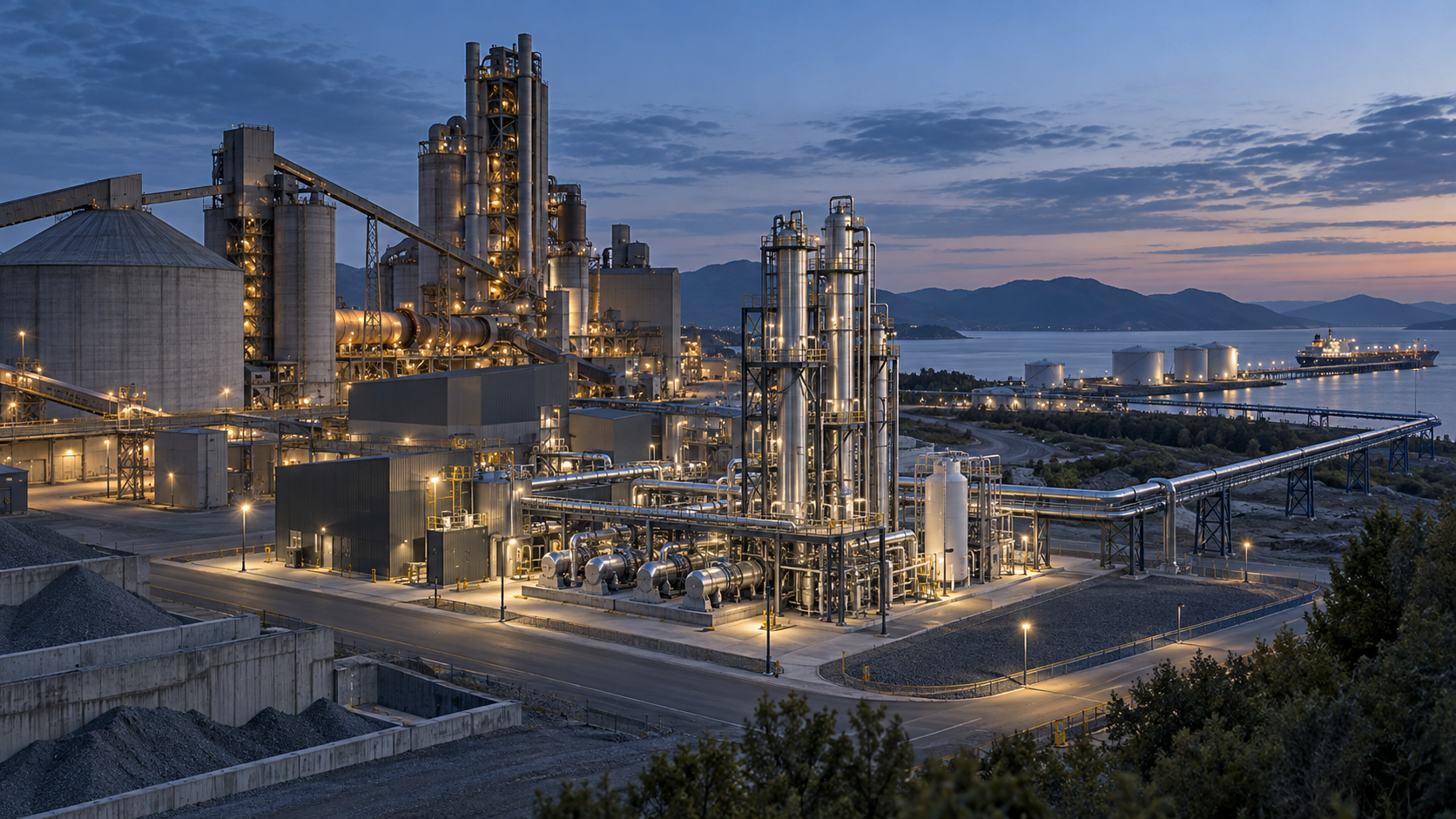
1. The commercial decision
An industrial emitter considering carbon capture faces a choice about organisational design as much as technology. It can procure equipment, finance the investment on its own balance sheet and build an operating capability. It can form a joint venture with a technology or infrastructure partner. It can procure an engineering, procurement and construction package and outsource operations. It can also buy a defined capture service under a long-term contract while a specialist finances, owns and operates the capture plant.
The capture-on-contract model is most useful where the emitter has a durable need to decarbonise, limited appetite for non-core capital expenditure and access to a credible carbon-dioxide transport and storage route. The transaction question is whether service payments, public support and avoided carbon costs can support an investable asset while preserving appropriate incentives for performance. The answer depends on the whole chain rather than the capture unit alone.
2. Why ownership can be a barrier
Capture equipment changes the host plant. It consumes energy, occupies space, interfaces with flue-gas handling, creates additional maintenance requirements and depends on the host's operating profile. An emitter that owns the system must manage process integration, technology performance, construction risk, specialist staffing, carbon measurement and downstream nominations. These obligations can compete with investment in the core production line.
The balance-sheet issue is only one part of the problem. A conventional equipment purchase leaves the emitter exposed to performance degradation, integration defects and obsolescence. A well-designed service contract converts some of those risks into measurable obligations for a specialist. It also creates a financing asset whose revenues can be analysed separately. The value of that separation depends on genuine risk transfer and enforceable interfaces.
3. Outsourcing does not remove the chain
Captured carbon dioxide has limited value at most industrial sites. It must be compressed, conditioned, transported and either used in a durable product or stored permanently. The International Energy Agency identifies coordination across capture, transport and storage as a distinctive source of cross-chain risk [1]. A service provider cannot guarantee disposal if the downstream network is unavailable unless it controls that network or purchases firm capacity with adequate remedies.
The contract must therefore state where the capture service ends. A common boundary is delivery of carbon dioxide meeting an agreed specification at a flange or metering point. Another structure includes compression, temporary storage and loading. A fully integrated service can include transport and storage. Each expansion of scope adds interfaces, revenue opportunities and contingent liabilities. The lender must understand which entity controls each dependency.
4. The service perimeter
The minimum service perimeter includes reception of feed gas, removal of impurities where allocated, capture, regeneration, dehydration, compression, measurement and delivery of an agreed carbon-dioxide stream. It may also include utilities, solvent or sorbent supply, emissions monitoring, maintenance, waste handling and reporting. The host usually supplies land, access, tie-ins, feed gas and some utilities.
The perimeter should be expressed through physical battery limits and responsibility schedules. A statement that the provider will capture ninety per cent of emissions is incomplete without a defined inlet stream, operating envelope, measurement method, exclusion regime and treatment of host outages. The contract needs a mass-balance protocol that reconciles inlet carbon, captured product, vented carbon, process losses and measurement uncertainty.
5. The contracting architecture
A capture service agreement sits within a larger contract network. The emitter may have a public-support contract, carbon-market obligations and low-carbon product commitments. The service company may have an equipment supply agreement, construction contract, technology licence, operations contract, energy supply, transport-and-storage agreement, insurance and financing documents. A project company can hold the capture assets and service contract.
The architecture should minimise gaps between promised performance and recoverable remedies. If the service company guarantees availability using an engineering contractor's warranty, the testing standards and exclusions should align. If transport unavailability reduces capture, the service payment and downstream remedies should interact. A pass-through clause without timing, evidence and caps can transfer risk without making it financeable.
6. The interface map
The figure maps the principal contractual and physical relationships. It highlights that the service company stands between the emitter's process conditions and the downstream carbon-management chain. Public support, carbon pricing and low-carbon product revenues can strengthen the emitter's payment capacity, but their eligibility rules may also constrain operations.
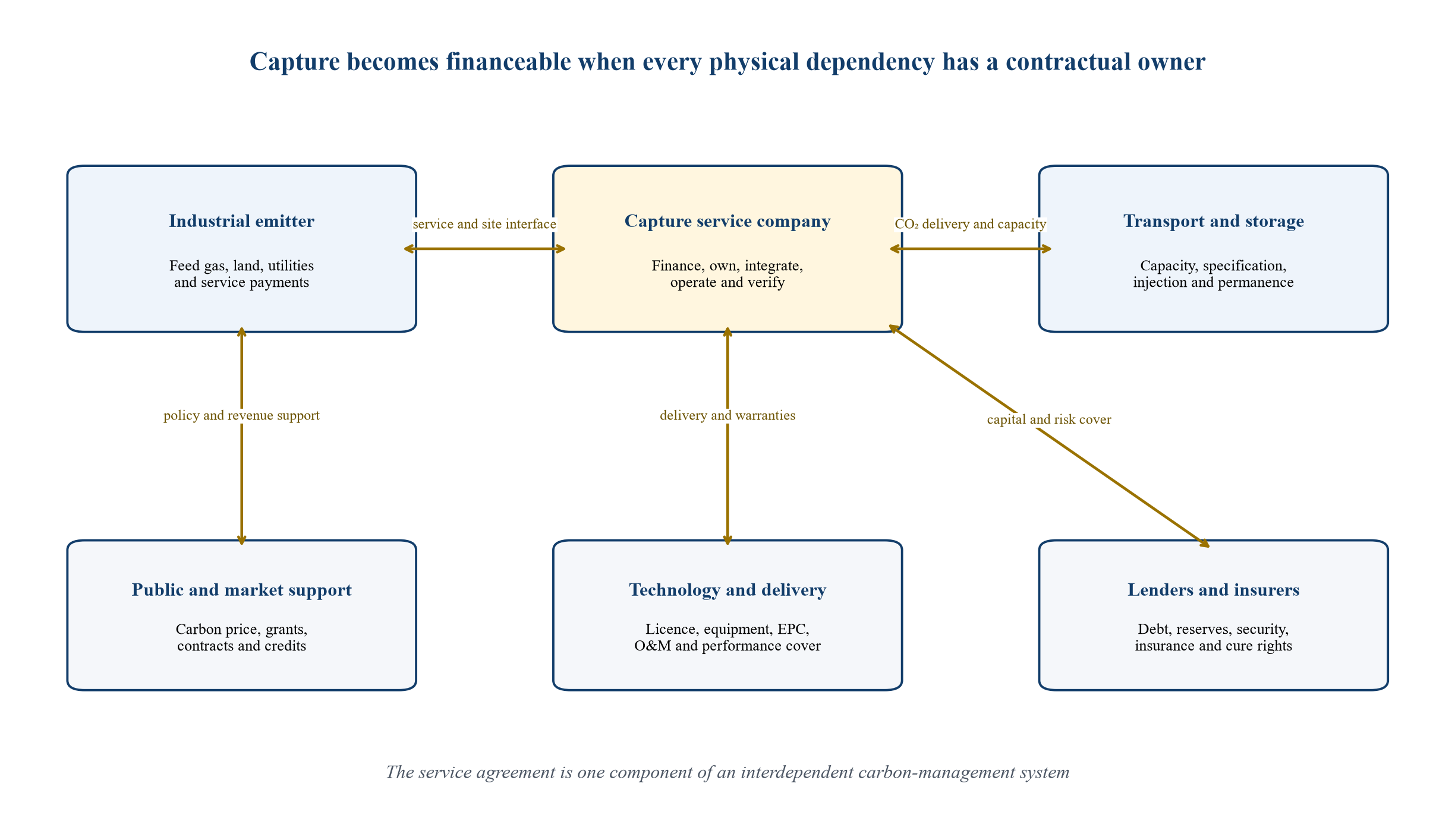
Generic transaction map. Actual roles, regulatory duties and contractual relationships depend on jurisdiction, sector and project configuration.
7. Payment design should follow controllability
The payment mechanism should reward capacity made available, tonnes verifiably captured and carbon dioxide delivered within specification. A fixed availability charge can support debt service and fixed operating costs. A variable charge can cover consumables, maintenance linked to throughput and performance incentives. Defined energy and transport costs may be indexed or passed through where the service company cannot efficiently control them.
The emitter should not pay full capacity charges when the capture plant is unavailable for reasons within the provider's control. The provider should not absorb losses caused by off-specification feed gas, unavailable utilities or host-plant shutdowns outside agreed assumptions. A controllability matrix provides the basis for relief events, deductions, compensation events and termination rights.
8. Availability is a financial metric
Availability should measure whether the service can operate when required within the agreed operating envelope. It is different from the annual capture rate, which also reflects host production, feed-gas composition, network availability and dispatch decisions. Conflating the two can create disputes and distort incentives.
A contract can define monthly or annual availability, planned-maintenance allowances, forced-outage treatment and minimum-run conditions. Deductions should be material enough to motivate performance while remaining compatible with debt service in credible downside cases. Repeated failure should trigger remediation plans, enhanced monitoring and ultimately termination or buyout rights.
9. Capture rate needs a denominator
A capture-rate guarantee requires a defined denominator. It may refer to carbon entering the capture island during eligible operating hours, carbon in the entire host exhaust, or an annual mass balance. Each definition produces a different allocation of bypass, start-up, turndown and host-plant effects.
The measurement plan should specify meters, sampling frequency, calibration, uncertainty, substitution procedures and independent verification. It should also state how solvent degradation, impurities and transient operations affect the calculation. The objective is a metric that can be administered during normal operations and tested during disputes without relying on judgement developed after the event.
10. Product specification protects the chain
Transport and storage operators require carbon-dioxide streams within composition, pressure, temperature and impurity limits. Water, oxygen, nitrogen oxides, sulphur compounds and other constituents can affect corrosion, phase behaviour, metering and storage operations. NETL publishes guidance on impurity parameters for carbon-management studies, while project specifications remain infrastructure specific [2].
The capture service agreement should incorporate the downstream specification and allocate the cost of conditioning. Off-specification product can cause rejection, shutdown or damage. The provider needs adequate control over pretreatment and dehydration to accept this risk. The emitter retains responsibility for undisclosed or out-of-envelope feed-gas conditions unless the provider has priced and engineered for them.
11. Technology readiness is integration readiness
Carbon-capture technologies include solvents, sorbents, membranes, cryogenic processes, oxyfuel approaches and process-specific separation. Technology readiness alone does not establish project readiness. An established separation process can face first-of-a-kind integration at a particular cement kiln, steel plant or waste-to-energy facility.
The relevant assessment combines core-process maturity, scale demonstrated, feed-gas similarity, heat integration, impurity tolerance, turndown, maintainability, waste streams and supply-chain depth. DOE and NETL continue to support advanced solvents, sorbents, membranes and chemical-looping approaches while maintaining industrial retrofit cost tools [3][4]. A service provider should avoid offering a fixed long-term price before integration uncertainty is bounded.
12. A readiness curve for service procurement
The figure distinguishes equipment maturity from contractual readiness. Mature equipment can remain difficult to wrap if integration, operating data or remedy alignment is weak. A technology should reach service-contract readiness only when the provider can define its operating envelope, test procedure, maintenance strategy, consumable exposure and credible performance security.
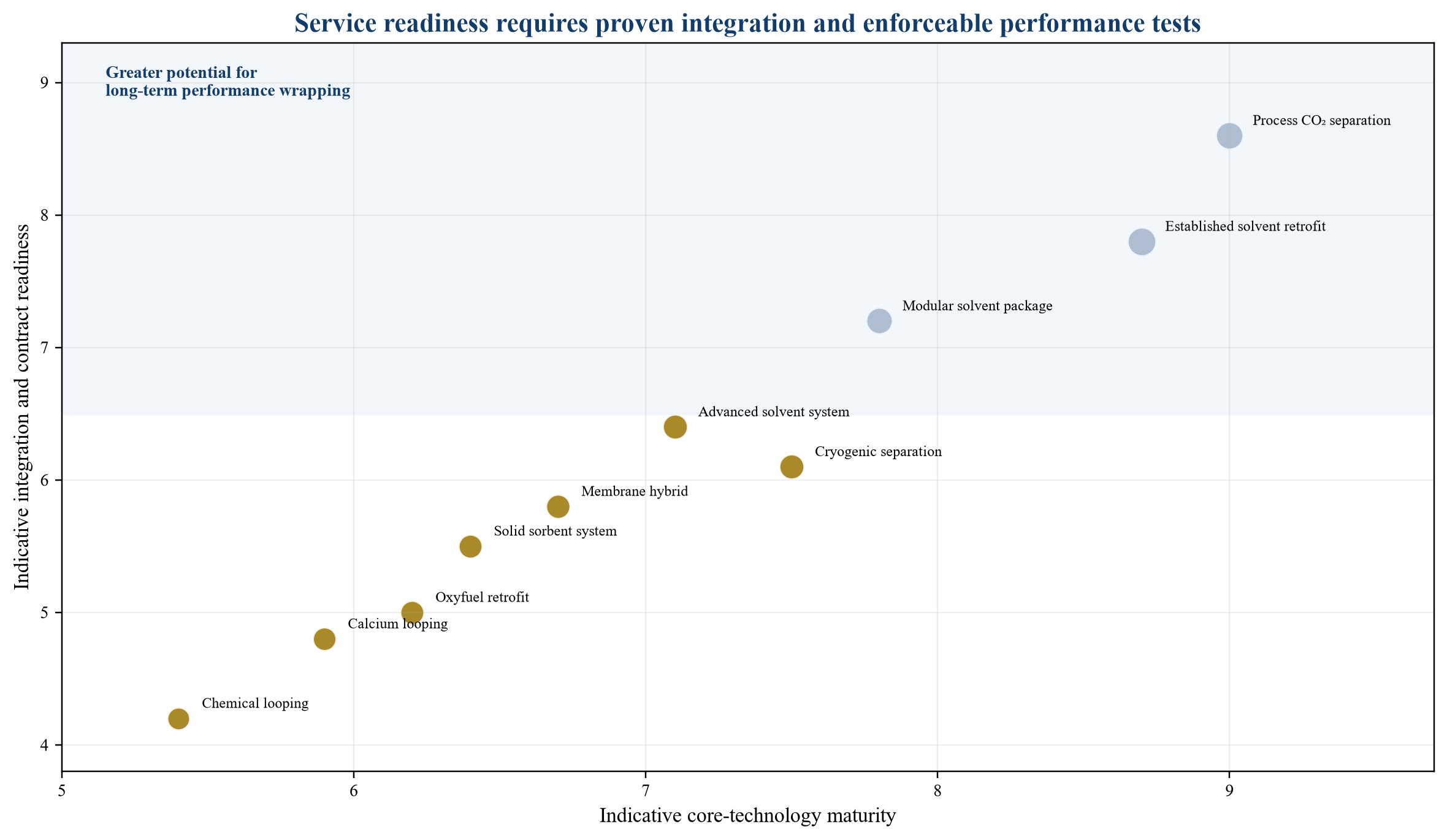
Qualitative decision framework. Positions are illustrative and project-specific; they are not vendor ratings or universal technology rankings.
13. Sector context changes the offer
High-purity process streams from ammonia, hydrogen or ethanol production can present different capture economics from dilute combustion streams. Cement and lime include process emissions that cannot be removed solely through fuel switching. Steel routes differ by furnace configuration. Refineries have multiple sources with different concentration and pressure. Waste-to-energy plants combine variable feedstock with public-service obligations.
NETL's industrial-source work shows that capture cost varies materially with source characteristics, contaminants, scale and the extent of additional treatment [4][5]. A service company should therefore offer a family of contracts rather than one generic price. Standard legal modules can be combined with sector-specific technical schedules and cost drivers.
14. The host plant must be creditworthy and durable
The capture asset is often site specific. Its residual value may be limited if the host plant closes, changes process or loses competitiveness. The service provider and its lenders therefore take host-plant risk even when the emitter has a strong current credit rating. Due diligence should cover remaining asset life, market position, maintenance history, environmental permits, feedstock security and planned modifications.
Termination compensation should reflect this dependence. If the emitter voluntarily closes or sells the site, the service company may require outstanding debt, break costs, demobilisation and an agreed return component. If closure follows prolonged service underperformance, the provider should bear a larger share. A step-in or transfer mechanism can preserve the service contract through a host ownership change.
15. Public-support eligibility must survive outsourcing
Many jurisdictions use grants, tax credits, carbon contracts or regulated business models to close the gap between capture cost and the value of avoided emissions. The United Kingdom's industrial carbon-capture model provides a payment per tonne under a contract with an initial ten-year period and possible extensions, with support intended to cover operating costs, transport-and-storage charges and capital recovery [6].
An outsourced model must fit the eligibility rules. The emitter may remain the support recipient while paying the provider. The project company may need direct rights over support proceeds or a security assignment. Change, suspension or clawback of support should be allocated according to cause. The contract should avoid promising revenue that depends on an unconfirmed award.
16. Carbon price is an exposure, not a complete revenue model
An emitter may value capture through avoided emissions allowances, carbon taxes, product premiums or compliance with procurement rules. These values can change. Carbon prices may be volatile, free allocations can evolve and product premiums may lack durable offtake. A long-term service contract financed with debt needs a payment obligation that remains enforceable across those market conditions.
The emitter can retain carbon-price upside and downside while paying a contracted service fee. Alternatively, a sharing mechanism can link part of the fee to carbon value. Any indexed component should include floors, caps and transparent reference prices. Lenders generally need a minimum contracted revenue that covers fixed obligations under conservative operating assumptions.
17. United States incentives create structuring choices
The United States federal tax credit under section 45Q can support qualifying capture, utilisation and storage. Eligibility depends on statutory and regulatory requirements, including measurement, secure storage or qualifying utilisation. Transferability and direct-pay provisions can affect monetisation for eligible entities and tax years [7][8].
The transaction must decide which entity owns the capture equipment, claims the credit and bears recapture or compliance risk. A service company can price the expected credit into its fee only where it can substantiate eligibility and monetisation. Tax-credit assumptions should be supported by specialist advice, robust records and downside cases for delayed or reduced proceeds.
18. European funding supports projects rather than generic economics
The European Union Innovation Fund supports industrial carbon management, including capture from hard-to-abate sources, storage sites and cross-border infrastructure [9]. The Net-Zero Industry Act sets an objective of at least fifty million tonnes of annual carbon-dioxide injection capacity by 2030 [10]. These measures can improve infrastructure availability and project economics.
Funding remains project specific. A capture-service proposal should separate confirmed grant proceeds from prospective applications. Grant conditions can affect ownership, procurement, milestones, knowledge sharing and asset disposal. The service agreement and finance documents need to preserve compliance with those conditions over the relevant period.
19. The United Kingdom demonstrates contract layering
The United Kingdom has published detailed business-model materials for industrial capture and transport and storage [6][11]. The framework demonstrates how public revenue support, private construction contracts, network access and operational obligations can be layered. It also shows the amount of contractual detail required to manage availability, metering, qualifying volumes and cross-chain events.
A private capture-on-contract model can draw on these principles without copying a government contract. Definitions, testing, relief events, reporting, change in law, termination and compensation should align with the actual allocation of control. The emitter's public-support contract should be reviewed alongside the service contract so that one agreement does not create obligations that the other cannot satisfy.
20. Transport and storage capacity is a gating condition
A capture asset has limited utility without a destination. The European Commission identifies transport infrastructure as an essential enabler and recognises pipelines, ships, rail and trucks as possible modes [12]. Shared networks can reduce unit costs and enable smaller emitters, yet they introduce scheduling, specification and capacity-allocation risks.
Before financial close, the parties should secure sufficient rights for expected volumes, commissioning and ramp-up. The agreement should address interruptions, nomination procedures, take-or-pay exposure, capacity expansion, ship or pipeline constraints and priority among users. Where firm downstream capacity is unavailable, construction staging or a delayed service commencement may protect capital.
21. Energy is often the largest controllable input
Capture systems can require steam, electricity, cooling water and compression power. The service price is highly sensitive to energy source, efficiency and operating profile. The contract should state who provides each utility, at what specification, and how price changes are treated. Heat integration can reduce cost while increasing dependence on host operations.
A pass-through arrangement can protect the provider from market prices, but it may weaken efficiency incentives. A better design can use an indexed reference consumption per tonne, with the provider bearing deviations caused by its performance and the emitter bearing agreed market-price exposure. Major changes to the host's heat balance should trigger technical and commercial review.
22. Cost-performance benchmark
The table presents a hypothetical benchmark for three service configurations. It is designed to show how asset scope and risk allocation affect the annual service price. The figures are assumptions in constant money and do not represent market quotations, engineering estimates or expected project outcomes.
Table 1. Hypothetical cost-performance benchmark for capture-service configurations
| Item | Modular capture service | Integrated capture island | Capture plus transport interface |
|---|---|---|---|
| Nominal captured volume, Mtpa | 0.20 | 0.80 | 0.80 |
| Contract availability | 90% | 92% | 92% |
| Illustrative provider capital, USDm | 180 | 520 | 610 |
| Fixed annual service charge, USDm | 31 | 78 | 94 |
| Variable operating charge, USD/t | 24 | 19 | 23 |
| Reference energy allowance, USD/t | 31 | 27 | 27 |
| Downstream tariff included | No | No | Interface only |
| Indicative total at reference volume, USD/t | 210 | 144 | 169 |
| Principal risk retained by emitter | Volume and utilities | Volume, utilities and downstream | Volume and storage capacity |
Illustrative assumptions only. Currency is USD in constant terms. Totals exclude tax, financing fees, emitter-side modifications and extraordinary remediation.
23. Pricing must distinguish fixed and variable economics
The hypothetical benchmark illustrates a high fixed-cost asset. Dividing annual cost by captured tonnes can create a misleading unit price when utilisation changes. The contract should expose the fixed capacity component and variable throughput component. This makes the consequences of host outages and ramp-up delays visible.
A minimum payment can support financeability, but it should be conditional on service availability. A deemed-volume mechanism can apply when the provider is ready and the host or downstream arrangements prevent operation. The parties can cap deemed payments during extended events and include termination rights when the project loses its decarbonisation purpose.
24. Volume risk follows host operations
Industrial facilities may cycle, undergo major shutdowns or respond to commodity markets. A capture plant designed for steady baseload operation can suffer when the host runs below plan. The provider faces lower fee income, more starts and stops and potential degradation. The emitter may resist a full take-or-pay obligation because it cannot control product demand.
Risk can be shared through a contracted capacity band, annual minimum service payment and variable fee. Planned host outages should be scheduled jointly. Prolonged low utilisation can trigger repricing, debt prepayment or buyout. The model should use host-specific operating history and downside cases rather than a single nameplate utilisation assumption.
25. Construction risk requires an integrated test
The service company may hold the primary construction risk, but the emitter controls access, tie-ins and modifications to the host. A split engineering scope can create gaps in design data and commissioning responsibility. The project needs an interface-management plan and an integrated test that reflects actual feed gas and downstream conditions.
Milestone payments or service commencement should depend on mechanical completion, reliability runs, capture performance, product specification and required permits. Tests should allow correction of host-caused deviations. Liquidated damages can support delay and performance obligations, while caps and exclusions should match the service company's exposure to the emitter.
26. Long-term performance requires lifecycle maintenance
Initial acceptance does not prove twenty-year performance. Solvent management, corrosion control, rotating equipment, heat exchangers, compressors and instrumentation require planned maintenance and replacement. The service fee should fund lifecycle expenditure and reserves for major overhauls.
The provider should supply a long-term maintenance plan, critical-spares strategy and degradation model. The emitter needs audit and reporting rights without directing operations so extensively that risk transfer becomes unclear. Lenders should test whether the reserve profile matches expected overhaul cycles and whether supply arrangements protect access to proprietary consumables and parts.
27. Technology licensing can become a single point of failure
A service company may depend on a licensor for process design, solvent, catalysts, software or technical support. The financeability of the project then depends on licence duration, transfer rights, intellectual-property protection and continuity after licensor distress. Restrictions on assignment or lender step-in can undermine security.
The licence should permit operation for the service-contract term, including cure and transition periods. Source-code escrow or alternative support may be relevant for control systems. Proprietary consumables need price, quality and availability protections. The provider should disclose where a substitute would require re-permitting or performance retesting.
28. Data is an operating asset
The service generates process, emissions, energy, maintenance and carbon-accounting data. These records support payment, regulatory reporting, support eligibility, tax credits and performance improvement. The contracts should allocate ownership, access, confidentiality, cybersecurity and retention.
The emitter needs sufficient data to substantiate its emissions position and product claims. The provider needs operating data to manage performance and improve its fleet. Lenders and insurers may need defined access. Data rights should survive termination and insolvency. Automated analytics can improve fault detection, but material operating and compliance decisions require accountable human governance.
29. Measurement disputes need a hierarchy
Meters fail, samples conflict and calibration can drift. A measurement hierarchy should identify primary instruments, backup methods, estimation procedures and independent expert determination. The parties should agree how disputed tonnes are treated in invoices and regulatory reports while the dispute is resolved.
The protocol should reconcile service-payment measurement with downstream custody transfer and any public-support or tax-credit rules. Small differences can accumulate across long contracts. A periodic mass-balance review, transparent raw data and calibration records reduce the risk that commercial and regulatory accounts diverge.
30. Change in law should be decomposed
Carbon-capture projects face evolving safety, environmental, carbon-market, tax and network rules. A generic change-in-law clause can produce large and ambiguous claims. The contract should distinguish discriminatory change, general change, foreseeable implementation and changes caused by a party's non-compliance.
Cost relief can depend on materiality, mitigation and available support. Capital modifications may require amortisation over the remaining term or extension of the service period. A change that makes performance unlawful or permanently uneconomic should lead to structured renegotiation and, if unresolved, termination compensation based on the agreed cause allocation.
31. Force majeure is narrower than chain interruption
Network outages, lack of storage capacity and host shutdowns may be foreseeable operational risks rather than force majeure. Treating every cross-chain event as force majeure can leave debt service unsupported and remove incentives to procure resilient arrangements. The contract should create specific regimes for host events, provider events and downstream events.
Each regime needs payment consequences, mitigation duties, maximum duration and termination rights. The party best able to procure capacity, backup logistics or insurance should generally manage that risk. Events outside either party's control can still be allocated commercially through caps, shared costs or public-support pass-through.
32. Insurance has a defined role
Construction all-risks, delay-in-start-up, property damage, machinery breakdown, business interruption, liability and environmental cover may be relevant. Insurance cannot substitute for a sound contract or routine maintenance. Policies have deductibles, exclusions, limits and timing gaps.
The project should map insurable events against contractual liabilities. The provider should avoid promising unlimited compensation for risks that cannot be insured or financed. The emitter and lenders need loss-payee rights, notice of cancellation and control over material settlements. Insurance proceeds should follow a repair, reinstate or debt-prepayment waterfall.
33. Financing structure
A ring-fenced project company can own the capture assets and receive the service fee. Debt service depends on emitter credit, service availability, stable operating costs and downstream access. The lenders may require a debt-service reserve, maintenance reserve, distribution lock-up, hedging and sponsor support through completion.
Security can include shares, assets, accounts, insurances and material contracts, subject to applicable law and site arrangements. Direct agreements with the emitter, engineering contractor, operator, licensor and network provider can grant notice and cure rights. The site lease and access rights must survive enforcement long enough to preserve or transfer the asset.
34. Scenario valuation
The figure shows a hypothetical project-company net present value under combinations of host utilisation and energy-price variance. It assumes a blended fixed and variable service fee, a twenty-year operating period and an illustrative discount rate. The purpose is to identify sensitivities and contracting priorities. It is not a forecast or valuation of an actual project.
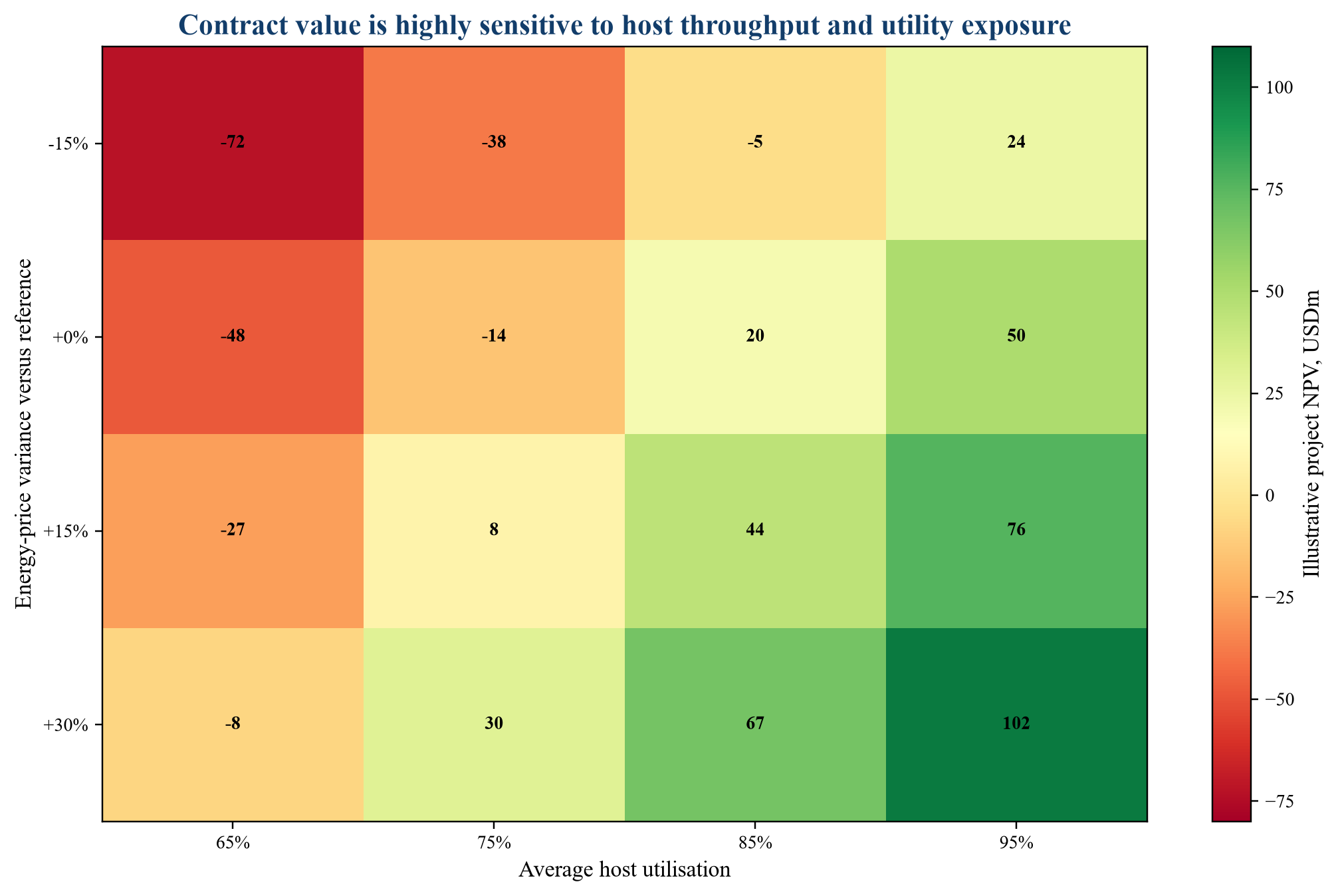
Illustrative scenario model only. Values are not engineering estimates, market forecasts, offers or investment recommendations.
35. Valuation interpretation
The hypothetical matrix shows that a service company can have positive base economics and still lose value when host utilisation falls or energy exposure rises. A higher fixed payment protects utilisation risk but increases the emitter's take-or-pay burden. Energy indexation protects the provider while weakening the emitter's cost certainty.
The commercial task is to allocate each sensitivity to the party able to control, diversify or hedge it. The provider can control capture efficiency and maintenance. The emitter controls production planning and feed-gas conditions. Market energy prices may be indexed, hedged or shared. Downstream capacity may sit with either party depending on procurement scope. The contract should mirror that map.
36. Ownership model comparison
The table compares four routes. The choice depends on capital strategy, capability, tax and support eligibility, appetite for integration risk and access to specialist providers. No structure is universally superior.
Table 2. Comparison of industrial capture ownership and service models
| Dimension | Emitter-owned | Joint venture | EPC plus outsourced O&M | Capture on contract |
|---|---|---|---|---|
| Upfront emitter capital | High | Medium | High | Low to medium |
| Control of technical design | High | Shared | High | Provider-led within agreed envelope |
| Long-term performance risk | Emitter | Shared | Mainly emitter after warranty | Provider within contracted metrics |
| Host-volume risk | Emitter | Shared | Emitter | Allocated through minimum payment and relief regime |
| Financing source | Corporate or project | Sponsor and project | Corporate or project | Service-company project finance or corporate capital |
| Technology obsolescence | Emitter | Shared | Emitter | Provider, subject to contract |
| Interface complexity | Internalised | Governance intensive | Multiple contracts | Concentrated in service contract, with downstream dependencies |
| Best suited to | Strategic owner with capability | Partners with complementary assets | Owner seeking asset control | Emitter prioritising capital preservation and measurable service |
Generic comparison. Project-specific legal, accounting, tax, regulatory and financing advice is required.
37. Commercialisation roadmap
The model should move through evidence gates rather than directly from concept to a twenty-year fixed price. Early phases establish the emissions baseline, site constraints, technology shortlist and downstream route. Development then tests integration, support eligibility, contractual interfaces and financing.
The roadmap can use a paid development agreement before the long-term service agreement becomes unconditional. Development costs can be reimbursed, capitalised or credited at financial close. Exclusivity should be limited by milestones. The emitter needs termination rights if the provider fails to demonstrate technical or financing capability, while the provider needs protection for proprietary work and third-party commitments.
38. Stage-gate plan
The table converts development into decision gates. Each gate requires evidence that narrows a specific source of risk. The parties should avoid declaring commercial readiness solely because a technology vendor has supplied a budget quotation.
Table 3. Commercialisation roadmap for a capture-on-contract offer
| Gate | Core work | Required evidence | Principal decision |
|---|---|---|---|
| 1. Screen | Emissions, site, utilities, host life and downstream options | Verified baseline and fatal-flaw register | Proceed to paid development |
| 2. Select | Technology, integration concept and service perimeter | Comparable operating evidence and basis of design | Select configuration and counterparties |
| 3. Validate | Front-end engineering, tests, permits and metering | Cost range, performance envelope and execution schedule | Fix risk-allocation principles |
| 4. Contract | Service, EPC, O&M, licence, network and support alignment | Bankable term sheets and interface matrix | Authorise final diligence |
| 5. Finance | Due diligence, credit support, reserves and insurance | Committed capital and satisfied conditions precedent | Financial close |
| 6. Deliver | Construction, commissioning and integrated tests | Completion certificates and performance results | Start service payments |
| 7. Operate | Availability, capture, specification and lifecycle maintenance | Verified data, audits and reserve adequacy | Continue, optimise or remediate |
| 8. Transition | Extension, buyout, transfer or decommissioning | Asset condition, liabilities and data package | Execute end-of-term route |
Indicative roadmap. Timing and evidence requirements depend on site, permitting, support and infrastructure.
39. Diligence checklist
Emitter diligence should test provider credit, technical references, integration capability, financing plan, supply chain, insurance and ability to stand behind performance. Provider diligence should test the host's emissions baseline, operating history, credit, permits, remaining life, utility capacity, site rights and downstream access. Both parties should examine support eligibility and carbon accounting.
Lender diligence should reconcile every major model assumption with a contract or evidence source. It should test construction contingency, ramp-up, availability, host utilisation, energy indexation, transport outages, major maintenance, tax and support timing, change in law, termination payments and enforcement access. Independent technical advice should address the integrated system rather than reviewing equipment in isolation.
The diligence report should also identify evidence that remains unavailable and conditions that must be satisfied before capital is committed. Examples include final network tariffs, storage permits, public-support awards, grid reinforcement, land rights, emissions baselines and performance guarantees. These items should enter a conditions-precedent schedule with responsible parties, long-stop dates and consequences for failure. Commercial models should avoid treating an unsigned term sheet, pending permit or indicative grant as committed support.
Operational diligence should examine how the parties will manage the first two years after commissioning. Ramp-up often exposes control-system, impurity, heat-integration and maintenance issues that a short acceptance test cannot reveal. The service contract can use a stabilisation period with enhanced reporting, temporary reserves and a declining support package. The emitter should retain sufficient remedies during this period, and the provider should receive relief for verified host or network constraints. The objective is a controlled transition from construction completion to repeatable service performance.
40. Decision framework
Capture on contract can make industrial decarbonisation more investable when it converts specialist performance into a measurable service and aligns fixed obligations with durable revenues. The model works best where the host plant has a long operating life, feed-gas conditions are understood, utilities are available, downstream capacity is credible and the provider can control the assets needed to meet its guarantee.
The recommended sequence is to define the physical perimeter, map control and risk, establish a verified baseline, select technology on integration evidence, secure downstream capacity, design the payment mechanism, align public support, test downside economics and finance the project through coordinated contracts. The decision should be based on total lifecycle value, retained liabilities and strategic flexibility. A low headline price cannot compensate for an incomplete chain or unenforceable performance promise.
Governance after financial close should preserve the same discipline. A joint operating committee can review planned outages, performance, metering, safety, network constraints, lifecycle expenditure and regulatory change. Reserved matters should protect the emitter and lenders without transferring daily operating control away from the provider. Escalation procedures should move technical disagreements rapidly to appropriately qualified experts. Annual review should confirm that the capture service continues to support the emitter's decarbonisation objective, the provider's financial capacity and the downstream chain's operating requirements.
References
- International Energy Agency, Financing CCUS at Scale: How to Mobilise Private Capital, 2026, https://www.iea.org/reports/financing-ccus-at-scale
- U.S. Department of Energy, National Energy Technology Laboratory, Quality Guidelines for Energy System Studies: CO₂ Impurity Design Parameters, https://www.netl.doe.gov/energy-analysis/details?id=82f089a5-597a-4d24-a0bb-3cf82bf76f59
- U.S. Department of Energy, National Energy Technology Laboratory, Point Source Carbon Capture, https://netl.doe.gov/carbon-management/carbon-capture
- U.S. Department of Energy, National Energy Technology Laboratory, Carbon Capture Retrofit Studies, https://www.netl.doe.gov/ea/CCRS
- U.S. Department of Energy, National Energy Technology Laboratory, Cost of Capturing CO₂ from Industrial Sources, DOE/NETL-2022/3319, 2022, https://www.netl.doe.gov/projects/files/CostofCapturingCO2fromIndustrialSources_071522.pdf
- UK Department for Energy Security and Net Zero, Industrial Carbon Capture Business Models Update, November 2025, https://assets.publishing.service.gov.uk/media/691c73d684a267da57d706c0/Industrial_Carbon_Capture_Business_Models_Update.pdf
- U.S. Internal Revenue Service, Credit for Carbon Oxide Sequestration, https://www.irs.gov/instructions/i8933
- U.S. Department of the Treasury and Internal Revenue Service, Final Regulations under Section 45Q, https://www.federalregister.gov/documents/2021/01/15/2021-00302/credit-for-carbon-oxide-sequestration
- European Commission, What is the Innovation Fund?, https://climate.ec.europa.eu/areas-action/eu-funding-climate-action/innovation-fund/what-innovation-fund_en
- European Commission, The EU's 2030 Carbon Storage Target, https://climate.ec.europa.eu/areas-action/industrial-carbon-management/eus-2030-carbon-storage-target_en
- UK Department for Energy Security and Net Zero, Carbon Capture, Usage and Storage: Business Models, updated July 2026, https://www.gov.uk/government/publications/carbon-capture-usage-and-storage-ccus-business-models
- European Commission, Industrial Carbon Management, https://energy.ec.europa.eu/topics/carbon-management-and-fossil-fuels/industrial-carbon-management_en
- European Commission, Legislative Framework for Industrial Carbon Management, https://climate.ec.europa.eu/areas-action/industrial-carbon-management/legislative-framework_en
- European Commission Joint Research Centre, CO₂ Transport Infrastructure: Key to Achieving Climate Neutrality by 2050, 2024, https://joint-research-centre.ec.europa.eu/jrc-news-and-updates/co2-transport-infrastructure-key-achieving-climate-neutrality-2050-2024-02-06_en
- Global CCS Institute, Global Status of CCS 2025, 2025, https://www.globalccsinstitute.com/global-status-of-ccs-2025/
- International Energy Agency, CCUS Policies and Business Models, https://www.iea.org/reports/ccus-policies-and-business-models
- International Energy Agency, CCUS Legal and Regulatory Frameworks, https://www.iea.org/reports/ccus-legal-and-regulatory-frameworks
- International Energy Agency, CCUS Projects Database, https://www.iea.org/data-and-statistics/data-product/ccus-projects-database
- International Organization for Standardization, ISO 27914:2017 Carbon Dioxide Capture, Transportation and Geological Storage; Geological Storage, https://www.iso.org/standard/64148.html
- International Organization for Standardization, ISO 27913:2024 Carbon Dioxide Capture, Transportation and Geological Storage; Pipeline Transportation Systems, https://www.iso.org/standard/86654.html
- European Commission, Innovation Fund Projects, https://climate.ec.europa.eu/areas-action/eu-funding-climate-action/innovation-fund/innovation-fund-projects_en
- U.S. Department of Energy, Office of Clean Energy Demonstrations, Overview of Point Source Carbon Capture Programs, 2024, https://www.energy.gov/sites/default/files/2024-04/OCED_Portfolio_Insights_CC_part_i_FINAL.pdf
- U.S. Department of Energy, Loan Programs Office, Application Process, https://www.energy.gov/edf/application-process
- UK Competition and Markets Authority, Referral of the Proposed Industrial Carbon Capture and Waste ICC Schemes, 2024, https://www.gov.uk/cma-cases/referral-of-the-proposed-industrial-carbon-capture-icc-and-waste-icc-schemes-by-the-department-for-energy-security-and-net-zero
- European Commission, A European Approach to Industrial Carbon Management, 2024, https://ec.europa.eu/commission/presscorner/api/files/attachment/877470/Factsheet%20Industrial%20Carbon_Management_en.pdf
About the Author
Chennakeshav (CK) is a corporate finance and investment banking executive with 25+ years of global experience in deal origination, structuring and execution across M&A, growth capital and corporate strategy. He has led value-creation mandates for founders, corporates and funds — bridging the boardroom view to hands-on execution and close.
His career spans Morgan Stanley, HSBC, Lloyds Banking Group, EWEC, ADQ portfolio companies and Emirates Growth Fund, across TMT, real estate, fintech, deeptech, cleantech, infrastructure and energy. He has partnered with C-suite leaders, private equity and venture funds, sovereign wealth funds and family offices to finance complex fund raises and scale-up ventures, and has led M&A due diligence, post-merger integration and business-transformation initiatives to create value.
At Matchpoint Partners he is Managing Partner, leading the firm's corporate finance, M&A and capital-raising practice. He holds an MBA from London Business School, an engineering degree from VTU and a Master of Laws (LLM, in progress) from UCL London.
An active start-up mentor, CK mentors at Techstars, DIFC FinTech Hive, Startup Grind, Founder Institute and IN5, serves as Entrepreneur Mentor in Residence (EMiR) at London Business School, and judges the Entrepreneurship World Cup.
LinkedIn: https://www.linkedin.com/in/ckadya/
Profile: https://www.matchpoint-partners.com/team/ck-adya.html
