

1. Closure begins a new operating phase
The end of carbon dioxide injection does not end a storage project. Wells must be plugged, facilities decommissioned, the plume and pressure front monitored, records preserved and emerging anomalies investigated. Revenue may stop while legal and technical duties continue. A project that appears profitable during injection can therefore destroy value if its closure obligations were understated, poorly secured or allocated to an entity that cannot survive the tail.
The decisive question is not simply who owns the pore space. It is who has the legal duty, technical capability and funded capacity to observe, intervene and pay. These attributes may sit with different parties. The storage operator may hold the permit; a specialist may perform monitoring; insurers may cover defined events; sponsors may guarantee specific obligations; and a public authority may accept responsibility only after conditions are met.
2. Liability has several layers
Post-closure liability is a bundle. Regulatory obligations can include monitoring, reporting, corrective measures, plugging, site restoration and emergency response. Carbon-market rules can require surrender of allowances or adjustment of credited removals after leakage. Environmental law can impose preventive and remedial duties. Contract law can allocate losses among emitters, transporters and storage operators. Tort, property and insolvency rules can create further exposure.
These layers do not necessarily transfer together. A regulator may accept specified statutory obligations after closure while private contractual claims, fraud, negligence or defective-data liabilities remain with the former operator. A financial model that uses one line called decommissioning provision obscures this structure. Each obligation needs a trigger, responsible party, duration, cost driver, security instrument and evidence standard.
3. Transfer is conditional rather than automatic
The European Union's CCS Directive provides a transfer route when evidence indicates complete and permanent containment, a minimum period has elapsed, financial obligations have been fulfilled and the site has been sealed with injection facilities removed [1]. The minimum period is generally at least twenty years unless the competent authority accepts earlier evidence. The former operator can remain exposed where fault, deficient data, concealment, negligence or failure of due diligence is established.
The commercial implication is clear. A sponsor cannot value transfer as a date-certain release. It is a regulatory decision supported by an evidence package. The schedule can move, monitoring can continue and security can remain locked. Debt documents, sale agreements and return models should therefore treat transfer as a contingent milestone with downside cases rather than a guaranteed terminal event.
4. The United Kingdom separates closure from licence termination
The United Kingdom's storage framework imposes continuing operator obligations between closure and licence termination [2][3]. Termination regulations require evidence on containment, observed conformity with modelled behaviour, absence of detectable leakage and long-term stability. The authority determines a financial contribution intended to cover expected post-transfer costs before serving a termination notice [4].
The storage licence, permit, monitoring plan, post-closure plan and financial-security package should be read as one system. Closure may stop injection, but the licence-holder remains responsible until statutory conditions are satisfied and termination occurs. For investors, the meaningful exit date is therefore the date of effective transfer and release of relevant security, subject to surviving liabilities. The engineering schedule alone cannot establish that date.
5. Norway illustrates an evidence-led state transfer
Norway's carbon-storage rules require evidence that injected CO₂ behaves consistently with modelling, that leakage cannot be demonstrated and that the storage site is evolving towards long-term stability [5]. A minimum period normally applies, monitoring plans must be updated and the operator provides a financial contribution before transfer. The amount considers expected monitoring, corrective measures, closure, post-closure operations and allowance costs in the event of leakage.
This structure links technical evidence to public acceptance of tail obligations. It also shows why a uniform percentage reserve is weak. A site's expected post-transfer cost depends on plume behaviour, wells, monitoring design, environmental sensitivity, remedy options and the confidence of the competent authority. Financial provision should evolve as evidence improves rather than remain a static construction-era assumption.
6. The United States retains a different liability profile
The United States Environmental Protection Agency's Class VI regime requires owners or operators to maintain financial responsibility for corrective action, injection-well plugging, post-injection site care, site closure, and emergency and remedial response [6][7]. Post-injection monitoring continues until the permitting authority determines that the project no longer endangers underground sources of drinking water. The default post-injection period is at least fifty years unless an alternative timeframe is approved.
Class VI site closure does not create the same general statutory transfer of long-term liability found in the EU model. EPA guidance explains that the Safe Drinking Water Act does not provide authority for an indefinite release or transfer of liability, and other legal claims may survive [7][8]. Cross-border investors should therefore avoid importing European transfer assumptions into United States valuations.
7. A lifecycle map makes the obligations visible
The figure separates project phases, responsible functions and the evidence needed to move from one stage to the next. It highlights that a transfer decision is an interface among technical performance, regulatory acceptance, financial security and records continuity.
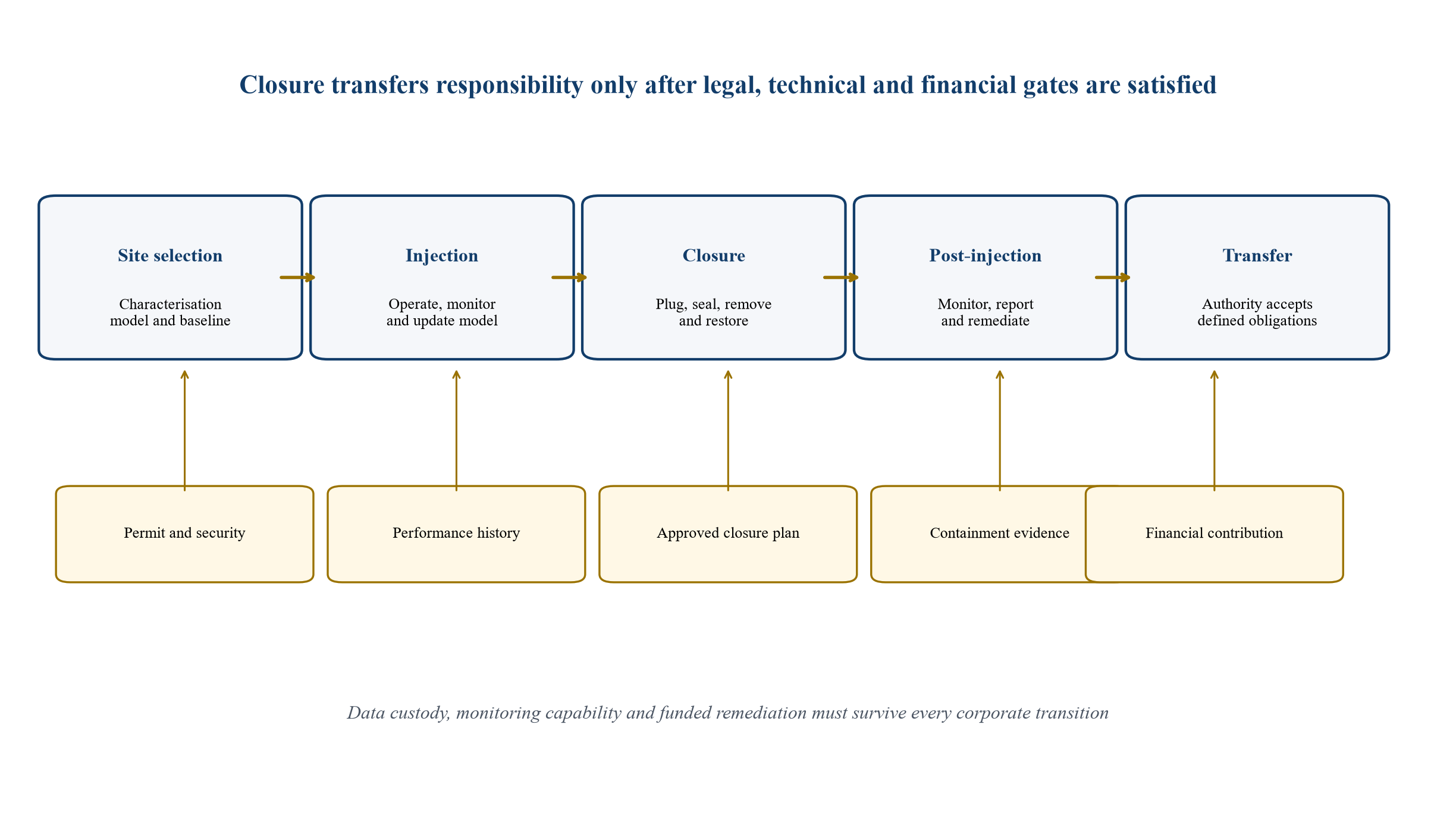
Generic transaction map. Legal obligations, transfer conditions and security requirements vary by jurisdiction, permit and project.
8. Monitoring serves four distinct decisions
Monitoring is often discussed as a single technical programme. It actually supports four decisions. First, it verifies that injection and storage are operating within permit conditions. Second, it updates reservoir understanding and detects deviations. Third, it supports carbon accounting and demonstrates permanence. Fourth, it provides evidence for closure and transfer. A method useful for one decision may be insufficient for another.
Pressure data can reveal reservoir response, seismic surveys can map plume development, well logs can test integrity, geochemical sampling can identify changes in fluids, and surface methods can investigate potential migration. The monitoring plan should link each measurement to a risk, threshold and management action. Data collection without a decision rule can create cost without reducing liability.
9. Technology readiness is site specific
Monitoring technologies differ in maturity, spatial coverage, resolution, frequency, cost and operating constraints. Wellhead pressure and injection-rate measurement are mature and continuous. Downhole gauges provide detailed reservoir response but depend on well access and durability. Time-lapse seismic imaging can cover large areas, yet acquisition and interpretation can be expensive. Distributed fibre-optic sensing offers high-frequency well and near-well data, with project-specific deployment requirements.
Satellite, airborne, soil-gas, groundwater and atmospheric tools address different leakage pathways. Their value depends on baseline variability and detection limits. A technology should therefore be assessed against the site's conceptual model rather than ranked in isolation. The relevant readiness question is whether it can produce admissible evidence for a defined permit or transfer decision under actual field conditions.
10. A readiness curve guides procurement
The figure positions monitoring tools by indicative field maturity and decision reach. It is a qualitative procurement aid based on established categories described by ISO, EPA, DOE and IPCC materials [6][9][10][11]. It does not represent a vendor ranking or universal cost curve.
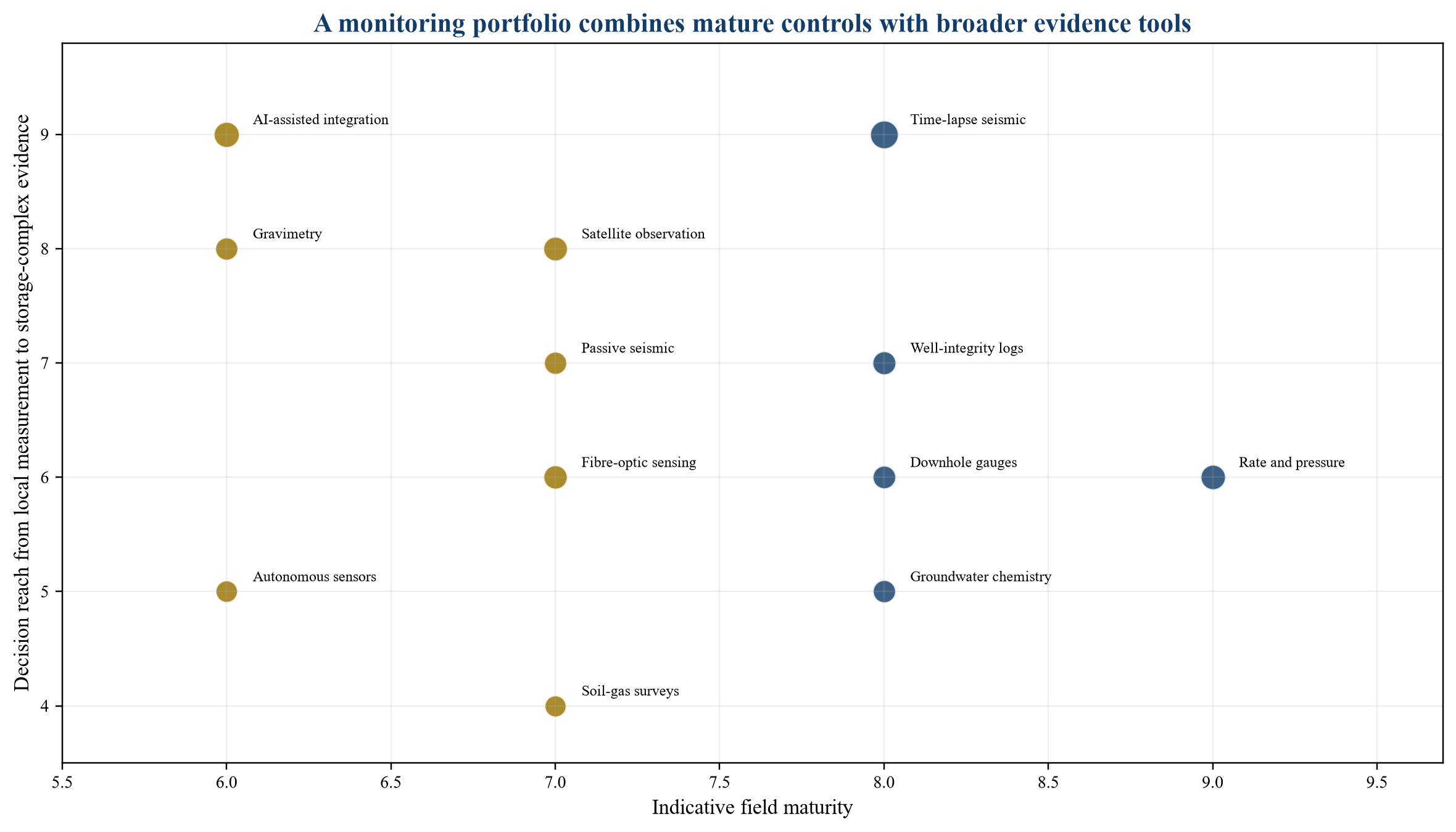
Qualitative classification. Actual readiness, cost, detection capability and regulatory acceptance are site and jurisdiction specific.
11. Baseline quality determines future proof
An anomaly can be interpreted only against a credible baseline. Baseline work should document natural pressure, fluid chemistry, seismicity, soil-gas variability, groundwater condition, existing wells and other potential migration pathways. It should also define data quality, calibration, custody and retention. Weak baseline evidence can make a benign variation appear material or make a real change difficult to prove.
The financing model should include baseline cost before injection and preserve the data for the whole liability period. A sale, refinancing or operator change should not fragment access. Data licences, cloud systems, proprietary processing and contractor termination rights require diligence because loss of the analysis chain can impair regulatory evidence even when raw data still exist.
12. Models must be updated rather than defended
Reservoir models forecast plume and pressure behaviour, support area-of-review boundaries and help design monitoring. They are decision tools under uncertainty. As operating data arrive, the model should be calibrated, challenged and updated. A material divergence between observed and modelled behaviour can alter monitoring, corrective action, financial security and transfer timing.
Governance should reward early identification of divergence. A contractual regime that treats every model update as operator failure can encourage defensive reporting. The permit and financing documents should distinguish normal model refinement from evidence of loss of containment. Independent technical review, documented assumptions and version control support both learning and accountability.
13. Wells are the principal engineered pathways
Active, monitoring and legacy wells can provide pathways for fluid migration. Cement condition, casing integrity, abandonment quality and pressure history influence risk. The area of review may contain old wells with incomplete records. Corrective action can include re-entering, testing, repairing or plugging those wells before or during injection.
Well obligations should be mapped individually. The operator needs access rights, records, intervention capability and cost estimates. A reserve based only on the project's new injection wells can omit the most uncertain pathways. Lenders should review the corrective-action plan, ownership of third-party wells, access arrangements and the legal ability to perform work on them.
14. Pressure management can be a remediation tool
Leakage response is only one form of remediation. Pressure management can reduce migration risk, protect caprock integrity and control plume movement. Options can include reducing or stopping injection, redistributing volumes among wells, producing formation water where permitted, or using alternative injection zones. Each option has technical, environmental and commercial consequences.
Contracts should define who can curtail injection, how affected users are treated and who pays. An emergency action that protects containment may reduce network revenue and trigger emitter losses. The storage operator needs operational discretion, while users and lenders need transparent thresholds, reporting and compensation rules. Safety and containment decisions should remain technically led.
15. Remediation must follow the pathway
The IPCC identifies remediation options for leakage associated with wells, faults, shallow groundwater, soil, surface water and indoor air [10]. Well leakage may be addressed through re-completion, repair or plugging. Reservoir or caprock concerns can require pressure management and injection changes. Shallow impacts can require extraction, treatment, ventilation, containment or environmental restoration.
A generic emergency plan cannot price these actions accurately. The project should identify credible pathways, response stages, equipment, contractors, access rights, public communication and regulatory approvals. Cost estimates should include diagnosis, mobilisation, intervention, monitoring after intervention, business interruption and carbon-market consequences. The first response objective is protection of people and the environment; the financial architecture should make rapid action possible.
16. The cost benchmark must be scenario based
Closure costs are driven by site design and events. Routine post-injection monitoring may be predictable, while corrective action is low-frequency and potentially severe. The table illustrates how a model can separate base activity from event-driven exposure. Values are hypothetical and omit tax, inflation, insurance recoveries and financing cost.
Table 1. Hypothetical post-injection monitoring and remediation cost benchmark
| Cost category | Base programme | Moderate deviation case | Major remediation case | Primary driver | Funding observation |
|---|---|---|---|---|---|
| Routine monitoring and reporting | 2.0 units per year for 20 years | 3.0 units per year for 30 years | 4.0 units per year for 50 years | Duration, technology mix and reporting | Ring-fenced funded reserve |
| Well plugging and site restoration | 24 units | 32 units | 48 units | Number, depth, condition and offshore logistics | Dedicated closure provision |
| Additional characterisation | 4 units | 12 units | 25 units | Model divergence and data gaps | Contingency reserve |
| Corrective intervention | 0 units | 18 units | 85 units | Pathway, mobilisation and technical remedy | Insurance plus liquidity backstop |
| Allowance or credit reversal exposure | 0 units | 10 units | 60 units | Leakage volume and carbon price | Separate market-risk scenario |
| Transfer contribution | 12 units | 22 units | 45 units | Expected public monitoring and remedy cost | Payable at transfer milestone |
Illustrative nominal amounts only. Currency units and cost ranges are hypothetical decision tools, not estimates for any project.
17. Duration dominates the base case
Small annual monitoring costs compound when transfer is delayed. A ten-year extension affects contractor cost, data systems, regulator engagement, insurance renewal and corporate administration. It can also trap security and prevent final distribution. The model should therefore vary duration independently from remediation severity.
The duration case should reflect evidence thresholds rather than arbitrary dates. Persistent pressure, unexpected plume movement, disputed data or a regulator's request for additional monitoring can extend the period. Sponsors need a liquidity plan that remains credible after project cash flow ends. A nominal reserve without a mechanism to replenish it can be exhausted by a long but uneventful tail.
18. Carbon price creates a second tail
Leakage can create obligations under emissions-trading or carbon-credit rules. The amount depends on measured or estimated leakage, the applicable carbon price, contractual allocation and the treatment of stored tonnes. A storage project can therefore face a market-linked liability alongside physical remediation cost.
The two exposures should be modelled separately. A small leak might be inexpensive to repair yet create a large allowance obligation if many tonnes are deemed released. A difficult intervention may cost more than the carbon liability. Hedging, reserve design and insurance respond differently to these risks. Contract definitions must align the physical evidence, carbon accounting and payment trigger.
19. Security instruments solve different problems
Trust funds, escrow accounts, letters of credit, surety bonds, insurance, corporate guarantees and financial tests can support closure obligations. EPA guidance evaluates instruments against the timing and uncertainty of Class VI activities [7]. A fully funded trust provides strong availability but can tie up capital. A letter of credit depends on bank capacity and renewal. Insurance can transfer defined event risk but may exclude gradual pollution, known conditions or regulatory change.
A portfolio is often stronger than one instrument. Routine closure and monitoring can be pre-funded; contingent remediation can use insurance and sponsor support; short-term liquidity can be covered by an on-demand facility. The documents should address renewal, downgrade, replacement, draw conditions, insolvency and control of proceeds.
20. Financial security must track risk
Regulators may require periodic adjustment of financial security as leakage risk and estimated obligations change [1]. A project should incorporate this review into its base model. An increase near the end of injection can reduce distributions or create a funding call when operating revenue is declining.
The security formula should use current cost estimates, planned activities, monitoring duration and event contingencies. Governance should define who prepares estimates, who independently reviews them and how disputes are resolved. A reserve release should require evidence that the related obligation has been performed or transferred. Book accounting provisions do not by themselves provide cash or creditor protection.
21. Insurance cannot replace operating capability
Insurance is useful for sudden pollution, control-of-well, third-party damage, professional liability and business interruption, subject to wording. It cannot guarantee that a competent operator, data set, vessel, rig or remediation contractor will be available. Claims can be disputed, capped, excluded or delayed.
The insured and regulatory obligations must be mapped line by line. Policy period, retroactive date, claims-made terms, discovery period, pollution exclusions, gradual leakage, fines and penalties, carbon-credit loss and government-action exclusions deserve particular attention. Tail cover should match the legal duration, and the project needs liquidity to act before a claim is settled.
22. Corporate guarantees weaken over time
A sponsor guarantee may appear strong at financial close and become weaker after asset sales, distributions, restructuring or commodity downturns. The guarantor may not exist when post-closure work is required. A guarantee also concentrates exposure across a sponsor's portfolio of sites.
Credit support should therefore include maintenance tests, reporting, transfer restrictions and replacement triggers. Ring-fenced cash and third-party instruments reduce dependence on future corporate strength. Sponsors should model the guarantee as contingent credit exposure and price its capacity. Buyers should diligence surviving obligations before acquiring or disposing of the operator.
23. Insolvency planning is part of environmental protection
The storage operator may become insolvent during injection or after closure. The permit, data, monitoring contracts, access rights and financial security must remain usable. An insolvency practitioner may seek to terminate uneconomic contracts or sell assets, while the regulator needs continuity of safety-critical functions.
Project structure should isolate required funds and give the appropriate authority rights to draw security. Critical licences, software and data should be transferable or accessible. Step-in arrangements should identify a capable replacement operator. Lenders need clarity on which obligations rank ahead of debt and whether enforcement can proceed without disrupting containment and monitoring.
24. Data custody is a bankability issue
Monitoring evidence may span decades, multiple contractors and changing software. Raw data, processed outputs, models, assumptions, calibration records, chain-of-custody evidence and regulator correspondence all matter. A future authority or replacement operator must be able to understand the site's history.
Contracts should provide durable rights to data and processing methods, including on contractor insolvency or termination. Open formats, documented workflows, cyber controls and migration plans reduce dependence on one vendor. The information-management plan should specify retention, authentication, access and handover. Data loss can delay transfer even when the geology is performing well.
25. AI can integrate evidence but needs controls
Machine-learning tools can screen seismic data, identify anomalies, integrate sensor streams and prioritise review. They may lower processing time and help detect subtle changes. Their outputs depend on training data, model drift, false positives, explainability and the quality of underlying measurements.
Regulatory evidence should remain traceable to validated data and documented methods. Human technical judgment and independent review remain necessary for consequential decisions. Procurement should require model versioning, performance testing, audit logs, cybersecurity and access to sufficient documentation. An opaque vendor score should not become the sole trigger for remediation or transfer.
26. A scenario valuation reveals the tail
The figure illustrates the present-value effect of monitoring duration and a contingent remediation event. It uses hypothetical cash flows: annual monitoring cost of 2 units, a transfer contribution of 12 units, and a remediation event with 25 percent probability and 60-unit cost. Discounting does not remove the need for liquidity or regulatory security.
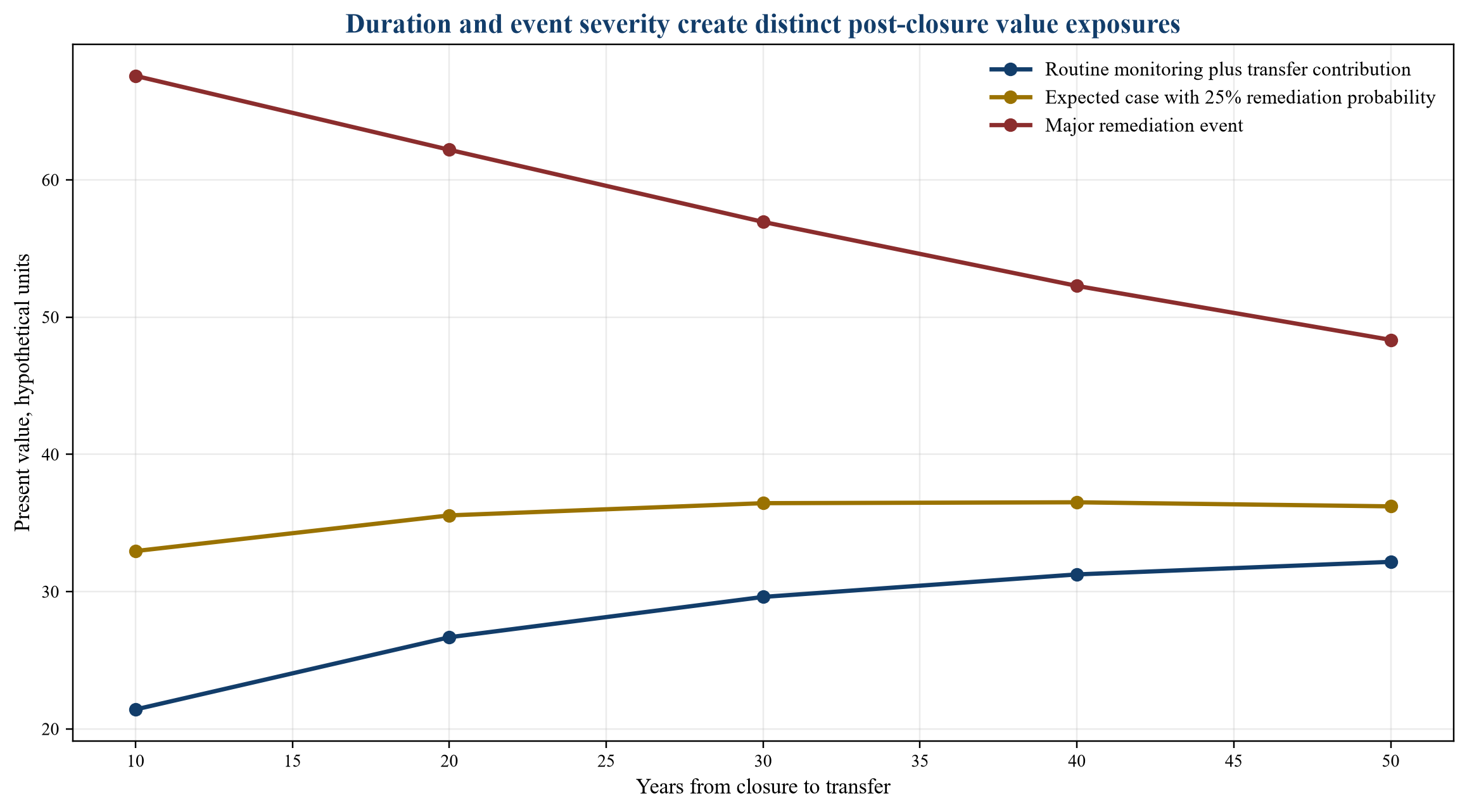
Illustrative assumptions only. Values are not forecasts, reserve estimates, engineering costs or valuations for any project.
27. Discount rates cannot fund obligations
Financial models often discount distant closure costs heavily. Regulators may require nominal or current-cost security because the duty must be performed regardless of sponsor return thresholds. A low present value in an equity model can coexist with a large future cash requirement.
The model should show at least three views: accounting provision, economic present value and funded nominal requirement. Differences should be reconciled. Inflation, offshore mobilisation, scarce specialist capacity and changing standards can increase real cost. Reserve assets should be matched to the timing, currency and liquidity of obligations rather than invested solely to maximise return.
28. Debt sizing should recognise trapped cash
Lenders usually require closure and decommissioning reserves, distribution tests and security-maintenance covenants. These protections reduce credit risk but affect equity value. A project may generate operating cash that cannot be distributed because post-closure security is underfunded or transfer is delayed.
Debt sizing should include reserve build-up, security fees, insurance renewal and downside monitoring duration. The base case should not assume immediate release at maturity. Refinancing lenders will examine remaining life, evidence quality and regulatory trajectory. Tail obligations can shorten effective debt tenor even when the physical asset has a long operating life.
29. Contracts must allocate cross-chain leakage claims
An off-specification CO₂ stream can contribute to corrosion, phase instability or storage performance concerns. A transport failure can affect custody and measurement. A storage anomaly may interrupt emitters and create carbon-market losses. Causation can be disputed across the chain.
Contracts should align specifications, sampling, custody transfer, measurement, notification, investigation and dispute resolution. Liability caps and exclusions should not leave mandatory remediation unfunded. The storage operator needs immediate response authority, while contractual allocation can follow after safety is secured. Common expert determination procedures can reduce inconsistent findings across agreements.
30. M&A diligence needs a liability ledger
Acquiring a storage operator or project interest requires more than reviewing the permit. The buyer should assemble a ledger of obligations, responsible entities, security instruments, cost estimates, data rights, claims, regulator correspondence and transfer conditions. Historical model deviations, well interventions and monitoring gaps deserve focused review.
Transaction documents can use specific indemnities, escrow, price adjustment, warranty insurance and continuing access to technical personnel. Broad environmental warranties may not capture carbon-market or transfer-delay exposure. The buyer should confirm whether the licence, permit and financial security can transfer and whether regulatory consent creates timing or execution risk.
31. Joint ventures need durable decision rights
Carbon storage projects often involve several sponsors. Joint-venture agreements should address monitoring budgets, reserve calls, remediation decisions, insurance, operator replacement, data disclosure and transfer applications. Minority investors may face uncapped funding calls for mandatory obligations.
Reserved matters should avoid paralysing urgent response. The operator needs authority to comply with permits and protect containment. Non-defaulting partners need remedies when another partner fails to fund. Parent support, dilution, default loans or security enforcement should be consistent with regulatory requirements. Governance should survive the operating phase and remain effective during closure.
32. Public transfer needs a credible contribution
A post-transfer financial contribution seeks to prevent future monitoring and remediation cost from becoming an unfunded public burden. The amount should reflect expected activity, uncertainty and the state's delivery model. It should not be treated as a simple fee for release.
The methodology should be transparent enough for investors to model and flexible enough to incorporate site evidence. Disputes over the contribution can delay transfer. Early regulatory dialogue, periodic estimates and an agreed data package reduce surprise. Public authorities also need institutional capability, records and procurement routes to perform the obligations they accept.
33. Monitoring services have a commercialisation pathway
The market for post-injection services includes sensors, seismic acquisition, well integrity, geochemistry, data platforms, modelling, assurance and remediation. Commercial growth depends on repeatable specifications, regulator acceptance, interoperability and long-term service support. Project-specific innovation must be converted into auditable products.
Providers should map each service to a regulatory decision and measurable performance criterion. Subscription analytics may support routine screening, while field campaigns remain milestone based. Long warranties and data continuity matter. A provider that cannot support software or calibrate equipment over the liability period creates replacement risk for the operator.
Table 3. Commercialisation roadmap for post-injection monitoring and remediation services
| Stage | Customer decision | Evidence product | Commercial model | Principal adoption risk |
|---|---|---|---|---|
| Site characterisation | Is the site suitable and what baseline is required? | Baseline data, conceptual model and risk register | Defined field campaign and technical study | Incomplete coverage or non-comparable data |
| Injection operations | Is observed performance within the approved envelope? | Integrated dashboard, calibrated model and exception report | Multi-year monitoring service with periodic campaigns | Vendor lock-in and inconsistent data custody |
| Closure preparation | Can wells be plugged and monitoring reduced safely? | Closure evidence pack, integrity verification and updated cost estimate | Milestone contract with independent assurance | Unresolved model divergence or regulator evidence gap |
| Post-injection care | Is the plume stable and are thresholds satisfied? | Long-duration surveillance, anomaly triage and annual report | Availability-based service with escalation schedule | Technology obsolescence and contractor continuity |
| Transfer application | Are legal, technical and financial conditions complete? | Auditable transfer dossier and records handover | Fixed-scope assurance and transaction support | Authority requests additional evidence or time |
| Post-transfer stewardship | Can the authority observe and intervene efficiently? | Public-sector data platform, periodic monitoring and call-off remediation | Long-term framework agreement | Unfunded procurement or loss of specialist capacity |
Generic roadmap. Market timing, procurement method and regulatory acceptance vary by jurisdiction and storage project.
34. Procurement should pay for evidence quality
Lowest-cost procurement can undermine the closure case if data are inconsistent, methods change without control or vendors retain critical intellectual property. Evaluation should consider detection performance, repeatability, calibration, data access, interoperability, cyber resilience, field support and regulator familiarity.
Framework agreements can preserve competition while maintaining standards. Performance incentives should reward usable evidence and timely escalation rather than a low number of reported anomalies. Independent assurance should test the monitoring system, not simply confirm that reports were delivered. The project needs rights to transition providers without losing continuity.
35. A risk-allocation matrix supports investment decisions
Table 2. Post-closure liability and financing allocation matrix
| Risk | Evidence required | Primary control | Financial protection | Board question |
|---|---|---|---|---|
| Containment divergence | Calibrated model, pressure and plume evidence | Monitoring escalation and injection response | Contingency reserve and insurance | What observation changes the plan? |
| Legacy well pathway | Well inventory, condition and access rights | Corrective action before and after injection | Dedicated well reserve | Can every material well be accessed and repaired? |
| Transfer delay | Regulator feedback and evidence-gap register | Milestone-based closure programme | Duration reserve and distribution lock | How many additional years remain fundable? |
| Major remediation | Pathway-specific response plan | Emergency authority and contractor readiness | Insurance, liquidity and sponsor backstop | Can action begin before claims are paid? |
| Carbon-price exposure | Leakage accounting and price scenarios | Measurement and contractual allocation | Separate market-risk reserve | Is allowance exposure capped or hedged? |
| Operator insolvency | Licence, security, data and step-in review | Replacement-operator plan | Ring-fenced security | Who can legally and technically take control? |
| Data loss or vendor failure | Data inventory, licences and migration test | Open formats and redundant custody | Service continuity reserve | Can evidence be reproduced without the vendor? |
| Regulatory change | Permit and policy monitoring | Change-control governance | Headroom and reopening mechanisms | Who funds newly required work? |
Generic diligence framework. Applicable obligations and protections require project-specific legal, technical, insurance and tax advice.
36. A closure plan should be a controlled document
The closure and post-closure plan should evolve with operating evidence. It needs defined owners, version control, regulatory approvals, cost estimates, monitoring methods, trigger levels, remediation options and handover requirements. Changes should flow into the financial model and security calculation.
Board reporting should identify unresolved assumptions and leading indicators. A plan that is updated only near cessation of injection can reveal unaffordable obligations too late. Annual integration of technical, legal and financial views creates a disciplined path to transfer. Independent review should increase as closure approaches.
37. Regulators need comparable evidence
Authorities will review projects with different geology, operators and monitoring systems. Common data standards and transparent transfer criteria can reduce delay while preserving site-specific judgment. ISO 27914:2026 provides an integrated lifecycle framework for geological storage, including risk management, monitoring, quantification, closure and post-injection activity [9].
Comparable evidence does not mean identical monitoring programmes. The regulator should require a reasoned link from site risk to method and threshold. Public registers can improve confidence and learning while protecting genuinely sensitive information. Clear expectations also help investors price the tail and monitoring providers develop reliable products.
38. Communities need continuity after operations
Local stakeholders may remain concerned after visible operations end. Closure communications should explain monitoring, reporting, emergency contacts, public data and responsibility. A corporate exit without a clear successor can undermine trust even when technical performance is strong.
Community engagement should be included in the post-closure budget and governance plan. Reports need plain-language interpretation alongside technical data. Complaint and incident channels should remain active. The party accepting responsibility needs the capability to respond to local concerns and demonstrate that monitoring remains meaningful.
39. A twelve-gate roadmap makes transfer executable
The first gate confirms the legal liability map. The second establishes baseline evidence. The third validates the reservoir and well model. The fourth defines monitoring decisions and thresholds. The fifth prices routine closure activity. The sixth models event-driven remediation. The seventh selects security instruments. The eighth secures data continuity and step-in capability.
The ninth aligns cross-chain contracts and carbon accounting. The tenth agrees regulatory milestones and the indicative transfer contribution. The eleventh tests sale, insolvency and operator-replacement scenarios. The twelfth authorises a transfer application only when technical evidence, funding and records are complete. Each gate should have an accountable owner, evidence file and board decision.
40. Conclusion
Post-closure liability is a financeable risk only when it is decomposed. Monitoring, plugging, corrective action, environmental remediation, carbon-market obligations, records custody and public transfer have different triggers and durations. A single accounting provision cannot represent them.
The strongest structure begins before injection. Site-specific evidence defines the monitoring plan; the monitoring plan informs cost and security; security remains available through closure; data and operating capability survive corporate change; and transfer is valued as a conditional regulatory milestone. Technology reduces uncertainty when it is tied to decisions, thresholds and action.
Sponsors, lenders and authorities should treat the tail as a continuing operating phase. The central investment test is whether the project can observe, decide, intervene and pay after revenue ends. A storage site is ready for transfer when containment evidence is persuasive, responsibilities are legally clear, funds are available, records are complete and a capable institution can manage the remaining obligations.
References
- European Union. Directive 2009/31/EC on the Geological Storage of Carbon Dioxide, Articles 17 to 20. 2009, consolidated text. https://eur-lex.europa.eu/legal-content/EN/TXT/?uri=CELEX:32009L0031
- United Kingdom. Energy Act 2008, Part 1 Chapter 3. https://www.legislation.gov.uk/ukpga/2008/32/part/1/chapter/3
- United Kingdom. Storage of Carbon Dioxide (Licensing etc.) Regulations 2010. https://www.legislation.gov.uk/uksi/2010/2221/contents
- United Kingdom. Storage of Carbon Dioxide (Termination of Licences) Regulations 2011. https://www.legislation.gov.uk/uksi/2011/1483/contents
- Government of Norway. Longship Carbon Capture and Storage, transfer of responsibility and financial security. 2020. https://www.regjeringen.no/en/documents/meld.-st.-33-20192020/id2765361/?ch=5
- United States Environmental Protection Agency. Class VI Wells Used for Geologic Sequestration of Carbon Dioxide. Accessed 29 September 2026. https://www.epa.gov/uic/class-vi-wells-used-geologic-sequestration-carbon-dioxide
- United States Environmental Protection Agency. Underground Injection Control Program Class VI Financial Responsibility Guidance. 2011. https://nepis.epa.gov/Exe/ZyPURL.cgi?Dockey=P100MQ6F.TXT
- United States Environmental Protection Agency. Class VI Well Plugging, Post-Injection Site Care, and Site Closure Guidance. 2016. https://www.epa.gov/sites/default/files/2016-12/documents/uic_program_class_vi_well_plugging_post-injection_site_care_and_site_closure_guidance.pdf
- International Organization for Standardization. ISO 27914:2026, Carbon Dioxide Capture, Transportation and Storage: Geological Storage. 2026. https://www.iso.org/standard/27914.html
- Intergovernmental Panel on Climate Change. Special Report on Carbon Dioxide Capture and Storage, Chapter 5. 2005. https://www.ipcc.ch/site/assets/uploads/2018/03/srccs_chapter5-1.pdf
- United States Department of Energy, National Energy Technology Laboratory. Monitoring, Verification, and Accounting of CO₂ Stored in Deep Geologic Formations. https://www.energy.gov/hgeo/articles/doe-releases-report-techniques-ensure-safe-effective-geologic-carbon-sequestration
- United States Department of Energy. Carbon Storage Systems and Well Management Activities Best Practices Manual. https://www.energy.gov/hgeo/articles/new-doe-best-practices-manual-features-top-strategies-carbon-storage-wells
- United Kingdom Department for Energy Security and Net Zero. Energy Security Bill Factsheet: Retention, Reporting and Disclosure of Carbon Dioxide Storage Information and Samples. 2023. https://www.gov.uk/government/publications/energy-security-bill-factsheets/energy-security-bill-factsheet-retention-reporting-and-disclosure-of-carbon-dioxide-storage-information-and-samples
- North Sea Transition Authority. Carbon Storage Licensing and Regulation Responsibilities, Review 2025. https://www.gov.uk/government/publications/north-sea-transition-authority-oil-and-gas-authority-review-2025/north-sea-transition-authority-oil-and-gas-authority-review-2025-accessible-webpage
- International Energy Agency. CCUS in Clean Energy Transitions, Accelerating Deployment. 2020. https://www.iea.org/reports/ccus-in-clean-energy-transitions/accelerating-deployment
- United Kingdom. Energy Act 2023, Carbon Dioxide Transport and Storage Provisions. https://www.legislation.gov.uk/ukpga/2023/52/contents
- Ofgem. How We Regulate Carbon Dioxide Transport and Storage Networks. Accessed 29 September 2026. https://www.ofgem.gov.uk/energy-regulation/low-carbon/carbon-capture-and-storage/how-we-regulate-carbon-dioxide-transport-and-storage-networks
- United Kingdom Department for Energy Security and Net Zero. Carbon Capture, Usage and Storage: A Vision to Establish a Competitive Market. 2023. https://www.gov.uk/government/publications/carbon-capture-usage-and-storage-a-vision-to-establish-a-competitive-market/carbon-capture-usage-and-storage-a-vision-to-establish-a-competitive-market
- United States Environmental Protection Agency. EPA Issues First Underground Injection Permits for Carbon Sequestration in California. 2025. https://www.epa.gov/newsreleases/epa-issues-first-ever-underground-injection-permits-carbon-sequestration-california
- United States Department of Energy Loan Programs Office. Environmental Impacts and Compliance Best Practices for Carbon Capture and Sequestration. 2021. https://www.energy.gov/edf/articles/lpo-report-examines-environmental-impacts-and-compliance-best-practices-carbon-capture
About the Author
Chennakeshav (CK) is a corporate finance and investment banking executive with 25+ years of global experience in deal origination, structuring and execution across M&A, growth capital and corporate strategy. He has led value-creation mandates for founders, corporates and funds — bridging the boardroom view to hands-on execution and close.
His career spans Morgan Stanley, HSBC, Lloyds Banking Group, EWEC, ADQ portfolio companies and Emirates Growth Fund, across TMT, real estate, fintech, deeptech, cleantech, infrastructure and energy. He has partnered with C-suite leaders, private equity and venture funds, sovereign wealth funds and family offices to finance complex fund raises and scale-up ventures, and has led M&A due diligence, post-merger integration and business-transformation initiatives to create value.
At Matchpoint Partners he is Managing Partner, leading the firm's corporate finance, M&A and capital-raising practice. He holds an MBA from London Business School, an engineering degree from VTU and a Master of Laws (LLM, in progress) from UCL London.
An active start-up mentor, CK mentors at Techstars, DIFC FinTech Hive, Startup Grind, Founder Institute and IN5, serves as Entrepreneur Mentor in Residence (EMiR) at London Business School, and judges the Entrepreneurship World Cup.
LinkedIn: https://www.linkedin.com/in/ckadya/
Profile: https://www.matchpoint-partners.com/team/ck-adya.html
