

1. The network must be financeable before it is full
Carbon capture projects depend on a complete chain. Carbon dioxide must be captured, conditioned, metered, transported, received, injected and monitored under contracts that allocate performance and liability. The transport network often requires the largest common investment before all intended users have reached final investment decision. That timing mismatch creates the core financing problem.
A pipeline or shipping system designed only for contracted first movers may become expensive to expand. A network sized for future demand can begin operations with low utilisation and weak cash coverage. The tariff must reconcile these objectives. It should recover prudent cost, permit investable returns, preserve incentives for efficient delivery and provide potential users with fair access.
This paper calls the tariff the carbon toll because it is the price paid to move and store a tonne of CO₂ through shared infrastructure. The analogy is incomplete: CO₂ transport has strict composition, pressure, custody-transfer and liability requirements, and the value chain fails when any linked asset is unavailable. Financeability therefore depends on more than a price per tonne.
2. Shared infrastructure creates a coordination problem
An industrial emitter will not invest in capture equipment without confidence that transport and storage will be available on the planned start date. A network developer will not build full-scale infrastructure without confidence that emitters will deliver sufficient volumes. A storage operator needs injection profiles, quality data and long-term liability arrangements. Each party can rationally wait for the others.
The International Energy Agency describes CCUS hubs as connected systems with cross-chain risks and complex contractual relationships [1]. A delay at a capture plant reduces network revenue. A pipeline outage can stop several emitters. Poor reservoir injectivity can constrain the entire cluster. These risks are correlated rather than diversified.
Public policy often responds with grants, tax credits, regulated revenue, concessional debt or revenue support. Those tools can accelerate investment, but they do not replace commercial discipline. The network still needs a defensible capacity plan, executable connection programme, bankable user contracts and a tariff method that behaves predictably through ramp-up, expansion and distress.
3. A natural monopoly requires economic rules
Large CO₂ pipelines and common terminals have high fixed cost and low short-run marginal cost. Parallel competing networks may be inefficient in a cluster. The owner can therefore acquire bargaining power after users invest in capture assets that have few alternative routes. A credible access regime protects users from discriminatory pricing and protects investors from politically driven tariff resets.
The European Union's CCS Directive requires transparent and non-discriminatory access to transport networks and storage sites. Member States may consider available capacity, technical compatibility and the reasonable needs of owners and other users. Operators may refuse access for lack of capacity, but reasons must be substantiated; economic expansion may be required where a customer is willing to pay [2].
These principles create a regulatory boundary rather than a complete tariff. Financeability still depends on how cost is allocated, how capacity is booked, who pays for reinforcement, how disputes are settled and whether future access changes the economics negotiated by first movers.
4. The tariff is a capital-allocation mechanism
A tariff decides who funds the network and when. A high entry charge can reduce public support but deter emitters. A low early tariff can accelerate capture projects but leave the network underfunded. A uniform postage-stamp tariff can socialise distance and complexity. A route-specific tariff can reflect causation but fragment the market.
The design should begin with the efficient cost base, depreciation profile, financing structure, operating cost, decommissioning obligations and allowed or contracted return. The revenue requirement must then be allocated among capacity reservation, actual throughput, storage service, connection and ancillary services. Each component places risk on a different party.
A capacity charge improves fixed-cost recovery and encourages users to book realistic volumes. A throughput charge aligns payment with actual service and may be easier for emitters during ramp-up. An availability charge can preserve revenue when the user fails to deliver but should fall when the network is unavailable. A balanced structure makes these incentives explicit.
5. The complete contract map determines bankability
The figure shows the contracts and public rules that convert network assets into debt-service cash flow. A tariff agreement by itself is insufficient because revenue also depends on capture performance, storage availability, quality compliance, metering and public support.
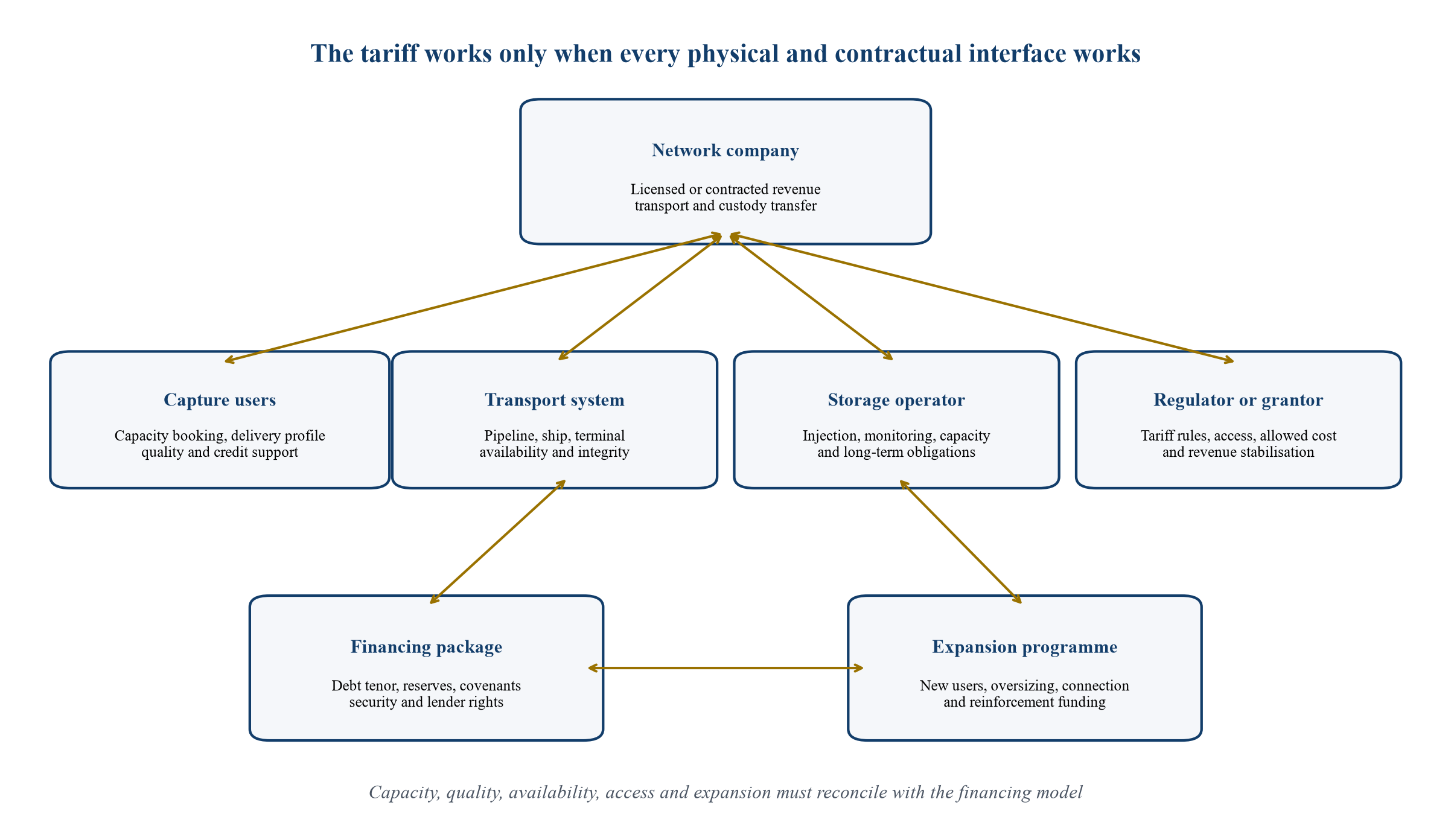
Generic transaction map. Actual roles, licences, security and liability vary by jurisdiction and project.
6. Europe has an access principle and an emerging market design
The EU CCS Directive establishes fair, open and non-discriminatory access, with independent dispute settlement [2]. The European Commission's 2024 Industrial Carbon Management strategy recognised that transport infrastructure is essential to a single CO₂ market and identified the need for a legislative initiative supporting competitive markets and infrastructure [3].
The Net-Zero Industry Act added a legally binding target of 50 million tonnes of annual injection capacity in the EU by 2030 and obligations for relevant oil and gas producers to contribute to storage development [4]. The policy direction increases the need for interoperable networks, common specifications and cross-border rules.
The Joint Research Centre estimated that a European network could reach 6,700 to 7,300 kilometres by 2030 and 15,000 to 19,000 kilometres by 2050, with investment needs ranging from approximately EUR 6.5 billion to EUR 19.5 billion by 2030 and EUR 9.3 billion to EUR 23.1 billion by 2050 [5]. The ranges demonstrate how storage location, sequencing and network planning affect capital requirements.
7. The United Kingdom uses an allowed-revenue model
The Energy Act 2023 created an economic licensing framework for CO₂ transport and storage in the United Kingdom [6]. A licensed transport and storage company can recover allowed revenue reflecting efficient costs and a reasonable return. Ofgem regulates the networks, protects current and future users, and considers the financeability of licensed activities [7].
The model recognises that first-of-a-kind networks cannot rely on mature utilisation. Government materials provide for risk-mitigation mechanisms and a revenue support agreement where user-funded mechanisms do not close an allowed-revenue shortfall [8]. Regulations adopted in 2024 enable the Secretary of State to direct an eligible counterparty to offer a revenue support contract [9].
Ofgem's price-control handbook and financial guidance define how the regulatory asset value and annual allowed revenue are calculated for relevant licensees [10][11]. For lenders, this produces a more predictable revenue framework than a purely merchant tariff. Regulatory reopening, efficiency assessment, reporting, user default and support-trigger rules remain material diligence items.
8. Four tariff architectures allocate risk differently
Table 1. Comparison of CO₂ network tariff architectures
| Architecture | Fixed-cost recovery | User exposure | Network exposure | Access effect | Financing observation |
|---|---|---|---|---|---|
| Capacity or ship-or-pay charge | Strong when bookings are creditworthy | Pays for reserved capacity even if unused | Lower volume risk; retains user credit risk | Can reserve scarce capacity and raise entry barriers | Bankable with long-tenor commitments and cure rights |
| Throughput charge per tonne | Weak during ramp-up | Pays only for delivered compliant volume | High utilisation and capture-performance risk | Flexible for entrants; may underfund oversized assets | Needs floor, support or conservative leverage |
| Regulated allowed revenue | Cost recovery set through licence and price control | Charges allocated under regulated methodology | Regulatory, efficiency and timing risk | Strong basis for non-discriminatory access | Supports infrastructure-style debt when regime is durable |
| Blended capacity, throughput and support | Fixed and variable cost allocated separately | Balanced booking and operating incentives | Residual ramp-up risk can be supported | Can reserve capacity while preserving expansion rules | Often practical for first-wave shared networks |
Generic comparison. Legal obligations and commercial effects depend on the applicable licence, access regime and network contract.
9. The United States combines common-carrier concepts and public finance
The United States has extensive experience with CO₂ pipelines, historically connected to enhanced oil recovery. New carbon-management networks require broader sources, storage destinations and community engagement. The Department of Energy's Carbon Dioxide Transportation Infrastructure Finance and Innovation programme supports large-capacity common-carrier infrastructure with direct loans, loan guarantees and grants [12].
CIFIA eligibility and underwriting require demonstrated demand, a tariff method applied in a non-discriminatory manner, forecast utilisation and evidence that federal assistance improves timing or lifecycle cost [13]. Future Growth Grants are designed to help finance capacity that exceeds current contracted volumes, directly addressing the oversizing problem [14].
This model separates base-project finance from public funding for future capacity. It preserves commercial demand testing while recognising that a private sponsor may be unable to fund socially useful spare capacity. The bankability test still turns on contracts, corridor rights, safety approval, construction risk, storage access and a defensible tariff.
10. Northern Lights demonstrates transport and storage as a service
Northern Lights developed a shipping, terminal, pipeline and offshore storage chain that offers CO₂ transport and storage as a service. Its first phase has capacity of 1.5 million tonnes per year, and the project announced expansion to more than 5 million tonnes per year by 2028 [15][16].
The service model is relevant for dispersed European emitters that cannot connect directly to a dedicated pipeline. Shipping allows capture projects to enter at different locations and volumes. The terminal creates aggregation and buffering, while the offshore system provides common injection infrastructure.
Commercial success depends on standardised specifications, scheduling, vessel availability, terminal capacity, storage performance and long-term service commitments. The service charge must recover several distinct assets and operating interfaces. A user needs clarity on delivery windows, off-specification treatment, title transfer, emissions accounting, delay and liability. Lenders need enough contracted volume and support to cover the integrated chain.
11. Efficient tariffs separate fixed and variable cost
Most network capital cost is incurred before a tonne moves. Pipeline, terminal, compression, wells, monitoring systems and control infrastructure create fixed or semi-fixed costs. Energy, consumables, ship fuel, injection activity and some maintenance vary with throughput. A tariff that treats every cost as volumetric can create severe revenue volatility.
A practical method separates a capacity component from a throughput component. The capacity charge recovers committed fixed cost and return. The throughput charge recovers variable transport and storage cost. Connection charges allocate user-specific facilities. Quality or ancillary charges recover conditioning, temporary storage, testing or exceptional handling.
The split should follow cost causation while preserving simplicity. Excessive tariff granularity can reduce transparency and make financing forecasts dependent on frequent reconciliation. Too little granularity can shift cost among users and invite disputes. The methodology should be specified before users commit to capture investments.
12. Utilisation is the dominant early-stage sensitivity
A network may be physically designed for future scale while debt service begins after construction. If the tariff is primarily volumetric, low initial utilisation increases the charge required per tonne. Raising the tariff can weaken capture-project economics and reduce demand further. This feedback loop can trap the network below efficient scale.
Lenders therefore test contracted utilisation, not announced capacity. They distinguish take-or-pay commitments from forecasts, letters of intent and policy targets. A user contract should define annual contract quantity, ramp-up, permitted outages, make-up rights, deficiency payments and termination.
The model should include delay by each anchor user, permanent loss of one user, capture underperformance, network outage, storage constraint and slower expansion. Revenue support can absorb part of ramp-up risk, but the trigger, duration and cap must be modelled. Equity should retain enough exposure to efficient customer acquisition and delivery.
13. Capacity reservation needs disciplined rules
Capacity booking gives users confidence that the network will be available. It can also create hoarding if an early user reserves more than it can use. Reservation rules should require credible project milestones, security and release of unused capacity. The operator needs discretion to manage physical constraints within transparent criteria.
A reservation agreement may progress from development capacity to firm operational capacity. Development capacity can expire if permits, financing or construction milestones are missed. Firm capacity should be backed by creditworthy ship-or-pay obligations or another revenue source. Transfer and secondary trading can improve utilisation if the network can verify compatibility.
The access regime should disclose available capacity, planned expansion and connection queues without revealing commercially sensitive information. A queue should not reward speculative applications that block financeable projects. Milestone-based allocation aligns access with delivery probability.
14. Quality specifications protect the common asset
CO₂ composition affects phase behaviour, corrosion, compression, metering, pipeline integrity and storage performance. Water, oxygen, nitrogen, sulphur compounds and other impurities can create technical risk. A shared network therefore needs a specification at each custody-transfer point.
The specification should align capture-plant design, transport envelope, terminal operations and storage permit. Users need measurement methods, sampling frequency, data access, tolerance bands and remedies. The operator needs rights to reject or condition off-specification CO₂. Rejection can shut a capture plant and undermine its support payments, so cure and temporary handling arrangements matter.
Quality rules should remain stable enough for capital investment while allowing safety-driven change. A change-control mechanism can allocate modification cost according to cause and system benefit. Lenders will test whether technical non-compliance can terminate the service contract or merely create a proportionate charge and correction period.
15. Debt coverage falls sharply when revenue is purely volumetric
The chart uses a hypothetical network to show how tariff architecture affects debt-service coverage during ramp-up. It is a decision model, not a forecast or representation of a particular project.
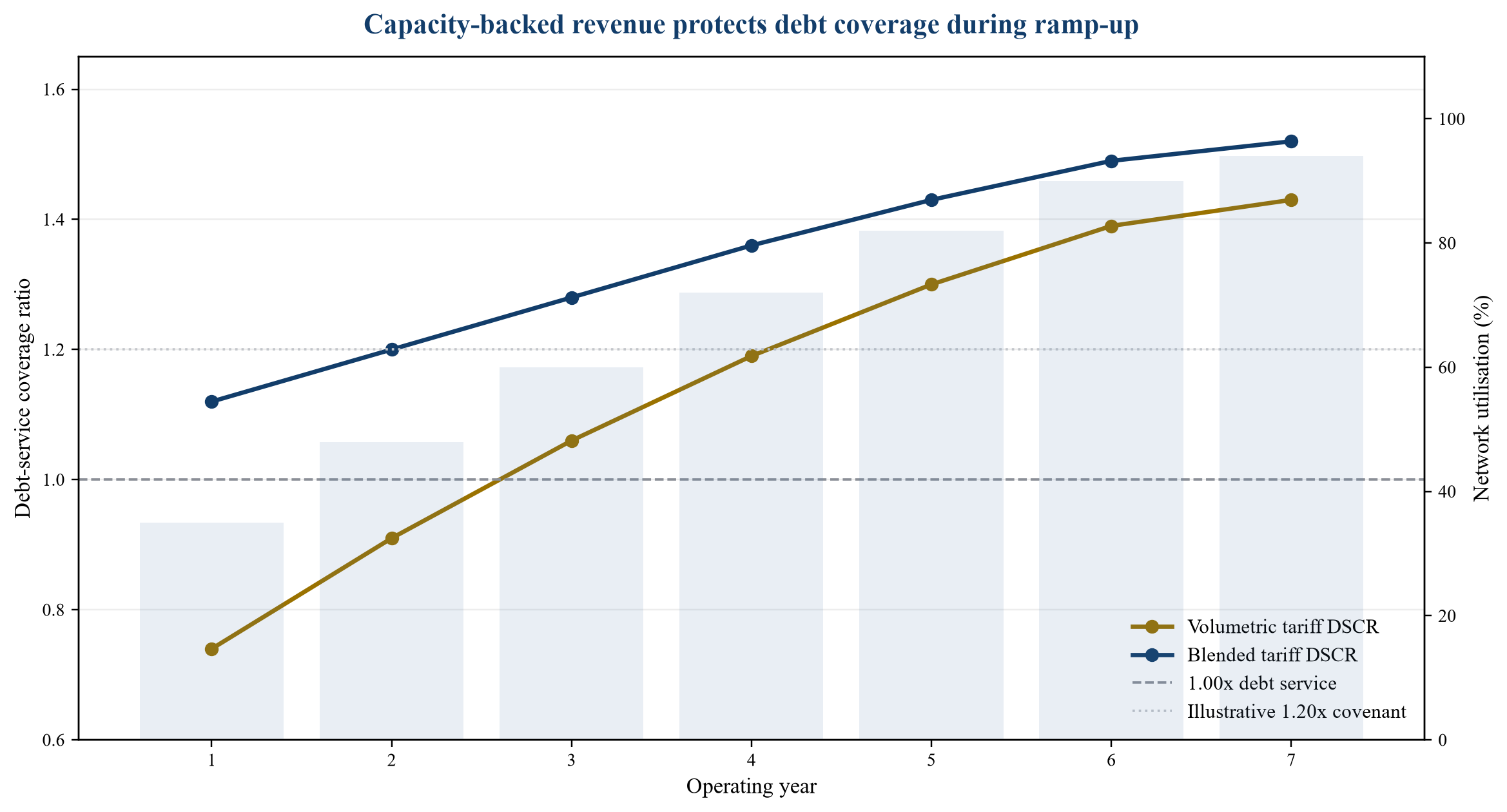
Illustrative assumptions only. Annual debt service is fixed at 100 units. The blended structure includes a capacity payment covering part of fixed cost; the volumetric structure depends only on delivered tonnes.
16. A hypothetical tariff model shows the allocation choices
The following example describes a network with 5 million tonnes of annual design capacity. It assumes a fixed annual revenue requirement, variable cost per delivered tonne and staged contracted volume. All values are hypothetical and are included to demonstrate method.
Table 2. Hypothetical capacity and tariff mechanics
| Item | Base assumption | Downside test | Financing relevance |
|---|---|---|---|
| Design capacity | 5.0 Mtpa | No change | Sets denominator and expansion headroom |
| Year 1 contracted capacity | 3.0 Mtpa | One 0.8 Mtpa user delayed | Determines capacity-charge base and concentration |
| Year 1 delivered volume | 2.2 Mt | 1.4 Mt | Drives throughput revenue and variable cost |
| Fixed annual revenue requirement | 240 units | 250 units after delay and remediation | Needs capacity or allowed-revenue recovery |
| Variable operating cost | 12 units per tonne equivalent | 15 units after energy escalation | Recovered through throughput component or indexation |
| Capacity charge recovery | 70% of fixed requirement | 80% during supported ramp-up | Stabilises debt coverage but raises user commitment |
| Throughput recovery | Variable cost plus 30% of fixed requirement | Lower tonnes increase per-tonne burden | Creates utilisation sensitivity |
| Revenue-support floor | 90% of approved revenue | Subject to defined trigger and cap | Protects first-wave ramp-up and debt service |
Illustrative values only. Currency units and tax effects are omitted. The example is not a forecast, bid, valuation or engineering estimate.
17. Anchor-user credit can matter more than total demand
A network with five prospective users can remain unfinanceable if none will sign long-term commitments. Conversely, one highly creditworthy anchor can support debt but create concentration risk. Credit analysis should cover the user, its parent, its capture project and any public support linked to the user's ability to pay tariffs.
Ship-or-pay obligations should survive ordinary capture underperformance and market weakness. Relief should apply where the network is unavailable or specified force majeure occurs. Parent guarantees, letters of credit, reserve accounts or termination payments can support obligations. Security must be sized to realistic replacement periods rather than a nominal number of months.
User default provisions should permit the network to preserve service to others. Cross-default and suspension rights require care because abrupt disconnection may damage the capture plant, support contract or industrial process. Lender cure rights on both sides can prevent value destruction.
18. Expansion economics require a published rule
Future users may benefit from infrastructure funded by first movers. If entry charges are too low, anchor users subsidise later entrants. If entry charges replicate historic cost without depreciation or system benefit, expansion may become uneconomic. The access regime needs a method for reinforcement and new-connection cost.
Options include shallow connection charges, deep charges, incremental-cost pricing, system-average tariffs and negotiated contributions. A regulated framework can socialise efficient reinforcement across users. A contractual network may use expansion tests tied to committed volume and minimum return.
The rule should address refunds or tariff reductions for first movers when later users join. It should also specify who funds oversizing. Public Future Growth Grants in the United States provide one example of supporting capacity above current contracted demand [14]. Transparent expansion economics reduce disputes and make spare capacity investable.
19. Cross-chain risk needs explicit relief and compensation
The network can be ready while storage is unavailable, or storage can be ready while an emitter is delayed. Contracts should distinguish operator-caused unavailability, user-caused deficiency, storage failure, shared infrastructure failure and government-caused delay. Each event should have clear payment, relief and termination consequences.
A chain coordination agreement can align definitions, notices, planned maintenance and force majeure across parties. Without alignment, the network may owe service credits to a user while receiving no relief from the storage operator. The financing model should trace each event through every contract.
Revenue support may cover specified gaps, but lenders should confirm sequencing. User-funded risk mechanisms may apply before public support. Claims may require regulatory approval and audited data. Delay between revenue loss and support payment creates liquidity needs even when the ultimate entitlement is strong.
20. Storage performance is a network credit risk
Storage capacity is not only a geological estimate. Injection rate, pressure management, well availability, monitoring and permit conditions determine the usable service. A transport network dependent on one store carries concentration risk similar to a single offtaker or terminal.
The storage agreement should define firm injection capacity, planned outages, performance testing, make-up rights, allocation during constraint and liability for rejected CO₂. Backup storage or alternate routes can improve resilience but may require different specifications and cross-border approvals.
Lenders need independent subsurface diligence and a schedule linking appraisal, permitting, wells and monitoring systems. Reserve classifications and probabilistic capacity should not be treated as firm contractual service without evidence. Expansion wells and pressure-management assets need funding and delivery obligations.
21. Liability should follow custody and control
The chain needs clear transfer points for title, risk and liability. The user may remain responsible for capture and composition until accepted at the network inlet. The network may assume transport risk until transfer to storage. Long-term storage responsibility may shift under statutory conditions after closure and monitoring.
Contracts should address leakage, contamination, metering error, emissions-accounting reversal, third-party claims and regulatory penalties. Liability caps must be evaluated against insurance, balance-sheet support and statutory obligations. Uncapped environmental or deliberate-misconduct liabilities may be unavoidable but should be allocated to the party controlling the risk.
The tariff should recover prudent insurance, monitoring and decommissioning cost. A network that prices only current operations can create an unfunded tail. Regulators and lenders should verify reserve mechanisms and financial contributions required under storage law.
22. Indexation must match the cost base
Network costs move with construction prices, labour, power, marine fuel, insurance and financing. A single consumer-price index can create basis risk. Full pass-through can weaken efficiency incentives and transfer uncontrolled cost to users.
A tariff can separate indexed controllable cost from pass-through items. Capital-cost reopening should apply only under defined conditions. Energy and shipping costs may use transparent indices with caps, collars or lagged reconciliation. Foreign-currency exposure should be allocated or hedged when equipment, debt and tariff currency differ.
The model should test inflation timing and working capital. Annual true-up may recover cost eventually but leave intra-year liquidity pressure. Indexation should apply symmetrically to revenues and user obligations, and should remain compatible with public support and carbon-credit economics.
23. Regulatory asset value creates discipline and exposure
A regulated asset value can support long-term financing by linking revenue to approved efficient investment. It also exposes sponsors to disallowance, timing and performance assessment. The regulator may review construction cost, output, financing assumptions and operational efficiency.
The licence should define how development expenditure enters the shadow or operational asset value, when assets begin earning return, how depreciation works and how overspend is treated. Post-construction reviews can create material uncertainty if standards are unclear. Transparent guidance and reporting reduce that risk [10][11].
Debt should be sized to downside allowed revenue, not only sponsor cost. Covenants need headroom for regulatory lag and disallowance. Equity should absorb controllable inefficiency, while users should receive protection from imprudent cost. This allocation is central to public legitimacy.
24. Merchant networks need stronger contracts and lower leverage
A network without regulated allowed revenue or public support relies on user contracts and market growth. It can be financeable where anchor users are strong, contracts are long, storage is firm and construction risk is controlled. The debt structure should reflect concentration and recontracting risk.
Contract tenor should cover a substantial portion of debt life. Termination payments should protect outstanding debt where the user exits without operator fault. Market-value compensation is unreliable when alternative users are scarce. Cash sweeps, distribution locks, debt-service reserves and amortisation can reduce refinancing risk.
Merchant upside may justify equity exposure to later users and expansion. Lenders should avoid relying on uncontracted growth unless strong evidence exists. A base case can include only committed revenue, with upside cases informing valuation rather than debt capacity.
25. A risk map reveals what the tariff cannot solve
The heatmap classifies which mechanisms directly address major network risks. It is an analytical framework rather than an empirical score. Project diligence should replace each rating with evidence from licences, contracts and financing documents.
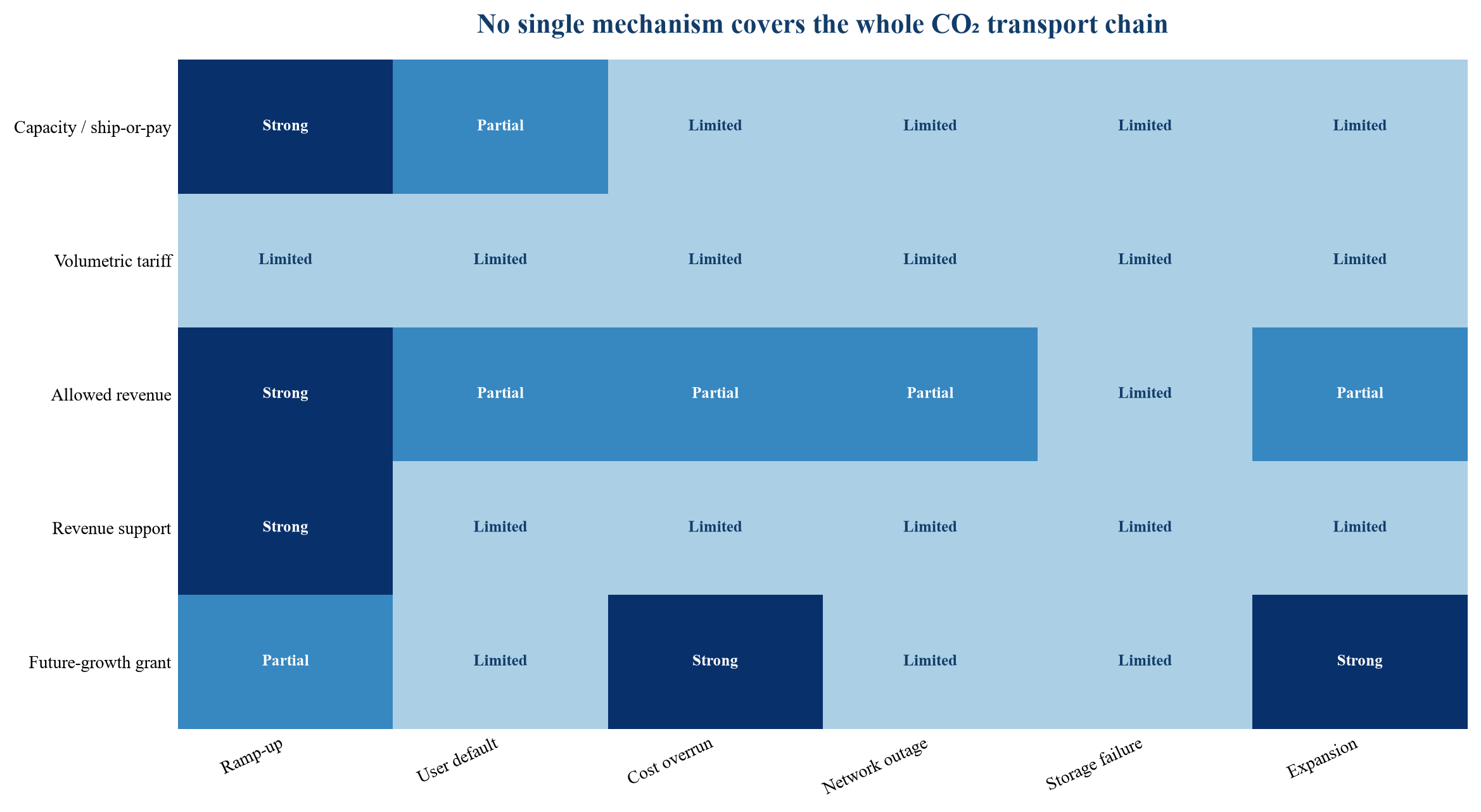
Qualitative classification only. Darker cells indicate stronger direct coverage; actual protection depends on legal terms and counterparty credit.
26. Debt sizing should use an event-based model
Traditional sensitivity tables vary price and volume independently. A CO₂ network needs event-based cases because delays and failures propagate across the chain. A capture-plant delay reduces throughput, may trigger a capacity payment, affects public support and changes expansion timing. A storage outage can reduce every user's delivered volume simultaneously.
The model should include a contracted base case, construction delay, staggered user ramp-up, anchor-user default, prolonged network outage, storage constraint, capital-cost overrun, regulatory disallowance and delayed support payment. Each case should calculate revenue, operating cost, liquidity, debt-service coverage, reserve draws and covenant compliance.
Debt capacity should be based on risks that are transferred to creditworthy parties or supported by adequate reserves. A contractual entitlement is useful only when enforceable, collectible and timely. Scenario design should follow contract language rather than generic percentage shocks.
27. Sources and uses must include network-specific reserves
Construction uses include pipeline or vessels, terminal, compression, metering, control systems, connections, wells, monitoring and owner costs. Development cost can be material because permitting, routing, land rights, offshore surveys and user coordination take years. Contingency should reflect design maturity and interface risk.
Financing reserves may include debt service, operating liquidity, user default, regulatory lag, decommissioning, environmental liability and major maintenance. A support-payment reserve can bridge claims processing. A connection reserve can fund works before reimbursement by later users.
Sources may include sponsor equity, commercial debt, public loans, grants and user contributions. The waterfall should prevent double recovery and clarify which funds bear overruns. Public support conditions may restrict distributions, refinancing or changes of control.
28. Access rights must remain compatible with lender security
Third-party access can require the operator to connect new users or expand capacity. Lenders need assurance that these obligations do not force unfunded capital expenditure or degrade contracted service. The licence and financing documents should define how mandatory investment is funded and how tariffs adjust.
Security usually includes shares, accounts, receivables and material contracts. Statutory duties, public-service continuity and special administration may limit enforcement. Lenders should understand whether they can step into the licence, transfer the business or appoint a substitute operator.
Direct agreements with key users, storage operators and public counterparties should provide notice and cure. Cure periods must fit technical and regulatory realities. A lender cannot solve reservoir performance immediately, but it may fund remediation, replace an operator or implement an agreed recovery plan.
29. Cross-border networks add legal and currency layers
European network planning anticipates numerous cross-border links [5]. Cross-border service can improve storage access and diversify routes, but it raises questions about permits, emissions accounting, carbon-price treatment, tax, customs, liability and dispute resolution.
Contracts should define the point at which CO₂ is treated as transferred for regulatory and commercial purposes. Bilateral arrangements may be needed where international rules or national implementation differ. Quality and measurement standards should be interoperable.
Currency mismatch arises where tariffs, debt and operating costs use different currencies. Index and foreign-exchange risk should be allocated before bidding. Governing law and enforcement should be clear across user, shipping, terminal and storage agreements. Political change in one jurisdiction can affect the whole route.
30. The financing and access diligence matrix
Table 3. Diligence questions for financeable CO₂ transport tariffs and access
| Area | Core question | Evidence | Typical protection |
|---|---|---|---|
| Capacity | Is booked capacity real, deliverable and creditworthy? | User FIDs, contracts, guarantees, schedules | Ship-or-pay, milestone release, replacement rights |
| Tariff | Does revenue recover efficient fixed and variable cost? | Cost model, licence, charging methodology | Capacity component, indexation, true-up, revenue floor |
| Access | Can new users connect without impairing existing service? | Queue, capacity map, expansion policy | Published rules, funded reinforcement, dispute process |
| Quality | Are composition and custody standards technically aligned? | Specification, metering, storage permit | Rejection rights, tolerance bands, cure and change control |
| Storage | Is firm injection available through the debt tenor? | Reservoir diligence, well plan, storage contract | Firm capacity, outage remedies, backup and expansion plan |
| Support | Is public or regulated revenue enforceable and timely? | Authority, budget, licence, support agreement | Direct agreement, reserve, clear trigger and payment timetable |
| Financing | Can lenders preserve the network as a going concern? | Security, licence transfer, special administration rules | Notice, cure, step-in, substitute operator and compensation |
The matrix is a transaction checklist. Project-specific legal, technical, environmental, tax and regulatory advice remains necessary.
31. Regulators should publish a coherent charging methodology
A charging methodology should explain the revenue requirement, cost allocation, depreciation, return, inflation, connection charges, reconciliation, under-recovery, over-recovery and treatment of grants. Users need enough visibility to finance capture projects. Investors need protection from retrospective change.
Consultation should test incentives and distributional effects. The regulator should disclose how it balances affordability, financeability, expansion and efficiency. Decisions should state the evidence and appeal route. Data reporting should support oversight without imposing duplicative systems.
Periodic review can improve efficiency as the market matures. Review periods should align with debt planning and allow committed investments to recover under known rules. Reopeners should be limited to defined events. Frequent discretionary change increases the cost of capital and weakens user confidence.
32. Governments should fund public benefits explicitly
Spare capacity, cross-border interoperability and early network build-out can create benefits that no first user can capture. Requiring anchor users to fund all future benefit can deter projects. Hidden subsidies within tariffs can obscure public cost and distort access.
Grants, concessional loans or revenue support can fund the public-benefit portion transparently. CIFIA Future Growth Grants illustrate support for capacity above current contracted demand [14]. The UK revenue-support framework addresses early revenue gaps under an economic licence [9].
Support should have measurable objectives, caps, reporting and a transition path. It should preserve incentives to contract users and control cost. Public funding should not validate weak demand or imprudent design. Independent review can distinguish strategic oversizing from speculative capacity.
33. Sponsors should negotiate from the integrated model
The sponsor should convert every tariff and access term into the financial model. Capacity quantity, deficiency payments, indexation, connection timing, storage availability, support triggers and termination compensation should each have a model line and legal source.
Negotiation should focus on the highest cash-flow sensitivities. A small change in ramp-up protection may create more value than a higher nominal throughput tariff. A lower construction price can be offset by weak change control or unavailable storage. The integrated model exposes these trade-offs.
Board approval should include downside funding needs, support conditions and the residual risks borne by equity. Bid discipline is essential where a competitive process rewards low tariffs. A winning tariff that cannot fund expansion, reserves and debt service destroys value.
34. Users need their own bankability test
An emitter evaluates the network tariff as part of the capture project's cost of abatement. It needs certainty on connection date, available capacity, specification, escalation and outage treatment. A tariff can be affordable in the base case and punitive if reserved capacity begins before the capture plant is ready.
The user should test alternative routes, storage options and delay scenarios. It should negotiate coordination with its capture support contract, product offtake and industrial operations. Network deficiency relief should align with the user's lost support and operating impact where appropriate.
Credit support should reflect the user's obligations and the network's replacement prospects. A long-term ship-or-pay contract may be necessary for the network, but the user needs termination and relief if the network or storage system fails persistently.
35. Construction strategy should preserve expansion
Initial design choices determine later expansion cost. Pipeline diameter, terminal land, compression configuration, jetty capacity, well count and control systems can create or remove options. Oversizing requires capital now; retrofit can disrupt operations later.
The sponsor should compare modular expansion with upfront capacity. The decision should use risk-adjusted demand, construction interface, permitting and outage cost. Public support may be justified where oversizing lowers total system cost but cannot be recovered from current users.
EPC contracts should define interfaces among pipeline, terminal, ships, wells and capture connections. Commissioning needs a coordinated plan with test volumes and storage readiness. Delay liquidated damages should reflect actual exposure and remain commercially available.
36. Operating governance should manage common-user conflicts
Shared networks need transparent scheduling, nomination, balancing and curtailment rules. Users may have different industrial cycles and capture flexibility. The operator should allocate constrained capacity according to published priorities and protect safety.
A network code can standardise nominations, quality, metering, maintenance, data and disputes. Ofgem lists a Carbon Capture and Storage Network Code within the UK energy-code framework [17]. Governance should permit technical evolution while protecting financed expectations.
Users should participate without controlling decisions that disadvantage competitors. Independent oversight or a code panel can improve legitimacy. Emergency powers and maintenance coordination should be clear before operations begin.
37. Data assurance underpins revenue and access
Allowed revenue, user charges, emissions accounting and support payments depend on reliable data. Metering at custody points should reconcile with capture, transport and injection records. Data definitions and audit trails should be consistent across contracts.
Ofgem's regulatory reporting and data-assurance frameworks illustrate the level of information expected from licensed network companies [18]. A project should design systems during development, not after commissioning. Manual reconciliation can create payment disputes and regulatory exposure.
Lenders should receive timely operating and regulatory reports. Independent assurance should focus on high-risk data and changes. Cybersecurity, retention and access rights matter because the network coordinates critical industrial infrastructure.
38. The path to a mature market should be defined
First-wave networks may require regulated revenue or public support. A mature market can support greater merchant exposure, competitive storage, secondary capacity trading and wider cross-border access. The transition should be planned rather than assumed.
Milestones can include operating history, user diversification, storage competition, utilisation thresholds and transparent price discovery. Support can decline as these conditions are met. Existing debt and user commitments should remain protected against abrupt rule change.
The European Commission's single-market ambition and the UK's stated evolution toward a competitive market point in this direction [3][8]. Market formation requires standard contracts, interoperable specifications, credible dispute resolution and a pipeline of financeable users.
39. A twelve-gate decision framework
The first gate confirms storage and route feasibility. The second verifies anchor-user maturity. The third defines design capacity and expansion logic. The fourth establishes efficient cost and contingency. The fifth selects tariff architecture. The sixth allocates connection and reinforcement cost.
The seventh aligns quality and custody rules. The eighth allocates cross-chain outage and liability. The ninth establishes public or regulatory support. The tenth sizes debt under event-based scenarios. The eleventh secures access, licence and lender rights. The twelfth defines governance, reporting and market transition.
Each gate should have evidence, an accountable owner and a board decision. Failure at one gate can invalidate the others. The framework converts a policy concept into an executable infrastructure transaction.
40. Conclusion
CO₂ transport networks can reduce decarbonisation cost by sharing infrastructure and aggregating emitters. Their value depends on a tariff and access framework that makes investment possible before utilisation reaches maturity. The essential design question is who pays for fixed cost, spare capacity and cross-chain failure during ramp-up.
Capacity charges, throughput tariffs, regulated allowed revenue, public support and future-growth grants solve different parts of the problem. A blended structure can protect debt service while retaining incentives for utilisation and expansion. Transparent third-party access, quality standards, funded reinforcement and dispute resolution protect users and market formation.
The financeability test is practical. Contracted revenue must cover efficient cost and debt through credible downside events; storage and transport must operate as one chain; and lenders must be able to cure, step in or recover value. The carbon toll road becomes investable when the tariff, access regime and financing package are designed together.
References
- International Energy Agency. Financing CCUS at Scale, Executive Summary. 2026. https://www.iea.org/reports/financing-ccus-at-scale/executive-summary
- European Union. Directive 2009/31/EC on the geological storage of carbon dioxide, Articles 21 and 22. 2009. https://eur-lex.europa.eu/eli/dir/2009/31/oj/eng
- European Commission. Industrial Carbon Management Strategy and policy overview. Updated 2026. https://energy.ec.europa.eu/topics/carbon-management-and-fossil-fuels/industrial-carbon-management_en
- European Union. Regulation (EU) 2024/1735, Net-Zero Industry Act. 2024. https://eur-lex.europa.eu/eli/reg/2024/1735/oj
- European Commission Joint Research Centre. Shaping the Future CO₂ Transport Network for Europe. 2024. https://publications.jrc.ec.europa.eu/repository/handle/JRC136833
- United Kingdom. Energy Act 2023. 2023. https://www.legislation.gov.uk/ukpga/2023/52/contents
- Ofgem. How We Regulate Carbon Dioxide Transport and Storage Networks. Accessed 29 September 2026. https://www.ofgem.gov.uk/energy-regulation/low-carbon/carbon-capture-and-storage/how-we-regulate-carbon-dioxide-transport-and-storage-networks
- UK Department for Energy Security and Net Zero. Carbon Capture, Usage and Storage: A Vision to Establish a Competitive Market. 2023. https://www.gov.uk/government/publications/carbon-capture-usage-and-storage-a-vision-to-establish-a-competitive-market/carbon-capture-usage-and-storage-a-vision-to-establish-a-competitive-market
- United Kingdom. Carbon Dioxide Transport and Storage Revenue Support (Directions and Counterparty) Regulations 2024. 2024. https://www.legislation.gov.uk/uksi/2024/687/contents/made
- Ofgem. Carbon Dioxide Transport and Storage Price Control Financial Handbook. 2024. https://www.ofgem.gov.uk/sites/default/files/2024-12/CO2_T%26S_PCFH_V1.00_20241211_0.pdf
- Ofgem. Carbon Dioxide Transport and Storage Price Control Financial Guidance. 2024. https://www.ofgem.gov.uk/sites/default/files/2024-12/CO2_T%26S_PCFG_V1.00_20241211_0.pdf
- US Department of Energy. Carbon Dioxide Transportation Infrastructure Finance and Innovation Program. Accessed 29 September 2026. https://www.energy.gov/edf/carbon-dioxide-transportation-infrastructure-finance-and-innovation-program
- US Department of Energy. CIFIA Program Guide. Revised 2024. https://www.energy.gov/edf/articles/cifia-guidance-document-2024-final-update
- US Department of Energy. CIFIA Future Growth Grants. Updated 2026. https://www.energy.gov/hgeo/funding-notice-carbon-dioxide-transportation-infrastructure-finance-and-innovation-cifia
- Northern Lights. What We Do. Accessed 29 September 2026. https://norlights.com/what-we-do/
- Northern Lights. Northern Lights Phase 2: Expanding Europe's CO₂ Storage Capacity. 17 March 2026. https://norlights.com/news/northern-lights-phase-2-expanding-europes-co%E2%82%82-storage-capacity/
- Ofgem. Energy Codes, Carbon Capture and Storage Network Code. Accessed 29 September 2026. https://www.ofgem.gov.uk/energy-regulation/how-we-regulate/energy-codes
- Ofgem. Carbon Dioxide Transport and Storage Regulatory Instructions and Guidance. Updated 21 July 2026. https://www.ofgem.gov.uk/guidance/carbon-dioxide-transport-and-storage-regulatory-instructions-and-guidance-rigs
- International Energy Agency. Carbon Capture, Utilisation and Storage. Accessed 29 September 2026. https://www.iea.org/fuels-and-technologies/carbon-capture-utilisation-and-storage/
- International Energy Agency. CCUS in Clean Energy Transitions. 2020. https://www.iea.org/reports/ccus-in-clean-energy-transitions
- US Department of Energy. Carbon Management Strategy. 2024. https://www.energy.gov/hgeo/does-carbon-management-strategy
- US Department of Energy. LPO Tech Talk: Carbon Management. 2023. https://www.energy.gov/edf/articles/lpo-tech-talk-carbon-management
- Global CCS Institute. Global Status of CCS 2025. 2025. https://www.globalccsinstitute.com/resources/global-status-report/
- UK Department for Energy Security and Net Zero. Energy Security Bill Factsheet: Carbon Dioxide Transport and Storage Regulatory Investment Model. Updated 1 September 2023. https://www.gov.uk/government/publications/energy-security-bill-factsheets/energy-security-bill-factsheet-carbon-dioxide-transport-and-storage-regulatory-investment-model
- UK Department for Energy Security and Net Zero. Evolution of Economic Regulation for CO₂ Storage: Call for Evidence. 2025. https://www.gov.uk/government/calls-for-evidence/evolution-of-economic-regulation-for-co2-storage/evolution-of-economic-regulation-for-co2-storage-call-for-evidence-accessible-webpage
About the Author
Chennakeshav (CK) is a corporate finance and investment banking executive with 25+ years of global experience in deal origination, structuring and execution across M&A, growth capital and corporate strategy. He has led value-creation mandates for founders, corporates and funds — bridging the boardroom view to hands-on execution and close.
His career spans Morgan Stanley, HSBC, Lloyds Banking Group, EWEC, ADQ portfolio companies and Emirates Growth Fund, across TMT, real estate, fintech, deeptech, cleantech, infrastructure and energy. He has partnered with C-suite leaders, private equity and venture funds, sovereign wealth funds and family offices to finance complex fund raises and scale-up ventures, and has led M&A due diligence, post-merger integration and business-transformation initiatives to create value.
At Matchpoint Partners he is Managing Partner, leading the firm's corporate finance, M&A and capital-raising practice. He holds an MBA from London Business School, an engineering degree from VTU and a Master of Laws (LLM, in progress) from UCL London.
An active start-up mentor, CK mentors at Techstars, DIFC FinTech Hive, Startup Grind, Founder Institute and IN5, serves as Entrepreneur Mentor in Residence (EMiR) at London Business School, and judges the Entrepreneurship World Cup.
LinkedIn: https://www.linkedin.com/in/ckadya/
Profile: https://www.matchpoint-partners.com/team/ck-adya.html
