

1. The financing question
A carbon project can create environmental value long before it creates cash. Equipment may operate, forests may grow, methane may be destroyed or carbon dioxide may be stored, yet the associated units may remain unverified, unissued, non-transferable or unsold. A lender therefore needs to identify the precise event that converts a mitigation outcome into cash available for debt service.
The central decision is the amount, tenor and structure of debt that can be supported by carbon revenue without assuming that every modelled tonne becomes a paid credit. This requires a chain-of-evidence approach. The model begins with eligible activity, follows monitoring and verification, tests registry issuance and transfer, applies the purchase contract, deducts fees and reserves, and recognises cash only when the relevant conditions are satisfied.
2. A credit is a conditional revenue asset
A carbon credit generally represents a quantified unit of greenhouse-gas reduction or removal under a defined programme or mechanism. Its commercial value depends on the governing methodology, project registration, monitored performance, independent verification, issuance rules, registry status, permitted use and buyer requirements. The label carbon credit therefore describes a class of assets rather than one uniform commodity.
For financing purposes, conditionality matters more than nominal volume. A projected credit has no registry serial number. An issued credit may still be ineligible for a buyer's intended claim or compliance use. A delivered credit may be exposed to replacement, reversal or representation claims. Each condition can alter timing, price, recovery and the appropriate lending advance rate.
3. The revenue conversion chain
Debt analysis should trace six conversions: physical activity into measured outcome; measured outcome into verified outcome; verified outcome into issued units; issued units into transferable units; transferable units into accepted delivery; and accepted delivery into collected cash. Each conversion is governed by a different party and evidence set.
A single annual carbon-volume assumption hides these dependencies. The operating model should therefore show gross activity, deductions, uncertainty, verification timing, issuance timing, eligible vintage, buffer or contribution deductions, transfer restrictions, contracted deliveries and payment dates. The financing model should reference those outputs rather than reproduce them manually.
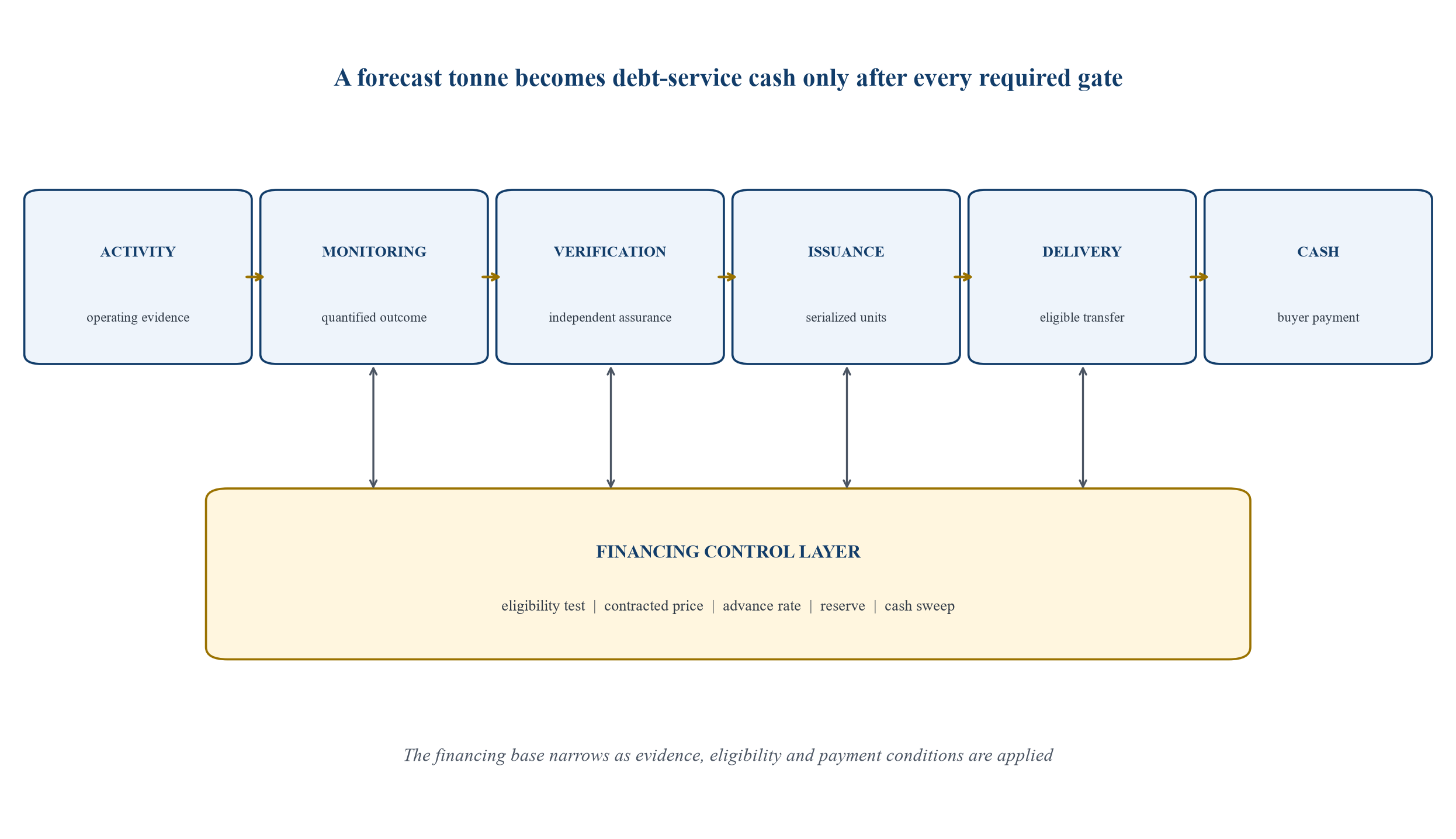
Generic financing topology. Programme rules, host-country requirements and purchase contracts determine the project-specific sequence.
4. Define the unit before valuing it
The financing memorandum should identify the programme, methodology, project identifier, geography, activity type, vintage, unit type, host-country treatment, corresponding-adjustment status where relevant, additional labels and intended use. These attributes can determine buyer eligibility and price. A generic reference to voluntary credits does not define the financed asset.
The World Bank's 2026 review reports price differentiation by credit type, rating and international-compliance eligibility. This evidence supports an attribute-specific approach. A lender should value only the unit that the project can issue and the contract requires the buyer to accept. Upside from possible premium labels belongs outside the core debt case until qualification is evidenced.
5. Methodology risk
The methodology determines the baseline, project boundary, additionality test, monitoring variables, uncertainty treatment, leakage and crediting calculations. A methodology can be revised, restricted or replaced. A project can also discover that its operating configuration does not produce the evidence needed for verification.
Methodology diligence should review applicability conditions, data availability, calibration, sampling, conservative deductions, renewal requirements and transition rules. The lender's technical adviser should reconcile the methodology with the engineering design and operating budget. Debt should not depend on a calculation that the project cannot reproduce from controlled source data.
6. Additionality and investment dependence
Crediting rules commonly require evidence that the mitigation would not occur without the incentive created by credit revenue or that another defined additionality test is satisfied. The Article 6.4 Supervisory Body has adopted a standard on demonstrating additionality in mechanism methodologies. Programme-specific tests can differ.
Financing creates a delicate interface. The project may rely on carbon revenue to demonstrate commercial dependence, while lenders may want construction completed before advancing against credits. The project should document the financing gap, decision chronology and role of expected carbon revenue. It should avoid circular assumptions in which the debt is treated as committed because credits are expected and the credits are treated as additional because debt is unavailable.
7. Registration risk
Registration confirms that a project has entered a programme or mechanism under applicable rules. It does not guarantee issuance. Validation findings, stakeholder processes, rights to the mitigation outcome, host-country approvals, safeguards and project-design revisions can delay registration.
Before registration, a facility is usually better structured as sponsor-risk development finance, a capped bridge or reimbursable development capital. Conversion to limited-recourse debt can occur after registration and satisfaction of objective conditions. The conditions should include final methodology, project boundary, crediting period, validation closure and evidence that no unresolved finding could materially reduce volume.
8. Monitoring risk
Monitoring converts operations into auditable data. Missing records, uncontrolled spreadsheets, instrument failures, changed operating procedures or weak chain of custody can reduce verified volume even when physical mitigation occurred. Monitoring is therefore an operational control, not an administrative afterthought.
The financing package should include a monitoring plan, meter register, calibration schedule, data dictionary, access control, retention policy and exception process. Information covenants should require prompt reporting of data gaps and methodology deviations. A reserve for additional sampling or re-verification may be appropriate where measurement complexity is high.
9. Verification risk
Independent validation and verification bodies examine project design, monitoring reports and quantified outcomes under programme rules. Verification can identify overstatement, missing evidence, non-conformities or required deductions. It can also take longer than the operating model assumes.
The base case should therefore include a verification lag and a volume haircut. The lag should be measured from monitoring-period close to expected payment, including audit, corrective action, programme review, issuance, transfer and buyer acceptance. Debt-service dates should follow the conservative cash date. Interest during an avoidable verification delay remains a real project cost.
10. Issuance risk
Verification and issuance are separate events. A programme administrator can review the verification package, request clarification, apply deductions, require fees or delay issuance. Credits may be placed into a buffer or contribution account, and some units may be withheld under programme rules.
A lender should distinguish verified gross reductions from net issued units. The forecast should show every deduction between those amounts. The security package can include control over the project registry account where programme rules allow, but registry control does not eliminate the programme's authority or the risk that no units are issued.
11. Transferability and title
The project must establish rights to the mitigation outcome and authority to transfer the resulting units. Land rights, operating licences, community agreements, concession terms, benefit-sharing arrangements and host-country law can affect ownership. The purchase contract cannot transfer better title than the seller holds.
Legal diligence should trace rights from the underlying activity to the project vehicle and then to the registry account. It should identify liens, competing claims, revenue shares, taxes and consent requirements. Where host-country authorization or corresponding adjustment is part of the contracted product, the model should recognize revenue only after the required evidence is obtained.
12. Buyer-use eligibility
A buyer may purchase credits for a corporate claim, an aviation obligation, another compliance purpose, resale or investment. Each use can impose programme, methodology, vintage, geography, authorization and registry requirements. ICAO publishes programme eligibility and exclusions for CORSIA periods. The ICVCM applies a two-stage assessment covering programmes and credit categories.
The emissions-reduction purchase agreement should define eligible units by objective attributes. It should avoid a standard that depends solely on the buyer's undisclosed policy. A buyer-policy change can be allocated through an agreed change mechanism, substitute-unit right, price adjustment or termination payment.
13. Integrity criteria
The ICVCM Core Carbon Principles address governance, tracking, transparency, validation and verification, additionality, permanence, robust quantification, no double counting, sustainable-development safeguards and contribution to net-zero transition. These criteria provide a useful diligence map even where a label is not contractually required.
For debt sizing, integrity affects both probability of delivery and price resilience. A project with robust quantification and transparent safeguards can still face market risk, while a project with unresolved integrity concerns can lose entire buyer segments. The credit committee should record which integrity attributes are contractual conditions, which are expected market preferences and which remain unverified upside.
14. Claims and demand risk
Demand depends partly on the claims buyers can make. The VCMI Claims Code links voluntary credit use to broader corporate climate action and quality requirements. Consumer-protection, securities and advertising rules can also affect buyer behaviour. A project should therefore avoid assuming that historic voluntary demand will continue unchanged.
An enforceable take-or-pay obligation from a creditworthy buyer is stronger than an indicative demand forecast. The agreement should identify permitted use, retirement instructions and claim-related information without making the seller responsible for the buyer's entire climate strategy. Broad reputational termination rights can remove the revenue certainty that debt sizing requires.
15. Carbon price is not one market price
Carbon-credit prices vary by project type, programme, methodology, vintage, location, buyer use, rating, co-benefits, durability, authorization and contract terms. The World Bank reports distinct ranges and premiums across segments. A single market-price curve can therefore misstate a project's revenue.
The financing model should separate fixed contracted price, indexed contracted price, floor-and-upside price and merchant price. Senior debt can give greatest weight to fixed or floored cash from an acceptable buyer. Indexed revenue needs a conservative reference case and basis-risk test. Merchant revenue should generally support upside, cash sweep or subordinated capacity unless demonstrated liquidity and hedging justify inclusion.
16. Purchase-contract architecture
The core commercial document can be an emissions-reduction purchase agreement, carbon-removal offtake, forward purchase or spot sale. It should define unit attributes, quantity, delivery schedule, price, payment, title transfer, registry mechanics, verification evidence, buyer acceptance, replacement, force majeure, change in rules, representations, liability and termination.
Financing depends on the relationship among these clauses. A fixed price has limited value if the buyer can reject units for subjective reputational reasons. A firm quantity has limited value if the seller must replace any shortfall at unlimited market cost. The lender should model the complete contract rather than headline price and volume.
17. Volume commitment
Volume can be fixed, percentage-based, best efforts, take-and-pay, take-or-pay or subject to a delivery band. Projects with uncertain production may prefer a percentage of verified issuance. Buyers seeking supply certainty may require a minimum quantity and replacement remedy.
Debt sizing should use the lower of conservatively forecast eligible issuance and enforceable contracted acceptance, after deductions and reserves. Overdelivery options can support upside. Under-delivery exposure should be capped or supported by a replacement strategy. A contract that converts operating shortfall into uncapped spot-price liability can increase credit risk even while appearing to strengthen revenue.
18. Price structure
A fixed price provides visibility but can create opportunity cost or replacement exposure. An indexed price can preserve market participation but introduces volatility and basis risk. A floor with upside sharing can balance bankability and sponsor economics. Advance purchase payments can fund construction but may operate economically as secured prepayment.
The model should place price mechanics on the actual delivery and payment dates. It should include registry fees, validation and verification costs, broker fees, taxes, community or government shares, buffer deductions and debt-account charges. Gross price per tonne is not cash available for debt service.
19. Payment timing
Carbon cash flow can be seasonal and lumpy. A twelve-month monitoring period may be followed by several months of verification and programme review. Annual debt service set before expected issuance can create a technical default despite successful operations.
The amortisation profile should follow conservative payment timing. Options include sculpted semi-annual debt service, interest reserve, cash sweep after issuance, payment-in-kind during construction, or a borrowing-base revolver that repays as buyer cash arrives. The facility should define the consequences of a timing delay separately from a permanent volume shortfall.
20. Counterparty credit
An offtake contract transfers price and demand risk only to the extent that the buyer can and must pay. Credit assessment should consider the contracting entity, parent support, financial capacity, business dependence on the credits, termination rights and concentration. A special-purpose buyer may require a guarantee, letter of credit, escrow or prepayment.
The facility should also consider settlement and registry intermediaries. Payment may depend on broker performance, custodian control or an exchange account. Direct agreements can require notice before termination and allow lender cure or assignment. Replacement-buyer assumptions should reflect realistic time, eligibility and price.
21. Contracted and merchant revenue buckets
The model should divide carbon revenue into contracted base, contracted upside and merchant residual. Contracted base consists of eligible units covered by a firm purchase obligation at a fixed price or enforceable floor. Contracted upside includes index participation and overdelivery. Merchant residual includes uncontracted volume and value from labels not yet secured.
Senior debt can be sized primarily to the contracted base after risk adjustments. Subordinated debt may take limited exposure to contracted upside. Equity retains merchant residual and remote qualification upside. This hierarchy clarifies which stakeholders bear price, volume and eligibility risk.
22. The eligibility and cash-flow matrix
Table 1. Carbon-revenue eligibility and financing matrix
| Revenue stage | Primary evidence | Principal risk | Suggested financing treatment | Typical control |
|---|---|---|---|---|
| forecast outcome | engineering or land-use model | performance and baseline error | equity case or capped development advance | independent technical review |
| monitored outcome | controlled operating data | data gaps and methodology deviation | limited borrowing-base eligibility | meter, data and audit covenants |
| verified outcome | verification report | programme review and deduction | higher advance rate with issuance reserve | approved verifier and finding closure |
| issued unit | registry serial number | transfer restriction and buyer eligibility | eligible collateral subject to contract | controlled registry account |
| delivered unit | registry transfer and buyer acceptance | payment and dispute | receivable financing | notice, direct agreement and set-off limits |
| collected cash | bank receipt | account leakage | debt-service cash | secured collection account and waterfall |
Generic framework. Programme rules, contracts and governing law determine the project-specific result.
23. Borrowing-base design
A borrowing base can apply different advance rates to stages of the carbon lifecycle. Forecast volume may receive no value. Monitored outcomes can receive a low advance rate after independent confirmation. Verified outcomes can receive more value, while issued and contracted units can receive the highest advance rate subject to buyer credit and transfer conditions.
The borrowing base should be recalculated after each monitoring, verification, issuance and delivery event. Concentration limits can apply by buyer, methodology, country, programme and vintage. Ineligible assets should be removed promptly, with a cure period and cash sweep rather than immediate acceleration where the shortfall is temporary and well evidenced.
24. Advance-rate logic
An advance rate is a risk allocation, not a statement of environmental quality. It reflects uncertainty in volume, time, price, eligibility, buyer payment and recovery. Two projects using the same methodology can justify different advance rates because their operating evidence, contracts and counterparties differ.
The credit paper should show each haircut separately. A combined haircut can conceal double counting or omitted risk. A transparent bridge begins with forecast tonnes, applies performance and verification deductions, recognizes only eligible contracted units, uses the lower of contract and stressed market price, deducts costs and reserves, and then applies the required debt-service coverage.
25. Cash available for debt service
Carbon cash available for debt service equals collected carbon receipts less programme fees, verification costs, registry charges, taxes, required benefit sharing, operating expenditure attributable to credit generation, replenishment of required reserves and any senior sharing obligation. This definition should be fixed in the common-terms agreement and financial model.
The model should avoid counting the same underlying operating margin twice. A renewable-energy project may already use electricity-sale cash flow to support debt while carbon credits arise from the same activity. The combined model should include both revenues and all associated costs, then test whether either revenue is conditional on the other. Separate financing vehicles require clear allocation of shared costs and security.
26. Debt-service coverage
Debt-service coverage is calculated by dividing cash available for debt service by scheduled principal and interest for the period. Carbon projects require careful period selection because cash can be annual or irregular. A twelve-month rolling test can be more informative than a quarterly test where issuance follows annual monitoring.
The required ratio should reflect volatility, concentration, contract strength and verification timing. The ratio is a credit decision rather than a universal carbon-market constant. The paper's numerical cases use hypothetical thresholds solely to show mechanics. Actual thresholds require lender policy, transaction evidence and legal and technical diligence.
27. Illustrative debt-sizing case
Consider a hypothetical project expected to generate 500,000 gross tonnes a year. The lender applies a 15 percent performance and verification haircut, leaving 425,000 tonnes. Eighty percent is covered by an eligible-unit offtake at a fixed USD 18 per tonne. Programme, verification, registry, benefit-sharing and operating costs attributable to the credit stream equal USD 2.10 per delivered tonne.
The resulting contracted gross receipt is USD 6.12 million. After attributable costs, contracted carbon cash available for debt service is approximately USD 5.406 million. At a hypothetical 1.50 times coverage requirement, annual debt service supported by this stream is approximately USD 3.604 million. Debt principal then depends on interest rate, amortisation profile, tenor, reserve requirements and payment timing.
28. Delay stress
If verification and issuance are delayed by six months, the economic value may remain while the scheduled cash date moves. A project with fixed semi-annual debt service can face a liquidity shortfall. The appropriate response may be a verification-delay reserve, flexible payment dates, a revolving tranche or capitalised interest subject to a long-stop date.
The delay should also affect terminal value and tenor. A repeated six-month delay can leave later vintages outside the loan maturity. Lenders should require a maturity tail after the final contracted delivery and should test whether the purchase agreement remains effective during the tail. A delay covenant should trigger enhanced reporting before payment default becomes likely.
29. Volume stress
Volume stress should combine physical underperformance and crediting deductions. A ten percent operating shortfall can interact with a baseline update, uncertainty deduction or monitoring gap. Applying only one flat haircut can understate this correlation.
The model should identify the cause because contractual recovery differs. Equipment underperformance may support an EPC or operating claim. Methodology deduction may have no recourse. A counterparty-caused data failure may support damages, while a natural event may fall within force majeure. The financing case recognizes recovery only where the right, counterparty credit and timing are sufficiently established.
30. Price stress
A fixed-price offtake reduces price volatility for contracted volume, subject to buyer credit and contract termination. Merchant volume remains exposed to market segmentation and liquidity. An indexed contract can retain volatility, and a price floor may contain eligibility or delivery conditions.
The downside case should use the lower of the enforceable contract price and an independently supported stressed price for the applicable unit. It should not substitute prices from another project type or use. A price premium for rating, label or co-benefit should enter the base case only after the required attribute is secured and the buyer must pay it.
31. Debt-sizing sensitivities
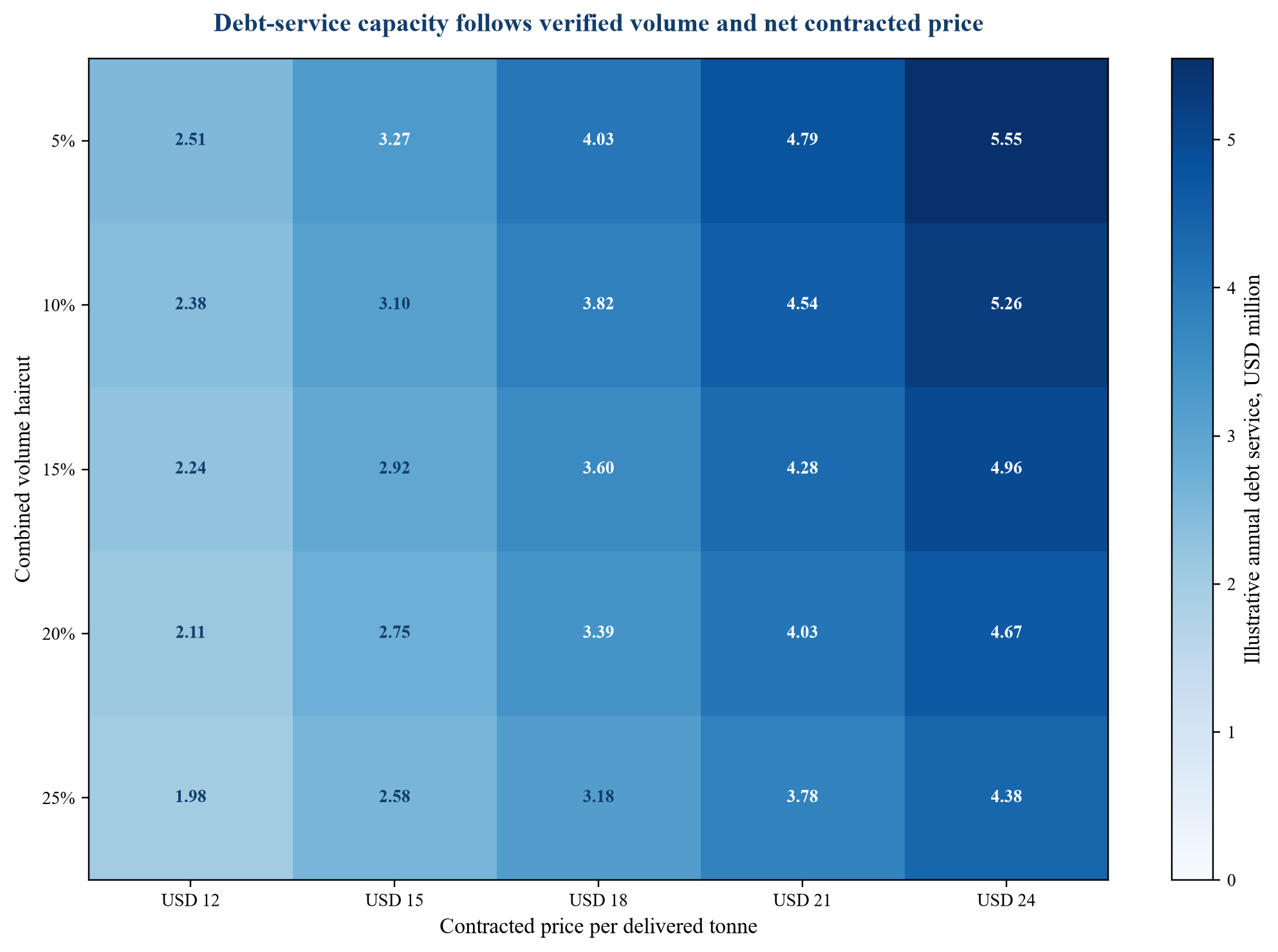
Hypothetical decision analysis. Assumes 500,000 gross tonnes, 80 percent contracted volume, USD 2.10 attributable cost per delivered tonne and 1.50 times coverage. Values are not a project forecast or lending commitment.
32. Debt principal from annual service
After annual debt-service capacity is determined, principal can be solved using the agreed interest rate, amortisation and payment dates. A level-debt-service annuity is one option, but sculpting to conservative carbon cash dates may better reflect the asset. The model should include arrangement fees, reserve funding, withholding tax and hedge costs.
The loan tenor should be shorter than the binding revenue period. A tail is needed for verification delay, replacement delivery and workout. The crediting period itself is insufficient if the purchase agreement ends earlier or the methodology requires renewal. Extension assumptions should remain outside the base debt case until approvals are secured.
33. Scenario table
Table 2. Illustrative carbon-revenue debt-sizing scenarios
| Case | Eligible contracted tonnes | Net price after attributable cost | Carbon cash available for debt service | Coverage assumption | Supported annual debt service |
|---|---|---|---|---|---|
| base | 340,000 | USD 15.90 | USD 5.406m | 1.50x | USD 3.604m |
| volume downside | 300,000 | USD 15.90 | USD 4.770m | 1.50x | USD 3.180m |
| price downside | 340,000 | USD 12.90 | USD 4.386m | 1.50x | USD 2.924m |
| combined downside | 300,000 | USD 12.90 | USD 3.870m | 1.60x | USD 2.419m |
| delayed receipt | 340,000 | USD 15.90 | USD 5.406m received six months late | 1.50x plus liquidity test | timing reserve required |
Hypothetical figures for framework demonstration. Debt principal requires transaction-specific interest, amortisation, tenor and reserve assumptions.
34. Construction finance
Construction lenders face technology, completion, registration and future-issuance risk simultaneously. Carbon revenue may improve the completion case, but forecast credits usually lack the certainty needed to carry core senior debt alone. Construction finance can instead rely on sponsor support, proven operating revenue, public support, guarantees or a committed carbon prepayment with clear repayment mechanics.
Conversion to term debt should require physical completion, programme registration where applicable, verified operating data, an effective purchase agreement and a funded reserve. A phased conversion can recognize growing evidence. This structure rewards de-risking without treating early forecasts as equivalent to issued units.
35. Prepayment and forward finance
A buyer can provide an advance against future delivery. The advance may be repaid through credits, cash or a price discount. Its legal and economic character depends on the documents, security and remedies. The project should model it as financing where repayment or replacement obligations create leverage.
Prepayment can align buyer and project interests, but it can also subordinate future cash flow. Senior lenders need intercreditor terms, delivery priority, cure rights and limits on acceleration. The unit price embedded in the prepayment should be compared with alternative financing cost and the value of surrendered upside.
36. Receivables finance
Once credits are delivered and accepted, the remaining risk may be a short-dated buyer receivable. Receivables finance can apply a high advance rate if payment is unconditional, set-off is limited and the buyer is creditworthy. Notice of assignment and control of the collection account strengthen the structure.
The financier should confirm that registry delivery cannot be reversed unilaterally and that the buyer has no unresolved rejection right. A receivable arising from disputed eligibility is materially different from an ordinary trade receivable. The carbon contract should provide a clear acceptance deadline and a defined expert process for technical disputes.
37. Portfolio finance
A portfolio can diversify project, methodology, geography, buyer and issuance timing. It can also conceal correlated exposure to one programme rule, market segment or claims standard. Portfolio debt requires asset-level data and concentration limits rather than reliance on aggregate tonnes.
Eligibility criteria should operate at unit or project cohort level. The facility can cap exposure by programme, methodology family, country, project developer, buyer and vintage. Cross-collateralisation improves liquidity, while weak assets should not automatically consume cash generated by strong assets without agreed limits.
38. Nature-based reversal risk
Nature-based removals and avoided emissions can face fire, drought, disease, illegal activity, political intervention or management failure. Programme buffers and risk tools can address part of the reversal exposure. They do not necessarily eliminate contractual replacement duties or revenue loss.
Debt sizing should use net units after buffer contributions and should review the circumstances in which additional contributions or cancellations can occur. Insurance, reserve accounts, geographic diversification and conservative leverage can support the structure. The lender should distinguish temporary issuance interruption from a reversal that creates a replacement liability.
39. Engineered removal risk
Engineered removals can offer durable storage but remain exposed to technology performance, energy inputs, monitoring boundaries, storage integrity and methodology evolution. Long-duration offtakes may support project finance when delivery specifications, price, volume and buyer credit are strong.
Completion testing should prove the integrated removal chain and the data needed for issuance. Debt draw can be linked to modular capacity, verified batches or contracted milestones. A premium price should not be treated as risk-free; it can carry demanding durability, additionality and delivery conditions.
40. Avoidance and reduction projects
Renewable energy, methane capture, clean cooking, industrial efficiency and other reduction activities have different baselines and monitoring risks. Some categories can face changing additionality assessments as technologies become common or regulation tightens. The financing case should therefore use the exact methodology and transition rules.
Outcome-based finance can combine carbon revenue with other verified development outcomes. IFC's 2025 work on outcome-based finance highlights the importance of buyers, reliable measurement and transparent revenue sharing. Any additional outcome payment should be documented separately and should not be included in senior debt until its conditions and counterparty are clear.
41. Article 6 and host-country interface
Internationally transferred mitigation outcomes can require host-country authorization, reporting and corresponding-adjustment treatment under the applicable cooperative approach. The Paris Agreement Crediting Mechanism has its own evolving standards, methodologies and registry processes. These features can affect eligibility, timing and claims.
The purchase agreement should state whether authorization is a condition precedent, a seller obligation or a shared regulatory risk. It should identify the consequence of withdrawal, delay or scope mismatch. Financing should recognize only the product the host country and registry can lawfully transfer under the contracted terms.
42. CORSIA eligibility
CORSIA creates compliance demand for eligible emissions units, subject to programme approval, exclusions, dates and host-country attestations described by ICAO. Eligibility is therefore a defined attribute rather than a general characteristic of all credits from an approved programme.
A CORSIA-linked offtake should reference the applicable compliance period and eligibility document. The model should exclude vintages or categories outside the approved scope. If eligibility is conditional or subject to future action, the revenue belongs in a contingent case until the condition is satisfied.
43. Change in rules
Crediting programmes, claims codes, host-country frameworks and compliance schemes evolve. A rule change can affect monitoring, issuance, eligibility, price or buyer use without changing physical performance. Contracts should distinguish a project breach from a prospective rule change.
The change mechanism should include notice, mitigation, substitute methodology or unit, cost allocation, price adjustment, expert determination and termination economics. Senior debt benefits from a minimum-payment or termination amount where the buyer requested a specialised attribute and later changes its policy. Mandatory-law changes require jurisdiction-specific advice.
44. Invalidity and replacement
A credit can be challenged or invalidated because of error, fraud, double counting, reversal, rights failure or programme action. The seller's replacement duty should be limited to causes within its responsibility and should specify equivalent-unit criteria, timing and price exposure.
The lender should model replacement as a contingent cash outflow and review liability caps, insurance and reserve arrangements. An uncapped obligation to replace at future market price can overwhelm project value. Fraud and deliberate misstatement can remain outside ordinary caps, supported by sponsor or responsible-party recourse.
45. Security package
Security can include shares in the project vehicle, project accounts, receivables, material contracts, registry rights where permitted, insurance proceeds and reserve accounts. Programme rules may restrict liens or account control. Legal advice should confirm enforceability and the transfer process following enforcement.
The collection account should receive buyer payments directly. The waterfall should fund taxes and essential operating costs, verification expenses, debt service, reserves and permitted distributions in that order as negotiated. Registry control helps prevent unauthorized transfer; it does not replace monitoring and eligibility covenants.
46. Cash waterfall
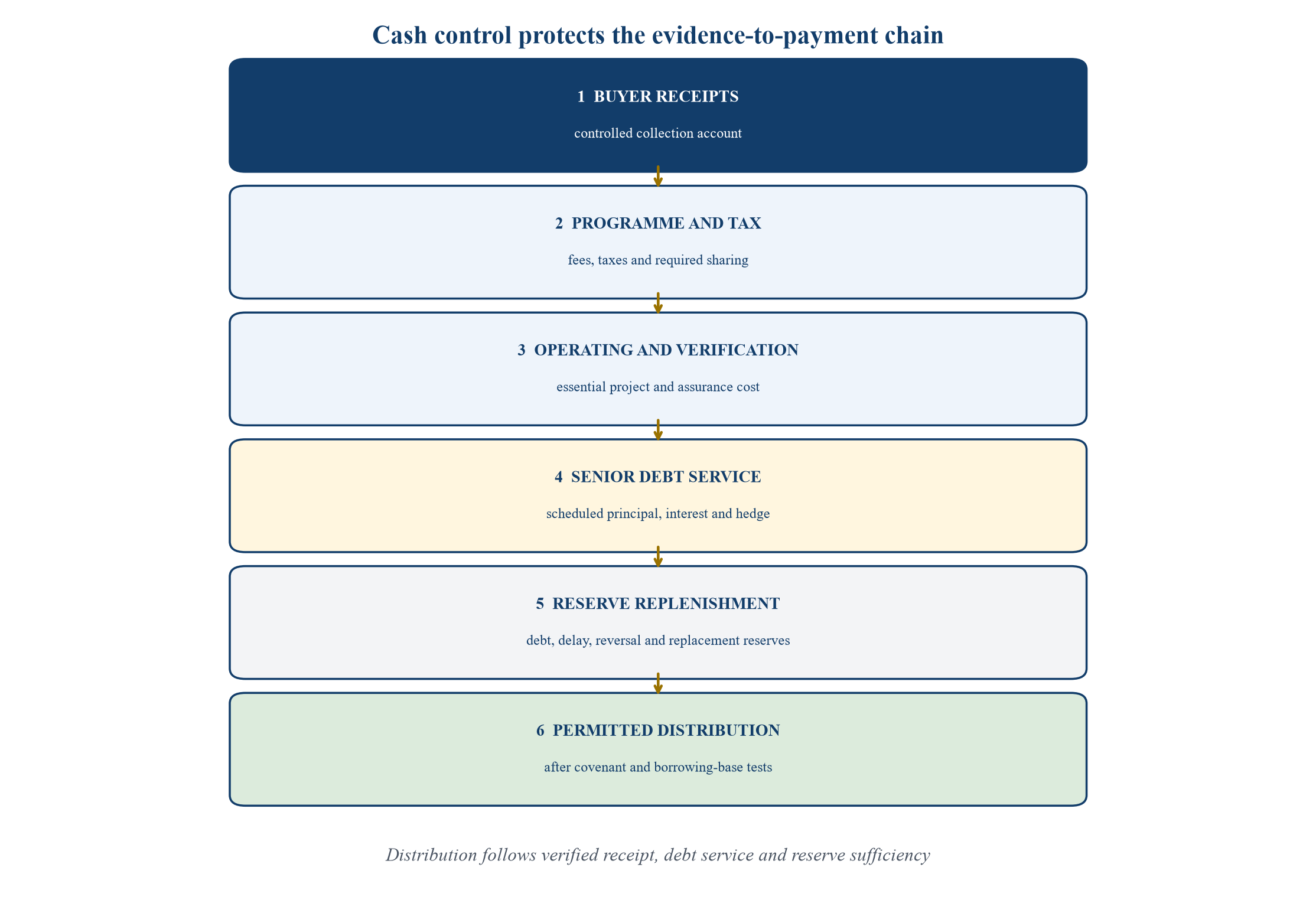
Generic control design. Account priority, taxes, operating payments and enforcement rights require transaction-specific legal analysis.
47. Covenant design
Financial covenants should include debt-service coverage, minimum liquidity, borrowing-base sufficiency, reserve funding and distribution conditions. Operating covenants should cover methodology compliance, monitoring, verifier appointment, registry account control, contract maintenance and prompt correction of findings.
Information covenants should deliver monitoring reports, verification correspondence, programme notices, registry statements, buyer notices, host-country communications and claim disputes. A methodology or eligibility breach can trigger a remediation plan and distribution lock before it becomes an event of default. Fraud, unauthorized transfer or loss of a critical right can justify immediate action.
48. Decision and covenant matrix
Table 3. Investment and lending gates for carbon-revenue finance
| Gate | Required evidence | Financing test | Protection if unresolved |
|---|---|---|---|
| methodology | current methodology, applicability review and monitored variables | calculation is reproducible from controlled data | exclude volume or apply development-only advance |
| registration and rights | registration record, project rights and required approvals | project can lawfully generate and transfer units | sponsor support and draw stop |
| verification and issuance | verifier plan, timetable and programme process | conservative cash date fits debt service | delay reserve and maturity tail |
| offtake | executed eligible-unit purchase agreement and buyer credit | firm payment covers stressed debt service | guarantee, letter of credit or lower advance rate |
| replacement exposure | cause-based liability, cap and replacement mechanics | downside remains within liquidity and equity support | reserve, insurance and liability limit |
| security and control | collection account, assignments and registry controls | cash and assets are enforceably within the waterfall | condition precedent and direct agreements |
Generic decision framework. Evidence thresholds and remedies should be tailored to the activity, programme, contract and jurisdiction.
49. Investment-committee sequence
The investment committee should first decide whether the physical activity and methodology are compatible. It should then establish rights, registration pathway, monitoring controls and verification timing. Only after those questions are resolved should it assess contracted volume, price, buyer credit, replacement exposure and security.
The debt-sizing model should be the final synthesis of this evidence. It should show a bridge from gross forecast outcome to eligible contracted units, net price, carbon cash available for debt service, coverage and principal. Each assumption should identify its evidence owner and update frequency. Unresolved items should reduce the borrowing base or remain conditions precedent.
50. Independent model review
The carbon model should receive independent technical and model review before financial close. The technical review tests physical performance, monitoring boundaries, methodology applicability and the reasonableness of deductions. The model review checks formula integrity, timing, consistency with contracts and treatment of taxes, fees and reserves. These reviews serve different purposes and should be coordinated.
The review scope should include reconciliation from monitored source data to issued units and from issued units to bank-account receipts. Sensitivities should be capable of changing volume, price, delay, eligibility and replacement exposure independently. A summary output should allow a credit committee to see which assumption drives each borrowing-base reduction.
51. Tax, accounting and currency
Carbon receipts can have different tax and accounting treatment across jurisdictions. Recognition of revenue may occur before or after cash receipt, while debt service depends on cash. Withholding tax, value-added tax, corporate tax, transfer pricing and cross-border payment controls can reduce or delay distributable proceeds. The financing model should use cash after applicable deductions.
Currency risk also matters where credits are sold in one currency and debt or operating costs are denominated in another. A fixed carbon price does not create fixed debt-service capacity if exchange rates remain open. Hedging, matching debt currency, reserve sizing or conservative exchange assumptions can address the exposure. Jurisdiction-specific professional advice is required.
52. Insurance and guarantees
Insurance may address property damage, business interruption, natural hazards, political risk, credit risk or selected reversal exposures. Coverage for methodology change, voluntary-market price decline or reputational buyer termination can be limited. Policy terms, waiting periods, exclusions, sublimits and claim-payment timing should be compared with the debt scenarios.
Guarantees can support buyer payment, delivery advance or political and regulatory risk. Public or development-finance instruments may improve the credit profile where their conditions align with the project. The model should recognize guarantee proceeds only when trigger, amount, timing and enforceability are clear. A guarantee with broad exclusions should not substitute for core project diligence.
53. Community and benefit-sharing obligations
Carbon projects can depend on communities, landholders, workers and public authorities whose rights and contributions should be reflected in project design and revenue sharing. Benefit-sharing can be a contractual, regulatory, programme or ethical obligation. It is also a financing variable because amounts paid before debt service reduce carbon cash available for debt service.
The project should document beneficiaries, calculation basis, payment timing, governance, audit and grievance mechanisms. The model should treat required shares as operating or waterfall obligations rather than discretionary distributions. Weak implementation can create legal, operational, reputational and credit risks that are not captured by a simple price-per-tonne assumption.
54. Workout and enforcement
A carbon-revenue workout differs from enforcement over a conventional commodity project. The lender may need continued monitoring, verification, community engagement, programme compliance and registry administration to preserve asset value. Enforcement that disrupts these functions can destroy the revenue it seeks to recover.
Direct agreements should give lenders notice, cure time and substitution rights where permitted. A qualified backup operator, data custodian and registry administrator can support continuity. The security trustee should understand transfer restrictions and programme approval requirements. Workout plans should prioritize preservation of evidence, rights and delivery contracts before asset disposal.
55. Ongoing portfolio surveillance
After closing, surveillance should update physical performance, monitored tonnes, verification status, issuance timing, registry balances, contracted deliveries, buyer credit and cash collections. It should also track methodology updates, programme decisions, host-country rules, compliance eligibility and integrity-label status. These indicators should feed the borrowing-base calculation.
Early-warning thresholds can cover data gaps, delayed verifier appointment, unresolved findings, expected issuance slippage, buyer downgrade, authorization uncertainty and increased replacement exposure. The reporting cadence should match the fastest material risk. Annual covenant testing alone can be too slow where registry or contract events occur during the year.
56. Conclusion
Carbon-credit revenue can support debt when the financed cash flow is defined as verified, issued, transferable, contractually acceptable and collected revenue rather than forecast tonnes multiplied by an assumed price. The conversion requires aligned methodology, monitoring, verification, registry, contract, buyer-credit and account-control systems.
The prudent structure separates lifecycle stages, applies transparent haircuts, matches debt service to conservative cash dates and preserves liquidity for delay, shortfall, rule change and replacement. Senior debt relies on the strongest contracted and evidenced cash. Subordinated capital and equity absorb merchant and qualification upside. This framework allows carbon revenue to contribute to project finance while keeping environmental integrity and credit discipline visible in the same decision model.
References
- World Bank. State and Trends of Carbon Pricing 2026. 2026. https://www.worldbank.org/en/publication/state-and-trends-of-carbon-pricing
- World Bank. State and Trends of Carbon Pricing 2026, full report. 2026. https://documents1.worldbank.org/curated/en/099051826185087983/pdf/P502283-3ee8b1dc-6f1a-46dd-8141-e6534fd34af9.pdf
- World Bank. Carbon Pricing Dashboard: About, methods and sources. https://carbonpricingdashboard.worldbank.org/about-us
- Integrity Council for the Voluntary Carbon Market. The Core Carbon Principles. https://icvcm.org/core-carbon-principles/
- Integrity Council for the Voluntary Carbon Market. Core Carbon Principles Assessment Framework and Procedure. https://icvcm.org/assessment-framework/
- Integrity Council for the Voluntary Carbon Market. How we assess carbon-crediting methodologies. https://www.icvcm.org/how-we-assess-carbon-crediting-methodologies/
- UNFCCC Article 6.4 Supervisory Body. Methodologies and methodological tools. https://www.unfccc.int/process-and-meetings/the-paris-agreement/article-6/article-64-pacm/methodologies
- UNFCCC Article 6.4 Supervisory Body. Standard: Demonstration of additionality in mechanism methodologies, version 01.1. 26 February 2025. https://unfccc.int/documents/645971
- UNFCCC. Rules for managing emission reversal risks agreed by UN Body. 10 October 2025. https://unfccc.int/news/rules-for-managing-emission-reversal-risks-agreed-by-un-body
- International Civil Aviation Organization. CORSIA Eligible Emissions Units. Current edition April 2026. https://www.icao.int/CORSIA/corsia-eligible-emissions-units
- Verra. VCS Program Details and Version 5 rules and requirements. https://verra.org/programs/verified-carbon-standard/vcs-program-details/
- Verra. Verified Carbon Standard Version 5. https://verra.org/programs/verified-carbon-standard/verified-carbon-standard-version-5/
- Gold Standard for the Global Goals. Validation and Verification Standard, version 2.0. 12 November 2024. https://globalgoals.goldstandard.org/113-par-validation-and-verification-standard/
- Voluntary Carbon Markets Integrity Initiative. Claims Code of Practice, version 3.1. August 2025. https://vcmintegrity.org/vcmi-claims-code-of-practice/
- International Organization of Securities Commissions. Voluntary Carbon Markets Final Report. November 2024. https://www.iosco.org/library/pubdocs/pdf/IOSCOPD774.pdf
- OECD. Exploring governments' efforts to shape carbon credit markets. 2025. https://www.oecd.org/content/dam/oecd/en/publications/reports/2025/06/exploring-governments-efforts-to-shape-carbon-credit-markets_dac6ff0f/0bafe9af-en.pdf
- International Finance Corporation. Unlocking Social and Environmental Impact: Outcome-based Finance in Clean Cooking, Distributed Renewable Energy, and Small-Scale Agribusiness. 2025. https://www.ifc.org/en/insights-reports/2025/unlocking-social-and-environmental-impact-outcome-based-finance
- International Finance Corporation. A Climate Opportunity for the Private Sector. 2022. https://www.ifc.org/en/insights-reports/2022/climate-opportunity-for-private-sector
About the Author
Chennakeshav (CK) is a corporate finance and investment banking executive with 25+ years of global experience in deal origination, structuring and execution across M&A, growth capital and corporate strategy. He has led value-creation mandates for founders, corporates and funds — bridging the boardroom view to hands-on execution and close.
His career spans Morgan Stanley, HSBC, Lloyds Banking Group, EWEC, ADQ portfolio companies and Emirates Growth Fund, across TMT, real estate, fintech, deeptech, cleantech, infrastructure and energy. He has partnered with C-suite leaders, private equity and venture funds, sovereign wealth funds and family offices to finance complex fund raises and scale-up ventures, and has led M&A due diligence, post-merger integration and business-transformation initiatives to create value.
At Matchpoint Partners he is Managing Partner, leading the firm's corporate finance, M&A and capital-raising practice. He holds an MBA from London Business School, an engineering degree from VTU and a Master of Laws (LLM, in progress) from UCL London.
An active start-up mentor, CK mentors at Techstars, DIFC FinTech Hive, Startup Grind, Founder Institute and IN5, serves as Entrepreneur Mentor in Residence (EMiR) at London Business School, and judges the Entrepreneurship World Cup.
LinkedIn: https://www.linkedin.com/in/ckadya/
Profile: https://www.matchpoint-partners.com/team/ck-adya.html
