

1 The credit question beneath the earnings multiple
A company can display an attractive earnings margin and still miss a debt payment. The lender receives cash on scheduled dates, not adjusted earnings. Revenue that is recognised but uncollected, margin attached to a disputed variation, a receivable assigned to another financier and a supplier balance paid late have different implications for repayment. The board's capital decision should begin by identifying the cash legally and practically available to the borrowing entity on the dates interest and principal fall due. It should then ask what happens when a material customer's order, certification or payment is delayed.
This question is especially consequential when a proposed debt amount is derived from a headline EBITDA multiple. EBITDA can be a useful operating indicator, but it excludes working-capital movements, capital expenditure, tax, debt service and some obligations whose treatment depends on the documents. A borrower can improve EBITDA while consuming cash to finance growth. A lender can apply its own permitted add-backs and covenant definition; that definition may differ from the figure in an investor presentation. The paper therefore treats EBITDA as a starting ledger, rather than a lending-capacity answer.
The objective is a replicable board and lender conversation. Management first identifies the entity that will borrow and its enforceable sources of repayment. It reconciles accounting, bank and customer evidence. It then builds monthly operating cash and debt-service forecasts, applies concentration stresses and compares alternative funding structures. Each decision needs a dated document and an owner. The framework is a proposed method, not an assertion that every GCC institution uses one formula or that private term sheets are publicly comparable.
2 Regulatory and prior-art boundary
The Central Bank of the UAE's Credit Risk Management Standards, effective from 30 November 2024, state that licensed financial institutions should document a robust understanding of a facility's purpose and associated risk using leverage, debt-service coverage, liquidity, net worth and operating cash flows [1]. The standards require comprehensive financial information and cash-flow projections from obligors and assessment of all financial obligations. For wholesale obligors, the standards specify forward-looking analysis, downside scenarios, stressed benchmark rates and, for non-amortising facilities, refinancing risk [1]. These are requirements on regulated lenders. They do not prescribe a single borrower-level CFADS formula or lender appetite for a specific credit.
The Basel Committee's 2025 principles identify repayment capacity, historical trends, future cash-flow projections and scenario analysis as components of a sound credit-granting process [2]. The European Banking Authority's loan-origination guidelines explicitly discuss free cash flow for debt service, the cash-conversion cycle and working-capital needs [3]. They provide comparative prior art. Their EU application does not turn them into GCC regulation. The method in this paper is therefore an operational synthesis of existing credit principles, not a claim of having discovered a new prudential test.
Existing accounting standards answer a different question. IAS 7 describes the classification and presentation of operating, investing and financing cash flows [4]. IFRS 7 addresses disclosure of financial-instrument risks and related concentrations [5]. The IFRS Foundation's amendments concerning supplier finance arrangements seek greater transparency about their effects on liabilities and cash flows [6]. None converts a reported period's cash flow into a forecast of freely transferable cash at every debt-payment date. That transformation requires borrower-specific evidence, contractual interpretation and explicit assumptions.
3 Fix the borrower, group and cash perimeter
The first model tab should be an entity map. It should name the legal borrower, operating subsidiaries, cash-collecting entities, material joint ventures and shareholders. It should identify where customer contracts sit, where inventory or receivables are held, and which entity pays staff, suppliers and taxes. A consolidated profit figure may include cash generated by a subsidiary that cannot be swept to a parent on the needed date. Minority interests, ring-fenced accounts, local legal restrictions, security and existing lender covenants may limit movement. The model should record each restriction as a document reference rather than assume consolidation equals availability.
The second tab should be a funding map. Existing bank facilities, supplier finance, leases, guarantees, letters of credit, shareholder loans and factoring arrangements can create payment obligations or claims on the same cash. A borrower may show a low balance-sheet term-loan figure while a working-capital line has a large seasonal draw. A receivable may have been sold or pledged. Underwriting should reconcile facility statements, security records, maturity schedules and management's own debt schedule. The CBUAE standards explicitly address due diligence across obligations, including other lenders and related parties [1].
A third tab should identify the proposed lender's actual repayment source. It might be operating cash generated by recurring contracts, collection of specific invoices, a committed take-out, asset-sale proceeds or a combination. Those sources have different evidentiary burdens. A signed customer contract is not itself collected cash; a draft equity raise is not committed refinancing. The borrower should mark each proposed source with its contract, bank statement, counterparty confirmation or other support, and state what remains unverified. Any proposed reliance on another group entity needs its own legal and cash-flow analysis.
4 Reconcile profit to cash before normalising it
Start with audited or independently reviewed financial statements when available, then bridge to management accounts and bank transactions. The bridge should begin at reported operating profit or EBITDA and name the cash consequences of interest, income tax, working capital, maintenance capital expenditure, lease payments and other recurring outflows. If EBITDA is adjusted, each adjustment needs a precise definition, historical occurrence, amount, cash status and forecast treatment. A claimed one-off cost that recurs each year does not disappear merely because it is labelled exceptional.
IAS 7's indirect method adjusts profit for non-cash items, deferrals and accruals, and cash flows classified elsewhere [4]. That is a useful reconciliation discipline, but a lender's cash-available-for-debt-service figure can differ from reported cash from operations. For example, interest and tax classifications, lease treatment, acquisition cash and supplier finance effects may need a consistent analytical treatment. The analyst should preserve the statutory cash-flow statement and show the adjustments in a separate, auditable schedule. Replacing the accounting statement with one untraceable 'bankable cash' number hides the very judgments a credit committee must evaluate.
Timing matters as much as the annual total. A business can generate positive full-year cash while experiencing a quarterly trough that coincides with principal repayment. Build a monthly cash bridge from opening bank balances through receipts, payroll, supplier payments, tax, capex, distributions and existing debt service. Reconcile every completed month to statements and explain material variance. The forward model should use contract dates and observed collection patterns where available. A simple annual DSCR can remain a screening metric; the payment-date liquidity test should determine whether it is sufficient.
5 Separate cash earnings from cash release
A revenue line has at least three clocks: performance, billing and collection. They can be far apart in project, engineering, healthcare, retail-platform or subscription businesses. Under IFRS 15, a contract asset can arise when an entity has transferred goods or services before payment is due, while a receivable reflects an unconditional right to consideration [7]. The accounting distinction is relevant to evidence quality; it does not mean every receivable is collectible on time. An analyst should trace the major balances to contract milestones, invoice dates, acceptance documents, disputed amounts and subsequent receipts.
The bridge should distinguish cash generated by normal operations from cash released by reducing inventory, stretching payables or collecting an unusually old receivable. A one-off working-capital release may be real and available for an immediate payment, yet it cannot be repeated each year in a five-year debt-sizing model. Conversely, a young growing company may experience a temporary investment in inventory and receivables. That investment could reverse, persist or increase. The model should show the driver and evidence, rather than automatically call every working-capital outflow exceptional.
Supplier-finance arrangements deserve a separate schedule. A programme can defer a buyer's cash outflow and make operating cash appear stronger during expansion; maturity concentration or withdrawal can reverse the benefit. The IFRS amendments on supplier finance arrangements reflect the importance of disclosing their terms, amounts and liquidity implications [6]. Underwriting should examine provider statements, payment terms, outstanding balances and any recourse, and should model the cash timing if the arrangement shrinks. No accounting presentation alone proves that the arrangement is stable funding.
6 Apply a hierarchy to proposed cash-flow adjustments
For each adjustment, ask whether it is contractual, recurring, cash, reversible and within the borrower's control. A depreciation add-back is generally a non-cash reconciliation item, but the business may need replacement assets; maintenance capex belongs elsewhere in the cash bridge. A restructuring cost might genuinely cease if the closure is complete, yet savings need implementation evidence and perhaps a period of observation. A prospective customer win should enter a scenario forecast, not historical cash available for debt service. A parent's support letter may warrant consideration only after its terms and enforceability are analysed.
An evidence hierarchy helps prevent negotiation from turning labels into cash. At the strongest end are bank-confirmed cash receipts and legally enforceable contracts with tested collection history. Next are invoiced amounts supported by acceptance and subsequent receipts. Weaker are unbilled claims, unsigned variations, pipeline opportunities and management estimates without contract evidence. The hierarchy does not supply a universal haircut. It directs the lender and borrower to agree which source supports each number and how uncertainty enters the downside model.
The adjustment schedule should maintain three columns: the reported amount, the proposed normalisation and the amount accepted for the case under analysis. An accepted amount may be zero until evidence arrives. Keep the reason and decision-maker beside each change. If an adjustment affects both EBITDA and working capital, model it once. Double counting is easy when a disputed invoice is removed from revenue but also deducted again as an assumed cash shortfall. A version-controlled bridge makes the credit discussion auditable and allows the board to see exactly why one financing offer uses a different capacity figure from another.
Table 1. Evidence-weighted cash-flow adjustment register
| Proposed adjustment | Minimum evidence to request | Treatment in a base case | Downside question |
|---|---|---|---|
| Add back depreciation | Fixed-asset roll-forward and capex plan | Reconcile non-cash expense; deduct maintenance capex separately | What spend maintains capacity? |
| Add back restructuring spend | Invoices, board approval and completion evidence | Accept only documented non-recurring cash costs | Which costs recur or savings slip? |
| Release aged receivables | Invoice, acceptance and bank receipt | Include collected cash in the receipt period | What remains disputed or overdue? |
| Forecast new contract margin | Executed order, milestones and cost plan | Forecast scenario, not historical cash | What if start or certification is delayed? |
| Extend supplier terms | Contracts, ageing and finance-provider terms | Show as financing/timing effect | What if terms normalise? |
| Count group support | Executed undertaking and provider capacity | Include only after legal and credit review | Can cash arrive before debt is due? |
Author-developed checklist. Examples are not statements about a real borrower or a lender's mandatory policy.
7 Concentration is a cash dependency map
Customer concentration is often presented as the largest customer's percentage of sales. That percentage is a useful warning indicator, but the lending question is deeper. One customer might also account for a disproportionate share of receivables, higher gross margin, contract assets or expected renewals. Related customer entities can have correlated payment risk. Several smaller customers can depend on the same government budget, commodity cycle or project sponsor. The concentration map should therefore connect revenue, contribution margin, billing, cash collection and the operational cost base.
For each material counterparty, calculate reported revenue share, receivable share, days since invoice, unbilled balance, historical collection lag, gross or contribution margin and termination or variation terms. A contract may have strong nominal value and weak payment timing. Where the same counterparty supplies inputs or guarantees another exposure, show those links. The CBUAE requires institutions to consider credit concentration risk in governance and stress testing, while its standards call for comprehensive group-wide views of significant sources of concentration [1]. That lender-level requirement does not establish a numerical threshold for a borrower's customer concentration. The borrower analysis proposed here is a transaction-specific extension of the repayment question.
A concentration stress must describe a mechanism. A complete customer loss, a six-month collection delay and a 10% pricing reset produce different cash paths. Delayed collections may leave revenue intact while consuming working capital. A lost contract can reduce margin but also eliminate some variable costs. A terminated project may create demobilisation cost or penalties. Model each event separately, specify what management can actually cut and when, and trace cash to the loan payment date. The objective is a transparent sensitivity, not a generic percentage haircut with no causal path.
8 Distinguish counterparty events from correlated shocks
An issuer can have an apparently diversified customer list and remain exposed to one common driver. Several construction customers may depend on the same real-estate cycle. Multiple utilities may depend on government payment processes. Technology clients may reduce spending in the same funding downturn. Geographic distribution alone cannot prove independent cash flows. A concentration analysis should group customers by end-market, sponsor, project, currency and payment mechanism, then test which groups could weaken together.
The analyst should avoid piling every conceivable shock into a single 'downside' without explanation. A customer delay, interest-rate increase, inventory build and new tax outflow may be correlated or independent. Create a scenario tree with named events, time horizons and transmission routes. A base case should use reconciled historical evidence and signed contracts where available. A moderate downside can test one material operational setback. A severe but plausible case can combine a concentrated loss with financing stress if the board can explain why the events could occur together. Probabilities should remain unassigned unless there is a defensible empirical basis.
This work also informs structure. A revolver may address seasonal cash conversion if eligible receivables are collectible and the borrowing base is monitored. A term loan might suit a predictable, recurring surplus. Equity can absorb cash volatility at the cost of ownership and governance rights. A borrower may combine a smaller term facility with equity or a reserve. These are structural possibilities, not promises that a financier will offer them. Each route needs a matched cash calendar, legal review and negotiation of its actual conditions.
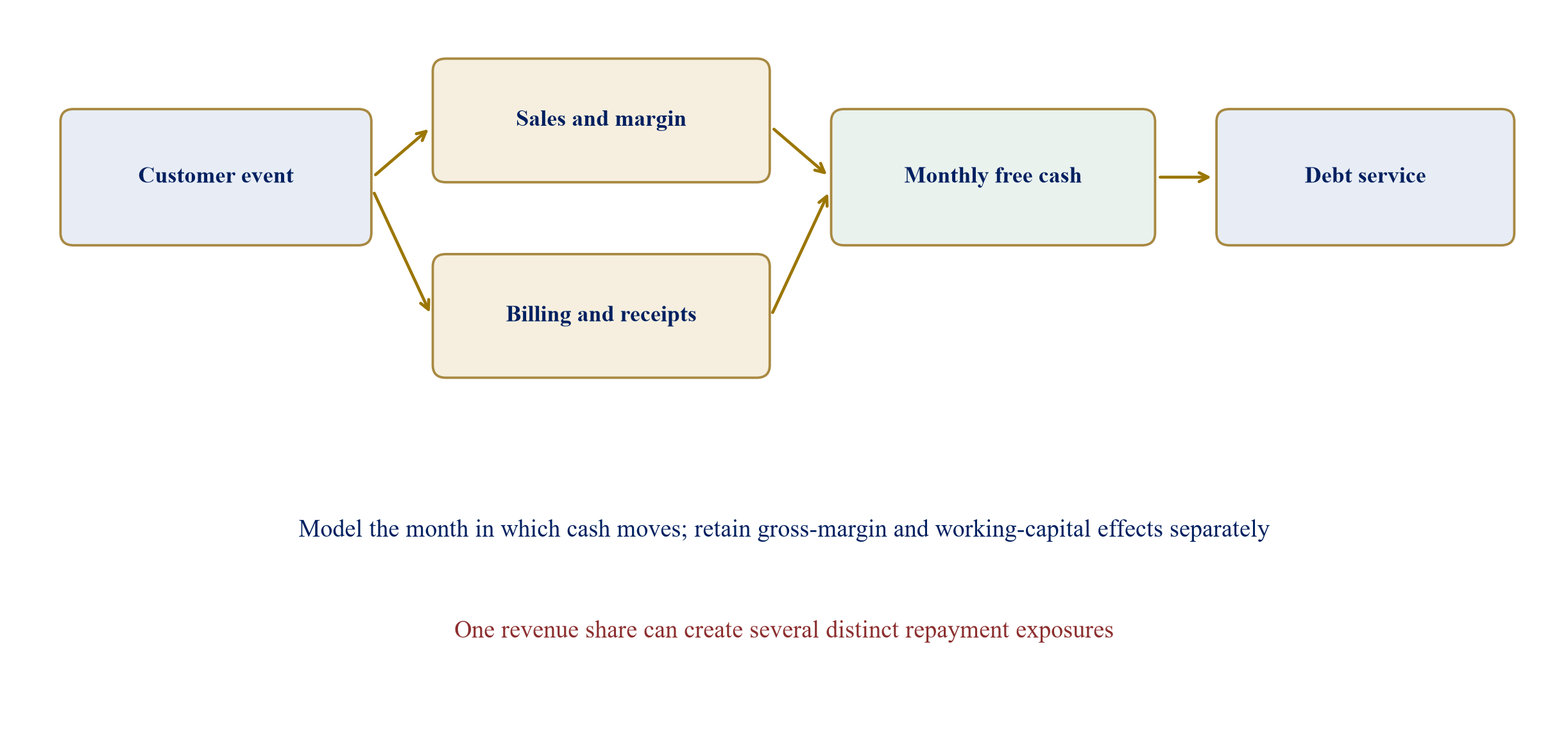
Author-developed causal map. Arrows represent analytical dependencies, not measured GCC transaction effects.
9 A wholly fictional operating company
Consider a fictional GCC services and equipment company whose annual revenue is AED 200 million and reported EBITDA is AED 40 million. These figures, its contracts and every subsequent assumption are invented for teaching. The borrower is assumed to receive all relevant operating cash and to have no restricted subsidiary cash in the illustration. A real credit decision would first test that assumption. The largest customer accounts for AED 40 million of revenue, or 20%, and is assumed to have a 30% contribution margin. This does not establish any actual market concentration level.
For a simplified annual bridge, start with AED 40 million EBITDA. Deduct AED 2 million cash tax, AED 10 million maintenance capex, AED 8 million normalised working-capital investment and AED 4 million of existing cash interest or comparable fixed financing cost. The resulting hypothetical cash available before new debt service is AED 16 million. The bridge is an analytical convention. A real model must determine whether existing interest belongs in the numerator or denominator of its covenant definition, and must avoid counting it twice. Here it is subtracted before sizing only the new facility. Lease principal, exceptional payments and other obligations are excluded from the simple example and would need inclusion if present.
Assume the proposed new term loan bears 9% annual cash interest and repays 20% of opening principal each year over five years. In the first year, scheduled service equals 29% of original principal, before fees and any change in rate or timing. Assume, solely for the model, that a lender requires at least 1.30 times coverage of new debt service using the AED 16 million cash figure. This threshold is fictional and is not attributed to any GCC institution. Dividing AED 16 million by 1.30 and then by 0.29 yields approximately AED 42.4 million of screening debt capacity. It is an annual first-year screen, not an approved commitment or a complete amortisation model.
10 The concentration stress changes the answer
Now assume half of the largest customer's annual work is lost at the start of the forecast year. Revenue falls by AED 20 million. At the fictional 30% contribution margin, annual contribution falls by AED 6 million after the variable costs assumed in that margin. Assume separately that delayed collections and transition costs absorb another AED 4 million of cash during the same year. The stressed cash available before new debt service falls from AED 16 million to AED 6 million. The assumptions are deliberately explicit so that the reader can contest the event, margin or timing independently.
At the same hypothetical 9% interest, 20% annual principal repayment and 1.30 coverage test, the stress-screened loan amount is AED 6 million divided by 1.30 and 0.29, or approximately AED 15.9 million. A proposed AED 35 million loan would require AED 10.15 million of first-year cash service and show 1.58 times coverage in the base case. Under the concentration stress it would show about 0.59 times coverage. A proposed AED 15 million loan would require AED 4.35 million of first-year service and show about 1.38 times coverage under that stress. These are mathematical results of the invented assumptions, not observed credit approvals.
Several boundary checks remain. The annual screen ignores intra-year cash troughs and later-year earnings changes; it assumes the rate stays at 9%, principal repayment follows the stated pattern, and the AED 6 million stress cash arrives before each instalment. It excludes transaction fees, taxes beyond those specified, reserve requirements and any financial covenant that uses a different EBITDA or CFADS definition. A serious proposal should run a monthly model through maturity, including opening cash, borrowing-base constraints, other debt and a delayed refinancing case. The difference between AED 42.4 million and AED 15.9 million is a sensitivity result, not a recommended facility amount.
Table 2. Fictional annual debt-service capacity under one concentration event
| Case | Cash before new service | New loan | First-year service | Coverage | Interpretation |
|---|---|---|---|---|---|
| Base screen at maximum | 16.0 | 42.4 | 12.30 | 1.30x | Mathematical screen only |
| Proposed large loan; base | 16.0 | 35.0 | 10.15 | 1.58x | Passes fictional annual base test |
| Proposed large loan; customer stress | 6.0 | 35.0 | 10.15 | 0.59x | Fails fictional stress test |
| Proposed smaller loan; customer stress | 6.0 | 15.0 | 4.35 | 1.38x | Passes fictional annual stress test |
| Stress-screened maximum | 6.0 | 15.9 | 4.61 | 1.30x | Mathematical screen only |
AED millions except ratios. Assumes 9% annual cash interest, annual principal of 20% of original new loan and a fictional 1.30x minimum coverage. Rounded; no fees, rate changes, tax effects from the shock or intra-year liquidity model.
11 Debt sizing is the minimum of several constraints
The DSCR screen is only one cap. A facility may also be limited by leverage, eligible collateral, borrowing-base availability, an internal counterparty or sector limit, existing debt documents, guarantee capacity and cash required at each payment date. The relevant limit is the lowest binding one after the actual terms are known. The board should resist a comparison that takes the highest result from each separate method and presents it as available financing. A loan that fits EBITDA but fails a liquidity test is not made lendable by the EBITDA calculation.
It is also important to distinguish gross commitment, amount drawn, and usable proceeds. A lender may offer a facility with conditions, a cash reserve, a holdback, an arrangement fee or borrowing-base eligibility rules. An AED 20 million headline line could produce less than AED 20 million of available cash on the day an acquisition or payroll obligation is due. The sources-and-uses table should show committed, drawable and immediately usable amounts separately. A conditional tranche belongs in the forecast on the date its conditions can be evidenced, not automatically at signing.
Repayment structure changes capacity. A fully amortising five-year loan front-loads annual principal. A bullet loan can look affordable in early years but shift risk to maturity. A revolving line can flex with eligible receivables and simultaneously contract if customers delay or disputes rise. A cash sweep can accelerate repayment in strong periods and reduce reinvestment capacity. The same rate cannot be compared across structures without a dated cash and covenant calendar. The lender's own approval policy and documents govern; this framework only exposes the borrower-side consequences.
12 Month-by-month liquidity is a separate gate
Annual CFADS can conceal a cash shortfall when tax, inventory purchases, capex and principal cluster in one quarter. A lender and board should review the low-cash month, not only the year-end balance. The monthly model begins with unrestricted cash in the borrowing entity, adds receipts by customer and facility draw, and deducts contractually timed payments. It should display the cushion above a management minimum and above any contractual minimum separately. These minima are not interchangeable: a company may satisfy a covenant and still lack an operating buffer.
For the fictional borrower, imagine the large customer's collections arrive sixty days later than planned while payroll and supplier payments remain due. The annual AED 6 million stress cash could still be positive but arrive after a quarterly loan instalment. The illustration has not specified an actual monthly collections schedule, so no payment-date pass can be claimed. A completed model would phase the AED 4 million working-capital effect and the lost contribution into each month, test credit-line availability and show whether a cash reserve or altered amortisation is needed.
The model should keep the base, downside and recovery paths together. If management assumes a delayed customer pays in month four, the board should see the evidence for that date and a case where payment extends to month seven. If working capital is funded with a revolver, the revolver must be included in debt service, availability and any clean-down requirement. The lowest monthly cash balance and time to cure often reveal a constraint that an annual ratio misses. The point is a decision-ready liquidity path, not a guarantee that all possible shocks have been imagined.
13 A matched debt-versus-equity decision
Debt and equity meet different constraints. Debt can preserve share ownership at closing while imposing dated cash payments, security and covenants. Equity can supply cash without scheduled principal repayment while diluting ownership and potentially adding governance rights. A hybrid facility can combine both effects. Comparing only a debt coupon with an equity valuation is therefore incomplete. The common comparison should start with the same AED cash requirement, use of proceeds, closing date and operating forecast, then show what each route changes in cash, ownership, control and execution risk.
In the fictional case, suppose the company needs AED 35 million of immediately usable growth funding. A proposed AED 35 million term loan passes the invented base annual coverage test and fails the invented customer stress. One possible design would raise AED 15 million of term debt and AED 20 million of equity. Another might use a smaller debt line plus staged equity, a longer amortisation schedule, a reserve or a working-capital instrument. Those are scenarios for negotiation; no provider, valuation, pricing or probability of closing is assumed. The equity route itself requires a fully diluted cap table, investor-rights review and cash-to-close analysis.
The borrower should ask whether the funded project actually increases resilience. A sales investment that deepens reliance on the same customer may worsen concentration even if it lifts expected revenue. An acquisition that diversifies contracts could reduce one dependency but add integration costs and debt. A new equity investor might supply strategic access yet demand consent over later financing. The decision matrix should state the business outcome sought and the downside failure mode. Financing is useful only when its conditions and risk allocation fit the operating plan.
Table 3. Matched financing routes for the fictional AED 35 million cash need
| Route | Cash at closing to verify | Ownership and control test | Cash-service test | Principal execution risk |
|---|---|---|---|---|
| AED 35m term debt | Net proceeds after fees and reserves | Security, covenants and lender consent | AED 10.15m first-year service in example | Stress coverage 0.59x in example |
| AED 15m term debt plus AED 20m equity | Both closings and net proceeds | Dilution, rights and debt consents | AED 4.35m first-year new-debt service | Two coordinated financing processes |
| AED 35m equity | Net subscription and closing conditions | Fully diluted cap table and investor rights | No assumed scheduled principal | Price, rights and execution certainty |
| Staged or revolving package | Draw conditions and eligible cash | Borrowing-base controls and future issuance | Model draw, interest and clean-down monthly | Availability may contract under stress |
Analytical options, not financing offers. No equity valuation or lender commitment is assumed; all debt terms in the example are fictional.
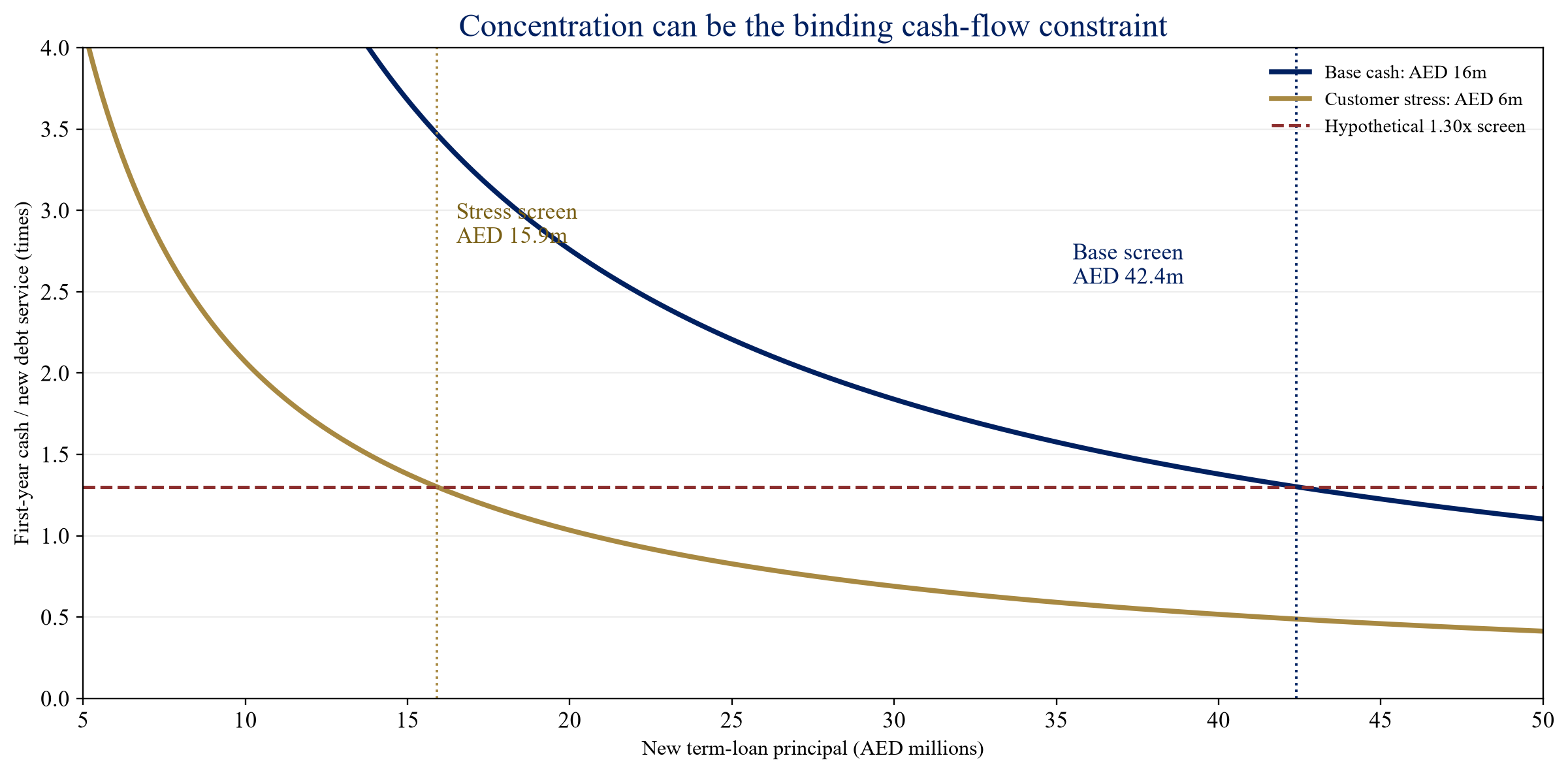
Author-calculated from the paper's invented assumptions: AED 16m base cash, AED 6m concentration-stress cash, 9% interest and 20% annual original-principal amortisation. The 1.30x line is a hypothetical test, not a lender policy.
14 Underwriting capacity and covenant headroom are distinct
A lender may approve a loan using a forward cash assessment and subsequently monitor it using a contractually defined financial covenant. Those two calculations need not share a numerator, denominator, test date or cure mechanism. A projected cash deficit could concern the credit team before a covenant breach occurs. Conversely, a covenant can be breached because of a defined EBITDA adjustment even where bank cash remains temporarily adequate. The borrower should obtain draft definitions early enough to run both tests throughout the forecast, including the concentration stress.
The board should ask whether the covenant is measured at the borrower, guarantor or consolidated group; whether leases, guarantees and shareholder loans count as debt; whether an acquisition's earnings may be included; and whether one-off costs can be added back. It should identify springing tests, borrowing-base triggers, cash-sweep clauses, cure rights and permitted baskets. The answers are document-specific. A credit presentation should never substitute its preferred interpretation of a term for the operative clause. An unresolved definition belongs in a highlighted issues list with counsel and the prospective lender as owners.
A margin of safety should be visible in both financial and operational terms. If a fictional AED 15 million loan has 1.38 times annual stress coverage against a fictional 1.30 test, the numerical excess is small. That does not establish a safe loan. A monthly trough, rate increase, tax payment, or lower-than-assumed contribution margin could remove the headroom. Management should show the amount of cash and timing needed to absorb such a change. The lender may require a different buffer, collateral or sponsor support; no market-standard threshold is inferred here.
15 Build the document checklist around disputed numbers
The most useful information pack is organised around the adjustments that change a decision. If the loan amount depends on a customer's timely payment, the team should provide the customer contract, invoice register, acceptance certificates, cash receipts and correspondence on disputes. If it depends on a cost saving, provide the approved plan, payroll or supplier termination documents and realised monthly trend. If it depends on available inventory finance, show eligibility rules and collateral reports. A generic data room full of unrelated files does not answer a precise underwriting question.
The checklist should tie each request to a number in the cash bridge. A document ID, date, legal entity, period, owner and reviewer are more valuable than an unreferenced attachment. The lender and issuer can then distinguish an unanswered question from an adverse fact. Missing evidence need not mean the cash is absent; it means the credit decision cannot rely on that cash without further work. Document quality may affect speed and terms, but this paper reports no measured relationship between data-room completeness and approval probability.
Version control is essential when management accounts change during a financing process. The issuer should preserve the first information pack, record subsequent corrections and send a clear bridge rather than silently replace figures. A newly collected invoice should be reflected in the bank-reconciled receipts schedule and the working-capital forecast. A lost order should flow through revenue, margin and collections. A board cannot compare offers reliably if each provider used a different, undocumented forecast vintage. The final pack should identify exactly which version underpins the negotiated terms.
The document checklist can be issued as six labelled folders. Historical cash should contain statements, bank records and a monthly reconciliation owned by finance. Major customers should contain contracts, invoices, ageing, acceptance and subsequent receipts owned jointly by commercial and finance teams. Working capital should contain inventory, payables, receivables and supplier-finance terms owned by treasury. Fixed outflows should contain tax, maintenance capex, leases, existing debt and guarantees owned by finance and counsel. The forecast should connect contract-backed volumes to margins and monthly cash under the CFO's ownership. The facility folder should contain draft terms, covenant definitions, security and draw conditions owned by treasury and counsel.
Each folder should answer one credit question. Which reported cash reached the borrower? How much depends on each counterparty? Which working-capital release can recur? What must be paid before new debt service? Which forecast assumptions have contractual support? How much of a proposed commitment is usable, and when? The scope should be tailored to the company and lawful access to information. The folders are a proposed control structure; they are not a mandatory form imposed by a regulator or lender.
16 Choose monitoring triggers that lead the cash event
A borrower and lender can monitor evidence before a missed payment. Customer receipts falling behind plan, a rising share of contract assets, delayed certification, higher dispute values and increasing use of supplier finance can all precede a liquidity problem. A monitoring pack should therefore track the concentration path through contract performance, billing, collection and cash. The trigger should be tied to a response: investigate, update the forecast, restrict discretionary spend, seek a waiver or raise alternative capital. A dashboard without action ownership adds little to the credit process.
Thresholds should be designed from the borrower's own volatility and the contractual reporting cycle. An arbitrary rule such as 'top customer above 20%' may have very different meanings for a young project company and a diversified distributor. The fictional company is exactly at 20% by revenue, but the paper cannot infer a breach or acceptable level from that fact. An issuer-specific alert could instead be based on a material customer's days-past-due balance, a forecast cash trough, or declining customer contribution. The lender can decide which thresholds fit its risk appetite.
Reporting can also create a better negotiation. A company that can provide bank-reconciled monthly cash, explain variance and identify corrective action may make a lender's uncertainty narrower. Whether that improves price or available amount is a transaction-specific outcome and cannot be assumed. The board should approve the ongoing reporting cost and data-access commitments when it approves the facility. If the business cannot produce the agreed information, a covenant package requiring it may be operationally unsuitable even if the initial debt calculation appears attractive.
17 Test a refinancing and maturity path
The CBUAE standards specifically call for an assessment of refinancing risk for facilities that are not fully amortising [1]. A borrower contemplating a bullet or large final payment should show the expected source of repayment and a delayed-exit case. A proposed future capital raise, asset sale or customer renewal may be plausible but is not cash today. The analysis should distinguish committed proceeds from plans, identify the decision-makers and show what happens if a market window closes. It should include the cash and covenant position in the months before maturity, when negotiating leverage may be weakest.
For a term loan, interest-rate sensitivity belongs in the same calendar. If a loan uses a floating benchmark, the borrower should model both the benchmark and any floor, margin step-up or hedge. A hedge can change cash flows, collateral needs and early-termination exposure; it is not a free reduction in uncertainty. The fictional 9% fixed-rate illustration avoids those complexities solely to isolate the customer-concentration effect. It cannot be used as a quote for a live facility or a current market rate.
The company should also identify a fallback if only part of the requested amount is approved. If a project requires AED 35 million at a fixed date and stress-screened debt is materially smaller in the example, the funding gap must be solved before committing to irreversible expenditure. Options could include phased investment, sponsor equity, asset monetisation or a revised contract structure. Each carries costs and execution risks. The board should approve a plan that remains funded under the conditions it is willing to accept, rather than treating an indicative debt number as cash in the bank.
18 Price the financing only after size and usability
Nominal interest is one component of debt cost. Arrangement and commitment fees, legal and valuation expense, security perfection, required cash reserves, monitoring cost, covenants, prepayment premiums and unused-line charges can change total economics. A facility with a lower coupon may deliver less usable cash, require earlier repayment or restrict the business plan. The company should show net proceeds and a dated cash-cost schedule for each real offer. It should also show the effect of the concentration stress on covenant headroom and refinancing needs. A single internal rate can complement the analysis, but cannot represent the operational restrictions.
Equity has a different cost profile. It can remove scheduled debt service from the cash calendar, while investors may require ownership, information rights, board representation or preferred economics. To compare it with debt, the board needs a fully diluted cap table and a range of exit outcomes. The fictional funding matrix deliberately omits an equity price; assigning one without a real offer would create false precision. Any claim that equity is 'more expensive' or debt is 'cheaper' should be supported by a defined horizon, scenario and rights package, not an abstract slogan.
The order of analysis matters. First establish the actual cash need and the earliest date it must be met. Next determine how much proposed debt survives the borrower's cash, concentration, liquidity and document tests. Then compare the remaining feasible funding mixes on matched dates and downside cases. This avoids using a cheap headline interest rate to justify an amount that cannot be serviced under a documented operating setback. It also prevents an equity recommendation from ignoring the company-specific control price that investors might request.
19 A research protocol for future GCC evidence
The paper does not claim to measure how often lenders reject a cash-flow add-back, how large concentration discounts are, or which GCC sector has the lowest debt capacity. Those empirical questions would require consented lender and issuer data unavailable here. A future study could define its unit as a dated financing request, preserve the original and adjusted financial information, record the lender's documented treatment of each adjustment, and follow the outcome through draw and repayment. It should include declined and withdrawn applications to reduce selection bias.
Comparability would be difficult. Borrower size, industry, security, relationship length, accounting policy, sponsor support, currency and lender mandate could all affect a decision. The researcher would need to separate the cash-flow adjustment from simultaneous changes in collateral or price. Approval is not an unbiased indicator of credit quality because stronger borrowers may apply to different institutions and weaker applications may never reach a credit committee. Confidentiality, consent and lawful handling of borrower data would be prerequisites. A small set of anecdotes could generate hypotheses, but could not establish a Gulf-wide effect size.
The present contribution is narrower and auditable: it combines authoritative credit, accounting and disclosure principles into a single repayment-cash chain and demonstrates arithmetic under stated assumptions. Prior art already establishes the importance of forward cash flow, conversion cycles and concentration [1–6]. The author-developed framework specifies an evidence register, causal concentration scenarios, a binding-constraint waterfall and a matched funding comparison. Its usefulness should be tested in actual mandates with the client's permission. Until then, it is a decision protocol, not empirical validation of outcomes.
20 A proposed financing timetable
In a first work period, the company can identify the borrower and group cash perimeter, reconcile twelve to twenty-four months of accounting and bank cash, and list material customers and obligations. The exact historical window should fit business seasonality and data quality. Finance should build the first monthly forecast, while commercial teams confirm contracts and collections. The board should agree the cash need, use of funds and tolerance for delayed funding. This work may reveal that the requested facility size is unsupported before any external approach.
In a second period, the issuer can run the base and customer scenarios, document adjustments, and ask prospective financiers for written indications against a common information pack. It should request explicit responses on eligible EBITDA or CFADS, debt-service test, availability conditions, security, covenant definitions and reporting. Equity discussions, if appropriate, should use the same operating forecast and dates. Management should record where a lender or investor's understanding differs from the model and resolve discrepancies before selecting an option.
The final period concerns executable terms. Counsel and accountants review corporate capacity, security, intercreditor matters and financial-statement treatment. Treasury tests the cash forecast against the agreed draft, including the first repayment date and any reserve or draw condition. The board compares net usable proceeds, downside liquidity, ownership and governance effects, then approves the actual documents and a funded fallback. The sequence is a proposed workplan, not a promise that a transaction can be closed in a fixed number of days.
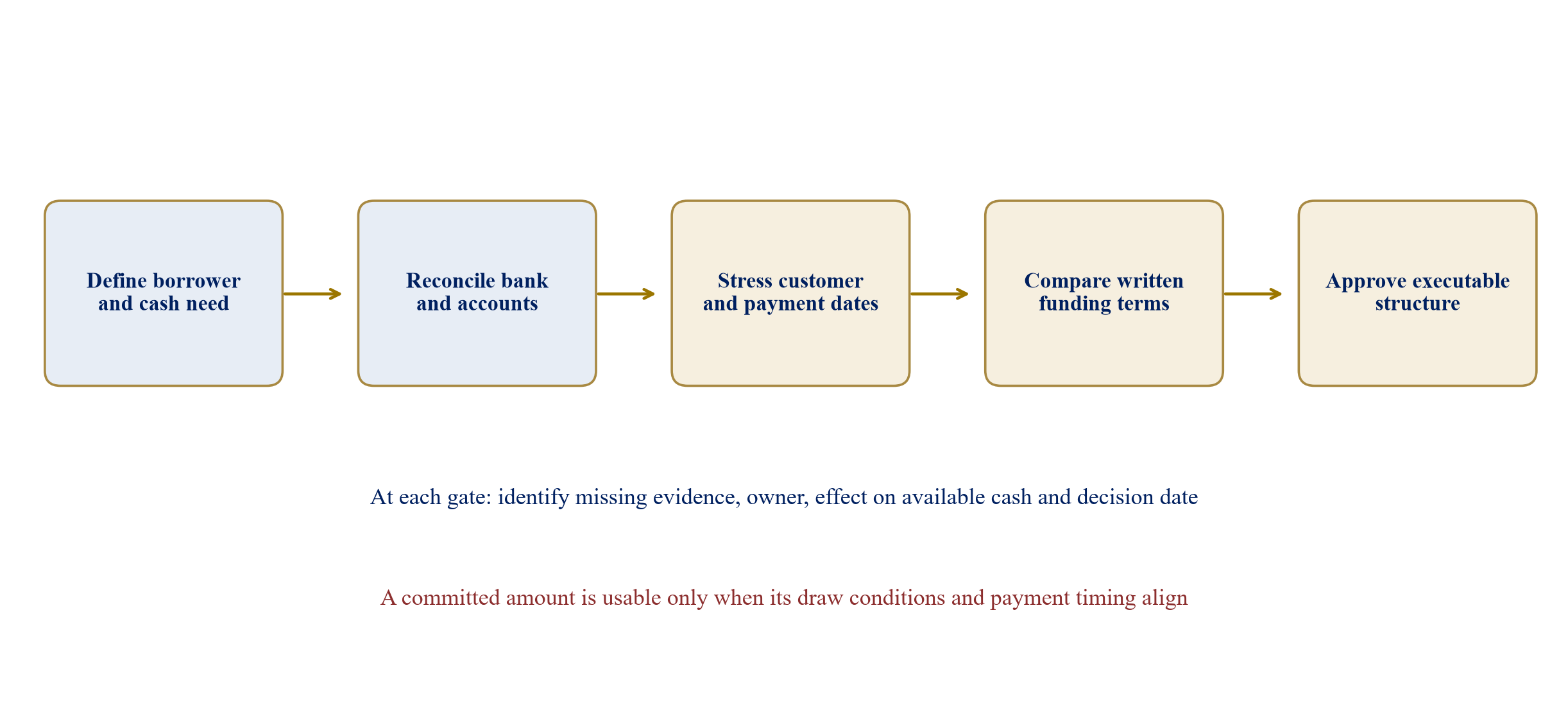
Author-developed workflow. Time bands are illustrative; they are not observed GCC transaction durations.
21 Board decision record and limitations
A board paper should show the proposed cash need, borrower entity, lowest monthly liquidity, base and downside debt capacity, binding constraint, funding gap, and terms still awaiting evidence. It should include the customer concentration map, adjustment register, source documents and version number. Where two advisers disagree, the record should identify the precise line item or contractual definition. A statement that 'the banks are comfortable' is not a substitute for a written term, credit approval or available draw. The board should know which assumptions could invalidate the plan after a delay of one month.
The fictional case demonstrates how one concentrated-customer event can move an annual DSCR screen from approximately AED 42.4 million of mathematical capacity to AED 15.9 million. The example assumes a particular margin, lost work, cash delay, tax, capex, working-capital investment, rate, amortisation and minimum coverage. Changing any of them changes the result. The scenario does not describe an actual company or predict that a lender will size debt at either amount. It does not model monthly payment dates, legal restrictions, borrowing-base eligibility or all tax and accounting effects. Those omissions must be resolved for a live mandate.
Source boundaries also matter. UAE credit-risk rules apply to the licensed institutions within their scope; the comparative Basel and EBA material is not a loan offer. IAS 7 and IFRS 7 explain accounting and disclosures, not enforceability of a specific receivable. Contract evidence, lawful data access, lender policy, local legal advice, tax advice and the executed documents determine a real transaction. The framework helps organise those inputs and makes the assumptions contestable. It cannot guarantee approval, an amount, a price or a future ability to refinance.
22 Conclusion: make cash quality visible
The useful lending-capacity number is the one that survives a dated evidence and repayment test. Reported EBITDA, operating cash flow, available bank cash and future debt-service cash answer different questions. The borrower should bridge them, identify each adjustment, and trace material customer dependencies through margin, billing, collections and working capital. It should then model the actual payment calendar and select the lowest binding funding constraint before comparing debt with equity or a hybrid structure.
The fictional case shows why that order changes a decision. Under its invented terms, AED 35 million of term debt appears serviceable in a simple annual base case and fails a specified customer stress. A smaller facility plus another source of capital is a possible response, subject to real offers and governance costs. The result is not a claim that every concentrated borrower should borrow less. It is a demonstration that a board can see precisely which evidence and shock determine its financing choice.
For the borrower, the work product is a reproducible cash bridge, a counterparty dependency map and an executable funding plan. For the lender, it is a cleaner record of repayment sources, downside resilience and missing evidence. Both parties can test the same facts rather than negotiate from different EBITDA labels. When the customer's cash behaviour or the facility terms change, the model should be updated and the decision record preserved. That is the practical meaning of putting cash flow under the microscope.
References
- Central Bank of the UAE. Credit Risk Management Standards, C 3/2024 STA, effective 30 November 2024, official rulebook; accessed 6 October 2026. https://rulebook.centralbank.ae/en/rulebook/credit-risk-management-standards
- Basel Committee on Banking Supervision. Principles for the Management of Credit Risk, 30 April 2025, official BIS publication. https://www.bis.org/publications/202504-guidelines-principles-management-credit-risk
- European Banking Authority. Guidelines on loan origination and monitoring, EBA/GL/2020/06, official guidelines page and consolidated document; accessed 6 October 2026. https://www.eba.europa.eu/activities/single-rulebook/regulatory-activities/credit-risk/guidelines-loan-origination-and-monitoring
- IFRS Foundation. IAS 7 Statement of Cash Flows, official standard overview; accessed 6 October 2026. https://www.ifrs.org/issued-standards/list-of-standards/ias-7-statement-of-cash-flows.html/
- IFRS Foundation. IFRS 7 Financial Instruments: Disclosures, official standard overview; accessed 6 October 2026. https://www.ifrs.org/issued-standards/list-of-standards/ifrs-7-financial-instruments-disclosures/
- IFRS Foundation. Supplier Finance Arrangements, amendments to IAS 7 and IFRS 7 issued May 2023, official explanatory webcast. https://www.ifrs.org/projects/completed-projects/2023/supplier-finance-arrangements/webcast-supplier-finance-arrangements/
- IFRS Foundation. IFRS 15 Revenue from Contracts with Customers, issued standard, paragraph 107 on contract assets and receivables. https://www.ifrs.org/content/dam/ifrs/publications/pdf-standards/english/2024/issued/part-a/ifrs-15-revenue-from-contracts-with-customers.pdf?bypass=on
- Central Bank of the UAE. Credit Risk Management Regulation, C 3/2024, effective 30 November 2024, official rulebook; accessed 6 October 2026. https://rulebook.centralbank.ae/en/rulebook/credit-risk-management-regulation
- Central Bank of the UAE. Article 5, Credit Underwriting, Credit Risk Management Regulation, official rulebook; accessed 6 October 2026. https://rulebook.centralbank.ae/en/rulebook/article-5-credit-underwriting
- Basel Committee on Banking Supervision. General credit risk management, consolidated guidelines, section CRI10, official BIS page; accessed 6 October 2026. https://www.bis.org/committees/bcbs/basel-consolidated-guidelines/module/cri/10
About the Author
Chennakeshav (CK) is a corporate finance and investment banking executive with 25+ years of global experience in deal origination, structuring and execution across M&A, growth capital and corporate strategy. He has led value-creation mandates for founders, corporates and funds — bridging the boardroom view to hands-on execution and close.
His career spans Morgan Stanley, HSBC, Lloyds Banking Group, EWEC, ADQ portfolio companies and Emirates Growth Fund, across TMT, real estate, fintech, deeptech, cleantech, infrastructure and energy. He has partnered with C-suite leaders, private equity and venture funds, sovereign wealth funds and family offices to finance complex fund raises and scale-up ventures, and has led M&A due diligence, post-merger integration and business-transformation initiatives to create value.
At Matchpoint Partners he is Managing Partner, leading the firm's corporate finance, M&A and capital-raising practice. He holds an MBA from London Business School, an engineering degree from VTU and a Master of Laws (LLM, in progress) from UCL London.
An active start-up mentor, CK mentors at Techstars, DIFC FinTech Hive, Startup Grind, Founder Institute and IN5, serves as Entrepreneur Mentor in Residence (EMiR) at London Business School, and judges the Entrepreneurship World Cup.
