

1. The decision facing buyers and producers
Cement producers considering carbon capture face a commercial gap. The capture unit, compression equipment and connections to transport and storage require capital before a broad market for near-zero-emissions cement has matured. Buyers can signal demand, yet a non-binding statement of intent does not pay operating cost or service debt. The central decision is how to convert procurement demand into contracted cash flow.
The answer requires both product design and transaction design. The product must meet structural, durability and emissions requirements. The transaction must identify who pays, which tonnes qualify, when the obligation begins, how long it lasts and what happens when a project is delayed. A procurement commitment that omits these points can support strategy; it cannot be treated as base-case project revenue.
2. Why capture creates a distinct premium question
Cement emissions arise from fuel use and from calcination, the chemical conversion of limestone into clinker. Efficiency, alternative fuels, lower clinker ratios and new binders can reduce emissions. Deep decarbonisation of conventional clinker production is likely to require capture for a material share of residual process emissions. Capture adds energy demand, maintenance, transport and permanent-storage cost.
The IEA's 2025 Breakthrough Agenda analysis estimates that production costs at early commercial plants using carbon capture could be 75 to 150 per cent higher than at conventional plants, with variation by region. That range is evidence of the challenge, not a price forecast for any plant. A financeable case needs site-specific engineering, energy, storage, policy and utilisation assumptions.
3. The buyer is often several contracts away
An infrastructure owner may appoint a design-and-build contractor. The contractor buys concrete from a ready-mix supplier, which buys cement or clinker from a producer. The capture asset sits at the producer's plant, while the emissions target may sit in the owner's procurement documents. Value can leak between these layers through fixed-price contracts, substitutions, change orders and competing specifications.
The procurement architecture should trace the premium from owner to contractor, supplier and producer. Each contract needs aligned definitions, evidence, payment timing and remedies. The producer should know the qualifying volume and cash it can rely on. The owner should know that its payment procures verified emissions performance rather than a general corporate claim.
4. Current demand signals
The World Economic Forum's First Movers Coalition asks participating construction and engineering companies, and real-estate developers, to procure at least ten per cent by volume of near-zero cement or concrete annually by 2030. Its 2024 status report uses a threshold below 184 kilograms of carbon-dioxide equivalent per tonne of cement and recognises carbon capture as an eligible pathway.
UNIDO's Industrial Deep Decarbonisation Initiative coordinates public-procurement pledges for low- and near-zero-emissions steel, cement and concrete. Its approach progresses from disclosure and target setting toward required procurement and whole-project life-cycle assessment. These initiatives demonstrate organised demand creation. They do not establish that any specific producer has contracted bankable revenue.
5. A threshold is more useful than a technology label
Buyers should procure measured performance. A specification framed solely as "carbon-captured cement" can exclude other efficient routes or reward a capture unit that operates below expectations. A threshold expressed in kilograms of carbon-dioxide equivalent per functional unit allows different plants and technologies to compete, subject to comparable accounting and technical performance.
The functional unit matters. Cement, concrete and a completed structure are not interchangeable units. Procurement should state the life-cycle modules, allocation rules, electricity treatment, transport boundary and verification standard. It should also state whether performance is assessed at product, batch, project or portfolio level.
6. Environmental product declarations as the evidence layer
An environmental product declaration provides third-party-verified information calculated under a product-category rule. It can support comparisons when products use compatible rules, boundaries, data quality and validity periods. The US Environmental Protection Agency's low-embodied-carbon programme emphasises improved product-category rules, threshold setting and labels to help purchasers identify qualifying materials.
An EPD is evidence, not a payment mechanism. The contract must define the acceptable programme operator, product specificity, plant coverage, version, audit rights and treatment of expired or revised declarations. It should address discrepancies between design-stage estimates and delivered-product results.
7. The procurement-to-finance chain
The following map shows the parties and evidence needed to connect a buyer's requirement to a capture asset's cash flow. Every arrow represents a contract, an evidence transfer or a payment obligation. Missing links create basis risk for the producer and reputational risk for the buyer.
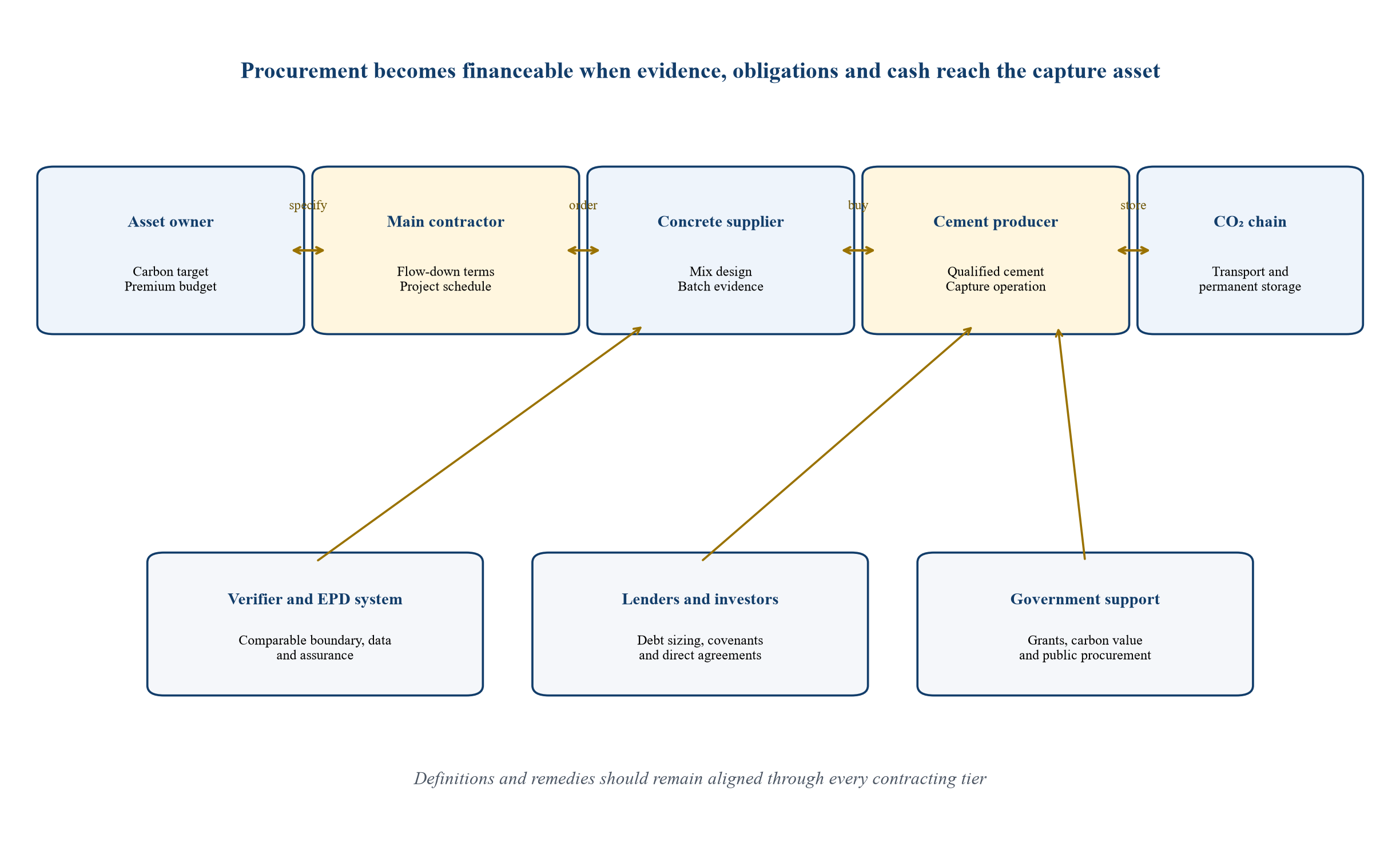
Generic structure. Actual procurement, ownership, regulation and security depend on the project and jurisdiction.
8. Commitment types and their financing value
Different instruments create different credit quality. A policy target can expand the addressable market. A tender requirement can create a project opportunity. A framework agreement can establish terms. A minimum-volume offtake with credit support can create forecast cash. Lenders will discount instruments with broad termination rights, discretionary annual budgets or unfulfilled conditions.
Table 1. Procurement instruments and indicative financing relevance
| Instrument | Buyer obligation | Producer visibility | Principal weakness | Typical financing relevance |
|---|---|---|---|---|
| Policy aspiration | None at project level | Directional | Can change or remain unfunded | Market context only |
| Tender threshold | Applies to a bid | Project-specific | Award and project timing uncertain | Pipeline evidence |
| Preferred-supplier framework | Ordering route | Partial | No assured call-off | Limited contracted value |
| Advance purchase commitment | Future qualifying volume | Stronger if binding | Technology and delivery conditions | Can support development and scale-up |
| Minimum-volume offtake | Pay or purchase obligation | High | Requires matched supply and remedies | Potential base-case revenue |
| Portfolio procurement commitment | Aggregate annual requirement | Diversified | Allocation across projects may vary | Useful with nomination rules |
| Contract for difference or public support | Defined price support | Policy-backed | Eligibility and appropriation risk | Can complement buyer revenue |
General framework. Financing treatment depends on exact legal terms, counterparty credit and project conditions.
9. Minimum volume and duration
A capture plant carries fixed cost even when product demand is weak. A commitment should therefore establish a minimum qualifying volume or minimum payment over a duration aligned with debt tenor and operating ramp-up. Annual percentages alone can be insufficient when the buyer's total construction volume changes.
The contract can combine a fixed capacity payment with a variable product premium. The fixed element contributes to capital recovery and readiness. The variable element pays for delivered qualifying material. Availability deductions protect the buyer, while deemed-delivery provisions protect the producer when the buyer fails to nominate committed volume.
10. Price architecture
A single fixed premium is simple and can become uneconomic when energy, carbon transport or storage costs change. A fully pass-through structure protects the producer and reduces the incentive to improve efficiency. A balanced design separates controllable and uncontrollable costs, applies transparent indices, sets review periods and includes sharing mechanisms.
The base price should remain comparable with conventional product. The decarbonisation premium should identify the added environmental attribute and evidence. Taxes, carbon prices, public subsidies and transferable certificates need explicit treatment to avoid double recovery or unexpected value transfer.
11. Who should pay the premium
The asset owner is often best placed to value whole-project carbon performance and approve a budget. The contractor controls procurement and schedule. The concrete supplier controls the mix. The cement producer controls kiln and capture operations. Payment can be divided across this chain, although accountability should stay clear.
A direct tripartite agreement can reduce leakage. The owner commits the environmental premium; the contractor integrates delivery; the producer provides qualifying material and evidence. Direct payment or escrow may be appropriate where the premium is intended to support capture financing. Conventional material payments can continue through the ordinary supply chain.
12. Premium incidence across the project
A cement-gate premium can sound large when expressed as a percentage of cement price. Its impact can be smaller per cubic metre of concrete and smaller again as a share of total construction cost. The conversion depends on cement content, concrete specification, material prices, logistics, wastage and the share of concrete in the project budget.
This incidence should be calculated before procurement targets are set. Buyers can compare the cost per tonne of emissions avoided with design changes and alternative materials. Producers can test whether the premium reaches capture cash needs. Neither party should rely on a percentage without translating it through the bill of quantities.
13. Hypothetical cost-performance benchmark
The benchmark below illustrates a consistent comparison. It is not a market quotation or engineering estimate. Each project requires supplier bids, verified EPDs and technical review.
Table 2. Hypothetical cost-performance benchmark for procurement design
| Route | Product emissions index | Cement-gate cost index | Indicative readiness | Procurement role |
|---|---|---|---|---|
| Conventional reference | 100 | 100 | Commercial | Baseline only |
| Optimised clinker factor and fuels | 75 | 104 | Commercial where inputs available | Immediate portfolio reduction |
| Calcined-clay or alternative-binder blend | 55 | 112 | Commercial or scaling by market | Performance-based specification |
| Partial capture retrofit | 38 | 145 | Demonstration to early commercial | Staged commitment with milestones |
| High-rate capture and permanent storage | 18 | 185 | First commercial in selected markets | Long-duration premium plus support |
| Novel near-zero route | 10 | 215 | Pilot to early commercial | Advance market commitment |
Illustrative assumptions only. Currency units are generic. Performance and cost vary materially by plant, mix, energy, transport, storage and jurisdiction.
14. Technology readiness and procurement readiness
Technology readiness asks whether a process works at the required scale. Procurement readiness asks whether a buyer can specify, verify and receive the product within its project schedule. A technology can be physically mature and commercially unavailable in a region. A promising pilot can have a buyer commitment but remain unsuitable for base-case delivery.
The two dimensions should be assessed separately. Near-term tenders can use proven lower-emissions mixes. Advance commitments can support capture and novel routes with later delivery. A portfolio can combine both, preventing a single technology schedule from controlling every project.
15. Readiness curve
The figure positions common interventions qualitatively. Placement is indicative and should be replaced by supplier and project evidence. Procurement should match the contractual instrument to the maturity and abatement potential of the route.
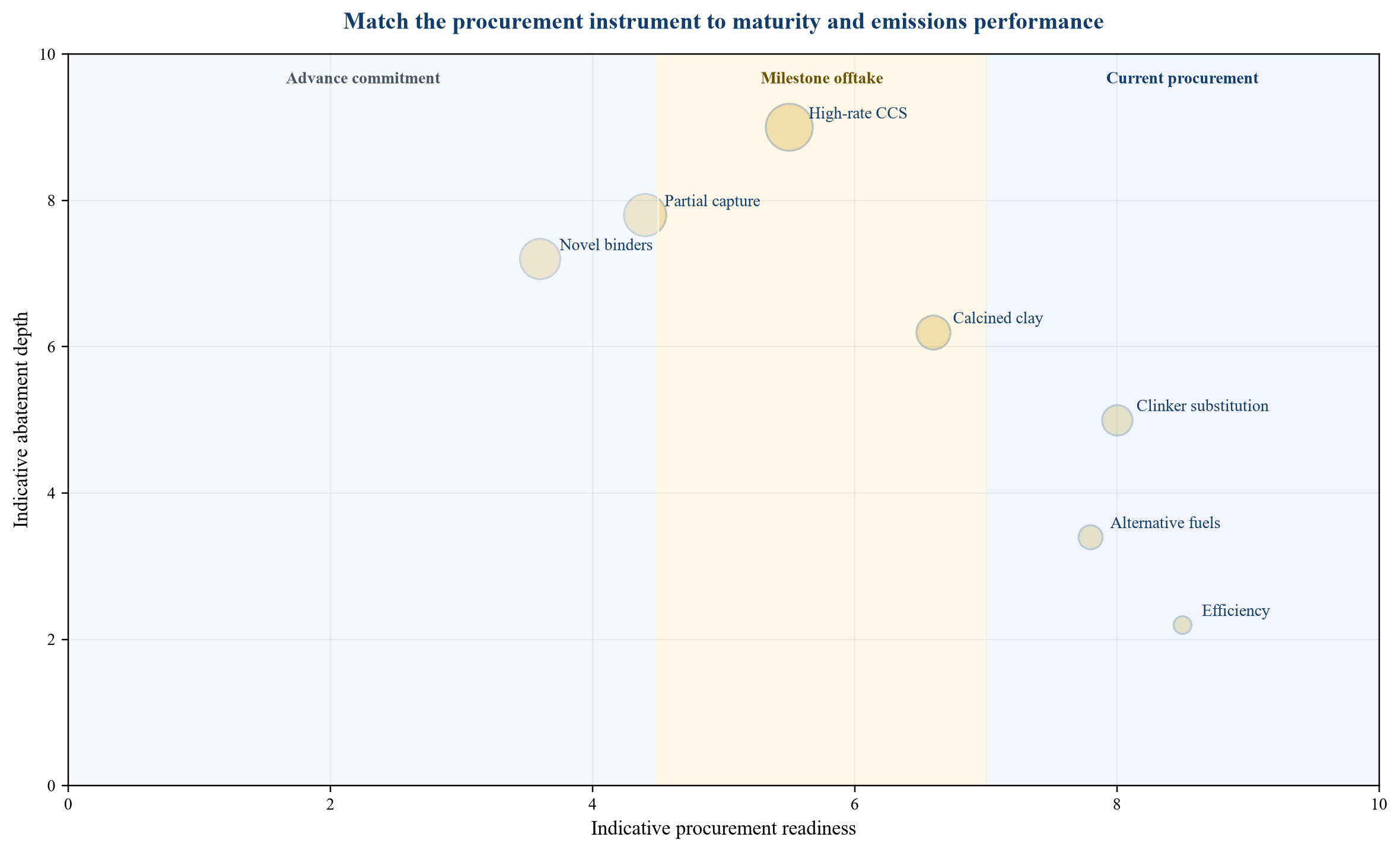
Qualitative decision map. Positions are illustrative and vary by region, plant, feedstock, engineering and product standard.
16. Capture performance must be measured
Nameplate capture rate does not equal product emissions. The calculation should include actual capture availability, steam and electricity emissions, compression, transport losses and storage. It should also identify how emissions are allocated among clinker, cement and co-products.
Contracts can use an annual performance band with batch-level evidence for procurement. A temporary outage may raise product emissions above the threshold. The parties need rules for substitution, banking, make-up volume and price adjustment. Persistent underperformance should trigger cure rights and, ultimately, termination or replacement.
17. Additionality and attribute ownership
A buyer paying a premium expects a credible claim. The contract should state whether the buyer owns the product-level environmental attribute, whether the producer may count the same reduction toward another programme and how regulatory compliance value is treated. Double claiming can undermine both reporting and financing.
Additionality should be described carefully. A premium may accelerate a project, increase utilisation or secure qualifying allocation. It may coexist with grants, carbon pricing and regulation. The evidence should show the buyer's contracted contribution without claiming sole causation where public and producer capital also support the asset.
18. Mass balance and book-and-claim
Physical segregation may be expensive in integrated plants and distribution networks. Mass-balance systems allocate verified lower-emissions production across customers within defined boundaries. Book-and-claim systems separate the environmental attribute further from physical delivery. Both can expand access, and both require robust rules.
Buyers should specify the chain-of-custody model, geographic boundary, issuance, retirement, audit and prohibition on duplicate allocation. Lenders should confirm that attribute sales remain compatible with product offtake, carbon regulation and subsidy conditions. Physical delivery may command stronger acceptance in early markets.
19. Project delay and nomination risk
Construction schedules move. A buyer can miss its committed call-off because planning, financing or site works are delayed. The producer can miss supply because capture commissioning is late. A balanced contract distinguishes buyer delay, producer delay, force majeure and wider carbon-chain interruption.
Nomination windows and rolling forecasts help coordinate production. Minimum payments can step up as confidence increases. Transfer rights can allow the buyer to nominate another qualifying project. The producer can redirect volumes subject to priority rights. Termination payments should reflect committed capital and reasonable mitigation.
20. Credit support
Long-duration commitments are only as strong as the obligor. A special-purpose project company may have limited credit before construction finance closes. Parent guarantees, letters of credit, escrow, milestone deposits, public guarantees or pooled procurement can improve reliability.
Credit support should cover the exposure created by the contract, including capacity reservation and unrecovered dedicated capital. It can decline as the producer recovers investment or as the buyer takes delivery. Lenders will test enforceability, expiry, renewal and interaction with project-finance security.
21. Aggregating multiple buyers
One buyer may not need enough cement to support a capture project. A buyers' club or procurement platform can aggregate demand across infrastructure, property and public works. Standard definitions and contract terms lower transaction cost and give producers a clearer pipeline.
Aggregation creates governance questions. Participants need allocation rules when supply is scarce, confidentiality protections, credit standards and a process for replacing a defaulting member. The platform should distinguish binding volume from expressions of interest and publish only verified aggregate data.
22. Public procurement as an anchor
Governments are major buyers of infrastructure and buildings. UNIDO reports that public procurement represents a material share of global construction revenue and positions it as a lever for low-emissions cement and concrete. Public projects can provide volume, visibility and standard-setting.
Public contracts face budget, tender, competition and appropriation constraints. Evaluation should reward measured performance while preserving fair access. Multi-year commitments may require framework structures or legislative authority. Payment terms should accommodate the producer's working-capital needs without weakening public accountability.
23. Performance-based specifications
Prescriptive standards can unintentionally lock in high-emissions recipes by requiring minimum cement content or familiar constituents. Performance-based specifications focus on strength, durability, workability and exposure conditions while allowing alternative mixes. EPA procurement resources identify performance-based specifications as a way to facilitate proven lower-carbon innovation.
Change requires engineer, insurer and authority acceptance. Trials, curing data and quality controls should precede critical applications. Procurement teams need enough lead time for approvals. The carbon threshold should never override structural safety or service-life requirements.
24. Regional supply and logistics
Cement is heavy and often traded regionally. A qualifying product may be unavailable within economic transport distance. Imports can add shipping emissions, customs, storage and schedule risk. A global commitment therefore needs regional implementation plans.
Buyers should map plants, terminals, grinding facilities, ready-mix networks and capture projects against the construction pipeline. A portfolio target can use different routes by region while retaining a common accounting framework. Local supplier development may create more durable emissions reduction than one-off long-distance procurement.
25. Carbon transport and storage dependency
Captured carbon has value only when transport and permanent storage operate. A cement producer may depend on third-party pipelines, shipping, terminals and storage permits. Procurement contracts should address interruption outside the kiln gate and define the emissions treatment of captured material awaiting transport.
The producer's project-finance package should include firm capacity, product specifications, metering, liability allocation and direct agreements across the chain. Buyer remedies should be matched to rights against infrastructure providers where possible. Unmatched exposure needs reserves, insurance or sponsor support.
26. Capital stack interaction
Buyer premiums rarely operate alone. A first-commercial capture project may combine sponsor equity, senior debt, grants, tax support, carbon-price value and product premiums. Each source should pay for a defined risk or output. The model should prevent double counting and test expiry dates.
Premium revenue can improve debt capacity when it is contracted, creditworthy and durable. Grants reduce upfront capital. Carbon-price value can support variable revenue but may be volatile. Public guarantees can address technology or completion risk. Equity absorbs residual uncertainty and benefits from upside.
27. Scenario valuation
The figure shows a hypothetical bridge from a conventional cement price to a capture-enabled revenue stack. It also illustrates the dilution of a cement-level premium when translated to concrete and whole-project cost. The values are generic indices and are not market data.
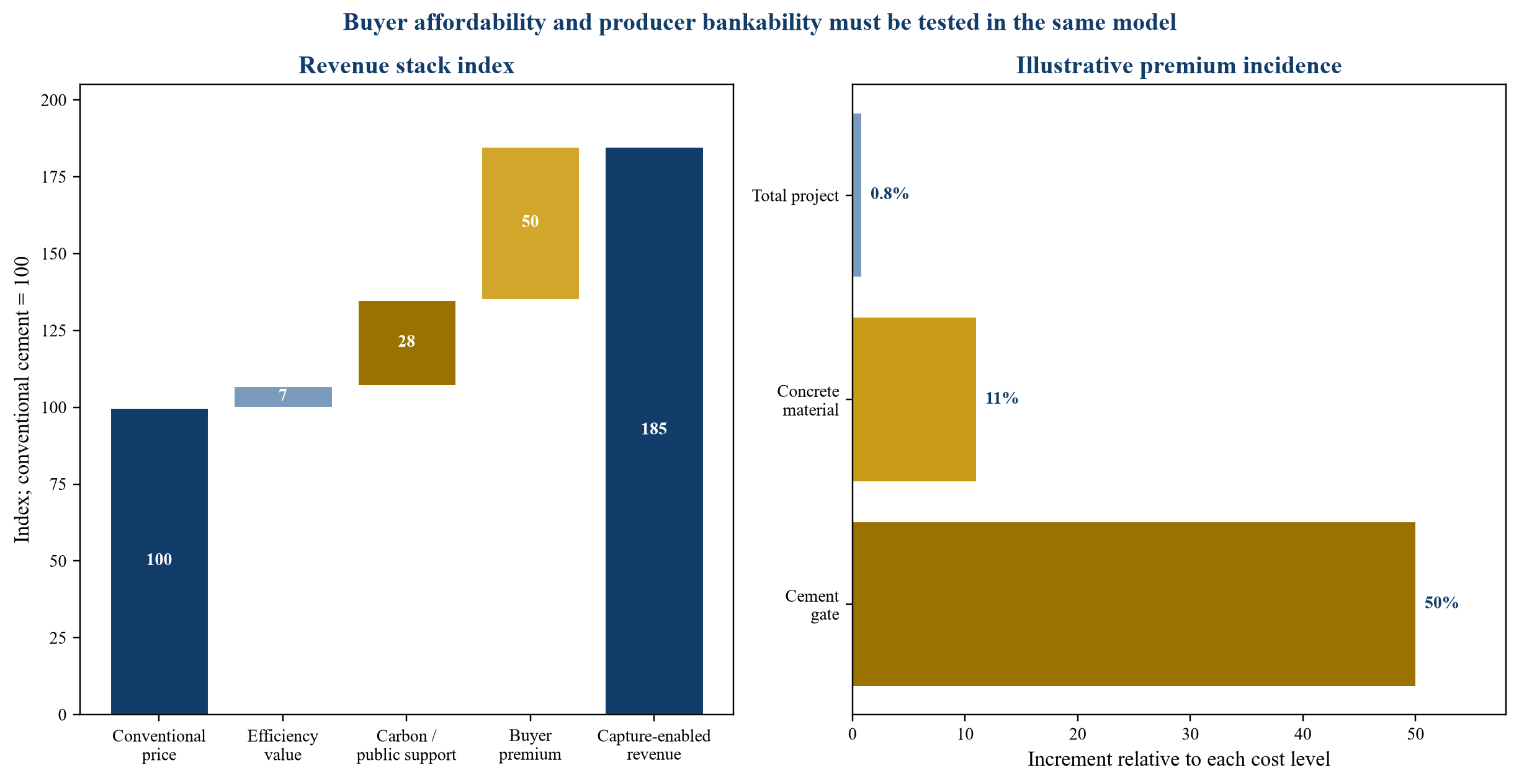
Illustrative indices only. The example assumes that cement represents a limited share of concrete and total project cost; actual incidence requires a project bill of quantities.
28. Debt sizing
Lenders will size debt against conservative contracted cash flow after operating cost, maintenance, taxes and required reserves. They will apply haircuts to volume above firm commitments and to premiums that expire before debt maturity. Capture availability and carbon-chain interruption require downside cases.
The model should test debt-service coverage under delayed ramp-up, lower capture rate, energy inflation, storage outage, buyer default and EPD disqualification. It should also test recovery through substitute buyers, public support and reserve accounts. A resilient case avoids dependence on a single favourable assumption.
29. A hypothetical financing case
Consider a retrofit with indexed total cost of 300, funded by 120 of equity, 120 of senior debt and 60 of grants. Conventional product revenue supports ordinary plant operations. The capture case adds carbon value and a buyer premium. Firm commitments cover sixty per cent of qualifying volume at start-up and rise after performance testing.
This case can support debt only if fixed or minimum revenue covers downside debt service and essential capture operating cost. Merchant premium assumptions should sit outside the base case. The model should show the premium required at each committed-volume level and the maximum premium buyers can absorb through their project budgets.
30. Sensitivity priorities
The most useful sensitivities vary one commercial driver at a time and then combine correlated stress. Volume, premium, capture availability, energy, transport-and-storage tariff and project delay deserve priority. Carbon price and grant timing can also be material.
Management should identify break-even premium, minimum contracted volume and covenant headroom. Buyers should see the resulting project-cost impact. This shared sensitivity map can support negotiation by showing which risks require price and which can be managed through scheduling, reserves or contractual flexibility.
A correlation case is essential because several adverse variables may move together. A capture outage can reduce qualifying volume while increasing unit energy and maintenance cost. A construction slowdown can reduce buyer nominations while weakening counterparty credit. A transport interruption can delay storage and force plant curtailment. The financing model should apply realistic combinations rather than treating every sensitivity as independent.
The committee should review three explicit cases. The contracted case uses only enforceable minimum payments and conservative availability. The operating case reflects expected nominations and scheduled maintenance. The upside case includes additional buyers, efficiency gains and debottlenecking. Debt capacity should rest on the contracted case; equity value can recognise the other cases with appropriate probability and timing.
Premium affordability should also be stressed against project economics. A developer may accept a low percentage increase in total construction cost, yet a contractor operating on a narrow margin may resist an unreimbursed material increase. The payment mechanism should protect the party that places the order and prevent the environmental premium from becoming a working-capital burden.
31. Commercialisation roadmap
The move from intent to finance should be staged. Early work creates definitions and a buyer coalition. The next stage executes conditional commitments and supplier trials. Final investment follows binding offtake, verified engineering, permits and a complete transport-and-storage chain.
Table 3. Commercialisation roadmap for buyer-supported cement capture
| Stage | Buyer action | Producer action | Financing evidence | Gate to proceed |
|---|---|---|---|---|
| 1. Market design | Define threshold, geography and expected volume | Screen abatement routes and plants | Addressable demand and preliminary cost | Common product definition |
| 2. Qualification | Amend specifications and trial products | Produce samples, EPDs and performance data | Verified product and delivery pathway | Technical acceptance |
| 3. Conditional commitment | Sign volumes subject to milestones | Complete engineering and carbon-chain contracts | Credible conditional cash flow | Permits and bankable allocation |
| 4. Binding offtake | Provide minimum payment and credit support | Commit capacity, price and remedies | Base-case revenue for lenders | Financial close |
| 5. Delivery and assurance | Nominate projects and pay against evidence | Operate capture and deliver qualifying product | Audited performance and covenant reporting | Sustained compliance |
| 6. Scale and renewal | Expand portfolio commitment | Debottleneck and replicate | Operating history and lower risk premium | Competitive expansion |
Indicative sequence. Activities can overlap, and final investment remains subject to project-specific approvals and diligence.
32. Governance and decision rights
A cross-functional steering group should include procurement, engineering, finance, sustainability, legal and project delivery. It needs authority to approve thresholds, supplier qualification, premium budgets and exceptions. The producer needs equivalent governance across plant, capture, commercial and financing teams.
Decision rights should be documented before tenders launch. Procurement cannot promise a premium without budget authority. Sustainability cannot certify engineering performance. Finance cannot count conditional volume as contracted revenue without legal review. Integrated governance reduces inconsistent commitments.
33. Data room for the producer
The producer's financing data room should include engineering design, capture guarantees, energy balances, permits, transport and storage contracts, construction plan, operating model, EPD methodology, product trials, offtake agreements, credit support and the integrated financial model.
Evidence should reconcile. Capture throughput must match eligible product volume. Storage capacity must support captured tonnes. Premium revenue must map to contracted buyers. Grant milestones must align with construction. Any divergence should appear in the risk register and downside model.
34. Data room for the buyer
The buyer should retain procurement policy, approved carbon threshold, project pipeline, bill-of-quantities assumptions, technical specifications, supplier diligence, EPDs, chain-of-custody records, delivery tickets, invoices and claims guidance. This supports audit and prevents unsupported environmental statements.
Portfolio reporting should distinguish contracted, ordered, delivered and verified volumes. It should state the accounting boundary and avoid aggregating incompatible metrics. Public claims should be reviewed against actual retired attributes and project evidence.
The buyer should also document how the product was selected. Tender records should show the technical requirement, emissions threshold, evaluation method, premium approval and treatment of competing bids. Where a negotiated award supports a first-commercial plant, the file should explain the commercial rationale and applicable procurement authority. This evidence supports governance, audit and future replication.
Delivery data should reconcile purchase orders, batch tickets, plant certificates, EPD coverage and project installation. Exceptions should be logged by quantity and cause. If a substitute product is used, the system should preserve the original commitment and show whether make-up volume remains due. Finance should reconcile premium invoices with verified qualifying quantities before payment.
Claims records should identify the exact statement approved for each project and reporting period. They should contain the evidence available at the time, the calculation owner, assurance status and any limitations. A correction process should exist for revised EPDs, data errors or attribute conflicts. This discipline protects the value of the procurement programme as it scales.
35. Legal drafting priorities
Core definitions include qualifying product, baseline, threshold, EPD, delivery point, committed volume, premium, environmental attribute and permanent storage. Operative clauses should cover nomination, testing, verification, payment, change in law, force majeure, substitution, audit, claims, liability and termination.
Direct agreements may give lenders notice, cure and assignment rights. Buyers should preserve supply continuity and technical recourse. Governing law and dispute resolution must fit the contract chain. Competition counsel should review buyer aggregation and information sharing.
The agreement should distinguish failure to deliver physical product from failure to deliver the environmental attribute. Structural performance can remain acceptable even when capture is unavailable. The buyer may accept the product at the conventional price while rejecting the premium, or it may require substitute qualifying supply. The selected remedy should reflect project schedule, technical approvals and the purpose of the commitment.
Change-in-law drafting should address carbon-price rules, product standards, public subsidies, accounting methodologies and import requirements. A change can alter cost, eligibility or claim value. The contract should define thresholds for renegotiation, evidence requirements and termination rights. Automatic pass-through should apply only to identified items that neither party controls.
Confidentiality should allow disclosure to lenders, verifiers, regulators and auditors while protecting plant cost and customer information. Assignment provisions should accommodate project financing and corporate reorganisation without weakening buyer credit or technical accountability. Survival clauses should preserve audit, claims and attribute-retirement obligations after delivery.
36. Avoiding green-claims risk
Claims should state what was purchased and measured. A buyer can report verified product emissions and quantities within a stated boundary. Claims about project causation or economy-wide neutrality require additional evidence. The producer should avoid implying that every product from a plant has the same attributes when allocation is limited.
Marketing language should follow the contract and EPD. Assurance should cover material data and allocation. Corrections and restatements need a process. Transparent limitations can increase credibility with investors, customers and regulators.
37. Emerging-market application
Emerging markets may have strong infrastructure demand and newer efficient kilns, alongside higher capital cost, limited storage networks and less mature EPD systems. Procurement commitments can support supplier investment when they are paired with technical assistance, concessional capital and credible public projects.
Imported standards should be adapted to local materials, codes and data. Capacity building for laboratories, programme operators and public buyers may be as important as the premium. Regional aggregation can create scale for capture transport and storage.
38. What boards should approve
A buyer board should approve the emissions objective, qualifying methodology, premium envelope, target volume, credit exposure and claims policy. A producer board should approve the capture capital case, minimum contracted revenue, technology and completion risks, carbon-chain dependencies and funding plan.
Both boards should receive a common bridge from premium per tonne of cement to project cost and emissions outcome. This prevents discussions based on incomparable percentages. Approval should be conditional on diligence items with named owners and deadlines.
The buyer's approval paper should separate three budgets. The first is the ordinary cost of cement, concrete and construction. The second is the incremental amount paid for verified environmental performance. The third covers internal implementation, assurance and reporting. This separation allows management to see whether the premium is reaching the industrial asset or being absorbed by administration and contractual margins. It also supports consistent treatment across projects.
The producer's approval paper should show the premium required under different capture utilisation levels. A plant that operates below planned throughput can face higher unit cost even if the capture equipment performs technically. The board should understand the relationship among committed product volume, captured tonnes, storage access and fixed operating cost. It should approve a minimum commercial threshold before accepting delivery obligations.
39. Investment committee checklist
The investment committee should confirm that the product threshold is measurable, the buyer obligation is enforceable, the premium reaches the capture asset, the volume and duration support downside debt service, and transport and storage capacity are firm. It should verify engineering interfaces, permits, credit support and direct agreements.
It should also review the merchant case separately, test subsidy expiry, confirm attribute ownership and scrutinise change-of-law exposure. A positive market narrative cannot replace these gates. The final memorandum should show each open condition and its effect on funding.
Commercial diligence should reconcile the construction pipeline with the product delivery curve project by project. Announced developments, preliminary budgets and non-binding sustainability targets should remain outside committed volume. The base case should include only projects with an enforceable nomination route and sufficient schedule confidence. The downside case should remove the largest buyer and apply delays across correlated projects.
Technical diligence should confirm that the emissions threshold remains achievable after accounting for energy, transport and storage. It should review the measurement plan, EPD update cycle, capture degradation, planned outages and the consequences of feedstock changes. Legal diligence should trace every key term through the buyer, contractor, concrete supplier and cement producer agreements.
The committee should require a conditions-precedent schedule that links contracts to capital deployment. Early development spending may proceed against conditional commitments. Major equipment awards should follow a defined level of engineering and procurement coverage. Debt drawdown should require binding offtake, approved credit support, permits, completion security and an effective transport-and-storage package.
40. Conclusion
Buyers can contribute meaningfully to the cost of cement capture when procurement commitments are designed as financeable contracts. The strongest structures define a comparable emissions threshold, verified evidence, committed volume, duration, credit support and matched remedies through the construction supply chain.
The premium question should be answered at three levels: producer cash flow, concrete cost and total project cost. This translation can reveal affordability that a cement-gate percentage obscures. It can also expose cases where buyer payments remain insufficient and public support or carbon value must close the gap. The practical goal is a revenue stack that rewards measured abatement and survives project delay, plant underperformance and counterparty stress.
Implementation should begin with a small number of representative projects and suppliers. The parties can validate specifications, evidence transfer, payment and claims before scaling the commitment. A controlled first programme produces operating data that can reduce risk premiums in later contracts. It also exposes regional constraints, including material availability, laboratory capacity, logistics and approval lead times.
The commercial model should remain open to technology improvement. Thresholds can tighten over time, subject to availability and technical acceptance. Price-review mechanisms can share verified cost reduction with buyers while preserving returns needed for efficient operation. Renewal decisions should use delivered emissions, reliability and audited cost evidence rather than the original development case.
An annual review should compare contracted and delivered volumes, product emissions, premium expenditure, capture utilisation, storage performance and claims made. Variances should be assigned to a named commercial or technical owner. The review should decide whether to renew, expand, reprice or reduce the programme. Published results should use verified data and explain boundaries, allocation methods and material limitations.
Procurement and finance teams should manage the commitment as one system. Procurement determines whether qualifying demand exists. Finance determines whether that demand supports capital. Engineering determines whether the product and capture chain can perform. Assurance determines whether the environmental result can be claimed. Coordinated decisions across these functions turn ambition into an investable contract.
References
- World Economic Forum. First Movers Coalition Status Report 2024. https://www3.weforum.org/docs/WEF_First_Movers_Coalition_Status_Report_2024.pdf
- World Economic Forum. First Movers Coalition Cement and Concrete Procurement Guide. 2024. https://www3.weforum.org/docs/WEF_First_Movers_Coalition_Cement_Concrete_Procurement_Guide_2024.pdf
- World Economic Forum. First Movers Coalition commitments. 2024. https://www.weforum.org/press/2024/01/wef24-first-movers-coalition-commitments/
- World Economic Forum. Decarbonization through demand. 2025. https://www.weforum.org/stories/climate-action/first-movers-coalition-decarbonization-through-demand/
- International Energy Agency. Cement and concrete; Breakthrough Agenda Report 2025. https://www.iea.org/reports/breakthrough-agenda-report-2025/cement-and-concrete
- International Energy Agency. Cement; Breakthrough Agenda Report 2024. https://www.iea.org/reports/breakthrough-agenda-report-2024/cement
- United Nations Industrial Development Organization. Industrial Deep Decarbonisation Initiative. https://www.unido.org/IDDI
- United Nations Industrial Development Organization. Green Public Procurement Pledge announcement. https://decarbonization.unido.org/wp-content/uploads/2026/04/iddi-gpp-pledge-announcement-2025.pdf
- United Nations Industrial Development Organization. Seven governments generate demand for cement and steel decarbonization technologies. 2023. https://www.unido.org/news/seven-key-governments-generate-demand-cement-and-steel-decarbonization-technologies-unido-led-green-public-procurement-campaign
- United States Environmental Protection Agency. Criteria for Product Category Rules to Support the Label Program for Low Embodied Carbon Construction Materials. 2024. https://nepis.epa.gov/Exe/ZyPURL.cgi?Dockey=P101BDR2.TXT
- United States Environmental Protection Agency. Implementation Approach for the Label Program for Low Embodied Carbon Construction Materials. 2024. https://www.epa.gov/system/files/documents/2024-08/lpa_final_8-6-24.pdf
- United States Environmental Protection Agency. Low Embodied Carbon Materials resources. 2024. https://www.epa.gov/system/files/documents/2024-11/resources_lecm.pdf
- Heidelberg Materials. First evoZero deliveries from Brevik CCS. 2025. https://www.heidelbergmaterials.com/en/pr-2025-10-17
- Global Cement and Concrete Association. Concrete Future; Net Zero Roadmap. https://gccassociation.org/concretefuture/
- International Organization for Standardization. ISO 14025: Environmental labels and declarations; Type III environmental declarations. https://www.iso.org/standard/38131.html
- International Organization for Standardization. ISO 21930: Sustainability in buildings and civil engineering works; core rules for environmental product declarations. https://www.iso.org/standard/61694.html
- European Committee for Standardization. EN 15804; sustainability of construction works and environmental product declarations. https://standards.iteh.ai/catalog/standards/cen
- European Commission. Level(s), the European framework for sustainable buildings. https://environment.ec.europa.eu/topics/circular-economy/levels_en
- United States General Services Administration. Inflation Reduction Act low-embodied-carbon material requirements. https://www.gsa.gov/real-estate/gsa-properties/inflation-reduction-act/lec-program-details
- Clean Energy Ministerial. Industrial Deep Decarbonisation Initiative. https://www.cleanenergyministerial.org/initiatives-campaigns/industrial-deep-decarbonisation-initiative/
- Mission Possible Partnership. Making net-zero cement possible. https://missionpossiblepartnership.org/action-sectors/cement/
- Science Based Targets initiative. Cement Science Based Target Setting Guidance. https://sciencebasedtargets.org/sectors/cement
- European Cement Research Academy. Carbon capture technologies in the cement industry. https://ecra-online.org/research/ccus/
- International Finance Corporation. Green construction and embodied carbon resources. https://www.ifc.org/en/what-we-do/sector-expertise/climate-business/green-buildings
About the Author
Chennakeshav (CK) is a corporate finance and investment banking executive with 25+ years of global experience in deal origination, structuring and execution across M&A, growth capital and corporate strategy. He has led value-creation mandates for founders, corporates and funds — bridging the boardroom view to hands-on execution and close.
His career spans Morgan Stanley, HSBC, Lloyds Banking Group, EWEC, ADQ portfolio companies and Emirates Growth Fund, across TMT, real estate, fintech, deeptech, cleantech, infrastructure and energy. He has partnered with C-suite leaders, private equity and venture funds, sovereign wealth funds and family offices to finance complex fund raises and scale-up ventures, and has led M&A due diligence, post-merger integration and business-transformation initiatives to create value.
At Matchpoint Partners he is Managing Partner, leading the firm's corporate finance, M&A and capital-raising practice. He holds an MBA from London Business School, an engineering degree from VTU and a Master of Laws (LLM, in progress) from UCL London.
An active start-up mentor, CK mentors at Techstars, DIFC FinTech Hive, Startup Grind, Founder Institute and IN5, serves as Entrepreneur Mentor in Residence (EMiR) at London Business School, and judges the Entrepreneurship World Cup.
LinkedIn: https://www.linkedin.com/in/ckadya/
Profile: https://www.matchpoint-partners.com/team/ck-adya.html
