
Introduction
Cement value is created across quarrying, raw-material preparation, clinker production, grinding, blending, distribution and concrete performance. Its emissions arise from both fuel combustion and the chemical conversion of limestone to clinker. A single equipment project cannot address every source, and each intervention changes the economics of the others.
The International Energy Agency identifies material efficiency, alternative fuels, supplementary cementitious materials and carbon capture and storage as complementary transition levers.[1] It estimates that early commercial near-zero-emissions cement plants using carbon capture can carry production costs materially above conventional plants.[1] The financing challenge therefore concerns sequencing, integration and risk allocation as much as technology.
This paper treats the cement transition as a stack. It separates measures that can be implemented within existing operations from projects that require new supply chains, product approvals or shared carbon infrastructure. It then reconnects them through one physical baseline, one capital plan and one governance process.
1. Define the investment decision
State whether the decision concerns one kiln, one grinding plant, a regional portfolio, a new line, a product platform or a carbon-capture hub. Define the approval date, commissioning horizon, maximum capital at risk and required operating continuity.
Fix the counterfactual. It may be continued operation, major maintenance, line replacement, capacity expansion, import substitution or closure. A transition project should receive credit for avoided conventional capital only when that capital would otherwise be spent.
Set the decision tests. These can include net present value, internal rate of return, levelised cost per tonne, debt-service coverage, emissions intensity, production reliability, product qualification and liquidity. Record which tests are binding. A technically attractive project can fail because it creates unacceptable ramp, covenant or market risk.
2. Draw the complete cement boundary
Map quarry, crusher, raw mill, preheater, calciner, kiln, cooler, fuel preparation, clinker storage, grinding, blending, packing and dispatch. Add imported clinker, supplementary materials, electricity, water, transport and waste handling. Assign ownership, cost and emissions to each step.
Separate clinker from cement. Clinker carries process and kiln emissions; grinding and blending convert it into cement with gypsum and other constituents. Product economics depend on clinker factor, material performance, grinding energy, availability and standards.
Define the emissions boundary for customer claims and regulation. The European Union Carbon Border Adjustment Mechanism covers cement and applies its definitive regime from 2026.[2] Regulatory reporting, customer procurement and corporate targets may use different methods. Contracts should identify the applicable standard, assurance and remedy.
3. Establish the physical baseline
Reconcile quarry feed, raw meal, fuels, clinker, cement constituents, cement output, kiln dust, bypass, rejects and inventory. Use measured data by line and product. Annual totals can hide seasonal fuel, kiln and product-mix effects.
Build the energy balance. Record kiln thermal energy, electricity by process, heat recovery, fuel moisture, calorific value and operating hours. Normalise for production, raw-material chemistry, product mix and planned outages.
Build the emissions baseline from calcination, fuels, electricity, transport and other relevant sources. Preserve direct measurements and calculation factors with dates. Separate observed data from management assumptions. The baseline should reconcile technical, financial and sustainability reports so every intervention starts from the same plant reality.
4. Rank the transition levers
The principal levers are material efficiency, lower clinker factor, kiln and grinding efficiency, alternative fuels, lower-carbon electricity, new binders and carbon capture. Their feasibility depends on plant design, input supply, product standards and market.
Rank each lever by maturity, capital, operating effect, emissions reduction, implementation time, product consequence and reversibility. A portfolio may begin with mature measures while developing complex projects.
Avoid a simple marginal-abatement-cost ranking when measures interact. Lower clinker production can reduce the capture plant's volume. Alternative fuels can change flue-gas composition and capture energy. Calcined clay requires heat and grinding. The combined programme should be modelled after individual screening.
5. Improve kiln energy performance
Measure preheater, precalciner, kiln, cooler and fan performance. Review false air, shell loss, refractory, burner, heat exchange, pressure drop and process control. Energy-efficiency projects can reduce fuel, improve stability and increase capacity without changing cement formulation.
Value production and energy together. A control upgrade may increase throughput while reducing specific energy. Attribute benefit according to measured output, quality and consumption. Include downtime, refractory and owner engineering.
Require a stable post-project baseline before layering further interventions. Carbon-capture design depends on heat and gas conditions, and fuel-substitution performance depends on kiln stability. Efficiency evidence therefore supports later engineering and finance.
6. Define the alternative-fuel envelope
Alternative fuels can include processed municipal or industrial waste, biomass, refuse-derived fuel, tyres, sewage sludge and other permitted materials. Each has different calorific value, moisture, ash, chlorine, sulphur, metals and biogenic content.
Specify acceptable chemistry, preparation, particle size, storage and feed rate. Test effects on kiln stability, clinker quality, bypass, emissions, refractory and maintenance. A target substitution rate should follow technical evidence rather than a headline percentage.
Define legal status and permits. Waste classification, transport, storage, co-processing and residue treatment can create obligations. Public acceptance and community conditions may affect operations. The investment case should include fuel-preparation and environmental-control capital required to use each stream safely.
7. Secure the fuel-supply chain
Map waste generation, collection, sorting, processing, transport, storage and kiln feeding. Identify competing uses, seasonal variation and gate-fee economics. A plant may receive a disposal payment for some streams and pay for others.
Use contracts that specify quantity, calorific value, moisture, contaminants, delivery, rejection and price. Define who bears preprocessing cost and disposal of rejected loads. Include indexation and regulatory change.
Diversify where feasible. One supplier can simplify quality control while creating concentration risk. Several suppliers can improve security while increasing testing and logistics. Size storage for disruption and fire safety. Debt models should include a fallback fuel and the cost of switching during supply failure.
8. Value the alternative-fuel project
Benefits can include avoided fossil fuel, gate fees, lower carbon cost and greater waste-management value. Costs include reception, laboratory, shredding, drying, storage, dosing, permitting, operating staff, maintenance and lower kiln output where relevant.
Separate fixed and variable economics. Minimum supplier payments, processing capacity and storage remain during kiln outages. Gate-fee revenue can reverse if market conditions or regulation change.
Calculate value by accepted energy delivered to the kiln rather than tonnes received. Adjust for moisture, ash and process effect. Apply central, downside and contamination cases. Treat biogenic emissions and claims according to the applicable reporting method.
9. Reduce the clinker factor
Clinker substitution lowers process and kiln emissions per tonne of cement. Potential constituents include slag, fly ash, limestone, natural pozzolan, calcined clay and other approved materials. Availability and performance differ by geography.
Define product formulations that satisfy strength, durability, setting, workability and exposure requirements. The lowest clinker factor is not automatically the highest-value product if grinding, admixture, curing or customer processes increase cost.
Build a material-balance model by product and market. Track constituent availability, quality, transport, storage and blending. Preserve a route for conventional grades where customer or standard requirements remain. The IEA identifies lower clinker-to-cement ratios as a core transition lever.[3]
10. Assess supplementary-material availability
Map current and future supply of slag, fly ash, pozzolan, limestone and clay. Some conventional materials depend on steel or coal assets whose output may decline. Local availability can be constrained even when global volumes appear sufficient.
Test chemistry, fineness, reactivity, variability and contaminants. Define beneficiation, drying, grinding and storage. Include transport capacity and seasonal handling.
Use resource confidence appropriate to contract tenor. A long-lived grinding or capture investment should not rely on a short industrial by-product contract without replacement options. Review ownership and permitting for natural pozzolan or clay deposits. Include closure and rehabilitation obligations where applicable.
11. Develop calcined-clay capacity
Calcined clay can create a supplementary material from more widely available feedstocks than some industrial by-products, subject to mineralogy and processing. The United States Department of Energy supports demonstrations intended to validate low-clinker products and regional clay supply.[4]
Test deposit quality, calcination temperature, activation, colour, grinding and product performance. Resource variability can affect design and market acceptance. Determine whether the plant uses an existing kiln, a dedicated calciner or external supply.
Model quarry, drying, calcination, heat recovery, grinding, storage and blending. Include fuel and electricity. The project reduces clinker use while adding another production system. Completion should require sustained constituent quality and qualified cement, rather than calciner output alone.
12. Finance grinding and blending assets
Lower-clinker products may require new silos, feeders, separators, mills, quality systems and dispatch capacity. Brownfield space and tie-ins can dominate execution risk. Port or terminal assets may be required for imported constituents.
Define whether investment sits at the integrated plant, grinding station or customer market. A distributed blending network can reduce freight or support local materials, while increasing working capital and quality-control complexity.
Size assets to the qualified product portfolio. Avoid funding capacity solely on an assumed rapid customer switch. Use staged modules and shared equipment where practical. Debt should follow contracted or evidenced demand and robust constituent supply.
13. Qualify lower-clinker cement
Product standards and project specifications determine permitted constituents and composition. Engineering practice, warranties and customer habits can constrain adoption even when a cement meets formal requirements.
Create a qualification plan covering laboratory testing, trial production, concrete mixes, durability, curing, field demonstration and independent certification. Segment customers by application and risk tolerance. Infrastructure, precast, ready-mix and retail markets can require different evidence.
Link ramp to qualification. Early output may be sold into limited applications or at different prices. Include trial cost, technical service and claims. A signed memorandum does not replace approved product and binding volume.
14. Model customer value
Customers may value embodied-carbon reduction, procurement compliance, project certification, carbon-border exposure, supply resilience and performance. The value can sit with the contractor, developer, asset owner or public buyer rather than the cement purchaser.
Translate the attribute into a commercial mechanism. Options include a fixed premium, carbon-indexed adjustment, preferred supplier status, minimum share, tender score or long-term offtake. Define product, volume, evidence and delivery.
Present the cement premium within final project cost without assuming willingness to pay. A modest percentage of construction value can remain material to a ready-mix producer operating on thin margins. Customer research and contracts should support the revenue case.
15. Use procurement to create demand
Public and private initiatives can aggregate demand for low-emissions cement and concrete. The IEA notes that programmes such as the Industrial Deep Decarbonisation Initiative and private coalitions are translating commitments into procurement and offtake.[1]
Review tender rules for embodied carbon, environmental product declarations, minimum shares, bid preference and local content. Confirm product eligibility and timing. A policy objective does not create revenue until it affects an awarded contract.
Use anchor projects to establish production and performance evidence. Avoid concentration in one public budget or construction programme. Contract terms should address schedule delays, specification changes and unused reserved volume.
16. Define the residual emissions problem
Fuel switching and clinker substitution reduce emissions but do not remove all calcination emissions from remaining clinker. Deep reductions can therefore require alternative chemistry or carbon capture. The IEA identifies carbon capture as a major pathway for residual cement emissions.[3]
Quantify the remaining stream after earlier measures. Model CO2 concentration, volume, impurities, temperature and pressure by operating case. Capture design should follow the future kiln and fuel configuration.
Separate captured from avoided emissions. Capture rate, energy source, transport losses and storage determine net reduction. Product claims and policy eligibility should use an approved lifecycle boundary.
17. Select the capture technology
Options can include post-combustion solvent systems, oxy-fuel concepts, calcium looping, membranes, mineralisation and other processes at different maturity. Evaluate compatibility with gas composition, plant layout, heat integration and capture specification.
Define reference scale, performance, solvent or sorbent, waste, water, electricity, steam and maintenance. Test the effect of alternative fuels and kiln operation. Capture equipment can reduce plant flexibility or require new utilities.
Use independent engineering and a technology-risk plan. Vendor guarantees should state capture rate, product purity, energy, availability and consumables. Include degradation, emissions and replacement. Preserve fallback and bypass conditions consistent with permits and offtake.
18. Integrate heat and power
Carbon capture can require substantial heat and electricity. Identify waste heat, steam, power, cooling and water at the plant. Assess whether a combined heat-and-power, renewable, grid or fuel project supplies the incremental demand.
Model delivered utilities by hour and season. A capture unit designed around unavailable waste heat can create a fuel penalty. Grid reinforcement or generation may determine schedule and capital.
Allocate common costs. A new energy asset may serve kiln, capture and other loads. Use transparent capacity and consumption drivers. Include outage coordination so utility maintenance does not strand the capture plant or stop cement production.
19. Condition captured CO2
Captured gas must meet transport and storage specifications. Drying, purification, compression or liquefaction may be required. Impurities can affect corrosion, phase behaviour, safety and storage acceptance.
Define custody-transfer quantity and quality. Metering, sampling and allocation should support payment and carbon accounting. Include off-specification handling and venting.
Model compression energy, equipment redundancy, storage buffer and export availability. A capture unit may continue temporarily during transport interruption only if onsite storage exists. Otherwise kiln output, capture rate or emissions can change. Integrate this constraint into operations and finance.
20. Secure transport capacity
CO2 transport may use pipeline, ship, rail or truck according to scale and geography. A cement plant can be too small to justify dedicated infrastructure and may depend on a shared network.
Define capacity, pressure, quality, availability, connection, expansion and tariff. Allocate line-pack or buffer and maintenance. Shared systems require rules for nomination, curtailment and priority.
Align construction schedules. A completed capture plant without transport creates stranded capital. Direct agreements, delay remedies and sponsor support may be required. Include alternative transport only when technically and legally feasible. Model tariff escalation and minimum capacity payments during kiln or capture outages.
21. Secure permanent storage
Storage requires a characterised formation, permits, injection wells, monitoring, verification and long-term stewardship. Define pore-space rights, capacity, injectivity and CO2 specification. Distinguish appraisal from proven operating capacity.
Allocate leakage, closure, monitoring and transfer obligations under applicable law. The storage contract should cover acceptance, nomination, interruption, liability and data. Carbon value depends on recognised permanence.
Use conservative availability and schedule. Appraisal results can change capacity or well count. Include additional wells, compression and remediation. A storage provider's financial capacity and security are material to long-term project value.
22. Structure the capture value chain
Capture, transport and storage can sit in one project company or separate entities. Shared networks can improve utilisation while adding interface and counterparty risk. Map title to CO2, environmental attributes, liability and payment at each boundary.
The cement producer may pay a service tariff, own infrastructure or form a joint venture. Compare capital, control, credit and consolidation. A service model can reduce upfront capital while creating long-term fixed obligations.
Align availability and force majeure. The capture provider cannot perform if the kiln is down; the producer cannot capture if transport or storage is unavailable. Contracts should define relief, compensation, mitigation and termination across the chain.
23. Build the policy-support case
Support can include capital grants, tax credits, contracts for difference, regulated-asset returns, concessional debt, guarantees, carbon-price protection or public infrastructure. Each has eligibility, milestones, reporting, timing and clawback.
The United States Department of Energy's industrial-demonstration portfolio illustrates public cost sharing for calcined clay, alternative processes and integrated capture projects, while distinguishing selections under negotiation from executed awards.[4] The finance model should preserve the same distinction.
Present unsupported economics, approved support and net economics separately. A policy announcement is not committed cash. Model delay and clawback. Avoid recovering the same cost through customer premium, carbon value and support without contractual provision.
24. Model carbon-border exposure
The European Union's definitive Carbon Border Adjustment Mechanism applies from 2026 to covered cement imports, subject to its rules and thresholds.[2] Product emissions, certificate price and carbon price paid at origin can affect importer cost.
Identify who reports, buys certificates and receives the benefit of lower embedded emissions. The producer captures value only where the commercial contract reflects it. Define data and audit obligations.
Run policy scenarios rather than one forecast. Product scope, benchmarks, free allocation and methodology can evolve. Obtain legal, customs and tax advice for specific transactions. Keep carbon-border value separate from operational savings and customer premium.
25. Build complete sources and uses
Uses can include quarry development, fuel preparation, kiln upgrades, calcined-clay assets, grinding and blending, capture, utilities, CO2 conditioning, transport connection, storage development, owner cost, financing fees, interest during construction, contingency, working capital and reserves.
Separate committed packages from allowances. Record currency, escalation, tax and schedule. Include lost production, tie-ins, initial consumables, spare parts, product qualification and ramp losses.
Sources may include sponsor equity, strategic capital, grants, senior debt, subordinated or concessional debt, equipment finance, customer prepayment and infrastructure funding. Match availability conditions to spending. A delayed support payment can create a liquidity gap even when total sources equal uses.
26. Segment capital by risk
Efficiency, fuel and grinding projects can often be financed against existing operations and measured savings. New calcined-clay assets add resource, technology and product risk. Capture, transport and storage carry first-of-a-kind, interface and policy exposure.
Use separate workstreams and financing where it improves transparency. Mature projects should not be delayed solely because capture remains developmental. Capture debt should not depend on savings already pledged to another facility.
Maintain one integrated model to prevent double counting and expose interactions. Define intercompany contracts, shared assets and security. Ensure essential services survive insolvency or change of control. Capital structure should follow actual risk rather than branding the entire programme as one green facility.
27. Forecast operating cash flow
Model cement tonnes and product mix, clinker production, constituents, fuels, electricity, maintenance, labour, logistics, carbon, capture utilities, transport and storage. Link physical drivers to contracts and accounts.
Separate fixed and variable costs. A transport reservation, capture service or alternative-fuel facility can incur charges during low production. Include minimum purchases and capacity payments.
Apply product price, low-emissions premium, carbon value and by-product income only to qualifying volume. Deduct rebates, freight and claims. Reconcile operating cash to management accounts so the finance team can verify every benefit.
28. Value the transition stack
Build after-tax cash flow by intervention and for the integrated programme. Include construction tranches, depreciation, tax, working capital, support, maintenance, decommissioning and residual value. Use consistent nominal or real assumptions.
Present a bridge from conventional operations to transition value. Show fuel, clinker, power, product premium, carbon, support, capture cost and capital. Assign each item to its evidence and contract.
Use risk-adjusted discount rates or probability-weighted cases without double counting. Development and technology risk should decline as permits, contracts and performance evidence arrive. Update the valuation at each gate. Avoid capitalising uncontracted premiums beyond the period supported by market evidence.
29. Size debt by cash-flow layer
Senior debt should follow predictable cash available for debt service after operating cost, sustaining capital, tax, working capital and reserves. Use the legal definition of cash consistently. Separate project debt from corporate facilities where cash is shared.
Mature efficiency and fuel savings can support amortising debt when baselines and performance are measurable. Product premiums require customer credit, volume and tenor. Capture finance may depend on policy and infrastructure contracts.
Test coverage under lower production, weak cement price, reduced premium, higher fuel and power cost, delayed capture, transport outage and carbon-policy change. Preserve correlations. A construction downturn can reduce volume while increasing competitive pressure.
30. Align contract tenors
Alternative-fuel supply, supplementary-material supply, product offtake, capture service, transport, storage, policy support and debt can have different durations. Map them year by year.
Identify expiry cliffs and reopeners. Debt that outlives critical support or storage access depends on a tested renewal or merchant case. Long input commitments can become burdensome if product demand changes.
Align termination payments with stranded obligations. If a customer exits while the producer retains transport and storage capacity payments, compensation should reflect unavoidable cost and mitigation. Use direct agreements and lender cure where appropriate. Avoid spreading every default across the structure without a clear financing purpose.
31. Protect plant continuity
Cement plants depend on continuous process stability and planned shutdown windows. Tie-ins for fuel, calcination, grinding, capture and utilities must be integrated into the maintenance plan. Model lost contribution margin and restart risk.
Design bypass, isolation and fallback. The kiln may require conventional fuel during alternative-fuel disruption. Capture can require controlled bypass during maintenance, subject to permits and customer claims. Product plants should preserve qualified formulations.
Include inventory for clinker, cement constituents, fuel and critical spares. Define decision authority for curtailment and recovery. Business-continuity plans should cover grid, water, transport, storage, cyber and contractor failure.
32. Define completion tests
Each project package needs objective tests. Alternative-fuel systems should demonstrate feed, substitution, kiln stability, emissions and clinker quality. Calcined-clay and grinding assets should demonstrate constituent reactivity, throughput, energy and qualified cement.
Capture completion should cover rate, purity, energy, availability, environmental performance and accepted storage over a sustained period. Test with representative kiln and fuel conditions.
Integrated completion should confirm that contracts, meters, data and customer claims work together. Define retest, cure, damages and sponsor support. Mechanical completion alone does not prove bankability. Lenders may require cost-to-complete and operating evidence before releasing support.
33. Fund commissioning and ramp
Build a monthly ramp for alternative-fuel substitution, constituent production, qualified cement, capture rate, transport and storage. Include learning, maintenance and customer trials. Use vendor and comparable evidence.
Fund operating loss, inventory, receivables, additional fuel, solvent, spares and technical support. Maintain liquidity beyond the expected completion date. Delayed qualification or capture can reduce premium and carbon value while fixed costs continue.
Use performance incentives linked to integrated output, quality, energy and emissions. Avoid incentives that increase one metric while degrading another. Preserve independent verification and raw data.
34. Allocate feedstock risk
Fuel and supplementary materials can vary in quality and supply. Suppliers control collection, processing and delivery; the producer controls testing, blending and plant operation. Contracts should specify data, sampling, adjustment, rejection and replacement.
Resource depletion and industrial transition can change long-term availability. Model replacement materials and capital. A fly-ash or slag strategy should account for changes in coal and steel production.
Diversification has cost and quality consequences. Secure sufficient storage and logistics. Debt cases should use delivered qualifying material rather than nominal contracted tonnes. Record who bears disposal of off-specification supply.
35. Allocate technology and interface risk
Suppliers can warrant package performance, while sponsors often retain integration. Create a responsibility matrix across kiln, fuel, clay, grinding, capture, utilities, transport and storage. Identify gaps explicitly.
Use engineering, procurement and construction arrangements, package contracts, wrap agreements, guarantees and contingency according to market capability. A nominal single point of responsibility has limited value without balance-sheet capacity and clear exclusions.
Set interface data, schedule and change control. One package can alter conditions for another. Preserve independent engineering and integrated testing. Link damages to material exposures while recognising that they may not cover all lost value.
36. Allocate policy and carbon risk
Define which party bears change in carbon price, border methodology, product standard, waste regulation, capture credit, storage liability and public support. Use adjustment formulas, sharing bands and reopeners with objective triggers.
Avoid making every change a termination right. Contracts need continuity and mitigation. Material adverse changes can trigger renegotiation within limits. Lenders require clarity on the cash consequence and cure period.
Maintain separate policy scenarios. Legal advice should address jurisdiction-specific eligibility and claims. Management should not describe uncertain policy value as contracted revenue. The board should see the residual exposure after contractual allocation.
37. Build the measurement system
Meter raw materials, fuels, energy, clinker, constituents, cement, captured CO2, transported CO2 and accepted storage. Record product batches and emissions attributes. Reconcile operations, invoices and sustainability reporting.
Define ownership, cybersecurity, retention, calibration, audit and data gaps. Customer premium, support and carbon value can depend on verified records. Missing data can delay payment or invalidate claims.
Use automated reconciliation and anomaly detection with human review. Preserve raw data and calculation versions. Independent assurance should test both measurements and methodology. Contracts should distinguish data failure from actual performance failure.
38. Manage product and claims risk
Lower-emissions cement must meet performance and legal claims. Define environmental product declarations, chain of custody, allocation and verification. Prevent sale of the same attribute to multiple parties unless the framework permits it.
Use graded remedies for minor deviation and clear response for material failure. A product can meet strength while missing an emissions threshold. Replacement, price adjustment or future make-up may be more proportionate than rejection, subject to customer need.
Review marketing language and warranties. Technical and legal approval should precede claims. Maintain traceability from plant data to invoice and customer certificate. Product liability insurance and contractual caps should reflect the actual market.
39. Apply scenario analysis
Create central, downside and severe cases. Change production, cement price, fuel supply, clinker factor, constituent cost, qualification, power, capture energy, capture rate, transport tariff, storage availability, carbon price, support, capital and schedule.
Calculate breakeven premium, minimum production, maximum capture cost, maximum capital overrun and minimum contract tenor. Present annual liquidity, debt-service coverage and covenant headroom. A positive present value can coexist with a funding shortfall.
Use reverse stress testing to identify the combination that exhausts contingency, reserves or equity. Define management actions and lead times. Avoid assuming that product repricing, extra funding and project delay are simultaneously available.
40. Establish governance
Assign owners for quarry, fuel, kiln, product, capture, infrastructure, finance, policy, customers and reporting. Define reserved matters, budgets, contracts, contingency, hedging, claims and shutdown authority.
Maintain an assumption register with source, date, owner and range. Link the model to contracts, engineering and operating data. Preserve prior versions so the board can see why value changed.
Require reapproval after material changes in production, capital, schedule, feedstock, product qualification, capture, infrastructure, premium, support or financing. Governance should allow mature projects to proceed while higher-risk work remains conditional.
41. Use staged investment gates
Gate one should establish the plant baseline, transition options and strategic case. Gate two should complete material testing, concept engineering, resource and customer screens, capture route and infrastructure options. Gate three should deliver front-end engineering, permits, binding term sheets, cost and schedule.
Final investment approval should require committed funding, essential contracts, contingency, completion tests and governance. Early works should be capped and reversible where practical.
Post-commissioning gates should require measured output, quality, emissions, capture and cash. Release retained capital and approve replication only after operating evidence. Each gate should specify required evidence, decision owner and maximum new capital at risk.
42. Sequence the transition
Begin with data, efficiency, fuel and product work that improves the baseline and creates operating evidence. Develop supplementary-material capacity and customer qualification in parallel. Advance capture only after future flue-gas, utility, transport and storage conditions are sufficiently defined.
Sequence by plant life and shutdown windows. A kiln approaching major rebuild may justify integrated investment or retirement. A modern line can support capture and long-term product supply. Grinding assets may be deployed closer to demand.
Maintain an integrated roadmap with separate decision gates. The objective is disciplined progress rather than simultaneous construction. Each completed measure should update the next investment case.
Conclusion
The cement transition combines mature operating improvements, evolving product systems and capital-intensive carbon infrastructure. Their risks, contracts and financing differ. One undifferentiated project can obscure value and create cross-subsidy.
Management should establish a reconciled physical baseline, rank measures, test feedstocks and products, align contracts and fund commissioning. Mature efficiency, fuel and blending projects can generate cash and evidence while capture is developed. Carbon-capture finance requires credible utilities, transport, storage, policy and customer value.
The transition stack connects these components through one model and governance process. It shows which intervention creates each benefit, which party bears each risk and what evidence justifies the next capital commitment.
Decision exhibits
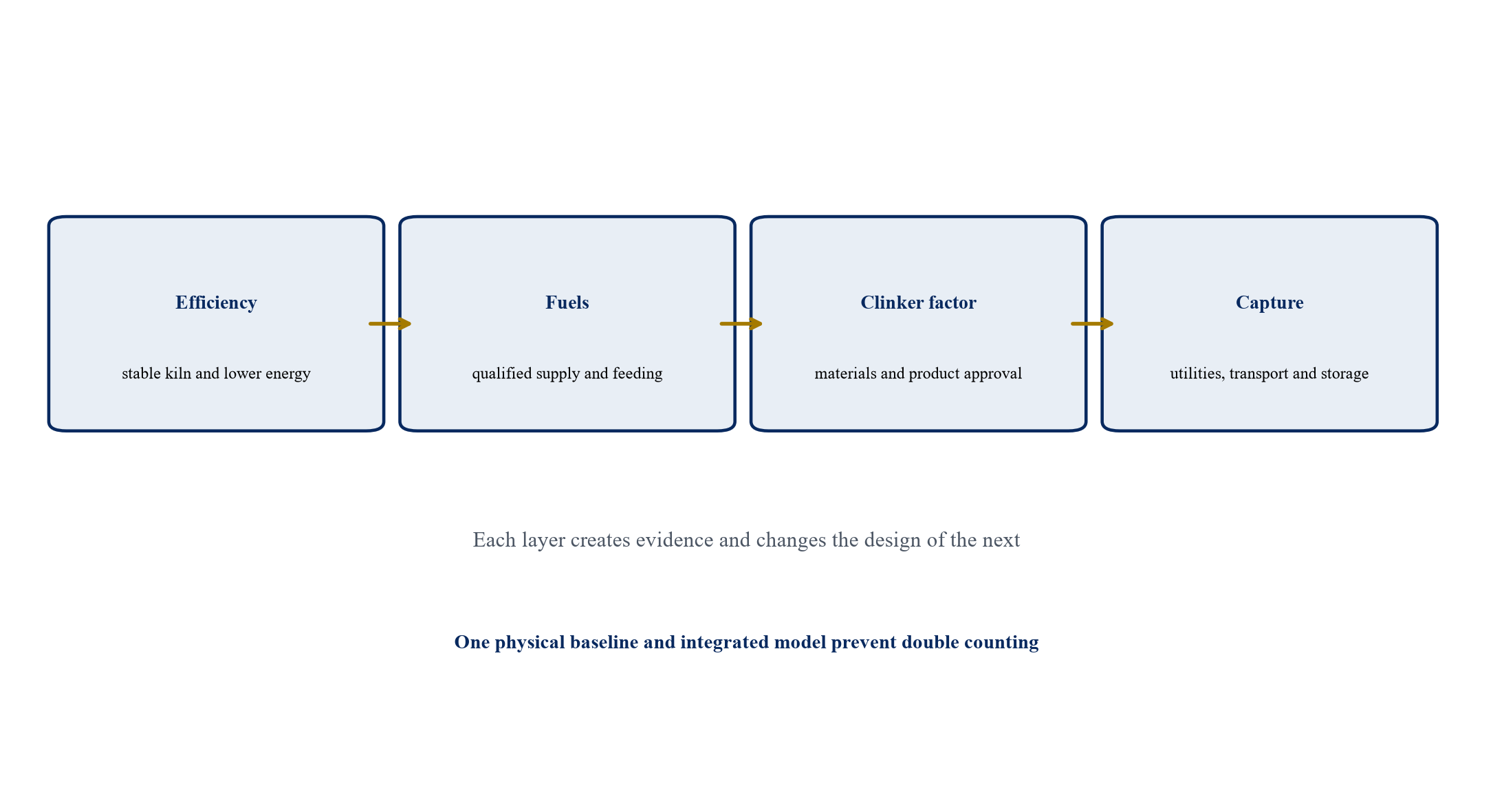
Proposed decision architecture based on the sources and analysis in this paper.
Table 1. Hypothetical sources and uses for a cement-transition programme
| Uses | Share of uses | Sources | Share of sources |
|---|---|---|---|
| Kiln efficiency and alternative fuels | 12% | Sponsor and strategic equity | 36% |
| Calcined clay, grinding and blending | 18% | Senior project debt | 31% |
| Carbon capture and utilities | 39% | Public capital support | 16% |
| CO2 conditioning and network connection | 12% | Concessional or subordinated debt | 10% |
| Owner cost, working capital and reserves | 7% | Customer and supplier capital | 7% |
| Contingency and financing cost | 12% | Total | 100% |
| Total | 100% |
Wholly hypothetical percentages; they describe no identified project and do not constitute a cost estimate.
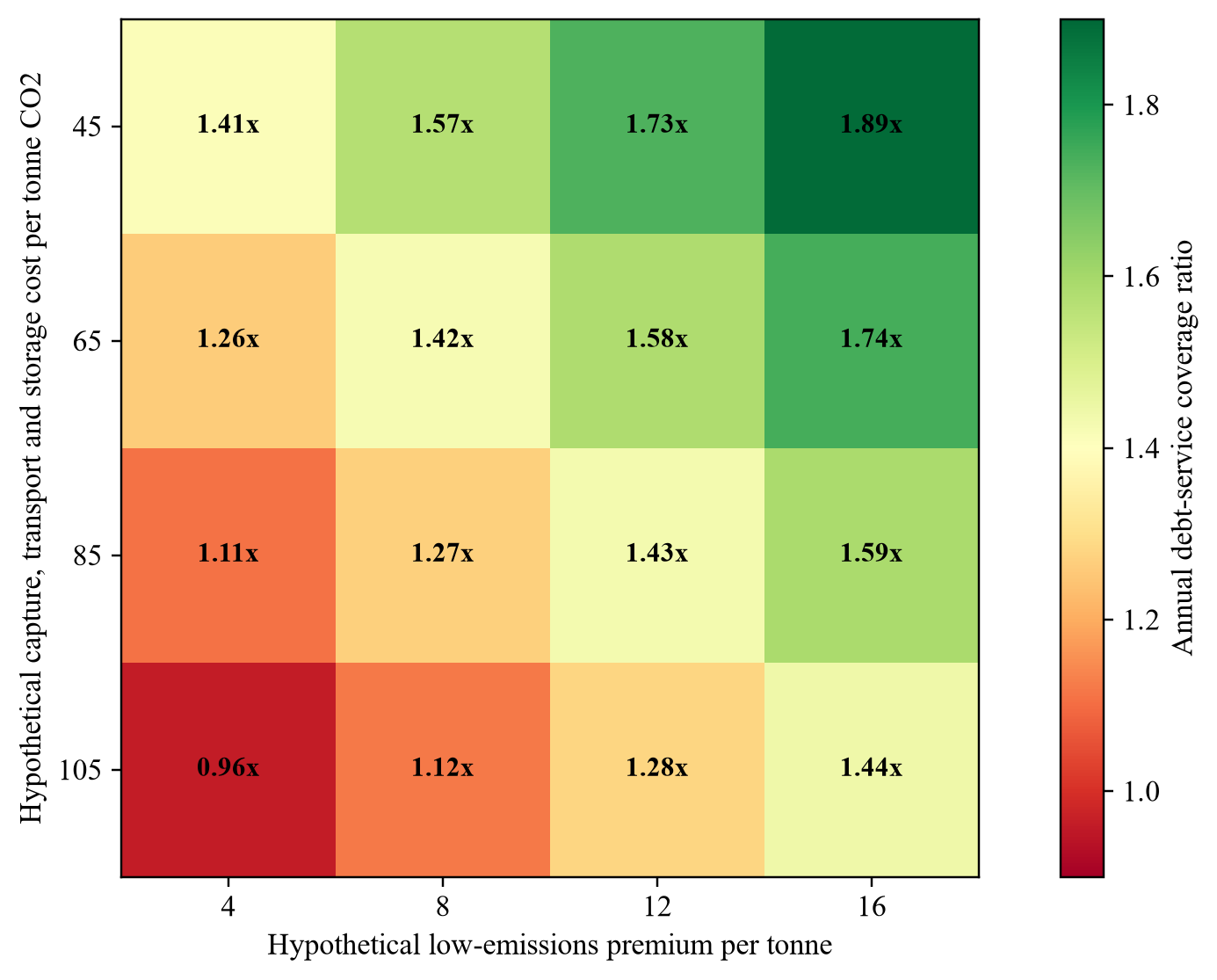
Wholly hypothetical; the values describe no identified company or project.
Table 2. Cement-transition risk-allocation matrix
| Exposure | Primary control | Contract mechanism | Residual financing concern |
|---|---|---|---|
| Alternative-fuel quality and supply | processor and producer | specification, testing, adjustment, rejection and replacement | concentration and regulatory change |
| Supplementary-material availability | supplier and producer | resource, volume, quality, delivery and substitution | depletion and competing demand |
| Product qualification | producer and customer | trials, standards, grades, acceptance and ramp | delayed volume and premium |
| Capture performance | technology and operating parties | rate, purity, energy, availability, replacement and damages | integration and first-of-a-kind risk |
| Transport and storage | infrastructure providers | capacity, quality, availability, tariff and liability | schedule, curtailment and permanence |
| Carbon and policy value | government, producer and customer | eligibility, data, price formula, sharing and change in law | methodology and support expiry |
| Customer demand | customer and producer | minimum volume, price floor, take-or-pay and credit support | renewal and construction cycle |
Proposed framework; transaction-specific legal and technical advice is required.
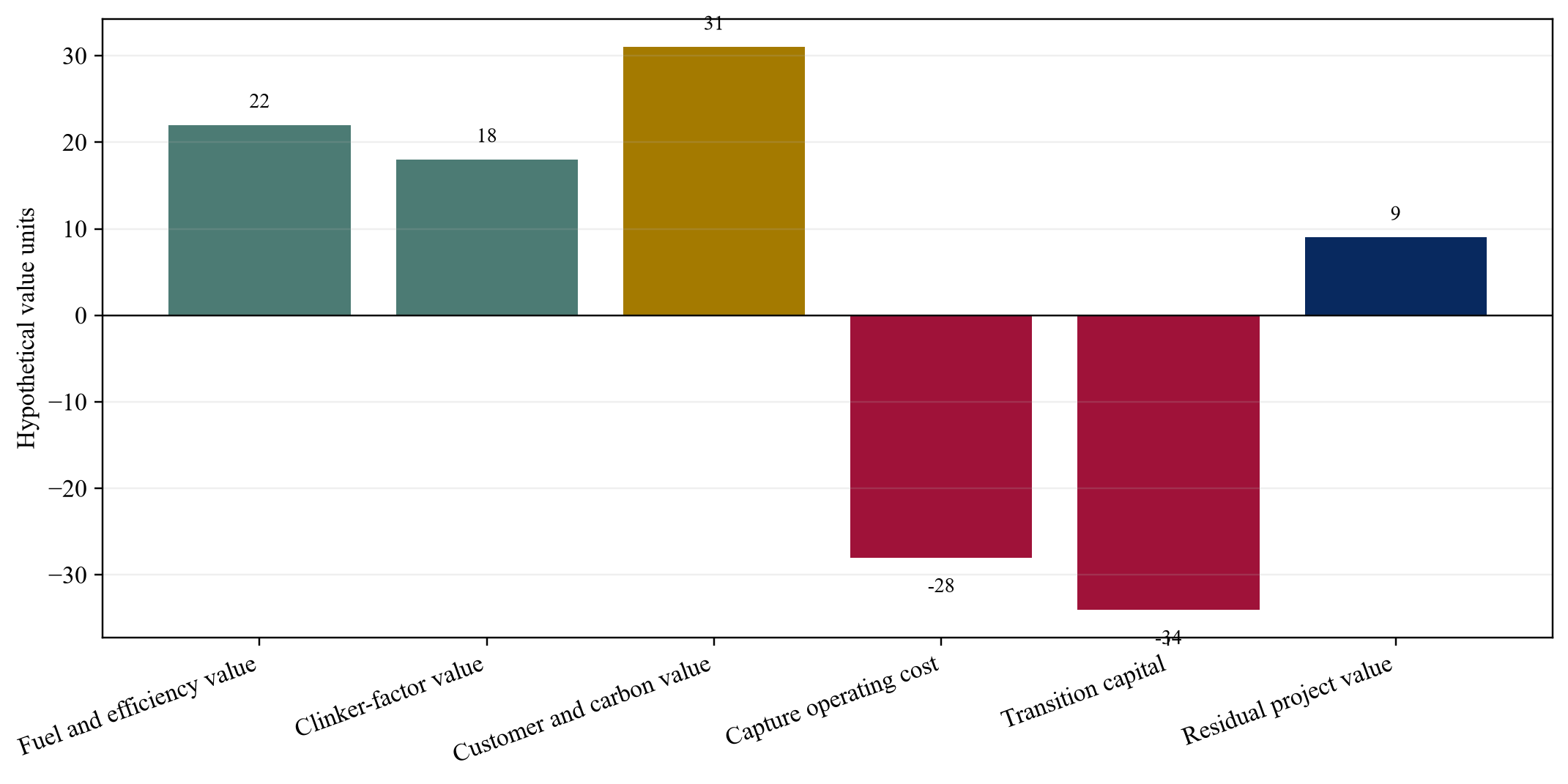
Wholly hypothetical; values describe no identified company or project.
Table 3. Investment gates for a cement-transition programme
| Gate | Minimum evidence | Maximum cumulative capital at risk | Decision |
|---|---|---|---|
| Baseline and options | reconciled mass, energy, emissions and strategic case | 0.2% | select transition portfolio |
| Integrated concept | feedstock tests, product plan, capture route and infrastructure screen | 1.5% | approve front-end work |
| Bankable definition | engineering, permits, contracts, cost, schedule and finance model | 5% | approve conditional commitments |
| Final investment | funding, essential contracts, contingency, completion and governance | 100% | issue notice to proceed |
| Completion | integrated performance, qualification, capture and assurance | retained capital | release support or require cure |
| Replication | measured operation and updated market case | next programme budget | replicate, redesign or stop |
Proposed governance framework; percentages are hypothetical caps on cumulative capital at risk.
Appendix A Questions for the investment committee
1. Which plant, products and emissions boundary define the investment case?
2. Which measured mass, energy and emissions data support the baseline?
3. Which alternative fuels are permitted, qualified and contractually available?
4. Which supplementary materials have tested resource, quality and logistics?
5. Which lower-clinker products are approved by customers and standards?
6. What future flue-gas and utility conditions support capture design?
7. Which transport and storage capacity is binding and available on schedule?
8. Which customer, carbon and policy cash flows are contracted?
9. How are capture cost, premium, carbon value and support prevented from double counting?
10. What minimum production, premium and contract tenor protect debt service?
11. Which obligations survive kiln, capture or infrastructure outage?
12. What evidence triggers each capital commitment and reapproval?
References
- International Energy Agency, Breakthrough Agenda Report 2025: Cement and concrete, 2025. https://www.iea.org/reports/breakthrough-agenda-report-2025/cement-and-concrete
- European Commission, Carbon Border Adjustment Mechanism definitive regime, accessed 2 October 2026. https://taxation-customs.ec.europa.eu/carbon-border-adjustment-mechanism/cbam-definitive-regime_en
- International Energy Agency, Cement, 2023. https://www.iea.org/reports/cement-3
- United States Department of Energy, Industrial Demonstrations Program Selected and Awarded Projects: Cement and Concrete, accessed 2 October 2026. https://www.energy.gov/cmei/oced/industrial-demonstrations-program-selected-and-awarded-projects-cement-and-concrete
- International Energy Agency and Cement Sustainability Initiative, Technology Roadmap: Low-Carbon Transition in the Cement Industry, 2018. https://www.iea.org/reports/technology-roadmap-low-carbon-transition-in-the-cement-industry
- United States Department of Energy, Carbon Capture Demonstration Projects Program, accessed 2 October 2026. https://www.energy.gov/oced/CCdemos
- International Energy Agency, The challenge of reaching zero emissions in heavy industry, 2020. https://www.iea.org/articles/the-challenge-of-reaching-zero-emissions-in-heavy-industry
- United Nations Industrial Development Organization, Industrial Deep Decarbonisation Initiative, accessed 2 October 2026. https://www.unido.org/IDDI
- International Energy Agency, CCUS in the transition to net-zero emissions, 2020. https://www.iea.org/reports/ccus-in-clean-energy-transitions/ccus-in-the-transition-to-net-zero-emissions
- IFRS Foundation, IAS 36 Impairment of Assets, accessed 2 October 2026. https://www.ifrs.org/issued-standards/list-of-standards/ias-36-impairment-of-assets/
- International Valuation Standards Council, International Valuation Standards, effective 31 January 2025. https://www.ivsc.org/standards/
About the Author
Authored by Chennakeshav Adya Independent Researcher
Chennakeshav (CK) is a corporate finance and investment banking executive with 25+ years of global experience in deal origination, structuring and execution across M&A, growth capital and corporate strategy. He has led value-creation mandates for founders, corporates and funds — bridging the boardroom view to hands-on execution and close.
His career spans Morgan Stanley, HSBC, Lloyds Banking Group, EWEC, ADQ portfolio companies and Emirates Growth Fund, across TMT, real estate, fintech, deeptech, cleantech, infrastructure and energy. He has partnered with C-suite leaders, private equity and venture funds, sovereign wealth funds and family offices to finance complex fund raises and scale-up ventures, and has led M&A due diligence, post-merger integration and business-transformation initiatives to create value.
At Matchpoint Partners he is Managing Partner, leading the firm's corporate finance, M&A and capital-raising practice. He holds an MBA from London Business School, an engineering degree from VTU and a Master of Laws (LLM, in progress) from UCL London.
An active start-up mentor, CK mentors at Techstars, DIFC FinTech Hive, Startup Grind, Founder Institute and IN5, serves as Entrepreneur Mentor in Residence (EMiR) at London Business School, and judges the Entrepreneurship World Cup.
Matchpoint profile: https://www.matchpoint-partners.com/team/ck-adya.html LinkedIn: https://www.linkedin.com/in/ckadya/
