

1. Frame the change-in-law decision
A long-term power or water contract must remain financeable when carbon, water, environmental, labour, tax, procurement or localisation rules change after bid submission. The decision is whether the event belongs to the project company, the purchaser, users or a shared mechanism, and what evidence activates relief.
The working file should reconcile the contracts, legal baseline and current compliance obligation. Each conclusion should identify its source, owner and approval status.
A practical review asks four questions: what changed, who controls the response, what cost or delay is unavoidable, and which contractual mechanism restores the agreed allocation. Unsupported estimates remain outside the approved amount.
2. Protect lawful policy action
A contractual protection allocates economic consequences; it does not restrict a legislature or regulator from changing law. The provision should preserve public authority while giving investors and lenders a predictable route for time, cost or performance relief where a qualifying legal change alters the agreed bargain.
The assessment should record the counterfactual position, incremental effect and credible alternatives. Legal, technical and financial advisers should use the same facts so that entitlement and quantum do not diverge.
The parties should translate the issue into a dated action register with responsible owners, dependencies and evidence requirements. Interim service and safety measures continue while the commercial allocation is determined.
3. Define bankability without a blank cheque
Lenders need confidence that an uncontrollable legal change will not destroy debt service. Public purchasers need thresholds, mitigation, audit and exclusions that prevent ordinary business risk from becoming an automatic tariff claim. Bankability therefore depends on a bounded process rather than unlimited indemnity.
The decision should be documented before expenditure or relief becomes irreversible. Conditions should cover notice, mitigation, audit, true-up, lender consent and the treatment of any later beneficial change.
The governing test is disciplined restoration rather than windfall. The project company receives the relief required for an efficient compliant solution; the purchaser retains protection against betterment, duplication and weak execution.
4. Set the baseline date
The contract should identify the legal baseline at bid submission, award, signing or financial close. The selected date determines which published measures, binding standards and known consultations are priced by bidders. A precise baseline also reduces later disputes about whether a rule was foreseeable.
The working file should reconcile the contracts, legal baseline and current compliance obligation. Each conclusion should identify its source, owner and approval status.
A practical review asks four questions: what changed, who controls the response, what cost or delay is unavoidable, and which contractual mechanism restores the agreed allocation. Unsupported estimates remain outside the approved amount.
5. Build the applicable-law perimeter
Applicable law can include statutes, regulations, permits, licences, binding directions, court judgments and enforceable technical codes. The drafting should distinguish mandatory rules from guidance and voluntary standards, while recognising that permit conditions and regulator interpretations can change project obligations materially.
The assessment should record the counterfactual position, incremental effect and credible alternatives. Legal, technical and financial advisers should use the same facts so that entitlement and quantum do not diverge.
The parties should translate the issue into a dated action register with responsible owners, dependencies and evidence requirements. Interim service and safety measures continue while the commercial allocation is determined.
Table 1. Change category, evidence and relief map
| Change category | Core evidence | Typical private obligation | Potential public relief | Control question |
|---|---|---|---|---|
| General change | Enacted rule, baseline and economy-wide scope | Ordinary compliance and efficient mitigation | Exceptional capital or material unpriced impact where agreed | Was the effect reasonably priced and diversified? |
| Sector-specific change | Rule directed at power, water or transition assets | Notice, compliance design and mitigation | Cost, time or tariff relief after threshold | Does the rule create a project-sector burden? |
| Discriminatory change | Text, effect and comparator projects | Preserve performance where lawful and safe | Strong time and cost protection | Does the measure target the project or contractor? |
| Change in interpretation | Binding judgment or regulator decision | Adapt after final authoritative position | Relief where a new binding meaning changes obligations | Was the prior interpretation reasonably relied upon? |
| Beneficial change | Reduced cost, released obligation or new attribute | Disclose and measure benefit | Purchaser share or tariff reduction | Is the benefit real, durable and monetisable? |
The allocation is illustrative and must be adapted to the executed contract, applicable law and procurement framework.
6. Classify general change
A general change affects businesses across the economy. Many contracts allocate ordinary general change to the project company, especially where the impact can be managed or passed through. Capital-intensive or exceptional general changes may receive separate treatment when they could not reasonably be priced.
The decision should be documented before expenditure or relief becomes irreversible. Conditions should cover notice, mitigation, audit, true-up, lender consent and the treatment of any later beneficial change.
The governing test is disciplined restoration rather than windfall. The project company receives the relief required for an efficient compliant solution; the purchaser retains protection against betterment, duplication and weak execution.
7. Classify sector-specific change
A rule directed at power generation, desalination, wastewater, grids or renewable assets can impose costs that other businesses do not face. The contract should define whether sector-specific change qualifies automatically or only after materiality, foreseeability and causation tests.
The working file should reconcile the contracts, legal baseline and current compliance obligation. Each conclusion should identify its source, owner and approval status.
A practical review asks four questions: what changed, who controls the response, what cost or delay is unavoidable, and which contractual mechanism restores the agreed allocation. Unsupported estimates remain outside the approved amount.
8. Classify discriminatory change
A discriminatory change targets the project, the project company or a narrow class of comparable contractors. Public-side relief is commonly stronger because the private party cannot diversify or control this risk. The definition must cover substance as well as formally discriminatory wording.
The assessment should record the counterfactual position, incremental effect and credible alternatives. Legal, technical and financial advisers should use the same facts so that entitlement and quantum do not diverge.
The parties should translate the issue into a dated action register with responsible owners, dependencies and evidence requirements. Interim service and safety measures continue while the commercial allocation is determined.
9. Address changes in interpretation
A statute can remain unchanged while a court, ministry or regulator adopts a binding new interpretation. The clause should state when an interpretation qualifies, whether it must be final, and how conflicting guidance is treated before enforcement becomes certain.
The decision should be documented before expenditure or relief becomes irreversible. Conditions should cover notice, mitigation, audit, true-up, lender consent and the treatment of any later beneficial change.
The governing test is disciplined restoration rather than windfall. The project company receives the relief required for an efficient compliant solution; the purchaser retains protection against betterment, duplication and weak execution.
10. Address changes in enforcement
More rigorous enforcement of an existing rule may increase compliance cost without changing the legal text. Relief should depend on whether the prior enforcement position was authoritative, reasonably relied upon and consistent with law, and whether the new position creates a measurable project-specific burden.
The working file should reconcile the contracts, legal baseline and current compliance obligation. Each conclusion should identify its source, owner and approval status.
A practical review asks four questions: what changed, who controls the response, what cost or delay is unavoidable, and which contractual mechanism restores the agreed allocation. Unsupported estimates remain outside the approved amount.
11. Test foreseeability
Foreseeability allocates emerging rules that were public before the baseline date. The diligence record should capture enacted measures, published drafts, formal consultations and announced implementation timetables. General political debate should not be treated as a fully priced obligation without a defined test.
The assessment should record the counterfactual position, incremental effect and credible alternatives. Legal, technical and financial advisers should use the same facts so that entitlement and quantum do not diverge.
The parties should translate the issue into a dated action register with responsible owners, dependencies and evidence requirements. Interim service and safety measures continue while the commercial allocation is determined.
12. Separate law from policy
Government strategy, targets and policy statements may signal future requirements without immediate legal force. The contract should clarify when policy becomes enforceable and whether a purchaser-requested policy enhancement travels through the variation mechanism instead of change in law.
The decision should be documented before expenditure or relief becomes irreversible. Conditions should cover notice, mitigation, audit, true-up, lender consent and the treatment of any later beneficial change.
The governing test is disciplined restoration rather than windfall. The project company receives the relief required for an efficient compliant solution; the purchaser retains protection against betterment, duplication and weak execution.
13. Map carbon-pricing exposure
Carbon taxes, emissions-trading obligations, reporting rules and credit-quality requirements can alter fuel cost, dispatch economics and compliance systems. The project should identify direct emissions, purchased-energy exposure, free allocations, pass-through rights and the treatment of beneficial changes.
The working file should reconcile the contracts, legal baseline and current compliance obligation. Each conclusion should identify its source, owner and approval status.
A practical review asks four questions: what changed, who controls the response, what cost or delay is unavoidable, and which contractual mechanism restores the agreed allocation. Unsupported estimates remain outside the approved amount.
14. Map emissions-performance standards
A new emissions limit can require retrofit, altered fuel, reduced output or early retirement. Relief should distinguish a feasible compliance investment from a rule that prevents the contracted service. Technical evidence must link the legal requirement to the selected compliance route.
The assessment should record the counterfactual position, incremental effect and credible alternatives. Legal, technical and financial advisers should use the same facts so that entitlement and quantum do not diverge.
The parties should translate the issue into a dated action register with responsible owners, dependencies and evidence requirements. Interim service and safety measures continue while the commercial allocation is determined.
15. Map water-quality exposure
Drinking-water, discharge, brine, intake and reuse standards can require additional treatment, monitoring or chemicals. The baseline specification and applicable health or environmental standard should be reconciled so that the project does not claim twice under output-specification and legal-change provisions.
The decision should be documented before expenditure or relief becomes irreversible. Conditions should cover notice, mitigation, audit, true-up, lender consent and the treatment of any later beneficial change.
The governing test is disciplined restoration rather than windfall. The project company receives the relief required for an efficient compliant solution; the purchaser retains protection against betterment, duplication and weak execution.
16. Map water-scarcity and abstraction rules
Changes to abstraction licences, allocation priority, aquifer protection or drought restrictions can constrain feedwater or increase cost. The contract should coordinate supply risk, force majeure, change in law and purchaser obligations, with clear rules for alternative sources and curtailment.
The working file should reconcile the contracts, legal baseline and current compliance obligation. Each conclusion should identify its source, owner and approval status.
A practical review asks four questions: what changed, who controls the response, what cost or delay is unavoidable, and which contractual mechanism restores the agreed allocation. Unsupported estimates remain outside the approved amount.
17. Map environmental and social standards
New environmental assessment, biodiversity, labour, community-health or resettlement requirements can affect construction and operation. The clause should align domestic law with agreed lender standards and define whether a voluntary financing standard creates contractual relief.
The assessment should record the counterfactual position, incremental effect and credible alternatives. Legal, technical and financial advisers should use the same facts so that entitlement and quantum do not diverge.
The parties should translate the issue into a dated action register with responsible owners, dependencies and evidence requirements. Interim service and safety measures continue while the commercial allocation is determined.
18. Map localisation requirements
Local-content, workforce, procurement and technology-transfer rules can change cost, schedule and supplier choice. Evidence should compare the compliant sourcing plan with the original plan, isolate genuine incremental cost and record efforts to develop capable local alternatives.
The decision should be documented before expenditure or relief becomes irreversible. Conditions should cover notice, mitigation, audit, true-up, lender consent and the treatment of any later beneficial change.
The governing test is disciplined restoration rather than windfall. The project company receives the relief required for an efficient compliant solution; the purchaser retains protection against betterment, duplication and weak execution.
19. Map tax and customs change
Corporate tax, withholding, customs, value-added tax and interest-deductibility changes can affect project cash flow. Tax clauses, tariff formulas and change-in-law rights should use consistent definitions and avoid double recovery, with treatment for both adverse and beneficial changes.
The working file should reconcile the contracts, legal baseline and current compliance obligation. Each conclusion should identify its source, owner and approval status.
A practical review asks four questions: what changed, who controls the response, what cost or delay is unavoidable, and which contractual mechanism restores the agreed allocation. Unsupported estimates remain outside the approved amount.
20. Map permit and licence change
Permit conditions may change because of law, regulator discretion or project performance. The contract map should identify which permits are project-company responsibility, which require purchaser support, and when delay or cost qualifies after diligent and timely application.
The assessment should record the counterfactual position, incremental effect and credible alternatives. Legal, technical and financial advisers should use the same facts so that entitlement and quantum do not diverge.
The parties should translate the issue into a dated action register with responsible owners, dependencies and evidence requirements. Interim service and safety measures continue while the commercial allocation is determined.
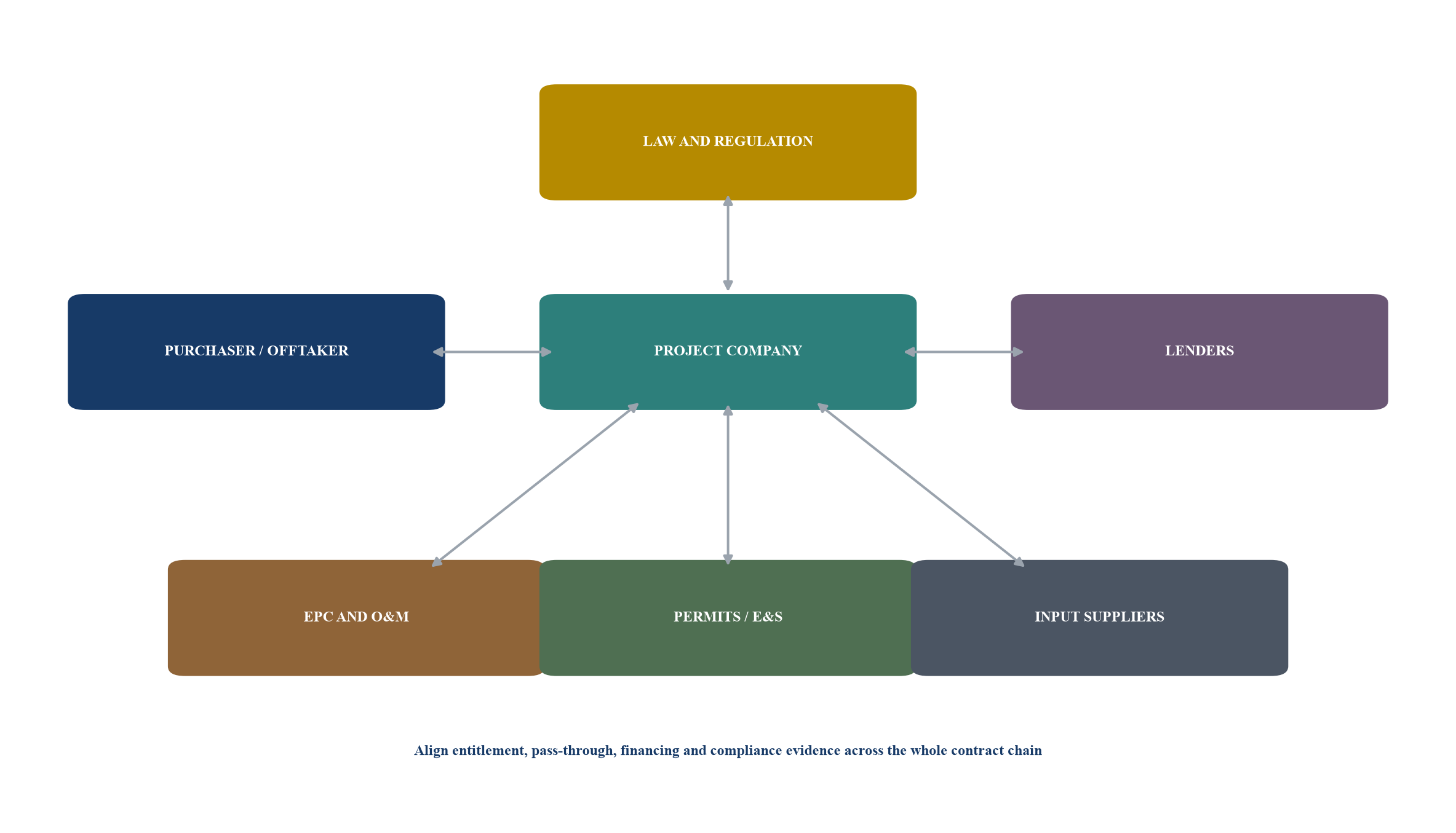
The map is generic; transaction-specific rights require review of executed documents and applicable law.
21. Map the contract structure
The primary offtake agreement sits alongside land, grid, fuel, EPC, O&M, financing, security, direct agreement and government support. Change-in-law treatment should flow through these documents without giving subcontractors broader protection than the project company receives.
The decision should be documented before expenditure or relief becomes irreversible. Conditions should cover notice, mitigation, audit, true-up, lender consent and the treatment of any later beneficial change.
The governing test is disciplined restoration rather than windfall. The project company receives the relief required for an efficient compliant solution; the purchaser retains protection against betterment, duplication and weak execution.
22. Align EPC pass-through
The EPC contract should pass relevant legal-change risk to the contractor only where the project company bears it and the contractor can manage it. Notice periods, evidence, schedule analysis and variation pricing should support the upstream claim without creating an unfunded gap.
The working file should reconcile the contracts, legal baseline and current compliance obligation. Each conclusion should identify its source, owner and approval status.
A practical review asks four questions: what changed, who controls the response, what cost or delay is unavoidable, and which contractual mechanism restores the agreed allocation. Unsupported estimates remain outside the approved amount.
23. Align O&M pass-through
Operating contractors can identify compliance action and cost, while the project company retains contract responsibility. The O&M agreement should require prompt notice, mitigation, open-book evidence and competitive procurement for material modifications.
The assessment should record the counterfactual position, incremental effect and credible alternatives. Legal, technical and financial advisers should use the same facts so that entitlement and quantum do not diverge.
The parties should translate the issue into a dated action register with responsible owners, dependencies and evidence requirements. Interim service and safety measures continue while the commercial allocation is determined.
24. Align fuel and utility inputs
Fuel, grid, chemicals, water and waste agreements can contain their own legal-change mechanisms. The project should prevent mismatches in qualifying events, timing, thresholds and compensation, especially where input costs pass through the tariff differently.
The decision should be documented before expenditure or relief becomes irreversible. Conditions should cover notice, mitigation, audit, true-up, lender consent and the treatment of any later beneficial change.
The governing test is disciplined restoration rather than windfall. The project company receives the relief required for an efficient compliant solution; the purchaser retains protection against betterment, duplication and weak execution.
25. Align financing documents
Facility agreements rarely compensate the borrower for legal change in the project contract. Lenders therefore rely on cash-flow relief, reserves, waivers and cure periods. Financing covenants should allow an approved compliance plan and control distributions during unresolved exposure.
The working file should reconcile the contracts, legal baseline and current compliance obligation. Each conclusion should identify its source, owner and approval status.
A practical review asks four questions: what changed, who controls the response, what cost or delay is unavoidable, and which contractual mechanism restores the agreed allocation. Unsupported estimates remain outside the approved amount.
26. Align the direct agreement
The direct agreement should coordinate notice, lender consultation, cure and termination rights. A prolonged legal-change event may affect debt service before the public contract reaches termination, so standstill and information rights must operate early.
The assessment should record the counterfactual position, incremental effect and credible alternatives. Legal, technical and financial advisers should use the same facts so that entitlement and quantum do not diverge.
The parties should translate the issue into a dated action register with responsible owners, dependencies and evidence requirements. Interim service and safety measures continue while the commercial allocation is determined.
27. Define the notice trigger
Notice should be required when a party becomes aware that a legal change is reasonably likely to affect cost, time or performance. The notice should identify the rule, baseline, expected impact, mitigation and requested relief without requiring final quantum before analysis is possible.
The decision should be documented before expenditure or relief becomes irreversible. Conditions should cover notice, mitigation, audit, true-up, lender consent and the treatment of any later beneficial change.
The governing test is disciplined restoration rather than windfall. The project company receives the relief required for an efficient compliant solution; the purchaser retains protection against betterment, duplication and weak execution.
28. Preserve claims without rewarding delay
Failure to give timely notice can prejudice investigation and mitigation. A proportionate rule can reduce recovery to the extent the delay caused loss, while preserving a meritorious claim that could not reasonably have been quantified earlier.
The working file should reconcile the contracts, legal baseline and current compliance obligation. Each conclusion should identify its source, owner and approval status.
A practical review asks four questions: what changed, who controls the response, what cost or delay is unavoidable, and which contractual mechanism restores the agreed allocation. Unsupported estimates remain outside the approved amount.
29. Prove legal causation
Counsel should show the legal instrument, effective date, binding effect and obligation created. The analysis must distinguish a mandatory response from a commercially preferred upgrade. A legal memorandum should connect the new duty to the affected project obligation.
The assessment should record the counterfactual position, incremental effect and credible alternatives. Legal, technical and financial advisers should use the same facts so that entitlement and quantum do not diverge.
The parties should translate the issue into a dated action register with responsible owners, dependencies and evidence requirements. Interim service and safety measures continue while the commercial allocation is determined.
30. Prove technical causation
The technical adviser should compare compliant options, capacity, efficiency, outage and implementation time. The selected solution should be reasonable, proportionate and compatible with output requirements rather than an opportunity to modernise unrelated systems at public cost.
The decision should be documented before expenditure or relief becomes irreversible. Conditions should cover notice, mitigation, audit, true-up, lender consent and the treatment of any later beneficial change.
The governing test is disciplined restoration rather than windfall. The project company receives the relief required for an efficient compliant solution; the purchaser retains protection against betterment, duplication and weak execution.
Table 2. Risk-allocation matrix for policy change
| Risk | Project company | Purchaser or authority | Shared control | Decision evidence |
|---|---|---|---|---|
| Carbon price or emissions rule | Measure emissions; optimise operations; procure efficiently | Relief for qualifying unpriced project-specific burden | Baseline, pass-through, credits and true-up | Verified emissions, price instrument and tariff treatment |
| Water-quality or discharge standard | Operate safely; maintain plant; test options | Fund qualifying retrofit or tariff effect | Technical solution and outage plan | Binding standard, design, bids and commissioning test |
| Environmental and social requirement | Maintain management system and lender compliance | Address qualifying public-policy change | Mitigation, stakeholder and permitting plan | Legal duty, impact assessment and action plan |
| Local-content rule | Develop compliant suppliers and workforce | Compensate qualifying incremental burden where agreed | Competitive procurement and capability plan | Baseline sourcing, local bids and cost comparison |
| Tax or customs change | File, pay and mitigate lawfully | Tariff or compensation where contract allocates | Audit and anti-duplication | Tax opinion, returns and model reconciliation |
Allocation depends on the specific contract, jurisdiction, tariff model and ability to manage or pass through risk.
31. Prove financial causation
The financial model should isolate incremental capital expenditure, operating cost, revenue loss, financing cost and tax. Existing inefficiency, deferred maintenance and unrelated scope should remain outside the claim. The calculation should reconcile to invoices, quantities and approved assumptions.
The working file should reconcile the contracts, legal baseline and current compliance obligation. Each conclusion should identify its source, owner and approval status.
A practical review asks four questions: what changed, who controls the response, what cost or delay is unavoidable, and which contractual mechanism restores the agreed allocation. Unsupported estimates remain outside the approved amount.
32. Set a materiality threshold
Minor compliance costs are usually priced into ordinary operations. A monetary, percentage or cumulative threshold can focus the mechanism on material events. The contract should state whether the threshold is a deductible, a trigger or an aggregation rule.
The assessment should record the counterfactual position, incremental effect and credible alternatives. Legal, technical and financial advisers should use the same facts so that entitlement and quantum do not diverge.
The parties should translate the issue into a dated action register with responsible owners, dependencies and evidence requirements. Interim service and safety measures continue while the commercial allocation is determined.
33. Aggregate related changes
A regulatory programme may arrive through several instruments whose individual cost is below threshold. Related measures should be aggregated where they implement one policy, while unrelated routine changes remain separate. The aggregation period and reset should be explicit.
The decision should be documented before expenditure or relief becomes irreversible. Conditions should cover notice, mitigation, audit, true-up, lender consent and the treatment of any later beneficial change.
The governing test is disciplined restoration rather than windfall. The project company receives the relief required for an efficient compliant solution; the purchaser retains protection against betterment, duplication and weak execution.
34. Require mitigation
The affected party should pursue reasonable design, procurement, sequencing, insurance, funding and operational alternatives. Mitigation does not require acceptance of disproportionate risk. The decision record should compare credible options and explain the chosen response.
The working file should reconcile the contracts, legal baseline and current compliance obligation. Each conclusion should identify its source, owner and approval status.
A practical review asks four questions: what changed, who controls the response, what cost or delay is unavoidable, and which contractual mechanism restores the agreed allocation. Unsupported estimates remain outside the approved amount.
35. Recognise beneficial change
A legal change can reduce cost, release reserves, create credits or simplify compliance. A symmetrical mechanism gives the purchaser the agreed benefit and supports legitimacy. Benefit measurement should use the same baseline, discounting and audit principles as an adverse claim.
The assessment should record the counterfactual position, incremental effect and credible alternatives. Legal, technical and financial advisers should use the same facts so that entitlement and quantum do not diverge.
The parties should translate the issue into a dated action register with responsible owners, dependencies and evidence requirements. Interim service and safety measures continue while the commercial allocation is determined.
36. Choose the relief ladder
Relief can include excused performance, extension of time, tariff adjustment, lump-sum payment, change to output, term extension or termination. The contract should apply the least-cost form that restores the agreed economic and service position.
The decision should be documented before expenditure or relief becomes irreversible. Conditions should cover notice, mitigation, audit, true-up, lender consent and the treatment of any later beneficial change.
The governing test is disciplined restoration rather than windfall. The project company receives the relief required for an efficient compliant solution; the purchaser retains protection against betterment, duplication and weak execution.
37. Design tariff adjustment
A tariff adjustment should match the timing and useful life of compliance expenditure, with defined indexation and true-up. Temporary operating cost should not produce a permanent uplift, and capital recovery should end when the approved amount has been recovered.
The working file should reconcile the contracts, legal baseline and current compliance obligation. Each conclusion should identify its source, owner and approval status.
A practical review asks four questions: what changed, who controls the response, what cost or delay is unavoidable, and which contractual mechanism restores the agreed allocation. Unsupported estimates remain outside the approved amount.
38. Design lump-sum compensation
A lump sum can fund urgent capital expenditure and avoid long tariff tails. Payment milestones should follow verified procurement, construction and commissioning. The structure should address unused amounts, cost underruns, tax and failure to deliver the compliance asset.
The assessment should record the counterfactual position, incremental effect and credible alternatives. Legal, technical and financial advisers should use the same facts so that entitlement and quantum do not diverge.
The parties should translate the issue into a dated action register with responsible owners, dependencies and evidence requirements. Interim service and safety measures continue while the commercial allocation is determined.
39. Use term extension carefully
Extending contract term can compensate without immediate budget expenditure, but transfers future revenues and may defer competition. The valuation should include lifecycle, handback, demand and regulatory uncertainty, with lender maturity and asset life aligned.
The decision should be documented before expenditure or relief becomes irreversible. Conditions should cover notice, mitigation, audit, true-up, lender consent and the treatment of any later beneficial change.
The governing test is disciplined restoration rather than windfall. The project company receives the relief required for an efficient compliant solution; the purchaser retains protection against betterment, duplication and weak execution.
40. Change output specifications transparently
A legal change may make the original output unlawful or uneconomic. The parties can modify capacity, quality, dispatch or availability through a controlled variation. The amended output should preserve public need and clearly allocate consequential cost and performance risk.
The working file should reconcile the contracts, legal baseline and current compliance obligation. Each conclusion should identify its source, owner and approval status.
A practical review asks four questions: what changed, who controls the response, what cost or delay is unavoidable, and which contractual mechanism restores the agreed allocation. Unsupported estimates remain outside the approved amount.
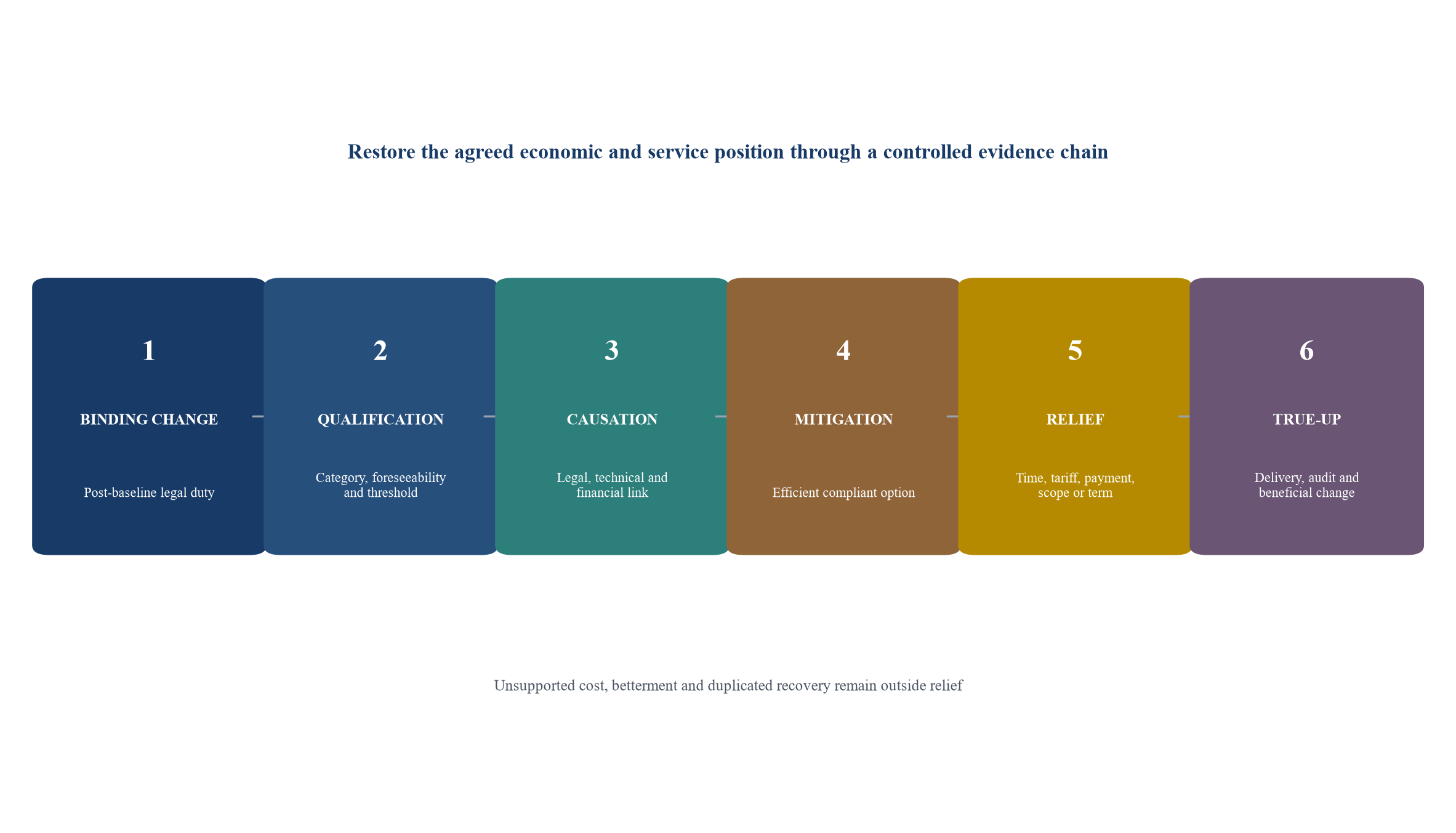
Relief advances only after entitlement, causation, mitigation and measurement have been evidenced.
41. Model construction delay
For assets under construction, legal change can affect procurement, redesign, permits and critical-path activities. Schedule relief should be based on a logic-linked programme, concurrency analysis and demonstrated mitigation rather than a simple assertion of elapsed time.
The assessment should record the counterfactual position, incremental effect and credible alternatives. Legal, technical and financial advisers should use the same facts so that entitlement and quantum do not diverge.
The parties should translate the issue into a dated action register with responsible owners, dependencies and evidence requirements. Interim service and safety measures continue while the commercial allocation is determined.
42. Model operating outage
Retrofit may require planned or forced outage. The claim should separate legal compliance from maintenance that would have occurred anyway. Availability deductions, deemed availability and substitute supply should be coordinated to avoid contradictory outcomes.
The decision should be documented before expenditure or relief becomes irreversible. Conditions should cover notice, mitigation, audit, true-up, lender consent and the treatment of any later beneficial change.
The governing test is disciplined restoration rather than windfall. The project company receives the relief required for an efficient compliant solution; the purchaser retains protection against betterment, duplication and weak execution.
43. Model debt-service sensitivity
The base case should test cost, delay, tariff timing and payment uncertainty against debt-service coverage and reserve levels. Lender protections can include distribution lock-up, temporary liquidity and waiver mechanics while the claim is determined.
The working file should reconcile the contracts, legal baseline and current compliance obligation. Each conclusion should identify its source, owner and approval status.
A practical review asks four questions: what changed, who controls the response, what cost or delay is unavoidable, and which contractual mechanism restores the agreed allocation. Unsupported estimates remain outside the approved amount.
44. Model financing cost
A legal change may require new debt or equity before compensation arrives. Eligible financing cost should be limited to efficient funding for approved expenditure and supported by market evidence. Sponsor return on ordinary equity should not be relabelled as unavoidable compliance cost.
The assessment should record the counterfactual position, incremental effect and credible alternatives. Legal, technical and financial advisers should use the same facts so that entitlement and quantum do not diverge.
The parties should translate the issue into a dated action register with responsible owners, dependencies and evidence requirements. Interim service and safety measures continue while the commercial allocation is determined.
45. Control contingencies
Early estimates include design and procurement uncertainty. Contingency should be transparent, risk-based and subject to true-up. A staged approval can authorise development cost first, then construction cost when scope and bids are sufficiently mature.
The decision should be documented before expenditure or relief becomes irreversible. Conditions should cover notice, mitigation, audit, true-up, lender consent and the treatment of any later beneficial change.
The governing test is disciplined restoration rather than windfall. The project company receives the relief required for an efficient compliant solution; the purchaser retains protection against betterment, duplication and weak execution.
46. Control affiliate transactions
An affiliate EPC, O&M or supplier contract can obscure price and margin. Material affiliate cost should be benchmarked or competitively tested, with disclosure of ownership and fees. Recovery should reflect reasonable arm's-length cost for the required compliance work.
The working file should reconcile the contracts, legal baseline and current compliance obligation. Each conclusion should identify its source, owner and approval status.
A practical review asks four questions: what changed, who controls the response, what cost or delay is unavoidable, and which contractual mechanism restores the agreed allocation. Unsupported estimates remain outside the approved amount.
47. Create an open-book record
The claim file should contain law, permits, baseline, notices, options, designs, bids, invoices, schedule, model, tax, mitigation and approvals. Open-book access enables audit while confidentiality rules protect legitimate commercial information.
The assessment should record the counterfactual position, incremental effect and credible alternatives. Legal, technical and financial advisers should use the same facts so that entitlement and quantum do not diverge.
The parties should translate the issue into a dated action register with responsible owners, dependencies and evidence requirements. Interim service and safety measures continue while the commercial allocation is determined.
48. Use independent experts
Legal, technical, environmental and financial experts should answer defined questions and disclose conflicts. Expert input supports determination; it should not replace accountable decisions by the contracting parties and authorised public bodies.
The decision should be documented before expenditure or relief becomes irreversible. Conditions should cover notice, mitigation, audit, true-up, lender consent and the treatment of any later beneficial change.
The governing test is disciplined restoration rather than windfall. The project company receives the relief required for an efficient compliant solution; the purchaser retains protection against betterment, duplication and weak execution.
49. Coordinate environmental and social lenders
A domestic legal minimum may sit below contractual lender standards. The project should maintain the agreed environmental and social management system and determine whether a change in those financing standards is mandatory, voluntary or an approved variation.
The working file should reconcile the contracts, legal baseline and current compliance obligation. Each conclusion should identify its source, owner and approval status.
A practical review asks four questions: what changed, who controls the response, what cost or delay is unavoidable, and which contractual mechanism restores the agreed allocation. Unsupported estimates remain outside the approved amount.
50. Coordinate insurance
Environmental liability, business interruption, political risk and construction insurance may respond to parts of the event. Insurance proceeds and reasonable recoveries should reduce compensation, while uninsurable legal change remains allocated by contract.
The assessment should record the counterfactual position, incremental effect and credible alternatives. Legal, technical and financial advisers should use the same facts so that entitlement and quantum do not diverge.
The parties should translate the issue into a dated action register with responsible owners, dependencies and evidence requirements. Interim service and safety measures continue while the commercial allocation is determined.
Table 3. Hypothetical compliance and debt-service sensitivity
| Scenario | Incremental capex | Annual opex impact | Delay or outage | Relief timing | Minimum DSCR without relief | Minimum DSCR with approved relief |
|---|---|---|---|---|---|---|
| Carbon-monitoring and control upgrade | 18 | 2.0 | 20 days | At commissioning | 1.16x | 1.29x |
| Water-quality retrofit | 42 | 3.5 | 45 days | Milestone payments | 1.05x | 1.30x |
| Brine-discharge standard | 65 | 5.0 | 60 days | Tariff over asset life | 0.98x | 1.27x |
| Local-content procurement change | 24 | 1.5 | 90 days | Cost and time relief | 1.10x | 1.26x |
| Combined policy programme | 96 | 8.0 | 120 days | Staged payment and tariff | 0.89x | 1.24x |
All values are hypothetical management assumptions in USD millions unless stated otherwise. They demonstrate method only and are not observations, forecasts or valuation conclusions.
51. Coordinate carbon credits and attributes
Compliance investment may generate allowances, renewable certificates, credits or other attributes. Ownership and valuation should be explicit. Public compensation should account for monetisable benefits without assuming uncertain credit revenue as guaranteed cash.
The decision should be documented before expenditure or relief becomes irreversible. Conditions should cover notice, mitigation, audit, true-up, lender consent and the treatment of any later beneficial change.
The governing test is disciplined restoration rather than windfall. The project company receives the relief required for an efficient compliant solution; the purchaser retains protection against betterment, duplication and weak execution.
52. Protect fiscal control
The public purchaser should quantify tariff, lump-sum, guarantee and termination exposure across the portfolio. Approval limits, budget treatment and contingent-liability reporting should apply before commitment. The claim should show present value and annual cash impact.
The working file should reconcile the contracts, legal baseline and current compliance obligation. Each conclusion should identify its source, owner and approval status.
A practical review asks four questions: what changed, who controls the response, what cost or delay is unavoidable, and which contractual mechanism restores the agreed allocation. Unsupported estimates remain outside the approved amount.
53. Protect service continuity
Change-in-law resolution should keep water and power service at the centre. Interim operating instructions, safety measures, emergency procurement and communications should be agreed while allocation and quantum remain under review.
The assessment should record the counterfactual position, incremental effect and credible alternatives. Legal, technical and financial advisers should use the same facts so that entitlement and quantum do not diverge.
The parties should translate the issue into a dated action register with responsible owners, dependencies and evidence requirements. Interim service and safety measures continue while the commercial allocation is determined.
54. Escalate disputes in stages
The dispute path can move from project teams to senior representatives, expert determination and arbitration or court. Technical and quantum issues may suit expert determination; fundamental legal interpretation may require a tribunal. Interim performance obligations should remain clear.
The decision should be documented before expenditure or relief becomes irreversible. Conditions should cover notice, mitigation, audit, true-up, lender consent and the treatment of any later beneficial change.
The governing test is disciplined restoration rather than windfall. The project company receives the relief required for an efficient compliant solution; the purchaser retains protection against betterment, duplication and weak execution.
55. Define prolonged-event termination
If compliance is impossible or relief cannot restore the project, a prolonged event may permit termination. The trigger should require duration, materiality and exhausted remedies. Compensation should coordinate senior debt, hedge, equity and public asset transfer.
The working file should reconcile the contracts, legal baseline and current compliance obligation. Each conclusion should identify its source, owner and approval status.
A practical review asks four questions: what changed, who controls the response, what cost or delay is unavoidable, and which contractual mechanism restores the agreed allocation. Unsupported estimates remain outside the approved amount.
56. Run the legal and eligibility gate
The first gate confirms a binding post-baseline legal change, proper classification, timely notice and contract entitlement. The gate file records disputed points and preserves positions without committing to quantum.
The assessment should record the counterfactual position, incremental effect and credible alternatives. Legal, technical and financial advisers should use the same facts so that entitlement and quantum do not diverge.
The parties should translate the issue into a dated action register with responsible owners, dependencies and evidence requirements. Interim service and safety measures continue while the commercial allocation is determined.
57. Run the causation and mitigation gate
The second gate verifies legal, technical and financial causation and compares reasonable compliance options. It excludes deferred maintenance, betterment and avoidable cost, then approves the solution perimeter.
The decision should be documented before expenditure or relief becomes irreversible. Conditions should cover notice, mitigation, audit, true-up, lender consent and the treatment of any later beneficial change.
The governing test is disciplined restoration rather than windfall. The project company receives the relief required for an efficient compliant solution; the purchaser retains protection against betterment, duplication and weak execution.
58. Run the economics and bankability gate
The third gate validates cost, schedule, tariff, tax, financing and debt-service effects. Independent replication should reproduce the claim and sensitivities, including the result if relief is delayed.
The working file should reconcile the contracts, legal baseline and current compliance obligation. Each conclusion should identify its source, owner and approval status.
A practical review asks four questions: what changed, who controls the response, what cost or delay is unavoidable, and which contractual mechanism restores the agreed allocation. Unsupported estimates remain outside the approved amount.
59. Run the public-value and completion gates
The fourth gate confirms procurement, fiscal, environmental and service consequences. The fifth gate converts approval into amendments, funding, construction, commissioning, true-up and continuing monitoring.
The assessment should record the counterfactual position, incremental effect and credible alternatives. Legal, technical and financial advisers should use the same facts so that entitlement and quantum do not diverge.
The parties should translate the issue into a dated action register with responsible owners, dependencies and evidence requirements. Interim service and safety measures continue while the commercial allocation is determined.
60. Adopt the decision record and 90-day plan
The final record states the legal event, baseline, classification, evidence, approved response, relief, funding, conditions, disputes and monitoring. A ninety-day plan gives each workstream an owner and converts a contested claim into a controlled transaction.
The decision should be documented before expenditure or relief becomes irreversible. Conditions should cover notice, mitigation, audit, true-up, lender consent and the treatment of any later beneficial change.
The governing test is disciplined restoration rather than windfall. The project company receives the relief required for an efficient compliant solution; the purchaser retains protection against betterment, duplication and weak execution.
Table 4. Illustrative 90-day change-in-law workplan
| Period | Workstream | Core actions | Decision output | Accountable owner |
|---|---|---|---|---|
| Days 1-15 | Preserve and classify | Issue notice; freeze baseline; obtain legal instrument; map contracts and permits | Preliminary entitlement and interim-service plan | Contract directors and counsel |
| Days 16-30 | Technical options | Define compliance options; test safety, output, outage and procurement | Approved solution perimeter | Technical and environmental advisers |
| Days 31-45 | Cost and schedule | Obtain bids; build critical path; isolate incremental capex and opex | Controlled cost and delay estimate | Project company and independent engineer |
| Days 46-60 | Finance and relief | Model DSCR, tariff, funding, tax, thresholds and beneficial effects | Preferred relief structure | Financial adviser and lenders |
| Days 61-75 | Approval and amendment | Complete public, procurement, budget, lender and governance approvals | Executable contract amendment | Purchaser, authority and counsel |
| Days 76-90 | Mobilise and monitor | Fund, procure, implement, report and establish true-up | Verified implementation baseline | Project board and contract manager |
Timing is indicative and should be adapted to urgency, statutory process and transaction complexity.
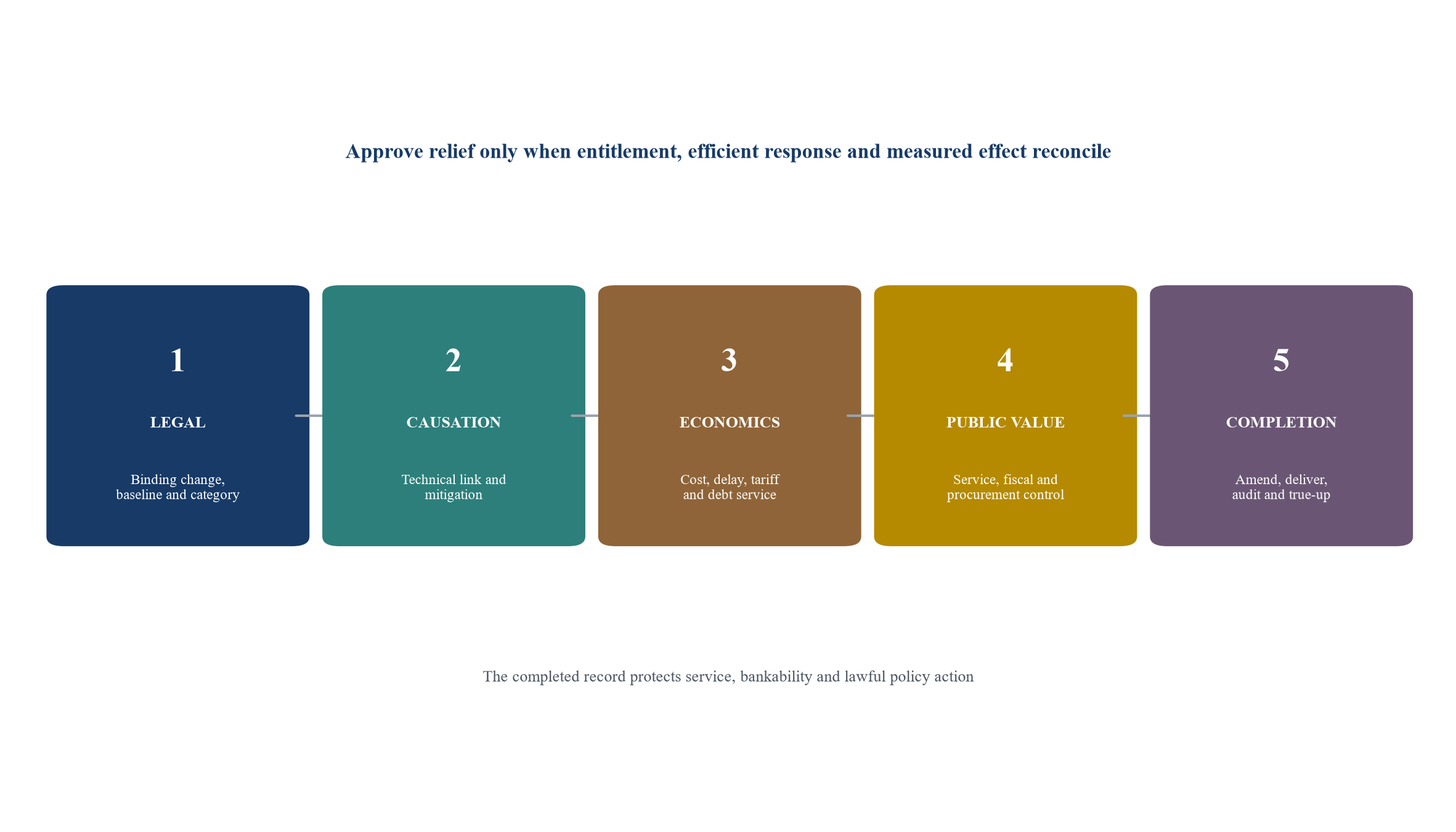
Each gate requires documented evidence before the project advances.
The framework converts legal uncertainty into a governed project-finance decision. It preserves the state's ability to regulate, protects essential service and gives capital providers a bounded path to relief when an unpriced qualifying change alters the contract.
Execution quality depends on disciplined evidence. The legal baseline, technical response, procurement record, financial model, lender position and public approvals should reconcile before relief is fixed. Continuing audit and true-up then align the approved amount with actual delivery.
References
- World Bank Group, "Change of Law," PPP Resource Center, https://ppp.worldbank.org/change-law
- World Bank Group, "Guidance on PPP Contractual Provisions," change-in-law chapter, https://ppp.worldbank.org/sites/default/files/2024-09/world_bank_group_report_on_recommended_ppp_contractual_provisions.pdf
- World Bank Group, "PPP Contracts in an Age of Disruption," 2023, https://ppp.worldbank.org/sites/default/files/2024-04/10028%20-%20PPP%20Contracts%20in%20An%20Age%20of%20Disruption%20%28October%202023%29.pdf
- World Bank Group, "Adjustments in Exceptional Situations," PPP Resource Center, https://ppp.worldbank.org/adjustments-exceptional-situations
- International Finance Corporation, "Performance Standards on Environmental and Social Sustainability," 2012, https://www.ifc.org/en/insights-reports/2012/ifc-performance-standards
- International Finance Corporation, "Guidance Notes to Performance Standards," updated 2021, https://www.ifc.org/en/insights-reports/2012/publications-policy-gn-2012
- World Health Organization, "Guidelines for Drinking-water Quality," fourth edition incorporating the first and second addenda, 2022, https://www.who.int/publications/b/62989
- World Bank Group, "State and Trends of Carbon Pricing 2026," https://www.worldbank.org/en/publication/state-and-trends-of-carbon-pricing
- OECD, "Clean Energy Finance and Investment Policy Review of Indonesia," local-content requirements chapter, https://www.oecd.org/en/publications/clean-energy-finance-and-investment-policy-review-of-indonesia_0007dd9d-en/full-report/component-8.html
- World Bank Group, "Increasing Local Content in the Procurement of Infrastructure Projects," https://ppp.worldbank.org/library/increasing-local-content-procurement-infrastructure-projects-low-income-countries
About the Author
Chennakeshav (CK) is a corporate finance and investment banking executive with 25+ years of global experience in deal origination, structuring and execution across M&A, growth capital and corporate strategy. He has led value-creation mandates for founders, corporates and funds — bridging the boardroom view to hands-on execution and close.
His career spans Morgan Stanley, HSBC, Lloyds Banking Group, EWEC, ADQ portfolio companies and Emirates Growth Fund, across TMT, real estate, fintech, deeptech, cleantech, infrastructure and energy. He has partnered with C-suite leaders, private equity and venture funds, sovereign wealth funds and family offices to finance complex fund raises and scale-up ventures, and has led M&A due diligence, post-merger integration and business-transformation initiatives to create value.
At Matchpoint Partners he is Managing Partner, leading the firm's corporate finance, M&A and capital-raising practice. He holds an MBA from London Business School, an engineering degree from VTU and a Master of Laws (LLM, in progress) from UCL London.
An active start-up mentor, CK mentors at Techstars, DIFC FinTech Hive, Startup Grind, Founder Institute and IN5, serves as Entrepreneur Mentor in Residence (EMiR) at London Business School, and judges the Entrepreneurship World Cup.
