

1 The decision hidden by the funding gap
A developer can have a viable scheme, an indicative bank facility and a clear shortfall between total project uses and available sponsor cash. The temptation is to ask which provider will fill that shortfall at the lowest quoted cost. The useful question is narrower and harder: which combination of capital, contractual rights and available cash allows this particular project to reach completion and exit under a credible downside? Senior debt, subordinated debt and joint-venture equity are different claims on a sequence of uncertain cash flows. Their repayment dates, draw conditions and control rights can change whether a fully funded-looking budget is actually buildable.
The immediate comparison must start with the project entity and timing. A signed loan commitment can be unavailable until title, approvals, security and presale or construction conditions are satisfied. Buyer cash collected through a regulated off-plan escrow arrangement cannot automatically be used as general sponsor liquidity. A partner may commit equity in stages, subject to governance or matching funds. A mezzanine investor may fund today but require current-pay interest while the project has no distributable cash. A headline stack can balance at financial close and fail six months later.
This paper develops a layer-choice protocol that a sponsor, lender and prospective partner can use to make their assumptions explicit. It maps the project rights and regulatory conditions, constructs a dated sources-and-uses ledger, compares the contractual exit waterfall, tests a joint cost-and-presale shock and records who must provide completion money. The comparison does not assume that any lender or partner will offer the modelled terms. The written term sheets and governing documents, once available, control the live answer.
2 Evidence, scope and prior-art boundary
The external sources in this paper perform specific functions. Dubai Land Department's project-registration and escrow materials identify procedural conditions and restrictions relevant to Dubai off-plan development [1,2,3]. Abu Dhabi Real Estate Centre publishes a separate developer journey and description of project escrow and construction-progress releases [4,5]. The Central Bank of the UAE's Credit Risk Management Standards describe the credit-governance, collateral and underwriting expectations for licensed financial institutions within their scope [6]. RICS explains development-property valuation and its sensitivity to cost, programme and completed value [7,8]. IFRS 11 establishes how joint control is assessed for financial reporting [9]. IFC's financing-information guidance shows the type of sources-and-terms evidence that a project financing proposal should assemble [10]. None of these sources supplies a universal UAE mezzanine coupon, JV split or senior advance rate.
Related Matchpoint work already examines the broad AED 50 million to AED 1 billion development capital stack and the option value of staging land payments before permits. The contribution here is a narrower post-land decision: after a defined project budget and an indicative senior amount exist, which residual funding layer survives simultaneous completion and sales stress? This paper adds an explicit exit waterfall, a cross-over calculation and a separate completion-liquidity test. It does not claim novelty over all academic or practitioner literature; no systematic global literature review or consented transaction database was available.
All monetary examples and financing terms below are wholly fictional author-developed assumptions. They are not observations of market pricing, approval policy or actual projects. The simplified model excludes tax, transaction fees, loan arrangement fees, security-enforcement costs, time value beyond stated simple interest and the possibility of staggered asset sales unless expressly added as a sensitivity. In a live mandate, counsel, the authority, account trustee, valuer, lender and project team must verify their respective inputs. The model is an analytical decision aid, not legal, tax, valuation, accounting or investment advice.
3 Separate funding capacity from contractual priority
Senior debt ordinarily has a first-ranking contractual claim against an agreed collateral and cash-flow package. Its exact priority depends on the facility and security documents, perfection, the relevant law and any intercreditor arrangements. A lender's indicative appetite is not a committed draw. For an in-scope UAE licensed financial institution, the Central Bank's standards require documented assessment of credit risk, repayment and collateral, including enforceability and relevant registration [6]. The sponsor should therefore distinguish bank credit approval, executed facility, satisfied conditions precedent and cash actually available in the project account.
Mezzanine is a subordinated debt layer whose claim is typically behind senior obligations and ahead of ordinary equity in the agreed waterfall. Its economics can include cash or capitalised interest, fees, profit participation and redemption rights. The term sheet may also contain covenants, step-in rights, security over shares, restrictions on senior amendments and a defined maturity. Calling an instrument “mezzanine” does not establish its actual ranking or regulatory treatment. Counsel must trace the subordination and enforcement provisions through the complete security and intercreditor documents.
JV equity absorbs a residual loss and participates in residual value under a negotiated split or preferred-return waterfall. It can bring additional completion capacity and expertise, but it also requires a valuation of what each party contributes, a budget approval process, reserved matters, further-funding rules and exit provisions. A stated minority stake need not imply passive governance. IFRS 11 defines joint control by contractual agreement and unanimous consent over relevant activities; the accounting classification of a particular arrangement needs a transaction-specific assessment [9]. The board should compare economic dilution and decision rights separately.
The three layers are not simply interchangeable currency. Their usable amounts can be conditioned on different documents and dates, and their losses travel through different claims. The comparison should show both the source of the initial AED 40 million gap and the party that has a legally binding obligation to fund an additional AED 20 million if completion costs increase. Without that second answer, the proposed stack is incomplete.
4 Build a dated sources-and-uses ledger
The starting ledger names the land and construction uses, contingencies, professional fees, finance costs, statutory payments and unrestricted liquidity required before every important draw. It then assigns each source a legal provider, borrower or issuer, commitment amount, availability date, permitted use, conditions precedent and evidence. A presale receipt is recorded as cash held in the specified escrow account, then as cash releasable for a defined construction purpose after the applicable verification, rather than as a single unrestricted inflow. Dubai Land Department explains that the escrow account receives off-plan buyer and project-financier funds for the registered project [2]. Abu Dhabi describes staged escrow releases against independently verified construction milestones [4]. The applicable contract and authority rules determine the live treatment.
The ledger should be monthly during construction and weekly near a covenant or completion pinch point. For each period, calculate opening unrestricted cash, legally available equity, drawable debt, permitted escrow release, authorised uses, interest, closing unrestricted cash and the minimum funding headroom. Separate the project's cash position from the sponsor's group cash and bank guarantee capacity. A sponsor may be solvent on a consolidated basis while the project vehicle has no lawful source for a contractor payment due next week.
The first stress moves the cost-to-complete estimate; the second moves sales and escrow release dates. They can occur together. A later sale can increase finance carry and defer a release precisely when higher costs require cash. The model should recalculate the first date of shortfall, amount, cause, contractual cure rights and person who can fund it. A “funded at completion” conclusion means the cash exists at each required date under the governing documents, not only that total expected receipts exceed total expected expenses at the end.
Table 1. A dated capital-availability test
| Layer | Evidence of commitment | Earliest usable point | Constraint in the stress case |
|---|---|---|---|
| Sponsor equity | Bank statement, board approval and subscription | When paid into the correct entity | May be needed for cost overruns and guarantees |
| Senior facility | Executed agreement and satisfied conditions | Draw schedule after security and eligibility tests | Advance, covenant or completion conditions can restrict draws |
| Mezzanine | Subscription or loan and intercreditor agreement | Contractual funding date | Coupon, maturity and subordination may create a cash pinch |
| JV equity | Executed JV documents and funded capital call | Agreed call date | Approval, reserved matters and further-funding rules can delay cash |
| Presale receipts | Registered contracts and account statement | Only when lawful project use and release conditions are met | Sales or milestone delay can defer availability |
Author-developed checklist; the actual commitment and release conditions depend on signed documents and the competent authority.
5 Fix the valuation date and the project perimeter
A development appraisal should state the valuation date, asset rights, approved or assumed scheme, gross development value, remaining cost, programme, finance and developer return. RICS notes that development valuations can be complex, variable and option-sensitive [7,8]. A lender may require a different collateral view from the sponsor's residual project appraisal. The analyst should keep those perspectives separate: completed-sales forecast, current land or work-in-progress value, value on an orderly exit and recovery after delay or enforcement are not the same number.
The project perimeter determines which obligations sit inside the comparison. If land is contributed by a related party at a book value, the economic opportunity cost and any deferred consideration still matter. If a contractor provides credit, that is another claim with timing and enforcement characteristics. If a parent guarantees completion, the sponsor has an exposure beyond its direct equity. An apparent AED 40 million gap may disappear only because a liability has been moved off the simplified project uses schedule. The board should reconcile project accounts, title and purchase documents, construction contracts and financing offers before ranking instruments.
Valuation also changes when a JV investor contributes more than cash. It may supply land, development management, design, tenant access or a guarantee. Each non-cash contribution needs a documented scope, independent valuation where material, delivery milestone and remedy for non-performance. A nominally low equity percentage can be expensive if the partner receives value for services that the project already budgeted elsewhere. Conversely, a higher percentage can be justified if the partner assumes a measurable completion risk that would otherwise fall on the sponsor.
6 Construct the initial capital stack
Consider a wholly fictional project with AED 220 million of land, construction and other stated uses before finance costs. At the assumed close, the sponsor contributes AED 60 million, a senior lender advances AED 120 million, and AED 40 million remains to be funded. The model compares two ways of filling that same gap. Under the mezzanine route, the project borrows AED 40 million behind the senior facility. Under the JV route, a partner contributes AED 40 million of ordinary equity for 40 percent of residual distributions after senior repayment. These terms are chosen only to expose the arithmetic; they do not represent a UAE market quote or recommended ownership split.
For transparency, assume the senior principal of AED 120 million remains outstanding until a single exit after two years and accrues simple interest at a fictional 5 percent per annum, or AED 12 million. The mezzanine principal of AED 40 million also remains until exit and accrues fictional capitalised simple interest at 12 percent per annum for two years, or AED 9.6 million. There are no fees, taxes, interim distributions or compounding. In both routes, all initial uses are paid from the stated sources. Sale receipts at exit are project cash available for the assumed waterfall, not a statement about actual escrow release mechanics.
The simplification deliberately separates three concepts. AED 220 million is the initial cost of the project, funded and spent during development. AED 300 million in the base case is gross project sale cash at exit. Debt principal repayments are claims on that sale cash; subtracting the AED 220 million initial cost a second time from exit cash would double count the investment. Sponsor profit is its exit distribution less its paid-in equity, adjusted for any later funding. An actual model would calculate every draw, cost, sale, interest period and regulated release at the dates they occur.
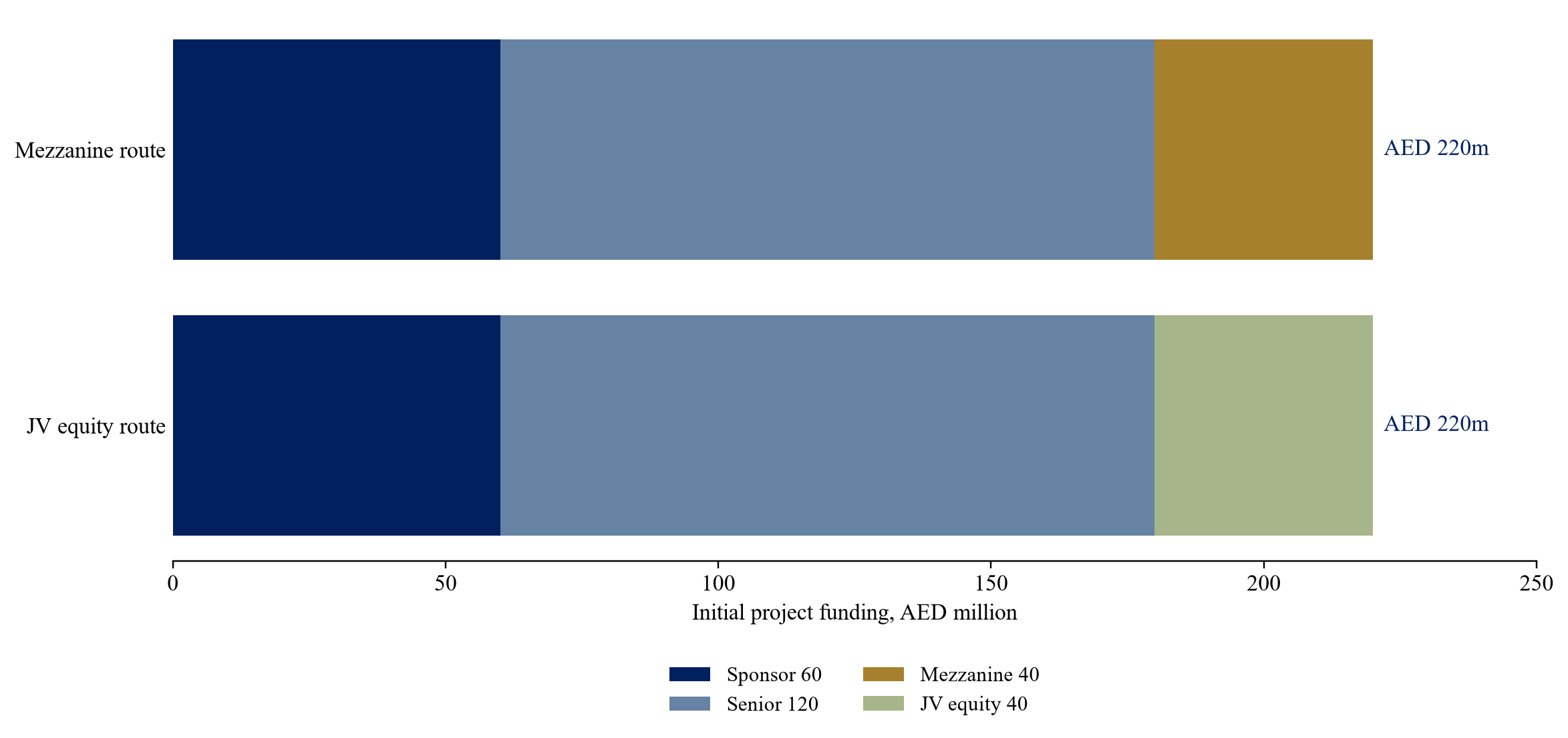
Author-developed illustration in AED million. The amounts and layer terms are invented for method testing and are not market data.
7 Write the waterfall before comparing returns
Under the fictional contract, sale proceeds first satisfy the AED 132 million senior principal and accrued interest. In the mezzanine route, the next AED 49.6 million satisfies subordinated principal and accrued interest. The sponsor receives the remainder, if any. In the JV route, after the same senior payment, the residual is split 60 percent to the sponsor and 40 percent to the partner. There is no preferred return, sponsor catch-up, promote, liquidation preference or priority for later equity in this simplified example. Each of those features would change the result and belongs in the live term sheet.
At AED 300 million of sale proceeds, the mezzanine route leaves AED 118.4 million for the sponsor: 300 less 132 less 49.6. The JV route leaves AED 168 million after senior repayment, of which the sponsor receives 60 percent, or AED 100.8 million. Relative to its initial AED 60 million contribution, the fictional sponsor's simple cash profit is AED 58.4 million with mezzanine and AED 40.8 million with the JV. These are undiscounted outputs of the stated assumptions, not returns forecast for a real project. The mezzanine provider receives AED 9.6 million interest on its AED 40 million principal if the full exit occurs as assumed; the JV partner receives AED 67.2 million, including its capital and residual gain.
The difference should not be described as the “cost of equity” versus a quoted coupon without qualification. The equity payment varies with the sale outcome, while the mezzanine claim is contractually fixed up to available cash and enforceable rights. Equity may carry control and future-funding obligations. Debt may constrain distributions or refinancing. The board needs a scenario distribution of both the sponsor's cash and the project's ability to survive before it can decide which layer is economically acceptable.
8 Find the economic crossover
The simplified waterfall permits a useful algebraic check. Let R denote exit sale proceeds in AED million after all initial uses have been funded and spent. When both debts are repaid in full, the sponsor's mezzanine-route exit cash is R minus 181.6. Under the stated ordinary-equity split, its JV-route exit cash is 60 percent of R minus 132. Set the expressions equal: R minus 181.6 equals 0.6 times R minus 132. The result is R equals AED 256 million. At that particular gross exit value, sponsor distributions are AED 74.4 million under either route.
This threshold is conditional. It is meaningful only for the fictional capital amounts, interest rates, term, senior claim, JV percentage and absence of other claims. A mezzanine redemption premium raises the threshold. A lower JV partner percentage lowers it. A later exit increases accrued interest in the simplified model, which also raises the threshold. A preferred-equity hurdle changes the shape of the JV waterfall, so a single straight-line crossover may no longer exist. A live committee should calculate the exact crossing points from executed or genuinely executable terms, not reuse AED 256 million.
The crossover is also distinct from project bankability. At AED 256 million, the sponsor may be indifferent on the simplified exit cash and still prefer one route because only one investor will commit during a permitted construction window. Conversely, a route that looks attractive on a gross exit basis can fail if its maturity arrives before cash is releasable. The board should document the economic crossing, then test liquidity, control and completion as separate pass-or-fail gates.
9 Stress sale proceeds and completion cost together
Now assume fictional gross sale proceeds fall to AED 230 million and the project incurs AED 20 million of additional costs. For comparability, the sponsor contributes that extra AED 20 million in cash under both routes, without changing loan principals or JV ownership shares. The sponsor's total invested capital is then AED 80 million. The model assumes those extra costs are paid before exit and that the stated AED 230 million remains the cash available for the exit waterfall. This is a deliberately simplified stress, not a prediction about sales, construction or financing markets.
After paying the unchanged AED 132 million senior claim, the project has AED 98 million. In the mezzanine route, AED 49.6 million goes to the subordinated lender and AED 48.4 million to the sponsor. Relative to AED 80 million invested by the sponsor, its simplified loss is AED 31.6 million. In the JV route, the sponsor receives 60 percent of AED 98 million, or AED 58.8 million; the partner receives AED 39.2 million. The sponsor's simplified loss is AED 21.2 million. The JV structure gives the sponsor AED 10.4 million more exit cash under this fictional stress, while shifting part of the residual loss to the partner.
The sponsor might not be able to provide the extra AED 20 million. If not, both model routes can fail before the AED 230 million exit is ever reached. A JV agreement could require pro rata further capital; a mezzanine provider could have a separate completion undertaking; a senior bank might require an equity cure. The decisive issue is which party has a binding, timely obligation to fund the overrun and what happens if it refuses. The committee should run a no-cure case, not assume the favourable exit of a project that has stopped construction.
Table 2. Fictional exit distributions and sponsor capital at risk, AED million
| Scenario and measure | Mezzanine route | JV equity route | Interpretation |
|---|---|---|---|
| Base sale cash, 300 | Sponsor exit 118.4 | Sponsor exit 100.8 | Both claims paid as modelled |
| Base sponsor profit on 60 | 58.4 | 40.8 | Before tax, fees and discounting |
| Stress sale cash, 230; extra sponsor cash 20 | Sponsor exit 48.4 | Sponsor exit 58.8 | Sponsor contribution rises to 80 |
| Stress sponsor profit on 80 | -31.6 | -21.2 | JV partner shares residual downside |
| Severe sale cash, 160; extra sponsor cash 20 | Sponsor exit 0 | Sponsor exit 16.8 | Mezzanine suffers a shortfall before senior |
All amounts derive from the wholly fictional assumptions in Sections 6 to 10; no market observations are presented.
10 Read a severe downside through each claim
Suppose the same fictional additional AED 20 million is funded by the sponsor, but gross exit proceeds are only AED 160 million. The AED 132 million senior claim is paid in full under the simplified priority, leaving AED 28 million. In the mezzanine route, that AED 28 million is applied to the AED 49.6 million subordinated claim. The subordinated provider has a AED 21.6 million contractual shortfall, subject to whatever enforcement, guarantee or recovery rights a real agreement provides. The sponsor receives zero and loses its AED 80 million cash contribution. In the JV route, the AED 28 million residual is split; the sponsor receives AED 16.8 million and the partner AED 11.2 million. The sponsor's simple loss is AED 63.2 million on its AED 80 million contribution.
This result reflects the chosen contractual priority, not an assertion that JV equity is intrinsically safer for sponsors. A mezzanine lender might demand a sponsor guarantee or security over other assets, increasing sponsor loss beyond project equity. A JV partner might negotiate preferred capital, a senior distribution or a dilution remedy if the sponsor cannot fund the overrun. A real senior lender might accelerate or enforce before the assumed sale. Each of those provisions can reshape the loss allocation. The investment committee should draw the waterfall from actual documents and show recourse outside the project company.
At sale proceeds below AED 132 million, even the senior lender is not fully repaid under this simplified single-asset waterfall. That point is a reminder that the priority stack does not manufacture value. Project asset rights, buyer obligations, contractor claims, enforcement time and legal costs determine actual recoveries. The severe case should be used to locate exposures and negotiation priorities; it cannot be treated as a formal valuation or expected loss without evidence for recoveries and probabilities.
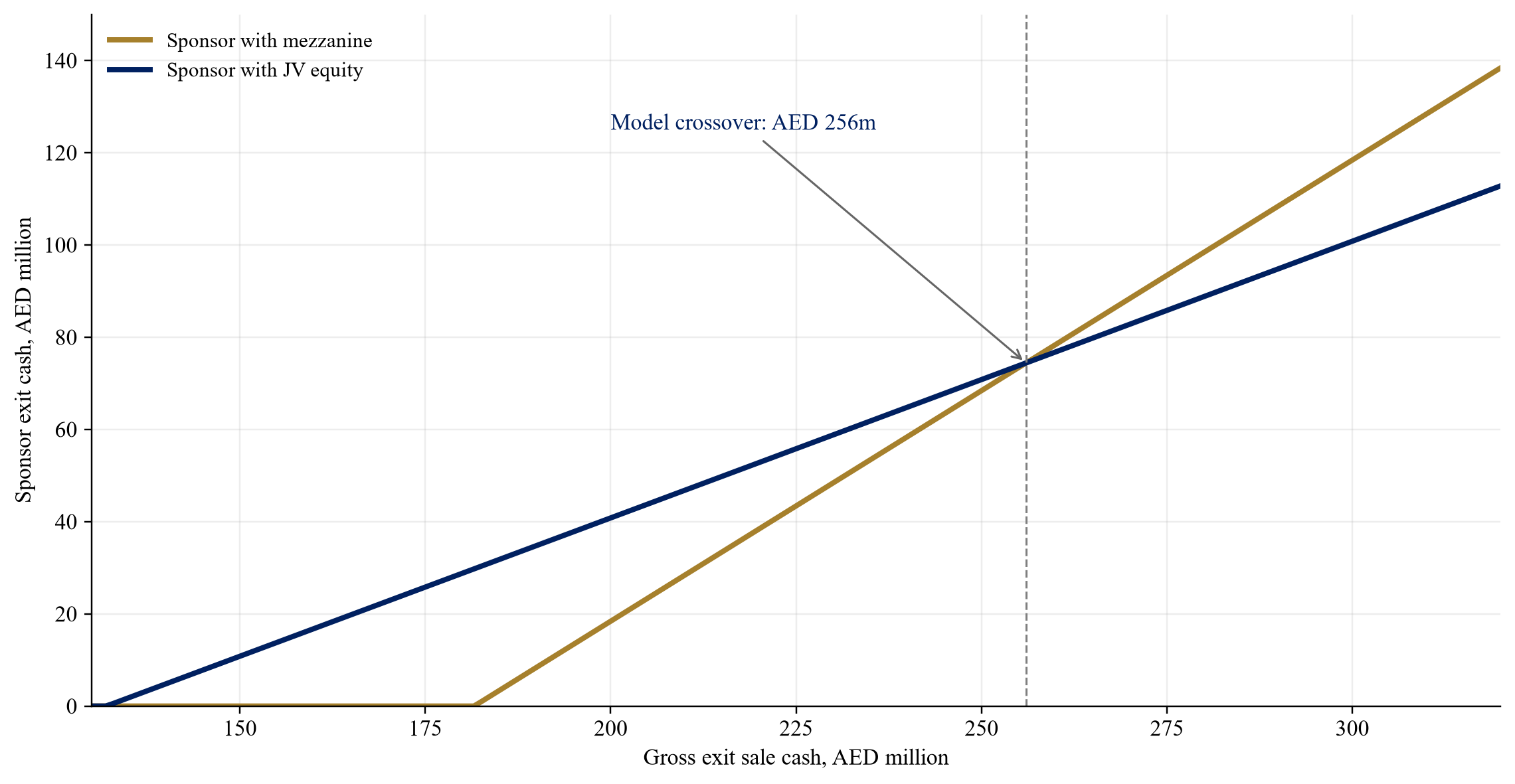
Author-developed waterfall with fixed AED 132m senior claim, AED 49.6m mezzanine claim and 60 percent sponsor JV share. Proceeds are not forecasts.
11 Add the delay stress to debt service
A later sale can change the comparison even if the final gross sale price is unchanged. Under the fictional simple-interest assumptions, an additional six months with full principal outstanding adds AED 3 million to the senior claim: AED 120 million at 5 percent for half a year. It adds AED 2.4 million to mezzanine: AED 40 million at 12 percent for half a year. If the JV has no time-based preferred return, its contractual residual share does not mechanically increase from this delay alone, though its investment return over time falls and it may seek revised terms. The modelled mezzanine-route sponsor cash falls by AED 5.4 million for the same exit proceeds; JV-route sponsor cash falls by 60 percent of the additional AED 3 million senior claim, or AED 1.8 million.
That arithmetic assumes interest is fully capitalised and payable at exit, the agreements permit the extension and no default interest, fee or mandatory prepayment applies. A real facility may mature before the sale. If current-pay coupons are required, the project or sponsor may need cash during construction, making the delay stress more acute. A lender may reduce undrawn availability if cost-to-complete, presale or valuation conditions fail. A JV investor may have a long-stop date or consent right over an extension. These contractual events should be represented as branch points, not smoothed into a larger year-end interest number.
Presale delay also has a regulatory dimension. A signed sale, a buyer instalment in escrow and a released amount for a certified construction milestone are distinct states. The project manager, authority and account trustee should verify the applicable release conditions [2,4]. The financing model needs the amount and date of usable cash in the project, with a fallback source if certification, collections or authority action arrives late. A project that can repay all investors after sale may still become insolvent on a contractor payment during the build.
12 Calculate the true completion-funding obligation
The cost-to-complete test begins with a third-party quantity-surveyor or technical-adviser update of committed and uncommitted works, contingency, claims, variations, permits, utilities, sales cost, finance carry and handover requirements. It deducts only funding that is legally committed and usable for those costs at the relevant dates. The balance is the completion-funding requirement. Where the budget has already been spent but project cash is locked or an expected instalment slips, the liquidity need can exceed the nominal cost overrun. It may also arise before the overrun is formally recognised.
The sponsor should list each party that might supply cure capital. Existing equity may be called pro rata, a new partner admitted, mezzanine increased, senior amended, assets sold or the contractor payment schedule renegotiated. Every option has conditions, transaction cost, timing and an effect on the waterfall. A generic “shareholders to fund shortfall” line has no value until the governing documents identify the amount, notice period, voting threshold, default remedy and source of cash. Completion support should be proven by executed obligations and, where relevant, evidence of the provider's capacity.
The test should include a no-cure branch. If the sponsor, mezzanine lender or JV partner declines additional funding and the senior bank does not advance more, identify the work stoppage date, contractual default, buyer obligations, security path and costs to preserve the site. This is a decision about avoiding a stranded asset; it cannot be repaired by a base-case internal rate of return. A funding proposal that closes the initial AED 40 million gap but leaves a foreseeable overrun with no provider fails the completion test.
13 Treat presales as a covenant and cash-flow variable
Presales can improve evidence of demand and support collections, but their timing and legal use require careful treatment. The Dubai Land Department's FAQ says off-plan buyer payments and project-financier amounts enter the project escrow account; its project-registration service governs the route to that account [1,2]. Abu Dhabi Real Estate Centre describes buyer funds entering an approved account and release in tranches against verified construction progress [4]. Those are jurisdiction-specific public descriptions. The exact project rules, approved budget, trustee agreement and current authority decisions control the live cash release.
For modelling, separate reservations, executed and registered sale-and-purchase agreements, billed instalments, cash received, cash held, cash released and cash spent on eligible works. A marketing pipeline cannot satisfy a debt covenant that tests executed contracts. An executed contract cannot pay a supplier if its instalment has not arrived. A collected instalment may be restricted. The committee should identify which metric each financing document uses and how it is verified. It should also test cancellations, price concessions, handover delay and concentration among large buyers without claiming an observed UAE cancellation rate.
An indicative lender may underwrite a minimum presale level before first draw or during construction; the specific condition must come from its term sheet. A mezzanine provider may define a separate cash-sweep trigger. A JV partner may wish to change the launch price or phasing after demand weakness. These rights can conflict. The intercreditor and JV documents should explain who can approve price changes, asset disposals, refinancing and a revised business plan when covenants tighten. A presale shortfall is a commercial signal and a governance event, not simply a cell in a sales forecast.
14 Test bankability under the lender's rules
The Central Bank of the UAE's credit-risk standards direct licensed financial institutions within scope to govern credit underwriting, legal due diligence, facility structure, collateral and monitoring [6]. They do not approve this fictional development or set its leverage. A sponsor seeking bank funding should prepare evidence that lets the lender make its own decision: land title and security route, permits, approved plans, construction contract and programme, cost-to-complete, presales and escrow, sponsor capacity, completion support and a repayment analysis. RICS development-valuation guidance supplies a separate standard for a valuation engagement, including the need to state assumptions and sensitivity [7,8].
The facility's eligible uses and draw conditions should be placed on the dated model. A bank may advance against certified works, require equity to be spent first, apply a loan-to-cost or loan-to-value limit, or demand a specific presale test; each is a potential term, not asserted practice for all UAE lenders. Subordinate capital may require senior consent and a clear intercreditor priority. If mezzanine is raised after senior documents are signed, the board must verify that the senior agreement permits the new debt and security. If a JV partner enters the project vehicle, transfer and change-of-control conditions may apply.
The funding package should show how the senior lender is repaid when unit sales are staggered. A single bullet sale of all units at one date is a useful simplified comparison but can hide release prices, repayment sweeps, trapped escrow balances and unsold-inventory exposure. A project-level cash model should reconcile each expected sale and cash release with lender repayment. The lender's downside may be driven by timing and collateral enforcement, while the sponsor's downside includes dilution, guarantees and reputation. Those perspectives should be presented on adjacent pages rather than blended into one target return.
15 Define JV control and deadlock before signing
JV equity can supply patient capital, but governance determines whether it remains available when conditions change. The agreement should identify project business plan and budget approval, contractor appointment, variations, launch pricing, borrowing, security, related-party transactions, asset sale, refinancing and distributions. It should also specify which decisions require one party's consent and which can be made by the manager within an approved envelope. IFRS 11 uses contractually agreed unanimous consent over relevant activities as the defining feature of joint control for financial reporting; commercial lawyers and accountants must assess the actual arrangement [9]. A label in a pitch deck is insufficient.
The next issue is a capital call. If the fictional AED 20 million overrun arises, who pays, by when and in what proportion? A pro rata call might require the partner to add AED 8 million and sponsor AED 12 million if the 40/60 ownership shares apply; this is a separate hypothetical variant, not the assumption used in the waterfall table. Failure to fund may cause dilution, a shareholder loan, a priority return or loss of voting rights, depending on the signed agreement. The paper's simplified table assumes the sponsor funds all AED 20 million with no ownership reset solely to keep the initial structures comparable. A live case should model the signed capital-call mechanism.
Deadlock matters most when the project is under pressure. If partners disagree about a price reduction or extra borrowing, a simple veto can block the response before a senior covenant deadline. The agreement should set escalation, independent expert determination where appropriate, emergency spending authority, buy-sell or sale process and protection for buyers and lenders. These rights can have financial value. A sponsor accepting a JV to reduce fixed debt service should price the possibility that it loses unilateral control over a time-critical decision.
16 Negotiate mezzanine terms as a liquidity package
The nominal mezzanine coupon is only one component. A term sheet should specify whether interest is paid in cash, capitalised or partly contingent; when it accrues; whether it compounds; the redemption premium; maturity; extension rights; early prepayment; default interest; guarantee; security; ranking; information rights and cure provisions. Each term affects either dated liquidity or ultimate distribution. A 12 percent capitalised fictional coupon in this paper avoids interim cash calls but increases the exit claim. A smaller current-pay coupon could produce a lower final claim while causing an earlier construction-period shortfall.
Subordination needs more than a sentence that says “behind senior”. The documents should specify payment blockage after a senior default, permitted payments, standstill, enforcement sequencing, proceeds application, cure rights and the treatment of a senior refinancing. The senior lender may require limits on mezzanine maturity or enforcement before its own loan is repaid. Local counsel should test security perfection and priority against the project structure and property rights. An intercreditor agreement that is still under negotiation is a condition to funding, not a completed part of the stack.
Mezzanine may be attractive where the sponsor expects substantial residual upside and can tolerate a fixed claim under the tested downside. It becomes hazardous when the project has weak sale timing, high cost volatility or no equity cure capacity. The board should show both the contractual repayment and the amount available after senior under at least a base, joint-stress and severe case. It should also ask whether a mezzanine provider will actually commit to the project given its collateral and cash-flow evidence. An elegant model with no willing funder does not finance a construction invoice.
17 Compare time-weighted returns with equal discipline
The simple cash profits in Table 2 do not measure time-weighted returns. A fair investor comparison uses dated contributions and distributions for every layer, with the same project programme, sales curve and cost forecasts. If the sponsor pays AED 60 million at close and another AED 20 million after a year, the timing differs from contributing AED 80 million at close. If sale receipts occur unit by unit, the date and amount of debt reduction affect interest. The model should calculate each party's internal rate of return and money multiple from its own cash flows, and should disclose any fee paid to an affiliated developer or funder.
Return calculations also depend on the definition of value. A sponsor may prefer a larger gross share but receive later cash. A partner may offer a lower ownership percentage in exchange for a preferred return. A mezzanine provider may take an exit fee rather than a higher coupon. Comparing only headline interest and nominal equity dilution fails to put these features on a common timeline. The committee should include both money received under each scenario and the funding gap that can emerge before receipt.
Discounting does not solve missing evidence. A single chosen hurdle rate cannot turn speculative sale timing into an observed fact. RICS development-property guidance calls attention to assumptions and sensitivity in valuing development projects [7,8]. Where sale price, cost or timing evidence is weak, the output should be a range and a conditional decision. The analyst can identify the contract term that would move the decision, such as a mezzanine maturity extension, a JV capital-call commitment or a senior draw condition, and seek that term before presenting a final recommendation.
18 Run a three-dimensional sensitivity rather than one downside
The minimum sensitivity grid varies sale proceeds, cost to complete and exit date jointly. Each point recomputes senior and mezzanine interest, availability of presale cash, the timing of the first deficit and each investor's exit distribution. It also flags a contract breach rather than reporting a positive terminal return after a covenant default. The cost axis should include contractor claims and infrastructure requirements that may appear after the initial budget. The delay axis should move both sales receipts and construction draw certification where the delay affects the physical works.
For the fictional example, the exit-waterfall crossover at AED 256 million assumes a two-year term and no extra claims. An extra six months of simple interest adds AED 3 million to senior and AED 2.4 million to mezzanine. With unchanged JV share, the mezzanine route's sponsor exit formula becomes R minus 187; the JV route becomes 0.6 times R minus 135. The new equality is R equals AED 265 million. This is exact arithmetic for the fictional contractual assumptions, not a general rule. If the project also incurs AED 20 million additional sponsor-funded costs, each route's net sponsor profit falls by the corresponding cash contribution, while the distribution crossover under unchanged ownership remains as calculated.
Table 3. Fictional sensitivity of the sponsor's layer choice
| Exit timing and stated terms | Equal-distribution sales cash | Mezzanine funding test | JV funding test |
|---|---|---|---|
| Two-year exit; no additional debt terms | AED 256m | Can the fixed AED 49.6m claim be paid? | Can 60/40 residual governance execute? |
| Two-and-a-half-year exit; simple interest only | AED 265m | Can maturity extend and AED 52m claim be paid? | Can partner accept later distribution? |
| Any exit with AED 20m overrun | Depends on debt term and split | Identify source and date of additional cash | Apply signed further-funding mechanism |
| Presale delay with blocked escrow release | Terminal crossover is insufficient | Test interim coupon and senior draw | Test capital-call timing and consent |
Author-developed decision sensitivity; equality points depend on the stated fictional simple-interest and ownership terms.
19 Identify the first date of failure
The most useful output of a monthly model may be the first date on which a contractor payment cannot be made, a senior covenant cannot be certified or an investor's funding condition cannot be met. Work backwards from that date. Identify the exact cash account, contractual payment, eligibility condition, approving person and shortest realistic cure time. A board can then choose among funded variations, a revised construction sequence, additional equity, a lender amendment or a controlled sale. If none is executable before the deadline, the board should confront that fact while options remain.
The exercise should preserve a clean distinction between information and action. A quantity surveyor can certify cost-to-complete; a valuer can appraise the collateral under defined assumptions; the lender can decide credit and draws; the account trustee can confirm release mechanics; counsel can establish legal rights; the board can decide risk appetite. A single financial model should receive the outputs and expose conflicts. It should not imply that the analyst's spreadsheet authorises a payment from escrow or waives a covenant.
An early warning register should record presale conversion, cash collection, construction progress, claims, uncommitted costs, utility approvals, interest forecast, restricted balances, lender headroom and partner call capacity. Each metric needs a source, threshold, owner and next decision date. A monthly dashboard without a pre-authorised response may simply document deterioration. The capital stack is resilient only if the project can obtain money and consent before the cash need, under enforceable documents.
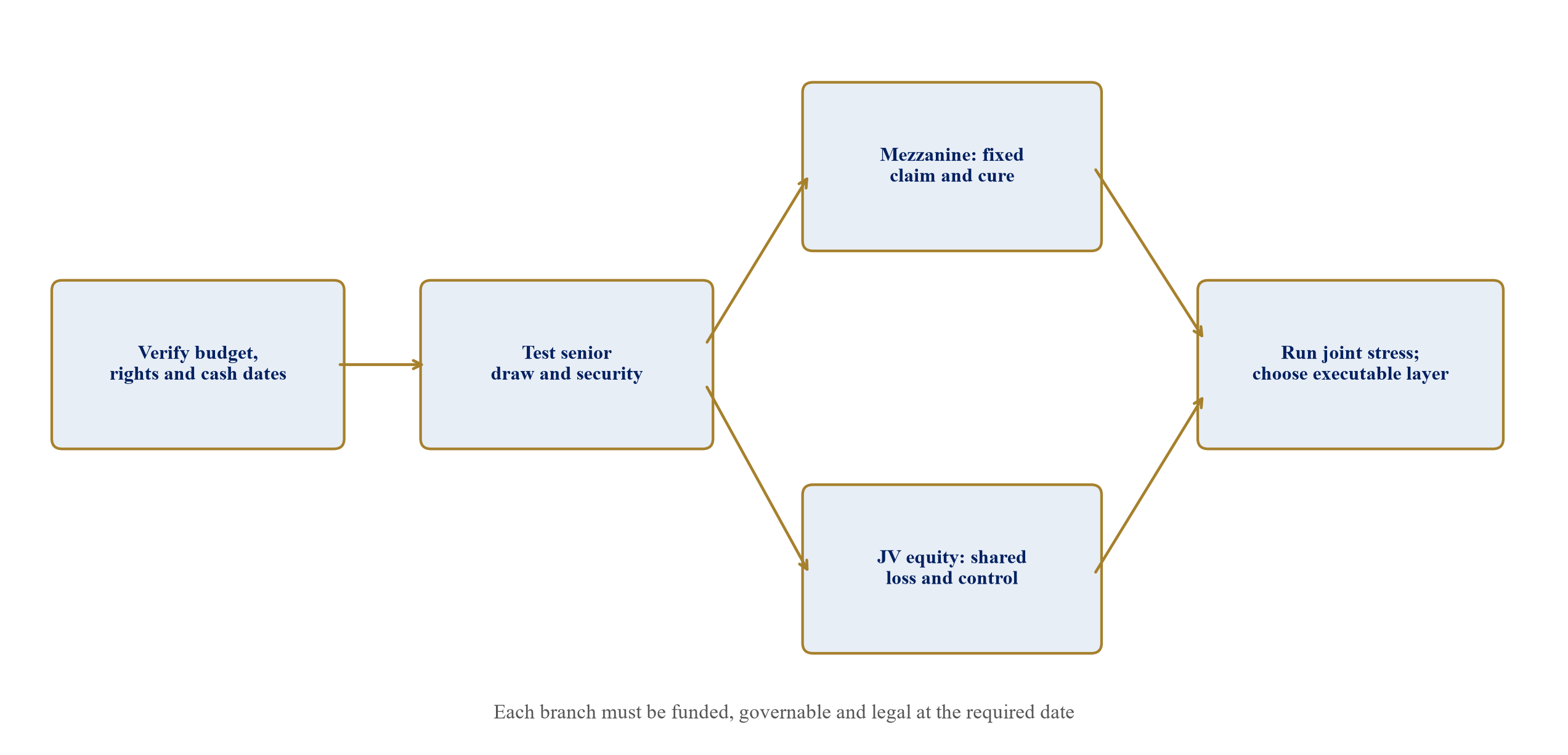
Author-developed decision sequence. Every route requires transaction-specific legal, credit and regulatory confirmation.
20 Negotiate a term sheet from the stress result
The stress model should determine which contractual term has the highest practical value. If mezzanine gives the sponsor higher base-case cash but a six-month delay creates a maturity mismatch, negotiate a realistic extension and define its price. If JV equity better absorbs downside but reserved matters could block urgent variation approval, set a decision deadline and emergency budget authority. If the senior lender's first draw arrives too late, reorder equity payments or obtain a separate genuinely committed bridge with an identified repayment source. The objective is to convert a weak assumption into an executable obligation.
The term-sheet comparison should use one-page summaries for each route. Each summary lists committed amount, funding date, eligible uses, draw conditions, interim cash costs, exit priority, recourse, completion obligations, security, approvals, control rights, default remedy, expected time to close and known unresolved items. The board should not allow different advisers to use different construction budgets or sale assumptions to make their favoured instrument look attractive. Version control is essential: every quoted return and covenant headroom figure should trace to the same dated cost plan and sales schedule.
Negotiation should be sequenced. Obtain the senior lender's written position on permitted subordinate funding and change of ownership before spending heavily on a mezzanine or JV process. Ask prospective gap investors for markups of the same base and downside model. Confirm the project company's authority to issue or borrow the capital and the regulator or trustee treatment of relevant receipts. Then reconcile conflicts among senior, mezzanine and shareholder documents. An investor's verbal willingness to fund does not belong in committed sources.
21 Build the investment-committee pack
The front page should ask for a concrete decision: authorise negotiations, select a preferred conditional structure, approve a funding limit or stop. It states the project perimeter, approvals, initial uses, committed sources, first uncovered payment date, base and downside sale cash, cost-to-complete range, peak liquidity need and exact contractual conditions still open. The second page shows the dated funding bridge. The third shows the waterfall under base, joint stress and severe downside, including claims outside the project. A governance page explains who controls budget, sales, refinance and emergency capital.
An evidence appendix should contain title and land documentation, official approval extracts, registered project and escrow status, construction contract and quantity-surveyor report, sales and collections register, bank and investor term sheets, valuer's report, legal issues list and group liquidity evidence. Each item needs a date and responsible owner. The board should be able to trace a model input to its source and distinguish an executed commitment from an indicative offer. IFC's project-financing information guidance similarly asks for the proposed financial structure and expected sources and terms of debt and equity [10]; it is a useful disclosure discipline, though it does not set UAE bank requirements.
The committee minute records the rejected alternative and why. A decision to pay more for flexible equity can be defensible if the cash shortfall and completion obligation are evidenced. A decision to retain upside with mezzanine can be defensible if the fixed claim, maturity and cure capacity pass the downside. The minute should identify the conditions that would require the decision to return to the board: material cost increase, presale delay, senior term change, investor refusal or project approval change. This prevents a conditional approval from becoming an unconditional funding promise.
22 Conclusion and research agenda
Choosing the layer is a transaction execution decision. The simplified case shows why a base-case comparison can reverse under downside: at AED 300 million of fictional sale proceeds, mezzanine leaves more sponsor cash under the stated terms; at AED 230 million with an additional AED 20 million sponsor contribution, the JV route leaves more. The calculated AED 256 million two-year crossover moves to AED 265 million after a fictional six-month interest extension. These thresholds are properties of the invented contracts. They say nothing about prevailing UAE pricing or the probable outcome of a real development.
The method's more durable result is the two-gate test. First, prove that each capital source is legally committed and usable on the date its cost must be paid. Second, prove that the project has a funded, governed route through a combined cost and sales shock. Only then compare the sponsor's residual economics. Dubai and Abu Dhabi escrow and project rules, lender credit standards and valuation practice inform that test; their details must be checked for the actual emirate, project and documents. A board that sees the first date of failure can negotiate a completion obligation or change the business plan before a shortfall crystallises.
Further empirical research would require consented project-level financing data: approved budgets, actual drawdowns, escrow restrictions and releases, presale schedules, cost changes, amendments, investor terms and realised exits, including unsuccessful projects. The study would need to separate Dubai, Abu Dhabi and other legal regimes, control for scheme and market conditions and address selection bias. This paper makes no empirical claim from such a dataset. It provides a transparent model that can be populated with verified live evidence and revised when the contractual terms change.
References
- Dubai Land Department. Register Project, official registration and escrow service; accessed 7 October 2026. https://dubailand.gov.ae/en/eservices/register-project/
- Dubai Land Department. Frequently Asked Questions, off-plan development escrow; accessed 7 October 2026. https://dubailand.gov.ae/en/frequently-asked-questions
- Dubai Land Department. Depositing a mortgage into an escrow account application; accessed 7 October 2026. https://dubailand.gov.ae/en/eservices/request-for-mortgage-payment-in-escrow-account/
- Abu Dhabi Real Estate Centre. Project Development, registration, escrow and construction-progress overview; accessed 7 October 2026. https://adrec.gov.ae/en/sectors/regulatory-services/project-development
- Abu Dhabi Real Estate Centre. Developer Journey, land, planning, registration and sales sequence; accessed 7 October 2026. https://adrec.gov.ae/en/sectors/regulatory-services/project-development/developer-journey
- Central Bank of the UAE. Credit Risk Management Standards, C 3/2024 STA; accessed 7 October 2026. https://rulebook.centralbank.ae/en/rulebook/credit-risk-management-standards
- Royal Institution of Chartered Surveyors. Valuation of development property, professional standard overview; accessed 7 October 2026. https://www.rics.org/profession-standards/rics-standards-and-guidance/sector-standards/valuation-standards/valuation-of-development-property
- Royal Institution of Chartered Surveyors. Valuation of development property, first edition professional standard; accessed 7 October 2026. https://www.rics.org/content/dam/ricsglobal/documents/to-be-sorted/valuation-of-development-property---first-edition.pdf
- IFRS Foundation. IFRS 11 Joint Arrangements, issued standard overview; accessed 7 October 2026. https://www.ifrs.org/issued-standards/list-of-standards/ifrs-11-joint-arrangements/
- International Finance Corporation. How to Apply for Financing, information on proposed financing structure; accessed 7 October 2026. https://www.ifc.org/en/what-we-do/products-and-services/how-to-apply-for-financing
About the Author
Chennakeshav (CK) is a corporate finance and investment banking executive with 25+ years of global experience in deal origination, structuring and execution across M&A, growth capital and corporate strategy. He has led value-creation mandates for founders, corporates and funds — bridging the boardroom view to hands-on execution and close.
His career spans Morgan Stanley, HSBC, Lloyds Banking Group, EWEC, ADQ portfolio companies and Emirates Growth Fund, across TMT, real estate, fintech, deeptech, cleantech, infrastructure and energy. He has partnered with C-suite leaders, private equity and venture funds, sovereign wealth funds and family offices to finance complex fund raises and scale-up ventures, and has led M&A due diligence, post-merger integration and business-transformation initiatives to create value.
At Matchpoint Partners he is Managing Partner, leading the firm's corporate finance, M&A and capital-raising practice. He holds an MBA from London Business School, an engineering degree from VTU and a Master of Laws (LLM, in progress) from UCL London.
An active start-up mentor, CK mentors at Techstars, DIFC FinTech Hive, Startup Grind, Founder Institute and IN5, serves as Entrepreneur Mentor in Residence (EMiR) at London Business School, and judges the Entrepreneurship World Cup.
