
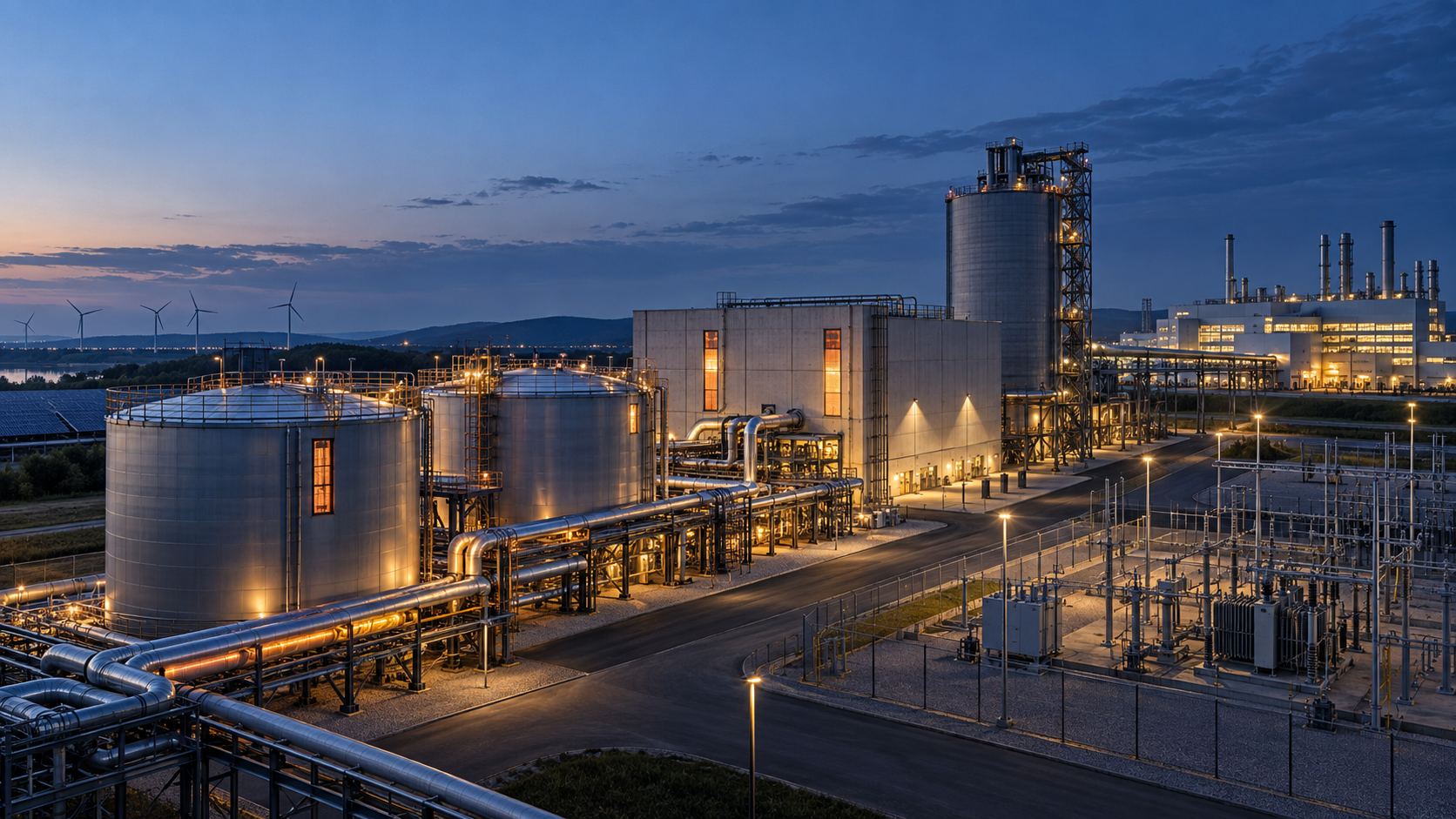
1. Thermal storage begins with the heat sink
An industrial thermal-storage project should begin with the process that consumes heat. The decision team needs the required temperature, pressure, flow, ramp rate, availability, product-quality tolerance and annual operating calendar. These variables determine the useful thermal service. They are more important than a generic storage-duration label.
A food plant requiring saturated steam, a paper mill with a continuous steam header, a ceramics line using hot air and a metals process above 1,000 degrees Celsius impose different boundaries. A technology that stores heat efficiently can still fail commercially when it cannot deliver the required medium or when integration creates pressure loss, contamination, unstable temperature or production downtime.
The investment case should therefore define the heat-delivery point and acceptance test before comparing storage media. The useful unit is verified heat at the process boundary, not heat retained inside an insulated vessel.
2. Storage separates energy purchase from heat use
Electric resistance heating, induction, electric boilers, heat pumps and renewable-thermal systems can produce industrial heat. Storage allows the charging equipment to operate when electricity is available or inexpensive while the factory consumes heat according to production needs. It can also capture waste heat that would otherwise be rejected.
This time separation can reduce exposure to peak prices, support renewable-power integration and limit the charging capacity needed at the heat sink. It can also add conversion losses, auxiliary power, control complexity and capital cost. The value depends on the spread between charging opportunities and avoided fuel or electricity cost after those penalties.
The financial model should preserve hourly or sub-hourly chronology. Annual average power prices cannot show the value of avoiding expensive hours or the risk that a storage system lacks enough low-cost charging windows.
3. Industrial heat covers a wide temperature range
The International Energy Agency reports that industries using low-temperature heat and steam represent a large share of industrial energy consumption. It also notes that heat pumps and electric boilers are commercially available for many lower-temperature applications, while high-temperature processes require a broader technology set.
The temperature requirement influences storage medium, containment, insulation and heat transfer. Water is effective for lower temperatures. Molten nitrate salts have an established operating window but require freeze protection and remain bounded by material stability. Refractory solids and particles can operate at higher temperatures. Phase-change materials are selected around a transition temperature that matches the process.
The buyer should map every heat sink rather than use one plant-wide temperature. A site can require several storage architectures or a shared steam network supplied by one system.
4. Sensible and latent heat are different commercial products
Sensible storage increases the temperature of a material without changing its phase. Molten salt, ceramic brick, rock, concrete and sand can store sensible heat. Stored energy depends on mass, specific heat and the usable temperature swing.
Latent storage uses energy absorbed or released during a phase change. A phase-change material can deliver heat around a selected transition temperature and can provide higher storage density over a narrower temperature interval. The system must manage containment, volume change, corrosion, segregation, supercooling and heat-transfer rate.
These physical distinctions shape contracts. A sensible system may need a defined outlet-temperature curve through discharge. A latent system may need guarantees for transition temperature, usable latent capacity and cycling stability. Both require an agreed system boundary for losses and auxiliary consumption.
5. Molten salt has an established reference base
Molten nitrate-salt storage has been deployed with concentrated solar power plants, commonly using hot and cold tanks. The operating base provides engineering evidence on tanks, pumps, valves, trace heating, corrosion, insulation, instrumentation and heat exchangers. The United States Department of Energy analyses molten-salt thermal storage within its long-duration storage programme.
Industrial applications can charge salt electrically or with solar heat and discharge through steam generators or other heat exchangers. Commercial fit depends on the process temperature and on maintaining salt above its freezing point. Freeze protection, heat tracing and restart procedures therefore belong in the operating and downside case.
The established reference base supports diligence. It does not make every industrial configuration mature. An electrically charged retrofit, a novel salt chemistry or a different heat-transfer loop can introduce new interfaces that require project-specific evidence.
6. Salt chemistry sets the operating window
Solar salt based on sodium and potassium nitrates is widely referenced in thermal-storage research. NREL describes conventional molten salts as freezing at about 220 degrees Celsius and beginning to decompose near 600 degrees Celsius. Exact limits depend on composition, pressure, impurities and operating practice.
Alternative chloride and hydroxide salts are being developed for higher temperatures and lower material cost. They can increase corrosion and materials challenges. A technology provider should disclose the offered chemistry, operating range, purity control, corrosion allowance, sampling plan and evidence from representative equipment.
The project should avoid extrapolating from one salt to another. A tank, pump or alloy qualified for nitrate service may not be suitable for chloride or hydroxide service. The bankable product is the integrated system with its declared operating envelope.
7. Refractory bricks provide solid-media simplicity
Brick and other solid-media systems use electrically heated air or embedded heating elements to raise the temperature of refractory material. Discharge transfers heat to air, steam or another process medium. The storage medium can be abundant, non-volatile and mechanically simple.
The commercial challenge moves toward heaters, blowers, ducts, heat exchangers, seals, insulation, controls and repeated thermal expansion. A brick system can retain a simple storage core while its balance of plant determines availability and efficiency. Pressure drop and fan power can materially affect delivered heat.
Publicly supported projects and company announcements show growing deployment of solid thermal batteries. Each reference should be classified by operating status, scale, duty, temperature, contract and verified performance before it is used as evidence for another site.
8. Carbon and ceramic systems need material evidence
Solid storage media can include ceramic refractory, firebrick, concrete, graphite or carbon blocks. Their specific heat, conductivity, strength, oxidation behaviour and cost differ. Carbon can operate at very high temperature in a controlled environment and can support combined heat and power concepts. Ceramic systems can use conventional industrial materials and manufacturing routes.
Material tests should cover representative temperature gradients, atmosphere, cycling, contaminants and mechanical loads. A coupon test cannot establish module performance. The owner needs evidence from blocks, channels, heaters, insulation and full thermal cycles.
The replacement plan should identify whether media can be reused, whether modules are serviceable and how degradation affects usable energy or pressure drop. Material abundance has value only when it converts into a repeatable, maintainable product.
9. Sand and particles widen the temperature range
Particle storage heats sand, crushed rock or engineered particles and stores them in insulated silos or bins. NREL reports research on particle systems operating at temperatures above conventional nitrate-salt ranges and a demonstration intended to validate electric thermal storage for long-duration applications.
Particles can be inexpensive and stable, but the system must move or circulate them where required, control dust and attrition, preserve flow, limit erosion and transfer heat effectively. Static packed beds avoid some handling equipment while introducing flow distribution and heat-transfer questions.
A reference using district-heating water does not directly prove performance for high-pressure industrial steam or high-temperature air. The diligence team should match the reference duty to the proposed application and isolate the unproven interfaces.
10. Phase-change materials target a defined temperature
Phase-change materials absorb and release latent heat near a transition temperature. Organic materials, salt hydrates, salts, metals and composites can cover different ranges. The selected material should align with the process temperature and remain chemically compatible with containment and heat-transfer equipment.
Latent storage can provide compact capacity and a comparatively stable delivery temperature. Heat-transfer limitations can reduce usable power, particularly as solid layers form around heat-exchanger surfaces. Designers may use fins, conductive matrices, encapsulation or composite materials to improve transfer.
Commercial diligence should require long-cycle evidence for enthalpy retention, transition temperature, segregation, supercooling, corrosion, leakage and module integrity. A material datasheet is only the first layer of evidence.
11. Temperature fit is the first screen
The technology screen should begin by placing the process duty inside the system's warranted charge and discharge range. The system also needs an adequate temperature difference to transfer heat at the required rate. Nominal maximum temperature can be misleading when useful discharge falls below the process requirement before the store is empty.
The buyer should request outlet-temperature curves across state of charge, load and ambient conditions. It should identify the minimum useful state of charge and exclude inaccessible thermal capacity from the economic model.
A cascade can improve utilisation. High-temperature heat may serve a primary process, with lower-temperature discharge used for steam, hot water or preheating. The value of cascading depends on a real secondary heat sink and compatible operating schedules.
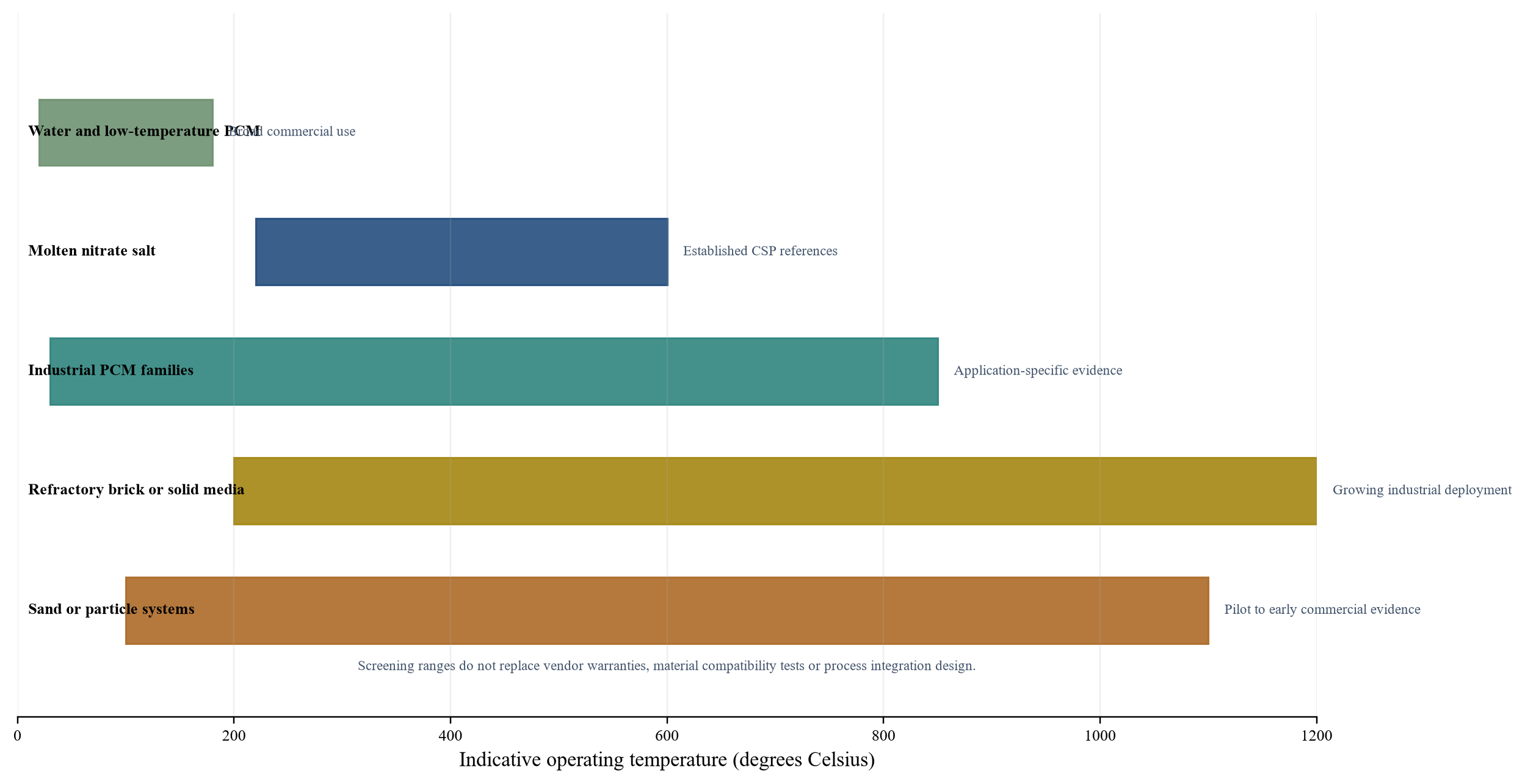
Temperature bands are simplified screening ranges based on cited public sources and disclosed applications. Offered systems require project-specific verification.
12. Heat-transfer medium can decide the project
Factories consume hot water, steam, hot air, radiant heat, thermal oil or direct process heat. A storage system that delivers a different medium needs a heat exchanger or steam generator. This equipment introduces temperature approach, pressure drop, water chemistry, blowdown, controls and maintenance.
Steam integration requires pressure and quality at the delivery point. A project can meet stored-energy and temperature guarantees while failing to maintain steam quality during ramps or low state of charge. The acceptance programme should test steady output, turndown, restart, pressure control and interaction with the existing boiler header.
Direct hot-air systems can reduce conversion stages. Their economics still depend on ducting distance, fan power, leakage, temperature uniformity and process acceptance.
13. Power and energy should be sized separately
Thermal power determines how quickly the store charges or discharges. Thermal energy determines duration. A factory with a 25 MW continuous load may require a 25 MW discharge train and several hundred megawatt-hours of storage. Charging power can be larger or smaller depending on available windows.
Oversized charging equipment captures shorter low-price periods but increases grid capacity, transformer and heater cost. Undersized charging can leave the store short before a long production run. The optimisation should use the site's actual production calendar and electricity market.
The model should distinguish installed, warranted and usable energy. Heat losses, minimum temperature, reserve, downtime and degradation reduce the energy available to the process.
14. Duration follows the production calendar
Storage duration should cover the commercial gap between low-cost charging and heat demand. An eight-hour store may shift daytime solar into an evening production period. A 24-hour store can bridge a full daily cycle. Multi-day storage may address weekend renewable supply, grid interruptions or a batch schedule.
Longer duration increases stored energy and insulation surface, while power equipment may remain similar. The marginal value can plateau once the store covers the dominant price or production cycle.
The investment committee should review a duration curve showing capital, heat cost, fuel displacement and resilience. Selecting a standard duration without this analysis can overbuild storage or leave the critical event uncovered.
15. Cycling duty determines the relevant evidence
A daily-cycling thermal battery experiences frequent temperature movement, heater operation, valve movement and blower starts. A reserve system may remain hot for extended periods and discharge infrequently. A waste-heat store can follow the irregular rhythm of another process.
Material and component evidence should match the intended duty. Daily cycling requires long-cycle durability and efficient charging. Standby service requires low heat loss and confidence after idle periods. Rapid load following requires controls and heat exchangers that respond without damaging the process.
The warranty should define cycles, throughput, temperature range, starts, standby hours and permitted operating modes. A broad design-life statement cannot replace a duty-specific guarantee.
16. Heat loss has a time dimension
Thermal stores lose heat through insulation, penetrations, foundations, ducts and idle equipment. The percentage loss over one day may be modest while the cumulative effect over several days changes usable energy. Larger stores can benefit from a lower surface-area-to-volume ratio.
The owner should obtain measured standing-loss data at representative scale and temperature. The test boundary should include auxiliary heating needed to maintain equipment or prevent salt freezing. Vendor calculations should disclose ambient conditions and measurement periods.
Heat-loss assumptions belong in dispatch and revenue models. Losses also affect safety, building ventilation and neighbouring equipment. The civil design should account for sustained high-temperature exposure.
17. Round-trip efficiency needs the right denominator
For heat-to-heat storage, round-trip efficiency compares thermal energy delivered with thermal or electrical energy charged, subject to the defined boundary. Electricity-to-heat systems should also show heater efficiency, auxiliary consumption, transformer losses and standing loss.
Comparing a heat battery with an electrochemical battery can confuse services. A thermal system that directly supplies heat avoids converting stored energy back to electricity. An electricity-storage system can serve wider electrical loads but incurs conversion stages when used for heat.
The economic denominator should be useful process heat. Efficiency should be tested at relevant power, duration and state of charge rather than quoted as one unconstrained number.
18. Flexibility value depends on the tariff
The IEA notes that electricity-to-gas price ratios, network charges and taxes materially influence industrial heat electrification. Storage can improve economics when it shifts charging into low-price hours or combines with on-site renewable generation. A flat tariff can remove much of that value.
The model should use the customer's actual tariff, demand charges, connection capacity, imbalance exposure and curtailment rules. Wholesale prices should not be used if the customer cannot access them. A power-purchase agreement should be represented according to its settlement and delivery terms.
The business case should separate energy savings, carbon value, resilience and product-market benefits. Each value stream needs a legal route to cash or an approved corporate value.
19. Grid connection can be the limiting asset
An industrial site may have enough average electricity supply while lacking the import capacity for large charging loads. Network studies, transformer lead times, protection, metering and tariff changes can determine schedule and cost.
Flexible charging can support the grid and reduce peak demand, but the operating controls and commercial arrangements must be approved. A promised flexible connection can include curtailment that prevents the store from reaching readiness.
The project schedule should place grid work on the critical path. The financing case should include connection cost, delay and a fallback operating mode. Storage hardware cannot compensate for unavailable charging power.
20. Existing boilers can support a staged transition
Many factories already operate gas, oil, biomass or electric boilers. Retaining part of this capacity can reduce production risk during commissioning and provide backup during high electricity prices or storage outages. The IEA analyses hybrid configurations where existing boilers and thermal storage support electrified heat.
Hybrid operation can improve resilience and enable a smaller initial store. It can also reduce utilisation of the new asset and leave fuel infrastructure costs in place. The dispatch model should optimise the whole heat system.
The contract should define which asset follows load, who controls switching and how emissions are measured. A staged programme can retire boiler capacity after thermal storage demonstrates reliable performance.
Table 1. Technology screen for industrial thermal-storage selection
| Decision dimension | Molten salt | Refractory brick or solid block | Sand or particle system | Phase-change material |
|---|---|---|---|---|
| Storage mechanism | Sensible heat in liquid salt | Sensible heat in solid media | Sensible heat in particles or packed bed | Latent and sensible heat around transition |
| Strongest initial fit | Medium- to high-temperature heat with established salt loop | High-temperature air or steam with modular solid core | Large energy capacity and broad temperature range | Compact storage near a defined process temperature |
| Principal integration question | Freeze protection, corrosion and heat exchanger | Heater, airflow, pressure drop and thermal expansion | Particle handling, attrition, flow and heat exchanger | Containment, heat transfer and phase stability |
| Evidence priority | Relevant salt chemistry and industrial duty | Full module cycles and balance-of-plant performance | Representative scale and sustained handling or bed behaviour | Long-cycle enthalpy, transition temperature and module integrity |
| Financing implication | Established components can support clearer risk allocation | Early references may require staged acceptance and supplier support | Demonstration evidence and integration guarantees are central | Material and encapsulation evidence can dominate warranty design |
| Best comparison metric | Delivered heat across usable salt-temperature window | Delivered heat after fan and auxiliary power | Delivered heat after handling and exchanger losses | Usable latent capacity and delivered power at target temperature |
The table is a decision framework. Offered products and site conditions require project-specific evidence.
21. The comparator should be the whole heat system
Thermal storage competes with existing boilers, electric boilers, heat pumps, direct electrification, renewable heat, waste-heat recovery, hydrogen, biomass and efficiency improvements. The correct comparator can be a portfolio rather than one replacement asset.
Energy efficiency and heat recovery should be assessed first because they can reduce the required power and storage capacity. A heat pump can be attractive for lower-temperature duties where its coefficient of performance offsets electricity cost. High-temperature storage may serve the residual load.
The decision model should hold process output and reliability constant. It should compare capital, energy, maintenance, carbon, grid, downtime, fuel and financing on one boundary.
22. Capital cost should be decomposed
Published storage-media cost captures only part of a project. The budget also includes charging equipment, power connection, transformers, heaters, vessels, insulation, foundations, buildings, heat exchangers, steam systems, controls, engineering, construction, commissioning, contingency and owner costs.
The split differs by technology. Inexpensive sand or brick may be paired with costly high-temperature equipment. Phase-change material can be expensive while reducing volume. Molten salt can require tanks, pumps, heat tracing and compatible alloys.
The investment committee should request a quantity-based cost estimate and responsibility matrix. A headline cost per thermal kilowatt-hour should identify included power equipment and balance of plant.
23. Levelised cost of heat needs transparent assumptions
Levelised cost of heat spreads capital, operating cost, charging energy, replacement and financing across useful heat delivered. It can support comparison when the boundary, life, utilisation and discount rate are consistent.
The metric can mislead when it excludes grid reinforcement, production downtime, backup capacity, taxes, carbon or residual value. A low utilisation rate can increase levelised cost even when energy-capacity cost is low. Cheap charging energy can dominate the result where the system cycles often.
The model should show annual cash flow and unit cost. Decision-makers need the timing of capital, savings, debt service and downside funding as well as one levelised number.
24. A hypothetical 25 MW industrial-heat case
The illustrative case considers a continuous 25 MW thermal load supplied through a steam header. The owner compares an existing gas boiler, a molten-salt system, a refractory-brick system, a particle system and a phase-change system. Every numerical input is hypothetical and does not represent a vendor quotation or market forecast.
The thermal-storage cases use 300 MWh of usable heat, equivalent to 12 hours at rated load, and retain the gas boiler for backup. Charging uses a hypothetical low-price electricity window. The cases differ in installed capital, delivered efficiency, footprint, integration contingency and evidence requirement.
The purpose is to show how a common process boundary changes technology ranking. A real project requires site data, firm bids, tariff analysis and qualified engineering.
Table 2. Hypothetical 25 MW industrial-heat comparison
| Input or outcome | Existing gas boiler | Molten salt | Refractory brick | Particle system | Phase-change system |
|---|---|---|---|---|---|
| Useful thermal output | 25 MW continuous | 25 MW for 12 hours | 25 MW for 12 hours | 25 MW for 12 hours | 25 MW for 12 hours |
| Usable stored heat | Not applicable | 300 MWh | 300 MWh | 300 MWh | 300 MWh |
| Hypothetical installed capital | USD 8 million | USD 47 million | USD 41 million | USD 44 million | USD 53 million |
| Hypothetical electricity-to-useful-heat efficiency | Not applicable | 88% | 92% | 86% | 90% |
| Hypothetical levelised useful-heat cost | USD 42/MWh | USD 46/MWh | USD 41/MWh | USD 45/MWh | USD 49/MWh |
| Principal commercial strength | Known operation and fuel flexibility | Established storage architecture and controllable heat | Simple solid medium and high-temperature potential | Scalable media and wide temperature range | Compact capacity near target temperature |
| Principal downside | Fuel and carbon exposure | Freeze protection and salt-system integration | Airflow, heaters and early project evidence | Handling, erosion and exchanger evidence | Material stability, containment and heat transfer |
| Initial financing stance | Corporate or conventional equipment finance | Project debt possible with contracts and proven configuration | Staged capital with completion and performance support | Demonstration-weighted capital and strong contingency | Technology-risk capital until module evidence is sufficient |
Every number is an illustrative modelling assumption. The table is not a quotation, forecast or investment recommendation.
25. The hypothetical ranking is conditional
The brick case has the lowest illustrative levelised cost because the selected assumptions combine moderate capital, high delivered efficiency and frequent charging. A different tariff, lower utilisation, a higher process temperature or a larger integration cost could change the ranking.
The phase-change case carries a higher hypothetical cost but may create value where footprint or near-isothermal delivery is critical. The molten-salt case may gain where a plant already has compatible thermal equipment. The particle case may gain at temperatures beyond nitrate salt.
The decision should focus on break-even conditions. A technology should not be selected from one deterministic base case.
26. Electricity-price spread drives frequent cycling
Storage earns operating value by charging below the avoided heat cost. The relevant spread includes electrical losses, network charges, taxes, maintenance and the cost of retaining backup. A narrow spread can leave the project dependent on carbon or resilience value.
Hourly dispatch should include forecast error and production constraints. The model should prevent charging above grid limits and should preserve minimum stored heat before critical production periods.
Long-term electricity-price scenarios should test renewable build-out, network reform and changing industrial tariffs. A historical spread can narrow as flexible demand grows.
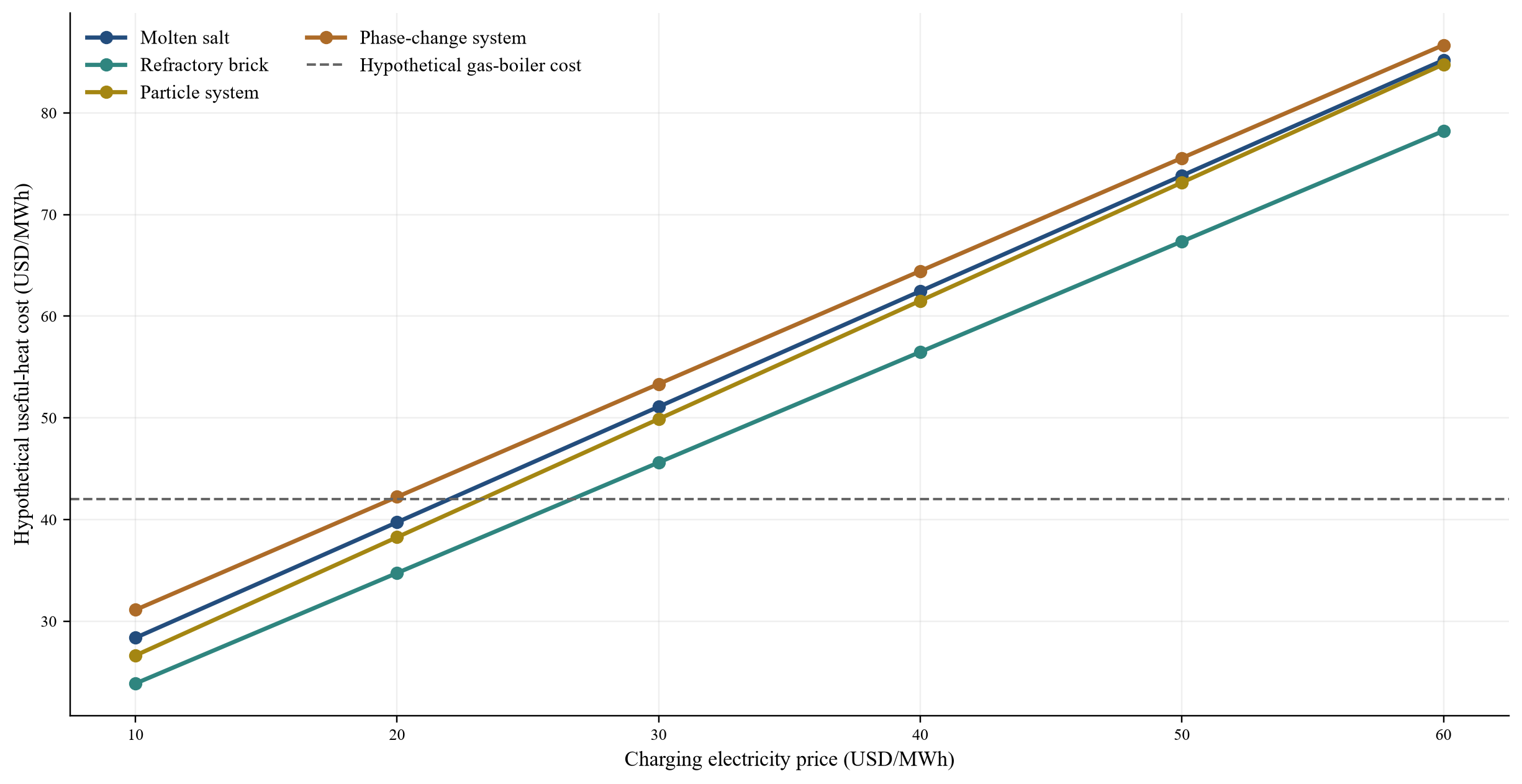
Values are illustrative modelling outputs for a common 25 MW heat service. They do not represent observed prices or vendor performance.
27. Carbon economics require a real accounting route
Electrified heat can reduce direct fuel combustion at the site. The emissions result depends on charging electricity, displaced fuel, efficiency, losses and the accounting method. On-site renewable supply, a power-purchase agreement and grid electricity can produce different claims.
Carbon prices, tax credits, grants, product premiums and customer requirements can affect cash flow. Each item should have a legal basis, eligibility analysis and duration. Corporate carbon targets can support a project while remaining unavailable for debt service.
The project should disclose location-based and market-based electricity emissions where relevant and avoid double counting renewable attributes.
28. Production resilience can be valuable
Thermal storage can provide a reserve of heat during grid or fuel disruption, subject to stored energy and equipment availability. It can also smooth boiler outages or process ramps. The financial value depends on avoided lost production, product spoilage and restart cost.
Resilience claims need scenario analysis. An electrically charged store provides limited protection during a long power outage once its energy is depleted. Shared electrical or control equipment can create common-mode failure.
The owner should define critical heat loads, minimum duration, black-start needs and backup fuel. Resilience value should use documented production economics and approved loss assumptions.
29. Footprint and location influence technology choice
Storage-media density, temperature, insulation and vessel geometry determine footprint. Phase-change systems can be compact around their transition temperature. Solid-media silos can be larger while using inexpensive materials. Molten-salt tanks require separation, access and spill management.
Industrial sites can have constrained plots and congested pipe racks. Distance between storage and process increases duct or pipe cost and heat loss. Brownfield construction can require shutdowns and complex sequencing.
The site layout should preserve maintenance access, fire and emergency routes, expansion and replacement. Land should be valued at its industrial alternative use.
30. Safety analysis must cover the complete system
Thermal storage can avoid some hazards associated with combustion or electrochemical batteries. It introduces high temperatures, stored energy, electrical equipment, hot fluids or gases, pressure, insulation and structural loads. Molten salts can create chemical and freeze-related hazards. Particles can create dust and erosion. Phase-change systems depend on containment.
The project should complete process-hazard analysis, failure-mode analysis and emergency planning. The authority having jurisdiction and insurer should review unfamiliar technology early.
Safety claims should be tied to the offered configuration and test evidence. A non-flammable storage material does not establish low site risk by itself.
31. Material compatibility is a lifecycle issue
High temperatures accelerate oxidation, corrosion, creep, seal ageing and insulation degradation. Heat-transfer media can react with alloys, refractories or contaminants. Thermal expansion creates mechanical stress at interfaces.
The owner should request a materials map covering normal operation, startups, shutdowns and upset conditions. Corrosion coupons, representative loops and long-duration tests can support life estimates. Inspection intervals and replaceable components should be defined.
The financial model should include planned replacement, outage and residual life. An optimistic design life without inspection evidence should not support long-tenor debt.
32. Factory repeatability supports financeability
Modular systems can move work from site to factory, but they depend on stable manufacturing, quality control and supply chains. Large tanks or silos can rely more heavily on site construction. Both routes require traceable materials, inspection and acceptance.
The lender's engineer should review manufacturing capacity, yields, critical suppliers, test procedures, non-conformance management and field-service resources. Announced capacity is not equivalent to accepted project equipment.
Payment milestones should follow completed, tested and delivered scope. Holdbacks can preserve leverage through commissioning and performance testing.
33. Commercial references need classification
A reference can be a laboratory prototype, pilot, demonstration, commissioned asset, daily operating system or signed future project. These categories provide different evidence. Public grants and company announcements show progress but may not disclose availability, cost or contract performance.
The diligence team should record scale, duty, operating hours, temperature, customer, funding, commissioning status and independent verification. It should contact operators where permitted and reconcile reported results with the proposed system.
References should be matched by interface. A system producing district-heating water offers limited evidence for a high-pressure steam project unless the conversion train is separately proven.
34. Performance guarantees should reach the process boundary
The core guarantees should include useful thermal power, usable thermal energy, outlet temperature or steam condition, charging power, efficiency, standing loss, availability and response. The boundary should include auxiliaries and heat-transfer equipment.
Tests should cover full charge, full discharge, turndown, cycling, standby, restart and interaction with backup equipment. The contract needs correction factors for ambient and process conditions.
Remedies should include cure, retest, liquidated damages, rejection and long-term degradation protection. Damages should reflect real loss while remaining supportable by the counterparty.
35. The warranty depends on supplier capacity
A long warranty has limited value without a solvent issuer, spare parts, trained service and access to controls. Early thermal-storage suppliers may be venture-backed or project-financed, creating counterparty and concentration risk.
Credit support can include parent guarantees, letters of credit, escrow, holdbacks, performance bonds, warranty reserves and step-in rights. The appropriate structure depends on supplier balance sheet, technology maturity and replacement options.
The owner should retain operating data, manuals, software continuity and rights to use qualified third-party service where practical.
36. Engineering interfaces require one accountable owner
Thermal storage connects electrical supply, heaters, storage media, vessels, heat exchangers, process controls, civil works and existing plant. Multiple suppliers can leave interface risk unowned.
The contracting strategy should define a single point for integrated performance or provide a detailed interface matrix with enforceable obligations. The owner should control design changes that affect the process or guarantees.
Schedule contingency should reflect brownfield access, long-lead equipment, grid work and commissioning. Completion support should remain available until the process acceptance test passes.
37. Data rights create operating and refinancing value
The owner should receive time-series data for charging energy, stored temperature, discharge heat, state of charge, losses, auxiliary loads, alarms, availability and maintenance. Data should be exportable and survive contract termination.
Independent validation can improve warranty enforcement and future financing. A qualified engineer or laboratory can witness acceptance and review operating results. Proprietary control logic can remain protected while the owner retains sufficient evidence to operate and diagnose the asset.
Data quality, calibration and retention should be contractual deliverables rather than optional vendor dashboards.
38. Financing should follow the evidence stack
Corporate balance sheets, strategic equity and public demonstration funding can absorb early technology risk. Equipment finance and project debt become more plausible when the configuration has operating references, fixed delivery terms, enforceable performance guarantees and predictable savings or contracted payments.
A behind-the-meter project often relies on avoided fuel cost rather than third-party revenue. Lenders need confidence in the host's credit, heat demand, tariff, operating commitment and termination protections. A heat-as-a-service structure can shift capital from the host while concentrating technology and performance risk in the provider.
Debt should be sized to conservative savings and proven performance. Carbon or merchant upside should remain outside the base case unless contractually secured.
39. Risk allocation should follow control
The technology supplier controls product design and manufacturing. The engineering contractor controls integration and construction. The host controls process access and production scheduling. The utility controls grid connection within its authority. The offtaker or host controls heat demand under the commercial agreement.
Contracts should allocate each risk accordingly and define relief for external events. Unallocated risk should appear in contingency, reserves, insurance or lower leverage.
The investment committee should reject a structure that hides unresolved technology or interface risk inside aggressive utilisation and savings assumptions.
Table 3. Project-risk allocation for industrial thermal storage
| Risk | Evidence before commitment | Party positioned to control it | Commercial protection | Ongoing monitor |
|---|---|---|---|---|
| Process fit | Heat-load data, temperature and interface design | Host and integrator | Approved design basis and acceptance boundary | Heat quality and production impact |
| Storage performance | Representative tests and reference operation | Technology supplier | Power, energy, efficiency and loss guarantees | State of charge, losses and degradation |
| Manufacturing | Factory plan, suppliers and quality evidence | Technology supplier | Milestones, holdback and audit rights | Yield, completion and test pass rate |
| Integration and completion | Interface matrix and integrated schedule | EPC contractor or integrator | Single-point completion support | Design changes, construction and commissioning |
| Grid connection | Study, tariff and import-capacity approval | Host and utility | Conditions precedent and delay allocation | Capacity, curtailment and tariff change |
| Heat demand and savings | Production plan, tariff and fuel baseline | Host or heat offtaker | Minimum payment or creditworthy host support | Utilisation, avoided fuel and payment |
| Lifecycle service | Maintenance, spares and inspection plan | Supplier and operator | Long-term service, reserve and step-in rights | Availability, maintenance and parts |
| Supplier credit | Financial and ownership diligence | Supplier and sponsor | Parent support, letter of credit or escrow | Liquidity and warranty capacity |
Final allocation depends on technology, contracts, counterparties, site and applicable law.
40. Decision gates preserve capital
The first gate confirms the process duty and energy baseline. The second confirms technology fit and hourly economics. The third confirms representative product evidence. The fourth confirms grid, site and integration. The fifth confirms contracts, credit, permits and financing. The sixth confirms factory and field acceptance. The seventh confirms sustained operation before replication.
Each gate should identify evidence, owner, deadline, capital at risk and the next decision. Conditional approval should remain visible to the investment committee.
Staging allows the buyer to resize, redesign or stop when evidence changes. It also gives suppliers a clear route for converting performance into commercial scale.
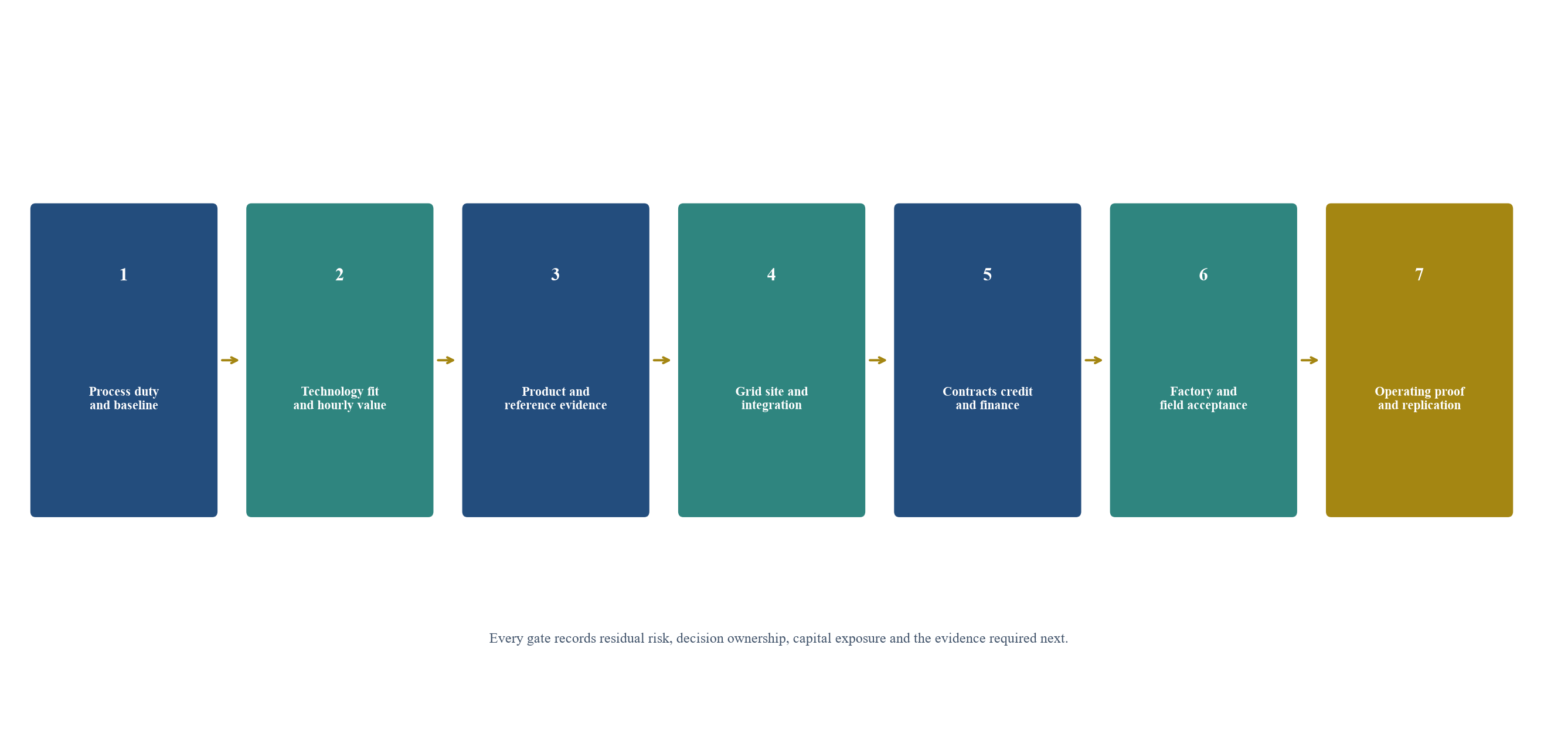
Capital advances as process fit, product evidence, integration and operating performance are confirmed.
41. A first project should create reusable evidence
The first hundred days should establish the heat-load dataset, production constraints, electricity tariff, fuel baseline and carbon accounting. The team should screen technologies on temperature, medium, power, duration, footprint and evidence before requesting firm proposals.
In parallel, it should engage the utility, insurer, authority having jurisdiction and process engineers. Bid documents should state the acceptance boundary, data rights, warranties and staged decision gates.
The first project should end with a reusable design basis and operating dataset. A demonstration without measurement, disclosure and replication criteria can remain an isolated asset.
42. Limits and further research
Public sources establish technology principles, policy priorities, disclosed demonstrations and company claims. They cannot establish the delivered cost, performance, warranty value or bankability of a specific offer. Confidential bids, contracts, operating data and engineering evidence are required for an investment decision.
The hypothetical case illustrates method only. Further research should compare realised industrial heat delivery, standing losses, maintenance, material life and integration cost across operating projects. It should also examine how electricity tariffs and flexible-connection rules affect savings.
Engineering, safety, environmental, legal, tax, accounting and regulatory conclusions require qualified advisers in the relevant jurisdiction.
43. Investment-committee questions
The committee should ask whether the process duty is measured, whether efficiency and heat recovery have already reduced demand, and whether storage creates value under the actual tariff. It should ask which technology provides the required medium and temperature through the full discharge.
It should review reference quality, grid capacity, site integration, performance guarantees, data rights, supplier credit, insurance, production downtime and downside funding. Every unresolved assumption should have an owner and consequence.
The decision should specify capital released now, evidence required for the next release and the operating result needed before replication.
44. Conclusion
Thermal energy storage can connect variable renewable electricity, waste heat and industrial production. Its commercial value comes from delivering the right heat at the required time while managing electricity cost, grid capacity and production reliability.
Molten salt, refractory brick, particles and phase-change materials have different strengths and evidence needs. The process temperature, heat-transfer medium, duty cycle and integration boundary determine which advantages matter. Storage-media cost alone cannot answer the investment question.
A disciplined project defines useful heat at the process boundary, models full chronology, compares the whole heat system, contracts for measurable performance and stages capital against evidence. This structure can turn emerging thermal-storage technology into a controlled industrial and financing decision.
References
- International Energy Agency, Renewables for Industry, 2025. https://www.iea.org/reports/renewables-for-industry
- International Energy Agency, Can Low-Temperature Heat in Factories Be Electrified Competitively?, 2025. https://www.iea.org/commentaries/can-low-temperature-heat-in-factories-be-electrified-competitively
- International Energy Agency, Electrification of Industrial Heat: Opportunities for Renewables Workshop, December 2024. https://www.iea.org/events/electrification-of-industrial-heat-opportunities-for-renewables-workshop
- International Renewable Energy Agency, Innovation Outlook: Thermal Energy Storage, November 2020. https://www.irena.org/publications/2020/Nov/Innovation-outlook-Thermal-energy-storage
- United States Department of Energy, Achieving the Promise of Low-Cost Long Duration Energy Storage, August 2024. https://www.energy.gov/sites/default/files/2024-08/Achieving%20the%20Promise%20of%20Low-Cost%20Long%20Duration%20Energy%20Storage_FINAL_08052024.pdf
- United States Department of Energy, Awarded Projects for the Long-Duration Energy Storage Demonstrations Lab Call, accessed September 2026. https://www.energy.gov/cmei/oced/awarded-projects-long-duration-energy-storage-demonstrations-lab-call
- United States Department of Energy, Industrial Funding Selections: 2024 Industrial Cross-Sector Technologies Funding Opportunity. https://www.energy.gov/cmei/ito/industrial-funding-selections-2024-industrial-cross-sector-technologies-funding
- United States Department of Energy, Heat Batteries for Deep Decarbonization of the Beverage Industry, November 2024. https://www.energy.gov/nepa/articles/cx-032610-heat-batteries-deep-decarbonization-beverage-industry-phase-1
- Advanced Research Projects Agency-Energy, Investor Update: Antora Energy's Thermal Batteries, April 2024. https://arpa-e.energy.gov/news-and-events/news-and-insights/arpa-e-investor-update-vol-22-antora-energys-thermal-batteries
- National Renewable Energy Laboratory, Solution to Energy Storage May Be Beneath Your Feet, March 2024. https://www.nrel.gov/news/features/2024/solution-to-energy-storage-may-be-beneath-your-feet.html
- National Renewable Energy Laboratory and Sandia National Laboratories, Solar Thermal Energy Planner, updated August 2025. https://step1.nrel.gov/
- National Renewable Energy Laboratory, Thermal Energy Storage for Energy Decarbonization, 2023. https://www.osti.gov/biblio/1992030
- European Commission, Technology Factsheet: Novel Thermal Energy Storage Technologies, December 2023. https://energy.ec.europa.eu/system/files/2024-01/Technology_factsheet_Competitiveness_of_clean_energy_technology-Novel_Thermal_Energy_Storage_Tech.pdf
- European Commission CORDIS, HEATERNAL: Innovative High Temperature Thermal Storage for Industrial Applications, accessed September 2026. https://cordis.europa.eu/project/id/101103921
- European Commission CORDIS, HYSE: Hydroxide Salt Energy Storage Innovation, reporting period to December 2025. https://cordis.europa.eu/project/id/101160790
- Rondo Energy, Rondo Powers Up World's Largest Industrial Heat Battery, October 2025. https://www.rondo.com/news-press/rondo-powers-up-worlds-largest-industrial-heat-battery
- Polar Night Energy, World's Largest Sand Battery Now in Operation, June 2025. https://polarnightenergy.com/news/worlds-largest-sand-battery-now-in-operation/
- Polar Night Energy, What Is a Sand Battery?, accessed September 2026. https://polarnightenergy.com/news/what-is-a-sand-battery/
About the Author
Chennakeshav (CK) is a corporate finance and investment banking executive with 25+ years of global experience in deal origination, structuring and execution across M&A, growth capital and corporate strategy. He has led value-creation mandates for founders, corporates and funds — bridging the boardroom view to hands-on execution and close.
His career spans Morgan Stanley, HSBC, Lloyds Banking Group, EWEC, ADQ portfolio companies and Emirates Growth Fund, across TMT, real estate, fintech, deeptech, cleantech, infrastructure and energy. He has partnered with C-suite leaders, private equity and venture funds, sovereign wealth funds and family offices to finance complex fund raises and scale-up ventures, and has led M&A due diligence, post-merger integration and business-transformation initiatives to create value.
At Matchpoint Partners he is Managing Partner, leading the firm's corporate finance, M&A and capital-raising practice. He holds an MBA from London Business School, an engineering degree from VTU and a Master of Laws (LLM, in progress) from UCL London.
An active start-up mentor, CK mentors at Techstars, DIFC FinTech Hive, Startup Grind, Founder Institute and IN5, serves as Entrepreneur Mentor in Residence (EMiR) at London Business School, and judges the Entrepreneurship World Cup.
LinkedIn: https://www.linkedin.com/in/ckadya/
Profile: https://www.matchpoint-partners.com/team/ck-adya.html
