

1. Define the governance problem
A co-investment is a direct or indirect investment made alongside a lead sponsor, fund manager or other institutional partner in a specific asset, company or transaction. It sits between two operating models. The asset owner relies on the sponsor for sourcing, transaction leadership and often portfolio-company control, while retaining responsibility for its own investment decision. The governance system must therefore use sponsor work without treating it as independent evidence.
The central decision is whether the asset owner should commit a stated amount, on stated terms, within a stated time. That decision must be consistent with beneficiary duties, governing documents, strategic allocation, concentration limits, liquidity capacity and internal authority. The process also needs a credible route to monitor the investment after closing and respond to follow-on requests, amendments, conflicts and exit decisions.
Speed is a design constraint. It should be expressed as a sequence of decision clocks rather than as pressure to waive work. A triage decision might be due within forty-eight hours, an indicative interest within five business days, final approval within fifteen business days and funding shortly thereafter. Each clock should have a minimum evidence pack, named owner and escalation path.
The required output is a decision record. It should identify the opportunity, sponsor, allocation rationale, economics, conflicts, investment thesis, downside case, concentration, liquidity, legal rights, approvals, unresolved conditions and post-close owner. The record should show what was known at the decision date and how uncertainty was handled.
2. Distinguish co-investment from fund underwriting
A fund commitment evaluates a manager, strategy, team, track record, governance and portfolio-construction proposition across a multi-year deployment period. A co-investment evaluates one transaction whose risks may be concentrated in a single company, asset, jurisdiction, financing structure and exit path. Good fund diligence is therefore a prerequisite rather than a substitute.
The sponsor relationship can create familiarity. Familiarity is useful because the asset owner understands the manager's decision style, reporting quality and operating resources. It can also weaken challenge when the organisation assumes that admission to the fund programme validates every direct opportunity. The co-investment process should preserve a separate transaction thesis, valuation analysis and risk assessment.
ILPA's Principles 3.0 ask managers to disclose the framework for allocating opportunities, interests and expenses; explain the strategic reason for the co-investment tranche; disclose preferential access, differentiated economics and follow-on allocation; and address conflicts and concentration risk [1]. These principles focus on the manager-investor relationship. The asset owner still needs internal standards for mandate fit, underwriting quality and portfolio impact.
A co-investment programme should therefore have two connected evidence files. The sponsor file contains organisational, operational, compliance and relationship diligence. The transaction file contains current deal evidence. Sponsor-file material can be reused when its date and scope remain valid. Transaction conclusions should be refreshed for each opportunity.
3. Establish the board-approved mandate
The governing body should approve why the institution uses co-investments and which outcomes the programme seeks. Possible objectives include improved fee efficiency, deliberate exposure to selected sectors, closer access to assets, deployment alongside high-conviction managers, or development of internal investment capability. These objectives can coexist, although each creates different governance demands.
The mandate should define eligible strategies, jurisdictions, instruments, stages, sponsors, currencies, ownership positions and maximum holding periods. It should state whether the programme may invest through special-purpose vehicles, acquire debt or preferred instruments, provide follow-on capital, accept unfunded obligations or participate in continuation transactions. It should also specify excluded structures and escalation cases.
APRA's SPS 530 requires regulated superannuation trustees to maintain an investment governance framework, effective due diligence, ongoing performance monitoring, stress testing, liquidity management and valuation governance [5]. The UK Pensions Regulator describes investment governance as policies and procedures that enable a governing body to comply with its investment obligations and expects arrangements tailored to the scheme [7]. These sources support a principle that the mandate, process and oversight should reflect the institution's own size, complexity and duties.
The board should retain decisions that can alter the institution's risk posture. Management can receive delegated authority for transactions within the approved perimeter. Exceptions involving related parties, novel instruments, material leverage, policy breaches, uncertain legal authority or concentration above threshold should return to the board or its designated committee.
4. Pre-qualify the opportunity perimeter
Pre-qualification reduces repeated work and makes response times credible. The investment team should maintain an approved-sponsor list, eligible-strategy map, jurisdiction map, conflict inventory and minimum deal characteristics. Each sponsor's file should identify historic allocations, time allowed for decisions, information quality, withdrawal rates, broken-deal expenses, realised outcomes and post-close reporting behaviour.
ILPA recommends a pre-qualifying assessment during fundraising and at appropriate intervals to confirm an investor's interest and ability to execute [1]. The asset owner can mirror this discipline. It should tell sponsors which opportunities fit, who receives them, which data fields are mandatory and how quickly a complete submission can be assessed.
Pre-qualification should not create automatic approval. It should determine whether a proposal can enter the rapid lane. A transaction outside the perimeter can enter an exception lane with longer timing and higher authority. This separation protects the normal programme from repeated improvisation.
The perimeter should be reviewed at least annually and after material changes in strategy, liquidity, staffing, regulation or sponsor behaviour. A sponsor can be suspended when allocation practices, diligence access, reporting or conflict management fall below the agreed standard.
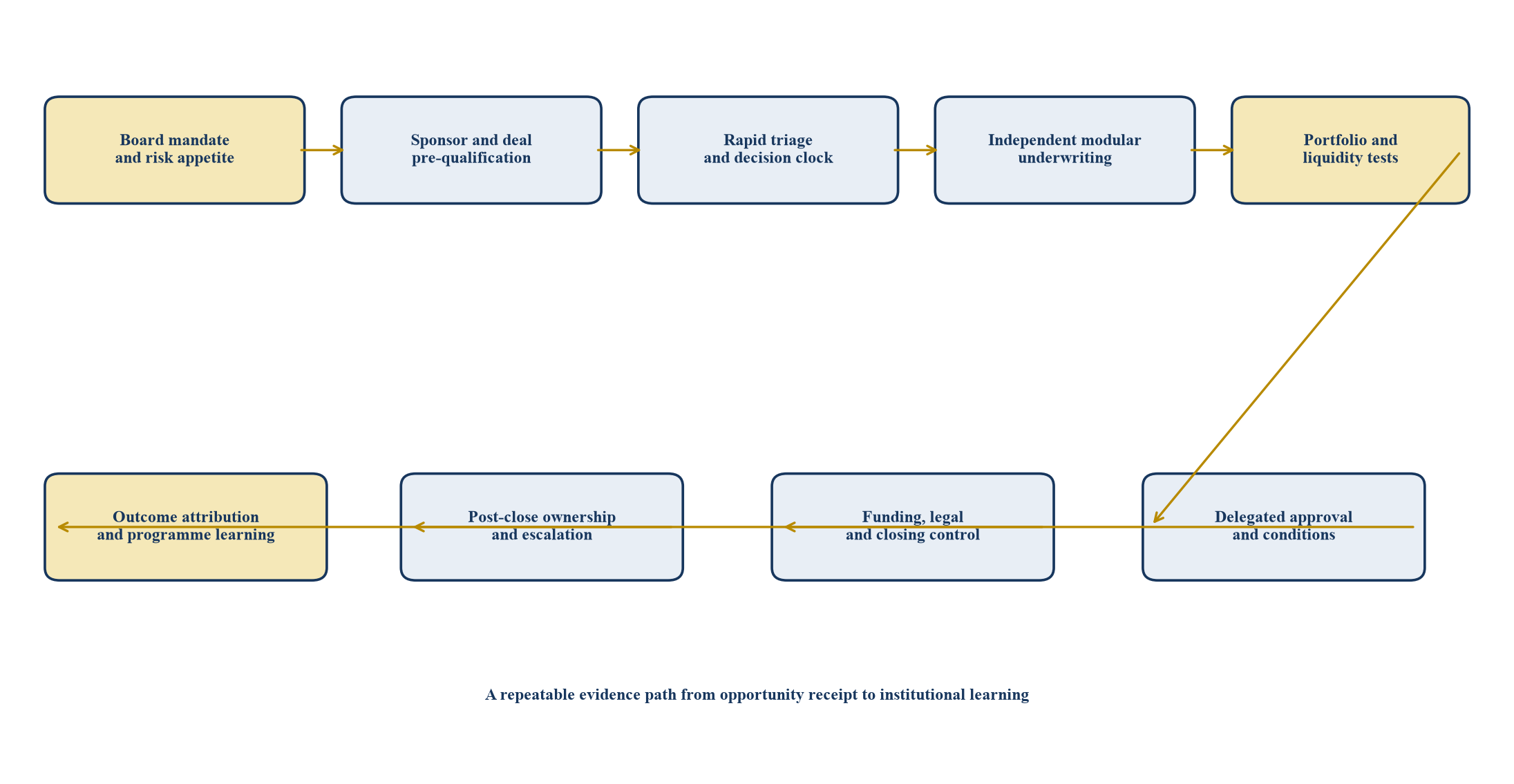
The proposed architecture connects mandate, rapid triage, independent underwriting, portfolio tests, authority, funding and post-close accountability.
5. Use a rapid triage gate
The triage gate should answer whether the institution should spend scarce time on the opportunity. It is not a preliminary investment recommendation. A concise intake form should capture sponsor, asset, sector, geography, security, transaction value, proposed allocation, ownership, leverage, valuation, expected hold, decision deadline, funding date, fees, expenses, conflicts and data-room status.
Four questions can govern admission. First, does the opportunity fit the mandate? Second, is the proposed allocation large enough to matter and small enough to remain governable? Third, can the team obtain the minimum evidence before the deadline? Fourth, can the institution fund the transaction without weakening other obligations?
The triage output should be accept, decline or exception review. Reasons should use a controlled taxonomy: mandate, sponsor, evidence, capacity, concentration, liquidity, conflict, economics, legal, valuation or timing. A disciplined decline record prevents repeated work on structurally unsuitable proposals and identifies whether sponsors are sending relevant opportunities.
The programme should track conversion from received opportunity to reviewed, indicated, approved, funded and realised. Low conversion can arise from poor sponsor fit, slow internal response, unattractive economics or excessive selectivity. The cause matters more than the headline acceptance rate.
6. Set the decision clock and evidence minimum
The investment office should publish a service standard for each stage. The sponsor should know when the clock starts, which missing items stop it and which conditions can remain open at approval. Internal reviewers should know when they must respond and who resolves disagreement.
An evidence minimum can include the investment memorandum, financial model, quality-of-earnings or equivalent review, commercial evidence, debt terms, legal structure, ownership and cap table, management references, material contracts, regulatory position, ESG or sustainability risks, cyber and data issues, valuation support, exit analysis, sponsor committee decision and allocation rationale. Asset-specific modules should supplement this core.
The evidence minimum should be proportionate to the investment and its risks. A minority growth investment, an infrastructure platform, a leveraged buyout and a private-credit position require different work. Proportionality should affect depth and specialist mix, while core questions on authority, conflicts, valuation, downside and funding remain.
The United States Department of Labor states that ERISA fiduciaries should act solely in participants' interests, use skill, prudence and diligence, diversify, pay reasonable expenses and avoid conflicts [8]. Its recent litigation guidance emphasises the methods used to investigate an investment rather than hindsight about outcomes [9]. A documented decision clock should preserve those methods under time pressure.
7. Separate sponsor evidence from independent evidence
Sponsor materials are essential. They contain the transaction thesis, model, diligence findings, management access and negotiated terms. They also reflect the sponsor's incentives and selected framing. The asset owner should classify evidence by source and independence.
Tier one evidence can include executed contracts, audited statements, regulatory filings, third-party reports with usable reliance, lender materials and independently sourced market data. Tier two can include management information reconciled to source records, sponsor analyses tested by the asset owner and specialist reviews commissioned for the transaction. Tier three can include management forecasts, sponsor cases and uncorroborated statements.
The investment recommendation should show which conclusions depend on each tier. A material conclusion supported only by tier-three evidence should become a condition, a downside adjustment or a stated residual risk. The team should avoid false precision where data are weak.
The Principles for Responsible Investment's due-diligence materials organise review across policy and governance, fundraising, pre-investment, post-investment, reporting and disclosure [11]. The same lifecycle logic helps an asset owner connect transaction diligence to ownership obligations rather than ending the process at closing.
8. Build modular diligence
A modular system combines a common core with risk-specific workstreams. The common core covers thesis, market, company or asset, management, financial performance, valuation, capital structure, legal rights, tax, regulation, conflicts, sustainability, technology, cyber, data, exit and portfolio impact.
Each module should state the decision question, evidence required, reviewer, completion standard, red flags and permitted residual risk. The team can then run modules in parallel without losing accountability. A central issues register should connect findings across modules.
The investment lead should own synthesis. Specialists should own their conclusions and state limitations. External advisers should have written scopes, conflict checks, reliance terms, deliverables and deadlines. A report received after approval has limited governance value.
Red flags should change the process. Examples include customer concentration, aggressive add-backs, dependence on one licence, related-party transactions, weak cyber controls, unresolved litigation, uncertain title, sanctions exposure, unsupported valuation, covenant headroom dependent on the upside case or an exit that requires multiple expansion. Escalation should be linked to materiality rather than count.
| Module | Core decision question | Minimum evidence | Escalation trigger |
|---|---|---|---|
| Mandate and sponsor | Is the opportunity eligible and appropriately allocated? | Mandate map, sponsor file, allocation rationale | Exception, preferential terms or unclear allocation |
| Commercial | Is demand durable under the downside case? | Customer, pricing, competition and market evidence | Thesis depends on unverified growth or one counterparty |
| Financial | Are earnings, cash conversion and capital needs credible? | Historical bridge, quality review, forecast and working capital | Unsupported adjustments or hidden funding requirement |
| Capital structure | Can the business survive stress and fund obligations? | Debt terms, covenant model, interest and maturity schedule | Downside breach, refinancing dependence or leakage |
| Legal and regulatory | Are ownership, rights and permissions enforceable? | Structure, contracts, licences, litigation and sanctions review | Unresolved authority, consent or compliance issue |
| Technology, cyber and data | Can the operating platform support the thesis safely? | Architecture, resilience, cyber, privacy and technical debt | Material control gap or unfunded remediation |
| Sustainability and stakeholders | Are material externalities and transition risks governed? | Risk assessment, permits, workforce and transition plan | Unpriced liability or incompatible beneficiary duty |
| Valuation and exit | Is price supported and is exit executable? | Comparable evidence, cash-flow model and buyer map | Return depends on unsupported terminal assumption |
This proposed standard should be adapted to the asset class, legal duties and transaction facts.
9. Create an independent underwriting case
The asset owner should rebuild the essential economics. It need not reproduce every sponsor worksheet. It should own the bridge from entry value to cash return, understand the operating drivers, reproduce debt and dilution mechanics and test the exit.
The independent case should include base, downside and severe-but-plausible conditions. Each scenario should connect revenue or operating drivers to margins, cash conversion, capital expenditure, working capital, debt service, covenant headroom, follow-on funding, exit value and investor proceeds. Scenario labels should not disguise optimistic assumptions.
Valuation should use more than one lens when evidence permits. Comparable transactions, trading multiples, discounted cash flow, asset value, replacement cost, unit economics or debt capacity can cross-check the sponsor case. The recommendation should identify where a valuation method is weak or circular.
The team should state the break-even operating and exit conditions. Reverse stress is particularly useful: determine the revenue, margin, leverage or exit multiple at which capital is impaired or the required return is missed. This makes hidden dependence visible.
10. Govern allocation and conflicts
Allocation risk begins before underwriting. The asset owner should understand why the sponsor is syndicating, which vehicles were offered the opportunity, whether the main fund has capacity, whether affiliates participate, whether any investor has priority, and how oversubscription is resolved. The explanation should be consistent with governing documents and prior disclosures.
Fees and expenses require a complete map. The review should identify management fees, carried interest, transaction fees, monitoring fees, broken-deal expenses, vehicle costs, adviser costs, financing fees and any offsets. Equal headline economics can produce different net outcomes when expenses or follow-on rights differ.
Conflicts can also arise through related-party sales, continuation vehicles, portfolio-company transactions, cross-fund investments, sponsor lending, stapled commitments and valuation roles. ILPA frames alignment, governance and transparency as the foundation of effective private-market partnerships [2]. The asset owner should translate those principles into approval conditions and disclosure requirements.
A conflict register should state the interested parties, economic interest, decision impact, mitigant, approver and evidence. Recusal alone may not resolve a structural conflict. Independent pricing, LP advisory committee review, external fairness work, modified rights or a decline may be required.
11. Test portfolio concentration
An attractive standalone transaction can be unsuitable for the portfolio. Concentration should be measured across issuer, sponsor, sector, geography, currency, technology, regulatory driver, vintage, liquidity, leverage and exit dependence. Look-through exposure matters when the asset owner also holds the company through funds, public securities, credit or affiliated vehicles.
The test should show exposure before investment, after initial investment, after plausible follow-on funding and under denominator stress. A fall in public markets can raise the percentage represented by private assets without any new commitment. Currency moves and valuation lags can alter apparent concentration.
Limits can include hard policy caps, management warning thresholds and board exception levels. A hard limit stops approval. A warning threshold requires mitigation or explicit acceptance. An exception level needs higher authority and a written rationale.
OECD analysis observes that large pension providers can use scale to invest directly and that institutions increasingly collaborate with other investors or managers in large unlisted projects [6]. Scale can support capability. It does not remove the need to assess aggregate exposure and governance capacity.
12. Integrate liquidity and funding readiness
A co-investment becomes a cash obligation. The programme should reserve funding when indicative interest is submitted and confirm the final source before approval. It should identify currency, entity, settlement account, hedge plan, capital-call mechanics, notice period and back-up source.
The liquidity test should include other commitments, collateral, benefit payments, spending, rebalancing and stress uses. Expected distributions should be classified by confidence and timing. A committed facility should enter coverage only after testing availability, covenants, maturity and competing uses.
Follow-on capital deserves explicit treatment. Some securities create legal commitments. Other investments create economic pressure to defend ownership, support a rescue financing or preserve value. The recommendation should estimate a plausible follow-on reserve and state who can approve its use.
Funding readiness should be certified by treasury or finance independently of the deal team. The certification should cover legal entity, cash source, foreign exchange, tax, settlement instructions and operational rehearsal. An approved investment that cannot settle is a governance failure.
13. Design delegated authority
Delegation should connect transaction risk to decision rights. It can use size, concentration, leverage, instrument, sponsor status, jurisdiction, conflict, exception count and residual-risk rating. A simple value threshold is insufficient because a small novel transaction can carry greater governance risk than a larger familiar one.
The investment committee can delegate within an approved programme and retain exceptions. The chief investment officer can approve preliminary interest within a reserved allocation, subject to final committee approval. Management can approve immaterial legal changes after verifying that economics and risk are unchanged. Each delegation should have expiry, reporting and escalation terms.
Quorum and conflicts should be designed for speed. Alternate members, pre-booked rapid meetings and secure electronic approval can preserve governance. Written materials should be distributed far enough in advance to allow challenge, even when the overall window is short.
The decision record should capture dissent, abstention, conditions and unresolved issues. Silence should not be treated as consent. Conditions should have owners and closure evidence before funds are released.
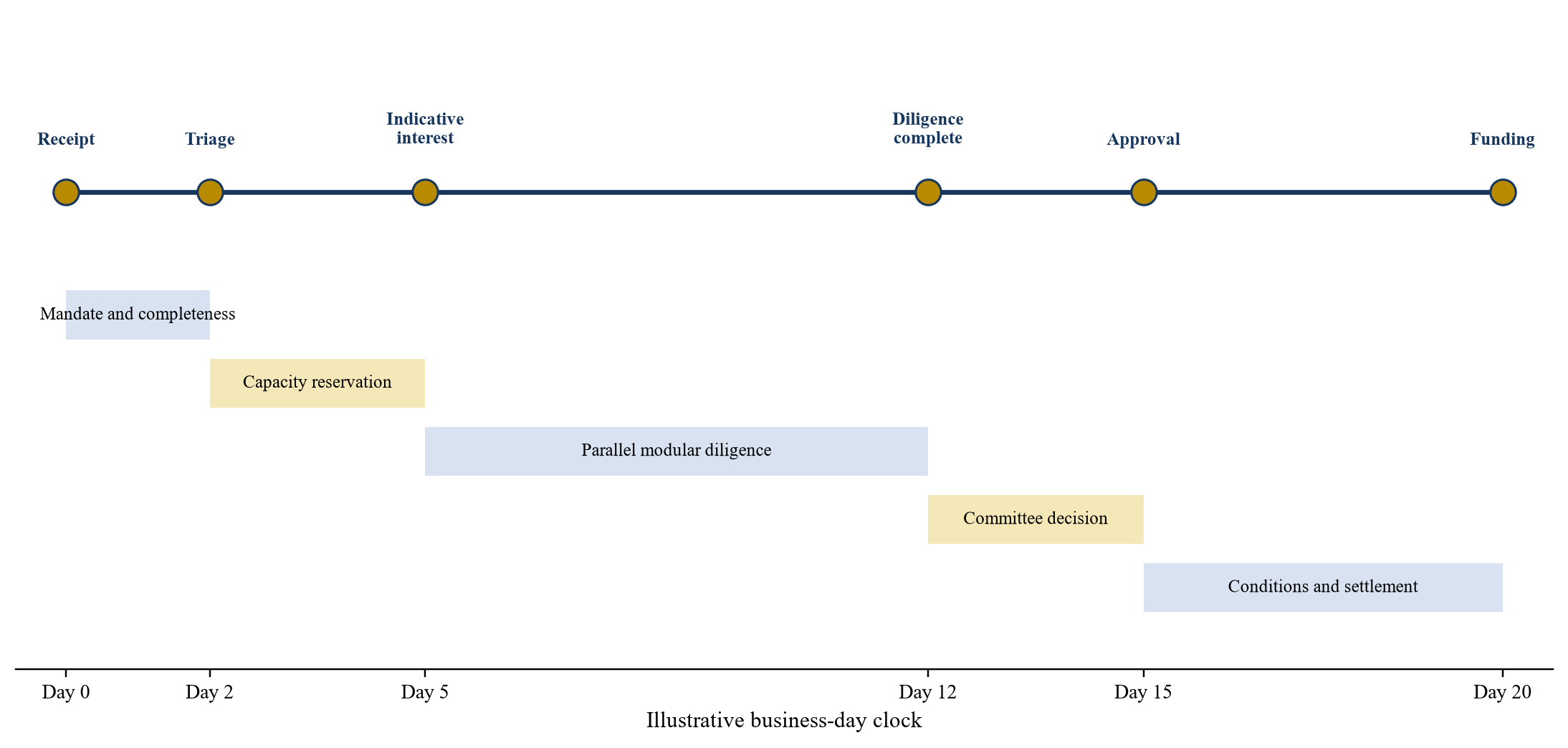
The timeline is an illustrative operating design rather than a regulatory requirement.
14. Define the hypothetical asset owner and opportunity
The worked case uses a hypothetical USD 30.0 billion asset owner. Its strategic allocation to private equity is 18 per cent, or USD 5.40 billion at current portfolio value. Existing co-investments have a reported value of USD 900 million. Unfunded private-equity commitments are USD 2.10 billion. The institution's liquid-resources plan and all case inputs are illustrative management assumptions.
A long-standing sponsor offers the institution up to USD 180 million in a minority investment in a business-services platform. The sponsor fund will invest USD 720 million. Total equity is USD 1.20 billion, with the remaining USD 300 million allocated among other co-investors. The proposed security is pari passu with the sponsor fund. The sponsor requests indicative interest in five business days and final approval in fifteen.
The entry enterprise value is assumed to be USD 3.60 billion, equal to 12.0 times an illustrative last-twelve-month EBITDA of USD 300 million. Debt at closing is USD 1.80 billion. The sponsor case assumes EBITDA grows to USD 455 million over five years, net debt falls to USD 1.10 billion and the business exits at 12.0 times EBITDA.
The asset owner's independent base case uses USD 420 million exit EBITDA, USD 1.25 billion net debt and an 11.0 times exit multiple. The downside uses USD 350 million, USD 1.55 billion and 9.0 times. The severe case uses USD 300 million, USD 1.75 billion and 8.0 times. These values do not describe an actual company or market expectation.
| Participation | Initial investment | Share of total portfolio | Co-investment exposure after closing | Private-equity exposure after closing | Illustrative follow-on reserve |
|---|---|---|---|---|---|
| Decline | USD 0m | 0.00% | USD 900m | USD 5,400m | USD 0m |
| Limited | USD 75m | 0.25% | USD 975m | USD 5,475m | USD 15m |
| Core | USD 120m | 0.40% | USD 1,020m | USD 5,520m | USD 24m |
| Maximum | USD 180m | 0.60% | USD 1,080m | USD 5,580m | USD 36m |
Every value is an illustrative management assumption. Percentages use the stated USD 30.0 billion portfolio before any denominator shock.
15. Rebuild the return bridge
The asset owner's return bridge begins with enterprise value, debt and equity. It then applies independently tested operating outcomes, cash conversion, debt paydown, dilution, fees and exit value. The model should allocate proceeds using the actual security waterfall.
Under the hypothetical independent base case, exit enterprise value is USD 4.62 billion: USD 420 million of EBITDA multiplied by 11.0. Deducting USD 1.25 billion of net debt gives USD 3.37 billion of equity value. Relative to USD 1.20 billion of entry equity, the gross equity multiple is approximately 2.81 times before fees, leakage, dilution and timing.
Under the downside, exit enterprise value is USD 3.15 billion and equity value is USD 1.60 billion, producing approximately 1.33 times gross equity value before adjustments. Under the severe case, enterprise value is USD 2.40 billion and equity value is USD 650 million, implying material capital impairment.
The difference between sponsor and independent cases should be decomposed into operating performance, leverage, multiple and time. This attribution prevents the committee from viewing one headline internal rate of return as the thesis.
16. Test concentration under denominator stress
The core USD 120 million participation represents 0.40 per cent of the opening portfolio. If liquid public assets fall and the total portfolio declines to USD 25.5 billion before private values adjust, the same investment represents 0.47 per cent. Existing private-equity value plus the new investment would represent 21.65 per cent rather than 18.40 per cent.
The denominator test should include the plausible follow-on reserve. If USD 24 million is funded during stress, total direct exposure increases while the portfolio may still be depressed. The committee should compare the result with policy limits and liquid-resource requirements.
Sponsor concentration also matters. The asset owner may have fund commitments, co-investments and credit exposure managed by the same organisation. A sponsor problem could affect information, valuation, capital calls and several portfolio companies at once. Aggregate exposure should therefore include unfunded obligations and contingent support.
The test should be performed before indicative interest and refreshed before funding. Market movements, revised allocation or new portfolio activity can change the result during the decision window.
17. Apply a decision scorecard
A scorecard creates a common language. It should not replace judgement or create artificial certainty. Each dimension should have evidence, a score, a reviewer and a statement of what would change the score.
The hypothetical case uses ten dimensions weighted to one hundred points. A score of seventy-five or above can enter approval, sixty to seventy-four requires exception review, and below sixty is declined. A hard-stop issue overrides the total. These thresholds are illustrative.
The core participation scores strongly on sponsor quality, mandate fit and governance rights. It scores moderately on valuation, leverage and exit resilience. The unresolved commercial diligence item and allocation explanation remain approval conditions. The resulting illustrative score is seventy-eight.
The recommendation should state the residual risks rather than rely on the aggregate. A high total cannot cure missing legal authority, sanctions concerns, an unresolved conflict or inability to fund.
| Dimension | Weight | Illustrative score | Weighted points | Required evidence or condition |
|---|---|---|---|---|
| Mandate and portfolio fit | 12 | 9/10 | 10.8 | Within approved strategy and concentration limits |
| Sponsor and allocation integrity | 10 | 8/10 | 8.0 | Written allocation rationale and economics map |
| Commercial resilience | 14 | 7/10 | 9.8 | Customer cohort and pricing evidence completed |
| Financial quality and cash conversion | 12 | 8/10 | 9.6 | Quality review reconciled to model |
| Capital structure and liquidity | 12 | 7/10 | 8.4 | Downside covenant and funding headroom confirmed |
| Valuation and return asymmetry | 14 | 7/10 | 9.8 | Independent case and reverse stress accepted |
| Legal, regulatory and tax | 8 | 9/10 | 7.2 | Final documents within approved terms |
| Technology, cyber and data | 6 | 7/10 | 4.2 | Remediation plan costed and covenanted |
| Sustainability and stakeholders | 5 | 8/10 | 4.0 | Material issues included in ownership plan |
| Governance rights and exit | 7 | 9/10 | 6.3 | Information, transfer and exit rights documented |
| Total | 100 | 78.1 | Approval subject to stated conditions |
Scores and thresholds are illustrative management assumptions. A hard-stop issue overrides the aggregate score.
18. Decide participation size
Sizing should connect conviction to portfolio capacity. The maximum allocation offered by the sponsor is not a target. The institution should compare the marginal benefit of each increment with concentration, liquidity, governance capacity and opportunity cost.
The limited USD 75 million option conserves capacity but may be too small to justify the diligence and monitoring burden. The maximum USD 180 million option increases exposure to the same sponsor, sector, financing and exit. The core USD 120 million option is assumed to remain within policy while producing meaningful economics.
Sizing should also consider minimum information and governance rights. A smaller holding may not receive an observer right, direct reporting or meaningful consultation. The asset owner should value rights that improve monitoring rather than seek influence it cannot exercise.
The decision record should state why the selected size is better than both decline and the maximum. It should also reserve or reject follow-on participation explicitly.
19. Convert diligence findings into conditions
Conditions should be specific, material and testable. A vague instruction to complete satisfactory diligence transfers risk to the closing team without identifying the required result. Each condition should state the evidence, accountable owner, deadline and approving authority for closure.
In the hypothetical case, conditions include written sponsor allocation rationale, confirmation of pari-passu economics, completion of customer-cohort work, acceptable downside covenant headroom, costed cyber remediation, final legal rights and treasury funding certification. Any material change to price, leverage, security, allocation, management or closing date returns to the investment lead and may require committee reconsideration.
Conditions precedent to funding differ from post-close actions. The former protect the decision before cash leaves. The latter become part of the ownership plan and should have reporting deadlines. A post-close promise should not be used to defer a fact essential to approval.
The closing certificate should reconcile final documents to the approved term sheet and recommendation. Legal counsel can confirm document changes; the investment owner should confirm their economic and governance effect.
20. Control the special-purpose vehicle
Co-investments often use a special-purpose vehicle. The asset owner should understand the vehicle's jurisdiction, manager, ownership, governance, bank accounts, expenses, tax reporting, regulatory status, sanctions controls, valuation, audit, insurance, information rights, transfer restrictions and wind-down.
The vehicle should not obscure look-through rights. The institution needs sufficient information about the underlying asset, cash flows, leverage and conflicts to meet its own obligations. It should know whether other investors can amend terms, whether the sponsor can borrow, whether liabilities are limited and how defaults are handled.
Expense allocation should be transparent. Formation, administration, audit, tax, legal, banking and broken-deal costs should be mapped before approval. The institution should understand any management fee, carry or sponsor reimbursement and how fund-level offsets operate.
Operational due diligence should continue after closing. Annual accounts, tax filings, cash reconciliations, valuations and authorised signatories should have owners and review dates.
21. Establish post-close ownership
The asset owner needs a named investment owner, a monitoring calendar and access to information. The plan should cover financial performance, operating drivers, liquidity, leverage, covenants, valuation, material incidents, sustainability risks, cyber, management changes, litigation, related-party activity and exit planning.
Reporting from the sponsor should be mapped to the institution's own metrics. Where definitions differ, the team should reconcile them. The institution should preserve the approved case and compare actual performance with the original operating, leverage and exit assumptions.
Observer or board rights create responsibilities. Representatives need mandates, conflict protocols, confidentiality controls, escalation rules and support. Information received in one capacity may be restricted from wider use.
The ownership plan should include a response ladder. A warning can trigger enhanced information. A covenant concern can trigger cash preservation and lender analysis. A management or cyber event can require specialist review. A follow-on request should return to a defined approval process rather than rely on sunk cost.
22. Govern follow-on capital and amendments
Follow-on decisions often occur under pressure. The institution should classify them as protective, value-accretive, strategic or rescue capital. Each class should have evidence and authority requirements.
The analysis should compare invest, do not invest and alternative structures. It should identify dilution, ranking, revised governance, new money terms, sponsor participation and the effect on existing capital. A pro-rata right is an option, not an obligation.
Amendments to debt, shareholder agreements, exit rights or reporting can change risk without requiring new cash. Material amendments should therefore pass an economic and governance review. The asset owner should track cumulative concessions.
The follow-on reserve in the hypothetical case is a planning allowance. It is not a commitment. Any use requires a fresh decision record and current liquidity test.
23. Monitor valuation and performance
Valuation governance should identify methodology, inputs, source, independence, frequency, challenge and approval. Sponsor marks may be the primary input, while the asset owner remains responsible for the value used in its own reporting.
Performance attribution should separate operating change, leverage, multiple, currency, fees, timing and follow-on capital. This helps the institution determine whether the original thesis worked and whether reported gains are realisable.
APRA's SPS 530 explicitly connects investment governance with ongoing performance assessment, stress testing, liquidity management and valuation governance [5]. EIOPA's governance guidance calls for investment-risk indicators aligned with policy and strategy [12]. These principles support an integrated dashboard rather than isolated valuation review.
The dashboard should include stale-information flags and exceptions. A smooth quarterly valuation can hide deteriorating cash flow or leverage. Operational indicators should therefore accompany the mark.
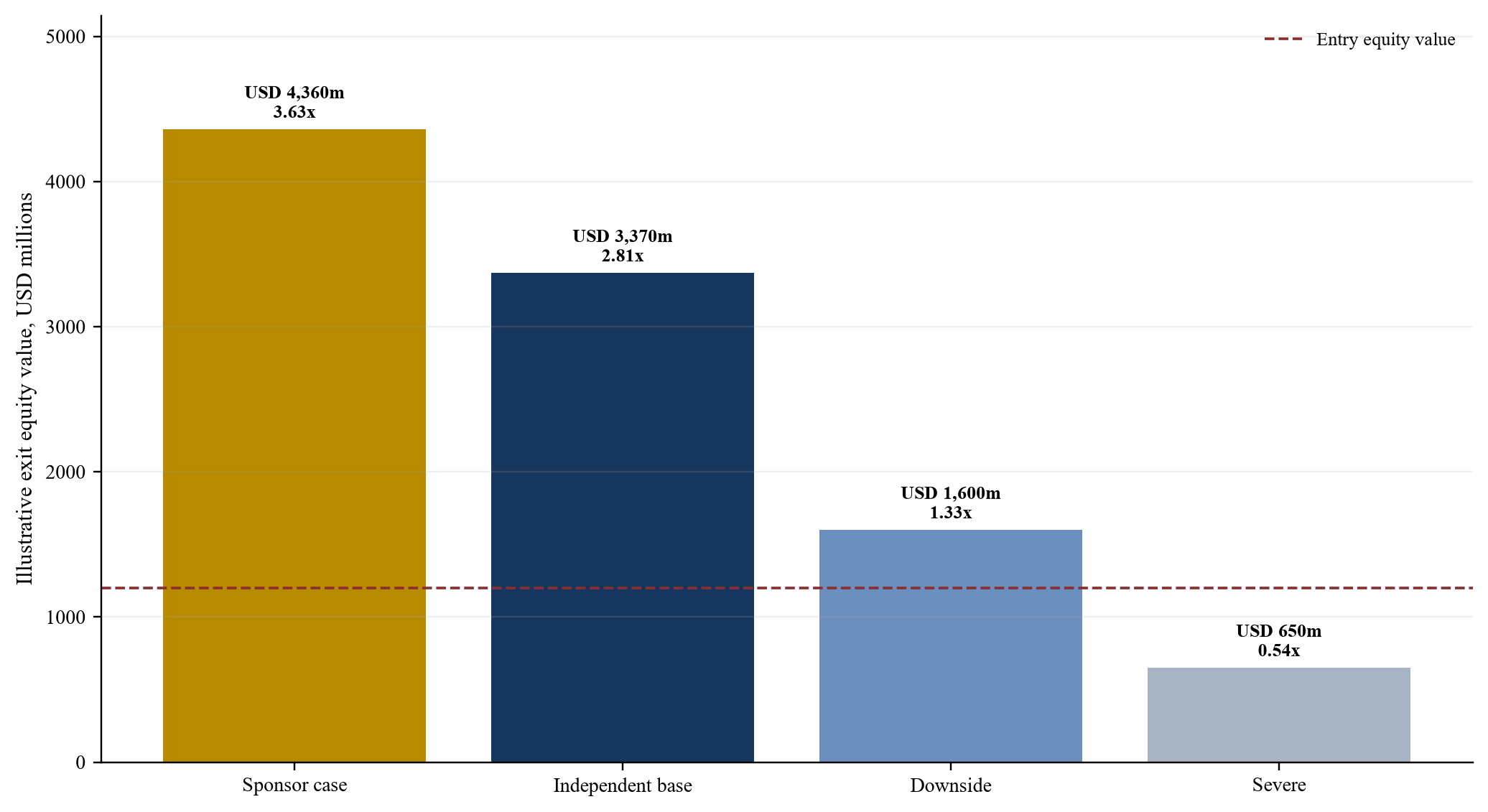
Outcomes use the paper's illustrative sponsor, independent base, downside and severe assumptions before fees, leakage, dilution, tax and timing.
24. Measure programme quality
The programme should be evaluated as a system. Metrics can include opportunity relevance, response time, diligence completeness, approval conversion, allocation received, funding accuracy, exceptions, concentration, post-close reporting, forecast error, realised performance and internal cost.
Fee savings should be measured rather than assumed. The institution should compare actual co-investment fees, carry, vehicle expenses, diligence costs, staff cost and broken-deal cost with the relevant alternative. Gross economics can overstate value when selection or operating cost is ignored.
Selection bias deserves attention. Sponsors choose which opportunities to syndicate and investors choose which to accept. The accepted portfolio may differ from the fund in sector, leverage, size, stage and outcome. Comparison with the sponsor fund should therefore control for these differences.
The programme should track declines and missed decisions. A decline for weak evidence can validate governance even when the asset performs well. A missed attractive opportunity can reveal a capacity problem. Outcome review should assess the decision process using information available at the time.
25. Create an ex-post learning loop
Each realised, written-off or materially restructured investment should receive an attribution review. The review should compare original thesis, independent case, identified risks, conditions, actual outcomes and sponsor behaviour. It should identify which signals were predictive and which controls failed.
Learning should update the mandate, pre-qualification rules, diligence modules, scorecard, delegation and sponsor ratings. It should also distinguish random outcome variation from process weakness. A good decision can produce a loss; a weak process can benefit from favourable markets.
The investment office should report programme learning to the governing body at least annually. The report should include exceptions, conflicts, concentration, funding events, valuation challenges, follow-on decisions and realised attribution.
OECD's G20 corporate-governance principles discuss the growing role of institutional investors and the importance of managing conflicts and governance in outsourced investment chains [13]. A co-investment programme should use ownership experience to improve both direct decisions and manager oversight.
26. Implement the system over ninety days
The first thirty days should establish authority. The institution confirms legal powers, beneficiary duties, strategic purpose, eligible perimeter, policy limits, board reservations and delegated roles. It inventories existing sponsor relationships, co-investments, look-through exposure, unfunded commitments and post-close obligations.
Days thirty-one to sixty should build the operating lane. The team creates the intake form, evidence minimum, modular diligence library, conflict register, scorecard, concentration test, liquidity certification, committee pack, conditions register and closing certificate. It pre-qualifies sponsors and agrees communication protocols.
Days sixty-one to ninety should test the system. A dry run uses a historic or synthetic opportunity to test clocks, hand-offs, secure data access, adviser mobilisation, modelling, committee scheduling, treasury confirmation and document closure. Findings should be resolved before live use.
The institution should begin with a controlled annual capacity. Capacity can be expressed as maximum reviewed opportunities, approved investments, capital, follow-on reserve and active monitoring relationships. It should expand only after evidence shows that the organisation can sustain quality.
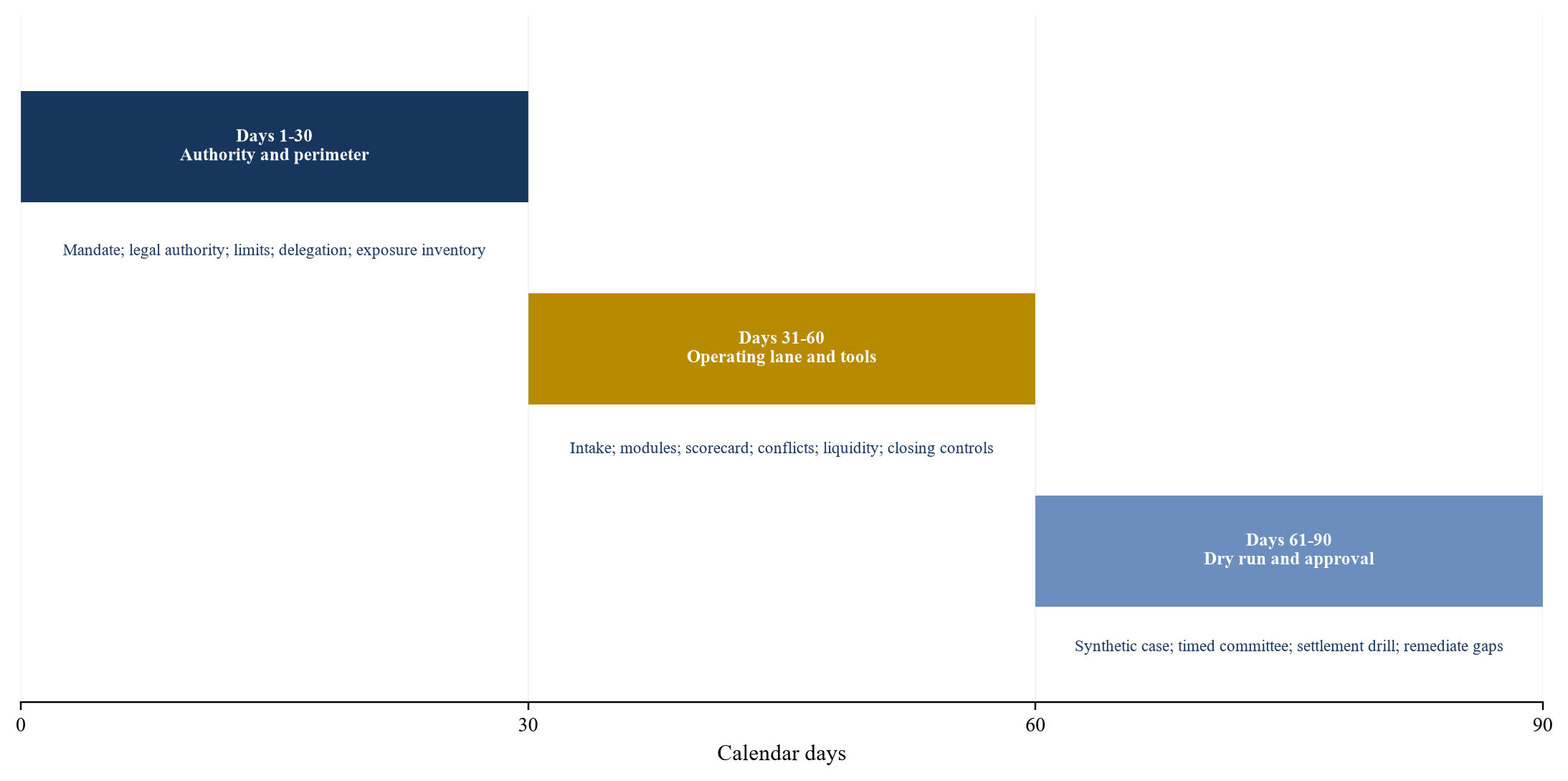
The roadmap is a proposed sequence and should be adapted to the institution's governance calendar and resources.
27. Control predictable failure modes
Co-investment governance usually fails through a chain of small compromises. An incomplete opportunity is admitted because the sponsor is familiar. Review begins without funding capacity. Specialists work in parallel without a shared issues register. A committee approves the thesis while material legal or commercial items remain open. Closing changes are treated as administrative. Ownership then lacks a named internal owner.
The control response is structural. The institution uses one intake standard, a clock that starts only when minimum evidence arrives, modular owners, one issues register, hard-stop rules, funding certification, final-document reconciliation and a post-close plan. Exceptions are visible and require authority.
| Failure mode | Consequence | Control response | Evidence of operation |
|---|---|---|---|
| Familiar sponsor substitutes for deal review | Transaction risk remains untested | Separate sponsor and transaction files | Independent investment thesis and downside case |
| Opportunity enters without complete intake | Time lost and gaps normalised | Clock starts after evidence minimum | Completeness certificate and decline taxonomy |
| Sponsor allocation is accepted without explanation | Adverse selection or conflict | Allocation and economics review | Written rationale, vehicle map and approvals |
| One headline return drives approval | Hidden leverage, multiple or timing dependence | Independent bridge and reverse stress | Attributed base and downside cases |
| Concentration assessed only at closing value | Follow-on and denominator risk missed | Look-through and stress exposure test | Pre- and post-investment concentration record |
| Funding assumed after approval | Settlement or liquidity failure | Treasury certification before approval | Named cash source, back-up and rehearsal |
| Conditions remain vague | Material issue moves into closing | Testable condition register | Owner, evidence, deadline and closure sign-off |
| Closing documents drift from approval | Economics or rights change silently | Final-document reconciliation | Investment and legal closing certificate |
| No internal post-close owner | Risks and rights are unmanaged | Ownership plan and escalation ladder | Dashboard, meeting record and action log |
| Programme judged only by realised return | Weak process hidden by market outcome | Ex-post decision attribution | Annual governance and learning report |
The controls are a proposed governance design and require adaptation to the institution's legal and operating arrangements.
28. Limitations and conclusion
This paper provides a governance framework for institutional co-investments. It does not determine whether an institution has legal authority to invest, whether a transaction is suitable, what valuation is fair, which tax structure applies, which regulatory approval is required, how fiduciary duties apply to specific facts or whether any sponsor, asset or security should be selected.
The worked case is hypothetical. Portfolio values, allocations, financial performance, leverage, valuation multiples, transaction terms, probabilities, thresholds, scores, time limits and outcomes are illustrative management assumptions. They are not observed investor or company data, probabilities, forecasts or investment advice.
Co-investment capability is an operating system. It begins with a board-approved purpose and opportunity perimeter. It uses a rapid triage gate, a defined evidence minimum and independent modular underwriting. It treats allocation, conflicts, concentration, funding and post-close ownership as decision variables rather than administrative details.
The practical result is speed with an auditable basis. Sponsors receive timely answers. Committees see the evidence, uncertainty and portfolio effect. Treasury knows the funding obligation. Investment owners inherit a monitoring plan. The governing body can assess whether the programme is producing value within its mandate and duties.
Sources
- Institutional Limited Partners Association, ILPA Principles 3.0, June 2019, accessed 17 September 2026, Read the primary source
- Institutional Limited Partners Association, ILPA Principles and Best Practices, accessed 17 September 2026, Read the primary source
- Institutional Limited Partners Association, Due Diligence Questionnaire 2.0, accessed 17 September 2026, Read the primary source
- Institutional Limited Partners Association, ILPA Reporting Template, accessed 17 September 2026, Read the primary source
- Australian Prudential Regulation Authority, Prudential Standard SPS 530 Investment Governance, in force 1 January 2023, accessed 17 September 2026, Read the primary source
- Organisation for Economic Co-operation and Development, Strengthening Asset-backed Pension Systems in a Post-COVID World, 2022, accessed 17 September 2026, Read the primary source
- The Pensions Regulator, Investment Governance, General Code in force 28 March 2024, accessed 17 September 2026, Read the primary source
- United States Department of Labor, FAQs about Retirement Plans and ERISA, accessed 17 September 2026, Read the primary source
- United States Department of Labor, Fiduciary Duties in Selecting Designated Investment Alternatives, 2026, accessed 17 September 2026, Read the primary source
- United States Department of Labor, Final Rule on Prudence and Loyalty in Selecting Plan Investments and Exercising Shareholder Rights, 22 November 2022, accessed 17 September 2026, Read the primary source
- Principles for Responsible Investment, Responsible Investment DDQ for Venture Capital Limited Partners, 15 November 2022, accessed 17 September 2026, Read the primary source
- European Insurance and Occupational Pensions Authority, Guidelines on System of Governance, Section 5: Prudent Person Principle, accessed 17 September 2026, Read the primary source
- Organisation for Economic Co-operation and Development, G20/OECD Principles of Corporate Governance 2023: Institutional Investors, Stock Markets and Other Intermediaries, 2023, accessed 17 September 2026, Read the primary source
- Organisation for Economic Co-operation and Development, Pension Markets in Focus 2025, 2025, accessed 17 September 2026, Read the primary source
- International Organisation of Pension Supervisors, OECD/IOPS Good Practices for Pension Funds' Risk Management Systems, 2011, accessed 17 September 2026, Read the primary source
- International Organization of Securities Commissions, Principles for the Valuation of Collective Investment Schemes, May 2013, accessed 17 September 2026, Read the primary source
- Financial Stability Board, Leverage in Non-Bank Financial Intermediation: Final Report, 9 July 2025, accessed 17 September 2026, Read the primary source
- International Monetary Fund, Global Financial Stability Report: The Rise and Risks of Private Credit, April 2024, accessed 17 September 2026, Read the primary source
