
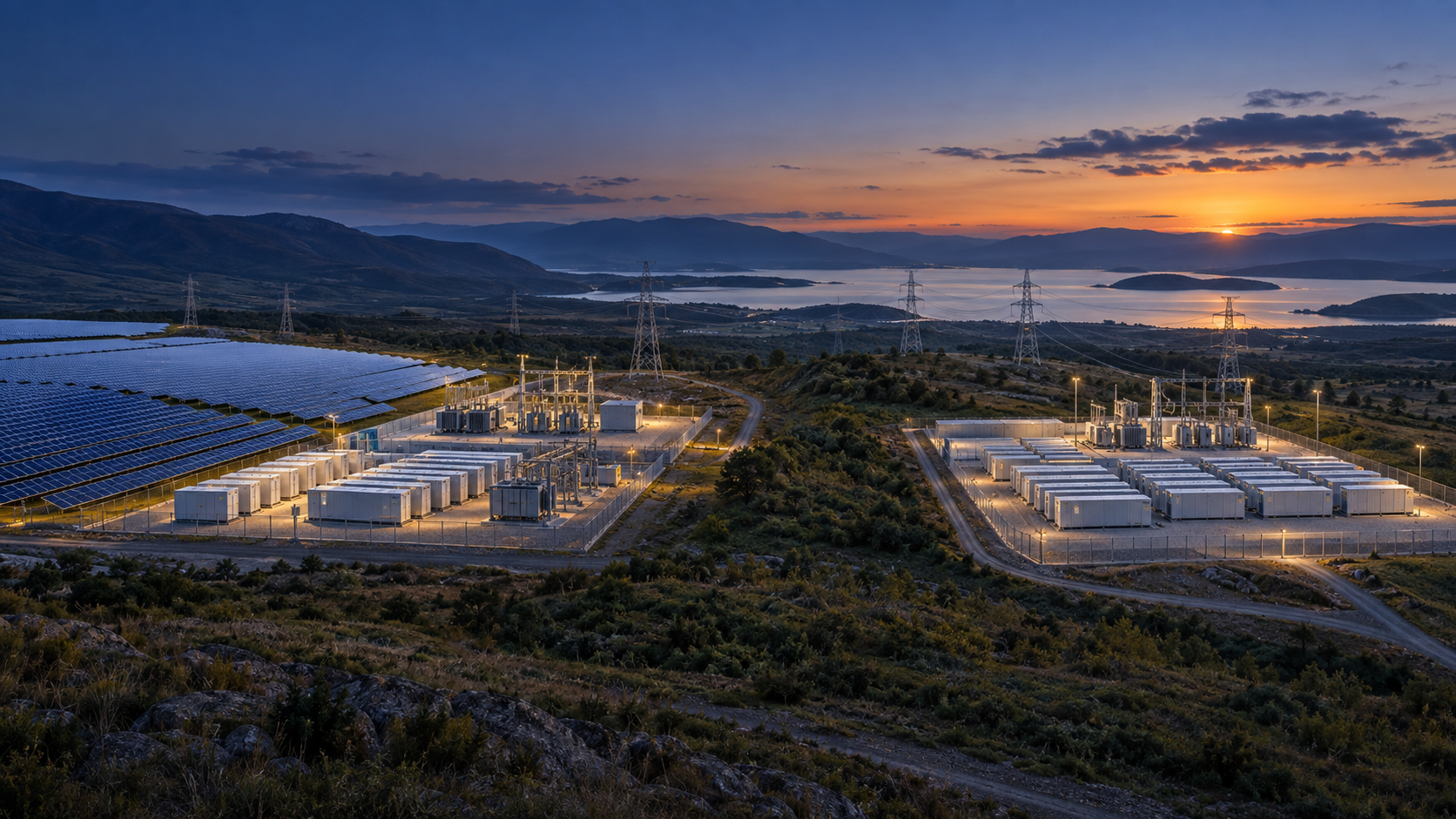
1. The site choice changes the asset being valued
A battery beside a solar or wind plant can share a point of interconnection, land, roads, security, control systems, operations and parts of the electrical balance of plant. The same battery developed on an independent site may hold separate import and export rights, its own metering and a wider dispatch envelope. These configurations can use similar cells and inverters while producing different cash flows, risks and financing structures.
The valuation question is therefore broader than installed cost. It asks which rights the project controls, which costs are genuinely avoided, which revenues can be earned simultaneously, and which constraints continue through the operating life. A shared connection can be scarce and valuable. It can also cap combined export at the moment when both generation and storage want to deliver. An independent connection can preserve flexibility while adding development cost and schedule risk.
Berkeley Lab defines co-located hybrids as resources that share a point of interconnection and may operate largely independently. A fuller hybrid also coordinates operations. That distinction matters. Physical proximity alone does not establish operational integration, and a shared interconnection alone does not establish common ownership or a single revenue contract. The valuation model should describe the actual arrangement rather than rely on the label.
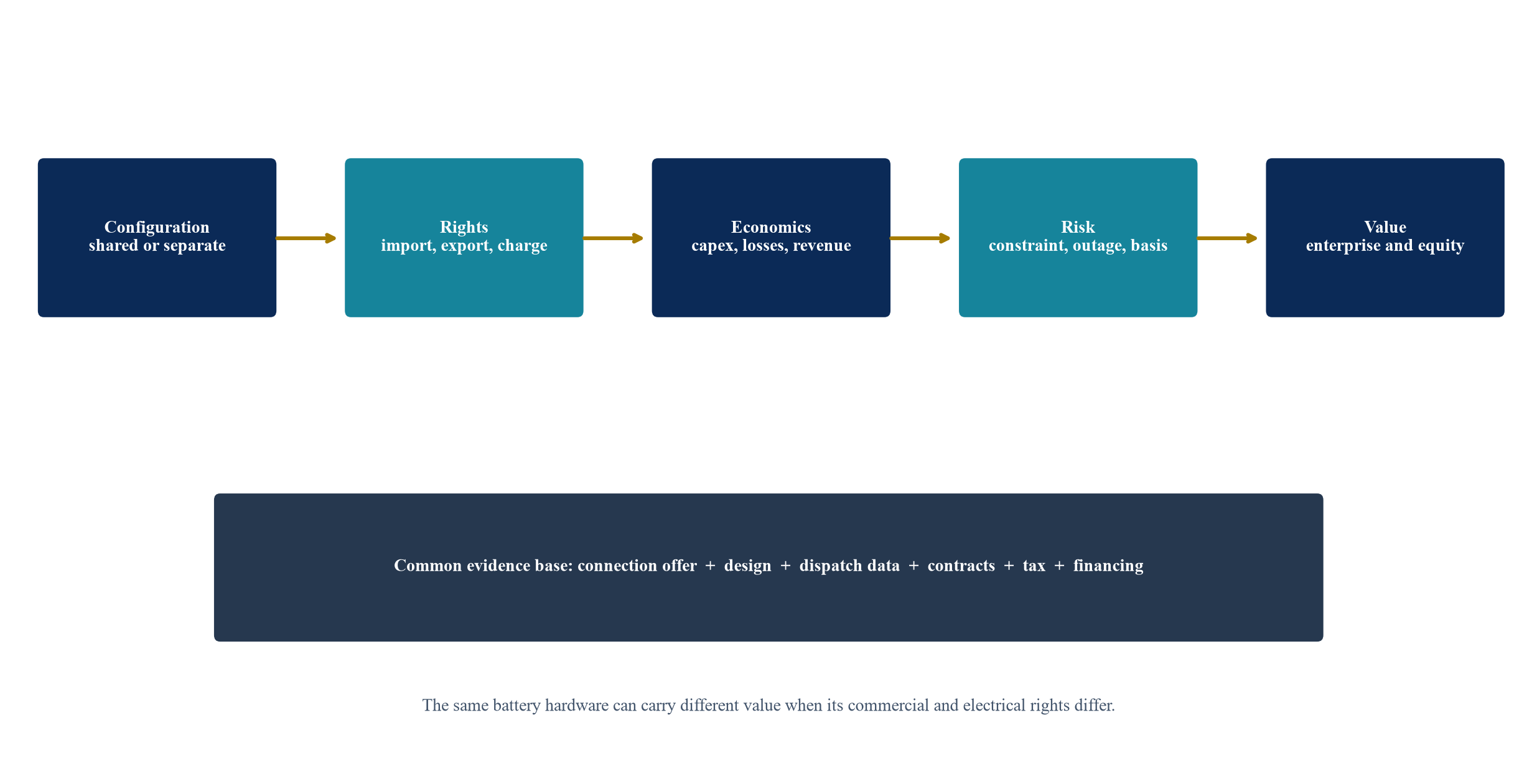
Conceptual framework. Each configuration must be valued through its rights, costs, operations, contracts, financing and residual value.
2. Define the unit of account before comparing returns
The model should identify whether it values the battery alone, the renewable plant alone, the combined project, or the sponsor's interest in a project company. Shared infrastructure can move value between these units. A battery may appear inexpensive when the solar project already funded the substation, cable route and control room. The combined project can still bear the economic cost of those assets and any foregone use of connection capacity.
The unit of account should also identify ownership. A single project company can allocate shared costs internally. Separate owners need access, easement, connection-sharing, metering, control, outage and cost-sharing agreements. A battery that depends on another owner's land or connection has a different risk profile from a fully integrated project, even when the physical layout is identical.
Investment committees should require three valuations where assets are combined: the renewable asset on a stand-alone basis, the battery on an incremental basis, and the integrated project. The bridge between them should show avoided cost, shared cost, incremental revenue, revenue displacement and risk adjustments. This prevents synergy from being counted in both component values.
3. Treat interconnection as a bundle of rights
A grid connection is more than a cable. It can define maximum import and export, firm or non-firm access, reactive-power duties, metering, losses, curtailment, operating instructions, commissioning milestones, securities and network charges. Co-location creates value when the shared connection can accommodate both resources without equivalent reinforcement or delay.
Great Britain's Connections Action Plan recognises that storage acts as both generation and demand and that inconsistent treatment of firm access and import diversity can lead to unnecessary reinforcement. The UK Solar Roadmap also states that co-located storage should be assessed through its operating profile, including its ability to reduce export during peak generation and deliver at peak demand. These principles support a valuation based on the actual access profile rather than the sum of nameplate ratings.
The connection offer should be translated into an hourly constraint set. The model should record combined export limits, import limits, dynamic or non-firm restrictions, outage windows and any operational intertrip. A connection date without the complete rights package is insufficient for valuation.
4. Value schedule certainty separately from connection capacity
Connection value has at least two dimensions: capability and timing. A co-located battery may use an existing or advanced connection date. A stand-alone project may enter a queue, fund studies and wait for reinforcement. The schedule advantage can create substantial present value before any operating synergy is counted.
The benefit should be supported by dated evidence. It may come from an executed modification, a confirmed shared-capacity arrangement, an accepted technical solution or an existing energised point. A preliminary discussion or an assumed modification should remain a development case. The model should attach probabilities and costs to each milestone rather than capitalise an unverified date.
Schedule certainty also affects procurement and tax. Equipment orders, notice to proceed, construction start, placed-in-service timing and offtake commitments can depend on the connection programme. A configuration that lowers connection capital but delays operation may destroy more value than it saves.
5. Separate shared capital from transferred capital
Co-location can avoid duplicate land, roads, fencing, security, communications, control rooms, operations facilities, grid studies, substations, transformers, switchgear and cable routes. Some equipment can be sized once for the combined project. Other equipment must be duplicated because charging, protection, metering or availability requirements differ.
The cost bridge should classify each item as avoided, shared, incremental or transferred. An avoided cost disappears from the combined project. A shared cost remains and needs an allocation rule. An incremental cost arises because of integration, such as protection changes, control logic or additional metering. A transferred cost moves from one asset to another and does not create combined value.
The allocation basis should follow use and capacity. Land can be allocated by occupied area plus common access. Substation cost can be allocated by reserved import and export capability. Control systems can be allocated by incremental functionality. A simple percentage of total capital can misstate both component returns and tax basis.
Table 1. Configuration comparison for investment underwriting
| Valuation factor | Co-located storage | Stand-alone storage | Evidence required |
|---|---|---|---|
| Connection | Shared point and combined operating envelope | Independent import and export rights | Executed offer, studies, limits and milestone schedule |
| Land and planning | Shared site and access; cumulative impacts | Separate site, access and permit | Title, lease, layout, permit and emergency access |
| Balance of plant | Potential sharing of substation, controls and security | Dedicated electrical and operating systems | Single-line diagram, equipment scope and cost plan |
| Charging source | Renewable output, grid import, or both as permitted | Grid import and any contracted source | Metering, market rules, tax conditions and offtake terms |
| Curtailment capture | Can absorb otherwise-lost renewable output | Depends on nodal prices and grid access | Historical constraints, hourly simulation and charging limit |
| Merchant optionality | May be constrained by shared export, PPA or tax structure | Usually broader market dispatch rights | Registration, bidding authority and contractual dispatch rules |
| Outage exposure | Common connection or control failure can affect both assets | More electrical independence; dedicated outages remain | Reliability design, outage history and interface matrix |
| Financing | Combined package may diversify revenue and share security | Separate credit case and security package | Base case, covenants, reserves and lender rights |
| Exit value | Buyer values integrated rights and interface durability | Buyer values independent control and optionality | Transferability, remaining term, consents and market evidence |
General framework. Project-specific rights, contracts, taxes and network rules determine the final result.
6. Distinguish AC coupling from DC coupling
Co-located projects can connect the battery on the alternating-current side or the direct-current side of the renewable plant. AC coupling generally gives the battery a separate inverter path and can support charging from the grid when permitted. DC coupling can capture energy that would otherwise be clipped before the solar inverter, while creating tighter dependence on the shared inverter architecture and control system.
The valuation should reflect conversion losses and equipment loading. A DC-coupled battery may charge directly from the solar array and later discharge through a shared inverter. This can avoid one conversion step for solar charging, but the shared inverter can limit simultaneous output. An AC-coupled system can operate more independently and can be simpler to retrofit, while using separate power-conversion equipment.
The choice affects replacement and augmentation. A battery added to an existing solar project must fit spare electrical capacity, controls and warranty boundaries. Future inverter replacement can affect both assets. The model should therefore include lifecycle capital and outage interactions, rather than treating coupling as a one-time capital choice.
7. Quantify curtailed-energy capture with hourly evidence
Curtailment capture is a common source of co-location value. The battery can charge when renewable output exceeds the connection limit, when the system operator curtails export, or when market prices make immediate export unattractive. The economic value equals the delivered discharge value less charging losses, degradation, variable cost and any displaced service revenue.
The calculation needs hourly or sub-hourly generation, prices, constraints and battery state. An annual curtailment percentage cannot show whether energy is available when the battery has space, whether the charging rate is sufficient, or whether the battery is already committed to another service. Historical curtailment should also be adjusted for future grid reinforcement, additional generation, market reform and changing dispatch.
Berkeley Lab's work on congested electricity markets shows that hybrid value varies with location, storage duration, degradation and grid-charging rights. In variable-renewable-rich areas, the reported median increase in energy value from extending storage from one hour to four hours was 29.4 percent for solar and 26.8 percent for wind under the study's assumptions. These results show sensitivity to configuration; they do not establish a universal premium.
8. Separate clipping, curtailment and negative-price charging
Clipping occurs when available direct-current solar output exceeds inverter capability. Network curtailment occurs when the system or connection restricts export. Economic curtailment occurs when the project elects not to generate because prices or contract terms make production unattractive. Each source of energy has a different evidence base and can have different tax, metering and contract treatment.
The model should record the source of every charged megawatt-hour. Capturing clipped solar can be closely tied to DC architecture. Capturing network curtailment requires the battery to remain available when the restriction occurs and may depend on whether import and export are separately controlled. Negative-price charging from the grid can be available to both configurations where market and connection rules permit it.
Combining these categories can overstate co-location value. The battery cannot capture the same megawatt-hour twice, and the same energy capacity cannot simultaneously support a capacity obligation, reserve service and arbitrage unless the market rules allow stacking and the dispatch model preserves physical feasibility.
9. Price merchant optionality as a portfolio of operating rights
Stand-alone storage often has a wider choice of charging hours and services because it is not tied to renewable production or a combined export limit. It can respond to energy spreads, ancillary-service prices, capacity payments, balancing needs and congestion. That flexibility has value when the project has the registrations, telemetry, bidding authority and operational capability to use it.
Optionality should be valued through feasible dispatch, not a sum of independent revenue forecasts. Price spreads, ancillary-service prices and capacity scarcity can be correlated. Market entry by other batteries can compress revenue. Perfect-foresight optimisation establishes a technical upper bound and should be discounted for forecast error, bidding rules, outages, state-of-charge requirements and degradation.
Berkeley Lab's 2024 solar and storage operations work estimated that optimised batteries could have raised the generation-weighted wholesale market value of U.S. solar from USD 29/MWh to USD 75/MWh in 2024, mainly through capacity value and then ancillary services and energy shifting. The study uses optimised dispatch with perfect price foresight. A transaction model should apply its own execution and market assumptions rather than adopt the result as a project forecast.
10. Test the shared export limit under coincident value hours
Co-location can use spare connection capacity when renewable output is low. It can lose value when high renewable output coincides with high prices and the battery also wants to discharge. The shared export limit then creates a choice between immediate renewable sales and battery discharge.
The valuation should calculate the shadow value of the connection constraint. For each interval, the optimiser should identify the gross value available without the limit and the value delivered under the limit. The difference is the cost of shared export. This cost can be small where solar output and peak prices are separated, or large where evening solar, wind peaks or capacity events overlap with battery discharge.
The project can mitigate the constraint through oversizing, control strategy, contractual dispatch priority or connection reinforcement. Each response has cost and risk. An assumed reinforcement should remain outside the base case until scope, price and timing are supported.
11. Model common-mode outages
Shared infrastructure can reduce capital and create common-mode failure. A transformer, bus, protection system, communications platform, control system or grid connection can remove both renewable and battery output. A stand-alone project has its own failure points, yet it may preserve independence from the renewable asset.
Availability models should distinguish component outages from connection outages. The combined project should not simply multiply separate availability assumptions. It should use a reliability block structure that reflects shared elements and restoration times. Planned maintenance also requires coordination, especially where isolation of one asset affects the other.
Insurance and warranties should follow the same architecture. Business-interruption value can increase when one failure affects two revenue streams. Shared deductibles, limits and reinstatement periods should be reviewed. The valuation should include retained loss and recovery timing where common equipment carries concentrated exposure.
12. Allocate operating costs to the service they support
Co-location can share operators, control rooms, security, vegetation management, site leases, spares, network charges and insurance administration. It can also require more complex scheduling, metering, settlement, cybersecurity, compliance and interface management. The net saving should be built from functions and contracts.
Fixed costs should be allocated consistently with the unit of account. A shared operator fee can be divided by work scope, asset value, installed capacity or a negotiated formula. Variable costs should follow throughput, cycles, metered import, exported energy or service use. The allocation matters for standalone returns and transfer pricing between project companies.
The cost model should include future separation. A buyer may acquire the battery without the renewable plant, or a lender may enforce against one asset. Shared services then need replacement or a transition agreement. Exit value should reflect the durability and transferability of the operating arrangement.
13. Treat metering as a valuation control
Metering determines settlement, tax evidence, renewable-attribute claims, PPA performance and operating data. A co-located project may need meters at the grid boundary, renewable output, battery charging point, battery discharge point and auxiliary loads. The data hierarchy should prevent double counting and preserve loss allocation.
Ofgem's 2025 guidance addresses co-location of storage with assets participating in the Renewables Obligation, Feed-in Tariffs, Renewable Energy Guarantees of Origin and Smart Export Guarantee frameworks. The guidance reflects the need to distinguish eligible renewable output, imported energy, stored energy and export. The economic model should use the same metering boundary as the applicable scheme and contract.
Meter errors or ambiguous settlement can delay revenue and impair compliance. The technical design, market registration, tax analysis and financial model should therefore use a common meter diagram. Changes after commissioning should trigger review across all four areas.
14. Allocate renewable attributes and environmental claims
Charging from renewable generation does not automatically give every discharged megawatt-hour the same environmental attribute. Certificate systems, emissions accounting, additionality claims and offtake contracts use defined boundaries. Grid charging can mix energy sources and change the project's claims.
The valuation should identify who owns renewable certificates, carbon benefits and other attributes. It should record whether the battery transfers, retires or preserves them and whether time matching is required. A co-located asset can support a shaped renewable product, while the claim should remain consistent with metered energy and scheme rules.
Unpriced environmental claims should not be capitalised. Contracted certificate revenue can be valued under its terms. Potential premium products can be analysed as scenarios with evidence on buyer requirements, metering capability and execution cost.
15. Apply U.S. tax rules to the correct property
U.S. federal tax treatment can materially affect configuration value. The clean electricity investment credit under section 48E applies to qualified facilities and energy storage technology placed in service after 2024. The IRS states a base credit of 6 percent, potentially increased to 30 percent where prevailing-wage and apprenticeship requirements are met, with possible domestic-content and energy-community bonuses subject to their rules.
The 2025 final regulations confirm that energy storage technology can qualify separately and can be co-located with a qualified facility. They also state that a unit of qualified facility and a unit of storage cannot share components for section 48E purposes, although integral property may be shared. This makes asset definition and basis allocation important.
The model should obtain project-specific tax advice on eligible basis, shared equipment, credit rate, bonus qualification, transfer or direct payment, recapture, depreciation and partnership allocation. Later statutory and regulatory changes can alter value. Tax credits should be dated to realistic monetisation and discounted for transaction cost, indemnity, audit and compliance risk.
16. Recognise current U.S. sourcing restrictions
U.S. rules affecting clean-energy credits changed again in 2025 and 2026. IRS guidance issued in February 2026 addresses material assistance from prohibited foreign entities for facilities and energy storage technologies beginning construction after 31 December 2025. The guidance describes interim safe harbours pending further tables and regulations.
The valuation should treat eligibility as a documented workstream. Cell, module, inverter and other component sourcing may affect the credit case. Procurement representations, supplier information rights, change control and tax indemnities should support the assumed benefit.
Configuration does not remove this exposure. A co-located project may combine separate tax units with shared property. A stand-alone battery can still face sourcing, beginning-of-construction and placed-in-service requirements. The model should avoid applying a generic credit percentage before the asset and supply chain have been tested.
17. Value offtake and dispatch control together
A renewable-plus-storage project can sell a shaped energy product, firm blocks, capacity, availability or dispatchable output. The contract can reduce merchant exposure and support financing. It can also transfer dispatch control to the buyer and limit other revenue.
The model should separate the value of price certainty from the cost of restricted operation. It should identify charging rights, dispatch priority, minimum state of charge, cycling limits, availability guarantees, degradation compensation, imbalance responsibility, curtailment, force majeure and termination payments. The owner should know which services remain available outside the contract.
A stand-alone tolling agreement can deliver a similar contracted credit profile while preserving a different physical arrangement. The comparison should therefore test contract alternatives for both configurations rather than equate co-location with contracted revenue and stand-alone storage with merchant revenue.
18. Reconcile renewable PPA and battery obligations
Adding storage to an existing renewable PPA can affect delivery, deemed energy, curtailment, availability and certificate provisions. The battery may charge from energy that would otherwise satisfy the PPA. It may discharge later at a different meter or settlement point. The amendment must define which cash flows belong to each asset.
The project should test whether storage changes the renewable asset's contracted quantity, merchant tail, operating standard or financing covenants. A battery can increase combined value while reducing the standalone renewable value. The valuation bridge should show both effects.
Consent and change-of-control provisions also matter. The offtaker, grid operator, landowner, tax investor and lenders may hold approval rights. Development schedule and transaction value should reflect the conditions and their probability of satisfaction.
19. Price capacity and reliability through local rules
Storage can earn capacity or resource-adequacy value where the market recognises its dependable contribution. Accreditation can depend on duration, state of charge, dispatch history, coincidence with system stress and interaction with renewable output. A shared connection can affect deliverability.
The model should use current market rules and conservative performance assumptions. Capacity revenue should be linked to tested capability and penalties. If the battery also supports a renewable delivery obligation, the same stored energy may not be fully available for system capacity.
The IEA identifies one-to-eight-hour storage as a major source of short-term flexibility and electricity security. That system need supports the market opportunity. The project cash flow still depends on local procurement, accreditation and competition.
20. Model degradation as an economic dispatch cost
Every charge and discharge contributes to degradation, alongside calendar ageing and operating conditions. Dispatch value should therefore include the marginal cost of lost future capability, augmentation and replacement. A strategy that maximises current gross revenue can reduce lifetime value.
Co-located operation can change the duty cycle. Charging from midday solar and discharging in the evening may create a regular daily cycle. Stand-alone optimisation can pursue more frequent ancillary and arbitrage activity. The model should connect the dispatch profile to the warranted operating envelope and capability forecast.
NREL's 2024 Annual Technology Baseline represents battery storage across two-to-ten-hour durations and describes cost-reduction scenarios. These benchmarks support scenario design. A project valuation should use its own supply contract, chemistry, climate, controls, warranty and replacement plan.
21. Value land as a controlled operating right
Co-location can reduce land acquisition and planning work where the renewable site has suitable space, access and permits. The benefit depends on the legal right to install and operate storage for the full economic life. A lease written for generation may not cover grid import, hazardous materials, new structures, extended hours, replacement or merchant operation.
The land model should include rent, option payments, easements, access, drainage, fire-service requirements, setbacks, biodiversity, noise and decommissioning. A stand-alone site closer to a constrained node or demand centre can earn higher market value even with higher land cost. Site value follows the connection and revenue opportunity, not acreage alone.
Planning risk can differ. UK guidance encourages early engagement with fire and rescue services for lithium-ion systems of 1 MWh or more and focuses on siting, thermal-runaway consequences and emergency access. A co-located application must address cumulative site effects. A stand-alone project must establish the complete planning case without relying on the renewable consent.
22. Include construction and interface risk
Co-location can build storage alongside a new renewable plant or retrofit it to an operating site. A simultaneous build can coordinate design and procurement while increasing interface complexity. A retrofit can use proven site data and infrastructure while creating outage, warranty and brownfield risk.
The construction model should identify work near energised equipment, planned shutdowns, protection changes, commissioning sequence and responsibility for damage to the existing asset. Delay to the battery can affect the renewable plant if shared equipment or permits sit on the same critical path. Delay to the renewable plant can affect battery charging assumptions or offtake.
The EPC structure should allocate integrated testing and performance. Separate contracts need an interface schedule and an owner capable of managing it. Combined wrap can reduce gaps but may carry a price premium and liability cap. The valuation should include the cost of the risk allocation it assumes.
23. Test control-system and cybersecurity dependency
An integrated energy-management system may optimise renewable output, battery state and grid limits. It can create value through coordinated dispatch. It can also create dependence on software, data feeds, communications and an optimiser with access to both assets.
The technology review should identify control hierarchy, fail-safe modes, manual override, data ownership, model updates, cyber access, outage response and vendor replacement. A battery should remain safe when price feeds or optimisation services fail. The project should know whether it can continue earning contracted revenue in a degraded control mode.
Software and optimisation fees belong in operating cost. Revenue claims should be supported by back-testing and governance. A vendor's simulated uplift should not be capitalised without an independent view of available services, execution limits, degradation and forecast error.
24. Use a nodal revenue model
Storage value depends on the prices and constraints at its connection point. Regional averages can miss congestion, losses, curtailment and local scarcity. A co-located battery should use the same nodal and network evidence as the renewable project. A stand-alone candidate site should be screened against alternative nodes.
The model should combine historical prices with a forward structural view. Historical spreads can narrow as more storage enters. New transmission, generation, demand and market design can change the node. The forecast should therefore include base, compression, congestion and policy cases.
Revenue should be separated by service and reconciled to physical dispatch. The project should report gross revenue, charging cost, losses, degradation cost, fees, penalties and net margin. This makes comparisons portable across sites and contracts.
25. Avoid double-counting correlation benefits
Renewable generation and battery revenue can diversify each other when their drivers differ. A shared constraint, common weather pattern, market reform or outage can also create correlation. The combined project's debt capacity should follow the downside relationship between cash flows, not the number of revenue lines.
The model should simulate joint scenarios. Low solar output can reduce co-located charging from the plant while creating higher market prices. High solar output can increase curtailment energy while depressing midday prices. A grid outage can remove both assets. Contracted renewable revenue may remain stable while merchant battery revenue compresses.
Financing benefit should be measured through cash available for debt service, coverage, reserves and default probability. A lower weighted average cost of capital can be used only where the financing structure and lender terms support it.
26. Structure debt around configuration-specific controls
Lenders will examine connection rights, dispatch control, offtake, permits, tax assumptions, equipment warranties, augmentation, insurance, land and shared infrastructure. Co-location adds interface and common-security questions. Stand-alone storage adds merchant exposure and independent development risk.
The security package should cover the assets and rights needed to operate. Where the battery depends on another project company, lenders may require direct agreements, step-in rights, access, shared-facility covenants and restrictions on amendment. A common account and cash waterfall can simplify control while affecting distributions between assets.
Debt sizing should use configuration-specific downside cases. These include lower spreads, ancillary-service compression, curtailment change, shared-export congestion, delayed tax monetisation, higher degradation, connection outage and augmentation cost. Contracted cases also need counterparty and termination scenarios.
27. Allocate shared infrastructure in an enforcement case
Value can change sharply if lenders enforce or assets are sold separately. A battery may require continued access to a shared substation, control system, road, meter and land. The renewable asset may depend on the same systems. A poorly documented sharing arrangement can impair both sales.
The transaction documents should define ownership, capacity reservation, cost sharing, maintenance, outage coordination, insurance, damage, replacement, term, default and transfer. They should preserve service through insolvency where legally possible. A valuation that assumes perpetual shared access should verify these rights.
Independent technical operation is also relevant. If the battery cannot be isolated, metered and operated without the renewable owner, its buyer pool can narrow. The exit model should consider integrated sale, separate sale and enforcement outcomes.
28. Apply three valuation methods and reconcile them
A discounted cash-flow model values project-specific contracts, merchant revenue, costs, tax and financing. A transaction-multiple approach can provide market context, though headline enterprise-value-per-megawatt or per-megawatt-hour metrics can conceal connection, duration, contract, tax and development differences. A replacement or development-cost approach can inform early-stage and infrastructure value.
The methods should reconcile to the same rights and date. A fully permitted, contracted and connected project should not be compared with an early-stage queue position without adjustments. Duration should be reported in both MW and MWh. Contracted revenue and merchant exposure should be separated.
The result should be a range tied to scenarios. The central case can use the approved dispatch and capital plan. Downside and upside cases should change a small number of material drivers with documented rationale. A probability-weighted development case can be useful before notice to proceed.
29. Build the co-location value bridge
The bridge begins with a stand-alone battery at the selected node. It then adds avoided connection and site capital, reduced development time, captured renewable energy, shared operating cost and any contracted-product premium. It subtracts integration capital, shared-export losses, common-mode outages, contract restrictions, incremental complexity and separation risk.
Each item should appear once. Avoided substation capital should not also be included as a higher terminal value unless the terminal method specifically values remaining shared infrastructure. Curtailment capture should not duplicate ordinary arbitrage revenue. Tax credits should be allocated to eligible basis and dated to monetisation.
The bridge can be positive or negative. Co-location is attractive where a scarce connection has unused capacity, renewable curtailment is material, shared systems are available and dispatch rights remain flexible. Stand-alone storage can be worth more where independent import and export access allows materially better revenue or avoids contractual and outage coupling.
30. Use a controlled hypothetical case
Consider a hypothetical 100 MW / 400 MWh battery with a 20-year operating period. The co-located case sits beside a 250 MW solar plant and shares a 200 MW export connection. The stand-alone case connects at a nearby node with separate 100 MW import and export capability. All figures below illustrate valuation mechanics and are not market quotes or forecasts.
Assume the stand-alone case requires USD 34 million of site, connection and dedicated balance-of-plant capital beyond the battery equipment. The co-located case avoids USD 21 million of that amount, incurs USD 8 million of integration and shared-facility upgrades, and reaches operation one year earlier. Its net initial capital advantage is therefore USD 13 million before timing value.
Assume co-location captures 62 GWh a year of solar energy that would otherwise be clipped or curtailed in the early period, declining as network conditions change. The shared export limit reduces discharge during selected high-value intervals. The stand-alone case earns more merchant optionality and ancillary-service revenue. Both cases include charging cost, losses, degradation and augmentation.
Under the constructed central case, the co-located project has an enterprise value of USD 161 million and the stand-alone project USD 149 million. The USD 12 million difference comprises USD 13 million of capital advantage, USD 12 million of schedule and curtailed-energy value, USD 6 million of shared operating and contracting value, less USD 12 million of export-constraint and outage cost and USD 7 million of separation and residual-risk adjustment. These are model outputs from the stated assumptions.
Table 2. Hypothetical valuation bridge for two configurations
| Valuation component | Co-located effect relative to stand-alone | Evidence basis in a live transaction |
|---|---|---|
| Avoided site and connection capital | 21 | Executed connection modification, design and cost plan |
| Integration and shared-facility upgrades | (8) | EPC scope, protection study and metering design |
| Earlier commercial operation | 7 | Dated connection and construction schedule |
| Curtailment and clipping capture | 5 | Hourly renewable output, constraints and battery simulation |
| Shared operating and contracted-product value | 6 | O&M budget and executed offtake terms |
| Shared export and dispatch restrictions | (9) | Hourly combined dispatch and connection limit |
| Common-mode outage and interface cost | (3) | Reliability model, maintenance plan and contracts |
| Separation and residual-risk adjustment | (7) | Sharing agreements, transfer rights and exit scenarios |
| Net co-location premium | 12 | Sum of configuration-specific effects |
| Stand-alone enterprise value | 149 | Independent DCF under common market assumptions |
| Co-located enterprise value | 161 | Stand-alone value plus net configuration premium |
Constructed values in USD millions. Figures illustrate the method and do not represent an actual project, market quote or forecast.
The displayed bridge reconciles to a USD 161 million co-located enterprise value and a USD 12 million premium. The model should preserve this formula check through every sensitivity and investment-committee version.
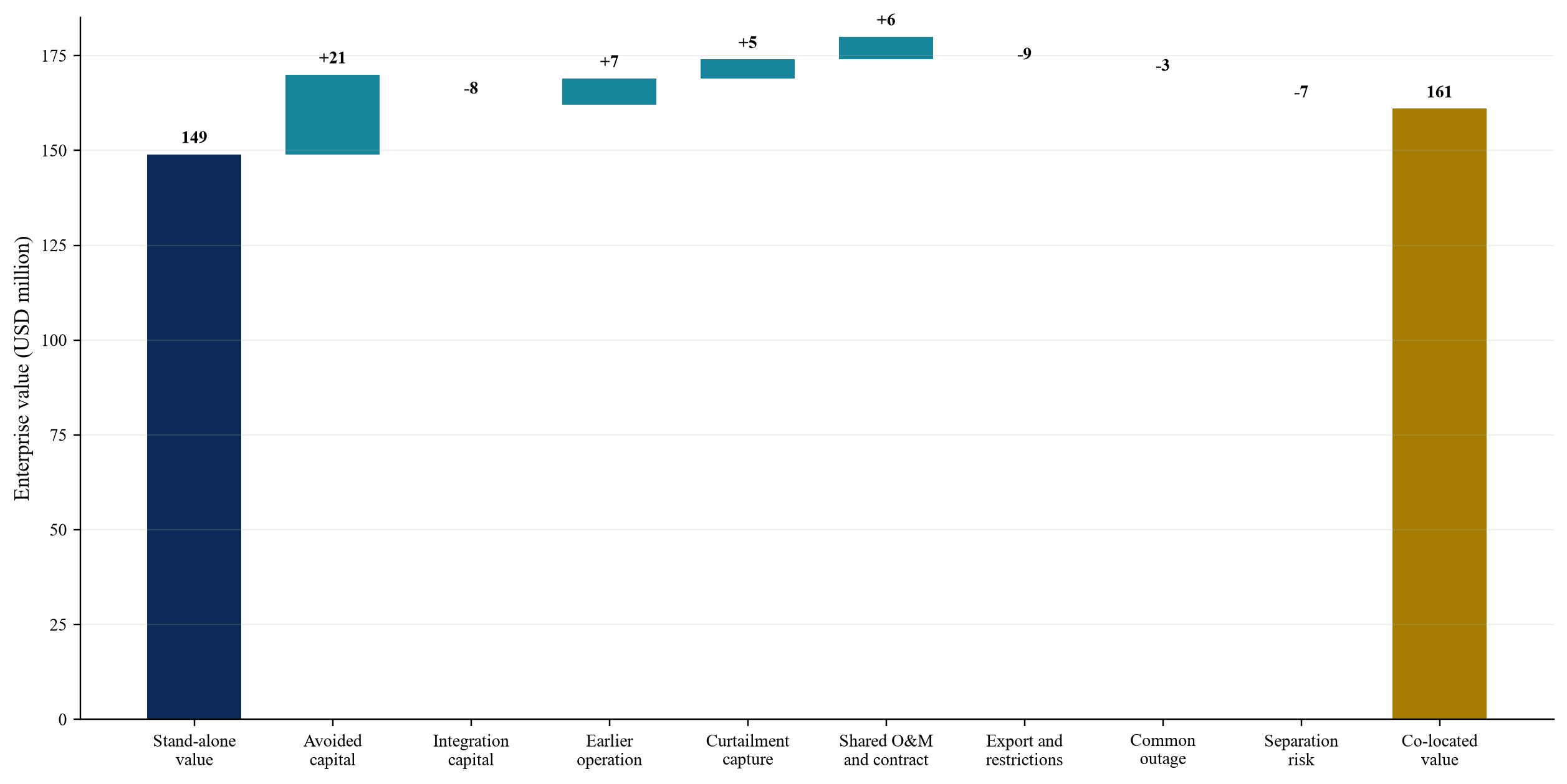
Hypothetical USD millions. Values illustrate configuration mechanics and are not forecasts or market quotes.
31. Stress the configuration premium
The co-location premium should be stressed separately from the underlying battery value. A change in market spreads can affect both configurations. A change in shared-export losses, renewable curtailment or connection schedule changes the relative value.
Useful sensitivities include connection reinforcement cost, commercial-operation delay, curtailment available for charging, merchant price compression, ancillary-service saturation, shared-export coincidence, degradation cost, augmentation price, tax-credit eligibility, contract price and terminal transferability. The model should show which variables change total storage value and which change the choice of configuration.
The investment committee should also see break-even points. It should know the maximum integration capital, minimum avoided connection cost, required curtailed energy and tolerable export displacement at which co-location remains superior. These thresholds support negotiation and site selection.
32. Use market evidence with configuration adjustments
Berkeley Lab reported 52 new U.S. PV-plus-battery hybrid plants with 5.3 GW of capacity entering service in 2023. Its queue data showed 571 GW, or 53 percent, of proposed solar capacity paired with storage at the end of 2023, with 98 percent in CAISO. The scale of the queue demonstrates developer interest and does not establish completion probability or transaction value.
Berkeley Lab's hybrid tracking also reports recent levelised storage adders in public PV-plus-storage PPAs of about USD 10,000/MW-month, USD 80/MWh stored or USD 35/MWh of PV under stated normalisations. These metrics provide contract context. They should be adjusted for storage ratio, duration, location, year, tax, equipment cost, contract structure and operating rights.
IRENA reports that installed utility-scale BESS cost fell 93 percent from 2010 to 2024, reaching USD 192/kWh in its dataset. It also reports increasing hybridisation. Falling equipment cost can reduce replacement value and increase competition. A project with scarce connection rights can retain value even as hardware becomes cheaper.
33. Use Australian hybrid registration as an operating example
Australia's Integrated Resource Provider framework allows storage and hybrid systems to register through a single category rather than separate generating and load categories. AEMO materials describe integrated treatment of energy flows and dispatch for storage and hybrids. This can reduce administrative fragmentation, while detailed registration, modelling and performance requirements remain.
AEMO's third-quarter 2025 connection snapshot reported 26.1 GW of battery projects in the connection process, up 79 percent over the year, with a substantial share of hybrid projects using grid-forming batteries. Pipeline scale can increase competition for connection, equipment and revenue. It also increases the importance of readiness and technical capability.
An Australian valuation should use National Electricity Market rules, local connection agreements, marginal loss factors, FCAS registration, dispatch conformance and state policy. The broader lesson is portable: market registration defines which physical capabilities can become cash flow.
34. Recognise portfolio and acquisition effects
A portfolio buyer may value co-located and stand-alone projects differently. Co-located assets can deepen relationships with renewable owners and create contracted expansion opportunities. Stand-alone sites can diversify technology and resource dependence and may be repositioned across services.
Portfolio value should reflect shared operators, optimisation, spares, financing and market access. It should also capture concentration by node, market, equipment supplier, offtaker and connection architecture. A portfolio of co-located assets can still carry common exposure if contracts and controls use the same design.
Acquisition diligence should reconcile the seller's model with metered operating data. It should test state-of-charge discipline, charging source, curtailment capture, lost renewable sales, ancillary-service performance, degradation, outages and settlement. Historical performance should be normalised for market and asset changes.
35. Build a configuration-specific data room
The data room should contain the executed connection offer and modifications, single-line diagrams, metering scheme, grid studies, land rights, permits, equipment contracts, EPC scope, warranties, dispatch and offtake agreements, market registrations, tax analysis, financing documents, insurance, operating data and model.
For co-located projects, it should also contain shared-facility, access, control, outage, cost-allocation and transfer agreements. The buyer should see the renewable plant's operating profile, curtailment, PPA and financing where they affect the battery. Confidential information can be managed through clean teams or summaries, while the relevant rights still need verification.
For stand-alone projects, the data room should establish independent site and connection control, import and export rights, market access and charging strategy. Development assumptions should be separated from executed rights.
36. Apply a financial-close scorecard
The scorecard should test the physical asset, commercial rights, financial model and exit path. Every material input needs an evidence owner, date and status. Exceptions should identify the value effect and the approval required.
Table 3. Configuration valuation and financial-close scorecard
| Gate | Required evidence | Approval question | Failure consequence |
|---|---|---|---|
| Unit of account | Ownership chart, asset register and shared-cost policy | Are value and cost allocated once? | Double-counted synergy or hidden subsidy |
| Connection | Executed offer, operating envelope and milestone schedule | Are import, export and timing bankable? | Revenue or schedule overstatement |
| Technical design | Single-line, coupling design, meters and controls | Can both assets operate as modelled? | Conversion, export or outage error |
| Revenue | Hourly dispatch, contracts, registrations and price cases | Is every revenue stream physically feasible? | Incompatible or duplicated revenues |
| Tax and attributes | Asset definition, basis allocation and compliance plan | Is the assumed benefit available and transferable? | Credit reduction, delay or recapture |
| Shared infrastructure | Access, capacity, cost, outage and step-in terms | Do rights survive default and transfer? | Impaired financing or exit value |
| Financing | Debt case, reserves, security and downside coverage | Can the structure withstand configuration risks? | Covenant pressure or refinancing gap |
| Exit | Consents, separation case and terminal assumptions | Can the asset be sold and operated independently? | Narrow buyer pool and value discount |
Complete with qualified technical, market, tax, legal and financing advisers for the specific project.
37. Use a six-gate decision process
First, define ownership and the unit of account. Second, prove connection rights and schedule. Third, validate the physical design, shared infrastructure, meters and controls. Fourth, run a common hourly market and dispatch model for both configurations. Fifth, allocate contracts, tax, financing and risk. Sixth, approve the valuation range, break-even thresholds and exit plan.
The process should be repeated at connection acceptance, design freeze, offtake execution, financial close, commissioning and acquisition. Material changes to grid rights, tax rules, dispatch, equipment or shared agreements can change the preferred configuration.
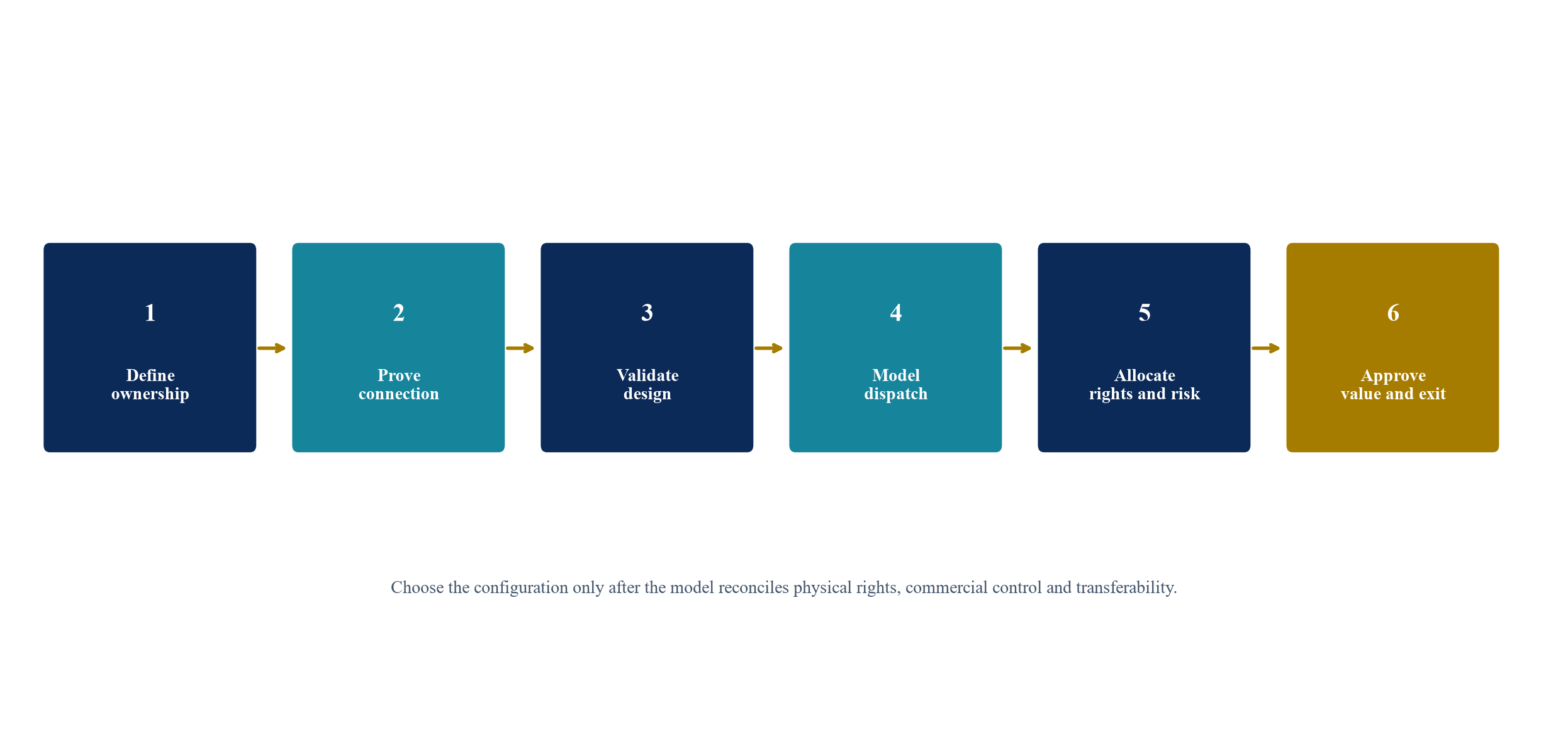
Governance sequence for development, financing, acquisition and portfolio review.
38. Recognise limitations and research needs
Public operating data for co-located storage remains limited. Projects differ in connection, duration, coupling, contracts, market rules, tax, age and dispatch. Reported pipeline capacity includes projects that may not reach operation. Transaction prices are often confidential and can bundle development rights, tax attributes and portfolios.
The hypothetical case in this paper demonstrates a valuation bridge. It does not estimate the value, cost, tax treatment or preferred configuration of a particular project. Legal, tax, engineering, market and financing conclusions require project-specific advice.
Further research should connect metered charging sources, curtailment, dispatch, degradation, outages and realised revenue at the project level. Standardised reporting of shared-connection constraints and hybrid operating rights would improve transaction comparability.
39. Conclusion
Co-located and stand-alone storage are different financial assets when their connection, charging, dispatch, contracts and control differ. Co-location can create value through connection reuse, schedule advantage, curtailed-energy capture, shared capital and a shaped product. It can lose value through shared export, common outages, operational restrictions and dependence on another asset.
The choice should begin with the unit of account and the complete connection rights. The model should then reconcile hourly dispatch, shared and incremental cost, tax basis, contracts, degradation, financing and exit. Every configuration premium should be traced to evidence and tested at a break-even threshold.
A controlled valuation bridge allows the investment committee to see why one site is worth more than two, or why independence deserves a premium. The answer will vary by node, project and contract. The discipline remains constant: value the rights the project can exercise, the constraints it must obey and the cash flows it can retain.
References
- Lawrence Berkeley National Laboratory, Utility-Scale Solar, 2024 Edition: Empirical Trends in Deployment, Technology, Cost, Performance, PPA Pricing, and Value in the United States, 2024. https://emp.lbl.gov/publications/utility-scale-solar-2024-edition
- Lawrence Berkeley National Laboratory, Hybrid Power Plants: Status of Operating and Proposed Plants, 2024 Edition, 2024. https://emp.lbl.gov/publications/hybrid-power-plants-status-2
- Lawrence Berkeley National Laboratory, Solar and Storage Operations, 2026. https://emp.lbl.gov/utility-scale-storage
- Lawrence Berkeley National Laboratory, Renewable-Battery Hybrid Power Plants in Congested Electricity Markets: Implications for Plant Configuration, 2024. https://energyanalysis.lbl.gov/publications/renewable-battery-hybrid-power
- Federal Energy Regulatory Commission staff, Hybrid Resources White Paper, Docket AD20-9-000, 2021. https://www.ferc.gov/sites/default/files/2021-05/white-paper-hybrid-resources.pdf
- U.S. Department of Energy, Solar Integration: Solar Energy and Storage Basics. https://www.energy.gov/cmei/systems/solar-integration-solar-energy-and-storage-basics
- U.S. Department of Energy, Solar-Plus-Storage 101. https://www.energy.gov/cmei/systems/articles/solar-plus-storage-101
- Internal Revenue Service, Clean Electricity Investment Credit, updated 2026. https://www.irs.gov/credits-deductions/clean-electricity-investment-credit
- Internal Revenue Service, T.D. 10024, Final Regulations for Sections 45Y and 48E, Internal Revenue Bulletin 2025-12, 2025. https://www.irs.gov/irb/2025-12_IRB
- Internal Revenue Service, Notice 2026-15 and related prohibited-foreign-entity guidance, 2026. https://www.irs.gov/newsroom/treasury-irs-provide-guidance-for-certain-energy-tax-credits-regarding-material-assistance-provided-by-prohibited-foreign-entities-under-the-one-big-beautiful-bill
- Ofgem, Guidance for generators: Co-location of electricity storage and hydrogen production under the RO, FIT, REGO and SEG, Version 6.2, 2025. https://www.ofgem.gov.uk/guidance/guidance-generators-co-location-electricity-storage-and-hydrogen-production-under-ro-fit-rego-and-seg-version-62
- UK Department for Energy Security and Net Zero and Ofgem, Connections Action Plan: Speeding up connections to the electricity network across Great Britain, 2023. https://www.gov.uk/government/publications/electricity-networks-connections-action-plan/connections-action-plan-speeding-up-connections-to-the-electricity-network-across-great-britain
- UK Department for Energy Security and Net Zero, Solar Roadmap: United Kingdom Powered by Solar, 2025. https://www.gov.uk/government/publications/solar-roadmap/solar-roadmap-united-kingdom-powered-by-solar-accessible-webpage
- UK Ministry of Housing, Communities and Local Government, Renewable and Low Carbon Energy Planning Practice Guidance, updated 2023. https://www.gov.uk/guidance/renewable-and-low-carbon-energy
- Australian Energy Market Operator, Integrating Energy Storage Systems, updated 2025. https://tech-specs.docs.public.aemo.com.au/Content/TSP_EMMS_June2024/Integrating_Energy_Storage.htm
- Australian Energy Market Operator, Quarterly Energy Dynamics Q3 2025, 2025. https://www.aemo.com.au/-/media/files/major-publications/qed/2025/qed-q3-2025.pdf
- International Energy Agency, Batteries and Secure Energy Transitions, 2024. https://www.iea.org/reports/batteries-and-secure-energy-transitions
- International Energy Agency, Electricity 2026: Flexibility, 2026. https://www.iea.org/reports/electricity-2026/flexibility
- International Renewable Energy Agency, Renewable Power Generation Costs in 2024, 2025. https://www.irena.org/Digital-Report/Renewable-Power-Generation-Costs-in-2024
- National Renewable Energy Laboratory, Annual Technology Baseline 2024: Utility-Scale Battery Storage, 2024. https://atb.nrel.gov/electricity/2024b/utility-scale_battery_storage
About the Author
Chennakeshav (CK) is a corporate finance and investment banking executive with 25+ years of global experience in deal origination, structuring and execution across M&A, growth capital and corporate strategy. He has led value-creation mandates for founders, corporates and funds — bridging the boardroom view to hands-on execution and close.
His career spans Morgan Stanley, HSBC, Lloyds Banking Group, EWEC, ADQ portfolio companies and Emirates Growth Fund, across TMT, real estate, fintech, deeptech, cleantech, infrastructure and energy. He has partnered with C-suite leaders, private equity and venture funds, sovereign wealth funds and family offices to finance complex fund raises and scale-up ventures, and has led M&A due diligence, post-merger integration and business-transformation initiatives to create value.
At Matchpoint Partners he is Managing Partner, leading the firm's corporate finance, M&A and capital-raising practice. He holds an MBA from London Business School, an engineering degree from VTU and a Master of Laws (LLM, in progress) from UCL London.
An active start-up mentor, CK mentors at Techstars, DIFC FinTech Hive, Startup Grind, Founder Institute and IN5, serves as Entrepreneur Mentor in Residence (EMiR) at London Business School, and judges the Entrepreneurship World Cup.
LinkedIn: https://www.linkedin.com/in/ckadya/
Profile: https://www.matchpoint-partners.com/team/ck-adya.html
