
1. Multi-day storage answers a system question
An iron-air project should begin with a power-system need that persists longer than conventional short-duration batteries can economically serve. The relevant event may be several days of weak wind and solar output, a prolonged fuel disruption, transmission congestion, extreme weather or the retirement of a dispatchable plant. Each event has a different frequency, shape and consequence.
The buyer should define the hours of dependable output, the power profile, the recharge window and the services required before selecting chemistry. A 100-hour label describes a possible discharge duration. It does not prove that the system needs 100 hours, that the project can deliver them under stressed conditions or that regulators and markets will pay for the resulting reliability.
Commercial readiness is therefore a combined assessment of need, technology, delivery, contracts and finance. Progress in one dimension cannot compensate for a failure in another.
2. Duration is only one performance dimension
Power rating determines the instantaneous contribution to the grid. Usable energy determines how long that contribution can continue. Response time, ramp rate, state-of-charge management, efficiency, availability and minimum operating limits determine how the asset behaves before, during and after a stress event.
A multi-day resource may discharge at rated power for part of an event, then follow a lower residual-load profile. It may also preserve energy for the most severe hours. The commercial model should use the expected dispatch shape rather than divide nameplate energy by power and treat the result as guaranteed service.
The acceptance test should establish usable energy at the delivery point, auxiliary consumption, power capability across state of charge and the conditions governing recharge. These boundaries belong in the contract and the operating model.
3. Iron-air uses a reversible oxidation cycle
Rechargeable iron-air systems use iron, water and oxygen in an electrochemical cycle. During discharge, iron is oxidised. Charging reverses the process and returns the active material toward metallic iron. Form Energy describes its commercial system as capable of storing and discharging energy for up to 100 hours.
The use of abundant active materials can reduce exposure to lithium, nickel and cobalt supply chains. The complete system still depends on manufactured electrodes, air systems, power electronics, controls, enclosures, construction materials and qualified production capacity. Material abundance should therefore be separated from equipment availability and factory execution.
The diligence team should request a bill-of-material risk map, manufacturing yields, qualified suppliers, lead times, substitution routes and quality-control evidence. These determine whether abundant inputs become dependable project equipment.
4. Public evidence shows an early commercial transition
DOE's Multiday Iron Air Demonstration programme describes two planned 10 MW, 100-hour systems with Xcel Energy at the Sherco and Comanche sites. DOE awarded more than USD 4.3 million for early project phases and identified a potential federal cost share of up to USD 70 million, subject to later negotiations and phase gates.
Xcel's 2024 Upper Midwest resource-plan filing described the Sherco pilot as a 10 MW, 1,000 MWh system and set out learning objectives covering renewable droughts, frequency and voltage support, congestion, emergency supply, curtailment, peak costs and emissions. These are credible development signals.
They also show why commercial readiness must be evidenced in stages. Public support, regulatory approval and announced scope establish project progress. They do not substitute for a sustained operating record at commercial scale.
5. Manufacturing scale is part of readiness
A storage technology cannot become a repeatable infrastructure asset without stable manufacturing, quality control, commissioning capacity and field support. Form Energy reports that its first high-volume facility in Weirton, West Virginia is producing systems and that deliveries have begun for a Minnesota pilot expected to come online in 2026.
Investors should verify line capacity, yield, rework, supplier qualification, labour availability, testing, product configuration control and the relationship between announced factory capacity and project commitments. A factory launch is an important milestone. The key credit question is whether it can deliver consistent equipment on schedule while retaining enough liquidity to honour warranties.
The project model should include manufacturing ramp contingency. Early units can require more inspection, commissioning time and field modification than mature products. Contract milestones should track completed, tested and accepted equipment rather than production announcements alone.
6. Commercial agreements require careful interpretation
Vendor announcements describe a growing portfolio of iron-air projects and capacity agreements, including utility projects, an Irish deployment and a large agreement associated with AI data centres. These announcements indicate market interest and customer engagement.
The term commercial project can cover a binding purchase contract, a capacity reservation, a development agreement, a memorandum, a regulatory proposal or a project subject to permits and financing. Each form provides different evidence of demand, backlog quality and expected cash conversion.
Diligence should classify every reference by contract status, cancellation rights, deposits, conditions precedent, delivery window, counterparty credit, regulatory approval and notice to proceed. Aggregate gigawatt-hour announcements should not be treated as firm revenue without that reconciliation.
7. The commercial-readiness test has five layers
The first layer is cell and module performance. The second is an integrated power block under relevant environmental conditions. The third is factory repeatability. The fourth is a grid-connected project with verified availability and dispatch. The fifth is a financeable product supported by contracts, service capability and durable counterparties.
Evidence should accumulate across layers. Laboratory cycle data supports electrochemical understanding. Factory tests support product consistency. Commissioning proves integration. Multi-season operation shows whether efficiency, availability and maintenance remain stable. Financing and insurance show how third parties price residual risk.
A readiness score should therefore use evidence quality and scale, not elapsed time or marketing labels. Missing evidence should create a condition, contingency or smaller first commitment.
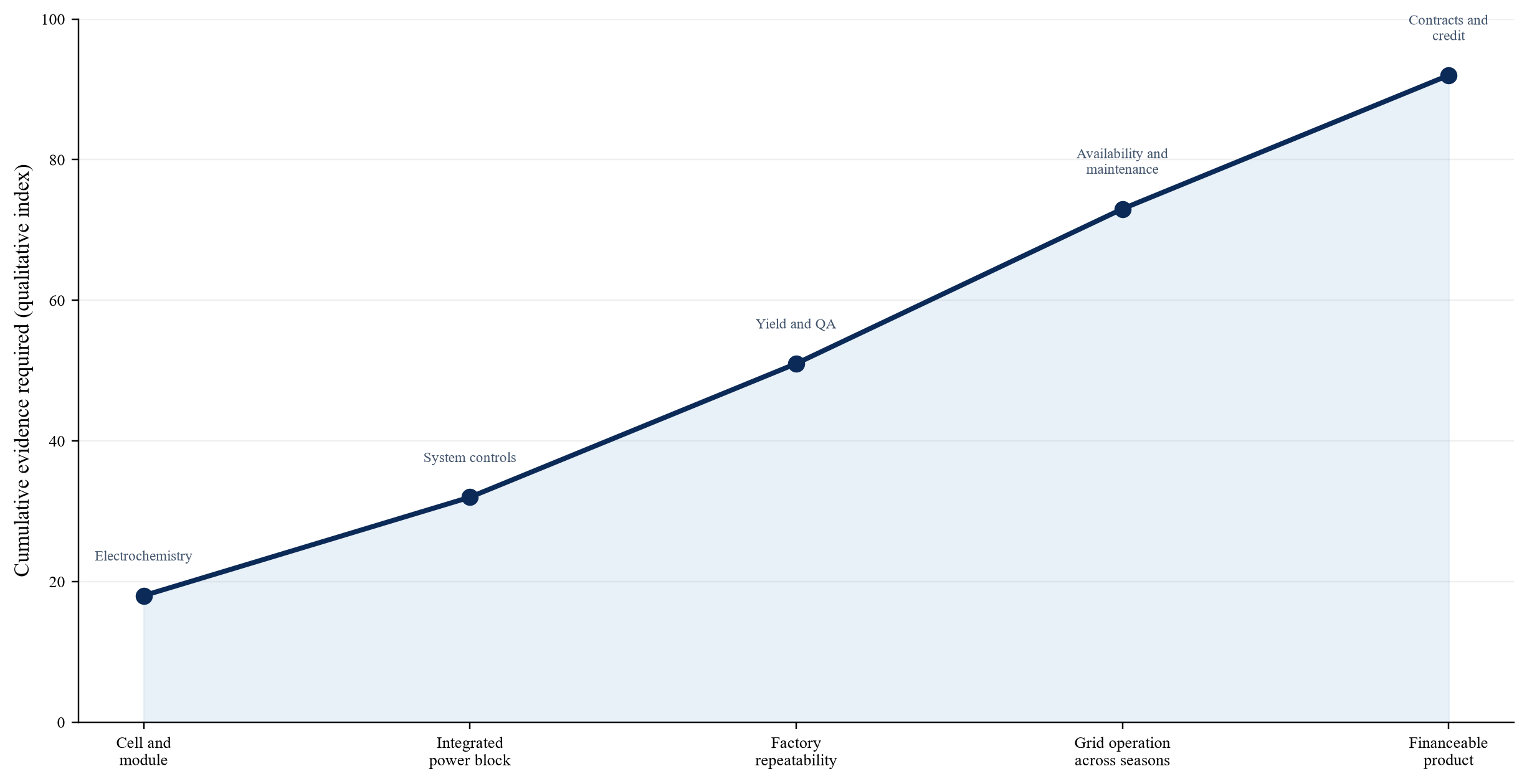
The curve is a qualitative framework. It does not score a specific vendor or project.
8. Technology readiness and commercial readiness differ
A technology can perform its intended electrochemical function while remaining difficult to finance. Project lenders require predictable construction, enforceable warranties, replacement pathways, operating procedures, insurance and revenues. Utilities require integration, dispatch and recovery behaviour that fits system operations.
Commercial readiness also depends on the buyer's procurement capability. An experienced utility can manage an emerging system through phased demonstrations and rate recovery. A merchant developer relying on volatile market revenue may need a stronger operating history and more credit support.
The investment committee should state which readiness threshold fits the owner, revenue model and loss tolerance. An innovation budget can accept more uncertainty than a highly leveraged availability contract.
9. Multi-year chronology is essential
Multi-day storage derives value from infrequent sequences that short sampling periods can miss. A model based on representative days or average renewable output can understate extended lulls, correlated weather and repeated stress before full recharge.
Form Energy's published modelling guidance recommends chronological analysis across all hours, multiple weather years and periods of real grid stress. This is consistent with the economic character of multi-day storage. The model should preserve correlations among load, wind, solar, temperature, fuel prices, outages and transmission limits.
The buyer should compare portfolios with and without iron-air storage under identical reliability criteria. It should record unserved energy, reserve shortfalls, curtailment, fuel use, starts, emissions and total system cost. The value is the avoided portfolio cost and risk, not the battery's standalone dispatch margin alone.
10. Capacity adequacy may be the principal value
Short-duration batteries can provide peak capacity when the system's risk window is brief. Their contribution can fall when risk extends beyond their stored energy or when several stressed hours occur before recharge. Multi-day storage can address longer energy-adequacy events.
Capacity accreditation rules vary by market and continue to evolve. FERC has highlighted the importance of methods that reflect the magnitude and duration of loss-of-load events. A project should not assume that nameplate power will receive full accredited capacity for its entire life.
The financial model should use current rules, test plausible reforms and separate accredited capacity from physical contribution. Regulatory counsel and the relevant system operator should confirm the treatment before debt sizing.
11. Energy arbitrage alone may understate and overstate value
Low-priced charging and high-priced discharge create arbitrage revenue. A 100-hour system may capture rare price events, reduce renewable curtailment and avoid fuel use during prolonged stress. Lower round-trip efficiency increases the charging energy required for each unit delivered.
An arbitrage-only model can understate capacity, resilience and avoided infrastructure value. It can overstate value if it assumes perfect foresight, unlimited charging, no grid constraints or frequent high-price events. The operating strategy may also reserve energy for reliability and forgo ordinary trading.
The project should use a revenue stack with explicit priority. Reliability obligations come first where contracted. Merchant opportunities should be constrained by state-of-charge policy, actual market rules and realistic forecast error.
12. Round-trip efficiency should be valued in context
Efficiency determines how much charging energy is lost before discharge. Its economic impact depends on charging price, congestion, curtailment, carbon intensity and the frequency of cycling. An emerging multi-day technology may accept lower efficiency in exchange for low energy-capacity cost and rare-event coverage.
The comparison should apply hourly prices and dispatch, not a single annual efficiency adjustment. Charging during otherwise curtailed renewable output may have low cash cost. The same energy can retain opportunity value if it could serve load, exports or another storage asset.
Efficiency guarantees should specify the measurement boundary, state of charge, ambient conditions, auxiliary loads and ageing. A project-level test is stronger than a cell-level figure.
13. Footprint has a financial value
Multi-day iron-air storage uses substantial physical space because energy density is not its principal design advantage. Xcel has described a 10 MW, 100-hour array as roughly football-field scale. Actual footprint depends on site design and configuration.
Former power-station sites can offer land, transmission, roads, workforce and existing permits. Constrained urban substations, ports or data-centre campuses can face a high opportunity cost for land. Civil works, drainage, foundations, access, setbacks and environmental conditions can materially affect capital cost.
The investment case should value land at its real alternative use. It should also account for expansion, construction logistics, maintenance access and any transmission benefit from reusing an existing interconnection.
14. Project life and component life must be separated
Battery cells, electrodes, air systems, inverters, controls, enclosures and auxiliary equipment can have different lives. Xcel's 2024 filing described an expected ten-year life for the Sherco pilot. A commercial financing case may require a longer economic horizon or an explicit replacement plan.
The owner should obtain a component-level maintenance and replacement schedule, including labour, spares, outage time and disposal. The model should distinguish warranted life, expected life and design life. It should identify which obligations survive a change in ownership or vendor distress.
Residual value should remain conservative until supported by a functioning secondary market, transferable warranties or enforceable repurchase terms.
15. Cycle count is not the only degradation measure
Multi-day systems may cycle less frequently than daily batteries. Calendar ageing, time at particular states of charge, depth of discharge, temperature, environmental exposure and component wear can therefore matter as much as headline cycle life.
The offered warranty should match the intended duty. A project reserved for rare adequacy events needs confidence that it will perform after long idle periods. A project used for regular curtailment absorption needs throughput and efficiency protection.
The owner should require diagnostic data, state-of-health methodology and periodic capacity tests. The commercial model should translate degradation into available energy, maintenance cost and replacement timing.
16. Reliability must cover the stress window
Annual availability can conceal failure during the hours that matter. A system can report high yearly availability while remaining unavailable during an extreme weather event because of a common-mode fault, maintenance backlog or depleted state of charge.
The contract should define event availability, forced-outage treatment, restoration time, partial capability and repeated-event performance. The operating plan should preserve charge before forecast stress and confirm the time needed to return to readiness after discharge.
Liquidated damages can support accountability. Their amount and security should reflect the consequence and the vendor's capacity. The utility may still require portfolio reserves because damages cannot restore lost power during an event.
17. Common-mode failure deserves explicit analysis
Modularity can limit the effect of a single module failure. Shared power conversion, controls, communication, auxiliaries, protection or site infrastructure can create common-mode exposure. Manufacturing defects can also affect many modules from the same production lot.
The project should complete a failure-modes and effects analysis covering electrical, mechanical, control, environmental and cyber risks. It should identify redundancy, isolation, spare parts, manual operation and restoration procedures.
Diversifying a portfolio across sites, technologies and production lots can improve resilience. The model should not treat 100 MW at one site as equivalent to several independent resources without testing the relevant failure correlations.
18. Safety evidence must fit the product and site
Iron-air systems are promoted as using abundant, non-flammable active materials. The complete installation still contains high-voltage equipment, stored energy, water systems, power electronics and industrial structures. Electrical faults, flooding, corrosion, mechanical damage and emergency access require design controls.
The buyer should request certification status, hazard analysis, test reports, emergency-response procedures and code review. The authority having jurisdiction, insurer and grid operator should be involved early because an unfamiliar technology can require additional evidence.
Safety claims should refer to the offered product and test boundary. A material-level characteristic cannot establish site-level risk on its own.
19. Environmental performance needs a lifecycle boundary
Abundant iron can reduce critical-mineral exposure. Lifecycle environmental performance also depends on manufacturing energy, steel and concrete, transport, land, charging losses, maintenance, replacement and end-of-life treatment.
The owner should request a product carbon footprint or lifecycle assessment with declared boundaries, data quality and allocation rules. It should distinguish verified third-party evidence from supplier estimates.
Carbon value in the financial model should follow the applicable market or corporate accounting rule. Avoided emissions depend on the marginal generation used for charging and displaced during discharge. A battery charged from a high-emissions source can produce a different result from one charged with otherwise curtailed renewable energy.
20. The comparator should be a portfolio
Iron-air storage competes with combinations of resources: lithium-ion batteries, pumped storage, thermal generation, demand response, transmission, renewable overbuild, hydrogen, flow batteries and other long-duration technologies. Each combination provides a different mix of response, duration, location and maturity.
A fair comparison holds the reliability target constant. It then identifies the least-cost portfolio that meets energy and power adequacy across the modelled years. The analysis should include construction lead time, fuel risk, emissions, land, network limits and technology concentration.
The result may favour a hybrid. A short-duration battery can handle fast and frequent dispatch while iron-air capacity remains available for multi-day events. Demand response and transmission can reduce the size of both.
Table 1. Commercial-readiness evidence for a multi-day iron-air project
| Readiness question | Minimum evidence | Stronger evidence | Investment response if missing |
|---|---|---|---|
| Cell and module performance | Independent or witnessed tests under relevant duty | Multi-season field data at representative scale | Limit initial commitment and require validation milestones |
| Integrated system performance | Factory and commissioning tests for power and usable energy | Repeated grid dispatch with verified availability | Hold acceptance payment and retain performance security |
| Manufacturing repeatability | Qualified process, quality plan and production schedule | Stable yield across multiple commercial batches | Add schedule contingency and factory audit rights |
| Lifecycle support | Maintenance plan, spares and warranty | Demonstrated service organisation and replacement history | Fund reserves and obtain step-in or escrow rights |
| Market value | Chronological portfolio model and current market rules | Regulator-approved cost recovery or contracted payment | Keep merchant upside outside base debt case |
| Project delivery | Site, permits, interconnection and integrated schedule | Completed comparable project and fixed interface matrix | Stage notice to proceed and retain completion support |
| Counterparty strength | Financial information and contractual obligations | Parent support, letter of credit or investment-grade owner | Reduce exposure, shorten tenor or add collateral |
The table defines evidence categories. It does not assess a named supplier or project.
21. Cost per kilowatt-hour can mislead
Energy-capacity cost is useful because long-duration technologies add many megawatt-hours. It does not capture power equipment, grid connection, land, charging losses, useful life, maintenance, availability, financing or the number of times the stored energy is used.
Levelized cost of storage provides a broader lifecycle measure. DOE uses LCOS in its storage assessments and set a Long Duration Storage Shot goal of USD 0.05 per kilowatt-hour for technologies delivering more than ten hours. The target is a policy and innovation objective, not proof that a specific project has reached it.
The investment committee should review total annualised portfolio cost, cost per dependable capacity unit and expected reliability benefit alongside LCOS.
22. First-of-a-kind cost needs transparent treatment
Early projects can carry engineering, tooling, commissioning, contingency and owner-learning costs that later deployments may avoid. Public grants can support demonstration and create valuable data. They can also obscure the unsubsidised cost of repeat deployment if the model treats every grant as recurring.
The project budget should separate product cost, site cost, development, grid connection, owner cost and first-of-a-kind work. It should identify which costs decline with repetition and which are site specific.
A learning-rate assumption should remain a scenario until supported by delivered projects and factory evidence. Debt sizing should use the contracted current project cost and funded contingency.
23. The hypothetical 100 MW portfolio case
The illustrative case considers a system facing rare multi-day adequacy events, renewable curtailment and retiring thermal capacity. The case compares a short-duration battery portfolio, a mixed portfolio with iron-air storage and a firm-generation case. All figures are hypothetical and do not represent vendor pricing, market forecasts or a specific utility.
The mixed portfolio includes 100 MW of iron-air capacity with 10,000 MWh of nominal energy, plus 100 MW of four-hour lithium-ion storage and demand response. The model reserves the multi-day resource for extended stress and uses the shorter battery for frequent peaks and ancillary services.
The case measures reliability, annualised cost, charging energy, land and construction risk. Its purpose is to show the questions an investment committee should ask.
Table 2. Hypothetical 100 MW multi-day storage portfolio case
| Input or outcome | Short-duration battery portfolio | Mixed portfolio with iron-air | Firm-generation portfolio |
|---|---|---|---|
| Principal resource | 400 MW / 1,600 MWh lithium-ion | 100 MW / 10,000 MWh iron-air plus 100 MW / 400 MWh lithium-ion | 140 MW dispatchable plant plus 100 MW / 400 MWh lithium-ion |
| Modelled annualised cost | USD 118 million | USD 104 million | USD 111 million |
| Modelled unserved energy in severe weather set | 28 GWh | 6 GWh | 9 GWh |
| Modelled renewable curtailment | 610 GWh | 390 GWh | 540 GWh |
| Charging or fuel exposure | High cycling and augmentation | Higher charging losses, lower fuel exposure | Fuel price and delivery exposure |
| Principal execution risk | Replacement and correlated duration limits | First-of-a-kind delivery and operating evidence | Permitting, fuel and emissions |
| Principal value driver | Frequent peak and ancillary services | Multi-day adequacy and curtailment absorption | Dispatchability and established operations |
Every number is an illustrative modelling assumption. The table is not a quotation, forecast or investment recommendation.
24. The hypothetical case requires discipline
The illustrative result favours the mixed portfolio under its selected stress events and assumptions. A different system can produce a different ranking. Lower renewable penetration, strong interconnection, cheap firm fuel or a shorter risk window can reduce the value of multi-day storage.
The model should disclose weather years, load growth, retirement schedule, outage assumptions, fuel prices, technology performance, construction dates and reliability criterion. It should run cases with delayed delivery and reduced availability.
Decision-makers should focus on the conditions that cause the ranking to change. A recommendation that depends on one unsupported assumption should remain conditional.
25. Value emerges non-linearly during long events
The first hours of storage can cover ordinary peaks. Additional hours may have little value until they cross a reliability threshold, such as the second night of weak renewable output. Value can then rise sharply because load shedding or emergency fuel is avoided.
This creates a duration curve with steps rather than a smooth line. The location of each step depends on the generation portfolio, transmission, demand flexibility and weather correlation.
Procurement should compare several power and duration combinations. Selecting 100 hours because the product offers 100 hours can overbuild energy. Selecting four hours because it is familiar can leave an adequacy gap.
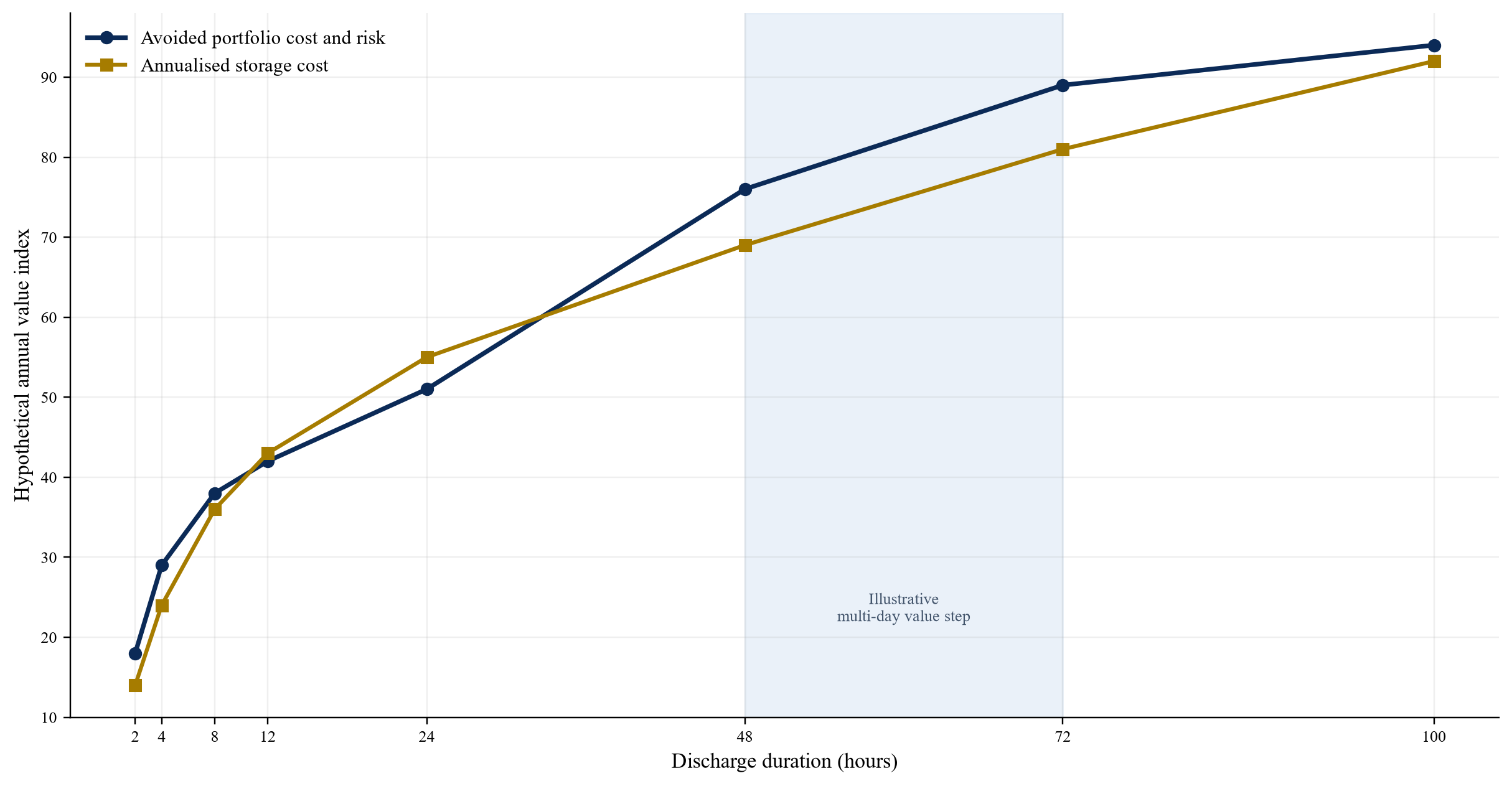
The values are illustrative and show non-linear portfolio value. They do not represent observed market prices.
26. Sensitivity should include delivery and performance
Traditional sensitivities vary capital cost, discount rate and energy price. An emerging storage case also needs schedule delay, lower usable energy, lower efficiency, extended commissioning, component replacement, service cost, warranty recovery and vendor distress.
The model should test partial capability. A project may deliver power while falling short on duration, or deliver energy while operating below availability. Each outcome affects capacity value and damages differently.
Combined downside cases are important because execution risks can correlate. A manufacturing delay can compress commissioning into adverse weather and increase financing cost. Conservative cases should remain plausible and traceable.
27. Revenue should match the service
A regulated utility can recover an approved investment through rates, subject to prudence and performance. A contracted project can receive an availability or capacity payment. A merchant project can earn energy, ancillary-service and capacity revenue where market rules permit.
Multi-day value may remain undercompensated where markets settle short intervals and capacity accreditation does not recognise energy adequacy. Policy interest does not create a bankable revenue line.
The base case should include only enforceable payments and current market access. Avoided system cost can support utility approval while remaining unavailable to a project-finance borrower. Merchant upside should be shown separately.
28. Contract design should follow technology maturity
A mature product can use standard supply, construction and warranty terms. An emerging product may require staged equipment orders, factory tests, pilot operation, extended commissioning, data rights and stronger security.
The owner should define performance guarantees for power, usable energy, efficiency, availability, response and environmental range. The contract should state test methods, cure periods, retest, damages, rejection and long-term service obligations.
The supplier should retain responsibility for outcomes it controls. The integrator should carry interface and completion risk. The owner should retain system dispatch and market risk unless another party accepts them explicitly.
29. Data rights are a financeability asset
Operating data supports warranty enforcement, maintenance, regulator reporting and future refinancing. The owner should receive raw and processed data for power, energy, state of charge, auxiliary load, alarms, availability, maintenance and component condition.
Access should survive termination or vendor distress. Proprietary algorithms can remain protected while the owner retains enough information to operate, diagnose and replace equipment.
Independent validation through a national laboratory, engineer or qualified consultant can improve confidence. DOE's MIND project identifies Argonne National Laboratory as a participant in technical and social-impact assessment, illustrating the role independent evidence can play during commercialisation.
30. The warranty is only as strong as its support
A long warranty has limited value if the issuer lacks capital, spares or service capability. The diligence team should review audited financial information where available, funding runway, manufacturing commitments, warranty reserves, parent structure and concentration risk.
Credit support can include parent guarantees, letters of credit, escrow, holdbacks, performance bonds or funded reserves. The appropriate instrument depends on the supplier, project size and remedy profile.
The owner should also seek documentation, software continuity, trained third-party service and rights to procure substitute components where practical. These controls protect availability when a contractual claim alone is insufficient.
31. Insurance is an evidence test
Insurers assess technology, construction, fire and machinery risk, delay, business interruption and operating history. Coverage terms, exclusions, deductibles and premium can reveal which risks the market remains unwilling to absorb.
The project should engage insurers before final design and contracting. Late review can create expensive requirements or leave critical exclusions unresolved.
Insurance does not transfer every performance risk. A policy may cover physical damage while excluding gradual degradation, design defects or lost market revenue. The financial model should use confirmed terms.
32. Financing should be staged
Corporate or utility balance-sheet capital is often the first source for an emerging technology. Project debt becomes more plausible as construction risk, operating evidence, contracted revenue and counterparty support improve.
A staged capital plan can fund development, then equipment, then construction, then operational refinancing. Each step should have measurable gates. Early public funding or strategic equity can absorb risks that senior debt cannot price.
Lenders should size debt to contracted cash and proven performance. They should maintain contingency, reserve accounts and covenants suited to remaining technology and lifecycle risk.
33. Regulatory approval should address learning value
A demonstration can create system knowledge even when its initial cost exceeds a mature alternative. Regulators can evaluate the scale, learning objectives, customer protections, reporting, cost-sharing and route to wider deployment.
DOE's MIND structure uses phases for planning, permitting, design and potential later construction funding. This approach limits irreversible commitment until evidence is produced.
A utility proposal should define what success means, how data will be shared, which costs are capped and what decision follows the demonstration. A pilot without a learning and replication plan can become an isolated asset.
34. Site selection can improve economics
Retiring power plants can provide transmission access, industrial land, roads, skilled labour and community-transition benefits. Brownfield conditions can also create demolition, contamination, geotechnical and interface risks.
The site screen should consider grid value, interconnection capacity, land, flood and weather exposure, construction access, water management, local permits, emergency response and community engagement. It should compare the cost of reusing infrastructure with a greenfield alternative.
The project should confirm that the stored-energy asset can obtain the intended interconnection rights after plant retirement. Existing wires do not automatically establish a transferable commercial position.
35. Interconnection and controls can constrain delivery
A storage plant needs protection, telemetry, metering, reactive power, fault response and dispatch communication that comply with the grid operator's requirements. Long duration does not reduce these obligations.
The integrated schedule should align equipment design, interconnection studies, network upgrades, permits, factory production and commissioning. Interface changes can create delay and rework.
The acceptance programme should include normal dispatch, state-of-charge estimation, partial availability, communication loss, protection events, restart and the transition into and out of extended discharge.
36. Operations should preserve rare-event readiness
An operator may be tempted to use stored energy for daily revenue and enter a stress event undercharged. A strict reserve can protect reliability while reducing ordinary earnings.
The operating protocol should specify minimum state of charge, weather triggers, charging priority, override authority and recovery after an event. Forecast error should be included in the reserve policy.
Performance reporting should distinguish technical availability from commercial readiness. A healthy battery at low state of charge cannot provide its contracted multi-day service.
37. Portfolio diversity improves the case
Multi-day iron-air storage can complement faster batteries, demand response, transmission and firm generation. Each resource covers a different part of the reliability distribution.
The utility should avoid assigning every service to the emerging asset. Frequent high-power cycling may be better handled by lithium-ion or another mature resource, leaving iron-air energy available for long events. This can also reduce uncertainty in degradation and maintenance.
Portfolio design should test common fuel, weather, site and technology risks. A diversified solution can carry a higher unit cost while producing lower system risk.
38. Procurement should retain competitive tension
A technology-neutral request for proposals can define multi-day adequacy, response, availability, evidence and lifecycle support. Vendors can propose iron-air, flow batteries, pumped storage, compressed air, thermal resources or portfolios.
Technology-specific procurement can be justified for a deliberate demonstration. It should state the learning objective and protect the owner against unsupported claims.
Bid evaluation should normalise scope, taxes, grid connection, land, charging energy, replacements, warranties, decommissioning and finance. An apparent low price often reflects excluded work or a different performance boundary.
39. Risk allocation should follow control
The supplier controls product design and manufacturing. The integrator controls interfaces and commissioning. The developer controls permits and site preparation. The owner controls dispatch and system planning. The grid operator controls interconnection and market rules under its authority.
Contracts should allocate risks to those parties and define relief for external events. A supplier should not guarantee merchant prices. An owner should not bear an undisclosed product shortfall.
Residual risk should appear in price, contingency, reserves, insurance, covenants or lower leverage. Hiding it in an aggressive base case weakens investment discipline.
Table 3. Project-risk allocation for early commercial iron-air storage
| Risk | Evidence before commitment | Party positioned to control it | Commercial protection | Ongoing monitor |
|---|---|---|---|---|
| Product performance | Witnessed tests and reference data | Technology supplier | Power, energy, efficiency and availability guarantees | State of health and event availability |
| Manufacturing delivery | Factory schedule, suppliers and quality plan | Technology supplier | Milestones, holdback and delay support | Yield, completed units and test pass rate |
| Integration and completion | Interface matrix and commissioning plan | EPC contractor or integrator | Single-point completion responsibility | Interface register and test status |
| Site and permits | Surveys, environmental work and approvals | Developer and owner | Conditions precedent and contingency | Permit, access and civil progress |
| Grid and market treatment | Interconnection and current rules | Owner and grid operator | Approval conditions and change-in-law allocation | Accreditation and market access |
| Lifecycle service | Maintenance, spares and component plan | Supplier and operator | Service agreement, reserve and step-in rights | Maintenance, spares and forced outage |
| Supplier credit | Financial and ownership diligence | Supplier and sponsor | Parent support, letter of credit or escrow | Liquidity and warranty capacity |
| Dispatch and revenue | Operating protocol and contract | Owner or offtaker | Availability payment and reserve policy | State of charge and realised revenue |
Final allocation depends on project contracts, counterparties and applicable law.
40. Decision gates preserve option value
The first gate confirms the system need. The second confirms modelling value under multiple weather years. The third confirms product and manufacturing evidence. The fourth confirms site, grid and permits. The fifth confirms contracts, credit and financing. The sixth confirms factory and field acceptance. The seventh confirms operating performance before replication.
Each gate should identify required evidence, decision owner, deadline and financial exposure. Conditional approval should remain visible to the investment committee.
Staging preserves the ability to stop, resize or redesign a project when evidence changes. It also rewards a supplier for converting claims into verified performance.
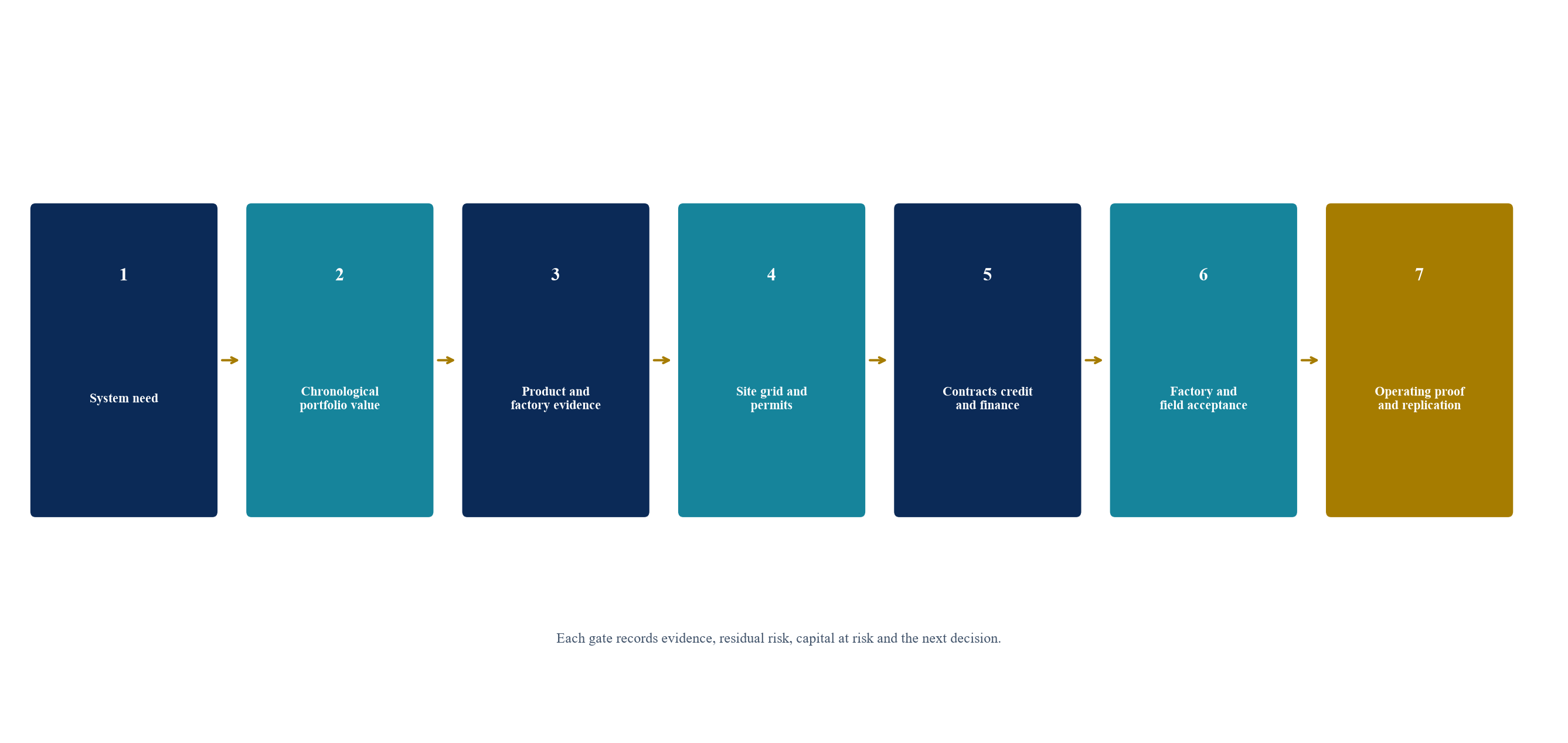
Capital advances as system need, evidence, delivery and operating performance are confirmed.
41. The first hundred days should reduce uncertainty
The project team should define the reliability event, collect chronological load and resource data, confirm market and capacity rules, and build the common portfolio model. It should complete an evidence request covering product tests, manufacturing, references, lifecycle support and supplier credit.
In parallel, the team should screen sites, start interconnection and permit work, engage regulators and insurers, and draft the performance and data requirements. A reference visit should include operators and maintenance personnel, not only commercial teams.
The first hundred days should end with a gated recommendation: proceed, run a smaller demonstration, negotiate conditions, compare alternatives or stop.
42. Replication should follow operating evidence
A successful commissioning test establishes initial capability. Replication should also consider availability, efficiency, maintenance and dispatch across seasons. The owner should compare actual results with the investment model and disclose variance.
Standardisation can reduce engineering cost and strengthen purchasing power. Each site still requires local grid, land, weather and permitting analysis.
A portfolio rollout should preserve competition and avoid concentration in a single unproven interface. Later projects can use data from earlier ones to refine warranties, reserves and operating rules.
43. International deployment requires local analysis
Iron-air's active-material logic is globally relevant. Project economics depend on local resource shape, fuel imports, grid rules, land, construction cost, financing, currency, tax and market design.
Form Energy and FuturEnergy Ireland announced an Irish project targeted for 2029. The announcement is evidence of international commercial engagement. Actual project status, permits, financing and operating results should be verified before using it as a reference.
Buyers in other jurisdictions should reproduce the system-need and portfolio analysis with local data. A United States grant, tax credit or capacity rule should not be carried into another market without a legal and financial basis.
44. Limits and further research
Public sources establish policy objectives, announced projects, utility plans and company claims. They cannot establish the delivered cost, long-term performance or bankability of a specific system. Confidential contracts, factory data, test results and operating records are required for a transaction decision.
The hypothetical portfolio case illustrates method only. Further research should compare realised iron-air efficiency, availability, component life and maintenance across seasons; evaluate capacity accreditation during multi-day risk; and examine how market design compensates energy adequacy.
Engineering, safety, environmental, legal, tax, accounting and regulatory conclusions require qualified advisers in the relevant jurisdiction.
45. Investment-committee questions
The committee should ask whether a verified multi-day adequacy need exists, whether iron-air storage reduces portfolio cost and risk across multiple weather years, and which assumptions determine the result. It should ask what commercial-scale operating evidence exists and what remains to be demonstrated.
It should review factory delivery, site readiness, grid approval, performance guarantees, data rights, supplier credit, insurance, revenue and downside funding. Every missing item should have an owner, deadline and consequence.
The final decision should specify the capital released now, the evidence required for the next release and the circumstances that trigger redesign or termination.
46. Conclusion
Iron-air storage has moved into early commercial deployment through announced projects, manufacturing investment, utility planning and government-supported demonstrations. Its multi-day duration can address a reliability problem that short-duration batteries do not always solve.
Commercial readiness depends on more than chemistry and energy-capacity cost. Utilities and investors need verified integrated performance, repeatable manufacturing, lifecycle support, suitable sites, bankable contracts and a revenue or cost-recovery route. Chronological portfolio modelling should establish whether the system needs the service.
A staged programme can convert uncertainty into evidence while limiting capital at risk. The strongest investment case procures dependable multi-day adequacy, assigns frequent services to complementary assets and advances only when each readiness gate is satisfied.
References
- United States Department of Energy, Storage Innovations 2030, accessed September 2026. https://www.energy.gov/oe/storage-innovations-2030
- United States Department of Energy, Energy Storage Grand Challenge Roadmap, December 2020. https://www.energy.gov/energy-storage-grand-challenge/articles/energy-storage-grand-challenge-roadmap
- United States Department of Energy, 2022 Grid Energy Storage Technology Cost and Performance Assessment. https://www.energy.gov/cmei/2022-grid-energy-storage-technology-cost-and-performance-assessment
- United States Department of Energy, Achieving the Promise of Low-Cost Long Duration Energy Storage, August 2024. https://www.energy.gov/sites/default/files/2024-08/Achieving%20the%20Promise%20of%20Low-Cost%20Long%20Duration%20Energy%20Storage_FINAL_08052024.pdf
- United States Department of Energy Office of Clean Energy Demonstrations, Long-Duration Energy Storage Demonstrations Program: Multiday Iron Air Demonstration, June 2024. https://www.energy.gov/sites/default/files/2024-06/FactSheet_LDESAward_Xcel_6.5.24_v3.pdf
- United States Department of Energy, CX-033539: Multiday Iron-Air Demonstration Project, October 2024. https://www.energy.gov/nepa/articles/cx-033539-multiday-iron-air-demonstration-mind-project
- Federal Energy Regulatory Commission, Joint Concurrence Regarding SPP Capacity Accreditation Proposals, July 2025. https://www.ferc.gov/news-events/news/commissioner-rosners-and-commissioner-changs-joint-concurrence-regarding-spps
- Xcel Energy, 2024 to 2040 Upper Midwest Integrated Resource Plan, Appendix X: Advanced Technologies, February 2024. https://www.xcelenergy.com/staticfiles/xe-responsive/Company/Rates%20%26%20Regulations/Resource%20Plans/03%202024%20to%202040%20Upper%20Midwest%20IRP%20Appendices%20N1%20thru%20Z.pdf
- Xcel Energy, Energy 101: How Energy Storage Makes Renewable Energy More Reliable, accessed September 2026. https://stories.xcelenergy.com/stories/Energy-101--How-energy-storage-makes-renewable-energy-more-reliable-
- International Energy Agency, Batteries and Secure Energy Transitions, April 2024. https://www.iea.org/reports/batteries-and-secure-energy-transitions
- International Energy Agency, Policy Implications and Recommendations: Batteries and Secure Energy Transitions, April 2024. https://www.iea.org/reports/batteries-and-secure-energy-transitions/policy-implications-and-recommendations
- Form Energy, Battery Technology, accessed September 2026. https://formenergy.com/technology/battery-technology/
- Form Energy, Navigating the Pacific Northwest's Energy Challenges, June 2024. https://formenergy.com/wp-content/uploads/2025/01/Navigating-the-Pacific-Northwests-Energy-Challenges.pdf
- Form Energy, Form Energy and FuturEnergy Ireland Announce Agreement to Deploy First Iron-Air Battery Storage Project in Ireland, March 2026. https://formenergy.com/form-energy-and-futurenergy-ireland-announce-agreement-to-deploy-first-iron-air-battery-storage-project-in-ireland/
- Form Energy, Form Energy and Crusoe Announce Agreement for 12 Gigawatt-Hours of Iron-Air Batteries for AI Data Centers, March 2026. https://formenergy.com/form-energy-crusoe-announce-agreement-for-12-gigawatt-hours-of-iron-air-batteries-for-ai-data-centers/
- Form Energy, Form Energy Collaborating with Leading Georgia Electric Utility on Multi-Day Energy Storage Solution, February 2022. https://formenergy.com/form-energy-collaborating-with-leading-georgia-electric-utility/
About the Author
Chennakeshav (CK) is a corporate finance and investment banking executive with 25+ years of global experience in deal origination, structuring and execution across M&A, growth capital and corporate strategy. He has led value-creation mandates for founders, corporates and funds — bridging the boardroom view to hands-on execution and close.
His career spans Morgan Stanley, HSBC, Lloyds Banking Group, EWEC, ADQ portfolio companies and Emirates Growth Fund, across TMT, real estate, fintech, deeptech, cleantech, infrastructure and energy. He has partnered with C-suite leaders, private equity and venture funds, sovereign wealth funds and family offices to finance complex fund raises and scale-up ventures, and has led M&A due diligence, post-merger integration and business-transformation initiatives to create value.
At Matchpoint Partners he is Managing Partner, leading the firm's corporate finance, M&A and capital-raising practice. He holds an MBA from London Business School, an engineering degree from VTU and a Master of Laws (LLM, in progress) from UCL London.
An active start-up mentor, CK mentors at Techstars, DIFC FinTech Hive, Startup Grind, Founder Institute and IN5, serves as Entrepreneur Mentor in Residence (EMiR) at London Business School, and judges the Entrepreneurship World Cup.
LinkedIn: https://www.linkedin.com/in/ckadya/
Profile: https://www.matchpoint-partners.com/team/ck-adya.html
