

1 Define the decision before collecting documents
The decision considered here is whether a development has sufficient evidenced funding to support a proposed construction borrowing and the next advance. A lender and a developer may agree on the attraction of the completed asset while remaining far apart on the evidence needed today. Title, design, construction progress, sales, existing borrowings and sponsor resources sit in different records, prepared at different dates. A reliable decision requires a reconciled project perimeter and an explicit account of how the remaining work will be paid for. The finished asset's expected value alone supplies an incomplete answer to that question.
This paper proposes a completion-evidence protocol for that decision. It begins with the entity and approved scope, establishes remaining uses, identifies legally usable funding, applies the actual facility limits and tests the timing of payments. Each step produces a dated finding and names the document supporting it. The same protocol can inform an initial term sheet, a delayed draw request or a refinancing discussion, with the relevant transaction documents determining its application. The protocol is an author-developed analytical tool. Its suitability for a particular project requires review by the lender and the appointed professional advisers.
Three distinctions organise the analysis. Physical work completed, money already spent and money still required are separate measures. Contracted sales, buyer receipts and permitted escrow releases are separate measures. A sponsor's stated resources, a binding obligation and cash delivered to the project are separate measures. The purpose of keeping these distinctions visible is to produce a decision that can be audited and updated when circumstances change. A board should be able to identify the evidence behind every funding amount, the date that evidence expires and the consequence if a condition remains unmet. That discipline also makes the remaining negotiation specific: amount, date, permitted purpose, obligation and responsible counterparty.
2 Establish the evidence and research boundary
The regulatory sources have jurisdiction-specific functions. Dubai Land Department publishes conditions for registering projects and depositing mortgage finance into escrow [1,2]. Abu Dhabi Real Estate Centre describes its project-development and escrow sequence [3]. Saudi Arabia's Real Estate General Authority publishes the active off-plan law and implementing regulations [4,5]. Bahrain's official real-estate law and regulator's escrow operating guidelines provide a further comparison [6,7]. These materials establish distinct procedural boundaries. They supply no common GCC construction-loan advance percentage. Their application depends on the location, project type, legal instruments, relevant amendments and competent authority.
The methodological sources serve different purposes. RICS provides development-property valuation guidance, including the relationship between project assumptions and appraisal [8,9]. IFC identifies information required in a financing proposal [10]. World Bank project-finance guidance discusses contractual lender protections and sponsor-support instruments [11]. IFC's 1999 publication distinguishes forms of completion and describes financing and overrun arrangements [12]. Its historical publication date limits its use here to concepts. The paper supplies neither an updated empirical lender survey nor a systematic claim of academic novelty. All numerical examples are wholly fictional and designed to expose the mechanics of the proposed protocol.
The specific research question is how construction evidence, cash collection and sponsor support translate into drawable funding at a given date. An empirical answer would require approved facility limits, dated draw requests, documentary conditions, project costs and outcomes across a consented sample. Such data were unavailable for this paper. The method therefore separates published rules, contract-specific inputs and author-developed scenario calculations. It develops a transparent structure for future measurement and present transaction analysis. It also separates its subject from capital-layer selection: choosing senior debt, mezzanine or equity concerns contractual economics and priority; the present test concerns whether the selected funding can actually reach the project when required.
3 Define the project perimeter and valuation date
Before computing availability, record the legal borrower, landowner, developer, project registration, escrow account and entities giving support. Identify whether the proposed facility finances one phase, several phases or a wider development business. A completed tower, a shared infrastructure package and an unstarted phase can have different permits, cash pools and lender claims. The model should state which obligations are included and which depend on another entity. A consolidated sponsor presentation requires a project-level bridge before its totals can support a draw decision. In particular, cash in an adjacent project needs an evidenced transfer right before inclusion.
Fix a single assessment date. The technical report, contractor claims, sales ledger, escrow balance, debt balance and sponsor evidence may each refer to different cut-offs. Create a bridge for movements between those dates: certified invoices paid, new variations approved, deposits received, drawdowns made and distributions permitted. Identify outstanding amounts that have been earned or claimed but remain absent from the general ledger. The proposed protocol records provisional items separately until reconciled. This avoids treating a later bank statement as though it belonged to an earlier cost estimate, or comparing current debt with an obsolete valuation.
The date also governs the meaning of completion. Define the scope required for lawful occupation, handover, operational use and the agreed financing milestone. Practical completion under a construction contract can differ from the final authority certificate, utility connection, buyer handover or a financing completion test. IFC's historical discussion separates physical, technical and financial completion [12]. The project documents should identify the actual milestone and any continuing obligation after it. A cost forecast that ends at shell completion cannot fund an obligation extending through fit-out or defects retention. The investment committee should approve the defined perimeter and end point before accepting a headline cost-to-complete figure.
4 Separate the four approval gates
The protocol distinguishes four gates: the regulatory route for project cash, technical evidence of work and remaining scope, credit approval under the facility, and lawful payment to the intended recipient. A consultant certificate supports a technical conclusion within its stated scope. An escrow trustee or authority may require additional documentation before cash leaves a restricted account. The lender can impose facility conditions and security requirements. The borrower must then execute a permitted payment. Each gate has a different decision maker. An internal dashboard should show them separately, even if the operational workflow gathers their documents in one submission.
Dubai's project-registration service describes an escrow-opening process and required project documents. It lists final building approvals, approved plans and specified developer and land evidence. The service describes alternatives involving 30 percent construction completion, a construction-cost bank guarantee or a cash deposit [1]. Those published alternatives concern that registration service. A financing model should avoid converting them into a generic senior advance rate or a universal equity requirement. The actual registration, escrow and financing conditions need to be confirmed for the project and its assessment date.
For each gate, state the consequence of an unresolved issue. A missing technical update may require a new inspection. An escrow restriction may mean cash remains unavailable for the intended use. A security defect may delay a facility advance despite acceptable construction progress. A disputed invoice may remain outside the eligible works claim. Some issues affect one payment; others affect the project's whole funding plan. Categorising consequences prevents a long document checklist from concealing the substantive shortfall. The proposed register should show the required action, accountable person, deadline and whether the amount is excluded, conditionally included or fully evidenced in the current calculation.
Table 1. A completion-evidence and bankability checklist
| Test | Evidence to reconcile | Model treatment while unresolved |
|---|---|---|
| Approved scope | Title, registration, permits, drawings and completion milestone | Separate unapproved or excluded works |
| Remaining uses | Independent cost forecast, variations, claims, fees and delay costs | Retain a clearly identified provisional allowance |
| Restricted receipts | Escrow statement, trustee conditions and permitted release | Count only dated, permitted funding |
| Loan availability | Facility limits, draw conditions, security and certified eligibility | Show conditional capacity separately from cash |
| Sponsor support | Signed obligation, available resources and delivery date | Exclude unsupported or late promises |
| Completion cure | Executable additional cash, consent and revised uses | Keep a draw hold where the contract requires it |
Author-developed decision checklist. Required documents and consequences depend on the actual project, jurisdiction and financing terms.
5 Make the cost-to-complete auditable
Construct a remaining-uses ledger from the approved scope and the work still outstanding at the assessment date. The proposed categories include unperformed contracted works, certified unpaid amounts, documented variations, provisional or disputed claims, professional fees, utility and authority charges, financing costs and reserves required by the actual documents. State whether tax and any recoverable amounts are shown gross or net. Explain the treatment of retention and obligations extending beyond handover. Total incurred cost and the contractor's remaining contract balance provide inputs; neither alone necessarily captures all remaining project obligations.
Use a reconciliation that connects the technical forecast to contracts and accounting. Begin with the latest approved budget, add authorised changes, record outstanding claims separately and subtract amounts actually paid. Explain departures between the consultant's forecast, the developer's forecast and the financing model. Some differences concern scope; others concern prices, quantities, contingencies or timing. An adviser should identify the origin of each difference before aggregating it into one number. A lender can then decide which forecast and reserve assumptions it accepts. The protocol calls for a documented decision instead of silently choosing the most favourable figure.
A cost estimate should also identify the confidence attached to its inputs. A signed fixed-price item, an unawarded package and a disputed variation require different evidence. For an unawarded package, state the quotation date, procurement status and allowance. For a dispute, state the assumed cash treatment and the downside if payment becomes due earlier or at a higher amount. The paper's fictional stress uses an explicit aggregate increase for simplicity. A live analysis should build that increase from project evidence and expert assessment. The ledger should preserve its version history so the board can distinguish a genuine reduction in remaining work from an unexplained change in the forecast.
6 Measure progress without confusing it with cash
Construction progress can be expressed through quantities, work packages, certified value or milestones. Record the definition before using a percentage. A weighted completion measure may differ from the share of the budget spent, particularly when land, mobilisation, equipment deposits or front-loaded packages are material. The proposed protocol links progress to outstanding scope and cash requirements. A project described as largely complete can still face an expensive final package or a utility dependency. That possibility should be tested from the actual schedule and procurement evidence, without assigning a universal relationship between percentage completion and remaining cost.
Review the independence, scope and age of technical evidence. Identify who appointed the reviewer, the site inspected, information relied upon, exclusions and discrepancies. A report should distinguish observed work from certificates or contractor representations accepted without further testing. Document material changes since the inspection, including design changes, contractor disruption and unpaid supplier claims. For the model, a dated report establishes a bounded evidence point. The relevant facility or authority decides whether that report is acceptable and current enough for the requested action. The paper makes no common regional assertion about report validity.
Abu Dhabi Real Estate Centre's project-development overview describes registration and a licensed escrow arrangement before off-plan marketing or sales, milestone-based releases, certified progress reporting and completion certification after inspections [3]. These steps demonstrate the importance of linking the project's evidence to its local process. The financing analysis must also test packages that construction photographs cannot establish: unpaid obligations, latent scope gaps, connection agreements and the remaining programme. The proposed bankability pack should include a works-completed reconciliation, a dated forecast to the defined completion milestone and a schedule of unresolved dependencies. Each dependency needs an owner and an expected resolution date before its funding consequences can be assessed.
7 Convert presales into dated usable funding
Presale analysis begins with a bridge from unit contracts to cash. Record contracted consideration, buyer deposits actually received, future instalments, cancellations, refunds, disputes and collection dates. Distinguish gross bookings from binding contracts and identify payment triggers tied to progress or handover. The model should connect each expected receipt to the project account that receives it. A cancellation assumption affects future receipts differently from a permitted refund of cash already held. Both require a dated cash entry. Any aggregate collection ratio should be traceable to contract-level assumptions and the treatment of overdue amounts.
Next apply the applicable escrow and release conditions. The fictional stress case later uses AED 40 million of bookings, AED 10 million of received buyer cash and AED 5 million of cash usable for future project uses. That final AED 5 million is the same escrow entry used in the stress funding ledger and is counted once. It is assumed unspent and available for the specified future uses. The other amounts remain visible as commercial and collection measures. A live project may produce a different bridge, with documentary limits and timing supplied by its actual regime and trustee agreement. The model should identify the source of each release assumption and state whether approval has been obtained or remains outstanding.
Presales can affect a lender's sales-risk assessment even when they provide no immediately drawable cash. That is a separate channel requiring actual facility terms or a documented credit decision. A contractual presale condition may specify eligible units, buyer deposits, cancellation rights or a minimum contracted amount. Record the definition and test it directly. Avoid using the same sales evidence twice as both assured loan support and unrestricted cash without checking its meaning. The proposed protocol keeps three ledgers connected but distinct: sales qualification, buyer collection and permitted project release. This gives a lender a clear account of how a change in sales affects the next draw, future completion funding and repayment at exit.
8 Apply the Dubai mortgage-and-escrow boundary
Dubai Land Department's mortgage-deposit service describes an application for financing to enter a project escrow account for completion. Its published documents include the financing agreement and a bank undertaking relating to deposit and unit registration. The service identifies active-project status, a recent technical report, completion undertakings and other conditions [2]. These requirements belong to the specific service route. Their presence supports an evidence-led completion analysis; it supplies no automatic permission for every project draw, debt repayment or distribution. A transaction team should confirm which service and conditions apply before scheduling the funding.
The same page describes separate conditions for financing-instalment settlement, including evidence of funding for remaining completion obligations and a stated completion-escrow amount [2]. The proposed model therefore distinguishes money entering escrow, permitted construction payments and repayment of financing from escrow. Each movement needs its own purpose, authority and document. A single forecast line labelled escrow cash conceals these differences. The board's cash report should show the opening restricted balance, receipts, approved releases, amounts retained and closing balance. It should also show the specific creditor or supplier paid by each permitted release.
Keep the regulatory review separate from the facility interpretation. A bank may accept a borrower economically while still requiring a deposit undertaking or authority consent. Equally, project registration establishes neither the facility amount nor the lender's acceptance of every model assumption. The team's completion pack should reconcile the competent authority's requirements with the financing conditions, identifying any different milestones or reserves. Obtain transaction-specific confirmation for ambiguous movements rather than treating an analyst's reading as approval. This paper's Dubai discussion is a bounded interpretation of published service information, accessed in October 2026. Legal advice and direct confirmation remain necessary for a proposed transaction or a change in the applicable rules.
9 Use the Saudi project and release sequence
Saudi Arabia's active off-plan law requires developer registration and project licensing. Its licensing provisions cover building approval, title, designs, consultant and accountant arrangements, feasibility information and an escrow-opening agreement. The law provides for separate project escrow and payment instructions involving the developer, consultant and certified public accountant [4]. The implementing regulations describe withdrawal requests, reporting and approved financial information supporting excess withdrawals [5]. These provisions create an identifiable evidence sequence. The analyst should map the actual project documents and approvals to that sequence before assigning cash availability.
The law also addresses completion-linked retention and a guarantee alternative, while the regulations address defect-related restrictions and qualifying hidden-defect cover [4,5]. The financing model should preserve the relevant retained amount as restricted until the applicable release is established. Construction progress and a completion certificate can change a cash restriction at different stages. The model requires the current project-specific position rather than assuming all retained balances become available on physical completion. The financing agreement may have its own reserves and tests that require separate treatment.
For a Saudi transaction, the proposed completion register names the document supporting each material funding event: project licence, progress report, withdrawal request, approved payment and release of retained funds. The register should also identify changes to scope, programme or quality that require escalation. Contractual milestones in a loan or construction agreement need to be aligned with regulatory reporting without merging their purposes. A lender reviewing a multi-country developer should receive a separate project-level schedule for each regime. The protocol makes comparison possible by using consistent financial categories, while preserving different legal conditions within those categories. Any common group funding or guarantee should be assessed under its actual legal and contractual structure before the cash is allocated among projects.
10 Keep Bahrain's conditions and document age visible
Bahrain's real-estate law requires licensing and registration of off-plan projects and provides for project escrow. Its financing provisions require mortgage financing proceeds to enter escrow and address completion-linked retention. The official page identifies the Arabic Official Gazette text as authoritative [6]. RERA's published operating guidance describes consultant progress certificates, instructions supporting payments, construction-finance deposits and conditions for financing repayment [7]. These sources support a distinct Bahrain evidence map. They should be applied with the current governing law, authority position and actual project arrangements.
The operating-guidelines PDF is undated and references earlier legislation and resolutions. This paper cannot establish that the downloadable guidance incorporates every amendment through October 2026. It therefore uses the guidance to identify evidence questions and the published process, without asserting a definitive present-day financing entitlement or quoting its numerical thresholds as current transaction terms. Before underwriting, obtain confirmation of the current release, retention and guarantee provisions. Record that confirmation in the financing pack, together with the document version and the party responsible for its legal assessment.
This document-age issue has a practical modelling consequence. An assumed release should remain conditional until its current legal basis and project eligibility are evidenced. The model can then show the funding outcome with and without the release while the transaction team resolves the question. That treatment avoids giving an undated guide the status of a live approval. For a developer with projects in Bahrain and another GCC jurisdiction, the proposed cash bridge should identify both the local authority process and any cross-border transfer limitations relevant to sponsor support. Group-level liquidity requires a lawful, timely route into the borrowing entity before it becomes completion funding in the project's ledger.
11 Define the fictional development and its uses
The worked case is wholly fictional. Amounts are in AED million for consistent arithmetic, including the regional comparison; they describe no actual borrower or lending proposal. At the assessment date, the development has remaining project uses of 90. The assumed senior facility has a total commitment of 120, of which 60 has already been drawn. The nominal undrawn commitment is therefore 60. Available unrestricted project cash is 12, cash presently eligible for release from a regulated account is 20, and timely committed sponsor funding is 18. The example assumes that those three sources are distinct and can fund the remaining uses.
The use of remaining costs is deliberate. The 60 already drawn belongs to historical financing and is excluded from future sources unless actual undisbursed cash from those advances is included in the verified opening balance of 12. The unrestricted balance of 12 excludes the separately counted escrow funding. The base remaining uses already include the assumed amounts needed through the example's defined completion point. Future sales proceeds used to repay debt after completion belong in a separate exit ledger. The model evaluates funding to that point before assessing the borrower's eventual profitability or distributions. This separation is necessary to keep completed expenditure from being counted as cash available for work still outstanding.
The case assumes a base total-debt limit of 120 and sufficient eligible works over the remaining programme to allow use of the undrawn 60. Its cumulative drawings and current outstanding debt counted under that limit are both 60, with no repayments or other counted debt. It also assumes all other draw conditions can be met. These are invented contractual inputs. No regulator, lender or professional standard supplies the model's amounts or terms. Under those assumptions, the potential completion sources total 110, exceeding the remaining uses of 90 by 20. This surplus is analytical headroom; its distributability and timing require separate conditions. A surplus in total also needs a dated cash test, because future releases and later sponsor payments may not meet an early contractor invoice.
12 Calculate conditional loan availability
The proposed calculation separates an amount limit from permission to draw. Take undrawn commitment from the current facility ledger, respecting repayment, cancellation and redrawing terms. In the illustrated facility, it equals total commitment less cumulative drawings. Define residual debt capacity as the current contractual total-debt ceiling less outstanding debt counted under that ceiling, with a floor of zero. Define eligible works capacity under the facility's actual reimbursement and certification rules. Potential additional debt is the smallest of those capacities and any other relevant contractual cap. Permission to draw then depends on the conditions applicable to that request. The model must retain both outputs so a suspended loan remains visible without being included as current cash.
In the fictional base, undrawn commitment and residual debt capacity are both 60. The case assumes that eligible work and other conditions permit that amount over the future programme. Potential debt funding is 60. This is a remaining-programme capacity, rather than an assertion that the entire amount may be paid on the assessment date. A dated draw schedule must still match certified work and expenditure. Facility conditions may require equity-first expenditure, reserves or further approvals; the live model should reflect the terms actually agreed. The paper assigns no universal sequence to development lenders.
World Bank project-finance guidance discusses repeated representations at drawdown, adviser access, reporting, consent requirements and contractual remedies where conditions fail [11]. That conceptual boundary informs the distinction between capacity and permission. For analytical clarity, the worked stress later assumes a clause requiring demonstrably funded remaining completion uses before a further advance. Here, funded means a complete accepted funding plan including committed debt that becomes drawable and qualifying sponsor support; it does not require every future use to be prefunded in cash. That clause is fictional. A live facility could define the test differently or allow a documented waiver or cure. The model should show the clause, the numerical result, any discretionary decision needed and the amount admitted to the cash schedule. Its output becomes a reviewable decision rather than an unexplained haircut to the original commitment.
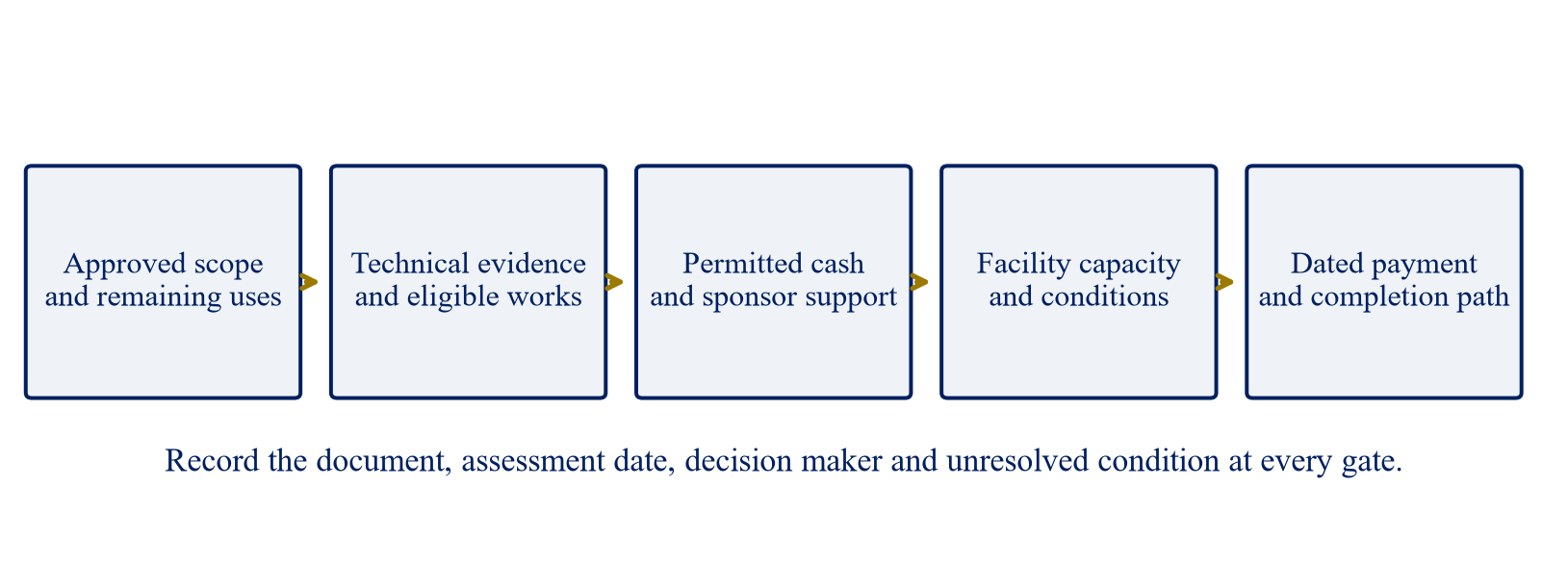
Author-developed framework. The gates require project-specific regulatory, technical, credit and payment confirmation.
13 Test the next draw separately from full completion
A single draw request tests particular expenditure and conditions. Suppose, solely for illustration, that the fictional borrower submits 10 of certified eligible work and its contract permits reimbursement of 80 percent of that value. The works-based amount is 8. The 80 percent is an invented term for explaining the calculation. The payable advance may still be smaller or suspended because of other facility caps, unmet conditions or restricted payment routes. The request ledger should reconcile the certificate to invoices, prior reimbursements, retention and the intended recipient, using the signed facility definition of eligibility.
The remaining-programme model and the next-draw model have different horizons. The base capacity of 60 assumes sufficient eligible work across the future programme. The 8 example concerns one specific certificate and is a separate eligibility illustration. If applied after the stress cure, assume its 10 of works is unpaid, included in the remaining uses of 115 and eligible net of prior financing. An advance of 8 consumes the stressed senior capacity, leaving 42; the required payment and remaining 2 need consistent cash treatment. The proposed protocol maintains a schedule of opening loan balance, work becoming eligible, draw requests, approved advances and closing balance for each period. It applies cumulative limits alongside the conditions attached to individual requests.
The draw pack also needs a funding-to-complete bridge after the requested advance. If the advance pays an already included remaining obligation, reduce both future uses and available debt capacity consistently. If the certified work has already been paid from project cash, identify whether reimbursement restores cash that remains available or repays another contributor. The contract and bank statements decide the treatment. This detail matters for double counting: the same invoice cannot appear as an unpaid future use and an already paid cash outflow in the same cut-off. Every model update should reconcile the advance, the payment and the reduction in remaining work before the next borrowing decision is made.
14 Assess sponsor support as an executable obligation
Sponsor support enters the proposed ledger only with a defined amount, delivery date, permitted project use and documentary basis. Identify the supporting entity, governing agreement, conditions, duration and scope. A completion undertaking may differ from a guarantee of all debt. A guarantee may differ from an obligation to deposit cash before a draw. A commitment capped at a stated amount differs from an uncapped undertaking, subject to its actual wording and enforceability. The analyst should obtain legal assessment rather than resolving those differences from an introductory term-sheet label.
Assess the resources behind the obligation. Relevant evidence can include cash, committed borrowing available for that purpose and assets that can lawfully be monetised within the required period. Record existing claims on those resources and competing project commitments. The protocol avoids treating a sponsor's aggregate asset value as delivered completion cash. A property sale dependent on a future buyer needs a different timetable from cash held in a verified account. If the funding route relies on a group transfer, document the approvals and restrictions relevant to it. The resulting schedule should state how much can reach this project by each required date.
The fictional base includes 18 of sponsor money assumed to be timely and usable. The stress cure later requires a further 30. The presence of the original 18 supplies no evidence that the additional 30 exists. Each support amount needs its own source and delivery test. IFC's historical discussion describes sponsor project-funds and overrun arrangements [12], and World Bank guidance identifies standby funding, undertakings, guarantees and reserves [11]. These conceptual sources support asking precise support questions. They provide no assurance about an actual sponsor. The investment committee should receive the obligation, resources, timing and any conditions that could leave the project exposed when a contribution is required.
15 Apply the combined cost, delay and release stress
The fictional stress raises remaining uses from 90 to 115. An assumed cost increase of 15 and an additional delay, finance and other completion allowance of 10 create the total increase of 25. These aggregates are modelling assumptions. A live stress should derive its components from procurement, programme, interest, fees and claims evidence, with consistent timing. In this example, the total-debt ceiling also falls from 120 to 110 under a fictional contractual reassessment. With 60 already drawn, residual debt capacity falls to 50. Nominal undrawn commitment stays at 60, so the lower cap controls potential additional debt.
At the same time, eligible escrow funding falls from 20 to 5. Unrestricted project cash remains 12 and timely existing sponsor support remains 18. Potential future sources are therefore 12 + 5 + 18 + 50 = 85. Against remaining uses of 115, the project has a funding shortfall of 30. That result precedes the assumed funding-to-complete condition. Under that fictional clause, the shortfall suspends further debt drawing until an accepted cure is in place. The amount-limit calculation remains 50, but current permitted availability is zero while the hold applies. The model should show both figures and the reason for the distinction.
This combined stress demonstrates a mechanism rather than a forecast. Costs and funding can deteriorate together. A draw suspension can then affect the programme and create further cost consequences that require another calculation. The present case stops at one review date to keep the arithmetic transparent. A live model should update the schedule after any hold, delay or cure and recalculate financing costs under the relevant terms. The board needs to see the original 30 structural shortfall and the cash consequences of the temporary draw hold. Adding those two outputs together without tracing their dates would overstate or misclassify the project's funding requirement.
Table 2. Fictional remaining completion sources and uses, AED million
| Item | Base | Combined stress | Stress with timely sponsor cure |
|---|---|---|---|
| Remaining uses | 90 | 115 | 115 |
| Unrestricted project cash | 12 | 12 | 12 |
| Permitted future escrow funding | 20 | 5 | 5 |
| Existing sponsor support | 18 | 18 | 18 |
| Additional sponsor cure | 0 | 0 | 30 |
| Potential senior capacity | 60 | 50 | 50 |
| Total potential sources | 110 | 85 | 115 |
| Structural headroom / shortfall | +20 | -30 | 0 |
| Senior permission under assumed completion test | Conditional draws allowed | Hold until cure | Subject to accepted cure and all other conditions |
All amounts and contractual terms are author-developed assumptions. Potential senior capacity remains conditional on the assumed funding-to-complete test and other draw conditions.
16 Calculate sensitivities before requesting a cure
The sensitivity separates three variables: remaining uses, permitted escrow funding and potential senior capacity. It holds unrestricted cash at 12 and existing sponsor support at 18. With escrow of 20 and senior capacity of 60, potential sources are 110. With escrow of 5 and senior capacity of 50, potential sources are 85. The intermediate combinations produce 95 or 100. Compare each total with remaining uses of 90, 100 or 115. This matrix identifies which assumption creates the shortfall and the amount of additional timely funding required in each scenario.
For example, at remaining uses of 115, reducing escrow from 20 to 5 while keeping senior capacity at 60 changes the shortfall from 5 to 20. Reducing the senior cap to 50 while retaining escrow of 20 produces a shortfall of 15. Applying both changes produces the 30 shortfall in the combined stress. These are arithmetic sensitivities of the invented model. They establish no probability of cost overrun, release reduction or lender reassessment. A transaction team should choose its own stress values using evidenced project risks and the facility terms, then explain why those values are decision-relevant.
Sensitivity also informs the form of a cure. An extra cash contribution addresses a funding shortfall if delivered and usable at the required date. An accepted scope reduction changes remaining uses. A release approval changes permitted cash. A facility amendment can change potential debt capacity, subject to credit and other conditions. Their timing and legal effects differ. The model should state which cell the proposed action changes and show the post-action cash profile. A cure request supported by this bridge gives the decision maker a clear amount and condition. It also identifies cases where a nominal commitment increase leaves the immediate cash deficit unresolved because the new money remains conditional or arrives too late.
Table 3. Fictional structural shortfall sensitivity, AED million
| Escrow / senior capacity | Potential sources | Uses 90 | Uses 100 | Uses 115 |
|---|---|---|---|---|
| 20 / 60 | 110 | 0 | 0 | 5 |
| 20 / 50 | 100 | 0 | 0 | 15 |
| 5 / 60 | 95 | 0 | 5 | 20 |
| 5 / 50 | 85 | 5 | 15 | 30 |
Unrestricted cash 12 and existing sponsor support 18 are fixed. Shortfall equals the greater of zero and remaining uses less potential sources; conditional draw holds require a separate dated analysis.
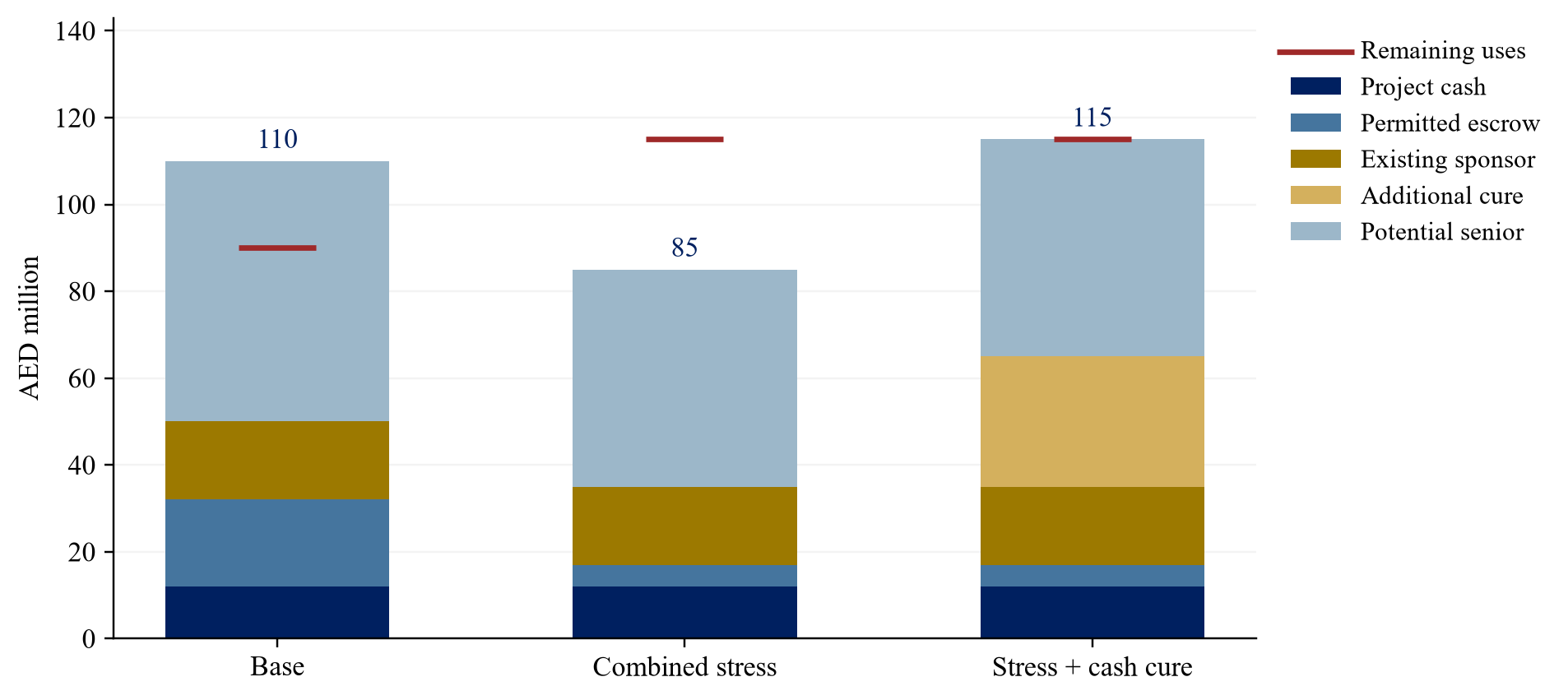
AED million. Senior amounts show potential capacity before individual draw timing and conditions. All inputs are fictional author assumptions.
17 Identify the first date of cash failure
An aggregate completion surplus needs a monthly or more frequent cash schedule before it supports a payment decision. Start with the verified unrestricted balance, add only receipts usable by the relevant date, deduct contractual payments and show the minimum cash balance. Maintain a parallel restricted-account schedule with expected approvals and release dates. Add loan requests on the dates permitted by certification and the facility. Sponsor contributions enter on evidenced delivery dates. The first negative balance identifies a timing deficit even when total remaining sources exceed total remaining uses over the full programme.
The protocol treats conditional money explicitly. A pending release can be displayed as expected conditional funding with a separate no-release case. A proposed amendment stays outside approved availability until its conditions are met. If construction progress triggers buyer instalments and loan certification, a delayed package can affect both receipts. The dated model should reflect the actual link rather than independently postponing one cash flow while holding the other unchanged. The fictional aggregate stress leaves these detailed timings unspecified; it therefore supports a structural funding calculation only. No claim about the project's first actual failure date follows from the invented totals.
After locating a timing deficit, distinguish its cure from the structural completion gap. A short bridge may resolve a temporary mismatch if later usable receipts repay it and the facility permits it. A permanent shortfall requires additional funding, accepted scope reduction or another executable change. Model any bridge interest, priority and maturity before calling the solution complete. The proposed decision pack reports the peak dated deficit, the total structural gap and the conditions connecting them. This gives the board an auditable basis for choosing an action and for understanding the residual risk if the proposed cash arrives after the critical payment date.
18 Design an executable completion cure
In the fictional combined stress, an additional sponsor contribution of 30 increases potential sources from 85 to 115. The case assumes that the contribution is delivered in time, legally usable and accepted under the fictional completion condition. The remaining structural headroom is zero. Individual draw conditions and timing still require testing. A cash cure can therefore restore the aggregate equation while leaving the project with no analytical cushion against further change. The board should decide whether an additional reserve is necessary using its own risk assessment and the actual lender requirements. This paper assigns no standard buffer.
A cure agreement needs a defined amount and delivery mechanism. Document who contributes, which account receives the money, restrictions on use, conditions before release, evidence required by the lender and the consequence of non-delivery. If support takes the form of subordinated borrowing, confirm lender consent, repayment priority and any cash interest. If it takes the form of new equity, confirm approvals and control implications. If the proposed solution reduces scope, confirm its compatibility with permits, buyer contracts and completion obligations. The ledger should update both uses and sources for the full economic effect of the chosen action.
An unsigned cure proposal remains a proposed route. The investment committee should see the uncured case alongside the agreed case and the evidence required to move between them. The same applies to a waiver: identify what condition is waived, its duration and any residual obligations. A waiver can permit a draw without supplying missing completion cash, depending on its wording. The protocol therefore recalculates completion funding after every cure or waiver decision. It records the accepted documents and dates rather than treating an approval label as a substitute for the revised cash model. Legal, technical and credit advisers should confirm their respective parts of the resulting completion path.
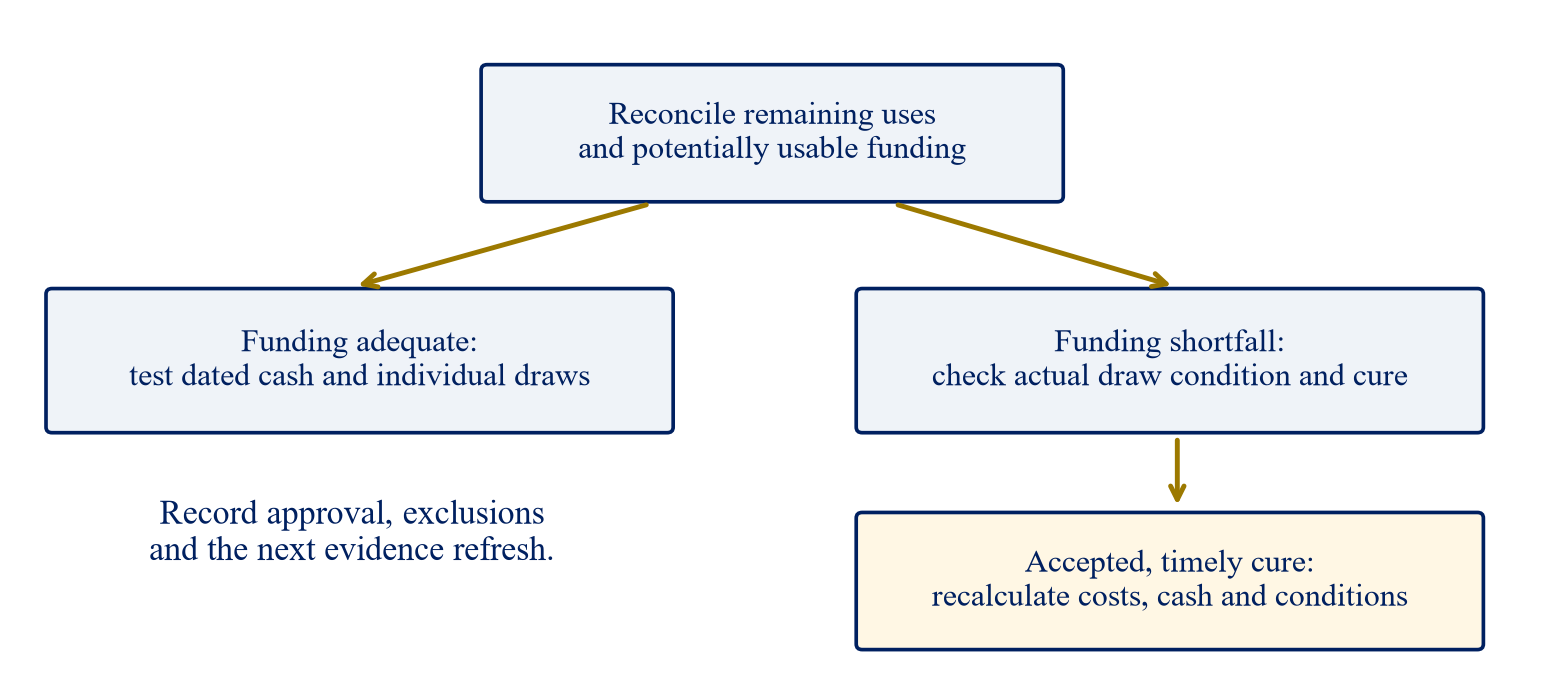
Author-developed protocol. The draw hold is a hypothetical contract condition; actual facility terms determine the applicable decision.
19 Connect valuation, collateral and repayment
Development valuation and completion funding address related questions with different outputs. The former requires an appropriate valuation basis, date, scope and assumptions. The latter asks which cash can meet remaining obligations under the agreed documents. RICS guidance describes development appraisal and sensitivity, and states that subsequent updates to the global standards take precedence where relevant [8,9]. A valuation prepared for loan security needs the applicable current standards and an appropriate professional instruction. The completion model should use the relevant valuation input without presenting its own fictional sensitivity as a formal valuation.
If a facility contains a value-linked debt ceiling, record its definition, valuation requirements, reassessment triggers and treatment of existing debt. The fictional reduction of the total-debt ceiling from 120 to 110 demonstrates the resulting arithmetic. It supplies no assumed loan-to-value ratio or explanation of a real lender's repricing decision. A live model should reference the actual covenant and approved valuation. The effect of a value change on permitted debt can differ from its effect on eventual sale proceeds. Both need separate lines, since a lower debt limit may constrain construction cash before the completed asset is sold.
Repayment analysis then follows the expected cash available at exit. Identify debt amounts, interest, fees, priority, restrictions and timing. Reconcile contracted sales, remaining unsold units and collection risks to the proposed repayment date. A completion-funded project may still face a repayment shortfall or a maturity mismatch. The protocol requires a separate exit case and sensitivity, with actual inputs and professional valuation where needed. Keeping that analysis alongside the completion test gives the investment committee a fuller view of the financing decision. The paper's worked numbers stop at completion funding and provide no estimated market value, return or investment recommendation for an actual development.
20 Build a controlled investment-committee pack
The proposed pack begins with a one-page decision statement: requested facility or draw, defined completion milestone, remaining uses, potentially usable sources, dated cash minimum, unresolved conditions and proposed action. Behind it sit the technical reconciliation, sales-to-cash bridge, escrow schedule, loan calculation, sponsor evidence and valuation or repayment analysis. Every material number needs a document, date and model location. The pack should show revisions since the previous approval and their causes. A clear change log helps reviewers identify whether a funding deterioration arises from costs, collections, legal availability, debt capacity or support.
Assign ownership for each evidence stream. The developer supplies its project and accounting records. Technical advisers assess their instructed scope. Legal advisers address documents and enforceability within their instructions. The trustee or authority determines relevant permissions, and the lender determines its credit and facility position. The proposed analyst role is to reconcile the outputs and identify gaps. It does not confer approval powers over another party's decision. The committee should record conditions accepted, conditions still open and the party responsible for confirming closure. A proposed deadline needs a delivery owner and evidence of completion.
Data and automation can support this controlled process by organising documents, matching invoice references and highlighting inconsistent dates or amounts. The paper proposes these uses as workflow options requiring validation. It makes no measured claim about accuracy, cost savings or faster draw approval. Any automated extraction should preserve the original document and receive review before entering a financing calculation. Confidential buyer, bank and sponsor information requires appropriate access controls and permitted handling. The practical objective is a traceable decision pack in which the reviewer can reproduce the calculation, locate the governing condition and identify the evidence needed for the next update.
21 Specify a feasible empirical study
A future study of lender advance limits would require a project-level dataset with explicit permissions and a sampling frame. Relevant variables include approved scope, programme, remaining cost estimates, independently measured progress, presale contracts, collected and released receipts, sponsor obligations, valuation, facility caps, requested draws and approved advances. The data should include dates and changes to terms. Rejected or suspended requests are necessary to understand constraints; a sample limited to completed financed projects would leave important cases unobserved. The unit of analysis should be defined before testing relationships, particularly where multiple draw requests belong to one project.
The study would need to preserve jurisdiction and project differences. Dubai, Abu Dhabi, Saudi Arabia and Bahrain operate under distinct processes described in the cited materials. Facility decisions also depend on borrower, lender and contract characteristics that an aggregate dataset may omit. A model could investigate associations between evidence variables and approved amounts only after documenting these limitations and the treatment of missing data. It should distinguish association from a causal explanation. No fitted coefficient, predictive accuracy or empirical conclusion is reported here. The fictional calculations test accounting and conditional availability under specified terms.
For practical data collection, the proposed protocol creates a reproducible record of each request: assessment date, evidence available, amount-limit calculation, conditions met, decision and subsequent outcome. A consented pilot could first test whether reviewers can reproduce the funding bridge from those records. Further analysis could examine how revised completion forecasts and release permissions relate to changes in available debt. The study would require confidentiality safeguards and transparent publication of its methods. That research agenda gives the framework a testable path without presenting document review as evidence of market-wide lending behaviour or promising that a model can determine a bank's credit decision.
22 Conclusion and decision protocol
The completion-evidence test produces three outputs: an auditable remaining-uses estimate, conditional funding capacity and a dated permitted-cash schedule. Construction progress informs the cost and draw evidence. Presales inform contractual qualification, collection and release through distinct bridges. Sponsor support contributes only through an evidenced obligation, resource and delivery route. The protocol keeps these channels separate until the signed documents and applicable permissions establish how they interact. A lender and developer can then discuss a specific funding gap or condition, supported by a calculation that can be revised when new evidence arrives.
The fictional development illustrates the mechanics. Base potential funding of 110 exceeds remaining uses of 90 by 20. Combined stress raises uses to 115 and lowers potential funding to 85, producing a 30 structural shortfall. Under the invented completion condition, further senior drawing remains on hold until an accepted cure. An additional timely sponsor contribution of 30 balances the stressed aggregate equation, subject to all remaining conditions and payment dates. These figures are properties of the author-developed scenario. They indicate no prevailing GCC terms, actual borrower resources or probable market outcome.
The proposed board sequence is explicit. Confirm the project perimeter and completion end point; reconcile dated technical, cash and sales evidence; compute amount limits; test contractual permissions; identify structural and timing deficits; and approve an executable action with named responsibilities. Recalculate after any cure, waiver or programme change. Published regulatory and professional materials support the evidence questions, while the project's actual documents determine the transaction answer. Empirical research can subsequently examine lender decisions using consented observations. Until such data exist, the framework's defensible contribution is a transparent method for testing completion funding and explaining exactly which evidence is needed before the loan can become usable project cash.
References
- Dubai Land Department. Register Project, official project-registration and escrow service; accessed 7 October 2026. https://dubailand.gov.ae/en/eservices/register-project/
- Dubai Land Department. Depositing a mortgage into an escrow account application, official financing and settlement service conditions; accessed 7 October 2026. https://dubailand.gov.ae/en/eservices/request-for-mortgage-payment-in-escrow-account/
- Abu Dhabi Real Estate Centre. Project Development, registration, escrow, progress and completion overview; accessed 7 October 2026. https://adrec.gov.ae/en/sectors/regulatory-services/project-development
- Real Estate General Authority, Saudi Arabia. Law of Selling and Leasing Off-Plan Real Estate Projects, active official text; accessed 7 October 2026. https://rega.gov.sa/en/laws-and-decisions/regulations-and-by-laws/rules/law-of-selling-and-leasing-off-plan-real-estate-projects/
- Real Estate General Authority, Saudi Arabia. Implementing Regulations of the Off-Plan Sale and Lease of Real Estate Projects Law, active official text; accessed 7 October 2026. https://rega.gov.sa/en/laws-and-decisions/regulations-and-by-laws/regulations/implementing-regulations-of-the-off-plan-sale-and-lease-of-real-estate-projects-law/
- Survey and Land Registration Bureau, Bahrain. Law No. 27 of 2017 Promulgating the Real Estate Regulatory Law; official English webpage identifies the Arabic Official Gazette version as authoritative; accessed 7 October 2026. https://www.slrb.gov.bh/en/law-no-27-of-2017-promulgating-the-real-estate-regulatory-law
- Real Estate Regulatory Authority, Bahrain. Operating Guidelines for Off-Plan Escrow Accounts, undated official downloadable guidance; current amendment incorporation requires confirmation; accessed 7 October 2026. https://helpdesk.rera.gov.bh/hc/ar/article_attachments/360014880732
- Royal Institution of Chartered Surveyors. Valuation of development property, professional-standard overview; accessed 7 October 2026. https://www.rics.org/profession-standards/rics-standards-and-guidance/sector-standards/valuation-standards/valuation-of-development-property
- Royal Institution of Chartered Surveyors. Valuation of development property, first edition, 2019, effective February 2020; read with applicable current global standards; accessed 7 October 2026. https://www.rics.org/content/dam/ricsglobal/documents/to-be-sorted/valuation-of-development-property---first-edition.pdf
- International Finance Corporation. How to Apply for Financing, proposed project and financing information; accessed 7 October 2026. https://www.ifc.org/en/what-we-do/products-and-services/how-to-apply-for-financing
- World Bank Public-Private Partnership Resource Center. Key Issues in Developing Project-Financed Transactions, lender protections and support mechanisms; accessed 7 October 2026. https://ppp.worldbank.org/financing/issues-in-project-financed-transactions
- International Finance Corporation. Project Finance in Developing Countries, April 1999, historical conceptual reference on completion and support arrangements; accessed 7 October 2026. https://ppp.worldbank.org/sites/default/files/2022-05/ProjectFinance_DevelopingCountries_IFC.pdf
About the Author
Chennakeshav (CK) is a corporate finance and investment banking executive with 25+ years of global experience in deal origination, structuring and execution across M&A, growth capital and corporate strategy. He has led value-creation mandates for founders, corporates and funds — bridging the boardroom view to hands-on execution and close.
His career spans Morgan Stanley, HSBC, Lloyds Banking Group, EWEC, ADQ portfolio companies and Emirates Growth Fund, across TMT, real estate, fintech, deeptech, cleantech, infrastructure and energy. He has partnered with C-suite leaders, private equity and venture funds, sovereign wealth funds and family offices to finance complex fund raises and scale-up ventures, and has led M&A due diligence, post-merger integration and business-transformation initiatives to create value.
At Matchpoint Partners he is Managing Partner, leading the firm's corporate finance, M&A and capital-raising practice. He holds an MBA from London Business School, an engineering degree from VTU and a Master of Laws (LLM, in progress) from UCL London.
An active start-up mentor, CK mentors at Techstars, DIFC FinTech Hive, Startup Grind, Founder Institute and IN5, serves as Entrepreneur Mentor in Residence (EMiR) at London Business School, and judges the Entrepreneurship World Cup.
