

1. The consolidation decision
The decision is whether a group of water operators can deliver safer, more reliable and more affordable service through a different institutional and ownership structure. Consolidation is one option within a spectrum that includes informal cooperation, shared services, operating contracts, joint entities and ownership transfer. Each structure changes control, accountability, risk and capital access.
The transaction should begin with the service problem and the required capability. A larger legal entity does not itself prove better outcomes. The case needs a traceable connection from structure to delivered performance.
2. Why fragmentation matters
Small or fragmented operators may struggle to maintain specialist engineering, laboratory, cyber, procurement, finance and regulatory capacity. They may buy equipment independently, hold limited spare inventory and plan capital without regional coordination. Industrial operators can add further fragmentation through separate intake, treatment, reuse and discharge systems.
EPA describes partnerships as tools for improving technical, managerial and financial capacity and identifies arrangements ranging from cooperation to ownership transfer [1]. The appropriate response depends on the actual capability gap.
3. Why consolidation can fail
Scale can introduce bureaucracy, remote decision making, tariff conflict, integration complexity and loss of local knowledge. Expected synergies may be absorbed by remediation, harmonisation, pensions, systems replacement or service commitments. Physical networks may remain separate even after legal combination.
The investment case should therefore test both benefits and disbenefits. OECD evidence warns that aggregation can add institutional complexity and that presumed scale economies require local assessment [2].
4. Define the protected outcomes
The board should define water quality, continuity, pressure, environmental compliance, affordability, response, resilience and capital-delivery outcomes. These become the transaction objectives and integration scorecard. A broad objective such as efficiency is too weak to govern trade-offs.
Outcomes should be disaggregated by geography and customer class. A transaction that lowers average cost while reducing service in a vulnerable municipality or critical industrial zone may fail its public or contractual purpose.
5. Transaction architecture
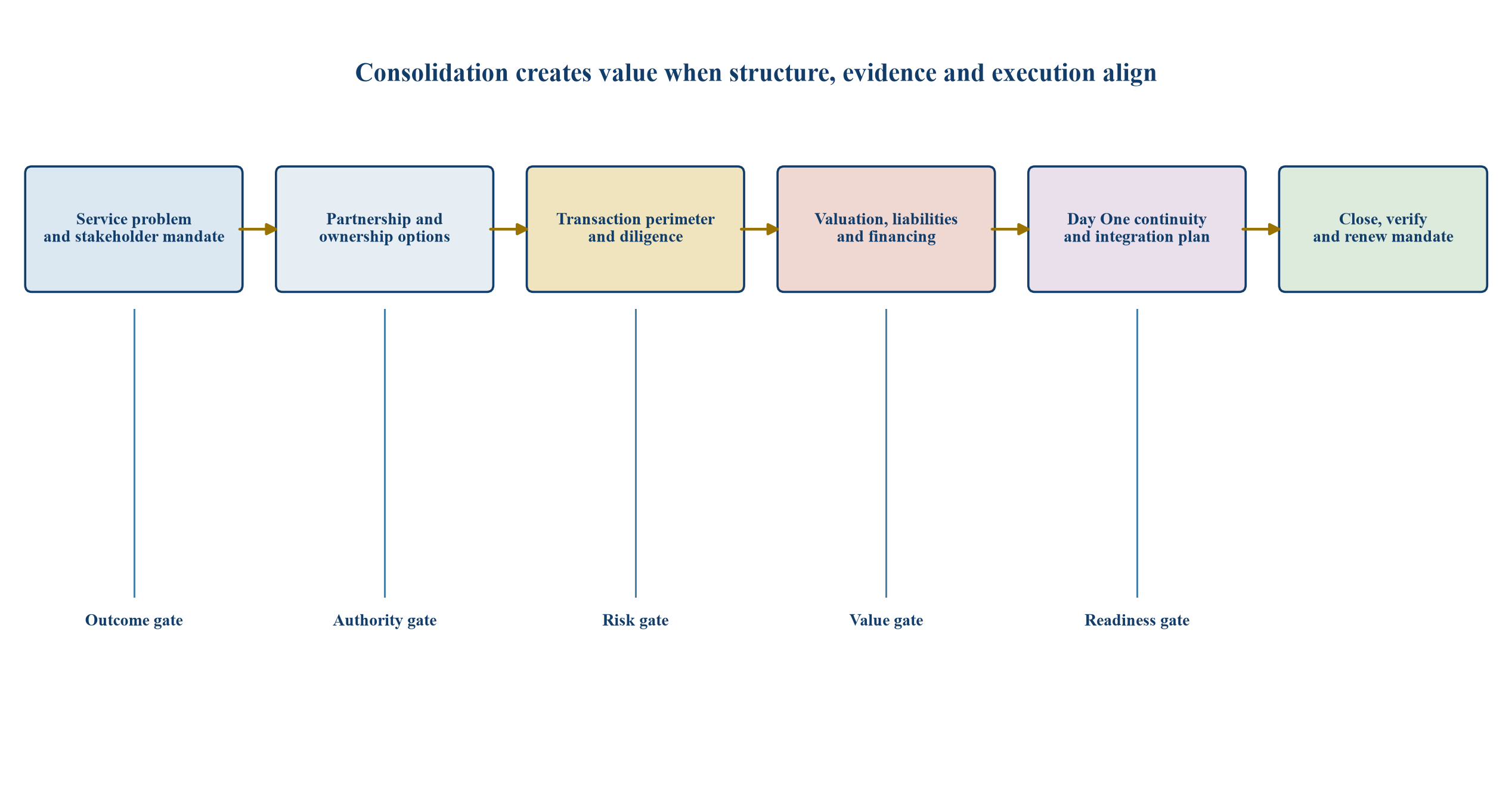
Generic framework; actual authority, approvals and structures depend on local law, regulation and ownership.
6. Cooperation before ownership
Informal cooperation can cover mutual aid, joint purchasing, equipment sharing and training. It preserves autonomy and can establish trust. Its limitations include voluntary participation, weak enforcement and limited ability to finance shared assets.
Cooperation is useful when the immediate problem is narrow or when stakeholders need evidence before deeper commitment. The agreement should still define scope, cost allocation, service priority, liability and exit.
7. Contractual assistance
One operator can provide laboratory, billing, maintenance, engineering or operating services to another under contract. This can professionalise capability without transferring assets or governance. The buyer retains statutory and customer accountability unless law provides otherwise.
Contracts should specify performance, data, change control, emergency response, audit, step-in and termination. A service contract can become operationally critical even when ownership remains separate.
8. Shared-service entity
A jointly owned service company can pool specialist people, procurement, technology and fleet while operators retain local assets and customer relationships. This structure can capture scale in functions where physical integration is unnecessary.
Governance should address voting, capital contributions, service levels, cost allocation and admission or exit of members. Shared services can create dependency without resolving weak asset ownership or tariff capacity.
9. Joint power or regional authority
A new regional entity can assume selected functions or full operations. EPA recognises joint power agencies as a partnership category in which systems remain independent while sharing management or operators [1]. The model can preserve public ownership and create scale.
Success depends on statutory authority, representation, tariff powers, borrowing capacity and a clear relationship with participating municipalities. Ambiguous responsibility can increase rather than reduce fragmentation.
10. Operating consolidation
Operations can be combined while asset ownership remains with municipalities or industrial owners. A regional operator may manage plants, networks, laboratories, billing and maintenance under concession, lease or management arrangements.
The transaction must separate asset risk from operating risk and define capital responsibility. Integration benefits may be available, but long-term performance can be constrained when owners delay renewal or retain inconsistent standards.
11. Ownership transfer
Ownership transfer creates the strongest control over assets, people and investment. It can support unified financing and operating standards. It also raises valuation, competition, public-interest and political questions.
Transfer terms should address legacy liabilities, debt, grants, land, permits, pensions, customer obligations and future governance. The buyer needs rights sufficient to implement the promised service plan.
12. Model selection
Table 1. Consolidation model selection matrix
| Model | Control transferred | Capital integration | Principal strength | Principal risk |
|---|---|---|---|---|
| Informal cooperation | Limited | None | Fast capability sharing | Voluntary and fragile |
| Contractual assistance | Defined service control | Usually separate | Targeted professional capacity | Contract dependency |
| Shared-service entity | Shared functional control | Shared-service capital | Scale without asset transfer | Complex allocation |
| Regional authority | Statutory or delegated control | Potentially unified | Public scale and borrowing | Governance dilution |
| Operating consolidation | Operating control | Split by contract | Unified standards and delivery | Asset-owner interface |
| Ownership transfer | Full agreed control | Unified | Strongest integration authority | Liability and political exposure |
The selection should reflect authority, problem scope, physical system, capital need and stakeholder mandate. A staged path can begin with shared services and progress to deeper integration after evidence is established.
13. Transaction perimeter
The perimeter should identify assets, licences, contracts, employees, systems, land, debt, grants, data, inventories, vehicles, laboratories, intellectual property and liabilities. It should also specify excluded functions and continuing dependencies.
Perimeter errors create stranded costs and operational gaps. A billing platform may be excluded legally while remaining essential on Day One. A source asset may be included without the land or power right needed to operate it.
14. Physical system boundary
Legal entities and hydraulic systems rarely align perfectly. The team should map sources, treatment, storage, networks, discharge, interconnections and industrial interfaces. It should identify which assets serve several owners and which customers depend on several systems.
The physical map determines separation difficulty, operating synergies and emergency resilience. It also tests whether a proposed perimeter is executable.
15. Regulatory perimeter
Water quality, environmental permits, abstraction, discharge, tariff, competition and municipal authority may sit with different bodies. Each approval should be mapped to the transaction step and future operating model.
Ofwat notes that water-company combinations can affect comparative regulation and may fall under a special merger regime in England and Wales [3]. Other jurisdictions use different public-interest and ownership tests.
16. Customer perimeter
Municipal households, commercial users and industrial customers have different service, tariff and contract terms. Critical facilities may have minimum pressure, quality, redundancy or emergency obligations. The transaction should preserve these rights through closing and integration.
Customer data, deposits, arrears and complaints also require controlled transfer. Consent and privacy rules need jurisdiction-specific review.
17. Industrial interfaces
Industrial water services may include process water, ultrapure water, cooling, wastewater, reuse and zero-liquid-discharge systems. These services can carry customer-specific technology and continuity obligations.
Consolidation can create cross-selling and shared infrastructure, but industrial liabilities can differ materially from municipal risks. The perimeter and valuation should distinguish them.
18. Stakeholder mandate
Municipal leaders, regulators, employees, communities, industrial customers, lenders and funding agencies may have approval or influence. Their objectives can conflict. One municipality may seek lower tariffs while another prioritises autonomy or accelerated investment.
The stakeholder plan should identify decision rights, consultation, commitments and red lines. Late political opposition can destroy value even when the financial model is sound.
19. Diligence architecture
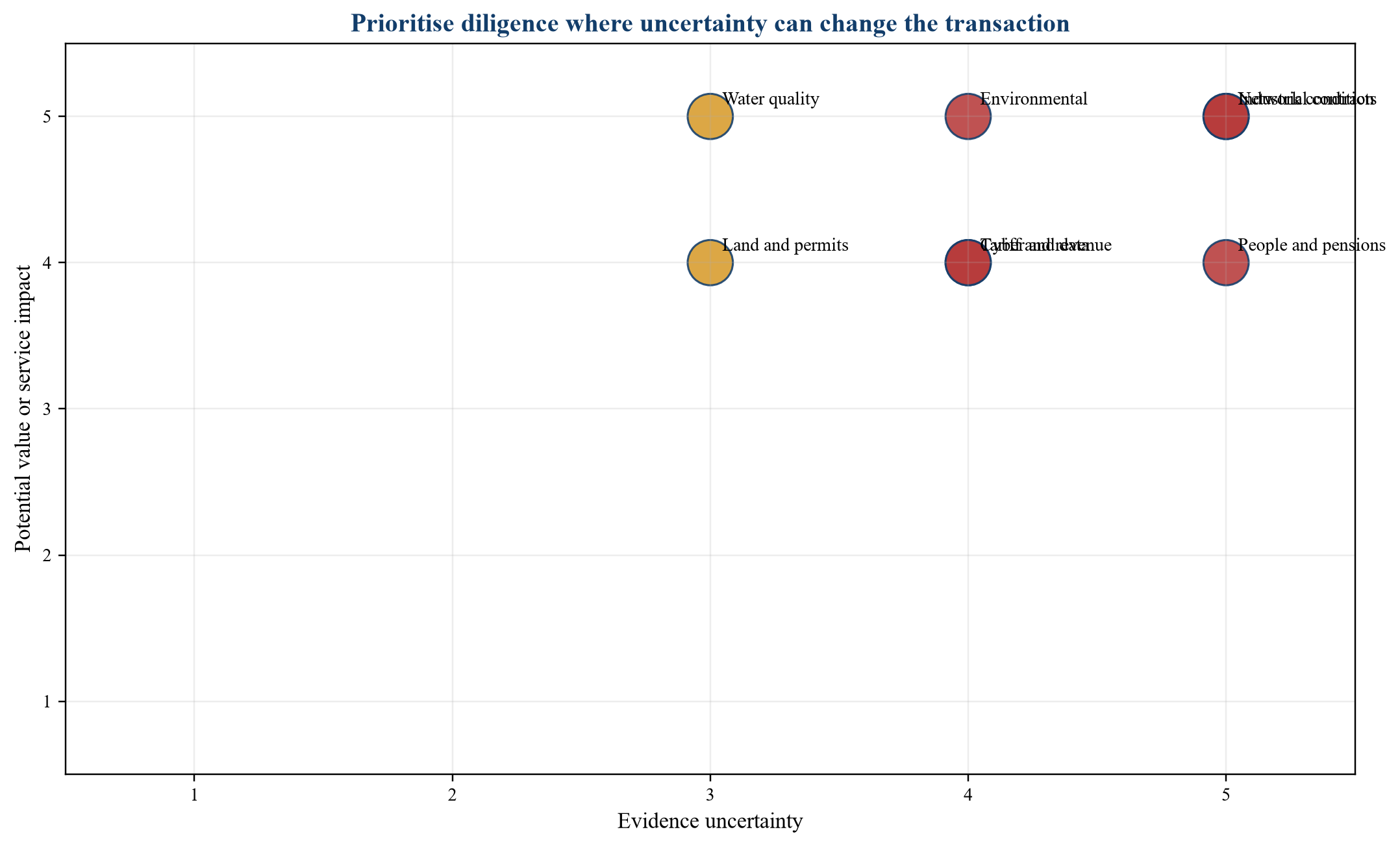
Illustrative prioritisation; a specific transaction requires jurisdictional, technical and financial evidence.
20. Water-quality diligence
Diligence should review compliance history, source protection, treatment barriers, sampling, laboratories, incidents, notices, operator competence and unresolved corrective actions. Reported compliance can conceal recurring near misses or temporary workarounds.
The buyer should identify immediate public-health controls and capital needs. Liability allocation cannot substitute for safe operation after closing.
21. Asset-condition diligence
Asset registers should be reconciled to physical inspection, maintenance records, failures, renewal plans and useful lives. Unknown pipe condition, inaccessible valves and deferred treatment maintenance can materially change value.
The review should distinguish replacement backlog, compliance remediation, growth capital and integration expenditure. Each category has different timing and responsibility.
22. Environmental diligence
Abstraction rights, discharge permits, sludge, contamination, flood exposure and ecological obligations should be reviewed by site and entity. Historic non-compliance or contaminated land can create long-tail liability.
The transaction agreement should address known remediation, unknown conditions, reporting and cooperation with regulators. Environmental restrictions may also reduce assumed operating synergies.
23. Revenue diligence
Revenue diligence should reconcile customers, meters, billed volumes, collections, arrears, subsidies, tariffs and contractual adjustments. Weak data can create apparent losses or hide unbilled service. Industrial revenue may depend on a small number of counterparties.
The model should separate recurring revenue, pass-through items, grants and one-off recovery. Tariff changes require legal and political evidence.
24. Cost diligence
Costs should be normalised for deferred maintenance, vacancies, emergency procurement, shared municipal services, grants and non-cash support. Standalone accounts may omit central functions that the combined operator must replace.
The buyer should build a bottom-up operating baseline. Reported expenditure below sustainable service cost is not automatically efficiency.
25. People and pensions
Operator licences, engineering skills, shift coverage, union agreements, pensions, benefits and municipal employment protections can determine deliverability. Critical knowledge may sit with a few individuals.
The workforce plan should identify transfer rules, retention, harmonisation, training and duplication. Synergy assumptions should respect service continuity and legal obligations.
26. Technology and cyber
Operators may use incompatible control systems, telemetry, billing, geographic information, asset management and customer platforms. Unsupported systems can create operational and cyber risk. Data ownership and quality affect integration.
The technology roadmap should sequence containment, access control, interoperability and replacement. A rapid platform migration can be riskier than a controlled coexistence period.
27. Land, title and access
Plants, wells, reservoirs, pipelines and discharge assets require valid title, easements and access. Municipal records may be incomplete or governed by historic rights. Industrial assets may sit within operating sites with shared utilities.
Exceptions should be resolved or protected through conditions, licences and indemnities. An asset without secure access has limited operational value.
28. Debt and grant restrictions
Existing debt may contain change-of-control, asset-transfer, tariff or additional-borrowing restrictions. Grant-funded assets can carry clawback or use conditions. Public lenders may require approvals or continued service commitments.
Financing diligence should identify consents, refinancing costs and security release. Debt cannot be treated as a simple balance-sheet deduction when obligations affect the transaction structure.
29. Contingent liabilities
Claims can arise from contamination, service interruption, employee matters, tax, procurement, construction disputes and historic compliance. Some liabilities may remain with municipalities while operational consequences transfer to the new operator.
The diligence register should state probability, impact, evidence, owner and proposed protection. Material uncertainty should influence price, escrow, indemnity or perimeter.
30. Synergy categories
Synergies can arise from procurement, shared laboratories, management, billing, fleet, energy, maintenance, spares, capital planning, financing and network optimisation. Revenue opportunities may arise from industrial services or reuse.
Each synergy needs a baseline, action, owner, timing, cost and service safeguard. Aspirational percentages should not enter valuation without an execution path.
31. Scale economics
World Bank work identifies potential benefits from aggregation including shared overhead, purchasing, skills, finance, resource access and cross-subsidy, while noting that optimal scale and local tailoring matter [4]. Scale benefits can plateau when geography and governance complexity rise.
The model should therefore test unit cost by function and density rather than assume that the largest perimeter is best.
32. Dis-synergies
Dis-synergies include tariff harmonisation, duplicated systems during transition, retention, branding, governance, travel, union alignment, remediation and lost municipal support. Centralisation can reduce local response if field capability is withdrawn.
Dis-synergies should be estimated alongside benefits and tracked after close. Their timing often precedes synergy realisation.
33. Valuation bridge
Table 2. Hypothetical enterprise-value bridge for a consolidated operator
| Component | Hypothetical value | Evidence requirement | Treatment |
|---|---|---|---|
| Standalone sustainable enterprise value | USD 420m | Normalised cash flow and regulated or contracted recovery | Starting value |
| Verified operating synergies | USD 85m | Action plan, owner, timing and service safeguard | Add after execution cost |
| Financing and procurement benefit | USD 35m | Committed terms or supportable benchmark | Risk-adjusted addition |
| Remediation and backlog | USD (110m) | Engineering diligence and cost plan | Deduction or seller funding |
| Integration and separation cost | USD (55m) | Bottom-up programme estimate | Deduction |
| Contingent liability reserve | USD (30m) | Claim and scenario analysis | Escrow, indemnity or deduction |
| Illustrative combined value | USD 345m | Subject to transaction evidence | Decision output |
The values are hypothetical and illustrate structure only. They are not benchmarks or a valuation of an actual operator.
34. Standalone value
Standalone value should reflect sustainable tariffs or contracts, service obligations, required maintenance, taxes, working capital and capital expenditure. Historic cash flow may be inflated by underinvestment or subsidies that will not continue.
The valuation should reconcile accounting earnings to distributable cash and required service capital. Public-service outcomes may require a separate economic appraisal.
35. Synergy value
Synergy value belongs to the party capable of delivering it and bearing the integration risk. Competitive process, alternatives and contribution influence how it is shared. Public owners may seek customer benefits rather than maximum sale proceeds.
The bridge should distinguish gross synergy, implementation cost, tax, delay and probability. Only net, executable benefits support price.
36. Regulatory asset and tariff value
Where regulated recovery exists, the team should understand the recognised asset base, allowed return, efficiency mechanism and treatment of acquisition premium. A high purchase price may not be recoverable from customers.
Tariff convergence can create winners and losers across municipalities. The plan should state transition, affordability and governance.
37. Industrial contract value
Industrial contracts should be valued using volume, price, indexation, minimum commitments, credit, renewal, capex obligations and termination rights. Customer concentration and site closure can dominate value.
Technical specifications may require dedicated assets with limited alternative use. Contract cash flow should be matched to asset and liability duration.
38. Purchase-price mechanics
Completion accounts, locked-box, debt-free cash-free and regulated balance-sheet approaches may produce different outcomes. The mechanism should reflect working-capital volatility, grants, customer deposits, restricted cash and capital commitments.
Definitions need water-sector specificity. Deferred maintenance is not captured by ordinary debt-like items unless expressly addressed.
39. Liability protection
Protection can include price adjustment, indemnity, warranty, escrow, retention, insurance, seller remediation and excluded assets. Public sellers may face legal constraints on indemnities. Industrial sellers may seek clean separation.
The structure should match the liability's duration, evidence and control. A contractual remedy has limited value if the counterparty cannot fund it.
40. Financing the combination
Funding may include municipal debt, regulated corporate finance, acquisition facilities, project finance, development lending, grants and sponsor equity. OECD evidence describes aggregation programmes supported by blended public grants, development lending and utility revenues [5].
The financing plan should cover acquisition, refinancing, remediation, integration and liquidity. Covenant headroom should survive slower synergies and higher capital needs.
41. Competition and public interest
Competition review may consider loss of comparative benchmarks, procurement markets, industrial services and customer choice. Public-interest review may consider quality, affordability, resilience and governance.
The filing strategy should use evidence that is consistent with the valuation and integration plan. Claimed benefits should be measurable and merger-specific.
42. Local accountability
Regional scale can coexist with local representation through boards, service councils, published standards and complaint routes. The model should identify decisions retained locally and those centralised.
Accountability requires information and remedy. Representation without access to performance data provides limited protection.
43. Day One continuity
Closing must preserve treatment, network control, laboratories, call centres, billing, emergency response, payroll, procurement and regulatory reporting. Every critical process needs an owner, access, data and fallback.
The Day One plan should prioritise safe continuity over visible integration. Non-essential changes can wait until controls are stable.
44. Control-room integration
Combining operating control requires authority, alarm ownership, communications, cyber access and common incident protocols. Physical systems may remain separate while oversight is coordinated.
Parallel operation and simulation can reduce transition risk. The combined operator should know which control decisions remain site-specific.
45. Integration management office
The integration office should connect technical, customer, people, finance, regulatory and technology workstreams. It needs decision rights, issue escalation, benefits tracking and service-risk reporting.
Programme reporting should show service outcomes and control readiness alongside milestones and spending. Completion of an activity is not proof of operating value.
46. First 100 days
The first phase should stabilise governance, confirm critical controls, retain key people, reconcile cash and customers, validate incidents, freeze unsafe changes and launch priority remediation. Synergy targets should be revalidated against closing evidence.
The output should be a revised integration baseline with accountable owners and board-approved tolerances.
47. Operating-model design
The target model should define central, regional and local responsibilities for operations, maintenance, engineering, customer service, capital, procurement, finance and assurance. It should preserve field response while pooling scarce expertise.
Organisation design should follow processes and service outcomes. Reporting lines alone do not create integration.
48. Tariff integration
Tariff harmonisation can be immediate, phased or avoided where law and customer economics require different structures. Cross-subsidy can support high-cost areas, but it needs legitimacy and transparency.
The plan should model bills, revenue, affordability and political acceptance. Customer communication should explain service commitments and transition protections.
49. Capital-plan integration
Legacy capital plans should be compared using common risk, condition and service criteria. Projects may duplicate capacity or compete for funding. Cancellation can create contractual cost or local opposition.
The combined plan should identify mandatory remediation, resilience, growth and efficiency capital. Prioritisation needs documented governance.
50. Procurement integration
Consolidated procurement can improve volume leverage, specification and supplier management. It can also reduce competition or exclude capable local suppliers. Frameworks should preserve performance evidence and resilience.
Savings should be measured net of transition, inventory, termination and specification costs. Supplier concentration needs monitoring.
51. Data migration
Customer, asset, geographic, laboratory and financial data require mapping, cleansing, reconciliation and controlled migration. Historical context should remain accessible for incidents, claims and regulation.
Migration acceptance should include completeness, accuracy, security and operational use. A technically completed transfer can still fail users.
52. Benefits assurance
Benefits should be tied to actions and verified against a controlled baseline. Cost reduction should not rely on deferred maintenance, lower testing or weaker service. Revenue benefits need customer and regulatory evidence.
Independent assurance can test material synergies and customer benefits. This is especially important where approval depended on them.
53. Integration scorecard
Table 3. Illustrative post-close integration scorecard
| Dimension | Measure | Gate | Board question |
|---|---|---|---|
| Safe service | Quality and continuity within approved limits | No material deterioration | Are customers protected during change? |
| Compliance | Notices, permits and corrective actions | All critical actions owned | Are inherited risks controlled? |
| People | Critical-role coverage and competence | Required shifts and licences maintained | Can the model operate safely? |
| Capital | Priority remediation delivered | Milestones and cost within tolerance | Is the backlog reducing? |
| Value | Verified net benefits | Evidence after implementation cost | Is value realised without service loss? |
| Accountability | Local reporting and remedies | Published performance and escalation | Can stakeholders challenge outcomes? |
The scorecard should be tailored to transaction commitments and reviewed at board level until steady-state control is demonstrated.
54. Separation planning
Some transactions require separation from a municipality, industrial site or diversified owner. Shared people, land, power, laboratories, procurement, IT and emergency services can create hidden dependencies.
The separation plan should identify transitional services, replacement capability, data migration, permits and stranded costs. Exit from transitional arrangements needs measurable readiness.
55. Failed integration signals
Warning signs include rising incidents, delayed maintenance, uncontrolled workarounds, key-person departures, disputed cost allocations, slow customer response, unreconciled data and benefits achieved through underinvestment. These signals should trigger intervention before they become structural.
The board should receive leading indicators as well as lagging financial results.
56. Optionality and staged consolidation
A staged path can begin with shared procurement or management, progress to operating integration and later transfer ownership. Staging can build evidence and trust. It can also entrench an inefficient interim structure.
Each stage needs entry, success, escalation and exit criteria. Future steps should remain authorised and executable where they are part of the strategy.
57. Deal timetable
The timetable should integrate stakeholder mandate, diligence, approvals, financing, employee process, contract negotiations, transition planning and close readiness. Water-service continuity limits the ability to solve problems after signing.
Conditions precedent should address material permits, funding, critical contracts, liability protection and Day One controls. Timing pressure should not weaken safety gates.
58. Investment committee questions
The committee should ask what service problem the deal solves, why the perimeter is optimal, which liabilities transfer, what benefits are merger-specific, how value changes after remediation and integration, and whether Day One can operate safely.
It should also test the alternative to consolidation. A shared-service or capital-support solution may achieve the objective with less transaction risk.
59. Diligence request list
The request should cover governance, licences, permits, customer and industrial contracts, tariffs, billing, collections, assets, maintenance, incidents, water quality, environment, land, debt, grants, employees, pensions, technology, cyber, claims, procurement, capital plans and insurance.
Documents should be reconciled to sites, systems and accountable people. A complete data room is not sufficient evidence of operating reality.
60. Implementation roadmap
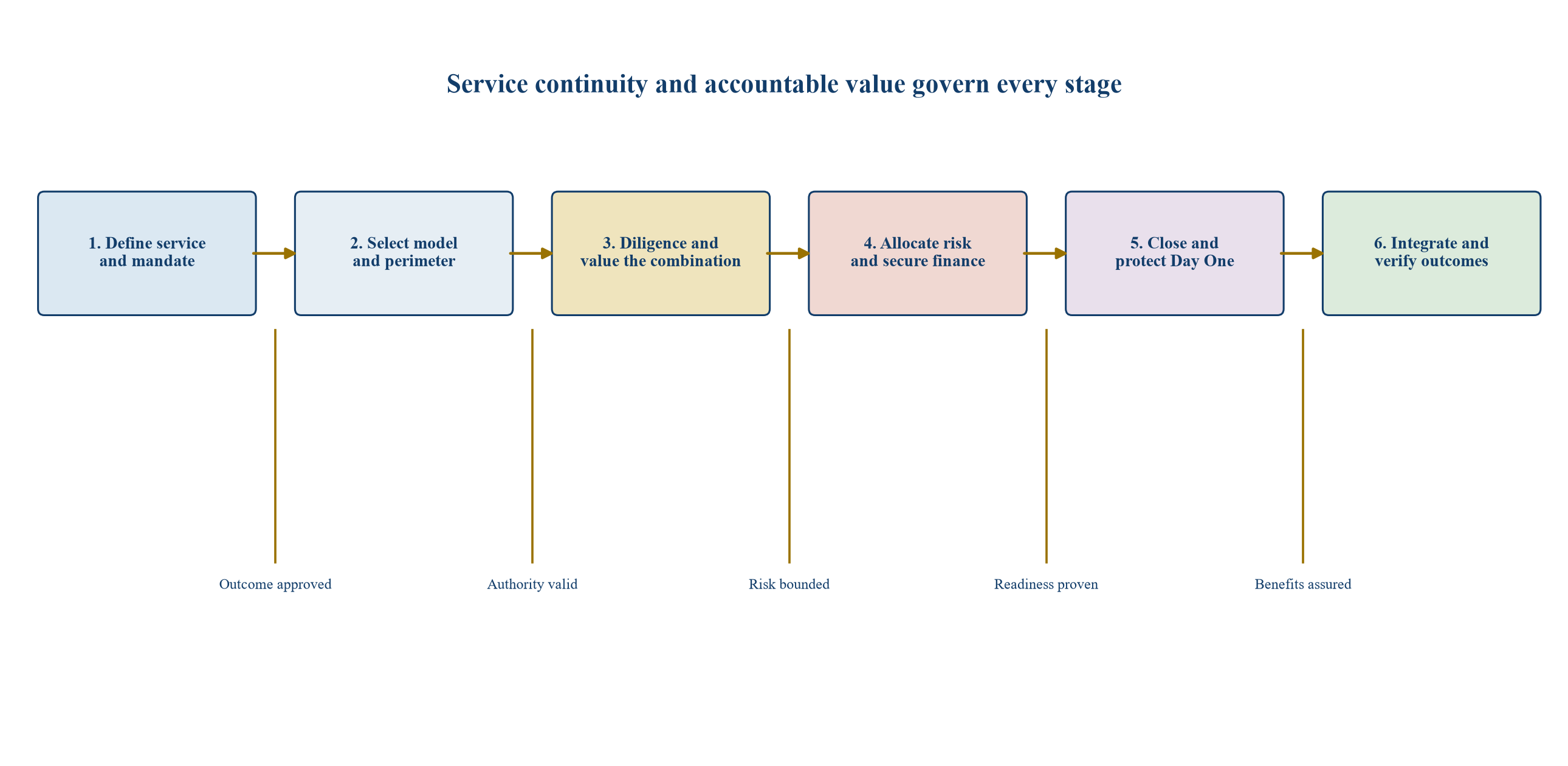
Generic roadmap; timing depends on authority, diligence, approvals, financing and operational readiness.
61. Cross-border and jurisdictional transfer
The framework transfers across public, private and mixed systems, but municipal powers, foreign ownership, procurement, tariff law, labour and environmental liability differ. Industrial-water contracts can introduce further jurisdiction and sanctions considerations.
The method should transfer while legal conclusions and numerical inputs remain local. Regulatory engagement should begin before structure is fixed.
62. Affordability and cross-subsidy
Aggregation can spread fixed costs and support customers in high-cost areas, but cross-subsidy needs an explicit policy basis. Customers contributing more after consolidation may challenge the transaction unless service improvements and allocation rules are transparent. The model should show tariff effects by municipality, customer type and consumption band.
Affordability measures may include phased convergence, targeted support, service guarantees and public funding for inherited deficits. These mechanisms should be financed and governed rather than treated as general commitments.
63. Resilience value
A combined operator may share sources, storage, laboratories, emergency crews, spares and purchasing power. The resilience benefit depends on physical interconnection, compatible equipment, authority and exercised procedures. Common climate, power or cyber dependencies can limit diversification.
The valuation should identify which resilience improvements protect cash flow, reduce emergency cost or satisfy public obligations. Benefits that cannot be monetised should still be reported as service outcomes with evidence.
64. Integration of industrial reuse
Industrial clusters may provide treated effluent, cooling-water loops or reuse demand that improves regional water efficiency. Consolidation can coordinate municipal wastewater supply with industrial quality and volume requirements. The opportunity requires contracts, treatment capability, connection infrastructure and regulatory approval.
The business case should test customer concentration, process changes, shutdowns and alternative discharge. Dedicated assets need a credible recovery structure if the industrial customer exits.
65. Tax and accounting
Asset transfer, concession, merger and service-company structures can produce different tax, accounting and grant consequences. Deferred tax, transfer duties, depreciation, regulated assets and purchase-price allocation may affect value and covenant calculations.
The transaction team should obtain jurisdiction-specific advice and reconcile financial reporting with tariff and funding rules. Accounting presentation should not be treated as the economic value of the operating system.
66. Insurance and risk transfer
Insurance diligence should cover property, machinery breakdown, environmental liability, cyber, professional liability, business interruption and historical claims. Consolidation may improve purchasing leverage while increasing concentration and aggregation exposure.
Coverage gaps, deductibles and exclusions should be reflected in liquidity and reserves. Insurance supports risk management but does not replace maintenance, emergency capability or contractual allocation.
67. Vendor and contractor dependencies
Operators may depend on a small group of treatment-chemical suppliers, laboratories, maintenance firms, software vendors and construction contractors. Consolidation can strengthen negotiation while making a common supplier failure more consequential.
The combined procurement strategy should map critical dependencies, alternatives, inventory and contractual rights. Termination or assignment restrictions need resolution before close.
68. Communications and legitimacy
Customers and employees need a clear explanation of why the transaction is proposed, what changes, what remains protected and how concerns will be addressed. Communication should use evidence and avoid promising savings before diligence and approval.
Legitimacy is strengthened through published commitments, local channels, performance reporting and visible remedies. A technically sound transaction can lose execution capacity if stakeholders do not trust its governance.
69. Post-close regulatory reporting
The combined operator should have a reporting calendar covering quality, environment, tariffs, service, financing and transaction commitments. Responsibilities should transfer without gaps. Historic data should remain attributable to the original system where comparison requires it.
Regulators should receive timely notice of changes in systems, people and controls. Reporting harmonisation should preserve local evidence until the new baseline is validated.
70. Renewal or exit decision
Contracts and joint structures need a process for renewal, expansion, withdrawal or failure. Exit can be operationally difficult once systems, people and data have been integrated. The governing documents should specify valuation, asset transfer, customer continuity, data and stranded cost.
Periodic review should test whether the structure continues to deliver the approved outcomes. A permanent legal form still requires performance accountability.
71. Board decision record
The board record should state the service rationale, alternatives considered, authority, selected structure, perimeter, diligence findings, valuation, liability protection, financing, customer effects, Day One controls and integration gates. It should identify unresolved matters and conditions to close.
This record becomes the reference against which post-close performance and representations are assessed. It should be concise enough to use and detailed enough to preserve the evidence chain.
72. Source and discharge rights
The combined utility must hold enforceable rights to abstract, purchase, reuse and discharge water across the operating horizon. Rights may attach to land, entity, purpose or volume and may not transfer automatically. Diligence should test conditions, renewal, competing claims and historic compliance.
Where rights remain with a seller or municipality, the operating agreement needs duration, priority, quality, access and remedies. Valuation should reflect the weakest essential right rather than assume uninterrupted availability.
73. Working capital and liquidity
Water operators can carry seasonal receivables, customer deposits, chemical inventory, energy accruals and capital creditors. Collection practice and public-payment cycles may differ across entities. The combined business needs sufficient liquidity during billing and system transition.
The purchase agreement should define normal working capital using a representative period. The financing plan should also provide contingency for incidents, integration delay and inherited supplier arrears.
74. Asset-service mapping
Every material asset should be linked to the customers, quality barrier, pressure zone, industrial contract or environmental obligation it supports. This mapping reveals assets that appear redundant but protect a critical service, and assets whose costs have no clear operating purpose.
Asset-service mapping improves perimeter, valuation and integration sequencing. It also supports transparent capital prioritisation after close.
75. Post-transaction assurance
Independent review after closing should confirm that conditions, controls and promised customer benefits were implemented. Assurance should examine service continuity, liability remediation, capital delivery, data integrity and verified net benefits. Exceptions need owners and deadlines.
The review should occur at defined milestones until steady-state governance is demonstrated. This closes the evidence chain from transaction approval to realised outcome.
76. Baseline integrity
The combined operator needs a defensible pre-close baseline for quality, continuity, leakage, complaints, cost, collections, workforce, maintenance and capital delivery. Definitions should be reconciled across entities before performance is compared. A favourable result can otherwise arise from changing the measure, boundary or reporting period.
Baseline documentation should preserve source data, adjustments, exclusions and assurance. Where evidence is weak, the transaction should use a range and a remediation plan. Benefits should not be credited until the relevant measure is reliable.
77. Service-area heterogeneity
Municipalities and industrial zones can differ in density, topography, source quality, income, asset age and environmental obligations. A standard operating model may create scale, while uniform targets can be unrealistic or inequitable. The combined utility should distinguish common controls from locally adapted delivery.
Cost allocation should reflect both shared benefit and causal use. Transparent rules reduce disputes and help decision makers understand whether a high-cost area is being supported deliberately or masking inefficient operation.
78. Capital prioritisation after close
The first combined capital plan should use a common risk and service methodology. Mandatory compliance, public-health barriers and critical continuity should take precedence over discretionary harmonisation. Projects inherited from each owner should be revalidated without assuming that prior political approval establishes combined priority.
The board should publish the criteria, affected outcomes and timing. Deferred projects need documented interim controls, while cancelled projects require treatment of contracts, design cost and stakeholder commitments.
79. Integration pace
Integration should proceed at the pace supported by control readiness and operational capacity. Functions such as treasury or procurement may combine earlier than control systems, laboratories or field dispatch. A single deadline for every workstream can create unnecessary service risk.
The roadmap should identify minimum viable integration, steady-state design and dependencies. Decisions to accelerate or defer should be recorded against customer, compliance and value consequences.
80. Management incentives
Management incentives should balance safe service, compliance, capital delivery, customer outcomes and verified net benefits. A narrow cost target can encourage deferred maintenance, vacancy or reduced monitoring. A narrow service target can obscure unaffordable cost.
Measures should use controlled baselines and exclude benefits created by changing definitions. Long-term incentives can support sustained integration, while malus and clawback provisions may address material control failure where permitted.
81. Future acquisitions
The first consolidation may become a platform for additional operators. Expansion criteria should define minimum service need, geographic fit, regulatory feasibility, management capacity, valuation and integration readiness. Repeated transactions can outpace remediation and weaken the existing system.
Each acquisition should pass the same evidence gates rather than rely on the strategic label of regional consolidation. The platform should demonstrate stable controls and realised outcomes before adding material complexity.
82. Completion certificate
Before the integration programme closes, the board should receive a completion certificate covering service stability, regulatory actions, transferred assets and rights, workforce readiness, technology controls, capital commitments, liability remediation and benefit assurance. Open exceptions should retain owners, funding and reporting dates.
Closing the programme should not erase continuing obligations. Material warranties, permits, indemnities and customer commitments need permanent ownership in the operating model. The certificate provides a controlled handover from temporary integration governance to business-as-usual accountability.
83. Conclusion
Water-operator consolidation creates value when it solves a defined service problem through an executable structure, a coherent perimeter and disciplined integration. Scale can support capability, finance and resilience, while hidden liabilities and weak governance can reverse those benefits.
The strongest transaction treats diligence, valuation, customer protection and Day One continuity as one decision system. It values verified net benefits after remediation and integration, allocates risk to capable parties and preserves local accountability.
The final approval should record the protected outcomes, selected model, perimeter, material liabilities, valuation bridge, financing, regulatory path, readiness gates, integration ownership and benefit-verification plan. This keeps the transaction accountable after legal close.
References
- United States Environmental Protection Agency. Water System Partnership Handbook. https://www.epa.gov/dwcapacity/water-system-partnership-handbook
- United States Environmental Protection Agency. Learn About Water System Partnerships. https://www.epa.gov/dwcapacity/learn-about-water-system-partnerships
- Ofwat. Mergers. https://www.ofwat.gov.uk/regulated-companies/investigations/mergers/
- World Bank. Aggregation of Water and Sanitation Provision: Finding the Optimal Scale for Operations. https://documents1.worldbank.org/curated/en/175641468313508259/pdf/447190BRI0Box31OTE11WSS1Aggregation.pdf
- OECD. Aggregation country experiences: Strengthening Economic Regulation of Water and Sanitation Services in the Philippines. https://www.oecd.org/en/publications/strengthening-economic-regulation-of-water-and-sanitation-services-in-the-philippines_3030ba36-en/full-report/aggregation-country-experiences_4ba6734f.html
- OECD. Financing a Water Secure Future. https://www.oecd.org/en/publications/financing-a-water-secure-future_a2ecb261-en/full-report/component-8.html
- OECD. Water Governance in Cities. https://www.oecd.org/en/publications/water-governance-in-cities_9789264251090-en.html
- United States Environmental Protection Agency. Water System Partnerships Case Studies. https://www.epa.gov/dwcapacity/water-system-partnerships-case-studies
- United States Environmental Protection Agency. Water System Restructuring Assessment Rule. https://www.epa.gov/dwcapacity/water-system-restructuring-assessment-rule
- United States Environmental Protection Agency. Water System Partnerships: A Compendium of State Programs, Statutes, and Policies. 2024. https://www.epa.gov/system/files/documents/2024-09/water_system_partnerships_compendium_of_state_programs_and_policies_2024.pdf
About the Author
Chennakeshav (CK) is a corporate finance and investment banking executive with 25+ years of global experience in deal origination, structuring and execution across M&A, growth capital and corporate strategy. He has led value-creation mandates for founders, corporates and funds — bridging the boardroom view to hands-on execution and close.
His career spans Morgan Stanley, HSBC, Lloyds Banking Group, EWEC, ADQ portfolio companies and Emirates Growth Fund, across TMT, real estate, fintech, deeptech, cleantech, infrastructure and energy. He has partnered with C-suite leaders, private equity and venture funds, sovereign wealth funds and family offices to finance complex fund raises and scale-up ventures, and has led M&A due diligence, post-merger integration and business-transformation initiatives to create value.
At Matchpoint Partners he is Managing Partner, leading the firm's corporate finance, M&A and capital-raising practice. He holds an MBA from London Business School, an engineering degree from VTU and a Master of Laws (LLM, in progress) from UCL London.
An active start-up mentor, CK mentors at Techstars, DIFC FinTech Hive, Startup Grind, Founder Institute and IN5, serves as Entrepreneur Mentor in Residence (EMiR) at London Business School, and judges the Entrepreneurship World Cup.
LinkedIn: https://www.linkedin.com/in/ckadya/
Profile: https://www.matchpoint-partners.com/team/ck-adya.html
