

1. The financing decision
The authority and sponsor must decide how a water pipeline will be paid for, who bears demand and operating risk, and which cash flow can support debt. The contract should convert a physical network into a measurable service and a predictable payment obligation.
The decision begins with the service, not the financing instrument. Capacity, pressure, quality, delivery point, operating hours, resilience and expansion rights need definition before tariff or leverage.
2. Why pipeline contracts fail
Failure often begins at an interface. Source water may be unavailable, a treatment plant may miss specification, the receiving network may reject delivery, electricity may be interrupted or customers may consume less than expected. A pipeline company cannot control every interface.
The contract must identify each dependency, allocate control and provide measurement, relief and payment consequences. Unallocated risk becomes dispute risk.
3. Define the project boundary
The perimeter can include intake, pumping, storage, transmission, balancing, metering, control systems and interconnections. It can exclude source development, treatment and downstream distribution.
Every exclusion needs an interface protocol. The lender should know which party provides water, power, land, permits, connection and dispatch instructions.
4. Contract architecture
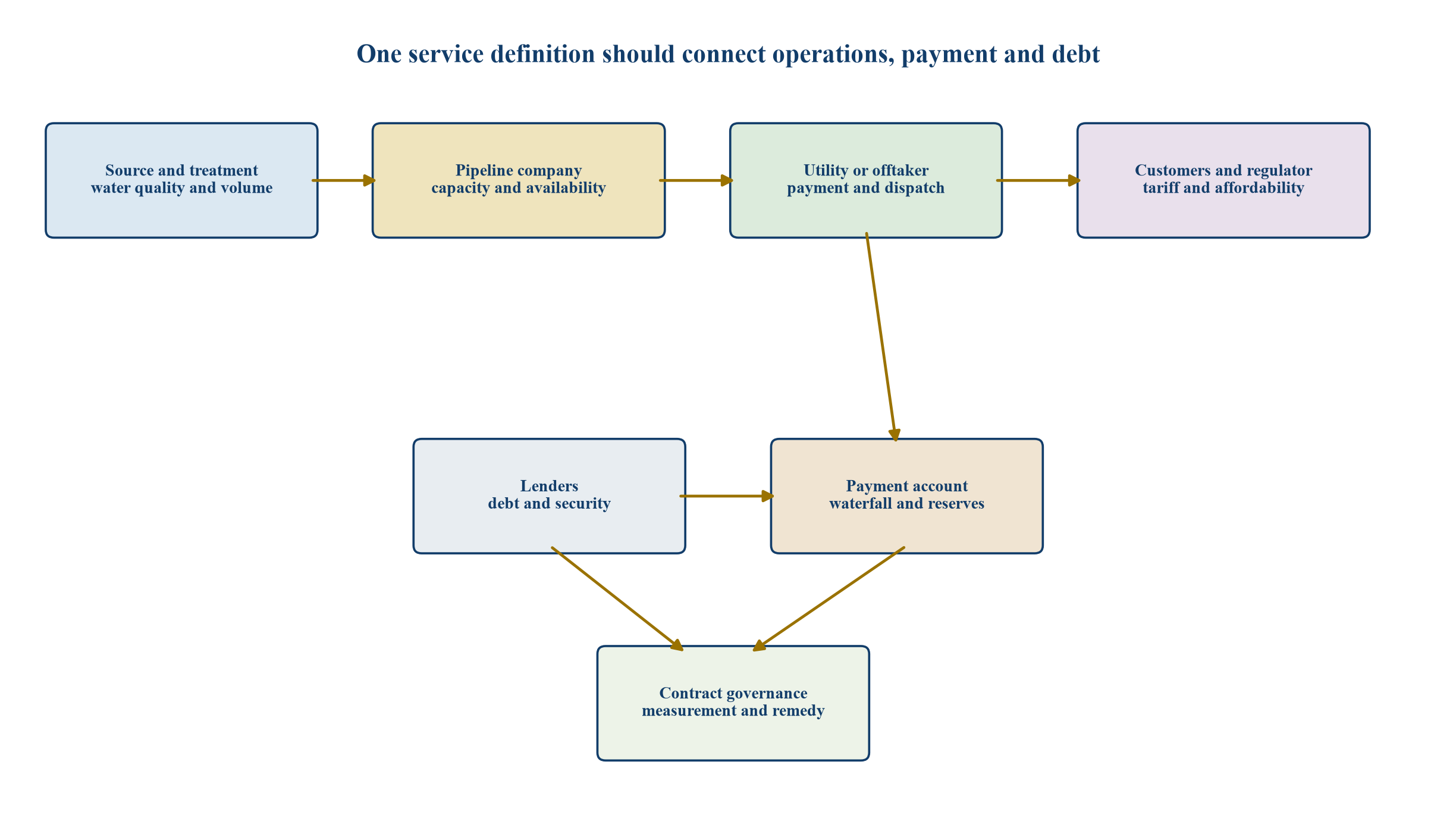
Generic structure; actual roles, security and regulation depend on jurisdiction and project conditions.
5. Choose the operating model
The project may be a concession, build-operate-transfer contract, design-build-operate contract, lease, bulk-supply agreement or regulated network. Labels vary across jurisdictions. Functions and risks should be stated directly.
World Bank guidance distinguishes water concessions, BOT structures, leases, management arrangements and bulk-supply agreements [1][2]. The financing case should follow the actual allocation.
6. Separate funding from financing
Tariffs, taxes, transfers and contractual payments provide funding. Equity and debt provide financing that must be repaid from funding. A financing package cannot cure a permanent funding gap.
The model should show the ultimate payer for capacity, volume, affordability support, expansion and exceptional events.
7. Payment-model choices
A volumetric tariff pays for delivered water. An availability payment pays for compliant capacity or service regardless of actual use. A hybrid combines fixed and variable components.
World Bank guidance notes that availability payments separate remuneration from demand, while usage-based structures transfer or share demand risk [3]. The choice should reflect control and policy.
8. Volumetric tariff
A volumetric tariff can align revenue with water delivered and encourage efficient dispatch. It can also expose fixed infrastructure costs to demand variability.
Debt capacity should use conservative offtake and consider customer concentration, competing supply, conservation, economic cycles and downstream constraints.
9. Availability payment
An availability payment compensates the project when capacity is ready at agreed quality. Deductions apply for unavailability or performance failure.
The structure can support long-term debt when the payer is creditworthy and budget commitments are enforceable. It requires precise service tests and relief rules.
10. Hybrid payment
A hybrid commonly uses a fixed capacity component for capital and fixed operating cost, plus a volumetric component for power, chemicals and variable maintenance. The split should match cost drivers.
The contract should prevent double recovery and state how low dispatch affects asset readiness and lifecycle cost.
11. Take-or-pay
Take-or-pay requires the offtaker to purchase or pay for a minimum volume. It can support debt while preserving a volumetric signal above the floor.
The minimum should align with credible system demand. An unaffordable take-or-pay obligation can create political and counterparty risk.
12. Capacity reservation
Multiple customers can reserve portions of capacity. Reservation charges fund fixed costs; usage charges recover variable cost.
The operator needs rules for unused capacity, secondary allocation, expansion and congestion. Credit quality should be assessed customer by customer.
13. Define availability
Availability can require hydraulic capacity, pressure, water quality, telemetry, redundancy, response time and delivery-point readiness. A pipeline should not be deemed available merely because it is physically intact.
Testing should be objective, reproducible and linked to operational records. Planned maintenance and relief events need separate treatment.
14. Service levels
World Bank contract materials identify service coverage, water quality, pressure, continuity, maintenance and customer service as measurable standards [4]. A bulk pipeline will emphasise delivery and network metrics.
Each metric should have a threshold, measurement source, reporting period, cure process and payment consequence.
15. Water quality interface
The pipeline may receive treated water from another party. The inlet specification should define responsibility for non-compliant feed, contamination, sampling and disposal.
The operator should receive relief when source water causes unavailability outside its control, subject to mitigation and evidence.
16. Source availability
Source shortfall can leave an available pipeline underused. A capacity-based contract should preserve payment when the pipeline remains ready and the source party fails.
If source risk is transferred, the operator needs control or a matching supply contract and compensation.
17. Receiving-network readiness
Downstream storage or distribution failure can prevent delivery. The contract should define deemed delivery, minimum acceptance and coordination.
Meter location and title transfer determine invoicing and loss allocation.
18. Metering
Revenue depends on calibrated custody-transfer meters and reliable data. The protocol should cover installation, ownership, testing, failure, estimated readings and disputes.
Backup measurement protects cash flow when the primary system is unavailable.
19. Network losses
Losses can arise through leakage, bursts, theft, metering or operational releases. The project boundary should identify where losses are measured and tolerated.
Unexplained loss should not automatically reduce payment when the cause sits outside the private network.
20. Dispatch
The offtaker should provide dispatch instructions within agreed capacity and ramping limits. The operator needs a process for conflicting or unsafe instructions.
Low dispatch can affect water age, quality and equipment. Minimum circulation and flushing obligations should be funded.
21. Power
Pumping can be a major variable cost. The contract should state who procures power, bears price risk and manages grid interruption.
A pass-through can protect bankability while preserving efficiency through a benchmark or consumption target.
22. Fixed and variable cost
Fixed costs include staffing, insurance, monitoring, routine maintenance and many corporate costs. Variable costs include power, treatment inputs and usage-related wear.
Payment components should follow these drivers. A fixed asset should not rely entirely on volatile volume.
23. Tariff structure
Tariffs can include connection, capacity, reservation, volume, peak, quality and penalty components. Complexity should correspond to real cost and service drivers.
Transparent design improves customer understanding and lender modelling.
24. Cost recovery
OECD work distinguishes financial, environmental and resource costs in water-service recovery [5]. A project tariff should state which costs it recovers and which remain public obligations.
Under-recovery can defer maintenance and weaken service. Excessive recovery can undermine affordability and legitimacy.
25. Affordability
Affordability support should be targeted and funded explicitly. Suppressing the project payment for all users transfers social policy into credit risk.
OECD analysis supports separating sustainable financing from well-designed affordability measures [6][7].
26. Tariff indexation
Indexation can cover inflation, wages, power, foreign exchange and specified inputs. The formula should use published indices, weights and reset dates.
Caps, floors and sharing bands can balance predictability and value. The contract should address discontinued or distorted indices.
27. Periodic reset
A long contract may require periodic review for efficient cost, capex and demand. The reset mechanism should specify evidence, timetable and decision authority.
An open-ended renegotiation weakens bankability. Unilateral tariff or availability changes are generally unsuitable for financed PPPs [8].
28. Change in law
Changes in technical, environmental, tax, labour or water rules can alter cost. Relief should depend on applicability, materiality, mitigation and insurance.
Discriminatory changes may receive broader protection than general changes.
29. Foreign exchange
Imported equipment or foreign-currency debt can create mismatch against local-currency revenue. Indexation, hedging, reserves or local financing can reduce exposure.
The model should disclose residual mismatch and stress depreciation.
30. Payment security
Payment support can include escrow, reserve accounts, letters of credit, guarantees, direct budget obligations or credit enhancement. The instrument should match payer risk and replenishment timing.
Security that cannot be drawn quickly may not protect debt service.
31. Invoicing
Invoices should show availability, volume, indexation, deductions, pass-throughs and tax. Certification deadlines and deemed approval can prevent administrative delay.
Disputed amounts should not permit withholding of undisputed payment.
32. Payment waterfall
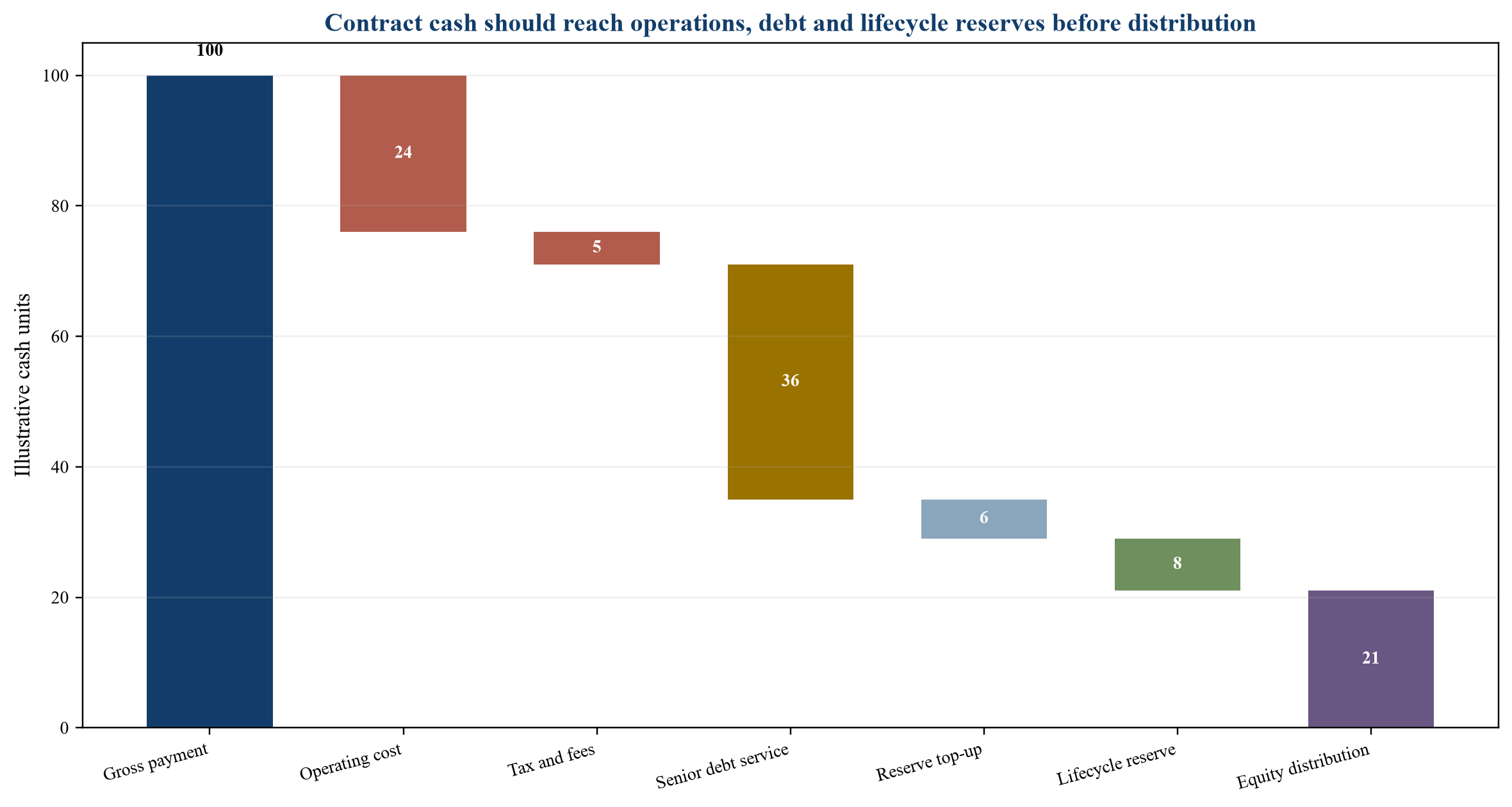
Illustrative percentages only; actual priorities depend on financing documents and law.
33. Deduction regime
Deductions should reflect the severity, duration and affected capacity of failure. They should incentivise performance without creating disproportionate revenue volatility.
Caps can protect financeability, except for prolonged or fundamental default. Repeated failures may trigger escalation.
34. Excused events
Relief can apply to source failure, receiving-network failure, grid outage, authority delay, force majeure and instructed shutdown. The operator should notify, mitigate and provide evidence.
Relief should distinguish time, cost and payment consequences.
35. Planned maintenance
The contract should allow scheduled outages within an annual plan and agreed windows. Excess or poorly coordinated maintenance can attract deductions.
Lifecycle planning should reconcile maintenance windows with system resilience.
36. Emergency operation
Emergency rules should prioritise health, safety, critical customers and system preservation. The operator needs authority to act and recover reasonable cost.
Regular exercises should test communications and decision rights.
37. Performance table
Table 1. Illustrative availability and deduction schedule
| Metric | Standard | Measurement | Illustrative consequence |
|---|---|---|---|
| Hydraulic capacity | Contracted flow at delivery pressure | Meter and test | Pro-rata capacity deduction |
| Water quality | Delivery specification | Accredited sample and online data | Affected-volume rejection and cure |
| Continuity | Available hours | Control-system log | Time-based deduction |
| Metering | Calibrated and redundant | Certification and audit | Estimated reading and correction |
| Response | Mobilisation within agreed time | Incident record | Service deduction |
| Reporting | Complete and timely | Submission register | Capped administrative deduction |
| Repeated failure | Recurrence threshold | Rolling performance record | Escalation, remediation and default review |
38. Construction risk
The project company normally bears design, construction, cost and schedule risks it controls. Relief applies for authority obligations, unforeseeable site conditions where allocated and defined exceptional events.
Completion tests should demonstrate the contracted service, not only mechanical completion.
39. Land and rights of way
Pipeline corridors require land, easements, crossings and access. The contract should allocate acquisition, delay, compensation and continuing access.
Lenders need durable rights for the term and enforcement period.
40. Permits
Responsibility should follow control. The authority may secure sovereign or network approvals; the project company may obtain construction and operating permits.
The conditions precedent should identify permits required before notice to proceed and drawdown.
41. Utility relocation
Unknown services can delay construction and increase cost. Surveys, records, relief thresholds and coordination should be defined.
A broad transfer of unknown-utility risk can increase bid price or reduce competition.
42. Interface risk
Treatment plants, reservoirs, power connections and distribution networks may be delivered by others. Interface agreements should align design, programme, testing and liability.
The pipeline completion date should account for counterpart infrastructure readiness.
43. Operating risk
The operator controls maintenance, staffing, monitoring, spares and emergency response. It should bear ordinary performance risk within the agreed asset condition and input envelope.
Benchmarking should not impose obligations inconsistent with the original design without compensation.
44. Demand risk
Demand risk belongs with the party best able to forecast, aggregate and influence demand. A public utility often controls tariffs, development connections and dispatch.
Private exposure can be appropriate with diversified contracted customers and reliable consumption history.
45. Credit risk
The offtaker may be a utility, municipality, industrial user or special-purpose entity. Credit assessment should include legal capacity, revenue, collections, budget, debt and support.
Payment security should address the actual weakness rather than provide a nominal instrument.
46. Political and regulatory risk
Tariff freezes, licence change, expropriation and payment interference can impair cash flow. The structure can use law, contract, guarantees, insurance and dispute mechanisms.
Risk allocation should remain realistic for the jurisdiction.
47. Environmental and social risk
Route, construction, abstraction, discharge and land access can affect communities and ecosystems. Assessment, consultation, mitigation and monitoring should precede financing.
Non-compliance can delay permits and trigger lender remedies.
48. Climate risk
Flood, heat, drought, wildfire, erosion and changing demand can affect availability. Design standards and operating plans should use current evidence.
The payment contract should distinguish resilience obligations from exceptional events.
49. Insurance
Construction, property, machinery breakdown, business interruption, liability, environmental and political-risk cover may apply. Availability and exclusions should be tested.
Insurance proceeds and reinstatement decisions need a controlled waterfall.
50. Risk-allocation matrix
Table 2. Water-pipeline risk allocation
| Risk | Primary owner | Contract treatment | Lender concern |
|---|---|---|---|
| Design and construction | Project company | Fixed-date completion and tests | Delay and cost contingency |
| Source-water failure | Source party or authority | Deemed availability and relief | Payment continuity |
| Demand | Offtaker under availability model | Capacity payment or minimum offtake | Revenue downside |
| Power price | Allocated by procurement control | Pass-through, benchmark or hedge | Cost volatility |
| Land and sovereign permits | Authority where controlled | Conditions and relief | Completion certainty |
| Operations | Project company | Standards, deductions and cure | Availability stability |
| Change in law | Shared by category | Compensation or tariff adjustment | Unfunded cost |
| Force majeure | Shared | Relief, insurance and termination | Debt recovery |
| Counterparty credit | Offtaker and support provider | Security and direct agreement | Timely payment |
51. Project company
The special-purpose company should hold project contracts, financing and assets or rights. Its permitted business, distributions and additional debt are constrained.
Shareholder support should cover agreed development, equity and contingency obligations.
52. EPC contract
The EPC contract should pass through project-company construction obligations where feasible. Scope, schedule, tests, liquidated damages, security and caps must align.
Gaps between concession and EPC terms remain with the project company.
53. O&M contract
The O&M contract should pass through service standards, reporting, maintenance and deductions. Fees should support adequate staffing and lifecycle performance.
Termination and replacement rights should protect continuous operation.
54. Direct agreement
Lenders commonly require notice, cure and step-in rights before termination. The authority should recognise security and replacement procedures.
Step-in should preserve public-service safeguards and operator qualifications.
55. Security package
Security can cover shares, accounts, receivables, contracts, insurances and movable assets, subject to law and public-asset restrictions.
Enforcement value may depend more on contract continuity than resale of pipeline assets.
56. Term
The contract term should accommodate construction, debt repayment, equity return and asset condition. A term that is too short increases tariff; a very long term requires robust adjustment.
Extension should follow objective conditions rather than compensate routine underperformance.
57. Termination
Termination events should distinguish project-company default, authority default, prolonged force majeure and voluntary authority termination. Compensation should be formula-based.
Lenders focus on recovery of outstanding debt, break cost and transfer mechanics.
58. Handover
Assets may transfer at expiry or remain private. Handover standards, inspection, reserve and rectification should begin well before expiry.
The payment model should fund lifecycle work throughout the term.
59. Dispute resolution
Technical disputes may use an expert; contractual disputes may use courts or arbitration. Interim service and payment obligations should continue where safe.
Fast mechanisms are important for measurement and indexation disputes.
60. Financial model
The model should integrate construction, capex, payment, deductions, opex, tax, debt, reserves and distributions. Assumptions should trace to contracts or evidence.
Observed data, contracted amounts and management estimates should remain distinct.
61. Sources and uses
Table 3. Hypothetical pipeline sources and uses
| Uses | Illustrative amount | Sources | Illustrative amount |
|---|---|---|---|
| Design and construction | 420 | Senior debt | 330 |
| Land and permits | 35 | Sponsor equity | 155 |
| Development and financing | 28 | Public capital contribution | 60 |
| Interest during construction | 42 | ||
| Initial reserves | 20 | ||
| Total | 545 | Total | 545 |
The exhibit is hypothetical and does not describe a project.
62. Debt sizing
Debt should be sized to minimum and average debt-service coverage under downside payment and cost assumptions. Leverage based on full utilisation can be fragile.
The model should test delay, deductions, inflation mismatch, lower demand, higher power, maintenance and refinancing.
63. Debt-service coverage
Coverage equals cash available for debt service divided by scheduled principal and interest. Definitions vary and should match financing documents.
Restricted cash and reserve movements should not obscure operating performance.
64. Coverage sensitivity
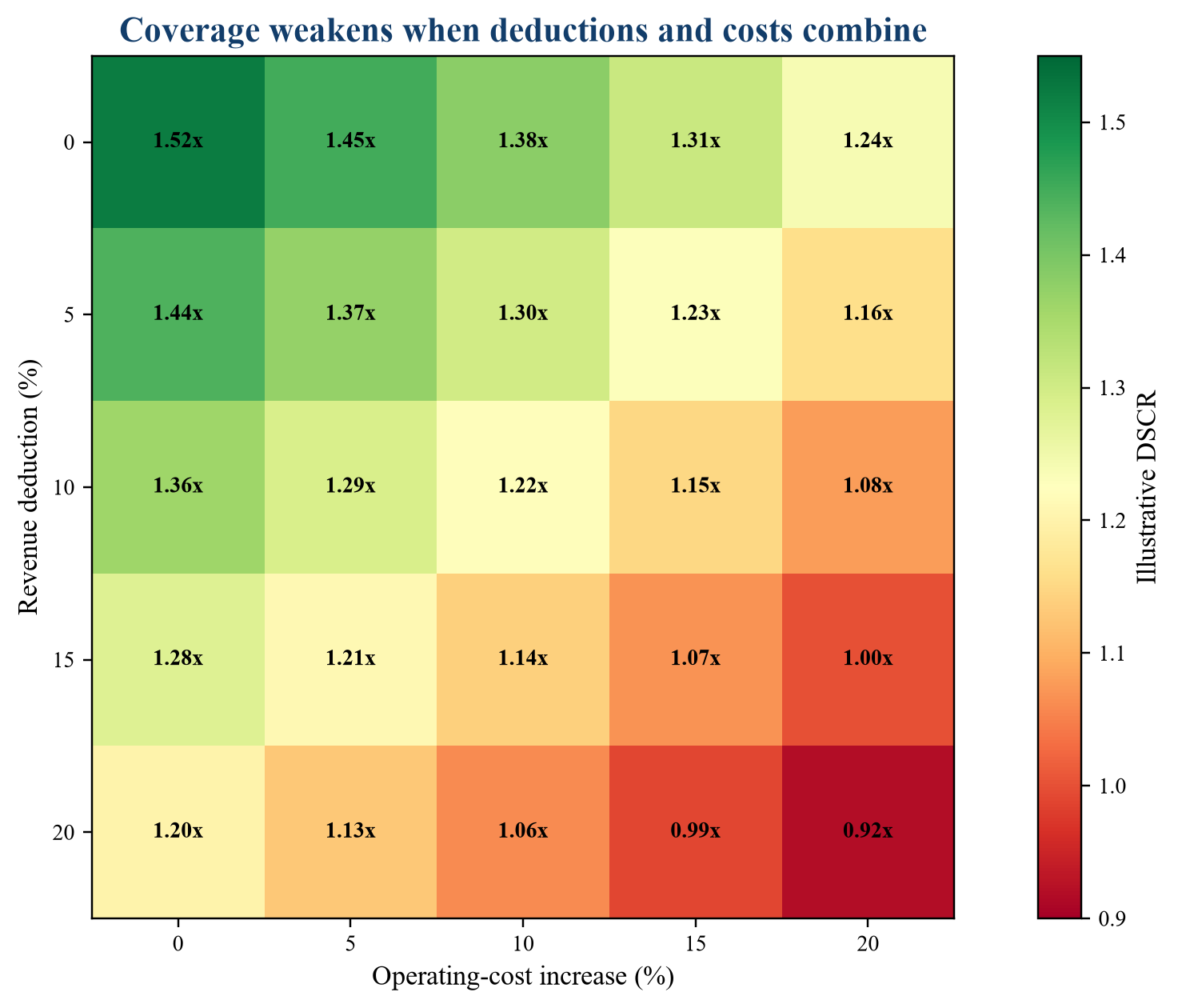
Illustrative values only; this is not a forecast, tariff or financing proposal.
65. Reserve accounts
Debt-service, maintenance, operating and distribution reserves can protect payment timing and lifecycle work. Funding and release rules should be explicit.
Reserves provide liquidity; they do not repair an uneconomic tariff.
66. Sculpting
Debt service can be sculpted to projected cash flow while preserving minimum coverage. The method should use conservative payment and cost assumptions.
Back-ended principal increases exposure to contract and refinancing risk.
67. Interest rate
Fixed, floating and hedged debt create different risk. The contract may not compensate every financing decision.
Hedge terms should align with drawdown, tenor and prepayment.
68. Refinancing
Long construction and operating terms can exceed bank tenor. Refinancing assumptions should be conservative, and gains may be shared.
Mandatory refinancing creates risk if markets are unavailable.
69. Public and concessional finance
EPA's WIFIA programme can support eligible transmission and distribution, desalination, reuse and alternative-water projects, including private borrowers, within programme rules [9][10]. Other jurisdictions provide different facilities.
Concessional finance should address a defined public benefit or risk and remain visible in the model.
70. EIB principles
The European Investment Bank evaluates technical, economic, environmental, social and financial sustainability and emphasises tariff policy and water efficiency [11]. These disciplines apply broadly to investment readiness.
The sponsor should demonstrate asset management and service sustainability alongside construction.
71. Procurement
Bid documents should include service, interfaces, draft contracts, payment, indexation, deductions, land, permits, data and financing requirements. Bidders need a common risk basis.
Evaluation should compare whole-life cost, resilience, financing certainty and departures, not only headline tariff.
72. Competitive dialogue
Market engagement can test bankability, technology and risk appetite before final tender. Confidential treatment and equal information are essential.
Material changes after selection can undermine competition and value.
73. Bid tariff
The bid tariff should be decomposed into capital recovery, fixed opex, variable opex, taxes, reserves and return. This supports evaluation and future adjustment.
An unusually low tariff may reflect optimistic demand, deferred maintenance or contract qualifications.
74. Financial close
Conditions should cover contracts, permits, land, insurance, equity, security, base model and opinions. Each party should know the longstop and consequences.
Early works need a clear funding and termination basis.
75. Construction monitoring
Independent review can monitor progress, cost, quality and drawdown. Reports should identify critical path and contingency.
Payment should follow verified work and financing controls.
76. Completion testing
Tests should demonstrate capacity, pressure, quality, controls, metering, reliability and interface performance. Reliability runs can reveal defects missed by short tests.
Provisional acceptance should retain security for open items.
77. Operating reporting
Monthly reports should show availability, flow, quality, energy, incidents, maintenance, deductions and financial performance. Definitions should reconcile to invoices.
Lenders and authority should receive timely notice of material events.
78. Tariff governance
A regulator, contract administrator or authority may approve tariffs. Ofwat's bulk-supply framework illustrates regulated attention to fair, transparent and predictable charges [12][13].
The project should identify decision rights and appeal routes before financing.
79. Change protocol
Changes need scope, price, time, approval and funding. Emergency changes can use provisional directions followed by valuation.
The operator should not finance authority changes without a credible payment mechanism.
80. Expansion
Network growth may require additional pumps, loops, storage or connections. The contract should define initiation, design, tariff and ownership.
Existing lenders need protection against expansion risk and ranking changes.
81. First 180 days
The development team should define service, map interfaces, establish demand, test routes, identify permits, choose payment structure, assess credit, build the model and consult lenders.
By day 180, material risk owners, security needs and tariff gaps should be visible.
82. Investment committee
The committee should receive the contract map, risk matrix, model, downside coverage, affordability plan, security package and open conditions. Assumptions should identify evidence.
Approval should specify maximum price, leverage, contingencies and stop conditions.
83. Red flags
Red flags include a volumetric tariff for fixed cost without minimum demand, availability undefined, deductions uncapped, indexation mismatched, source risk transferred without control, weak payment security, incomplete rights of way, tariff support without budget and debt sized to full capacity.
Each requires evidence, redesign, protection or reduced commitment.
84. Decision rule
Select the payment model that aligns revenue with controllable service, protects affordability through explicit policy funding and supports debt under downside performance. The contract should remain operable across ordinary variation.
The lowest bid tariff should not override incomplete risk pricing.
85. Build a demand evidence book
Demand should be supported by a customer and system evidence book. It should separate existing consumption, contracted connections, approved developments, policy aspirations and management estimates. Historical demand should be normalised for drought restrictions, outages, unusual industry use and changes in metering. Large customers should be reviewed individually, including their credit, alternative sources, conservation plans, expansion rights and termination provisions.
The evidence book should reconcile the utility demand forecast with source capacity, treatment, storage and downstream distribution. A transmission pipeline cannot monetise demand that another system component cannot serve. Scenario probabilities should remain explicit so that the financing model does not treat aspirational growth as contracted volume.
86. Test payment capacity
Payment capacity should be assessed at both project and ultimate-payer level. A utility may have a legal payment obligation while relying on tariffs, government transfers or a narrow customer base. The review should examine collection, operating margin, debt, capital programme, budget process, tariff authority and historical payment performance.
Where payment support is proposed, the team should confirm provider authority, instrument form, coverage, draw conditions, replenishment, expiry and ranking. A guarantee that covers principal only, expires before debt maturity or requires lengthy administrative approval may provide limited liquidity protection.
87. Translate affordability into a funding plan
Affordability analysis should identify affected customer groups, household or business expenditure, connection cost and the distribution of tariff change. A blended average can hide material hardship. The authority should determine which users require support and which institution funds it.
Targeted subsidy, lifeline volume, social transfer, phased connection contribution or public capital can address different constraints. Each measure should have an eligibility rule, budget source and review process. The project payment should remain contractually visible so that affordability policy does not become an unexplained receivable.
88. Model tariff adequacy over the full term
A tariff that covers first-year debt service may become inadequate as maintenance rises or assets age. The model should include indexation, efficiency, lifecycle capex, reserve funding, tax, insurance and major component replacement. It should also show how the tariff responds when actual inflation differs from the index basket.
The contract should avoid an automatic assumption that future regulators will approve every required increase. Approval conditions, evidence standards, consultation and appeal should be reflected in timing and liquidity. A temporary lag can still create covenant breach even when recovery is ultimately allowed.
89. Design deductions against service economics
The deduction formula should begin with the value and severity of lost service. A localised short interruption should not remove an entire monthly payment. A prolonged loss of critical capacity may justify stronger consequences. Repetition can increase deductions where it indicates systemic underperformance.
The financial model should simulate deductions by cause, duration and affected capacity. It should identify the point at which debt-service coverage, reserve requirements or default thresholds are reached. This enables the authority to preserve performance incentives while avoiding accidental termination through minor administrative failures.
90. Validate lifecycle expenditure
Lifecycle cost should be based on an asset register, condition assumptions, duty cycle, manufacturer guidance and operating experience. Pumps, motors, valves, meters, controls, coatings, cathodic protection and civil assets have different intervention profiles. Deferred expenditure may improve early distributions while transferring risk to later availability and handover.
The contract can require an annual lifecycle plan, reserve contribution, independent review and condition survey. Lenders should test whether reserve release depends on demonstrated completion and whether handover requirements remain funded after scheduled debt maturity.
91. Align the contract suite
The concession, bulk-supply agreement, EPC contract, O&M contract, land rights, source agreement, power arrangement and finance documents should be checked through an obligations matrix. Each material project-company obligation should have a matching subcontract obligation or a deliberate retained risk.
Dates, liability caps, force-majeure definitions, notice periods, tests and termination consequences frequently diverge across documents. The matrix should quantify retained gaps and identify the party funding them. Interface protocols should be executed alongside the main contracts where they are essential to commissioning or operation.
92. Confirm model and contract consistency
Every material financial-model input should carry a source reference to a contract clause, bid assumption or evidence file. Availability, deductions, indexation, tax, pass-through, reserve, termination and refinancing should be modelled using the same definitions that appear in the documents.
An independent model audit can test logic, formulae and consistency. Contract counsel and financial advisers should jointly review the payment schedule and example calculations. Ambiguous drafting discovered after financial close can affect invoicing for decades.
93. Prepare a bankability evidence ledger
The evidence ledger should list each material risk, supporting document, responsible party, status, residual exposure and closing treatment. Items can include source rights, demand commitments, permits, route access, design maturity, payment support, indexation, insurance, contractor security and environmental approvals.
The ledger should distinguish conditions precedent from post-close actions and ordinary monitoring. It provides a traceable record for investment committee, lenders and public approval. Unresolved items should affect price, contingency, leverage, security or the decision to proceed.
94. Operating review after commissioning
The first operating year should compare contracted assumptions with actual flow, availability, energy, leakage, incidents, deductions, collections and maintenance. Differences should update forecasts and operating plans. Early underperformance can require technical intervention before it becomes a long-term financial problem.
The authority and project company should conduct periodic joint reviews without reopening the commercial bargain casually. Formal change mechanisms should handle material new requirements. Transparent operating evidence supports both regulation and refinancing while preserving accountability for the original service commitment.
95. Run a contract stress laboratory
Before signature, the parties should run structured scenarios through operations, payment and finance. Tests should include source interruption, receiving-network rejection, grid outage, meter failure, prolonged low dispatch, contamination, pipe rupture, inflation spike, currency depreciation, authority-payment delay and force majeure. Each scenario should identify notices, operational authority, relief, payment, insurance, reserve use, lender rights and restoration steps.
The exercise should use the actual draft contracts and model rather than a high-level risk register. Participants should calculate an invoice, deduction and cash waterfall for each event. They should identify whether the same event is treated consistently across the concession, source agreement, O&M contract, insurance and finance documents. A scenario that produces two plausible payment outcomes requires drafting repair.
Combined stresses matter. A payment delay during a maintenance outage may consume liquidity faster than either event alone. A power-price increase can coincide with low demand, reducing volumetric revenue while raising pumping cost. The model should test the time to reserve depletion, minimum coverage, covenant cure and default. This helps determine the appropriate reserve, guarantee and distribution lock-up.
The stress laboratory should also test governance. Notices should reach the correct people; data should be available; emergency decisions should have legal authority; and disputed amounts should follow the contract timetable. The output should be a signed action register with drafting, model, operating and financing changes. Repeating the exercise before commissioning can verify that the final operating procedures reflect the financed contract.
96. Financing close checklist
The financing close should use a single checklist owned jointly by the project company, authority and lenders. Corporate items include incorporation, authority, ownership, equity commitments and beneficial-ownership evidence. Project items include executed contracts, land rights, permits, interface agreements, technical schedules, insurance and an agreed base-case model. Finance items include facility agreements, security, accounts, hedging, direct agreements, legal opinions and satisfaction of equity-first or pro-rata funding rules.
Technical conditions should confirm route surveys, design maturity, geotechnical evidence, hydraulic modelling, construction programme, cost estimate, contingency and completion tests. Environmental and social conditions should confirm assessment, approvals, land-access process, stakeholder engagement, management plans and grievance mechanisms. Open obligations should have dated action plans, responsible parties and consequences for drawdown.
The model delivered at close should match the executed tariff, availability test, deduction schedule, indexation, tax, pass-through, reserve and termination provisions. A locked copy and assumption book should be retained. The parties should agree how approved changes enter the model and which version governs covenant calculations. This reduces later disputes about whether an invoice or ratio reflects the contracted economics.
Payment-security instruments should be issued and drawable before debt is funded. Escrow and reserve accounts should be opened with authorised signatories and tested payment instructions. Guarantees should cover the intended obligations, currency and term. Direct agreements should provide notice and cure periods that align with financing documents and public-service continuity.
The closing memorandum should record material qualifications and residual risks. It should identify any item accepted through pricing, contingency, sponsor support, covenant or authority undertaking. A condition waived for timing remains a risk and needs an owner. The first drawdown should occur only after the checklist, evidence ledger and funds-flow statement reconcile.
The close should also establish the first-year governance calendar. It should schedule construction reports, lender reviews, tariff-index observations, insurance renewals, budget submissions, reserve tests and authority approvals. Contact lists and notice addresses should be tested. A document repository should preserve executed versions, technical schedules, certificates and drawdown evidence. These practical controls reduce the risk that a financeable contract loses discipline during construction.
The first disbursement certificate should confirm that the planned use remains within the approved project scope and budget. Cost overruns, delayed equity or unresolved land parcels should be reported before funds move. If a waiver is required, its duration, conditions and financial impact should be recorded. Closing therefore becomes the start of controlled delivery rather than the end of transaction diligence.
97. Conclusion
A private water pipeline becomes financeable when service, risk, payment and lender rights form one coherent system. Availability payments can support fixed infrastructure where the public offtaker controls demand; volumetric tariffs can work with diversified, credible use; hybrids can align fixed and variable cost.
The strongest structure defines interfaces, measures performance, applies proportionate deductions, preserves tariff adjustment, secures payment and sizes debt to downside cash flow. Affordability support should be transparent and funded. This discipline turns a physical corridor into a durable water service and an auditable financing proposition.
References
- World Bank PPP Resource Center. Water and Sanitation PPPs. https://ppp.worldbank.org/water-and-sanitation/water-sanitation-ppps
- World Bank PPP Resource Center. Water and Sanitation Agreements. https://ppp.worldbank.org/sector/water-sanitation/water-agreements
- World Bank PPP Resource Center. Payment Mechanism. https://ppp.worldbank.org/payment-mechanism
- World Bank PPP Resource Center. Performance Contract for Water Supply and Sewerage Authorities. https://ppp.worldbank.org/library/performance-contract-water-supply-and-sewerage-authorities
- OECD. Cost Recovery for Water Services under the Water Framework Directive. https://www.oecd.org/en/publications/cost-recovery-for-water-services-under-the-water-framework-directive_e2a363e3-en.html
- OECD. Financing Water Security: Models and Approaches for Investments that Last. https://www.oecd.org/en/publications/financing-water-security_7cf3f5bd-en.html
- OECD. Financing Water Supply, Sanitation and Flood Protection. https://www.oecd.org/en/publications/financing-water-supply-sanitation-and-flood-protection_6893cdac-en.html
- World Bank PPP Resource Center. Regular Adjustments. https://ppp.worldbank.org/regular-adjustments
- United States Environmental Protection Agency. What is WIFIA? https://www.epa.gov/wifia/what-wifia
- United States Environmental Protection Agency. WIFIA Eligibility. https://www.epa.gov/wifia/wifia-eligibility
- European Investment Bank. Water Sector Lending Orientation. https://www.eib.org/attachments/strategies/eib_water_sector_lending_orientation_en.pdf
- Ofwat. Charging. https://www.ofwat.gov.uk/regulated-companies/company-obligations/ofwat-regulating-the-industry-compliance-requirements-charging/
- Ofwat. Bulk Supply Agreements. https://www.ofwat.gov.uk/regulated-companies/markets/nav-market/bulk-supply-agreements/
- World Bank PPP Resource Center. Structuring the PPP Contract. https://ppp.worldbank.org/structuring-ppp-contract
- World Bank. Approaches to Private Participation in Water Services. https://ppp.worldbank.org/sites/default/files/2024-09/ApproachestoPrivateParticipationWaterServices.pdf
- OECD. Financing a Water Secure Future: The Challenge of Financing Water-related Investments. https://www.oecd.org/en/publications/financing-a-water-secure-future_a2ecb261-en/full-report/component-7.html
About the Author
Chennakeshav (CK) is a corporate finance and investment banking executive with 25+ years of global experience in deal origination, structuring and execution across M&A, growth capital and corporate strategy. He has led value-creation mandates for founders, corporates and funds — bridging the boardroom view to hands-on execution and close.
His career spans Morgan Stanley, HSBC, Lloyds Banking Group, EWEC, ADQ portfolio companies and Emirates Growth Fund, across TMT, real estate, fintech, deeptech, cleantech, infrastructure and energy. He has partnered with C-suite leaders, private equity and venture funds, sovereign wealth funds and family offices to finance complex fund raises and scale-up ventures, and has led M&A due diligence, post-merger integration and business-transformation initiatives to create value.
At Matchpoint Partners he is Managing Partner, leading the firm's corporate finance, M&A and capital-raising practice. He holds an MBA from London Business School, an engineering degree from VTU and a Master of Laws (LLM, in progress) from UCL London.
An active start-up mentor, CK mentors at Techstars, DIFC FinTech Hive, Startup Grind, Founder Institute and IN5, serves as Entrepreneur Mentor in Residence (EMiR) at London Business School, and judges the Entrepreneurship World Cup.
LinkedIn: https://www.linkedin.com/in/ckadya/
Profile: https://www.matchpoint-partners.com/team/ck-adya.html
