
Introduction
Cooling has moved closer to the processor. Air remains important for many workloads, but dense accelerators increasingly require heat to be collected at the chip, moved through a technology cooling loop and rejected through facility infrastructure. That chain introduces new products, interfaces and responsibilities. A leak, contaminated loop, inadequate control sequence or mismatched heat exchanger can affect expensive computing equipment and delay customer acceptance.
Recent acquisitions show how industrial and data-centre infrastructure companies are assembling end-to-end thermal portfolios. Schneider Electric acquired a controlling interest in Motivair. Trane Technologies announced an agreement to acquire LiquidStack after an earlier minority investment. Vertiv acquired ThermoKey and PurgeRite to expand heat-rejection capacity and thermal services. Public filings describe wider portfolios that combine chillers, dry coolers, rear-door heat exchangers, coolant distribution units, immersion systems, controls, monitoring and maintenance.
The acquisition question is specific: how much of a target's apparent growth deserves to be capitalised, and what evidence supports a premium? A buyer needs to separate qualified capability from early demonstrations, durable gross profit from project revenue, and scalable manufacturing from working-capital strain. The decision also requires a realistic view of product liability, coolant and refrigerant regulation, customer concentration, service obligations and integration cost.
1 Define the acquisition thesis
The investment committee should state which gap the transaction closes. The target may provide a missing chip interface, a coolant distribution platform, immersion expertise, heat-rejection equipment, controls, commissioning, field service or regional manufacturing. Each thesis has a different value driver. A technology acquisition can depend on intellectual property and design wins. A capacity acquisition can depend on factories, test laboratories and supplier relationships. A service acquisition can depend on technicians, installed systems and recurring maintenance.
The thesis should identify the customer, workload and density range that the combined company expects to serve. It should also state whether the buyer intends to sell components, integrated systems or a lifecycle service. The answer determines which interfaces, warranties and commercial responsibilities the buyer will assume.
Management should define decline conditions before price negotiations advance. Examples include unverified qualification claims, dependence on one customer programme, margins created by temporary expedite charges, insufficient cash to support growth, unresolved fluid or refrigerant exposure, and a warranty history that the target cannot explain. A strategic fit cannot compensate for evidence that the product is unsafe, unqualified or commercially fragile.
2 Map the thermal chain
The thermal chain begins at the heat-generating component. A cold plate transfers heat from a processor into a working fluid. Manifolds and hoses distribute that fluid through a rack. A coolant distribution unit isolates and manages the technology loop while exchanging heat with a facility loop. Pumps, sensors, controls and water-treatment systems maintain flow, temperature, pressure and cleanliness. Chillers, dry coolers or cooling towers reject heat outside the building. Software, commissioning and service connect the physical layers.
Immersion changes the chip interface. Electronic equipment is placed in dielectric fluid, either in a single-phase system where the fluid remains liquid or a two-phase system where boiling and condensation move heat. Rear-door heat exchangers remain indirect liquid cooling because air carries heat from the IT equipment to the liquid-filled door. Hybrid facilities can use cold plates for high-power devices and air for remaining components.
This map establishes the transaction perimeter. A target that owns one component may still influence the reliability of the entire system. Diligence should identify every technical boundary, the owner of the design calculation, the party responsible for commissioning, and the contractual allocation when system performance falls short.
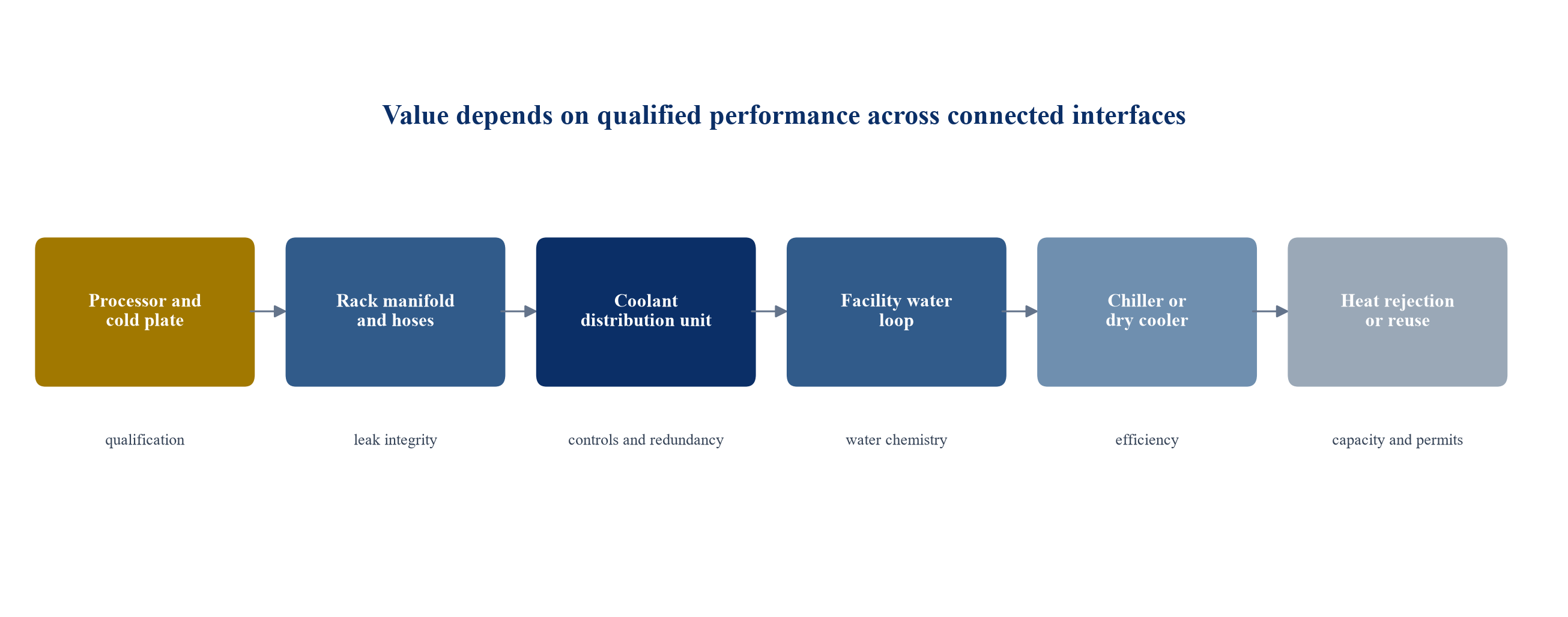
This author-developed diagram shows a general architecture. Actual systems vary by equipment, coolant, facility design and operating conditions.
3 Distinguish the cooling technologies
Cold-plate cooling places a liquid-cooled metal assembly on selected heat-generating components. It can support high heat flux while retaining familiar rack formats. The system still contains pumps, couplings, manifolds, controls and facility interfaces. Qualification must address flow distribution, pressure drop, materials compatibility, thermal interface performance and leak detection.
Single-phase immersion places equipment in an electrically insulating fluid that remains liquid. Heat is carried to a heat exchanger without a phase change. Two-phase immersion uses fluid boiling and condensation. The two designs have different fluid management, containment, maintenance, safety and regulatory considerations. A buyer should avoid treating immersion as one uniform market.
Rear-door heat exchangers and liquid-to-air units can help retrofit facilities that retain air-cooled servers. Chillers, dry coolers and evaporative systems determine the final energy and water outcome. A target can produce an efficient chip-level device while the whole installation consumes more energy or water because of facility conditions. Product valuation therefore requires a defined system boundary and comparable operating assumptions.
4 Identify the acquired asset
A cooling target can contain several economic assets. Patents and trade secrets can protect cold-plate geometry, flow control, dielectric fluids or control algorithms. Engineering files and test data can shorten qualification. Design wins and approved-vendor status can create access to future platforms. Factories and test laboratories can provide scarce capacity. Field technicians and commissioning procedures can protect operating performance. Customer and supplier relationships can reduce commercial friction.
The buyer should construct an asset register that links each claimed advantage to ownership, transferability and evidence. An employee's undocumented knowledge has different durability from controlled drawings and validated test reports. A customer trial differs from a production award. A patent application differs from freedom to operate. A contract manufacturer differs from owned capacity.
The register should also identify dependencies. A proprietary cold plate can rely on a third-party pump, connector, coating or coolant. A control platform can rely on customer data and licences. A manufacturing process can depend on one specialist supplier. These dependencies affect both price and the integration plan.
5 Test product qualification
Qualification evidence deserves a central place in valuation. The buyer should obtain test protocols, environmental conditions, pass criteria, failure records, corrective actions and customer acceptance. Tests should cover thermal performance, pressure, vibration, corrosion, contamination, materials compatibility, leak integrity, electrical safety, maintainability and expected life. Results should be traceable to the production design rather than an engineering prototype.
The commercial meaning of qualification must be clear. Approval for a laboratory trial does not establish approval for production. Approval for one processor generation may not transfer to the next. A design win can be conditional on cost, capacity, schedule or final system validation. The buyer should confirm the programme, customer, volume, duration and right to reference the relationship.
Qualification should be linked to revenue recognition and backlog. Orders subject to acceptance, cancellation or redesign require different valuation treatment from shipped and accepted production. A premium should reflect evidence that the target can repeat qualification across customers and compute generations.
6 Review the engineering evidence
Technical diligence should reproduce the target's design basis. Reviewers need heat-load assumptions, inlet temperatures, flow rates, pressure drops, pump curves, heat-exchanger approach temperatures, redundancy, controls and failure modes. The review should reconcile component performance with rack and facility performance. A system can meet average heat removal while failing local temperature or transient conditions.
Reliability evidence should include accelerated-life tests, field hours, mean time between failures where available, leak events, coolant analysis and repair history. Management estimates should remain identified as estimates. A small installed base cannot support a mature-field-failure assumption without a transparent statistical basis.
The buyer should inspect configuration control. Engineering changes need version history, approval and traceability into bills of material and customer deliveries. Rapid product development can create undocumented variants that complicate warranties and spares. A disciplined configuration process can become a valuable integration asset because it connects design, manufacturing, service and customer evidence.
7 Evaluate intellectual property
The intellectual-property review should identify patents, applications, trade secrets, software, test methods, drawings and employee-created know-how. Ownership must be supported by assignments from founders, employees, contractors and universities. Licences should permit the planned products, geographies and change of control. Open-source software requires a separate licence review.
Freedom to operate is distinct from ownership. A target may own improvements while relying on a field crowded with third-party patents. Counsel and technical experts should map important claims against the current product. The analysis should include threatened disputes, design-around options and the commercial cost of a licence.
Trade-secret value depends on controls. Access restrictions, confidentiality terms, repository logs and exit procedures matter. A process known across suppliers can have limited secrecy. The buyer should also test whether key knowledge sits only with employees whose retention remains uncertain. Price allocation should reflect the legal and operational durability of the acquired capability.
8 Analyse the customer base
Cooling revenue can be concentrated in hyperscalers, server manufacturers, original equipment manufacturers and a small group of data-centre developers. A large customer can accelerate qualification and scale while also controlling price, warranty terms and product changes. The buyer should analyse concentration by customer, programme, end user, facility, platform and region.
The revenue bridge should distinguish engineering fees, prototypes, initial production, repeat production, spares, service and pass-through equipment. It should identify customer-funded tooling and obligations attached to it. Backlog should be reconciled to enforceable purchase orders, delivery schedules, cancellation rights and customer forecasts.
Reference rights matter commercially. Confidential programmes can demonstrate capability internally while providing limited external marketing value. The buyer should verify which relationships can be disclosed, transferred and expanded. Cross-selling assumptions should be based on customer-level opportunities and procurement evidence rather than a percentage applied to the whole buyer base.
9 Separate design wins from revenue
A design win can signal technical acceptance, but it does not by itself establish volume or margin. The customer may dual-source. The compute platform may be delayed. The cooling specification may change. The target may need to fund tooling and inventory before revenue. Diligence should therefore create a probability-weighted schedule for each programme.
The schedule should show qualification stage, expected production start, customer commitment, units, price, gross margin, capital requirement and cancellation terms. Historical conversion from trial to production provides useful context when the sample is sufficiently comparable. Management forecasts should be separated from contracted orders.
Revenue recognised during engineering and pilot phases can be non-recurring even when it carries a high margin. Production revenue can grow rapidly with lower margin and greater working-capital needs. The valuation model should capitalise maintainable economics after those transitions rather than current growth alone.
10 Normalise gross profit
Gross profit is often more informative than revenue for a mixed cooling target. Project revenue can include bought-in equipment, installation and freight that increase sales with limited value creation. Proprietary products can carry stronger margin while requiring engineering and warranty support. Services can be recurring or episodic depending on the contract.
The buyer should restate gross profit by product, customer and programme. Expedite charges, prototype pricing, supplier rebates, warranty recoveries, inventory releases and under-absorbed factory costs require separate treatment. Changes in standard cost should be reconciled to purchase prices, labour, scrap and utilisation.
The maintainable gross-profit bridge should include the cost of quality, field service, application engineering and customer-specific support. Those costs may sit below gross profit in the target's accounts. Acquisition valuation should use an operating definition that reflects the resources required to deliver and sustain the product.
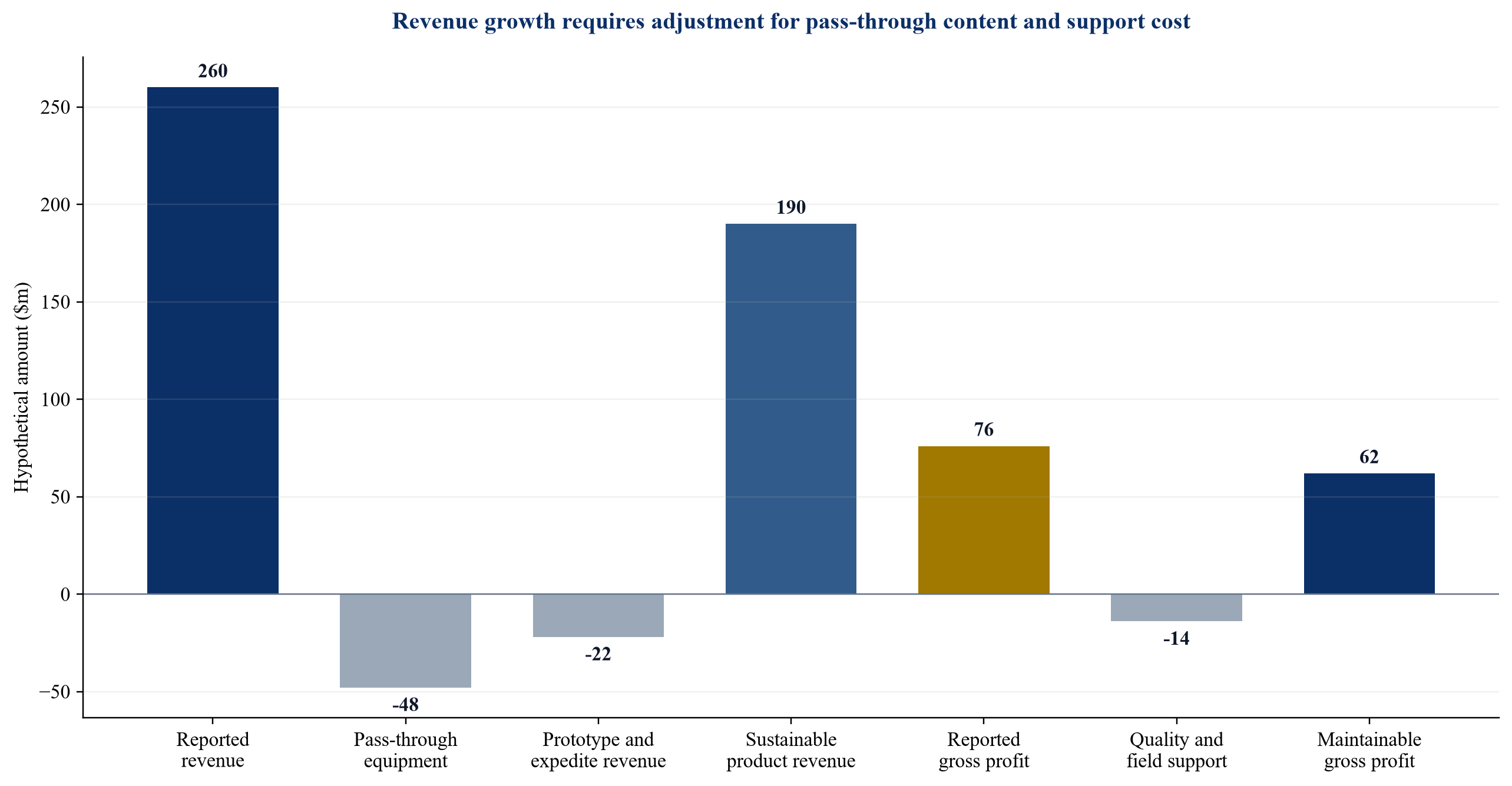
Values are hypothetical author-developed assumptions in US dollars millions. They do not describe a company, transaction or forecast.
11 Test pricing power
Pricing power requires evidence that customers value the target's performance, reliability, qualification or delivery capability. The buyer should examine historical price changes, bid outcomes, sole-source periods, redesign costs and contractual indexation. A high price during a capacity shortage can decline when competitors qualify.
The analysis should separate product value from programme urgency. Expedited engineering and scarce components can create temporary premiums. A customer may accept them during a rapid AI deployment and renegotiate after supply expands. Multi-year agreements should be reviewed for price-downs, productivity commitments and most-favoured-customer terms.
Technical differentiation can support pricing when it reduces total facility cost, improves compute density or preserves uptime. Those benefits need a measurement boundary and customer evidence. A component supplier should avoid claiming the full data-centre efficiency benefit when facility design and operations determine much of the outcome.
12 Examine the installed base
An installed base can support spares, service, monitoring, upgrades and customer access. Its value depends on asset records and contractual rights. The buyer should reconcile serial numbers, location, configuration, commissioning date, warranty, service history and responsible customer entity. Units shipped through distributors can be difficult to trace.
Service attachment should be measured by cohort. The analysis should show how many systems remain active, how many carry a service contract, renewal rates, average revenue and gross profit. Warranty work should not be counted as recurring service. Remote monitoring can create useful data, subject to customer consent, cybersecurity and data ownership.
The installed base also creates liabilities. Older designs can require parts, fluid management and field support for years. A product withdrawal, leak event or component obsolescence can concentrate cost. Valuation should include both the recurring opportunity and the lifecycle obligation.
13 Assess manufacturing capacity
Manufacturing diligence should establish what the target actually makes. Cold plates can require precision machining, brazing, surface treatment, cleaning and leak testing. Coolant distribution units can require pumps, heat exchangers, electrical panels, controls and system testing. Immersion tanks can require fabrication, seals, fluid handling and integration. Chillers and dry coolers add compressors, coils, fans, refrigerants and substantial factory infrastructure.
The buyer should measure rated and demonstrated capacity by process. Bottlenecks can sit in testing, skilled labour, supplier tooling or customer inspection rather than floor space. Yield, rework, scrap and first-pass test data should be reviewed by product and site.
Capacity claims should include the capital, people and working capital needed to reach them. A new factory can provide strategic value while operating below efficient utilisation. The integration plan should identify which processes remain local, which can transfer to buyer sites, and how customer requalification will be managed after a transfer.
14 Review the supply chain
Critical suppliers can include pumps, heat exchangers, quick disconnects, sensors, controllers, seals, coatings, compressors, fans, chips and specialty fluids. The buyer should identify single-source items, lead times, minimum orders, tooling ownership, quality history and change-notification rights. Substitution can require a new qualification cycle.
Supplier concentration should be tested against customer commitments. A target can show a strong backlog while lacking secured components. Purchase commitments may be non-cancellable even when customer forecasts remain cancellable. That mismatch can create inventory and cash risk.
Materials compatibility deserves specific attention. Coolants, elastomers, metals, coatings and contaminants interact over time. A component change can alter corrosion or leak performance. Supplier quality agreements should preserve traceability and corrective-action rights. The buyer should confirm that incoming inspection and test procedures are sufficient for the claimed reliability.
15 Model working capital
Cooling growth can consume cash before it generates earnings. Long-lead components require deposits. Work in progress can remain in testing. Customers can hold payment until acceptance. Warranty reserves and spares add further requirements. The buyer should build a monthly cash-conversion model by programme.
Receivables should be tested for acceptance conditions, disputes, retainage and concentration. Inventory should be divided into standard parts, customer-specific material, work in progress, finished goods and spares. Excess and obsolete provisions should reflect processor generations and design changes. Payables should identify overdue balances and supplier financing.
Purchase-price discussions often focus on debt and cash while leaving working-capital definitions until late. The agreement should use a target level consistent with the forecast operating state. A fast-growing target delivered with inadequate inventory or unpaid suppliers transfers a funding need to the buyer. That need should be reflected in price and closing mechanics.
16 Evaluate service capability
Liquid cooling expands the need for commissioning, water treatment, flushing, monitoring, maintenance and rapid field response. A buyer should identify the competencies required at each stage and compare them with the target's employed workforce and partner network. Technician location, certification, response time and spare-parts availability affect the value of product revenue.
Service contracts should specify scope, response, exclusions, pricing, escalation and liability. Monitoring contracts should address data rights, cybersecurity and customer access. The buyer should reconcile service revenue to active systems and labour capacity.
An acquisition can create value by combining target technology with the buyer's global service network. Integration cost can also be substantial. Training, diagnostic tools, parts, call-centre procedures and insurance must be ready before the combined company promises wider coverage. The valuation case should phase cross-selling according to this operational readiness.
17 Analyse warranty and product liability
Warranty diligence should begin with claims data, failure modes, field actions and reserves. Cooling failures can damage computing equipment, interrupt operations or cause environmental and safety concerns. Contractual limits can reduce exposure, subject to law, insurance, customer leverage and the nature of a failure.
The buyer should compare warranty terms across customers and products. Extended warranties, uptime commitments, liquid-damage exclusions and consequential-loss waivers can vary. Supplier recourse should be matched to customer obligations. A target can carry a broad customer warranty while receiving a narrow component warranty.
Reserve adequacy requires claims frequency, severity, installed population and maturation. Recent products may not have completed a full life cycle. The model should use scenario ranges rather than assuming current claims represent mature experience. Known corrective actions, redesigns and retrofit campaigns should be valued separately from ordinary warranty.
18 Verify coolant and fluid exposure
Cooling fluids influence thermal performance, electrical properties, materials compatibility, maintenance and environmental exposure. Cold-plate loops can use water-based or other fluids subject to chemistry and contamination controls. Immersion requires dielectric fluid selected for the system. Two-phase designs can rely on specialised fluids with distinct containment and regulatory issues.
The buyer should obtain fluid specifications, supplier contracts, safety data, lifecycle procedures, compatibility tests and disposal requirements. It should determine whether customers or the target provide the fluid and who bears replacement cost. Long-term availability and price matter because an installed base can remain dependent on one formulation.
Regulatory review should cover applicable restrictions on the relevant substances. General references to environmental benefit are insufficient. The transaction model should include redesign, requalification or customer retrofit where a material fluid becomes restricted or unavailable.
19 Review refrigerants and heat rejection
Chillers and other refrigeration equipment introduce refrigerant regulation, leak management, service capability and redesign risk. Buyers should map product configurations by refrigerant, jurisdiction and installed base. They should assess global-warming potential, availability, safety classification, technician capability and compliance schedules.
Heat rejection choices also affect energy, water and site approval. Dry coolers can reduce on-site water consumption while operating differently across ambient conditions. Evaporative systems can improve energy performance in suitable climates while consuming water. Hybrid systems seek a controlled balance. The best choice depends on climate, water availability, electricity, load profile and facility temperatures.
The valuation case should therefore avoid assigning one universal efficiency premium. It should value the target's ability to design and control options across sites. A broad heat-rejection portfolio can create strategic value when supported by engineering, manufacturing and commissioning capability.
20 Measure water efficiency
Water efficiency needs a defined metric and boundary. European reporting rules use Water Usage Effectiveness as total water input divided by IT energy. The rules also require reporting of potable water input and recognise waste heat reuse. These metrics can affect customer requirements, permitting and public disclosure.
The buyer should test each product claim against a baseline facility and climate. Moving from evaporative heat rejection to a dry or refrigerant-based system can reduce water use and change energy consumption. A liquid-cooled rack can reduce room-air requirements while the facility's final heat rejection still determines water use.
Commercial diligence should identify where water constraints influence procurement. Contracts can require measured performance, while marketing claims may rely on simulations. The buyer should value verified data, measurement capability and control software that allow customers to manage the tradeoff. Unverified percentage claims should not support a premium.
21 Test energy performance
Energy performance depends on the full thermal chain. Higher coolant temperatures can increase economiser hours and reduce chiller work. Pump power rises with flow and pressure drop. Fans can decline when more heat moves through liquid. Controls determine whether equipment operates near efficient points. Heat reuse can create value only where a practical user and temperature level exist.
The US Department of Energy's data-centre design guide discusses chilled-water temperatures, economisers, pumping and direct liquid cooling as connected design choices. The buyer should use similar system-level analysis. Component coefficients tested in a laboratory should be reconciled to installed conditions.
Performance guarantees need clear boundaries, sensors and adjustment methods. The buyer should review commissioning reports and operating data rather than relying on a design simulation. Where data remain limited, the valuation should use conservative adoption and warranty assumptions.
22 Review controls and software
Controls manage pumps, valves, temperatures, pressure, alarms, redundancy and interaction with building systems. Software can improve reliability and service economics, but it can also create cybersecurity and integration risk. The buyer should inventory source code, licences, protocols, data models, cloud dependencies and supported versions.
The review should test failure behaviour. Cooling must remain safe when a sensor, controller, network or cloud service fails. Manual override, local control and alarm escalation need evidence. Cybersecurity controls should cover remote access, credentials, updates, logging and incident response.
Software revenue requires separate quality-of-earnings analysis. A monitoring fee tied to active assets differs from a perpetual licence or project configuration charge. The buyer should verify recurring contracts, retention, support cost and ownership of customer data. Integration value depends on compatibility with the buyer's power, building and service platforms.
23 Assess standards and interoperability
Open Compute Project requirements distinguish cold-plate, immersion and indirect liquid cooling and provide technical guidance on loops and interfaces. ASHRAE publications address liquid cooling, facility water systems and thermal conditions. These resources help a buyer test whether the target's terminology and design evidence align with recognised practice.
Interoperability can influence adoption. Customers may prefer standard connectors, fluids, control protocols and service procedures to reduce lock-in. Proprietary designs can create differentiation while increasing switching and qualification cost. The commercial value depends on the customer's architecture and procurement strategy.
The buyer should map each product to applicable standards, certifications and customer specifications. Gaps require a costed plan. A statement that a product was designed with reference to a standard differs from certification or independent test evidence. Transaction documents should allocate responsibility for undisclosed non-compliance.
24 Evaluate geographic expansion
Cooling equipment crosses regulatory, climate and service environments. A system designed for one water quality, ambient temperature or electrical standard may require changes elsewhere. Customs, local content, refrigerant rules, pressure-equipment requirements and certifications can affect timing and margin.
Regional manufacturing can shorten delivery and support qualification. Schneider Electric's 2026 Bengaluru liquid-cooling factory announcement described a third global production site. Vertiv's ThermoKey transaction emphasised EMEA manufacturing and heat-rejection capabilities. These announcements illustrate the strategic role of capacity and location, while each buyer must verify actual economics.
Expansion value should be built from product-by-region readiness. The model should include certification, engineering, tooling, supplier development, inventory, service and customer qualification. A global sales network creates access; it does not remove the operational work needed to deliver.
25 Analyse competition
Competition includes integrated infrastructure companies, HVAC manufacturers, server companies, cooling specialists and engineering businesses. The buyer should compare thermal coverage, qualification, capacity, service and installed base. Public filings show broad portfolio expansion, while customer win-loss evidence remains the stronger basis for target-specific positioning. Market-size estimates should identify definition and overlap because a target can address only one component or customer segment.
26 Build the valuation bridge
The valuation should begin with maintainable earnings or gross profit supported by customer and programme evidence. It should then separate strategic value from standalone value. Strategic value can include faster time to market, cross-selling, manufacturing access, service attachment, procurement savings and avoided internal development. Each item needs an owner, investment plan, timing and probability.
Risks should be translated into explicit adjustments. Customer concentration can affect the multiple or earn-out structure. Working-capital needs reduce cash value. Warranty exposure can require an escrow or specific indemnity. Fluid or refrigerant redesign can reduce price or create contingent consideration. Key-person dependency can affect retention and vesting.
The valuation range should reconcile market, income and asset perspectives where appropriate. Transaction multiples can provide context only after adjusting for perimeter, growth, margin, recurring revenue, control and date. The disclosed Motivair consideration and expected revenue multiple provide one transaction data point with a specific stake, date and strategic context.
Table 1. Technology and commercial diligence matrix
| Layer | Evidence to verify | Value driver | Principal downside |
|---|---|---|---|
| Cold plates | Thermal maps, pressure tests, materials, qualification and field data | Design wins and high-density capability | Leak, corrosion, redesign or platform change |
| Manifolds and couplings | Flow balance, connector cycles, contamination and supplier quality | Repeatable rack integration | Single-source component or field failure |
| Coolant distribution units | Capacity, redundancy, controls, heat exchanger and test results | Scalable system platform and service | Control failure, insufficient capacity or warranty |
| Immersion | Fluid, tank, heat exchanger, maintenance and safety evidence | Differentiated high-density solution | Fluid restriction, customer workflow or limited adoption |
| Facility cooling | Chillers, dry coolers, heat rejection, climate curves and commissioning | Larger addressable scope and system optimisation | Capital intensity, refrigerant and site dependence |
| Software and controls | Source ownership, protocols, local fail-safe, cyber controls and contracts | Monitoring, optimisation and recurring service | Integration, support burden or cyber incident |
| Field service | Installed-base register, technician coverage, response and parts | Recurring gross profit and customer retention | Understaffing, warranty workload or geographic gaps |
| Manufacturing | Demonstrated throughput, yield, tests, suppliers and capex | Delivery capacity and margin control | Working capital, bottlenecks or requalification |
This author-developed matrix identifies evidence relevant to an acquisition. It does not replace engineering, legal, environmental or financial advice.
27 Adjust earnings quality
Quality-of-earnings work should align the financial statements with the operating evidence. Revenue cut-off depends on delivery and acceptance terms. Contract assets can contain unbilled engineering or milestone amounts. Customer deposits can fund inventory while creating performance obligations. Capitalised development can shift expense into assets.
The review should identify non-recurring prototype work, founder compensation, grants, litigation, start-up factory costs and unusual supplier recoveries. It should also add the cost of functions needed as a standalone or integrated business, including quality, cybersecurity, compliance and service.
Forecast adjustments should be linked to programme evidence. A pipeline percentage is not a substitute for customer-level probability. Synergies should be shown after integration cost, customer consent and capacity constraints. The table below converts common findings into valuation treatment.
Table 2. Earnings-quality and purchase-price adjustments
| Finding | Diligence question | Possible valuation treatment |
|---|---|---|
| Prototype revenue | Will it repeat, and what engineering capacity did it consume? | Exclude from maintainable revenue or value separately |
| Pass-through equipment | How much gross profit and risk does the target retain? | Emphasise gross profit rather than headline revenue |
| Customer concentration | Are volumes committed and terms transferable? | Lower multiple, earn-out or customer-specific condition |
| Understated warranty | Does the reserve reflect installed population and product age? | Debt-like adjustment, escrow or indemnity |
| Growth inventory | Is stock standard, current and supported by orders? | Normalise working capital and impair obsolete items |
| Capitalised development | Which costs meet policy and create usable assets? | Restate earnings and test asset value |
| Factory ramp | What cost and time are required for qualified capacity? | Deduct capex and operating losses from synergy value |
| Key-person dependency | Can knowledge and relationships transfer? | Retention pool, vesting and contingent consideration |
| Fluid or refrigerant exposure | Is redesign or requalification probable? | Scenario deduction, covenant or specific protection |
| Service obligation | Does installed revenue fund lifecycle support? | Add missing cost or value recurring contracts separately |
The treatment is an author-developed analytical guide. Transaction-specific accounting, tax and legal advice is required.
28 Model valuation sensitivities
The valuation model should show how price changes when qualified recurring gross profit, concentration, margin and integration risk change. A high revenue multiple can obscure weak gross-profit conversion or substantial cash needs. A gross-profit framework can improve comparability across component, systems and service businesses.
The hypothetical sensitivity below applies a range of enterprise-value multiples to qualified recurring gross profit, then applies an integration-risk deduction. It is an analytical example only. A real valuation requires forecast cash flow, comparable-company and transaction analysis, balance-sheet adjustments, tax, capital expenditure and legal structure.
The model should also test downside adoption. Customers can defer liquid-cooling deployment, change architecture or dual-source. Production can move from high-margin prototypes to lower-margin volume. A scenario should combine delay, price pressure, working capital and warranty rather than changing one variable at a time.
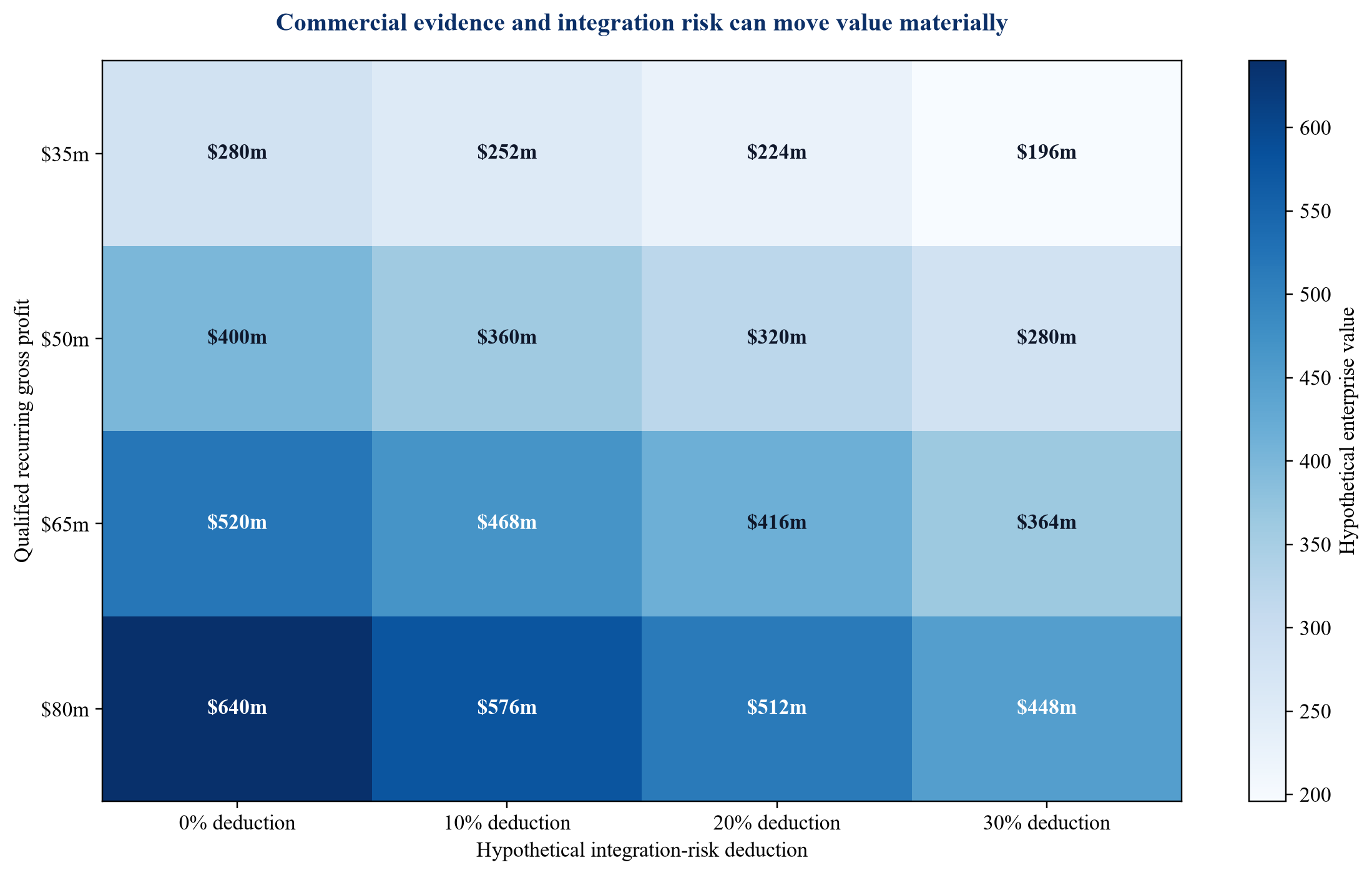
Values are hypothetical author-developed assumptions in US dollars millions. They do not represent observed market multiples, an appraisal or a transaction recommendation.
29 Structure contingent consideration
Contingent consideration can bridge uncertainty around qualification, production and concentration. Qualified recurring gross profit, customer acceptance, production yield or service attachment can be more specific than revenue or EBITDA. The agreement should define accounting policy, attribution, operating control, information rights and evidence. The buyer should support the base price under its downside case and reserve contingent value for defined upside.
30 Design transaction protections
Representations should cover intellectual property, compliance, test data, customer terms, backlog, warranties, cybersecurity, fluids, refrigerants, inventory and suppliers. Specific indemnities or escrows can address identified failures, litigation or redesign; warranty insurance may exclude known issues. Closing conditions can cover consents, retention, certification, factory leases and approvals. Interim covenants should preserve engineering controls and customer commitments.
31 Plan integration before signing
Integration planning should begin with product architecture and customer commitments. The buyer must decide which products remain standalone, which become part of an integrated offer and which will be retired. Customer qualification can make rapid consolidation impractical. Product changes may require approval or new testing.
Manufacturing integration needs a site-by-site plan for tooling, suppliers, quality systems, enterprise software and test capacity. Moving production can interrupt delivery and trigger requalification. Procurement savings should be phased after technical approval.
Commercial integration should preserve accountability. A combined sales team needs rules for solution design, quotation and warranty. Service teams need training and parts. Cybersecurity, data access and remote monitoring require controlled migration. The transaction model should fund these activities before recognising full synergy.
32 Protect engineering talent
The buyer should identify the people responsible for architecture, qualification, manufacturing processes, customer programmes and field problem-solving. Retention arrangements should cover the time needed for qualification, production transfer and succession. Critical designs and processes require controlled documentation and knowledge-transfer milestones. A valuation premium depends on a realistic ability to retain or institutionalise the capability.
33 Manage integration interfaces
The combined company needs a responsibility matrix from chip to heat rejection covering design inputs, tests, commissioning, alarms, root-cause analysis and customer communication. Commercial terms, supplier warranties and insurance should match that allocation. Early installations should be controlled reference projects with performance, failure and service data reviewed before wider sales.
34 Apply an acquisition decision matrix
The decision matrix below connects diligence to price and execution. It does not produce a mechanical score. A severe weakness in product safety, qualification or ownership can justify decline regardless of growth. Moderate gaps can be addressed through price, contingent consideration, retention, covenants or a staged investment.
The committee should record the evidence supporting each conclusion. It should identify which value depends on standalone performance and which depends on buyer integration. The plan should name the executive responsible for every material synergy and risk cure.
Table 3. Cooling acquisition decision matrix
| Category | Support a premium when | Require protection when | Decline when |
|---|---|---|---|
| Qualification | Production approval, repeatable tests and field evidence align | Important programmes remain conditional | Safety or performance claims cannot be substantiated |
| Customers | Transferable programmes and repeat gross profit are diversified | One customer or platform drives the forecast | Forecast depends on unsupported pipeline |
| Manufacturing | Demonstrated yield and funded capacity support commitments | Ramp requires material capex or working capital | Delivery plan lacks secured processes or components |
| Technology | Owned IP, controlled design and clear interfaces support roadmap | Key knowledge or licences require cure | Ownership or freedom to operate is materially deficient |
| Warranty | Mature field evidence and adequate reserves support risk | Young installed base or known corrective action remains | Unbounded failure exposure threatens the buyer |
| Sustainability | Measured energy and water performance supports claims | Fluid, refrigerant or reporting exposure needs redesign | Product cannot comply in core markets |
| Integration | Named owners, funded plan and customer path support synergy | Requalification or service build delays value | Combined offer creates unmanaged system liability |
| Valuation | Maintainable economics support price without heroic synergy | Earn-out or escrow can bridge defined uncertainty | Price requires unverified adoption or margin |
This author-developed matrix summarises transaction gates. It does not replace board judgement or transaction-specific advice.
35 Recognise common failure modes
Common errors begin with valuing a target from the size of the AI market. The target's addressable segment, qualification status and production capacity can be much narrower. Another error is applying a revenue multiple to pass-through equipment and proprietary products without adjusting for gross profit.
Buyers can also overvalue design wins, understate working capital, overlook field-service cost and treat immature warranty experience as proof of reliability. Technical teams can confirm that a product works while commercial teams assume it scales. The acquisition case needs both conclusions supported by evidence.
Integration assumptions can become another source of overpayment. Cross-selling may require customer requalification, regional certification and service capability. Manufacturing transfer can interrupt supply. A broad portfolio can create value after interfaces and responsibilities are controlled. The transaction model should include that work and its timing.
36 Apply an execution sequence
The process begins with the acquisition thesis and thermal-chain map. Technical diligence then verifies product architecture, qualification, reliability, fluids, controls and standards. Commercial diligence tests customers, programmes, pricing and competition. Operational diligence assesses manufacturing, suppliers, working capital and service. Financial diligence restates gross profit, development cost, warranty and cash needs.
Valuation follows the evidence. The buyer builds standalone value, then adds probability-weighted strategic value and deducts integration cost. Transaction protections allocate identified risks. The integration plan establishes product, manufacturing, service, people and customer workstreams before signing.
The board should receive a concise record of what is verified, what remains conditional and which assumptions drive price. Post-closing governance should compare actual qualification, gross profit, working capital, warranty and synergy with the acquisition model.
37 Limitations
This paper presents a general analytical framework. It does not determine the value, safety, market position, legal status, technical performance, environmental position or investment merit of a particular company, product or transaction. Outcomes depend on jurisdiction, contracts, technology, customer requirements, fluids, refrigerants, standards, facilities and operating conditions.
The figures and tables use hypothetical author-developed assumptions. They do not represent observed transaction data, a forecast, an appraisal, market terms or an investment recommendation. Public-company filings and announcements describe their issuers' own positions and can contain forward-looking statements subject to the stated risks.
Transaction-specific engineering, legal, environmental, regulatory, accounting, tax, insurance, cybersecurity, valuation and financial advice is required. Buyers should conduct independent tests and apply their own governance and risk appetite.
Conclusion
A cooling acquisition can provide valuable technology, qualified customer access, manufacturing capacity and service capability. The premium depends on evidence that these assets transfer and can produce maintainable gross profit. The buyer should understand the complete thermal chain because value and liability move across its interfaces.
The Cooling Acquisition Valuation Framework connects qualification, customer programmes, earnings quality, working capital, warranty, fluids, water and energy performance to price and transaction structure. It treats integration as a funded operating programme rather than an unexplained multiple premium.
The strongest transaction case states exactly what the buyer acquires, how the capability has been verified, which cash flow is repeatable, what investment is still required and how system responsibility will be controlled. That evidence supports a price that can withstand changes in compute architecture, customer timing and cooling technology.
References
- Schneider Electric, Schneider Electric to Acquire Controlling Interest in Motivair Corporation, 17 October 2024. https://www.se.com/ww/en/about-us/newsroom/news/press-releases/schneider-electric-to-acquire-controlling-interest-in-motivair-corporation-6710e67a557e6c7c790e782a/
- Schneider Electric, Q3 2024 Financial Results Transcript, 30 October 2024. https://www.se.com/ww/fr/assets/342/document/494973/transcript-Q3-results-2024.pdf
- Schneider Electric, Completion of Acquisition of Controlling Interest in Motivair, 28 February 2025. https://www.se.com/ww/en/about-us/newsroom/news/press-releases/schneider-electric-completes-acquisition-of-controlling-interest-in-motivair-67c19b8e96b1c1767957961f/
- Schneider Electric, Liquid Cooling Portfolio with Motivair for HPC and AI Workloads, 29 September 2025. https://www.se.com/us/en/about-us/newsroom/news/press-releases/schneider-electric-unveils-liquid-cooling-portfolio-with-motivair-featuring-dedicated-solutions-and-services-for-hpc-and-ai-workloads-68da975376d417f4a10de42c/
- Schneider Electric, Motivair Liquid Cooling Factory in Bengaluru, 18 February 2026. https://www.se.com/in/en/about-us/newsroom/news/press-releases/Schneider-Electric-launches-Motivair-liquid-cooling-solutions-factory-to-accelerate-India%E2%80%99s-highdensity-AI-infrastructure-699493fd07a7fbd2c30cbafa/
- Trane Technologies, Agreement to Acquire LiquidStack, 10 February 2026. https://investors.tranetechnologies.com/news-and-events/news-releases/news-release-details/2026/Trane-Technologies-to-Acquire-LiquidStack-to-Accelerate-EndtoEnd-Data-Center-Thermal-Management-Solutions/default.aspx
- Vertiv Holdings, Annual Report on Form 10-K for 2025, filed 13 February 2026. https://www.sec.gov/Archives/edgar/data/1674101/000167410126000008/vrt-20251231.htm
- Vertiv Holdings, Completion of ThermoKey Acquisition, 12 June 2026. https://www.sec.gov/Archives/edgar/data/1674101/000162828026042641/exhibit991vrt-q220266122026.htm
- Vertiv Holdings, Agreement to Acquire ThermoKey, 23 March 2026. https://www.sec.gov/Archives/edgar/data/1674101/000119312526120863/d94872dex991.htm
- Super Micro Computer, Annual Report on Form 10-K for Year Ended 30 June 2026. https://www.sec.gov/Archives/edgar/data/1375365/000137536526000022/smci-20260630.htm
- Modine Manufacturing, Annual Report on Form 10-K for Year Ended 31 March 2026. https://www.sec.gov/Archives/edgar/data/67347/000110465926066795/mod-20260331x10k.htm
- Modine Manufacturing, Fiscal 2025 Data Centers Revenue Re-segmentation, 1 July 2025. https://www.sec.gov/Archives/edgar/data/67347/000155837025009017/mod-20250701xex99d2.htm
- US Department of Energy, Best Practices Guide for Energy-Efficient Data Center Design, July 2024. https://www.energy.gov/sites/default/files/2024-07/best-practice-guide-data-center-design.pdf
- US Department of Energy, Cooling Water Efficiency Opportunities for Federal Data Centers. https://www.energy.gov/cmei/femp/cooling-water-efficiency-opportunities-federal-data-centers
- Open Compute Project, Cold Plate Cooling Loop Requirements, Revision 2.0. https://www.opencompute.org/documents/cold-plate-cooling-loop-requirements-rev-2-pdf
- Open Compute Project, Immersion Requirements, Revision 2.0. https://www.opencompute.org/documents/ocp-acs-immersion-requirements-rev-2-v1-00-pdf
- Open Compute Project, Cooling Environments Project. https://www.opencompute.org/projects/cooling-environments
- ASHRAE, Data Center Resources and Datacom Series. https://www.ashrae.org/technical-resources/bookstore/datacom-series
- ASHRAE, Data Centers and Telecommunications Facilities Handbook Chapter. https://handbook.ashrae.org/Handbooks/A15/IP/A15_CH19/a15_ch19_ip.aspx
- European Commission, Delegated Regulation (EU) 2024/1364 on Data Centre Sustainability Reporting. https://eur-lex.europa.eu/eli/reg_del/2024/1364/oj?locale=eng
- European Commission, Assessment of Energy and Water Efficiency of Data Centres, COM(2026) 500. https://eur-lex.europa.eu/legal-content/EN/TXT/?uri=CELEX:52026DC0500
- AirJoule Technologies, Annual Report on Form 10-K for 2025, filed 31 March 2026. https://www.sec.gov/Archives/edgar/data/1855474/000119312526133335/airj-20251231.htm
- European Chemicals Agency, PFAS Restriction Proposal and Use-Mapping Guidance. https://echa.europa.eu/hot-topics/perfluoroalkyl-chemicals-pfas
- US Environmental Protection Agency, American Innovation and Manufacturing Act. https://www.epa.gov/climate-hfcs-reduction
- US Environmental Protection Agency, Technology Transitions Program. https://www.epa.gov/climate-hfcs-reduction/technology-transitions-program
- International Organization for Standardization, ISO/IEC 30134 Data Centre Key Performance Indicators. https://www.iso.org/standard/63451.html
- International Valuation Standards Council, International Valuation Standards. https://www.ivsc.org/standards/
- IFRS Foundation, IFRS 3 Business Combinations. https://www.ifrs.org/issued-standards/list-of-standards/ifrs-3-business-combinations/
- IFRS Foundation, IAS 36 Impairment of Assets. https://www.ifrs.org/issued-standards/list-of-standards/ias-36-impairment-of-assets/
- IFRS Foundation, IAS 38 Intangible Assets. https://www.ifrs.org/issued-standards/list-of-standards/ias-38-intangible-assets/
- Financial Accounting Standards Board, Accounting Standards Codification Topic 805 Business Combinations. https://asc.fasb.org/topic&trid=2125323
- Financial Accounting Standards Board, Accounting Standards Codification Topic 350 Intangibles Goodwill and Other. https://asc.fasb.org/topic&trid=2125328
- US Securities and Exchange Commission, Commission Guidance Regarding Management's Discussion and Analysis. https://www.sec.gov/rules/interp/2020/33-10751.pdf
- National Institute of Standards and Technology, Cybersecurity Framework 2.0, 2024. https://doi.org/10.6028/NIST.CSWP.29
- National Institute of Standards and Technology, Guide to Operational Technology Security, SP 800-82 Revision 3, 2023. https://doi.org/10.6028/NIST.SP.800-82r3
- International Organization for Standardization, ISO 9001 Quality Management Systems. https://www.iso.org/iso-9001-quality-management.html
- International Organization for Standardization, ISO 14001 Environmental Management Systems. https://www.iso.org/iso-14001-environmental-management.html
- International Organization for Standardization, ISO 50001 Energy Management Systems. https://www.iso.org/iso-50001-energy-management.html
- International Electrotechnical Commission, IEC 62443 Industrial Communication Networks and System Security. https://www.iec.ch/cyber-security
- US Department of Justice and Federal Trade Commission, 2023 Merger Guidelines. https://www.justice.gov/atr/2023-merger-guidelines
- UK Competition and Markets Authority, Merger Assessment Guidelines. https://www.gov.uk/government/publications/merger-assessment-guidelines
- European Commission, Guidelines on the Assessment of Horizontal Mergers. https://competition-policy.ec.europa.eu/mergers/legislation_en
- International Energy Agency, Energy and AI, 2025. https://www.iea.org/reports/energy-and-ai
- Uptime Institute, Data Center Sustainability and Cooling Resources. https://uptimeinstitute.com/resources
- World Intellectual Property Organization, IP Due Diligence in Business Transactions. https://www.wipo.int/sme/en/ip_business/acquisitions/ip_due_diligence.htm
- Organisation for Economic Co-operation and Development, Due Diligence Guidance for Responsible Business Conduct. https://mneguidelines.oecd.org/due-diligence-guidance-for-responsible-business-conduct.htm
About the Author
Chennakeshav (CK) is a corporate finance and investment banking executive with 25+ years of global experience in deal origination, structuring and execution across M&A, growth capital and corporate strategy. He has led value-creation mandates for founders, corporates and funds — bridging the boardroom view to hands-on execution and close.
His career spans Morgan Stanley, HSBC, Lloyds Banking Group, EWEC, ADQ portfolio companies and Emirates Growth Fund, across TMT, real estate, fintech, deeptech, cleantech, infrastructure and energy. He has partnered with C-suite leaders, private equity and venture funds, sovereign wealth funds and family offices to finance complex fund raises and scale-up ventures, and has led M&A due diligence, post-merger integration and business-transformation initiatives to create value.
At Matchpoint Partners he is Managing Partner, leading the firm's corporate finance, M&A and capital-raising practice. He holds an MBA from London Business School, an engineering degree from VTU and a Master of Laws (LLM, in progress) from UCL London.
An active start-up mentor, CK mentors at Techstars, DIFC FinTech Hive, Startup Grind, Founder Institute and IN5, serves as Entrepreneur Mentor in Residence (EMiR) at London Business School, and judges the Entrepreneurship World Cup.
