

1. Define the covenant decision
The financing decision is whether the proposed bond documents create an operating control system that remains useful from closing through maturity. The board should identify the borrowing entity, secured asset perimeter, repayment source, project agreements, operating risks, debt profile, investor base and governing law. These facts determine which covenants are measurable, which controls can be operated and which remedies can be exercised.
A covenant is valuable when it converts a defined condition into timely evidence and a proportionate response. A debt-service coverage test can retain cash only if cash available for debt service is defined consistently, accounts are controlled, the calculation agent receives reliable information and the distribution prohibition is enforceable. A reserve requirement can support liquidity only if the required amount, permitted investments, replenishment priority and draw conditions are clear.
The decision paper should separate three questions. Measurement asks whether the documents observe the asset's real financial condition. Response asks whether the agreed action occurs before liquidity is exhausted. Execution asks whether the trustee, security agent and bondholders can act within the available time. Approval requires affirmative evidence on all three.
The covenant package should also define operational freedom. Management needs authority to operate, maintain and adapt the asset within an approved plan. Creditor controls should focus on value leakage, risk migration and material departure from the financed case. Excessive consent requirements can delay ordinary decisions while failing to detect the risks that matter.
2. Start with the repayment source
Infrastructure debt is repaid from a defined cash-generating system. That system can be an availability-based concession, regulated network, contracted generation asset, merchant facility, toll road, port, digital-infrastructure platform or mixed portfolio. Each model has different volume, price, counterparty, operating, maintenance and regulatory exposures.
The covenant architecture should follow the economic route from service delivery to collected cash. It should identify who pays, when payment is due, what deductions or set-offs apply, how tariffs change, where receipts are deposited and which costs must be paid before debt service. Contracted revenue can still be volatile when availability deductions, indexation lags, curtailment, disputes or counterparty delay affect cash.
The legal perimeter must match the model. Revenue earned outside the obligor group, cash trapped in an unrestricted account or assets held by an unpledged affiliate can weaken an apparently strong coverage ratio. The financing committee should map ownership, contracts, accounts, guarantees, security and permitted transfers before selecting thresholds.
The result should be a repayment-source memorandum. It states the sources of revenue, essential operating costs, maintenance obligations, taxes, working-capital movements, senior claims and transfer restrictions. Every financial covenant should reconcile to that memorandum.
3. Use an integrated covenant architecture
The proposed Covenant Architecture System contains six connected layers. Layer One defines the asset, obligor and cash perimeter. Layer Two establishes information, forecasting and calculation standards. Layer Three controls collection accounts, operating payments, reserves and debt service. Layer Four tests coverage, leverage, liquidity, project performance and additional debt. Layer Five restricts distributions, disposals, amendments and other value transfers. Layer Six governs cure, creditor decisions, step-in and enforcement.
The layers should operate as one system. A forecast covenant provides early visibility. A reserve top-up requirement protects the next payment period. A distribution lock retains cash. A cure plan addresses the operating cause. Direct agreements preserve the project contracts if default persists. Bondholder mechanics allow decisions before contractual time expires.
Documentation should state the relationship between layers. For example, a reserve draw can trigger enhanced reporting, prohibit distributions and require replenishment through the next waterfall. A forecast breach can trigger a remedial plan without creating immediate payment default. A repeated breach can escalate to independent review and creditor consent.
The architecture should be tested against plausible sequences rather than isolated clauses. Reviewers should simulate lower revenue, higher costs, maintenance failure, counterparty delay and refinancing stress. Each simulation should show which information arrives, which account changes, who decides and what cash remains.
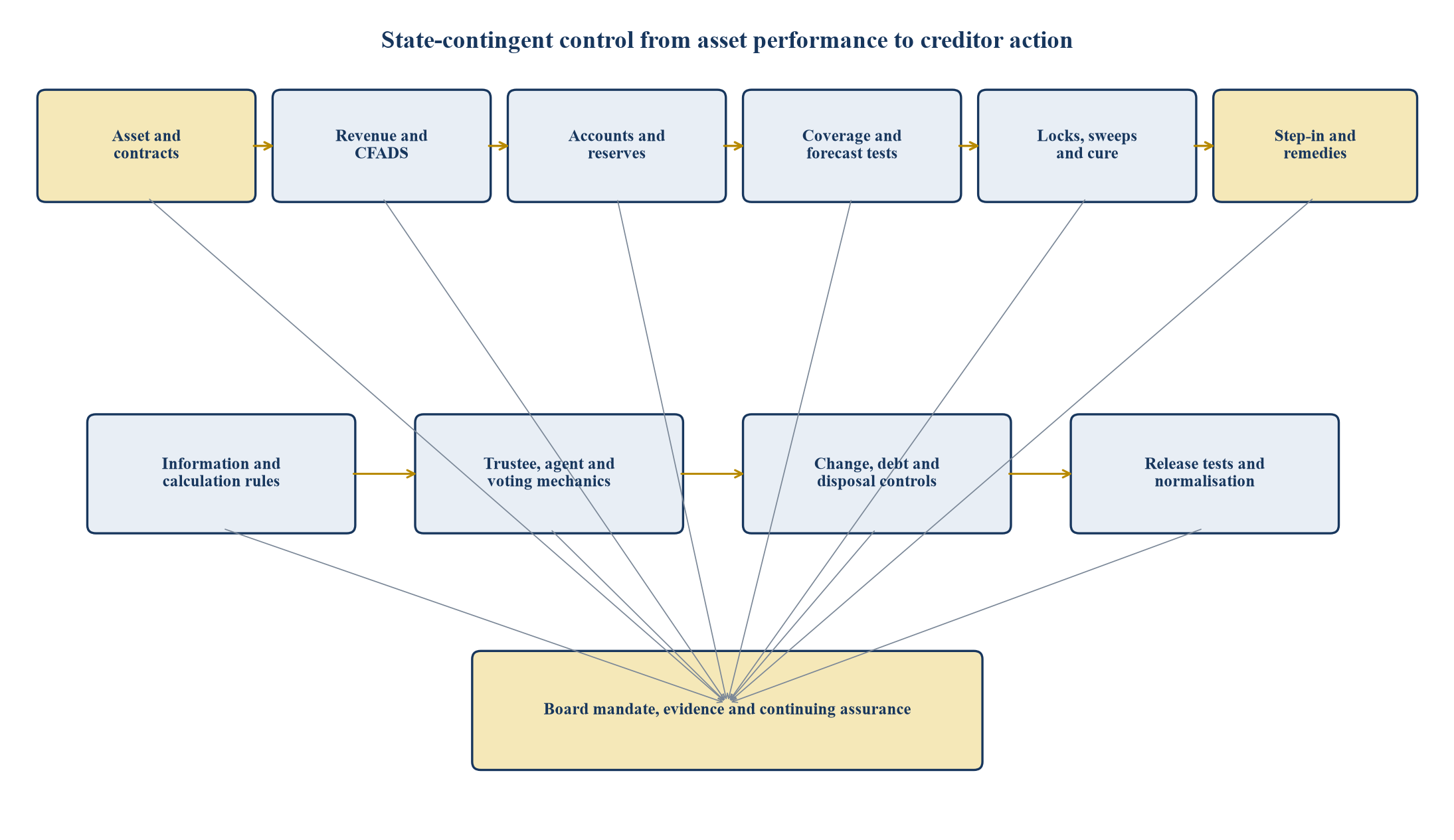
The architecture connects asset cash generation to measurement, controlled accounts, covenant states, proportionate actions and creditor remedies.
4. Fix the obligor and asset perimeter
The obligor perimeter should identify every entity whose assets, contracts, accounts or undertakings support repayment. Project-finance structures commonly use a special-purpose entity, but legal isolation depends on ownership, corporate powers, intercompany arrangements, insolvency analysis and transaction-specific law. The label alone does not establish bankruptcy remoteness.
The asset register should cover land or concession rights, plant, licences, permits, material contracts, insurance, intellectual property, accounts and claims. It should show which items are owned, leased, licensed, pledged or outside the security package. It should also identify completion status and material dependencies on affiliates or public authorities.
Boundary differences need explicit treatment. The operating model may consolidate entities that are outside the secured group. A service agreement may move margin to an affiliate. A shared treasury system may collect project revenue before transferring it to the issuer. These arrangements can make covenant calculations look stronger or weaker than accessible cash.
The financing committee should require a legal-entity and cash map that reconciles to the financial model. Changes in ownership, mergers, new subsidiaries and transfers should enter a controlled approval process so that the original perimeter does not erode silently.
5. Define cash available for debt service
Cash available for debt service, or CFADS, is the central financial measure in many infrastructure financings. It should begin with collected operating revenue and deduct the cash costs required to operate, maintain and preserve the project, together with applicable tax and working-capital movements. The exact definition must reflect the transaction.
The definition should address timing. Accrued revenue can overstate cash when collection is delayed. Large annual payments can distort a short testing period. Maintenance expenditure can be cyclical. Tax and working-capital movements can reverse. A calculation should state whether it is historical, projected, annualised or measured over a rolling period.
Permitted adjustments need disciplined rules. Insurance proceeds, compensation, liquidated damages, sponsor support, extraordinary receipts and asset-sale proceeds should enter only when the documents specify their treatment and the cash is accessible. Expected refinancing proceeds or uncommitted support should not strengthen operating coverage.
The calculation agent should preserve a bridge from financial statements and bank accounts to CFADS. The bridge should show every inclusion, exclusion and adjustment. Consistent lineage makes the ratio auditable and reduces disputes at the moment when action is most urgent.
6. Design debt-service coverage tests
The debt-service coverage ratio compares CFADS with scheduled principal, interest and other defined senior debt-service amounts. A useful test states the numerator, denominator, period, calculation date, information source, responsible party, certification and consequence. Ambiguity in any component can delay a lock or cure.
Historical and forward tests serve different purposes. A historical ratio tests observed cash performance. A forward ratio tests expected resilience using an approved budget and assumptions. Requiring both can prevent a distribution after a strong historical period when the next operating period is weak.
Thresholds should be calibrated to revenue volatility, operating leverage, maintenance profile, debt amortisation, reserve support and forecast reliability. A single ratio should not be imported from another sector. The hypothetical thresholds in this paper illustrate a state system and do not represent market terms.
Calculation provisions should anticipate disputes. They should specify whether a challenged invoice, exceptional cost or reserve movement affects the ratio and who decides. A rapid expert or agent process can preserve the timetable while maintaining rights.
7. Add earlier warning measures
A payment-default threshold arrives after liquidity has failed. The covenant system therefore needs measures that show deterioration earlier. These can include rolling revenue, availability, utilisation, collection days, operating cost, maintenance backlog, counterparty arrears, reserve sufficiency, construction milestones and forecast coverage.
Each measure should connect to an action. A minor variance can require explanation. A material variance can require a revised forecast and remediation plan. Repeated variance can trigger independent technical review, cash retention or creditor consultation. The response should reflect the likely lead time before debt service is affected.
Forecast tests need governance. Assumptions should reconcile to contracts, operating evidence and approved budgets. Management should identify overlays and contingencies separately. An updated forecast should not cure a breach merely by changing assumptions.
The early-warning dashboard should be limited to decision-useful indicators. A long reporting schedule can create volume without visibility. The strongest measures are those linked to the economic drivers of repayment and to defined contractual action.
8. Build the account waterfall
The account structure converts contractual priority into cash movement. It commonly covers revenue collection, taxes, operating costs, maintenance, debt service, reserve funding, hedging, permitted capital expenditure and distributions. The exact order should match the project's legal and operating needs.
Account control should be operationally feasible. The documents should state where cash is deposited, when transfers occur, who gives instructions, what happens on non-business days and how disputed amounts are handled. Standing instructions and tested bank mandates reduce reliance on manual intervention.
The waterfall should distinguish ordinary operation from a lock-up or default state. In ordinary operation, management may have defined flexibility within budget. During stress, retained cash can move to reserve replenishment, debt service or remedial expenditure. Following default, the agent may control disbursements subject to essential operating obligations and applicable law.
The project company should perform periodic waterfall reconciliations. These compare source receipts, permitted payments, reserve balances and distributions with the documents. Exceptions should be corrected and reported before the next covenant date.
9. Size the debt-service reserve
A debt-service reserve account provides liquidity when operating cash is temporarily insufficient. Its required balance can be defined by a number of months of scheduled debt service, the next payment amount, a letter of credit, another permitted instrument or a combination. The appropriate design depends on payment frequency and the duration of plausible disruption.
The hypothetical case uses six months of scheduled debt service, equal to USD 20 million. That assumption illustrates a calculation and is not a recommendation. The financing committee should test how long a reserve must cover cash while a delayed payment, outage or remediation is resolved.
Funding mechanics matter. The reserve may be funded at closing, built through the waterfall, supported by a qualifying instrument or replenished after a draw. The documents should state valuation, permitted investments, provider criteria, replacement triggers and the priority of replenishment.
A reserve draw should trigger information and action. The issuer should explain the cause, update liquidity forecasts, suspend distributions and propose a replenishment plan. Repeated draws can indicate structural weakness that requires debt or operating intervention rather than another refill.
10. Separate other reserve purposes
Debt service, major maintenance, operating liquidity, tax, insurance and lifecycle expenditure serve different purposes. Combining them in one account can obscure whether the project is prepared for the next payment and the next physical obligation. Separate requirements improve transparency even when cash is held with the same account bank.
A major-maintenance reserve should follow the technical schedule and cost estimate. Funding should rise before the expected event and permit withdrawal against verified expenditure. An operating reserve can protect essential services during collection interruption. A tax or insurance reserve can address predictable but infrequent payments.
The model should avoid double counting. Cash transferred to a reserve is not automatically an operating expense, while a reserve withdrawal is not automatically new income. The CFADS definition, waterfall and forecast should treat the same movement consistently.
Reserve releases should require evidence that the underlying obligation has passed or been funded elsewhere. A surplus calculation should retain amounts needed for the next measurement period and any unresolved variance. Release mechanics should be as precise as funding mechanics.
11. Create a four-state response ladder
The proposed architecture uses Green, Amber, Red and Default states. Green indicates compliance, full required reserves and sufficient historical and forward coverage. Amber indicates declining headroom, a reserve draw or another warning condition. Red indicates material coverage weakness, reserve underfunding or repeated project-performance failure. Default indicates missed payment or another defined event that has passed any applicable grace period.
Each state changes behaviour. Green permits distributions if every condition is met. Amber locks distributions, increases reporting and can sweep surplus cash. Red requires a funded cure plan, independent review and creditor consent for material actions. Default activates the contractual remedy framework, subject to direct agreements, standstill provisions and applicable law.
The thresholds should avoid cliffs where a small measurement difference produces a disproportionate result. Cure periods, look-back rules and repeated-breach tests can distinguish temporary noise from sustained deterioration. The documents should preserve immediate action for payment, insolvency, abandonment, illegality or other critical events.
Release from a stressed state should require evidence over a defined period. A single favourable calculation may be insufficient when the underlying cause persists. The release test should include reserves, forecast coverage, absence of default and completion of required remediation.
| State | Illustrative condition | Cash consequence | Governance consequence | Release evidence |
|---|---|---|---|---|
| Green | Historical and forward DSCR at or above 1.30x; reserves full; no default | Ordinary waterfall; distributions subject to all tests | Routine reporting and certification | Continuing compliance |
| Amber | DSCR from 1.15x to below 1.30x; reserve draw; material warning variance | Distribution lock; surplus cash sweep; reserve replenishment | Monthly reporting; revised model and cure plan | Two compliant tests; reserves restored |
| Red | DSCR below 1.15x; reserve underfunded; repeated project failure | Full cash retention; controlled remedial expenditure | Independent review; creditor consent for material actions | Creditor-approved remediation and sustained compliance |
| Default | DSCR below 1.00x if defined as an event; unpaid debt service; material default after grace | Default waterfall and preservation of essential operations | Trustee or agent remedies; direct-agreement process | Waiver, cure, restructuring or enforcement outcome |
Thresholds are hypothetical management assumptions and require transaction-specific calibration and legal drafting.
12. Model the hypothetical operating case
The illustrative project earns annual revenue of USD 150 million. Cash operating costs are USD 78 million, maintenance expenditure is USD 12 million and taxes plus working-capital uses are USD 6 million. CFADS is therefore USD 54 million. Scheduled debt service is USD 40 million, producing a DSCR of 1.35x.
The Amber case assumes revenue of USD 144 million, operating costs of USD 80 million, maintenance expenditure of USD 14 million and taxes plus working capital of USD 6 million. CFADS falls to USD 44 million and DSCR to 1.10x. Under the illustrative state definitions, that result is Red rather than Amber, which shows the need to calibrate labels and thresholds carefully.
A milder warning case can use revenue of USD 147 million, operating costs of USD 79 million, maintenance of USD 13 million and taxes plus working capital of USD 6 million. CFADS is USD 49 million and DSCR is 1.225x. This falls within the illustrative Amber band.
The severe case assumes revenue of USD 132 million, operating costs of USD 84 million, maintenance of USD 18 million and taxes plus working capital of USD 7 million. CFADS is USD 23 million and DSCR is 0.575x. The reserve can cover a payment timing gap, but it does not repair the operating deficit.
| Item | Central | Warning | Material stress | Severe stress |
|---|---|---|---|---|
| Revenue collected | 150.0 | 147.0 | 144.0 | 132.0 |
| Cash operating cost | (78.0) | (79.0) | (80.0) | (84.0) |
| Maintenance expenditure | (12.0) | (13.0) | (14.0) | (18.0) |
| Tax and working-capital use | (6.0) | (6.0) | (6.0) | (7.0) |
| CFADS | 54.0 | 49.0 | 44.0 | 23.0 |
| Scheduled debt service | (40.0) | (40.0) | (40.0) | (40.0) |
| DSCR | 1.35x | 1.23x | 1.10x | 0.58x |
| Illustrative state | Green | Amber | Red | Default |
USD millions. All figures are illustrative management assumptions; they are not observed data, forecasts or recommended terms.
13. Test timing and path dependence
Annual ratios can conceal intra-year stress. A project can report adequate annual CFADS while facing a debt-service payment before a large contractual receipt. Monthly or quarterly modelling should identify minimum cash, reserve draw and the time available for cure.
Path dependence matters because the order of events changes available action. A maintenance outage followed by delayed customer payment can exhaust liquidity even if each event is manageable separately. A reserve draw before a refinancing date can weaken rating or investor readiness. A distribution shortly before deterioration can increase the required cure.
The financing model should therefore include cash dates, account balances and covenant dates. It should show the state transition in each period, the amount retained and the effect of proposed management action. Annual summaries should reconcile to this underlying schedule.
The board should examine the earliest point of failure. That point determines the useful warning indicator and the cure period. A covenant that reports after cash has left the structure provides historical information rather than protection.
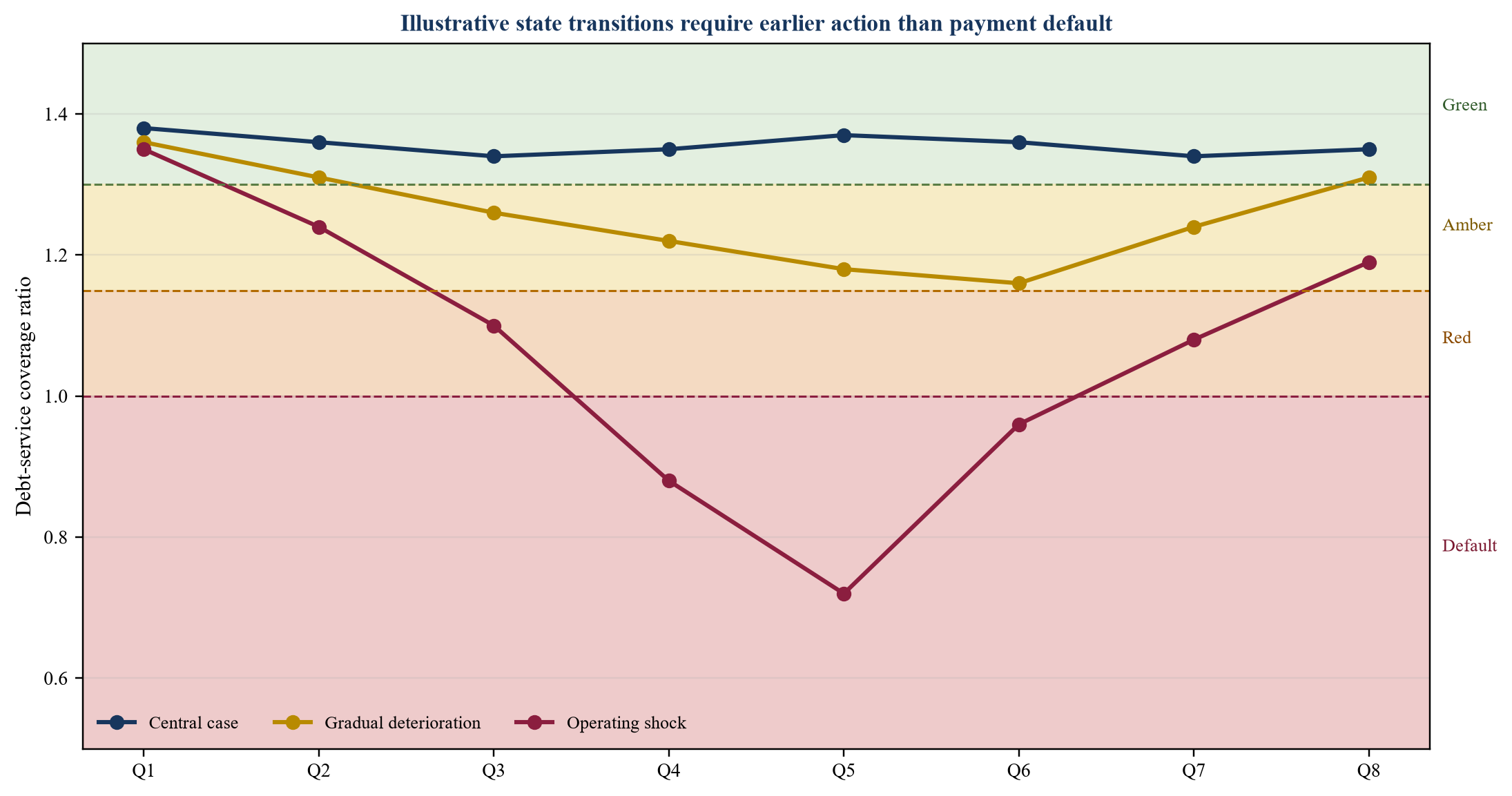
The ratios and thresholds are illustrative management assumptions. They show how warning, lock-up and default states can develop over eight quarters.
14. Design distribution conditions
Distributions transfer value outside the secured structure. A distribution test should therefore require more than one ratio on one date. The conditions can include historical and forward coverage, full reserve funding, absence of default, completion of required capital expenditure, payment of current liabilities, an approved budget and delivery of certifications.
The test should capture direct and indirect transfers. Dividends, shareholder-loan repayment, management fees, asset transfers, affiliate payments and other value leakage may need common limits or arm's-length requirements. Ordinary operating payments under approved contracts should remain possible.
The measurement date should precede the payment closely enough to remain reliable. The issuer should update for known material events between certification and distribution. A stale certificate should not permit cash to leave after a significant deterioration.
The documents should also specify trapped-cash treatment. Retained cash can fund reserves, debt reduction, approved remediation or permitted capital expenditure. A defined release test prevents permanent trapping after the project has recovered.
15. Use cash sweeps deliberately
A cash sweep applies surplus cash to debt repayment, reserve replenishment or another protected purpose. It can accelerate deleveraging during underperformance or after a risk event. Its design should state the sweep percentage, calculation base, priority, prepayment mechanics and interaction with hedging and break costs.
A full sweep can preserve creditors but deprive the asset of productive investment. A partial sweep can balance debt reduction with approved maintenance or resilience expenditure. The appropriate choice depends on the cause of deterioration and the value of retaining operational flexibility.
The sweep should not create an accidental liquidity shortfall. Cash required for taxes, essential operations, near-term maintenance and the next debt-service period should remain protected. The model should show account balances after the sweep.
Prepayment can alter hedging, amortisation and future coverage. The issuer should calculate derivative termination amounts, hedge notional, interest savings and revised ratios before applying cash. Documentation across the bond, security and hedge agreements should align.
16. Control additional debt
Additional debt can subordinate existing creditors economically even when legal ranking remains unchanged. The covenant should define permitted debt, refinancing debt, working-capital facilities, hedging liabilities, leases, guarantees and contingent obligations. It should also address debt at subsidiaries and affiliates within the cash perimeter.
An incurrence test can require pro forma historical and forward coverage, leverage, reserve funding and absence of default. It should use the same calculation principles as the continuing covenants. Projected growth or sponsor support should enter only on the basis permitted by the documents.
Refinancing debt requires special treatment. It can extend maturity or reduce cost while increasing principal, changing security or introducing new creditors. The test should examine all-in cash service, intercreditor terms, maturity, ranking and execution certainty.
Permitted debt baskets should remain proportionate to operational need. A large general basket can migrate risk without a fresh test. Small operational obligations may use delegated authority with periodic reporting.
17. Control disposals and acquisitions
Asset disposal can remove cash generation, security or essential operating capability. Acquisition can add construction, integration, leverage and governance risk. The documents should distinguish ordinary-course replacement from a material change to the financed business.
A permitted disposal test can require fair value, arm's-length terms, no material impairment of operations, application of proceeds and pro forma covenant compliance. Release of security should occur only after the stated conditions are satisfied and the agent has the required evidence.
Acquisition tests should consider the target's cash quality, contracts, liabilities, capital expenditure and integration requirements. Pro forma coverage based on unverified synergies can overstate capacity. The financing committee should require a controlled model and independent diligence for material transactions.
Both controls should link to the asset register and security schedule. The covenant package remains reliable only if the legal collateral record changes with the operating perimeter.
18. Protect project agreements
Concessions, offtake agreements, operating contracts, construction contracts, land rights and licences can be central to repayment. Amendments, termination, waiver or replacement can change revenue, cost, risk allocation and creditor remedies. Material project agreements therefore need defined consent and reporting provisions.
The restriction should focus on economic consequence. Minor administrative changes can remain delegated. Material changes affecting payment, term, performance, liability, termination, security or assignability should require analysis and, where agreed, creditor consent.
The issuer should provide a change memorandum with legal, operational and financial effects. The model should show coverage and liquidity after the amendment. Direct-agreement rights and security assignments should be updated at the same time.
Government or regulatory counterparties can impose mandatory changes. The covenant framework should distinguish an issuer-initiated amendment from a change in law or public-authority action and specify the required response.
19. Build information covenants around decisions
Information covenants should deliver what management and creditors need to make timely decisions. Core reporting can include financial statements, compliance certificates, budgets, operating data, reserve balances, material-contract events, litigation, insurance, permits and project milestones.
Frequency should reflect volatility and state. Quarterly reporting may be sufficient in Green. Amber can require monthly accounts, thirteen-week liquidity, variance analysis and cure progress. Red can require more frequent cash and operating data together with independent review.
Data definitions should remain stable. Operating metrics should identify source systems, owners, cut-off rules and adjustments. Compliance certificates should reconcile to a controlled calculation workbook and bank statements.
Prompt event notices should supplement routine reports. Payment delay, material outage, permit action, contract default, insurance event, reserve draw, cyber incident or forecast breach can require notice before the next reporting date. The notice should state known facts and planned action without waiting for a complete investigation.
20. Calibrate representations and undertakings
Representations establish facts at signing, drawdown or another specified date. Undertakings govern future conduct. The covenant package should identify which statements are repeated, qualified by materiality or knowledge, and connected to default.
Key subjects can include corporate authority, ownership, project agreements, permits, financial information, litigation, sanctions, tax, insurance, security, environmental compliance and absence of default. Transaction-specific diligence should determine scope.
Operational undertakings can require maintenance, insurance, permits, compliance, preservation of rights, taxes, books and access. They should reflect what the project company can control. Absolute language can create technical breach where performance depends on a public authority or counterparty.
The cure regime should distinguish inaccurate information that can be corrected from a fundamental misrepresentation affecting the financing decision. Materiality, reliance and consequence require careful legal drafting under the governing law.
21. Create a cure hierarchy
Cure should address the cause, preserve value and fit the time available. An information breach can be cured by delivery and control improvement. A reserve shortfall may require top-up or cash sweep. An operating failure may need technical remediation, budget and monitoring. A project-agreement default may require action under a direct agreement.
The hierarchy should define notice, grace period, cure plan, approval, milestones and consequence of failure. Different events require different periods. A missed payment, insolvency or abandonment can require immediate action, while a complex operating remedy may need a controlled timetable.
Sponsor support can be one cure route when legally committed and funded. An uncommitted expectation should not delay creditor action. Equity cure provisions should state amount, frequency, application and whether the injection increases CFADS, reduces debt or funds an account.
Repeated cure deserves attention. A project that relies on recurring injections or waivers may have a structural problem. Repetition can tighten the state, extend cash retention or require restructuring even if each isolated breach is cured.
22. Design direct agreements and step-in
Direct agreements connect creditors to critical project counterparties. They can provide notice before termination, a standstill period, cure rights, step-in and novation to a substitute entity. Their effectiveness depends on the underlying contract, counterparty consent, licence regime and applicable law.
The timetable should be executable. The counterparty notice must reach the correct agent. The standstill should provide enough time to assess, cure or nominate a substitute. The substitute must meet technical, financial and regulatory conditions. Security and operating continuity should survive the transition.
Step-in is an operational intervention, not merely a legal right. Creditors need a decision process, advisers, funding and a capable operator. The covenant package should identify who can instruct action and how costs are funded.
The financing committee should maintain a direct-agreement matrix. It should list each critical contract, notice route, cure period, step-in right, consent requirement, replacement test and unresolved gap. The matrix should be tested periodically.
23. Make bondholder decisions executable
Project bonds can be held by many investors. A bank group may negotiate through a small lending syndicate, while bondholders act through a trustee or agent and specified voting thresholds. Time-sensitive waivers and operational decisions require clear authority.
The documents should define ordinary matters, reserved matters, quorum, voting thresholds, written resolutions, meeting procedures and disenfranchisement of issuer-related holdings. They should state what the trustee can do without instruction and when it requires indemnity or funding.
Emergency action deserves specific design. The security agent may need authority to preserve assets, control accounts or respond to a termination notice before a full vote can be completed. That authority should be bounded and reported.
Investor communication should protect confidential information while supporting informed decisions. A controlled data room, standard information package and adviser protocol can reduce delay during stress.
24. Align events of default and remedies
Events of default commonly include non-payment, insolvency, material covenant breach, misrepresentation, cross-default, invalidity of security, loss of material project rights and abandonment. Their scope, thresholds, grace periods and consequences should match the financed risk.
Cross-default requires calibration. A broad provision can import an immaterial dispute from outside the project. A narrow provision can miss debt or guarantees that threaten the secured group. The perimeter and monetary threshold should be deliberate.
Remedies can include acceleration, account control, enforcement of security, appointment rights, contract cure, step-in and restructuring. Their sequence should respect direct agreements and legal requirements. Immediate acceleration can destroy project value when a controlled cure would preserve it.
The enforcement analysis should be completed before issuance. It should examine perfection, ranking, local procedure, licences, public-interest constraints, insolvency, taxes, timing and the ability to transfer the project. Disclosure should reflect material limitations.
25. Address intercreditor and hedge claims
Infrastructure structures can include senior bonds, working-capital facilities, liquidity lines, hedging, letters of credit and subordinated debt. Intercreditor arrangements determine ranking, voting, payment blockage, enforcement control and proceeds allocation.
Hedge liabilities require special attention. A swap can protect floating-rate debt while creating collateral, termination and close-out exposure. The documents should align hedge notional with debt, define permitted counterparties, control collateral and address replacement following downgrade.
Voting should avoid misalignment. A hedge provider with a large termination claim can have different incentives from long-term bondholders. The intercreditor agreement should define how claims are measured and which decisions they influence.
The waterfall should show payments before and after default. Priority should be consistent across account agreements, security documents, indenture and intercreditor terms. Conflicting language can create uncertainty when liquidity is scarce.
26. Protect maintenance and resilience
Debt protection depends on preserving the physical asset. Covenants should require maintenance under the applicable standard, funding of lifecycle works and response to technical findings. Deferred maintenance can temporarily raise CFADS while reducing future performance and collateral value.
The independent engineer or technical adviser can review budgets, outages, completion, performance and reserve sufficiency. Scope, access, reliance and reporting should be defined. The adviser should not become a substitute for management responsibility.
Resilience investment can include climate adaptation, cyber protection, spare parts, redundancy and supply-chain measures. The covenant framework should permit approved investment even during stress when it protects future cash flow. The decision should be evidence-led and controlled.
Maintenance measures should connect to financial triggers. Backlog, repeated outage or underfunded lifecycle reserve can move the project into Amber before DSCR falls. This provides time to act while cash and operational options remain.
27. Integrate environmental and social obligations
Infrastructure assets can face environmental, land, community, labour and safety obligations that affect permits, operations, reputation and cash flow. Covenants should require compliance with applicable requirements and agreed standards within a transaction-specific scope.
Material events should trigger prompt reporting and remediation. The assessment should connect the underlying issue to operating continuity, cost, liability, insurance and project agreements. A purely narrative report can miss the credit effect.
Corrective expenditure should enter the liquidity model. The financing committee should identify whether it is paid through operating cash, reserve, insurance, sponsor support or new funding. Distribution and debt-incurrence tests should reflect the obligation.
Lender or bondholder rights must remain consistent with public law and stakeholder protections. Step-in does not remove permitting, labour or community duties. Enforcement planning should preserve essential obligations.
28. Build a covenant risk heat map
The risk register should connect each failure mode to the affected clause, information source, cash consequence, owner and escalation route. High-priority risks include a weak CFADS definition, late warning, underfunded reserves, value leakage, unenforceable security, slow voting and inadequate cure time.
Likelihood and consequence should be assessed separately. A low-frequency concession termination can have severe value impact. A frequent reporting delay may be less severe individually but can hide worsening performance. Connections should remain visible.
Control effectiveness should be supported by evidence. An account-control clause is only effective if the account bank mandate is active and tested. A direct agreement is only useful if notices reach the correct party and the cure process is practicable.
The board and financing committee should review residual risks before launch and after material change. Acceptance should state the reason, authority and monitoring plan.
| Failure mode | Credit consequence | Required evidence | Proposed response |
|---|---|---|---|
| CFADS includes inaccessible or non-cash items | Coverage is overstated | Bank-account bridge and calculation policy | Correct definition; recalculate tests; retain cash |
| Warning arrives after liquidity is depleted | Cure options narrow | Monthly cash path and reporting calendar | Earlier operating triggers and forecast tests |
| Reserve is unavailable or underfunded | Next debt-service payment is exposed | Account control, balance and provider evidence | Top-up, sweep, replacement and distribution lock |
| Distribution occurs before deterioration is reflected | Value leaves secured perimeter | Current historical and forward compliance certificate | Event update and multi-condition distribution test |
| Project contract can terminate before creditor action | Repayment source can disappear | Executed direct agreement and tested notice route | Standstill, cure, step-in and substitution plan |
| Bondholder vote cannot occur in cure period | Rights become operationally unusable | Trustee powers, quorum and timing simulation | Bounded emergency authority and written-resolution route |
| Maintenance is deferred to protect near-term cash | Asset reliability and future CFADS weaken | Technical plan, backlog and reserve schedule | Ring-fenced lifecycle funding and engineer review |
Assessments are transaction-specific; the table identifies evidence and response design rather than universal risk ratings.
29. Control amendments and waivers
An amendment or waiver can be a rational response to change, but it alters the original risk allocation. The request should state the breach or proposed change, cause, financial effect, alternatives, consideration, conditions and monitoring.
The issuer should provide a current model and downside. The analysis should show liquidity, reserves, coverage, leverage, security and project-contract effects. Temporary relief should have a clear end date and milestones.
Voting thresholds should reflect materiality. Fundamental changes to payment, maturity, principal, ranking or security can require higher consent under the documents and law. Operational waivers may use a lower threshold or agent authority.
The final decision record should identify conflicts and fees. Consent payments, adviser costs and changes in economics should be transparent. Continuing undertakings should be incorporated into the compliance calendar.
30. Establish release mechanics
Controls should tighten when risk rises and relax when evidence supports recovery. Release mechanics prevent a temporary breach from creating indefinite cash trapping or excessive intervention. They also protect creditors from a premature return to Green.
A release test can require two consecutive compliant periods, full reserves, no default, completion of the cure plan and acceptable forward coverage. The period should match the operating cycle and reliability of the evidence.
Security release at refinancing, disposal or maturity requires separate conditions. The agent should receive funds, discharge instructions, evidence of permitted action and any required creditor approval. Releases should follow a controlled checklist.
The organisation should record why the state changed. This history supports future underwriting, calibration and refinancing. It also shows whether the same cause is recurring.
31. Conduct a clause-to-model audit
The financial model and legal documents should describe the same transaction. A clause-to-model audit maps definitions, dates, priorities, thresholds, reserves, distributions, additional debt, prepayment and cure into model logic. Differences should be resolved before issuance.
The audit should reproduce each covenant calculation from source data. It should test boundary cases around thresholds, payment dates, leap periods, currency conversion and indexation. It should also test missing or disputed data.
Legal drafting can change late in execution. Every material amendment should be assessed for model impact. A change in debt-service definition, reserve amount or distribution test can alter economics even when the headline coupon and maturity are unchanged.
The final model should be controlled, versioned and capable of supporting compliance. A transaction model that cannot be operated by the post-closing team leaves a gap between execution and continuing governance.
32. Run operational dry-runs
Before closing, the issuer, account bank, calculation agent, trustee and advisers should dry-run the recurring processes. The exercise should cover revenue receipt, waterfall transfer, reserve funding, covenant calculation, compliance certificate, distribution request and event notice.
A stress dry-run should simulate an Amber transition. The team should produce a liquidity forecast, stop a distribution, apply a sweep, notify the agent and submit a cure plan. A second exercise can simulate a material project-contract default and direct-agreement notice.
The dry-run should measure time and identify unavailable data, unclear authority and system constraints. Issues should be corrected in documents, procedures, bank mandates or responsibilities before issuance where possible.
Training should cover successors as well as the transaction team. Infrastructure bonds can remain outstanding for decades. A concise operating manual, calendar and evidence register make the architecture durable.
33. Execute through a 180-day roadmap
Days 0 to 30 define the repayment source, obligor perimeter, risk map and board mandate. Days 31 to 65 reconcile contracts, accounts, operating data and the base model. Days 66 to 100 design the state ladder, reserves, tests, restrictions and cure hierarchy.
Days 101 to 130 integrate the indenture, security, intercreditor and direct agreements with the model. Days 131 to 155 complete investor, rating and disclosure work while testing calculation and voting mechanics. Days 156 to 180 execute, fund accounts, complete dry-runs and hand control to the operating team.
Each phase should have exit evidence. Market engagement should not outrun the ability to explain the cash perimeter, downside and creditor response. Final pricing authority should remain within approved leverage, liquidity and covenant boundaries.
The roadmap should adapt to the project, jurisdiction and issuance process. Its purpose is to keep legal, financial, technical and operating work on one dependency plan.
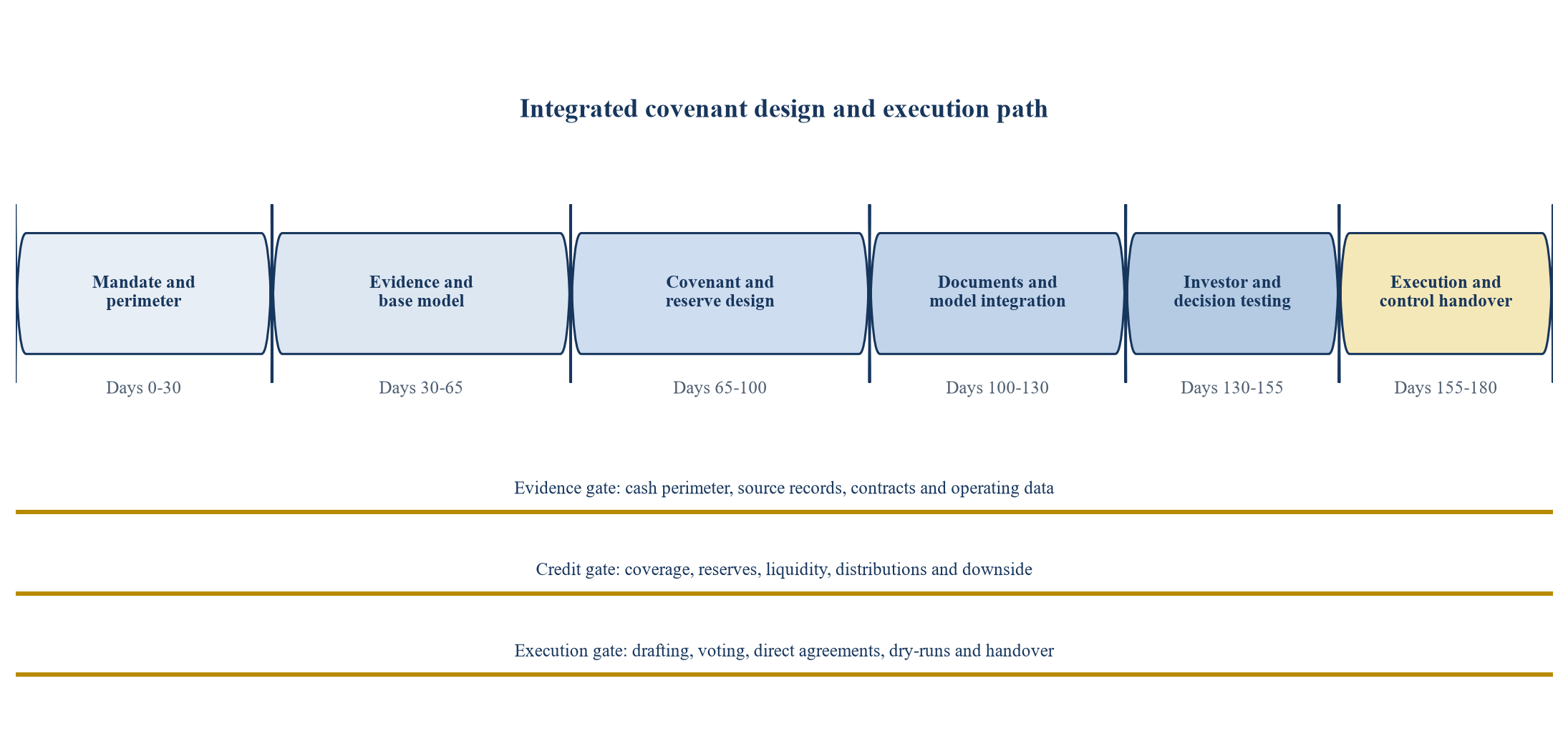
The sequence is illustrative and should be adapted to project maturity, jurisdiction, investor process and documentation timetable.
34. Prepare the approval pack
The board pack should state the financing objective, alternatives, obligor perimeter, repayment source, base and downside cases, covenant architecture, reserves, security, direct agreements, bondholder mechanics and unresolved risks. It should distinguish observed evidence from assumptions.
The pack should include the clause-to-model audit, state-transition model, account diagram, covenant summary, risk heat map and implementation plan. Legal, technical, financial, tax and accounting advisers should identify limitations within their scopes.
The board should approve launch and withdrawal thresholds. These can include maximum debt, minimum coverage, required reserve funding, security completion, direct agreements, investor quality, rating outcome and all-in cost. Delegated pricing authority should remain inside the mandate.
The closing paper should compare executed terms with approval. Changes in thresholds, baskets, grace periods, voting, security or information should be visible. Post-closing actions should have owners and dates.
35. Operate the architecture after issuance
Post-issuance governance should convert documents into a recurring calendar. Obligations include financial reporting, operating data, covenant tests, reserve checks, budget approval, insurance, technical review, project-contract notices and investor communication.
Management should maintain one evidence file for each calculation date. It should contain bank statements, model inputs, calculations, certifications, approvals and correspondence. This record supports audit, waiver and refinancing.
The board should review trends rather than isolated compliance. Coverage headroom, revenue quality, costs, maintenance, reserves, counterparty performance and forecast accuracy show whether risk is changing before a breach.
Periodic assurance should test both design and operation. A clause can be well drafted and poorly implemented. Findings should remain open until corrective evidence is verified.
36. Turn covenants into a durable financing capability
Effective covenant architecture makes project risk visible and actionable. It begins with a disciplined cash perimeter, measures observed and forecast performance, protects liquidity through accounts and reserves, retains value during deterioration and creates an executable route from cure to creditor action.
The architecture also protects operational value. Management retains authority for ordinary activity within an approved plan. Escalation focuses on material variance, leakage and failure. Release mechanics restore flexibility when evidence supports recovery.
The quality test is practical. An informed reviewer should be able to reproduce CFADS, verify reserve balances, identify the current state, understand the resulting cash restrictions, trace the cure plan and determine who can act before value is lost.
Infrastructure owners that operate this system develop a reusable financing capability. Controlled evidence, tested accounts, calibrated triggers, direct-agreement maps and decision procedures can support refinancing and future capital access. Their value should be judged through observed execution, resilience and creditor outcomes.
| Decision question | Minimum evidence | Approval owner |
|---|---|---|
| Is the repayment perimeter complete and legally accessible? | Entity, asset, contract, account and security maps | Board and legal workstream |
| Does the model measure available cash consistently? | Source-to-CFADS bridge, controlled model and calculation policy | Finance and credit committees |
| Do reserves and restrictions preserve liquidity before default? | Account agreements, funded balances, state model and stress cases | Treasury and financing committee |
| Can deterioration be cured while project value is preserved? | Cure hierarchy, technical plan, direct agreements and liquidity path | Board, project and risk committees |
| Can dispersed creditors act within the available period? | Trustee powers, voting simulation, intercreditor terms and adviser plan | Financing committee and counsel |
| Can the system be operated for the bond life? | Calendar, procedures, dry-run results, data ownership and assurance plan | Management and audit committee |
The checklist supports an auditable decision and does not replace transaction-specific legal, technical, tax, accounting, regulatory or investment advice.
Sources
- Basel Committee on Banking Supervision, CRE33: IRB approach for specialised lending, Basel Framework. Read the primary source
- Basel Committee on Banking Supervision, Basel Framework. Read the primary source
- Basel Committee on Banking Supervision, Principles for the management of credit risk. Read the primary source
- World Bank PPP Resource Center, Key Issues in Developing Project Financed Transactions. Read the primary source
- World Bank, Public-Private Partnership Reference Guide, Version 3. Read the primary source
- World Bank, Guidance on PPP Contractual Provisions, 2019 edition. Read the primary source
- World Bank, Promoting the Use of Capital Markets for Infrastructure Financing. Read the primary source
- World Bank, The Emerging Project Bond Market. Read the primary source
- UK National Infrastructure and Service Transformation Authority, PFI Foundations for Contract Managers. Read the primary source
- UK National Infrastructure and Service Transformation Authority, Navigating PFI Project Distress, Part 2: Project Company Financial Stress. Read the primary source
- UK National Infrastructure and Service Transformation Authority, Navigating PFI Project Distress, Part 4: Contract Termination and Direct Agreements. Read the primary source
- S&P Global Ratings, Project Finance Ratings Methodology, ratio model criteria. Read the primary source
- S&P Global Ratings, Project Finance Transactions that Can Achieve Ratings Above the Sovereign. Read the primary source
- S&P Global Ratings, Credit FAQ: Assessing Project Finance as a Way to Unlock India's Renewables Potential. Read the primary source
- Moody's Ratings, PFI and PPP Projects Methodology. Read the primary source
- European Investment Bank, Project Bonds Guide. Read the primary source
- European Bank for Reconstruction and Development, Secured Lending and Project Finance. Read the primary source
- Asian Infrastructure Investment Bank, Infrastructure Asset-Backed Securities Research. Read the primary source
- U.S. Securities and Exchange Commission, 2026 project indenture exhibit with debt-service reserve, project accounts and cash waterfall provisions. Read the primary source
- U.S. Securities and Exchange Commission, 2026 LNG financing exhibit with reserve funding and restricted-payment provisions. Read the primary source
