

1 Define the covenant decision
A development lender and a developer need a common answer to a precise question: does the next adverse observation call for further information, additional cash, a restriction on spending or a contractual remedy? A cost increase, slower reservation rate or late payment certificate can affect those choices in different ways. The proposed framework records the relevant fact, its effective date, the calculation it changes and the response available under the financing documents. It gives the investment committee a way to review the decision without treating every change in a forecast as the same kind of event.
The analysis concerns construction and sale of a property project in the UAE. Applicable permissions depend on the emirate, project registration, escrow arrangement and particular financing contract. A lender considering several locations should maintain a separate legal and operating schedule for each project. The paper uses public sources to identify questions for that schedule. It supplies no opinion that an actual project may withdraw a balance, draw a loan or change a payment instruction. Each such action requires its own evidence and authorised decision.
The title describes the risk of assigning the wrong consequence to a warning. An internal ratio may fall below a management tolerance while every contractual test remains satisfied. Conversely, a comfortable month-end balance can hide a contractor payment that falls due before reimbursement. The proposed work product is a set of dated definitions and response records that exposes both possibilities. A reviewer can then distinguish an analytical concern from a contractual breach and test whether a proposed cure supplies money at the relevant time. This distinction is central to financing negotiations, construction approvals and the allocation of additional sponsor capital.
2 Establish the research method and evidence boundary
The research combines a bounded review of primary and authoritative publications with an independently constructed cash model. The source set covers UAE bank credit-risk requirements, Dubai escrow administration, Abu Dhabi project-development context, RICS development-property valuation, IFRS covenant reporting and World Bank project-finance guidance [1–13]. These publications address different decisions. A banking requirement applies to its regulated institutions. A service page describes an administrative route. A valuation standard informs the basis of a professional opinion. None of those sources supplies the exact financial ratio or cure period in an unseen loan agreement.
The model uses deliberately fictional amounts and receipt ordering. It calculates aggregate completion funding and the cash remaining immediately after each construction bill. A separate set of snapshots illustrates loan-to-value mechanics. There is no claim that the snapshots describe the same financed project or that a cost increase mechanically produces a specified market-value reduction. The examples make the definitions inspectable. They allow another analyst to reproduce the arithmetic and identify which assumption changes the result. They provide no estimate of the frequency of covenant failures, developer distress or successful cures.
The proposed framework should be evaluated through consented transaction evidence before any performance claim is made. Such a study would require executed definitions, contemporaneous forecasts, payment records and documented lender decisions. A later sale outcome alone cannot establish whether an earlier warning was appropriate. The review would need to reconstruct the information available on the original decision date. This paper claims a transparent analytical procedure and a set of testable questions. It establishes no worldwide novelty, verified commercial demand or observed reduction in defaults. Its recommendations remain subject to legal, accounting, valuation and technical review for the project under consideration.
3 Separate warning funding gap and contractual breach
An internal warning is a management classification that directs attention to deteriorating headroom or uncertain evidence. A funding gap exists in a defined model when resources available for the specified obligations are insufficient at the relevant dates. A contractual breach requires failure of an applicable provision under its agreed definitions, testing date and other conditions. A warning can precede a gap. A gap can arise between formal covenant dates. A covenant can be breached even when a sponsor has enough cash elsewhere to complete the development. Each statement needs a distinct evidential basis.
The monitoring record should preserve the distinction throughout escalation. A dashboard entry marked for review should identify the internal rule that caused it. A potential breach should cite the document, provision, applicable entity and contractual calculation. A confirmed breach should record the responsible legal assessment and any relevant notice or cure status. A proposed waiver remains a proposal until the authorised parties grant it. The purpose is to support prompt commercial discussion and a precise account of legal status, with no unsupported statement about lender rights based solely on a spreadsheet colour.
The illustrative funding classification in this paper uses coverage of at least 1.10 times as the upper category. Coverage from 1.00 inclusive to below 1.10 is an internal warning; coverage below 1.00 represents an aggregate modelled funding gap. These invented thresholds create mutually exclusive categories and have no claimed regulatory or market authority. They say nothing by themselves about default. The committee should assess time to remedy, documentary certainty and payment-date liquidity alongside the category. A project with a ratio above 1.10 may still require immediate bridging cash, as the worked case later demonstrates.
The CBUAE Credit Risk Management Standards connect documented credit terms with forward-looking monitoring by their regulated institutions [2]. The official indexed provisions reviewed for this paper support attention to covenant documentation, timely information and action when credit risk changes. Direct access to the rulebook pages was restricted, as recorded in the references. This banking context supports a disciplined information process; it supplies no project-specific coverage boundary, cure entitlement or permission to release escrow cash. Actual facility terms and operative requirements still need transaction-specific confirmation.
4 Set the funding and obligation perimeter
The completion test needs a defined asset and borrower perimeter. The analyst should state which legal entity owes the construction bills, controls the accounts and may draw each facility. Land acquisition, enabling works, core construction, professional fees and obligations to adjacent infrastructure may fall under different contracts. A group-level cash balance cannot be attributed to a project merely because the entities share ownership. The proposed schedule identifies transfer authority and the funding obligation before including a resource. This provides the basis for a project-level comparison that can be reconciled with the group's wider financing plan.
The denominator should include the obligations the selected resources are intended to meet. Remaining construction cost is suitable for a narrowly bounded construction model. A full completion assessment may also require financing charges, insurance, claims, retention, handover expenditure, operating readiness and taxes where applicable. The fictional example excludes these additional items so that the arithmetic is clear. A transaction team applying the method should add them explicitly and extend the cash calendar to the relevant completion and repayment dates. An exclusion should remain visible in the committee paper rather than disappear into an assumed contingency.
Funding should be assigned once to a specified purpose. A reserve pledged to one creditor cannot also be counted as freely available completion cash without confirming the permitted use. A debt facility committed for another project requires evidence of an authorised allocation. The same sponsor support cannot be attributed in full to several projects if they may require it together. The perimeter review should therefore include competing calls on cash and commitments. This paper proposes a reconciled source ledger in which each item records its owner, eligible obligations, conditions, amount, timing and competing claims. Those fields support both aggregate coverage and the more demanding dated-payment test.
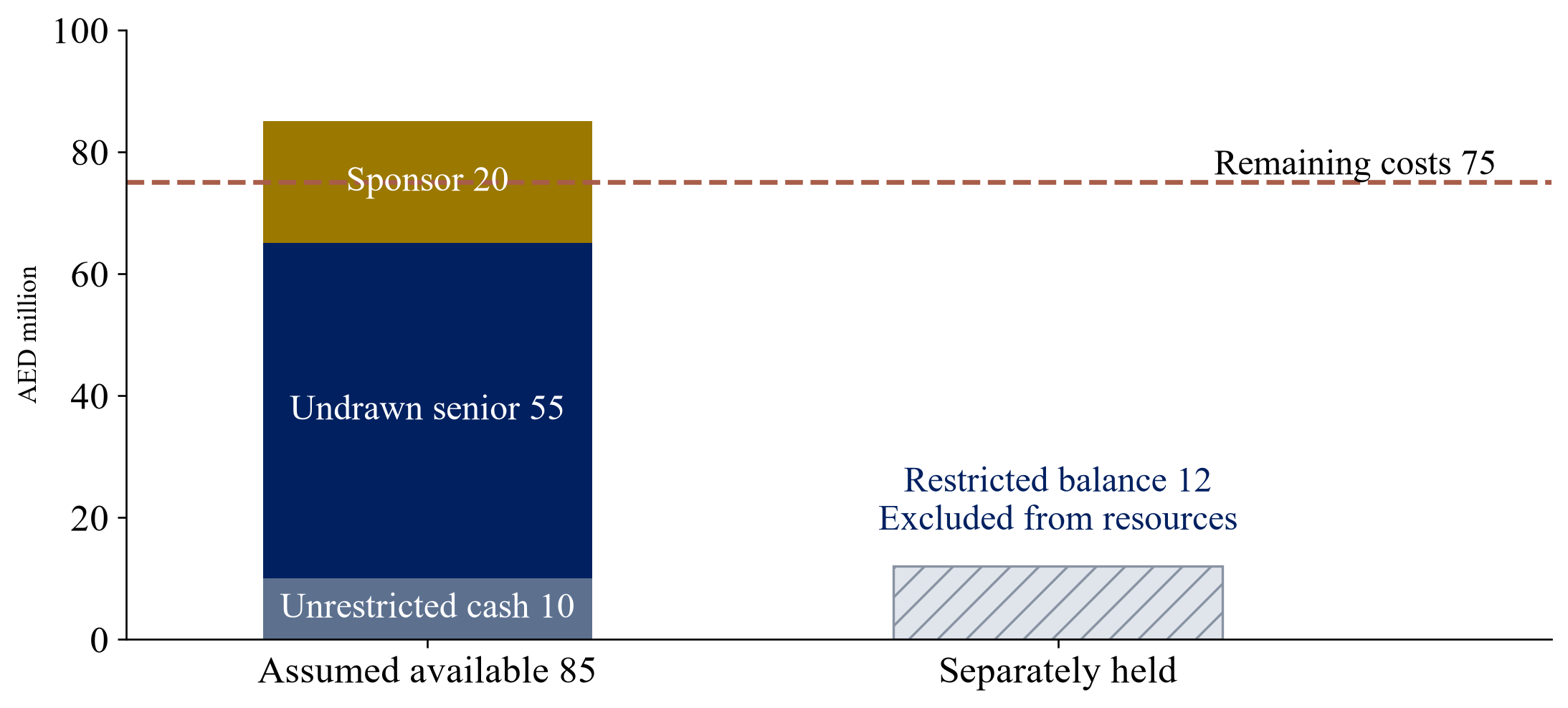
Author-developed illustration in AED million. The three available components total 85; the separate restricted balance of 12 contributes zero to the assumed executable completion resources.
5 Distinguish cash presentation from payment permission
Cash availability needs an account-level review. The monitor should obtain the bank balance, identify the account holder and document the conditions governing the proposed use. A balance may be reported in financial statements while remaining unsuitable for a particular contractor invoice. The IFRS Interpretations Committee's demand-deposit decision addresses a specified accounting fact pattern in which contractual restrictions do not necessarily change the nature of cash [8]. Accounting presentation therefore supplies no automatic answer to the separate question of permission to pay a defined construction obligation.
Dubai Land Department's activation service describes an application, trustee assessment and departmental approval process for activating an escrow disbursement mechanism. Its mortgage-deposit service distinguishes deposit conditions from settlement conditions [3–4]. Those published routes support a project-specific permissions check. Their existence does not authorise an analyst to assume that every cash balance or loan commitment is immediately releasable. The team should confirm the operative route, account status and instruction required for the proposed payment. Abu Dhabi's official project-development material should be assessed separately for an Abu Dhabi project [5].
The fictional model holds AED 12 million in a separate restricted account and excludes it entirely from completion resources. Its purpose is to expose a classification error. Counting that balance would increase the displayed numerator from 85 to 97 without changing the assumed permitted payment capacity. A live analysis should examine whether an authorised release is possible and when it would settle. If the release remains conditional, the base cash calendar should retain that condition. A sensitivity can show the consequence of timely release, but the committee record should preserve the unresolved approval and the party responsible for obtaining it.
6 Update remaining cost on a controlled basis
The cost-to-complete forecast should identify amounts already paid, unpaid certified work, committed future work and expenditure required to finish the approved scope. The project team should reconcile these categories with the quantity surveyor's report and contract ledger. Cost already paid belongs outside the remaining-use denominator. An unpaid liability remains a future cash obligation even when progress has been certified. A forecast variation should retain its approval status and uncertainty. These distinctions make the denominator reproducible and avoid counting the same cost in both an invoice schedule and a contingency estimate.
The monitor should also record the date and scope of the technical assessment. A forecast based on an earlier design or contract package can remain numerically balanced while omitting newly committed works. RICS guidance explains that development valuation depends on current inputs and remaining project risks; incurred cost does not necessarily equal value [9–10]. This paper applies that context to a proposed monitoring discipline: refresh the cost evidence before using it in a lender decision and retain a bridge showing what changed. A replacement forecast should not obscure the original amount or the event that caused the revision.
Contingency needs a consistent definition. A budget may already include a reserve for identified risks. Adding another percentage to the whole budget can duplicate that reserve unless the new stress is explicitly incremental. Conversely, removing an exhausted allowance while leaving the old completion total unchanged conceals a funding need. The fictional sensitivities increase the remaining construction amount of 75 directly and add separately invented delay costs. They establish no estimate of actual UAE inflation or contingency adequacy. A live committee should use evidenced work-package exposures, explain correlation assumptions and test whether a proposed funding response can meet the revised obligations when they become due.
7 Test debt availability and sponsor support separately
An undrawn facility amount is a capacity measure. Its availability for a bill depends on its own conditions, permitted costs, final draw date and any suspension rights. The source ledger should distinguish the commitment, the amount remaining after prior drawings and the portion expected to satisfy all conditions by the payment date. A covenant concern may affect that availability. The monitor should document the relevant clause and lender position instead of treating a facility headline as an unconditional receipt. Confirmation should cover both amount and settlement sequence where the contractor needs cash before reimbursement.
Sponsor support also requires a defined source and mechanism. The ledger should identify the contributing entity, obligation, approval, funding source and timing. An expression of intent can be shown as a proposed action without adding it to executable resources. A contractual undertaking still requires consideration of the sponsor's capacity and conditions. Where several developments depend on the same sponsor, the team should test simultaneous calls. The paper assumes a fictional commitment of 20 is executable on the dates specified later. It verifies no actual sponsor undertaking or financing capacity.
Debt and sponsor support should remain separate in the model because remedies can affect them differently. A delayed technical certificate may postpone a draw while leaving the sponsor contribution unchanged. An impaired sponsor may affect the contribution even when debt availability is confirmed. An approved direct-payment arrangement can alter payment ordering without enlarging the facility. The monitor should identify which dependency changed and revise only the affected cash event. This creates a practical negotiation agenda: obtain the missing certificate, advance an evidenced sponsor instalment, change the authorised transfer route or revise the work package. Each option should be evaluated against its own conditions and consequences.
8 Reproduce the aggregate completion test
The worked construction case is wholly fictional. All figures are AED million. Remaining uses are 75. Unrestricted opening cash is 10, undrawn senior capacity is 55 and assumed executable sponsor support is 20. The numerator is therefore 85. Aggregate coverage equals 85 divided by 75, or approximately 1.133 times. Headroom equals available resources less remaining uses, producing 10. The example excludes buyer receipts, interest, fees, taxes, final principal repayment and additional handover obligations. Those exclusions narrow the calculation to the stipulated construction payments.
The classification described earlier places this aggregate case above the invented 1.10 internal-warning boundary. That result follows directly from the arithmetic and the assumed availability of each source. It should be recorded as an aggregate result with its horizon and exclusions. If the restricted balance of 12 were incorrectly included, coverage would appear to be approximately 1.293 times. That difference arises from the analyst's treatment of resources. It supplies no additional permitted payment capacity under the scenario assumptions. The example therefore exposes how account definitions can change a monitoring result before any external market event occurs.
Aggregate coverage answers whether the stipulated eventual resources exceed the specified uses. The next decision concerns when each receipt and payment occurs. A monitor should retain both tests and reconcile them. The opening cash, total debt receipts and sponsor contributions must equal the amounts in the aggregate ledger. The remaining-cost schedule must sum to the denominator. Any unmatched receipt, duplicated reserve or omitted bill should be resolved before the result reaches the committee. This reconciliation provides a transparent starting point for the cash test without implying that positive aggregate headroom can fund every intermediate obligation.
9 Order sponsor instalments bills and lender receipts
The fictional six-month cost schedule is 15, 18, 17, 12, 8 and 5, summing to 75. Sponsor contributions of 5, 5, 5, 3, 1 and 1 sum to 20 and arrive before each month's construction bill. Lender receipts of 12, 15, 14, 8, 4 and 2 sum to 55 and arrive after that bill in the same month. These are invented cash allocations, not a stated advance-rate formula. The model evaluates cash after the bill and again after the lender receipt. Its ordering is essential to the result.
Starting with cash of 10, the unsupported balances immediately before lender receipts are 0, minus 1, 2, 7, 8 and 8. Month-end balances after those receipts are 12, 14, 16, 15, 12 and 10. The negative entry is a counterfactual funding requirement. An actual account cannot make an unsupported payment on the assumed terms. A temporary bridge of 1, available before the month-two bill, is sufficient to bring the lowest balance to zero in this simplified case. If that bridge remains contributed, final cash is 11; repayment requires a separate authorised event.
The calculation explains why the aggregate test and payment test need distinct labels. Completion resources exceed costs by 10, while a particular bill precedes enough receipts to cause a shortfall. A committee reviewing only month-end cash would miss that event. The practical response could include moving an evidenced sponsor contribution earlier or using an approved simultaneous payment arrangement. Those alternatives require their own modelled sequence. They should not be described as equivalent to same-month reimbursement without examining the actual settlement order. A live project should repeat the exercise at daily or weekly frequency around large obligations and keep the original evidence for each assumed receipt.
Table 1. The fictional monthly cash test before lender receipts
| Month | Bill | Sponsor | Baseline pre receipt | Baseline close | Lagged pre receipt | Lagged close |
|---|---|---|---|---|---|---|
| 1 | 15 | 5 | 0 | 12 | 0 | 0 |
| 2 | 18 | 5 | -1 | 14 | -13 | -1 |
| 3 | 17 | 5 | 2 | 16 | -13 | 2 |
| 4 | 12 | 3 | 7 | 15 | -7 | 7 |
| 5 | 8 | 1 | 8 | 12 | 0 | 8 |
| 6 | 5 | 1 | 8 | 10 | 4 | 8 |
AED million. Sponsor cash precedes the bill; baseline debt cash follows it. Negative unsupported balances measure an additional funding need. The lagged case receives the final 2 in month seven.
10 Trace a lender receipt lag through the same programme
The delay case moves every lender receipt one month later while leaving costs and sponsor contributions unchanged. Month one receives no lender cash; later receipts are 12, 15, 14, 8 and 4 during the six-month horizon. A tail receipt of 2 arrives in month seven. This scenario preserves the eventual facility capacity of 55. It changes the availability dates. It assumes no associated default, interest charge, cancellation or acceleration. Such consequences would require separately stated contractual assumptions and a longer calculation.
The unsupported pre-receipt balances become 0, minus 13, minus 13, minus 7, 0 and 4. The peak additional zero-floor bridge is therefore 13. The six-month closing position is 8, rising to 10 after the tail receipt. If a bridge of 13 is supplied at the outset and remains in the account, the corresponding funded positions are 21 at month six and 23 after the tail. These figures show the distinction between original resources and added timing cash. The paper assumes no repayment of that bridge. Any repayment needs its own permitted date and cash-flow event.
A monitoring rule should identify the delay's consequence without treating an unchanged total commitment as immediately usable money. The event register should record the delayed receipt, its cause, expected settlement date and supporting evidence. A forecast recovery can be included as a sensitivity while the base case retains the unresolved condition. The committee should examine which bills must be deferred or supported before the receipt arrives. This approach allows a temporary timing problem to be analysed accurately. It also avoids assuming that an eventual reimbursement excuses an earlier unpaid obligation or automatically restores any affected contractual status.
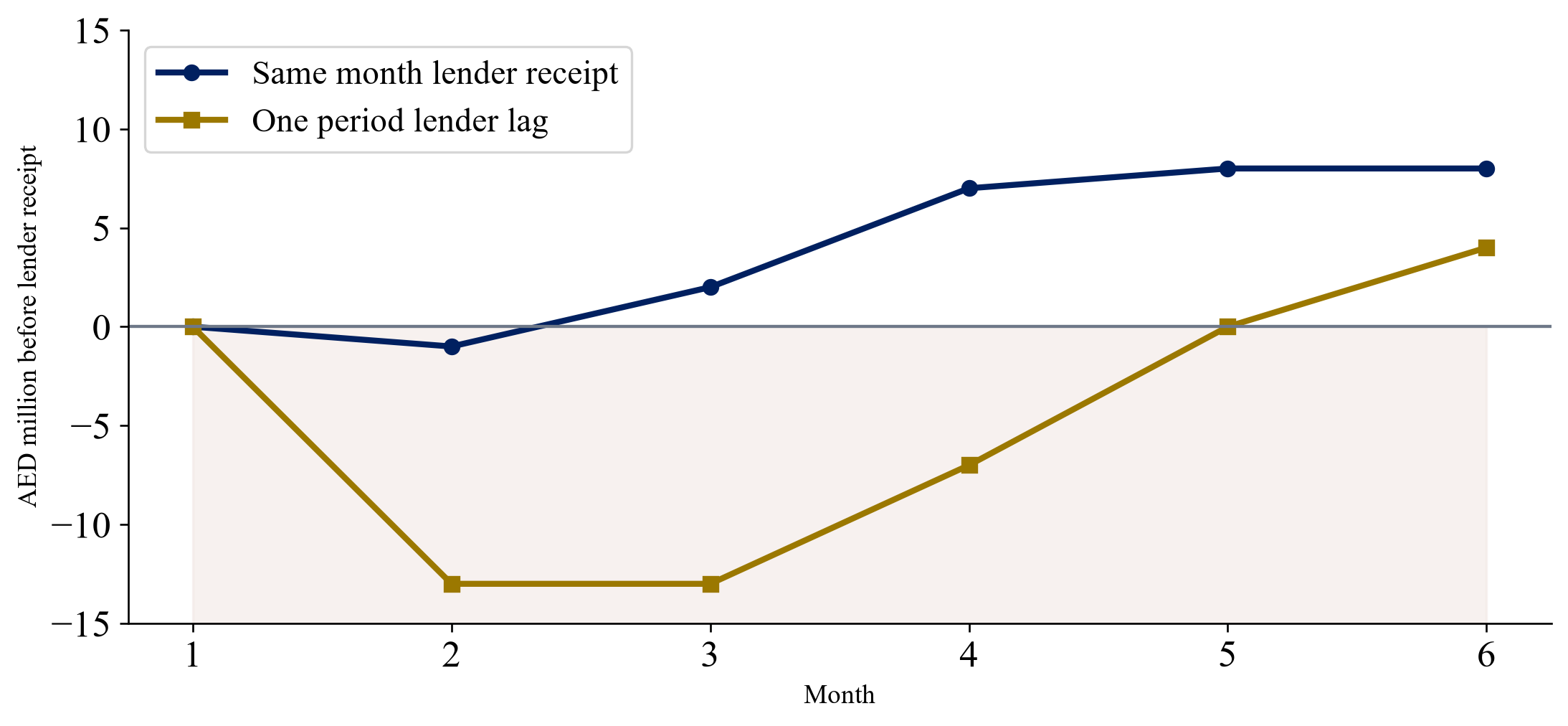
Author-developed hypothetical paths in AED million. Negative values are funding requirements before added bridge cash. The baseline bridge is 1; the one-period lag requires 13. No contractual-default status is inferred from these lines.
11 Combine cost and construction delay stress
The aggregate stress test keeps available resources at 85 and varies remaining uses. A ten-percent increase in the construction amount of 75 raises uses to 82.5. Headroom becomes 2.5 and coverage approximately 1.030 times, placing the result in the invented warning band. A twenty-percent increase raises uses to 90, creating a shortfall of 5 and coverage approximately 0.944 times. These stresses are fictional sensitivity inputs. They describe no observed cost trend and supply no statistical probability of a UAE project experiencing either increase.
Delay is represented separately as an invented cost of 1 per additional month. Three months of delay adds 3, giving uses of 78, headroom of 7 and coverage approximately 1.090 times. Combining the ten-percent construction increase with that delay produces uses of 85.5, a shortfall of 0.5 and coverage approximately 0.994 times. A twenty-percent increase with six months of delay produces uses of 96, a shortfall of 11 and coverage approximately 0.885 times. The delay-cost assumption excludes interest and other omitted obligations. A transaction model should replace it with evidenced costs and avoid duplicating expenses already present in the revised schedule.
These aggregate stresses identify how much eventual construction funding is missing under the stated cases. They do not establish the payment-date bridge for a stressed programme. That requires a revised schedule allocating the higher costs and changed receipts to actual dates. The baseline bridge and the aggregate stressed shortfall should not be added mechanically. Some additional contributions may cover both effects. The committee should run the combined dated model and state its peak external support and remaining terminal exposure. This separation keeps a convenient sensitivity table from being mistaken for a complete executable financing plan.
Table 2. Aggregate completion coverage under fictional cost and delay stress
| Construction increase | Added delay months | Remaining uses | Headroom | Coverage | Model classification |
|---|---|---|---|---|---|
| 0% | 0 | 75.0 | 10.0 | 1.133 | Above warning band |
| 10% | 0 | 82.5 | 2.5 | 1.030 | Warning |
| 20% | 0 | 90.0 | -5.0 | 0.944 | Gap |
| 0% | 3 | 78.0 | 7.0 | 1.090 | Warning |
| 10% | 3 | 85.5 | -0.5 | 0.994 | Gap |
| 20% | 6 | 96.0 | -11.0 | 0.885 | Gap |
AED million except coverage. Available resources remain 85. Warning means 1.00 inclusive to below 1.10; gap means below 1.00. These classifications are invented monitoring rules and create no legal-default conclusion.
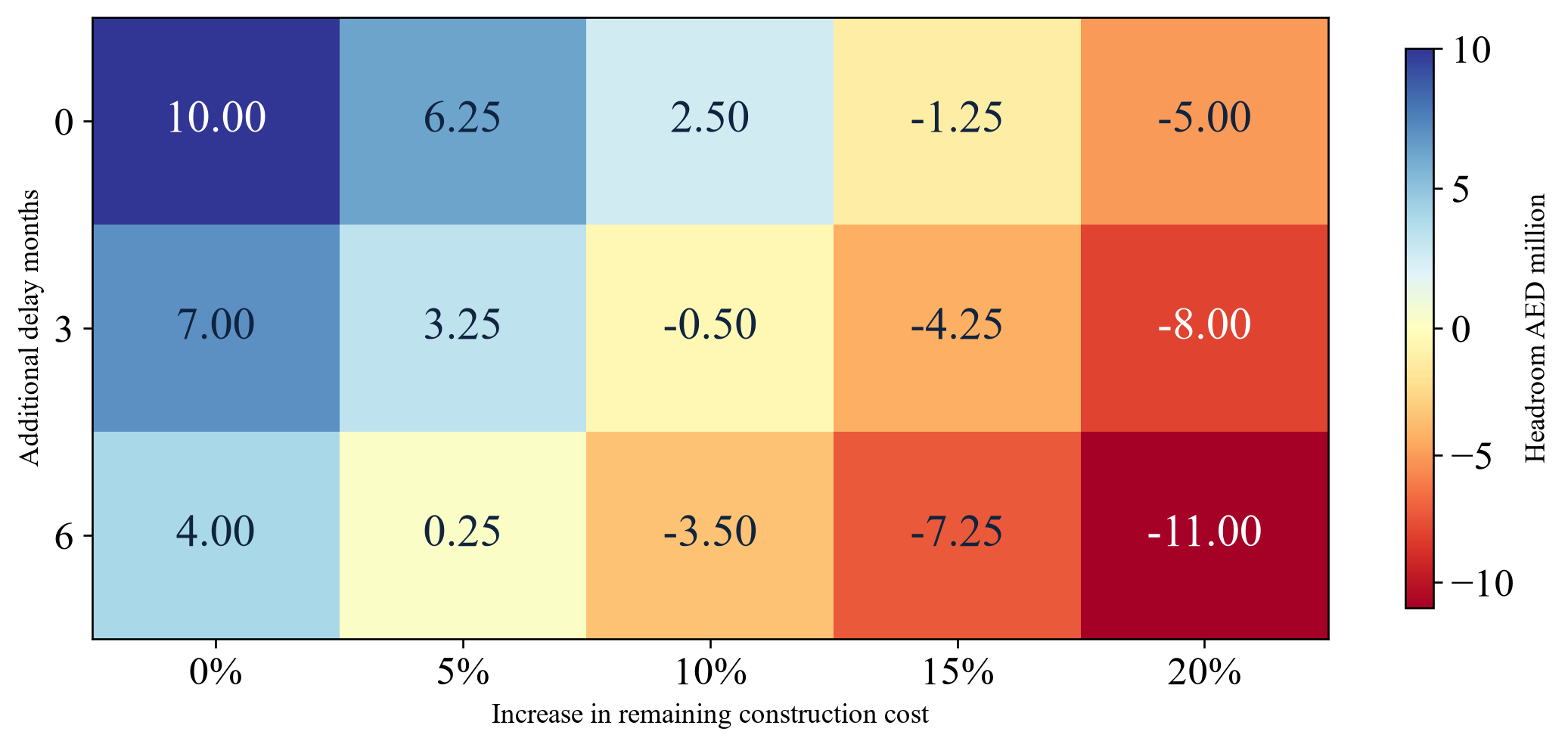
AED million. Each cell equals 85 less 75 times one plus the construction increase, less delay months times 1. The display establishes no shock probability or contractual covenant level.
12 Measure sales quality and permitted collections
Sales monitoring should distinguish reservations, signed contracts, cleared deposits, overdue instalments and cash authorised for a defined use. Each status answers a different financing question. A reservation can inform a demand assessment while producing no receipt in the payment calendar. A signed sale can support a forecast, subject to its terms and collection assumptions. A cleared deposit may remain subject to the applicable account restrictions. The proposed monitor should preserve those states instead of collapsing them into one percentage sold. The calculation should identify the particular sales event that changes funding, valuation or a contractual test.
The construction example assumes zero buyer cash throughout its horizon. This is a modelling boundary, not a statement about an actual project's sales performance. A project-specific extension would add cleared and permitted buyer receipts on their relevant dates, with separate scenarios for later collection, cancellation and an altered sale programme. The committee should avoid counting the same receipt as both future sales value and cash already available to reduce financing needs. Where a debt-service test uses sale proceeds, its definition should identify deductions, release conditions and the period covered. A gross sales announcement cannot supply those missing details.
An illustrative sales warning might direct the team to refresh the collection forecast when a specified cohort of instalments becomes overdue. That proposed management trigger would need calibration against the project's contract terms and cash requirement. It should not be presented as a universal covenant. The response record should state whether the observation changes expected receipts, lender availability or a valuation input. If the collection date changes, the model should recalculate payment-date liquidity. If an executed covenant refers to eligible contracted sales, the team should calculate that measure separately, retaining evidence of eligibility and the contractual treatment of cancellations or disputed amounts.
13 Specify the valuation basis before using loan to value
Loan-to-value monitoring requires a stated numerator and an agreed valuation basis. Drawn principal, outstanding financial liabilities and total committed exposure are different possible numerators. An as-is valuation, an as-completed valuation and a management appraisal also have different assumptions. The contract should determine the applicable measure. The monitor should record the valuation date, professional instructions, permitted assumptions and any required refresh. RICS provides development-valuation context [9–10]. It establishes no universal UAE loan ratio or conclusion that the value of work in progress equals money spent on it.
A separate fictional snapshot uses outstanding debt of 35 and an as-is value of 70. The ratio is fifty percent. With an invented maximum of sixty percent, the indicated debt capacity is 42 and the headroom is 7. If an independently assumed value is 60, the ratio is approximately 58.33 percent, capacity is 36 and headroom is 1. With a value of 50, the ratio becomes seventy percent and capacity is 30, giving an excess of 5 over the invented limit. These independent value assumptions are not estimated responses to the earlier cost or delay shocks.
The snapshots are deliberately separate from the six-month future-draw model. Applying the same sixty-percent cap continuously to the value of 70 would permit only another 7 of debt on that basis. It would not permit the earlier assumed 55 of future drawings without additional conditions or a different agreed basis. The analyst should therefore test each future draw against the actual covenant definition and current evidence. A forecast of completed value should retain its assumption status. If the lender requires a fresh professional valuation before a later draw, that requirement should appear as a dated dependency in the construction funding calendar.
14 Write a covenant dictionary that can be reproduced
The covenant dictionary should connect each defined measure with its source data, measurement date, test frequency and consequence. A ratio without those fields is difficult to reproduce and can acquire different meanings across teams. The proposed dictionary records the exact clause, applicable entity, numerator, denominator, exclusions, rounding convention and authorised reviewer. It also distinguishes the date on which compliance is required from the date on which a certificate is delivered. The parties can then compare a calculation with the provision it is intended to evidence instead of arguing from an abbreviated spreadsheet heading.
Terms such as available cash, committed equity and remaining costs deserve particular attention. The document should say how restricted balances, disputed liabilities, conditional commitments and amounts available after a payment deadline are treated. It should identify whether undrawn debt counts only when draw conditions are satisfied. The source pack should keep the evidence for each included amount. The fictional example demonstrates the economic importance of these definitions, but its thresholds and categories have no binding status. A real dictionary must reflect negotiated terms and be reviewed by the relevant legal and credit teams.
The consequence field should describe what actually follows from a failed test. Possible consequences require contractual review and may include an information request, a draw restriction, a distribution restriction, a cure process or a specified default assessment. A monitoring recommendation should retain its separate status. The dictionary should also record any amendment or waiver, its scope, expiry and approving parties. An amendment to one test should not silently alter another. This proposed structure gives the committee a compact audit trail from evidence to calculation to authority, while preserving the distinctions needed for accurate reporting and financing decisions.
Table 3. A proposed bankability and covenant definition checklist
| Test or dependency | Evidence and definition | Date question | Decision record |
|---|---|---|---|
| Completion coverage | Eligible cash and support against updated remaining obligations | Available by each obligation date? | Internal warning separate from legal test |
| Payment liquidity | Sponsor, invoice and lender settlement sequence | Cash before the bill? | Authorised bridge or revised payment sequence |
| Draw availability | Permitted costs, approvals and facility conditions | Conditions met before funding needed? | Lender and trustee confirmations |
| Sales and collections | Eligible contracts, cancellations and permitted cleared cash | Contract and cash dates reconciled? | Revised collection and funding forecast |
| Loan to value | Agreed debt perimeter and professional valuation basis | Current value and next draw tested? | Clause calculation and valuation review |
| Cure and waiver | Contributing party, cash, authority and scope | Effective before required deadline? | Written approval and post-cure calculation |
| Reporting classification | Applicable accounting requirements and compliance date | Right present at reporting date? | Separate accountant assessment |
Author-developed checklist. Every legal consequence, permitted cure and threshold requires the actual executed documents; the rows create no automatic rights.
15 Align measurement notice and testing dates
A useful monitoring calendar identifies the date of the economic observation, the date the data became available, the contractual compliance date and the delivery deadline for the evidence. Those dates can differ. A cost report issued in one month may describe work and commitments from an earlier period. A covenant certificate delivered after year end may test compliance required at year end. The analyst should preserve both time references. Otherwise, a late data submission can be mistaken for a substantive breach or an assessment performed later can be treated as if its underlying obligation also arose later.
The proposed record should also distinguish scheduled testing from event-driven review. A quarterly formal test may coexist with weekly monitoring of a large upcoming bill. An adverse observation should cause the appropriate team to consider whether other contractual notification obligations apply. This paper supplies no universal notification period. The actual documents and applicable rules determine that question. The monitor should identify the reviewer responsible for assessing it and retain the assessment alongside the factual observation. The purpose is to support prompt action without inventing a notice requirement or replacing legal review with a spreadsheet rule.
Evidence ageing should be explicit. A technical certificate, account statement, sales report or valuation can remain relevant to one historical calculation while becoming insufficient for a future draw. The system should keep the original evidence for historical reconstruction and request the current evidence required for the next decision. A revised data value should record its effective date, reason and approval. The committee can then see whether a changed ratio reflects an actual economic change, a corrected input or a new measurement basis. This distinction helps the parties resolve disputes about the calculation and understand what action remains necessary.
16 Calibrate an early warning to the time needed for action
The illustrative 1.10 warning boundary is a deliberate modelling choice. It gives the stress cases a visible classification and makes the threshold inspectable. Its practical appropriateness would depend on volatility of costs and receipts, evidence quality, payment frequency and the time needed to obtain additional support. A project with a large imminent invoice may need an earlier warning even when aggregate coverage appears comfortable. The committee should identify the decision the warning is meant to support and estimate the relevant response time from documented project processes before selecting a threshold.
Calibration should consider the cost of both late and unnecessary escalation. An excessively permissive rule may leave little time to arrange a permitted transfer. A highly sensitive rule may repeatedly direct staff to review harmless measurement changes. This paper provides no empirical estimate of either effect. A consented backtest could compare contemporaneous warnings with documented decisions and later cash events. The review should preserve what was known at the time, rather than declaring a warning unnecessary solely because the project ultimately succeeded. Successful additional funding can be the reason an earlier concern did not become an unpaid bill.
The warning response should be proportionate and documented. A modest reduction in headroom with reliable evidence may call for a forecast refresh. A receipt with unresolved conditions before a major payment may require immediate funding confirmation. A suspected contractual failure requires the responsible legal and credit review. Those are proposed decision categories, not automatic lending instructions. The committee should define when human review can close an alert, what evidence is required and who may change the rule. Retaining the original threshold and override rationale makes later evaluation possible without disguising discretionary judgement as a purely mechanical result.
17 Assess cash cures and written waivers on their own terms
A proposed cash cure should identify the amount, contributing party, permitted transfer route and date of settlement. It should also explain which test the contribution changes. Cash deposited after an unpaid bill can improve future liquidity while leaving the earlier payment event unresolved. A contribution to a restricted account may not meet a freely available cash definition. A debt repayment may reduce an LTV numerator without supplying construction funds. The team should calculate the post-cure position using the correct definitions and retain any remaining obligations, conditions or documentary uncertainty.
The fictional ten-percent cost and three-month delay case has an aggregate shortfall of 0.5. A permitted additional contribution of 0.5 would bring its aggregate resources equal to uses, producing coverage of 1.00. Under the invented classification, that result remains in the warning band. Reaching 1.10 coverage would require resources of 94.05 against uses of 85.5, or an addition of 9.05 to the original 85. These calculations concern eventual construction resources. They supply no conclusion about payment-date liquidity, the sponsor's capacity to contribute or a contractual cure mechanism.
A waiver has a separate function. Its existence, scope and consequences require the authorised parties' agreement. The monitor should record the provision covered, applicable period, conditions and remaining rights. A commercial conversation or unsigned draft should remain unresolved in the record. The parties should also consider whether the waiver changes draw availability, disclosures or other obligations. This paper proposes a documented post-remedy review rather than assuming that one approval resolves every consequence. The committee should compare the cash position, legal status and next required evidence after the action, with each conclusion assigned to its responsible reviewer.
18 Review completion support and maturity exposure
Completion support should be assessed for its amount, duration, conditions and ability to provide usable cash. World Bank project-finance guidance discusses negotiated sponsor contributions, completion support and intercreditor arrangements [11–12]. Those publications describe possible structures rather than an available commitment for a particular UAE developer. The proposed monitor should identify the specific undertaking in the transaction, including when it begins, when it expires and how a claim would be funded. The definition of completion used to release support should be reconciled with the obligations remaining at that date.
The construction model ends before final senior principal repayment. A project can fund its remaining works while facing a later debt-maturity problem. The financing plan should extend to permitted sale proceeds, repayment dates and any retained expenditure. A forecast refinancing should remain conditional unless its relevant availability is evidenced. The committee should distinguish a construction cash gap from a maturity gap and consider the consequences of solving one while leaving the other unresolved. A bridge that funds a bill adds an obligation if it must later be repaid; the extended model should retain that obligation.
Contractor continuity also deserves review when a funding issue arises. Suspending a work package can alter completion cost and timing. A lender's ability to cure, step in or substitute a party depends on the contractual and legal framework; the World Bank's discussion of such arrangements supplies context [11]. A committee should obtain transaction-specific advice before assuming an enforcement or continuity route. The proposed response record should show the affected scope, costs of maintaining or stopping work and approvals needed for the chosen action. This turns the covenant discussion into a review of executable alternatives while preserving the limits of the available evidence.
19 Keep accounting classification separate from the monitoring result
For a hypothetical entity applying IAS 1 without early adoption of IFRS 18, covenant accounting needs its own assessment. IAS 1 distinguishes compliance required on or before the reporting date from compliance required only afterward; a later assessment date does not change an earlier contractual compliance date [6–7]. Relevant non-current loans subject to later covenants can require disclosures about the conditions and risk of early repayment. The applicable reporting framework and facts determine classification. An internal warning category has no independent authority to classify a loan in financial statements.
The monitoring pack should therefore provide the accountant with the contract, amendments, compliance calendar, calculations and any waiver or grace-period evidence. It should preserve when a right or approval became effective. A discussion after the reporting date requires assessment under the applicable accounting rules and does not automatically establish that a deferral right existed earlier. IFRS 18 replaces IAS 1 for annual periods beginning on or after 1 January 2027, with early application permitted [13]; the relevant framework should be stated. This paper provides analytical context and no accounting opinion for an actual entity.
Management should reconcile the accounting assessment with the financing forecast without conflating them. A classification conclusion can be economically important, and a funding forecast may need to reflect the rights established by the contract. The two work products still answer different questions. The proposed procedure records both conclusions, their evidence and the reviewer responsible. A forecast update should not overwrite the accounting assessment. An accounting disclosure should not be treated as approval of an assumed cash transfer. The committee should use the combined evidence to understand the obligations and uncertainties that remain in the financing plan.
20 Use data and AI with deterministic calculations and review
The proposed data architecture stores every covenant definition as a versioned record linked to the executed document and supporting evidence. Numerical calculations should use explicit formulas and tested input transformations. A language model could assist with locating a clause, extracting a candidate definition or summarising a changed report. Such output would require comparison with the source and qualified review before use. This paper reports no deployed system or measured model accuracy. The method is a proposed assistance workflow in which legal status and payment authority remain decisions of the responsible professionals.
Evaluation should focus on errors that matter to the decision. A tool that confuses a commitment with executable cash can inflate headroom. A tool that reads the certificate-delivery date as the compliance date can misstate a test. A tool that omits an amended definition can produce a mathematically correct answer to the wrong clause. A proposed test set should include these cases, along with account restrictions, duplicated support, cancellation conditions, version conflicts and missing data. Expected outcomes should be reviewed independently. No inferred amount or missing provision should be silently filled to make the calculation run.
The system should retain source location, extraction result, reviewer correction and model version alongside the final approved input. Alerts should identify the failed rule and relevant evidence. A permissioned operating environment would need its own access, retention and security design before implementation. The committee should receive a reproducible calculation and a separate list of unresolved evidence. The proposed use of AI is limited to supporting those tasks. It establishes no autonomous authority to declare default, waive a clause, contact a lender or instruct an account. Performance claims require a consented evaluation against an independently reviewed baseline.
21 Present an executable decision pack to the committee
The committee paper should lead with the specific approval required. It should state the next material payment, cash available before that payment, conditions attached to the expected receipts and proposed action. The covenant dictionary and model should support that opening conclusion. The committee should be able to identify the amount at risk and the evidence still missing without reconstructing an entire spreadsheet. For a proposed bridge, the paper should show the source, permitted route, timing, resulting cash profile and any repayment obligation. For a waiver, it should identify the provision and approving parties.
Negotiation should focus on the definition or dependency creating the problem. A parties' disagreement about whether restricted cash is eligible calls for a documented contractual interpretation and account evidence. A delay in an otherwise eligible receipt calls for a funding-date solution. A stale cost estimate calls for technical updating. A valuation-basis disagreement calls for the agreed professional instructions. These are proposed diagnostic categories. The committee should avoid changing a threshold merely to make a displayed ratio pass while the underlying payment remains unfunded. Any negotiated change should be tested against the whole financing plan and retained as an explicit amendment.
The pack should also identify the decision expiry and next review event. A funding approval based on a particular receipt date may require reconsideration when that date changes. A conditional work authorisation should state the spending boundary and further evidence needed. After the action, the team should reconcile actual cash with the assumed path and document any variance. The purpose is to maintain a useful record of the decision, its assumptions and subsequent outcome. This record can support later evaluation of the warning procedure without relying on a reconstructed narrative or an undated summary of the final result.
22 State the limitations and the conclusion
The worked cases demonstrate arithmetic relationships under stated fictional assumptions. They establish that aggregate resources can exceed remaining uses while payment sequencing creates an earlier shortfall. They also show how higher costs and additional delay expenditure reduce coverage, and how valuation definitions affect a separate loan-to-value snapshot. The examples contain no observed market terms, project approval, borrower outcome or statistical evidence. The proposed warning boundary, support amounts, cost increases, receipt dates and ratio limits should be replaced with transaction-specific definitions before any real financing decision is made.
The method has important limits. Monthly periods can conceal more severe intra-month requirements. Interest, fees, principal repayment, taxes and other completion obligations are excluded from the simplified construction calculation. Future drawing capacity is assumed executable in the baseline and must be tested against the actual conditions. The separate valuation snapshots cannot be combined mechanically with that baseline. The legal and accounting discussion remains bounded by the cited public materials and their stated access limitations. A current project requires independent confirmation of operative rules, approvals, contracts and professional assessments.
The conclusion is a proposed decision discipline: define the measure, attach the evidence and date, calculate both aggregate coverage and event-ordered liquidity, and assign the consequence through the correct authority. Internal warnings can direct timely review while legal breaches retain their contractual meaning. A remedy should be tested for its cash effect and scope rather than accepted as a general statement that the problem is resolved. Further research should use consented histories to assess warning timeliness, evidence errors and response outcomes. Until that evidence exists, the paper's contribution is a reproducible framework for a more precise financing discussion.
References
- Central Bank of the UAE. Credit Risk Management Regulation, C3/2024, official indexed status In-Force and effective 30 November 2024; relevant indexed provisions reviewed 8 October 2026; direct opening returned access restriction. https://rulebook.centralbank.ae/en/rulebook/credit-risk-management-regulation
- Central Bank of the UAE. Credit Risk Management Standards, C3/2024 STA, official indexed status In-Force and effective 30 November 2024; sections 3.11–3.12 and monitoring context; official indexed text reviewed 8 October 2026; direct opening returned access restriction. https://rulebook.centralbank.ae/en/rulebook/credit-risk-management-standards
- Dubai Land Department. Escrow Account activation, official service description and application conditions; project-specific permission requires confirmation; accessed 8 October 2026. https://dubailand.gov.ae/en/eservices/request-to-activate-an-escrow-account/
- Dubai Land Department. Depositing a mortgage into an escrow account application, separate deposit and settlement conditions; accessed 8 October 2026. https://dubailand.gov.ae/en/eservices/request-for-mortgage-payment-in-escrow-account/
- Abu Dhabi Real Estate Centre. Project Development, official operating context; operative project-specific requirements and approval remain subject to confirmation; accessed 8 October 2026. https://adrec.gov.ae/en/sectors/regulatory-services/project-development
- IFRS Foundation. IASB amends accounting standard to improve information about long-term debt with covenants, October 2022 announcement; amendments effective for annual periods beginning on or after 1 January 2024; accessed 8 October 2026. https://www.ifrs.org/news-and-events/news/2022/10/iasb-amends-accounting-standard-to-improve-information-about-long-term-debt-with-covenants/
- IFRS Foundation. IFRS 18 Reference Material, April 2024, official IAS 1 and IFRS 18 comparison including covenant compliance and disclosure text, printed pages 22–23; accessed 8 October 2026. https://www.ifrs.org/content/dam/ifrs/project/primary-financial-statements/ifrs-standard/reference-material-for-ifrs18.pdf
- IFRS Interpretations Committee. Demand Deposits with Restrictions on Use arising from a Contract with a Third Party, IAS 7 agenda decision, April 2022, presentation references updated January 2026; accessed 8 October 2026. https://www.ifrs.org/content/dam/ifrs/supporting-implementation/agenda-decisions/2026/demand-deposits-with-restrictions-on-use-jan-26.pdf
- Royal Institution of Chartered Surveyors. Valuation of development property, professional-standard overview, published 1 October 2019; read with applicable current global standards; accessed 8 October 2026. https://www.rics.org/profession-standards/rics-standards-and-guidance/sector-standards/valuation-standards/valuation-of-development-property
- Royal Institution of Chartered Surveyors. Valuation of development property, first edition October 2019, effective 1 February 2020; reissued April 2023 as a professional standard; sections 7–8 on sensitivity and development in progress; accessed 8 October 2026. https://www.rics.org/content/dam/ricsglobal/documents/to-be-sorted/Valuation%20of%20development%20property_ready%20for%20approvals.pdf
- World Bank Public-Private Partnership Resource Center. Key Issues in Developing Project Financed Transactions, ratios, monitoring, support and contractually structured rights; PPP context rather than a verified UAE facility; accessed 8 October 2026. https://ppp.worldbank.org/financing/issues-in-project-financed-transactions
- World Bank Public-Private Partnership Resource Center. Intercreditor Arrangements, sponsor-contribution timing and completion-support context; accessed 8 October 2026. https://ppp.worldbank.org/intercreditor-arrangements
- IFRS Foundation. IFRS 18 Presentation and Disclosure in Financial Statements, official standard overview; effective for annual reporting periods beginning on or after 1 January 2027, with early application permitted; accessed 8 October 2026. https://www.ifrs.org/issued-standards/list-of-standards/ifrs-18-presentation-and-disclosure-in-financial-statements/
About the Author
Chennakeshav (CK) is a corporate finance and investment banking executive with 25+ years of global experience in deal origination, structuring and execution across M&A, growth capital and corporate strategy. He has led value-creation mandates for founders, corporates and funds — bridging the boardroom view to hands-on execution and close.
His career spans Morgan Stanley, HSBC, Lloyds Banking Group, EWEC, ADQ portfolio companies and Emirates Growth Fund, across TMT, real estate, fintech, deeptech, cleantech, infrastructure and energy. He has partnered with C-suite leaders, private equity and venture funds, sovereign wealth funds and family offices to finance complex fund raises and scale-up ventures, and has led M&A due diligence, post-merger integration and business-transformation initiatives to create value.
At Matchpoint Partners he is Managing Partner, leading the firm's corporate finance, M&A and capital-raising practice. He holds an MBA from London Business School, an engineering degree from VTU and a Master of Laws (LLM, in progress) from UCL London.
An active start-up mentor, CK mentors at Techstars, DIFC FinTech Hive, Startup Grind, Founder Institute and IN5, serves as Entrepreneur Mentor in Residence (EMiR) at London Business School, and judges the Entrepreneurship World Cup.
