

1. The buyer's decision
The central decision is whether paying before delivery improves supply security enough to justify the credit, performance and recovery risks assumed. A prepayment can accelerate a mine, expand processing, fund inventory or reserve production. It can also convert a procurement relationship into a concentrated unsecured exposure.
The buyer therefore needs two linked cases. The supply case asks what disruption is avoided, which product is required and how quickly substitute material can be obtained. The credit case asks how the advance is repaid through deliveries, cash or enforceable recovery. Approval should require both cases to remain credible under stress.
2. Why prepayment is used
Critical-mineral projects can face a financing gap between capital investment and stable operating cash flow. A buyer may have stronger credit, strategic demand and access to liquidity. It can advance funds in exchange for product rights, pricing terms, priority, information and control.
Official World Bank material describes long-term offtake as a relationship under which a buyer purchases specified production and notes that an agreement can support construction financing. It also recognises that pricing may include a discount that repays upfront financing costs [1]. The commercial benefit is real; the buyer still needs protection against under-delivery.
3. Supply concentration raises the stakes
The International Energy Agency reported continuing concentration in critical-mineral refining and growing use of export controls [2]. A buyer can suffer loss far beyond the value of undelivered tonnes when a small mineral input constrains a high-value production line.
That asymmetry supports deliberate supply investment. It does not justify indiscriminate advances. The more strategic the product, the more carefully the buyer should test quality, logistics, substitution, legal access and common-shock exposure. A contract with a supplier in the same disruption corridor as existing supply may add nominal volume without adding resilience.
4. Transaction boundary
This paper addresses buyer-side advance purchase funding tied to mineral deliveries. It does not attempt to finance the entire mine, refinery or infrastructure system. The distinction matters because a buyer may accept a limited completion or operating exposure while retaining procurement discipline.
Where funding becomes material to total project capital, the structure may require full project-finance diligence, construction controls, reserve analysis, environmental and social review, intercreditor arrangements and sponsor support. The buyer should state when its approval boundary has crossed from procurement into project credit.
5. Economic character
Prepayment can have several economic characters. It may be a deposit against future deliveries, a loan amortised through product, a revolving working-capital facility, a secured advance against inventory, or a hybrid with price and volume options. Legal character depends on the documents and governing law.
Accounting, tax, insolvency and regulatory treatment can differ from the commercial label. Transaction teams should avoid assuming that calling an advance a prepayment creates ownership, priority or bankruptcy protection. Counsel should test substance, perfection and enforceability in each relevant jurisdiction.
6. The controlled system
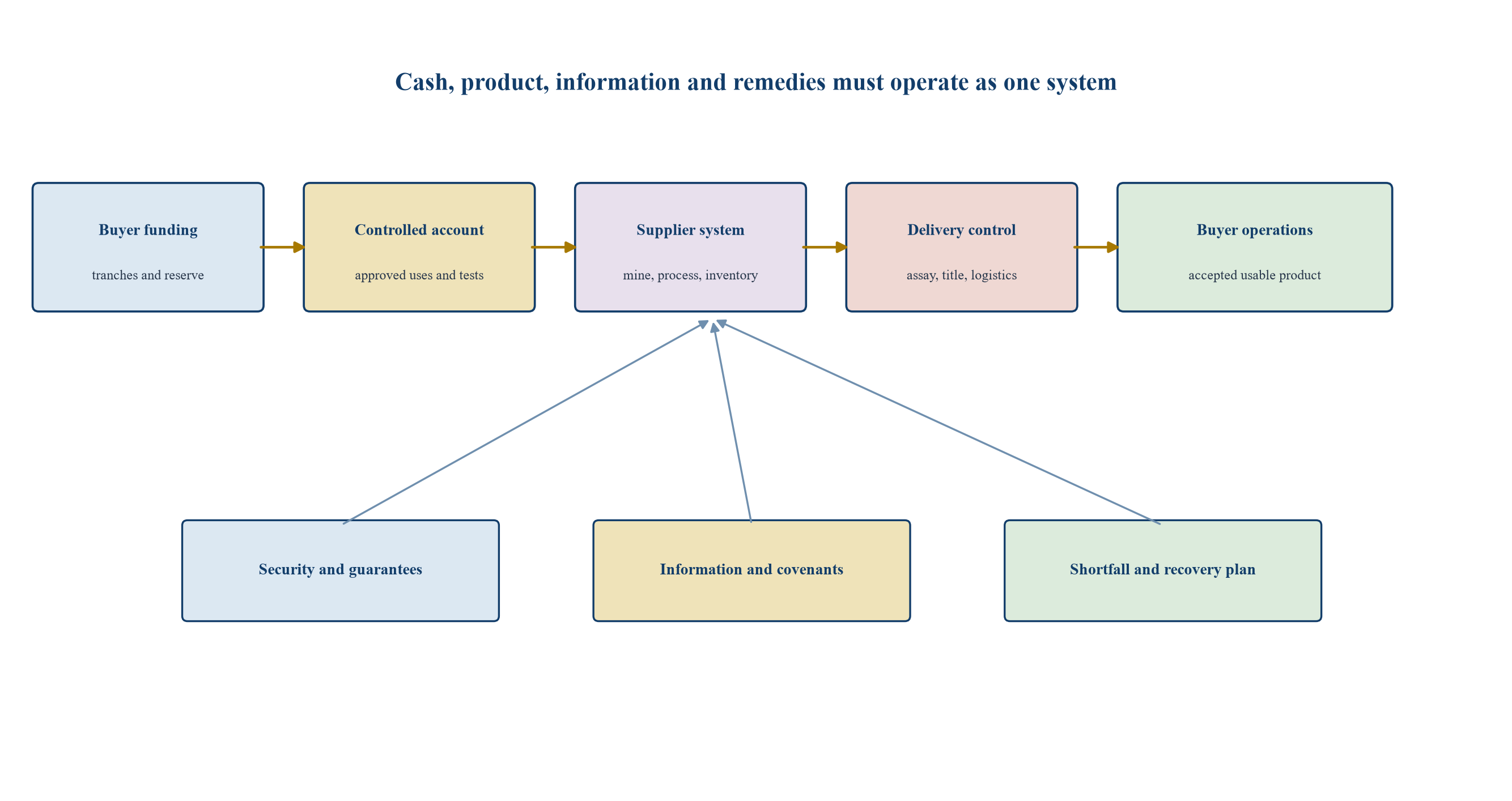
Generic decision framework; rights, perfection and enforcement require jurisdiction-specific advice.
7. The buyer's protected outcome
The contract should define the industrial output protected by the mineral supply. This connects tonnes and specification to the buyer's actual exposure. A tonne of material that cannot enter the buyer's process has little continuity value.
The protected outcome should identify the facility, product, minimum operating rate, conversion losses and disruption period. Procurement and treasury can then compare the cost of prepayment with inventory, dual sourcing, substitution, capacity reservation or production curtailment. This comparison prevents a strategic label from obscuring an uneconomic structure.
8. Product definition
The schedule should specify mineral, form, grade, chemistry, moisture, impurities, packaging, lot size, assay method, sampling, tolerance and rejection. A reference to a broad commodity name leaves room for unusable delivery.
Specification should reflect downstream equipment and regulatory requirements. Where blending or refining can cure variance, the contract should allocate the cost, time and recovery. Independent inspection rights and split samples support dispute resolution. A buyer should decide whether title passes before final assay and how provisional payment is adjusted.
9. Quantity architecture
Quantity can be fixed, percentage-based, take-or-pay, requirements-based or bounded by minimum and maximum nominations. Each design allocates production and demand risk differently. A percentage of output shares operating risk; a fixed commitment can burden the supplier after production loss.
The agreement should define annual, quarterly and shipment obligations, nomination windows, make-up rights, carry-forward, over-delivery, allocation during shortage and treatment of co-products. A delivery obligation without a calendar and measurement point is difficult to monitor and enforce.
10. Tenor and amortisation
Prepayment tenor should follow the credible production and delivery profile. Amortisation commonly occurs through a deduction from the price payable for each accepted shipment. The model should show opening advance, accrued return if applicable, delivered quantity, unit deduction, cash settlement and closing balance.
Slow ramp-up lengthens exposure and can create a maturity wall. The buyer can use a long-stop date, minimum amortisation, cash sweep or sponsor top-up. Extension should require a refreshed supply and recovery case rather than becoming automatic after underperformance.
Table 1. Buyer-side prepayment structure comparison
| Structure | Funding trigger | Buyer return | Principal risk | Control priority |
|---|---|---|---|---|
| Unsecured advance | contract effectiveness | product discount or set-off | supplier insolvency | guarantee and refund liquidity |
| Secured prepayment | collateral perfection and milestones | delivery deductions | collateral shortfall | priority, custody and enforcement |
| Revolving prepay | eligible production or inventory | margin and product access | borrowing-base leakage | reporting, eligibility and controls |
| Capacity expansion advance | verified capital expenditure | reserved production | completion and ramp-up | engineer, budget and completion support |
| Fixed-volume stream | production availability | contracted volume and price formula | reserve and operating risk | life-of-mine diligence and step-in |
| Escrowed purchase funding | documented procurement or shipment | accepted product | diversion and rejection | account, documents and inspection |
11. Structure selection
The table is a decision map, not a hierarchy. An investment-grade supplier with diversified operations may support an unsecured advance. A single-asset developer may require restricted use, collateral, sponsor support and milestone funding.
The buyer should avoid buying more control than it can exercise. Step-in rights, for example, create little value without technical capability, permits, local standing and funding. A simpler guarantee or reserve account may provide stronger practical recovery in some cases. The chosen package should reflect how distress is expected to unfold.
12. Pricing architecture
The product price can reference an exchange, published assessment, formula, negotiated benchmark or downstream realisation. Adjustments may cover grade, impurities, treatment, refining, freight, insurance, currency and tax. The prepayment return may appear as interest, discount, fee, option value or price participation.
The buyer should separate the commodity purchase formula from compensation for credit and optionality. Combining them can hide effective yield and make renegotiation difficult. A transparent waterfall supports accounting, transfer-pricing review and dispute resolution.
13. Price volatility
Price decline can reduce supplier cash generation and collateral value while increasing the quantity needed to amortise a fixed cash advance. Price increase can make a favourable delivery contract expensive for the supplier to honour, increasing diversion risk.
Stress testing should cover both directions. Controls may include quantity floors, cash sweeps, margining, collateral top-ups, hedging, price collars and accelerated amortisation. Hedging should be assessed for basis risk between the financial instrument and delivered specification.
14. Sources and uses
The buyer should know exactly what its cash funds. Permitted uses may include defined equipment, development work, working capital, inventory, logistics or transaction costs. General corporate purposes increase flexibility and leakage risk.
An approved budget, draw certificate, evidence package and independent review can link cash to progress. The buyer should retain discretion to stop undrawn amounts when conditions fail. Funding already spent on a specialised asset may have limited recovery value, so milestone design remains more important than post-default audit.
Table 2. Hypothetical USD 100 million prepayment sources and uses
| Funding and protection | Amount | Supplier use | Amount |
|---|---|---|---|
| Buyer prepayment | 100 | Processing expansion | 42 |
| Parent completion support | 15 | Mine development and equipment | 25 |
| Supplier equity funded first | 20 | Working capital and inventory | 18 |
| Contingent liquidity reserve | 10 | Logistics and assay systems | 5 |
| Total committed support | 145 | Contingency and fees | 10 |
| Total prepayment uses | 100 |
15. Reading the illustration
The illustration is hypothetical. Supplier equity is shown as funded before or alongside buyer cash, while parent support and contingent liquidity remain available for completion and ramp-up. Their legal availability would require verification.
The buyer's USD 100 million should not be confused with total project capital. Existing assets, senior debt and operating cash may sit elsewhere in the structure. The buyer needs visibility into the full funding plan because an apparently ring-fenced expansion can fail when the wider business runs out of liquidity.
16. Conditions precedent
Initial funding conditions may include corporate authority, contract effectiveness, permits, title, insurance, security perfection, account control, equity contribution, technical report, budget, compliance diligence, offtake priority and legal opinions. Subsequent draws should depend on measurable milestones.
Conditions should protect real risks. A long checklist with weak evidence can create false comfort. Each item should have an owner, evidence standard and consequence. Waivers should be recorded with the resulting risk and compensating protection.
17. Milestone funding
Milestones can be physical, financial, regulatory or commercial. Examples include equipment delivery, mechanical completion, commissioning, first compliant production, inventory accumulation and first shipment. Payment against expenditure alone does not prove productive capacity.
An independent technical reviewer can confirm progress, remaining cost and schedule. The buyer should retain a final tranche until performance testing demonstrates the specified product at the required rate. A cost-to-complete test helps avoid funding a project that cannot reach delivery with remaining resources.
18. Collateral perimeter
Potential collateral includes inventory, receivables, bank accounts, equipment, contractual rights, insurance proceeds, shares, licences where assignable and future assets. Security value depends on creation, third-party effectiveness, priority, control, location and enforcement.
UNCITRAL's Model Law on Secured Transactions uses a functional approach and covers tangible and intangible movable assets, including goods, receivables and bank accounts [3]. It is a model law; actual local implementation and conflict-of-laws rules must be confirmed. The transaction should map each asset to the law and filing or control method that governs it.
19. Inventory security
Security over ore, concentrate or refined product requires identification, ownership, location, custody, segregation or tracing, inspection and insurance. Commingled bulk material can complicate identification and recovery.
A controlled warehouse or collateral manager can report receipts and releases. The buyer should understand whether the supplier can process, blend or sell inventory in the ordinary course, and how proceeds remain subject to control. Eligibility should exclude disputed, unpaid, non-compliant, obsolete or encumbered material.
20. Receivables and proceeds
Receivables may arise from sales to the buyer or third parties. Security should extend to proceeds where law permits. Account control and payment instructions reduce diversion, while customer notification can affect commercial relationships.
UNCITRAL guidance illustrates security over present and future inventory and receivables and explains the importance of registration and priority [4]. The buyer should verify whether competing lenders have floating security, receivables assignments or account rights. A contractual promise not to encumber assets does not itself establish priority.
21. Share and sponsor support
A share pledge can support a change of control after default. Its value depends on holding-company structure, local approval, licences, liabilities and the buyer's ability to own or transfer the entity. Enforcement may take time.
Parent guarantees, equity cure commitments, keepwell agreements and completion support can provide more direct liquidity. The guarantor's financial capacity, governing law, defences and asset location require diligence. A guarantee from a thin intermediate company provides little protection.
22. Negative pledge and disposals
The supplier should be restricted from creating competing security, selling core assets, changing control, transferring licences or entering conflicting offtake. Exceptions need thresholds and ordinary-course boundaries.
Consent rights should be calibrated to preserve operations. Excessive vetoes can slow necessary action and create lender-liability or shadow-control concerns in some jurisdictions. The buyer's objective is to preserve supply and recovery value, supported by information and early-warning rights.
23. Intercreditor position
Senior lenders may already control project assets, accounts, insurance and enforcement. The prepayment buyer should not assume equal access. Intercreditor documents should address priority, payment blockage, standstill, cure, information, enforcement, proceeds and continued delivery.
The buyer can negotiate a product carve-out, segregated inventory, subordinated security, purchase-money treatment where available, direct agreement or contractual delivery priority. The remedy package should reflect the actual ranking rather than the commercial importance of the buyer.
24. Controlled accounts
Funding can move through a dedicated account subject to an agreed waterfall. Permitted payments may require budget classification, evidence and dual authorisation. Product sale proceeds can first cover taxes, operating costs, replenishment, debt service and prepayment amortisation.
Control should continue through distress. The buyer needs to know who can block, redirect or freeze the account and under what law. Operational liquidity must remain sufficient to produce deliverable material; sweeping all cash can destroy the recovery source.
25. Information covenant
Monthly reporting can include production, recovery, grade, inventory, shipments, sales, cash, budget variance, permits, safety, disputes, sanctions and compliance. Annual reporting is too slow for a concentrated advance.
The buyer should define data, format, timing and verification. Site visits and audit rights should complement management reports. A reporting breach is an early-warning signal; the response can progress from cure and enhanced monitoring to drawstop and default.
26. Independent verification
Independent engineers, assay laboratories, inspectors, auditors and collateral managers each answer different questions. The buyer should specify their duty, access, reliance and reporting line.
Verification is strongest when it connects physical production, inventory records, shipping documents and cash. A mine report without account data cannot identify diversion. A bank statement without assay cannot prove usable product. The control system should reconcile both.
27. Title and risk transfer
Title, possession, delivery and risk are separate concepts. The agreement should identify when each transfers and how rejection affects them. Incoterms 2020 allocates specified delivery, transport, cost and risk responsibilities, while the sale contract must still address title, quality and payment [5].
The chosen trade term should match actual transport. Named places and ports should be precise. Insurance should cover the party bearing risk at each stage, and the buyer should receive evidence of cover and claim rights where appropriate.
28. Shipping documents
Bills of lading, warehouse receipts, certificates of origin, assay certificates, weight certificates, export permits and insurance documents support control. Documentary compliance should not replace physical verification.
The contract should address electronic records, originals, discrepancies, fraudulent documents and timing. A letter-of-credit or documentary collection structure can support payment discipline, while prepayment exposure remains until conforming product is received and accepted.
29. Quality failure
Quality remedies may include rejection, price adjustment, reprocessing, replacement, blending, cost recovery and suspension. The choice depends on whether the defect is curable and whether using the material creates operational or regulatory harm.
Sampling and assay protocols should define finality and umpire testing. The buyer should preserve evidence and avoid contaminating a dispute by processing rejected material without agreement. Repeated marginal deliveries can be as damaging as one major failure and should trigger escalation.
30. Responsible sourcing
Supply security requires lawful and responsible sourcing. OECD guidance provides a five-step risk-based due-diligence framework covering management systems, risk identification, risk response, independent audit at identified points and public reporting [6].
The contract can require origin and chain-of-custody information, supplier policy, audit, remediation, incident notice and suspension. Termination should consider worker, community and environmental consequences. Responsible-sourcing controls should be integrated with delivery and financing rather than treated as a separate questionnaire.
31. Sanctions and export controls
Export controls can block shipment even when product exists. Sanctions can restrict parties, banks, insurers, vessels, routes or currencies. Clauses should address compliance representations, ongoing screening, licence efforts, alternative routes, payment suspension and termination.
The buyer should avoid requiring unlawful performance. It should also prevent the supplier from using broad compliance language as an unsupported excuse. Notice, evidence, mitigation and allocation procedures are essential. Legal advice must be current because controls can change quickly.
32. Change in law
Taxes, royalties, beneficiation rules, local-content requirements, export duties and environmental standards can change transaction economics. The agreement should define which changes qualify, how evidence is provided and whether price, quantity or delivery is adjusted.
A negotiation mechanism needs a fallback. Without one, a material change can produce indefinite uncertainty. Options include expert determination, defined pass-through, quantity adjustment, suspension or termination. The buyer should model the effect on prepayment recovery before accepting a change.
33. Force majeure
Force majeure should identify qualifying impediments, causation, notice, mitigation, duration and consequence. UNIDROIT Principles Article 7.1.7 addresses an impediment beyond a party's control that could not reasonably have been taken into account or avoided or overcome [7]. Governing law and contract wording control the actual result.
The buyer should distinguish temporary delay from permanent shortfall. Excusing damages does not automatically repay the advance. Long-stop rights, alternate-source obligations, inventory access and refund mechanisms should operate alongside force majeure.
34. Hardship
Price movement or cost inflation may make performance onerous without making it impossible. UNIDROIT's hardship provisions contemplate events that fundamentally alter contractual equilibrium and may support renegotiation under the Principles [8]. The contract can define its own threshold and process.
The buyer should decide whether adverse market movement permits price reopening. A vague economic-hardship clause can undermine a long-term bargain precisely when it becomes valuable. Objective triggers, information, negotiation periods and fallback determination reduce that risk.
35. Allocation during shortage
When output is insufficient, allocation rules determine whether the buyer receives priority, pro rata supply or discretionary treatment. The supplier should disclose other commitments and avoid granting superior rights that defeat the prepaid position.
Priority must be operationally feasible and legally enforceable. Government direction, senior lender action or insolvency law may override contract. The buyer can supplement priority with segregated stock, replacement procurement, guarantees and cash reserves.
36. Delivery shortfall definition
Shortfall should be measured against scheduled, nominated and accepted quantity. Exclusions may cover buyer-caused delay, agreed maintenance and valid force majeure. Quality rejection can count as non-delivery when material cannot be used.
The contract should prevent timing manipulation, such as delivering late into a later period without curing the original operational loss. Cumulative and repeated-shortfall tests capture chronic underperformance. Measurement should link directly to remedy amounts.
Table 3. Delivery-shortfall remedy matrix
| Remedy | Best use | Dependency | Main limitation |
|---|---|---|---|
| Cure delivery | temporary shortfall | recoverable production and time | may arrive after operational need |
| Cover purchase reimbursement | liquid substitute market | evidence of reasonable cover | market may be unavailable or basis differs |
| Refund and set-off | supplier has cash or other payments due | liquidity and mutual obligations | weak during insolvency |
| Price adjustment or credit | quality or timing variance | future deliveries | value depends on continuing performance |
| Agreed damages | measurable continuity loss | enforceability and calibrated amount | may be reduced or challenged |
| Collateral enforcement | persistent default or insolvency | perfected priority and saleable assets | delay, cost and operational value loss |
| Guarantee call | sponsor-supported structure | guarantor capacity and enforceability | correlated group distress |
| Suspension or termination | fundamental or repeated breach | replacement supply plan | can crystallise unrecovered advance |
| Step-in or assignment | recoverable operating asset | permits, capability and funding | complex, slow and jurisdiction-sensitive |
37. Remedy ladder
Remedies should escalate with severity. A minor delay may trigger notice and cure. A material shortfall may trigger cover purchase, accelerated amortisation, cash collateral and enhanced control. Persistent or fundamental breach may trigger suspension, termination, guarantee and enforcement.
The ladder should preserve optionality. Immediate termination can destroy the only production source and leave the advance unpaid. The buyer needs discretion to continue, waive conditionally or exercise selected rights without losing others, subject to governing law.
38. Specific performance
International sales law may allow a buyer to require performance, subject to the convention and forum. The CISG provides a set of buyer remedies after seller breach, including performance, avoidance in defined circumstances and damages [9]. Applicability and exclusions require legal analysis.
Specific delivery can be commercially valuable where substitute material is scarce. Court or arbitral relief may still arrive too late for production. Inventory control, direct agreements and interim measures can make the right more practical.
39. Cover purchase
The buyer should maintain a contingency sourcing plan before default. Cover may require qualification of alternate material, transport capacity, working capital and regulatory approval. The contract can require the supplier to reimburse the reasonable difference and related costs.
CISG Article 75 addresses damages based on a reasonable substitute transaction after avoidance, while Article 76 addresses a current-price measure in specified circumstances [9]. Transaction counsel should determine how the agreed remedy interacts with governing law and mitigation.
40. Damages and mitigation
CISG Article 74 frames damages as loss, including lost profit, subject to foreseeability, and Article 77 requires reasonable mitigation [9]. A buyer seeking substantial downstream loss should document why the supplier understood the protected production exposure.
Consequential-loss exclusions can eliminate important continuity claims. The parties may negotiate specific indemnities, agreed damages or caps. The amount should be commercially defensible and should avoid double recovery with cover, insurance or refund.
41. Agreed damages
An agreed sum can simplify proof and create a predictable signal. It should be tied to a credible estimate of disruption, replacement premium, idle capacity or administrative loss. Enforceability differs across jurisdictions.
The agreement should state whether the amount is exclusive, cumulative or credited against other recovery. A very high amount may be challenged; a low amount may become an option to breach. Legal advice should test characterisation and proportionality.
42. Refund obligation
The supplier can be required to refund the unamortised balance after specified default, long-stop or termination. Timing, currency, interest and gross-up should be clear. A refund claim is only as strong as the payer's liquidity and priority.
The buyer can support refund with cash reserve, guarantee, letter of credit, insurance or collateral. It should model recovery delay and enforcement cost. A nominal 100% claim can have low present value under distress.
43. Set-off
Set-off can apply amounts owed by the buyer against the supplier's refund or damages. UNIDROIT Principles address set-off where parties owe each other obligations and require declaration [10]. Governing law, contract and insolvency rules determine availability.
The buyer should define contractual set-off across shipments and related agreements where lawful. Mutuality, currency and affiliate issues require care. Set-off is most useful when continuing deliveries or other payments create a live payable stream.
44. Suspension
Suspension can stop further funding or payment while preserving the agreement. Triggers may include missed milestone, reporting failure, material adverse event, sanctions issue, shortfall or default under senior debt.
The buyer should consider whether suspension worsens the supplier's ability to cure. A controlled funding plan may preserve value better than a complete stop. Decision rights should sit with an identified credit and procurement committee.
45. Termination
Termination should be available for fundamental breach, repeated shortfall, prolonged force majeure, illegality, insolvency, abandonment and unremedied control failure. The agreement should state the effect on undrawn funding, outstanding balance, product, security and accrued rights.
Termination requires a replacement-supply plan. Procurement continuity and legal enforcement should be coordinated. The buyer should avoid terminating automatically before obtaining documents, inventory control and interim protection.
46. Step-in
Step-in can allow the buyer or nominee to cure a default, operate a defined system, replace a contractor or take an assignment. It is valuable only when licences, land, personnel, technology and senior lenders permit effective action.
The buyer should identify a qualified operator and funding limit in advance. It should assess liability, health and safety, environmental obligations and sanctions. A direct agreement with key counterparties can provide notice and cure without assuming full operational control.
47. Insurance
Relevant cover may include property damage, business interruption, cargo, political risk, trade credit, environmental liability and directors' liability. Policy exclusions, deductibles, waiting periods and insured parties matter more than headline limits.
The buyer can require lender's loss payable status or assignment of proceeds where lawful. Insurance cannot replace maintenance, security or diversified supply. Claims may take time and may not cover price movement or contractual penalties.
48. Political risk
Expropriation, currency inconvertibility, transfer restriction, political violence, licence cancellation and government non-honouring can interrupt delivery or recovery. Political-risk insurance and multilateral support may mitigate selected risks.
Coverage should match the precise investment or trade exposure. Waiting periods and exclusions require modelling. The buyer should also design operational mitigants, including alternate routes, offshore accounts where lawful and diversified supply.
49. Dispute resolution
The agreement should choose governing law, forum, seat, language, rules, number of arbitrators, interim relief and service. Technical disputes over assay, quantity or price can go to an expert; legal and enforcement disputes may require arbitration or court.
The buyer should map where assets and counterparties are located. An award needs practical enforcement. Confidentiality, emergency relief and consolidation with related documents should be addressed.
50. Insolvency analysis
Insolvency can stay enforcement, challenge preferences, recharacterise transactions and disrupt executory contracts. The buyer should understand whether it owns product, holds security, has a priority claim or remains unsecured.
Pre-closing opinions cannot eliminate future facts. Ongoing perfection, possession, filing and control must be maintained. The transaction should avoid relying on a single remedy that insolvency can suspend.
51. Hypothetical base case
Assume a USD 100 million advance amortised over five years through accepted deliveries. Planned annual amortisation is USD 20 million. The buyer receives a product discount equivalent to a hypothetical 8% annual financing return, while product price otherwise follows an external benchmark.
The base case assumes compliant ramp-up, no diversion and on-time shipping. It is a decision model only. The buyer should separately model commodity purchase cost, financing return, supply value and credit loss.
52. Shortfall sensitivity
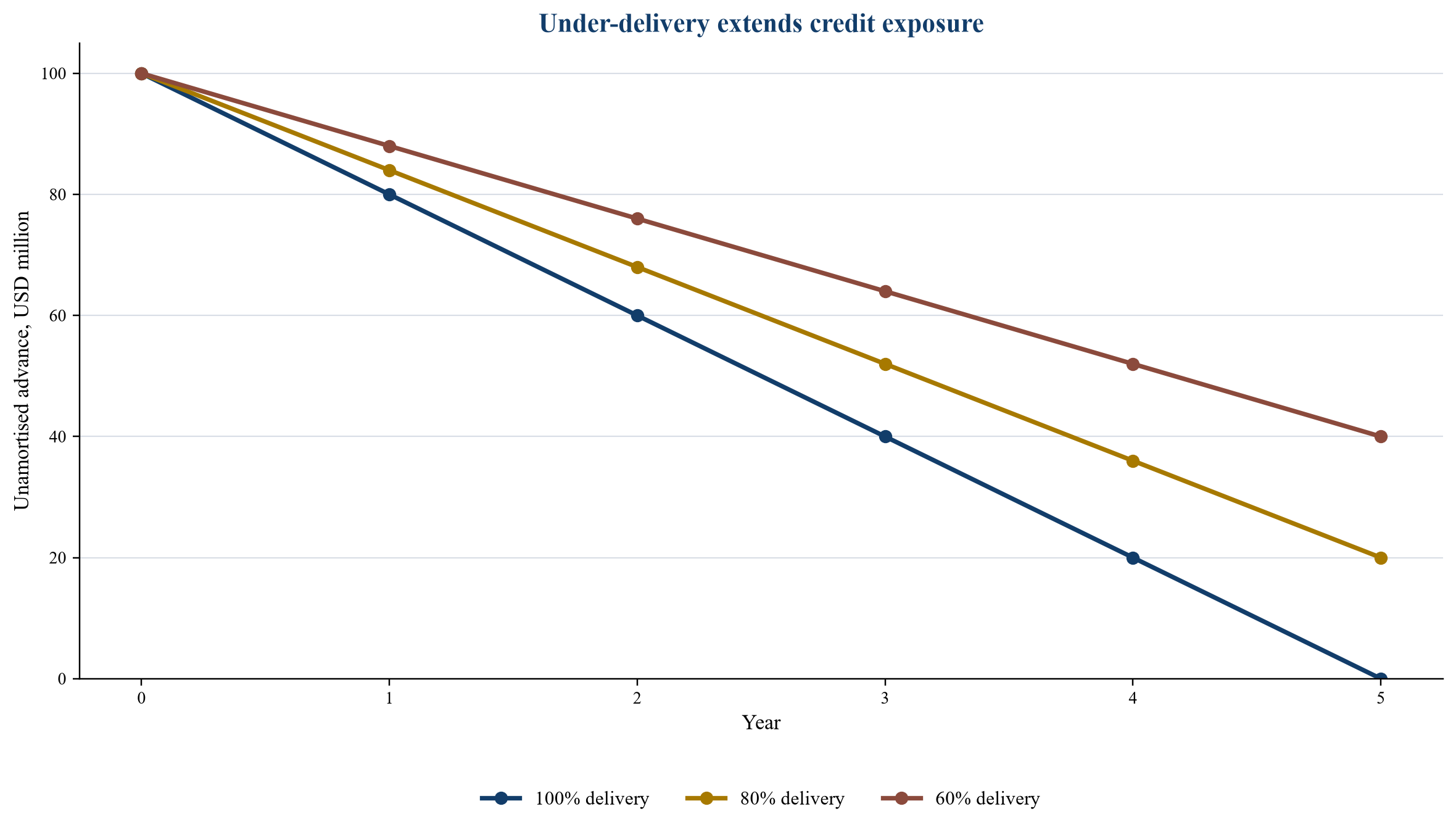
Illustrative USD 100 million advance; no interest, fees, taxes or recoveries; not a forecast.
53. Sensitivity interpretation
At full delivery, the hypothetical advance amortises in five years. At 80% delivery, USD 20 million remains after five years. At 60%, USD 40 million remains. The exposure can be larger if return accrues or price mechanics reduce the deduction per tonne.
The buyer should define whether maturity requires cash repayment, accelerated deliveries or extension. A structure that automatically extends transfers operating underperformance to the buyer. A cash bullet may be unrealistic when under-delivery reflects financial distress.
54. Recovery waterfall
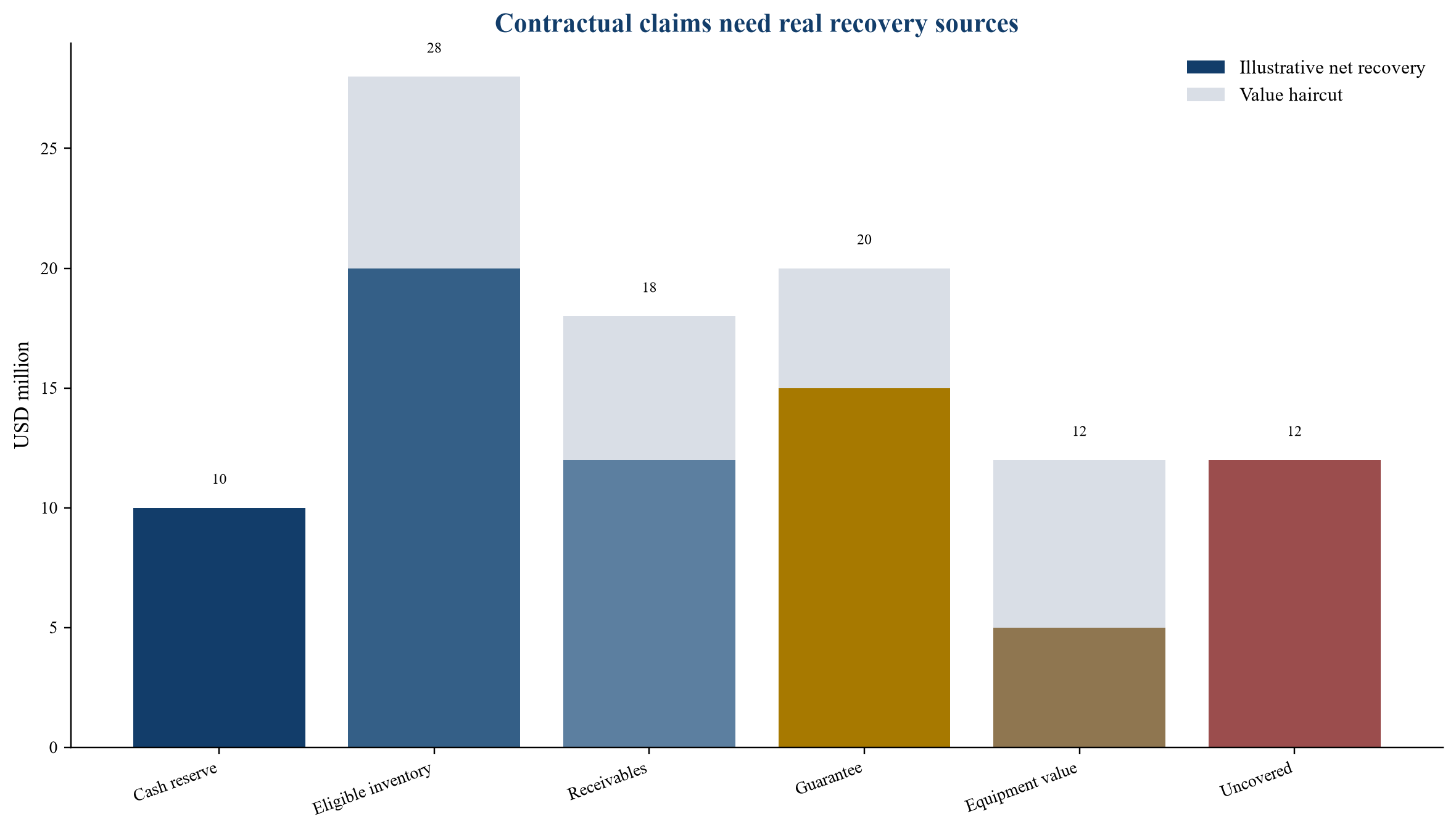
Illustrative gross values and haircuts; legal priority, costs and timing are excluded and require verification.
55. Recovery interpretation
The hypothetical waterfall shows USD 88 million of gross recovery sources before value haircuts and USD 62 million after them, leaving USD 38 million uncovered against a USD 100 million exposure. It excludes enforcement cost, delay and priority leakage.
The case demonstrates why asset lists should be converted into realistic recovery estimates. Inventory may be specialised, receivables disputed, guarantees correlated and equipment hard to sell. Recovery analysis should use jurisdiction, priority, control and time-adjusted value.
56. Liquidity reserve
A reserve account can fund operating continuity, replacement supply, enforcement or refund. Its permitted uses and replenishment trigger should be defined. A reserve held by the supplier without control may be consumed before default.
The amount can reflect several months of production cost, shipping delay, cover premium or debt service. The buyer should avoid overfunding idle cash when a letter of credit or committed facility provides equivalent protection.
57. Covenant package
Financial covenants may include minimum liquidity, leverage, debt-service coverage and tangible net worth. Operating covenants can cover production, grade, recovery, inventory and maintenance. Contract covenants can preserve licences, key agreements, insurance and compliance.
Headroom should reflect volatility. A covenant that trips during normal commodity movement creates repeated waivers; a loose covenant provides no warning. Cure rights should identify permitted equity, cash collateral and sponsor support.
58. Events of default
Defaults can include payment failure, delivery failure, misrepresentation, covenant breach, invalid security, cross-default, insolvency, abandonment, permit loss, sanctions, change of control and judgment. Materiality and cure periods should match risk.
Cross-default should avoid accidental acceleration from small unrelated disputes. The buyer should distinguish an event that stops new funding from one that accelerates the balance or triggers enforcement. This preserves calibrated response.
59. Governance
A transaction committee should include procurement, treasury, legal, technical, compliance and operations. Procurement understands product; treasury understands credit and liquidity; operations understands usability. No single function sees the full exposure.
Reserved matters can include draw, waiver, pricing change, security release, competing offtake, material budget variance and enforcement. Minutes should record evidence and rationale. The supplier should have a clear escalation route.
60. Monitoring dashboard
The dashboard should show advance balance, amortisation, production, yield, compliant inventory, shipments, quality, cover price, cash, covenants, incidents and security status. Red, amber and green thresholds should have defined actions.
Leading indicators include maintenance backlog, staff turnover, delayed assays, unpaid contractors, permit notices and reporting slippage. These often appear before missed delivery. The buyer should integrate site and financial information.
61. Operational contingency
The buyer should qualify alternate suppliers and material before distress. Laboratory and production trials, logistics routes and regulatory approvals can take months. A paper list of suppliers is not a contingency plan.
Inventory can bridge a short disruption. Substitution and redesign may address longer shocks. The prepayment should sit within a portfolio that includes diversification, stock, recycling and demand management.
62. Technology risk
Battery chemistry, process design and product specifications can change during a long tenor. The buyer may no longer need the contracted form, or the supplier may produce a grade that loses market depth.
Review rights, substitution schedules and transfer options can preserve value. Changes should not allow the supplier to dilute the original obligation without equivalent protection. Technology risk belongs in both the supply and recovery cases.
63. Currency risk
The advance, product benchmark, operating costs and refund may use different currencies. Currency depreciation can impair supplier capacity or inflate the quantity required to repay a hard-currency advance.
The model should identify each exposure and hedge availability. Gross-up, conversion and payment-location clauses need legal and tax review. Currency controls can delay recovery even when the supplier remains solvent.
64. Tax and transfer pricing
Discounts, fees, interest-equivalent returns, royalties and options can have different tax treatment. Withholding, customs value, VAT and transfer pricing can change economics. Cross-border affiliates require particular care.
The commercial model should show pre- and post-tax cash flows without assuming a label controls treatment. Tax advice should be obtained in each material jurisdiction. Change-in-tax rules should allocate future adjustments.
65. Accounting and disclosure
The buyer should determine whether the advance is a financial asset, inventory prepayment, derivative-containing contract or another category under applicable standards. Impairment and fair-value requirements can affect earnings and covenants.
Concentration, related-party and significant-judgment disclosures may apply. The supplier may record contract liability or debt depending on substance. Accounting should be assessed before signature and updated when terms change.
66. Antitrust and market conduct
Long-term exclusivity, market allocation, information exchange and control over scarce supply can raise competition concerns. The parties should limit restrictions to legitimate investment and supply objectives.
Market-sensitive information should be governed. Pricing formulas and audit rights should not become channels for inappropriate coordination. Competition counsel should assess jurisdiction and market share.
67. First 30 days
Define the protected output, required product, disruption scenarios and alternatives. Build a supplier and jurisdiction risk map. Establish a preliminary advance size, delivery profile and recovery target.
Request technical, financial, legal, compliance and contract data. Identify existing lenders and competing offtake. Set approval criteria and appoint external advisers where needed.
68. Days 31 to 60
Complete site and model diligence. Negotiate product, quantity, price, funding conditions, security, accounts, reporting, remedies and intercreditor principles. Qualify alternate supply and model cover cost.
Prepare base, downside and enforcement cases. Obtain tax, accounting, sanctions and competition advice. Resolve material gaps before signing a binding commitment.
69. Days 61 to 100
Finalise documents and conditions, perfect security, establish accounts and reporting, fund supplier equity, test data feeds and approve the first milestone. Conduct a shipment and shortfall tabletop exercise.
The exercise should test notice, cover purchase, set-off, guarantee, account control and escalation. Document failures and close them before major funding.
70. Decision rule
Proceed when the mineral protects a defined industrial outcome, the supplier can deliver the required product, funding is matched to verified milestones, product and cash are controlled, security has practical recovery value, intercreditor terms preserve the buyer's position and replacement supply can be activated.
Defer when the advance funds an unresolved project deficit, product definition is weak, collateral priority is uncertain, refund relies on the same cash flow that failed, or the buyer has no credible response to shortfall. These conditions indicate concentrated credit exposure without reliable supply protection.
71. Conclusion
Prepayment can convert buyer demand into productive capacity and more reliable critical-mineral supply. Its value depends on the quality of the system around the advance. Product, milestones, accounts, security, information, responsible sourcing and remedies must reinforce one another.
The strongest structure anticipates distress before funds move. It defines shortfall precisely, preserves cover and refund routes, uses collateral that can be controlled and sold, and coordinates procurement with credit decisions. The buyer then purchases supply resilience with an understood and governed risk position.
References
- World Bank Group and Organisation for Economic Co-operation and Development. Transfer Pricing in Mining with a Focus on Africa: A Reference Guide for Practitioners. Long-term supply agreements discussion. 2017. https://documents.worldbank.org/curated/en/775571485262636835/pdf/112221-WP-PUBLIC-ABSTRACT-SENT-23-1-2017-10-50-11-OECDmineralproductstradedinintermediateformsdiscussi.pdf
- International Energy Agency. Global Critical Minerals Outlook 2026: Executive Summary. 2026. https://www.iea.org/reports/global-critical-minerals-outlook-2026/executive-summary
- United Nations Commission on International Trade Law. UNCITRAL Model Law on Secured Transactions. 2016. https://uncitral.un.org/en/texts/securityinterests/modellaw/secured_transactions
- United Nations Commission on International Trade Law. Practice Guide to the UNCITRAL Model Law on Secured Transactions. 2019. https://uncitral.un.org/sites/uncitral.un.org/files/media-documents/uncitral/en/19-10910_e.pdf
- International Chamber of Commerce. Incoterms 2020: Rules for Any Mode or Modes of Transport. https://library.iccwbo.org/content/tfb/BOOKS/BK_0049/BK_0049_04_RulesAny.htm
- Organisation for Economic Co-operation and Development. OECD Due Diligence Guidance for Responsible Supply Chains of Minerals from Conflict-Affected and High-Risk Areas, Third Edition. 2016. https://mneguidelines.oecd.org/OECD-Due-Diligence-Guidance-Minerals-Edition3.pdf
- International Institute for the Unification of Private Law. UNIDROIT Principles of International Commercial Contracts, Article 7.1.7, Force Majeure. 2016 edition. https://www.unidroit.org/instruments/commercial-contracts/unidroit-principles-2010/chapter-7-section-1/
- International Institute for the Unification of Private Law. UNIDROIT Principles of International Commercial Contracts, Chapter 6, Section 2, Hardship. 2016 edition. https://www.unidroit.org/instruments/commercial-contracts/unidroit-principles-2010/chapter-6-section-2/
- United Nations Commission on International Trade Law. UNCITRAL Digest of Case Law on the United Nations Convention on Contracts for the International Sale of Goods. 2016. https://uncitral.un.org/sites/uncitral.un.org/files/media-documents/uncitral/en/cisg_digest_2016.pdf
- International Institute for the Unification of Private Law. UNIDROIT Principles of International Commercial Contracts, Chapter 8, Set-off. 2016 edition. https://www.unidroit.org/instruments/commercial-contracts/unidroit-principles-2010/chapter-8/
About the Author
Chennakeshav (CK) is a corporate finance and investment banking executive with 25+ years of global experience in deal origination, structuring and execution across M&A, growth capital and corporate strategy. He has led value-creation mandates for founders, corporates and funds — bridging the boardroom view to hands-on execution and close.
His career spans Morgan Stanley, HSBC, Lloyds Banking Group, EWEC, ADQ portfolio companies and Emirates Growth Fund, across TMT, real estate, fintech, deeptech, cleantech, infrastructure and energy. He has partnered with C-suite leaders, private equity and venture funds, sovereign wealth funds and family offices to finance complex fund raises and scale-up ventures, and has led M&A due diligence, post-merger integration and business-transformation initiatives to create value.
At Matchpoint Partners he is Managing Partner, leading the firm's corporate finance, M&A and capital-raising practice. He holds an MBA from London Business School, an engineering degree from VTU and a Master of Laws (LLM, in progress) from UCL London.
An active start-up mentor, CK mentors at Techstars, DIFC FinTech Hive, Startup Grind, Founder Institute and IN5, serves as Entrepreneur Mentor in Residence (EMiR) at London Business School, and judges the Entrepreneurship World Cup.
LinkedIn: https://www.linkedin.com/in/ckadya/
Profile: https://www.matchpoint-partners.com/team/ck-adya.html
