

1. The investment decision
The decision is which lithium assets can preserve positive cash generation, finance obligations and strategic relevance across price cycles. The opportunity set includes producing hard-rock mines, brine operations, development projects, chemical converters, direct lithium extraction systems, recycling plants and integrated platforms.
Each pathway has different feed, process, product, infrastructure, qualification and capital risks. A common framework should trace material from resource or recovered feed to qualified battery-grade product and cash available to capital providers.
2. The cycle is the starting condition
The International Energy Agency reported that lithium demand rose strongly in 2024 while supply expansion drove a major price decline after the 2021 to 2022 surge [1]. Its 2026 outlook recorded a subsequent recovery, continuing volatility, reduced lithium investment and strong demand from battery storage [2].
These observations show that demand growth and producer economics can diverge. Capacity can arrive faster than demand, inventories can move and marginal projects can reset price. Valuation therefore needs a through-cycle cost and liquidity case.
3. Long-term demand remains a scenario
The IEA's 2026 Stated Policies Scenario projects lithium demand rising more than threefold to 2040 [3]. Projected supply gaps have narrowed as projects advance. The outlook remains conditional on policy, battery deployment, chemistry, recycling, project execution and demand growth.
An investor should use these scenarios to frame exposure. They do not establish a future price or make every resource economic.
4. Production responded rapidly
The United States Geological Survey estimated that worldwide lithium production outside the United States rose materially in 2025 as projects developed during the earlier high-price period entered production [4]. This supply response is central to the cycle.
Assets should be tested against competitors already operating, projects under construction and capacity capable of restarting. Announced projects deserve probability and timing adjustments.
5. Define the saleable product
Spodumene concentrate, lithium carbonate, lithium hydroxide and intermediate solutions have different specifications, customers and prices. Battery-grade material requires impurity control, consistency and qualification. Contained lithium in ore or brine is not equivalent to qualified chemical output.
Revenue should use actual product volume, payable terms, conversion cost, logistics, penalties and quotation period. The model should avoid applying a battery-grade benchmark directly to unconverted feed.
6. The lithium value chain
Hard-rock ore is mined, concentrated and converted. Brine is pumped, concentrated or processed and converted. Direct lithium extraction seeks selective recovery from brines before purification. Recycling recovers lithium-bearing material from manufacturing scrap and end-of-life batteries.
Integration can capture margin and create more interfaces. Standalone assets depend on reliable conversion capacity, feed or customers. The investment perimeter should be explicit.
7. Cost-advantage architecture
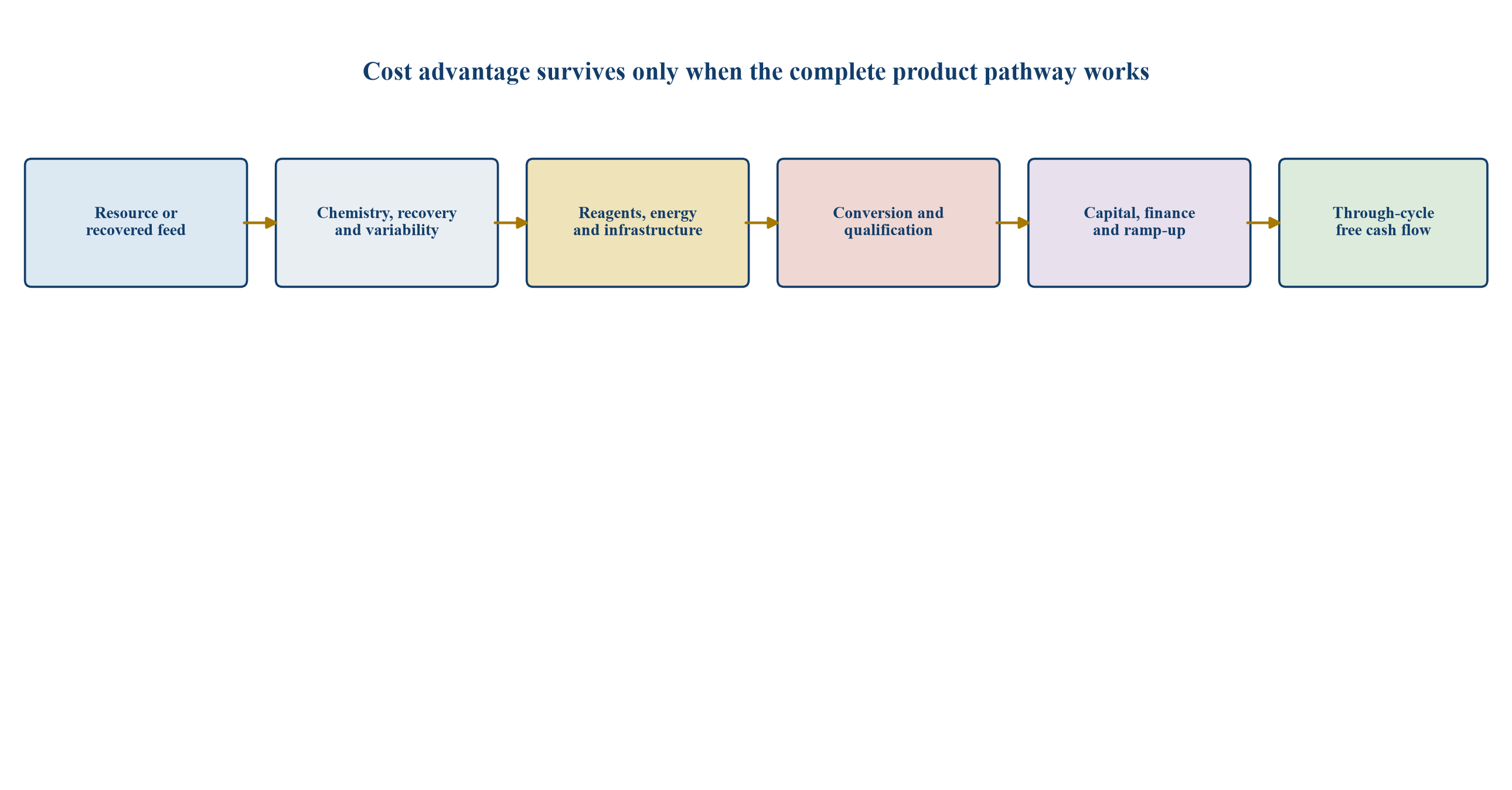
Generic framework; actual project economics require asset-specific technical, legal and financial evidence.
8. Hard-rock resource quality
Hard-rock economics depend on grade, mineralogy, geometry, strip ratio, hardness, recovery, concentrate specification and mine sequence. Pegmatite continuity and dilution affect feed. By-products can support economics when their recovery and market are evidenced.
The model should reconcile the resource, reserve, mine plan and plant feed. Head grade without mining loss, dilution and recovery is incomplete.
9. Concentrator performance
Crushing, dense-media separation, flotation and magnetic separation may be used depending on mineralogy and flowsheet. Recovery, concentrate grade, mica, iron and moisture influence converter acceptance. Variability testing should represent the scheduled ore.
Nameplate throughput and design recovery remain assumptions until demonstrated. Ramp-up should include ore blending, operator capability, maintenance and product consistency.
10. Conventional brine economics
Brine projects depend on lithium concentration, impurities, aquifer behaviour, pumping, evaporation or processing route, reagent use, recovery and climate. Reservoir performance determines sustainable feed over time. Water balance and community impacts influence permits and operations.
An evaporation-pond footprint may reduce some processing intensity while creating time, weather and inventory exposure. Site evidence should drive the comparison.
11. Direct lithium extraction
Direct lithium extraction covers different adsorption, ion-exchange, solvent and membrane approaches. Performance depends on brine chemistry, selectivity, recovery, sorbent life, reagent use, energy, water, waste and reinjection. A laboratory recovery percentage does not establish commercial economics.
Evidence should progress through representative pilot, demonstration and sustained operation. Scale-up, consumables and downstream purification need explicit cost and availability assumptions.
12. Clay and unconventional resources
Clay, geothermal and oilfield brines can expand the resource base. They may require new mining, leaching, filtration, concentration or reinjection systems. Large contained resources can coexist with low concentration or difficult impurities.
Valuation should stage capital against technical proof. Early optionality should not be priced as operating capacity.
13. Conversion is a separate business
Conversion plants transform concentrate or intermediate feed into carbonate or hydroxide. Economics depend on feed quality, recovery, reagents, energy, waste, plant utilisation and customer specification. Feed contracts and working capital can be as important as processing cost.
A converter without secure feed can remain underutilised. A mine without conversion access can face lower netback and customer concentration.
14. Product qualification
Battery customers qualify chemistry, impurities, particle attributes, consistency, packaging and traceability. Qualification can take time and may be customer specific. Product sold during ramp-up may receive a lower price or enter non-battery markets.
The model should include qualification batches, reject risk and price differentials. Nameplate battery-grade capacity should not be assumed available from first production.
15. Chemistry risk
Lithium is used across several battery chemistries, but carbonate and hydroxide demand can change with cathode mix. Lithium iron phosphate growth alters nickel and cobalt intensity while continuing to require lithium. Sodium-ion and other technologies can affect portions of future demand.
The investor should model chemistry scenarios by product. A broad battery-growth forecast can conceal product mismatch.
16. Reagent exposure
Lime, soda ash, sulphuric acid and other reagents can be major costs. Supply, transport, purity and price vary by location. The IEA's 2026 outlook described how sulphur and acid disruption affected several mineral-processing chains [2].
Reagent intensity should come from test work and mass balance. Strategic supply contracts need volume, price and reliability analysis.
17. Energy and emissions
Mining, comminution, calcination, leaching, purification and transport consume energy. Power and fuel source affect cost, emissions and customer requirements. Conversion routes should be compared on a consistent product and boundary.
Low-carbon claims need defined scope and evidence. Renewable power may require grid, firming or storage capital.
18. Water and reinjection
Water affects mining, processing, brine balance, dust and communities. Direct extraction may require substantial process water and a technically acceptable reinjection strategy. Reservoir pressure and chemistry can change with operation.
Permitted abstraction or reinjection does not establish sustainable performance. The model should connect hydrology to production and closure.
19. Infrastructure
Road, rail, port, power, gas, water, camp and communications determine delivered cost. Remote hard-rock assets may move concentrate over long distances. Brine and chemical facilities may require specialised reagents and export handling.
Each dependency needs capacity, access, contract, cost and schedule evidence. Shared infrastructure can reduce capital and create counterparty risk.
20. Fiscal and jurisdictional terms
Royalties, tax, duties, state participation, export rules and foreign exchange shape cash flow. Policy support can improve financing while adding domestic-processing or delivery conditions. Strategic designation is not equivalent to economic viability.
The base case should use enacted terms. Proposed changes belong in scenarios.
21. Structural cost test
Table 1. Lithium asset structural cost-advantage test
| Dimension | Evidence | Cyclical vulnerability | Durable advantage signal |
|---|---|---|---|
| Feed | Reserve, brine model, scrap contracts | High-cost feed acquired during boom | Controlled, consistent and expandable feed |
| Process | Variability tests and operating data | Design recovery used as fact | Demonstrated recovery across representative feed |
| Inputs | Reagent, energy and water contracts | Spot exposure and single corridor | Secure inputs with manageable intensity |
| Product | Specification and qualification | Benchmark price applied to unqualified output | Repeat qualified sales and diversified customers |
| Capital | Scope, contracts and contingency | Expansion depends on high price | Funded plan with downside headroom |
| Finance | Debt, covenants and liquidity | Refinancing required before ramp-up | Tenor and reserves aligned with cash generation |
| Closure | Costed obligations and security | Liabilities deferred outside the model | Funded progressive and final obligations |
22. Price deck
The price deck should separate spot, contract, long-term and stress assumptions by product. A carbonate benchmark may not match hydroxide, concentrate or technical-grade output. Freight, duties, conversion and quotation periods affect realised price.
The central case should remain investable without a return to a prior peak. Upside can be shown separately.
23. Cost curve
Cost curves can benchmark relative exposure when definitions, product, by-products, exchange rates and time periods are consistent. They can omit sustaining capital, royalties, closure and financing. Integrated and standalone producers may report costs differently.
Asset cash flow should lead the analysis. Cost-curve position supports the downside view.
24. Capital intensity
Capital includes mine, wells, ponds, plant, conversion, infrastructure, owner costs, contingency, working capital and financing. New technology and remote infrastructure increase uncertainty. Foreign and local currency exposure should be visible.
The estimate should reconcile scope, maturity, contracting and schedule. Contingency needs a funded source.
25. Operating-cost architecture
Operating cost should separate mining or pumping, concentration, conversion, reagents, energy, water, labour, maintenance, logistics, waste, royalties and site administration. By-product credits and transfer prices should be visible. Integrated groups should not hide a high-cost upstream asset behind downstream margin.
Unit cost should reconcile with production, recovery and utilisation. A plant operating below capacity can experience sharply higher unit cost even when total spending is controlled.
26. Sustaining capital
Sustaining capital includes waste stripping, wells, pond maintenance, tailings, equipment replacement, reagent systems, environmental controls and conversion-plant renewal. Deferral can improve short-term cash while weakening reliability and future production.
The model should distinguish sustaining, growth and remediation capital. Reported operating cost without sustaining capital can overstate structural competitiveness.
27. Ramp-up
Ramp-up links construction completion to stable qualified output. Hard-rock assets need consistent ore, plant performance and concentrate quality. Brine assets need reservoir, pond or extraction-system stability. Converters need feed, process control and customer qualification.
The forecast should use monthly throughput, recovery, quality and price during ramp-up. Completion tests should require sustained performance rather than a short peak run.
28. Maintenance and reliability
Critical equipment, wells, membranes, sorbents, kilns, filtration and utilities can constrain availability. Vendor support, spares, maintenance strategy and workforce determine recovery time. First-of-a-kind systems can have limited operating history.
The investor should connect failure modes to downtime, replacement cost and inventory. Nominal availability unsupported by maintenance evidence is a management estimate.
29. Reservoir and resource depletion
Mine schedules consume reserves and move through changing grades and material types. Brine reservoirs may respond to pumping and reinjection over time. Production history should be reconciled with modelled response and updated technical interpretation.
The valuation should distinguish current cash generation from reserve replacement or resource conversion. Development drilling and reservoir work require capital and may not reproduce prior performance.
30. Working capital
Concentrate, chemicals, work in process and finished product tie up cash. Provisional pricing, customer terms, qualification stock and shipping create additional exposure. Recyclers may purchase feed before product sale.
Higher lithium prices can increase inventory and receivable funding requirements. Liquidity facilities should reflect actual settlement cycles and borrowing-base eligibility.
31. Price and cost sensitivity
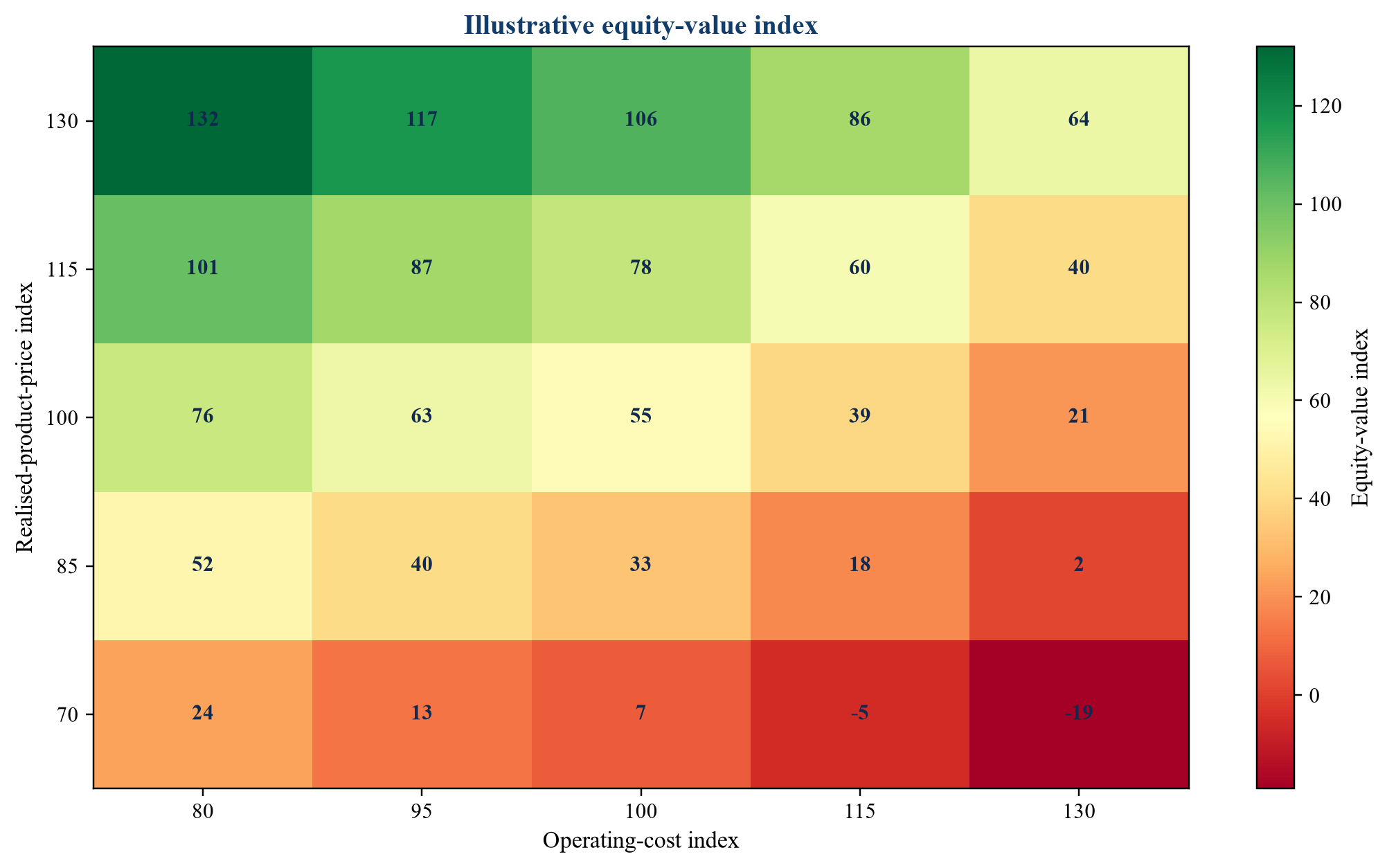
Indexed illustration only; values are not a forecast or valuation of any asset.
32. Break-even map
The model should calculate break-even realised price for operating cash, sustaining capital, debt service, full investment return and expansion. These thresholds differ. A producer can remain operational while failing to earn its development capital.
Break-even should be shown by product and conversion route. Concentrate and chemical producers face different netbacks, working capital and customer requirements.
33. Scenario matrix
Table 2. Hypothetical lithium-asset scenario matrix
| Case | Product-price index | Capital cost | Ramp-up | Recovery | Decision use |
|---|---|---|---|---|---|
| Prolonged downside | 70 | 120 | 24 months late | 4 points below design | Tests liquidity, closure and sponsor support |
| Execution downside | 100 | 130 | 18 months late | 3 points below design | Isolates delivery and technical risk |
| Controlled base | 100 | 100 | Plan | Design less normal ramp-up | Supports central approval |
| Tight-market upside | 130 | 105 | 6 months late | Design | Tests value capture without perfect execution |
The indices are hypothetical. Asset-specific cases should use evidenced prices, costs and technical performance.
34. Producing-asset valuation
A producing asset provides operating, cost, quality and customer evidence. Diligence should normalise temporary grade, outages, inventory changes, by-products and exceptional spending. It should identify maintenance backlog, depletion, sustaining capital and closure.
Value depends on free cash flow after the investment required to preserve production. Recent peak margin is not a through-cycle forecast.
35. Development-asset valuation
Development value should follow observable milestones: resource definition, test work, feasibility, permits, infrastructure, feed or offtake, financing, construction and qualification. Each milestone reduces a different uncertainty.
Stage-gated valuation should show capital required to reach the next decision. A single probability applied to final net present value can conceal the source of risk.
36. Conversion-plant valuation
Converters should be valued through secure feed, yield, utilisation, reagent cost, product mix, qualification and customer contracts. Nameplate capacity creates value only when feed and qualified sales support operation.
The model should test margin when feed and chemical prices move at different times. Contract pass-through, inventory and quotation periods affect cash conversion.
37. Direct-extraction valuation
Direct-extraction value should separate reservoir access, extraction system, purification, reinjection and conversion. Intellectual-property rights, sorbent or membrane supply, vendor capacity and performance guarantees matter. Pilot results should be adjusted for representativeness and duration.
Technology upside can be valued as staged optionality. Commercial-scale economics require demonstrated throughput, recovery, consumable life and waste management.
38. Recycling economics
Recycling can recover lithium and other battery materials from manufacturing scrap and end-of-life cells. Economics depend on feed contracts, collection, discharge, dismantling, process yield, product route and producer-responsibility rules. Used-battery availability develops with fleet age.
The plant should be matched to feed chemistry and qualification requirements. Announced battery capacity does not establish available recycling feed.
39. Supply concentration
The IEA expects some geographic diversification of lithium mining while refined supply remains concentrated [1]. Concentration can support policy incentives and customer demand for diversified supply. It can also reflect established infrastructure and scale in leading regions.
A security premium should be tied to enforceable customer terms or public support. Geography alone cannot cure weak economics.
40. Policy support
Support can include grants, loans, guarantees, tax credits, strategic-project status and public offtake. The United States Department of Energy has supported domestic battery supply-chain development and first-of-a-kind projects [5]. Conditions can include domestic processing, jobs, reporting and milestones.
The model should recognise support only when eligibility, amount, timing and obligations are documented.
41. Offtake
Offtake can improve qualification, revenue visibility and financing. Terms may cover volume, product, benchmark, floor, ceiling, prepayment, security and exclusivity. Buyers may receive options or control rights in exchange for support.
The investor should value the full package. A headline prepayment can transfer substantial upside or constrain future customers.
42. Project debt
Debt capacity depends on reserves or reservoir evidence, proven process, qualified product, cost position, contracts and sponsor support. Lenders may require completion guarantees, hedging, reserve accounts and distribution tests.
The debt case should use conservative production, price and ramp-up assumptions. Tenor must fit the operating life and cash-generation profile.
43. Corporate debt
Corporate facilities can diversify risk across assets and provide flexible liquidity. They can also expose operating assets to development overruns and refinancing pressure. Cross-default and collateral should be mapped.
The board should test group liquidity under simultaneous price weakness and project delay. Annual leverage metrics can hide monthly funding gaps.
44. Equity and dilution
Development assets often require multiple equity rounds. Placements, rights issues, strategic stakes, joint ventures and earn-ins allocate control and future capital differently. Options, warrants and employee plans affect fully diluted value.
The model should include expected funding through qualification and stable operation. Current shares outstanding can overstate value per share.
45. Streams and royalties
Royalties and streams provide upfront capital in exchange for future production-linked claims. They can reduce immediate equity need while burdening future cash flow and expansion. Buyback, security, area-of-interest and change-of-control provisions matter.
These claims should be deducted before current equity value. Their cost should be compared with debt and equity under several price cases.
46. Joint ventures
Joint ventures can combine resource, process technology, conversion, customer access and capital. Governance should address programmes, budgets, dilution, default, marketing, technology rights, deadlock and transfer.
The investor should value the actual economic and governance position. Proportionate resource ownership does not guarantee proportionate cash distributions.
47. Acquisition diligence
Acquisition diligence should reconcile technical reports, operating data, licences, environmental obligations, contracts, tax, people, cyber, community commitments and finance. Site and laboratory evidence should reconcile with the investment model.
Material gaps need price, structure, condition precedent, remediation, indemnity or withdrawal. Recoverability of contractual protection should be assessed.
48. Transaction structures
Structures include share purchase, asset purchase, farm-in, joint venture, royalty, stream, staged option and earn-out. Choice affects tax, liability, approvals, control and future funding. Milestone consideration can align uncertainty when definitions and verification are clear.
Structure should follow the identified risk rather than substitute for diligence.
49. Comparable transactions
Comparable transactions can provide evidence when stage, product, jurisdiction, resource confidence, process, infrastructure and date are aligned. Metrics based on resources, reserves, capacity or cash flow answer different questions.
Selection and adjustments should be disclosed. A broad multiple applied to early technical optionality creates false precision.
50. Responsible sourcing
Customers and financiers may require traceability, human-rights controls, environmental performance and chain-of-custody evidence. OECD mineral-supply guidance provides a risk-based diligence framework [6]. Standards and regulatory obligations vary by market.
Claims need scope, period and assurance. Responsible-sourcing capability can protect customer access while creating operating and data costs.
51. Community and Indigenous rights
Land, water, cultural heritage, livelihoods and benefit sharing can affect timing and continuity. Consultation and consent requirements depend on jurisdiction and rights. Agreements require ongoing implementation, grievance handling and governance.
Investor diligence should examine commitments, staffing, disputes and cumulative impacts. A signed document is not evidence of continuing performance.
52. Tailings, residues and closure
Hard-rock tailings, brine residues, spent reagents and chemical waste require engineered management. Closure may include land rehabilitation, water treatment, well abandonment, pond remediation and monitoring.
The model should include progressive and final obligations, security and post-closure cost. Liability does not disappear when production stops.
53. Climate resilience
Drought, flood, heat and extreme weather can affect brine balance, water, power, roads, tailings and workforce. Historical averages may not represent a long operating period. Adaptation may require storage, drainage, redundancy and revised design.
Physical hazards should connect to downtime, capital, insurance and production rather than remain qualitative disclosures.
54. Data and AI
Analytics can support exploration, resource models, reservoir management, sorting, predictive maintenance, process control and market planning. Value depends on data quality, integration and operating adoption. Model accuracy is not equivalent to cash benefit.
The business case should identify the decision changed, control limits, human accountability and measured result.
55. Investment-committee scorecard
Table 3. Lithium investment-committee scorecard
| Dimension | Required evidence | Failure signal | Response |
|---|---|---|---|
| Feed | Reserve, reservoir model or feed contracts | Contained material treated as product | Further work or staged funding |
| Process | Representative tests and operating data | Laboratory result scaled directly | Pilot, demonstration or guarantee |
| Product | Specification and qualification plan | Benchmark applied before qualification | Discount, condition or customer support |
| Capital | Scope, estimate, schedule and contingency | Unfunded enabling works | Rebase and secure funding |
| Operations | Team, inputs, maintenance and ramp-up | Nameplate output from first production | Controlled ramp and liquidity reserve |
| ESG | Rights, permits, water, waste and closure | Material unresolved obligation | Remediate, protect or decline |
| Finance | Sources, covenants and overrun support | Refinancing needed before stability | Resize or add risk capital |
| Valuation | Product cash flow and downside cases | Peak price substitutes for economics | Reprice or reject |
56. Stage gates
The first gate confirms evidence access and strategic fit. The second establishes feed and process proof. The third tests feasibility, permits, infrastructure, product route and finance. The fourth authorises construction against funded scope. The fifth releases completion support after sustained qualified output.
Each gate should define evidence, decision rights and maximum capital at risk.
57. Implementation roadmap
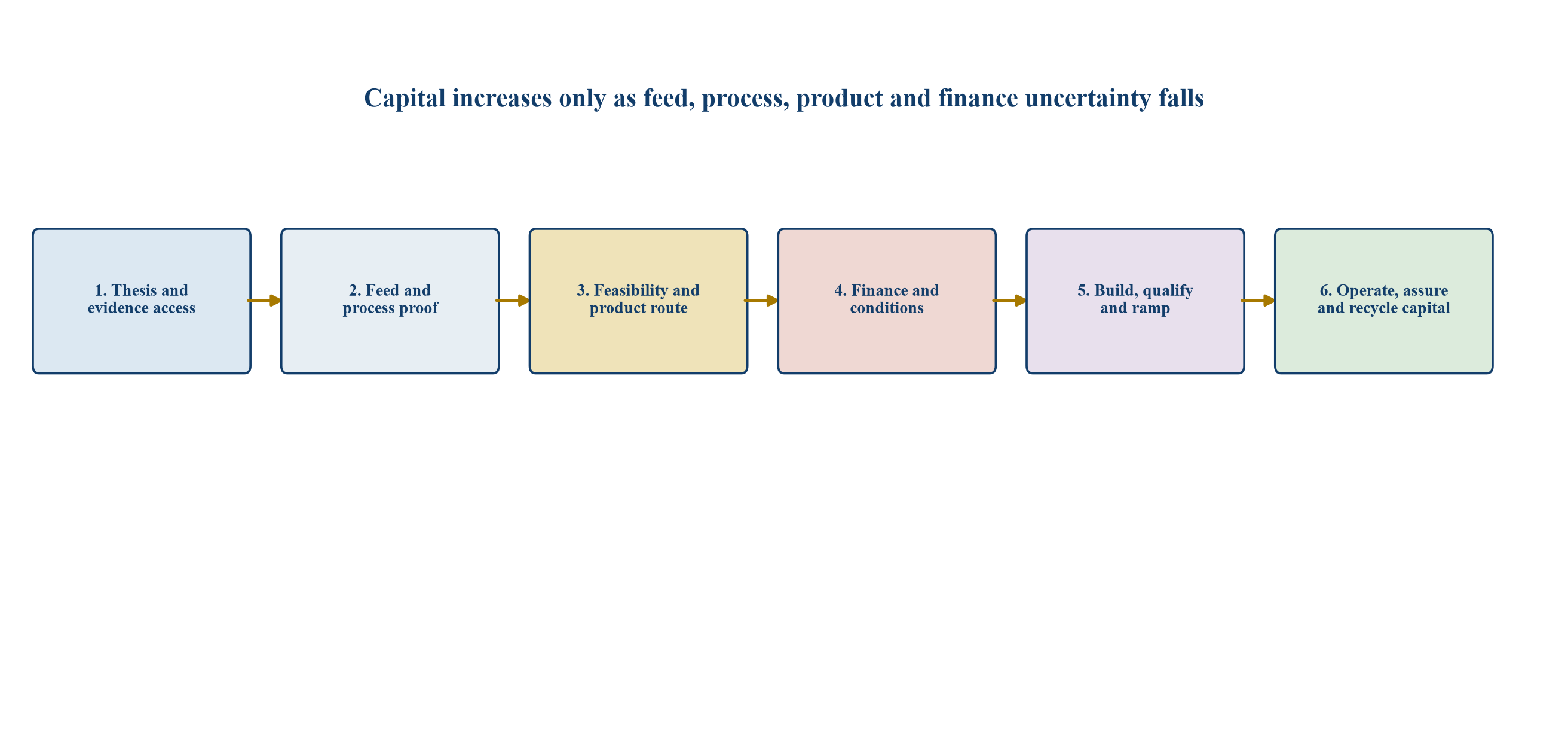
Generic sequence; actual approvals, qualification and financing differ by asset and jurisdiction.
58. First 100 days after acquisition
The buyer should secure people, licences, data, cash, procurement, customers and stakeholder continuity. It should validate feed, plant performance, inventories, maintenance, qualification, closure and liquidity. Material acquisition assumptions need accountable owners.
Early value creation should prioritise reliability, recovery and product consistency before aggressive expansion.
59. Monitoring dashboard
The board should monitor safety, feed, grade or concentration, recovery, utilisation, quality, cost, capital, schedule, permits, water, energy, waste, qualification, liquidity and covenants. Leading indicators should sit beside financial outcomes.
Definitions need controlled sources and reconciliation. Temporary price strength should not override deteriorating technical or funding evidence.
60. Trigger framework
Triggers can cover capital overrun, schedule delay, recovery shortfall, qualification failure, reagent interruption, reservoir underperformance, covenant headroom and permit slippage. Each trigger needs escalation, funding and decision rights.
Early action preserves restructuring and partnership options. Delay can force distressed dilution or shutdown.
61. Exit pathways
Exit can occur through strategic sale, public market, joint-venture sell-down, royalty or stream monetisation, dividend recapitalisation or closure. The best milestone may be feasibility, permit, demonstration or qualification.
The investment case should identify likely buyers and required evidence. Exit multiples remain scenarios.
62. What cost advantage means
Structural advantage is the ability to deliver qualified product, fund sustaining obligations and preserve liquidity at prices that pressure marginal competitors. It comes from the complete system rather than one low-cost input. Feed, recovery, inputs, infrastructure, product and finance all matter.
A low cash-cost claim can be weakened by capital intensity, qualification discounts, royalties or closure liabilities.
63. Board decision record
Approval should record feed confidence, process evidence, product route, permits, infrastructure, cost, capital, price deck, financing, liquidity, scenarios, valuation, conditions and exit. Unresolved matters need owners and dates.
The record should distinguish observed data, third-party scenarios and management estimates.
64. Market-balance discipline
Market balances should distinguish mine output, chemical output, primary demand, secondary supply, inventory and conversion loss. Surplus at one stage can coexist with shortage at another. Product specification and region also matter.
The investor should document the balance source, units, coverage and update date. A global headline should not be applied directly to a local product contract.
65. Inventory signals
Inventory can sit at mines, converters, manufacturers, traders and customers. Public exchange stocks capture only part of the system. Restocking can amplify demand while destocking can weaken prices despite end-use growth.
The valuation should avoid assuming that a short-term inventory movement changes long-term asset quality. It can materially affect near-term liquidity and realised price.
66. Contract pricing
Lithium contracts may reference assessments, formulas, floors, ceilings, lags, quality adjustments and renegotiation. Contract duration and volume flexibility influence price exposure. Related-party pricing needs governance and comparability.
The model should reproduce the contractual calculation rather than apply one spot series. Quotation lag can create temporary divergence between market and realised revenue.
67. Hedging and price protection
Compared with mature base-metal markets, lithium hedging liquidity and product alignment can be limited. Floors, collars, fixed-price offtake and prepayment can protect cash while transferring upside or creating delivery obligations.
Any protection should be assessed for counterparty, volume, product, collateral and termination risk. A contract is useful only when the producer can deliver the specified material.
68. Fiscal sensitivity
Royalty and tax systems may respond to price, profit or production. Loss carry-forwards, withholding, duties and transfer pricing influence integrated groups. Policy can change after commodity-price movements.
The downside and upside cases should apply the relevant fiscal formula. A flat effective tax rate can misstate cash when royalties are payable before profit.
69. Insurance
Construction, property, cargo, liability and interruption insurance contain limits, exclusions, deductibles and waiting periods. Novel processes may face restricted coverage. Environmental and closure obligations may remain largely uninsured.
The investor should map probable loss to coverage and liquidity. Insurance does not replace maintenance, contingency or sponsor support.
70. Contractor and vendor capacity
Lithium growth can strain engineering, drilling, equipment, reagent and commissioning supply chains. A process vendor may be essential to intellectual property, consumables and performance. Financial weakness or competing projects can affect delivery.
Contracts should identify interfaces, guarantees, security and replacement rights. Owner capability remains necessary even under turnkey labels.
71. Workforce readiness
Geology, hydrogeology, metallurgy, chemical processing, maintenance, laboratories and community engagement require specialised people. Remote locations add recruitment, retention and accommodation challenges. New plants need training before commissioning.
The operating plan should reconcile positions, mobilisation, competence and cost. A staffing chart without available people is not readiness evidence.
72. Laboratory and quality controls
Sampling, assay, mass balance and product testing determine resource, recovery and customer acceptance. Laboratories need appropriate methods, standards, calibration, custody and proficiency. Disagreement can affect payment and disclosure.
The investor should trace reported results to controlled evidence. Customer and regulatory testing requirements should be included in operating cost and schedule.
73. Refinancing risk
Development debt may mature before stable operation if schedule or qualification slips. Refinancing then depends on market conditions and evidence available at that time. High prices at financial close do not guarantee future access.
The model should show maturity, amortisation, covenants and refinancing assumptions. Equity or sponsor support should be identified before a shortfall occurs.
74. Portfolio construction
A portfolio can combine producing hard-rock, brine, conversion, recycling and technology exposure. Diversification should be assessed across price, feed, geography, process and capital calls. Several assets can share the same customer or financing risk.
Aggregate liquidity should be tested under common price weakness and project delays. Optionality has value only when the investor can fund it.
75. Strategic-buyer perspective
Battery, automotive and storage companies may value traceability, location, chemistry and supply security alongside financial return. Strategic investment can include offtake, technical cooperation or prepayment.
The buyer should quantify the supply benefit and obtain enforceable rights. Paying a strategic premium without delivery, qualification or governance protections can transfer value to the seller.
76. Public-finance perspective
Public lenders and agencies can support diversification, jobs, technology and security. Their appraisal should measure additionality, public exposure, milestones and outcomes. Disbursement conditions can affect project timing.
Public participation should complement technical and commercial evidence. Strategic importance does not remove construction, process or market risk.
77. Claims and change control
Construction and technology projects can generate claims over scope, feed, utilities, schedule and performance. The owner should maintain notices, evidence, mitigation, cost and decision records. Changes need technical and financial approval.
Uncontrolled changes can consume contingency without improving output. A formal process preserves lender and board visibility.
78. Completion and handover
Completion should require safe, sustained, specification-compliant operation, complete documentation, trained staff, spares, permits and resolved defects. Contractor mechanical completion is different from commercial product qualification.
Handover criteria should align contracts, debt and customer requirements. Retentions and guarantees need sufficient duration and recoverability.
79. Resource and reserve reporting
Resource and reserve statements should follow the applicable reporting code and use competent technical judgment, current assumptions and a stated effective date. Brine and hard-rock evidence require different sampling, continuity and recovery analysis. Exploration targets remain distinct from resources.
Transaction models should preserve those distinctions. Inferred or conceptual material should not receive the production certainty of reserves without staged probability and capital.
80. Impurity management
Magnesium, calcium, boron, sodium, iron and other impurities can affect recovery, reagent use, equipment and product qualification. The relevant impurity profile differs by feed and process. Removal can create residues and additional operating steps.
The model should use representative chemistry and mass balance. Average composition can conceal difficult domains that arrive later in the schedule.
81. Conversion yield
Conversion yield links concentrate or intermediate input to saleable chemical. Losses can arise through calcination, leaching, purification, precipitation, drying and off-spec material. Yield should be stated on a consistent lithium-content basis.
Integrated valuation should avoid counting the same recovery twice. Demonstrated plant reconciliation carries more weight than isolated laboratory tests.
82. Logistics and hazardous materials
Lithium concentrates, chemicals, reagents and residues require suitable transport, storage, packaging and emergency controls. Port capacity, weather, border processes and dangerous-goods rules can affect schedule and working capital.
Delivered cost should include all handling and loss. A remote asset's mine-gate cost may not represent its competitive customer netback.
83. Expansion options
Expansion can use additional resource, wells, trains, conversion capacity or debottlenecking. Existing permits and infrastructure may create advantage, while shared systems can become constraints. Expansion may change water, energy and community impacts.
Optionality should be valued with probability, timing and capital. It should not be embedded automatically in the base operating case.
84. Benefits register
Potential benefits include recovery, utilisation, reagent efficiency, energy, maintenance, logistics, qualification, working capital and financing. Each needs a baseline, owner, action, cost, timing and cash-flow effect.
Lithium-price movement should remain separate from operating value creation. This allows boards and investors to assess delivery rather than market luck.
85. Public reporting
External disclosure should use consistent product units, capacity definitions, resource categories and cost boundaries. Management targets should be identified as targets. Material changes in schedule, capital, recovery or qualification need timely treatment under applicable rules.
Clear reporting reduces comparison error. It also limits the risk that promotional capacity claims outrun technical and commercial evidence.
86. Exit readiness
An exit-ready asset maintains current technical reports, permits, contracts, data, models, environmental records, stakeholder commitments and financial reconciliations. Buyers need evidence that supports production, liabilities and future funding.
Preparation should begin before a transaction. Repairing incomplete records during diligence can delay closing, weaken competition and reduce recoverable value.
87. Customer concentration
A small number of customers can accelerate qualification and financing while creating pricing, credit and renegotiation exposure. Minimum-volume obligations, take-or-pay language and termination rights need careful review. Customer financial strength can change during the project period.
The downside case should test loss or delay of the largest customer. Alternative qualification pathways and product flexibility can protect continuity.
88. Counterparty credit
Feed suppliers, offtakers, contractors, technology vendors, utilities and lenders can each interrupt cash flow. Security, guarantees, parent support and replacement rights should match exposure. Contract value has limited protection when the counterparty cannot perform.
The investor should maintain a counterparty register with limits, warning indicators and contingency actions. Concentrated dependencies require board visibility.
89. Foreign exchange
Lithium revenue may be denominated in United States dollars while labour, power, reagents and capital span several currencies. Exchange movements can offset or amplify price changes. Imported equipment and local inflation respond differently.
The model should apply currency by line item and distinguish transaction from translation effects. Hedging should align with probable cash flows and collateral capacity.
90. Final investment test
The final test asks whether the asset can complete, qualify product, meet obligations and preserve option value under an evidenced downside. It should identify the price, delay, recovery and cost combinations that exhaust liquidity or breach covenants.
Approval should specify conditions, funding sources, triggers and decision rights. Upside remains visible while the commitment rests on executable evidence.
91. Conclusion
Lithium demand remains supported by electric vehicles and storage, while rapid supply response and changing prices create severe investment cycles. The strongest assets combine recoverable feed, proven process, controlled inputs, qualified product, disciplined capital and liquidity through downside conditions.
Long-term demand projections belong in the scenario set. Asset value remains grounded in product-specific cash flow and executable milestones. This framework allows investors to increase capital as uncertainty falls and to restructure or withdraw when evidence weakens.
References
- International Energy Agency. Global Critical Minerals Outlook 2025: Executive Summary. 2025. https://www.iea.org/reports/global-critical-minerals-outlook-2025/executive-summary
- International Energy Agency. Global Critical Minerals Outlook 2026: Executive Summary and Market Overview. 2026. https://www.iea.org/reports/global-critical-minerals-outlook-2026/executive-summary
- International Energy Agency. Global Critical Minerals Outlook 2026: Outlook. 2026. https://www.iea.org/reports/global-critical-minerals-outlook-2026/outlook
- United States Geological Survey. Mineral Commodity Summaries 2026: Lithium. 2026. https://pubs.usgs.gov/periodicals/mcs2026/mcs2026-lithium.pdf
- United States Department of Energy. Four-Year Review of Supply Chains for the Advanced Batteries Sector. 2024. https://www.energy.gov/sites/default/files/2024-12/20212024-Four%20Year%20Review%20of%20Supply%20Chains%20for%20the%20Advanced%20Batteries%20Sector.pdf
- OECD. OECD Due Diligence Guidance for Responsible Supply Chains of Minerals from Conflict-Affected and High-Risk Areas. Third Edition. 2016. https://www.oecd.org/corporate/mne/mining.htm
- International Energy Agency. Global EV Outlook 2026: Electric Vehicle Batteries. 2026. https://www.iea.org/reports/global-ev-outlook-2026/electric-vehicle-batteries
- United States Department of Energy. Draft Environmental Assessment, South West Arkansas Project. 2026. https://www.energy.gov/sites/default/files/2026-03/draft-ea-2304-swa-lithium-with-appendices_2026-03.pdf
About the Author
Chennakeshav (CK) is a corporate finance and investment banking executive with 25+ years of global experience in deal origination, structuring and execution across M&A, growth capital and corporate strategy. He has led value-creation mandates for founders, corporates and funds — bridging the boardroom view to hands-on execution and close.
His career spans Morgan Stanley, HSBC, Lloyds Banking Group, EWEC, ADQ portfolio companies and Emirates Growth Fund, across TMT, real estate, fintech, deeptech, cleantech, infrastructure and energy. He has partnered with C-suite leaders, private equity and venture funds, sovereign wealth funds and family offices to finance complex fund raises and scale-up ventures, and has led M&A due diligence, post-merger integration and business-transformation initiatives to create value.
At Matchpoint Partners he is Managing Partner, leading the firm's corporate finance, M&A and capital-raising practice. He holds an MBA from London Business School, an engineering degree from VTU and a Master of Laws (LLM, in progress) from UCL London.
An active start-up mentor, CK mentors at Techstars, DIFC FinTech Hive, Startup Grind, Founder Institute and IN5, serves as Entrepreneur Mentor in Residence (EMiR) at London Business School, and judges the Entrepreneurship World Cup.
LinkedIn: https://www.linkedin.com/in/ckadya/
Profile: https://www.matchpoint-partners.com/team/ck-adya.html
