
1. The investment decision
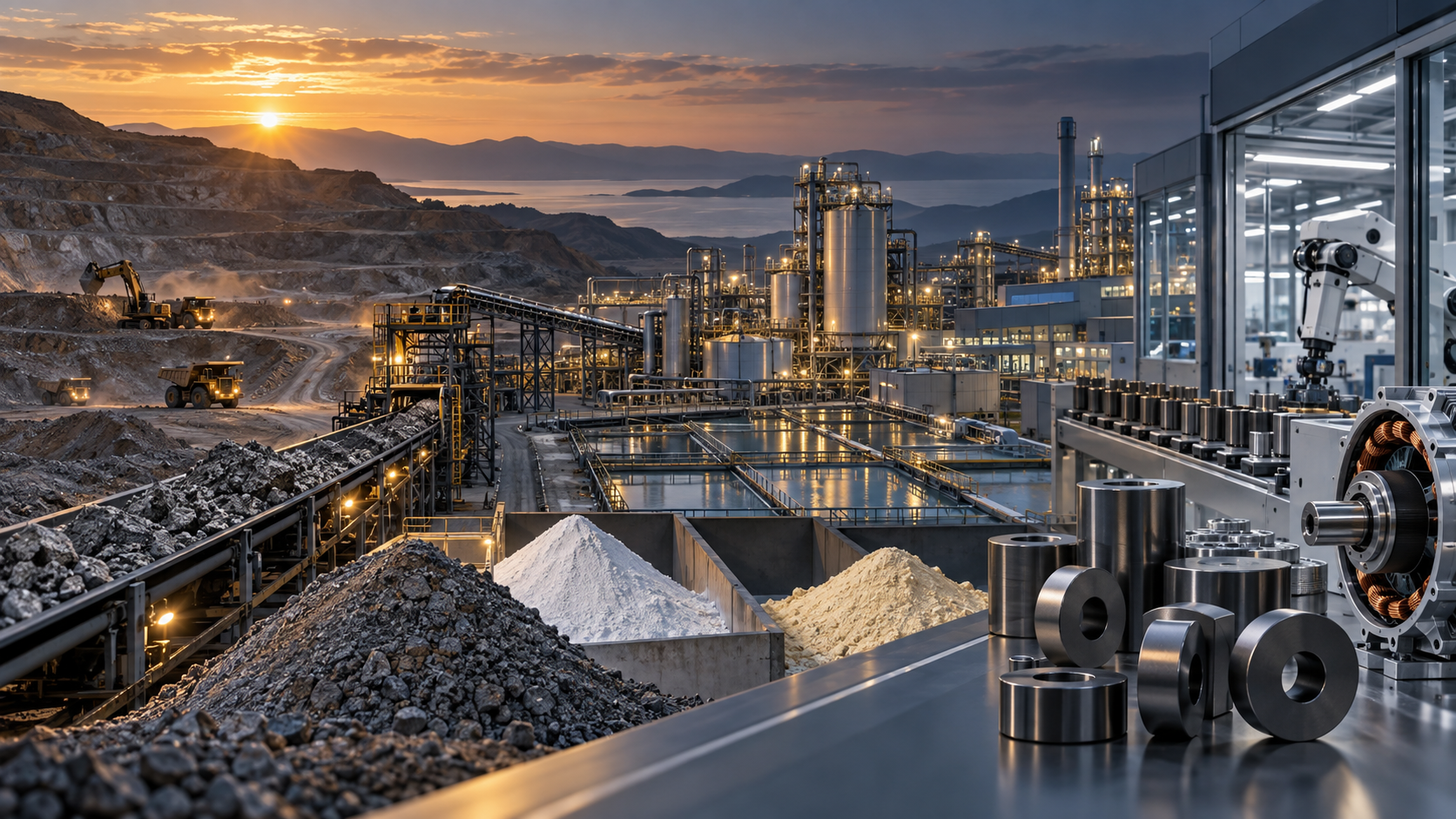
The investment question is where risk-adjusted value can be created between ore and a qualified permanent magnet. The chain includes resource development, mining, beneficiation, cracking and leaching, impurity removal, separation into individual oxides, conversion to metals, alloy preparation, powder production, magnet forming, sintering, machining, coating, quality assurance and component integration.
Each stage has different technical evidence, customers, margins, capital intensity and financing capacity. An investor needs a product-specific view of value rather than a single rare-earth price thesis.
2. Strategic demand and concentration
The International Energy Agency reported that demand for magnet rare earths doubled between 2015 and 2024 and is projected to expand by more than 30 per cent by 2030 under stated policies [1]. Electric vehicles, wind turbines, industrial motors, robotics, electronics, aerospace and defence applications support demand.
The same report found substantial concentration across the chain. China represented 60 per cent of mined magnet rare-earth output, 91 per cent of refined output and 94 per cent of sintered permanent-magnet production in 2024 [1]. This concentration affects security of supply, qualification choices, inventory policy and strategic willingness to pay.
3. Supply disruption became observable
China introduced export controls covering several heavy rare-earth elements and related products in April 2025. The IEA recorded sharp falls in export volumes and operational disruption for manufacturers outside China before licences and volumes recovered [1]. The United States Geological Survey described additional controls during 2025 [2].
The event demonstrates that exposure includes administrative timing and product classification as well as physical scarcity. A diversified project can therefore have option value even when its direct cash cost exceeds an incumbent benchmark.
4. Define the magnet system
Rare earths comprise chemically similar elements with different uses and economics. High-performance neodymium-iron-boron magnets commonly rely on neodymium and praseodymium, with dysprosium or terbium added where resistance to demagnetisation at high temperature is required. Samarium-cobalt magnets serve demanding temperature and corrosion applications [3].
An investment case should specify the targeted elements, alloy and magnet grade, customer application and operating temperature. A generic basket conceals scarcity, recovery and revenue differences.
5. The mine-to-magnet chain
The IEA identifies extraction, beneficiation, chemical upgrading, separation, metal refining, alloying and magnet manufacturing as distinct stages [1]. Material changes form, purity and commercial market at each step. Losses and recycle streams also arise at each interface.
Investment analysis should reconcile tonnes through the complete mass balance. Contained rare-earth oxide in a resource cannot be treated as finished magnet output, and mixed concentrate cannot be valued at a separated-oxide benchmark without conversion costs and recoveries.
6. Investable-stage architecture
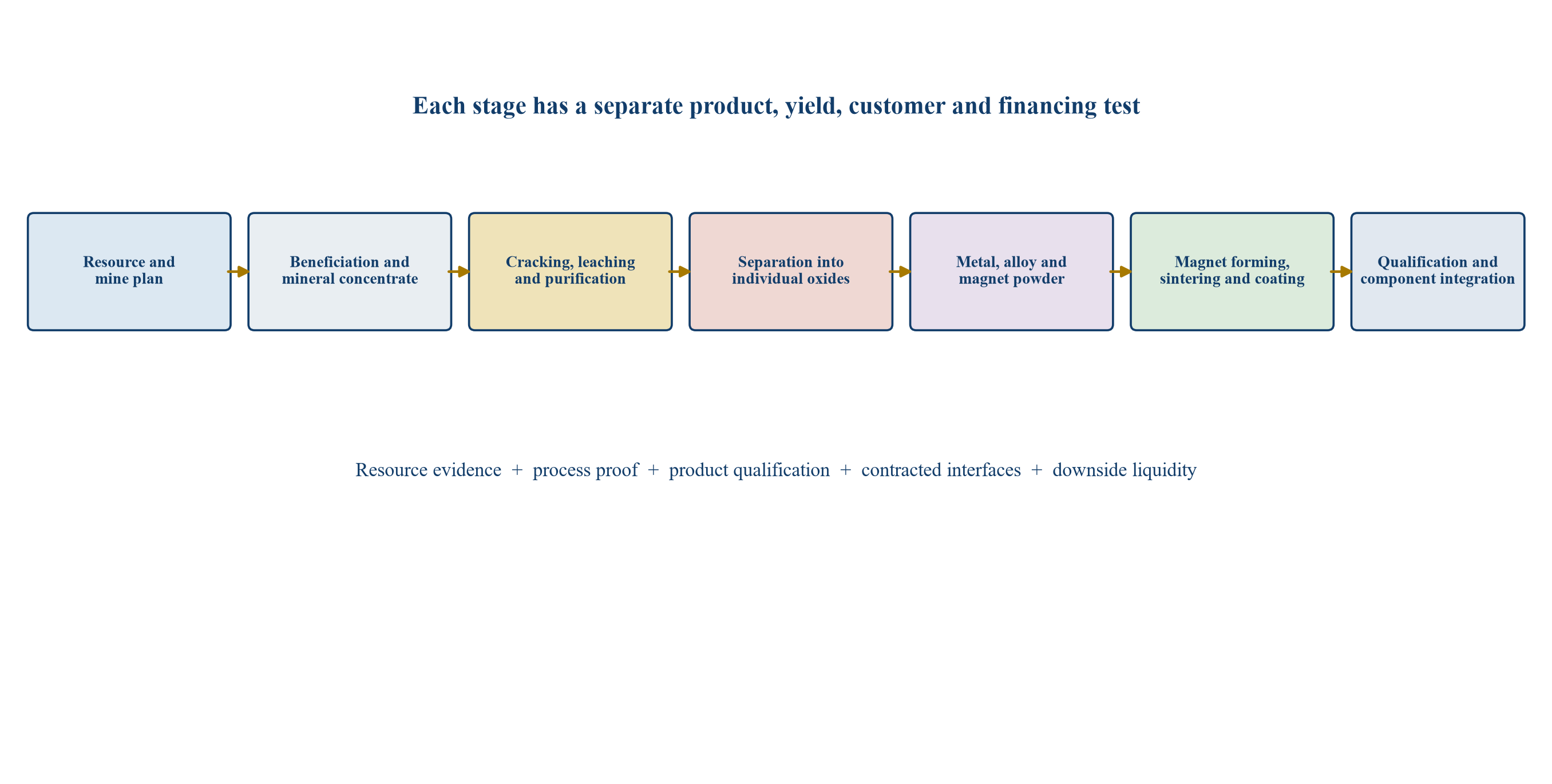
Generic decision framework; each project requires asset-specific technical, legal, commercial and financial evidence.
7. Resource quality
Resource quality begins with mineralogy, grade, distribution of valuable elements, deleterious elements, geometry, continuity and mining conditions. Bastnaesite, monazite, ionic adsorption clays and other hosts require different mining and processing routes. Total rare-earth grade alone provides limited information about recoverable magnet elements.
The resource model should report the payable distribution by domain. Revenue assumptions need to reflect the actual assemblage, recovery and saleable product. High concentrations of low-value elements can raise processing volume without providing proportional revenue.
8. Reserve conversion and mine schedule
A mineral resource becomes an investable mining proposition through mine design, recovery, dilution, geotechnical work, hydrogeology, infrastructure, permits, operating assumptions and economic testing. The mine schedule controls feed grade and mineralogy over time.
Early high-grade feed can make initial economics look stronger than steady-state performance. The valuation should reconcile annual plant feed to the reserve model and show the effect of dilution, stockpiles, cut-off grade and mining sequence.
9. Beneficiation
Beneficiation aims to reject waste and produce a mineral concentrate before chemical processing. Crushing, grinding, flotation, magnetic separation, gravity separation or other methods may be used. Recovery, concentrate grade, mineral liberation, reagent use, water, variability and impurity deportment determine downstream performance.
A higher concentrate grade can reduce chemical plant size, reagent consumption and residue volume. Selectivity may sacrifice valuable recovery. The economic optimum should minimise total delivered oxide cost rather than maximise one laboratory metric.
10. Cracking and leaching
Mineral concentrate must be chemically opened so rare earths can enter solution. Acid or alkali routes vary with mineralogy. Temperature, residence time, reagent intensity, materials of construction, gas handling and residue characteristics influence cost and environmental controls.
Laboratory extraction requires confirmation with representative feed and integrated circuits. Heat integration, reagent recycle and impurity control affect scale economics. A project should disclose the boundary between demonstrated chemistry and engineering assumptions.
11. Radioactive and hazardous constituents
Some rare-earth minerals contain thorium or uranium. Their distribution can affect concentrate transport, residue classification, worker protection, storage, permits and long-term liabilities. Other impurities may create corrosive streams or hazardous wastes.
The diligence programme should follow each constituent through the mass balance. Management plans need credible facilities, monitoring and closure funding. A nominally valuable concentrate can become difficult to market when its impurity profile restricts transport or processing.
12. Separation is the technical core
Rare-earth elements have similar chemical properties. Separation commonly uses long solvent-extraction circuits with many stages, tight process control and substantial reagent inventories. Product purity and recovery depend on feed composition, circuit configuration, operators, analytics and recycle management.
The IEA identifies separation as a critical bottleneck in diversification [1]. A new plant should be assessed by individual product recoveries, not aggregate rare-earth recovery. Commercial evidence includes sustained purity, throughput, solvent performance, phase control and residue management.
13. Mixed products and tolling
A project may sell mixed carbonate, mixed oxide or concentrate rather than install full separation. This reduces capital and operating complexity while transferring value and bargaining power to a processor. Payability, treatment charges, penalties, working capital and customer concentration determine the economics.
Toll separation can accelerate market access when capacity and contractual protections exist. The model should specify title transfer, assay settlement, recovery allocation, inventory ownership and liability for off-specification material.
14. Metallisation
Separated oxides must be converted to metals before many magnet alloys can be produced. Metallisation requires high-purity inputs, specialised furnaces, controlled atmospheres, energy, process knowledge and quality assurance. The IEA described metallisation as one of the most acute diversification constraints [1].
Metal yield and purity affect alloy quality. Investors should test equipment provenance, commissioning plan, raw-material specification, waste streams and operator capability. Oxide availability does not automatically establish a secure metal supply.
15. Alloy and powder preparation
Magnet alloy composition determines magnetic and thermal performance. Melting, strip casting, hydrogen decrepitation, milling and powder handling require tight composition and contamination control. Fine powders can present oxidation and safety risks.
The investment case should connect alloy formulation to licensed or proprietary process knowledge, equipment capability and customer grades. Yield losses and internal recycle affect economics. Rare heavy elements deserve particular reconciliation because small additions can carry high value.
16. Magnet production
Sintered magnets are formed, aligned, pressed, sintered, heat-treated and machined. Bonded magnets combine magnetic powder with a polymer. The US Department of Energy noted that sintered products represent the dominant NdFeB market and serve demanding traction and generator applications [3].
Nameplate tonnes do not capture value. Magnet grade, shape, tolerances, coating, yield and customer specification drive realised revenue. Machining losses may be recycled, sold or lost depending on capability.
17. Coating and corrosion performance
NdFeB magnets can require protective coatings. Coating selection depends on environment, geometry, adhesion, temperature and component life. Surface preparation and process control affect failure risk.
Qualification should include corrosion, thermal cycling, adhesion and dimensional tests relevant to the application. A coating line can constrain throughput even when sintering capacity is available. Warranty exposure should enter the commercial model.
18. Customer qualification
Automotive, aerospace, defence and industrial customers can require extensive product and process qualification. Evidence may include magnetic-property distributions, dimensional capability, traceability, process audits, reliability testing and change-control discipline.
Qualification creates time and working-capital exposure. Revenue should ramp by approved grade and customer rather than plant nameplate. Investors should identify whether an offtake is a binding purchase obligation, a development arrangement or a non-binding expression of interest.
19. Component integration
Magnets are integrated into rotors, motors, generators, sensors and other assemblies. Design choices affect magnet geometry, grade, coating and operating temperature. A component partner can shorten qualification and provide demand visibility, while also concentrating bargaining power.
The value boundary should be explicit. An integrated platform may capture design margin and customer access, but it also adds assembly capital, warranties and programme risk.
20. Recycling and circular supply
Manufacturing scrap and end-of-life products can provide alternative feed. Routes include direct alloy recycling, hydrometallurgical recovery and other processes. Feed collection, identification, coatings, contamination, disassembly and scale affect economics.
The EU Critical Raw Materials Act sets a 2030 benchmark for recycling capacity equal to 25 per cent of annual strategic-raw-material consumption [4]. Recycling projects need contracted feed and product qualification. Availability may remain limited during early fleet growth because material stays in use for years.
21. Stage economics
Table 1. Investable stages and principal evidence
| Stage | Saleable product | Main value driver | Principal proof | Common failure |
|---|---|---|---|---|
| Mine and beneficiation | Mineral concentrate | Recoverable payable elements | Reserve, mine plan and sustained recovery | Resource tonnes treated as revenue |
| Chemical upgrading | Leach solution or mixed product | Extraction, impurity removal and reagent efficiency | Integrated pilot and mass balance | Laboratory recovery extrapolated to scale |
| Separation | Individual high-purity oxides | Purity, recovery and circuit utilisation | Sustained representative campaign | Aggregate recovery hides product losses |
| Metallisation and alloy | Metal or specified alloy | Yield, composition and process control | Qualified runs and reliable oxide feed | Oxide capacity assumed to equal metal supply |
| Magnet production | Finished magnet | Grade, dimensional yield and qualification | Customer approval and statistical capability | Nameplate tonnes valued as qualified output |
| Recycling | Scrap-derived alloy or oxide | Feed access and recovery economics | Contracted feed and qualified product | Unsecured future waste counted as current feed |
22. Product-specific revenue
Rare-earth prices differ by element, purity, form, contract, delivery point and market conditions. A project should model the actual product slate and payable terms. Basket revenue based on contained elements should be reduced for recovery, unsold products, treatment charges, discounts and logistics.
Heavy rare-earth revenue can be material despite low volume. The model should avoid assuming spot quotations apply to long-term qualified sales. Contract floors, collars, index lags and strategic premiums require documentary evidence.
23. Market balance by element
Demand and supply should be assessed separately for neodymium, praseodymium, dysprosium, terbium and other products. Co-production can create surplus in lower-value elements while scarce magnet elements support value.
The USGS reported world rare-earth mine production of roughly 390,000 tonnes of rare-earth-oxide equivalent in 2025 and resources exceeding 85 million tonnes [2]. These aggregate figures describe scale and geological availability. They do not resolve the distribution, processing capacity or magnet-grade availability of individual elements.
24. Pipeline imbalance
The IEA estimated that diversified mining capacity could exceed 50 kilotonnes of magnet rare-earth content by 2035, while announced metals, alloys and finished-magnet capacity outside China amounted to around 18 kilotonnes as of early 2026 [1]. Separation capacity also lagged mining [1].
This imbalance creates interface risk. New mines may compete for limited separation and conversion outlets. Downstream plants may face feed shortages or inconsistent specifications. Contracted alignment across stages can be more valuable than stand-alone nameplate capacity.
25. Price and margin exposure
Prices can fall when supply additions, demand changes or inventory releases exceed consumption. They can rise sharply during disruption. A concentrated chain can produce wide regional spreads and strategic premiums.
The valuation should use stage-specific margins. A separator purchasing concentrate has feed-price exposure; an integrated mine-to-magnet platform has construction and operating interfaces; a magnet producer can face oxide and alloy volatility. Pass-through clauses and repricing lags determine working-capital needs.
26. Capital intensity
Capital includes mine development, beneficiation, chemical plants, solvent-extraction circuits, utilities, residue facilities, laboratories, metal and alloy equipment, magnet lines, buildings, qualification inventory and owner costs. Contingency should reflect design maturity and interfaces.
Brownfield capacity can benefit from infrastructure and operating teams. It can also inherit constrained layouts or legacy liabilities. Benchmark capital should be normalised for product boundary, geography, capacity, utilities and environmental scope.
27. Operating-cost architecture
Operating costs include mining, grinding, reagents, energy, labour, consumables, solvent replacement, maintenance, laboratories, waste management, logistics, royalties and corporate support. Unit costs depend on utilisation and product mix.
A co-product allocation can make a stage appear artificially competitive. The model should show cash cost before and after by-product credits, and reconcile unprofitable elements that must still be separated or managed.
28. Working capital
Long process residence, intermediate inventory, assay settlement, qualification batches and customer payment terms can consume cash. High-value heavy elements may create disproportionate inventory exposure. Imported reagents and spare parts can add safety stocks.
The financing plan should include ramp-up inventory and the delay between material input and cash receipt. A profitable steady-state model can still fail when working capital is underfunded.
29. Cost and yield sensitivity
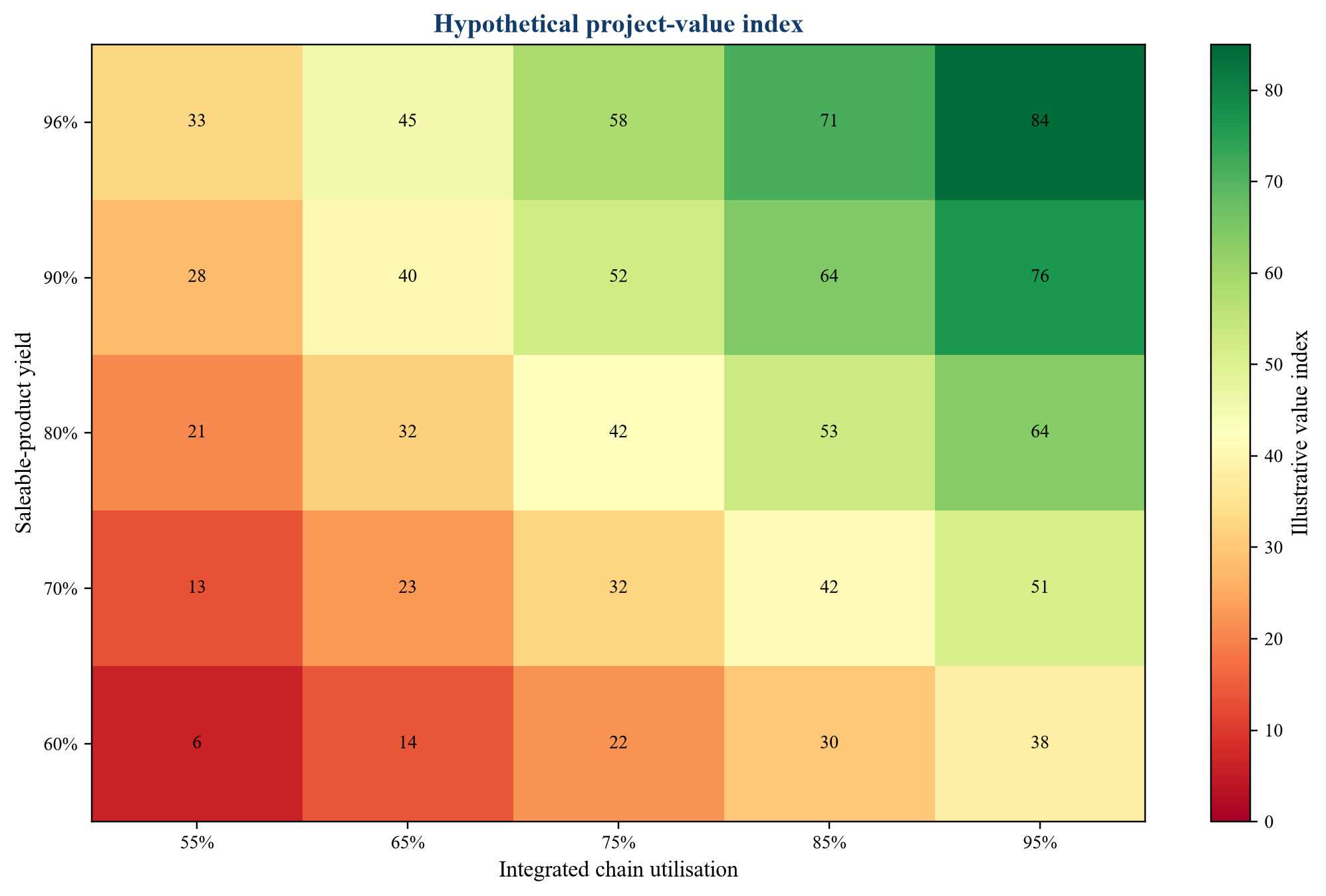
Illustrative index only; not a forecast or valuation. Asset-specific evidence must replace every assumption.
30. Integrated yield
The chain compounds losses. Mine recovery, beneficiation recovery, chemical extraction, separation recovery, metal yield, alloy yield and magnet manufacturing yield each reduce final saleable output. A 90 per cent recovery at several consecutive stages can produce a materially lower end-to-end yield.
The financial model should calculate physical flow at every stage and reconcile internal recycle. Recovery assumptions should vary by element and product. Aggregate yield can conceal the loss of the most valuable heavy elements.
31. Utilisation and bottlenecks
Integrated plants operate at the rate of their limiting stage. A bottleneck in separation, metallisation, coating, laboratory release or customer approval can strand capacity elsewhere.
Ramp-up should model stage-specific curves, maintenance and batch campaigns. The design should include intermediate storage without treating inventory as a substitute for reliable operations. Debottlenecking capital and shutdown windows need funding.
32. Break-even architecture
Break-even should be calculated for each saleable product and for consolidated cash flow. The model should identify the prices, utilisation, recoveries and costs required to cover operating expenses, sustaining capital, debt service and minimum liquidity.
Strategic value can support contracts or public finance, but it should not conceal recurring negative cash generation. Any security premium should be evidenced through binding commercial or policy mechanisms.
33. Scenario matrix
Table 2. Hypothetical mine-to-magnet scenarios
| Case | Demand and price | Execution | Commercial structure | Decision use |
|---|---|---|---|---|
| Diversified growth | Firm demand with moderate premium | Milestones broadly achieved | Qualified offtake across several customers | Test upside and expansion options |
| Base execution | Mid-cycle pricing | Planned ramp with ordinary delay | Contract mix and staged qualification | Size capital and liquidity |
| Upstream surplus | Oxide prices weaken | Mine supply grows faster than conversion | Limited separation slots | Test tolling and integration exposure |
| Downstream constraint | Magnet premiums persist | Metallisation or magnet capacity delayed | Strategic customers seek secure supply | Test bottleneck investment value |
| Disruption | Regional spreads widen sharply | Licensing and logistics slow | Inventory and priority contracts matter | Test continuity value and working capital |
| Qualification failure | Product discounts dominate | Yield and approval remain below plan | Customer concentration increases | Protect capital through stage gates |
34. Mine valuation
A producing mine can be valued through discounted cash flow supported by reserve, operating history, recovery and contracts. Development mines require probability-weighted schedules, capital and permitting. The value of an uncontracted concentrate depends on available processors and payable terms.
Resource optionality should remain separate from funded production value. Expansion cases need new technical, permit and market evidence. Strategic interest does not remove geology or execution risk.
35. Separation-plant valuation
A separator resembles a specialised chemical business. Value depends on feed security, element distribution, recovery, product purity, circuit utilisation, reagent efficiency, residues and customer qualification.
Tolling, merchant and integrated models have different margin and working-capital profiles. A merchant plant buying feed and selling oxides carries both sides of price exposure. A tolling plant may earn a steadier fee while relying on counterparty credit and volume commitments.
36. Metallisation and alloy valuation
Metallisation and alloy operations can occupy a scarce interface. Their value depends on access to qualified oxides, process yield, grade portfolio, energy, equipment and customer contracts.
Comparable multiples should be used carefully because product and integration differ. Replacement cost, contracted margin and cash-flow evidence can be more informative. Intellectual property and operator know-how deserve diligence rather than a generic technology premium.
37. Magnet-plant valuation
A magnet plant is an advanced-manufacturing asset. Value depends on approved grades, customer programmes, process capability, yield, machining mix, coating, warranty history, automation and intellectual property.
Revenue backlog should be separated into binding orders, nominated programmes, framework agreements and development discussions. Customer qualification can create switching costs, but it can also concentrate revenue and impose change-control obligations.
38. Recycling valuation
Recycling value begins with feed access. Manufacturing scrap can provide consistent near-term material; end-of-life feed depends on collection, disassembly, age and product design. Contracts should specify ownership, contamination and pricing.
Technology value requires demonstrated recovery and qualified output. A forecast of future discarded magnets should be discounted for collection losses, competing recyclers and delayed availability. Policy support can strengthen economics when eligibility is clear.
39. Comparable transactions
Transaction comparables require normalisation for chain stage, product, resource status, qualification, geography, infrastructure, contracts, policy support and market date. A mine acquisition should not be compared directly with a qualified magnet manufacturer.
Reported enterprise value may omit contingent payments, assumed liabilities, government grants or customer prepayments. The analysis should disclose adjustments and retain a broad valuation range.
40. Strategic value
Strategic value can arise from security of supply, regional content, customer continuity, intellectual property, workforce, infrastructure and acceleration of a larger industrial platform. It should be tied to a buyer-specific benefit.
A strategic premium is justified only when the buyer can realise that benefit and the transaction protects it. Competitive tension may reveal value, while security restrictions can narrow the buyer universe.
41. Offtake structure
Offtake can support financing when volume, specification, price, tenor, credit and remedies are bankable. Floor prices, prepayments, take-or-pay obligations and capacity reservations can allocate risk.
Exclusivity can restrict future customers or products. Investors should test whether the buyer can reject material, delay qualification or terminate after adverse tests. The contract should align the product actually produced with the benchmark used for payment.
42. Project finance
Project debt requires predictable completion, feed, operating cost, saleable product and revenue. A first-of-a-kind integrated chain may be difficult to finance without guarantees, completion support, subordinated capital or public participation.
Lenders should use stage-specific completion tests. Mechanical completion alone is insufficient. Performance tests should cover sustained throughput, recovery, purity, environmental compliance and contracted saleability.
43. Corporate and asset-backed debt
Corporate debt can fund expansion where a diversified sponsor has cash flow and balance-sheet capacity. Asset-backed structures may finance inventory, receivables or equipment when title, value and liquidation pathways are clear.
Specialised intermediate inventory can be hard to realise outside the operating chain. Advance rates should reflect assay uncertainty, price volatility, processing needs and buyer concentration.
44. Equity and staged capital
Equity absorbs geology, technology, permitting and market risk before senior debt is available. Staged funding should release capital against evidence: resource definition, pilot results, permits, engineering, contracts, construction and qualification.
Milestones should measure risk retirement rather than calendar passage. Governance should prevent a weak result from being recast as success. Investors need reserve rights for material design, budget and commercial changes.
45. Public finance
Governments may provide grants, loans, guarantees, tax incentives, procurement or stockpiling because supply security has wider economic value. The EU Act sets capacity benchmarks for extraction, processing and recycling and limits reliance on a single third country [4]. United States policy has supported domestic magnet-chain projects [3].
The model should treat support according to its legal conditions, disbursement milestones, cost sharing and clawbacks. Announced policy is not cash until eligibility and appropriation are established.
46. Joint ventures
Joint ventures can combine a resource owner, process provider, industrial operator, customer and public investor. The structure can align chain interfaces and reduce capital demands on one party.
Governance becomes central. Reserved matters, funding defaults, technology rights, product allocation, transfer restrictions and exit mechanisms should be agreed before major capital is committed. The vehicle needs a complete operating model rather than a collection of sponsor intentions.
47. Acquisitions
Acquisition can accelerate access to permits, teams, equipment, customer approvals or intellectual property. Diligence should reconcile technical claims, operating data, maintenance, contracts, warranties, environmental liabilities and funding needs.
Integration planning should begin before signing. A buyer that acquires one stage must secure its feed and customer interfaces. Synergy estimates should identify the exact material, cost or qualification pathway that changes.
48. Transaction perimeter
The transaction perimeter may include licences, land, permits, infrastructure, equipment, inventory, data, technology, contracts and personnel. Shared facilities and intellectual property can remain with a seller or affiliate.
Separation agreements should protect operational continuity. Transitional services need scope, price, term, data access and exit plans. Environmental and residue liabilities should follow clear legal allocation supported by financial capacity.
49. Technology diligence
Technology diligence should review process chemistry, flowsheets, mass and energy balances, pilot design, representative feed, scale factors, equipment, control strategy, failure modes and intellectual property.
Vendor data should be reconciled with independent tests and operating references. Confidentiality can limit review, but it does not remove the need for evidence. The investment committee should distinguish demonstrated performance from design targets.
50. Intellectual property
Value may depend on patents, trade secrets, recipes, operating data and specialised teams. Freedom to operate, ownership, jurisdiction, licence scope, improvements and change-of-control provisions require review.
A patent does not establish commercial performance. Trade-secret dependence on a few individuals creates retention and continuity risk. The operating model should document critical knowledge while respecting legal protections.
51. Permitting
Permits can cover mining, water, chemical storage, air emissions, radioactive material, residue facilities, transport and construction. Downstream plants may face different authorities and industrial-zone requirements from mines.
The schedule should reflect actual critical-path permits and appeal rights. A strategic designation can help coordination without guaranteeing approval. Conditions and monitoring costs belong in the financial model.
52. Residues and closure
Beneficiation and chemical processing can generate tailings, neutralisation residues, salts, solvents and radioactive or hazardous streams. Facilities need geochemical, geotechnical and water evidence.
Closure cost should include dismantling, residue stability, water treatment, monitoring and land obligations. A short mine life can coexist with long environmental liabilities. Security and provisioning should match the legal regime and engineering case.
53. Water
Mining, grinding, leaching, washing, separation and cooling can require water. Quality and seasonal availability matter as much as annual volume. Competing users and discharge limits can constrain operation.
Water balance should cover normal, dry and extreme conditions. Recycling can reduce withdrawals while concentrating impurities. The model should connect water availability to throughput and cost.
54. Energy and emissions
Grinding, thermal treatment, chemical processing, metallisation and sintering consume energy. Power reliability, fuel mix and price affect cost, emissions and customer requirements.
Low-carbon claims need a defined boundary and verified inputs. Renewable contracts may reduce market exposure while requiring firming or network capital. Energy assumptions should be tested under outage and price scenarios.
55. Responsible sourcing
Responsible sourcing includes human rights, labour, community, environment, corruption, security and traceability. OECD due-diligence principles provide a risk-based framework for mineral supply chains [5].
Traceability should connect feed lots to products without overstating certainty. Audits and certifications can support evidence, but management systems must address actual risks and remediation.
56. Community and Indigenous rights
Mining and processing projects affect land, water, livelihoods, heritage and local infrastructure. Engagement should begin before design is fixed and continue through closure.
Agreements need clear benefits, grievance mechanisms and implementation capacity. Schedule and valuation should reflect commitments. Formal permits do not substitute for durable relationships and lawful consultation.
57. Geopolitics and trade
Export controls, tariffs, sanctions, investment screening, origin rules and procurement preferences can change market access. Product classifications and licences may be decisive.
The commercial plan should map material, technology, ownership and customer jurisdictions. Diversification value can rise during disruption, while compliance costs and buyer restrictions can also increase. Legal review should be refreshed before investment and contracting decisions.
58. Foreign exchange
Projects may incur local costs, imported-equipment costs, reagent purchases and debt service in different currencies. Revenue benchmarks may use United States dollars while grants or customer payments use other currencies.
The model should separate transaction, translation and convertibility risk. Hedging availability may change by tenor and construction stage. A nominal local-cost advantage can disappear after currency and inflation effects.
59. Inflation and escalation
Chemical plants and specialised equipment can be exposed to vendor concentration and long lead times. Civil works, energy and labour also escalate. Fixed-price contracts often retain exclusions or indexation.
The capital model should state escalation dates and currencies. Contingency does not replace an updated estimate. Procurement strategy should prioritise critical equipment and preserve technical compatibility.
60. Workforce
Rare-earth separation, metallisation and magnet production need specialised chemistry, process-control, maintenance, laboratory and quality skills. New regions may have limited experienced personnel.
Staffing plans should include recruitment, training, visas, shift coverage and retention. Vendor support can help commissioning but should transition to a sustainable operating team. A few experts should not become single points of failure.
61. Data and digital control
Integrated process data can improve mass-balance reconciliation, predictive maintenance, quality control and traceability. Advanced analytics can identify drift before product fails specification.
Data value depends on calibrated instruments, consistent tags, laboratory integration and governance. Models should operate within validated ranges and retain human review. Cybersecurity matters because process and customer data can be commercially sensitive.
62. Investment-committee scorecard
Table 3. Mine-to-magnet investment-committee scorecard
| Dimension | Evidence required | Investment question | Protective response |
|---|---|---|---|
| Resource and feed | Mineralogy, schedule and contracts | Is feed available in the required composition? | Stage capital and diversify supply |
| Process | Representative integrated campaigns | Are yield and purity demonstrated at relevant scale? | Require milestones and performance tests |
| Product | Specification and qualification evidence | Can output be sold at the assumed price? | Link value to approved grades and customers |
| Interfaces | Binding logistics, tolling and supply terms | Can material move reliably between stages? | Contract capacity and define remedies |
| Capital | Classed estimate and execution plan | Is the funding envelope complete? | Add contingency and sponsor support |
| Operations | Team, maintenance and quality systems | Can the plant sustain output and control? | Fund readiness before start-up |
| Sustainability | Permits, water, residues and communities | Are impacts manageable through closure? | Price liabilities and retain decision rights |
| Finance | Liquidity, covenants and downside cases | Can the project survive delay and weak pricing? | Size debt to stressed cash flow |
| Strategy | Buyer-specific security and synergy | Who can realise strategic value? | Preserve competition and optionality |
63. Stage gates
The first gate proves feed and process relevance. The second proves integrated extraction and separation. The third establishes permits, engineering and contracts. The fourth controls construction release. The fifth requires sustained performance and qualified product.
Each gate should have objective evidence, independent review and a maximum capital-at-risk limit. A failed gate should trigger redesign, pause, partnership or exit rather than automatic continuation.
64. Implementation roadmap
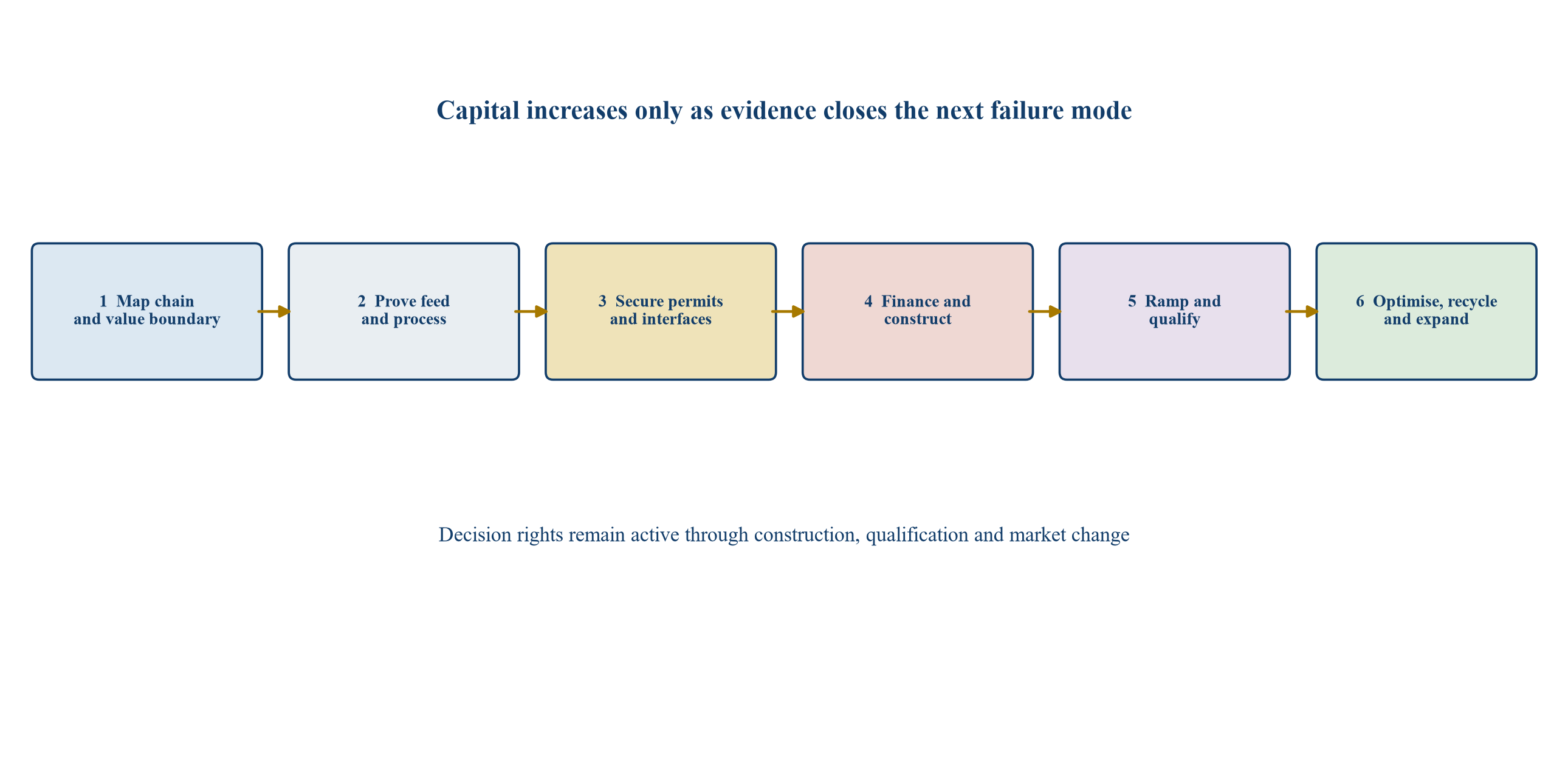
Generic sequence; timing and evidence vary by jurisdiction, process route and customer.
65. First 100 days after acquisition
The first 100 days should reconcile physical inventory, feed, mass balance, laboratory methods, product certificates, customer approvals, maintenance backlog, permits, residues and cash controls. Management should establish one version of operational and commercial truth.
Near-term improvements should protect product consistency and safety before chasing throughput. The integration team should preserve customer communication and critical personnel while validating synergy assumptions.
66. Monitoring dashboard
A board dashboard should track feed grade and mineralogy, throughput, recovery by element, purity, off-specification rate, yield, inventory, reagent intensity, energy, residue generation, customer qualification, contracted volume, cash and liquidity.
Targets should distinguish design, ramp and steady-state performance. Variances need owners and corrective actions. A single aggregate recovery or production number is insufficient.
67. Trigger framework
Triggers can cover feed shortfall, recovery, purity, solvent loss, equipment availability, qualification delay, price, working capital, permit conditions and counterparty credit. Each trigger should link to a defined decision.
Actions can include campaign changes, alternate feed, technical review, capital hold, liquidity draw, contract enforcement or shutdown. Early triggers protect value when management still has options.
68. Inventory strategy
Strategic inventory can protect customers against disruption, while tying up cash and carrying price risk. The IEA estimated that the net operating cost of a one-year stockpile of exposed magnet rare-earth imports outside China could be modest relative to disruption costs [1].
Company policy should define material, form, ownership, location, rotation, insurance and release authority. Mixed concentrate inventory does not replace a missing separation or magnet stage.
69. Contract pricing
Contracts can use market indices, negotiated references, floors, collars, cost pass-throughs or fixed margins. Thin or opaque markets complicate benchmarking.
Pricing should match product form and delivery point. Audit rights, quotation periods, assay settlement and related-party terms need clarity. A floor can support finance if the counterparty is creditworthy and the obligation survives relevant events.
70. Insurance
Coverage may include construction, property, business interruption, cargo, environmental and political risks. Specialised equipment can create long reinstatement periods.
Insurance cannot replace maintenance, spares or supply-chain redundancy. Limits, exclusions, waiting periods and insurer security should be compared with the loss scenarios in the financial model.
71. Climate resilience
Mines and plants can face flood, drought, heat, storms, wildfire and transport disruption. Water and residue facilities require particular attention under changing extremes.
Design criteria should use site evidence and stress cases. Adaptation capital belongs in the funding plan. Historical averages alone may be insufficient for long-lived infrastructure.
72. Expansion options
Expansion can add mine throughput, separation trains, heavy-element circuits, metal or magnet lines and recycling feed. Shared infrastructure can improve returns while increasing integration risk.
Options should be valued separately and released after the first phase demonstrates feed, process and market evidence. Future capacity should not inflate current valuation before permits, engineering and funding exist.
73. Exit pathways
Potential exits include sale to a strategic customer, industrial manufacturer, mining company, private-capital investor or public market. An integrated chain may appeal to buyers seeking security, while a specialised stage can appeal to operators with adjacent capabilities.
Exit readiness requires clean title, permits, contracts, operating data, environmental records, qualified products and a credible management team. Buyer-specific value should be supported without narrowing the sale process prematurely.
74. What investable means
An investable stage has a defined product, evidenced feed, demonstrated process, executable permits, capable team, credible customers, complete capital plan and sufficient downside liquidity. It also has transparent interfaces with the stages before and after it.
Geological abundance and strategic policy provide context. Cash generation still depends on conversion of material into a product a qualified customer will buy.
75. Board decision record
The board should document evidence, assumptions, unresolved risks, funding sources, conditions, triggers and decision rights. The record should distinguish observed performance from engineering targets and management estimates.
Material updates should return to the board when process route, product, customer, budget, schedule or policy support changes. A disciplined record improves governance and later transaction readiness.
76. Final investment test
The final test asks whether the selected stage can deliver a specified product to a credible customer, at a complete cost, through a financeable execution plan and under a downside case. It also asks whether missing adjacent stages are secured by contract or controlled integration.
Approval should specify conditions, capital limits, stage gates, reporting and exit rights. Strategic importance can strengthen the case, but it cannot substitute for technical and commercial proof.
77. Conclusion
Rare-earth value is created through a chain of technically demanding transformations. Current evidence shows that diversified mining capacity is advancing faster than separation, metallisation and magnet manufacturing. The bottleneck therefore sits in coordinated delivery of qualified products rather than geological scarcity alone.
Investors should value mines, processors, metallisation plants, alloy operations, magnet manufacturers and recyclers according to their own products and risks. The strongest propositions combine demonstrated yield, contracted interfaces, customer qualification, responsible operations and liquidity sufficient to survive delay and market change.
Long-term demand and supply-security policy create opportunity. Stage-gated capital and product-specific evidence determine which opportunities become investable businesses.
References
- International Energy Agency. Rare Earth Elements: Pathways to Secure and Diversified Supply Chains. Paris: IEA, 8 April 2026. https://www.iea.org/reports/rare-earth-elements
- United States Geological Survey. Mineral Commodity Summaries 2026: Rare Earths. Reston, Virginia: USGS, February 2026. https://pubs.usgs.gov/periodicals/mcs2026/mcs2026-rare-earths.pdf
- United States Department of Energy. Rare Earth Permanent Magnets: Supply Chain Deep Dive Assessment. Washington, DC: DOE, February 2022. https://www.energy.gov/sites/default/files/2022-02/Neodymium%20Magnets%20Supply%20Chain%20Report%20-%20Final_0.pdf
- European Parliament and Council. Regulation (EU) 2024/1252 establishing a framework for ensuring a secure and sustainable supply of critical raw materials. 11 April 2024. https://eur-lex.europa.eu/eli/reg/2024/1252/oj
- Organisation for Economic Co-operation and Development. OECD Due Diligence Guidance for Responsible Supply Chains of Minerals from Conflict-Affected and High-Risk Areas, Third Edition. Paris: OECD Publishing, 2016. https://doi.org/10.1787/9789264252479-en
About the Author
# ABOUT THE AUTHOR Authored by Chennakeshav Adya Independent Researcher Chennakeshav (CK) is a corporate finance and investment banking executive with 25+ years of global experience in deal origination, structuring and execution across M&A, growth capital and corporate strategy. He has led value-creation mandates for founders, corporates and funds — bridging the boardroom view to hands-on execution and close. His career spans Morgan Stanley, HSBC, Lloyds Banking Group, EWEC, ADQ portfolio companies and Emirates Growth Fund, across TMT, real estate, fintech, deeptech, cleantech, infrastructure and energy. He has partnered with C-suite leaders, private equity and venture funds, sovereign wealth funds and family offices to finance complex fund raises and scale-up ventures, and has led M&A due diligence, post-merger integration and business-transformation initiatives to create value. At Matchpoint Partners he is Managing Partner, leading the firm's corporate finance, M&A and capital-raising practice. He holds an MBA from London Business School, an engineering degree from VTU and a Master of Laws (LLM, in progress) from UCL London. An active start-up mentor, CK mentors at Techstars, DIFC FinTech Hive, Startup Grind, Founder Institute and IN5, serves as Entrepreneur Mentor in Residence (EMiR) at London Business School, and judges the Entrepreneurship World Cup.
LinkedIn: https://www.linkedin.com/in/ckadya/
Profile: https://www.matchpoint-partners.com/team/ck-adya.html
