

Introduction
Industrial projects reach financial close when customers create dependable revenue. Technical readiness, permits and capital cost remain essential, yet none produces cash on its own. A lender must understand who will buy the output, how much they must take or pay for, what price applies, how long the obligation lasts and what happens when either party fails.
The problem is acute for low-carbon materials, hydrogen, sustainable fuels, electrified process heat and other first-commercial products. Production may cost more than the incumbent alternative during early scale-up. Buyers may value lower emissions but hesitate to accept a fixed premium for ten or fifteen years. Producers cannot finance large assets against expressions of interest that can be withdrawn.
The International Energy Agency reported that firm offtake agreements represented less than two million tonnes per year of low-emissions hydrogen by mid-2025, around five per cent of the production potential announced for 2030. Existing industrial uses and shipping accounted for almost all firm private commitments and most investment in committed production projects.[1] This paper addresses the contract design that can narrow that gap.
1. Start with the financing decision
The central decision is whether contracted customer cash flow can support construction and term debt. The analysis should begin with the proposed debt amount, tenor, repayment profile, required coverage and reserve structure. It should then work backwards to the minimum revenue that must remain dependable under downside conditions.
Customer interest has several levels. A non-binding memorandum can guide development. A conditional reservation can support engineering. A signed purchase agreement can support financing when its conditions, remedies and counterparty credit are adequate. Each level has value, but only enforceable obligations should enter the base debt case.
The board should approve final investment after matching customer commitments to capital exposure. Early development can proceed with weaker evidence. Equipment orders, construction notice and debt draw require progressively stronger commitments because cancellation costs and stranded capital increase at each gate.
2. Define the product before pricing it
A contract cannot support finance when the product remains ambiguous. Define physical specifications, permissible tolerances, certification, emissions intensity, delivery point, transfer of title, measurement and testing. Low-carbon products can lose their premium when the attributes delivered do not satisfy the customer's regulation or internal procurement standard.
Separate the physical product from environmental attributes. Hydrogen molecules, steel, cement, heat or fuel can carry certificates, lifecycle-emissions data, renewable-content evidence or book-and-claim instruments. State whether attributes transfer with the product, remain with the producer or can be sold separately.
The definition should remain stable enough for lenders and flexible enough for technical development. Use objective standards and controlled change procedures. A broad promise to meet every future customer specification can create uncapped redesign cost and undermine the construction budget.
3. Map the customer's economic use
The customer's willingness to commit depends on the value created in its own operation. Map how the product affects production cost, emissions compliance, end-customer revenue, asset utilisation and supply security. A premium that appears large per tonne of input may be small per unit of the final product.
The IEA illustrates this value-chain effect with renewable ammonia used in fertiliser and then agriculture. A high premium at the ammonia stage can become a very small share of the final consumer price, while allocating that premium across the chain remains difficult.[9] Contract design should follow the value pool rather than assume the first industrial buyer can absorb the whole difference.
Identify the party with the clearest incentive and credit. It may be the direct industrial user, its end customer, a brand owner, a public procurer or an intermediary that aggregates demand. Multiple commitments can share the premium and reduce reliance on one buyer.
4. Build a commitment ladder
Use a defined ladder from market evidence to financeable obligation. The first level is a customer interview or non-binding interest. The second is a letter identifying product, indicative volume and target price. The third reserves capacity against a deposit or development payment. The fourth creates a conditional purchase obligation. The fifth is an unconditional or tightly conditioned offtake agreement.
Each level should have an expiry date, next action and evidence requirement. Sponsors often count the full potential volume of early discussions even when buyers have no budget, approval or delivery plan. A disciplined ladder prevents pipeline optimism from entering the financing case.
Record customer authority as well as wording. A signed document has limited value when procurement, treasury or the board can reject it later. The commitment register should identify required approvals, remaining conditions and the date on which the obligation becomes binding.
5. Select an anchor customer
An anchor customer establishes the initial demand base. The anchor should have a durable need, credible credit, operational capability to receive the product and authority to sign a long-term agreement. Volume alone does not determine anchor value. A smaller commitment from a strong counterparty can support more debt than a larger commitment from an uncertain buyer.
The US Department of Energy's Loan Programs Office states that signed offtake contracts or committed letters for a significant portion of project output improve the sales case. It also identifies long-term contracts from creditworthy buyers and an established anchor tenant as evidence that can reduce market risk.[2]
Avoid allowing the anchor to control every commercial decision. Concentrated demand can give the buyer strong renegotiation leverage. The agreement should protect the project while preserving transparent rights for additional customers and future refinancing.
6. Diversify committed demand
Several customers can reduce exposure to one insolvency, outage or strategy change. Diversification works only when commitments are genuinely independent. Buyers in the same sector, geography or end market can fail together during a common downturn.
Classify customers by credit, sector, product use, delivery point and contract expiry. Calculate the largest single exposure and the share held by the three largest buyers. Apply correlated downside cases where several customers reduce uncommitted volume or dispute the same product attribute.
A portfolio requires standard terms. Excessive customisation creates operational complexity and inconsistent remedies. Use a common product specification, nomination process, payment structure and credit package, then limit bespoke terms to genuine customer requirements.
7. Choose the commitment instrument
Possible instruments include take-or-pay, capacity reservation, availability payment, minimum revenue guarantee, tolling, floor-price purchase, advance market commitment and direct procurement. Each transfers a different risk. The choice should reflect the asset, product and customer's ability to control demand.
World Bank guidance describes offtake agreements that require purchase of all or part of output, enough output to cover debt service, or amounts linked to foreign-exchange needs. It also notes that power purchase agreements can mitigate price risk when the formula is clearly specified even if the nominal price changes.[3]
Use the narrowest obligation that solves the financing problem. A customer may accept reserved capacity and a minimum annual payment more readily than a rigid obligation to receive physical volume every day. The project receives fixed-cost recovery while the customer retains operating flexibility.
8. Separate capacity from throughput
Industrial assets carry large fixed costs. A pure volumetric price exposes the project to customer utilisation that it cannot control. Split the tariff into a fixed capacity or availability charge and a variable charge for delivered units.
The capacity charge should recover the portion of capital, fixed operating cost and reserves allocated to the customer. The variable charge should recover energy, feedstock, consumables and other costs that move with production. This split makes the economic bargain visible and improves the connection between payment and risk.
Apply performance deductions to the fixed charge when the project is unavailable. Keep deductions proportionate to the service failure. Unlimited deductions can remove all fixed-cost recovery during a period when the project still owes debt and must fund repairs.
9. Put the premium on a defined base
The environmental or technology premium should sit on a transparent reference. State the conventional product benchmark, location, quality, currency, delivery basis and publication source. Define what happens when the benchmark disappears or becomes unrepresentative.
The premium can be fixed, indexed, stepped or shared. A fixed premium provides revenue clarity. An indexed premium can reflect power, carbon, fuel or inflation. A stepped premium can decline as the plant learns and scales. A shared formula can allocate changes in the cost gap between producer and customer.
Avoid a premium expressed as an unexplained percentage of an unstable commodity price. The contract should identify the risk being paid for and the evidence required for an adjustment.
10. Distinguish price support from volume support
Price and volume are separate problems. A high price provides little finance support when the customer can buy zero. A firm volume at an inadequate price can lock in losses. Contracts and public programmes increasingly address both dimensions.
The UK Low Carbon Hydrogen Agreement provides price support through a variable premium and volume support for qualifying hydrogen sold under the contract framework.[5] The European Hydrogen Bank uses a fixed premium per verified unit for up to ten years.[6] These examples illustrate different ways to bridge the production-cost gap.
A private contract can combine a minimum annual payment with a variable delivered-unit premium. The project should model each component separately so lenders can distinguish dependable fixed revenue from throughput and market exposure.
11. Set a credible contract term
The contract term should cover the period when debt is most exposed. A short agreement followed by merchant assumptions can leave a large refinancing cliff. A long agreement that exceeds the customer's planning horizon may never be approved or may contain broad termination rights that weaken its apparent value.
Match term to asset life, debt amortisation and customer need. A twelve-year loan may be supported by a ten-year offtake when debt amortises faster, reserves cover the tail and the product has a credible replacement market. The relationship must be tested quantitatively.
Include extension options with clear notice periods and pricing. Lenders should treat optional extensions as upside until exercised. A customer option to terminate early should be priced as an exposure, rather than ignored.
12. Design the volume profile
Industrial customers rarely move from zero to full demand on the commercial-operation date. Use a ramp schedule by month or quarter. State minimum, forecast and maximum quantities. Align the schedule with commissioning, customer conversion and qualification.
The project should retain remedies when the customer delays its own plant. A reservation fee, deposit or termination payment can cover capacity built for that customer. Mutual schedule relief may apply when the producer causes delay.
Allow make-up rights within a bounded period. A customer that pays for unused volume may take additional product later, subject to available capacity. Unrestricted carry-forward can accumulate a liability that disrupts future operations and sales.
13. Define nominations and delivery
Set annual, monthly, weekly and daily nomination procedures. Specify lead times, permitted changes, measurement, delivery point and allocation during shortage. Industrial operations require enough flexibility to manage maintenance and demand variation.
The project must distinguish a failure to nominate from a failure to take after nomination. Payment and operational consequences can differ. A minimum annual commitment may coexist with daily flexibility, allowing the customer to shape volume while preserving annual revenue.
Define storage and balancing responsibility. If the producer carries inventory for customer variability, the tariff should recover working capital, losses and storage cost. Where the customer controls dispatch, imbalance charges can allocate those costs more directly.
14. Specify quality and certification
Quality disputes can suspend payment and damage the product. State sampling frequency, laboratory standards, meter calibration, certification, rejection rights and independent determination. A low-carbon claim should trace the measurement boundary and calculation method.
IFC's green-hydrogen framework identifies quality, quantity, inspection, price adjustment and offtaker creditworthiness as core offtake considerations.[4] These items should appear in enforceable schedules rather than marketing material.
Use a cure regime for minor deviations and a stronger remedy for safety or regulatory failure. The contract should prevent opportunistic rejection of usable product while protecting the customer's process and compliance obligations.
15. Allocate change in law
Industrial decarbonisation projects depend on evolving emissions, certification, tax and product rules. A change can alter eligibility for subsidies, the customer's compliance value or the cost of production. The contract should classify changes by jurisdiction, specificity and affected party.
Use a defined adjustment procedure. Require evidence, mitigation and a materiality threshold. Allocate general business-law changes differently from changes targeted at the project or product. Preserve termination only for changes that make performance unlawful or economically impossible beyond an agreed limit.
An open-ended right to renegotiate whenever regulation changes weakens financeability. Objective formulas and bounded reopeners give customers protection while preserving enforceable revenue.
16. Allocate commodity and input risk
Power, gas, biomass, carbon allowances and feedstock can dominate production cost. Decide whether the producer bears these inputs, passes them through or hedges them. A fixed selling price against floating input cost creates margin exposure that can overwhelm the premium.
Use indices that reflect the actual cost base. Apply caps, floors or sharing bands where customers need budget certainty. The project should retain an incentive to procure efficiently rather than recover every cost without scrutiny.
Align hedge tenor with the sales contract. A long customer price commitment supported by short input hedges leaves an unprotected tail. Lenders should review hedge liquidity, collateral and termination exposure alongside the offtake.
17. Protect against customer credit risk
The payment obligation is worth only as much as the counterparty or its support. Assess financial statements, ratings, ownership, liquidity, industry exposure and legal enforceability. A special-purpose buyer may require a parent guarantee.
Credit support can include deposits, letters of credit, guarantees, insurance, escrow, prepayment and reserve accounts. Size support to expected exposure during the cure and replacement period, including debt service, fixed cost and remarketing expense.
World Bank power-project guidance describes letters of credit, sovereign support and development-finance guarantees as tools for payment and termination exposure.[11] The appropriate instrument depends on the buyer, jurisdiction and project economics.
18. Create a credit-maintenance covenant
Credit quality can deteriorate after signing. Require regular financial information and define objective triggers for additional support. Triggers may include rating downgrade, leverage, liquidity, payment delay, ownership change or loss of a material licence.
The cure should be proportionate. A downgrade can require a larger letter of credit or parent guarantee. Repeated payment default can suspend deliveries or accelerate termination. Avoid immediate termination for a temporary technical breach that remains fully secured.
Give lenders notice and cure rights where appropriate. A coordinated process reduces the risk that the core revenue contract disappears before financiers can protect the project.
19. Use termination payments deliberately
Termination compensation protects capital built for the customer. Calculate it from outstanding allocated debt, break costs, committed operating liabilities, decommissioning and the value of reusable capacity. Deduct recoveries and insurance to avoid overcompensation.
Different causes justify different formulas. Customer default can support full debt protection and equity costs within agreed limits. Producer default should protect the customer while recognising asset value and cure rights. Prolonged force majeure may share the burden.
The payment must remain enforceable and supportable by the customer's credit. A large formula from a weak special-purpose vehicle provides little practical protection unless guaranteed or funded.
20. Define performance security
Customers need confidence that the project will deliver. Producers can provide construction guarantees, performance bonds, delay liquidated damages, availability credits and parent support. These remedies should reflect risks under the producer's control.
Cap liability at a level consistent with project economics and insurance. Unlimited exposure can prevent financing because one operating event could destroy the project. Carve-outs for fraud, deliberate misconduct and defined third-party claims can follow applicable law.
Coordinate customer remedies with engineering, procurement and construction contracts. The project should pass controllable delay and performance exposure to capable contractors without creating a gap or double liability.
21. Align conditions precedent
The offtake, debt, construction contract, permits and public support should become effective through a coordinated closing plan. Conditions can include permits, land, financing, subsidy approval, customer conversion works, feedstock and grid connection.
Avoid circular conditions where each party waits for the other to become unconditional. Use a responsibility matrix, evidence standard and longstop date. Allow limited waivers only when the party bearing the resulting risk agrees.
Record which obligations survive before financial close. Development contributions, exclusivity, confidentiality and cooperation may need effect while major purchase obligations remain conditional.
22. Control contract amendments
Lenders finance a defined revenue contract. Amendments to price, volume, term, termination or credit support can change repayment capacity. Require lender consent for material changes while allowing ordinary operational administration.
Create thresholds by economic effect. Minor nomination adjustments need no finance consent. A reduction in minimum revenue, broad new force majeure right or release of a parent guarantee should require approval.
Maintain one controlled contract model. Side letters and informal commercial concessions can create hidden value leakage. Every amendment should update the financial model and covenant forecast.
23. Build direct agreements with lenders
A direct agreement gives lenders notice of default, cure periods and step-in rights before the customer terminates. It can also recognise a permitted transfer to a substitute project company following enforcement.
The arrangement should preserve customer safety, quality and legal rights. Lenders cannot compel continued delivery from an unsafe or unlicensed facility. Cure rights need practical time limits and qualified operators.
Align direct agreements across major customers. Conflicting step-in processes can delay a restructuring. A common framework can preserve revenue while allocating customer-specific issues separately.
24. Link the premium to evidence
A customer may accept a premium when the product delivers verified emissions reduction, regulatory compliance or downstream revenue. Define the evidence, audit rights, calculation boundary and correction process.
Payment can include a base commodity price plus an attribute premium. If attributes fail, the customer may pay the commodity price while withholding the premium, subject to safety and legal rights. This separation avoids treating every certification issue as a total product rejection.
Use independent verification where the data influence material payments. Protect commercially sensitive information while giving customers and lenders enough evidence to rely on the result.
25. Allocate subsidy interactions
Public support can reduce the premium required from customers. State whether grants, tax credits, contracts for difference or auction premiums benefit the producer, reduce customer price or are shared. Avoid double recovery where programme rules prohibit it.
The European Commission's hydrogen auction pays a fixed premium for verified production over a maximum ten-year period.[6] The UK hydrogen framework uses a long-term private-law contract with price and volume mechanisms.[5] Each support scheme has eligibility, reporting and change provisions that the commercial offtake must respect.
Model expiry and clawback. Customer terms may outlast support. A compliance failure can remove subsidy and increase production cost. The contract should allocate these events according to control and due diligence.
26. Aggregate demand when single buyers are too small
Demand aggregation can combine several buyers into a financeable portfolio. A platform, public procurer or intermediary can standardise product, tender supply and manage allocation. The structure must identify who bears buyer default and volume mismatch.
US DOE identifies advanced market commitments, direct procurement and guaranteed offtake as potential demand-side support measures for clean technologies.[7] Aggregation can also improve price discovery and reduce transaction cost for smaller industrial users.
Avoid placing all mismatch risk on an undercapitalised intermediary. Require transparent credit support, balancing rules and replacement-customer rights. The project should understand the ultimate customers and their correlated exposures.
27. Use a portfolio reserve
A reserve can cover temporary customer default, ramp delay or replacement time. Fund it at financial close or through retained cash. Size it from scenario analysis rather than an arbitrary number of months.
Calculate exposure by customer, cure period and remarketing time. A standard commodity with many buyers may need a smaller reserve than a specialised product delivered through dedicated infrastructure.
Define permitted uses and replenishment. The reserve should protect debt service and essential operations. Equity distributions can resume after coverage and replenishment tests are met.
28. Size debt from dependable revenue
Build the debt case from fixed capacity payments and conservative minimum-volume revenue. Deduct operating cost, maintenance, taxes, working capital and reserves. Apply downtime, price and credit haircuts. Treat merchant sales and uncommitted premiums as upside.
DOE's Loan Programs Office evaluates a reasonable prospect of repayment through project due diligence and identifies future sales evidence as a material part of the underwriting case.[13] The contract should allow the model to trace cash flow from customer obligation to debt service.
Use a repayment profile that matches contract cash flow. Sculpted amortisation can follow ramp and seasonality. The final maturity should preserve a contract tail or adequate refinancing protection.
29. Test debt-service coverage
Debt-service coverage should be tested under combined downside cases. Vary committed volume, premium, availability, input cost, customer default and start date. Correlation matters because a weak market can reduce merchant revenue while pressuring customer credit.
Calculate coverage before and after reserves. Show the duration and cause of any shortfall. A single average ratio can hide a severe first-year deficit or contract-expiry cliff.
Set distribution locks and cash sweeps around realistic thresholds. Covenants should preserve liquidity early enough for corrective action rather than trigger only after cash is exhausted.
30. Value the customer commitment
The economic value of a commitment equals more than contracted revenue. It can reduce financing cost, increase debt capacity, shorten development and reduce the probability of cancellation. It can also transfer margin, performance and termination risk to the project.
Compare financing cases with and without the commitment. Measure changes in debt amount, interest, reserve, equity requirement and expected delay. Deduct customer discounts, options and liability accepted by the project.
This analysis informs commercial negotiation. A lower unit price from a strong anchor can create greater equity value than a higher indicative price from a weak buyer.
31. Avoid double counting contracted value
Do not count a customer contribution, capacity payment and purchase obligation as separate value when they fund the same capital. Map every payment to its purpose and accounting treatment.
A refundable deposit may provide liquidity but limited loss protection. A connection contribution can reduce capex without supporting operating debt. A minimum payment can support debt only after performance conditions and deductions.
Reconcile contract schedules to the financial model. Every modeled line should identify the clause, counterparty, timing and tax treatment that supports it.
32. Manage merchant exposure
Merchant volume can provide growth and price upside. It also introduces market, logistics and working-capital risk. The base case should include only the portion supported by mature markets and conservative evidence.
Use contracted anchors to cover fixed costs and debt, then sell incremental capacity under shorter contracts or spot arrangements. Preserve production and delivery flexibility for these sales.
Monitor whether merchant activity competes with anchor obligations. Priority, allocation and maintenance schedules should protect contracted service while allowing the project to capture upside.
33. Protect replacement-customer rights
When a buyer defaults or exits, the project needs freedom to remarket capacity. Restrictive exclusivity, territorial limits or customer-owned tooling can prevent replacement. Define release rights and transition support.
The customer may transfer its commitment to an approved affiliate or buyer. Require equivalent credit and operational capability. A transfer should not release the original party until the replacement satisfies stated conditions.
Preserve data and certification needed for a new buyer. Remarketing is faster when product qualification, logistics and digital records are standardised.
34. Address cross-border sales
Cross-border offtake adds currency, customs, sanctions, tax, certification and transport risk. Define delivery terms and the party responsible for export and import compliance. Align payment currency with debt and major input costs where possible.
Use hedging or indexation for material currency mismatch. Assess convertibility and transfer risk. A foreign buyer with strong credit may still provide weak support when payment cannot reach the project.
Certification regimes can differ. The contract should identify recognised standards and the consequence of regulatory divergence. Avoid guaranteeing eligibility in every future jurisdiction.
35. Coordinate logistics and infrastructure
The product may depend on pipelines, ports, storage, grid capacity or dedicated customer modifications. These interfaces can delay revenue even when the production plant is ready. Include them in the closing schedule and risk matrix.
Define the delivery point and which party bears loss before and after it. Allocate third-party infrastructure charges, congestion and interruption. Require alternative arrangements when economically justified.
Customer commitments should become unconditional only when the delivery chain is credible. Lenders need direct evidence of capacity rights, operating arrangements and completion dates.
36. Create a sources and uses plan
Sources can include sponsor equity, senior debt, public support, customer contributions and subordinated capital. Uses include development, equipment, construction, owner cost, financing, reserves and contingency.
Customer contributions should fund clearly identified assets or capacity. State refund, security and ownership terms. A contribution subject to broad repayment rights may resemble debt and weaken the capital structure.
Match long-lived assets to long-term capital. Use contingent facilities for defined overrun and delay exposure. Avoid assuming uncommitted customer prepayments will close a funding gap.
37. Stage capital against evidence
Development capital should progress through defined gates: product and customer evidence, term sheet, conditional contract, permits, financing commitments and final investment. Each gate should cap cumulative exposure.
Require stronger evidence before irreversible spending. Engineering can proceed while commercial terms develop. Long-lead orders may require deposits, customer support or sponsor risk capital. Full construction requires a coordinated contractual package.
The stage-gate record should show open items, owners and expiry dates. Reapproval follows material changes in cost, schedule, customers, regulation or financing.
38. Run a coordinated financial close
Financial close should satisfy conditions across debt, equity, customer contracts, construction, feedstock, permits, land and insurance. Use one closing checklist and evidence repository.
Test the agreements as a system. A customer contract may allow termination before lenders can cure. A construction warranty may expire before the corresponding customer performance test. A subsidy start date may precede commercial operation.
Resolve interface gaps before drawdown. Post-closing conditions should be limited, time-bound and supported by retained funds or remedies.
39. Monitor contract performance
Track nominations, delivered quantity, quality, availability, invoices, disputes, credit support and covenant forecasts. Compare actual cash with the finance model and explain variances.
Automate measurement where practical, with controlled data ownership and audit trails. Customer and lender reports should use consistent definitions. Data exceptions require documented review.
Watch leading indicators such as reduced forecasts, delayed payment and support expiry. Early engagement can preserve the commitment before a formal default.
40. Prepare for restructuring
A viable project can face temporary customer or operating distress. Contracts should allow waivers, replacement support, revised ramp and consensual transfer without destroying the financing package.
Prioritise liquidity and continuity. Lenders, sponsors and customers need a common information base. Any concession should be valued and documented, with conditions for reinstatement.
Preserve enforcement as a credible backstop. A restructuring works best when rights are clear enough that each party understands the alternative.
41. Assess accounting and tax treatment
Capacity payments, prepayments, embedded leases, derivatives and customer contributions can create accounting and tax consequences. Obtain project-specific advice before finalising terms.
The commercial intent should remain visible in the contract. Artificial labels cannot override substance. Payment timing can affect revenue recognition, indirect tax and working capital.
Model cash taxes and recoverability alongside accounting presentation. Lender covenants should use definitions that remain stable when accounting standards change.
42. Support refinancing
Operating history and stronger customer demand can reduce financing cost. Preserve assignment, security and information rights required for refinancing. Avoid customer consent rights that can be withheld without objective reason.
Extend or replace contracts before the refinancing window. A short remaining term can reduce debt capacity even when historical performance is strong.
Use refinancing proceeds according to the agreed waterfall. Customer price should change only when the contract expressly shares financing benefits.
43. Assess acquisition implications
An acquirer should examine customer concentration, contract enforceability, pricing formula, credit support, termination, change of control and direct agreements. Reported backlog can overstate value when orders remain cancellable.
Rebuild the contracted cash-flow case from clauses and counterparty evidence. Test whether a change of control requires consent or allows termination. Confirm that environmental attributes and subsidy rights transfer.
Value the project with separate contracted and merchant cases. Apply transaction-specific assumptions and avoid treating non-binding pipeline as equivalent to signed revenue.
44. Set board reporting
The board should receive a concise commitment dashboard. Show contracted capacity, weighted term, customer credit, conditions precedent, support expiry, expected fixed revenue, downside coverage and concentration.
Report exceptions rather than only totals. One weak contract can determine the financing outcome. Identify amendments, disputes and approaching longstop dates.
Connect every metric to a decision. The board should know whether to continue development, order equipment, sign debt, seek support or pause exposure.
45. Define the financing package
The financing package should state the debt amount supported by contracted cash flow, the equity that bears ramp and merchant risk, the reserves that protect temporary shortfall and the public or customer capital that addresses a defined market failure.
Debt should have security over project assets, accounts and material contracts, subject to law and permitted assignments. Intercreditor terms should preserve operating continuity and customer rights.
Capital structure follows risk allocation. A contract that removes demand risk can support more senior debt. A project retaining technology, volume and price risk requires more equity and contingent liquidity.
46. Use an evidence-led negotiation strategy
Prepare the financial value of each term before negotiation. Quantify how volume, term, price, credit support and termination affect debt and equity. This prevents trading a valuable protection for a small headline-price improvement.
Offer structured choices. A customer can select a lower price with stronger minimum payment, or greater flexibility with a higher capacity charge. Each option should preserve the project's minimum financeability.
Keep a controlled issues list. Record commercial owner, legal drafting, model effect and approval authority. Close high-value terms before spending time on minor drafting.
47. Apply an investment gate
Final investment requires a defined product, completed customer diligence, executed commitments, coordinated conditions precedent, funded capital, permits, construction security and acceptable downside coverage. Each element should have documentary evidence.
The approval paper should state remaining risks and the party bearing them. It should separate facts, assumptions and judgement. Hypothetical scenarios inform the decision without being presented as forecasts.
Approval should expire if financial close or major equipment orders do not occur by a stated date. Changed facts require reapproval.
48. Define the board decision
The board should approve the customer commitment package only when contracted cash flow supports the proposed debt under conservative assumptions. The decision should specify the minimum signed volume, permitted customer concentration, credit-support standard, premium formula, contract tail and reserve requirement.
Approval should identify conditions that can be waived by management and those reserved for the board. A material reduction in committed revenue, term or credit should return for approval.
The final record should authorise a financing package and contract framework, rather than a headline production project. This distinction keeps capital tied to enforceable demand.
Conclusion
Customer commitments convert an industrial project from a technical proposition into a financeable cash-flow system. The essential terms are product, quantity, term, price, credit, performance and termination. A clear contract lets lenders trace payment obligations through operating costs to debt service.
The strongest structure separates fixed capacity value from variable throughput and identifies the environmental premium against a transparent reference. It aligns contract term with debt exposure, supports payment with credible credit and gives the project rights to replace a failed customer.
Capital should follow evidence. Development can begin with market interest. Construction and debt require executed commitments, coordinated closing conditions and acceptable downside coverage. Merchant demand and future premiums then remain equity upside until performance provides stronger evidence.
Decision exhibits
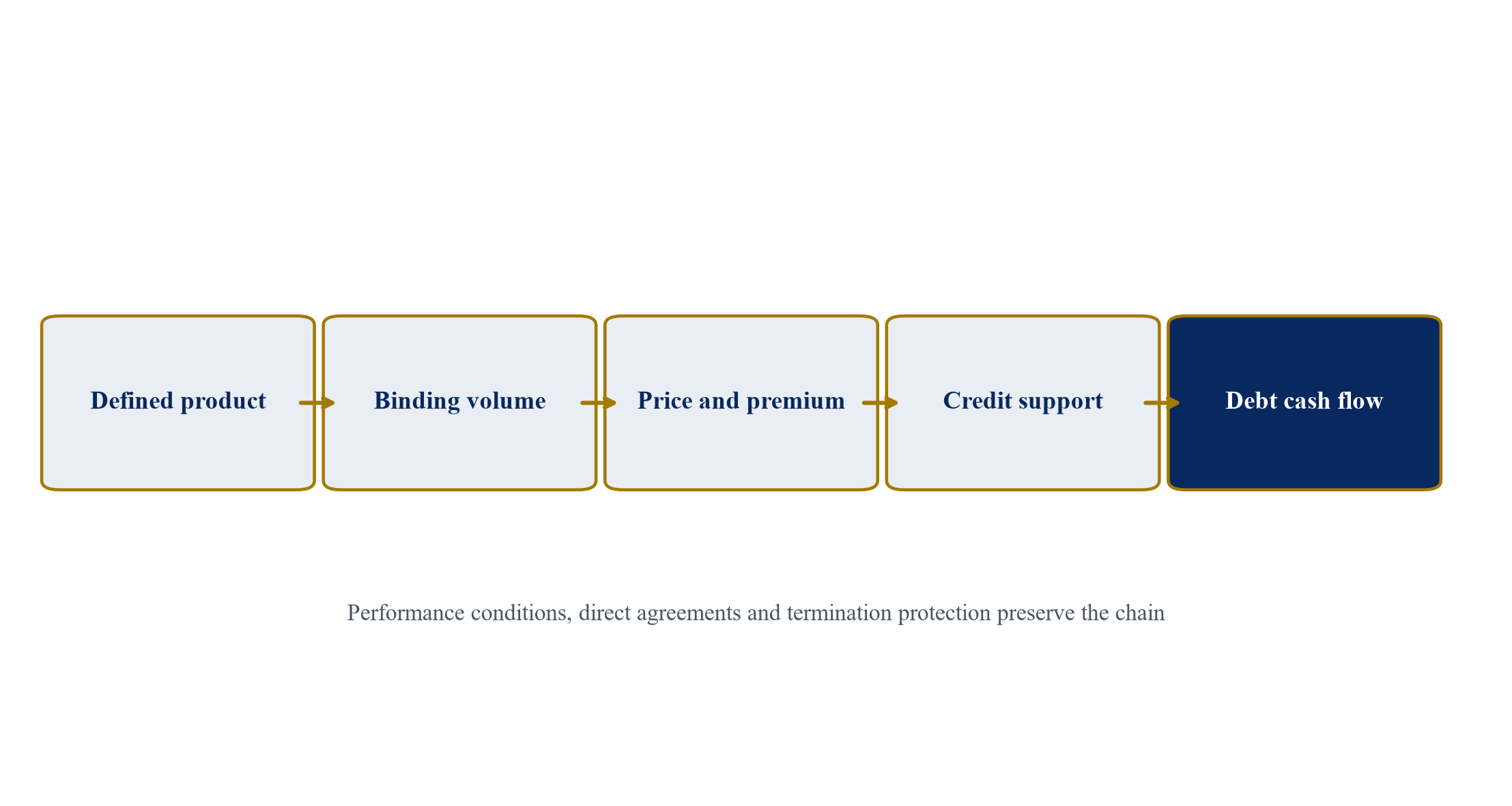
Proposed decision architecture based on the sources and analysis in this paper.
Table 1. Customer commitment benchmark
| Term | Financeable treatment | Customer protection | Lender test |
|---|---|---|---|
| Product | objective specification and delivery point | testing, cure and rejection rights | enforceable sale of usable output |
| Volume | minimum payment or reserved capacity | ramp, make-up and bounded flexibility | dependable annual revenue |
| Price | reference plus defined premium | index, cap and objective reopener | margin survives downside |
| Credit | parent support, letter of credit or funded reserve | support falls as exposure reduces | recovery during cure and replacement |
| Termination | formula linked to allocated exposure | mitigation and recovery deductions | debt and break-cost protection |
Proposed qualitative benchmark; applicable law and transaction documents control.
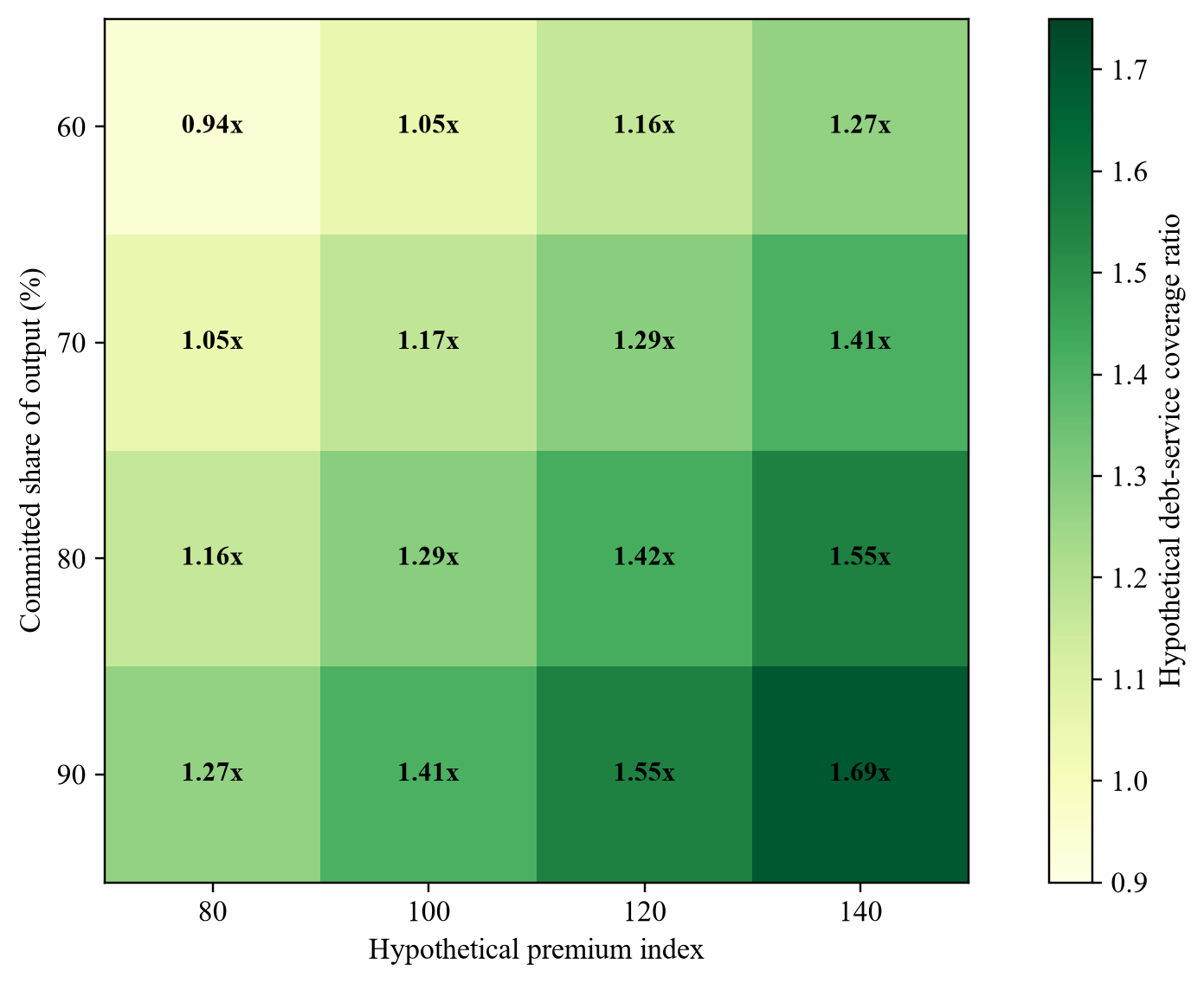
Wholly hypothetical; the values describe no identified company or transaction.
Table 2. Hypothetical sources and uses framework
| Uses | Share of total uses | Sources | Share of total sources |
|---|---|---|---|
| Plant and process equipment | 48% | Sponsor equity | 30% |
| Utilities, logistics and connection | 18% | Senior debt | 45% |
| Development, engineering and owner cost | 10% | Public or programme support | 15% |
| Financing, reserves and working capital | 11% | Customer contribution | 10% |
| Contingency | 13% | Total sources | 100% |
| Total uses | 100% |
Illustrative percentages only; transaction-specific commitments and costs are required.
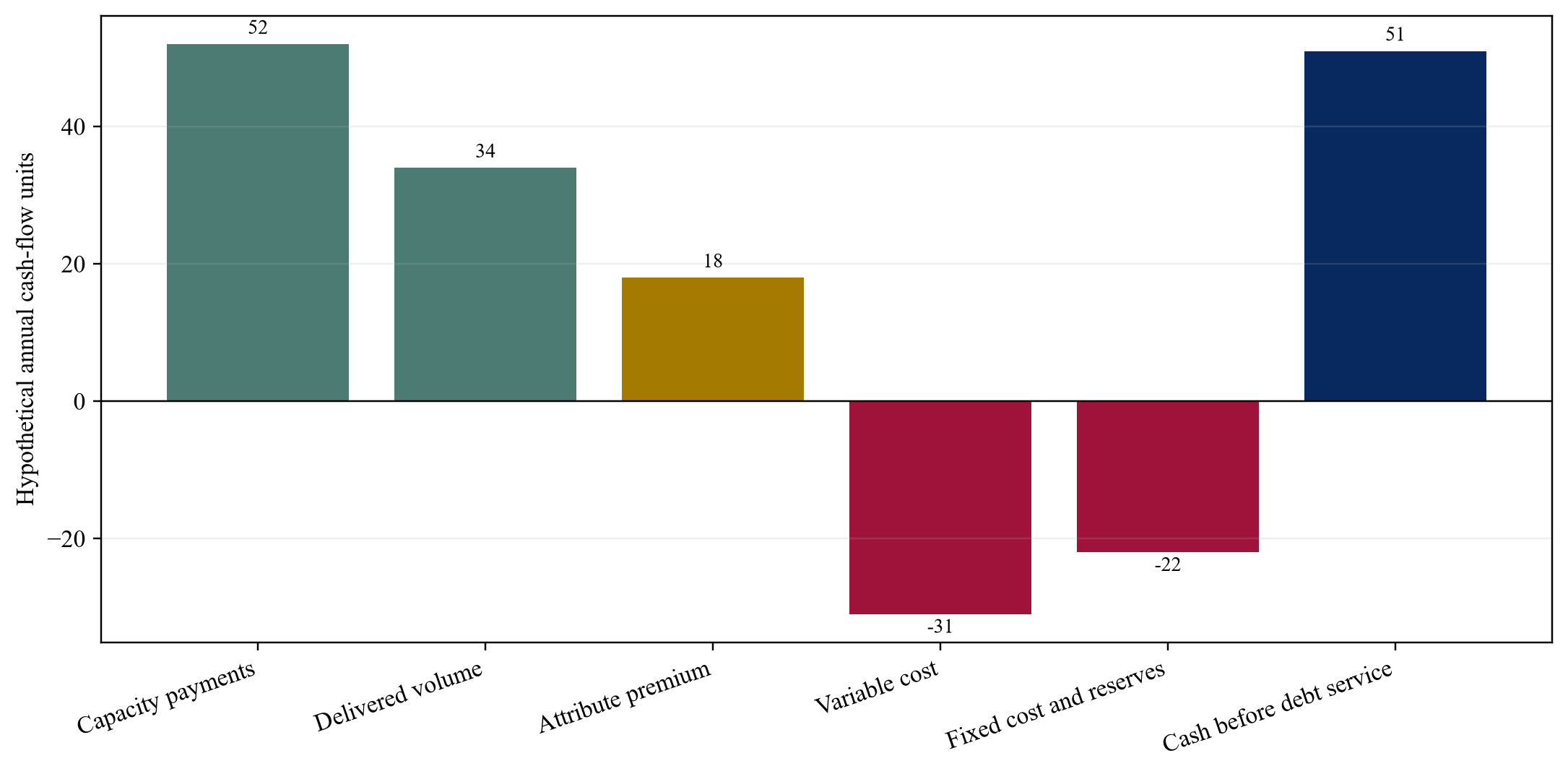
Wholly hypothetical; values describe no identified company or transaction.
Table 3. Risk allocation and investment gates
| Gate | Minimum evidence | Primary risk owner | Maximum cumulative capital at risk |
|---|---|---|---|
| Market definition | product, customer use and reference price | sponsor | 0.2% |
| Conditional commitment | volume, premium, approvals and conditions | sponsor and customer | 1.5% |
| Bankable contract | credit support, remedies, permits and financing model | allocated by contract | 5% |
| Final investment | executed funding, construction security and customer commitments | sponsors and lenders | 100% |
| Commercial operation | tested output, delivery, quality and data | contractors and operator | retained capital |
| Expansion | additional executed demand and operating evidence | project board | next module budget |
Proposed governance framework; percentages are hypothetical caps on cumulative capital at risk.
Appendix A Questions for the investment committee
1. Which signed customer commitments support the initial capacity and debt case?
2. Which revenue is fixed, volumetric, indexed or merchant?
3. Which product specifications and environmental attributes drive customer payment?
4. How does the contract term compare with debt tenor and amortisation?
5. Which conditions precedent remain and who controls their satisfaction?
6. Which credit support protects payment and termination exposure?
7. Which customer or market events can affect several contracts at once?
8. Which price, volume, input-cost and availability cases reduce coverage below covenant levels?
9. How are public support and customer premiums coordinated?
10. Which direct agreements, cure rights and transfer provisions protect lenders?
11. Which capital is exposed before commitments become unconditional?
12. What changes require management action or board reapproval?
References
- International Energy Agency, Global Hydrogen Review 2025, 12 September 2025. https://www.iea.org/reports/global-hydrogen-review-2025
- United States Department of Energy Loan Programs Office, Questions All Applicants Should Ask Before Applying to LPO, accessed 2 October 2026. https://www.energy.gov/lpo/articles/questions-all-applicants-should-ask-applying-lpo
- World Bank and International Finance Corporation, Project Finance in Developing Countries, 1999. https://ppp.worldbank.org/sites/default/files/2022-05/ProjectFinance_DevelopingCountries_IFC.pdf
- International Finance Corporation, Unlocking Opportunities: A Framework for Assessing Green Hydrogen Potential in Emerging Markets, 2025. https://www.ifc.org/content/dam/ifc/doc/2025/a-framework-for-assessing-emerging-market-s-green-hydrogen-potential.pdf
- UK Department for Energy Security and Net Zero, Hydrogen Production Business Model and Low Carbon Hydrogen Agreement, updated 19 December 2025. https://www.gov.uk/government/publications/hydrogen-production-business-model
- European Commission, IF25 Hydrogen Auction, updated 19 June 2026. https://climate.ec.europa.eu/areas-action/eu-funding-climate-action/innovation-fund/calls-proposals/if25-hydrogen-auction_en
- United States Department of Energy Office of Clean Energy Demonstrations, Public Insight Requested for Demand-Side Support for Clean Energy Technologies, 2 February 2023. https://www.energy.gov/cmei/oced/articles/public-insight-requested-demand-side-support-clean-energy-technologies
- World Bank Group PPP Resource Center, Structuring the PPP Contract, accessed 2 October 2026. https://ppp.worldbank.org/structuring-ppp-contract
- International Energy Agency, From Promise to Practice: How Policy Can Help Anchor Demand for Hydrogen, 10 September 2025. https://www.iea.org/commentaries/from-promise-to-practice-how-policy-can-help-anchor-demand-for-hydrogen
- United States Department of Energy Office of Clean Energy Demonstrations, H2Hubs Demand-Side Support Request for Information webinar, August 2023. https://www.energy.gov/sites/default/files/2023-09/H2Hubs%20Demand%20Side%20RFI%20Webinar_August2023.pdf
- World Bank Group, Understanding Power Project Financing, 2015. https://ppp.worldbank.org/sites/default/files/2021-09/Understanding%20Power%20Project%20Financing.pdf
- International Finance Corporation, Increasing the Use of Alternative Fuels at Cement Plants, 2017. https://www.ifc.org/content/dam/ifc/doc/mgrt/ifc-afr-report-web-1-11-2016.pdf
- United States Department of Energy Loan Programs Office, Application Process, accessed 2 October 2026. https://www.energy.gov/edf/application-process
- International Energy Agency, Breakthrough Agenda Report 2025: Hydrogen, 2025. https://www.iea.org/reports/breakthrough-agenda-report-2025/hydrogen
About the Author
Authored by Chennakeshav Adya Independent Researcher
Chennakeshav (CK) is a corporate finance and investment banking executive with 25+ years of global experience in deal origination, structuring and execution across M&A, growth capital and corporate strategy. He has led value-creation mandates for founders, corporates and funds — bridging the boardroom view to hands-on execution and close.
His career spans Morgan Stanley, HSBC, Lloyds Banking Group, EWEC, ADQ portfolio companies and Emirates Growth Fund, across TMT, real estate, fintech, deeptech, cleantech, infrastructure and energy. He has partnered with C-suite leaders, private equity and venture funds, sovereign wealth funds and family offices to finance complex fund raises and scale-up ventures, and has led M&A due diligence, post-merger integration and business-transformation initiatives to create value.
At Matchpoint Partners he is Managing Partner, leading the firm's corporate finance, M&A and capital-raising practice. He holds an MBA from London Business School, an engineering degree from VTU and a Master of Laws (LLM, in progress) from UCL London.
An active start-up mentor, CK mentors at Techstars, DIFC FinTech Hive, Startup Grind, Founder Institute and IN5, serves as Entrepreneur Mentor in Residence (EMiR) at London Business School, and judges the Entrepreneurship World Cup.
Matchpoint profile: https://www.matchpoint-partners.com/team/ck-adya.html LinkedIn: https://www.linkedin.com/in/ckadya/
