

Introduction
A cyber incident at a power or water utility can create a simultaneous operational, financial and public-service crisis. The affected organisation may need to isolate systems, operate manually, bring in incident-response specialists, replace damaged equipment, rebuild software, notify regulators, communicate with customers, purchase emergency supplies and fund debt service. Revenue can fall while restoration expenditure rises. The operator may also face contractual claims, regulatory investigation, environmental consequences and political scrutiny.
Insurance can transfer defined parts of this exposure. It cannot restore a substation, water-treatment process or control room by itself. Coverage is valuable when the policy language matches the utility's operating technology, dependency chain and recovery plan; the declared controls exist; notification and consent rules are understood; and liquidity is available while the claim is adjusted. NCSC guidance similarly asks organisations to understand existing cover, exclusions, incident-response services and the accuracy of information supplied to insurers [1].
The financing question is therefore wider than the purchase of a cyber policy. Management, lenders, regulators and public authorities need to know which losses are prevented, retained, transferred, recoverable through tariffs or public support, and funded temporarily. This paper provides a structured answer.
1 Define the essential service
The analysis should begin with the service that must continue or be restored. For a power utility, that service may include generation control, transmission operation, distribution switching, metering, customer service and market settlement. For a water utility, it can include abstraction, treatment, disinfection, pumping, storage, pressure management, wastewater treatment, laboratory assurance and public-health communication.
The service definition should specify minimum safe output, maximum tolerable outage, manual operating capability, geographic priority and restoration dependencies. A generic objective to restore information technology is insufficient. The critical requirement is the recovery of controlled physical service within a defined time and safety envelope.
NIST Cybersecurity Framework 2.0 organises cyber-risk outcomes around Govern, Identify, Protect, Detect, Respond and Recover [2]. These functions apply to information technology, operational technology and connected environments. For a utility, the financial model should connect each function to a service outcome, accountable owner, budget and evidence source.
2 Draw the operational-technology boundary
Utilities often operate several technology estates: corporate IT, operational technology, telecommunications, advanced metering, geographic systems, customer platforms, laboratory systems, cloud services and vendor remote-access environments. The insurance schedule and incident plan should identify how these estates connect and where interruption can propagate.
The boundary should include programmable logic controllers, supervisory control and data acquisition, distributed control systems, protection devices, human-machine interfaces, historians, engineering workstations, network equipment, identity systems, backup facilities and the external services required to operate them. Asset inventories should record ownership, location, criticality, firmware, support status, dependencies and recovery method.
CISA, EPA and the FBI identify OT and IT asset inventories, reduced internet exposure, backups and exercised incident-response plans among the priority actions for water systems [3]. The DOE and NARUC cybersecurity baselines similarly use asset scoping and prioritisation to focus protection on critical distribution and distributed-energy resources [4]. These are operational controls and underwriting evidence.
3 Map the cyber-loss chain
Loss develops through a sequence. An initial compromise can affect identity, remote access, enterprise systems, operational controls or a supplier. The operator then incurs containment, investigation and restoration cost. Physical service may be interrupted, degraded or operated manually. Revenue, working capital, regulatory performance and debt service can be affected. Third parties may suffer loss.
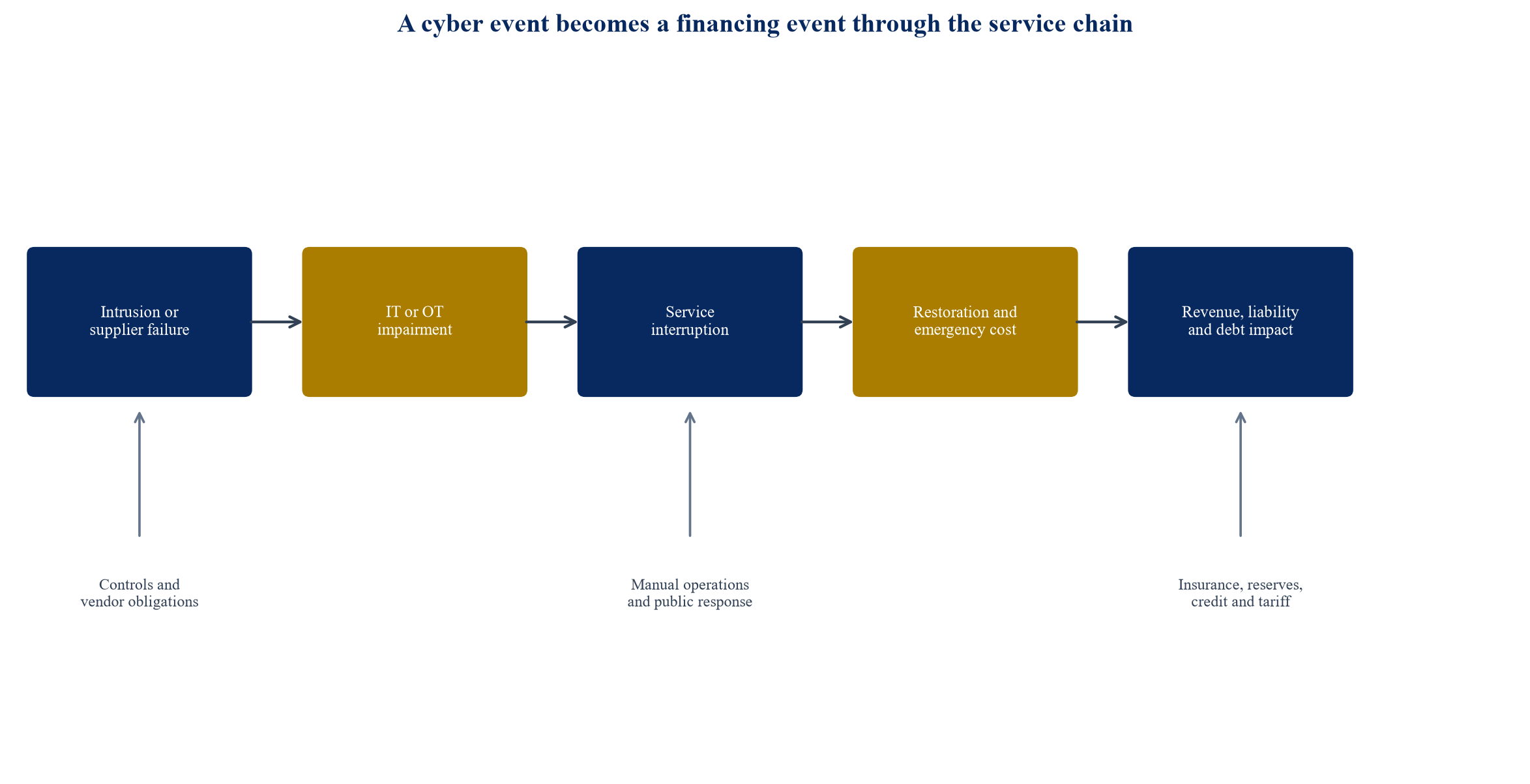
The diagram is an author-developed framework and does not represent a specific utility, incident or insurance policy.
The map should distinguish direct costs from consequential costs. It should identify the entity that incurs each cost, the contract or policy that may respond, the evidence required and the timing of cash recovery. A loss map that ends with technical restoration misses revenue, credit and public-service consequences.
4 Separate safety, service, property and data
Cyber incidents can create several legally and financially distinct outcomes. Data may be encrypted or disclosed. Systems may become unavailable. Machinery can be damaged by manipulated controls. Unsafe operating conditions can cause bodily injury, pollution or property damage. Each outcome can engage different insurance policies and exclusions.
The utility should classify scenarios by physical safety, environmental protection, service continuity, asset integrity, data confidentiality, regulatory compliance and financial loss. A single incident can occupy all categories. The placement therefore needs a coordinated review of cyber, property, machinery breakdown, business interruption, general liability, environmental liability, directors' and officers', crime and professional indemnity policies.
Lloyd's guidance on cyber exposure emphasises clarity over whether policies affirm, limit or exclude cyber loss [5]. The utility should test overlapping policies before placement and again after material system or wording changes. Silent assumptions about which policy responds can become a dispute during restoration.
5 Quantify maximum foreseeable disruption
Traditional probable maximum loss methods require adaptation for cyber events. A cyber loss may affect several sites simultaneously, disable common identity or communications services, corrupt backups, interrupt a supplier, or trigger cautious shutdowns. Geographic separation may provide less diversification where systems share architecture and administration.
The utility should model at least four horizons: the first 24 hours, the first seven days, the first 30 days and the extended recovery period. Costs should include response retainers, forensic work, legal advice, communications, emergency labour, temporary equipment, alternate supply, customer support, data restoration, equipment replacement, pollution response, regulatory work and financing cost. Revenue effects should reflect the applicable tariff, collection cycle and settlement regime.
Scenario outputs should remain management estimates unless supported by observed data. The model should show assumptions explicitly and avoid presenting a single number as certainty. GAO has identified limited historical loss data and inconsistent definitions as challenges for cyber-insurance pricing and coverage [6]. Scenario ranges are therefore more credible than false precision.
6 Establish the restoration sequence
The financial plan should follow the operational recovery sequence. The first priorities are life safety, process stability, containment and preservation of essential service. Technical recovery then proceeds through trusted communications, identity, monitoring, control, data, field operations and customer systems according to the utility's architecture.
NIST SP 800-61 Revision 3 integrates incident response into wider cyber-risk management and seeks to improve detection, response and recovery effectiveness [7]. The CISA, FBI and EPA water-sector guide describes how utilities can work with public authorities through the incident lifecycle [8]. These frameworks support a utility-specific playbook with named decision rights.
Each recovery stage should state the minimum personnel, information, equipment, vendor access and financing required. The insurer's incident-response panel should be mapped to the utility's operational command structure. A policy requirement for prior consent should not remain undiscovered while engineers are making urgent safety decisions.
7 Build minimum controls into financing
Minimum controls should operate as financing conditions, procurement requirements and insurance representations. They can include multifactor authentication, privileged-access management, tested backups, network segmentation, asset inventory, logging, endpoint protection, vulnerability management, remote-access control, supplier governance and incident exercises.
CISA's Cross-Sector Cybersecurity Performance Goals are a prioritised baseline for IT and OT owners and are intended to reduce risks to critical infrastructure operations and the public [9]. NERC's current CIP family includes mandatory standards for incident reporting and response planning, recovery plans and supply-chain risk management within its applicable scope [10]. NIS2 requires risk-management measures and incident reporting across essential sectors that include energy, drinking water and wastewater [11].
Compliance with one framework should not be treated as complete assurance. The utility should document applicable obligations, voluntary baselines, target maturity, remediation owners and evidence. Financing documents can require maintenance of material controls and prompt notice of significant deterioration without freezing the technology architecture.
8 Make underwriting information accurate
Cyber placements commonly require detailed information about identity, backups, endpoint controls, network segmentation, remote access, patching, incident history and suppliers. Management should establish a controlled process for collecting and approving this information. The submission should distinguish verified evidence, management representation and planned remediation.
NCSC guidance warns that an insurer may decline to pay if declared cyber defences are absent [1]. The placement process should therefore resemble lender due diligence. Control owners should sign evidence packs; internal audit or independent specialists should test material claims; legal counsel should review warranties and disclosure duties; and changes between submission and inception should be reported where required.
The operator should avoid absolute statements where controls have exceptions. A representation that all critical systems use multifactor authentication can be inaccurate if legacy OT, emergency accounts or supplier access fall outside the control. Precise scope and compensating controls improve coverage certainty.
9 Construct the coverage tower
A coverage tower can combine a primary cyber policy, excess layers, property and machinery policies, liability cover, environmental cover, crime cover, captive participation and retained risk. The structure should reflect loss categories, correlations, exclusions, insurer credit and the speed of response.
Table 1. Illustrative utility cyber coverage and funding tower
| Layer | Intended function | Key trigger or condition | Common gap to test | Funding owner |
|---|---|---|---|---|
| Operating liquidity | Immediate containment and continuity | Internal incident authority | Cash may be inadequate for a long outage | Utility |
| Primary cyber policy | Response, restoration and interruption | Covered cyber event; notice and waiting period | OT scope, system failure, sublimits | Insurer |
| Excess cyber layers | Severe loss above primary limit | Follow-form or scheduled wording | Different exclusions and attachment disputes | Insurers |
| Property and machinery | Physical damage and related interruption | Covered damage under policy wording | Cyber exclusions and damage definition | Insurer |
| Liability and environmental | Third-party injury, property or pollution claims | Legal liability and covered event | Cyber, pollution and professional-service exclusions | Insurer |
| Captive or reserve | Deductibles, exclusions and volatility | Board-approved retention rules | Concentration and insufficient capital | Sponsor or utility |
| Regulatory or public recovery | Approved essential-service expenditure | Tariff, grant or statutory mechanism | Timing, prudence review and disallowance | Regulator or authority |
The table is an author-developed framework. Coverage depends on the executed wording, law and facts of each loss.
The tower should be tested vertically and horizontally. Vertical testing confirms that excess policies attach as expected. Horizontal testing confirms how the same event interacts with property, cyber, liability and public-recovery mechanisms. Differences in definitions, territories, valuation, waiting periods and dispute forums should be reconciled before inception.
10 Define the insured computer system broadly enough
Policy definitions should reflect the systems the utility uses to deliver service. The insured environment may need to include OT, industrial control systems, cloud platforms, telecommunications, embedded devices, mobile equipment, third-party hosted systems, backup facilities and equipment under the utility's operational control.
The review should test whether older control systems, unsupported software, contractor-owned devices and temporary connections are covered. It should examine whether loss arising from a supplier's system, a telecommunications carrier or a cloud provider is treated as dependent-system interruption or excluded infrastructure failure.
Broad definitions can still be narrowed by schedules, territorial limitations, sublimits or exclusions. The placement memorandum should use an architecture diagram and dependency schedule. Coverage counsel and the broker should trace each critical service through the definitions and endorsements.
11 Align business-interruption triggers
Business-interruption cover may require a security failure, system failure, network interruption or physical damage. The operator should understand whether voluntary shutdown, precautionary isolation, regulatory direction and degraded manual operation satisfy the trigger. It should also examine whether loss of data, loss of control or inability to trust a system constitutes interruption.
The indemnity period should reflect the time required to restore trusted operations and customer activity, not only the time to reconnect equipment. A system can be technically available while integrity testing, regulatory approval or customer reconciliation continues. The policy should address forensic validation, staged restart and the treatment of increased cost of working.
The waiting period and deductible should be modelled in hours and cash. Several short interruptions arising from one campaign may aggregate differently from one continuous outage. Event aggregation language can affect both retention and limits.
12 Address contingent and dependent interruption
Utilities depend on telecommunications, cloud services, fuel, chemicals, equipment manufacturers, payment systems, laboratories, engineering contractors and other utilities. A cyber event at one supplier can interrupt service without compromising the utility's own network.
Dependent-system coverage should identify named and unnamed providers, direct suppliers, indirect suppliers and public infrastructure. Sublimits may be materially lower than the main policy limit. Waiting periods may differ. Infrastructure or utility-service exclusions can remove the very dependencies that matter most.
The operator should rank suppliers by service consequence and recovery time. Contracts should require security controls, incident notification, continuity, evidence preservation, co-operation and insurance. Concentrated suppliers should be reflected in both procurement and insurance limits.
13 Value data and software restoration correctly
Restoration cost can include clean-room environments, forensic validation, software rebuilds, configuration reconstruction, data reconciliation, vendor support and controlled re-entry into service. Replacement with a modern system may exceed the cost of restoring the old one and can raise betterment disputes.
The policy should state the valuation basis for data, software, hardware and obsolete equipment. It should address whether unsupported systems can be replaced with functional equivalents, whether expedited procurement is covered, and how costs are allocated between restoration and improvement.
Backups should be tested for integrity, isolation, recovery time and operational compatibility. NIST's ransomware profile focuses on readiness across governance, identification, protection, detection, response and recovery [12]. A backup that exists but cannot restore safe process control within the required time has limited financial value.
14 Treat physical damage as a separate coverage question
Malicious manipulation of operational controls can damage pumps, turbines, transformers, valves, treatment equipment or other machinery. Resulting fire, explosion, pollution or equipment breakdown can activate property and liability policies. Cyber exclusions can affect the response.
The utility should test whether the cyber policy covers physical damage, whether the property policy affirms or excludes cyber causation, and whether machinery-breakdown wording responds to corrupted controls. The review should include ensuing loss, debris removal, expediting expense, engineering cost and business interruption.
Policy co-ordination should avoid a gap in which the cyber policy excludes physical damage and the property policy excludes cyber causation. The intended allocation should be documented in endorsements and claims protocols.
15 Analyse bodily injury and environmental harm
Power and water failures can affect public health, worker safety, fire protection, wastewater discharge and environmental compliance. Bodily injury and pollution exposures may sit outside standard cyber cover or be subject to sublimits. Liability policies may contain cyber, pollution or professional-services exclusions.
The utility should model credible pathways from cyber compromise to unsafe physical conditions. It should identify the emergency controls, legal duties, public-warning procedures and insurance policies that respond. Coverage should be reviewed with specialists in cyber, casualty and environmental risk.
Financial modelling should include defence cost, investigation, remediation, third-party claims and possible uninsured regulatory consequences. The paper does not determine whether a particular fine or liability is insurable; that question depends on law, policy wording and facts.
16 Examine regulatory and disclosure duties
Incident reporting obligations can arise under sector regulation, data-protection law, securities rules, licence conditions and contractual commitments. Timing and materiality tests may differ. Disclosure must also protect sensitive infrastructure information and the integrity of the response.
The SEC's 2023 final rule requires covered public companies to disclose material cyber incidents and describe material cyber-risk management, strategy and governance [13]. NIS2 establishes risk-management and reporting duties for covered essential and important entities [11]. NERC CIP standards address incident reporting and response planning within their applicable scope [10].
The incident-governance plan should name the teams that determine materiality, approve external statements and notify insurers, lenders and authorities. Evidence for those decisions should be preserved. Public disclosure should remain co-ordinated with operational security and applicable delay mechanisms.
17 Evaluate ransomware and extortion cover
Ransomware can combine encryption, operational disruption, data theft and extortion. Coverage may include negotiation, forensic work, legal advice, communications, restoration and a permitted payment. Sublimits, consent requirements and legal restrictions can apply.
OFAC's updated advisory highlights sanctions risks associated with making or facilitating ransomware payments and encourages defensive and resilience measures [14]. Payment does not establish that systems or data will be restored. Utility governance should therefore prioritise safe recovery, legal compliance and public-service continuity.
The board-approved response plan should identify authority, legal review, law-enforcement engagement, insurer consent, sanctions screening and alternatives to payment. The financial model should avoid assuming that a ransom payment will occur or succeed.
18 Resolve war and state-backed cyber wording
Critical infrastructure can be exposed to state-linked operations, geopolitical escalation and systemic campaigns. War and cyber-operation exclusions therefore require detailed review. The issue is material for utilities because a major attack may be directed at public services or have widespread national effects.
The Lloyd's Market Association updated its model cyber war and cyber-operation clauses in 2023, including provisions addressing attribution in the compliant versions [15]. The model clauses are illustrative and contracting parties may agree different terms. The utility should review the executed clause, attribution mechanism, thresholds, carve-backs, waiting process and burden of proof.
Management should not treat public attribution as automatic or rapid. The liquidity plan should address the possibility that coverage remains disputed while restoration costs are incurred.
19 Test infrastructure and widespread-event exclusions
Policies may exclude or limit failure of electricity, telecommunications, internet, satellite, cloud or other infrastructure. A utility can be both the insured operator and the provider of an affected infrastructure service. The wording should clarify where the excluded infrastructure begins and whether the utility's own systems remain covered.
Widespread events also raise aggregation risk. Several plants, networks, suppliers or group companies can be affected by the same campaign or vulnerability. The definition of one event can determine deductibles, limits and excess attachment.
The operator should run a wording workshop using specific scenarios: common identity compromise, cloud outage, telecommunications failure, malicious firmware, regional grid interruption and simultaneous supplier attack. Each scenario should be traced through the tower.
20 Allocate vendor cyber risk
Technology vendors can control remote access, software updates, maintenance accounts, cloud platforms, intellectual property and restoration expertise. Contract risk allocation should reflect that operational leverage. Minimum controls, access restrictions, incident notice, forensic co-operation, patch support, recovery obligations and insurance should be written into procurement.
NERC's supply-chain risk requirements and DOE/NARUC baselines demonstrate the importance of managing technology dependencies [4][10]. Contract provisions should survive termination where evidence, vulnerability support or incident co-operation remains necessary.
Liability caps should be tested against credible service loss, while recognising vendor capacity and market practice. The utility may retain residual loss where the vendor cannot accept catastrophic exposure. Insurance and reserves should reflect that retained amount rather than assuming the indemnity is collectible.
21 Make cloud and telecommunications dependencies financeable
Cloud and telecommunications services can improve resilience through redundancy and specialist capability. They can also create common dependencies. Diligence should examine service architecture, regional concentration, recovery commitments, data portability, privileged access, incident communication and exit procedures.
Service credits are rarely equivalent to business-interruption loss. The contract should preserve claims and termination rights for severe failure where commercially achievable. The insurance review should identify dependent-system coverage and any infrastructure exclusion.
Lenders should understand whether a critical service can operate during a provider outage and how long migration would take. A board statement that the service is cloud-based does not answer the recovery question.
22 Design the evidence chain
Claims depend on evidence of the event, affected systems, timing, decisions, costs and lost income. Technical containment can conflict with forensic preservation unless the plan addresses both. Operational safety remains the priority, with contemporaneous documentation where possible.
The evidence protocol should define logging, time synchronisation, chain of custody, privileged investigation, cost codes, vendor records, customer-impact records and decision minutes. Finance should create incident-specific ledgers from the first day. Operational teams should record manual workarounds, unavailable capacity and restoration milestones.
Insurer notification and consent requirements should be integrated into the playbook. The operator should know which panel firms may be used and how emergency appointments are approved. Evidence governance should also protect security-sensitive information.
23 Establish claims decision rights
A major claim needs a single governance structure across operations, cyber, legal, finance, communications, insurance, lenders and public authorities. The structure should distinguish emergency operational authority from claims authority. Engineers must be able to protect life and service within approved protocols.
Named executives should control notice, appointment of advisers, major expenditure, insurer engagement, public statements and settlement. The board or crisis committee should receive service, cash, coverage and liability dashboards. Conflicts between rapid restoration and forensic or policy requirements should be escalated immediately.
The broker and coverage counsel can support the claim, while management remains accountable for facts and decisions. Claims preparation should begin during response rather than after recovery.
24 Fund the waiting period
Insurance proceeds can arrive after investigation, coverage analysis, quantification and adjustment. The utility therefore needs immediate liquidity. Sources can include operating cash, revolving credit, committed emergency facilities, captive funds, reserve accounts, shareholder support, tariff mechanisms and public emergency funding.
The liquidity requirement should be modelled by week. It should include the policy retention, waiting period, uncovered costs and delayed receivables. Covenant headroom should reflect the same period. A claim receivable should not be treated as unrestricted cash before recoverability and timing are sufficiently evidenced.
Lenders may require notice, consent for additional debt, blocked-account control or mandatory prepayment from insurance proceeds. These provisions should be reconciled with emergency funding before an incident.
25 Protect debt service and credit ratings
Cyber interruption can reduce earnings, increase working capital and trigger covenant pressure. Project-financed utilities may face reserve requirements, distribution locks and technical defaults. Corporate utilities may face liquidity and rating consequences even where revenue is regulated.
The financing model should test debt-service coverage, minimum liquidity, leverage, reserve draw, claims delay and uninsured loss. It should identify cure rights, waiver process, sponsor support and permitted emergency debt. Information undertakings should align with incident confidentiality and regulatory reporting.
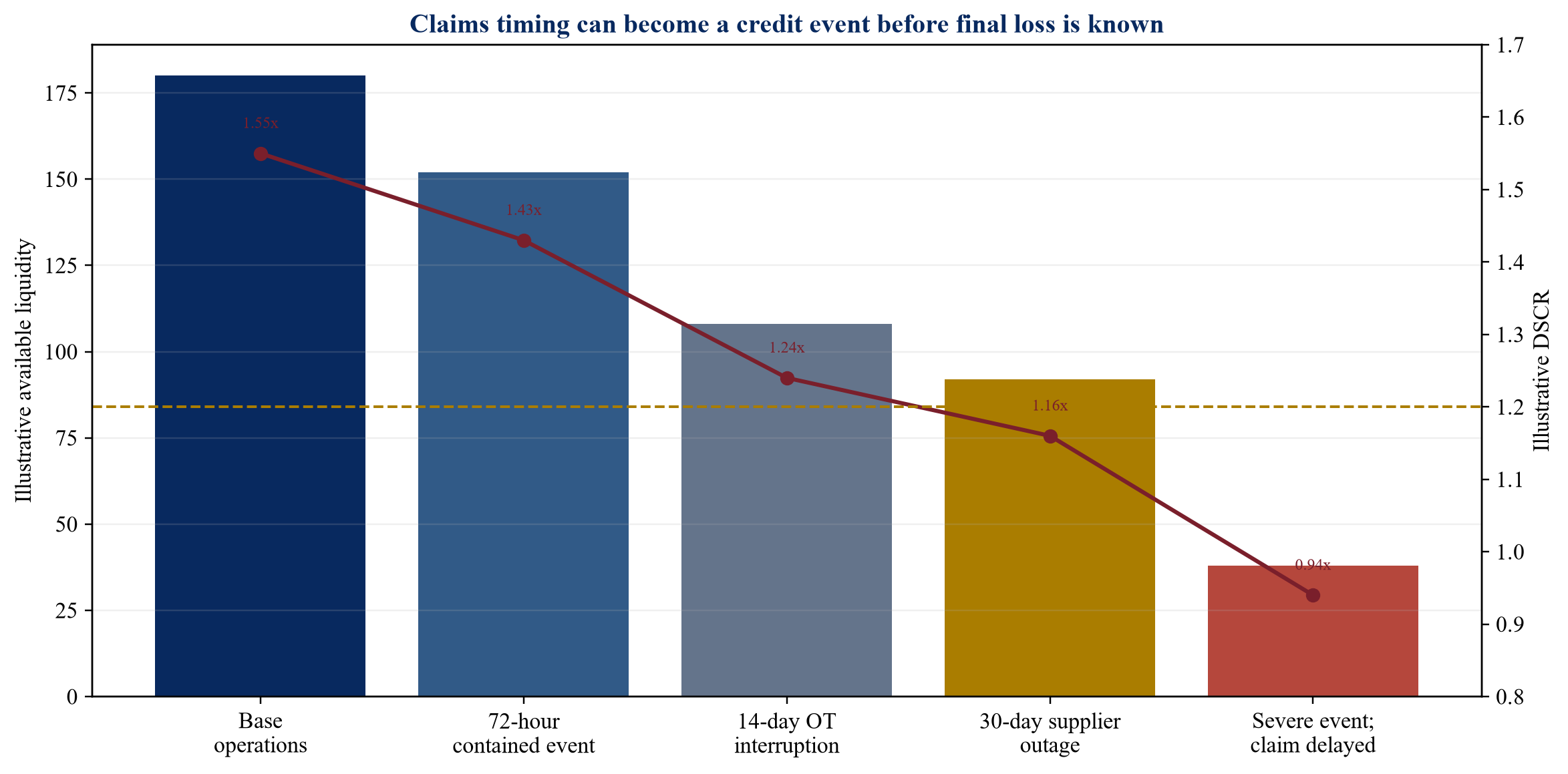
All values are hypothetical author-modelled assumptions and do not represent a utility forecast, insurance recovery or financing offer.
The graph illustrates method only. Each operator should build scenarios from its own service economics, debt documents, reserves, policy terms and recovery plan.
26 Integrate tariff and regulatory recovery
Regulated utilities may seek recovery of prudent cyber-security cost, incident expense or capital replacement through tariffs. Eligibility, timing and disallowance risk vary by jurisdiction. Insurance proceeds may reduce the amount recoverable from customers.
The utility should maintain records that support prudence: applicable standards, risk assessment, board approval, procurement, control evidence, incident decisions and cost allocation. It should distinguish ordinary security expenditure from extraordinary event costs and permanent improvements.
Regulators may require performance, affordability and customer-protection evidence. A financing model should use approved mechanisms rather than assume automatic pass-through. Interim liquidity remains necessary where the regulatory process is slower than restoration.
27 Allocate residual public-service risk
Some cyber losses can exceed commercial insurance capacity or fall within exclusions. Essential services may still need public support. The residual risk framework should identify the conditions for emergency co-ordination, mutual aid, statutory powers, grants, guarantees or other support.
GAO found uncertainty about private coverage for catastrophic cyber attacks and recommended assessment of whether a federal insurance response may be warranted for critical-infrastructure exposure [16]. This does not create an automatic backstop. Operators should plan from enacted mechanisms and documented authority.
Public support should preserve operational accountability and avoid double recovery. The utility should report insurance, reserves, vendor recoveries and regulatory funding under a transparent reconciliation process.
28 Use a complete allocation matrix
Table 2. Illustrative cyber-loss allocation for power and water utilities
| Exposure | Primary control owner | Potential transfer or recovery | Financing gap to test |
|---|---|---|---|
| Identity or access compromise | Utility and service provider | Cyber response cover; vendor remedy | Emergency containment before claim approval |
| OT interruption | Utility; technology vendors | Cyber interruption; captive; tariff | Waiting period and manual-operation cost |
| Physical equipment damage | Utility and equipment vendor | Property, machinery and cyber cover | Cyber exclusion and betterment |
| Supplier outage | Supplier and utility procurement | Dependent interruption; indemnity | Sublimit and infrastructure exclusion |
| Data restoration | Utility and hosting provider | Cyber restoration cover | Integrity validation and obsolete systems |
| Ransomware or extortion | Utility crisis team | Permitted cyber cover | Sanctions, consent and uncertain recovery |
| Bodily injury or pollution | Utility operational owner | Liability and environmental cover | Cyber and pollution exclusions |
| Regulatory response | Utility board and legal team | Defence cover where available | Fines, remediation and disclosure cost |
| Catastrophic systemic event | Utility and public authorities | Excess, captive, public mechanism | Capacity shortfall and disputed attribution |
The matrix is an author-developed framework. Final allocation depends on law, contracts, policy wording and the facts of the incident.
Each row should connect to an executed contract, policy, reserve or public mechanism. An allocation described only in a risk register has limited cash value.
29 Align insurance with lender controls
Financing agreements often require specified policies, insurer ratings, loss-payee clauses, notice of cancellation and application of proceeds. Cyber insurance should be incorporated into that schedule where material. Lenders should receive appropriate evidence without accessing sensitive operational detail beyond their need.
The parties should agree how proceeds are used. Immediate restoration may require funds before a lender-controlled account can release them. Pre-agreed thresholds and emergency procedures can reduce delay. Major property proceeds may follow reinstatement tests; response-cost proceeds may need faster access.
The direct-agreement framework should address insurer cancellation, material reduction, premium non-payment and claims co-operation. Lenders should recognise that cyber wording and capacity can change at renewal.
30 Build renewal discipline
Cyber risk and policy language evolve quickly. Annual renewal should start with changes in systems, suppliers, controls, incidents, acquisitions, disposals, regulations and debt. The utility should compare expiring and proposed wording clause by clause.
Management should test limits against updated scenarios and inflation in response costs. It should review insurer financial strength, claims capability, panel vendors and territorial reach. Material exclusions, sublimits and changes in war or infrastructure wording should be reported to the board and lenders.
Renewal should also close evidence gaps. Planned controls should have owners, funding and completion dates. Representations should reflect the actual environment on the inception date.
31 Treat mergers and acquisitions as a coverage event
Acquisitions can introduce legacy OT, unsupported assets, prior incidents, different policies and unknown supplier access. Disposals can create shared systems and transitional-service dependencies. Cyber diligence should be integrated with operational, environmental, insurance and financing diligence.
The buyer should assess asset inventory, architecture, control evidence, incidents, backups, vendor contracts, regulatory obligations, insurance history and remediation cost. The transaction agreement should address disclosures, warranties, indemnities, conditions, covenants and access to claims information. Coverage for prior acts and known circumstances should be reviewed.
Integration should prioritise identity, remote access, network boundaries, backups and incident reporting. A rapid connection of the target to the buyer's network can create concentrated risk before controls are harmonised.
32 Finance the remediation portfolio
Cyber improvements compete with other utility capital. Management should group remediation into service-critical packages with defined outcomes, cost, dependency and assurance. High-priority work may include segmentation, backup recovery, identity controls, monitoring, resilient communications, legacy replacement and vendor-access redesign.
Funding can come from operating budgets, regulated capital allowances, sustainability-linked facilities where terms genuinely fit, government programmes, captive savings or transaction proceeds. Debt financing should match the asset life and approved revenue route. Short-lived software subscriptions should not be assumed to support long-term debt without wider cash flow.
The business case should quantify service consequence, regulatory obligation, insurance effect and recovery improvement. Premium savings alone may not justify the control; avoided interruption and safer recovery often provide the larger value.
33 Use an investment-committee scorecard
The investment committee should receive a concise view of essential service, credible cyber scenarios, control evidence, residual loss, coverage, liquidity, debt impact, public obligations and implementation status. Each material gap should have an owner and date.
Critical conditions can include tested offline backups, segmented OT, controlled vendor access, exercised manual operations, executed response retainers, reviewed policy wording, committed liquidity and lender alignment. A high aggregate maturity score should not offset a single critical recovery failure.
The committee should distinguish verified evidence from management estimates. Expected insurance recovery should be shown as a range tied to policy terms and claims timing.
34 Select a retention and financing structure
The utility should choose a retention structure that reflects balance-sheet capacity, loss volatility, policy pricing, regulatory treatment and access to emergency liquidity. A low deductible can reduce immediate cash exposure, while the premium and available limit may be less efficient. A higher retention can preserve insurance capacity for severe events, provided the retained amount is funded and governed.
Four structures illustrate the choices. A conventional placement uses operating liquidity for the deductible and transfers larger loss to the commercial market. A funded-reserve structure pre-finances the retention. A captive structure can retain predictable layers and purchase reinsurance for severity. A public-private structure can combine commercial insurance with an enacted catastrophic mechanism for losses outside private capacity.
Table 3. Illustrative cyber-risk financing structures for essential-service utilities
| Structure | Retained first-loss layer | Commercial transfer | Liquidity requirement | Principal governance test |
|---|---|---|---|---|
| Conventional placement | Deductible and exclusions | Primary and excess cyber layers | Revolver or operating cash through adjustment | Accurate submission and clear proceeds access |
| Funded cyber reserve | Board-approved reserve band | Cover above reserve | Segregated cash or permitted investments | Replenishment and restricted use |
| Captive participation | Frequency layer and selected exclusions | Reinsurance or excess market | Captive capital plus parent liquidity | Capital adequacy and claims independence |
| Public-private catastrophic layer | Utility and market attachment layers | Commercial tower plus enacted public mechanism | Bridge funding until eligibility is confirmed | Statutory trigger and double-recovery control |
All values and descriptions are hypothetical author-modelled assumptions and do not constitute insurance or financing terms.
The selection should use cash-flow-at-risk analysis rather than premium comparison alone. Management should model the time between expenditure and recoveries, the possibility of a coverage dispute, and simultaneous operational demands on the same liquidity facility. The reserve or captive should not be counted twice as general corporate liquidity and incident funding.
Where the utility is regulated, the treatment of premiums, captive contributions, reserves and recoveries should be agreed or evidenced under the applicable framework. Where several group entities share a programme, allocation of limits, deductibles and proceeds should be documented before an event. A shared aggregate limit can create competition among subsidiaries during a common campaign.
The chosen structure should be re-tested after material acquisitions, system changes, claims, policy-market shifts or changes in public support. The financial objective is a credible route from the first authorised emergency expenditure to the final allocation of loss.
35 Implement a 180-day programme
Days 1 to 30 should define essential services, system boundaries, decision rights and priority scenarios. Days 31 to 60 should complete asset and dependency mapping, control evidence and loss modelling. Days 61 to 90 should review policies, contracts, vendor obligations and regulatory mechanisms.
Days 91 to 120 should design the coverage tower, liquidity facility, reserve policy, claims protocol and lender amendments. Days 121 to 150 should negotiate placement, close critical contract gaps and exercise incident response. Days 151 to 180 should approve the programme, complete evidence packs and establish ongoing governance.
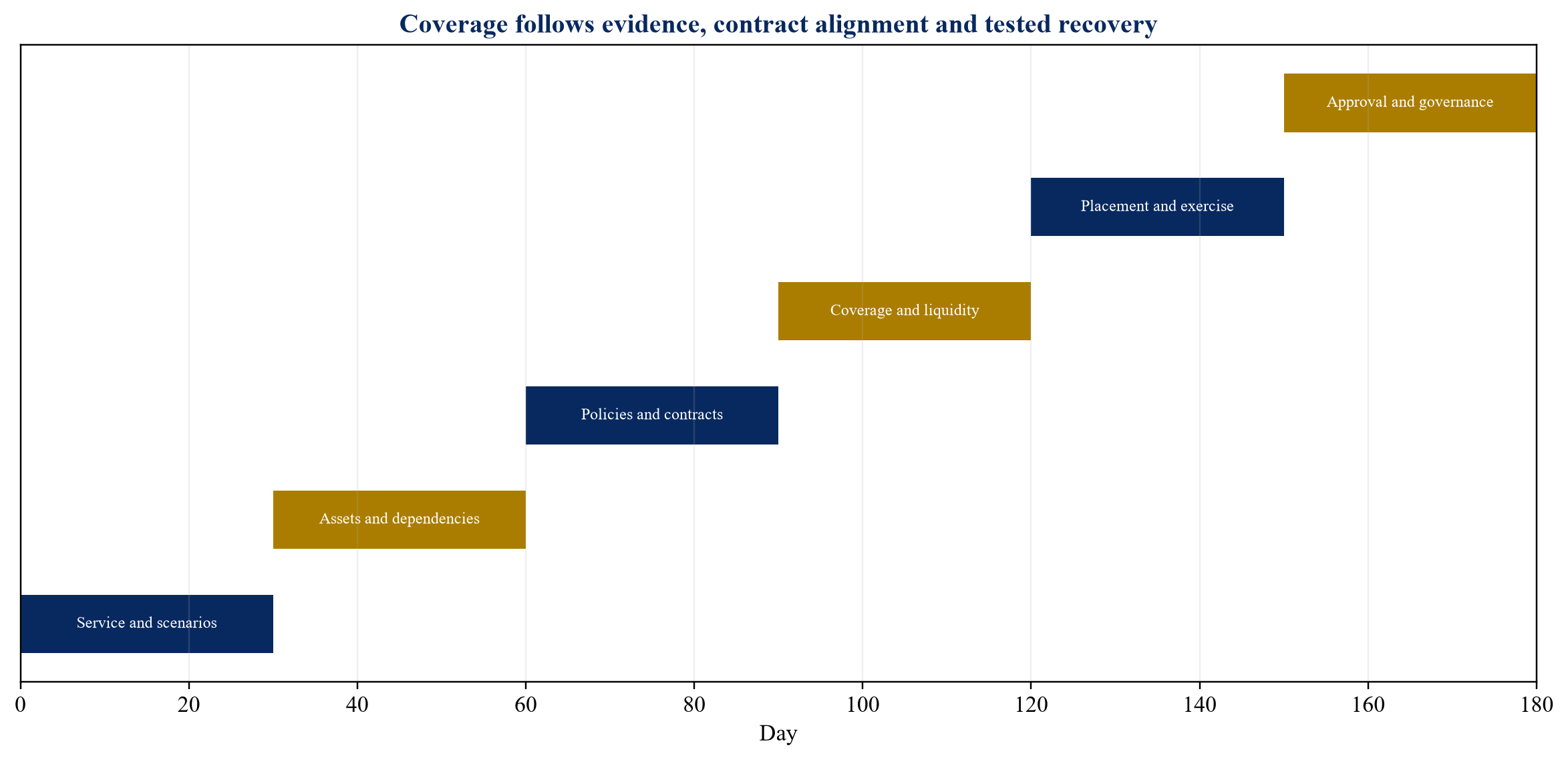
The roadmap is an author-developed implementation framework.
Each gate should have documented acceptance criteria. Placement should not proceed with material inaccuracies in the underwriting submission. Financing should not rely on proceeds that remain excluded or uncommitted.
36 Exercise the whole financial response
Technical exercises should include finance, legal, insurance, communications, lenders, regulators and key vendors. A scenario can begin with loss of control visibility, suspected manipulation, supplier compromise or ransomware. The exercise should test safe operations, notification, evidence, expenditure authority, liquidity draw, claims consent and disclosure.
The post-exercise report should record decisions, elapsed times, missing information, policy issues, contract failures and remediation. The operator should repeat the exercise after material system, personnel or policy changes.
An insurance tabletop should use the executed policy wording. Participants should determine which insuring agreements respond, when notice is due, which costs need consent, how business interruption is measured and where exclusions may apply.
37 Govern the programme at board level
Cyber risk is an enterprise and public-service risk. Board oversight should connect operational resilience, capital planning, insurance, debt, regulation and crisis governance. Management should report control exceptions, scenario exposure, claims readiness, supplier concentration and remediation progress.
The board should approve risk appetite for service interruption, retention, limits and residual catastrophic exposure. It should understand where coverage depends on representations, exclusions or uncertain attribution. The governance record can support regulatory, investor and insurer confidence.
The SEC disclosure framework places emphasis on management's role and board oversight for material cyber risks [13]. Comparable governance disciplines are useful for utilities outside its scope, subject to local law and confidentiality.
38 Recognise limitations
This framework does not determine whether a particular loss is covered, whether a payment is lawful, whether a fine is insurable, or whether a tariff or public mechanism will reimburse cost. Those questions require review of applicable law, executed policies, contracts, regulatory decisions and incident facts.
The figures and tables use hypothetical author-modelled assumptions. They are not insurance quotations, market benchmarks, loss forecasts or financing terms. Cyber threats, policy wording and regulation change over time. Utilities should use current specialist advice and maintain controlled evidence.
Operational security limits public disclosure of detailed architectures, vulnerabilities and restoration procedures. Transaction and insurance diligence should use protected channels and need-to-know access.
Conclusion
A cyber attack can stop a utility before management knows the final cause, loss or insurance response. The first financial requirement is immediate cash for safe containment and restoration. The final loss can include interruption, equipment, data, suppliers, liability, regulation and public-service consequences.
A financeable response begins with the essential service and follows the operational chain. It defines the technology boundary, minimum controls, dependencies, recovery sequence, contract obligations, evidence and governance. Insurance is then designed around explicit loss pathways and connected to reserves, credit, tariff recovery and public support.
The decisive test is whether the operator can answer five questions with evidence: what service must continue; what can stop it; who controls each dependency; which funding source responds at each stage; and who has authority to act. When those answers are documented, exercised and financed, cyber insurance becomes a credible component of utility resilience.
References
- UK National Cyber Security Centre, Cyber Insurance Guidance. https://www.ncsc.gov.uk/guidance/cyber-insurance-guidance
- National Institute of Standards and Technology, The NIST Cybersecurity Framework 2.0, 2024. https://www.nist.gov/publications/nist-cybersecurity-framework-csf-20
- Cybersecurity and Infrastructure Security Agency, Environmental Protection Agency and Federal Bureau of Investigation, Top Cyber Actions for Securing Water Systems, 2024. https://www.cisa.gov/news-events/alerts/2024/02/21/cisa-epa-and-fbi-release-top-cyber-actions-securing-water-systems
- US Department of Energy and National Association of Regulatory Utility Commissioners, Cybersecurity Baselines for Electric Distribution Systems and Distributed Energy Resources, 2024-2025. https://www.energy.gov/ceser/cybersecurity-baselines-electric-distribution-systems-and-der-and-guidance
- Lloyd's Market Association, Provision of Coverage Clarity in Respect of Cyber Exposures, LMA21-008-PD, 2021. https://www.lmalloyds.com/LMA/LMA_Bulletins/LMA21-008-PD.aspx
- US Government Accountability Office, Cyber Insurance: Insurers and Policyholders Face Challenges in an Evolving Market, GAO-21-477, 2021. https://www.gao.gov/products/gao-21-477
- National Institute of Standards and Technology, SP 800-61 Revision 3: Incident Response Recommendations and Considerations for Cybersecurity Risk Management, 2025. https://csrc.nist.gov/pubs/sp/800/61/r3/final
- Cybersecurity and Infrastructure Security Agency, Federal Bureau of Investigation and Environmental Protection Agency, Water and Wastewater Sector Incident Response Guide, 2024. https://www.cisa.gov/sites/default/files/2024-10/WWS-Sector_Incident-Response-Guide.pdf
- Cybersecurity and Infrastructure Security Agency, Cross-Sector Cybersecurity Performance Goals. https://www.cisa.gov/cybersecurity-performance-goals
- North American Electric Reliability Corporation, Critical Infrastructure Protection Reliability Standards. https://www.nerc.com/standards/reliability-standards/cip
- European Union, Directive (EU) 2022/2555 on Measures for a High Common Level of Cybersecurity Across the Union. https://eur-lex.europa.eu/legal-content/EN/TXT/?uri=CELEX%3A32022L2555
- National Institute of Standards and Technology, IR 8374 Revision 1: Ransomware Risk Management, 2026. https://csrc.nist.gov/pubs/ir/8374/r1/final
- US Securities and Exchange Commission, Cybersecurity Risk Management, Strategy, Governance, and Incident Disclosure, Release 33-11216, 2023. https://www.sec.gov/rule-release/33-11216
- US Department of the Treasury, Office of Foreign Assets Control, Updated Advisory on Potential Sanctions Risks for Facilitating Ransomware Payments, 2021. https://ofac.treasury.gov/media/912981/download?inline=
- Lloyd's Market Association, Cyber War and Cyber Operation Clauses Updated, LMA23-002-PD, 2023. https://my.lmalloyds.com/WP/LMA_Bulletins/LMA23-002-PD.aspx
- US Government Accountability Office, Cyber Insurance: Action Needed to Assess Potential Federal Response to Catastrophic Attacks, GAO-22-104256, 2022. https://www.gao.gov/products/gao-22-104256
- UK National Cyber Security Centre, How to Prepare for and Plan Your Organisation's Response to Severe Cyber Threat: A Guide for CNI, 2026. https://www.ncsc.gov.uk/collection/how-to-prepare-and-plan-your-organisations-response-to-severe-cyber-threat-a-guide-for-cni
- UK National Cyber Security Centre, Cyber Assessment Framework. https://www.ncsc.gov.uk/collection/cyber-assessment-framework
- UK National Cyber Security Centre, Operational Technology Guidance. https://www.ncsc.gov.uk/collection/operational-technology
- Cybersecurity and Infrastructure Security Agency, StopRansomware Guide. https://www.cisa.gov/stopransomware/ransomware-guide
- US Environmental Protection Agency, Cybersecurity for the Water Sector. https://www.epa.gov/waterresilience/cybersecurity-and-water-sector
- US Department of Energy, Cybersecurity Capability Maturity Model. https://www.energy.gov/ceser/cybersecurity-capability-maturity-model-c2m2
- International Electrotechnical Commission, IEC 62443 Industrial Communication Networks and System Security. https://www.iec.ch/cyber-security
- International Organization for Standardization, ISO 22301 Security and Resilience: Business Continuity Management Systems. https://www.iso.org/standard/75106.html
- International Organization for Standardization and International Electrotechnical Commission, ISO/IEC 27001 Information Security Management Systems. https://www.iso.org/standard/27001
- European Union Agency for Cybersecurity, Good Practices for Cyber Crisis Management. https://www.enisa.europa.eu/publications/good-practices-for-cyber-crisis-management
- Federal Energy Regulatory Commission, Cybersecurity and Critical Energy Infrastructure. https://www.ferc.gov/industries-data/resources/cyber-and-grid-security
- Australian Signals Directorate, Essential Eight Maturity Model. https://www.cyber.gov.au/resources-business-and-government/essential-cyber-security/essential-eight
- World Bank, Lifelines: The Resilient Infrastructure Opportunity, 2019. https://documents1.worldbank.org/curated/en/775891600098079887/pdf/Lifelines-The-Resilient-Infrastructure-Opportunity.pdf
- US Department of the Treasury, Federal Insurance Office, Request for Information on a Potential Federal Insurance Response to Catastrophic Cyber Incidents, 2022. https://home.treasury.gov/news/press-releases/jy1002
About the Author
Authored by Chennakeshav Adya Independent Researcher
Chennakeshav (CK) is a corporate finance and investment banking executive with 25+ years of global experience in deal origination, structuring and execution across M&A, growth capital and corporate strategy. He has led value-creation mandates for founders, corporates and funds — bridging the boardroom view to hands-on execution and close.
His career spans Morgan Stanley, HSBC, Lloyds Banking Group, EWEC, ADQ portfolio companies and Emirates Growth Fund, across TMT, real estate, fintech, deeptech, cleantech, infrastructure and energy. He has partnered with C-suite leaders, private equity and venture funds, sovereign wealth funds and family offices to finance complex fund raises and scale-up ventures, and has led M&A due diligence, post-merger integration and business-transformation initiatives to create value.
At Matchpoint Partners he is Managing Partner, leading the firm's corporate finance, M&A and capital-raising practice. He holds an MBA from London Business School, an engineering degree from VTU and a Master of Laws (LLM, in progress) from UCL London.
An active start-up mentor, CK mentors at Techstars, DIFC FinTech Hive, Startup Grind, Founder Institute and IN5, serves as Entrepreneur Mentor in Residence (EMiR) at London Business School, and judges the Entrepreneurship World Cup.
LinkedIn: https://www.linkedin.com/in/ckadya/ Matchpoint Partners: https://www.matchpoint-partners.com/team/ck-adya.html
This paper is part of a continuing series on the structure of private and alternative markets. The views expressed are the author's own. The paper is for information only, describes market structure in general terms, and does not constitute investment, legal, tax or regulatory advice or a recommendation in respect of any security, vehicle or counterparty.
