
Introduction
A data centre converts electricity into computing service and heat. The heat usually leaves through air, water or refrigerant systems and then passes to the environment. A commercial heat-reuse project changes that final step. It captures energy at a defined boundary, upgrades or transfers it, and delivers a useful thermal product to another customer.
The opportunity is physical and local. Electricity can be contracted across a wide market. Low-temperature heat loses value with distance and temperature mismatch. A campus can therefore have abundant recoverable energy and no viable buyer. It can also have an attractive district or industrial customer but lose the opportunity because the cooling design, route, permits or commercial agreements were fixed too late.
This paper addresses project origination and operating revenue. A related Matchpoint paper addresses acquisition valuation for European data centres with district-energy offtake. The present analysis begins before the revenue exists. It asks how a sponsor identifies heat sinks, designs the interface, allocates capital, negotiates payment, protects computing reliability and creates a package that can support investment approval and financing.
1. Define the product before describing the benefit
The product is not simply waste heat. State the delivery point, fluid, temperature band, pressure, flow, thermal capacity, annual energy, ramp, availability, maintenance allowance and permissible interruptions. State whether the customer receives heat directly, receives upgraded heat after a heat pump, or pays for a broader heating or cooling service.
Define the seller as carefully as the product. The data-centre owner may sell boundary heat. A district-energy utility may buy low-temperature heat, own the heat pumps and sell network heat. A special-purpose vehicle may own the recovery plant and purchase heat under one agreement while selling useful energy under another. An industrial customer may own the connection assets and receive heat without a commodity payment in exchange for funding the interface.
Each structure directs cash, control and risk differently. A board paper should show the complete chain from computing load to collected cash rather than equating rejected energy with revenue.
2. Establish the physical energy balance
Start with measured or engineered information-technology electricity. Add electrical losses, cooling-system loads and other facility consumption within clearly stated boundaries. Identify where heat appears and at what temperature. The United States Department of Energy advises that higher leaving-air or water temperature improves reuse opportunity and that direct low-temperature use avoids heat-pump energy where a compatible host exists.[4]
The useful quantity is lower than gross electricity input. Some heat remains inside the facility, is unavailable during maintenance, arrives below the contract temperature, or cannot be accepted by the customer. Pumps, heat exchangers and heat pumps consume electricity. Distribution loses heat. The contract may pay only for heat measured at the customer's delivery point.
Create an hourly or monthly bridge from IT load to gross heat, recoverable heat, exported heat, upgraded heat, accepted heat, invoiced heat and paid heat. Reconcile the same bridge to metering and settlement after operation.
3. Select a heat sink with an evidence ladder
Screen nearby demand by temperature, annual volume, daily and seasonal shape, distance, credit, operating life, connection route and expansion plan. District heating can absorb large volumes through a network. Industrial users can offer year-round demand when their process needs compatible heat. Buildings, hospitals, campuses, swimming pools, greenhouses, aquaculture, laundries, food production and water preheating can provide lower-temperature uses. Each requires engineering and commercial verification.
Classify the opportunity in five states: theoretical demand, mapped demand, qualified demand, contracted demand and commissioned delivery. A map or municipal heat plan supports the first two states. Customer data, site access, a route study and a compatible temperature support qualification. A binding agreement and funded works support contracted demand. Completion tests and accepted meter data support operating revenue.
Investment treatment should follow the evidence. Theoretical demand belongs in strategy. Qualified demand can support development capital. Contracted demand can enter a risk-adjusted forecast. Collected settlement is the strongest evidence for recurring value.
4. Use location as a commercial design variable
Heat reuse works best when considered before the data-centre site, cooling architecture and neighbouring land uses are fixed. Fortum states that the Microsoft data-centre region in Finland was located with waste-heat recycling in mind and uses an existing district-heating system.[7] The project illustrates the value of matching supply and network during location planning.
For a greenfield campus, map heat demand within practical route bands. Identify road, rail, waterway, utility and third-party land crossings. Test whether the route can be permitted and built before the data centre requires cooling. Record future development that could add demand and existing heat sources that could compete for dispatch.
Location value should include optionality. A site beside one uncontracted customer is exposed to a single failure. A site near a network, public buildings and industrial demand can support a portfolio. The sponsor should price that option through development cost and probability rather than assume all mapped demand converts into contracted revenue.
5. Align temperature with end use
Temperature determines whether heat can be used directly or must be upgraded. Traditional air-cooled data centres can reject heat near temperatures that require a heat pump for many networks. Liquid cooling can create higher-grade return water and reduce the lift required, subject to hardware, water-quality, redundancy and maintenance design.
The European Commission recommends that cost-benefit analysis consider cooling solutions capable of capturing heat at a useful temperature with minimal ancillary energy.[2] This makes server and cooling decisions part of the commercial case. A design optimised solely for low internal cooling cost can reduce external heat value. A design optimised solely for high outlet temperature can impose equipment or reliability costs.
Model the integrated service. Compare computing performance, cooling electricity, water, heat-pump electricity, network losses, delivered temperature and accepted energy. The preferred solution maximises total risk-adjusted value while meeting data-centre availability requirements.
6. Preserve computing reliability
The heat customer must never become an uncontrolled dependency for critical computing. The data centre needs a route to reject heat when the customer, network, heat pump or pipeline is unavailable. Redundant cooling and bypass arrangements should be sized and tested. Control logic must prevent a network event from causing a temperature excursion in the data hall.
The DOE best-practices guide states that data centres commonly retain redundant cooling able to remove heat when the heat host is unavailable.[4] The commercial model should therefore include backup cooling capex, maintenance and electricity. A claimed cooling saving should include only equipment or operating cost that can genuinely be avoided without compromising redundancy.
The operating agreement should coordinate planned outages, emergency curtailment, restart and communications. The data-centre operator retains control of computing safety. The heat buyer receives defined notice, available alternatives and contractual remedies within a capped regime.
7. Build a heat-sink portfolio
District heating offers aggregation, yet seasonal space-heating demand can fall sharply in warm months. Industrial processes can provide flatter demand but may have concentrated counterparty and plant-life risk. A portfolio can combine network offtake, domestic hot-water load, industrial preheating, greenhouse or aquaculture use, and thermal storage.
Rank uses by temperature compatibility and dispatch value. Direct low-temperature use can avoid heat-pump energy. Higher-temperature network or industrial use may pay more while requiring electricity and equipment. Thermal storage can shift delivery within hours or days; it does not solve a full seasonal mismatch unless storage scale and losses are economically justified.
The portfolio should avoid double counting. One unit of recovered heat can be delivered once. Model priority, nomination, capacity, price and curtailment for every sink. The dispatch algorithm and contract hierarchy determine revenue when customers compete for the same heat.
8. Choose the commercial structure
Four structures cover many projects. Under a boundary-heat sale, the data centre delivers heat at an agreed interface and the buyer owns upgrading and distribution. Under a heat-as-a-service model, the seller or project company delivers useful heat and owns more infrastructure. Under a cooling-service model, the utility provides cooling and recovers heat for its own network. Under a shared-asset model, the parties co-invest and allocate returns through tariffs, availability payments or savings shares.
Select the structure according to operating capability, capital appetite, regulation, accounting, tax, control and financeability. The party best able to manage heat pumps may differ from the party best able to operate a data centre. The network owner often controls dispatch and customer tariffs. A project company can isolate assets and cash while adding interface and governance requirements.
The term sheet should state asset ownership, construction responsibility, operating control, metering, energy procurement, permits, insurance, maintenance, replacements and decommissioning.
9. Design revenue as a service stack
Commodity energy payment is one source of value. A robust contract may combine a payment per accepted thermal megawatt-hour, a capacity or availability payment, a contribution to interface capex, a cooling-service credit and performance incentives. The data centre can also realise avoided chiller, fan, cooling-tower, water or maintenance cost when supported by the final design.
Stockholm Exergi publishes a model in which suppliers are paid monthly for excess heat, with daily prices and capacity requirements influenced by forecast outdoor temperature.[10] South Dublin County Council describes a different model: AWS provides recycled heat free of charge while the publicly owned utility charges end customers and funds network expansion through the wider project structure.[8][9] These examples demonstrate that physical reuse does not dictate one revenue allocation.
The sponsor should model cash to each party. A socially valuable project can provide no commodity revenue to the data centre while still supporting permits, cooling savings or community commitments. Those benefits require separate evidence and governance.
10. Contract for volume and availability
State who nominates delivery and whether the buyer must take or pay. Define minimum and maximum capacity, ramp rate, seasonal bands, outage allowance, force majeure, maintenance windows and curtailment priority. Distinguish heat available from the data centre from heat accepted by the customer.
A firm volume obligation can support financing but may require the seller to procure replacement heat during a data-centre outage. An as-available contract protects the seller but transfers volume risk to the buyer and weakens debt capacity. A hybrid can use an availability payment for ready capacity and an energy payment for actual delivery.
Performance damages should match controllable loss and remain capped. The seller should not guarantee IT load created by its customers unless the underlying commercial commitments support that obligation. The buyer should not pay for unusable heat outside the agreed temperature and delivery specification.
11. Allocate heat-pump electricity
Low-temperature recovery often requires large heat pumps. Electricity cost can determine project economics. The agreement must state who procures power, bears network charges and taxes, owns renewable attributes, controls operation and benefits from flexibility.
Coefficient of performance changes with source and delivery temperature. Use manufacturer curves, independent engineering and measured seasonal performance. Avoid a single annual efficiency assumption that ignores cold-weather network temperature or part-load operation. Model electricity price and heat price on compatible time intervals.
The party controlling dispatch should bear or pass through the energy consequence of its decisions. A buyer requesting higher delivery temperature can bear the incremental electricity cost. A seller delivering below the agreed source temperature can bear the efficiency loss. Indexation can share long-term price risk while preserving an incentive to operate efficiently.
12. Price heat without inventing a market quotation
There is no universal price for data-centre heat. Value depends on the buyer's avoided marginal heat cost, the seller's alternative cooling cost, electricity required for upgrading, connection capex, network losses, taxes, carbon cost and available competing sources.
Construct a price corridor. The buyer ceiling is the risk-adjusted cost of alternative heat with comparable reliability and environmental characteristics. The seller floor is the incremental cost of capture and delivery after verified cooling benefits. The negotiable range lies between them and should fund capital, operating cost and risk.
Use an energy component, capacity component and transparent indexation where appropriate. Include floors, caps and reopeners for material changes in electricity, fuel, carbon or regulation. A public benchmark can inform discussion, but project pricing requires site-specific evidence. Stockholm Exergi's published example should not be transferred to another network without adjusting currency, temperature, season, capacity and investment allocation.[10]
13. Fund the asset perimeter
List every asset between the data hall and customer: internal collection loop, heat exchangers, pumps, controls, meters, heat-pump plant, electrical connection, thermal storage, pipeline, substation and backup heat. Assign owner, construction contract, warranty, maintenance and replacement obligation.
Capital can be allocated by functional control. The data-centre owner may fund internal modifications. The utility may fund heat pumps and network. A customer may fund its substation. Grants or municipal capital may support common infrastructure. Each contribution can carry performance, reporting and clawback conditions.
Use staged funding. Feasibility capital purchases engineering and customer evidence. Development capital purchases design, route, permits and contracts. Construction capital follows agreed conditions. Contingency should sit with the party controlling the relevant cost. Cost overruns require a waterfall rather than an open-ended obligation.
14. Establish development gates
Gate One confirms credible heat demand, preliminary temperature compatibility and a route. Gate Two confirms customer data, concept design, capex range, land and utility constraints. Gate Three requires a binding commercial term sheet, permit pathway, grid capacity for heat pumps and an agreed asset perimeter. Final investment requires executable contracts, funded capital, construction schedule and completion tests.
Each gate should have deliverables, budget, decision owner and exit rights. A sponsor should be able to stop after poor evidence without funding the full system. The heat customer should be able to confirm its own investment and long-term demand before the data centre relies on offtake.
Early memoranda of understanding should avoid unsupported revenue claims. They can grant access, confidentiality, data exchange and development exclusivity. Revenue enters the base case only after enforceable obligations and credible completion evidence exist.
15. Test route, permits and rights
Pipelines can cross public roads, private land and other utilities. Identify easements, licences, wayleaves, environmental approvals, traffic management, construction windows and reinstatement obligations. Test whether the route conflicts with future development or security requirements around the data centre.
The permit review should include the recovery plant, heat pumps, noise, refrigerant, water, electrical connection, pressure systems and customer substation. District-energy regulation, tariff approval, concession rights or public procurement may apply. Local counsel should identify the actual regime.
Completion dates must reconcile the data centre, network and customer. A working heat plant cannot earn revenue before the pipeline and customer connection are ready. Long-stop dates, phased commissioning and temporary rejection capacity should appear in one integrated schedule.
16. Meter the value chain
Install meters at the commercial boundaries. Measure flow, supply temperature, return temperature and energy. Meter heat-pump electricity and auxiliary loads separately. Align time stamps and retain calibration records. Define data ownership, access, cybersecurity and audit rights.
Settlement should calculate accepted heat under the contract formula. It should identify exclusions for temperature, availability, curtailment and meter failure. Provide a substitute calculation and dispute process. Invoices should reconcile to interval data and payment receipts.
Regulatory sustainability metrics and commercial billing can use different boundaries. The European Union's reporting framework includes reused heat, average waste-heat temperature and energy reuse factor.[3] The commercial agreement should state how those figures relate to settlement without assuming that a reported reuse ratio equals revenue.
17. Separate environmental claims from cash
Recovered heat can displace another heat source. The emissions effect depends on the marginal source, heat-pump electricity, network losses and time. Define the counterfactual and avoid claiming the full electricity input as emissions savings.
Allocate reporting rights. The data-centre operator, utility, customer and municipality can each describe the project, yet the same avoided emissions should not be double counted in incompatible inventories. Contractual claims, regulatory reporting and financed-emissions treatment require consistent boundaries.
South Dublin County Council reports measured annual emissions savings for the operating Tallaght network.[9] Fortum publishes expected effects for its Finnish system.[7] Those figures belong to their disclosed projects. Another site requires its own metering, network counterfactual and calculation method.
18. Manage seasonal mismatch
Computing heat can be relatively steady while space-heating demand is seasonal. The central model should use monthly or hourly chronology. Show heat available, network demand, accepted volume, heat-pump electricity and rejected heat. Avoid applying a high winter price to annual recoverable energy.
Industrial or domestic hot-water demand can improve summer utilisation. Thermal storage can manage daily peaks. Alternative customers can reduce single-network exposure. Cooling demand may create another thermal service, although the conversion equipment and electricity must be modelled.
The contract can use seasonal capacity bands and price schedules. Maintenance can be concentrated in low-value periods. Downside analysis should test warm weather, reduced network demand, competing heat sources and a delayed customer ramp.
19. Protect against counterparty and asset-life risk
Heat infrastructure can outlive an individual data-centre tenant, industrial plant or network contract. Review the credit and strategic life of every counterparty. A hyperscale operator may have strong credit while retaining flexibility over workload and campus development. An industrial customer may offer stable demand while facing commodity cycles or technology change.
Use parent support, letters of credit, reserves, termination payments, step-in rights and replacement-customer rights according to exposure. Security should decline as construction cost is recovered and operating history develops. Termination compensation should distinguish unamortised dedicated assets from future profit.
Design assets for reuse where economical. A pipeline connected to a wider network has more residual value than a dedicated line to one plant. Standard equipment and accessible routes improve transferability. The valuation should still apply time and cost to finding a replacement.
20. Coordinate outages and operating control
The operating protocol should state who controls pumps, valves, heat pumps, storage and backup plant. Define planned outage coordination, emergency response, communications, cybersecurity, access and safe isolation. The data-centre operator controls any action that can affect computing availability.
Use service levels that reflect the physical system. Measure availability at the agreed interface. Exclude customer curtailment from seller underperformance. Define temperature and flow tolerances, test periods and correction. Require root-cause review for recurring failures.
Maintenance should preserve warranties and regulatory compliance. The parties need spares, response times and lifecycle plans. A low first-year operating cost can hide future compressor, refrigerant, pump or control replacement. The financial model should include those obligations.
21. Structure completion and performance tests
Mechanical completion confirms installed assets. Commissioning confirms individual systems. Integrated testing confirms the complete chain from data-centre heat capture to customer delivery. Seasonal testing may be needed where network conditions differ materially.
Define test load, duration, ambient conditions, source and delivery temperatures, capacity, coefficient of performance, metering accuracy, control response and backup transition. Use an independent engineer where finance or contingent payments depend on the result.
The remedy ladder can require correction, retest, price adjustment, capacity reduction, liquidated damages or termination. Acceptance of a lower capacity should reduce payment and future obligation. The buyer should not reject the system for immaterial deviation. The seller should not receive full capacity value before the service is proven.
22. Determine financeable cash
Project debt depends on predictable cash controlled by enforceable contracts. A heat project with as-available energy revenue and merchant pricing can carry limited debt. Capacity payments, take-or-pay volume, creditworthy customers, tested performance and funded lifecycle reserves strengthen the case.
Lenders will review completion risk, dispatch, price, electricity pass-through, customer credit, data-centre operating life, pipeline rights, insurance, termination and step-in. They will test revenue with the largest customer unavailable and under low seasonal demand. They will also assess whether security over specialised assets has practical recovery value.
Debt sizing should use the contracted downside rather than the theoretical heat potential. Uncontracted expansion can remain an equity option. Grants and subordinated capital can fund public or environmental benefits that do not create senior-debt cash flow.
23. Value avoided cooling cost carefully
Heat recovery can reduce operation of chillers, fans or cooling towers. It can also add pumps, controls, maintenance and backup requirements. Calculate the net difference using the final engineering design and operating schedule.
Avoid claiming elimination of cooling equipment when redundancy remains. Separate annual energy saving, water saving, maintenance change and deferred replacement. Apply the heat customer's availability because savings may disappear during curtailment. Include the cost of operating the fallback path.
If the utility provides cooling as a service, compare the service charge with owned-system lifecycle cost and performance. Allocate outage liability and data-centre consequences explicitly. A cooling credit can be more valuable than a small heat payment when it displaces verified cost, but it requires the same evidence and settlement discipline.
24. Consider industrial reuse
Industrial customers can use low- or medium-temperature heat for feedwater, washing, drying, process preheating, fermentation, controlled environments or other duties. The exact suitability depends on temperature, contamination boundary, continuity, pressure and process integration. Engineering evidence controls.
Industrial offtake can be attractive where demand is year-round and the customer avoids fuel or electricity. It can also create exposure to plant outages, production cycles and credit. The supply agreement should specify whether heat is firm, interruptible or secondary to another source. The customer should retain backup for critical production.
Evaluate the customer's avoided-cost ceiling and conversion capex. A customer may accept free or low-priced heat while funding its own equipment. Another may pay for a complete service. The data-centre sponsor should compare structures using collected cash, avoided cooling cost, capital at risk and residual options.
25. Use district energy as a platform
District-energy networks aggregate buildings and heat sources. They can provide a durable route to many customers and allow dispatch among waste heat, heat pumps, boilers, storage and other sources. The IEA identifies data centres as a growing low-temperature source and reports that heat pumps can recover a substantial share of their heat.[5]
The network's value depends on temperature, return conditions, losses, customer density and source merit order. A new data-centre source can reduce fuel use or compete with geothermal, waste incineration, biomass, wastewater or other low-cost heat. The contract should establish dispatch and compensation when the network has excess supply.
The utility must maintain customer service when the data centre is unavailable. Backup cost and capacity belong in the tariff and project model. A data centre should not receive firm payment for capacity that the utility cannot use or displace.
26. Build the financial model
Model development, construction and operation separately. Development includes studies, customer origination, design, route, permits and legal work. Construction includes interface assets, heat pumps, electrical connection, storage, pipeline, contingency, interest and commissioning. Operation includes energy revenue, capacity payment, cooling credit, electricity, maintenance, network fees, insurance, taxes and lifecycle reserves.
Use chronology. Link heat to IT load and delivery temperature. Apply customer demand, dispatch and price by period. Include heat-pump coefficient of performance and electricity price. Calculate revenue at the billing boundary and cash after payment delay.
Report returns to each participant. The project can be economic for the combined system and unattractive to one party under a poor allocation. Negotiation should move payments or capital to align the parties while preserving end-customer affordability.
27. Apply a hypothetical 100 MW campus case
Consider a wholly hypothetical 100 MW data-centre campus with an average 65 MW IT load. Assume 58 MW of boundary heat is recoverable after internal losses and availability. A district network accepts up to 35 MW seasonally. An industrial customer accepts up to 12 MW more evenly. Thermal storage shifts daily delivery but provides no seasonal storage.
The central year exports 250 GWh to the district network and 70 GWh to industry. The contracts combine energy payments, a modest availability payment and a cooling-service credit. The data-centre owner funds AED 65 million of internal interface and controls. A utility project company funds heat pumps, storage and pipelines. All figures are management-style modelling assumptions for illustration; they are not forecasts or market quotations.
The central data-centre benefit is AED 18 million per year before financing and tax. A combined downside with lower IT load, warmer weather, industrial curtailment, higher electricity allocation and delayed commissioning reduces annual benefit to AED 6 million. The downside demonstrates that gross recoverable heat is an inadequate basis for investment.
28. Test the critical sensitivities
Vary IT load factor, recoverable share, source temperature, heat-pump performance, electricity price, district acceptance, industrial availability, heat price, capacity payment, capex, delay and financing cost. Use combined cases because the variables can move together.
A lower IT load reduces heat and can coincide with weaker customer credit if the campus ramp is delayed. Warm weather can reduce district demand while electricity prices remain high. Lower source temperature can raise heat-pump electricity and reduce margin. A delayed pipeline can require continued use of the conventional cooling path while capital earns no heat revenue.
Show breakeven accepted volume and price. Identify the earliest indicators: customer connection progress, route permit, IT ramp, source temperature, heat-pump tender price and network nominations. Tie governance actions to those indicators.
29. Allocate termination value
Termination can occur during development, construction or operation. The agreement should distinguish approved development cost, committed supplier cancellation, demobilisation, debt breakage, unamortised dedicated assets, transferable equipment and future profit.
The party causing termination should compensate controllable loss within agreed caps. Change in law, prolonged force majeure and loss of network demand require tailored treatment. The seller should mitigate and transfer assets where possible. The buyer should receive step-in or purchase rights where it has funded infrastructure.
At operating termination, preserve safe heat rejection for the data centre and continuous service for network customers. A transition plan may require backup heat, temporary operation, customer transfer and data handover. Termination economics must include this service obligation.
30. Govern the operating partnership
Create a joint operating committee with defined decision rights. Review safety, computing availability, heat delivery, electricity, customer demand, maintenance, capex, incidents, claims and performance. Keep reserved matters narrow enough for operation and strong enough for material change.
The dashboard should bridge physical and financial performance. Track IT load, recoverable heat, source temperature, accepted heat, heat-pump electricity, network curtailment, invoices, receipts, service credits, availability and remaining capital. Reconcile sustainability metrics separately.
Use annual budget and lifecycle review. Refresh customer demand, competing sources, tariffs and regulatory obligations. A heat-reuse system is a long-lived infrastructure interface; its contracts and assets need active management after commissioning.
31. Use policy as a gate, not as revenue
Directive (EU) 2023/1791 requires Member States to address waste-heat use for data centres above the stated threshold, subject to technical and economic feasibility, and requires installation-level cost-benefit analysis for specified new or substantially refurbished facilities.[1][2] These rules strengthen the need for evidence and planning.
Policy can support permits, grants or customer demand. It does not create cash unless a contract, tariff, saving or funding instrument directs value to the project. A mandatory feasibility study can still conclude that a route is uneconomic. A reported energy reuse factor can coexist with poor project returns.
The investment case should model regulation through identifiable obligations, costs and benefits. Legal advice should confirm national implementation. Management should avoid treating policy ambition as a substitute for counterparty commitment.
32. Originate the project through a controlled process
Begin with a site and heat-demand screen. Select two or three plausible customers. Execute data-sharing and access agreements. Complete concept design, route and metering studies. Compare commercial structures and allocate capital. Negotiate a term sheet with volume, price, availability, energy, credit and termination principles.
Advance the data-centre and heat project schedules together. Secure permits, easements, power, customer approvals and financing. Procure assets under interfaces that match the contract. Complete integrated testing and meter validation before revenue recognition.
Retain alternatives at every stage. The data centre keeps a conventional rejection route. The utility keeps backup heat. The sponsor preserves substitute customers or phased capacity. These options reduce the cost of failed coordination and improve negotiating discipline.
33. Decision framework for the board
Approve feasibility when mapped demand, temperature and route support a credible opportunity. Approve development capital when customer data and concept design establish compatibility. Approve construction only when the asset perimeter, contracts, permits, route, financing and completion tests are controlled.
Base value should include cash supported by enforceable agreements and a deliverable system. Probability-adjusted development value can recognise qualified but incomplete opportunities. Strategy can describe further heat sinks without presenting them as committed revenue.
The board should see capital at risk, annual cash, downside, break-even, termination exposure and residual options. It should also see the consequences for computing availability. The project succeeds when the heat service earns sufficient value while preserving the data centre's primary mission.
34. Record limitations
This paper reviews public regulation, guidance and disclosed projects. Public sources rarely disclose complete heat prices, capex allocation, operating guarantees, settlement formulas or financing terms. Named projects demonstrate structures and operating evidence; they do not establish universal economics.
The hypothetical case uses illustrative assumptions and describes no identified asset. Actual conclusions require interval IT and thermal data, cooling design, customer demand, route, permits, grid capacity, vendor quotations, contracts, tariffs, tax, accounting and financing evidence.
Temperature, performance and safety require qualified engineering. Regulation, ownership, procurement, tax, emissions reporting and contract enforceability require jurisdiction-specific advice. The framework supports commercial decision-making and does not replace those disciplines.
35. Conclusion
Heat becomes a commercial product only after the physical and contractual chain is complete. A data-centre sponsor must identify a compatible customer, preserve useful temperature, allocate assets, protect computing reliability, meter delivery and secure payment. District networks and industrial customers offer different demand, credit and infrastructure profiles.
The most resilient structure uses a portfolio of heat sinks, staged development, explicit electricity and capex allocation, backup cooling and heat, tested completion, enforceable offtake and transparent settlement. It separates heat potential from accepted energy and collected cash.
The commercial objective is a reliable joint service. The data centre continues to deliver computing. The heat customer receives useful energy. The infrastructure owners earn returns that reflect their capital and risk. Evidence at each gate determines whether that system can be built, financed and operated.
Decision exhibits
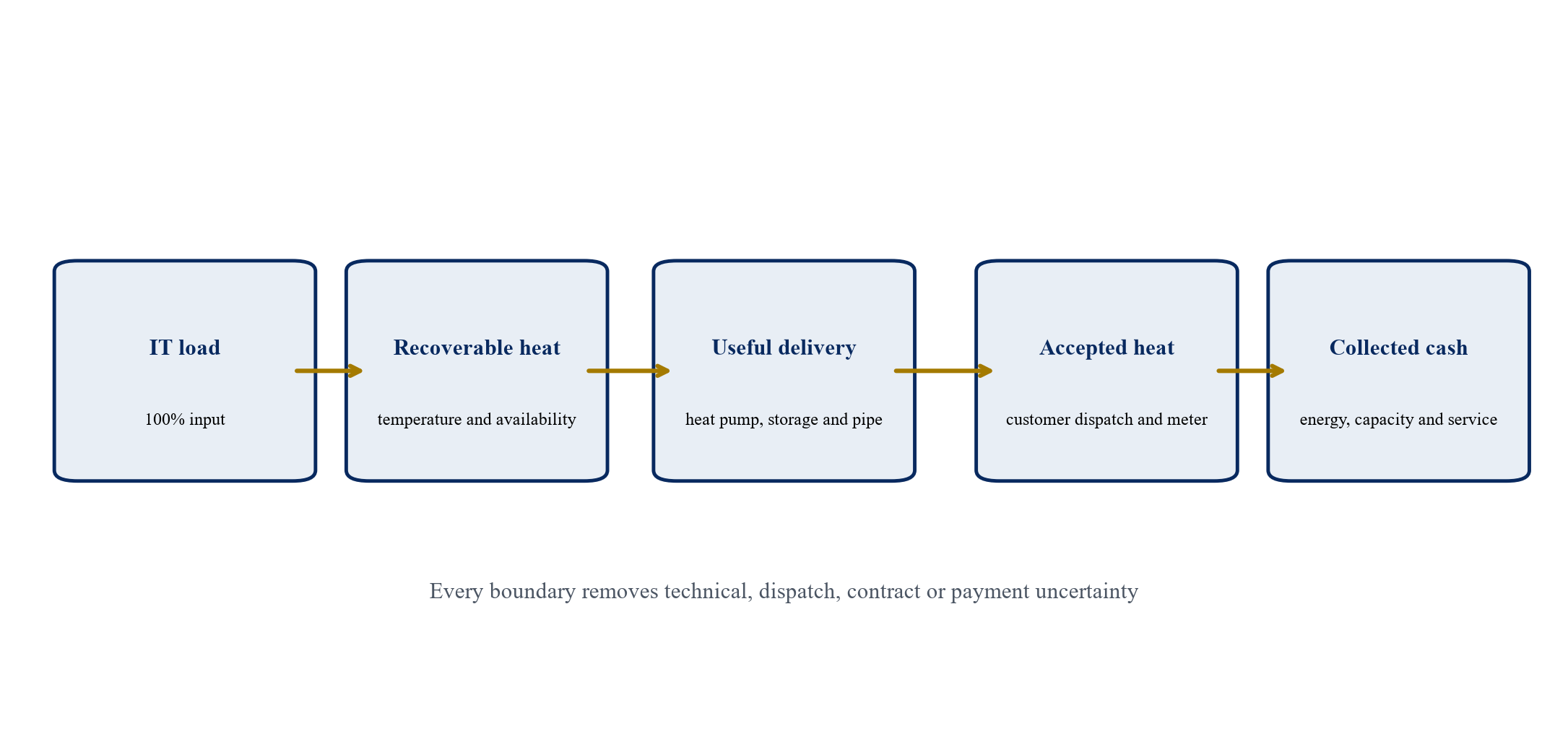
Proposed commercial architecture; actual project boundaries and contracts control.
Table 1. Heat-sink qualification ladder
| Evidence state | Minimum evidence | Capital treatment | Revenue treatment |
|---|---|---|---|
| Mapped demand | public heat map or customer list | strategy budget | none |
| Qualified demand | customer data, temperature and route study | capped development | none |
| Contracted demand | binding terms, funded scope and credit support | construction subject to conditions | risk-adjusted forecast |
| Commissioned delivery | passed integrated tests and valid meters | operating asset | contracted revenue |
| Collected settlement | invoices reconciled to receipts | performance history | strongest recurring evidence |
Proposed framework unless stated otherwise.
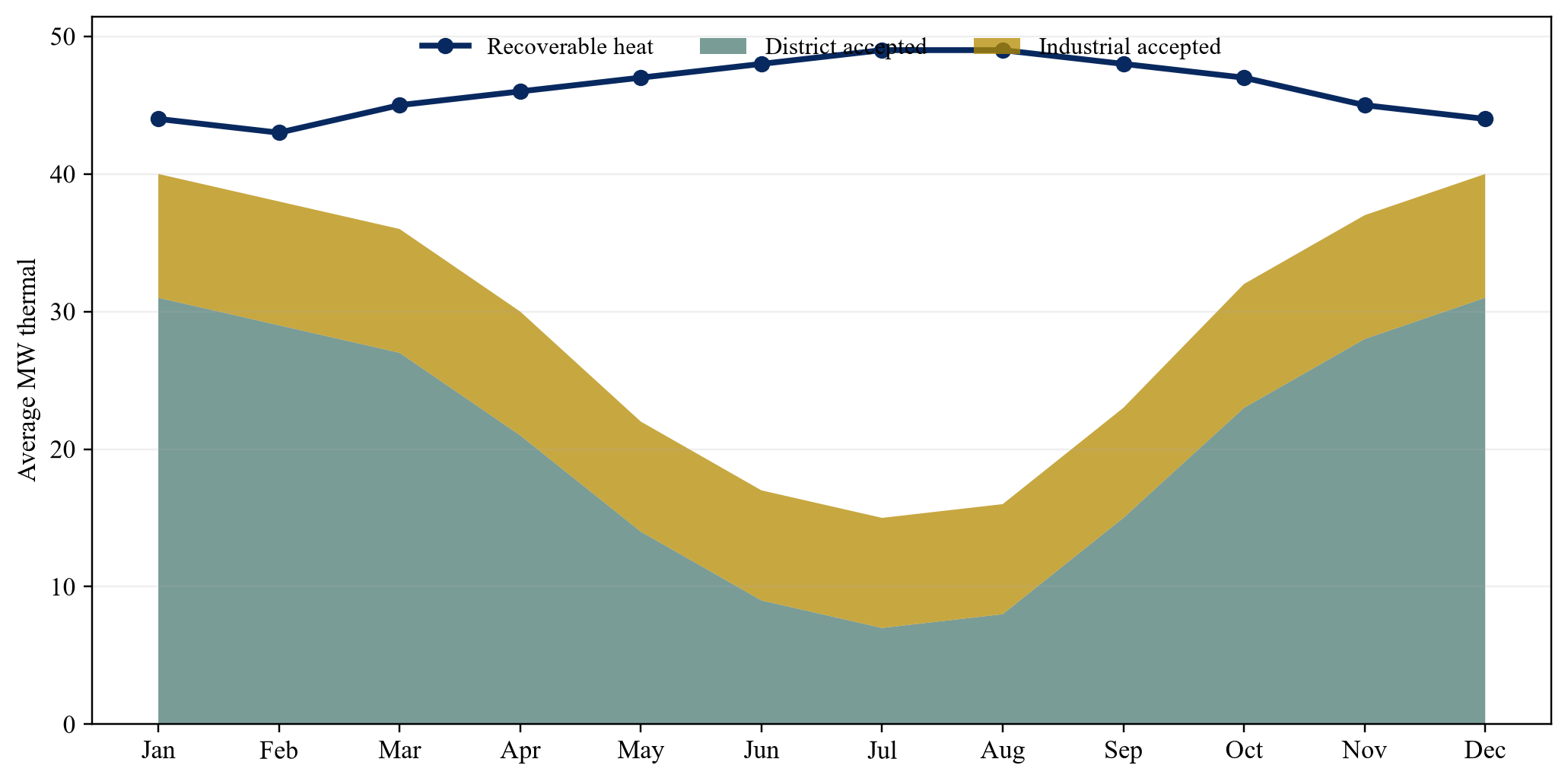
Wholly hypothetical 100 MW campus; figures describe no identified project.
Table 2. Commercial structure and risk allocation
| Item | Data-centre party | Heat-project or utility party | Shared control |
|---|---|---|---|
| Computing and internal cooling | operate and preserve availability | comply with interface limits | outage coordination |
| Heat pumps and network | provide source specification | own or operate funded assets | completion tests |
| Electricity | allocate under contract | procure or reimburse as agreed | indexation and efficiency |
| Customer dispatch | provide available heat | nominate and accept within rights | seasonal plan |
| Metering and settlement | grant data access | calculate invoice | audit and dispute process |
| Termination | maintain safe heat rejection | maintain customer heat transition | asset transfer and compensation |
Proposed framework unless stated otherwise.
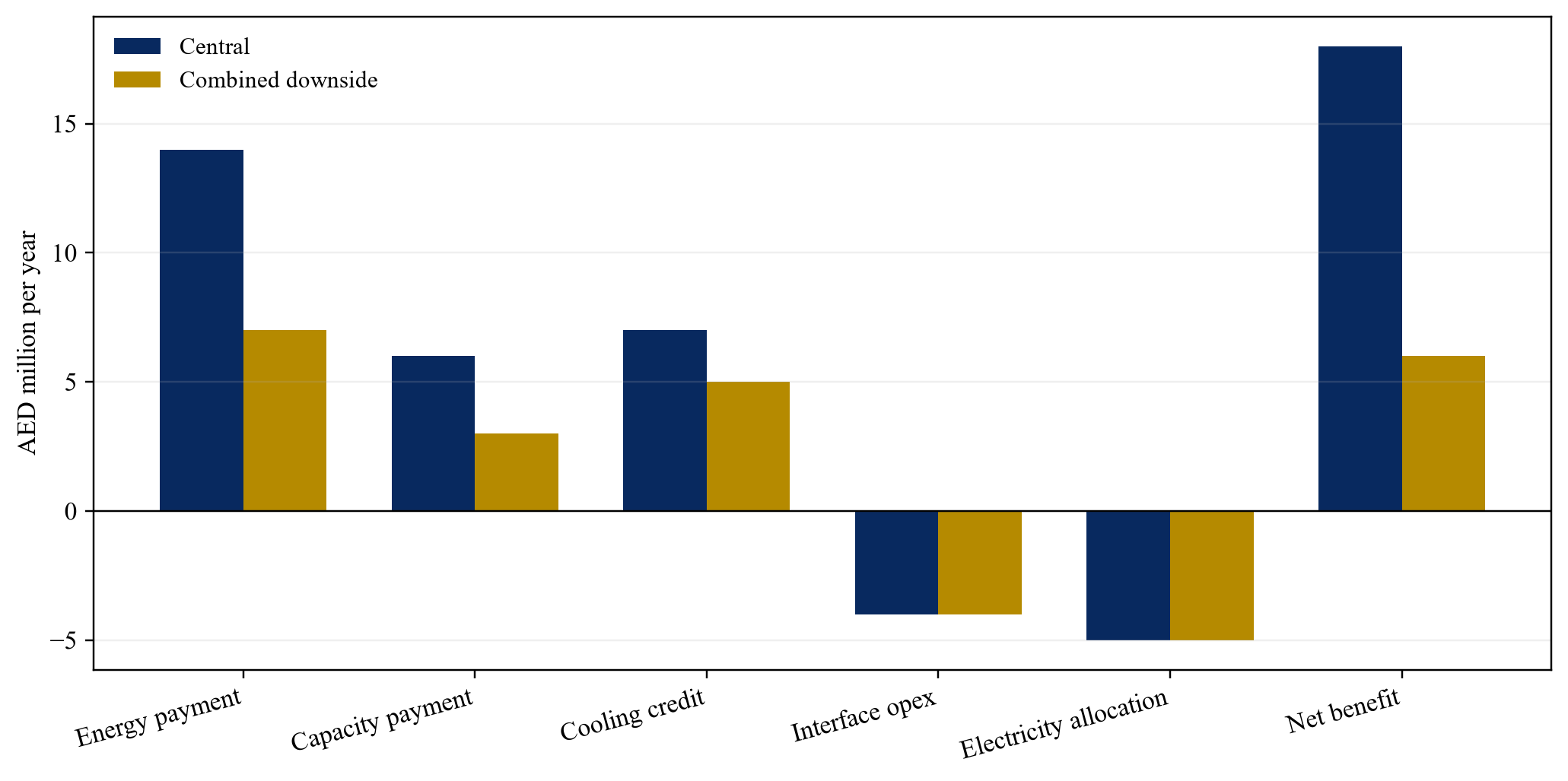
Wholly hypothetical; amounts are illustrative and are not forecasts or market quotations.
Table 3. Hypothetical investment case and gates
| Gate | Evidence required | Hypothetical sponsor capital | Principal decision |
|---|---|---|---|
| Feasibility | heat map, customer interest and concept route | AED 2m | advance or stop |
| Development | customer data, design, permits and term sheet | AED 8m | select structure |
| Final investment | executable contracts, funded utility scope and completion plan | AED 55m | construct |
| Commissioning | integrated performance and meter tests | included above | accept, correct or resize |
| Operation | accepted heat, invoices and receipts | lifecycle reserve | refinance, expand or redirect |
All amounts and outcomes are illustrative and describe no identified project.
Appendix A Questions for the investment committee
1. Which heat product is delivered, at what boundary and temperature?
2. Which customers can accept heat by month and hour?
3. What assets connect the data hall to the customer, and who owns each one?
4. Which cooling path protects computing when heat offtake stops?
5. Who procures heat-pump electricity and bears efficiency risk?
6. Which payments are energy, capacity, cooling service or capital contributions?
7. What evidence supports customer demand, credit and operating life?
8. Which permits, easements and grid rights remain outstanding?
9. What integrated tests begin payment and release security?
10. What is the maximum capital at risk before each gate?
11. Which cash remains under combined downside conditions?
12. How can assets and customers be replaced after termination?
References
- European Union, Directive (EU) 2023/1791 on energy efficiency, Article 26. https://eur-lex.europa.eu/eli/dir/2023/1791/oj/eng
- European Commission, Recommendation (EU) 2024/2395 on heating and cooling supply and installation-level cost-benefit analysis. https://eur-lex.europa.eu/eli/reco/2024/2395/oj/eng
- European Commission, Delegated Regulation (EU) 2024/1364 establishing a common Union rating scheme for data centres. https://eur-lex.europa.eu/eli/reg_del/2024/1364/oj/eng
- United States Department of Energy, Best Practices Guide for Energy-Efficient Data Center Design, 2024. https://www.energy.gov/sites/default/files/2024-07/best-practice-guide-data-center-design.pdf
- International Energy Agency, Opportunities for district heating in the changing energy landscape, 2026. https://www.iea.org/commentaries/opportunities-for-district-heating-in-the-changing-energy-landscape
- International Energy Agency, Renewables in District Energy, 2026. https://www.iea.org/reports/renewables-in-district-energy
- Fortum, Fortum and Microsoft announce collaboration to heat homes, services and businesses with data-centre waste heat, 17 March 2022. https://www.fortum.com/media/2022/03/fortum-and-microsoft-announce-worlds-largest-collaboration-heat-homes-services-and-businesses-sustainable-waste-heat-new-data-centre-region
- South Dublin County Council, Council creates Ireland's first publicly owned energy company, 14 December 2020. https://www.sdcc.ie/en/news/council-create-ireland-s-first-publicly-owned-energy-company.html
- South Dublin County Council, Tallaght District Heating Scheme, accessed 2 October 2026. https://www.sdcc.ie/en/climate-action/spotlight-tallaght-district-heating-scheme/
- Stockholm Exergi, Frequently asked questions about Open District Heating, accessed 2 October 2026. https://www.stockholmexergi.se/en/heat-recovery/frequently-asked-questions-about-open-district-heating/
- Stockholm Exergi, Heat Recovery supplier references, accessed 2 October 2026. https://www.stockholmexergi.se/en/heat-recovery/this-is-what-our-suppliers-say-about-open-district-heating/
- Meta, Odense data centre heat-recovery system, 8 July 2020. https://about.fb.com/fr/news/2020/07/facebook-devoile-son-premier-rapport-sur-le-developpement-durable-et-alimente-desormais-en-chaleur-la-ville-dodense-grace-a-son-data-center/
- IEA District Heating and Cooling, Low-Temperature District Heating Implementation Guidebook, 2021. https://www.iea-dhc.org/fileadmin/documents/Annex_TS2/IEA_DHC_Annex_TS2_Transition_to_low_temperature_DH.pdf
- European Commission, Energy performance of data centres, accessed 2 October 2026. https://energy.ec.europa.eu/topics/energy-efficiency/energy-efficiency-targets-directive-and-rules/energy-efficiency-directive/energy-performance-data-centres_en
- European Commission, Report assessing energy efficiency and sustainability of data centres, 2026. https://eur-lex.europa.eu/legal-content/EN/ALL/?uri=CELEX:52026DC0500
About the Author
Authored by Chennakeshav Adya Independent Researcher
Chennakeshav (CK) is a corporate finance and investment banking executive with 25+ years of global experience in deal origination, structuring and execution across M&A, growth capital and corporate strategy. He has led value-creation mandates for founders, corporates and funds — bridging the boardroom view to hands-on execution and close.
His career spans Morgan Stanley, HSBC, Lloyds Banking Group, EWEC, ADQ portfolio companies and Emirates Growth Fund, across TMT, real estate, fintech, deeptech, cleantech, infrastructure and energy. He has partnered with C-suite leaders, private equity and venture funds, sovereign wealth funds and family offices to finance complex fund raises and scale-up ventures, and has led M&A due diligence, post-merger integration and business-transformation initiatives to create value.
At Matchpoint Partners he is Managing Partner, leading the firm's corporate finance, M&A and capital-raising practice. He holds an MBA from London Business School, an engineering degree from VTU and a Master of Laws (LLM, in progress) from UCL London.
An active start-up mentor, CK mentors at Techstars, DIFC FinTech Hive, Startup Grind, Founder Institute and IN5, serves as Entrepreneur Mentor in Residence (EMiR) at London Business School, and judges the Entrepreneurship World Cup.
Matchpoint profile: https://www.matchpoint-partners.com/team/ck-adya.html LinkedIn: https://www.linkedin.com/in/ckadya/
