

1 Price the last obligation at the first investment decision
An asset can be economically useful and still carry a large final claim against its owner. Turbines, solar arrays, battery systems, wells, foundations, cables, contaminated land and nuclear facilities require different end-of-life work. The work may include isolation, dismantling, transport, waste treatment, seabed or land restoration, monitoring and formal release by an authority. A forecast that stops at the final power-purchase payment misses a cash outflow that may survive the power plant, concession, lease or selling company.
The investment question is specific: if the asset stopped operating at any permitted or plausible earlier date, who would be legally required to do what, how much money would be needed, and who could obtain that money? A current accounting provision is one input. The investor also needs the physical work scope, a third-party cost estimate, the applicable security rule, expected salvage or reuse and a schedule of restricted cash, surety or bank credit. The answer can change at financial close, after a change of owner, following an incident and at planned retirement.
Published official materials illustrate the variety. UK guidance for offshore renewable installations asks developers to plan and finance removal under the Energy Act 2004 scheme in England and Wales [1]. The US Nuclear Regulatory Commission permits specified methods of decommissioning funding assurance for licensed reactors [4]. The US Department of Energy explains that wind-decommissioning responsibility and financial assurance often arise through state or local requirements and land leases [6]. The European Union's batteries regime addresses producer responsibility for waste-battery collection and treatment [9,10]. A sponsor cannot import one regime's definition of adequate security into another project's documents.
This paper develops a corporate-finance decision framework. It does not determine a particular legal obligation, regulatory approval, accounting treatment, environmental remedy or investment value. Current law, permits, executed contracts, technical surveys and competent professional advice control a real asset. Every numerical example below is hypothetical author modelling, clearly separated from sourced regulatory descriptions.
2 Define the physical and legal perimeter
The first boundary is physical. A wind project may include turbines, offshore or onshore foundations, export and array cables, substations, access roads and marine works. A solar site may include panels, racks, foundations, electrical equipment, cabling and disturbed soil. A battery site adds modules, thermal-management equipment, fire-suppression systems and possible contaminated material. A nuclear plant requires a specialised radiological decommissioning programme. Offshore hydrocarbon assets add wells, pipelines, topsides and subsea structures. An estimator needs an asset register and approved removal standard before pricing any of these packages.
The second boundary is legal. The licence, lease, permit, concession, decommissioning programme, environmental approval, waste law, product-responsibility rule and financing contract may each impose a different duty. A lease may require full surface restoration when a public permit permits partial retention of buried infrastructure. A producer may owe a battery-collection duty while the project company owes site restoration. A former offshore asset owner may retain exposure after transfer under an applicable statutory regime or contract. Counsel should identify each obligor, beneficiary, trigger, notice process and surviving liability.
The third boundary is financial access. Cash on the project company's balance sheet can be subject to senior-lender security or insolvency. A restricted account may be reserved for restoration but still require trustee consent. A letter of credit may be callable by a public authority while using a sponsor's bank line or collateral. A parent guarantee depends on the parent's solvency when called. These distinctions determine whether a stated amount is actually available to the party doing the work. UK offshore-renewables guidance explicitly addresses ring-fencing and availability on insolvency when reserved cash is proposed as security [1].
The obligation map should be signed by legal, technical and finance leads. It records the component, work standard, responsible entity, governing document, approval authority, expected work date, early-trigger date, current-cost estimate, security requirement, funding source and release evidence. A map with uncertain fields is still useful if uncertainty is assigned to an owner and a deadline. A single total labelled decommissioning liability conceals the decisions that determine cash need.
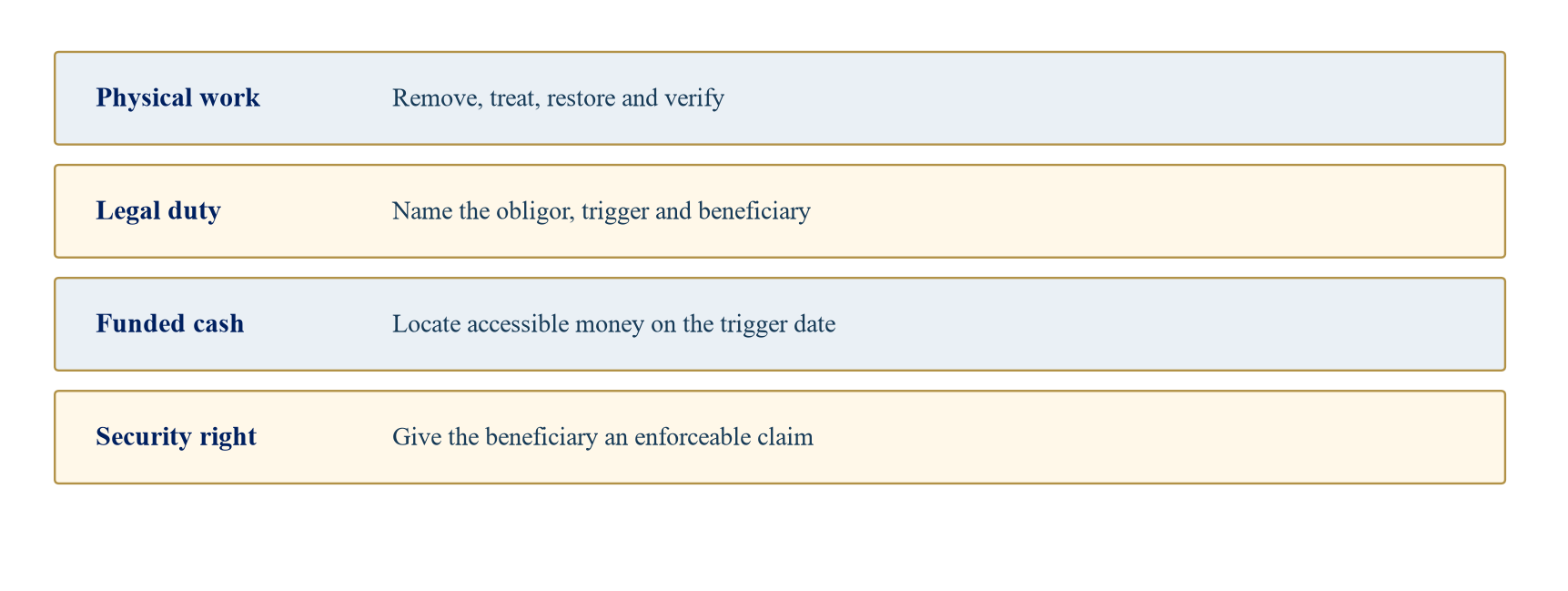
Author-developed decision framework; the boxes are analytical categories rather than legal tests.
3 Compare regimes without inventing a universal rule
The published rules show different protected interests. The UK offshore-renewables scheme in England and Wales is concerned with decommissioning an installation and protecting the public purse if the owner defaults [1]. UK offshore oil-and-gas guidance concerns the financial capability of persons with relevant field interests and the government's powers in relation to a decommissioning programme [2]. BOEM's US Outer Continental Shelf rule uses financial-risk assessment and supplemental assurance for offshore oil-and-gas lease and grant obligations [3]. These are not interchangeable bonds for a generic energy project.
US wind and solar duties often arise through land rights, permits and state or local conditions. DOE's wind end-of-service guide describes bond, guarantee and letter-of-credit arrangements that some jurisdictions require; it also notes that leases can hold project owners responsible for removal and restoration [6]. DOE's solar life-cycle guide asks for end-of-performance decisions and budgeting for decommissioning in a project's financial plan [7]. Neither source sets a universal assurance amount. A site-specific rule, lease and plan must be read before modelling collateral.
Nuclear regulation requires its own perimeter. The NRC lists prepayment, external sinking funds, surety or guarantees as permitted methods subject to the applicable requirements. It also requires periodic reporting on funding status for reactor licensees [4]. IAEA costing guidance recommends an early decommissioning study and updates as information improves [5]. Nuclear radiological decommissioning, spent-fuel management and site restoration should not be silently collapsed into one accessible trust balance; their regulatory uses and financing sources require separate analysis.
European battery producer responsibility concerns the battery as a product in a waste system, and project-site restoration may be a separate matter. Regulation (EU) 2023/1542 assigns specified collection, transport and treatment costs to producers and provides for producer-responsibility organisations [9,10]. It does not make every battery supplier's producer-responsibility contribution a ready-made fund for dismantling a particular energy-storage site. Contracting parties need a chain-of-custody and cost-allocation schedule for the project itself.
Table 1. Public-rule comparison for selected energy-asset end-of-life duties
| Asset and source | Principal published concern | Security or funding feature | Transaction question |
|---|---|---|---|
| Offshore renewables, England and Wales [1] | Approved removal programme and public protection | Finance plan and acceptable security, including insolvency access | Does security remain effective after sponsor or owner change? |
| Offshore oil and gas, UK [2] | Capability to carry out programme for relevant interests | Government financial-capability assessment and potential statutory powers | Which current or former parties remain exposed? |
| Offshore oil and gas, US federal waters [3] | Lease and grant removal liability | Risk-based supplemental assurance under BOEM rule | What collateral follows the asset and operator? |
| Wind and solar, US examples [6,7] | Removal, disposal and restoration under site rules | Local or state assurance and land-lease obligations may apply | Are permit and lease requirements both included? |
| Nuclear reactor, US [4] | Radiological removal funding | Specified trust, sinking-fund and guarantee mechanisms | What funds can be used for which work? |
| Industrial batteries, EU [9,10] | Waste-battery collection and treatment | Producer responsibility and possible collective organisation | Who pays for battery waste and who restores the site? |
Summary of cited official materials as accessed in October 2026; actual scope and legal effect require project-specific advice.
4 Assign duties across the transaction chain
The project company may be the permit holder, but it is rarely the only relevant counterparty. The landowner controls access and may have restoration rights. The offtaker may hold a credit-support claim after early termination. The EPC contractor can owe warranties or removal of temporary works. A battery producer can carry statutory waste duties. A waste contractor provides the actual collection and treatment route. A lender may hold security over project cash. The public authority may be able to call financial assurance. Each contract should be read for the same asset boundaries and event dates.
Transfer introduces a second dimension. A buyer may acquire shares in the obligor, acquire the assets into a new company or take only selected components. The seller's release under the sale agreement may be broader than any statutory release; the buyer's obligation to replenish security may arise before or after formal consent. The acquisition model should contain both replacement collateral and any retained seller guarantee. A price adjustment against a book provision is insufficient if the buyer must post a cash-backed letter of credit at completion.
Documentation should assign responsibility for cost updates, regulator submissions, disposal evidence, insurance coordination and security renewal. A bank guarantee with an expiry date before the earliest permitted closure date may leave a gap. A parent guarantee from a listed group that later sells the asset may be withdrawn or weakened. The project should have substitute-security requirements and notice periods that work before the old instrument expires. The same governance applies after refinancing, repowering or material damage.
The matrix should distinguish legal responsibility from economic allocation. Parties can agree that the buyer reimburses the seller for a surviving statutory liability, but that contract does not itself remove a government's rights against the seller. A group may fund a subsidiary's obligation without being the named permit obligor. A competent legal review should confirm the effect of each transfer in the applicable jurisdiction, while the finance team models who pays first and who can recover later.
5 Build a work-based cost estimate
A meaningful estimate starts with a method statement and quantities. For each component, the technical adviser should estimate isolation, preparation, disconnection, lifting or dismantling, marine or road transport, treatment, disposal, restoration, testing, permits, independent verification and project management. The estimate should state currency, base date, escalation, contingency, taxes, exclusions, assumed contractor capacity and schedule. Salvage receipts should be a separate line. A single percentage of original construction cost ignores changes in equipment, access and waste pathways.
Offshore wind illustrates schedule risk. A future heavy-lift vessel, cable survey, weather window and port can dominate the programme; physical removal standards and accepted seabed conditions matter. A solar array is more modular, yet contaminated land, buried components or lack of local recycling may change the cost. For battery storage, damaged modules can require a different handling and transport route from intact modules. The US Environmental Protection Agency's 2025 battery-storage incident guidance describes safety and cleanup considerations that make a simple residual-metal credit unreliable after an incident [8].
Nuclear estimates require specialist scope and a disciplined update cycle. The NRC states that reactor-decommissioning cost depends on timing, facility characteristics, location, radioactive-waste disposal and spent-fuel plans [4]. IAEA material recommends an early estimate and iterative revision [5]. A buyer should understand the estimate's confidence, regulatory scope and excluded fuel or environmental obligations. A minimum statutory funding calculation, when one applies, should not be mistaken for a complete asset-specific cost-to-exit budget.
An independent estimate should report both a base scope and the credible downside drivers. The downside could be early closure, contractor insolvency, higher disposal charges, damaged equipment, a changed restoration standard or prolonged monitoring. A board can then decide whether a reserve, guarantee or price discount covers each driver. Where cost distributions are used, the input ranges and correlations should be recorded; a single unexplained confidence label does not show which physical assumptions create the tail.
6 Separate gross work cost from uncertain recoveries
The gross estimate represents the cash required to perform the work before uncertain receipts. Salvage proceeds, reuse value, tax relief, insurance recoveries, warranty claims and a later sale of equipment are potential offsets. They have different legal owners, timing and credit risk. An authority may require security against gross cost or may allow a specified offset; the project should never assume an offset is permitted without the governing rule or approved programme. UK offshore-renewables guidance requires finance and security proposals to satisfy its public-protection purpose [1].
Salvage is especially fragile in an early-closure case. Commodity prices may be low when several similar assets retire together. Equipment damaged by fire or corrosion may have negative handling value. A manufacturer could offer a take-back contract, but the supplier may not be solvent at year 20. A recycling plant may be available in one jurisdiction and uneconomic to reach from another. The estimate should identify the counterparty, transport route, quality condition, payment terms and legal title for each expected receipt.
Timing matters even if a recovery is probable. A decommissioning contractor may need a deposit, vessel mobilisation and hazardous-material treatment payment before scrap is sold. The reserve or callable security must bridge that interval. Where the authority has first rights to a security instrument, a lender should not count the same instrument as a debt-service reserve. The deal model should show the maximum pre-recovery cash requirement and any cash released only after final acceptance.
A cautious investment case can show gross cost, contractually supported recovery and speculative residual value in separate columns. The base finance case can use only the recovery supported by enforceable, financeable rights and a realistic payment date. More optimistic recycling or repowering value can remain an upside case. This treatment is an underwriting proposal, not a universal accounting or regulatory rule.
7 Keep the provision, fund and security on separate ledgers
An accounting provision answers a measurement question under the applicable reporting standard. IAS 37 addresses provisions of uncertain timing or amount, including restoration obligations; IFRIC 1 addresses subsequent changes in existing decommissioning and similar liabilities for assets within its scope [11,12]. The accounting estimate may move when expected cost, timing or discount rates change. It does not establish that cash has been segregated, that a guarantor can perform or that an authority can draw money after insolvency.
A funding plan answers when cash will be accumulated and invested. Its inputs include opening balance, annual contribution, investment return, permitted investments, fees, taxes and withdrawal conditions. A security plan answers who has an enforceable claim on that money or another instrument at default. A trust or escrow can serve both purposes if its terms give the beneficiary the required access. A surety bond can protect a beneficiary without accumulating a dedicated cash fund at the project level; the surety's indemnity claim and any collateral still affect sponsor liquidity.
The finance model should therefore have three linked schedules. The financial statements contain the provision and its changes. The project cash flow contains deposits, premiums, fees, interest and withdrawals. The security register contains face amount, obligor, beneficiary, issuer rating, collateral, expiry, replacement trigger and call conditions. Reconciling only the first two can leave a contractual gap. Reconciling only the last two can misstate reported leverage or asset value.
The investment committee should ask for a bridge between the latest technical cost estimate and each ledger. The bridge should explain discounting, inflation, tax, currency, scope exclusions and permitted uses. For cross-border assets, a local regulator may require a specific currency or approved instrument. A group-level provision in one currency does not necessarily satisfy a project-level security call in another. Legal and accounting advisers should confirm the applicable treatment before the investment model is approved.
8 Select an instrument whose failure mode is understood
Cash escrow gives a visible funded amount, but ties up capital and requires robust control, investment and release rules. A decommissioning trust can ring-fence contributions and permit long-term accumulation, subject to governing law and trustee terms. A bank letter of credit provides immediate drawable credit if the beneficiary can present conforming documents; it creates fees, expiry, bank concentration and possible cash collateral. A surety bond transfers first-call performance risk to an insurer or surety but may require indemnities and underwriting renewals. A parent guarantee is only as strong as the parent and the enforceability of the undertaking.
Choice depends on the beneficiary's acceptance and the asset's risk profile. The NRC identifies several assurance methods for reactor licensees, subject to its regime [4]. BOEM describes bonds, decommissioning accounts and guarantees within the US offshore context [3]. UK offshore-renewables guidance considers whether reserved funds remain available to the state on insolvency [1]. These examples show why a sponsor cannot simply choose the cheapest quoted fee. The security must perform when the project, sponsor or issuer is under stress.
The hidden cost is collateral interaction. A project lender may require a debt-service reserve, cash sweep and security over accounts. A decommissioning authority may require a first-priority claim on separate cash. A letter-of-credit bank may take cash collateral or a parent guarantee. The same USD 20 million cannot be promised twice without a documented priority and replenishment route. The financing term sheet should show the cash and borrowing-base effect of each alternative, including how it behaves after a covenant breach.
The procurement process for security should test issuer tenor, rating, governing law, claim documentation, renewal and replacement, counterparty downgrades and surviving obligations. It should identify whether an authority can call before completion of an appeal, and whether the sponsor can contest or recover an excess call. Those rights are jurisdiction- and instrument-specific. A cost comparison without these clauses can select an instrument that is cheap while operating and ineffective when needed.
Table 2. Funding and security instruments viewed through cash and performance
| Instrument | Cash or credit burden | Principal performance question | Model treatment |
|---|---|---|---|
| Segregated cash or trust | Upfront or periodic deposit | Can the beneficiary access it after insolvency? | Restricted cash, earnings, withdrawal and release |
| Bank letter of credit | Fee, credit line and possible collateral | Does tenor and presentation language cover the trigger? | Fee, collateral, replacement and call liquidity |
| Surety bond | Premium and possible indemnity | Can the surety perform through contractor or sponsor distress? | Premium, indemnity exposure and renewal |
| Parent guarantee | Group contingent credit | Will parent credit and legal capacity survive transfer? | Stress group credit and substitute-security trigger |
| External sinking fund | Scheduled deposits and investment risk | Is the fund sufficient at an earlier closure date? | Contributions, returns and accelerated shortfall |
Author-developed comparison; legal acceptance, priority and call conditions depend on each applicable regime and instrument.
9 Make the funding arithmetic visible
Consider a fictional energy asset with a current-cost decommissioning estimate of USD 140 million. Assume its planned end of service is in 20 years, that nominal work cost rises 2.5% per year, and that a USD 20 million opening reserve earns 4% annually. Assume equal deposits at each year end earn the same rate. These numbers are selected only to demonstrate the mechanics; no market cost, expected investment return, legal security threshold or project valuation is inferred.
At the stated inflation rate, USD 140 million becomes about USD 229.4 million at year 20. The opening reserve becomes about USD 43.8 million. The twenty annual deposits must make up about USD 185.6 million. An annuity factor of approximately 29.778 at 4% gives an annual deposit of about USD 6.23 million. In a real financing, investment returns are uncertain, restricted investments may earn less, withdrawals and fees reduce accumulation, and the actual rule may require a different gross or net amount.
Now assume the asset closes at year 10. The nominal cost under the same 2.5% escalation is about USD 179.2 million. The opening reserve plus ten deposits has grown to about USD 104.4 million. The resulting shortfall is about USD 74.8 million before any additional cost or salvage adjustment. The model reaches its planned year-20 target and still fails the earlier cash test. That is the core underwriting issue: the closing date and the funding date can diverge.
The cash-flow interaction is separate. If fictional annual cash available for debt service is USD 60 million and scheduled debt service is USD 45 million, the pre-deposit ratio is 1.33 times. If the USD 6.23 million deposit is paid from that same cash before debt service, the simplified ratio becomes about 1.19 times. The actual loan definition, reserve waterfall and distribution tests would decide whether these simplified figures correspond to any covenant. The example is not an observed bank term.
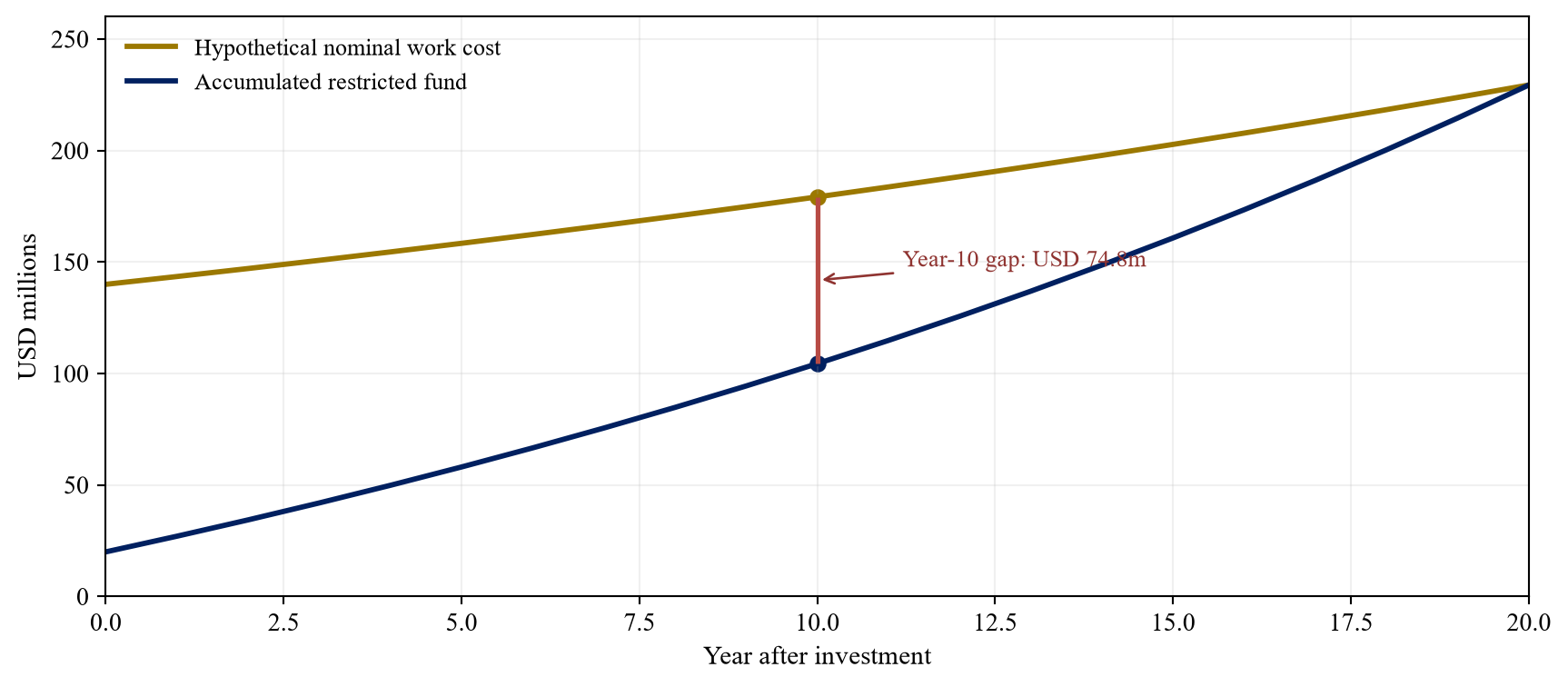
Author assumptions only: USD 140m current cost, 2.5% annual cost growth, USD 20m opening reserve, 4% fund return and USD 6.232m year-end deposits. No market benchmark.
10 Test the first failure date rather than the final balance
The reserve shortfall at year 10 needs a source. A sponsor could post additional cash, maintain a drawable letter of credit, arrange an acceptable surety or agree another approved support package. Each solution has a different counterparty and collateral profile. The model should show whether the cover is available from the first date of potential accelerated retirement, rather than only from the planned end date. A facility can be forced to close through damage, licence loss, persistent unprofitability or a contractual termination.
The downside should also vary the work cost. A damaged battery system can require special handling; an offshore asset may face a changed vessel market; a nuclear site can face revised waste costs. The illustrative gap is USD 74.8 million only under the selected cost and return assumptions. A credible stress should include lower fund returns, higher disposal expense, earlier closure, delayed salvage and issuer failure. These drivers may coincide. A high commodity price should not be assumed to rescue a default scenario in which recovery is most difficult.
The commercial decision is to set a maximum acceptable unsecured shortfall at each review date. If that amount is zero, the sponsor needs fully available support even before the reserve matures. If an authority accepts a phased approach, its approval and replenishment triggers should be documented. If a lender tolerates an amount of sponsor exposure, it should show why the sponsor can fund it under the same stress that closes the asset. A support promise from a parent whose core business depends on that asset may be correlated with the loss.
The owner should update the model when the asset changes, not merely at a calendar anniversary. New batteries, repowered turbines, changed cable routing, a new waste destination, a permit amendment or a revised lease can alter both cost and law. Before a change is approved, the board should ask whether the revised security has been accepted by the beneficiary and whether financing covenants permit the extra restricted cash or credit line.
Table 3. Hypothetical funding and early-closure sensitivity
| Test | Planned year 20 | Closure year 10 | Finance implication |
|---|---|---|---|
| Work cost at 2.5% nominal escalation | 229.4 | 179.2 | Earlier cash call remains substantial |
| Fund with USD 20m opening and USD 6.23m annual deposits at 4% | 229.4 | 104.4 | Planned balance masks early shortfall |
| Unfunded amount before other security | 0.0 | 74.8 | Requires approved contingent support |
| Annual cash available before contribution | 60.0 | 60.0 assumed | Same cash cannot be allocated twice |
| Annual debt service | 45.0 | 45.0 assumed | Pre-contribution ratio 1.33x |
| Ratio after annual deposit if paid before debt | 1.19x | 1.19x assumed | Actual covenant definition controls |
All USD values are author calculations in millions, rounded. Cost and return assumptions are illustrative, not observed rates or security requirements.
11 Give the obligation a place in the cash waterfall
The project-finance waterfall states which claims are paid from operating cash and in what order. A decommissioning contribution that ranks after debt service can disappear when cash is weak. A contribution that ranks before debt service reduces cash available to lenders and can change leverage. The term sheet must define the order, minimum balance, permitted withdrawal, distribution block and cure after a shortfall. A separate schedule should show any public security requirement that takes priority over lender claims.
An asset with predictable operating revenue can accumulate a fund gradually, subject to the public beneficiary's acceptance. Yet a rising annual contribution near retirement may coincide with declining output, higher maintenance and a shorter debt tenor. The base model should not hold output or price constant merely to make the last deposits affordable. A wind or solar project considering extension may need both sustaining capital and a larger restoration reserve. A battery project replacing modules may generate earlier waste expenses while increasing the future site's physical scope.
Debt documentation should distinguish a missed contribution from an underfunded estimate. The former may be cured by depositing an agreed amount. The latter requires recalculating future contributions or posting new security. A temporary investment loss could trigger a top-up despite no change in physical work cost. Lenders should ask who certifies the updated estimate, whether the authority can demand a greater amount, and whether the borrower can draw for authorised work before final termination.
The waterfall should prevent circular liquidity claims. If a borrower plans to use a working-capital line to post a letter of credit, that draw may reduce debt capacity and create a reimbursement claim if the letter is called. If the same parent provides a completion guarantee, a debt guarantee and end-of-life indemnity, a correlated stress can exhaust the parent's available credit. The credit committee needs a consolidated exposure schedule, including contingent calls and collateral, rather than separate comfort statements for each instrument.
12 Design the call and step-in pathway
Security has practical value only when its beneficiary can use it to complete the work. The documents should identify who can declare default, what notice and cure periods apply, who controls the removal contractor, what evidence is needed to draw and how unused amounts are returned. The authority may have statutory powers; the lender may have step-in rights under direct agreements; the landowner may have a separate restoration claim. Those rights need a hierarchy to avoid three parties directing the same contractor.
World Bank PPP material on asset recycling identifies handback conditions and public step-in among commercial principles for concession-type structures [13]. The exact arrangement for an energy asset will differ, but the underlying control problem is similar. Someone must preserve site access, records, permits, grid interfaces and insurance during the transition from operating company to removal programme. A funded trust without those operational rights may sit unused while deterioration raises cost.
The independent engineer should be able to certify observable stages: isolation, removal of equipment, treatment of hazardous material, restoration and final evidence. The security agreement can permit staged draws against defined work packages, with records and an independent cost review. A fully discretionary call can prompt litigation and financing resistance; a call requiring impossible proof can leave the beneficiary stranded. Project counsel must align the mechanism with the applicable public regime and insolvency law.
Step-in may also be necessary before actual abandonment. A deteriorating operator can defer maintenance, lose personnel or allow environmental conditions to worsen. Early-warning rights should cover missed reserve payments, a downgrade of the security issuer, missed renewal, a failed cost-estimate review and breaches of the decommissioning programme. Intervention thresholds should be measurable and provide proportionate cures. The objective is to retain a capable operator and a funded removal route while choices still exist.
13 Treat nuclear funding as a distinct regulated case
Nuclear decommissioning should not be modelled as ordinary equipment removal. The work is subject to radiological controls, licence conditions, waste routes and long schedules. The NRC's published funding-assurance page describes acceptable assurance methods and periodic status reporting for reactor licensees [4]. The IAEA advises early cost studies and updates as the facility and strategy become better understood [5]. An investor should demand facility-specific documentation and specialist technical review rather than extrapolating a wind or thermal-plant cost multiple.
The cost estimate should separate radiological dismantling, site remediation, spent-fuel and waste-management requirements and any continuing monitoring. The boundaries depend on law and licence. A trust dedicated to a particular regulated purpose may not be available for a different obligation. Cash held by an affiliate may not be callable by the licensee when needed. The legal review should identify permitted withdrawals and whether a proposed transaction requires regulator consent, replacement funding assurance or a revised cost estimate.
Where a nuclear asset is sold, a buyer should reconcile three different valuations: operating cash flows until shutdown, the net cost of the approved end-state and the funding assurance that must be maintained during ownership. A trust balance can be an asset economically, a restricted resource legally and an inadequate amount technically if the estimate is stale. The sale price should reflect the specific rights to the fund, obligations transferred and any seller liability retained.
Investment committees should also ask how shutdown date changes the economics. A shorter operating life reduces revenue that could fund later contributions. A delayed end-state can increase security, monitoring and administrative cost even if physical work begins later. The interaction between operating strategy and decommissioning strategy should be visible in the same model. A generic discounted liability hidden below enterprise value does not show the timing of required cash.
14 Plan battery removal for normal and incident states
Battery energy storage has at least two end-of-life pathways. In the normal pathway, modules are safely isolated, removed and sent through a qualified reuse, repurposing, recycling or disposal chain. In an incident pathway, damaged cells, contamination, fire water, structural debris and site safety can change the work plan and contractors. EPA's battery-storage guidance and its public response information describe why damaged-battery handling and cleanup require different controls from an ordinary equipment sale [8].
The European batteries regime places extended producer-responsibility obligations on identified producers and permits collective arrangements through producer-responsibility organisations [9,10]. A project developer should obtain written clarity on what the producer or supplier takes back, where, at what cost and under what condition. A warranty replacement or take-back promise may exclude fire-damaged modules or require the project to pay for packaging and transport. Those exclusions belong in the end-of-life estimate.
The owner's physical plan should include battery chemistry, module inventory, state-of-health data, isolation procedure, lifting and packaging method, permitted carrier, receiving facility and documentary chain of custody. An operating data system can support this plan if the data remain accessible after the supplier or operator exits. A transaction buyer should inspect the records, not assume that a battery management system can reconstruct them after a fire or software-access dispute.
Security should cover the part of the site obligation that survives product-level recycling arrangements. Land restoration, foundations, cabling, buildings and environmental testing remain relevant even when a producer finances waste-battery treatment. If a third party bears some cost, the sponsor should demonstrate that the right is enforceable and that the beneficiary accepts the allocation. A system-wide product rule and a site-specific project security can coexist without offsetting one another automatically.
15 Model extension, repowering and abandonment as separate choices
At the approach of planned retirement, an owner may extend operation, replace components, sell the asset or decommission. Each choice changes cash timing and sometimes the liability itself. Extension can add revenue, but it may require inspections, permits, performance upgrades and a revised restoration date. Repowering can reuse an interconnection or land right while producing a new removal obligation for old equipment. A buyer of an aging asset may demand security at signing even if the seller expected to fund it from later production.
DOE's wind end-of-service guide describes repowering and decommissioning as distinct possible outcomes [6]. Its solar life-cycle guidance similarly places extension, refurbishment, replacement and decommissioning in an end-of-performance decision [7]. These options should be valued on complete cash flows. The model should include the incremental security required for each option and the moment a public authority or landowner must approve a revised plan. A theoretical repowering option is less valuable if the lease expires, grid capacity cannot be retained or the security must be posted before investment approval.
Abandonment is not an option the lender can assume the owner may exercise without consequence. A project company that stops operating may still owe removal and restoration. The public counterparty may call security, and a landowner may pursue contractual remedies. The acquisition or refinancing case should test the cash at the earliest credible stop date. A terminal value that presumes an orderly sale can overstate proceeds if the buyer must immediately replace a bank guarantee and absorb an underfunded reserve.
The decision record should compare four cases: operate to contracted term, extend, repower and close. It should show revenue, sustaining capital, permitted operating life, end-of-life cost, amount and form of security, required consents and residual buyer or seller claims. A board can then compare economic outcomes and executable permissions. The same set of numbers should feed the lender model and the asset-sale data room.
16 Make transfer security a closing condition
An energy-asset sale has a moment when old and new obligations overlap. The seller may want its letter of credit cancelled, the buyer may need an authority-approved replacement, and the underlying licence may not transfer until consent. A closing checklist should place those events in an enforceable order. A contract that releases the seller at closing while the authority has not accepted the buyer's security can leave the seller exposed and the buyer unable to operate.
The seller should provide a current asset register, latest approved decommissioning programme, recent independent estimate, security instruments, letters with regulators, restricted-account statements, waste contracts, insurance notices and any previous release or transfer consent. The buyer should model the cost of replacing each instrument and the timing of funds becoming available. A bank may require cash collateral before the buyer can draw acquisition financing. This is a funding need at closing, separate from the eventual decommissioning cost.
Sale-price mechanics can allocate a known reserve deficit, but they cannot answer an unknown work scope. A holdback, escrow, indemnity, price adjustment or vendor-funded top-up may be appropriate after a measured deficit is agreed. The agreement should define who benefits if the future estimate falls and who funds an increase. It should address the seller's continuing statutory exposure where the law permits such exposure, without assuming a private indemnity binds the regulator.
A buyer's diligence should also consider the security issuer. A buyer may inherit a letter of credit that is non-transferable, expires soon or is backed by the seller's parent. A surety may re-underwrite the new owner. The buyer can require replacement terms to be approved before closing, with a long-stop and allocation of fees if the authority requests a higher amount. Financing certainty depends on that approval arriving while both parties can still perform.
17 Control portfolio, currency and counterparty concentration
Portfolio owners may be tempted to net expected salvage and security across projects. The legal beneficiary may treat each licence or site separately. A pooled cash fund can be efficient only if the governing documents permit allocation, withdrawals and replenishment across assets. The portfolio model should show each project's gross obligation and security, then any legally usable common support. A diversification argument cannot release an individual project from an obligation without approval.
Currency adds another gap. Removal contractors, vessels, disposal fees, insurance and bank guarantees may be priced in different currencies from project revenue. The reserve can grow in the accounting currency while the work estimate grows in a contractor currency. A stress should apply exchange rates to both cost and collateral. Hedging may reduce one exposure and introduce margin or renewal demands. The board should know which currency the beneficiary expects at call date.
Counterparty concentration can appear in several places at once. One bank may issue letters of credit for multiple sites, hold restricted deposits and lend to the sponsor. One parent can guarantee several assets. One waste contractor may be the only permitted facility in a region. A portfolio-level review should identify whether a common shock could impair all three sources of protection. A nameplate sum of guarantees is weak evidence when the same guarantor would face simultaneous calls.
Data quality matters to an acquisition platform. Sites built by different developers may use inconsistent asset registers and cost assumptions. The platform should standardise component counts, removal methods, estimate dates, confidence bands and security terms while retaining legal differences. It should preserve original estimates, approvals and decisions, so that a later change can be traced to engineering scope, market price, law or discount rate. A clean database reduces diligence time and reveals where security is actually short.
18 Set renewal and top-up triggers before distress
An annual certificate is useful only if it prompts action. The owner should compare the latest technical estimate, fund value, instrument face amount, issuer credit and earliest credible closure date. The certificate should identify any gap and a dated cure. Triggers can include a cost increase, investment loss, asset damage, early retirement notice, issuer downgrade, missed instrument renewal, permit change, asset sale or a new waste pathway. Each trigger should specify the person who recalculates, the evidence required and the time to restore cover.
The technical adviser should avoid false precision. Costs for a future vessel, waste facility or restoration standard cannot be known exactly decades ahead. The review should explain what changed and what remains uncertain. The finance team then prices the effect on annual contributions, debt service, restricted cash and shareholder distributions. A legal reviewer confirms whether a revised instrument must be lodged with an authority or counterparty. The board receives a single reconciliation of these decisions rather than three unrelated reports.
An effective release procedure matters as much as a top-up. Once work is complete and the competent beneficiary accepts the evidence, excess security should be released under documented conditions. Without a release route, capital can remain trapped after the asset is gone. The contract should state the surviving monitoring or defect period, final account, waste documentation, site certificate and any permitted retention. Release should follow verified completion, not a mere declaration by the owner.
The security register can be simple but must be maintained. It records document, issuer, amount, currency, expiry, draw conditions, collateral, beneficiary, renewal date, next cost-estimate review and named owner. The register should be reconciled to restricted-cash balances and accounting provisions at every material transaction. That gives decision-makers the location and legal quality of the money they may need on the asset's last day.
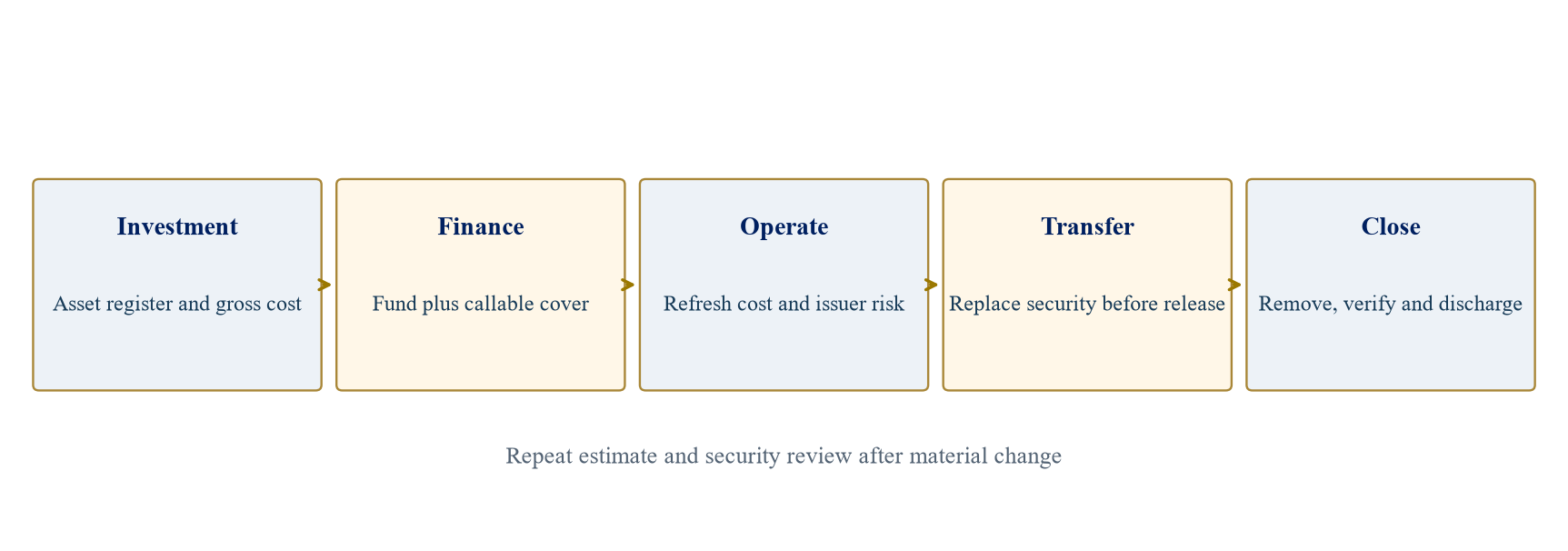
Author-developed process. Exact approvals, timing and remedies depend on asset documents and jurisdiction.
19 Execute an evidence led investment and financing review
The first workstream assembles the obligation. Counsel obtains the applicable permit, lease, licence, decommissioning plan, environmental conditions, waste obligations, security instrument and transfer rules. The technical adviser verifies the asset register and expected removal standard. Management identifies the legal obligor and any former owner or parent still exposed. This produces a dated responsibility map, not merely a liability number from the accounts.
The second workstream prices the work. Independent engineers prepare a gross estimate with quantities, method, schedule, contractor assumptions and uncertainty. Finance reconciles that estimate to the provision, reserve and proposed security. The team tests normal retirement, earlier closure, damaged equipment, lower fund returns and unavailable salvage. It also tests whether the cash waterfall can make contributions while debt remains outstanding. A decision paper shows the first date on which liquid cover could fall below the work cost.
The third workstream negotiates performance. The beneficiary confirms acceptable security, call terms, replacement and release. Lenders approve the priority, permitted payments and distributions. Sponsor and buyer, if any, agree who funds a shortfall before closing. The deal team resolves inconsistent expiry dates, currencies and draw conditions across documents. A draw right that cannot be exercised and a reserve that cannot be spent should fail the review, even if both appear as large figures on a summary slide.
The final workstream sets operations. The project names an owner for the security register and schedules annual or event-triggered updates. It retains engineering drawings, component serial data, site surveys, waste records and authority correspondence. Before extending, repowering, refinancing or selling, the team reruns the same end-of-life test. At decommissioning, the operator documents work and obtains the acceptance required to release security. Every stage should have a recorded decision and evidence owner.
For a mandate, a useful first deliverable is a ten-column schedule covering component, obligor, governing document, work method, current gross cost, cost-date and currency, earliest trigger, funded cash, other callable security and release evidence. It can be built from existing documents before commissioning a full probabilistic model. Missing cells show exactly where legal, technical or financial diligence is needed. The resulting negotiation can focus on named gaps rather than a generic debate about whether decommissioning has been 'provided for'.
20 State the boundaries of the decision
The sources in this paper describe selected public regimes, not all energy jurisdictions. The UK offshore-renewables guidance cited applies to England and Wales and does not govern every Scottish or international project [1]. BOEM's rule concerns specified US federal offshore oil-and-gas obligations [3]. NRC assurance requirements concern licensed nuclear activities [4]. European battery producer responsibility has its own product and territorial scope [9,10]. Local counsel must determine current law, regulatory interpretations and instrument acceptability for each real asset.
The hypothetical USD 140 million estimate, USD 20 million opening reserve, 2.5% cost escalation, 4% fund return, USD 6.23 million deposit and USD 74.8 million year-10 shortfall are author-selected teaching inputs. They are not observed project costs, a safe contribution rate, market returns, lender covenants or regulatory thresholds. Actual models require documented physical scope, a professionally prepared estimate, legal security terms, tax and accounting advice, realistic investment and inflation assumptions, and scenario analysis.
The framework's central decision is whether the owner and beneficiary can identify and use enough money on the earliest credible day the work may be required. A final-year balance is insufficient evidence if it leaves earlier closure uncovered. The investment committee should require a work-based estimate, accessible funding, acceptable security, replenishment triggers and a transfer-and-release path before pricing the asset or committing long-term debt. The security package should be retested whenever the physical asset, owner or legal duty changes.
The next step for a live transaction is a joint review of the permit, lease, asset register, estimate, accounts, restricted-cash statements and security instruments. It should produce a dated gap schedule and an agreed owner for every cure. That document allows the parties to value, finance and transfer the asset with the final obligation visible while there is still operating cash and decision time.
References
- UK Department for Energy Security and Net Zero. Decommissioning offshore renewable energy installations under the Energy Act 2004: guidance notes for industry. Updated 21 March 2019. Accessed 6 October 2026. https://www.gov.uk/government/publications/decommissioning-offshore-renewable-energy-installations
- UK Department for Energy Security and Net Zero. Oil and Gas: decommissioning of offshore installations and pipelines, including Financial Assurance Guidance. Accessed 6 October 2026. https://www.gov.uk/guidance/oil-and-gas-decommissioning-of-offshore-installations-and-pipelines
- US Bureau of Ocean Energy Management. Risk Management and Financial Assurance Rule fact sheet and final-rule effective-date notice. 2024. Accessed 6 October 2026. https://www.boem.gov/oil-gas-energy/risk-management/boemrisk-managementfinancial-assurance-rulefact-sheet
- US Nuclear Regulatory Commission. Financial Assurance for Decommissioning. Accessed 6 October 2026. https://www.nrc.gov/facilities-safety/decommissioning/financial-assurance
- International Atomic Energy Agency. Cost Estimation for Research Reactor Decommissioning and related nuclear-decommissioning guidance. Accessed 6 October 2026. https://www-pub.iaea.org/MTCD/Publications/PDF/Pub1596_web.pdf
- US Department of Energy. Wind Energy End-of-Service Guide. Accessed 6 October 2026. https://www.energy.gov/cmei/systems/windexchange/wind-energy-end-service-guide
- US Department of Energy. Life Cycle of Photovoltaic Systems: Prepare for the End of a Performance Period. Accessed 6 October 2026. https://www.energy.gov/cmei/femp/life-cycle-photovoltaic-systems-prepare-end-performance-period
- US Environmental Protection Agency. Battery Energy Storage Systems: Main Considerations for Safe Installation and Incident Response. July 2025. Accessed 6 October 2026. https://www.epa.gov/system/files/documents/2025-08/battery_energy_storage_systems_fact_sheet.pdf
- European Commission. Batteries: Environment overview and implementation of Regulation (EU) 2023/1542. Accessed 6 October 2026. https://environment.ec.europa.eu/topics/waste-and-recycling/batteries_en
- European Parliament and Council. Regulation (EU) 2023/1542 concerning batteries and waste batteries, especially Article 56. Accessed 6 October 2026. https://eur-lex.europa.eu/eli/reg/2023/1542/2023-07-28
- IFRS Foundation. IAS 37 Provisions, Contingent Liabilities and Contingent Assets. Accessed 6 October 2026. https://www.ifrs.org/issued-standards/list-of-standards/ias-37-provisions-contingent-liabilities-and-contingent-assets/
- IFRS Foundation. IFRIC 1 Changes in Existing Decommissioning, Restoration and Similar Liabilities. Accessed 6 October 2026. https://www.ifrs.org/issued-standards/list-of-standards/ifric-1-changes-in-existing-decommissioning-restoration-and-similar-liabilities/
- World Bank PPP Reference. Commercial Principles in Asset Recycling Public Private Partnership. Accessed 6 October 2026. https://ppp.worldbank.org/commercial-principles-asset-recycling
About the Author
Chennakeshav (CK) is a corporate finance and investment banking executive with 25+ years of global experience in deal origination, structuring and execution across M&A, growth capital and corporate strategy. He has led value-creation mandates for founders, corporates and funds — bridging the boardroom view to hands-on execution and close.
His career spans Morgan Stanley, HSBC, Lloyds Banking Group, EWEC, ADQ portfolio companies and Emirates Growth Fund, across TMT, real estate, fintech, deeptech, cleantech, infrastructure and energy. He has partnered with C-suite leaders, private equity and venture funds, sovereign wealth funds and family offices to finance complex fund raises and scale-up ventures, and has led M&A due diligence, post-merger integration and business-transformation initiatives to create value.
At Matchpoint Partners he is Managing Partner, leading the firm's corporate finance, M&A and capital-raising practice. He holds an MBA from London Business School, an engineering degree from VTU and a Master of Laws (LLM, in progress) from UCL London.
An active start-up mentor, CK mentors at Techstars, DIFC FinTech Hive, Startup Grind, Founder Institute and IN5, serves as Entrepreneur Mentor in Residence (EMiR) at London Business School, and judges the Entrepreneurship World Cup.
