

Introduction
An electric fleet contains mobile batteries that spend part of each day connected to charging equipment. That physical fact creates several possible forms of flexibility. Charging can be shifted away from expensive or constrained periods. Vehicles can reduce building demand, support a microgrid, export power or join an aggregation that offers services to an electricity market. The commercial question is narrower: when can an investor, lender or fleet operator treat those services as dependable revenue rather than optional upside?
The International Energy Agency's 2026 vehicle-to-grid assessment describes substantial potential system benefits from smart and bidirectional charging while identifying continuing barriers in vehicle and charger compatibility, interoperability, testing, regulation and incentives.[1] The US Department of Energy's Vehicle-Grid Integration Assessment similarly separates use cases, enabling technology and institutional requirements across vehicle segments.[2] These sources support a staged assessment rather than an assumption that every connected battery is a saleable grid resource.
Fleet transport remains the primary mission. A vehicle that misses a route or returns without the required state of charge can destroy more value than a grid dispatch earns. The available battery, time window and power therefore begin after mobility needs, operating reserve and charging losses. Market rules, interconnection, telemetry and aggregator contracts then determine how much of that technical flexibility can be sold.
This paper addresses the investment decision: what evidence should permit V2G revenue to enter a base case, debt-sizing model or valuation, and which revenue should remain unrecognised until performance is demonstrated?
1. Separate the value pathways
Vehicle-grid integration covers several pathways with different commercial and regulatory requirements. Unidirectional managed charging changes when or how quickly the vehicle charges. Vehicle-to-building offsets site load. Vehicle-to-home or vehicle-to-microgrid can provide resilience. Vehicle-to-grid exports power or provides a measurable service to the wider electricity system.
The first value may be an avoided cost rather than revenue. Shifting charging can reduce energy and demand charges. Building support can reduce the site's peak. Resilience can avoid interruption losses. Wholesale energy, capacity or ancillary-service participation can create a payment from a market or aggregator.
Analyse each pathway separately. Avoid combining bill savings, avoided infrastructure and market receipts into one headline number without tracing measurement, counterparty and operating obligations. Some pathways may compete for the same battery window.
2. Preserve the mobility hierarchy
Fleet dispatch, safety and customer service take priority. Define the required departure time, route energy, minimum state of charge, contingency reserve and return uncertainty for every vehicle group. V2G may use only the residual flexibility after these requirements.
The hierarchy should be embedded in control software and contracts. A market instruction should not override a vehicle's protected mobility reserve. Operations staff should have authority to remove a vehicle when routes change, while the aggregator receives accurate availability updates.
Model the cost of a missed route, late departure or replacement vehicle. This creates an economic ceiling on grid participation risk. A service that appears profitable before transport consequences can be value-destructive after them.
3. Define the commercial decision
The investor must decide how V2G affects capital approval, financing and valuation. There are five possible treatments: ignore it, recognise a technical option, include limited upside, include contracted revenue, or treat verified revenue as part of recurring cash flow.
Each treatment requires stronger evidence. A bidirectional-capable vehicle establishes an option. A successful pilot establishes capability. Approved interconnection and market qualification establish access. A contract establishes payment rules. Operating history establishes delivery and net margin.
The decision should state the recognition threshold in advance. This reduces the temptation to use optimistic future grid revenue to close a weak fleet business case.
4. Map the full V2G system
The physical system includes vehicles, batteries, bidirectional chargers, switchgear, meters, site loads, grid connection and communications. The commercial system adds fleet software, an energy-management platform, aggregator, utility, market operator, customer contract and settlement process.
Map ownership and control for every element. The fleet may lease vehicles, the landlord may control the connection, a charger provider may own equipment and an aggregator may control dispatch. Rights to battery data, export, market participation and software replacement can sit with different parties.
The system earns only when all required links function. A compatible vehicle and charger do not create revenue without interconnection, telemetry, qualification, dispatch and settlement.
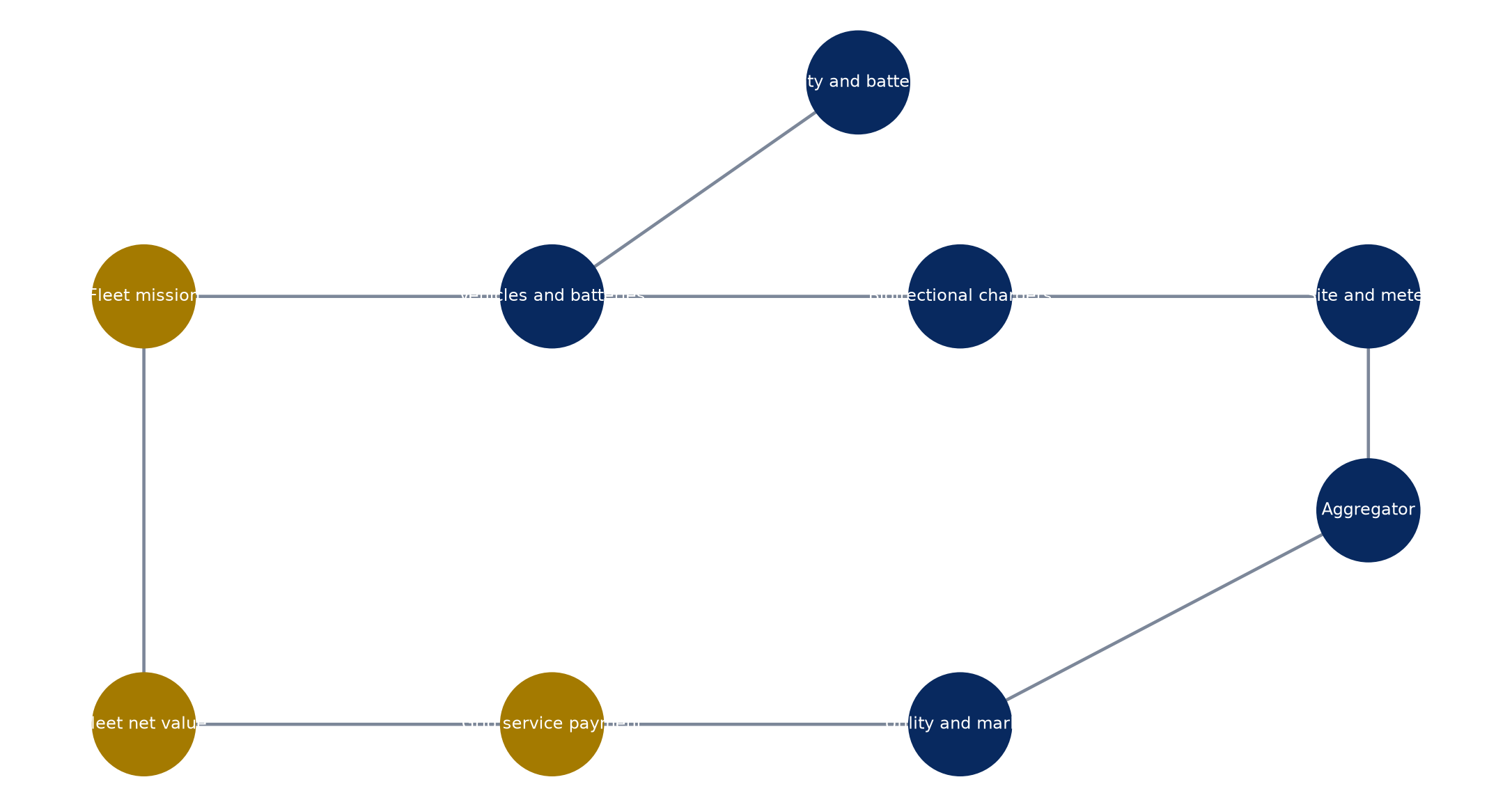
Proposed system map; actual market roles and legal rights vary by jurisdiction and contract.
5. Start with the connection window
A vehicle contributes flexibility only while plugged in and available. Build a connection schedule from telematics and depot records. Record arrival, departure, route assignment, energy consumed, required charge and exceptions by vehicle and day.
Measure connection probability rather than scheduled parking alone. Vehicles may return late, park at a different bay, fail to connect or leave for maintenance. Charger occupancy can also limit access. The dependable window is the overlap of physical connection, operational release and market availability.
Segment predictable fleets from variable fleets. School buses, transit buses, municipal fleets and stable return-to-base operations can have recurring windows. Emergency, long-haul or highly variable vehicles may provide a smaller dependable resource even with larger batteries.
6. Build the mobility reserve
Define a minimum departure state of charge for each route under conservative conditions. Include temperature, payload, traffic, detours, auxiliary loads, degradation and charging losses. Add an operational reserve for unplanned dispatch.
The reserve can vary by time and vehicle. A vehicle with no next-day assignment may offer more energy than one scheduled for an early long route. Controls should update automatically when dispatch changes.
Do not count the full battery nameplate. Available export equals usable state of charge above the protected reserve, limited by the next charging opportunity and battery operating limits. Report the reserve policy to drivers, fleet managers and the aggregator.
7. Convert batteries into dependable power
Grid services often require power for a specified duration, response speed and availability interval. Convert connected vehicle energy into deliverable power using charger ratings, vehicle limits, connection constraints and diversity.
Apply simultaneous-availability factors. A fleet of one hundred vehicles does not provide one hundred times the single-vehicle export rating when only part of the fleet is connected or the site connection is smaller. Include common-mode failures in switchgear, communications and software.
The dependable offer should survive the loss of the largest credible vehicle or charger group. Capacity offered to a market should be lower than the technical maximum unless non-delivery exposure is negligible.
8. Establish the interconnection right
Charging permission does not automatically include export permission. Confirm that the utility agreement, protection settings, meter and site electrical design allow bidirectional flow. Identify the export limit and whether it applies to gross vehicle export or net site flow.
The interconnection process may require studies, certified equipment, controls and operating procedures. A landlord or master-meter arrangement can complicate rights. Obtain consent and allocate upgrade cost before relying on revenue.
Record curtailment rights. A utility may limit export during network conditions. Revenue models should use the enforceable right rather than charger capability.
9. Verify vehicle and charger compatibility
V2G requires compatible hardware, software and communications across the vehicle and charger combination. ISO 15118-20 defines communication messages and sequence requirements for bidirectional power transfer.[3] Conformance to a standard supports interoperability while field testing remains necessary.
Maintain an approved combination list by vehicle model, software version, charger model and firmware. Test start, stop, power modulation, fault recovery, certificate management and dispatch response. Repeat tests after material updates.
Avoid assuming that a fleet purchase labelled bidirectional can participate with any charger or market platform. Procurement should make interoperability, updates and continued support contractual obligations.
10. Choose the initial service
Start with the service that best matches fleet availability and local rules. Managed charging may create savings with lower complexity. Building peak reduction can use site-specific load. Backup or microgrid support can have high resilience value but infrequent dispatch. Market services can offer recurring payments while imposing qualification and performance requirements.
Screen services by required availability, response speed, duration, dispatch frequency, metering, minimum size, penalty and price volatility. Match these to the fleet's connection profile.
Avoid pursuing every value stream simultaneously. Establish one service, prove operations and settlement, then add compatible services without double counting the same capacity.
Table 1. Fleet flexibility service screen
| Service | Primary value | Fleet requirement | Principal risk | Initial evidence |
|---|---|---|---|---|
| Managed charging | avoided energy and demand cost | flexible charging window | route conflict | interval load and tariff |
| Building peak support | avoided site peak | connection during site peak | site-load uncertainty | meter data and control test |
| Resilience or microgrid | avoided interruption | islanding and protected reserve | infrequent value realisation | outage plan and technical test |
| Energy export | price spread | export right and energy window | efficiency and price | interconnection and settlement |
| Capacity | availability payment | dependable seasonal commitment | non-delivery | qualification and contract |
| Ancillary services | performance payment | fast accurate response | telemetry and degradation | market test and dispatch history |
Proposed screening framework; market rules and commercial terms vary by location.
11. Understand market eligibility
Electricity-market access depends on jurisdiction, market design and resource classification. In US organised wholesale markets, FERC Order 2222 seeks to enable distributed energy resources to participate through aggregations, subject to regional implementation, locational, metering, telemetry and coordination rules.[4]
Eligibility should be confirmed for the fleet's exact location and service. A policy objective or approved framework does not prove that registration is open, that the aggregator has completed qualification, or that the site can provide the product.
Record minimum size, bidding interval, telemetry, baseline, testing, availability and penalty terms. Obtain written confirmation from the responsible market participant or utility before including revenue in a base case.
12. Separate wholesale, retail and site value
The fleet can interact with retail tariffs, utility programmes and wholesale markets. Each layer has different settlement and regulatory treatment. A retail demand response payment may coexist with managed charging, while wholesale participation can require an aggregator and restrictions against duplicate compensation.
Map every payment to a measured action. Identify the paying counterparty, governing tariff or contract, and responsible participant. Clarify whether the fleet retains environmental attributes or other credits.
FERC Order 2222 requires coordination and addresses participation in multiple programmes while avoiding double counting.[4] The commercial model should apply the same principle even outside that jurisdiction.
13. Define the aggregator's role
An aggregator combines resources, forecasts availability, bids into a programme or market, dispatches assets, receives settlement and allocates proceeds. Its contract can determine whether headline market value reaches the fleet.
Review revenue share, fixed fees, minimum term, exclusivity, performance allocation, data rights, credit support, termination and change of control. Confirm which party bears imbalance, non-delivery and market-registration risk.
Require transparent settlement statements showing gross market revenue, penalties, fees, losses and net fleet payment. Preserve audit and data-export rights. The fleet should be able to reconcile vehicle activity to cash.
14. Build the availability waterfall
Begin with installed battery energy. Deduct vehicles away from site, unavailable vehicles, mobility reserve, state-of-charge limits and battery operating buffers. Apply charger and connection power limits, site load, efficiency and market derating.
The resulting quantity is service-specific. A one-hour energy product, a four-hour capacity obligation and a fast frequency response have different constraints. Calculate each interval rather than using an annual average.
Report technical, qualified, offered and delivered capacity separately. This exposes where value is lost and which investment can improve it.
15. Forecast dispatch frequency
Revenue and battery cost depend on how often the service is called. Use historical market or programme data where available, while recognising rule and price changes. A capacity contract may pay for availability with infrequent energy dispatch; arbitrage can cycle batteries daily.
Model dispatch duration, depth, time of day and seasonal concentration. Link the event to route schedules and recharge capability. A fleet may deliver an evening peak and still need time to recharge before morning.
Stress unusually frequent events and consecutive days. The operating plan should protect mobility even when dispatch exceeds the average.
16. Model efficiency and energy replacement
Exported energy must usually be replaced before transport. Include vehicle-to-charger, charger-to-grid and recharge losses. Price the replacement energy at the actual tariff and time, not the original charging cost alone.
The round-trip spread can eliminate arbitrage margin when market prices are close. Demand charges or export tariffs can alter the result. Building-level netting may have different economics from gross export.
Measure delivered energy at the settlement point and reconcile it to battery state of charge. The model should show gross receipt, replacement cost, losses and net energy margin.
17. Price battery degradation
Additional energy throughput and time at high or low state of charge can affect battery ageing. The effect depends on chemistry, temperature, power, depth of discharge, calendar age and control strategy. A flat cost per kilowatt-hour can be a useful screen and should not replace vehicle-specific evidence.
Review manufacturer warranty terms and confirm that bidirectional operation is permitted. Allocate loss of warranty, accelerated replacement and data access. Track state of health before and during the programme.
Optimise dispatch against net value after degradation. Low-value events can be rejected when battery cost, replacement energy and penalties exceed revenue.
18. Protect warranty and residual value
Vehicle procurement should specify authorised V2G use, charger combinations, software, throughput limits and warranty treatment. Obtain written confirmation where programme operation could affect coverage.
Residual value may benefit from documented battery care or decline if buyers perceive extra cycling. Preserve granular charging and discharging history, thermal exposure, faults and state of health. Make data transferable with the vehicle.
If an aggregator controls dispatch, require compliance with warranty limits and indemnity for unauthorised operation. Establish an approval process for material strategy changes.
19. Establish metering and telemetry
Settlement requires accurate measurement at the correct point and interval. Identify vehicle, charger, site and revenue meters and reconcile differences. Meter standards and data latency depend on the service.
Telemetry should show availability, state of charge, dispatch instruction, response, delivered power and exceptions. Secure time synchronisation and data retention. Define treatment of missing data.
The market participant, utility and fleet may need different data. Establish access and confidentiality while preserving auditability. A black-box monthly payment is insufficient for financed revenue.
20. Test the control hierarchy
Fleet dispatch, site energy management, charger control, aggregator dispatch and utility limits can issue competing commands. Define priority and arbitration. Safety and mobility reserve should remain protected.
Test normal and failure modes. Simulate a route change during a market event, loss of communications, charger fault, export curtailment and emergency vehicle release. The system should fail to a safe state without trapping vehicles.
Document manual override and notification. Frequent overrides indicate that the service design does not match fleet operations and should reduce dependable capacity.
21. Build a revenue stack without double counting
A vehicle can create managed-charging savings, site peak reduction, capacity payments, ancillary-service receipts and energy revenue. The same kilowatt cannot necessarily serve all products at the same time. Create an interval allocation of capacity and energy.
Apply programme restrictions and baseline rules. A reduction from an uncontrolled charging baseline may conflict with a wholesale export claim. Resilience reserve may be unavailable for daily arbitrage.
Present gross and net value by stream. Remove aggregator fees, penalties, replacement energy, degradation, maintenance, software and incremental capital. The residual is fleet value.
22. Distinguish contracted and merchant revenue
Contracted availability or capacity payments can support fixed costs when the fleet meets defined obligations. Merchant energy and ancillary prices can vary materially. Performance bonuses can add upside, while penalties can create downside.
Classify revenue by counterparty, tenor, indexation, volume and termination. Use contracted minimums in the base case only after conditions are satisfied. Use conservative historical evidence and downside cases for merchant exposure.
Avoid capitalising a short pilot incentive as perpetual revenue. A programme funded to learn can expire before the fleet financing term.
23. Construct the base case
The base case should begin with eligible vehicles and connection windows. Apply mobility reserve, technical derating, qualification, expected dispatch and performance. Price the contracted service and conservative merchant component.
Deduct all incremental costs. Separate avoided charging cost from cash revenue. Include tax and accounting treatment only after professional review. Reconcile monthly value to vehicle and site data.
The base case should survive ordinary operating variance. Exceptional weather, perfect connection and uninterrupted eligibility belong outside it.
24. Stress the revenue drivers
Key sensitivities include connected vehicles, available hours, export power, market price, dispatch frequency, replacement energy, efficiency, degradation, aggregator share, penalty and equipment uptime. Stress correlated movements.
A high-price event can coincide with transport demand or a grid constraint that limits export. More dispatch can increase revenue and battery cost simultaneously. Low fleet utilisation can increase connected availability while weakening the core transport business.
Show break-even price and minimum availability. Identify the variables controlled by the fleet and those set by the market or utility.
Table 2. Hypothetical annual V2G revenue sensitivity
| Metric | Base case | Downside | Severe case | Proposed control |
|---|---|---|---|---|
| Qualified connected capacity | 10 MW | 7 MW | 4 MW | staged recognition |
| Paid availability | 82% | 68% | 50% | fleet and charger covenant |
| Gross grid-service receipts | 100 | 64 | 35 | contracted floor where available |
| Replacement energy and losses | 18 | 17 | 15 | tariff and dispatch optimisation |
| Battery degradation allowance | 12 | 14 | 16 | dispatch hurdle and warranty limits |
| Aggregator, software and meter fees | 15 | 13 | 11 | fee cap and audit rights |
| Penalties and failed dispatch | 3 | 8 | 14 | conservative offer and redundancy |
| Net fleet value | 52 | 12 | -21 | reserve and stop-loss trigger |
Wholly hypothetical; values are illustrative units and describe no identified fleet, tariff, programme or market.
25. Recognise V2G revenue in stages
Stage one recognises no revenue and records technical capability. Stage two recognises an option after successful interoperability testing. Stage three permits limited upside after interconnection and market qualification. Stage four recognises contracted revenue after conditions precedent. Stage five considers recurring cash flow after verified operating history.
Each stage should have evidence and a valuation treatment. This creates a disciplined bridge from technology potential to financeable revenue. It also permits progress without forcing an early binary conclusion.
Debt sizing should lag technical possibility. A lender can require a coverage haircut, cash trap or reserve until delivery history is established.
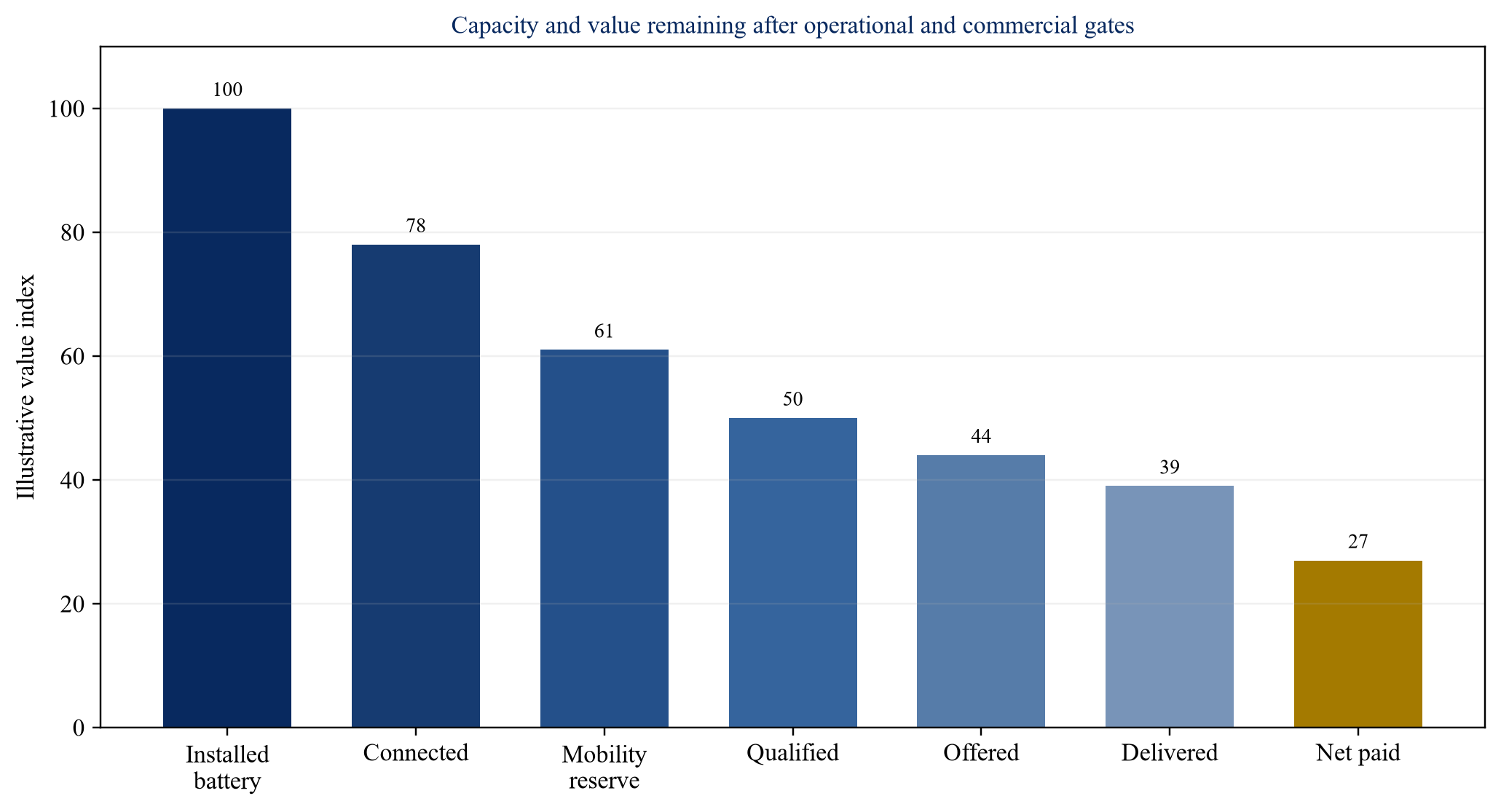
Wholly hypothetical; the chart illustrates evidence gates and describes no identified fleet or market.
26. Structure fleet and aggregator contracts
Define eligible assets, service, availability, dispatch, performance, settlement, fees, penalties, warranty limits and data. State the fleet's mobility priority and withdrawal rights. Specify the aggregator's bidding discretion and risk limits.
Address exclusivity carefully. An exclusive contract can block future services or replacement. Limit exclusivity by site, vehicle, service and term. Preserve termination for lost qualification, persistent underpayment or performance failure.
Require credit support if the aggregator receives market cash before paying the fleet. Define treatment of negative prices, market rule changes and suspended programmes.
27. Allocate non-delivery risk
Non-delivery can arise from vehicle absence, low state of charge, charger failure, site constraint, communications, aggregator error or utility curtailment. Attribute events using telemetry and agreed rules.
The party controlling the cause should bear the consequence within negotiated limits. Aggregate penalties should not expose the fleet to losses far above expected revenue. A conservative offer and reserve can reduce risk.
Dispute resolution should be fast because market settlements can recur daily. Preserve raw data and clock synchronisation to support attribution.
28. Address distribution-network constraints
Export can create voltage, protection or thermal issues on the local network even when the wider market values flexibility. The utility may impose an export limit or dynamic operating envelope. Model the site under both import and export conditions.
Local constraints can also create value if the utility procures targeted flexibility. That value depends on location, timing and an approved programme. Do not assume a general market price captures it.
Coordinate aggregator dispatch with utility limits. A wholesale instruction should not breach the distribution agreement. Automated controls and clear hierarchy are essential.
29. Use V2B and resilience as separate cases
Vehicle-to-building can reduce site demand or energy cost without exporting beyond the meter. It may face a simpler market path while still requiring compatible equipment and controls. Compare it with stationary storage and managed charging.
Resilience value depends on outage probability, critical load, islanding capability and avoided loss. It may be economically material and infrequent. Avoid treating a resilience estimate as annual cash revenue.
CPUC pilots distinguish residential, commercial and microgrid use cases and are designed to test customer and grid value, barriers and scalability.[5] The investment model should preserve these distinctions.
30. Compare mobile and stationary storage
Fleet batteries are funded primarily for mobility and can earn incremental value during dwell. Stationary storage can remain connected, dispatch more predictably and avoid route constraints. The appropriate choice depends on service and site.
Compare capital already committed, incremental bidirectional equipment, available hours, degradation, warranty, replacement and control. Avoid treating vehicle battery cost as free when additional cycling consumes economic life.
A hybrid design can use stationary storage for firm delivery and vehicles for flexible upside. This may improve dependability while adding capital and complexity.
31. Integrate tax, accounting and legal review
Grid-service receipts can have tax, licensing, energy-sale and accounting implications. Vehicle leases may restrict battery use or assign energy rights. Grant and subsidy agreements may contain operating conditions.
Obtain jurisdiction-specific advice before final contracts. Determine revenue recognition, asset treatment, VAT or sales tax, withholding and environmental attributes. Confirm whether market participation requires registration or licensing.
The commercial model should show pre-tax operating economics and keep unverified tax benefits outside the base case.
32. Address cyber and operational security
V2G increases control connections among vehicles, chargers, site systems, aggregators and grid entities. A compromised instruction can affect mobility, batteries or grid operation. Security is a service requirement.
Define identity, certificates, access, encryption, patching, monitoring and incident response. ISO 15118-20 includes communication requirements relevant to bidirectional transfer.[3] Apply current security practice across the full system.
Maintain a safe local mode and manual release for vehicles. Test restoration after lost communications or platform failure. Contract suppliers to notify vulnerabilities and support updates.
33. Protect data rights
V2G operation generates route, connection, battery, dispatch, tariff and settlement data. The fleet needs sufficient rights to audit revenue, protect warranty and change provider. The aggregator needs data to forecast and bid.
Define ownership, permitted use, retention, export and deletion. Restrict use of commercially sensitive route or customer information. Provide lenders or investors with aggregated evidence where appropriate.
Data portability reduces lock-in. Require standard exports of vehicle availability, instructions, responses, energy, faults and settlement.
34. Create an operating reserve
Revenue can be delayed, disputed or reduced by penalties. Battery or charger failures can create repair costs. Establish liquidity proportionate to settlement timing and performance exposure.
The reserve can be funded from initial capital or a share of receipts. Release it after stable operating history and lower exposure. Avoid using fleet maintenance cash to absorb grid-programme volatility.
If V2G supports debt service, the lender may require a revenue haircut, reserve or cash sweep. The control should reflect the contracted and merchant mix.
35. Establish performance covenants
Track connected availability, qualified capacity, successful dispatch, response accuracy, energy delivered, failed sessions, state-of-charge breaches, battery health, gross revenue, deductions and net value. Reconcile to fleet operations.
Set thresholds for remediation, reduced market offer and suspension. A mobility breach should trigger immediate review. Persistent negative net value should stop the service unless a separately approved resilience objective applies.
Report changes in market qualification, interconnection, warranty or aggregator credit. These can impair revenue before operational metrics change.
36. Build the risk-allocation matrix
Every material risk should have a controller, evidence, contract treatment and investor protection. Vehicle availability sits primarily with the fleet; market bidding with the aggregator; network permission with the utility; interoperability across vehicle, charger and platform providers.
Interface risk remains important because no single supplier may accept the complete outcome. Appoint an integrator and conduct end-to-end acceptance tests. Require cooperation during incident investigation.
Retained risks belong in contingency, pricing or the investment return. A label without a remedy does not transfer risk.
Table 3. Fleet V2G risk-allocation matrix
| Risk | Primary controller | Evidence | Contract control | Investor protection |
|---|---|---|---|---|
| Mobility availability | fleet operator | routes, telematics, dispatch | protected reserve and withdrawal rules | conservative offer and covenant |
| Interoperability | vehicle, charger and integrator | approved combinations and tests | warranty, updates and cure | holdback and replacement rights |
| Market eligibility | aggregator and market participant | registration and qualification | condition precedent and notice | no base-case recognition before approval |
| Grid export | utility and site owner | interconnection agreement | export limit and curtailment rules | site derating and change protection |
| Dispatch performance | aggregator and operator | telemetry and event history | service level and penalty attribution | reserve and offer haircut |
| Battery degradation | fleet and technology providers | state of health and throughput | operating limits and warranty | degradation allowance and stop rule |
| Settlement and credit | aggregator and payer | statements and credit review | audit, payment timing and security | cash control and termination |
Proposed allocation principles; actual rights depend on contracts, market rules and law.
37. Test aggregator credit
The fleet may perform before receiving payment. Review the aggregator's capital, market access, settlement history, insurance and dependence on a single programme. Understand whether customer cash is segregated.
Use payment timing, security, trust or direct-settlement mechanisms where feasible. Limit unpaid exposure and preserve termination after default. Audit the calculation rather than accepting a summary amount.
Market eligibility can be valuable and should not justify unlimited counterparty risk. Keep data and equipment portable so a replacement aggregator can qualify.
38. Plan for market-rule change
Programmes, tariffs and qualification can change during the fleet life. Model expiry, lower price, revised baseline, higher telemetry cost and new penalty. Avoid financing a long-lived asset solely on a short rule.
Contracts should address change in law and market rules. The parties can adjust service, fees or exit when economics change materially. Protect the fleet's ability to use managed charging or building value if wholesale access weakens.
Review the market annually and before each vehicle or charger expansion. A proven service can remain merchant and volatile.
39. Design the pilot to answer investment questions
A pilot should test the uncertainties that matter to capital. Define compatible vehicles, connection windows, export rights, services, dispatch, measurement, battery impact, settlement and operating burden. Set success thresholds before starting.
Use representative routes and seasons. A laboratory test proves communication and cannot establish annual availability. Run enough events to observe faults, late returns and consecutive dispatch.
The output should be an investable data set: delivered capacity, availability, net revenue, costs, mobility exceptions and state-of-health change. Publish only claims supported by evidence and permissions.
40. Scale by vehicle cohort
Expand first within vehicle and charger combinations already proven. New models, firmware or sites require admission tests. Standardisation can reduce integration cost while increasing correlated supplier risk.
Use cohorts with similar routes and dwell. A mixed fleet can diversify availability, yet aggregation logic becomes more complex. Preserve asset-level data.
Scale market offers more slowly than installed capacity until performance is established. This protects against non-delivery during rapid fleet growth.
41. Build the implementation roadmap
During the first ninety days, map routes, connection windows, tariffs, site rights and candidate services. Confirm interconnection and identify compatible vehicle-charger combinations. Establish the mobility reserve.
During months four to nine, complete end-to-end testing, contract an aggregator where required, qualify the resource and run a controlled pilot. Reconcile every dispatch to transport and settlement.
During months ten to twenty-four, move from technical option to contracted service, expand proven cohorts and establish operating covenants. Recognise recurring revenue only after verified performance meets the approved threshold.
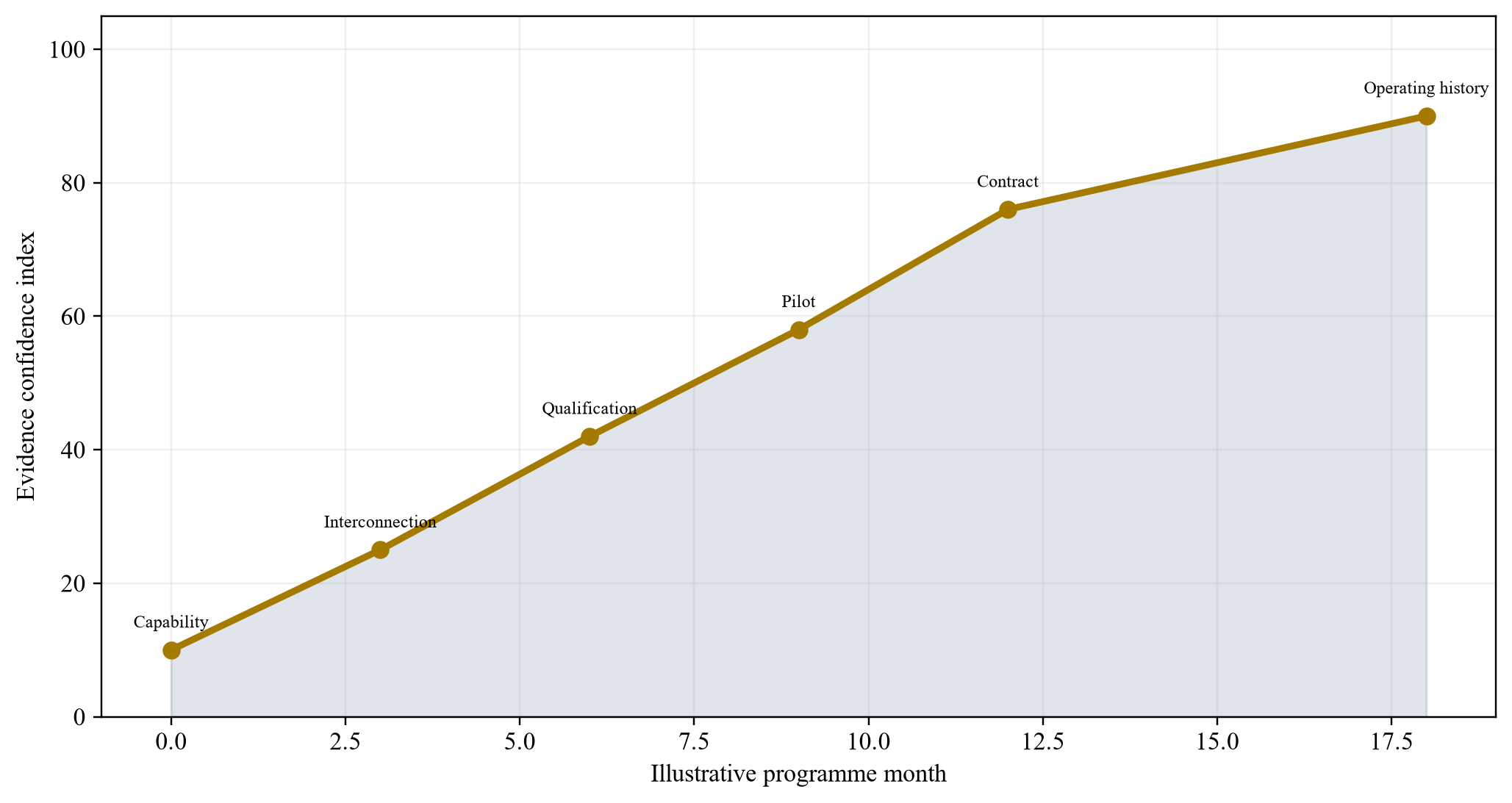
Proposed implementation gates; timing depends on equipment, utility, market and fleet conditions.
42. Apply an investment-committee test
The committee should receive the core fleet case and the incremental V2G case separately. The pack should show routes, availability, mobility reserve, compatible assets, interconnection, service eligibility, aggregator contract, revenue model, battery cost, downside and implementation.
Approval should answer five questions. Does the service preserve transport? Is deliverable capacity measured conservatively? Is there a lawful and qualified path to payment? Does net value remain positive after all costs and penalties? Can the fleet exit without impairing charging or warranties?
Conditions should follow missing evidence. The committee can approve technical readiness, pilot capital or commercial scale separately. Revenue recognition should advance only when the corresponding gate is verified.
43. Limitations
The framework is general and does not replace electrical engineering, interconnection, market qualification, legal, tax, accounting, battery or warranty advice. Market rules, prices, technology and vehicle operations can change. Site-specific evidence should govern each decision.
All numerical exhibits are hypothetical and describe no identified fleet, aggregator, utility, tariff, market or financing. They should not be used as forecasts or valuation inputs without independent verification and adaptation.
Evidence from the United States, California and international bodies illustrates current market and technology development. Local regulation, grid structure and fleet practice determine application elsewhere.
44. Conclusion
Vehicle-to-grid can create value when mobile batteries are connected, operationally released, technically compatible, permitted to export, qualified for a service and paid under clear rules. Installed battery capacity is the beginning of the analysis. Dependable revenue is the quantity left after mobility, connection, market, performance and cost gates.
Managed charging usually provides the first low-complexity value. Building support, resilience and market services can follow where fleet schedules and local rules support them. Contracted availability can improve dependability, while merchant energy arbitrage remains exposed to price, efficiency, degradation and dispatch.
Investors should recognise V2G in stages. Technical capability creates an option. Interconnection and qualification create access. A contract creates defined payment rights. Operating history establishes recurring net cash flow. This discipline allows fleets to capture grid value while protecting the transport mission that funded the batteries.
Appendix A Investment-committee questions
1. Which vehicles, chargers and software versions are bidirectionally compatible?
2. What connection windows are supported by actual fleet data?
3. What mobility reserve protects each route and contingency?
4. How much capacity remains after all technical and operating derating?
5. Does the interconnection agreement permit export?
6. Which service is available and what are its qualification rules?
7. Has the vehicle-charger-aggregator combination passed end-to-end testing?
8. Which party controls bidding, dispatch and penalties?
9. How are wholesale, retail and site values separated?
10. What replacement-energy, efficiency and degradation costs apply?
11. Does the vehicle warranty permit the proposed operation?
12. How are metering, telemetry and settlement reconciled?
13. What portion of revenue is contracted and what remains merchant?
14. What happens after market-rule or tariff change?
15. Can the fleet replace the aggregator and retain its data?
16. Which thresholds reduce offers, suspend service or require remediation?
17. Does the downside remain acceptable without V2G revenue?
18. What evidence is required before revenue enters debt sizing or valuation?
References
- International Energy Agency, Vehicle-to-grid technology, Global EV Outlook 2026, 20 May 2026. https://www.iea.org/reports/vehicle-to-grid-technology
- US Department of Energy, Vehicle-Grid Integration Assessment Report, January 2025. https://www.energy.gov/sites/default/files/2025-01/Vehicle_Grid_Integration_Asseessment_Report_01162025.pdf
- International Organization for Standardization, ISO 15118-20:2022, Road vehicles, vehicle to grid communication interface, Part 20. https://www.iso.org/standard/77845.html
- Federal Energy Regulatory Commission, Order No. 2222 Explainer: Facilitating Participation in Electricity Markets by Distributed Energy Resources, accessed 2 October 2026. https://www.ferc.gov/ferc-order-no-2222-explainer-facilitating-participation-distributed-energy
- California Public Utilities Commission, Vehicle-Grid Integration Activities, accessed 2 October 2026. https://www.cpuc.ca.gov/vgi/
- California Public Utilities Commission, PG&E V2X Pilots Summary, September 2025. https://www.cpuc.ca.gov/-/media/cpuc-website/divisions/energy-division/documents/transportation-electrification/energization/pge-v2x-pilots-summary-202509.pdf
- California Public Utilities Commission, 2026 Vehicle-Grid Integration Forum combined materials, April 2026. https://www.cpuc.ca.gov/-/media/cpuc-website/divisions/energy-division/documents/transportation-electrification/energization/vgi/2026-vgi-forum-combined-deck-all-slides_20260417.pdf
- Federal Energy Regulatory Commission, Order No. 2222 Fact Sheet, 28 September 2020. https://www.ferc.gov/media/ferc-order-no-2222-fact-sheet
- International Energy Agency, Grid Integration of Electric Vehicles, 2022. https://www.iea.org/reports/grid-integration-of-electric-vehicles/executive-summary
- International Energy Agency, Electricity 2026: Flexibility, 2026. https://www.iea.org/reports/electricity-2026/flexibility
- US Department of Energy, LPO Announces Conditional Commitment to Zum Services for Battery-Electric School Buses with V2G Capability, 2025. https://www.energy.gov/edf/articles/lpo-announces-conditional-commitment-zum-services-inc-deploy-battery-electric-school
- California Public Utilities Commission, Decision approving PG&E Vehicle-Grid Integration pilot programmes, 5 May 2022. https://docs.cpuc.ca.gov/PublishedDocs/Published/G000/M474/K173/474173490.PDF
- US Department of Energy, Alternative Fuels Data Center, Massachusetts School Fleets Get Answers through Electric Bus Testing, 17 July 2020. https://afdc.energy.gov/case/3092
- International Energy Agency, Global EV Outlook 2026: Executive Summary, 20 May 2026. https://www.iea.org/reports/global-ev-outlook-2026/executive-summary
About the Author
Authored by Chennakeshav Adya Independent Researcher
Chennakeshav (CK) is a corporate finance and investment banking executive with 25+ years of global experience in deal origination, structuring and execution across M&A, growth capital and corporate strategy. He has led value-creation mandates for founders, corporates and funds — bridging the boardroom view to hands-on execution and close.
His career spans Morgan Stanley, HSBC, Lloyds Banking Group, EWEC, ADQ portfolio companies and Emirates Growth Fund, across TMT, real estate, fintech, deeptech, cleantech, infrastructure and energy. He has partnered with C-suite leaders, private equity and venture funds, sovereign wealth funds and family offices to finance complex fund raises and scale-up ventures, and has led M&A due diligence, post-merger integration and business-transformation initiatives to create value.
At Matchpoint Partners he is Managing Partner, leading the firm's corporate finance, M&A and capital-raising practice. He holds an MBA from London Business School, an engineering degree from VTU and a Master of Laws (LLM, in progress) from UCL London.
An active start-up mentor, CK mentors at Techstars, DIFC FinTech Hive, Startup Grind, Founder Institute and IN5, serves as Entrepreneur Mentor in Residence (EMiR) at London Business School, and judges the Entrepreneurship World Cup.
Matchpoint profile: https://www.matchpoint-partners.com/team/ck-adya.html LinkedIn: https://www.linkedin.com/in/ckadya/
