

1. The investment decision
The decision is not simply how much desalination capacity to build. The authority must decide which combination of production, storage, conveyance, interconnection and demand management delivers the required service at acceptable lifecycle cost and risk. A plant with low unit cost can still be a weak investment if it cannot reach customers when needed or spends long periods underused.
The framework begins with service obligations: normal supply, peak demand, planned maintenance, sudden plant loss, source contamination and prolonged emergency. Capacity should then be assigned to those obligations and priced according to the control, availability and duration required.
2. Treat the assets as one system
Desalination, tanks, aquifer storage, pumps, transmission mains and network interconnections form a single operating system. Their interfaces determine usable output. Nameplate production without injection capacity, storage space or network transfer capability does not equal deliverable water.
The finance model should therefore reconcile every unit of production to a destination, a storage movement or a permitted curtailment. The operating model should use the same boundaries as the contracts and financing documents.
3. Demand is a profile
Annual demand conceals the shape that drives investment. Daily peaks, seasonal heat, tourism, industrial loads, irrigation, network losses and emergency restrictions can produce different operating requirements even when annual volume is unchanged. Forecasts should show hourly or daily demand where dispatch matters and monthly demand where seasonal storage matters.
Demand cases should separate observed consumption, committed connections, policy targets and management estimates. A single growth percentage provides insufficient evidence for a long-lived plant.
4. Production is also a profile
Reverse-osmosis plants can be designed for relatively stable output, flexible operation or a defined operating range. Intake conditions, membrane trains, energy-recovery systems, pretreatment, post-treatment and pumping affect ramping and minimum load. A plant that can technically reduce output may face higher unit cost, membrane stress or water-quality constraints.
The dispatch case should use tested operating envelopes and vendor evidence. Financial flexibility should not exceed physical flexibility.
5. Define the reserve objective
A strategic reserve protects a stated service through a stated disruption. The target may be full demand for a short interruption, essential demand for a longer event or staged service for an extreme emergency. The reserve definition should identify customer classes, quality, withdrawal rate, replenishment time and network reach.
Volume alone is insufficient. A reserve that cannot be recovered at the required rate or delivered through an available corridor may not meet the service objective.
6. Portfolio planning
The World Bank's work on desalination and reuse places unconventional supply within a broader portfolio rather than treating it as an isolated source [1][2]. Portfolio planning compares cost, reliability, correlation and flexibility across sources. Storage changes the portfolio because it can move supply between periods and preserve water when production exceeds immediate demand.
The authority should evaluate marginal system value rather than average plant cost. The next unit of capacity may avoid a shortage, replace a high-cost peaker or remain idle.
7. The production-storage-demand map
Every flow should pass through a controllable and measurable interface.
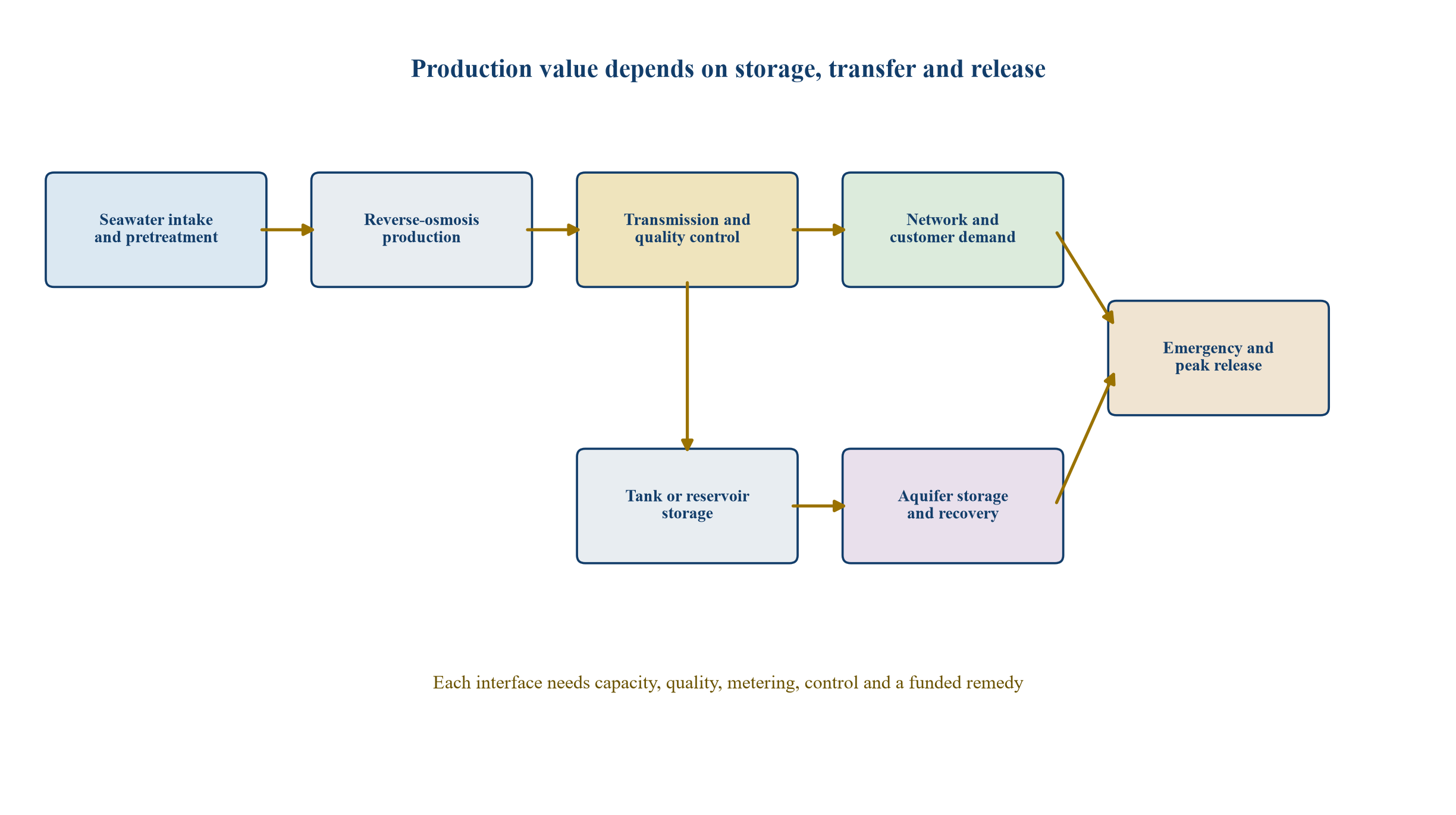
Generic structure; actual assets, rights, quality controls and dispatch authority depend on the relevant system and jurisdiction.
8. Build a dispatch stack
The dispatch stack orders resources by service role and marginal system cost. Existing efficient production may run first, followed by contracted reverse-osmosis capacity, stored water, interconnection imports, flexible production and emergency resources. The order changes when storage is full, an outage is probable or reserve requirements bind.
Dispatch rules should be explicit enough for budgeting and finance while preserving operator authority for public health and emergencies.
9. Base production
Base production serves demand expected through most operating periods. It supports high utilisation and predictable fixed-cost recovery. Base capacity should remain below the level that repeatedly forces uneconomic curtailment or storage overflow.
The base case should include planned maintenance and realistic availability. Nameplate output multiplied by every hour of the year is not a credible revenue assumption.
10. Flexible production
Flexible production responds to demand, power conditions and storage state. Its value comes from optionality rather than continuous volume. Payment may therefore require a capacity component for availability plus a variable component when dispatched.
The contract should define start time, ramp rate, minimum run, minimum load, water quality after restart and permitted cycling. Unsupported flexibility can move operational risk to the project company.
11. Emergency replacement
Emergency production replaces unavailable supply after an outage, contamination event or network constraint. It may require black-start capability, independent power, protected intake, spare membranes, chemicals and priority access to transmission.
The economic case should compare the cost of maintaining this capability with the consequences of lost service. An emergency asset cannot be valued solely through expected annual volume.
12. Reserve replenishment
Reserve replenishment converts available plant output into future reliability. The plant produces more than current network demand and injects or transfers the difference into storage. Replenishment value depends on available storage space, injection rate, water compatibility and expected future need.
The dispatcher should avoid filling the reserve so early that later low-cost production must be curtailed, unless security policy requires full inventory.
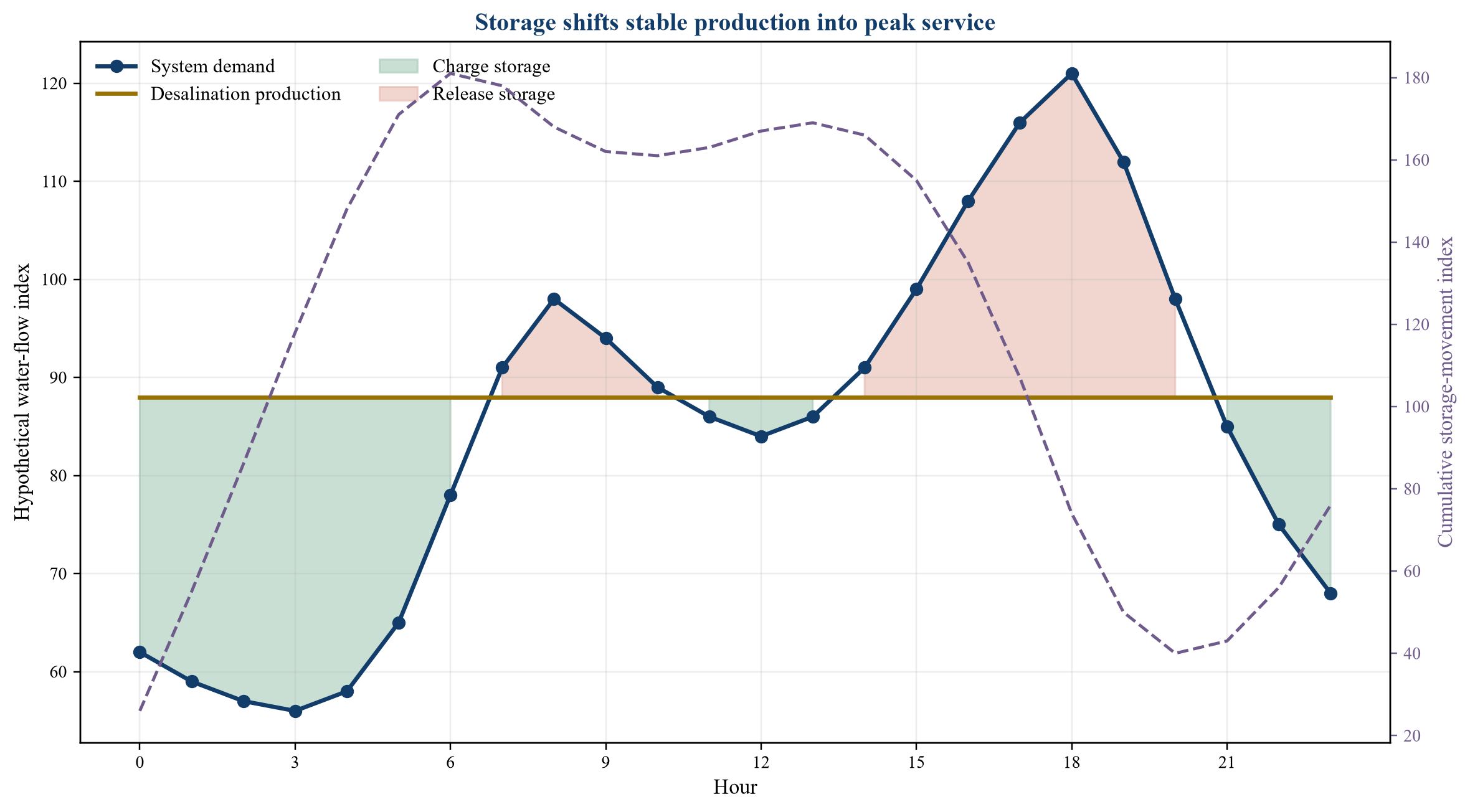
Illustrative operating profile only; actual dispatch depends on asset constraints, demand, power, quality and reserve policy.
13. The power-water interface
Electricity is a major operating input for reverse osmosis, intake, pumping and recovery. Power price, carbon intensity, grid congestion and outage risk can change the preferred production hour. A water portfolio with storage may shift some production toward lower-cost or lower-carbon periods.
The benefit depends on plant flexibility and storage headroom. A power-price opportunity has no value when the water system cannot accept additional output.
14. Renewable alignment
Renewable generation can support lower-carbon desalination when contractual and physical arrangements align. Hourly renewable output, grid settlement, curtailment rights and backup supply matter more than an annual certificate alone. Storage can widen the hours in which water production is useful.
The finance case should distinguish a fixed renewable tariff, a market-linked power price, a sleeved arrangement and an unbundled environmental attribute.
15. Water as operational storage
Stored water can provide a form of operational flexibility to the energy-water system. Producing water before a peak may reduce simultaneous electricity and water stress. This value should be assessed through actual dispatch constraints rather than described as equivalent to an electrical battery.
Conversion losses, pumping energy, storage loss and water-quality management remain part of the cost.
16. Storage options
Storage can include service reservoirs, large tanks, surface reservoirs, aquifer storage and recovery, managed aquifer recharge and network storage. Each option has different duration, footprint, loss, quality, discharge rate, construction risk and regulatory requirements.
The World Bank recommends integrated consideration of natural, built and hybrid storage [3]. Selection should follow the service requirement and local hydrogeology.
17. Service reservoirs
Service reservoirs support balancing, pressure and short-duration continuity near demand centres. Their value is high when network response must be rapid. Land, structural cost, evaporation, security and urban interface can constrain scale.
Reservoir sizing should reflect usable operating volume rather than gross volume. Fire reserve, dead storage and maintenance isolation may reduce dispatchable capacity.
18. Strategic tanks
Large tanks can provide controlled water quality and predictable recovery. They can be easier to meter and isolate than subsurface storage. Their capital cost, land requirement and exposure may increase with duration.
The authority should price inlet and outlet pumping, turnover, disinfection, mixing and periodic inspection. Stored inventory needs an operating protocol, not merely a completed civil asset.
19. Aquifer storage and recovery
The EPA defines aquifer storage and recovery as underground storage followed by recovery for beneficial use [4]. ASR can offer large storage volume with a limited surface footprint. Its feasibility depends on the aquifer, injected water, well design, water-quality reactions and regulation.
Recovery is a technical process rather than an accounting withdrawal. Yield, rate and quality should be established through testing and monitored over repeated cycles.
20. Strategic precedent
DEWA has disclosed a strategic ASR programme designed to store desalinated water underground and recover it during emergencies [5]. Its public materials describe the connection between reverse-osmosis production, surplus water and strategic reserve.
The precedent demonstrates the system concept. It does not establish the cost, yield or design of a different site. Each project requires local evidence.
21. Physical interconnection
Interconnection can substitute for some local reserve by allowing systems to support one another. The connection needs hydraulic capacity, compatible quality, metering, operating protocols and firm emergency rights. A pipe with discretionary access is weaker than contracted capacity.
Correlation matters. Interconnection provides less protection when both systems depend on the same coastline, power source or vulnerable corridor.
22. Define reserve days carefully
Reserve days equal usable volume divided by the demand level protected, subject to recovery and network limits. Full-demand days, essential-demand days and extreme-emergency days are different products. The UAE Water Security Strategy 2036 states differentiated normal and emergency objectives [6].
The model should show the numerator, denominator and operating restrictions. Public statements about days of storage should not be imported into a project model without reconciliation.
23. Injection capacity
Injection capacity determines how quickly surplus production becomes reserve inventory. It can be constrained by well performance, aquifer pressure, conditioning, permits and maintenance. Slow injection may cause plant curtailment even when nominal storage volume is available.
The system model should test low-demand periods against injection capability. Storage volume without charging capacity can create stranded headroom.
24. Recovery capacity
Recovery capacity determines the rate at which stored water can meet demand. Multiple wells, pumps, treatment and network connection may be required to achieve the stated emergency service. Reliability should include common infrastructure and power.
The reserve contract should specify tested recovery capacity, availability, water-quality acceptance and restoration time after a well failure.
25. Cycle efficiency
Storage efficiency includes physical recovery, water that must remain to protect quality, treatment loss and operating consumption. The relevant measure is compliant water delivered to the network divided by water charged into storage.
Early cycles can differ from mature operation. Debt and tariff models should use demonstrated or conservatively supported assumptions and retain contingency for conditioning.
26. Hydrogeological diligence
Aquifer geometry, permeability, pressure, confining layers, native groundwater, nearby abstraction and geochemical conditions affect feasibility. USGS material highlights hydrogeological, geochemical and microbiological uncertainties in regional ASR [7][8].
Diligence should include drilling, logging, modelling, pilot injection, recovery testing and monitoring design. A regional map cannot replace site investigation.
27. Water compatibility
Injected desalinated water can interact with native groundwater and aquifer minerals. The programme should assess mobilised constituents, salinity, microbes, disinfection residual and recovered-water treatment. Blending may be needed before network entry.
The water-quality plan should define acceptance at injection, monitoring during storage, acceptance at recovery and the response to an out-of-specification result.
28. Permitting
Storage rights, injection approval, groundwater protection, abstraction, environmental assessment, land access and potable-water regulation may apply. The EPA regulates relevant injection wells in the United States through the Underground Injection Control programme [4].
Jurisdiction-specific advice is essential. The financing schedule should include permit dependencies, test periods and appeal risk.
29. Public-health priority
Emergency dispatch cannot compromise potable-water standards. Quality assurance, isolation, sampling and disinfection should operate under defined authority. A rapid release target needs a corresponding laboratory and online-monitoring protocol.
Contracts should preserve the authority's power to stop unsafe delivery. Compensation rules should distinguish project failure from a lawful precaution caused by an external event.
30. Inventory quality
Stored water ages. Tanks and reservoirs require turnover, mixing and residual control. Aquifer storage requires monitoring of residence time and recovered quality. Inventory policy should balance strategic duration with quality management.
The operating model can rotate inventory by blending stored water into routine supply. Rotation consumes pumping and treatment capacity and should be budgeted.
31. Demand hierarchy
Emergency planning should classify demand by public-health and economic priority. Hospitals, households, firefighting, essential industry and cooling may require different minimum service. The hierarchy should be approved before a crisis.
The release model should test whether physical network zones match policy priority. A central reserve cannot automatically direct water to every customer class.
32. Peak shaving
Storage can discharge during daily peaks and recharge during off-peak periods. This can reduce the production and transmission capacity needed solely for short-duration demand. Peak-shaving value equals avoided or deferred system cost, adjusted for storage cost and loss.
The analysis should use actual peak duration and recurrence. A short peak should not justify a full plant unless alternatives are constrained.
33. Seasonal shifting
Where demand varies by season, storage can move production from lower-demand months into higher-demand months. Aquifer storage may suit longer duration than service reservoirs, subject to recovery and quality.
The economic case should compare seasonal inventory with flexible plant operation, temporary interconnection, demand management and peaking capacity.
34. Planned maintenance
Storage can support demand while a plant, intake or transmission asset is maintained. This may allow more efficient maintenance windows and reduce redundant production. The reserve plan should account for maintenance of the storage asset itself.
Planned-use inventory should remain separate from the minimum emergency floor unless governance expressly permits overlap.
35. Sudden outage
An unplanned outage tests response time. Tanks may respond immediately while aquifer recovery ramps through wells and treatment. Interconnection may depend on counterpart availability. The portfolio should layer fast and long-duration resources.
The model should include detection, decision, start, transfer and network stabilisation, not merely the steady-state recovery rate.
36. Source contamination
Coastal contamination, harmful algal bloom, oil spill or intake damage can affect several plants. Geographic diversification, protected inventory and interconnection can reduce common-mode exposure. Storage filled before the event may provide critical separation from the source.
Risk assessment should consider how long the event persists and whether water quality or infrastructure limits restart.
37. Power failure
Desalination and pumping depend on electricity. Backup power for controls, critical pumps and recovery assets can preserve service while full production is unavailable. The reserve architecture should identify which components share substations, fuel and transmission corridors.
Debt and insurance analysis should test business interruption alongside public-service continuity.
38. Network failure
Water can be available and still fail to reach customers after a trunk-main or pumping-station outage. Distributed storage and alternate corridors may provide more resilience than a single large reserve.
Network criticality should therefore enter the capacity plan. The marginal reserve site may be chosen for deliverability rather than lowest storage cost.
39. Plant portfolio
Multiple plants can differ by technology, age, power arrangement, intake, location and flexibility. Dispatch should account for variable cost and risk contribution. Concentrating production in the cheapest plant can increase common-mode exposure or accelerate wear.
A portfolio reserve margin should be linked to credible outage size and repair duration.
40. Capacity timing
New capacity should enter when the system loses adequate headroom under tested demand and outage scenarios. Storage, interconnection and demand measures can defer a plant while maintaining service. Deferral value depends on reliability equivalence and remaining option life.
The decision should use staged commitments where uncertainty is high. Land, intake and connection rights can preserve a future option without building all trains immediately.
41. Price the service components
The complete price can include production availability, delivered volume, flexible dispatch, reserve replenishment, storage availability, injection, inventory stewardship, recovery availability, released volume and emergency mobilisation. Combining every service into a single unit tariff can obscure incentives.
Each component should correspond to a controllable obligation and measurable evidence.
42. Production capacity payment
A capacity payment supports fixed plant cost when compliant output is available for dispatch. It should define tests, planned outages, degradation, minimum load and deductions. The authority should avoid paying twice for capacity already committed elsewhere.
Fixed payment can support debt when the service is contracted over the financing term.
43. Variable production charge
The variable charge covers power, chemicals, membranes, consumables and other dispatch-linked cost. Indexation should reflect the cost exposure that the project actually bears. Pass-through can reduce risk while weakening efficiency if unmanaged.
Benchmarking and energy-performance tests can preserve incentives without transferring uncontrollable market risk.
44. Storage availability payment
Storage availability should reflect usable volume, injection capacity, recovery capacity, quality compliance and access rights. Gross civil volume alone is an incomplete performance measure.
Deductions should distinguish lost capacity, slow recovery, contamination and unavailable connection. Caps should preserve safe operation and debt service while retaining meaningful consequence.
45. Inventory stewardship charge
Long-duration storage requires monitoring, rotation, treatment, testing and reporting even when no emergency occurs. A stewardship charge can fund these obligations. Payment should follow verified activities and inventory condition.
The charge should not reward unnecessary cycling. The operating plan should define efficient maintenance of readiness.
46. Release payment
Released-water payment covers pumping, treatment, energy and wear when stored inventory is delivered. It may vary by source, lift and quality. Emergency pricing should be agreed before an event to avoid dispute.
The release tariff should avoid creating an incentive to withhold routine water or overuse protected inventory.
47. Dispatch rights
The authority needs the right to call production, injection and release within defined limits. The project needs notice, operating boundaries, compensation and relief when instructions conflict. Automated dispatch can operate within approved parameters.
Priority rules should resolve simultaneous calls for network supply, reserve charging and emergency release.
48. Curtailment rights
Curtailment determines who pays when production is available but cannot be accepted. If the authority controls demand and storage, capacity payment may continue. If the plant caused the constraint, deductions may apply.
Repeated curtailment can affect membrane operation and lifecycle cost. The contract should address minimum run and preservation procedures.
49. Storage floor
The reserve floor is the inventory that cannot be used for routine optimisation without specified approval. It protects emergency service and creates discipline around apparent surplus.
Governance should state who can release below the floor, which event qualifies and how the reserve will be replenished.
50. Storage ceiling
The ceiling can be lower than gross capacity because of quality, pressure, dead volume or operating buffer. Approaching the ceiling reduces the value of further surplus production.
Dispatch systems should forecast headroom and adjust plant schedules before physical overflow or uneconomic curtailment occurs.
51. Risk-allocation matrix
Risk should sit with the party controlling the relevant decision or able to absorb the consequence at lowest whole-system cost.
Table 1. Production-storage risk allocation
| Risk | Primary control | Typical owner | Contract mechanism |
|---|---|---|---|
| Demand forecast | Authority and system planner | Authority | Capacity commitment and review |
| Plant availability | Design, operator and maintenance | Plant company | Availability tests and deductions |
| Power price | Procurement and tariff design | Shared | Index, hedge or pass-through |
| Injection rate | Well design and aquifer response | Storage company, with site relief | Performance test and relief protocol |
| Recovery quality | Source quality, aquifer and treatment | Shared | Envelope, monitoring and treatment |
| Network constraint | Transmission operator | Authority | Deemed availability or curtailment payment |
| Emergency dispatch | Public authority | Authority | Call protocol and priority rules |
| Change in law | Government and adaptable design | Shared | Time and cost relief |
| Long-term demand change | Policy and customer behaviour | Authority | Reopener, staged capacity and option rights |
| Asset performance | Contractor and operator | Project company | Warranty, reserve and lifecycle covenant |
52. Capital-cost boundary
Capital cost should include the plant, intake, outfall, power connection, transmission, injection wells, recovery wells, treatment, storage, controls, land, development, financing and reserves. Excluding interface assets produces a misleading production price.
Contingency should reflect site evidence and contract maturity. A generic percentage cannot substitute for risk analysis.
53. Operating-cost boundary
Operating cost includes energy, chemicals, membranes, labour, maintenance, monitoring, laboratory work, pumping, residual management and reserve cycling. Storage may reduce production peaks while adding pumping and quality-management cost.
The model should allocate common costs consistently across normal supply and reserve services.
54. Hypothetical sources and uses
The following exhibit illustrates a combined plant and strategic-storage capital structure. It is a decision tool only.
Table 2. Hypothetical sources and uses for an integrated water SPV
| Uses | Index | Sources | Index |
|---|---|---|---|
| Desalination process and intake | 430 | Senior debt | 575 |
| Transmission and network connection | 145 | Concessional or subordinated debt | 115 |
| Storage, injection and recovery | 180 | Public viability or resilience funding | 90 |
| Development, permits and testing | 55 | Sponsor equity | 155 |
| Construction contingency | 75 | ||
| Interest and fees during construction | 50 | ||
| Initial reserves and working capital | 40 | ||
| Total uses | 975 | Total sources | 935 |
The illustrative funding gap of 40 demonstrates the need to reconcile complete uses and committed sources before financial close. Actual values require a project-specific model and financing plan.
55. Financing structure
An integrated project can use corporate finance, sovereign or utility borrowing, project finance, public-private partnership, green or sustainability-linked debt, development-finance support and blended finance. The structure should follow revenue, risk and control.
The Joint MDB Water Security Financing Report records substantial water-sector financing and the continuing need for investable structures [9].
56. Debt sizing
Debt should be sized against contracted, available service and conservative operating cost. Merchant demand, uncommitted emergency use and speculative power-market savings should remain outside base debt unless supported by enforceable revenue.
Coverage should be tested under plant outage, low utilisation, higher power cost, reduced recovery yield and delayed replenishment.
57. Revenue model
Revenue can combine fixed plant availability, storage availability, inventory stewardship and variable production or release. Fixed revenue supports fixed obligations. Variable revenue preserves operating incentives and passes measurable dispatch cost.
The model should avoid circularity in which debt service depends on discretionary dispatch controlled by the buyer without minimum payment.
58. Public funding
Public funding may support strategic-reserve benefits that customer tariffs do not fully compensate. The rationale should identify the public service purchased, value-for-money evidence and accountability. Funding should not conceal weak project design.
Grant and viability support should be committed, timed and conditional before debt sizing.
59. Utilisation sensitivity
The exhibit shows how plant utilisation and storage affect a hypothetical unit-cost index. Values are illustrative.
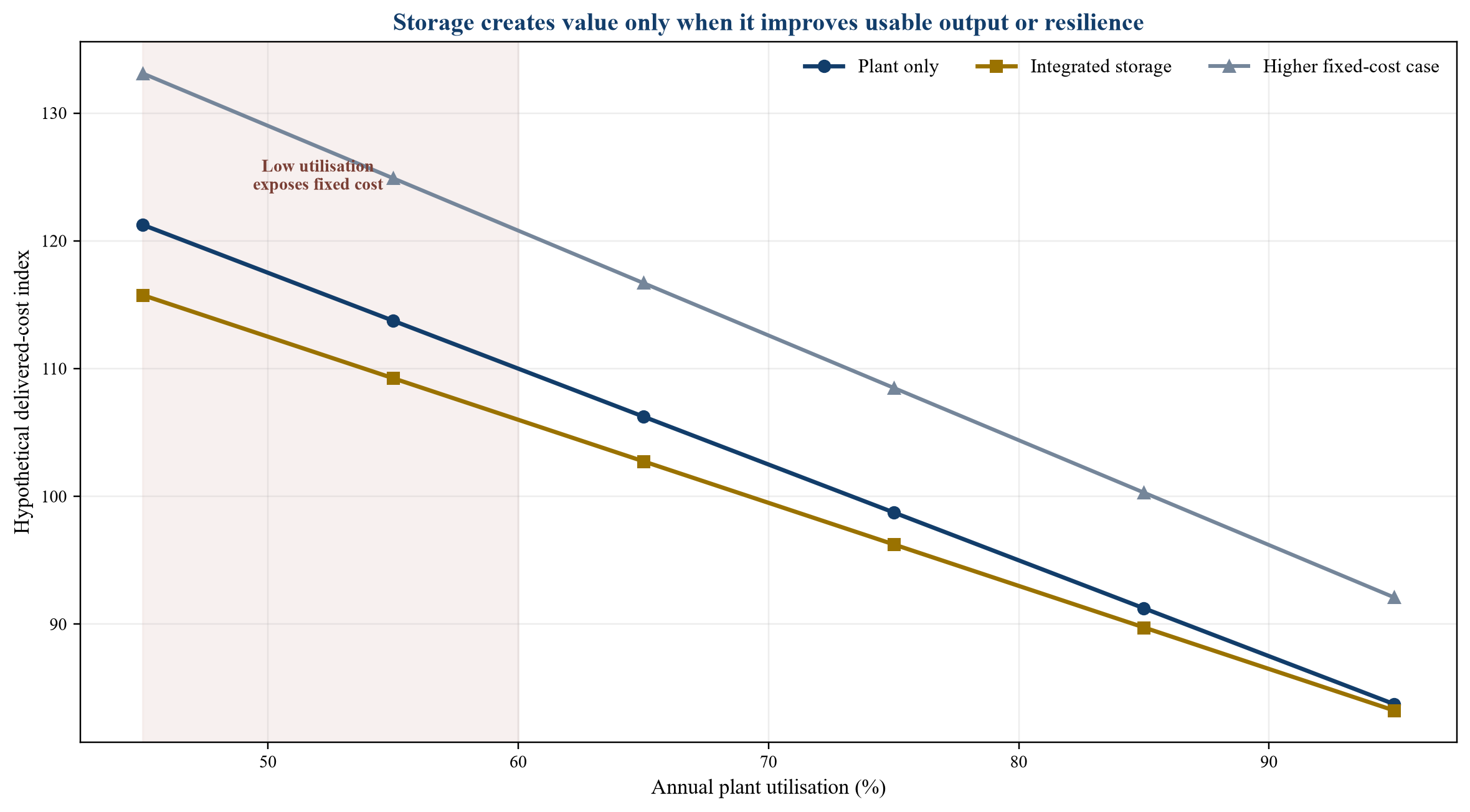
Illustrative index values only; not a forecast, tariff, valuation or project proposal.
60. Interpret utilisation carefully
Higher utilisation usually spreads fixed plant cost across more water. Storage can improve useful utilisation by accepting surplus production. It can also add cost without benefit when demand is flat, storage losses are high or production already follows demand efficiently.
The comparison should include avoided peaking investment and resilience value, not only plant-level cost.
61. Scenario set
At minimum, the model should test base demand, slow growth, accelerated growth, high seasonal peak, major plant outage, power shock, lower injection rate, lower recovery yield, quality treatment requirement and delayed new capacity. Combined scenarios reveal correlated weakness.
Each scenario should state whether it is observed, contracted, technical, policy-driven or a management estimate.
62. Capacity adequacy
Capacity adequacy measures whether available production, storage release and firm imports can meet demand after credible outages. The test should apply maintenance, derating and network constraints.
An annual surplus can coexist with an hourly or regional shortage. Adequacy therefore needs time and location.
63. Reserve adequacy
Reserve adequacy measures usable inventory and recovery capability against the protected demand sequence. It should account for deterioration, inaccessible volume and replenishment after a partial event.
A single reserve event may be followed by another before full recharge. The policy should define the acceptable recovery trajectory.
64. Membrane lifecycle
Operating pattern affects membrane replacement, cleaning and performance. Frequent starts, off-design operation and feedwater variation can change cost and availability. The lifecycle plan should use supplier data and operating experience.
Replacement reserves and performance guarantees should reflect the intended dispatch regime.
65. Intake and outfall
Intake availability and outfall compliance can constrain production irrespective of membrane capacity. Marine conditions, maintenance, environmental limits and shared infrastructure create risks.
Storage can protect service during a temporary intake event, but it does not cure an unresolved environmental or capacity constraint.
66. Brine and residuals
Concentrate management remains part of the complete system. Discharge permits, mixing, monitoring and energy affect operating cost. A flexible plant may change discharge timing and concentration.
Environmental compliance should be tested across the proposed dispatch range rather than only at steady nameplate operation.
67. Carbon accounting
Carbon analysis should use power consumed, generation mix, pumping, storage, treatment and losses. Shifting production can reduce or increase emissions depending on hourly power. Annual averages may hide the effect.
The project should disclose boundaries and avoid claiming a carbon benefit without evidence from the contracted power arrangement.
68. Environmental and social obligations
Plant and storage development can affect coast, land, groundwater, communities and cultural assets. Engagement, environmental assessment, monitoring and remedy should begin before procurement.
Aquifer protection and public-health safeguards remain central. Strategic importance does not remove environmental responsibility.
69. Procurement strategy
Procurement should present demand data, dispatch requirements, storage interfaces, site information, power assumptions, permits and draft contracts. Bidders need enough evidence to price flexibility and hydrogeological risk.
Evaluation should consider lifecycle system cost, resilience, technical compliance, financing certainty and contract qualifications.
70. Delivery models
The authority can procure separate design-build-operate packages, an independent water producer, a storage concession, an integrated PPP or utility-owned assets with service contracts. World Bank guidance links delivery model and financial structure to sector governance [1].
The chosen model should minimise unmanaged interfaces while preserving competition and public control of emergency service.
71. Independent water producer
An IWP can finance, build and operate contracted production. DEWA describes Hassyan as an IWP reverse-osmosis project supporting water security [10]. The project agreement typically needs capacity, output, availability, power and termination provisions.
If storage sits outside the IWP, dispatch and curtailment must connect the two contracts.
72. Integrated project company
One project company can deliver plant, connection and storage. Integration reduces some interface risk while expanding scope and technical complexity. Lenders require clear completion tests for every component.
Payment should avoid full capacity remuneration before the integrated service is available.
73. Separate storage company
A storage company can specialise in injection, inventory and recovery. The production company supplies water under a defined schedule. The authority or dispatcher coordinates both.
Direct agreements, quality interfaces and deemed-availability rules are essential when one project is ready and the other is not.
74. Completion tests
Completion should demonstrate production capacity, quality, ramp, injection rate, storage availability, recovery rate, treatment, network transfer and control integration. A paper test cannot prove the complete service.
Seasonal or cycle tests may extend beyond mechanical completion. Financing should provide enough liquidity for the evidence period.
75. Data architecture
The operator needs demand forecasts, plant status, energy price, storage level, well performance, quality and network constraints. Definitions should be common across control, billing and finance.
Data lineage should allow an invoice or availability deduction to be traced to measured events.
76. Digital dispatch
A digital twin or optimisation engine can propose production, storage and release schedules. Its objective function should include cost, reliability, reserve floors, quality and asset constraints. Human operators retain safety and emergency authority.
Model governance should cover data quality, validation, version control, override and audit.
77. Cybersecurity
Connected plants, wells and dispatch systems create cyber exposure. Segmentation, access control, monitoring, backup operation and incident response should protect continuity.
The financing case should include cyber resilience where loss of control can interrupt revenue or essential service.
78. Governance
A system committee should approve demand cases, reserve policy, dispatch rules, outage assumptions and investment gates. Responsibilities across water authority, power provider, network operator, plant companies and emergency agencies should be documented.
Unclear decision rights can leave every asset technically complete while the portfolio remains uncoordinated.
79. Contract management
Contract managers should monitor availability, dispatch instructions, storage inventory, security expiry, maintenance, claims and future demand. They should reconcile technical and financial models after material events.
Waivers and changes should state their impact on resilience, price and debt.
80. First 180 days
The first phase should map assets and interfaces, obtain demand and outage data, define protected service, screen storage sites, test hydrogeology, model dispatch, assess network transfer, define procurement options and open market engagement.
By day 180, the sponsor should know which uncertainties require pilots, which capacity can be staged and which revenue structure can support finance.
81. Due-diligence checklist
Diligence should cover demand, customer priority, existing supply, outage history, intake, power, network, storage site, injection and recovery tests, water quality, permits, land, environmental impact, contracts, cost, funding, financing, operations, cybersecurity and emergency governance.
Each conclusion should identify source, date, owner and remaining uncertainty.
82. Red flags
Red flags include plant capacity with no destination, storage volume with weak recovery rate, annual demand used for hourly sizing, untested aquifer assumptions, common-mode power or intake exposure, reserve days without a demand definition, variable-only revenue for fixed debt and emergency duties without funded readiness.
Each red flag requires evidence, redesign, contract support or reduced commitment.
83. Decision matrix
Table 3. Investment decision matrix
| Question | Evidence required | Proceed when | Rework when |
|---|---|---|---|
| Is new production required? | Time-based demand and outage model | Adequacy gap persists after alternatives | Annual average alone supports need |
| Can storage defer capacity? | Charge, duration and release model | Equivalent service is demonstrated | Recovery or network rate is inadequate |
| Is ASR feasible? | Site tests, quality and permits | Cycled recovery meets service | Yield or quality remains unsupported |
| Is flexibility valuable? | Dispatch and power scenarios | Savings exceed lifecycle effect | Plant constraints erase benefit |
| Can debt be supported? | Contracted fixed revenue and coverage | Availability revenue covers fixed obligations | Debt depends on discretionary volume |
| Is the reserve usable? | Tested release and customer delivery | Required demand receives compliant water | Gross volume is the only evidence |
84. Implementation roadmap
The programme should advance through service definition, data validation, concept design, site tests, portfolio modelling, commercial structure, market sounding, procurement, financing, construction, integrated commissioning and operating review. Gates should release capital only when the next uncertainty is sufficiently resolved.
Pilots and option rights can preserve speed while protecting against irreversible overbuild.
85. Conclusion
Desalination, storage and strategic demand belong in one investment case. The system must produce water, accept it, preserve its quality and release it through an available network when customers need it. Plant utilisation creates value only when output serves present demand, replenishes a useful reserve or avoids a credible future cost.
Authorities should define the protected service, model demand and outages in time and location, test storage physically, allocate dispatch rights and price each capacity service. Investors should rely on contracted availability, complete interface tests and conservative recovery assumptions. The strongest programme stages capital, preserves emergency authority and measures performance across the entire production-storage-demand chain.
References
- World Bank Group. Governance and Economics of Desalination and Reuse. https://www.worldbank.org/en/topic/water/publication/governance-and-economics-of-desalination-and-reuse
- World Bank Group. Governance and Economics of Desalination and Reuse, Volume 3: Evaluating Economic Viability Using Modern Portfolio Theory. https://documents1.worldbank.org/curated/en/099655507222510271/pdf/IDU-e88a99e6-f763-4c7d-b374-82fc30bba1bb.pdf
- World Bank Group. What the Future Has in Store: A New Paradigm for Water Storage. https://www.worldbank.org/en/topic/water/publication/what-the-future-has-in-store-a-new-paradigm-for-water-storage
- United States Environmental Protection Agency. Aquifer Recharge and Aquifer Storage and Recovery. https://www.epa.gov/uic/aquifer-recharge-and-aquifer-storage-and-recovery
- Dubai Electricity and Water Authority. DEWA Completes Construction of the First Stage of the Aquifer Storage and Recovery Strategic Project. https://www.dewa.gov.ae/en/about-us/media-publications/latest-news/2022/03/dewa-completes-construction-of-the-first-stage-of-the-asr-project
- Government of the United Arab Emirates. The UAE Water Security Strategy 2036. https://u.ae/en/about-the-uae/strategies-initiatives-and-awards/strategies-plans-and-visions/environment-and-energy/the-uae-water-security-strategy-2036
- United States Geological Survey. Artificial Groundwater Recharge. https://www.usgs.gov/mission-areas/water-resources/science/artificial-groundwater-recharge
- United States Geological Survey. Feasibility of Regional-Scale Aquifer Storage and Recovery: Scientific Uncertainties. https://water.usgs.gov/ogw/pubs/ofr0289/crg_feasibility.htm
- World Bank Group. Water Security Financing Report 2024. https://www.worldbank.org/en/topic/water/publication/water-security-financing-report-2024
- Dubai Electricity and Water Authority. Hassyan Seawater Reverse-Osmosis Project. https://www.dewa.gov.ae/en/about-us/strategic-initiatives/hassyan
- Abu Dhabi Department of Energy. Energy: A Strategic Sector Boosting Abu Dhabi's Comprehensive Development Plan. https://www.doe.gov.ae/Media-Centre/News/Energy-A-Strategic-Sector-Boosting-Abu-Dhabis-Comprehensive-Development-Plan
- Abu Dhabi Department of Energy. Our Objectives. https://www.doe.gov.ae/About-Us/Our-Objectives
- Dubai Electricity and Water Authority. DEWA Commissions 60 MIG Water Reservoir. https://www.dewa.gov.ae/en/about-us/media-publications/latest-news/2023/05/dewa-commissions-60-mig-water-reservoir
- United States Environmental Protection Agency. Water Efficiency for Water Suppliers. https://www.epa.gov/sustainable-water-infrastructure/water-efficiency-water-suppliers
- United States Environmental Protection Agency. Decision Support System for Aquifer Recharge and Aquifer Storage and Recovery Planning, Design and Evaluation. https://nepis.epa.gov/Exe/ZyPURL.cgi?Dockey=P100QVPA.TXT
- World Bank PPP Resource Center. Desalination Plant, Ensenada, Mexico Public Private Partnership. https://ppp.worldbank.org/water-and-sanitation/desalination-plant-ensenada-mexico
About the Author
Chennakeshav (CK) is a corporate finance and investment banking executive with 25+ years of global experience in deal origination, structuring and execution across M&A, growth capital and corporate strategy. He has led value-creation mandates for founders, corporates and funds — bridging the boardroom view to hands-on execution and close.
His career spans Morgan Stanley, HSBC, Lloyds Banking Group, EWEC, ADQ portfolio companies and Emirates Growth Fund, across TMT, real estate, fintech, deeptech, cleantech, infrastructure and energy. He has partnered with C-suite leaders, private equity and venture funds, sovereign wealth funds and family offices to finance complex fund raises and scale-up ventures, and has led M&A due diligence, post-merger integration and business-transformation initiatives to create value.
At Matchpoint Partners he is Managing Partner, leading the firm's corporate finance, M&A and capital-raising practice. He holds an MBA from London Business School, an engineering degree from VTU and a Master of Laws (LLM, in progress) from UCL London.
An active start-up mentor, CK mentors at Techstars, DIFC FinTech Hive, Startup Grind, Founder Institute and IN5, serves as Entrepreneur Mentor in Residence (EMiR) at London Business School, and judges the Entrepreneurship World Cup.
LinkedIn: https://www.linkedin.com/in/ckadya/
Profile: https://www.matchpoint-partners.com/team/ck-adya.html
