

1 Test the net cash and rent decision
A developer should evaluate a proposed sale and leaseback through the amount of usable capital it delivers and the obligations that remain after the property changes ownership. The asset may be an occupied office, workshop or other completed operational property that supports the developer's business. Selling it can supply money for a different construction programme while a negotiated lease preserves defined rights of use. The approval question concerns the combined transaction: whether the cash becomes available before the relevant development bills and whether rent, occupancy conditions and other continuing commitments remain affordable under the selected cases.
The framework proposed here requires a proceeds allocation before any forecast treats the sale price as construction funding. It then compares dated economic cash flows over a defined ownership and lease horizon. A separate liquidity model matches available cash to payment events. These views answer different questions. The proceeds allocation identifies where closing money goes. The economic comparison values future commitments and ownership rights under explicit assumptions. The liquidity model identifies unsupported payments. An approval record should show each view separately and reconcile their shared inputs so that a favourable result in one calculation cannot conceal an unresolved obligation elsewhere.
The geographic subject is the UAE, with Dubai administrative sources and an Abu Dhabi legal compilation examined separately. Neither is applied automatically to another emirate or to a free-zone transaction. Every numerical amount, rate, receipt date and financing term in the worked cases is fictional. No operating property, actual tenant, development budget or investor offer has been supplied. The paper therefore sets out an analytical method and an evidence agenda. A board using it would need its own title and lease documents, bank statements, lending terms, asset operating forecast and location-specific professional advice before deciding to sell or distribute any proceeds.
2 Establish the method and research boundary
This study combines a bounded review of primary materials with deterministic financial illustrations and an author-proposed transaction workflow. IFRS materials establish lease-accounting context and specific sale-and-leaseback considerations. RICS publications provide property-valuation and cash-flow context. Dubai Land Department materials identify sale, mortgage and tenancy procedures; an Abu Dhabi compilation provides a separate local reference. IFRS restricted-deposit guidance informs the distinction between accounting presentation and usable funds. Federal Tax Authority guidance identifies property-specific VAT questions. NIST supplies a voluntary governance reference for the proposed use of AI [1–12]. No source supplies the numerical case parameters.
The model uses monetary units without a currency conversion or claim of calibration to UAE prices. The ten-year economic example holds rent fixed, specifies an interest-only debt comparator and uses a single fictional discount rate to make its arithmetic inspectable. A construction-pool example follows ordered payments and a later collection. A further stress grid delays that collection until after all modelled construction and delay expenditure. The cases share certain starting inputs but use different timing assumptions. Each must be read with its own perimeter; adding their calculated shortfalls together would create a quantity that the study has not defined.
The prior-art check identifies an established body of sale-and-leaseback and lease-accounting analysis. This paper claims no worldwide first, absence of comparable research or verified demand for a particular advisory service. Its specific contribution is the connection between net permitted proceeds, a lease-adjusted economic comparison and event-level development funding. Future empirical research would require consented transaction evidence, consistent definitions and a comparison group. The present results are reproducible consequences of invented assumptions. They show how a decision can change when the same upfront transaction is viewed through different payment dates, residual ownership values and restrictions on redeployment.
3 Define the asset and the continuing business use
The asset perimeter should describe the legal interest being transferred and the property use that must continue after closing. A completed operating facility differs from development inventory held for sale. A property occupied by the developer differs from a building leased directly to external tenants. A proposed transaction might also involve only part of a site, shared access or services that remain with another entity. The analyst should identify the seller, current occupier, proposed tenant, purchaser and party responsible for the new development. Those identities determine which cash flows and rights belong in each model.
For an externally let property, a leaseback can place the developer between an investor-landlord and existing occupiers. The proposed master lease, subletting rights, tenant receipts and operating responsibilities then require specific review. The relevant question includes the difference between money received from occupants and the obligations owed to the investor, with their respective payment dates and termination conditions. This paper models no such tenant portfolio. Its worked example assumes that the same operational use and underlying business receipts continue under both ownership alternatives. Any change in occupancy, rental collection or operating performance would need a separate incremental line in an actual comparison.
The diligence file should also establish physical condition, approved use, access, insurance responsibilities and costs of modifications. An asset whose location or specialised design is essential to operations may carry a relocation cost that ordinary cash-flow schedules omit. Those costs should be evidenced and modelled if a lease term, landlord consent or default consequence could require a move. The economic horizon should extend far enough to capture the decision's material commitments. A short construction programme can receive the sale money immediately while leaving a much longer property-use obligation with the operating business. Both periods belong in the committee's assessment.
4 Identify the sale and lease accounting questions
The IFRS Foundation describes a lessee model that recognises a right-of-use asset and a lease liability for relevant leases, subject to the standard's exceptions [1]. Its September 2022 sale-and-leaseback amendments add subsequent measurement requirements; the announcement distinguishes those requirements from the initial transaction accounting [2]. The June 2020 agenda decision considers retained rights in a sale and leaseback with variable payments [3]. These references establish why a transaction's accounting assessment needs the actual transfer and lease terms. The seller's preferred description of the financing does not settle recognition, gain measurement or subsequent accounting.
The worked case deliberately reports an analytical present value of fixed rent. It does not calculate an accounting right-of-use asset, recognised lease liability or disposal gain. The paper has no carrying amount, assessed fair value, market rent evidence or complete contract. A formal accounting memorandum would need to assess whether the transfer satisfies the applicable sale requirements, identify the rights retained and examine payment terms, options and any financing component. Legal registration and accounting sale recognition require their own evidence. The economic model can remain useful for the investment decision while the accounting conclusion is still being examined.
The proposed control is to maintain a bridge between the financial model and the accountant's reviewed schedule. Each lease payment should have a common contract reference, amount and date, followed by clearly labelled accounting and analytical treatments. If the accountant uses a different discount rate or payment perimeter, the difference should be explained rather than forced into a match. The board should receive the cash commitments even when a presentation metric changes after lease recognition. Any claimed improvement in reported leverage, earnings or asset intensity should be tested against the applicable statements, covenant definitions and accounting advice before it appears in transaction marketing.
5 Confirm title transfer mortgage release and tenancy routes
Dubai Land Department's property-sale service describes registration of full or partial sales and lists related mortgaged-property and lease-to-own services [5]. Its mortgaged-property sale service links completion to a mortgage release letter from the bank [6]. The tenancy service concerns registration or renewal of contracts in Dubai [7]. These are distinct procedures. A developer transaction needs a mapped route for its legal entities, asset interest and continuing use. The public service descriptions provide an initial checklist; a transaction team should confirm the current documentation and sequence with its advisers and the relevant authority.
Closing arrangements should connect the buyer's payment, repayment to the lender, release of the existing security, registration of the transfer and effectiveness of the lease. The file should identify any required consent, responsible signatory and evidence of completion. The operating business also needs a defined basis for remaining in the property during any gap between those events. A model should place proceeds at the first date on which they can be used for the specified purpose. A signed term sheet, an accepted application or a payment still subject to release conditions should receive its own status and should not automatically be treated as settled cash.
For an Abu Dhabi asset, the ADREC compilation contains separate mortgage, transfer and tenancy instruments [8]. Applicable provisions, legal interest and the operative documents require local review. The proposed method records the relevant jurisdiction beside each approval and account assumption. It also asks whether a lease, sale of shares in a property entity, usufruct arrangement or other interest would require a different route. Transaction counsel should establish that route before financial completion is assumed. The committee can then distinguish an expected timetable from completed conditions and identify the additional liquidity needed if registration, lender release or another closing step moves beyond a scheduled construction payment.
6 Build a closing proceeds allocation
Gross sale consideration is the starting amount in a closing allocation. The allocation should then identify the lender settlement, transaction expenses, taxes payable or collected, retained deposits, escrow amounts and money reserved for future obligations. Each line needs a beneficiary and payment date. The remainder is available to the seller only under the actual account and financing arrangements. A property sold by one company can release cash that a different project company cannot use immediately. The proposed model therefore adds a final step that identifies the permitted transfer into the construction-paying entity, including any executed loan, equity contribution or distribution approval.
In the fictional example, the buyer pays 100 monetary units. Existing debt repayment consumes 55, and transaction costs consume five. The seller owns the remaining 40, of which eight is earmarked for a future rent payment and 32 is available for construction. The five-unit cost is invented; it is not a Dubai fee estimate or a tax calculation. The eight-unit reserve remains owned cash under the example's definition, although it is unavailable to the construction pool. The distinction between economic receipt and permitted deployment is essential to reading the subsequent models. Figure 1 records that allocation without attaching a market frequency or preferred transaction structure to it.
For an actual transaction, the allocation should be agreed before the sale price enters the development forecast. A provisional cost estimate can be replaced by the completion statement, lender settlement letter and tax advice as those documents become available. The committee should examine gross, net owned and unrestricted figures together, with a clear bridge among them. It should also ask whether changing the sale price changes the rent, reserve or security requirements. A higher gross price with a larger continuing commitment may require a different approval decision. The complete allocation provides the inputs for that comparison and identifies the money whose availability still depends on an unresolved condition.
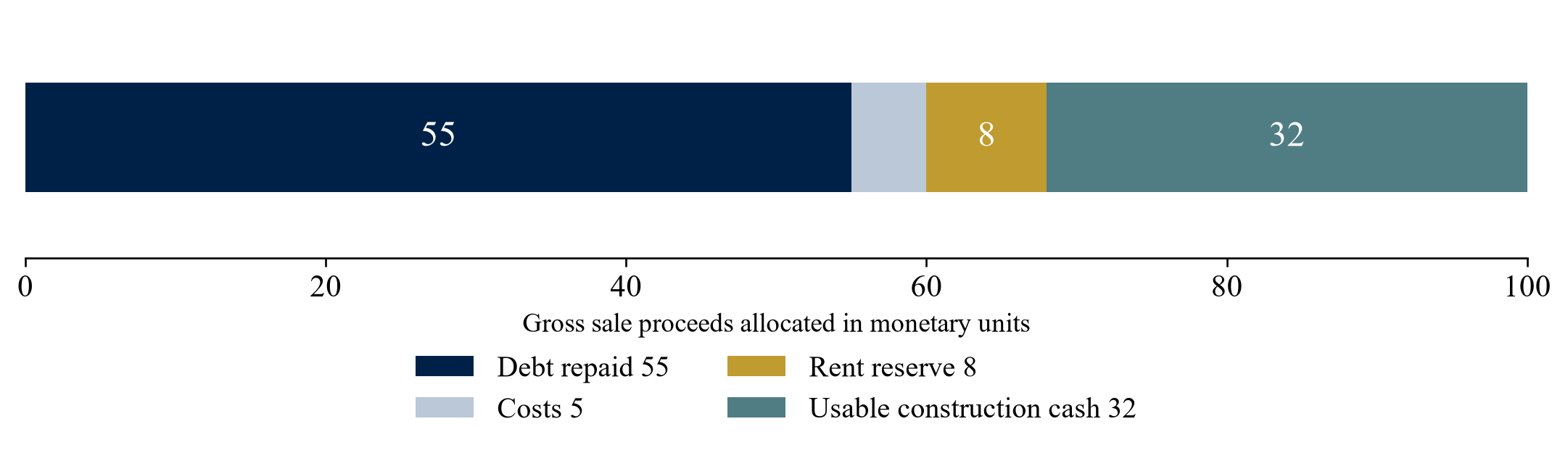
Author-developed capital allocation in monetary units. Gross proceeds 100; lender repayment 55; invented closing costs 5; owned rent reserve 8; unrestricted construction proceeds 32. These are not observed prices fees or financing terms.
7 Distinguish owned cash from cash available for construction
The proposed availability test asks what each account can pay, when it can pay and which party can authorise the payment. Cash classification in financial statements does not itself establish permission to transfer the money to a development. IFRS guidance on demand deposits with contractual restrictions explains a specific accounting-presentation question and disclosure implications [9]. The transaction model should maintain its own permitted-use record. A deposit can remain part of an owned cash position while its contractual purpose restricts a particular construction payment. Conversely, a financing commitment can become useful without being cash on the balance sheet before it is drawn.
For this paper's fictional closing allocation, the eight-unit rent reserve is excluded from the construction pool. It is still included in the 40-unit immediate owned receipt used in the economic benchmark. The benchmark abstracts from reserve yield and the opportunity cost of that earmarking. An actual analysis would add those effects if material. When the reserved rent is paid, the cash must be reconciled with the payment already included in the lease schedule. Treating the reserve as an expense at inception and then charging the same rent again would double-count the expenditure. Treating it as freely redeployable would overstate construction capacity.
The account schedule should name the current owner, permitted recipient, purpose, conditions and expected release date. These fields provide a way to model staged use of proceeds. If eight can be released only after a specific payment or certificate, the forecast should record that event rather than distribute it across the construction programme in advance. The analyst should also reconcile all earmarked funds across the sponsor's projects. Allocating the same deposit to a rent reserve, a new equity contribution and another guarantee support account creates unsupported capacity. The decision record should show where those allocations are mutually exclusive and identify the executed funding source for each separately protected obligation.
8 Specify the economic comparison and terminal rights
An economic comparison should use consistent dated cash flows for the alternatives under examination. RICS practice information discusses explicit discounted cash flow and distinguishes market valuation from investment value for a particular owner [4]. The proposed calculation here is a fictional incremental decision example. It does not value a real UAE property or determine an appropriate investor yield. The benchmark holds the underlying business use and operating receipts constant, so those common cash flows cancel. It then identifies the sale receipt, debt repayment, transaction costs, rent commitments, avoided interest and changed terminal ownership position. An actual transaction would need additional lines for any operational differences.
The assumed comparison lasts ten years. Under continued ownership, the developer retains a 55-unit debt that pays 4.4 annually at each year-end and repays its full principal at year ten. It also receives gross terminal property proceeds of 80 at that date. Under sale and leaseback, the debt is repaid at closing, the developer pays rent of eight at each year-end and retains no terminal property receipt. All cash flows use a fictional eight-percent analytical discount rate. Rent ends after the tenth payment, with no renewal, purchase option, relocation cost or other terminal commitment assumed in this deliberately narrow benchmark.
The terminal specification is part of the economic decision. Foregoing gross property proceeds of 80 while avoiding a debt repayment of 55 gives a foregone net ownership receipt of 25. A model may show the gross asset and avoided principal separately or show their net effect. It should use one consistent representation. Including a net residual of 25 and then adding the avoided 55 again would overstate the benefit. Table 1 uses the gross representation. Where a lease continues beyond the model horizon, or where the business needs the premises beyond year ten, the remaining commitments and continuation choices would have to be valued explicitly.
Table 1. Fictional incremental economic cash flows compared with continued ownership
| Incremental item | Payment date | Nominal amount | Present value |
|---|---|---|---|
| Net owned sale receipt | Closing | 100 minus 55 minus 5 | 40.00 |
| Avoided interest | Year ends 1 to 10 | 4.4 each year | 29.52 |
| Rent paid | Year ends 1 to 10 | minus 8 each year | minus 53.68 |
| Foregone gross property proceeds | Year 10 | minus 80 | minus 37.06 |
| Avoided debt principal repayment | Year 10 | 55 | 25.48 |
| Incremental economic present value | Same comparison | Author calculation | 4.26 |
Author calculations at an invented 8% annual analytical discount rate. Values rounded to two decimals in monetary units. The rent PV is an analytical commitment measure; no accounting liability or disposal gain is calculated.
9 Calculate the analytical rent present value
The analytical rent present value sums each rent payment discounted from its payment date. With rent of eight at each year-end for ten years and a discount rate of eight percent, the annuity factor is approximately 6.7100814. Multiplying that factor by eight gives a rent present value of 53.6806512. This calculation measures the fictional payment commitment at the chosen rate. It supplies neither a recognised accounting liability nor a market quote. Payment timing is integral to the result. Rent paid in advance, an initial premium, variable charges or an escalation clause would require a schedule that differs from this fixed year-end annuity.
The example's present value of avoided interest is 29.5243582. Foregone gross property proceeds have a present value of 37.0554790, and the avoided debt principal has a present value of 25.4756418. Adding the net owned receipt of 40 and the positive avoided payments, then deducting rent and the foregone asset receipt, yields 4.2638698. These values reconcile the nominal allocation with a dated economic calculation. Since the fictional debt interest rate equals the analytical discount rate, its interest and principal payments have a combined present value of 55. Paying that debt at closing therefore cancels its value within this specific benchmark.
The debt cancellation provides a useful independent arithmetic check. The same result follows from gross sale consideration of 100, less five in costs, less the rent present value and less the present value of the foregone gross asset receipt. It does not imply that an actual borrower's debt can be refinanced or repaid at par without penalty. A real settlement amount might include accrued interest, charges or other conditions. Those items belong in the closing allocation and economic schedule. The model should also use risk-appropriate assumptions for the actual cash flows; the single common discount rate here is an explicit simplification for reproducibility.
10 Interpret rent and residual value together
Figure 2 changes only annual rent and gross terminal property proceeds while retaining the other fictional assumptions. At rent of six and terminal proceeds of 60, incremental present value is approximately 26.95. At rent of ten and terminal proceeds of 100, it is approximately minus 18.42. The central eight-rent and 80-terminal case produces 4.26. With terminal proceeds of 100 and rent of eight, the result is minus five. The grid demonstrates the consequence of giving up ownership alongside continuing rent payments. It assigns no probabilities to the cells and establishes no expected transaction return or UAE valuation range.
The sensitivity should be interpreted alongside the evidence supporting each assumption. Market rent, contractual rent and the rent an investor demands in exchange for a particular price can be different inputs. Terminal property proceeds also depend on the rights held, asset condition, remaining uses and an assessed market context. The fictional grid holds those relationships independent to expose the arithmetic. An actual negotiation may connect them: the purchaser could offer a larger price for higher rent, or require terms that affect future occupancy. The modeller should therefore add paired price-and-rent cases drawn from executable proposals, rather than construct a preferred combination from unrelated indications.
The committee should also see the omitted decision elements. Reinvestment could add value or generate a cash shortfall, but no construction investment return is included in the economic benchmark. Tax, reserve opportunity cost, maintenance differences, relocation and lease options are also excluded. A positive 4.26 alone cannot determine whether the development should proceed. It identifies the result of one bounded ownership comparison. The investment case for redeploying the 32 units remains a separate task, including the project's full cash forecast, execution risk and required support. Approval requires those tasks to reconcile with the continuing obligations created by the sale-and-leaseback terms.
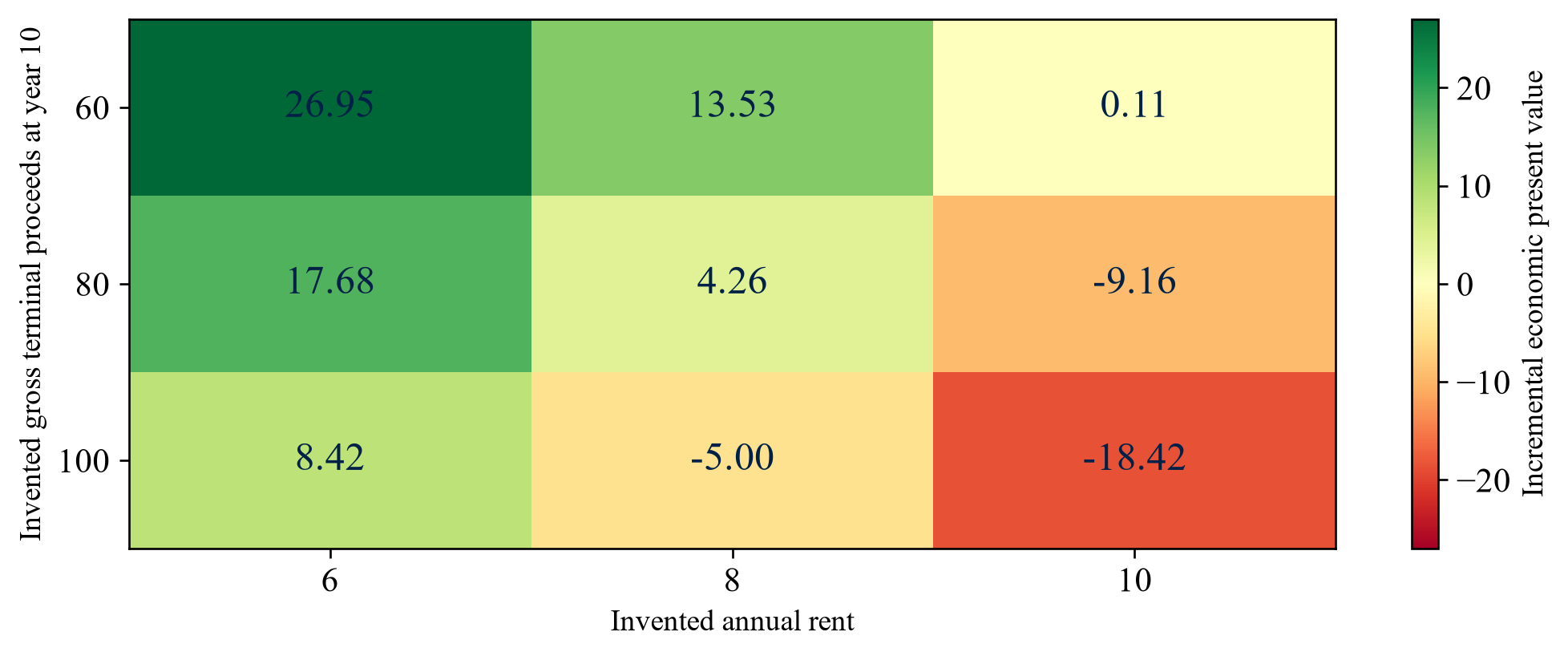
Author calculations in monetary units. Annual rent paid at year ends for ten years; analytical discount 8%; initial owned receipt 40; avoided interest and principal included consistently. No probability market yield or accounting gain is represented.
11 Build a separate dated construction cash pool
The liquidity illustration models a construction pool separately from the ten-year ownership comparison. Its opening cash is ten monetary units. Monthly construction payments in months one to six are six, six, five, four, three and two, totalling 26. A collection of 20 arrives after the month-five payment. The sale-and-leaseback case adds 32 of unrestricted proceeds at inception. The eight-unit rent reserve remains outside this pool. Asset operating receipts, existing debt service and rent payment from the reserve are also outside the construction path. These explicit boundaries mean that the illustration cannot establish the consolidated business's solvency or its ability to pay later rent.
Without monetisation, the pool falls from ten to four after the first payment. It becomes minus two after month two, minus seven after month three, minus eleven after month four and minus fourteen after the month-five bill. The subsequent collection increases it to six, and month-six expenditure leaves four. The negative balances represent unsupported payments, not an authorised overdraft. The case needs additional capacity of at least fourteen to meet every specified bill without going below zero, assuming support can arrive in time and is usable for those payments. That requirement follows from event order even though the final balance is positive.
Adding the unrestricted sale proceeds raises opening construction cash to 42. The corresponding balances are 36, 30, 25, 21 and 18 before the collection, then 38 and 36. Its minimum balance is eighteen under the specified order. This result demonstrates the role of the proceeds in one selected cash schedule. It says nothing about whether the sale price, lease terms or new development are attractive in a real mandate. An actual forecast should integrate the construction pool with asset operations and financing service, including the dates on which earmarked cash pays rent and any conditions that restrict the transfer of sale proceeds into the project.
12 Test collection timing before relying on the balance
The delayed-collection case retains the sale proceeds and the first six construction payments but moves the 20-unit collection until after month-eight expenditure. It also adds a two-unit payment in month seven and another in month eight. The construction balance is eighteen after the month-five payment, sixteen after month six, fourteen after month seven and twelve after month eight. The collection then raises it to 32. The minimum is twelve. This case differs from a collection arriving before the month-eight bill, which would produce a different minimum. The event schedule should state the ordering whenever a receipt and an expenditure share the same month.
Figure 3 displays the baseline and delayed paths with payment and collection events separately identified. The plot intentionally includes the unsupported balances in the no-monetisation baseline. Those balances help identify the amount and first date of missing support. They do not permit the analyst to carry negative cash as if funding had already been arranged. A production model should stop or flag an unauthorised deficit at the relevant event, then show any proposed financing response as a separately dated case. The response requires its own commitment, purpose, conditions and settlement evidence before it becomes available capacity.
Collection estimates should also have explicit evidence states. A contracted receivable, an expected sale, a pending certification and an assumption of future demand provide different levels of support for a forecast. The proposed schedule separates the amount legally payable, the conditions still outstanding and the earliest usable bank receipt. If the transaction relies on a collection to replenish a rent reserve, that linkage belongs in the model as well. Moving the collection should change both construction availability and the rent-funding view where appropriate. The two illustrations here hold the reserve outside the pool, so that further linkage remains a task for the complete transaction forecast.
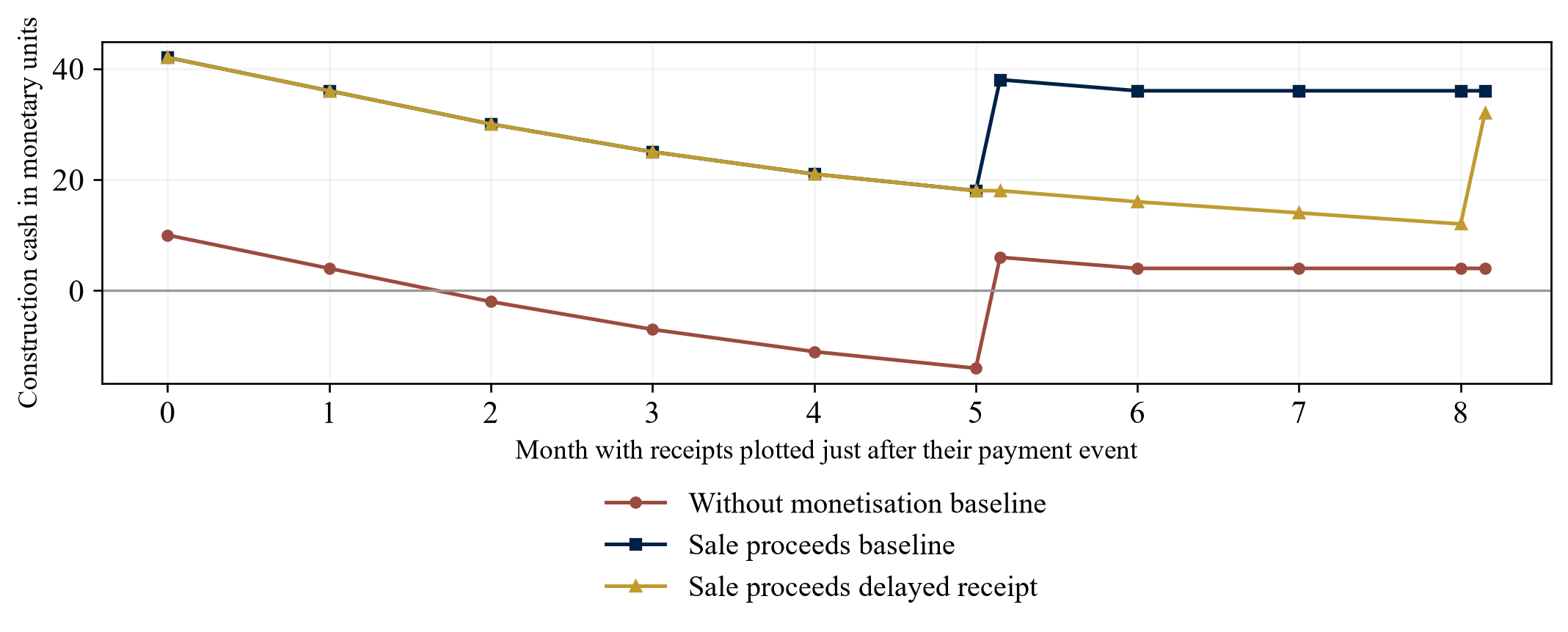
Construction pool only. Baseline receipt follows month-five payment; delayed receipt follows month-eight payment and two extra payments of 2. Rent reserve and asset operations are outside these paths. Negative values indicate unsupported payments.
13 Calculate a separate cost and delay support grid
Table 2 tests a separately defined pre-collection stress case. All base construction expenditure of 26 and all additional delay expenditure occur before the 20-unit collection. Opening unrestricted construction cash remains 42. A selected cost increase applies to the full 26-unit construction amount, and each additional delay month adds two monetary units of invented expenditure. The support requirement is the positive part of total pre-collection expenditure less 42. In words, it equals the greater of zero and 26 multiplied by one plus the chosen cost increase, plus two multiplied by additional delay months, less opening cash of 42.
The grid chooses cost increases of zero, ten, twenty and thirty percent, alongside additional delay of zero, three, six and nine months. These choices are illustrative stresses, not observed UAE inflation or construction-delay probabilities. At thirty-percent cost stress and nine additional months, expenditure before collection is 51.8, leaving an unsupported gap of 9.8. At thirty percent and three months, expenditure is 39.8 and available cash exceeds it by 2.2. The grid places the receipt after month six plus the selected additional delay; its ordering differs from the baseline month-five collection and the separately specified month-eight example.
The longest grid case extends to fifteen months. Under the fictional perimeter, the separate eight-unit reserve pays the year-one rent when due and does not supply construction cash. No second annual rent falls due before the end of that grid horizon. Future rent, reserve replenishment, asset operating cash and other financing service still require the full business forecast. The two-unit monthly delay cost includes only the expenditure defined for this illustration. An actual model would need package-level cost exposure, schedule changes and the financing consequences of a delay. The grid helps identify the remaining amount to fund under its assumptions; it does not replace that detailed forecast.
Table 2. Fictional additional construction support before the delayed collection
| Additional delay months | Cost 0% | Cost 10% | Cost 20% | Cost 30% |
|---|---|---|---|---|
| 0 | 0 | 0 | 0 | 0 |
| 3 | 0 | 0 | 0 | 0 |
| 6 | 0 | 0 | 1.2 | 3.8 |
| 9 | 2.0 | 4.6 | 7.2 | 9.8 |
Author calculations in monetary units: max of zero and 26 times one plus cost increase plus 2 times extra delay months minus 42. Receipt arrives after month 6 plus delay and all modelled bills. Selected stress parameters carry no empirical probability.
14 Test continuing rent and operating capacity
The construction pool's temporary surplus should be reconciled with the business's continuing property-use payments. The fictional rent reserve supplies only the first annual rent of eight. Later rent payments still require operating cash or other executable funding. An actual transaction should compare each rent payment with receipts available to the tenant entity after operating expenditure, taxes and its other commitments. If the property houses a critical business function, the assessment should also identify the operational consequences of a missed payment or disputed lease term. Those consequences require the actual contract and appropriate legal review, rather than an assumed standard remedy.
The proposed coverage schedule uses a specified cash-availability definition, period and payment date. It should include contractual escalation, service charges, maintenance responsibilities, insurance, deposits and any required capital expenditure. A financial-statement earnings measure can be included as supplementary information with a bridge to usable cash. The transaction model should identify which costs are common to continued ownership and leaseback, which change at closing and which arise only under a stress scenario. This separation supports a consistent economic comparison and an operating payment forecast. It also makes a change in responsibility visible when an apparently fixed rent excludes substantial property-related expenditure.
The board can set an internal decision limit for the selected downside cases without presenting that limit as a legal or market requirement. The record should state the chosen buffer, reasons and actions needed if the forecast breaches it. A proposed alternative might change rent timing, reserve requirements or the amount reinvested into the new development. Each alternative should be run through the same dated payment schedule. A claim that a leaseback improves resilience should remain conditional on the defined test and executed terms. The first-year reserve and the case's positive construction balance alone provide insufficient evidence for every later year of the business plan.
15 Evaluate price lease terms and retained flexibility jointly
The transaction proposal should link the sale price to the lease terms, property responsibilities and continuing rights of use. A price quoted for one rental schedule cannot be combined automatically with a different schedule that the purchaser has not accepted. The evidence file should retain each executable package as a whole, including expiry and conditions. The developer's comparison should also identify what remains negotiable. A change in term, escalation, guarantee, deposit or use restrictions can alter both immediate proceeds and the risk of future operations. The proposed model records those changes before summarising a preferred transaction for approval.
Flexibility should be assessed through defined actions and their contractual cost. The business may need to alter the premises, sublet unused space, transfer operations, exit early or retain use after the original lease expires. Each desired action should be matched to the proposed clause and reviewed for the relevant location. A purchase or renewal option also requires valuation and accounting consideration. This paper's numerical benchmark assumes no such option, so the 4.26 result includes no value for it. Adding an option would require a consistent change to the terminal cash flows and other assumptions rather than a qualitative premium attached without a calculation.
The investor's property risk and the developer's business risk should also be traced through the contract. Ownership transfer can change which party receives an eventual property sale receipt while the tenant retains rent and specified operating obligations. A property becoming obsolete or requiring redevelopment can therefore affect the parties differently. The financial comparison should identify the contractual allocation for the actual transaction and explain any exposure omitted from the model. The proposed approval packet includes a summary of the consequential clauses beside the cash schedules. This helps the committee evaluate the commercial effect of retained use and continuing commitments at the same time as the sale proceeds.
16 Examine tax and transaction costs before claiming benefits
Federal Tax Authority real-estate VAT guidance distinguishes commercial property, residential property, bare land and mixed cases. It also specifies limits on its particular commercial-sale buyer-payment procedure, including exclusions for developer sales and commercial leases [10]. This paper assumes no applicable VAT treatment, tax recovery or corporate-tax saving. The five-unit cost in the closing allocation is entirely invented. A developer should obtain current advice for the property, seller, purchaser, tenancy and proposed consideration before determining the taxes, charges and timing that belong in its transaction model. Public guidance should be read with the operative law and the actual facts.
The cost schedule should show the responsible party and whether an amount is permanent expenditure, a recoverable tax balance or cash temporarily unavailable. A recoverable amount can still create a funding need if it is paid before recovery. Any tax treatment affecting rent, disposal proceeds, financing charges or asset ownership should be reflected consistently in both alternatives. The model should also consider the evidence required for the expected treatment and the consequences if a key assumption changes. An approval case should distinguish an advised treatment from an unresolved classification question; the forecast can then include a separate adverse case without presenting it as an established tax outcome.
Corporate-tax effects require their own analysis of the relevant entities and transactions. This paper does not infer that leasing universally improves the after-tax result or that every rental payment is deductible in the intended circumstances. The proposed comparison begins with pre-tax cash flows to make the numerical mechanism transparent. A qualified tax adviser can extend it using evidenced rates, rules and conditions for the transaction. The committee should receive the resulting bridge, including any difference in ownership-side deductions and disposal treatment. That bridge helps the board assess the whole after-tax cash schedule and avoids relying on one isolated deduction as the reason to monetise the property.
17 Assess alternatives on the same obligation perimeter
The board should compare the proposed leaseback with financing alternatives that could meet the same dated funding need. Possible discussions include a property-backed borrowing, new shareholder capital, a partial asset sale or a smaller construction programme. None is assumed available in this paper. Each executable proposal should identify its amount, fees, timing, repayment, security, control rights and conditions. The comparison should preserve the same project obligations and operating forecast so that a more optimistic construction assumption does not make one funding structure appear superior. The amount provided at inception should be reconciled to the payments and claims created after it is received.
The existing debt position is particularly important. Refinancing can leave ownership rights with the developer while adding future financing service. A leaseback can remove the specific debt repaid at closing and replace it with property-use commitments. The economic benchmark explicitly includes those avoided debt payments and the foregone terminal asset receipt. Any alternative should receive the equivalent treatment. If a lender requires an additional guarantee or reserve, the available-cash calculation should reflect it. If a new investor acquires an ownership interest, the model should identify the distributions, governance rights and terminal value allocated to that investor under the actual proposed arrangement.
The committee can then compare results under a common set of selected stresses, while acknowledging differences in the relevant contracts. A construction delay might affect debt maturity, a rent-reserve balance and shareholder contribution timing in different ways. The proposed comparison record retains those differences through dated events rather than reducing every structure to one headline rate. It should also record the option to defer or resize the new development if no proposal supplies executable capital on acceptable terms. The paper offers a method for that appraisal; it establishes no universally preferred mix of debt, lease commitments or new equity for UAE developers.
18 Use a transaction specific bankability checklist
Table 3 is an author-proposed checklist for assessing whether the negotiated transaction can supply the required capital while maintaining the intended property use. It maps evidence to a modelling consequence. The checklist should be adapted to the actual asset, parties, jurisdiction and financing arrangements. Its completion is not a financing entitlement or a legal opinion. The important outcome is a set of specific unanswered questions with an owner and decision date. An unresolved mortgage settlement, transfer restriction or rent clause can then be assigned a consequence in the forecast rather than buried in a general statement that diligence is continuing.
The diligence owner should cross-reference the evidence supporting each line. A bank settlement letter, account statement and executed lease should identify their dates and the parties to whom they apply. When terms change, the corresponding forecast inputs need an update and a documented review. The same applies to a proposal whose price remains open while the lease terms are still being negotiated. The approval packet should present that dependency expressly. A committee can approve a bounded negotiation or impose a closing condition without labelling the unresolved proposal as an already available funding source. That distinction also supports orderly communication with the purchaser and existing lender.
The checklist should include the intended redevelopment receiving the proceeds. RICS development-property guidance identifies development valuation and the significance of assumptions and sensitivity analysis [11]. For this paper's proposed workflow, the funding application therefore sits alongside a documented construction budget, selected cost exposure and collection assumptions. Sale closing cannot resolve every risk in the receiving project. A full decision should connect the asset transaction with that project's permission to receive funds, remaining cost to complete and support under the relevant cases. Table 3 provides a compact record for those connections and can form part of the mandate's agreed scope of work.
Table 3. Proposed bankability checklist for developer sale and leaseback
| Question | Evidence required | Modelling consequence |
|---|---|---|
| Who sells and who leases | Title entity chart and proposed lease | Assign receipts and rent to the correct entity |
| Can existing security be released | Lender settlement and release terms | Date net proceeds after required settlement |
| What use survives closing | Lease rights permitted use and conditions | Model continuation relocation and expiry |
| How much cash is unrestricted | Closing allocation and account terms | Exclude reserves from construction funding |
| What rent and property costs remain | Complete payment and responsibility schedule | Forecast each continuing payment |
| How is the receiving project funded | Permitted transfer and project accounts | Include only executable project cash |
| Which accounting and taxes apply | Reviewed accounting and tax memoranda | Keep economic and statutory measures distinct |
| What happens under construction stress | Updated cost schedule and collection evidence | Identify support amount and first payment date |
Author-developed diligence structure. Answers require transaction evidence and qualified review; no standard approval threshold or automatic remedy is asserted.
19 Control closing and the first use of proceeds
The proposed closing control links evidence of completion to the first permitted use of cash. The transaction team should identify the event that makes the property transfer effective, the evidence of debt discharge and the start of the lease obligations. It should then reconcile the completion statement to bank entries and the reserve schedule. This process supplies the actual net receipt for the model. A forecast can retain a provisional amount before completion, but its status should remain explicit and its timing should be tested. The committee's decision should identify who may release money into construction and which conditions must first be satisfied.
After closing, the operating and construction forecasts should be updated from actual payments. A change in the rent-payment schedule, an additional deposit or delayed settlement can affect the available pool even when the headline price stays unchanged. The proposed control compares the forecast closing allocation with the completed one line by line. Any difference needs a treatment in the funding schedule and an explanation in the approval record. The first construction transfer should also be traced to the receiving project's bank evidence. This establishes a clear route from sale consideration through debt and reserve uses to the cash actually paying project obligations.
The monitoring period should cover the remaining development programme and continuing lease commitments. A near-term cash surplus can disappear as construction costs change or an expected receipt moves. The paper's grid shows a residual need even after the invented monetisation, under the largest selected stress. In an actual mandate, that finding would lead to an assessment of executable support, revised investment timing or another authorised response. It would not justify an assumption that funding appears automatically. The operating record should retain the previous forecast, changed evidence and action approved, so that later reviews can distinguish a revised assumption from a completed financing arrangement.
20 Apply data and AI through reviewed source records
The proposed data system connects each model input to a document, page or clause and a responsible reviewer. Title records, loan settlements, lease drafts, cost schedules and account restrictions can be indexed alongside dated versions. A proposed AI tool could assist extraction and comparison, subject to testing against those records. It should leave uncertain fields unresolved for review. A clause's commercial interpretation, legal enforceability or accounting consequence requires the appropriate professional judgement. This paper establishes no measured accuracy, automatic approval capability or productivity gain for such a tool. The proposed use is limited to supporting a documented review and calculation process.
NIST's AI Risk Management Framework is a voluntary reference organised around governance and risk-management functions [12]. The paper's application proposal uses that context to require defined responsibilities, test evidence and monitoring of a tool employed on transaction documents. It does not claim NIST certification or compliance with a particular UAE requirement. For this workflow, a test should include documents containing conflicting versions, missing clauses, unusual payment schedules and restrictions that affect cash use. Reviewer corrections should remain visible. An extraction result should identify its source and should not silently change a forecast when the underlying commercial term has not been approved.
The arithmetic should remain deterministic and independently reproducible. Once reviewed inputs are accepted, a calculation engine can produce the proceeds allocation, rent present value, dated cash paths and sensitivity grid. The model should test conservation of proceeds, correct event order, consistent principal treatment and exclusion of restricted funds from the construction pool. The fictional cases in this paper demonstrate those checks through fixed inputs and transparent formulas. A future tool implementation would need permission to process the documents, access controls and validation proportionate to the transaction. The committee should receive the reviewed calculation and its limits, with a clear route to the underlying evidence.
21 State limitations and a feasible empirical research design
The analysis has no dataset of executed developer sale-and-leasebacks, observed borrowing quotes or measured construction outcomes. It supplies no estimated causal effect on valuation, solvency or project completion. Its fictional discount rate, rent, sale price and terminal values serve only to make the arithmetic reproducible. The economic benchmark excludes reinvestment returns, taxes, reserve opportunity cost, changing maintenance, relocation and options. The construction model excludes the consolidated operating cash of the property business and most financing service. These boundaries limit what can be concluded from a positive economic result or a construction-pool surplus, and they should remain attached to any use of the examples.
A feasible empirical extension would collect consented completed transactions and retain the price, lease terms, lender settlement, restricted balances and uses of proceeds at closing. It would then record project payment events, changes in cost to complete, collection dates and the rent-funding position over a defined follow-up period. A consistent classification would distinguish owner-occupied property from externally let assets and the relevant legal interest. The research would need to address selection: developers choosing monetisation can differ from those that retain ownership. A comparison of raw outcomes alone could therefore reflect different project risks, funding access or management decisions rather than the transaction itself.
Until such evidence is available, the proposed test is a decision aid for one transaction using its own reviewed inputs. The practical evidence requirement is narrower than a claim about the whole market. A developer can establish its actual closing allocation, continuing commitments and unsupported payment dates without proving that sale-and-leaseback generally improves performance. The paper's model can help identify which documents or assumptions determine that transaction's decision. It also provides a structure for rejecting a proposal that lacks executable cash, acceptable use rights or support for selected adverse cases. No conclusion about buyer demand, standard investor appetite or the availability of capital is inferred from the illustrations.
22 Conclude with an executable capital decision
A developer sale-and-leaseback should be approved through the cash it can legally and operationally deploy, the property-use commitments it creates and the remaining funding needs of the receiving development. The fictional sale of 100 delivers net owned cash of 40 after debt and costs, with 32 available for construction and eight reserved for rent. Those figures answer different questions and require an explicit reconciliation. Treating every unit of sale consideration as project funding would overstate the model's available construction capacity. The proposed closing allocation makes the relevant uses and restrictions visible before the proceeds enter the project forecast.
The fictional ten-year comparison values rent and foregone ownership consistently with avoided debt service. Its central incremental present value is approximately 4.26, with materially different results under the selected rent and terminal cases. The separate construction path reaches a minimum of eighteen after monetisation; delayed collection and extra expenditure reduce it to twelve. A more adverse, separately defined pre-collection grid still needs additional support of 9.8 at its largest selected stress. These are arithmetic results within stated boundaries. They establish no accounting gain, observed valuation, tax benefit or proof that an actual development can pay all its future obligations.
The committee's next action is to assemble the transaction-specific evidence: title and lender release, complete lease commitments, advised accounting and taxes, a permitted proceeds route and the receiving project's dated cost and collection forecast. It should then compare executable alternatives, test selected adverse cases and identify support for every unsupported payment. The approval record should state the amounts, conditions, use rights and actions that remain outstanding. This approach provides a disciplined basis for a corporate-finance mandate spanning structuring, negotiation and completion. A usable sale receipt and continuing rent responsibility can be evaluated together through explicit calculations and reviewed documents before capital is redeployed.
References
- IFRS Foundation. IFRS 16 Leases. Official standard overview and history; accessed 8 October 2026. https://www.ifrs.org/issued-standards/list-of-standards/ifrs-16-leases/
- IFRS Foundation. IASB issues narrow-scope amendments to requirements for sale and leaseback transactions. September 2022; accessed 8 October 2026. https://www.ifrs.org/news-and-events/news/2022/09/iasb-issues-narrow-scope-amendments-to-requirements-for-sale-and-leaseback-transactions/
- IFRS Interpretations Committee. Sale and Leaseback with Variable Payments IFRS 16. Agenda decision, June 2020; historical initial-measurement context, read with subsequent amendments; accessed 8 October 2026. https://www.ifrs.org/content/dam/ifrs/supporting-implementation/agenda-decisions/2020/ifrs16-sale-and-leaseback-with-variable-payments-june-20.pdf
- Royal Institution of Chartered Surveyors. Discounted cash flow valuations. Global practice information, first edition, November 2023; accessed 8 October 2026. https://www.rics.org/content/dam/ricsglobal/documents/standards/Discounted-cash-flow-valuations-1.pdf
- Dubai Land Department. Property Sale Registration. Official Dubai service requirements; accessed 8 October 2026. https://dubailand.gov.ae/en/eservices/property-sale-registration/
- Dubai Land Department. Registering the Sale of a Mortgaged Property. Official Dubai service description; accessed 8 October 2026. https://dubailand.gov.ae/en/eservices/registering-the-sale-of-a-mortgaged-property/
- Dubai Land Department. Register Renew Tenancy Contract. Official Dubai tenancy registration service; accessed 8 October 2026. https://dubailand.gov.ae/en/eservices/register-renew-ejari-contract/
- Abu Dhabi Real Estate Centre. Tenancy and real estate legal compilation. Includes Law 3 of 2015 and mortgage-registration instruments; applicability and operative provisions require transaction-specific local review; accessed 8 October 2026. https://adrec.gov.ae/en/rules_and_regulations/Tenancy
- IFRS Interpretations Committee. Demand Deposits with Restrictions on Use IAS 7. April 2022 agenda decision, January 2026 presentation-reference update; accessed 8 October 2026. https://www.ifrs.org/content/dam/ifrs/supporting-implementation/agenda-decisions/2026/demand-deposits-with-restrictions-on-use-jan-26.pdf
- UAE Federal Tax Authority. Real Estate VAT Guide VATGRE1. April 2021 revision; sections on commercial property and exclusions from the particular buyer-payment procedure; accessed 8 October 2026. https://tax.gov.ae/DownloadOpenTextFile?fileUrl=en%2FVAT_VAT_Guides%2FReal_Estate_Guide%2FReal_Estate_Guide_VATGRE1_EN_19_04_2021_EN.pdf
- Royal Institution of Chartered Surveyors. Valuation of development property. First edition October 2019, effective February 2020, reissued April 2023; accessed 8 October 2026. https://www.rics.org/content/dam/ricsglobal/documents/to-be-sorted/Valuation%20of%20development%20property_ready%20for%20approvals.pdf
- National Institute of Standards and Technology. AI Risk Management Framework. Voluntary governance reference; accessed 8 October 2026. https://www.nist.gov/itl/ai-risk-management-framework
About the Author
Chennakeshav (CK) is a corporate finance and investment banking executive with 25+ years of global experience in deal origination, structuring and execution across M&A, growth capital and corporate strategy. He has led value-creation mandates for founders, corporates and funds — bridging the boardroom view to hands-on execution and close.
His career spans Morgan Stanley, HSBC, Lloyds Banking Group, EWEC, ADQ portfolio companies and Emirates Growth Fund, across TMT, real estate, fintech, deeptech, cleantech, infrastructure and energy. He has partnered with C-suite leaders, private equity and venture funds, sovereign wealth funds and family offices to finance complex fund raises and scale-up ventures, and has led M&A due diligence, post-merger integration and business-transformation initiatives to create value.
At Matchpoint Partners he is Managing Partner, leading the firm's corporate finance, M&A and capital-raising practice. He holds an MBA from London Business School, an engineering degree from VTU and a Master of Laws (LLM, in progress) from UCL London.
An active start-up mentor, CK mentors at Techstars, DIFC FinTech Hive, Startup Grind, Founder Institute and IN5, serves as Entrepreneur Mentor in Residence (EMiR) at London Business School, and judges the Entrepreneurship World Cup.
