
1 Define the financing decision
The first cheque for a natural hydrogen prospect buys evidence. It does not buy a proved production stream. A geological map, a surface signal and a gas show can each justify further investigation, yet none tells a lender how many kilograms a future project can deliver each year. A useful financing memorandum therefore begins with the decision that the proposed expenditure can actually resolve. Prospect screening may justify a modest option on acreage. A well may test whether hydrogen is present at a specific target. A flow programme may test whether the gas can be produced at a useful rate. Construction finance requires a far wider body of evidence, including contracts and permissions.
The United States Geological Survey describes geologic hydrogen research as an early effort to understand generation, migration, trapping and preservation. Its 2025 national map identifies relative geological prospectivity in the contiguous United States. The agency distinguishes that map from a quantitative assessment of recoverable resources [1, 2]. This boundary is the starting point for finance. A lender should never convert a regional probability score into a production schedule. Even a discovered accumulation needs an independently reviewable estimate of size, composition, deliverability and decline before it can support a long-tenor repayment model.
This paper concentrates on the capital handoff after an exploration thesis is formed. It asks who pays for the well, who controls the resulting data, when a farm-in partner earns an interest, which costs belong in a development vehicle, and what would make limited-recourse debt plausible. These are transaction questions rather than a general survey of hydrogen geology. They require a specific project perimeter. A memo should identify the legal rights, geological target, well plan, processing route, customer, transport path and financing entity. A missing element remains a workstream with a budget and accountable owner.
2 Separate regional prospectivity from collateral
The USGS prospectivity method combines interpreted source, reservoir and seal conditions; its national map is designed to guide more detailed work [1]. It does not identify a pool of saleable gas under a particular licence. A surface seep might be related to a deep accumulation, a shallow process or another source. A drill result can be distorted by sampling equipment, drilling fluids or laboratory methods. USGS work on dissolved hydrogen sampling documented that equipment and casing choices can affect measured concentrations [3]. The implication for investment is straightforward: data provenance belongs in the valuation file.
The sponsor should maintain an evidence register with the sample date, location, depth, method, chain of custody, instrument, calibration, blanks, independent laboratory and competing geological interpretations. Every public claim about a discovery should be traceable to that register. The register should distinguish a detected molecule from a commercially producible stream. It should also record negative tests. An unsuccessful well may eliminate a false trap model and improve the value of a neighbouring target; that informational benefit does not turn the unsuccessful well into collateral.
The Petroleum Resources Management System provides a petroleum industry vocabulary for prospective, contingent and reserve quantities [9]. It cannot simply be presumed to classify geologic hydrogen under every regulatory or professional regime. A competent independent professional should select and explain the applicable method. Until then, investor materials should use ordinary descriptive language: mapped prospect, tested occurrence, discovered accumulation, appraised deliverability or contracted production. The financing model should state exactly which of those evidence states underpins each volume assumption.
Lenders typically seek rights they can enforce and cash flows they can stress. A licence application, regional map or untested pore-space theory may support equity option value; it cannot independently repay a term loan. The sponsor can still use secured equipment finance or corporate borrowing where a creditworthy balance sheet supports it. Such recourse must be stated openly. Calling a corporate loan 'project finance' does not change who bears the geological loss.
3 Price the next experiment before the field
An exploration budget should be built around falsifiable questions. If the main uncertainty concerns the seal, a cheaper seismic interpretation or shallow test may be more informative than a full production well. If gas composition is unknown, a properly designed sampling programme may determine whether processing costs could overwhelm the project. If the rights position is unclear, legal diligence may be the highest-value activity before further subsurface spending. Each work package needs a stated result that advances, redirects or stops expenditure.
For every proposed test, the investment committee should ask three questions. What decision changes if the result is positive? What decision changes if it is negative? What happens when the result is ambiguous? A test with no consequential decision has weak information value. Pre-agreed responses also reduce the temptation to spend repeatedly in support of a favourite geological story. Exploration managers retain technical discretion within an approved programme; material changes to depth, target or test design should trigger a revised capital authorisation.
The model should track committed, cancellable and spent amounts separately. A drilling slot may require a deposit months before a site permit is issued. Long-lead equipment can create exposure even if the well never starts. A farm-in partner may earn an interest on paying a defined cost share, whereas a grant may reimburse eligible expenditure only after documentation. Timing mismatches can produce a funding shortfall despite apparently sufficient total capital. The cash schedule should use the date at which each obligation becomes payable, not the expected date of a successful discovery.
Figure 1 sets out a generic sequence. Its stages, decision criteria and funding labels are an author-developed framework. A real project may combine or repeat stages. The point of the diagram is the shift in risk bearer: the earliest unknowns sit with equity and risk-sharing counterparties; lenders enter only when the remaining commercial and technical uncertainties can be measured and allocated.
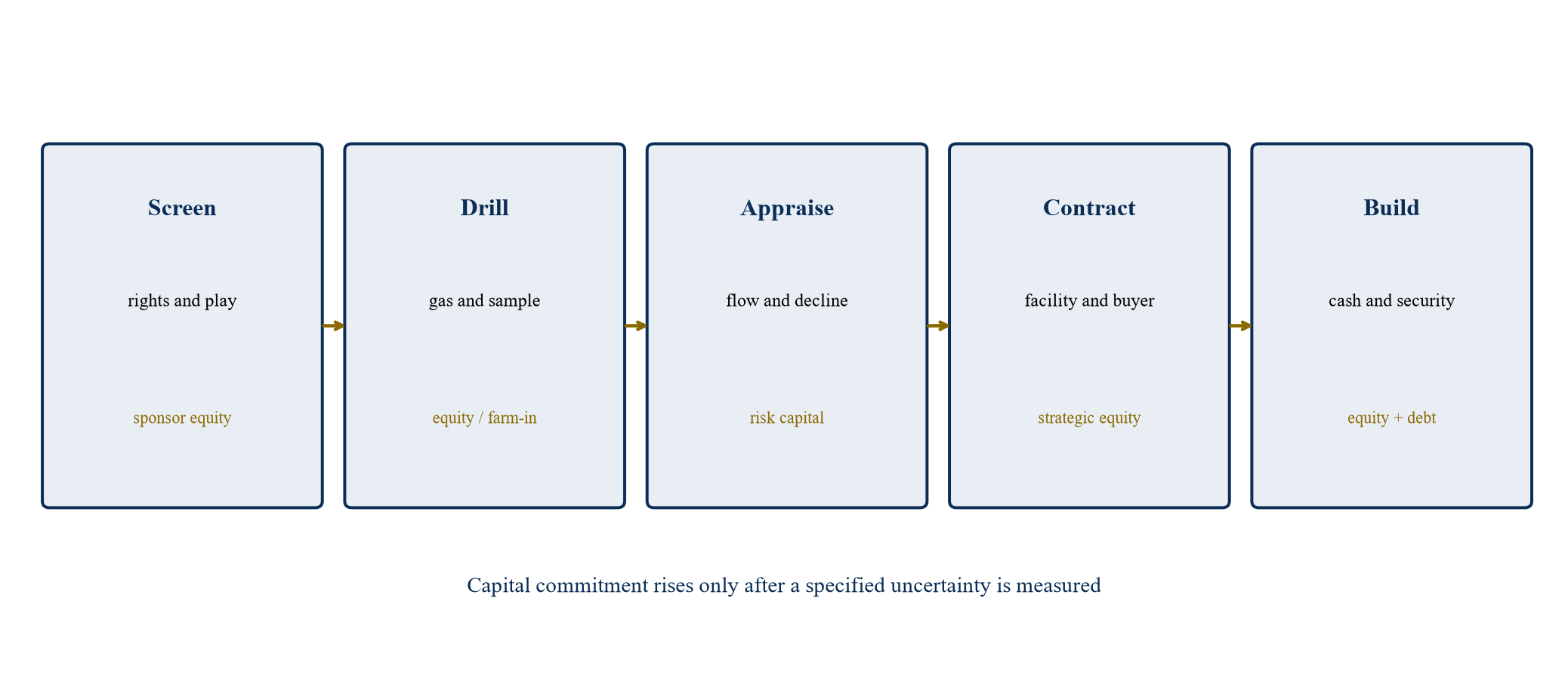
Author-developed transaction sequence; it does not describe a completed project or a standard market term.
4 Establish rights that can survive financing
Subsurface title is a financing issue before it is a legal footnote. Different jurisdictions may assign rights to gas, minerals, water, geothermal resources and pore space through different instruments. The sponsor should obtain counsel's opinion on what the existing licence actually permits: exploration for hydrogen, drilling, testing, production, processing, transport and security over the interest. A right to collect geological data may not include a right to sell produced gas. A licence that expires before the debt tenor cannot support the same structure as a renewable production right with clear extension criteria.
The title review should identify land access, surface compensation, environmental permissions, legacy wells, protected areas, indigenous or community rights where applicable, and the governing response to competing resource uses. A geological target may span multiple licences. A fault or reservoir may connect to a neighbour's acreage. The project needs a plan for unitisation or data-sharing where law and geology require it. Counsel should also test whether security can be granted over the licence, shares, receivables, bank accounts and movable plant, and whether enforcement would require regulator consent.
An exploration farm-in adds another layer. The partner's earned interest should be precisely defined. Does it attach to all acreage, one prospect or a development area around a successful well? Which prior costs are recoverable? Who pays for a sidetrack, suspended well, environmental incident or abandonment? What happens if a permit is refused or the well misses its target? A vague 'earn 40 percent for funding the first well' can become expensive when scope and cost overrun are disputed. The definitive agreement should contain an approved work programme, cost cap, operator standard, cash-call timetable, audit rights and a default remedy.
If the project later seeks debt, the lender will review the farm-in and joint operating arrangements. Consent rights, pre-emption, change-of-control and non-operator vetoes can frustrate security or a rescue sale. These issues should be negotiated while investors still have bargaining flexibility. A project company cannot promise lenders control over an asset that its partners can block from transfer. Counsel's verified rights analysis should be attached to the financing decision file.
5 Match the instrument to the geological risk
The earliest stage can be funded by sponsor equity, specialist venture or resource capital, a carried farm-in, research grants where actually available, or a corporate balance sheet. Each instrument allocates loss differently. Equity can be wiped out without scheduled repayment. A carried farm-in transfers a defined part of the drilling bill in exchange for an earned asset interest. A grant has eligibility and reporting conditions. Corporate debt relies on the sponsor's broader assets and may constrain other mandates. The term sheet should show the economic cost of each choice, including dilution, control and future financing restrictions.
A royalty or stream can appear attractive because it may avoid immediate equity dilution. Its payout, however, reduces future project cash flow. A royalty over gross revenue is particularly powerful in a downside case because it is payable before the project has recovered fixed operating costs. Before granting one, the board should model the royalty through an actual price-volume distribution and check lender consent and security ranking. A milestone loan payable after an appraisal success can also become a hidden balloon liability. The project should disclose every contingent payment in its capital stack.
Project debt belongs later in the sequence. A signed off-take expression of interest does not establish production. A well test without a sustained profile does not establish the tenor of a seven-year loan. A lender will also need a defensible facility cost, commissioning plan, abandonment funding and downside cash flow. The risk can be shared through parent support or a completion guarantee, but that moves loss to the guarantor. The guarantee's cap, duration and release test should be explicit. World Bank material on project finance explains that recourse and risk allocation can change over a project lifecycle [10]. That general architecture is a reference point, not evidence that a particular hydrogen discovery can already borrow.
6 Structure the farm-in around observable performance
A farm-in term sheet can separate three economic events. The incoming partner pays an agreed share of pre-drill data and permitting work. It then funds a capped exploration well in exchange for an initial interest. A further interest is earned only after it funds a specified appraisal programme following an agreed test result. Each event should have its own budget, evidence deliverable and election date. The mechanism keeps one successful gas reading from automatically obliging either party to fund full development.
Operator control requires specific protections. The operator should follow an approved well design, tendering process, safety plan and sample protocol. The non-operator should receive logs, raw measurements, laboratory reports and independent audit access promptly. A daily drilling report with cost-to-complete helps both sides decide whether a depth extension is justified. Expenditure beyond the cap should need an affirmative election, with pre-agreed dilution or sole-risk treatment if a partner declines. The agreement should preserve a pathway to abandon a non-commercial well and pay for restoration.
The price of the earned interest should be discussed as a package, not as a headline percentage. A partner contributing USD 12 million to a well while receiving 40 percent of one licence has a different economic position from a partner receiving 40 percent of a region-wide portfolio. Carry, back-cost reimbursement, operatorship, future cash-call obligations and production royalties all affect effective price. An independent valuation can model those elements, but the geological probability inputs must be labelled as management assumptions and stress-tested. The committee should see the zero-recovery outcome alongside the success case.
Table 1 proposes a transaction responsibility matrix. It is a drafting checklist and does not state that any particular counterparty has accepted the obligations. A negotiated agreement needs counsel and technical specialists to resolve the details under the applicable law.
Table 1. Risk allocation in a proposed exploration farm-in
| Risk or decision | Lead obligation | Evidence before payment or election |
|---|---|---|
| Licence and access | Existing holder, with counsel opinion | Valid rights, work commitments and transferable interest |
| Well design and procurement | Operator under approved budget | Independent design review and tender record |
| Cost overrun | Partners under capped election rules | Revised forecast and reason for change |
| Sample integrity | Operator and independent laboratory | Chain of custody, blanks and calibration |
| Appraisal election | Incoming partner within defined period | Agreed flow and composition results |
| Environmental restoration | Project company with secured funds | Approved plan and cost estimate |
| Future project debt | All partners through consent framework | Security, step-in and transfer permissions |
Author framework; amounts and obligations require negotiation for the actual asset.
7 Contract the well as an information asset
The exploration well is usually the most consequential early cheque. Its statement of work should protect the information that justified drilling. Geological objectives belong alongside drilling objectives. The contract should define planned depth, coring, mud-gas analysis, pressure tests, wireline logging, flow testing, sample containers, laboratory duplicates and data delivery. The programme should identify how contamination from drilling materials, equipment or surface handling will be detected. USGS sampling work shows why measured hydrogen must be interpreted through the sampling method [3].
Procurement should distinguish day-rate, turnkey and performance obligations. A turnkey price may shift some mechanical cost risk, but it cannot make a geological target certain. A day-rate contract leaves more schedule exposure with the operator. Weather, lost circulation, well control, regulatory delay and redrilling provisions can change cost materially. The board should approve a contingency tied to identified hazards and a stop-work authority that is independent of sunk expenditure. The model should include plugging and site restoration even in the failure case.
The test protocol should be locked before the well result becomes known. It should specify minimum duration, measurement frequency, equipment calibration, gas composition panels, pressure stabilisation, flow data and the independent party who validates the result. A positive hydrogen reading with no sustained flow may justify further geological research while failing an investment gate for commercial appraisal. Conversely, an ambiguous result might support a narrow diagnostic sidetrack rather than a full second well. These decisions should be possible under the contract without improvising governance during a costly rig campaign.
8 Protect the chain from sample to sales specification
A saleable hydrogen stream is a commercial product with a defined quality and delivery point. The subsurface gas may contain nitrogen, methane, helium, hydrogen sulphide, water or other constituents depending on the geology. The identity and proportion of those constituents are project-specific facts, to be established by representative sampling. Processing capital and operating costs depend on that composition and on the buyer's specification. A model that prices pure hydrogen against an unanalysed gas show omits a potentially large cost and yield adjustment.
The data room should contain raw chromatograms or equivalent laboratory outputs, sampling conditions, repeated samples, laboratory accreditation, uncertainty estimates and a clear reconciliation between measured volume and recoverable hydrogen. Mass balance should follow the gas from wellhead through drying, separation, compression, metering, storage and delivery. Losses, venting, fuel consumption and maintenance must be assigned. A by-product such as helium should remain outside the base financing case until rights, volumes, processing, market access and a buyer are independently established.
Technical acceptance tests should link to customer obligations. If the contracted product must meet a purity threshold at a pipeline receipt point, a wellhead sample alone does not prove contract performance. The project may need redundancy or treatment capacity to handle composition variation over time. Construction contracts should define performance guarantees for the processing plant and remedies for shortfalls. The financing model should use the net saleable kilogram after all conversion losses. The same metered unit should appear in the independent engineer's report, offtake agreement and lender model.
9 Design appraisal around repayment tenor
One flow test cannot establish a seven-year cash-flow profile. Appraisal should ask whether the reservoir is connected, how pressure behaves, whether deliverability can be repeated and whether gas composition changes with production. The test design may include multiple wells, interference tests and a pilot production period. Its duration and scope depend on the project; this paper prescribes no universal threshold. An independent subsurface adviser should explain what can and cannot be estimated from the data set.
The production model must state its physical mechanism. A finite trapped accumulation and a continuously generated or recharged system imply different decline and uncertainty patterns. Public research on geologic hydrogen continues to examine both natural accumulation and stimulated generation [2, 4]. Investors should not assume replenishment merely because a process can generate hydrogen somewhere in the subsurface. A claim of sustainable flow needs site-specific measurements and a model that accounts for pressure, migration, reaction and recovery.
Debt tenor creates a direct evidence requirement. If a loan amortises over seven years, the downside production case must cover scheduled service across those seven years and the tail of the field's useful life. A lender may require a reserve tail or cash sweep if production uncertainty remains material. The model should show a cohort of wells and replacement capital rather than a single indefinitely productive borehole. A successful pilot can improve confidence, yet it cannot remove the need for conservative ranges, independent engineering and a plan for underperformance.
10 Set the processing and transport boundary
The economics of a discovery depend on where the product enters the buyer's system. Wellhead gas, compressed hydrogen at a plant gate and delivered hydrogen at an industrial facility have different costs and liabilities. The project company should identify which assets it owns, which it leases and which are provided by a third party. A processing partner may take title to raw gas; a transport operator may charge a capacity fee even when output is low. Those contracts can transfer or concentrate risk.
Site selection should connect the well pattern with purification, compression, water management, electricity, road access, pipeline route and emergency response. A remote discovery with strong flow can still be uneconomic if transport distance or permitting delays exceed the buyer's willingness to pay. The 2026 IEA review describes wider hydrogen-market constraints involving cost, demand and infrastructure [6, 7]. Those observations concern the broader hydrogen sector. A geologic project needs its own route and tariffs, rather than a generic market growth assumption.
Completion risk must be allocated across interfaces. The drilling contractor, plant supplier, pipeline contractor and buyer may each assume that another party will provide a tested connection. An interface schedule should identify the party responsible for specifications, commissioning, remedies and delay costs at each boundary. The lenders' technical adviser should reconcile the contractual completion tests with the cash-flow model. If the plant can run while the pipeline is late, the model should price storage or curtailment. If the pipeline can open while gas quality fails, the buyer's rejection right should appear in the downside case.
11 Make the offtake test demanding
An offtake agreement is useful only to the extent that it defines a bankable payment obligation for deliverable product. A memorandum of understanding or non-binding indication can support market testing; it should not be entered as contracted revenue. The 2026 IEA review records that firm offtake is only a portion of newly announced low-emissions hydrogen agreements [7]. A natural hydrogen sponsor should ask the buyer to specify volume, price, indexation, quality, delivery point, commencement, curtailment, remedies, credit support and change-in-law treatment.
Take-or-pay language can protect revenue when the buyer chooses not to take conforming product. It does not protect the project from its own production shortfall unless a separate party has assumed that risk. A producer guarantee of minimum volume may create penalties just when the reservoir underperforms. The financing team should model both directions: buyer non-performance and seller non-delivery. It should also examine termination payments, assignment, lender step-in and the buyer's credit quality. World Bank work on hydrogen financing discusses long-term offtake and credit enhancement as project-finance tools [8]. Those tools need actual counterparties and negotiated documents.
Price should be tested against alternatives available to the customer at the intended delivery point. A premium for low-emissions supply may depend on a specific certification methodology, measured lifecycle emissions and procurement rule. A sponsor should verify eligibility before assuming the premium. The investment model should have an unassisted commodity price case, a contracted-price case and an adverse renegotiation case. The buyer's board approval and the project's final investment decision may be conditional on each other; a clear conditions-precedent schedule can expose that circularity before legal costs and construction deposits accumulate.
12 Distinguish the exploration ledger from development sources and uses
An exploration company's historic drilling expenditure can inform the price of an equity interest; it should not automatically be reimbursed by a new project loan. Debt proceeds are normally tied to eligible construction costs and an agreed funding plan. A sponsor that wants to recover pre-development expenditure should disclose it as a separate use and test whether the lender accepts it. The project model should show three ledgers: spent exploration cash, committed appraisal cash and forward development cash. This separation stops a successful well from being presented as if it had arrived at the plant gate without further capital.
The fictional development case below assumes a USD 40 million forward programme. It is independent of any earlier exploration spending. The uses are illustrative: USD 14 million for producing wells and gathering, USD 8 million for treatment and compression, USD 6 million for the delivery connection, USD 6 million for construction contingency, USD 3 million for funded reserves and USD 3 million for fees and interest during construction. The sources are USD 10 million sponsor equity, USD 16 million strategic equity and USD 14 million term debt. These allocations are author assumptions, not market quotations, engineering estimates or available lender terms.
Each use needs an estimate of quality appropriate to the financing stage. An early order-of-magnitude concept should carry a wide uncertainty range; a debt case should rely on tenders, contracted interfaces and independent review. The USD 6 million contingency is not an automatic cure for geological shortfall. It addresses defined construction variation within the fictional budget. If the field requires another well because initial deliverability fails, the capital plan must name the party who funds it or reduce committed production. Lenders should compare the committed costs, independent cost-to-complete and remaining undrawn equity before each draw.
Table 2. Fictional forward development sources and uses in USD millions
| Sources | USD m | Uses | USD m |
|---|---|---|---|
| Sponsor equity | 10 | Producing wells and gathering | 14 |
| Strategic equity | 16 | Treatment and compression | 8 |
| Term debt | 14 | Delivery connection | 6 |
| Construction contingency | 6 | ||
| Funded reserves | 3 | ||
| Fees and construction interest | 3 | ||
| Total | 40 | Total | 40 |
All amounts are author assumptions for a teaching case. Earlier exploration and appraisal cash is excluded.
Figure 2 places the capital sources beside the full development uses. It helps expose a common presentation error: a wellhead-only plant estimate compared with a delivered-price revenue line. The figure should be replaced by a costed project schedule in a live transaction.
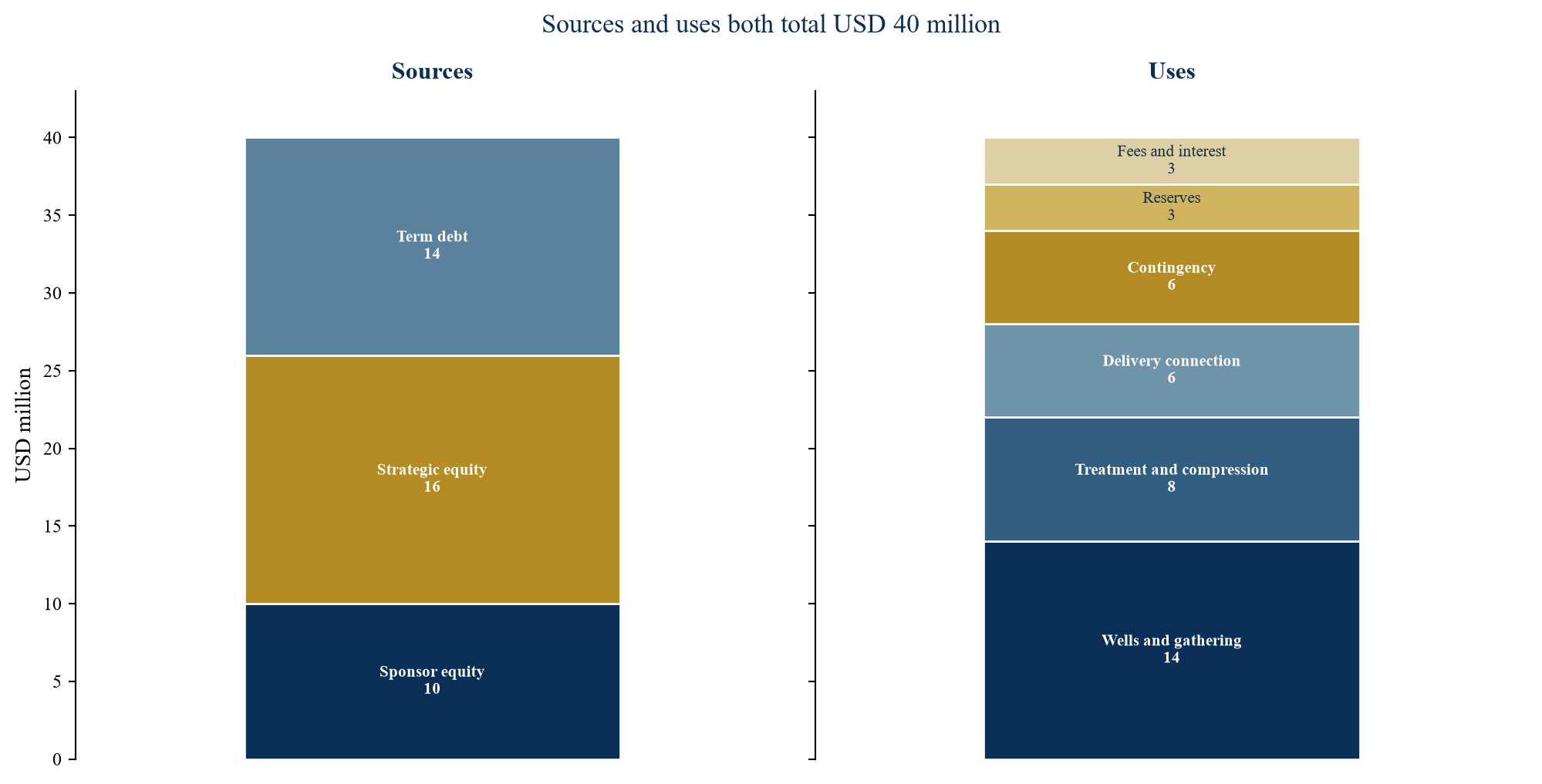
USD million author assumptions; the graphic is a financing reconciliation, not a project cost estimate.
13 Calculate debt service from saleable kilograms
Debt capacity begins with cash available for debt service, not with an undiscounted resource volume. In the fictional case, annual saleable deliveries are assumed to be 2 million kilograms at USD 4 per kilogram, producing USD 8 million revenue. Annual operating expenditure is assumed at USD 3 million and sustaining capital at USD 1 million. Simplifying away tax, working capital and other adjustments for teaching, cash available for debt service is USD 4 million. A real credit model must include all relevant cash costs, taxes, working capital, required environmental and abandonment funding, royalties and restrictions on distributions.
The example term debt is USD 14 million, with a fixed 8 percent annual rate and equal annual payments over seven years. The annual annuity is debt multiplied by the rate divided by one minus the reciprocal of one plus the rate to the seventh power. The result is about USD 2.69 million per year. Dividing USD 4 million by this payment produces a debt-service coverage ratio of about 1.49. The calculation says only that the fictional base case covers scheduled service under its own assumptions. It does not say that a lender would accept the case or that the field could produce for seven years.
The debt schedule needs a production case by year. A flat 2 million kilograms each year is a simplifying assumption, not a geologically supported curve. Early commissioning may reduce first-year output; pressure decline may reduce later years; a workover may interrupt deliveries and consume capital. The lender will want the model to reconcile gross well flow, gas composition, processing recovery, plant availability and contracted delivery. Independent engineering should examine each bridge. If the tenor exceeds the reasonably supported production period, shorter amortisation or more equity may be necessary.
14 Stress price and production together
Volume and price can fall together. A buyer may decline deliveries that fail specification, a pipeline outage can force curtailment, and a weaker market can make the spot fallback less valuable. A downside test should therefore vary saleable volume and realised price in combination. With fixed USD 3 million operating cost and USD 1 million sustaining capital in this teaching model, delivery of 1.6 million kilograms at USD 4 yields USD 2.4 million before debt service and coverage of about 0.89. At 2 million kilograms and USD 3.50 per kilogram, coverage is about 1.12. At 1.6 million kilograms and USD 3.50, coverage falls to about 0.59.
These figures are mechanical sensitivities, not probabilities. Some operating costs may vary with volume; a real model should use a cost function supported by engineering. A royalty can amplify the weak case. A take-or-pay floor may reduce price exposure if the buyer is creditworthy and the project can deliver conforming product; it cannot correct a production failure. The committee should see the minimum delivery and price needed to meet its chosen coverage requirement, with the requirement identified as a proposed credit policy rather than an asserted market standard.
The figure shows the coverage ratio over selected fictional prices and volumes. The grid makes visible the region in which a USD 14 million loan would fail to cover scheduled debt service under the assumed fixed cost. It should never be reproduced in an investor deck without the assumptions shown beside it. At the same time, a single ratio cannot substitute for a cash-flow waterfall, reserve account, distribution lock-up, hedging terms where available or a lender's actual credit decision.
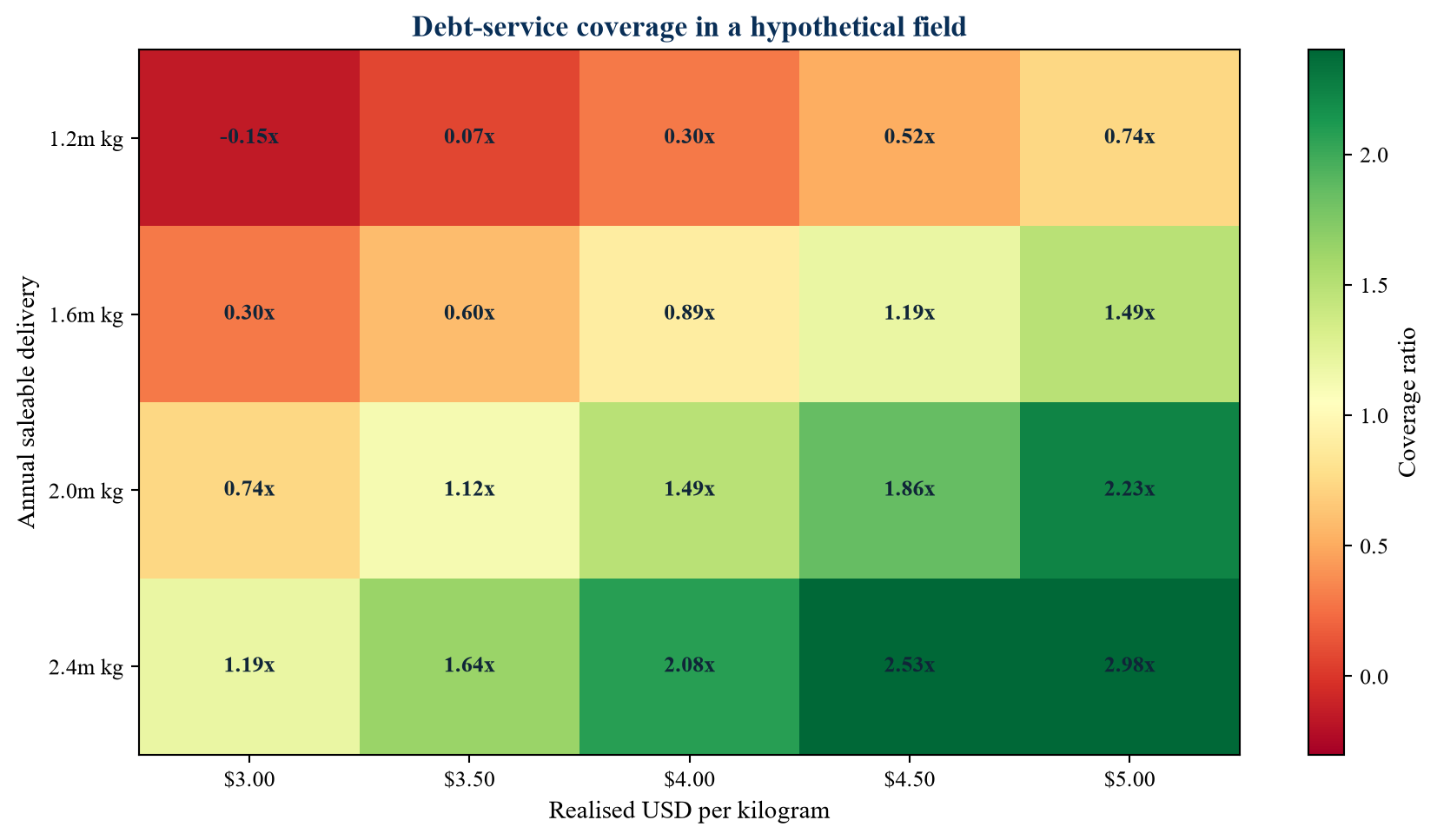
Author calculation using USD 3 million operating cost, USD 1 million sustaining capital and a USD 14 million seven-year 8 percent annuity. Negative cash flows are displayed as negative coverage for illustration only.
15 Draft security around actual enforceable assets
A development lender may seek security over project shares, licences where permitted, wells, plant, receivables, material contracts, bank accounts and insurance proceeds. The existence and enforceability of each security interest depend on governing law and third-party consent. A lender should review those matters with local counsel before issuing binding terms. If the surface land, mineral right and pipeline are held by different entities, an apparently complete security package can conceal a critical gap. The collateral map should show who owns every link in the saleable-hydrogen chain.
The financing documents should set out how cash enters controlled accounts and how it is applied. A typical proposed waterfall would pay permitted operating expenses and statutory obligations, then scheduled debt service, required reserves and only then permitted distributions. Its exact order is a negotiated legal term, not a universal rule. Maintenance and abandonment funding should be matched to physical obligations. A funded debt-service reserve can bridge a short interruption, but it cannot support an asset whose sustained output is below repayment needs.
Step-in rights should work operationally as well as on paper. The lender must know whether an alternative operator could run the wells and plant, use the data, maintain permits and continue offtake. The offtake contract and joint venture documents should have compatible cure periods and assignment rules. A change in operator may require regulator approval. Where approvals are uncertain, the downside recovery estimate should be conservative. Security value depends on the ability to preserve a functioning project, not on a list of pledged documents alone.
16 Link covenants to leading physical indicators
Financial ratios become visible after performance weakens. A geologic hydrogen loan also needs physical monitoring. The borrower could report wellhead flow, pressure, gas composition, process recovery, plant availability, delivered kilograms and buyer acceptance. Each metric should have an agreed measurement method and independent audit right. A pressure trend may signal reduced future deliverability before cash receipts fall. A shift in gas composition may warn of higher treatment costs or a specification failure. Management and lenders should agree which changes require engineering review and a revised forecast.
The proposed covenants in Table 3 are choices for negotiation, not current market terms. A cash sweep may reduce debt faster when performance is strong. A distribution lock-up can retain liquidity when coverage weakens. A cost-to-complete test can hold a construction draw until new equity is funded. A reserve-topping requirement can respond to an adverse reforecast. These mechanisms should be proportionate, testable and compatible with the project company's obligation to maintain safe operations.
An over-tight covenant can create an avoidable default after a temporary test shutdown; an over-loose covenant can let owners distribute cash before the field's decline is understood. The lender and sponsor should model cure options, equity injection rights and the point at which independent technical reassessment becomes mandatory. Any covenant labelled 'reserve coverage' should specify the resource-estimation method and the person qualified to provide it. Project cash flows should be the primary repayment evidence, while resource language reflects the actual maturity of the field.
Table 3. Proposed credit controls tied to an appraised hydrogen field
| Control | Measurement | Proposed response to deterioration |
|---|---|---|
| Completion test | Plant, well and delivery-point acceptance | Defer final term-debt availability |
| Production reforecast | Independently reviewed flow and decline | Revise debt capacity and distributions |
| Debt-service coverage | Cash available divided by scheduled service | Trap cash or require a funded cure |
| Cost-to-complete | Remaining contracted uses versus committed sources | Fund equity shortfall before new draws |
| Debt-service reserve | Cash in controlled reserve account | Replenish before shareholder distributions |
| Gas quality | Independent delivery-point assay | Cure processing or revise contracted volume |
| Abandonment funding | Engineer- and regulator-reviewed estimate | Increase restricted reserve as needed |
Author framework; thresholds and remedies require transaction-specific negotiation and legal review.
17 Allocate environmental and closure costs
Natural hydrogen production may carry lower direct carbon emissions than fossil-derived hydrogen, yet its actual environmental profile depends on drilling, process energy, leakage, transport, land use and restoration. No generic low-emissions label should be capitalised without a project-specific lifecycle analysis and an identified certification rule. The sponsor should include monitoring and reporting systems in its cost estimate. If buyers pay a premium for emissions performance, the contract should define the measurement boundary and consequence of losing eligibility.
Well integrity and abandonment are financing obligations. The project needs a funded plan for plugging, remediation and post-closure monitoring as required by the regulator and site conditions. A failure case can bring these costs forward before any revenue is earned. The exploration budget should therefore include restoration security for an unsuccessful well. The development model should accumulate closure funding over production or reserve it upfront, according to the applicable permissions and negotiated lender requirements. The liability should not disappear from the model because a farm-in counterparty operates the well.
Water management, safety and community engagement should be assigned to named project workstreams. A drilling programme may interact with existing water users and local roads. The sponsor should obtain permits and perform the applicable environmental assessment before committing irreversible capital. This paper states no jurisdiction-specific legal conclusion. The financing consequence is general: an unpermitted asset, an uncosted closure liability or a contested access route can delay construction and erode security value. Counsel, engineers and environmental specialists should each sign off on their own evidence before the board treats the project as development-ready.
18 Value the option without promising a reserve
An exploration licence can have option value even when it has no bankable production. The value comes from a controlled opportunity to spend more after receiving information. A simple valuation can compare the cost of the next test with the expected value of the decisions it enables, using clearly identified author or management assumptions. The model should include failure, ambiguous results, delays, dilution and the capital needed after success. It should not present a single 'risked NPV' without showing how geological, engineering, price and contract risks are related.
The farm-in is one way to trade option value for risk sharing. A strategic investor funds a defined well and receives an earned interest in the resulting asset. The owner sacrifices part of the upside but reduces cash exposure and may gain technical capability. A royalty can preserve equity ownership while taking value out of every future sale. Corporate debt avoids ownership dilution while exposing the parent to losses if the well fails. The optimal choice depends on actual rights, costs, counterparties and balance-sheet capacity. A board should compare a coherent downside, base and upside for each instrument.
A discovery can be valuable before project debt is available, but its valuation should preserve the distinction between technical and commercial milestones. A buyer of the licence may pay for geological information, acreage position and future option value. A lender against the field asks whether cash receipts will meet scheduled service. The same test result can legitimately support different conclusions for those two transactions. This distinction helps a sponsor negotiate a sale, joint venture or further appraisal without overstating the maturity of a discovery.
19 Build a financeable data room
A transaction data room should begin with title and rights, then the technical chain, then commercial contracts and the financial model. The technical folder should include the original geological thesis, alternative interpretations, geophysical data, well logs, sample protocols, independent assays, pressure and flow records, and a version-controlled resource assessment. The commercial folder should include plant design, cost estimates, delivery route, customer specification, offtake contract, insurance scope and permitted development schedule. Each claim in an investor presentation should have a source file and an owner.
The model should be auditable from raw input to financing output. Saleable kilograms should reconcile with wells, process recovery, plant availability and buyer acceptance. Capital should reconcile with tenders, contracts, contingency and funded reserves. Financing should reconcile with equity commitments, debt conditions, the cash waterfall and distribution restrictions. A change log should show when a new test result replaced an old assumption. Lenders and investors should be able to reproduce the downside without asking management to rebuild the spreadsheet.
The data room should also contain the decisions that did not succeed. A dry well, contaminated sample or failed pilot is relevant to neighbouring targets and to management credibility. The absence of negative evidence can make the portfolio look more certain than it is. An independent adviser can verify whether claims are supported, whether rights permit the proposed transaction and whether the model answers the buyer's or lender's actual decision. The resulting process can support a fair transaction even when it recommends postponing development.
20 Commission a bounded transaction mandate
A sponsor may need three separate advisory mandates. An early capital mandate can structure a farm-in and run a competitive process among risk-capital partners using a defined well programme. An appraisal mandate can negotiate strategic equity, a pilot customer arrangement and a funded test plan. A development-finance mandate can prepare lender materials after deliverability, engineering, permissions and offtake are evidenced. Each mandate should have a specific decision, deliverable, counterparty list and fee arrangement agreed with the actual client.
For an exploration farm-in, the deliverables could include a rights and data-room review, risk-allocation term sheet, valuation ranges under transparent assumptions, process timetable and negotiation support. For later debt, the work could include a source-linked model, independent engineer scope, contract interface matrix, proposed sources and uses, downside sensitivities, lender shortlist and financing term comparison. Technical professionals remain responsible for geology and engineering, while counsel advises on law and enforceability. Corporate finance integrates their work into a capital decision; it cannot certify a resource through presentation design.
The milestone for a lender process should be explicit. A sponsor may have a compelling geological discovery and still need a longer flow test, amended production right, binding buyer contract or more equity. Running a lender auction before those items are resolved can consume time and weaken credibility. A bounded readiness review may show that a strategic farm-out, asset sale or additional appraisal is the better next transaction. No outcome, mandate fee or financing result is promised by the framework.
21 Conclusion
The economic value of a natural hydrogen prospect depends on a chain of proof. Rights give a sponsor the ability to test. Sampling and a well establish whether the target contains hydrogen. Appraisal tests whether the stream can be produced at a useful rate for long enough. Engineering and contracts convert that stream into deliverable kilograms and receivables. Only then can a lender evaluate scheduled repayment against a stressed cash flow. The USGS evidence base supports prospect screening and careful research; it does not convert a regional map into project collateral [1, 2].
The fictional development case shows why the financing boundary matters. A USD 40 million project with USD 14 million debt can display about 1.49 times debt-service coverage at 2 million saleable kilograms and USD 4 per kilogram. Its coverage drops below one when volume falls to 1.6 million kilograms under the same assumed cost base. The arithmetic is simple; the difficult work is proving the production curve, processing yield, sale price, cost and contract remedy for a real asset. Those inputs require site-specific evidence and independent review.
The recommended sequence is to buy evidence in defined increments, contract the operating interfaces before assigning revenue, and place geological losses with investors who have agreed to bear them. A well-structured farm-in can finance a test. A strategic equity round can finance appraisal and plant design. Development debt may become viable once a field, facility and buyer create an enforceable and measurable cash-flow system. A disciplined decision can also conclude that another test or an exit is preferable. That conclusion preserves capital and the integrity of the eventual transaction.
References
- Gelman, S. E., Hearon, J. S., and Ellis, G. S. (2025). Prospectivity mapping for geologic hydrogen. US Geological Survey Professional Paper 1900. https://pubs.usgs.gov/publication/pp1900
- US Geological Survey. Geologic Hydrogen research programme. Accessed 5 October 2026. https://www.usgs.gov/centers/central-energy-resources-science-center/science/geologic-hydrogen
- Chapelle, F. H., Vroblesky, D. A., Woodward, J. C., and Lovley, D. R. (1997). Practical considerations for measuring hydrogen concentrations in groundwater. Environmental Science & Technology. https://www.usgs.gov/publications/practical-considerations-measuring-hydrogen-concentrations-groundwater
- US Department of Energy, ARPA-E. Request for Information on Geologic Hydrogen Resource Exploration, DE-FOA-0003494. https://arpa-e-foa.energy.gov/Default.aspx?foaId=13d601e1-8d5f-4156-b579-978abdb338c4
- US Department of Energy. 2026 American Resources Report, Geologic Hydrogen section. https://www.energy.gov/documents/2026-american-resources-report
- International Energy Agency (2026). Global Hydrogen Review 2026, Production. https://www.iea.org/reports/global-hydrogen-review-2026/production
- International Energy Agency (2026). Global Hydrogen Review 2026, Demand. https://www.iea.org/reports/global-hydrogen-review-2026/demand
- World Bank (2024). Scaling Hydrogen Financing for Development. https://documents1.worldbank.org/curated/en/099022024121527489/pdf/P1809201780da10e518c061a2e73041a6fc.pdf
- Society of Petroleum Engineers (2018). An Update of the Global Standard in Reserves/Resources Classification and Definitions. https://jpt.spe.org/update-global-standard-reservesresources-classification-and-definitions
- World Bank Public-Private Partnership Reference. Intercreditor Arrangements. https://ppp.worldbank.org/intercreditor-arrangements
About the Author
Chennakeshav (CK) is a corporate finance and investment banking executive with 25+ years of global experience in deal origination, structuring and execution across M&A, growth capital and corporate strategy. He has led value-creation mandates for founders, corporates and funds — bridging the boardroom view to hands-on execution and close.
His career spans Morgan Stanley, HSBC, Lloyds Banking Group, EWEC, ADQ portfolio companies and Emirates Growth Fund, across TMT, real estate, fintech, deeptech, cleantech, infrastructure and energy. He has partnered with C-suite leaders, private equity and venture funds, sovereign wealth funds and family offices to finance complex fund raises and scale-up ventures, and has led M&A due diligence, post-merger integration and business-transformation initiatives to create value.
At Matchpoint Partners he is Managing Partner, leading the firm's corporate finance, M&A and capital-raising practice. He holds an MBA from London Business School, an engineering degree from VTU and a Master of Laws (LLM, in progress) from UCL London.
An active start-up mentor, CK mentors at Techstars, DIFC FinTech Hive, Startup Grind, Founder Institute and IN5, serves as Entrepreneur Mentor in Residence (EMiR) at London Business School, and judges the Entrepreneurship World Cup.
